*Corresponding author
Email address: [email protected] http:// tlx.doi.org/……..
International Journal of
Railway Research
Improved Performance of Subballast Stabilized Using Geocell for High Speed Train
M. Mahdi Biabani1*, Buddhima Indraratna2, Sanjay Nimbalkar3
1,2,3Centre for Geomechanics and Railway Eng., Faculty of Eng., Univ. of Wollongong, Wollongong City, NSW
2522, Australia.
ARTICLE INFO A B S T R A C T
Article history: Received: 11.08.2016 Accepted: 23.10.2016 Published: 14.12.2016
Rapid urbanization and growing industrial demand in many developing countries has led to frequent congestion of the transport infrastructure. Therefore, the expansion of high-speed rail (HSR) networks is crucial to meet this growing demand. Nevertheless, applying high cyclic stress causes significant lateral spreading and in turn excessive settlements of the track substructure. This problem becomes more crucial when the subballast layer is constructed using locally available poor quality granular material in order to keep the construction costs to minimum. The use of planar form of geosynthetics (geogrid, geotextile, geocomposite) to improve the performance of rail track is well established. Large-scale laboratory and full scale field studies conducted in the past at the Center for Geomechanics and Railway Engineering (CGRE) of the University of Wollongong, NSW, Australia, have shown that geogrids and geocomposites of appropriate technical specifications can effectively reduce track settlement. Recent studies have shown that cellular confinement, known as geocell mattress, can offer more confinement than planar geogrid for the infill material. By employing geocell as reinforcement in subballast layer, tensile strength mobilized as an additional confinement and arrests lateral spreading of infill material and help to maintain track geometry.
Keywords: Subballast
Geocell reinforcement Additional confining pressure Cyclic loading
1. Introduction
Considering significant demand for urban rail service, increasing train speed is necessary to improve its efficiency compared to other transportation systems and to cater for substantial growth in capital cities in Australia and around the globe. The rapid expansion of high-speed rail (HSR) networks is therefore crucial to meet this growing demand. However, trains travelling with high speed exert high stresses, cause substantial differential settlement and lateral spread of granular media (ballast and subballast), leading to frequent and costly track maintenance. These problems becomes more severe in cities involving majority of population located in coastal areas, such as Sydney and Melbourne, where soil has relatively poor strength and the cost of
transporting of required quality is high. The substantial improvements in railway substructure are necessary for commuting train with high speed. Among several techniques available, planer form of geosynthetics (geogrid, geotextile, geocomposite) have shown a promising approach for improving ballast performance, in terms of reducing axial and lateral deformations [1-4]. However, recent study shows that cellular mattress, known as geocell, can provide better performance than planar geogrid.
Geocells were developed originally by U.S. Army Corps of Engineers for improving mobility of army vehicles over soil with very low strength [5]. Since then, use of geocells has gained significant popularity in various applications (i.e. railway, runways and embankments) [6-8]. The improved
2 International Journal of Railway Research (IJRARE) performance was attributed to apparent
cohesion developed between infill material and geocell strips [9]. Nevertheless, due to difficulty associated with the maintenance, the use of cellular mattress is not preferable for reinforcing upper ballast in railway substructure. On the other hand, due to finer particle size of the subballast (also known as capping layer), geocell is an ideal solution for reinforcing subballast layer located just underneath the ballast layer. Numerous studies have been devoted to investigate the performance of geocell mattress under different load applications [10-13]. It is well known that the improved performance of geocell reinforcement soil is attributed to additional confinement induced by the cellular confinement. However, there are a few studies have been carried out with respect to the railway environment [14].
A very low confinement is usually available in the railway environment and is exerted by the ballast shoulder. Due to this relatively low confinement, ballast and subballast undergo a significant later spreading. Thereby, appropriate laboratory equipment is needed to simulate the actual behaviour of subballast under cyclic loading. In this paper, the behaviour of unreinforced and geocell-reinforced subballast subjected to different frequencies and low confining pressure at large number of cycles is described. Large-scale prismoidal process simulation triaxial apparatus (800 mm long, 600 mm wide and 600 mm high) designed and built at the Center for Geomechanics and Railway Engineering (CGRE) of the University of Wollongong, NSW, Australia, was employed as shown in Figure 1. Granular material provided from locally available quarry (Bambo, NSW) was used and was sieved to prepare PSD in accordance with criteria proposed by Australasian rail industries (Dmax = 19 mm, Dmin
= 0.075 mm, D50 = 3.3 mm). The specimens
were compacted at a relative density (RD) of
about 2100 kg/m3, to simulate field condition. All specimens were prepared with the height of 450 mm. Geocell mattress made from polyethylene material, connected at the joint (depth = 150 mm, ultimate tensile strength = 9.5 kN.m, thickness = 1.3 mm, density = 950 kg/m3) were used for reinforcing subballast. In order to simulate field condition, lateral spreading was restricted in direction parallel to the sleeper (ε2 = 0), while the walls in direction
parallel to the sleeper were allowed to move
laterally (ε3 ≠ 0). The geocell mattress was
placed on the top of specimen. The laboratory experiments were carried out at very low confining pressures (5 ≤ σ
3 ≤ 30 kPa) at various
frequencies (10 ≤ f ≤ 30 Hz). A stress controlled cyclic loading tests were conducted. Cyclic stress with a positive full-since waveform was applied to the specimen. In order to measure lateral spreading of geocell mattress, several strain gauges (Length = 20 mm) were attached to the geocell strips. Also, miniature cell pressure (Diameter = 50 mm) were used to measure horizontal pressure on the geocell strip. A maximum and minimum stress of qmax =
160-170 kPa and qmin = 41 kPa was applied to
simulate the subballast performance under heavy haul freight network operating in NSW. All laboratory experiments were carried for the number of cycles of N = 500,000 cycles. Lateral and axial displacements were measured and recorded by data logger.
2. Results and Discussions
2.1. Lateral spreading
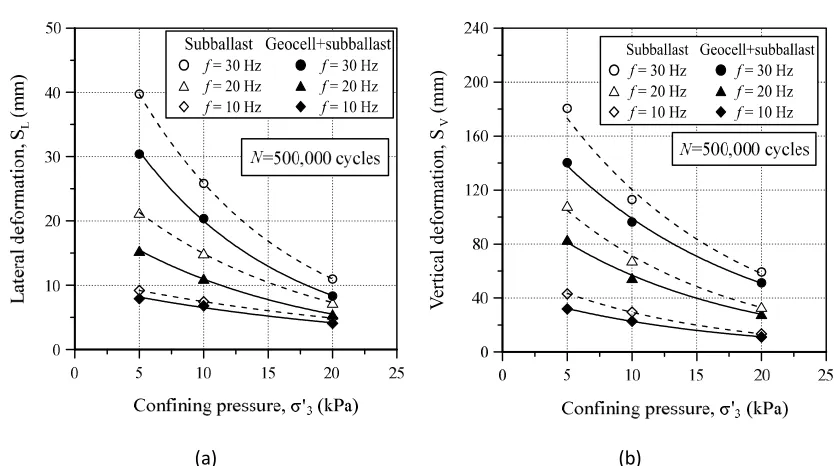
The effectiveness of the geocell mattress can be shown in terms of comparing the lateral spreading. Figure 2(a) shows the laboratory results of lateral spreading (SL) in unreinforced
and geocell-reinforced subballast at the given number of load cycles (N = 500,000 cycles) for different confining pressures (σ
3 = 5, 10, 20
kPa) and frequencies (10 ≤ f ≤ 30 Hz). As shown in Figure 2(a), unreinforced subballast experiences significant lateral deformation at relatively low confining pressure (σ
3 = 5 kPa).
The magnitude of SL was reduced markedly by
increasing σ
3 up to about 20 kPa. However, by
using geocell mattress, lateral spreading of the specimen was reduced by about 30 % for σ
3 = 5
kPa. This can be justified due to mobilized tensile strength acting as an additional confinement, applied through the three dimensional cellular mattress to the infill material. The effectiveness of geocell mattress was reduced by increasing confining pressure (σ
3 = 20 kPa). This indicates that a confinement
of σ
3 ≥ 20 kPa is sufficient to arrest excessive
lateral spreading of subballast under cyclic loading exerted by the high speed trains. As shown in Figure 2(a), marginal improvement was observed in the performance of geocell-reinforced subballast at lower frequency (f = 10 Hz), while the magnitude of SL was more
pronounced at higher frequency (f > 10 Hz).
International Journal of Railway Research (IJRARE) 3 This can be explained by the fact that at higher
frequency, the magnitude of mobilized tensile strength in the geocell is markedly greater than that at lower frequency, which led to better performance of the reinforced layer. This highlights the influence of geocell mattress for arresting lateral spreading, at very low confining pressure and relatively higher train speed.
2.2. Vertical displacement
The beneficial influence of the geocell mattress is highlighted by comparing the axial deformation of unreinforced and geocell-reinforced subballast, as shown in Figure 2(b). At very low confinement (σ
3 = 5 kPa),
unreinforced subballast underwent a substantial vertical displacement of about SV = 180 mm.
The magnitude of SV was found to be markedly
reduced by increasing confining pressure (σ 3 =
20 kPa). Nevertheless, utilizing the geocell, helped to reduce vertical settlement of reinforced specimen by about 20-30%. This is because, subballast reinforced with geocell creates a semi-rigid mattress, which has higher stiffness. As a result, most of the applied cyclic loading is captured by the new geocomposite layer.Thereby, the stress level transferred to the lower soil layer is reduced notably, thus resulting into an improved performance of the specimen.
As shown in this figure, at the lower confining pressure (σ
3 = 5 kPa) and lower
frequency (f = 10 Hz) geocell provided significant performance. Nevertheless, the influence of reinforcement was marginal at higher confining pressure (σ
3 = 20 kPa) and
lower frequency (f = 10 Hz). The effectiveness of geocell reinforcement can be best illustrated by increasing frequency from 10 to 30 Hz. The vertical deformation was reduced to about 20-25% by utilising the geocell as reinforcement.
2.3. Mobilised friction and dilatancy angle
In the conventional practice, it is assumed that friction angle is constant for the specimen during the loading. Nevertheless, based on the laboratory results, it was found that internal friction angle and dilatancy angle changed at different confining pressures and frequencies of cyclic loading. The mobilised friction angle (m) and mobilised dilatancy angle (m) can be
calculated by: ' 3 ' 1 ' 3 ' 1
sin
m (1)
P P
v P P v P P P P md
d
d
d
xd
d
xd
d
1 1 3 1 3 12
sin
(2)Figure 3(a) shows the variation of m and m
at different σ
3 and f. By increasing confining
pressure (5 ≤ σ
3 ≤ 20 kPa), the degree of mand
m for both unreinforced and geocell-
reinforced subballast are decreasing in the range of 39 ≤ m≤ 44 and 3 ≤ m≤ 12 degree.
Moreover, the rate of decreasing of m in
reinforced specimen was higher when the frequency was increased (Figure 3(a)). Considering higher m for unreinforced
subballast, it was found that the degree of mobilised dilatancy angle in the reinforced specimen was notably less than unreinforced specimen.
As a result, it can be concluded that in the reinforced specimen the mobilised dilatancy angle could be considerably suppressed (approaching to zero) at the higher rate than unreinforced subballast. This difference was more at higher frequency and confining pressure.
2.4. Resilient modulus
Another parameter that was found to be influenced by the geocell mattress was resilient modulus (MR = qcyc/εe) of reinforced layer.
Figure 3(b) shows the resilient modulus obtained from experimental results for both unreinforced and geocell-reinforced specimens for different frequencies and confining pressures at the end of cyclic loading (i.e. N = 500,000 cycles). The magnitude of MR, was
increased by about 10%-20% by increasing both confining pressure levels (σ
3 = 5-20 kPa)
and range of frequency (f = 10-30 Hz). This behaviour was observed for both unreinforced and reinforced specimens. This is due to the fact that cyclic loading causes particles rearrangement, lead to densification of specimen. Nevertheless, in the reinforced specimen the rate of increase of MR was greater
than unreinforced one. This is because, the geocell mattress confines infill material and accelerated the rate of densification of infill
4 International Journal of Railway Research (IJRARE)
Figure 1. Large-scale process simulation prismoidal triaxial apparatus used in this study
(a) (b)
Figure 2. (a) Lateral spreading and (b) Vertical deformation of unreinforced and geocell-reinforced subballast (data sourced from Indraratna et al. [17], with permission from ASCE).
V
er
ti
ca
l
d
ef
o
rm
at
io
n
,
SV
(
m
m
)
International Journal of Railway Research (IJRARE) 5 material. As a result, rigidity of reinforced layer
is increased, improving further the performance of reinforced soil layer.
The variation of MR at the confining pressure
of 10 kPa and different number of cycles (N) is presented in Figure 4. Due to rapid densification, the magnitude of MR showed
increase at the initial stage of cyclic loading and the rate of increase diminished at higher number of cycles (N ≥100,000 cycles). It was found that the degree of densification was greater at higher frequency (f = 30 Hz). This figure also shows that by increasing number of cycles (N ≥ 200,000 cycles), marginal improvement in MR is observed.
Figure 3. Variation of (a) mobilised dilatancy angle
(m) and (b) Resilient modulus of unreinforced and
geocell-reinforced subballast at different confining pressures and frequencies (Indraratna et al. [17],
with permission from ASCE).
This is because, the specimen reached the stable zone (also known as shakedown zone), and no further volumetric change occurred.
3. Additional Confinement (Δ σ
3)
The influence of geocell reinforcement can be best evaluated in terms of additional confining pressure (Δσ
3) induced by the cellular
confinement. There are several analytical models available in the literature, which can predict the additional confining pressure [15-16]. Nevertheless, they all fail to capture the actual Δσ
3 with respect to number of cycles,
mobilized friction angle and dilatancy angle. By incorporating the elastic behaviour of geocell mattress and hoop tension theory [16], the degree of Δσ
3 can be determined by [17].
Figure 4. Variation of resilient modulus (MR) at
different number of cycles (N) (Indraratna et al. [17],
with permission from ASCE).
(3) where, D is diameter of an equivalent circular area of the geocell pocket, Mmis the mobilized
geocell modulus at a different number of cycles,
ѱm is the mobilized dilation angle, Nlim is
number of cycles required to attain the stable zone, a and b are empirical coefficient
parameters representing the stable and unstable zone, υg is the Poisson’s ratio of geocell and k is
the ratio of plastic circumferential strain (p c) to
plastic lateral strain (p
3). The value of k is
dN N b N a dM k D M m m P R cyc g g g g g N N N m sin 1 sin 1 ) 2 1 )( 1 ( ) 1 (2 ' '
1 , 1 lim 1 ' 3
6 International Journal of Railway Research (IJRARE)
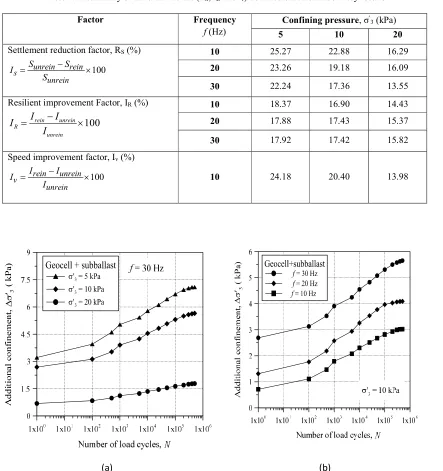
Table 1. A summary of different factors (RS, IR and Iv) obtained based on laboratory results
Factor Frequency
f (Hz)
(kPa)
3
, σ
Confining pressure
5 10 20
(%)
S
Settlement reduction factor, R
100
unrein rein
s
unrein
S S
I
S
10 25.27 22.88 16.29
20 23.26 19.18 16.09
30 22.24 17.36 13.55
(%)
R
Resilient improvement Factor, I
100
unrein unrein rein R
I I I I
10 18.37 16.90 14.43
20 17.88 17.43 15.37
30 17.92 17.42 15.82
(%)
v
Speed improvement factor, I
100
rein unrein
v
unrein
I I
I I
10 24.18 20.40 13.98
(a) (b)
Figure 5. Variation of additional confinement of reinforced subballast with number of load cycles for (a) different confining pressures and (b) different frequencies (Indraratna et al. [17], with permission from ASCE).
considered as 0.45 in this study. The merit of the proposed model is its ability to capture the additional confining pressure at any desired number of load cycles and cyclic stress in terms of variation in mobilized friction angle, dilatancy angle and geocell modulus. The values of Δσ
3 predicted using this proposed
model are plotted for different apparent confining pressures at different frequencies for different number of cycles (N), as shown in Figure 5 (a & b). As shown in Figure 5(a), the
degree of Δσ
3 was increased by increasing
number of cycles. Marginal improvement was observed after N = 100,000 cycles, which is due to attainment of shakedown stage. At very low confining pressure of 5 kPa, the magnitude of
Δσ
3 was found to be maximum. The degree of
Δσ
3 was reduced remarkably by increasing
confining pressure from 5 to 20 kPa. This is due to fact that increase in confining pressure lead to mobilization of lower tensile strength in the geocell. The results also confirm the
International Journal of Railway Research (IJRARE) 7 effectiveness of geocell, when it is used for
specimen with very low confining pressure and relatively high frequency. Figure 5(b) shows that at given confining pressure (σ
3 = 10 kPa),
the degree of Δσ
3was increased by increasing
frequency (f) to about 30 Hz.
Based on the laboratory results, different factors including the settlement reduction (IS),
resilient improvement (IR) and speed
improvement (IS) factors for a given range of σ3 and f were defined and summarised in Table 1. Table 1 shows that the maximum effectiveness of the geocell mattress was at lower confining pressure and higher frequency.
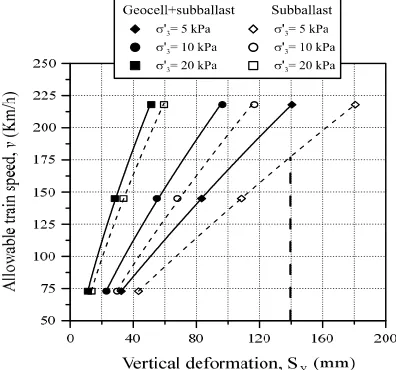
Considering the load frequency as a function of train speed and the distance between the wheels of bogies, the relevant train speeds for different range of frequencies can be calculated by using the relation viz. v = λ×f, where λ is the wavelength (λ = 2.02 m). Accordingly the influence of cellular confinement is shown for different confine pressures and frequencies. Accordingly the variation of train speed against vertical settlement (Figure 6). By utilizing the geocell reinforcement led to substantial reduction of vertical settlement of subballast (SV).
4. Conclusions
The laboratory results presented in this paper showed that geocell can effectively improve subballast performance under high frequencies (f = 10-30 Hz) and at very low confining pressure increased resilient modulus of subballast. By increasing subballast rigidity due to use of geocells, axial settlements were markedly reduced. This implies that rail tracks can be subjected to higher cyclic stress from high speed trains to attain the same settlement as unreinforced subballast. This study proved that by employing geocell reinforcement reduces differential settlement, improves longevity of the
(σ
3≤ 20 kPa). Also, the use of geocell led to
ballasted track, and thus curtails the track maintenance cost. The outcome of this study can be benefited by railway industry in rehabilitation schemes of existing tracks or construction of new tracks on subgrade with low shear strength.
Acknowledgments
The financial support received from the Cooperative Research Centre (CRC) for Rail
Innovation to conduct this research is gratefully appreciated. The Author wishes to thank the Australia Research Council, CRC for Rail Innovation, Sydney Trains and Australian Rail Track Corporation for their continuous support. The assistance from Mr. Alan Grant (laboratory manager), Mr. Cameron Neilson (senior technical officer) and Mr. Ritchie McLean (technical officer) in the School of Civil, Mining, and Environmental Engineering at the
Figure 6. Variation of train speed with vertical deformation (data sourced from Indraratna et al.
[17], with permission from ASCE
University of Wollongong, is appreciated. A significant portion of the contents have been reproduced with kind permission from the Journal of Geotechnical and Geoenvironmental Engineering ASCE.
References
[1] B. Indraratna, S. Nimbalkar, D. Christie, C. Rujikiatkamjorn, J.S. Vinod, Field assessment of the performance of a ballasted rail track with and without geosynthetics, Journal of Geotechnical and Geoenvironmental, 136(7), (2010), pp.907-917.
[2] B. Indraratna, S. Nimbalkar, C. Rujikiatkamjorn, Enhancement of rail track performance through utilization of geosynthetic inclusions, Geotechnical Engineering Journal of the SEAGS & AGSSEA, 45(1), (2014), pp.17-27.
[3] S. Nimbalkar, B. Indraratna, S. Dash, D. Christie, Improved performance of railway ballast under impact loads using shock mats,
8 International Journal of Railway Research (IJRARE) Journal of Geotechnical and Geoenvironmental
Engineering, 138(3), (2012), pp.281-294.
[4] B. Indraratna, S. Nimbalkar, Stress-strain degradation response of railway ballast Stabilized with geosynthetics, Journal of Geotechnical and Geoenvironmental Engineering, 139(5), (2013), pp.684-700.
[5] S.L. Webster, S.J. Alford, Investigation of construction concepts for pavements across soft ground, Technical Rep. S-78-6, U.S. Army Engineer Waterways Experiment Station, Vicksburg, MS, 1978.
[6] Y.M. Wang, Y.K. Chen, W. Liu, Large-scale direct shear testing of geocell reinforced soil, Journal of Central South University of Technology, 15(6), (2008), pp.895-900.
[7] A. Biswas, A.M. Krishna, S.K. Dash, Influence of subgrade strength on the performance of geocell-reinforced foundation systems, Geosynthetics international, 20(6), (2013), pp.376-388.
[8] S.N.M. Tafreshi, O. Khalaj, A.R. Dawson, Repeated loading of soil containing granulated rubber and multiple geocell layers, Geotextiles and Geomembranes, 42(1), (2014), pp.25-38.
[9] R.J. Bathurst, R. Karpurapu, Large-scale triaxial compression testing of geocell-reinforced granular soils, Geotechnical Testing Journal, 16(3), (1993), pp.296–303.
[10] S. Thallak, S. Saride, S. Dash, Performance of surface footing on geocell-reinforced soft clay beds, Geotechnical and Geological Engineering, 25(5), (2007), pp.509-524.
[11] B. Leshchinsky, H. Ling, Effects of geocell confinement on strength and deformation behavior of gravel, Journal of Geotechnical and Geoenvironmental Engineering, 139(2), (2013), pp.340-352.
[12] I. Mehdipour, M. Ghazavi, R.Z. Moayed, Numerical study on stability analysis of geocell reinforced slopes by considering the bending effect, Geotextiles and Geomembranes, 37(0), (2013), pp.23-34.
[13] A. Hegde, T.G. Sitharam, 3-Dimensional numerical modelling of geocell reinforced sand
beds, Geotextiles and Geomembranes, doi:10.1016/j.geotexmem.2014.11.009 , (2014).
[14] B. Leshchinsky, H.I. Ling, Numerical modeling of behavior of railway ballasted structure with geocell confinement, Geotextiles and Geomembranes, 36(2), (2013), pp.33-43.
[15] X. Yang, J. Han, Analytical model for resilient modulus and permanent deformation of geosynthetic-reinforced unbound granular material, Geotechnical and Geoenvironmental Engineering., 139(9), (2013), pp.1443-1453.
[16] D.J. Henkel, G.D. Gilbert, The effect of the rubber membrane on the measured triaxial compression strength of clay samples, Géotechnique, 3(1), (1952), pp.20-29.
[17] B. Indraratna, M. Biabani, S. Nimbalkar, Behavior of geocell-reinforced subballast subjected to cyclic loading in plane-strain condition, Journal of Geotechnical and Geoenvironmental Engineering, 141(1), (2015), 04014081.