Review Paper:
The Effect of Splinting After Dupuytren’s
Contracture Operation: A Systematic Review
Marzieh Pashmdarfard1 , Akram Azad1* , Malek Amini1 , Ghazale Golabi1
1. Rehabilitation Research Center, Department of Occupational Therapy, School of Rehabilitation Sciences, Iran University of Medical Sciences, Tehran, Iran.
* Corresponding Author:
Akram Azad, PhD.
Address: Rehabilitation Research Center, Department of Occupational Therapy, School of Rehabilitation Sciences, Iran University of Medical Sciences, Tehran, Iran.
E-mail: [email protected]
Objectives: Flexion contracture in fingers of hands is a complication of Dupuytren’s contracture and cannot be stopped by the progressive course. The aim of this study was to review the effect of splinting in the correction of contracture after Dupuytren’s contracture operation.
Methods: To carry out this research, a kind of systematic evidence-based review process (Duffy 2005) was used. For data gathering, we used electronic database and Persian- and English-language specific journals between 1990 and January 2019. The keywords were related to examine the effect of various splinting after Dupuytren’s contracture operation.
Results: After data gathering, 26 articles about Dupuytren’s contracture were found; after checking and deep reviewing of those articles, 17 articles were removed from the study and 9 articles were included in the study for reviewing. The results of a review article based on using splint in Dupuytren’s contracture after operation were classified into 6 categories, including static splint, dynamic splint, day splint, night splint, the time duration of splinting, and prescribed time of splinting.
Discussion: Splint alone has been ineffective in reducing contracture. Static splint and hand therapy (exercise) are together the most effective way for the treatment of Dupuytren’s contracture. Occasional and irregular use of splint also has no effect on pain relief and the reduction of contracture. The pressure and force of splint will be gradually increased, and the splint should be used at least for 3 months, too.
A B S T R A C T
Article info:
Received: 10 June 2019
Accepted:12 Aug 2019
Available Online: 01 Dec 2019
Keywords:
Dupuytren’s contracture, Hand therapy, Occupational therapy, Splints, Operative
Citation: Pashmdarfard M, Azad A, Amin M, Golabi Gh.The Effect of Splinting After Dupuytren’s Contracture Operation: A Systematic Review. Iranian Rehabilitation Journal. 2019; 17(4):297-304. http://dx.doi.org/10.32598/irj.17.4.297
:
http://dx.doi.org/10.32598/irj.17.4.297 Use your device to scan
Highlights
● The most effective way for the treatment of Dupuytren’s contracture is to use splint after the operation.
● Exercise with the splinting effect is ineffective in reducing the contracture.
● Night static splints are effective in improving the range of motion and performance of their hands of Dupuytren’s contracture.
Plain Language Summary
Dupuytren’s contracture is a controversial problem with orthopedics and rehabilitation. It is commonly used in surgi-cal procedures, splint administration, and rehabilitation exercises. Considering the experience and studies of rehabilita-tion specialists, simultaneously, these methods have a more favorable outcome in improving hand funcrehabilita-tion. Surgical technique, type of exercise, and how to use the splint are very important. According to the results of this study, splint-ing with postoperative exercises was more effective in surgical outcomes. Of course, the duration of ussplint-ing the splint, how to use it overnight or daily, and the length of use of the splint for better treatment results should be addressed to therapists.
1. Introduction
upuytren’s Contracture (DC) or Dupuy-tren’s Disease is a kind of active and benign cell proliferation in the palmar facial tissue that can lead to disability [1]. It develops in middle age and creates a progressive flexor contracture in the hands, especially along with the index and little fingers.Palter (1614) was the first expert to explain the disease that it was a type of disorder in palm facial was read by hard-working people. In 1831, Guillaume Dupuytren’s expanded the previous approach, and he described the dis-ease as cellular proliferation. This proliferation results in the formation of a nodule in the palm of the hand, and palmar fascia becomes rope-shaped and this is what leads to the cre-ation of flexor contracture on the joints of the fingers.
Flexion contracture is a natural part of this disorder and cannot be stopped by the progressive course. The underlying cause of this disorder is still unknown, but the factors that may be lead to this disorder include genetic factors, race, gender (in men 8-9 times more likely than women), cancer, epilepsy, thyroid disorders, AIDS, alcohol, and smoking [2]. Therefore, we cannot slow down the course of this disease, and no conservative treatments such as splinting can delay progress. The main treatment is operation (fasciotomy, Z-plasty, skin graft), which is raised after that the need for reha-bilitation. The surgical criterion is the presence of 35-degree flexion contracture in metacarpophalangeal and proximal interphalangeal joints [1-3]. Since the operation leads to scar formation, the temporary limitation of hand functions in or-der to carry out activities of daily living and occupation,
sen-sory problems, edema, and abnormalities in blood circulation to surrounding tissues.
Occupational therapy can be used for hand rehabilitation after assessments in the field of skin and ulcer, pain, sensa-tion, active and passive range of mosensa-tion, how to do activities of daily living, and by prescribing a series of exercises (e.g. flexion and extension active motions in fingers) and specific splinting and also ergonomic reforms come into effect [2]. The purpose of splinting after the operation is to maximize the movement of extension on the fingers [1]. The splint used for postoperative DC is a Paddle splint [3]. This splint can be used in a variety of ways; palmar or dorsal, and static or dynamic, in which the static type is used in further treatment [4]. There are different opinions and results about the effect of splinting after Dupuytren’s operation and the duration of the use of this method, the position of the wrist and fingers in terms of angle, and the amount of force that should be applied to the various joints.
Another study was conducted by Jerosch-Herold et al. in 2008 to investigate the effect of splinting after DC operation. The result of this study showed that more studies were re-quired to confirm the clinical effect of night splinting after fasciotomy or derma fasciotomy operation of DC [6]. Con-sidering the fact that most studies were done about the effect of splinting after DC operation, further studies are required in this regard, and regarding the important role of hands in performing various types of activities of daily living and the consequences of injuries, there is a need for more research in this regard. Therefore, this review study aimed at investigat-ing the effect of splintinvestigat-ing after DC operation.
2. Methods
To carry out this research, a kind of systematic evidence-based review process (Duffy 2005) was used [7].
Search strategy
For data gathering, all Persian articles, which examined the effect of various splinting after DC operation, as well as re-lated published foreign articles between 1990 and January of 2019, were used. The following sources were: 1) Electronic databases, including Medlin, PubMed, Google Scholar, CI-NAHL, Ovid, Cochrane, ProQuest, Up to Date, Web of Sci-ence, OT search, OT direct, OT BibSys, Pedro, SID, Magi-ran, Iran Medex, Madlib, and Iran doc, 2) Iranian and foreign famous journals, including Iranian Rehabilitation Journal (IRJ), Iranian Journal of Child Neurology (IJCN), Archive Physical Medicine and Rehabilitation (APMR), Develop-mental Medicine, American Journal of Occupational Therapy (AJOT), Koomesh, Archives of bone & joint operation, Re-habilitation journal, Journal of Medical Council of Iran, Jour-nal of Research in Rehabilitation Science, and Hand Therapy Journal. The keywords used individually or in combination according to the MeSH were as follow: “Dupuytren’s con-tracture”, “splinting”, “post-operative splinting”, “systematic
review”, “management for Dupuytren’s contracture”, “hand therapy”, “rehabilitation”, and “occupational therapy”.
Inclusion and exclusion criteria
The inclusion criteria were research studies on the effect of static, dynamics, and day and night splints on the pain re-duction of postoperative DC operation. All retrospective and prospective papers, experimental and quasi-experimental studies, or observational studies that reviewed the effects of night/day, dynamic/static splints at least 10 to 14 days after the operation and up to 2 months after the operation have en-tered this study. Articles that studied the effects of splinting on problems other than DC were removed from the study. The articles included in this study were in I, II, and III levels of evidence-based on the evidence-based model [8,9]:
Level I—randomized controlled trials (RCTs), systematic reviews, and meta-analyses
Level II—non-randomized studies (e.g., cohort, case-con-trol) and two groups
Level III—one group, non-randomized studies (e.g., pre-test-posttest)
Level IV—descriptive studies that include analysis of out-comes (e.g., single-subject design, case series)
Level V—case reports and expert opinion that include nar-rative literature reviews and consensus statements
All of the articles that were theses, presentations, and con-ferences that were in the levels IV and V evidence were ex-cluded from this review (Table 1).
Table 1. Inclusion and exclusion critera
Inclusion Criteria Exclusion Criteria
Iranian and English article about the DC Articles that were found other than Persian or English. Related articles between 1990 and January 2019. Articles that had been done before 1990.
Articles related to the effects of splinting on postoperative DC. Articles related to the effects of splinting on other disorders and contractures.
The availability of full-text articles or abstracts. Articles related to the effect of splinting before the DC operation. Retrospective and prospective papers, experimental and
quasi-experimental studies, or observational studies that reviewed the effects of night/day, dynamic/static splints at least 10 to 14 days
after the operation and up to 2 months after the operation.
3. Results
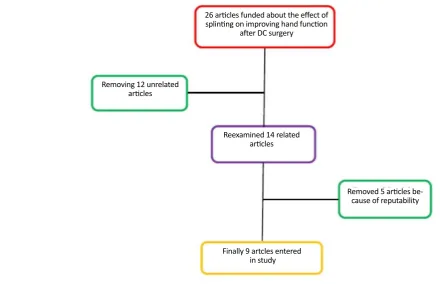
A total of 26 articles on the effect of splinting on improving hand function after DC operation with 22 articles with full-text and 4 abstracts were found. After reviewing the abstracts of the articles and the text of the articles, 12 articles related to the effects of splinting after the DC operation, which included the inclusion criteria were selected. After deep reviewing of those 12 articles, 3 of them were removed because of repeat-ability and, finally, 9 articles (8 were at the level of I evidence [6 RCTs and 2 reviews] based on level and 1 was at level III) entered this study (Figure 1).
The methodological quality of the included studies
Table 2 presents the results of the methodological quality assessment of the 7 included RCTs studies. Four of the 6 RCTs included in our review were of high quality (67%). Another 2 RCTs scored 40% to 50% of the total score (33%). Based on the methodological quality of the assess-ment, if the quality of studies is >50%, it is high quality, if it is 50>quality >30, the quality is moderate, and if it is <30, it is low quality [10].
The results of the review of the articles led to the classifica-tion of the study into 6 categories, including 1) The effect of static splint after DC operation, 2) The effect of dynamic splint after DC operation, 3) The effect of day splint after DC
operation, 4) The effect of night splint after DC operation, 5) The effect of time duration of splinting after DC operation, and 6) The effect of the prescribed time of splinting after DC operation. Table 3 presents the results of the review articles.
4. Discussion
Since DC is considered as a progressive disorder, there is no definitive treatment for this disorder. Nevertheless, in the middle to severe phases, the first line is fasciotomy operation. After the operation and also in the first phases of the disease, the best and most effective intervention is rehabilitation, which includes all hand therapy modalities and splinting. Dynamic and static splints are among the most commonly used splints in these patients and can be used either overnight or throughout the day [11]. Accord-ing to the study, it was found that the best and most use-ful splints among patients with DC are the static splints. However, in a study by Rives et al., the long-term use of dynamic splints could improve the extension movement of the proximal interphalangeal joints of fingers [12].
Regarding the splint administration time, there was no definitive conclusion. In the study of Jerosch-Herold et al., splint administration was reported 10 to 14 days postoperatively with lower pressure and more effective than late injection with high force splint [6]. In connec-tion with the use of splint during the night or day, most
Figure 1. Flowchart of study selection
26 articles funded about the effect of splinting on improving hand function
after DC surgery
Removing 12 unrelated articles
Reexamined 14 related articles
Removed 5 articles be-cause of reputability
studies also emphasized the ineffectiveness of night-time splinting and suggested the use of splint during the day, although unpleasant for the individuals [5,6, 13-16]. Most studies about the DC suggested that the rehabilitation (exercise) and splinting each alone have been ineffective in reducing the contracture of these individuals; they also concluded that occasional and ir-regular use of splint also has no effect on pain relief and the reduction of contracture [11,13].
5. Conclusion
The most effective way for the treatment of DC is to use a splint (preferably static) and hand therapy (exercise) together. In addition, after the operation, hand rehabilitation and splint with low pressure should be administered as soon as possible. The pressure and force of splint will be gradually increased, and the splint should be used at least for 3 months too.
The lack of access to free hand therapy journals is one of the limitations of this study. Also, a small number of papers in the impact analysis of splint, especially day/night and static/
Table 2. Methodological quality scores of the included RCTs
Study
Adequa
te
Randomiz
ation?
Alloc
ation Concealmen
t?
Blinding? P
atien
ts?
Blinding? Car
egiv
er?
Blinding? Out
come
Assesso
rs?
Inc
omple
teOut
come Da
ta
Addr
essed?
Dr
opouts?
Inc
omple
teOut
come
Da
ta? IT
T Analy
sis?
Fr
ee of Sug
ges
tions of Selectiv
e
Out
come
Rep
orting?
Similarity of B
aseline
Char
act
eris
tics?
Coin
ter
ven
tions A
voided or
Similar?
Compliance Accep
table in
All
Gr
oup
s?
Timing of the Out
co
me Assess
-men
t Similar?
Sc
or
e Ma
ximum
Study Sc
or
e
%
Je
rosch-Her
old e
t al.
(2008)
[6]
? ? - - ? + + + + + - + 12 6 50
Collis
et al. (2013)
[10] ? ? - - ? + + + + + - + 12 6 50
Eb
sk
ov e
t al.
(2000)
[11]
? ? - - ? + + - + + - + 12 5 42
Riv
es
e
t al. (1992) [12]
? ? - - ? + + + + ? n.a. + 12 5 42
Ke
mler e
t al.
(2012)
[13]
+ + - - + + + + + - ? + 12 8 67
Je
rosch-Her
old e
t al.
(2011)
[14]
? ? - - ? + + + + + - + 12 6 50
Table 3. The results of the review articles
No. of Articles First Author
Year
Public
ation
Type of Study Sample Siz
e Results Conclusion St atic Splin t 5 Jer osch-Her old et al. [6]
2008 RCT 15 The use of static splints has been effective in improv-ing the range of motion and performance of their hands.
The static splint in people with severe DC and its long-term use
can be effective in improv-ing the performance of these individuals. There are not any differences between using splints and hand therapy with hand therapy alone but using splint maintains this improve-ment longer than hand therapy
alone.
Collis et al. [10] 2013 RCT 56
There were no statistically significant differences between the no-static orthosis and static orthosis groups for total active extension or for any of the secondary outcomes. Between the first postoperative
measure and 3 months after the operation, 62% of little fingers had maintained or improved total active
extension.
Bionk
a e
t
al.
[15] 2018 Review 290
This study concluded that splinting (static) and hand therapy had the same effect on DC patients and these interventions can be used after the operation
and none is overcome to another.
Lar
son
et al. [5] 2008 Review 28
The use of static splint in the postoperative phase in people with severe DC increases the extension of their fingers and is more effective in long-term use.
Dynamic Splin t 4 Eb sk ov e t al
[11] 2000 RCT 15
Usage and dis usage of The dynamic splinting have no affected on hand function and even on the
postoper-ative restoration of the contracture. It is even better not to use splint after the operation to have a better
and more comfortable manipulation of the fingers. The use of dynamic splinting if combined with other rehabilita-tion treatments can help to improve the performance of
the hand.
Riv
es
et al.
[12] 1992 RCT 27 The use of dynamic splinting, if used simultaneously with other rehabilitation interventions, has more pronounced effectiveness with DC, especially in PIP
joints.
Lar
son
et al.
[5]
2008 Review 28 The use of dynamic splint in the postoperative phase in people with severe DC increases the extension of their fingers and is more effective in long-term use.
Da y Splin t 1 Lar son et al. [5]
2008 Review 28 In this paper, there was no difference between the use of day splint and night, and the difference was more in the static or dynamic.
There is no significant differ-ence in the use of the day splint, night splint, and only the
most important point is to use splinters i n postoperative DC.
Nigh
t Splin
t
6
Jer
osch- Herold
et al.
[6]
2008 RCT 15 improving the range of motion and performance of The use of night static splints has been effective in their hands.
The use of night splint to reduce the contracture, reduce pain and increase strength, and increase the range of motion of fingers is not very impressive.
However, there is a need for more and more specific studies
among people with DC.
Lar
son
et al. [5] 2008 Review 28
In this paper, there was no difference between the use of day splint and night, and the difference was
more in the static or dynamic.
Jer
osch- Herold
et al.
[14] 2011 RCT 148 The use of night static splints has been effective in improving the range of motion, satisfaction, and
performance of participants.
Collis et al. [10] 2013 RCT 56 The participants were instructed to apply the orthosis overnight and remove it during the daytime.
Bionk
a e
t
al.
[15] 2018 Review 290
This study concluded that splinting and hand therapy had the same effect on DC patients and these inter-ventions can be used after the operation and none is
overcome to another.
Glasse
y e
t
al.
[16] 2001 post-Pre/ test 31
It was suggested in this article that the use of night splints has no effect on increasing the extension of fingers, reducing pain, increasing strength, and
No. of Articles First Author
Year
Public
ation
Type of Study Sample Siz
e
Results Conclusion
Dur
ation of Splin
t use
8
Jer
osch-Her
old
et al.
[6]
2008 RCT 15 In this study, the static splint was used for 6 months, which was administered 10 to 14 days after the operation.
The duration of splinting depends on the patient’s ac-ceptance and the therapist’s opinion. Long-term use of at least 3 months and the use of static splinting can be effective.
Riv
es e
t
al.
[12] 1992 RCT 27 In this study, the participants used the dynamic splints for at least 6 months.
Ke
mler e
t
al.
[13] 2007 RCT 54 In this study, the participants used the splints for at least 3 months.
Jer
osch- Herold et al. [14] 2011 RCT 148 months) by postoperative DC. Of course, evaluations In this study, the splint was used for 1 year (12
are after 3 months, 6 months, and finally 12 months.
Eb
sk
ov
et al. [11] 2000 RCT 15 In this study, individuals used a dynamic splint for 9 months after DC operation.
Collis
et al.
[10] 2013 RCT 56 In this study, the splint was used for 3 months after the DC operation.
Bionk
a e
t al.
[15] 2018 Review 290 The 3 studies that were included in this study used splint between 3 and 12 months.
Lar
son
et al.
[5]
2008 Review 28 In this study, the splint was used in at least 6 weeks (1.5 months).
Time of pr
escrip
tion
4
Jer
osch-He
rold
et al.
[14] 2011 RCT 148
In this study, night static splint was prescribed to pa-tients immediately after the operation. Papa-tients used
a night static splint for 3 weeks that did not enter the tension and compression to the wound. After 3 weeks, and since the wound healing was because of operation, another static splint was prescribed to the
patients.
The time of splint administra-tion is because of a number of
factors, including the type of operation, the severity of con-tracture, the number of times a person has undergone the operation, and the decision of the therapist. However, faster administration of the splint after the operation can have a
better effect.
Jer
osch-He
rold
et al.
[6]
2008 RCT 15 In this study, the static splint was prescribed to patients 10 to 14 days after the operation.
Bionk
a e
t
al.
[15] 2018 Review 290 In this study, the splint was used for 3 months after the DC operation.
Lar
son
et al.
[5]
dynamic, are among the other limitations of this study. It is suggested that the hand-therapists and occupational thera-pists examine the impact of splinting and different kinds of splints types on DC.
Ethical Considerations
Compliance with ethical guidelines
The Ethics Committee of Iran University of Medical Sci-ences approved this study (Code: IR.IUMS.REC. 28930). All participants signed informed consent to participate in the study. A code number was placed on each participant’s name to provide confidentiality.
Funding
This research was supported by Iran University of Medical Sciences (Grant No. 95-02-32-28930).
Authors' contributions
Conceptualization: Akram Azad, Ghazale Golabi; Method-ology: Akram Azad, Malek Amini; Investigation: Gazaleh Golabi, Marzieh Pashmdarfard, Malek Amini; Writing – Original Draft: Akram Azad, Marzieh Pashmdarfard; Writing – Review & Editing: Akram Azad, Marzieh Pashmdarfard; Supervision: Akram Azad.
Conflict of interest
The authors declared no conflict of interest.
Acknowledgments
The Authors would like to thank Iran University of Medical Sciences for their financial support of this study.
References
[1] Saunders RJ, Astifidis RP. McClinton MA. Hand and upper extremity rehabilition: A pracice guide [A Azad, L Lajevardi Persian Trans.], 2nd ed. Tehran: Hasti-Setaish; 2018.
[2] Judith M, Conolly B. The Hand: Fundamental of Therapy. [A Azad, Persian Trans.]. Tehran: Nor-e-Danesh; 2004. [3] Jacons A, Austin N. Splinting the hand and upper extremity:
principles and process. Philadelphia: Lippincott Williams & Wilkins; 2003.
[4] Moosavi S, Azad A, Amini M, Edrisy M, Taghizadeh G. Effect of paddle static splint on muscle tone, range of mo-tion, and dexterity of upper-extremity in children with
spas-tic hemiplegia. Journal of Rehabilitation Medicine. 2016; 5(1):174-82.
[5] Larson D, Jerosh-Herold C. Clinical effectiveness of post-op-erative splinting after surgery release of Dupuytren’s contrac-ture: A systematic review. BMC Musculoskeletal Disorders. 2008; 104(9):1-10. [DOI:10.1186/1471-2474-9-104] [PMID] [PMCID]
[6] Jerosh-Herold C, Spepstone L, Chojnowski A, Larson D. Splinting after contracture release for dupuytren’s contracture: Protocol of a pragmatic, multi-centre, rand-omized. BMC Musculoskeletal Disorders. 2008; 62(9):1-5.
[DOI:10.1186/1471-2474-9-62] [PMID] [PMCID]
[7] Law M, Mac-Dermid J. Evidence-based rehabilitation: A guide to practice. Thorofare: SLACK; 2005.
[8] Lieberman D, Scheer J. AOTA’s evidence-based literature re-view project: An overre-view. American Journal of Occupational Therapy. 2002; 56:344-9. [DOI:10.5014/ajot.56.3.344] [PMID]
[9] Sackett DL, Rosenberg WM, Gray JA, Haynes RB, Richard-son WS. Evidence based medicine: What it is and what it isn’t. BMJ. 1996; 312 (7023):71-2. [DOI:10.1136/bmj.312.7023.71] [PMID] [PMCID]
[10] Collis J, Collocott S, Hing W, Kelly E. The effect of night
extension orthoses following surgical release of Dupuytren contracture: A single-center, randomized, controlled trial. Journal Hand Surgery American. 2013; 38(7):1285-94.e2.
[DOI:10.1016/j.jhsa.2013.04.012] [PMID]
[11] Ebskov LB, Boeckstyns ME, Sorensen AI, Soe-Nielsen N. Result after surgery for severe Dupuytren’s contracture: Does a dynamic extension splint influence outcome? Scand Jour-nal Plast Reconstr Surgery Hand Surgery. 2000; 34(2):155-60.
[DOI:10.1080/02844310050160024] [PMID]
[12] Rives K, Gelberman R, Smith B, Carney K. Severe
contrac-tures of the proximal interphalangeal joint in Dupuytren’s dis-ease: Results of a prospective trial of operative correction and dynamic extension splinting. Journal Hand Surgery Ameri-can. 1992; 17(6):1153-9. [DOI:10.1016/S0363-5023(09)91084-X] [PMID]
[13] Kemler MA, Houpt P, van der Horst CM. A pilot study assessing the effectiveness of post-operative splinting after limited fasciectomy for Dupuytren’s disease. Journal Hand Surgery. 2012; 37(8):733-7. [DOI:10.1177/1753193412437631] [PMID]
[14] Jerosch-Herold C, Shepstone L, Chojnowski AJ, Larson D
BE, Vaughan SP. Night-time splinting after Fasciectomy or dermo-fasciectomy for Dupuytren’s contracture: A pragmat-ic, multi-centre, randomized controlled trial. BMC Musculo-skeletal Disorders. 2011; 136(12):1-9. [DOI:10.1186/1471-2474-12-136] [PMID] [PMCID]
[15] Huisstede BM, Gladdines S, Randsdorp MS, Koes BW. Effectiveness of conservative, surgical, and postsurgical interventions for trigger finger, dupuytren disease, and De-quervain disease: A systematic review. Archives of Physical Medicine and Rehabilitation. 2018; 99(8):1635-49.
[DOI:10.1016/j.apmr.2017.07.014] [PMID]
[16] Glassey N. A study of the effect of night extension