Http://www.ijetmr.com©International Journal of Engineering Technologies and Management Research [68]
A STUDY ON CLASSIFICATIONS OF CLOUD
Miss. Vinaya Tayade 1, Professor M. R. Khan 21 MCA-III, Department of Research and PG Studies in Science & Management, Vidyabharati
Mahavidyalaya, Amravati, India
2 Department of Research and PG Studies in Science & Management, Vidyabharati
Mahavidyalaya, Amravati, India
Abstract:
“The interesting thing about cloud computing is that we’ve redefined cloud computing to include everything that we already do.” - Larry Ellison
Cloud computing is an emerging field that is expected to change the entire information technology processes and IT market in the future. It is changing how we develop, deploy, and use the information technology and the infrastructure that it runs on. Cloud Computing can be defined as Internet-based computing in which virtually shared servers that are data centers provide software, platform, infrastructure, policies and many resources.
Clouds can be classified in various types: Public, Private, Hybrid and Virtual Private. In this paper we will understand the Different Classifications of Clouds – IaaS, PaaS, SaaS – Public, Private, Community, Hybrid and also match Cloud Providers to Our Needs – Amazon, Google, Microsoft.
Keywords: Cloud Computing; SaaS; PaaS; IaaS.
Cite This Article: Miss. Vinaya Tayade, and Professor M. R. Khan. (2019). “A STUDY ON CLASSIFICATIONS OF CLOUD.” International Journal of Engineering Technologies and Management Research, 6(12), 68-72. DOI: https://doi.org/10.29121/ijetmr.v6.i12.2019.556.
1. Introduction
Cloud computing provides a platform or service through the internet. The user needs minimum hardware and software installed. User data, applications and even infrastructure are provided via networks. Google Drive, One drive, Google photos are examples of some popular data storage clouds. Facebook, Gmail, Adobe Creative Cloud are examples of cloud applications.
Http://www.ijetmr.com©International Journal of Engineering Technologies and Management Research [69] computing was then commercialized in 2006 when Amazon released an elastic compute cloud (EC2). Furthermore, Google released the Google app engine in 2008 and Microsoft Azure services were launched in October 2008, which increased the competition in the area of cloud computing. Since then these companies have done a lot of development in cloud computing.
2. Classification of Cloud
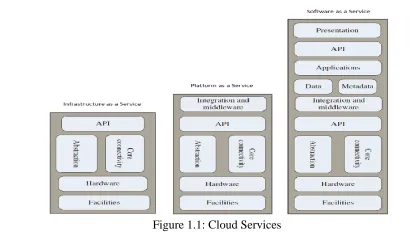
The cloud services, in other words, can be termed as cloud computing stack because they are built on top of one another. The categories of services of cloud computing are:
• Infrastructure as a Service (IaaS) • Platform as a Service (PaaS) • Software as a Service (SaaS)
Infrastructure as a Service (IaaS)
IaaS are online services that provide high-level APIs used to dereference various low-level details of underlying network infrastructures like physical computing resources, location, data partitioning, scaling, security, backup, etc.
• Examples: Amazon EC2, Rackspace, Oracle Virtual Box
Platform as a Service (PaaS)
PaaS provides a platform that allows customers to develop, run and manage applications without the complexity of building and maintaining the infrastructure typically associated with developing and launching an app.
• Example: Google App Engine (GAE)
Software as a Service (SaaS)
SaaS is a software distribution model in which a third-party provider hosts applications and makes them available to customers over the internet.
• Example: Gmail, Sales force’s Online CRM
Http://www.ijetmr.com©International Journal of Engineering Technologies and Management Research [70]
3. Cloud Types
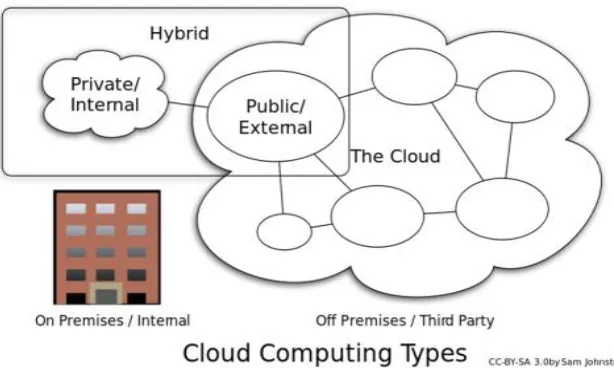
Figure 1.2: Types of Cloud Computing
Public Cloud
• The cloud made available to the general public by a service provider, either free or offered on a pay-per-use model.
Private Cloud
• The cloud operated solely for a single organization and not shared with others.
Community Cloud
• The cloud shared between several organizations from a specific community with common concerns.
Hybrid Cloud
• A composition of two or more different types of clouds. • Why?
1) The organization may want to host some critical, secure applications in their private cloud, but use a public cloud for the not-so-critical applications.
2) Cloud bursting: the organization uses its cloud for normal usage, but an external cloud is used for peak loads.
To Be Private, or Not?
• Private clouds are at small scale
Big cost savings are driven by the huge volume • Legacy applications don’t clarify easily
You can achieve only marginal improvements without re-architecting them • On-premises doesn’t mean more secure
Http://www.ijetmr.com©International Journal of Engineering Technologies and Management Research [71] • Do what you do best
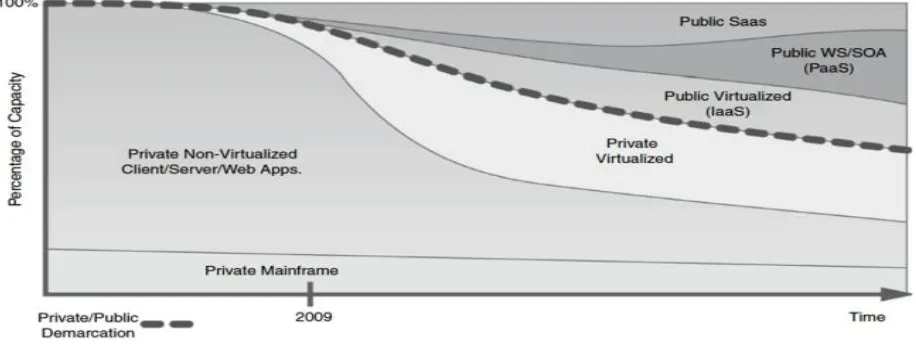
Private clouds will always be many steps behind public clouds in the rate of innovation and optimization.
Figure 1.3: Scope of Computing
4. Matching Cloud Providers to Our Needs
1) Choose AWS (Amazon Web Services)
If you
• want to use third-party open-source software • have existing code
• want to transfer a web app to your machine/servers later • port code to another language
• want complete control
• need to stress/load test an app for example, load up 1,000 instances
2) Choose GAE (Google App Engine)
If you
• have no pre-existing code
• are building request-response web apps or mashups • consider time-to-market the most important
• aren’t doing anything fancy (installing software) • aren’t worried about lock-in to Google
IaaS + PaaS
3) Choose Azure
• If you
Http://www.ijetmr.com©International Journal of Engineering Technologies and Management Research [72] • have existing code developed to those Microsoft APIs.
• have teams that normally develop in Visual Studio using C# • want to blend development from desktop to cloud.
• have no issue with lock-in to Microsoft.
5. Conclusion
Cloud computing is the endless service model that we can use thoroughly according to our business needs. We can choose different services and methods according to our priorities and goal. We can cut the cost of purchasing H/W by using the services provided by the cloud. These services are not only important for business needs but also for our work or educational needs.
References
[1] C. Jatoth, G. Gangadharan, U. Fiore and R. Buyya, “SELCLOUD: A Hybrid Multi-Criteria Decision-Making Model for Selection of Cloud Services”, Soft Computing, Springer, Vol. 23, Issue 13, pp. 4701-4715, 2019.
[2] S. K. Panda, I. Gupta and P. K. Jana, “Task Scheduling Algorithms for Multi-Cloud Systems: Allocation-Aware Approach”, Information Systems Frontiers, Springer, Vol. 21, Issue 2, pp. 241-259, 2019.
[3] S. K. Panda and P. K. Jana, “An Energy-Efficient Task Scheduling Algorithm for Heterogeneous Cloud Computing Systems”, Cluster Computing, Springer, Vol. 22, Issue 2, pp. 509-527, 2019. [4] Cloud Computing, https://en.wikipedia. org/wiki/Cloud_computing, Accessed on 1st September