R
R
A
A
N
N
D
D
O
O
M
M
F
F
O
O
R
R
E
E
S
S
T
T
,
,
S
S
U
U
P
P
P
P
O
O
R
R
T
T
V
V
E
E
C
C
T
T
O
O
R
R
M
M
A
A
C
C
H
H
I
I
N
N
E
E
A
A
N
N
D
D
N
N
E
E
A
A
R
R
E
E
S
S
T
T
C
C
E
E
N
N
T
T
R
R
O
O
I
I
D
D
M
M
E
E
T
T
H
H
O
O
D
D
S
S
F
F
O
O
R
R
C
C
L
L
A
A
S
S
S
S
I
I
F
F
Y
Y
I
I
N
N
G
G
N
N
E
E
T
T
W
W
O
O
R
R
K
K
I
I
N
N
T
T
R
R
U
U
S
S
I
I
O
O
N
N
S
S
a
a
n
n
j
j
i
i
b
b
a
a
n
n
S
S
e
e
k
k
h
h
a
a
r
r
R
R
o
o
y
y
11,
,
D
D
i
i
s
s
h
h
a
a
n
n
t
t
M
M
i
i
t
t
t
t
a
a
l
l
11,
,
M
M
a
a
r
r
e
e
n
n
g
g
l
l
e
e
n
n
B
B
i
i
b
b
a
a
22,
,
A
A
j
j
i
i
t
t
h
h
A
A
b
b
r
r
a
a
h
h
a
a
m
m
331
School of Computer Science and Engineering, VIT University,Vellore, India 2
Department of Computer Science ,University of NewYork,Tirana,Albania
3
Machine Intelligence Research Labs (MIR Labs), Washington,98071-2259, USA
Corresponding author: Sanjiban Sekhar Roy, [email protected]
ABSTRACT: Software systems that are capable of controlling a network of computers from malicious intervention are known as intrusion detection systems (IDS).Constantly changing and the complicated nature of intrusion activities on computer networks cannot be dealt with IDSs that are currently operational. This paper proposes a Random Forests method based on the averaging technique for detection of different intrusion types. This proposed method works as a predictive model to detect the types of intrusion attacks. The experimental results indicate that the intended model compared with decision trees, support vector classification models and nearest centroid classification. Proposed model outperforms support vector classification model and nearest centroid classification model.Several comparison metrics have been used like accuracy, the detection rate and false alarm for performance analysis.
KEYWORDS:Intrusion detection system, Random forests, support vector classification, Accuracy, Detection rate, False Alarm.
1.
INTRODUCTIONAn intrusion detection system (IDS) supervises the network system for suspicious activities and if it detects one, it issues a report to the network management station. In the last few years there has been a step increment in the number of intrusion attacks and as years passed, it has become equally important the task of information assurance by building appropriate intrusion detection systems. The threats such as spyware, hacking, malicious software (like worms and Trojans) is remarkable defiance in regard to maintaining the security of computers and networks. To alleviate this problem, IDS have been drastically deployed into a network environment to identify intrusions.
There are mainly two types of IDS, network based (NIDS) and host based (HIDS). A NIDS acts by placing it at critical points within the network so that it can supervise the signals arriving and leaving from each device in the network. Once the attack is confirmed a notification is sent to the administrator. Host intrusion detection system works on each of the hosts on the network separately. A HIDS supervises
the incoming and outgoing traffic from that particular device only and issues a notification if a suspicious activity is detected.
Machine learning techniques are heavily being adapted and developed in intrusion detection to enhance the efficacy of the systems [RV16] and in other applications as well [R+15]. Suthaharan [Sut12] in his work stated that due to the large size and redundant data in the datasets the computation cost of the machine learning methods increases drastically. They proposed ellipsoid-based technique which detects anomalies and side by side cleans the dataset. The research of Chandrasekhar and Raghuveer [CR13] deals with intrusion detection technique which is a combination of k means clustering, neuro-fuzzy and radial basis support vector machine. In their technique, firstly k-means clustering is used to spawn the training subsets, on them various neuro fuzzy models are trained, after that a vector used by svm classification is generated and finally classification task is carried by radial SVM technique.
method and the nearest centroid classification method in terms of accuracy, the detection rate and false alarm. An analysis has been performed for each type of attack mentioned in the dataset that has been utilized for this study.
1.1KDD CUP DATA SET
This dataset is developed from the DARPA packet traces and it comprises of a huge collection of intrusions that take place in a military network environment which can be downloaded from the site (http://kdd.ics.uci.edu/databases/kddcup99/kddcup99. html). The original KDD dataset is comprised of 4898431 instances, each of which contains 41 features and is classified with exactly one particular attack type. The type can be either normal or attack. Every instance that is not labelled as normal is considered to be attack. KDD CUP 99 has been dramatically used in network attacks. Every attack is comprised in one of the following categories [TK12]:
A)Denial of Service Attack (DOS)
Denial of Service Attack (DOS): Under this category the attacker makes any computing resource or memory resources too much busy so that it becomes incapable of handling any genuine requests. Hence, the machine denies any legitimate users access to machines.
B)Users to Root Attack (U2R)
Users to Root Attack (U2R): Under this category the attacker firstly finds an access to the account of a normal user on the system and further is able to exploit some vulnerable factor so as to obtain the root access to the system.
C)Remote to Local Attack (R2L)
Under this category the attacker not having an account on a machine in the network delivers packets to that machine and exploits some vulnerable factor so that to have an authority as a user of that machine.
D)Probing Attack (PROBE)
Under this category the attacker tries to collect the information related to the computer in the network with an intention of dodging the established security.
Table 1. Attack categories and type
S.No. Probe Dos U2R R2L
1 Ipsweep Back Buffer overflow ftp_write 2 Nmap Land Loadmodule Guess_passwd 3 Portsweep Neptune Perl Imap
4 Satan Pod Rootkit Multihop
5 - Smurf - Phf
6 - Teardrop - Spy
7 - - - Warezclient
8 - - - Warezmaster
The main aim of detecting the network intrusion are detecting the attacks that occur rarely like U2R and R2L and increase the accuracy, detection rate thereby decreasing rate of false alarm.
The protocols that are used in KDD dataset are UDP, TCP and ICMP.The experiment performed utilizes several machine learning techniques to analyze efficiency and study the pattern of different types of attacks in relation to these protocols.
2. RELATED WORK
removal was also conducted and the result was an accuracy of over 98.6 %. Levent Koc al. [KMS12] claimed that a technique known as Hidden Naïve Bayes (HNB) model proves to be efficient in circumstances related to highly correlated feature vectors and the problems which suffer from dimensionality. Their results indicated that HNB performs better than typical Naive Bayes models and models like svm when applied to KDD cup 99 datasets. In their research Kim et al. [KLK14] build a highly accurate misuse detection model related to decision tree and then decomposed the generic training data into small chunks for which one–class svm models were created. Tian et al. [GTX09] presented a method exclusively for host based intrusion systems. The sequence of the shell commands is used to create multiple sequence libraries signifying the normal profile. In detection stage, mining is performed in the pre-recorded data using a sequence matching algorithm and the mined patterns are evaluated for the similarities with respect to historical profile. Finally the smoothed similarities are used to decide on normal or attack conditions. The accuracy was reported high with significantly less detection time. A better accuracy was perceived as compared to existing techniques. KDD 99 dataset was used for experimentation. The reviewed techniques included neural networks, soft computing, swarm intelligence, fuzzy logic. Mukherjee and Sharma [MS12] suggested a feature reduction technique based on feature importance which is used to recognize vital reduced features. Naïve Bayes was applied on the resulting dataset for anomaly detection and they found that with reduced features it was more efficient. Zhang and Zulkernine [ZZ06] proposed a hybrid approach which combines anomaly detection technique with misuse detection and applied it over KDD 99 dataset. They concluded that this hybrid approach performed better than if either anomaly or misuse detection technique is used in isolation.The resultant training and testing times were significantly reduced and descent accuracy was reported. Moskovitch et al. [M+07] presented a technique based on machine learning for categorizing the codes in host based intrusion detection system as malicious or benign. The algorithm is trained by previously detected malicious code. The accuracy was detected to be above 90 %. Das et al. [DSB09] implemented a web intrusion detection system. An unsupervised technique was used for clustering of the queries which helped in detection of intrusions. They used a two phase approach in which the first was related to matching mechanism and in second phase the frequency of the arriving packets was an important criteria for detection. Both phases worked simultaneously. Gao et al. [GTX09] combined genetic algorithm with svm for the task of intrusion detection.
This combination ensured the optimization of svm parameters. The results of their implementation specified that the method was effective in detecting the attacks. Through their study they claimed that after including a certain number of classifiers, the accuracy of the system remains intact. Roy et al. also have proposed Intrusion detection systems based on rough set and dominance based rough set approaches respectively [R+12], [R+13], [DAP+14]. They arrived at a conclusion that practical context is a very crucial factor in evaluating the performance of machine learning algorithms. Muda et al. [M+11] proposed a hybrid method which combines k-means algorithm with naïve bayes. The mentioned approach clustered the instances to their corresponding classes. The dataset utilized was KDD 99 dataset. The results indicated a descent accuracy level.
3. CLASSIFICATION MODEL
In general, the category of problems which contains data as well as the additional attributes that we want to predict comes under supervised learning approach. Under supervised learning approach the classification problem comes into account when the instances belong to two or more classes and our intention is to forecast the class of the unlabeled instances. Under the category of supervised learning methods, a technique known as Support vector machines (SVM) holds its place for classification. This method is effective for high dimensional spaces, is memory efficient since it utilizes subset of training data points in the decision function called as support vectors, also it is adroit as for the decision function various kinds of kernel functions can be stated . If the count of features is bigger than the count of samples this technique is liable to give mediocre performance.
A. Suggested Classification Model
The suggested classification model is comprised of random forest algorithm; it advances by building an aggregation of decision trees during the process of training and comes under the category of ensemble methods. This method is based on creating several models in isolation and after that take a mean of the predictions done by each of the models. The output class is computed by taking the mode of the labels calculated by each tree.
B. Mathematical Formulation Given a set of training data points,
} , {Xi Yj
D
n i Yi X Wim X Tm 1 ) ( ) (where Wim(X) is equal to 1/km , if X and Xi are in the same leaf in the m-th tree and 0 otherwise, km is the number of training data which fall in the same leaf as X in the m-th tree. The prediction of the entire forest is given by,
n i M m M m n i M mYi
X
Wim
M
Yi
X
Wim
M
X
Tm
M
X
F
1 1 1 1 1)
(
1
)
(
1
)
(
1
)
(
which signifies that the prediction made by the random forest algorithm is the weighted average of the Yi’s, with weights,
M m X Wim M X Wi 1 ) ( 1 ) (The data points Xi which are contained in the corresponding leaf as X in at least one tree of the forest are termed as the neighbours of X in this analysis.
4. EXPERIMENTAL ANALYSIS
A. Data Preparation
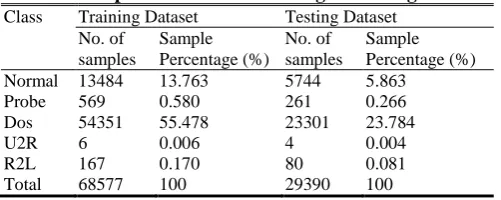
In our experiments, two per cent of original KDD CUP 99 dataset that is approximately 97968 single connection vectors has been utilized. Since KDD CUP 99 dataset contains a vast amount of instances, it is very computationally expensive and requires powerful machines to perform the task. Therefore, a subset of 2% of this dataset is considered for the experimentation. Since the first 97968 original dataset was comprised of only normal, buffer_overflow, loadmodule, perl, neptune and smurf as the class types, to ensure the uniform distribution of all the classes in the considered portion the dataset was shuffled. Each instance consists of 41 features and is classified with one particular attack type mentioned in table 1. Further description regarding available features can be found in. The training data set was considered as the first 70% of the instances, while the testing data comprised of remaining 30% of the instances. From the dataset considered for implementation the distribution of the training and the testing dataset according to the class type is shown in table 3. We have used python programming environment for all the experiments.
Table 2. Sample distribution of training and testing dataset
Class Training Dataset Testing Dataset No. of samples Sample Percentage (%) No. of samples Sample Percentage (%) Normal 13484 13.763 5744 5.863
Probe 569 0.580 261 0.266
Dos 54351 55.478 23301 23.784
U2R 6 0.006 4 0.004
R2L 167 0.170 80 0.081
Total 68577 100 29390 100
B. Algorithm
Random Forest Classification ( ) 1.data ←read data set
2.data ←convert_features_text_to_integral (data) 3.(train_features,train_intrusion_categories)← training_function() 4.(test_features,test_intrusion_categorie)← testing_function() 5.model←randomforests_train(train_features, train_intrusion_categories) 6.classification_result← randomforests_classify (train_features)
7.Accuracy ← (TP+TN) / (TP+TN+FP+FN) 8.Detection_Rate ← TP / (TP+FP)
9.False_Alarm ← FP / (FP+TN)
5. RESULT AND DISCUSSION
The performance of all the classifiers was computed by utilizing a matrix known as confusion matrix. It is a standard metric for benchmarking the effectiveness and robustness of a classification algorithm. Using the confusion matrix, measures like accuracy, detection rate and false alarm rate have been computed which are the generic criteria for evaluating the performance of the IDS. These metrics have been utilized in a number of studies and they ensure a viable means of deciding the efficiency of the model for detecting the intrusions within systems. For a decent level of performance, the intrusion detection system (IDS) needs high accuracy and detection rate and conversely false alarm rate should be low. These terms are given by the following formulae:
) ( ) ( FN FP TN TP TN TP Accuracy ) ( _ FP TP TP Rate Detection ) ( _ TN FP FP Alarm False
label of normal and were correctly classified as normal. False positive (FP) indicates the number of instances that have a label of being valid but have been incorrectly classified as intrusion. False negative (FN) indicates the number of instances that were having a label of intrusion but were incorrectly classified as normal by the IDS.
Table 3. Confusion matrix
Predicted class
Class=attack Class=normal Actual
Class
Class=attack TP FN
Class=normal FP TN
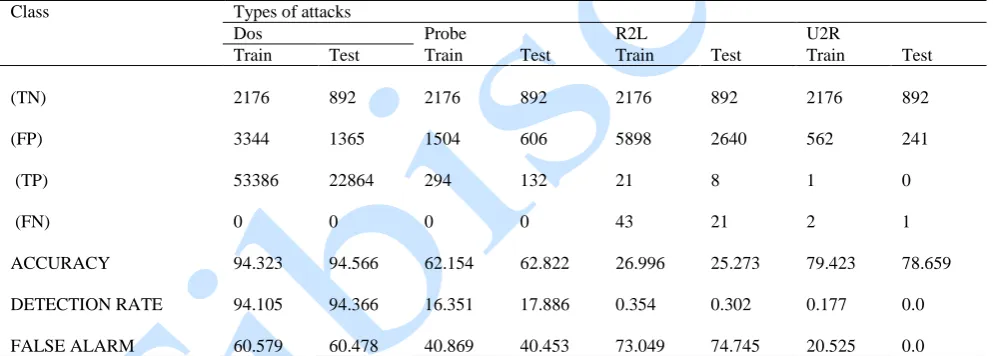
A ten-fold cross validation scheme has been followed for computing the confusion matrix corresponding to each kind of attack. This has been accomplished for both training as well as testing data set. Table 4, 5 and 6 signify the best result among the 10 outputs returned after ten-fold cross validation for nearest centroid, svm and random forests, respectively. For simultaneous observation in each table, the confusion
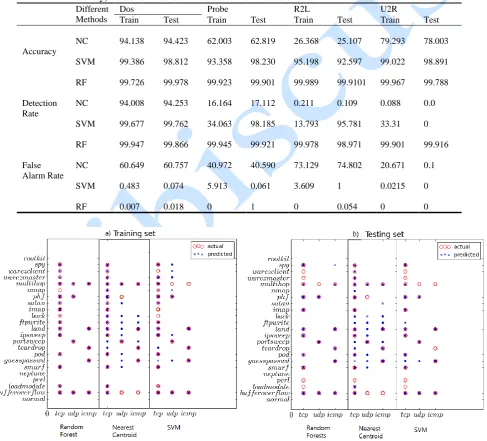
matrix for testing and training sets in each type of attack, namely DOS, PROBE, R2L and U2R have been integrated into a single table. The last 3 rows in table 4, 5 and 6 denote accuracy, the detection rate and false alarm rate for the corresponding training or test set. It is apparent that,in our proposed work, Random forest has accomplished dependable peak values for all intrusion types. In case of DOS intrusion, 99.996 % is attained, which is the maximum accuracy, when compared with other techniques. In case of PROBE intrusion, a very descent accuracy of 99.916 % has been attained. For R2L and U2R, once again the highest accuracy values of 99.914 and 99.947 are reported, respectively. Table 7 represents the experimental results of the three techniques used for intrusion detection over the KDD CUP 99 dataset. The accuracy values were calculated for the testing dataset to elaborate on the efficiency of the compared models. It was concluded that the random forests method outperforms the other two methods.
Table 4. Experimental results obtained for the training and testing dataset using the nearest centroid technique
Class Types of attacks
Dos Probe R2L U2R
Train Test Train Test Train Test Train Test
(TN) 2176 892 2176 892 2176 892 2176 892
(FP) 3344 1365 1504 606 5898 2640 562 241
(TP) 53386 22864 294 132 21 8 1 0
(FN) 0 0 0 0 43 21 2 1
ACCURACY 94.323 94.566 62.154 62.822 26.996 25.273 79.423 78.659
DETECTION RATE 94.105 94.366 16.351 17.886 0.354 0.302 0.177 0.0
FALSE ALARM 60.579 60.478 40.869 40.453 73.049 74.745 20.525 0.0
Table 5.Experimental results obtained for the training and testing dataset using the supportvector machine technique
Class Types of attacks
Dos Probe R2L U2R
Train Test Train Test Train Test Train Test
(TN) 12211 5737 12211 5737 12211 5737 12211 5737
(FP) 59 4 766 3 446 0 2 0
(TP) 54000 23112 396 178 72 4 1 0
(FN) 5 189 44 64 94 76 5 4
ACCURACY 99.903 99.335 93.962 98.879 95.788 98.693 99.942 99.930
DETECTION RATE 99.890 99.982 34.079 98.342 13.899 100 33.333 0
Table 6. Experimental results obtained for the training and testing dataset using proposed technique
Class Types of attacks
Dos Probe R2L U2R
Train Test Train Test Train Test Train Test
(TN) 13483 5740 13483 5740 13483 5740 13483 5740
(FP) 1 1 0 0 0 3 0 0
(TP) 54351 23299 568 255 167 76 6 1
(FN) 0 0 1 5 0 2 0 3
ACCURACY 99.998 99.996 99.992 99.916 100 99.914 100 99.947
DETECTION RATE 99.998 99.995 100 100 100 98.202 100 100
FALSE ALARM 0.007 0.017 0 0 0 0.052 0 0
Table 7. Accuracy, detection rate and false alarm rate values after a 10-fold cross validation scheme
Different Methods
Dos Probe R2L U2R
Train Test Train Test Train Test Train Test
Accuracy
NC 94.138 94.423 62.003 62.819 26.368 25.107 79.293 78.003
SVM 99.386 98.812 93.358 98.230 95.198 92.597 99.022 98.891
RF 99.726 99.978 99.923 99.901 99.989 99.9101 99.967 99.788
Detection Rate
NC 94.008 94.253 16.164 17.112 0.211 0.109 0.088 0.0
SVM 99.677 99.762 34.063 98.185 13.793 95.781 33.31 0
RF 99.947 99.866 99.945 99.921 99.978 98.971 99.901 99.916
False Alarm Rate
NC 60.649 60.757 40.972 40.590 73.129 74.802 20.671 0.1
SVM 0.483 0.074 5.913 0.061 3.609 1 0.0215 0
RF 0.007 0.018 0 1 0 0.054 0 0
Figure 2. Accuracy comparison of other techniques with our proposed technique (train and test sets)
Figure 3. Detection rate comparison of other techniques with our proposed technique (train and test sets)
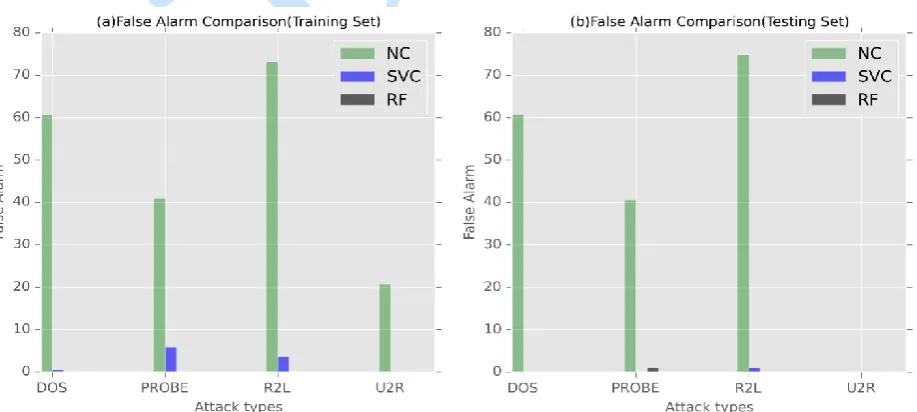
Figure 4. False Alarm comparison of other techniques with our proposed technique (train and test sets)
Fig. 1 depicts a comparison between nearest centroid, svm and random forests. Fig. 1 (a) and (b) have been plotted with respect to the protocol feature. Protocol feature in turn could be any one of three discrete types
more the number of blue points outside the circle, the lesser is the accuracy of that model or the more the number of empty circles the lesser is the accuracy for that model. Fig. 2-4 describe the comparative results of the experimentation in the graphical format for accuracy, detection rate and false alarm rate. In each fig. 2-4, (a) and (b) denote testing and training set results, respectively. These graphs clearly show that the proposed model can provide an efficient intrusion detection tool compared to other equivalent advanced predictive techniques.
CONCLUSION
Intrusion detection is a significant task nowadays for computational methods. In this paper a novel method for detecting intrusion type was introduced. 41 feature vectors were utilized as input to classify attack categories of the KDD Cup dataset successfully. An IDS system that was able to analyse the dynamic and complex nature of intrusion activities has been built. Random forests technique based on the averaging method outperformed the major classification methods support vector machine and nearest centroid. After achieving ten-fold cross validation, the proposed model resulted in the highest accuracy and detection rate values as well as the least alarm rate values. This trend was maintained consistently for PROBE, DOS, U2R and R2L intrusion attacks. The results specify that the classification ability of the proposed model is incomparable to nearest centroid approach and is inherently superior to the support vector machine model. Anomaly detection methods that are based on artificial intelligence are continuously alluring a lot of attention from the research community. Through this paper, we were able to successfully perform a comparison study and come over with a state of the art method in intrusion detection system.
REFERENCES
[A+12] J. Ali, R. Khan, N. Ahmad, I. Maqsood - Random forests and decision trees, IJCSI International Journal of Computer Science Issues, vol. 9, no. 5, 2012.
[A+15] S. Adusumilli, D. Bhatt, H. Wang, V. Devabhaktuni, P. Bhattacharya - A novel hybrid approach utilizing principal component regression and random forest regression to bridge the eripod of GPS outages, Neurocomputing, 2015.
[CR13] A. Chandrasekhar, K. Raghuveer - Intrusion detection technique by using k-means, fuzzy neural network and svm
classifiers, In Computer Communication and Informatics (ICCCI), 2013 International Conference, pp. 1-7.
[C+07] Y. Chen, L. Dai, Y. Li, X. Q. Cheng - Building lightweight intrusion detection system based on principal component analysis and C4. 5 algorithm, In Advanced Communication Technology, The 9th International Conference on IEEE. vol. 3, pp. 2109-2112, 2007.
[DAP14] T. K. Das, D. P. Acharjya, M. R. Patra - Business Intelligence from Online Product Review-A Rough Set Based Rule Induction Approach, 2014 International Conference on Contemporary computing and Informatics (IC3I-2014), 27-29 Nov, 2014, pp. 800-803, Mysore, India, IEEE Xplore,
DOI:10.1109/IC3I.2014.7019662, 2014.
[DSB09] D. Das, U. Sharma, D. K. Bhattacharyya - A Web Intrusion Detection Mechanism based on Feature based Data Clustering, In Advance Computing Conference, 2009.
[GTX09] M. Gao, J. Tian, M. Xi - Intrusion detection method based on classify support vector machine, In Intelligent Computation Technology and Automation, 2009. ICICTA'09. Second International Conference on, vol. 2, pp. 391-394, IEEE, 2009.
[H+00] G. Helmer, J. S. Wong, V. Honavar, L. Miller - Automated discovery of concise predictive rules for intrusion detection, Journal of Systems and Software, vol. 60, no. 3, pp. 165-175, 2002.
[H+11] S. J. Horng, M. Y. Su, Y.H. Chen, T. W. Kao, R.J. Chen, J.L. Lai, C. D. Perkasa - A novel intrusion detection system based on hierarchical clustering and support vector machines, Expert systems with Applications, vol. 38, no. 1, pp. 306-313, 2011.
[KMS12] L. Koc, T. A. Mazzuchi, S. Sarkani - A network intrusion detection system based on a Hidden Naïve Bayes multiclass classifier, Expert Systems with Applications, vol. 39, no. 18, pp. 13492-13500, 2012.
[L+12] Y. Li, J. Xi, S. Zhang, J. Yan, X. Ai, K. Dai - An efficient intrusion detection system based on pport vector machines and gradually feature removal method, Expert Systems with Applications, vol. 39, no. 1, pp. 424-430, 2012.
[MS12] S. Mukherjee, N. Sharma - Intrusion detection using naive Bayes classifier with feature reduction, Procedia Technology, vol. 4, pp. 119-128, 2012.
[M+07]
R. Moskovitch, S. Pluderman, I. Gus, D. Stopel, C. Feher, Y. Parmet, Y. Elovici - Host based intrusion detection using machine learning, In Intelligence and Security Informatics, IEEE, pp. 107-114, 2007.[M+11] Z.Muda, W. Yassin, M. N. Sulaiman, N. I. Udzir - Intrusion detection based on K-Means clustering and Naïve Bayes classification, In Information Technology in Asia (CITA 11), 2011 7th International Conference on, pp. 1-6.
[RV16] S. S. Roy, V. M. Viswanatham - Classifying Spam Emails Using Artificial Intelligent Techniques. In International Journal of Engineering Research in Africa, vol. 22, pp. 152-161. Trans Tech Publications, 2016.
[R+12] S. S. Roy, O. Jadhav, S. Chakraborty, V. M. Viswanatham - Multicriteria Decision Analysis for Intrusion Detection Data, Proceedings of International Conference on Advances in Computing. Springer India, pp. 667-672, 2012.
[R+13] S. S. Roy, V. M. Viswanatham, P. V. Krishna, N. Saraf, A. Gupta, R. Mishra - Applicability of Rough Set Technique for Data Investigation and Optimization of Intrusion Detection System, Quality, Reliability, Security and Robustness in Heterogeneous Networks. Springer Berlin Heidelberg, pp. 479-484, 2013.
[R+15] S. S. Roy, D. Mittal, A. Basu, A. Abraham - Stock Market Forecasting Using LASSO Linear Regression Model. In Afro-European Conference for Industrial Advancement, pp. 371-381. Springer International Publishing, 2015.
[Sut12] S. Suthaharan - An iterative ellipsoid-based anomaly detection technique for intrusion detection systems, In Southeast on, Proceedings of IEEE, pp. 1-6, 2012.
[SM07] T. Shon, J. Moon - A hybrid machine learning approach to network anomaly detection, Information Sciences, vol. 177, no. 18, 3799-3821, 2007.
[SWC11] P. Sangkatsanee, N.
Wattanapongsakorn, C.
Charnsripinyo - Practical real-time Intrusion detection using machine learning approaches, Computer Communications, vol. 34, no. 18, pp. 2227-2235, 2011.
[TK12] A. N. Toosi, M. Kahani - A new approach to intrusion detection based on an evolutionary soft computing model using neuro-fuzzy classifiers, Computer communications, vol. 30, no. 10, pp. 2201-2212, 2012.