Iranian Journal of Language Teaching Research 4(2), (July, 2016) 69-86 69
* Corresponding author: University of Mazandaran, Iran
Email address: [email protected]
Urmia University
One of the recent issues in English as a Second/Foreign Language (ESL/EFL) writing instruction has been the quest for a more effective way to give feedback to L2 learners’ writing drafts. Although teacher-learner writing conferences have been increasingly used for providing ample opportunity for negotiating revisions, relatively little attention has been given to actual teacher-learner conversation. Drawing on sociocultural theory, which holds that all cognitive developments are results of ‘social interactions’, and drawing on conversation analysis as an analytical tool, this study attempts to explore the different functions of ‘silence’ in writing conferences during teacher-learner conversation. The data comes from transcripts of six 1-hour writing conferences video-recorded in a graduate program with 7 candidates in Iran. During the writing conferences, learners’ drafts were discussed. Findings of the study demonstrated that teacher’s silence can play a key role in the management of turns in writing conferences, thereby providing the parties with various opportunities for accomplishing intersubjectivity: the teacher used silence to rethink the information provided during writing conferences, and the learner exploited silence to revise the writing draft. The current study, reporting a range of functions of silence in writing conferences, offers an extension to the existing literature and draws language teachers’, specifically writing instructors’, attention to different functions of silence in writing conferences.
Keywords: writing conference; teacher-learner talk; silence; conversation analysis; written feedback © Urmia University Press
Received: 27 Nov. 2015 Revised version received: 2 Apr. 2016
Accepted: 4 June 2016 Available online: 1 July 2016
A conversation analysis of the function of silence in
writing conferences
Milad Mirzaee
a, *, Baqer Yaqubi
a aUniversity of Mazandaran, Iran
A B S T R A C T
A R T I C L E H I S T O R Y
Content list available at www.urmia.ac.ir/ijltr
Iranian Journal
of
70 M. Mirzaee & B. Yaqubi/A conversation analysis of …
Introduction
Written corrective feedback (WCF) has been a controversial topic in second language studies following John Truscott’s contentious paper in 1996, when he claimed that written corrective feedback (error correction on L2 learner writing) was hardly effective. Prior to that date, the underlying assumption in corrective feedback studies held that corrective feedback assisted L2 writers in improving the accuracy of their writing, a belief that had not been challenged (Hyland & Hyland, 2006). Following Truscott’s strong claim, Ferris (1999) strongly claimed that Truscott’s arguments were largely premature and overly strong, given the rapidly growing research evidence on the contribution of error correction to L2 learners’ writing drafts. Despite the fact that the conclusions Truscott drew from the findings of previous research were not supported by subsequent studies (Bitchener, 2008; Ellis, Sheen, Murakami & Takashima, 2008; van Beuningan, Jong & Kuiken, 2012), the interest thus revived in the topic was very beneficial, prompting L2 writing researchers to rethink whether, how, and when to respond to students’ grammatical and lexical errors (Hyland & Hyland, 2006).
Among the different strategies used to deliver feedback to learners in composition pedagogy, writing conferences have attracted considerable interest because not only is it an effective and sometimes efficient tool for responding to learner writing (Carnicelli, 1980; Ferris, 2003), but it is also an ‘‘unparalleled opportunity to provide targeted individualized instruction’’ (Weissberg, 2006, p. 261). Writing conferences, according to Young and Miller (2004), provide the participants involved with affordances in which meaning making is constantly negotiated, constructed, and revised by the participants. Furthermore, Hyland (2000) claims that the writing conference will give learners a clearer idea of their strengths and weaknesses, thereby helping them construct on their own a revision plan for the next draft. In recent years, the literature on writing conferences has enriched our understanding of them in terms of how the exchange of ideas, management of turns, and paralinguistic features of talk are enacted within them (Ewert, 2009; Haneda, 2004; Young & Miller, 2004). It has also highlighted the fact that the how of corrective feedback enactment is no less important than the provision of feedback per se. However, our transcript data presented repeatedly to us that silence plays a significant role in the construction and obstruction of opportunities for learners’ participation in writing conferences. The following short transcribed extract from our study (silence is shown in parentheses) captures a short moment in which silence generates motivation for continuation of the topic being addressed.
1 S5 ((S reads part of her draft))
2 T what does the word these in this sentence refer to↑
3 S5 [local governments]
4 T [local governments]
5 so you mean local governments had an Iranian background=
6 S5 =it says that they had Iranian background like sasanids or
7 they were absorbed by iranian background like qaznavids.
8 T aha, aha. (4.3s)
9 S2 like samanids or sasanids↑
10 S5 samanids.
Iranian Journal of Language Teaching Research 4(2), (July, 2016) 69-86 71
In general, although the functions of silence have received considerable attention in the literature (Heldner & Edlund, 2010; Sacks, Schegloff, & Jefferson, 1974), its significant pedagogical roles in writing conferences are still underrepresented. Hence, the current research, using a conversation analytic framework as an analytical tool, aims to investigate how silence is used in writing conferences to further contribute to the scant body of research in this area.
Review of literature
Literature on writing conferences and silence
In recent decades, there have been a number of important studies on written feedback in the fields of both general language education and second/foreign language teaching (Bitchener, 2008, 2012; Chandler, 2003). The bulk of research has largely been devoted to the efficacy of written feedback (Ahmadi Shirzai & Shekarabi, 2014; Bitchener, 2008; Chandler, 2003; Ferris, 2012; Guenette, 2007), different strategies for providing feedback (Akbarzadeh, Saeidi & Chehreh, 2014; Bitchener & Knoch, 2008; Chang, 2012), and the short/long-term effects of feedback on learners’ writing (Berg, 1999; Truscott, 2007). Particularly relevant to the current study is the body of work that focuses primarily on issues of teacher-learner talk in writing conferences. Although previous studies (e.g. Jacobs & Karliner, 1997) have found that the type of interactions within the writing conference does influence the type of subsequent revision made, very few of such studies have detailed how this is actually co-constructed in the discourse. For example, Goldstein and Conrad (1990) examined the effects of negotiation of revisions and actual revisions of subsequent written drafts using discourse features derived from the transcript data of the study. Comparing the conference drafts with the ones drafted subsequently, they found out that successful revisions made by the learners had already been negotiated, thereby emphasizing how revisions are co-talked into being. Regarding the changes in the organization of teacher-learner talk in writing conferences, Young and Miller (2004) found that while in the first writing conferences the teacher took the major role (e.g. identifying problems and directing to revisions), in later conferences, the learner had participated more fully in their talk and the revision process. While both studies consider co-talk in writing conferences important and use transcript data to illustrate how languaging (Swain, 2010) is involved in meaning-making, problem solving and knowledge building, they do not specifically focus on the interactional features that the teacher exploits to navigate talk.
72 M. Mirzaee & B. Yaqubi/A conversation analysis of …
By reviewing literature, it becomes clear that much can be done regarding identifying the different functions of different features of talk in promoting or prohibiting the learners’ participation in the specific context of writing conferences. Although a small number of studies do address the issues of teacher-learner talk (Ewert, 2009; Haneda, 2004; Young & Miller, 2004), the significance of ‘silence’, as a feature of talk, has received very little attention in teacher-learner writing conference talk. Hence, this study aims at extending the existing literature by describing the different functions of silence in writing conferences and identifying the constructive and obstructive instances from the viewpoint of sociocultural theory through utilizing a set of video data and CA: an analytical tool which can fully elucidate the complexities of teacher-learner interaction.
Theoretical framework
The current study demonstrates the contribution of sociocultural theory (Vygotsky, 1978) and conversation analysis. Sociocultural theory is noteworthy for the kind of insights it offers us about the learning process, including how learners respond to and use the feedback they are given. According to Bitchener and Ferris (2012), all cognitive developments (including language development) are results of ‘social interactions’, especially when learners are provided with opportunities to collaborate and interact with speakers who are more knowledgeable than they are. Fine-tuned to the context of writing conferences is the view of learning presented in Young and Miller (2004) in which L2 acquisition is suggested “as a situated, co-constructed process, distributed among participants” and which takes “social and ecological interaction as its starting point” (p. 519). As a situated, co-constructed process, writing conferences demonstrate the participation of two parties: teacher and learner. Thus, learning, from this perspective, can be defined as the changes found in the learner’s participation during the writing conferences (ibid.). Consequently, the teacher’s role in this co-constructed process, that is the provision of opportunities for the learners for more participation, is highly significant.
Conversation analysis (CA) is also the analytic framework jointly used with sociocultural theory in the current study. CA approach to classroom interaction has a number of features that set it apart from the more quantitative product-oriented techniques like interaction analysis and discourse analysis. In order to achieve its goals, CA requires naturally occurring data that have been recorded and transcribed. CA analysts approach the data with an emic perspective; an “insider’s” perspective, that is stepping inside the shoes of participants to understand their talk and actions in terms of the local context of talk-in-interaction (Wong & Waring, 2010).
Research questions
In our close analysis of the first sets of writing conference video-recordings, many instances of silence in teacher-learner talk were found. This initial conversation analysis led us to study the teacher’s uses of silence in the writing conferences in order to have a clearer understanding of the functions of these instances of silence and simultaneously deriving some recurring patterns to categorize these instances. In our study, we strived to answer the following questions:
1. What function(s) does the teacher silence play in teacher-learner writing conference talk?
Iranian Journal of Language Teaching Research 4(2), (July, 2016) 69-86 73
Methodology
Participants
The students in the writing conferences were seven MA candidates, including one male and six females. The teacher was the first researcher, an MA candidate in TEFL. The seven students were studying Arts. They were all Persian-L1 native speakers with an age range of 23 to 26. The students in the intact class were heterogeneous in terms of their language proficiency levels. Prior to data collection, the first researcher met with the students to inform them of the general purpose of the study, but exercised care to confine his remarks to generalities. He also assured them that the video data to be collected would be used for research purposes, and anonymity in data analyses would be preserved. All the students gave their written consent for the study. The students who agreed to participate in the study will hereafter be referred to as S1, S2, S3, S4, S5, S6, and S7.
Procedure
Prior to writing conference
The course, from which the data have been collected, consisted of two different kinds of classes: the writing conferences led by the first researcher and the regular classes held by the second researcher. A number of pages of an article1 related to candidates’ field of study were assigned each session and discussed the following session in class. The purpose of the course was to raise learners’ awareness on the organization and structure of academic texts while keeping them meaningfully engaged with the text. Therefore, the course had both academic structure and meaning in focus, although the teacher sometimes explained grammatical points that obstructed comprehension. The learners and the course teacher exchanged ideas about the purpose, relations of the paragraphs, and overall organization of the paper. Then, the learners were asked to write a summary of the pages discussed in the class and email their drafts to the first researcher two days prior to the conference day. The selected works for each conference were sent to all class members to be read before the conference day.
Conference day
74 M. Mirzaee & B. Yaqubi/A conversation analysis of … Data Collection
In order to collect naturally-occurring data, six writing conferences, approximately totaling 6 hours, were video-recorded. As the study does not set out to generalize its findings, a corpus of 6 hours is considered enough to draw situated conclusions (Young & Miller, 2004). The writing conferences were conducted in Persian with the learners. All the writing conferences were then viewed repeatedly and transcribed. Following CA methodology, the transcripts of the writing conference sessions included such details as overlaps, latched utterances, parts of participants’ nonverbal behavior (gestures, gazes), as well as instances of silence (and their duration). The transcripts were then typed into QSR Nvivo 10, a qualitative data analysis software used during the whole analysis process.
The initial analyses of the data helped the researchers to gradually reach one specific feature of interaction in the corpus: silence. Therefore, all parts containing instances of silence were identified in the transcripts. Since the study used a conversation analytic tool, no pre-conceived categories were imposed on the instances; rather the categories emerged from the data analyzed in the context of their sequences and turns. The categories of different functions of silence generated from the preliminary analysis were used to analyze, describe and discuss the results of the current study.
Results
In contrast with interaction and discourse analytic studies which rely on pre-stated categories, conversation analytic studies do not pose any pre-planned research questions and do not impose any pre-planned categories on the data (Ten Have, 2007). As this study used conversation analysis, through initial observation it was found that silence is one of the elements in teacher-learner writing conference talk that occurs repeatedly and thus may influence the patterns of interaction and participation. The findings of the present study, including the categories of functions of silence in writing conference talk, are the result of ‘unmotivated looking’ (Psathas, 1995), i.e., they are all grounded in the data. These categories of different functions of silence will be explained in this section.
Function 1:
Not only does silence signal that the sequence is closed, but the case is also closed.
Extract 1
1 T the word analyses… spelling=
2 S2 =analyses needs i.
3 S1 i↑ I checked it with a dictionary=
4 T =yes yes. this word has an odd plural form. the singular
5 form is analysis. if it’s more than one it ends with ses… analyses.
6 she used it correctly.
7 [I just wanted you to notice it]
8 S2 [I didn’t see these at all] (6.2s)
10 T aaa… well…this categorizing you put in your draft I think
11 will help you in your future work.
Iranian Journal of Language Teaching Research 4(2), (July, 2016) 69-86 75
choice in the learner’s draft. Then, the teacher initiated a new sequence about the word ‘analyses’, “the word ‘analyses’, spelling” (line 1). The word “analyses” was highlighted by the teacher for being odd in term of its plural form, as it is stated by the teacher himself (line 4). Since the teacher highlighted the point through ‘problematizing’ it (Wong & Waring, 2009), he is the one who leads and controls the sequence. After this discussion led by the teacher, there is silence for 6.2s in the talk (line 8). As the data shows, he is the party who holds most of the turns and also longer turns in the sequence. When he seems to be finished with his explanation, he makes an evaluative comment on the writer’s correct use of the word in the draft, “she used it correctly.” (line 6). This comment is followed by his restatement of the point that it was the teacher who made the point candidate for the learners, “I just wanted you to notice it” (line 7). By this explanation from the teacher, S1 and the other learners of the class keep silent, since there has been no interest or error from their side. Although the teacher waits for more than 6s, there’s no attempt in pursuit of the topic. Following an instance of silence for more than 6s, the teacher initiates a new discussion on the content of the text (lines 10 and 11). This initiation shows that the silence can serve as the point where not only the sequence, but also the case is closed.
The analysis suggests that the silence is highly influenced by the process of highlighting an issue by the teacher through problematizing and giving a metalinguistic explanation on a point which normally manifests a minimum participation by the learners. The non-reciprocal way of interaction led to the teacher’s dominance in the sequence. This is further supported in the data when the teacher provides the learners with a period of time to raise any questions but there is no initiation on their side.
One of the interesting points in this extract is the participation of the learners in the writing conference talk. Although it was the teacher who highlighted the word ‘analyses’ (line 1) and S1 was expected to participate as the writer, S2 also participated in the discussion (line 2). The utterance made by S2 “I didn’t see ‘these’ at all” in line 5 shows that she was carefully following the discussion and also expressed her evaluative comment. The turn by S2 supports the innovation in the procedure of the study that the presence of other learners may result in their involvement in the discussion, their participation and thus their language learning (see Young & Miller, 2004).
Function 2:
Silence after providing a DIU helps learners to successfully complete the utterance.
Extract 2
1 T ((a brief explanation on how to make verbs passive))
2 T and now again we need the past participle form… what’s the
p.p.
form↑ (3s)
3 T were prohibit↑
4 S4 ((the learner silently gazes at the paper)) (2s)
5 it should be prohibited.
6 T yes… it takes ed.
76 M. Mirzaee & B. Yaqubi/A conversation analysis of …
“Students hear DIUs as invitations to continue by correcting the problems they target.” (ibid., p. 164) and explains the reason students understand how to correct is supported by the hints which are usually provided by the teacher, e.g. the metalinguistic explanation provided by the teacher beforehand. As the data shows, the teacher has already provided the learners with a brief explanation on passive verbs (line 1).
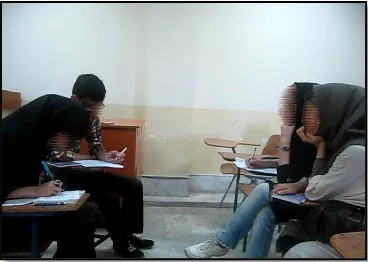
The DIU in this extract is preceded by a period of silence for 3s provided as the wait time for the question that has just been asked. Since there is no initiation to answer the question, the teacher prefers to provide a DIU to help the learner (line 3). While both the teacher and the learner are looking at the text, the teacher (in Figure 1) asks “were prohibit” pointing to the word on the paper. After providing DIU (Figure 1), the teacher waits for 2s looking at the learner while she is gazing at the paper and thinking (Figure 2). Finally, the learner responds (in line 6) and by receiving the positive feedback from the teacher (“yes” in line 7), she starts to write the correction on the text (Figure 3).
The silence is a very important component of a DIU, especially in writing conferences. As Koshik (2008) illustrates, when the learners complete the utterance, teachers evaluate their responses; thus, DIUs are generally treated as question-answer sequences. If the learner is not provided with enough time to think (line 5), the DIU may not result in a successful revision on the text.
Figure 1. Provision of DIU. Figure 2. The learner gazing at the paper.
Iranian Journal of Language Teaching Research 4(2), (July, 2016) 69-86 77
Function 3:
Sometimes the teacher keeps silent and provides the learner with the opportunity to think about the answer to the question, i.e., the silence works as the ‘wait time’.
Extract 3
1 S5 ((S reads the first part of her draft for the class))
2 T uhum…what role does this sentence play in your paragraph↑
3 S5 mmm…it worked somehow as an introductory sentence…to talk
about
4 the effects of returning local governments to power…and what
5 happened after that.
6 T uhum.
7 S5 for this reason I wrote this sentence to start with.
8 T aaa…so you just meant an introduction↑
9 S5 yes.
10 T you mean it was not a topic↑=
11 S5 =no.
12 T well that’s good… we continue reading the text.
13 S5 ((S reads))
14 T what does the word these in this sentence refer to↑
15 S5 [local governments.]
16 T [local governments↑]
17 so you mean local governments had an Iranian background=
18 S5 =it says that they had Iranian background like sasanids or
19 they were absorbed by Iranian background like qaznavids.
20 T aha aha (4.3s)
21 S2 like samanids or sasanids↑
22 S5 samanids.
23 T and this sentence I still think that is a part of introduction=
24 S5 =yes it refers to=
25 T =the first sentence.
26 S5 to local governments
27 T okay. and we continue.
28 S5 ((S reads))
29 T uhum…
30 S5 and this background, their understanding and support of art
31 were because of the heritage they had and it was hard for them=
32 T =to depart=
33 S5 =yes to depart from their cultural and historical roots.
34 T aaa… I read your draft to the end and I was searching for a
35 unifying point. it was in your draft↑ in this part↑ (4.9s)
36 T and we continue your draft we find that it goes the same way.
37 S5 yes. I think the return of local governments to power and its
38 effects are the main points.
78 M. Mirzaee & B. Yaqubi/A conversation analysis of …
The first silence in this extract functions in different ways. The sequence begins with the writer reading her draft. Learner’s explanation about the Iranian background of local governments (line 15) gives some new pieces of information about the text. Therefore, after a backchannel, i.e. the use of the word “aha”, the teacher keeps silent thinking about the new pieces of information. However, what the teacher is seeking is not thinking about this information since he is not concerned with the details in the content but with the structure of the paragraph. It is high probably understood as the teacher’s strategy to provide the learner with some more time to think about these sentences in the text.
While it was predicted that either the teacher will take the turn to discuss new information, or the learner (S5) will talk about the role of previous sentences, it’s one of the learners of the class (S2) who asks a very detailed question about the information discussed in the class, “like samanids or sasanids”. What occurred in the reality of the classroom shows that the silence served as a tool for S2 to read the text, to reflect on the S5 explanation, and to decide to initiate a new sequence.
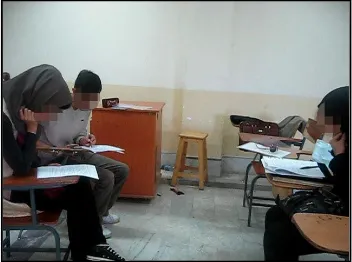
Finally, the learner and the teacher achieved the target revision. The second silence in the extract, however, achieves what it is aimed at. After his explanation about the draft and the way it continues to the end, the teacher asks two yes/no questions “it was in your draft↑ in this part↑” (line 35). This question is followed by a period of silence (for 4.9s) which is intended to help the learner to think about the question and the point the teacher made. As it is seen in Figure 4 and Figure 5, the learner bends toward his paper while she is looking and thinking about teacher’s question. This period of silence helps the learner finally achieve what the teacher intended: to find out the main idea of the text and then to see whether it is well supported in the body.
The silence can be considered as one of the crucial elements of the learner’s successful revision in writing conferences. As Rowe (1986) states, it is difficult for many teachers to reach an average wait time up to 3 seconds or longer. She further suggests that if teachers succeed in reaching this average, “there are pronounced changes in student use of language…” (ibid., p. 43). Accordingly, the appropriate use of wait time by the teacher (line 35) can be considered as a key in the participation, first and foremost, and also the right answer made by the learner.
Figure 4. Silence; the learner bends towards draft. Figure 5. gazing at the draft.
Extract 4
1 T next paragraph is a bit different from previous paragraphs.
2 you know the difference↑ (9.7s)
4 S7 I introduced it immediately.
Iranian Journal of Language Teaching Research 4(2), (July, 2016) 69-86 79
In this extract, the teacher asks a fairly general question, “you know the difference”, which alternatively could be a more detailed question or followed by some backups. The teacher, however, prefers to keep silent for a longer period of time. The silence (9.7s) in this sequence is one of the longest instances of silence in all 6 writing conferences video-recorded and transcribed. After waiting for 9.7s, gazing at the paper and thinking about the teacher’s question (Figure 6), the learner finally made the point and answered the question. Her answer is the one which the teacher was waiting for which is shown in teacher’s immediate and positive evaluation of learner’s response.
In this extract, the silence also served as a room in which the learner could think about the question asked in the conference and also prepare to answer the question.
Figure 6. The learner gazing and thinking.
Extract 5
1 T In the Islamic…
2 here I think… I think you should add something... can you
3 tell us in Persian↑ (5.5s)
5 S6 ،نارظن بحاص ،یملاسا هزوح رد...ممم
mmm,dar hozeye eslami,saheb-nazaran in Islamic fields, the theorists
6 دروم رد متشونیم دیاب دیاش
shayad bayad mineveshtam dar morede perhaps I should have written about
7 هن
na no
8 یملاسا رنه رد ،یملاسا رنه هک دندقتعم نادنمشناد ،یملاسا هزوح رد
ریواصت زا هدافتسا هدوب عونمم
dar hozeye eslami, daneshmandan motaghedand k honar-e eslami, dar honar-e eslami estefade az tasavir mamno bude
in Islamic fields, the theorists believe that Islamic art… in Islamic art the use of pictures was prohibited.
80 M. Mirzaee & B. Yaqubi/A conversation analysis of …
occurs a period of silence for 5.5s. This silence can be analyzed from two perspectives: the teacher and the learner. When the teacher asks the question, the learner is provided with a period of time to think and prepare to answer the question. However, this silence would also help us understand a reversed pattern of what has occurred in teacher-learner talk more frequently.
Transcripts of the writing conferences showed many instances of silence in which the teacher took the time to think about a new explanation given by the learners. In this extract, however, it’s the learner who takes the time to think about a new question asked by her teacher. Asking for L1 translation was not a frequent technique during conferences and it is assumed that the learner had to take enough time (5.5s) to think about it and then answer the teacher’s question.
Discussion
This study was a case study which aimed to examine the significance of silence and its different functions in teacher-learner talk in writing conferences. The findings were based on the conference video-recordings analyzed by qualitative methods using a CA methodology. The qualitative method intended to consider the degree to which teacher’s silence in writing conferences provided opportunities for learners’ participation and learning through a micro-analysis of transcribed extracts occurring in the context of writing conferences.
On the significance of silence in the unfolding teacher-learner writing conference talk, the learner and teachers’ instances of silence have shown to lead to different results in terms of their turn-taking system (See Extract 1) and also substantive comments (Extract 3) made by the participants. It was found that when there was a period of silence in the conference, the following teacher-learner talk was substantially influenced by the participants’ silence. This finding specifically contributes to the first research question, seeking functions of silence.
As it has been discussed, different functions of silence in teacher-learner writing conference talk were identified in the data. The micro-analysis of the data showed that there are a number of recurring patterns for silence in conferences. As presented earlier and as Extract 1 shows, silence can function as a room in which the sequence and also the case are closed. In this function, after teacher’s silence, a new case and sequence are initiated suggesting that the previous case and sequence were already closed. It can also function as a period of time when the teacher provides the participants with following his/her comments on a revision. After giving a comment on a revision, the teacher keeps silent and provides the participants (the writer and the other learners in the conferences) with the time to think about the explanation and comment given.
The silence in the DIU is also a function found in the study. DIUs are utterances, designedly incomplete, in order to be completed by the learner with his/her following response (Young & Miller, 2004). They are formed by repeating portions of the learner’s talk or animating portions of the learner’s text and stopping just before the error (Koshik, 2008). The silence in the DIU is an integral part of it; when the learner is provided with the incomplete unit, the teacher is required to give the learner enough time to complete the unit. If not provided with enough time to complete the unit, the DIU will not achieve its goal and the usage of DIU would result in no significant outcome.
Iranian Journal of Language Teaching Research 4(2), (July, 2016) 69-86 81
question was one of the strategies the instructor used to achieve fuller turn from the learner, the current study’s findings suggest that besides the frequent use of asking direct question, the importance also lies in the silence in question-answer sequences. On the significance of this function of silence in question-answer sequences, it is suggested that increasing wait-time is a change that not only impacts the kind of interaction but also is “likely to open up space for learning” (Walsh, 2011, p. 148). Similarly, the results of the current study revealed that question-answer sequences will be successful only if the learners are allowed enough wait-time, showed by the teacher’s silence in the writing conferences (Extracts 3,4, and 5). If the learners are not provided with enough wait-time in the question-answer sequences, they will not be able to answer the question, or answer the question correctly.
On the obstructive and constructive uses of silence by the teacher in the writing conferences (the second research question), the micro-analysis of the results suggests that when teachers give the writer an evaluative comment on a revision, the following silence will not result in the participation of the learners. A possible explanation might be that when the teacher evaluates a revision explicitly in the writing conference talk, the learners find little opportunity to react to this comment. However, instances when a question is asked (referred to as ‘wait-time’) or the DIU sequences are examples which clearly show how silence can assist learning through providing the learner with the opportunity to participate in the discussion. The silence in the question-answer sequences helps the learners to think about their answer. The lack of this period of silence can easily lead to the withdrawal from the participation by the learners. Silence in DIU sequences (e.g., Extract 2) is also an instance which can contribute to learners’ participation, and consequently their learning. The learners can complete the DIUs only if they are provided with enough time to think about the incomplete unit and the response.
One of the significant points regarding the construction or obstruction of learning opportunities is the presence of all class members in the writing conference by adding a theatrical dimension to the study. Supporting the initial conjecture on the positive effects of this innovation in this study, the results also suggested that the presence of the other learners of the class can and does lead to their involvement in the discussions. Extract 1 is an example showing other learners’ engagement in teacher-learner writing conference talk. Extract 1 demonstrates a course of interaction in which while there was a discussion between the teacher and the writer, one of the other participants of conference either asked or answered a question and took the turn from the writer and the teacher. This finding suggests that the presence of other class members in a theatrical arrangement in the conferences has the potential to construct opportunities of participation for the writer and the other participants of the writing conferences, as well.
Conclusion
82 M. Mirzaee & B. Yaqubi/A conversation analysis of …
to extend themselves by mobilizing their resources to reconceptualize their linguistic and non-linguistic knowledge, i.e., to be more accurate.
It is hoped that findings and discussions presented earlier will contribute to the familiarity with the writing conferences as a strategy for feedback provision and classroom-centered research in an EFL context. In addition, we also hope that the current study might provide some insights to the readers/teachers to begin their own journey of exploring their teaching.
The current study had some limitations. One of the limitations lies in the data collection process: collecting data through video-recording. Referring to this fact that recording is an uncommon occurrence in Iranian classrooms including university classes, it is possible that the presence of the video-equipment might have affected the behaviors of the learners. Also, the database of the current study consisted of 6 hours of video-recordings of writing conferences held by only one university teacher. Focusing on one teacher enabled us to study the teacher’s performance through six writing conferences with different learners in depth. However, if we had analyzed more teachers and more writing conferences, findings could have been richer and more generalizable. It must be noted that the findings of this study have only presented a preliminary analysis of teacher’s use of silence in writing conferences.
For future research, investigations of teachers of different educational backgrounds and experiences of teaching are suggested. The learners in this study were not at the same level of proficiency; therefore, some future studies may investigate teachers’ silence with regard to different levels of proficiency. Furthermore, due to limitations of time, each learner had participated in writing conferences talk with the teacher once. Future studies can address the difference in teacher’s performance and use of interactional features of talk (e.g. silence) in the following writing conferences with the same learner to find how teacher’s performance is influenced by learner’s participation.
As a concluding remark, it is noteworthy to mention that for a teacher, either a language teacher or a writing teacher, responsible for giving feedback to learners, making the most out of any strategy being used needs a thorough understanding of what actually occurs in the practice.
References
Ahmadi Shirazi, M., & Shekarabi, Z. (2014). The role of written corrective feedback in enhancing the linguistic accuracy of Iranian Japanese learners’ writing. Iranian Journal of Language Teaching Research, 2(1), 99-118.
Akbarzadeh, R., Saeidi, M., & Chereh, M. (2014). The effect of oral interactive feedback on the accuracy and complexity of EFL learners’ writing performance: Uptake and retention. Iranian Journal of Language Teaching Research, 2(2), 105-126.
Berg, B. C. (1999). The effects of trained peer response on ESL students’ revision types and writing quality. Journal of Second Language Writing, 8(3), 215-241.
Iranian Journal of Language Teaching Research 4(2), (July, 2016) 69-86 83
Bitchener, J. (2012). A reflection on ‘the language learning potential’ of written CF. Journal of Second Language Writing, 21, 348-363.
Bitchener, J., & Ferris, D. R. (2012). Written corrective feedback in second language acquisition and writing. New York: Routledge.
Bitchener, J., & Knoch, U. (2008). The value of written corrective feedback for migrant and international students. Language Teaching Research, 12, 409-431.
Carnicelli, T.A. (1980). The writing conference: A one-to-one conversation. In T. Donovan & B. McClelland (Eds.), Eight approaches to teaching composition (pp. 101-131). Urbana (IL.), National Council of Teachers of English.
Chandler, J. (2003). The efficacy of various kinds of error feedback for improvement in the accuracy and fluency of L2 student writing. Journal of Second Language Writing, 12, 267-296.
Chang, C. F. (2012). Peer review via three modes in an EFL writing course. Computers and Composition, 29, 63-78.
Ellis, R., Sheen, Y., Murakami, M., & Takashima, H. (2008). The effects of focused and unfocused written corrective feedback in an English as a foreign language context. System, 36, 353-371.
Ewert, D. E. (2009). L2 writing conferences: Investigating teacher talk. Journal of Second Language Writing, 18, 251-269.
Ferris, D. R. (1999). The case for grammar correction in L2 writing classes. A response to Truscott (1996). Journal of Second Language Writing, 8, 1-10.
Ferris, D. R. (2003). Response to student writing: Research implications for second language students. Mahwah, NJ: Lawrence Erlbaum.
Ferris, D. R. (2012). Technology and corrective feedback for L2 writers: Principles, practices, and problems. In G. Kessler, A. Oskoz, & I. Elola (Eds.), Technology across writing contexts and tasks (pp. 7-29). San Marcos, TX: CALICO.
Goldstein, L. M., & Conrad, S. M. (1990). Student input and negotiation of meaning in ESL writing conferences. TESOL Quarterly, 24(3), 443-460.
Guenette, D. (2007). Is feedback pedagogically correct? Research design issues in studies of feedback on writing. Journal of Second Language Writing, 16, 40-53.
Haneda, M. (2004). The joint construction of meaning in writing conferences. Applied Linguistics, 25(2), 178-219.
Heldner, M., & Edlund, J. (2010). Pauses, gaps and overlaps in conversations. Journal of Phonetics, 38(4), 555-568.
84 M. Mirzaee & B. Yaqubi/A conversation analysis of …
Hyland, K., & Hyland, F. (2006). Contexts and issues in feedback on L2 writing: An introduction. In K. Hyland and F. Hyland (Eds.), Feedback in ESL writing: Contexts and issues (pp. 1-19). Cambridge: Cambridge University Press.
Ingram, J., & Elliott, V. (2014). Turn taking and 'wait time' in classroom interactions. Journal of Pragmatics, 62, 1-12.
Jacobs, S. E., & Karliner, A.B. (1977). Helping writers to think: the effect of speech roles in individual conferences on the quality of thought in student writing. College English, 38(5), 489-505.
Koshik, I. (2002). Designedly Incomplete Utterances: A pedagogical practice for eliciting knowledge displays in error correction sequences. Research on Language and Social Interaction, 35(3), 277-309.
Koshik, I. (2008). Questions and Questioning. The International Encyclopedia of Communication. Malden, MA: Blackwell.
Koshik, I. (2009). Questions That Convey Information in Teacher-Student Conferences. In A. Freed & S. Ehrlich (Eds.), Why do you ask?: The function of questions in institutional discourse (pp. 159-186). Oxford University Press.
Kurzon, D. (2007). Towards a typology of silence. Journal of Pragmatics, 39(10), 1673-1688.
Mushin, I., & Gardner, R. (2008). Silence is talk: Conversational silence in Australian Aboriginal talk-in-interaction. Journal of Pragmatics, 41(10), 2033-2052.
Psathas, G. (1995). Conversation analysis. London: Sage.
Qureshi, Z. (2012). Teacher-student talk in the one to one writing conference: Who talks more and why?. UCLan Journal of Pedagogic Research, 3, 27-36.
Rowe, M. B. (1986). Wait Time: Slowing Down May Be A Way of Speeding Up! Journal of Teacher Education., 37(1), 43-50.
Sacks, H., Schegloff, E.A., & Jefferson, G. (1974). A simplest systematics for the organization of turn-taking for conversation. Language, 50(4), 696-735.
Swain, M. (2010). Talking-it through: Languaging as a source of learning. In R. Batstone (Ed.), Sociocognitive perspectives on language use/ learning (pp. 112–130). Oxford: Oxford University Press.
Ten Have, P. (2007). Doing conversation analysis: Introducing qualitative methods series. London: Sage.
Truscott, J. (1996). The case against grammar correction in L2 writing classes. Language Learning, 46, 327-369.
Iranian Journal of Language Teaching Research 4(2), (July, 2016) 69-86 85
Van Beuningan, C., de Jong, N. H., & Kuiken, F. (2012). Evidence on the effectiveness of comprehensive error correction in Dutch multilingual classroom. Language Learning, 62, 1-41.
Vygotsky, L. S. (1978). Mind in society: The development of higher psychological processes. Cambridge. MA: Harvard University Press.
Walsh, S. (2011). Exploring Classroom Discourse: Language in Action. New York: Routledge.
Weissberg, R. (2006). Connecting Speaking & Writing in Second Language Writing Instruction. Ann Arbor: University of Michigan Press.
Wong, J., & Waring, H. Z. (2009). ‘Very good’ as a teacher response. ELT Journal, 63(3), 195-203.
Wong, J., & Waring, H. Z. (2010). Conversation analysis and second language pedagogy: A guide for ESL/EFL teachers. New York: Routledge.
Young, R. F., & Miller, E. R. (2004). Learning as Changing Participation: Discourse Roles in ESL Writing Conferences. The Modern Language Journal, 88, 519-535.
Acknowledgement
The authors thank the learners who made it possible to video-record their writing conferences for this project. It is our sincere hope that this line of research will ultimately benefit the whole community in the years to come.
Milad Mirzaee teaches English at the Iran Language Institute. He received his M.A. in TEFL
from University of Mazandaran. His research interests include feedback and classroom interaction.
Baqer Yaqubi is an associate professor at the department of Foreign Languages in University
of Mazandaran, Babolsar, Iran. His main areas of research are teacher talk, teacher identity, classroom interaction, and teacher's professional development.
1Saif, M. (2006). The Evolution of Persian Thought regarding Art and Figural Representation in Secular and
86 M. Mirzaee & B. Yaqubi/A conversation analysis of …
Appendix A
Key to Transcript Symbols and Notations
The transcription symbols used here are common to conversation analytic research, and were developed by Gail Jefferson (1989) and Schegloff (2007). The following symbols are used in the data:
T: teacher
S1: learner (identified as learner 1)
… three dots indicates a pause of about one second
(2.0s) timed silence
[ ] overlapping utterances
↑ (upward arrow) raised pitch
. (period) falling intonation
= (equal sign) latch or continuing speech
(word) (word or phrase in parentheses) transcription doubt
((word)) (double parentheses) non-speech activity or transcriptionist comment