Corrosion Protection of Copper by TiO
2Nanoparticles
and SN
Schiff base Coating
M. Behpour*, S. M. Ghoreishi, M. Salavati-Niasari, N. Mohammadi
Department of Analytical Chemistry, Faculty of Chemistry, University of Kashan, Kashan, I. R. Iran, P. O. Box. 87317–51167, Iran
Abstract
The corrosion protection abilities of modified copper in 2-[((Z)-1-{6-[(2-sulfanylphenyl)ethanimidoyl]-2-pyridyl}ethylidene) amino]-1-benzenthiol solution containing TiO2 nanoparticles were evaluated by Tafel polarization and impedance spectroscopy in 3.5% sodium chloride solution. The samples were characterized by energy dispersive X-ray (EDX) and scanning electron microscopy (SEM). The electrochemical results indicated corrosion resistance of this coating depends on the concentration of TiO2 nanoparticles and assembling time at this solution. After immersing copper for 10 min in Schiff base solution containing 150 mg L-1 nanoparticles, the coating was able to protect the copper against corrosion about 97%. Results indicated high ability of coating at high temperature and immersing time in sodium chloride solution.
2012 JNS All rights reserved Article history:
Received 3/7/2012 Accepted 6/11/2012 Published online 1/12/2012
Keywords: Nanoparticles Titanium dioxide Corrosion protection Electrochemical method Self assembly
*Corresponding author: E-mail address:
[email protected] Phone: +98 361 591 2375 Fax: +98 361 555 2935
1. Introduction
Copper and its alloys, despite being noble metal corrode significantly in waters containing chloride ions. Extensive use of copper as a structural material in cooling systems of nuclear installations, automobiles, power plants, hotels, oil refineries, sugar factories etc. [1–3], has prompted a thorough research on the corrosion protection of copper in water containing chloride ions. At chloride concentrations lower than 1.0 M, the dissolution of copper surface occurs through
formation of CuCl , which is not protective enough
and is converted to the soluble
2
CuCl . On the
other hand, higher cuprous complexes such as
2 3
CuCl and 3
4
CuCl are formed at chloride
protection because in many cases, the SAMs on the active substrates like copper form densely packed monolayer coatings. SAMs are nanostructures with useful properties. SAMs have typically 1-3 nm thickness but they can be fabricated into patterns having 10-100 nm scale dimensions. SAMs is used as effective barriers for metal protection in corrosive media [10]. Some literatures [11-14] have shown that electrons can penetrate SAMs even though they are defect free. They suggested a corrosion reaction model for the electrode modified by SAMs with defects. The halide ions can permeate through defects and react with metal substrate. Addition of various nanoparticles has been successfully investigated for decrease of defects of coatings. The nanoparticles can be added to the solutions [15-17]
and the electrode is simply modified at these solutions for corrosion protection of surface. Because electrons can penetrate SAM, at this work, TiO2 nanoparticles were added to SN-SAM for higher resistance.
The purpose of this work is to investigate the
protection efficiency of
2-[((Z)-1-{6-[(2-sulfanylphenyl) ethanimidoyl]-2-pyridyl} ethylidene)amino]-1-benzenthiol (Fig. 1) self-assembled monolayer (SN-SAM) and coating 2-[((Z)-1-{6-[(2-sulfanylphenyl) ethanimidoyl]-2-pyridyl} ethylidene)amino]-1-benzenthiol-TiO2 nanoparticles (SN-SAM-TiO2) on copper corrosion in sodium chloride 3.5% by Tafel polarization, electrochemical impedance spectroscopy and surface analysis.
2. Experimental
2-[((Z)-1-{6-[(2-sulfanylphenyl)ethanimidoyl]-2-pyridyl} ethylidene) amino-1-benzenthiol solution (5×10⁻³M) were prepared by dissolving of accurate amount of SN Schiff base in ethanol
circuits. Images of the coatings were acquired by scanning electron microscopy. The coatings were characterized with scanning electron microscopy (SEM) and energy dispersive X-ray (EDX) spectrums. N SH N SH N C H3 CH3
Fig. 1. Structure of Schiff base
3. Results and discussion
3. 1. Electrochemical impedance spectroscopy
The corrosion inhibiting properties of copper electrode modified in SN-SAM and SN-SAM-TiO2 at various concentrations of nanoparticles and 10 and 20 min assembling time in sodium chloride was investigated by impedance method. The results have been shown in Fig. 2 and Table 1.
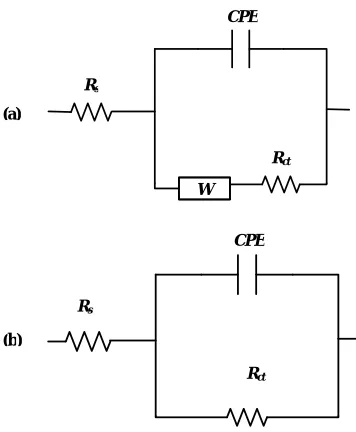
The impedance data of bare copper electrode was fitted with an equivalent circuit as shown in
Fig. 3-a, Warburg impedance (Zw) that is in series
with the charge transfer resistance (Rct) and both
are generally in parallel with the constant phase element (CPE), and all of them are in series with the solution resistance (Rs). The Warburg
impedance reflects the anodic diffusion process of soluble copper species (CuCl−2) from the surface of the electrode to the bulk solution and the cathodic diffusion process of dissolved oxygen from the bulk solution to the surface of the electrode [18].
Fig. 2. Nyquist plots of copper electrode modified for (a) 10 min (b) 20 min assembling time in SN-SAM-TiO2 in sodium chloride solution
The Nyquist plots show there are differences at size and shape of Nyquist plots of modified copper electrodes than bare copper electrode. The figures show that there isn't Warburg impedance in presence of coatings and a high charge transfer resistance (Rct) was seen for the coatings
incorporated with nanoparticles. The Warburg impedance observed in bare disappears from the Nyquist plots of SN-SAM-TiO2 coating, reflecting that the coating have good inhibition effect and they can prevent the diffusion processes. The impedance plots of copper modified with coating
(a) 0 1000 2000 3000 4000 5000 6000 7000 8000 9000 10000
0 5000 10000 15000 20000 25000
Z' (ohm cm2)
-Z " ( o h m c m 2) 0 50 100 150 200
S-N+0 mg/L TiO2 S-N+50 mg/LTiO2 S-N+100 mg/L TiO2 S-N+150 mg/L TiO2 S-N+200 mg/L TiO2 Bare 0 100 200 300 400 500
0 200 400600 800 1000 1200 Z' (ohm cm2
) -Z " ( o h m c m 2) (b) 0 1000 2000 3000 4000 5000 6000 7000 8000 9000
0 2000 4000 6000 8000 10000 12000 14000 16000 18000
Z' (ohm cm2)
-Z " ( o h m c m 2 ) 0 50 100 150 200
S-N+0 mg/L TiO2 S-N+50 mg/LTiO2 S-N+100 mg/L TiO2 S-N+150 mg/L TiO2 S-N+200 mg/L TiO2 Bare 0 100 200 300 400 500
0 200 400600 800 1000 1200 Z' (ohm cm2
Rct
were fitted (Fig. 3-b) by Rs, Rct and CPE.
Fig. 3. Equivalent circuit of the copper (a) without coating (b) with coatings.
Rs shows the solution resistance and Rctshows
the chargetransfer resistance and CPE is constant phase element instead of a ideal double layer capacitor for more accurate fit. The impedance function of a CPE is defined by the mathematical expression:
1 0( ) ]
[
n
CPE Y j
Z
(1)where Y0is the magnitude of the CPE, n the CPE
exponent (phase shift), ω the angular frequency (ω
= 2πf , where f is the AC frequency), and j here is the imaginary unit. The correction of capacity to its real values was calculated from following equation [19]:
1 max
0( )
n
dl Y
C
(2)where ωmax is the frequency at which the
imaginary part of impedance (−Z") has a
maximum. The percentage inhibition efficiency (η) was calculated using the following equation
[20]:
100
ct ct ct
R R
R
(3)
whereRct and Rct are the charge transfer resistance
in absence and presence of coating, respectively. In order to investigate the influence of assembling time on the protective properties of the coating, the coating were prepared in 10 and 20 min immersion time. Table 1 shows the values of η and other obtained electrochemical parameters from Nayquist plots. The results of Table 1 indicate the highest impedance values are found at 150 mg L-1 of nanoparticles incorporation for 10 min assembling time. This is why, the assembling time wasn’t increased and assembling time was stopped until 20 min.
Fig. 2 clearly indicates that the polarization resistance values increases and then decreases when the content of nanoparticless increases. The best results were obtained at 150 mg L-1 of nanoparticles incorporation for 10 min assembled. This effect suggests the presence of the nanoparticles in coating that covers the defects of SN-SAM. But the excessive amount of TiO2 nanoparticles gives serious aggregation among nanoparticless [21]. For the coatings were modified by 50, 100 and 150 mg L-1 of TiO2 nanoparticles the resistance values increase, but there is a drop, for the coatings were modified by 200 mg L-1 of TiO2 nanoparticles. Investigations show that the both amount of nanoparticles and assembling time have important effects on the barrier properties of the coating.
Table 1. Electrochemical impedance analysis data obtained from copper electrode modified at different immersing
Rs
CPE
W
Rct (a)
(b)
CPE
time of SN-SAM solution containing various concentrations of TiO2 nanoparticle in sodium chloride solution
Time
(min)
C (TiO2) (mg L-1)
Rs
(Ω cm2)
Rct
(Ω cm2)
CPE
(10-6; Ω-1 cm-2 sn) n
Cdl
(µF cm-2)
W
(Ω-1cm-2s0.5)
Bare - 5.9 704 60.5 0.82 55.1 0.002 -
10
0 5.2 3170 28.5 0.806 24.4 - 77.8
50 4.9 8430 6.62 0.843 5.6 - 91.6
100 4.1 9860 4.76 0.845 4.1 - 91.7
150 3.9 18800 4.64 0.780 4.1 - 96.3
200 6.7 9810 8.76 0.791 7.4 - 92.8
20
0 5.4 5070 22.9 0.756 21.6 - 86.1
50 5.1 9150 5.73 0.856 4.9 - 92.3
100 5.4 9540 5.52 0.819 4.3 - 92.6
150 5.1 14200 4.52 0.840 4.0 - 95.0
200 8.7 6100 11.2 0.816 9.2 - 88.5
This trend has been mentioned by some authors
[22-24] and has been attributed to this fact that
nanoparticles are likely to agglomerate and to create large defects in the coating, therefore increase corrosion activity.
3. 2. Tafel polarization investigation
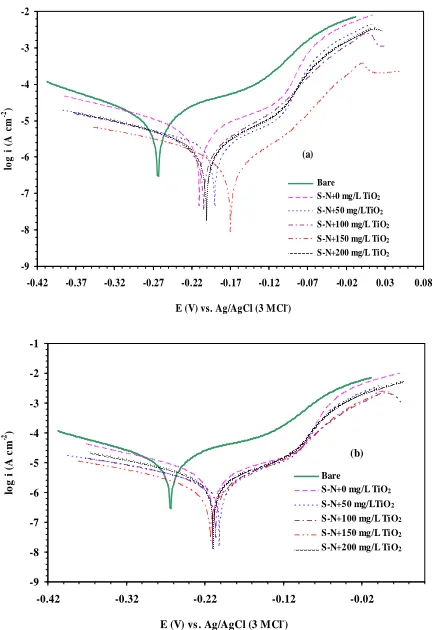
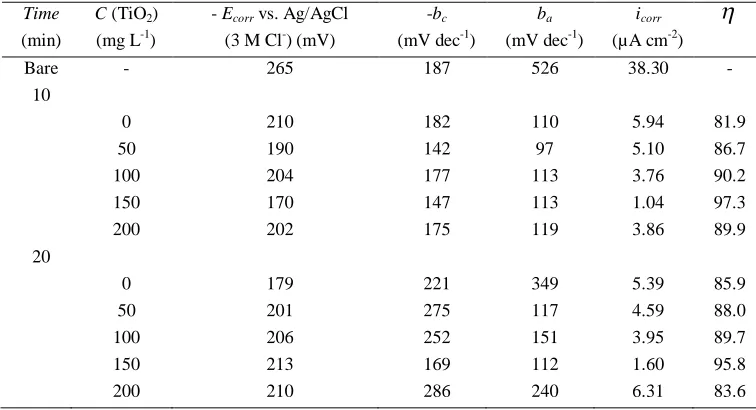
In this section, corrosion protection of copper electrode modified in SN-SAM-TiO2 solution at various concentrations of nanoparticles at 10 and 20 min assembling time for forming coatings at 298 K in 3.5% sodium chloride solution can be observed by corrosion current. Fig. 4 indicates the Tafel curves of bare and modified copper
electrodes in sodium chloride solution. The polarization parameters obtained by the Tafel extrapolation method have been listed in Table 2. The percentage inhibition efficiencies were calculated using the following equation [25]:
100
corr corr corr
i i i
(4)
where icorr and icorr are the corrosion current in
absence and presence of coating, respectively. The corrosion current and corrosion potential of coatings on copper were found to decrease with increasing of TiO2 until 150 mg L-1. For the bare copper electrode in sodium chloride solution the
icorr is 38.30 µA cm
-2
, when the copper was modified with SN-SAM solution for 10 min, icorr
decrease to 5.94 µA cm-2, and when the copper was modified with SAM solution containing 150 mg L-1 nanoparticles for 10 min, icorr decreases to
1.04 µA cm-2, which indicates corrosion current remarkably decreases in presence of coatings. Enhanced corrosion protection effect of SN-SAM-TiO2 nanocomposite can be because of inertness of TiO2 in an electrochemical environment;
principally because TiO2 has dielectric property,
high bond energy, and lattice this coating can
prevent the anodic dissolution process [26].
Moreover S atoms can be bonded to the Ti rows or
O vacancies in the bridging oxygen rows. The
O2p+Ti3d are valance bond, which are ideal for
(a)
-9 -8 -7 -6 -5 -4 -3 -2
-0.42 -0.37 -0.32 -0.27 -0.22 -0.17 -0.12 -0.07 -0.02 0.03 0.08 E (V) vs. Ag/AgCl (3 MCl
-)
lo
g
i
(
A
c
m
-2)
Bare 0 50 100 150 200 Bare S-N+0 mg/L TiO2
S-N+50 mg/LTiO2
S-N+100 mg/L TiO2
S-N+150 mg/L TiO2
S-N+200 mg/L TiO2
(b)
-9 -8 -7 -6 -5 -4 -3 -2 -1
-0.42 -0.32 -0.22 -0.12 -0.02 E (V) vs . Ag/AgCl (3 MCl
-)
lo
g
i
(
A
c
m
-2)
Bare 0 50 100 150 200 Bare S-N+0 mg/L TiO2
S-N+50 mg/LTiO2
S-N+100 mg/L TiO2
S-N+150 mg/L TiO2
S-N+200 mg/L TiO2
Fig. 4. Tafel polarization plots of copper electrode modified for (a) 10 min (b) 20 min assembling time in SN-SAM-TiO2 in sodium chloride solution.
As clearly seen in Table 2, the corrosion potential of the coating was more positive than the bare. In the literature [28, 29], it has been reported that if displacement in corrosion potential is less than 85 mV, the inhibitor can be seen as mixed
type; and if the displacement in corrosion potential
is bigger than 85 mV from corrosion potential of bare, the inhibitor can be seen as a cathodic or anodic type. At this work, the prepared coating have displacement lower than 85 mv, but for best coating with high inhibition efficiency there is 95 mV displacement. These results show the prepared coating at 150 mg L-1 nanoparticle for 10 min assembling time has more effect on protecting of anodic dissolution.
For investigation of effect immersion time in sodium chloride solution polarization curves of coating at various immersion times were shown at
Fig. 5. It is clear that both the cathodic and anodic
reactions were inhibited. The corresponding electrochemical parameters including corrosion potential, Tafel slopes, corrosion current and inhibition efficiency have been given in Table 3. It is evident from obtained results the coating indicates inhibition efficiency 96.1% even after 12.0 h immersion in corrosive media. The results indicate performance of coating hasn’t been shown significant change with increasing in immersion time.
-9 -8 -7 -6 -5 -4 -3
-0.35 -0.30 -0.25 -0.20 -0.15 -0.10 -0.05 0.00 0.05
E (V) vs. Ag/AgCl (3 M Cl-)
lo
g
i
(
A
c
m
-2)
0.5 h
6.0 h
12.0 h
Fig. 5. Tafel polarization plots copper electrode
modified for 10 min in SN-TiO2 (150 mg L
-1 ) in
Table 2. Electrochemical Tafel parameters of copper electrode modified at 10 and 20 min assembling time of SN- SAM-TiO2 in sodium chloride solution
Time
(min)
C (TiO2) (mg L-1)
- Ecorr vs. Ag/AgCl (3 M Cl-) (mV)
-bc
(mV dec-1)
ba
(mV dec-1)
icorr
(µA cm-2)
Bare - 265 187 526 38.30 -
10
0 210 182 110 5.94 81.9
50 190 142 97 5.10 86.7
100 204 177 113 3.76 90.2
150 170 147 113 1.04 97.3
200 202 175 119 3.86 89.9
20
0 179 221 349 5.39 85.9
50 201 275 117 4.59 88.0
100 206 252 151 3.95 89.7
150 213 169 112 1.60 95.8
200 210 286 240 6.31 83.6
Table 3. Electrochemical impedance analysis data of copper electrode modified for 10 min assembling time in
SN-SAM-TiO2 solution containing 150 mg L-1 TiO2 nanoparticle for different immersion time in sodium chloride
solution.
Time
(h)
- Ecorr vs. Ag/AgCl (3 M Cl-) (mV)
-bc
(mV dec-1)
ba
(mV dec-1)
icorr
(µA cm-2) η
0.5 170 147 113 1.04 97.3
6.0 173 143 223 1.23 96.8
12.0 180 111 138 1.49 96.1
3. 3. Effect of temperature
At this part, the influence of solution
temperature on inhibition efficiency of SN
-SAM-TiO2 coating was shown by Tafel polarization. To
investigation of effect temperature on the coating,
it was prepared for 10 min assembling time in SN
solution containing 150 mg L-1TiO2 nanoparticles
and was immersed in sodium chloride media for
30 min in the range of 298–328 K (Fig. 6). It was
observed that corrosion current and inhibition efficiency increase with increasing of temperature.
The increase in inhibition efficiency with increasing temperature can be attributed to strong adsorption of the coating to surface [20]. The
results of Table 4 suggest coating has high
(a)
-7.5 -6.5 -5.5 -4.5 -3.5 -2.5 -1.5
-0.45 -0.40 -0.35 -0.30 -0.25 -0.20 -0.15 -0.10 -0.05 0.00 E (V) vs. Ag/AgCl (3 M Cl-)
lo
g
i
(
A
c
m
-2)
298 K 308 K 318 K 328 K
Fig. 6. Tafel polarization plots copper electrode modified for 10 min assembling in SN-SAM-TiO2 (150 mg L-1) in
different temperature of sodium chloride solution
Table 4. Electrochemical parameters of copper electrode modified for 10 min assembling in SN-SAM-TiO2 (150 mg
L-1) in different temperature of sodium chloride solution
T
(K)
- Ecorr vs. Ag/AgCl (3 M Cl-) (mV)
-bc
(mV dec-1)
ba
(mV dec-1)
icorr
(µA cm-2)
Bare
298 265 187 526 38.30 -
308 268 306 291 67.57 -
318 272 312 577 109.29 -
328 282 405 246 132.10 -
coating
298 170 147 113 1.04 97.3
308 192 114 168 1.48 97.8
318 193 89 149 2.33 97.9
328 200 86 146 2.39 98.2
3. 4. Surface analysis
The surface morphology and composition of the
coatings were determined by scanning electron
microscopy and energy-dispersive X-ray
spectrometry. Fig. 7 (a-b) shows SEM images of
SN-SAM and SN-SAM-TiO2 coating. Fig. 8
indicates SEM images of copper without coating
and SN-SAM-TiO2 coating was immersed in
sodium chloride solution for 8.0 h. SEM image of
copper without coating was immersed in corrosive
solution show effect of attack of ions to copper
surface. Comparison of Fig. 7-b with Fig. 8-b
show that there are little change after washing the
samples in water and ethanol and immersing
electrode for 8.0 h at sodium chloride solution.
These results indicate the titanum were strongly
attached to the electrode (Fig. 7-b). The elemental
distribution of SN-SAM-TiO2 was investigated by
(b)
-9 -8 -7 -6 -5 -4 -3 -2
-0.40 -0.35 -0.30 -0.25 -0.20 -0.15 -0.10 -0.05 0.00 0.05 E (V) vs. Ag/AgCl (3 M Cl-)
lo
g
i
(
A
c
m
-2)
energy dispersive X-Ray method. EDX spectrums
indicated presence of titanium in coating SN
-SAM-TiO2(Fig. 9-b) than SN-SAM (Fig. 9-a).
Fig. 7.SEM images of copper with a) SN-SAM
coating, b) SN-SAM-TiO2coating
Fig. 8. SEM images of copper a) without coating after
8.0 h immersing in sodium chloride 3.5%, b) with SN
-SAM-TiO2 coating after 8.0 h immersing in sodium
chloride 3.5%
Fig. 9. EDX spectrums of copper a) with SN-SAM
coating, b) with SN-SAM-TiO2 coating
4. Conclusion
The SN solution containing 150 mg L-1 TiO2 nanoparticles indicated good resistance for copper corrosion in sodium chloride media. Obtained results suggested that the both amount of
(a)
(a)
) (b)
(b)
(a)
nanoparticle and immersing time are important parameters on the inhibition efficiency of prepared coating. The electrochemical indicated high ability of coating even at high temperature and immersing time in sodium chloride media. The EDX analysis and SEM image showed presence of titanium at coating and SEM image confirmed good performance of coating containing SN Schiff base and TiO2 nanoparticles with preparation at short time.
Acknowledgements
The authors are grateful to University of Kashan for supporting this work by Grant No.15919527.
References
[1] M.M. Singh, R.B. Rastogi, B.N. Upadhyay, M. Yadav. Mater. Chem. Phys. 80 (2003) 283–293. [2] M. Behpour, N. Mohammadi. Chem. Eng. Comm. 200 (2012) 1-16.
[3] E.M. Sherif, S.M. Park. Corros. Sci. 48 (2006) 4065-4079.
[4] M. Behpour, N. Mohammadi. Corrosion. DOI: http://dx.doi.org/10.5006/0607.
[5] K.C. Emregul, A.A. Akay and O. Atakol. Mater. Chem. Phys. 93 (2008) 325-329.
[6] M. Behpour, S.M. Ghoreishi, N. Mohammadi, N. Soltani, M. Salavati-Niasari. Corros. Sci. 52 (2010) 4046-4057.
[7] M. Behpour, S.M. Ghoreishi, N. Mohammadi, M. Salavati-Niasari, Corros. Sci. 53 (2011) 3380-3387.
[8] F.M. Donahue, K. Nobe. J. Electrochem. Soc. 112 (1965) 886-891.
[9] M. Behpour, N. Mohammadi. Corros. Sci. 65, (2012) 331-339.
[10] Y.Q. Feng, W.K. Teo, K.S. Siow, Z.Q. Gao, K.L. Tan, A.K. Hsieh. J. Electrochem. Soc. 144 (1997) 55-64.
[11] T.M. Nahir, E.F. Bowden. Electrochim. Acta. 39 (1994) 2347-2352.
[12] F.P. Zamborini, R.M. Crooks. Langmuir. 14 (1998) 3279-3286.
[13] L. Sun, R.M. Crooks. Langmuir. 9 (1993) 1951-1954.
[14] O. Chailapakul, L. Sun, C. Xu, R.M. Crooks. J. Am. Chem. Soc. 115 (1993) 12459-12467.
[15] M.F. Montemor, A.M. Cabral, M.G.S. Ferreira. Surf. Coat. Technol. 200 (2006) 2875-2885.
[16] M.F. Montemor, M.G.S. Ferreira. Prog. Org. Coat. 63 (2008) 330-337.
[17] X.H. Chen, C.S. Chen, H.N. Xiao, F.Q. Cheng, G. Zhang, G.J. Yi. Surf. Coat. Technol. 191 (2005) 351-356.
[18] P. Wang, C. Liang, B. Wu, N. Huang, J. Li. Electrochim. Acta. 55 (2010) 878-883.
[19] M. Behpour, S.M. Ghoreishi, N. Soltani, M. Salavati-Niasari. Corros. Sci. 51 (2009) 1073–1082. [20] M. Behpour, S.M. Ghoreishi, N. Mohammadi, N. Soltani, M. Salavati-Niasari. Corros. Sci. 52 (2010) 4046-4057.
[21] M. Li, Y. Yang, L. Liu, J. Hu, J. Zhang. Electrochim. Acta 55 (2010) 3008–3014.
[22] V. Palanivel, D. Zhu, W.J. van Ooij. Prog. Org. Coat. 47 (2003) 384–392.
[23] L. Liu, J.-M. Hu, J.-Q. Zhang, C.-N. Cao. Electrochim. Acta 52 (2006) 538–545.
[24] M.F. Montemora, M.G.S. Ferreira. Prog. Org. Coat. 63 (2008) 330–337.