Strojniški vestnik - Journal of Mechanical Engineering 53(2007)1, 3-12 UDK - UDC 62-225.5:532.525
Kratki znanstveni prispevek - Short scientific paper (1.03)
Vzporedni vplivi pospeška in površinskega ogrevanja na stisljiv
tok: simulacija vesoljske pogonske šobe s srednje veliko
površinsko obrabo
Parallel Effects of Acceleration and Surface Heating on Compressible Flow:
Simulation of an Aerospace Propulsion Nozzle with a Medium Amount of Surface
Wear
A. AlperOzalp (Uludag University, Turkey)
Numerične simulacije vesoljskih pogonskih šob so, zaradi nujnosti sočasnega obravnavanja pospeška toka, stopenj prenosa toplote, hrapavosti površine, temperaturno odvisnih lastnosti zraka in sprememb gostote tokovnic zaradi stisljivosti toka, zelo zapletene. Da bi zagotovili pregled za večstransko obravnavo toka pogonskih šob, smo razvili nov računski model, ki vključuje osnosimetrično zveznost, vztrajnostne in energijske enačbe. Izvedli smo računske preizkuse z različnimi geometrijskimi oblikami šob in vstopnimi robnimi pogoji ter s skupno obravnavo površinskega toplotnega toka in hrapavosti. Izračuni so pokazali, da se vstopna moč pogonske šobe in njene izgube povečujejo z večanjem notranjega statičnega tlaka ter zmanjšujejo z zoževalnim kotom šobe in površinskim toplotnim tokom. Ugotovili smo, da je razmerje izgub glede na vstopno moč neodvisno od toplotnega toka, vendar pa se linearno zmanjšuje s povečanjem zoževalnih kotov.
© 2007 Strojniški vestnik. Vse pravice pridržane.
(K ljučne besede: pogonske šobe, stisljivi tok, pretočni koeficient, izgube moči)
Numerical simulations o f aerospace propulsion nozzles are very complex due to the necessity to simultaneously handle flow acceleration, momentum heat-transfer rates, surface roughness, temperature-dependent air properties and streamwise density variations due to the compressible character o f the flow. To provide an overview fo r a multitask consideration o f the propulsion-nozzle flows, a new computational model that integrates the axi-symmetrical continuity, the momentum and the energy equations has been developed. Numerical experiments were performed with various nozzle geometries, inlet-boundary condi tions, with the combined handling o f the surface heat flux and roughness conditions. The computations indicated that the input and loss power values o f the propulsion nozzle increase with higher inlet stagna tion pressures and decrease with higher nozzle convergence half angles and surface heat flux. The ratio o f the loss to the input power was found to be independent o f the heat flux; however, it decreases linearly with an increase in the convergence half angles.
© 2007 Journal o f Mechanical Engineering. All rights reserved.
(Keywords: propulsion nozzle, compressible flow, discharge coefficient, pow er losses)
0 INTRODUCTION
Compressible flows are encountered in a wide variety o f engineering applications, e.g., the flow accelerator o f environmental control systems in com mercial aircraft [1] which supplies fresh air to the passenger cabins o f aircraft and the exhaust system o f nuclear propulsion engines [2], which generate
prediction in the design-oriented calculations o f compressible flows is still a challenging task that is becom ing increasingly important.
The m ain design considerations for com pressible-flow applications with nozzles are the flow geometries, the inlet-boundary conditions and the flow heat-transfer characteristics, where the perform ance predictions are reported by several experimen tal and numerical investigations. The effect o f noz zle-exit over-pressure on vortex formation, with its contribution to nozzle thrust, was experimentally examined by Krueger and Gharib [3]. Significant losses in efficiency, due to heat transfer, especially w hen the ratio o f the inlet stagnation to the back pressure converges to unity was determined by Lear et al. [4], who modelled the dissipative effects o f heat transfer on the exit kinetic energy and the noz zle efficiency. Orieux et al. [5] illustrated the steady and transient performance o f micro-nozzles for vari ous nozzle geometries, ambient conditions and sur face cooling, where the thrust values decreased both with cooling and with a narrower nozzle exit. The heat transfer and gas dynamics structure in a choked nozzle with cooling was experimentally investigated by Back et al. [6], Instabilities in the propulsion o f rockets, due to pressure and temperature fluctua tions at the upstream o f the rocket nozzle and due to the flow geometry, were numerically considered by Assovskii andRashkovskii [7]. Bartz [8] handled the heat-transfer phenom ena in com pressible nozzle flows and considered the Nusselt num ber as a func tion o f the inlet stagnation pressure and the conver gence half angle, and Ahmad [9] correlated the vari ation o f the nozzle discharge coefficients and sur fa c e h e a t-tra n s fe r v a lu e s fo r v a rio u s n o z z le geometries. A10° convergence half-angle nozzle with different working fluids and w ith a w ide range o f inlet stagnation pressures was experimentally con sidered by M assier et al. [10], who recorded lower discharge coefficients with a decrease in the inlet stagnation pressure. Paik et al. [11] studied the in fluence o f flow geometry and Reynolds number on the variation o f the discharge coefficients for sonic nozzles that are applied to gas flow-rate measure m ents, and reported higher discharge coefficients w ith an increase in the mass flow rate. Kim et al. [12] considered the effects o f several kinds o f gases and turbulence models with a wide range o f Reynolds num bers on different sonic nozzle geometries. The combined effects o f Reynolds number, area ratio and flow velocity on the critical pressure ratio o f sonic
nozzles were investigated by Park et al. [13]. Sato et al. [ 14] presented recent data on a real-time air-cooled propulsion ramjet engine. Ribault and Friedrich [15] investigated com pressible flow behaviour along adiabatic and cooled w alls by implem enting the turbulent momentum and heat-transport analogies in a code.
Although the available literature is highly concentrated on heating/cooling applications, inlet/ exit conditions and the geometrical structures o f the nozzles, surface roughness (<?) is becoming o f major interest for com pressible/incom pressible nozzle flows. Gas-solid particle flows in the nozzles together with the high pressures and temperatures within the flow volume are the main sources o f augmentations in the surface roughness. Kumar et al. [ 16] performed an experimental study o f nozzle wear due to gas- solid particle flow and determined an increase in the relative roughness (é/D .J values from 0.006 to 0.052. Bussiere and M ora [17] presented the real-time data o f an Ariane 5 rocket-booster nozzle, where the rela tive roughness increased from a perfect surface fin ish to 0.012 during a flight that initiates with a launch and ends with the rocket in orbit.
A lthough the surface roughness and the surface heat flux act simultaneously in real-time sys tems, the available literature deals with them sepa rately. The combined effects have not yet been con sidered. To perform a comprehensive computational study, a new mathematical model, capable o f imple m enting both the surface roughness and the sur face heat flux (Q) conditions for aerospace propul sion nozzles was developed. Choked and un-choked cases were investigated for various convergence half angles (a), rafia o f inlet stagnation to back pressure
(ß=(PJ J P ,) and Q cases, and the proposed method was validated with the previous experimental and numerical reports.
1 MODELLING AND COMPUTATION
en-ergy conservation and on the momentum and state equations applied to the control volume, given in Fig. 1. It is assumed that the stagnation conditions o f pressure and temperature in the storage tank, upstream o f the nozzle, are homogeneous and, as in many numerical studies [2] to [13], the air velocity, pressure and temperature are considered to be uni form across any section normal to the flow axis. Since air properties, like the specific heat at constant pres sure (Cp ), the kinematic viscosity ( v) and the Prandtl number (Pr), are substantially dependent on tem perature (7) [18], they are characterized by 6th-order polynomials with an uncertainty o f less than 0.02%, and the temperature dependency is indicated by the superscript T throughout the formulation.
As the study is focused on flows with fric tion and heat transfer, the stagnation pressure (Po ) and stagnation temperature (T ) values will also vary in the flow direction with the variation in the Mach number (M). Thus, the conventional equations (Eqs.
1 and 2) for compressible, isentropic and one-dimen sional flows are applicable only with the simultane ous handling o f the momentum and energy
equa-(2)
m = piU,Aj (3)
(4)
p
P, = -rr- (5)
RT.
(6)
(Poh
P, l 2
( U
=1
+^ v
The nodal values (subscript i) o f the mass flow rate ( m ) the air velocity ( U) and the density (p)
can be calculated using Eqs. 3 to 5, where the mass flow rate, the most significant consideration from a numerical point o f view, is kept constant in the flow direction. On the other hand, the diameter (D), based the Reynolds number (Eq. 6), is assigned to each differential cell with the mean cellular values o f U, D
and v. The friction coefficient (f) is a function of both ReD and s (Eq. 7), and the cell-based (subscript n) shear stress (r) and friction force (Ff ) can be ex pressed with Eqs. 8 to 9.
V7T
-3.6 log 6.9(ReD)„
?/g„~
3.7 (7)
(
8
)(fy )n=r„^D„Ax„ (9) The one-dimensional momentum (Eq. 10) and energy equations (Eq. 11) are applied to each differ ential cell in the nozzle, where the nodal properties, such as P, U and are interrelated with the contri butions o f cellular variants like Ff and the impulse (l). Eq. 11 represents the conservation o f mechani cal and thermal energy by the implementation o f a cell-based surface flux and the frictional loss term.
PA +mU'= PmAm + m UM + (F, \+ I„ (10)
0.50 to 0.85, with the empirical correlation o f Eq. 12. In the current study the M ach numbers are within 0.05 to 1.0, similar to the subsonic data o f [1], and Eq. 12 is applied with the cell-based values o ffl Pr
and Re/X Moreover, the combined effects o f fa n d Q
on the mass flow rate are investigated through the non-dimensional discharge coefficient (C(/) o f Eq. 13, which compares the real mass flow rate with that o f the isentropic case.
( / ^ j [ ( ReD), - 1 0 3lPrnTJ n / — /\ 0.5
l + 12.7[f^ j 1
1
_____
1
Cd = ^ L (13)
m isen
For the one-dimensional, compressible march ing procedure, forward difference discretization is applied in the flow direction, as defined by Chapra and Canale [19], Since the continuity, momentum and energy equations are to be solved, the geometric dom ain is divided into n sequential cells, having an equal width equal to Ax. The fineness o f the compu tational grids was examined to ensure that the ob tained solutions were independent o f the grid em ployed. Initial runs indicated that with more than
1000 cells the results showed no sign o f change with the grid density. Therefore, to provide more reason able predictions computations were performed with n= 1000. Flow parameters, like U, P, T, p and stagna
tion data (P To ), were calculated at the nodes o f these cells, which are numbered from i= l to n +1, whereas t, I, ReD and NuD were evaluated on a cell basis using the mean values o f nodal inlet and exit data o f each cell.
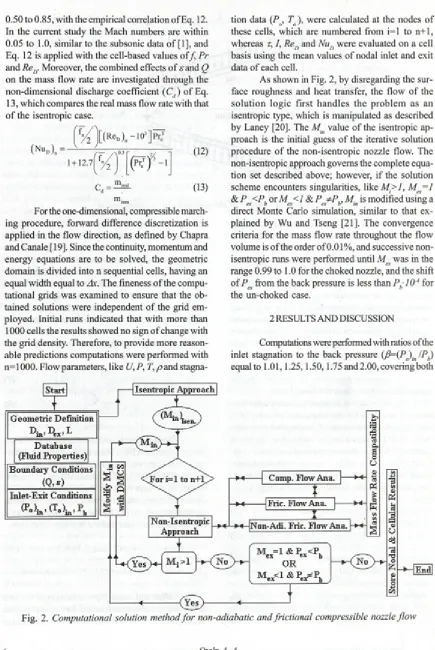
As shown in Fig. 2, by disregarding the sur face roughness and heat transfer, the flow o f the so lution logic first handles the problem as an isentropic type, which is manipulated as described by Laney [20]. The M.n value o f the isentropic ap proach is the initial guess o f the iterative solution procedure o f the non-isentropic nozzle flow. The non-isentropic approach governs the complete equa tion set described above; however, if the solution scheme encounters singularities, like M>1, M e =l
& P <P or M <1 & P *P,,M . is modified using a direct Monte Carlo simulation, similar to that ex plained by Wu and Tseng [21]. The convergence criteria for the mass flow rate throughout the flow volume is o f the order o f 0.01 %, and successive non- isentropic m ns were performed until M was in the range 0.99 to 1.0 for the choked nozzle, and the shift o f P from the back pressure is less than Ph IP 4 for the un-choked case.
2 RESULTS AND DISCUSSION
Computations were performed with ratios o f the inlet stagnation to the back pressure ( ß f l P f m !Ph)
equal to 1.01,1.25,1.50,1.75 and 2.00, covering both
Start
Geometric Definition
D atabase (Fluid Properties) Boundary Conditions
1
i
(Q,s)
s
Inlet-Exit Conditions
w
•fi
P - W (T° \ n ,P hi
■fIsentropic Approach
Comp. Flow Ana.
Fric. Flow Ana. Non-isentropic
Approach M M
M =1 & Pex<P.6X b OR M ex< l & P e^ P h
- K
Non-Adi. Fric. Flow Ana.
-M-I
1
f
O U
at
’S
rt
-<n
T)-*-< g >
-»HEndl
Fig. 3. Streamwise variation o f the Mach number with various a, ß and Q conditions
the un-choked and choked flow cases. To build a comprehensive overview and to include the most frequent geometrical structures, analyses were con ducted at nozzle-convergence half angles (a ) from 3° to 9°. The medium value o f 0.0125, which is similar to the experimental data o f Kumar et al. [16] and Bussiere and M ora [17], was selected for the non- dimensional surface roughness (# © „) o f the nozzle wall, and the effects o f constant surface heat flux were evaluated by imposing three distinct values o f 2=800,1200 and 1600 kW/m2. The results o f various design and boundary-condition cases are discussed through streamwise variations o f the Mach number, non-dimensional pressure values, flow and surface temperature data and the Nusselt number. Moreover, the influences o f the a, ß and Q conditions on the discharge coefficient and the input and loss power values are presented for a comparison.
Stream w ise M ach-num ber variations are given in Fig. 3 for various a, ß and Q cases. Fig. 3 suggests that flows with a lower ß result in a lower
M.n and Ma for all the nozzle-convergence half an gles (« = 3° to 9°). When compared with the /£=2.00 pattern, /£=1.25 caused a decrease o f 22.8% and 27.2% in M for the isentropic and 2=1600 kW /m2
cases in the a=3° nozzle, whereas the similar ratios for /M .0 1 are 82.3% and 88.5%. On the other hand, for the ct=9° nozzle, the decreased amounts in Mjn for
ß = \2 5 were 18.9% and 24.8%, and fo r>9=1.01 they were 80.2% and 85.6% for the isentropic and Q= 1600 kW/m2 cases, respectively. These proportions sug gest that the decreased amounts are more apparent for lower a and less for the sharp convergent case (o=9°). In the exit plane the Ma values are identical and equal to 1, being independent o f M.n, for the /£=2.00 case, which corresponds to a choking condi tion for the complete «range. However, as ß is low ered, the nozzles run in the un-choked condition with
accompanied decreases in M . The variations in M , when compared with the above discussions about
M.n, are small and kept in the range 2 to 4% for the complete a, Q and ß set. Fig. 3 further implies that the application o f a surface heat flux produces lower
M values throughout the nozzle, regardless o f the level o f ß and a. These findings are similar to those o f Lear et al.’s [4] numerical and Sato et al.’s [14] experimental determinations. Application o f the con stant-surface-temperature condition on the nozzle wall [4] caused flow velocities, and thus M, to de crease, whereas the cooling o f the nozzle surface [14], which is the opposite operation to that studied here, resulted in higher mass flow rates. For the «=3° nozzle, the heat flux o f 2=1600 kW/m2 results in a decrease in Mjn by 7.3%, 12.5% and 40% for ßequal to 2, 1.25 and 1.01, respectively. On the other hand, the same flux constitutes a lowerM.n by 6.9%, 11.6% and 36.5% for a= 9° in the same /frange. These pro portions suggest that the effect o f the heat flux on the M pattem is more apparent with a lower a.
In compressible flows, static pressure (P) variation is a major consideration since in the case that the inlet stagnation (PJ values attain signifi cant levels, the nozzle walls will be obliged to face pressure forces that may be at the wear or crack limit o f the nozzle material. In fact the conventional theory (Eq. 1) implies that the extreme P value can be as high as P , which can be controlled at the nozzle inlet. However, the missing part o f the theory is the probability o f an augmentation in Po in the flow di rection w ith in the nozzle. Fig. 4 displays the stre a m w ise v a ria tio n o f P, th a t is non- dim ensionalized by the inlet stagnation value o f
On the other hand, w ith an increase in the surface heat flux, the P values, throughout the flow volume, also increased, which was accompanied by a decrease in the Mach numbers (Fig. 3), and the variations in the static pressures and the Mach num bers were more distinguishable for the nozzles with low convergence half angles (a*=30). For the cc= 3° case, Fig. 4 further indicates that the pressure val ues continuously decrease in the streamwise direc tion if the ratio o f the inlet stagnation to the back pressure (ß) is kept above 1.25, which is similar to the reports o f Kim et al. [12]. This fact keeps the static pressure values below the stagnation value, which in return eliminates the probability o f system damage. Flowever, for the lowest / / o f 1.01, the static pressure values remain around the inlet stagnation value, which is remarkable from the point o f view of momentum transfer. In the cases with higher con vergence half angles (a=6 to 9°) the local static pres sure values exceed the inlet stagnation value by up to 6.3%, particularly for the scenario o f oc=9°, /1=1.01. Simultaneous handling o f the momentum and en ergy equations (Eqs. 10 and 11) suggests that the frictional behaviour o f the compressible flow de creases the stagnation pressure in the flow direc tion; however, the application o f the surface heat flux produces the opposite effect on the stagnation pressure. The curves o f Fig. 4 indicate that the im pact o f Q on Pg increases in cases with higher a,
where the mass flow rates are comparably smaller. The energy transferred through the nozzle walls is absorbed by the flow, in greater amounts per unit mass for « o f 6 to 9° with ß=\ .01, and stored in stag nation pressure form. As a consequence, increased static pressure values may cause damage to the noz zle structure; moreover, they m ay also increase the wear rates. The following decrease in P values for
jc>0.3 m (a=9°) is due to the higher acceleration rates o f the flowing air, which can also be seen in Fig. 3.
1.10
oO a =3
(Po)i„
0.95 0.90 0.85 0.80
: = * =
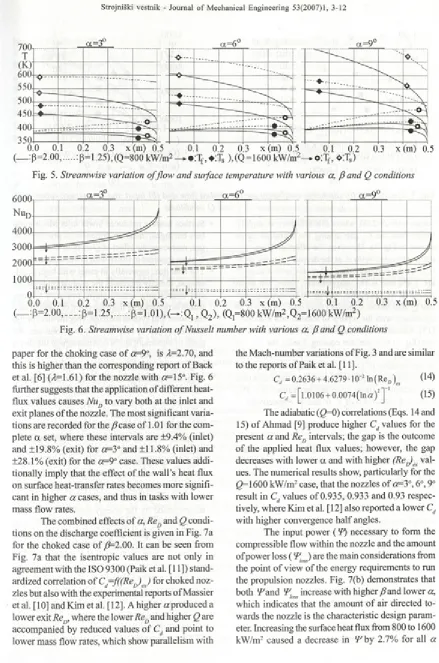
-The streamwise variations o f the fluid (T ) and surface (T ) temperatures are presented in Fig. 5. As a consequence o f the applied surface heat flux, the T values are above T. for the complete a and ß
ranges and also throughout the flow volume. On the o th e r h an d , as th e T v a lu e s d e c re a se in the streamwise direction, the opposite is true for Tf in all cases. The decrease rates o f T become more signifi cant towards the nozzle exit, especially forx>0.45 m, where the highest flow acceleration is determined for all the nozzles. Lower ß and higher a indicates lower mass flow rates, which constitutes higher T
and Tj, especially at the nozzle inlet. The durability o f the nozzle material is directly related to the T , and the computations suggest the upstream nozzle sec tions should be carefully considered. On the other hand, surface wear is connected w ith Tp and the vital regions appear towards the downstream regions o f the nozzle, specifically at the exit plane.
Fig. 6 presents the streamwise variations of surface heat-transfer rates for various convergence- half-angle and pressure-ratio cases, with the appli cation o f constant surface heat-flux values o f 800 and 1600 kW /m2. The Nusselt numbers {Nuß) were observed to increase in the flow direction for the complete set o f investigated systems; however, a
and Q appeared to cause the NuD to decrease in both the choked (//=2.00) and un-choked (//<2.00) cases. This outcome is highly dependent on the fact that narrower nozzles and higher heat-flux values contributed to lower mass flow rate values (Fig. 3), and thus M and U, which also decrease the amount o f heat swept from the nozzle wall. On the other hand, the ratio o f the ex it to in let N u sse lt num bers
A=(NußJ(N uI) . n increases with ß and a, whereas it decreases with Q. Bartz [8] also reported increased
A ratia with higher a and /?; moreover, the typical report o f Ahmad [9] for a nozzle with a=45° is A - 3.9. The most significant ratio, evaluated in the present ot=6° a =9°
x (m ) 0.5
—
4-\ 4-\ __ ^__
\ \ \ \
\ \ ---1 ----x (m) 0.5 0.1 0.2 0.3 X (m) 0.5 (— :ß=2.00,__ :ß=1.25’ :ß= 1.01),(— :Q j, Q2), (Qj=800 kW/m2,Q 2=1600 kW/m2)
Fig. 5. Streamwise variation o f flow and surface temperature with various a, ß and Q conditions
Fig. 6. Streamwise variation o f Nusselt number with various a, ß and Q conditions
paper for the choking case o f ot=9°, is 1=2.70, and this is higher than the corresponding report o f Back et al. [6] (/1=1.61) for the nozzle with o=15°. Fig. 6
further suggests that the application o f different heat- flux values causes NuD to vary both at the inlet and exit planes of the nozzle. The most significant varia tions are recorded for the /?case o f 1.01 for the com plete a set, where these intervals are ±9.4% (inlet) and ±19.8% (exit) for a=3" and ±11.8% (inlet) and ±28.1% (exit) for the a=9° case. These values addi tionally imply that the effect o f the wall’s heat flux on surface heat-transfer rates becomes more signifi cant in higher a cases, and thus in tasks with lower mass flow rates.
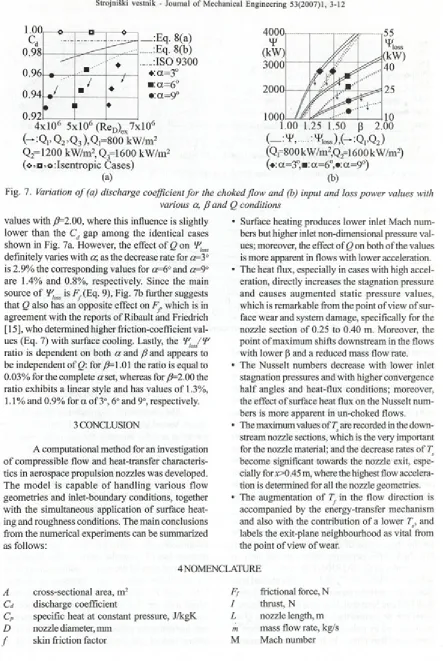
The combined effects o f a, ReD and Q condi tions on the discharge coefficient is given in Fig. 7a for the choked case o f ß=2.00. It can be seen from Fig. 7a that the isentropic values are not only in agreement with the ISO 9300 (Paik et al. [11]) stand ardized correlation o f C =f((ReD) ej for choked noz zles but also with the experimental reports o f Massier et al. [10] and Kim et al. [12]. A higher «produced a lower exit ReD, where the lower ReD and higher Q are accompanied by reduced values o f Cd and point to lower mass flow rates, which show parallelism with
the Mach-number variations o f Fig. 3 and are similar to the reports o f Paik et al. [11].
C j = 0.2636+ 4.6279-KT2 In( R e ^ ( 14) Q = [ l .0 1 0 6 + 0 .0 0 7 4 (ln « )2] (15)
The adiabatic ((7=0) correlations (Eqs. 14 and 15) o f Ahmad [9] produce higher Cd values for the present a and ReD intervals; the gap is the outcome o f the applied heat flux values; however, the gap decreases with lower a and with higher (R e j^ val ues. The numerical results show, particularly for the (>=1600 kW /m2 case, that the nozzles o f «=3°, 6°, 9° result in Cd values o f 0.935, 0.933 and 0.93 respec tively, where Kim et al. [12] also reported a lower Cd
with higher convergence half angles.
The input power ( 7) necessary to form the compressible flow within the nozzle and the amount o f power loss ( 7 ^ ) are the main considerations from the point o f view o f the energy requirements to run the propulsion nozzles. Fig. 7(b) demonstrates that both T'and increase with higher /?and lower a,
1
no
«
cd
0.98
0 96
— :Eq. 8(a)
...:Eq. 8(b)
_:ISO 9300
♦:a=3°
■:a=6°
• :a - 9 °
♦
0.94
0.92
v U
/
■
♦
•
' 1
♦
' 4 x l0 6 5 x l0 6 (ReD)ex7 x l0 6
( - : Qi> Q2 ’ Q 3 ), Q
i=800 kW /m2
Q2=1200 kW/m2, Q3=1600 kW /m2
(o>n>o:Isentropic Cases)
(a)
(Q f800 kW/m2, Q2=l 600 k W/m2)
(♦: a=3°, ■: a = 6 ‘> : a=9°)
(b)
Fig. 7. Variation o f (a) discharge coefficient fo r the choked flow and (b) input and loss power values with various a, ß and Q conditions
values w ith / L2.00, where this influence is slightly low er than the Cd gap am ong the identical cases shown in Fig. 7a. Flowever, the effect o f Q on W
definitely varies with or, as the decrease rate for a=3°
is 2.9% the corresponding values for «=6° and oc= 9° are 1.4% and 0.8%, respectively. Since the main source o f is F/ (Eq. 9), Fig. 7b further suggests that Q also has an opposite effect on Ff which is in agreem ent with the reports o f Ribault and Friedrich [15], who determined higher friction-coefficient val ues (Eq. 7) w ith surface cooling. Lastly, the 'FloJ ' ¥
ratio is dependent on both a and ß and appears to be independent o f Q: for / L i .01 the ratio is equal to 0.03% for the complete « set, whereas for ß=2.00 the ratio exhibits a linear style and has values o f 1.3%, 1.1% and 0.9% for a o f 3°, 6° and 9°, respectively.
3 CONCLUSION
A computational method for an investigation o f compressible flow and heat-transfer characteris tics in aerospace propulsion nozzles was developed. The m odel is capable o f handling various flow geometries and inlet-boundary conditions, together w ith the simultaneous application o f surface heat ing and roughness conditions. The main conclusions from the numerical experiments can be summarized as follows:
• Surface heating produces lower inlet M ach num bers but higher inlet non-dimensional pressure val ues; moreover, the effect o f Q on both o f the values is more apparent in flows with lower acceleration. • The heat flux, especially in cases with high accel
eration, directly increases the stagnation pressure and causes augm ented static pressure values, which is remarkable from the point o f view o f sur face wear and system damage, specifically for the nozzle section o f 0.25 to 0.40 m. Moreover, the point o f maximum shifts downstream in the flows with lower ß and a reduced mass flow rate. • The Nusselt numbers decrease with lower inlet
stagnation pressures and with higher convergence h alf angles and heat-flux conditions; moreover, the effect o f surface heat flux on the Nusselt num bers is more apparent in un-choked flows. • The maximum values o f Ts are recorded in the
down-stream nozzle sections, which is the very important for the nozzle material; and the decrease rates o f T
become significant towards the nozzle exit, espe cially forx>0.45 m, where the highest flow accelera tion is determined for all the nozzle geometries. • The augmentation o f Tf in the flow direction is
accompanied by the energy-transfer mechanism and also with the contribution o f a lower T, and labels the exit-plane neighbourhood as vital from the point o f view o f wear.
4 NOMENCLATURE
A cross-sectional area, m2 Ff frictional force, N
Cd discharge coefficient I thrust, N
Cp specific heat at constant pressure, J/kgK L nozzle length, m
D nozzle diameter, mm m mass flow rate, kg/s
Nud Nusselt number V kinematic viscosity, m2/s
P pressure, Pa p density, kg/m3
Pr Prandtl number T shear stress, Pa
Q surface heat flux, W/m2 power, kW R gas constant, J/kgK
Reo Reynolds number Subscripts
T temperature, K b, o back, stagnation
U
air velocity, m/s D diameterX streamwise direction, m ex, in exit, inlet
i,n node, cell number G reek Letters loss loss power
a convergence half angle, deg s heat-transfer surface
ß ratio o f the inlet stagnation to the back
pressure Superscripts
£ surface roughness, mm T temperature dependency
r
specific heat ratio — cellular average5 REFERENCES
[1] Vargas, J.V.C., A. Bejan (2001) Thermodynamic optimization o f finned crossflow heat exchangers for aircraft environmental control systems. Int J Heat Fluid Flow 22(2001), pp. 657-665.
[2] Kammash, T., T. Godffoy (1997) An open cycle gas core fusion rocket for space exploration. Acta Astronautica 41(1997), pp. 229-237.
[3] Krueger, P.S., M. Gharib (2003) The significance o f vortex ring formation to the impulse and thrust o f a startingjet. Physics o f Fluids 15(2003), pp. 1271-1281.
[4] Lear, W.E., S.A. Sherif, J.R. Langford (1997) Efficiency and gas dynamics analysis o f two-phase mixtures in supersonic nozzles with inter-phase heat transfer and slip. Acta Astronautica 40(1997), pp. 701-706. [5] Orieux, S., C. Rossi, D. Esteve (2002) Compact model based on a lumped parameter approach for the
prediction o f solid propellant micro-rocket performance. Sensors and Actuators A-Physical 101(2002), pp. 383-391.
[6] Back, L.H., RF. Massier, R.F. Culfel (1996) Some observations on reduction o f turbulent boundary-layer heat transfer in nozzle. AIAA Journal 4(1996), pp. 2226-2229.
[7] Assovskii, I.G., S.A. Rashkovskii (2001) Low-frequency instability o f solid rocket motors: Influence o f the Mach effect and charge geometry. Combustion, Explosion and Shock Waves 37(2001), pp. 321-330. [8] Bartz, D.R. (1957) A simple equation for rapid estimation o f rocket nozzle convective heat transfer coeffi
cients. Jet Propulsion 27(1957), pp. 49-51.
[9] Ahmad, R.A. (2001) Discharge coefficients and heat transfer for axisymmetric supersonic nozzles. Heat Transfer Engineering 22(2001), pp. 40-61.
[10] Massier, P.F., L.H. Back, M.B. Noel, F. Saheli (1970) Viscous effects on the flow coefficient for supersonic nozzle. AIAA Journal8( 1970), pp. 605-607.
[11] Paik, J.S., K.A. Park, J.T. Park (2000) Inter-laboratory comparison o f sonic nozzles at KRISS. Flow Meas urement and Instrumentation 11(2000), pp. 339-344.
[12] Kim, H.D., J.H. Kim, K.A. Park, T. Setoguchi, S. Matsuo (2003) Computational study o f the gas flow through a critical nozzle. Proc Instn Mech Engrs Part C: JM ech Eng Sci 217(2003), pp. 1179-1189. [13] Park, K.A., Y.M. Choi, H.M. Choi, T.S. Cha, B.H. Yoon (2001) The evaluation o f critical pressure ratios o f
sonic nozzles at low Reynolds numbers. Flow Measurement and Instrumentation 12(2001), pp. 37-41. [14] Sato, T , N. Tanatusgu, Y. Naruo, T. Kashiwagi, J. Omi, J. Tomike, T. Nishino (2000) Development study on
ATREX engine. Acta Astronautica 47(2000), pp. 799-808.
[ 16] Kumar, R., A.P. Verma, G.K. Lai (1983) Nozzle wear during the flow o f a gas-particle mixture. Wear 91(1983), pp. 33-43.
[17] Bussiere, M., B. Mora (1994) Ariane 5 booster nozzle: components description and dimensioning. Acta Astronautica 34(1994), pp. 83-89.
[18] Incropera, F.R, D.R De Witt (1990) Fundamentals o f heat and mass transfer. John Wiley & Sons, New York.
[19] Chapra, S.C., R.P. Canale (1990) Numerical methods for engineers .McGrow Hill, Singapore. [20] Laney, C.B. (1998) Computational gasdynamics. Cambridge University Press, Cambridge.
[21] Wu, J.S., K.C. Tseng (2001) Analysis o f micro-scale gas flows with pressure boundaries using direct simulation Monte Carlo method. Computers and Fluids 30(2001), pp. 711-735.
A uthor’s Address: Prof. Dr. A. Alper Ozalp Uludag University
Department o f Mechanical Eng. 16059 Gorukle, Bursa, Turkey [email protected]
Prejeto:
Received: 27.4.2005
Sprejeto:
Accepted: 25.10.2006
![Fig. 1. It is assumed that the stagnation conditions equations applied to the control volume, given in number perature (7) [18], they are characterized by polynomials with an uncertainty of less than upstream of the nozzle, are homogeneous and, as in press](https://thumb-us.123doks.com/thumbv2/123dok_us/8954685.1864053/3.482.30.458.33.252/stagnation-conditions-equations-perature-characterized-polynomials-uncertainty-homogeneous.webp)