D
D
E
E
V
V
E
E
L
L
O
O
P
P
S
S
E
E
L
L
F
F
-
-
S
S
T
T
U
U
D
D
Y
Y
I
I
N
N
G
G
A
A
B
B
I
I
L
L
I
I
T
T
Y
Y
O
O
F
F
H
H
I
I
G
G
H
H
S
S
C
C
H
H
O
O
O
O
L
L
S
S
T
T
U
U
D
D
E
E
N
N
T
T
S
S
T
T
H
H
R
R
O
O
U
U
G
G
H
H
L
L
E
E
A
A
R
R
N
N
I
I
N
N
G
G
P
P
R
R
O
O
J
J
E
E
C
C
T
T
S
S
-
-
A
A
C
C
A
A
S
S
E
E
S
S
T
T
U
U
D
D
Y
Y
I
I
N
N
V
V
I
I
E
E
T
T
N
N
A
A
M
M
N
Ng
gu
uy
ye
en
n
V
Va
an
n
Q
Qu
uy
ye
en
n
Tran Phu Specialized High School, Hai Phong province, Vietnam
Email: [email protected] ABSTRACT:In addition to traditional teaching methods,
project-based teaching method has been introduced to catch up with the modern trend in education in the world towards improving students' self-learning capacity. By understanding the principles of project-based teaching teachers will have more opportunities to promote the self-learning of students, thereby making teaching activities more plentiful and practical.
Therefore, in this research I aim to enhance the capacity of Mathematics self-studying of high school students through learning projects. This research was done through studying documents related to capacity and Mathematics self-study ability. In addition, in order to evaluate the results of mathematics self-study capacity of high school students in Vietnam I and the teachers involved in the project designed the assessment tool set including self-studying ladder levels, and a self-assessment note. Fourteen 10-grade students were randomly selected to participate in the project. Research results: The learning project has improved the efficiency, confidence and interest of students in solving practical problems, nurturing creative talents. Students increase their self-study ability. In addition, this self-study is the basis for teachers, educational researchers and curriculum developers to implement a constructive approach in enabling students to understand the relationship between theory and practice, then improving students' self-studying ability.
KEYWORDS: Project -based teaching, self-studying ability, solving practical problems.
1. INTRODUCTION
Self-study is a process in which a learner transforms himself, transforms his values, enriches his values by manipulating thinking and willing, energy and personal learning passion. Self-study in high schools is in fact still a problem that has not been implemented regularly and continuously, although modern education has been mentioned for a long time. Undeniably in high school there are students who are passionate about learning and always conscious of self-study but not many. In the growing trend of society, the issue of self-study in schools has been even more concerned than ever. Self-study must become one of the most important skills of education. The learners themselves need to become
familiar with self-study, form a self-learning ability so that later on they can continue learning by themselves to improve their knowledge and adapt to the times. Therefore, self-study of high school students is a necessary strategic issue.
Self-study of high school students as well as self-study of students in general is a combination of many abilities. The purpose of students' self-study is to successfully complete certain parts of their learning tasks without their teachers. Thus, self-study of high school students is always associated with proactive and positive competencies. Students have to study materials on their own, discover their own knowledge, capture part of their knowledge by themselves. Students must regularly search for materials related to the lesson to compare, and self-apply to transform knowledge of lessons under the direction and guidance of teachers.
For example, after watching a video, students remember more when they are asked questions about the video content than when they simply re-watch it ([JM09]). Furthermore improves long-term learning ([KR08]), and outperforms popular study methods such as note-taking and restudying ([D+13]). The self-study capacity of high school students has only been at a low level, but this is an extremely important basis for the formation of high self-learning and self-study capacity later. The school will create a solid foundation for a mature scientist's self-learning and self-studying experience.
Teachers are instructors, organizations for students to self-study to find knowledge and express themselves in the classroom; teachers are an adviser or referee. Conclusions in dialogue debates (Students - Students - Teachers - Teachers) are to confirm the knowledge that students find, and teachers are the testers to evaluate the self-study results of students.
In the process of study, students are always self-reliant, dynamic and creative, know how to learn and evaluate, compare, know and test situations. More importantly, students must know how to self-dominate documents. In parallel with maximizing the internal resources of students in the process of self-study, the role of teachers is extremely important. If in society, learners have the right to choose knowledge for self-study and self-study freely, the self-study in the school is oriented, teachers have the responsibility to guide them from how to study the textbooks themselves, to adjust the knowledge that they acquire to get the most accurate knowledge. Thereby, teachers form and develop the self-learning ability for students with ways of thinking and searching to be able to set problems, solve problems and self-study. The orientations of teachers also work to promote the dynamism, self-awareness and passion for learning in the learning process of students.
2. RESEARCH METHODS
Aims of research
The objective of the research is to enhance of mathematics self-studying capacity for high school students through learning projects
Research questions
This research aims to answer these following questions:
1. What are the views on mathematics self-study capacity in Vietnam high schools?
2. What are the benefits for students participating in project-based learning?
Research Methods
This study was carried out through studying documents related to mathematics self-learning capacity. In order to evaluate the results of self-studying capacity of high school students in Vietnam, me and the teachers involved in the project designed a set of assessment tools including self-study scales and mathematics self-assessment note, assessing the capacity of self-study Math. Then we set up learning contents and learning projects. After students attended the learning activities, I let them answer the self-assessment form.
Data collection and analysis
To determine the level of students' self-learning ability in mathematics, I conducted project-based learning activities with 14 students. After the set time (2 days), I let them answer the self-assessment form to determine their mathematical thinking and manipulation process when solving the problem. Along with the self-assessment form, I conducted face-to-face conversations with students in order to learn how they self-study. I recorded the conversations as materials for research.
After obtaining the data, I processed the data and showed it through the evaluation chart.
Table 1. The self-learning scale of 5 steps is presented in the table below along with the external manifestations of each step
Step External manifestations
Self-learning motivation and attitude 1. Interested in self-study 2. Conscious of self-study Competence to determine the content, goals
and tasks of self-study
3. Ability to detect content for self-study Ability to define learning goals and tasks Ability to propose, develop self-study plan
4. Ability to analyze content for self-study
5. Ability to identify documents related to self-study content 6. Ability to identify self-study steps and results to be achieved
Ability to implement self-study plans
7. Ability to study documents, propose measures to solve the problem set by each step.
8. The ability to use relevant documents along with knowledge and awareness to fulfill the goal of each step
9. Combine the results of each step. Summarize, generalize the results of the steps to complete the set objectives of the self-study process
Ability to self-assess and adjust self-study plans
10. Ability to assess advantages and disadvantages of implementing self-study plans based on results achieved 11. Ability to adjust self-study plans based on the advantages and
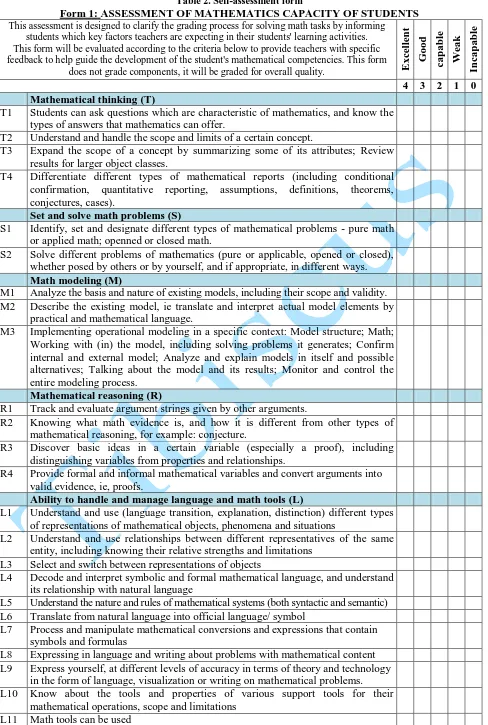
Table 2.Self-assessment form
Form 1: ASSESSMENT OF MATHEMATICS CAPACITY OF STUDENTS
This assessment is designed to clarify the grading process for solving math tasks by informing students which key factors teachers are expecting in their students' learning activities. This form will be evaluated according to the criteria below to provide teachers with specific feedback to help guide the development of the student's mathematical competencies. This form
does not grade components, it will be graded for overall quality. E
xc
el
le
n
t
G
ood
cap
ab
le
We
ak
In
cap
a
b
le
4 3 2 1 0 Mathematical thinking (T)
T1 Students can ask questions which are characteristic of mathematics, and know the types of answers that mathematics can offer.
T2 Understand and handle the scope and limits of a certain concept.
T3 Expand the scope of a concept by summarizing some of its attributes; Review results for larger object classes.
T4 Differentiate different types of mathematical reports (including conditional confirmation, quantitative reporting, assumptions, definitions, theorems, conjectures, cases).
Set and solve math problems (S)
S1 Identify, set and designate different types of mathematical problems - pure math or applied math; openned or closed math.
S2 Solve different problems of mathematics (pure or applicable, opened or closed), whether posed by others or by yourself, and if appropriate, in different ways.
Math modeling (M)
M1 Analyze the basis and nature of existing models, including their scope and validity. M2 Describe the existing model, ie translate and interpret actual model elements by
practical and mathematical language.
M3 Implementing operational modeling in a specific context: Model structure; Math; Working with (in) the model, including solving problems it generates; Confirm internal and external model; Analyze and explain models in itself and possible alternatives; Talking about the model and its results; Monitor and control the entire modeling process.
Mathematical reasoning (R)
R1 Track and evaluate argument strings given by other arguments.
R2 Knowing what math evidence is, and how it is different from other types of mathematical reasoning, for example: conjecture.
R3 Discover basic ideas in a certain variable (especially a proof), including distinguishing variables from properties and relationships.
R4 Provide formal and informal mathematical variables and convert arguments into valid evidence, ie, proofs.
Ability to handle and manage language and math tools (L)
L1 Understand and use (language transition, explanation, distinction) different types of representations of mathematical objects, phenomena and situations
L2 Understand and use relationships between different representatives of the same entity, including knowing their relative strengths and limitations
L3 Select and switch between representations of objects
L4 Decode and interpret symbolic and formal mathematical language, and understand its relationship with natural language
L5 Understand the nature and rules of mathematical systems (both syntactic and semantic) L6 Translate from natural language into official language/ symbol
L7 Process and manipulate mathematical conversions and expressions that contain symbols and formulas
L8 Expressing in language and writing about problems with mathematical content L9 Express yourself, at different levels of accuracy in terms of theory and technology
in the form of language, visualization or writing on mathematical problems. L10 Know about the tools and properties of various support tools for their
3. RESEARCH RESULTS
3.1. Answer to the first question
Through the innovations expressed from the time of Thomas Edison to the time of Bill Gates, the science and technology world is increasingly aware of a causal link between the creative mind and self-study. Science et Vie (France) wrote: “Who is the strongest self-learner will accumulate a richest creative potential. On the contrary, whoever needs more creativity, he will have much more needs of self-study”. Korean Times magazine also offers a concept of portraits of new intellectuals. It is people who know how to use study attitude and self-study skills to regularly approach new things, to learn new things, thereby making new ones of themselves with higher and higher creativity.
According to the educational and scientific experts of UNESCO, self-study skills and the expression value of self-study are measures of creative psychology and innovative products. Entering the 21st century, that skill will exist as one of the life skills that people cannot lack, while that value helps each individual to assert himself in the leaping trend of the information age. There will be no creativity without active self-study; self-study will not be effectively without sharpening the creative mind. Self-study to discover creativity and creative exploration. Creative to affirm superficial exploration in self-study. The teacher is the facilitator, creating a learning environment in which the students work together to solve problems and perform practical tasks. Teachers are people who study with the students, not the providers. The duties of teachers for students are:
Building knowledge (not just conveying knowledge)
Make students understand (not just making them memorize)
Focusing on pedagogical methods (not just conducting activities)
Creating social trends for students (not just studying individuals)
Helping students learn with their own orientation (not just with teacher orientation) Provide assessments and self-assessments to
shape (not just synthesize points)
Helping students learn about learning (not just learning about the topic).
An active learner is the one who devotes his whole heart to learning. The more positively a student studies, the more the quality of learning increases. Under this new model, learners must be proactive in the learning process; teachers only play a guiding, encouraging and supporting role. The active learning model consists of the four following elements:
Students take responsibility and manage their own learning. They must clearly identify learning goals and know what to do to accomplish that goal, as well as develop their own quality assessment standards.
Students know how to make effective learning strategies. They know how to learn, improve learning methods and apply knowledge creatively. The students know how to cooperate with friends. They should understand that learning is a social activity, that each person has a different perspective on the same problem, and the exchange of ideas and the sharing of knowledge will make learning more abundant and quality.
Students are always encouraged during the learning process. They know how to handle information, see the joy and excitement as well as the benefits of learning.
Information processing in self-study in other words is the whole method of self-study of learners. Self-study corresponds to information processing including 3 stages:
+ Capture the data (knowledge / information). + Processing data (to understand knowledge / information).
+ Remember and re-express the data. Expressions of self-study ability
Self-study ability is an abstract concept and is dominated by many factors. In scientific research, in order to determine the changing factors of self-learning capacity after a learning process, researchers focused on simulating, identifying the signs of exposed self-learning ability. This has been shown in some of the following studies:
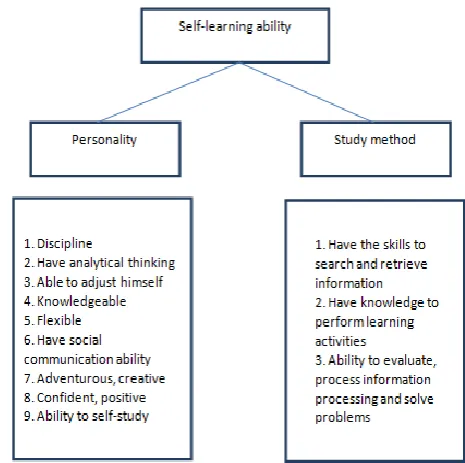
Philip Candy ([Can91]) listed 12 manifestations of self-learning people. He divided into two groups to determine which groups of factors will be strongly influenced by the learning environment
External special group is the method of learning contains the necessary learning skills of learners, mainly formed and developed in the learning process, so the teaching method of teachers will make great impact on the learning method of students, creating conditions to form, develop and maintain self-learning ability.
The internal characteristics group (personality) is formed and developed mainly through personal activities and experiences and is influenced by psychological factors. Because of that, teachers should create an environment for students to test and verify themselves. Sometimes just responding right and wrong in awareness or receiving encouragement and encouragement also creates motivation for learners strive, try to learn for themselves.
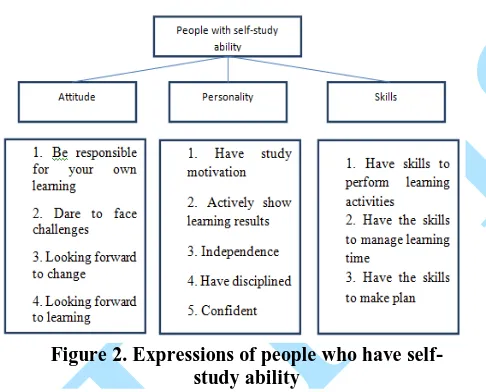
When Taylor ([Tay95]) studied the self-study problem of high school students, he identified the self-learning ability with the following manifestations:
Figure 2. Expressions of people who have self-study ability
Taylor has confirmed that self-learners are motivated and persistent motivators, independent, disciplined, confident and knowledgeable with appropriate operational skills. Through the above model the author has analyzed that there are three basic elements of self-study including attitude, personality and skills. It can be seen that delimitation is to clearly define the expressions of thinking and the ability to operate in reality and not merely refer to the psychological aspect of the learner.
Self-learning ability is also an "inherent" ability, quality of each individual. However, it always changes depending on the individual's activities in the socio-cultural environment. Self-learning ability is the innate ability of each person but must be trained in practical activities so that it will reveal the
advantages that help individuals develop, otherwise it will forever be the potential. The time at school is very short compared to the life so the self-study and self-learning ability of the students will be the basic foundation that plays a decisive role in their success ahead and it is also the foundation for children to learn for the whole life.
Thus, I think that "Self-study capacity is the ability to identify the task of learning in a voluntary and proactive way; to set up self-learning goals to require the effort to implement; to implement effectively learning methods; to adjust mistakes and limitations of himself when performing learning tasks through self-assessment or suggestions of teachers and friends; to actively seek support when having difficulties in studying”.
3.2. Answer to the second question
Students' self-learning ability through practical problem solving
Example 1: One of the important knowledge contents in chapter "dot product of tow vectors and application" is the area of a triangle's formula. We designed Project: "Measure the campus area". In order to meet the requirements of enhancing the self-study of students with the orientation of teachers, we assign tasks to students including preliminary planning and making task diagrams. The preliminary planning process for implementing the project is based on the outline of the content and way to proceed as follows:
Identify the main content of the project: Measure the campus area;
Determine the formula to calculate the area that can be used to measure the campus area: the formula for calculating the area of a triangle, the formula for calculating the area of a trapezoid, the formula for calculating the area of a rectangle, ...;
The necessary tools for measurement: Sensors, measuring tape length.
reasonable adjustments. This is the self-adjustment under the guidance of teachers to implement the project in the right direction. The result of this phase is the detailed plan with the group's task map. In the process of project implementation, there is a need for mutual support and sharing among team members. Team members should regularly give feedback, self-assess or evaluate each other for timely adjustments. In fact, when implementing this project, there are a number of issues that arise as follows: 1) the school campus is not rectangular (the campus is pentagonal; the length of the edges is not equal). Therefore, the project team discussed and divided polygons into many triangles to calculate the school campus area; 2) The measurement of the parameters of each triangle after division of the project groups is different, so each project team
flexibly manipulates the triangle area calculation formulas, including the calculation formula to for the area of a triangle in the length of two sides and sin of the interleaving angle, Heron's formula. Through self-study activities, students discover issues to be solved, propose solutions to solve problems, apply knowledge of quantitative knowledge in the triangle including Law of cosines Law of sin, formula to calculate triangle area to solve practical situations.
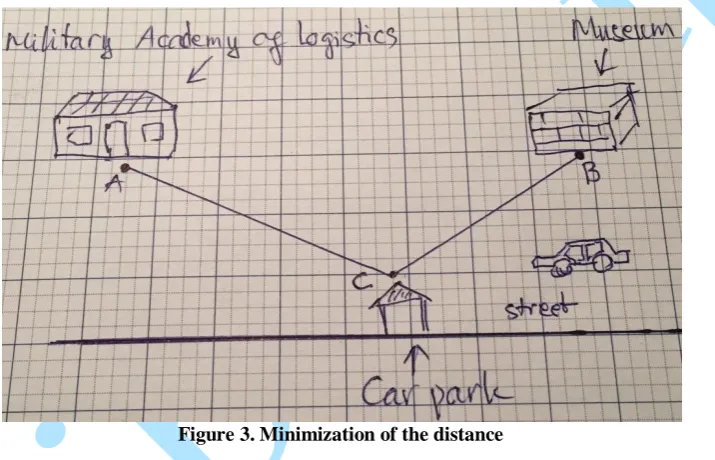
Example 2: Design intent a spot for car park This stop is at one of the major intersections in the Central Hanoi neighborhood. It is close to Military Academy of Logistics (A), Museum of Weapons (B) (Fig. 3). Find a spot for a car for military service members car park (C) so that the total distance between AC and BC is smallest.
Figure 3. Minimization of the distance
Real-world problem: We want to find a spot for car park so that the total distance from Military Academy of Logistics to car park and from Museum of Weapons to car park is smallest.
Mathematical system: Transform reflects, how to find the sum of line segments, the sum of line segments is smallest.
Applying mathematics knowledge: The standard method of solving the problem is to using transform reflects and the sum of the length of line segments A’C and BC.
AC + BC = A’C + BC ≥ A’C
We deduce:
min {AC + BC} = min{A’C + BC} = A’C
Let C’ = A’B ∩ d, where d is road pavement (Fig. 2.)
Mathematical results: the car park spot is C’.
Figure 4. The mathematical system
Other real-world problems in life: Design intent:
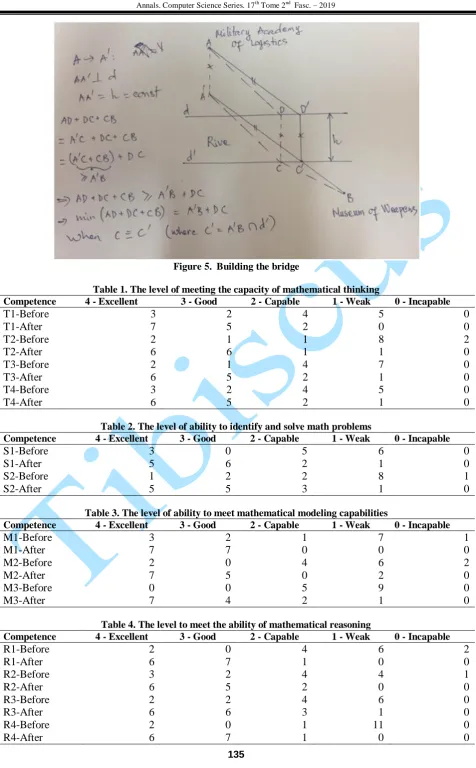
This design of providing bridge that serves people. This bridge is at one of the major intersections from Longbien district to opera house the in Hanoi center (Fig. 5). Find a spot to build the bridge so that the total distance from Longbien district to the opera house is smallest (including segments lines: AD + DC + CB).
Analysis of survey:
Figure 5. Building the bridge
Table 1. The level of meeting the capacity of mathematical thinking
Competence 4 - Excellent 3 - Good 2 - Capable 1 - Weak 0 - Incapable
T1-Before 3 2 4 5 0
T1-After 7 5 2 0 0
T2-Before 2 1 1 8 2
T2-After 6 6 1 1 0
T3-Before 2 1 4 7 0
T3-After 6 5 2 1 0
T4-Before 3 2 4 5 0
T4-After 6 5 2 1 0
Table 2. The level of ability to identify and solve math problems
Competence 4 - Excellent 3 - Good 2 - Capable 1 - Weak 0 - Incapable
S1-Before 3 0 5 6 0
S1-After 5 6 2 1 0
S2-Before 1 2 2 8 1
S2-After 5 5 3 1 0
Table 3. The level of ability to meet mathematical modeling capabilities
Competence 4 - Excellent 3 - Good 2 - Capable 1 - Weak 0 - Incapable
M1-Before 3 2 1 7 1
M1-After 7 7 0 0 0
M2-Before 2 0 4 6 2
M2-After 7 5 0 2 0
M3-Before 0 0 5 9 0
M3-After 7 4 2 1 0
Table 4. The level to meet the ability of mathematical reasoning
Competence 4 - Excellent 3 - Good 2 - Capable 1 - Weak 0 - Incapable
R1-Before 2 0 4 6 2
R1-After 6 7 1 0 0
R2-Before 3 2 4 4 1
R2-After 6 5 2 0 0
R3-Before 2 2 4 6 0
R3-After 6 6 3 1 0
R4-Before 2 0 1 11 0
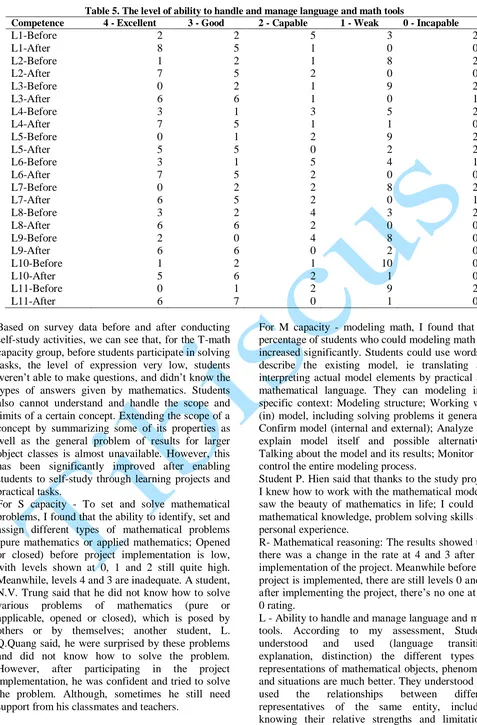
Table 5. The level of ability to handle and manage language and math tools
Competence 4 - Excellent 3 - Good 2 - Capable 1 - Weak 0 - Incapable
L1-Before 2 2 5 3 2
L1-After 8 5 1 0 0
L2-Before 1 2 1 8 2
L2-After 7 5 2 0 0
L3-Before 0 2 1 9 2
L3-After 6 6 1 0 1
L4-Before 3 1 3 5 2
L4-After 7 5 1 1 0
L5-Before 0 1 2 9 2
L5-After 5 5 0 2 2
L6-Before 3 1 5 4 1
L6-After 7 5 2 0 0
L7-Before 0 2 2 8 2
L7-After 6 5 2 0 1
L8-Before 3 2 4 3 2
L8-After 6 6 2 0 0
L9-Before 2 0 4 8 0
L9-After 6 6 0 2 0
L10-Before 1 2 1 10 0
L10-After 5 6 2 1 0
L11-Before 0 1 2 9 2
L11-After 6 7 0 1 0
Based on survey data before and after conducting self-study activities, we can see that, for the T-math capacity group, before students participate in solving tasks, the level of expression very low, students weren’t able to make questions, and didn’t know the types of answers given by mathematics. Students also cannot understand and handle the scope and limits of a certain concept. Extending the scope of a concept by summarizing some of its properties as well as the general problem of results for larger object classes is almost unavailable. However, this has been significantly improved after enabling students to self-study through learning projects and practical tasks.
For S capacity - To set and solve mathematical problems, I found that the ability to identify, set and assign different types of mathematical problems (pure mathematics or applied mathematics; Opened or closed) before project implementation is low, with levels shown at 0, 1 and 2 still quite high. Meanwhile, levels 4 and 3 are inadequate. A student, N.V. Trung said that he did not know how to solve various problems of mathematics (pure or applicable, opened or closed), which is posed by others or by themselves; another student, L. Q.Quang said, he were surprised by these problems and did not know how to solve the problem. However, after participating in the project implementation, he was confident and tried to solve the problem. Although, sometimes he still need support from his classmates and teachers.
For M capacity - modeling math, I found that the percentage of students who could modeling math has increased significantly. Students could use words to describe the existing model, ie translating and interpreting actual model elements by practical and mathematical language. They can modeling in a specific context: Modeling structure; Working with (in) model, including solving problems it generates; Confirm model (internal and external); Analyze and explain model itself and possible alternatives; Talking about the model and its results; Monitor and control the entire modeling process.
Student P. Hien said that thanks to the study project I knew how to work with the mathematical model; I saw the beauty of mathematics in life; I could use mathematical knowledge, problem solving skills and personal experience.
R- Mathematical reasoning: The results showed that there was a change in the rate at 4 and 3 after the implementation of the project. Meanwhile before the project is implemented, there are still levels 0 and 1, after implementing the project, there’s no one at the 0 rating.
Student D.L.Son said that after implementing the project, he knew how to perform, decode and interpret mathematical language, and understand its relationship with natural language. Student N.T.Viet said that after implementing the project, he understood the nature and rules of mathematical systems (both syntactic and semantic), he could translate natural language into official language/ icon. In addition, he can handle and manipulate mathematical conversions and expressions that contain symbols and formulas, express in language and write about problems with mathematical content. He affirmed that after implementing the project, he knew about the tools and properties of the various support tools for their mathematical activity, scope and limitations, he can use Math learning tools.
4. FINDINGS
The learning project aims to improve students' effectiveness, confidence and interest in solving practical problems and nurturing creative talents.
The learning project has tried to increase students' self-learning ability to solve problems in a focused manner and develop strategies to bring understanding to students.
High school age is considered an important stage in developing students' values and interests. Therefore, a better understanding of the development of a learning project is necessary. The contribution of this article is to develop students' self-study and self-studying ability.
The learning project is designed to contribute to the development of practical problem-solving capabilities applied in the context of learning projects.
This study informs teachers, educational researchers and curriculum developers to implement a constructive approach in enabling students to understand the relationship between physics theory and practice, then improve students' self-learning ability.
5. WHAT TO PAY ATTENTION WHEN
IMPLEMENTING PROJECT-BASED TEACHING
Do not leave the project after school. The project is the focus of the curriculum, not just an interesting activity after finishing the learning process. Don't be afraid to ask colleagues and experts. Ask to get feedback on project ideas from colleagues. Getting expert
advice will help your project become more realistic.
Do not abandon effective teaching and learning activities in traditional methods when moving to project-based teaching: Instead of giving lessons to the whole class, you can deliver "short lectures" through questions with each group. the student. Instead of planning independent activities such as field trips or guest speaker talks, you can connect these events during the project research process. Think about ways you can check student progress and use these to assess students' project progress.
Don't forget to self-assess: Self-assessment is an important activity for students as well as teachers in problem solving, so we should encourage student throughout the project. Try alternating written reviews with short conversations that students tell about the process and the challenges they experience. At the end of the project, take time to interview students after giving presentations, give feedback to encourage students to set high goals for their next projects. Teachers themselves also benefit from self-assessment of their project-based teaching process. List the things you have done well and the difficulties (you or your students get), and how you can improve the quality of the next project. Moreover, you can share this review with colleagues. This will enhance your understanding of project-based learning.
6. CONCLUSION
The results of theoretical research have been tested by me through the implementation of learning projects. The results have been confirmed. Project-based teaching helps students develop their self-learning ability, and contributes to improving students' progress. The research results of this work contribute to building a theoretical basis and orienting to apply the learning project in teaching mathematics at high schools. It is completely consistent with the current Vietnamese education, focusing on learners, focusing on developing competencies, and overcoming the academic nature of the teaching content.
REFERENCES
[D+13] Dunlosky J., Rawson K. A., Marsh E. J., Nathan M. J., Willingham D. T. – Improving students’ learning with effective learning techniques promising
directions from cognitive and
educational psychology. Psychological Science in the Public Interest, 14 (1), 4-58, 2013.
[JM09] Johnson C. I., Mayer R. E. – A testing effect with multimedia learning. Journal of Educational Psychology, 101 (3), 621, 2009.
[KR08] Karpicke J. D., Roediger H. L. – The critical importance of retrieval for learning. Science, 319 (5865), 966-968, 2008.