R E S E A R C H
Open Access
Compulsory coding in education:
liberal-humanism, Baudrillard and the
‘
problem
’
of
abstraction
Laurence Tamatea
Correspondence:Laurence. [email protected]
College of Education, Charles Darwin University, Darwin, Australia
Abstract
Internationally, coding is increasingly introduced into primary and junior high schools (children generally aged between 5 and 15) on a compulsory basis, though not all stakeholders support this‘initiative’. In response to the public reception, discussion highlights popular argument around compulsory coding in school education. This is an argument between those supportive (hereafter referred to as the Yes case) and those unsupportive of compulsory coding (hereafter referred to as the No case). But more than simply produce a list of arguments, this discussion contributes to our understanding of this reception by identifying the‘discourses’ deployed by both cases (namely, digital ubiquity, disadvantage, and habits of mind discourses) and by providing theoretical framings through which these discourses and their potential implications might be differently understood. Using critical discourse analysis to unpack these discourses shows that while both cases hold to key tenets of liberal-humanism, a commitment to the individual subject, liberty and full participation in the social, it is the Yes case with its stronger commitment to children engaging in abstraction that seems to challenge these. Discussion of this difference is framed by the work of Baudrillard around abstraction, not to‘prove’the validity of Baudrillard’s thesis concerning the consequences of humanity’s deepening engagement with abstraction, but to provide a broader understanding of this debate, in relation to a trajectory of engagement with abstraction that seems set to intensify.
Introduction
Digital code underwrites war machinery (Howard,2013), the stock market (Clarke,2013),
autonomous stealth drones (Northrop Grumman,2015), robotics (Boston Dynamics,2017)
and artificial intelligence (Evlin, 2017). And while not less than two decades ago we
proclaimed AI could not‘really’outperform humans, we now speak of the need to‘check’ its rise (Rawlinson,2015; Vincent,2017a). Our world is inscribed by the digital, and
educa-tion has responded by introducing compulsory coding in schools (Chambers,2014; Estrin,
2017; Euractive, 2015; Hamilton-Smith, 2017; Smith, 2016; Turula, 2017; Verma, 2016;
Woolf, 2014). This response, however, has not been without debate, within which some
argue the significance of coding to self and society, while others, its irrelevance. Although school education is now often the subject of debate, the significance of this debate emerges in the extent to which the politico-philosophical underpinnings of the modern education
project, namely liberal-humanism, are simultaneously championed and yet (possibly) under-mined. Exploring this seeming contradiction, discussion highlights argument for and against compulsory coding in school education, represented here as the Yes and No cases. But more than simply producing a list of arguments, discussion identifies the dominant discourses deployed in this debate.
More than words, discourse comprises the strategic deployment of socially shared
patterns of words in constructing claims to truth (Foucault, 1981). And in the debate
around compulsory coding in schools, the dominant discourses comprise those around digital ubiquities, disadvantage and habits of mind. More specifically, Yes case discourse is inscribed by positive liberty, and the No case, negative liberty. The Yes case main-tains that the realization of the individual and their freedom emerges from compulsory exposure to state-sanctioned knowledge, while the No case holds that these only emerge where the individual self-selects valued knowledge.
Despite this difference, both cases reproduce key tenets of liberal-humanism, namely a commitment to the individual subject, liberty and participation in the social. But this
consensus breaks down with the Yes case’s deployment of the habits of mind discourse,
wherein prioritization of computational thinking constructs the individual as less analogue, independent and inscribed by liberty than liberal-humanism perhaps ever imagined. With this, the Yes case is inscribed by a contradictory‘logic’, such that I ask: How can the Yes case deploy key tenets of liberal-humanism to advocate compulsory
coding in schools, when the very thing argued for—deeper engagement with the digital
and consequently abstraction—potentially erodes such tenets? This question, in part,
motivates Kissinger’s discussion of the Enlightenment and the rise of artificial
intelligence (2018), wherein he reflects upon how the Age of Reason’s penchant for
scientific knowledge not only displaced the prior ‘liturgical order’, but now threatens to undermine the very project from which it was birthed.
Kissinger concludes, noting that while ‘the Enlightenment started with essentially
philosophical insights spread by a new technology, our [current] period is moving in the opposite direction, [generating] a potentially dominating technology in search of a
guiding philosophy’ (2018 para 29). It is this contradiction which is present in the
debate around compulsory coding in schools, particularly so in the Yes case, such that deeper analysis of this debate requires a robust theoretical if not philosophical framing, taking our understanding of the positions and protagonists beyond seeing such as simply Luddite-like or progressive. To this end, the discussion draws upon Baudrillard
(1983; 1993; 1995; 2009) to reflect upon the possible implications of the quantitative
‘logic’of deepening abstraction, with which the Yes case’s desire for children to increas-ingly‘interface’with computers seems to align.
Discussion concludes that while the‘quantitative’has always informed liberal-humanism, such that AI could emerge from the Age of Reason (Kissinger,2018, para 6), the strengthen-ing alignment with the logic of abstraction signalled in Yes case’habits of mind discourse,
might otherwise be considered—drawing upon Baudrillard—to be synonymous with
challenges the existing dominant philosophy, namely liberal-humanism, upon which both it and indeed the modern education project rests.
Literature: the popular voice—largely ignored
Coding in schools is not a new phenomenon, being a curriculum area introduced as
early as the 1970s in some settings (Knobelsdorf et al.,2015) and during the 1980s and
1990s in others (Cartelli, 2002; Popat & Starkey, 2019). While these instances have
been implemented with varying success over the past 30 to 40 years, the most recent
‘initiative’ arguably gained momentum from the first decade of the twenty-first
century (Bresnihan, Millwood, Oldham, Strong, & Wilson, 2015), as part of a larger
coding for all movement (Dimeo,2017; Shein,2014; Thoreau,2017). Whereas the
cod-ing agenda was once more so associated with programmers and computer societies seekcod-ing discipline exposure (Jovanov, Stankov, Mihova, Ristov, & Gusev,2016), it is now an initiative shared more broadly by states, industry, entrepreneurs and presidents (Smith,2016). Related to this has been the emergence of the creative industries economy (Gouvea & Vora,2018; Tamatea & Paramatasari,2018) and arguably a populist change in the discursive
representa-tion of the programmer (Kainulainen,2013; Pritchard,2016). Now it seems everyone can or
should code. Code bootcamps are now ‘big business’ (Clark, 2018), while online coding
courses are ubiquitous.
Coding has come‘out of the lab’and is now to be engaged by the‘masses’, who, as I show below, have an opinion about this. Less apparent, however, is the voice of the
academy regarding this popular mass response to ‘coding for all’in schools. Certainly,
there has been formal research around coding and education. Studies explore how to
teach programming in schools (Mathrani & Agate, 2016; Pellas & Efstratios, 2017),
universities (Abdul-Rahman & Bendeict, 2014) and now in early childhood settings
(Campbell & Walsh, 2017). Studies acknowledge the difficulty of learning coding
(Cardell-Oliver,2014, Bain and Barnes2014; Guzdial, Hohmann, Konneman, Walton, &
Soloway, 1998) and, related to this, how coding might be best introduced in education
settings, in terms of how to best teach coding (Merkouris, Chorianopoulo, & Kameas, 2017; Hiltunen, 2016) and which languages and technologies are best introduced first (Pellas & Efstratios,2017). Much of this pedagogy-focused research (Hutchison, Nadolny,
& Estapa, 2015) suggests students are best introduced to coding not through text-based
languages such as C++, C# or Java, but through visual and block-based languages like Scratch (Kalelioğlu & Yasemen,2014; Saez-Lopez, Gonzalez, & Vazquez-Cano,2016; Van
Zyl, Elsa Mentz, & Havenga,2016). The emergence of visual coding environments has
in part been responsible for the traction of the coding for all initiative (Popat &
Starkey,2019, p. 365; Wong, Cheung, Ching, & Huen,2015).
While research-informed discussion focused specifically on reasons why coding is now more prominent in the school curriculum is arguably still limited; not-withstanding policy-linked reports invariably constructing an economic case
(Deloitte Access Economics, 2016), these reasons have occasionally been
articu-lated as part of a broader discussion of coding in schools, particularly where coding is a compulsory subject. This literature shows that while some reasons have changed over time, others have remained largely the same (Knobelsdorf
et al., 2015; Jovanov et al., Hubwieser, 2012). In their discussion of coding in
Witnessing the increasing role of Information Technology (IT), stakeholders began arguing for the inclusion of CS in secondary education. On the bases of economic growth, societal welfare, and the stability of the labor market, they argued that Germany would need computer scientists and employees to fill IT positions across sec- tors. At a fundamental level, being able to solve problems was viewed as an important skill that all students should possess, even if at a basic level (2016 p. 5).
These reasons are not too dissimilar from those informing the current initiative. Similarly, the introduction of ‘coding’in Italian state schools can be attributed to a 1980
report (Inquiry on Computer Science) identifying a need for more employees with
informa-tion technology skills (Cartelli, 2002). But beyond employment, the report proposed that
learning to code would result in a number of learning outcomes in domains not related to coding (p. 36). These outcomes are today referred to as spill-over or transfer skills, such that Popat and Starkey (2019) ask: Are students learning coding or coding to learn? Answering their question, they identify six educational outcomes including problem-solving through mathematical concepts, social skills including collaboration, self-management/active
learn-ing, critical thinking and ‘Academic skills (NOT including mathematical or computer
science/ programming related skills)’(p. 367).
Central to this question is also the notion of (digital/information)‘literacy’, where learn-ing to code results in acquisition of a range of skills as significant to the learner’s capacity to participate in the twenty-first century society as acquisition of‘traditional’literacy was to full social participation in earlier times (Bresnihan et al.,2015; Hutchison et al.,2015;
Popat & Starkey, 2019; Vee, 2013). Key among these transfer skills is ‘computational
thinking’(Wing,2010), and to a lesser degree‘computational participation’(Kotsopoulos et al., 2017; Burke, O’Bryne & Kafai, 2016; Fields, Giang, & Kafai, 2014; Kafai & Burke, 2014; Kafai & Burke, 2013). But whereas computational participation is ground Under-standing computer programming as a literacyed in the claim that coding is collaborative providing students with the skills to participate in a networked society (Popat & Starkey, 2019, p. 368), the notion of computational thinking makes grander claims in relation to transfer skills.
Notwithstanding disagreement around what computational thinking more precisely
comprises (Shute, Sun, & Asbell-Clarke, 2017), it is a framework for understanding (if
not constructing) human-computing machine relations well discussed within formal
literature (Gover & Pea, 2013). According to Shute et al. (2017), the notion emerged
from‘the constructionist work of Seymour Papert (1980, 1991), being first coined as a
term in a seminal article by Wing (2006)’(p. 143). Consequently, Wing’s work now is
often associated with computational thinking (Wing, 2008,2010,2016). Broadly,
com-putational thinking is grounded in a number of elements associated with cognitive pro-cesses, one specifically related to abstraction—the ability to‘model the core aspects of
complex problems or systems’ (Shute et al.,2017, p. 145; Wing, 2010). Indeed, Wing
advocates the value of computational thinking to life more generally, and utility in disciplines beyond science, maths and engineering, such that it is considered a new
‘literacy’(Wing,2010,2016).
extended to most (Raja, 2014; Shute et al., 2017; Vee, 2013). Crow (2014) argues that
‘not knowing the language of computers will be as challenging as being illiterate or
innumerate are today’(p. 2). Thus, computational thinking is regarded as a ‘universal
competence, which should be added to every child’s analytical ability as a vital ingredi-ent of their school learning’(Voogt, Fisser, Good, Mishra, & Yadav,2015, p. 715).
Voogt et al.’s (2015) investigation, however, acknowledges some of the challenges
around the use of the term. Beyond the lack of definitional clarity, they highlight the challenge of being too precise, which would have the effect of restricting it largely to computer science, although a too encompassing-a-definition might render the notion
of computational thinking almost meaningless (Voogt et al., 2015). The later
observa-tion is significant, because arguably all ‘disciplines’ have transfer effects. Not too long ago, Australian school education was heralding the transfer effects of learning a
language other than English (Fernandez, 2008). Consequently, there is the risk, as
Voogt et al. (2015) suggest, that in staking out too broad-a-scope of effect, the specifi-city of computational thinking as a coding outcome diminishes. Indeed, part of the
‘push’for computational thinking in school education is consequently grounded in the
claim that this is something that we ‘innately’already do (Wing,2008), which‘may’be correct. But arguably, a key difference between this default computational thinking and that associated with coding seems to be that the latter is mostly actioned through and with the screen, as part of a digital communications network, using (programming) languages which inherently impose limits on how such thinking can take place and be externalized. The computational thinking undertaken by children interfacing with computers is arguably of a different kind, hence possibly inscribed by the kinds of
challenges Baudrillard highlights in his discussion of humanity’s deepening engagement
with (digital) abstraction (Baudrillard,1993,1995).
Arguably, it is this aspect of computational thinking (CT)—its unintended
conse-quences for individual and society—that is underexplored in formal literature on coding
in schools, beyond what CT comprises in terms of definitions and its relationship to
learning outcomes (Gover & Pea, 2013; Shute et al.,2017). The default assumption of
much discussion is that because students live in a networked information age, coding
and computational thinking are—by default—individual and social goods.
Unfortu-nately, this perspective is seldom elaborated with reference to the political philosophy
framing society and the individual’s relationship to society for which computational
thinking is held as significant. An exception is the work of Bresnihan et al. (2015) that deploys Marxist theory to problematize mandatory coding. Their (sociological) argu-ment is that state and industry support of the coding initiative results from the desire to increase labour supply, thus decreasing coding labour costs.
Bresnihan et al.’s work is significant not because of the veracity of Marxist theory
in this application, but because it comprises an instance of critical thinking from the humanities in understanding coding in schools. Though critical thinking is held to be an outcome of computational thinking, as is creative thinking (Shute et al., 2017; Voogt et al., 2015), much research investigating computational thinking for
coding in schools is devoid of ‘critical thinking’, as understood in the humanities
more broadly. With this, there is an absence of discussion around the political
philosophy framing the society and the individual’s relationship to it for which
A clue as to what kind of society this might be, and what political philosophy frames it, is offered in Knobelsdorf et al. (2015) discussion. Referencing the relatively early introduction of coding in German schools, they note that the curriculum was labelled
with the terminformatische Bildung. Unpacking the meaning of this term, Knobelsdorf
et al. explain that:
As Meyer [2009] puts it,‘Bildung has no simple, straightforward English equivalent.
In Germany, we define a person with Bildung as one with the capacity to participate in his or her society and the willingness to take responsibility for himself/herself and for others. In this view, Bildung is more than education: it is education in a
humanistic sense. It aims for self-regulation and includes a moral dimension.’
Accordingly, within the German CS education community, the question of how to offer CS education in secondary schools—either as training in ICT skills or aligned with the scientific methods and principles of the academic discipline—has been discussed with regard to the principles of‘Bildung’for more than two decades. From those discussions, the term‘informatische Bildung’(a combination of‘Informatik’and‘Bildung,’roughly general CS education) was coined. The German CS education
community argues that general CS education can provide specific knowledge and competencies for students to become conscious and responsible users and makers of information to participate fully in an ever-evolving information society and digital world (2015, p. 7).
Though as we are informed, the notion ofinformatische Bildung‘has no simple, straight-forward English equivalent’ (p. 7), it resonates strongly with key tenets of liberal-humanism, highlighting the value of coding education to the individual and society. What is more, this relationship is to be understood‘in a humanistic sense’(2015, p. 7), such that informatische Bildungcan be considered ‘akin to American understandings of…liberal arts’ (p. 7). References to‘responsibility’and ‘self-regulation’ strengthen this conclusion, detailing a relationship between coding in schools and a particular political philosophy in ways which much contemporary discussion does not.
While the absence of a more specific articulation of the political philosophy framing the compulsory coding in schools rationale is understandable given that the liberal-humanist underpinnings of modern schooling are perhaps simply a taken-for-granted, arguably, this absence functions to preclude consideration that coding for all might actually produce outcomes inconsistent with key tenets of liberal-humanism. This
dilemma is consequently similar to that highlighted in Kissinger’s reading of the
rela-tionship between AI and the Enlightenment (2018). It is in response to this absence that this discussion of coding in schools aims to move our academic framing beyond a focus on pedagogy, the order of introducing coding skills and technologies and the difficulty of coding. While these remain important, there is arguably a larger framing
needing to be invoked to understand the state’s rationale for coding in schools, and the
popular response to this.
Methodology
The research project from which this paper emerges was concerned to understand the
notions of discourse (Foucault, 1972)—positions within this response construct truths about coding, individuals and society. Based upon the significance of discourse to
con-structing social truths (Foucault, 1972; Foucault,1981; Luke, 1997), and the
methodo-logical approach of Tamatea in the analysis of populist online discourse (Tamatea,2005;
2008;2011), online texts were chosen for a number of reasons as sources of data. Among these is the capacity of the Internet to provide closer proximity to circulation of contem-porary discourses. Online discourses can be accessed in (almost)‘real-time’, from a larger
source of ‘participants’ (Ungar, 2001). While online ‘discourse’ communities reveal a
shared sense of interest and purpose, the higher degree of (relative) anonymity—a factor
currently informing policy discussion around social media regulation (Phillips & Bartlett, 2018)—increases opportunities for personal disclosure, such that online comments about
compulsory coding likely reproduces a ‘truer’ account of feelings (Joinson, 2005). This
data sourcing strategy thus follows the recent example of Tamatea and Paramatasari (2018), who collected rich online data to map current approaches to providing coding classes for disadvantaged youth.
Data were generated from a dynamically bounded review of online posts about compulsory coding in education using the Google search engine in December 2017, which allowed the search to respond to emergent trends in results. Terms used for the
online search are presented in Table1.
The search revealed a range of non-formal and grey literature including blogs, news reports, webpages, policy and reports, curriculum documents and associated social media commentary. The search for formal academic literature pertaining to compul-sory coding in schools, however, was conducted through an Australian university library using international enterprise data bases.
Critical discourse analysis was used to analyse the online texts, not to verify their truth, but to identify how truths about coding in school are constructed through the
process of description, definition and delimitation (Sherridan, 1980). As Altheide
(2003) (drawing upon Schwalbe) highlights, discourses are more than just talk and writing. Through description, definition and delimitation, discourses impose rules about what can be said and written and who has the authority to say and write things accepted as truth, which regulate and maintain social action and boundaries.
The initial criteria for analysis of the online texts were simply the text’s position in relation to the question: Did the text support or oppose coding in schools? Supporting texts were classified as belonging to the‘Yes case’, while opposing texts were associated with a ‘No case’. Approximately 135 textual artefacts were initially identified, represen-tative of the Yes case. Forty No case artefacts were identified. Working with these two discursive orientations, a table was constructed into which arguments deployed by each case were inserted. These arguments were, with few exceptions, mostly common to
Table 1Initial Google search terms
Search terms
Computational thinking
Criticism/critique/problems of computational thinking
Coding movement
Compulsory/mandatory coding in schools
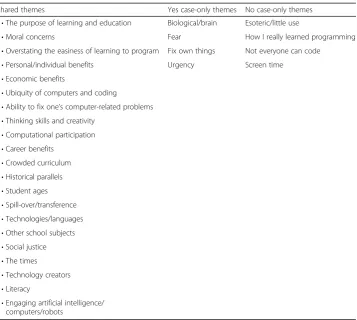
both cases. They were subsequently coded into a range of equally common themes, as
shown in Table2.
While critical discourse analysis (CDA) is not a monolithic project, multiple concepts and tools can be mobilised under the banner of CDA; it is important to appreciate that discourse comprises more than simply words, topics or themes. Rather, as noted, discourses comprise socially shared patterns of language (as texts). They are neither random nor neutral but deployed strategically in the social contest of truth
construc-tion, linked to material outcomes (Foucault, 1981). A macro-level analysis explored
how the arguments for and against compulsory coding are both produced by and seek to reproduce versions of the arguably dominant political-philosophy framing education circulating within the broader socio-political context in which the debates occurs. In this, a key question was: Why out of all the things that might have been possible to say about compulsory coding in schools have only certain things been said?
Finally, the author is an education sociologist and developer working with C#, JavaScript and the NET environment more broadly. I declare this because in this
author’s experience, computer science and sociology can make ‘strange’ partners.
Though both deal in abstraction, one is more qualitative and hence seen as‘subjective’
while the other is more quantitative and seen to be more ‘objective’. Because of this,
these disciplines can uphold antagonistic claims to truth. However, lest this author be viewed as favouring one side or another, or failing to understand one or the other, it is
Table 2Discursive themes
Shared themes Yes case-only themes No case-only themes
•The purpose of learning and education Biological/brain Esoteric/little use
•Moral concerns Fear How I really learned programming
•Overstating the easiness of learning to program Fix own things Not everyone can code
•Personal/individual benefits Urgency Screen time
•Economic benefits
•Ubiquity of computers and coding
•Ability to fix one’s computer-related problems •Thinking skills and creativity
•Computational participation •Career benefits
•Crowded curriculum •Historical parallels •Student ages •Spill-over/transference •Technologies/languages •Other school subjects •Social justice •The times •Technology creators •Literacy
perhaps best to declare one’s position and acknowledge that in some instances,
object-ivity emerges from the recognition of our own subjectobject-ivity (Schatzki, 1995).
Social theory
Analysis and discussion below is framed by social theory pertaining to
liberal-humanism and Baudrillard’s argument around intensifying abstraction (Baudrillard,
1993; Baudrillard, 1995). While these framings are unpacked in detail later, it is valu-able here to briefly introduce their‘fundamentals’.
Liberal-humanism
Liberal-humanism is grounded in liberalism and humanism, the former historic-ally preceding the latter. Humanism comprises a conceptualization wherein
hu-manity occupies the centre of its own existence. This once ‘radical’ framing holds
that humans are capable of rationally knowing their world, and its workings, and that such can be explained without referencing deities or non-physical properties
(Agar, 2012). Humanism has thus been grounded in a knowledge of humanity
and the material world realised in the Arts and Humanities, and the Sciences
(Good, 2001). The‘modern’West generally attributes its understanding of humanism to
the Renaissance, its associated literary tradition and the Enlightenment (Good, 2001;
Kircher,2015; Yousefi, Yousefy, & Keshtiaray,2015).
Whereas humanism might be considered a metaphysical view of humankind, liberalism, arguably emerging from humanism, comprises a political philosophy
(Gahringer, 1995). Liberalism is concerned with humanity’s existential status,
par-ticularly the individual, and how socio-economic factors are arranged to uphold individual and social liberty. Liberalism is thus concerned with the distribution of
goods and rights (Riberio, 2014). Although there are streams of thought and
practice within liberalism, a common ‘thread’ comprises a commitment to
indi-vidual liberty and freedom, the equality of all, and (broadly) process (es) leading to their achievement. Liberalism holds that individuals have an inherent right to
pursue the ‘good life’, a consequence of reviewing a range of conceptualizations
of such. The decision to pursue one life over others is an exercise in individual liberty and freedom, the outcome of rationality and reason grounded in
deliber-ation upon the ‘facts’. Knowledge (as opposed to ignorance) is central to this
(Singh, 1998; Titlestadt, 2010). The individual subject, truth and factual
know-ledge are thus important to liberal-humanism and the Enlightenment more broadly.
A key difference within liberalism concerns the extent of (state) regulation to secure liberty and freedom. Those holding to positive liberty accept that while individuals have an inherent capacity to be rational, this might not be exercised if one is not equipped with the knowledge to foster its emergence. Hence, regulation is required to prevent individuals infringing the freedom of others and society more broadly, as much as for their own interests. By contrast, negative liberty holds that the individual must be free
to establish themselves what counts as valuable knowledge and that the state has the
right to determine what this should be (Guilherme, 2016; Singh, 1998; West, 1965).
Baudrillard and abstraction
It looks so ridiculous and impossible, Musk told reporters in a press conference after the launch. You can tell it’s real because it looks so fake, honestly (Geggel,2018).
Elon Musk, described as inspiring a new generation of engineers and space explorers (Keenihan, 2017; Rogers, 2018), made this statement after launching his red Tesler Roadster into space (Matousek, 2018). It references imagery of the car subsequently streamed to Earth. Predictably, online discussion asserted it was fake. YouTube videos claimed the roadster was never launched; it was simply digital trickery. The dilemma with these claims, however, is not that we can never really know if the car is in space, because most cannot access the referent. Neither is it because the YouTube like other social media platforms is used to spread ‘fake news’, challenging the veracity of the Enlightenment notion of the free market of fact-based ideas (Schroeder,2018). Rather, it is because with powerful digital imaging tools grounded in abstraction, it may well be—just a simulation (Leary,2017; Vincent,2017b).
This dilemma signifies our times, characterised by Baudrillard as those of the third
phase of the image (Baudrillard, 1995). For Baudrillard, arrival at this point, wherein
interaction with the world, self, others and‘society’is increasingly mediated by a digital abstraction layer, has proceed through three orders, each grounded in a relationship
between humanity, the representational image and reality (Baudrillard, 1995). The
significance of this, to the analysis of the data below pertaining to the Yes and No cases,
is not only the resonance between popular argument and Baudrillard’s stages of the
image, but also these orders provide a thought framework for reflection upon the impli-cations for liberal-humanism arising from this resonance. However, with the first order grounded in dissimulation (Baudrillard,1995, pp. 2–4), it is, then, the second and third that are of more relevance here. In the second order of simulacra, a shift takes place,
from dissimulation to simulation, the move to simulate or ‘feign(s) to have what one
doesn’t have’(p. 2). In the second order, roughly from the Renaissance to mid-twentieth century, industrial technologies impact image production, including (analogue) photog-raphy leading to mass production and re-production of copies. Still, a difference remains between the real and copy. An analogue photo cannot be mistaken for the real.
By contrast, the third order is ‘founded on information, the model, the cybernetic
game –total operationally, hyper-reality, aim of total control’(Baudrillard,1995, p. 79). This is our time, one in which the analysis of the data suggests notions of the rational liberal individual are grounded in the capacity to think in the abstract language of the
computing machine and be ‘enmeshed’ in its broader network for collaborative social
participation. In this order, we increasingly inhabit digital spaces that are not real (in an analogue sense) and yet not fake. They do not necessarily aim to copy the real, as much as provide some other kind of (virtual) space within which to interact. In this order, the digital object may have‘no relation to any reality whatsoever’(Baudrillard,1995, p. 4), being pure abstraction and simulation. And when reabsorbed back into the construction of the real, it creates a hyper-reality (p. 8) wherein reality engagement is increasingly via digital models against which the analogue reality (including people) is evaluated.
Simula-tions reference simulaSimula-tions, while the corpse of the real lies ‘rotting’ in the corner
map, nor does it survive it—‘welcome to the desert of the real’—as Morpheus
(drawing on Baudrillard, 1995) explains to Neo in the Matrix (Warner Brothers,
1999). Today, Baudrillard asserts abstraction is increasingly the only means through which we access the real, the outcome of a logic which perhaps only ends through implo-sion or ‘the destruction of meaning and the reality-effect’(Robinson,2012). Simply put, humankind increasingly prefers the map (abstraction) to the territory (which is the real). Coding in schools seems an exercise in how to best engage the map.
Results
Data analysis identifies three dominant discourses in the popular response to coding for all: the digital ubiquity, the disadvantage and the habits of mind discourses. But before data informing these discourses are identified, it is worthwhile noting the rela-tive‘strength’of the discursive themes in terms of the number of individual expressions or arguments within broad groupings deployed by each case. In terms of themes shared by both cases, among the strongest are the economic, personal benefits, thinking skills/ creativity, technologies/languages, social justice, literacy and engaging AI/computers/ robots. Within these, the Yes case dominates in terms of the number of arguments articulated in all except for the social justice and AI/computers/robots themes. In terms of themes deployed by the Yes case alone, a number of these were relatively weak in terms of the number of individual arguments deployed. By contrast, several of the argu-ments within the No case alone themes were relatively strong. These included overstat-ing the easiness of learnoverstat-ing programmoverstat-ing, and codoverstat-ing in schools beoverstat-ing too esoteric and
of little use. However, other than these perhaps ‘outlier’ themes, the majority of the
arguments in the popular response are contained within broadly shared themes, though argued from oppositional positions. This coalescence and coherence of argument around strong themes informs the dominance of the discourses identified in this debate.
Digital ubiquity discourse
Both sides in the debate deploy a digital ubiquity discourse. The Yes case maintains the digital impacts all aspects of our lives (Ruseva & Rissola,2016), and that computers are
pervasive (Kafai & Burke, 2014, p. iv), while the No case acknowledges this is ‘an
increasingly tech-driven world’ (Editorial Board, 2017, para 1). Argument diverges,
however, in relation to providing evidence supporting the representation of digital ubi-quity and in constructing what digital ubiubi-quity implies for education.
Regarding evidence, the Yes case (like the No case) is grounded in sources of textual authority, citing industry reports, government data and authoritative voices. We are
told that ‘six of the world’s ten most valuable companies are technology companies,
with Apple leading the pack’ (Broadband Solutions, 2016, para 1). We are also told
that according to the Australian Workforce Productivity Agency,‘in 2025 there could
be an undersupply of qualifications for key ICT occupations, with employment
pro-jected to grow between 64 and 72 per cent faster than overall employment growth’
(Carroll, 2016, para 3). This argument references Australian Chief Scientist Ian
Chubb, stating that ‘if the digital economy is the arena, then the skills you need to
Consequently, the Yes case constructs the economic value of learning to code in terms of the digital economy and its skills requirements. Cohen, for example, repro-duces statistics from Gartner showing that globally in 2015, IT spending would not
only reach $3.5 million, but use of digital technologies would ‘grow the size of the
global GDP by $1.36 trillion in the next 5 years–all of those dollars equal opportunity
for the people who are fluent in tech’(Cohen,2015, para 2).
But as the reference to Gartner suggests, the Yes case represents the economic need and employment opportunities as not only of national significance, but also
inter-national. Puiu notes that‘according to the European Commission, there will be a
short-age of over one million programmers in Europe by 2020’(European Commission,2016,
para 1), while according to Mayo,‘in the US alone there’ll be a million more computing
jobs than computing science graduates by 2020’(Mayo,2013, para 1).
For some in the No case, the economics argument is not so much an opportunity for workers as for ‘capital’, as argued in the literature by Bresnihan et al. (2015). Silicon Valley, it is claimed,‘has been unusually successful in persuading our political class and much of the general public that its interests coincide with the interests of humanity as a whole’(Tarnoff,2017, para 12). Tarnoff adds,‘it will proletarianize the profession …
flooding the market and forcing wages down –and that’s precisely the point’ (para 4).
The relevance of this argument is somewhat validated by Yes case discourse, not in the sense of a capitalist conspiracy, but in recognition that an increased supply of devel-opers will lead to lower wages. Yes-case proponent, McAllister (2008), suggests that
‘computer literacy should be seen as a baseline skill for the U.S. workforce, not a differ-entiator’(para 20) leading to a‘ticket to a golden future’(para 20).
Referencing economics, the Yes case also highlights ethno-national divisions as justifica-tion for compulsory coding. This boundary constructing posijustifica-tion references fear and
danger, expressed through the notion of crisis and risk (Bagshaw,2015; Mayo, 2013). In
the Australian context, Carroll (2016) highlights the ‘global nature and ferocity of the
competition’in software development (para 5). Others maintain that without‘compulsory’ coding, there is a risk that‘Australia [will be] left behind in the digital age’(Calixto,2015, para 1). Regarding the USA, Bajarin (2014) notes that it is‘far behind in having a robust
technical workforce created within our own boarders’(para 13). Reference to borders and
‘us’and‘them’is significant in the Yes case. Regarding innovation, we are told that coding
in schools will ensure that the Microsoft and Google continue to be grown‘at home’, in
the USA (Cellan-Jones,2014). Elsewhere,‘we’are warned of reliance on‘foreign’workers, including those from‘a variety of Asian companies’(Debate.org,2013, para 3), and specif-ically‘coders in China, India and other parts of the world’(Bajarin,2014, para 12).
The Yes case’s deployment of the ubiquity discourse further represents compulsory
coding as an individual and social good. Lexical items such as ‘empower’ (European
Commission, 2016, para 4) and ‘enhance’ (Lucisano,2017, para 2), construct the value
coding skills add to the individual. Compulsory coding will enable individuals to under-stand‘how their devices work’(Bajarin,2014, para 9), allowing them to fix them (Hinsliff, 2015). It will allow individuals to know ‘how [digital technologies] operate and how to
customize them for better functionality’ (Lynch,2017, para 3). Coding, Enobrev argues,
will help students gain a ‘better understanding of the world and hopefully better interact
within (sic)’(Atwood,2012, para 3). Agon likewise associates coding with how to better
By contrast, the No case asserts, ‘no matter how pervasive a technology is, we don’t
need to understand how it works’ (Felker, 2013, para 9). Constructing less relevance
between digital ubiquity and education, the No case highlights the division of labour and employment specializations. Argument maintains that as the employment sector is characterized by different people doing different jobs, the need to understand how code works in order to fix something is mitigated by the existence of those whose job it is to fix such code. As Felker notes,‘society divides it labour so that everyone can use things
without going to the trouble of making them’(para 9). A further argument advises the
reader not to overlook that society still requires a broad spectrum of employment fields.
We’re always going to need doctors and nurses, teachers and chefs, all sorts of jobs that
don’t need to write computer code at all. To assume that everyone should be required
to learn it is to be caught in the bubble of your own profession (Hall,2017, para 8).
The ‘ubiquitous though less relevant’argument proceeds by highlighting the extent to which ubiquity in other fields does not mandate subject specialization. Parallels are drawn with music (Rawlins, 2015), motor vehicles (Atwood,2015; Gray,2014), plumb-ing (Atwood,2012), carpentry (Bethune,2016), aircraft (Gray,2014) and electrical work (Cohen, 2015). Stucky (2015) notes that he does not use any of his coding knowledge to shop or bank online, suggesting that:For the majority it’s probably more like
understanding a car engine. You don’t need to be able to strip an engine and rebuild
it to drive a car, but if you basically understand how a car works you can drive and maintain it efficiently and effectively (para 9).
Disadvantage discourse
Data show that argument in disadvantage discourse is more explicitly grounded in
liberal notions around resource distribution (Riberio, 2014). The Yes case is grounded
in a Rawlsian liberal-distributive framework, the No case in a more libertarian position. Both, however, assert disadvantage. The Yes case maintains those without coding skills are, and will remain disadvantaged, without state intervention. The No case maintains that state intervention disadvantages those already equipped with skills. Both argue from a position grounded in pursuit of liberty.
At its broadest level, the Yes case challenges a (claimed) elitist image of soft-ware development, on grounds that it is uninviting to the underrepresented
masses (Raja, 2014). Compulsory coding, it is argued, will demystify programming
(Rawlins, 2015). A challenge to ‘elitism’ is also expressed through re-asserting the
value of amateur coding as opposed to professional. Neil argues that ‘it skirts
close to snobbery to discourage somebody merely on the grounds that it isn’t
their day job’ (Atwood, 2012, para 73).
Specifically, the disadvantage discourse foregrounds equalizing access as the principal justification for compulsion. Compulsion, it is argued, will prevent disadvantage arising from some schools implementing coding and others not, and boys choosing coding and not girls. Compulsion will equalize access to a field often unavailable to or not accessed
(Guzdial, 2014). As AnonymousCoward, 2012, para 53) notes, ‘it is a meritocracy, and it should be - but if you don’t look for talent, you won’t find it all’. In sum, as argued
by Lyonnais, compulsory coding might‘level the playing field’(Lyonnais,2015, para 8),
particularly in terms of gender (Gilbert, 2017). Compulsion will allow the
underrepre-sented to exercise choice about the relevance of coding to later school and post-school
life (ECDL,2015).
Like the Yes case, the No case deploys a disadvantage discourse across several fronts. One concerns existing inequalities, another concerns likely inequalities, and yet another
responds to (in) equality arising from state intervention in the coding ‘market’. With
regard to the former, Keneally (2015) asserts there are unresolved matters in school
education more significant to improving student outcomes. Citing Krugman’s
commen-tary, Keneally reaffirms that while ‘talking breathlessly about how technology changes
everything might seem harmless …[its] a distraction from more mundane issues’(para
11), adding:
that includes issues such as failing schools, poor teaching quality, lack of specialist support for students with a disability, the increasing shift away from comprehensive publicly funded schools to private education, poor international rankings in literacy and numeracy, and countless other real, and very difficult issues, that confront Australia’s education system (2015, para 12).
Keneally concludes that ‘sorting out those problems will take much more than a few lines of code’(2015, para 13). Here, compulsory coding perpetuates existing disadvan-tage. Elsewhere teaching quality is highlighted. The demand for skilled coding teachers, which may not be met, will result in unqualified teachers delivering the curriculum, resulting in a watered-down curriculum (Guzdial, 2014, para 19). Guzdial (2014) adds, regarding inequality in terms of access, ‘let’s work first at making it accessible, before we try to require it’(para 19).
The No case references the‘crowded curriculum’, constructing a concern for teacher
welfare (Debate.org, 2013; Dodge, 2017) and asserting the greater value of other
subjects to the liberal-humanist project of dispelling ‘ignorance’. While this argument
does not contest the role of the state in providing children with access to knowledge
supporting liberty, it represents coding as deleterious to the capacity of ‘more valued’
subjects to achieve this goal. At Debate.org, a post in the ‘con’ argument asks: ‘what
subject will you be robbing these children of, Science? Math? History, or the already
underfunded art and music departments?’(2013, para 6). Aside from representing
com-pulsory coding as robbery, argument highlights the desire of some in the Yes case to
have humanities subjects make way for coding, such as Geography (Lui,2015), Religion
(Debating Europe, 2015), or History (Lui, 2015). In Lui’s (2015) article, Dunford, for
example, asserts,‘give the boot to art/woodwork/cooking and lessen the time for sport’
(para 1), though he supports retaining Geography and History. Elsewhere, languages
would be removed (Hait,2017).
The No case equally acknowledges the significance of choice; however, its reference
is elaborated in terms of the child’s right to make their own choice about subjects
arguing that elementary schools should provide the basics, and leave more specific areas to specific choices later on (para 1). This argument, highlighting student age, holds that younger students are disadvantaged through deprivation of the option to choose coding later in life, when more capable of making informed choices. Others,
however, assert the right of parents to make choices about their child’s school subjects
(Debate.org,2013).
Argument deploying references to‘choice’also highlights likely outcome of
compul-sion—coding enjoyed by few and hated by many (Guzdial, 2014). Mainstreaming
coding to generate equality may result in unequal distribution of the enjoyment of
cod-ing. Dkramer3 adds, ‘if you want kids to hate programming … make it mandatory’
(Haaramo, 2015, para 19). This argument represents not only the remainder of the
‘mainstream’as potentially disenfranchised, but also students of lower academic ability.
This too is a concern with disadvantage. Dillon asks: ‘do we know how to teach CS to
students with learning or development disabilities? Can we confidently state that,
with-out CS, those students should not earn a high school degree?’(Guzdial, 2014, para 7).
Consequently, the No case represents compulsory coding as yet another opportunity for students to fail, creating a two-tier subject performance cohort (Computing
Educa-tion Research Blog,2014). What is more, the No case argues that the level playing field
will be distorted by the power of economically advantaged families to purchase support
resources beyond those provided by the state (Editorial Board,2017).
The No case maintains that a commitment to coding should arise naturally through
individual passion (Chris-Granger.com,2015) and intelligence (The Register 2012). While
acknowledging one is not a Luddite if one cannot code (Chris-Granger.com), many in the No case assert that coding is neither easy nor quickly learned, such that to assert
other-wise devalues the profession and intelligence of those who can code (Byrne,2013). Hence,
the No case holds that anti-elitism disadvantages existing coders. As Hartnell explains:
I hate the current railing against‘elitism’from the know-nots. They would be the first to complain if their football team didn’t field elite players, or their medical treatments weren’t by highly-skilled professionals, but they also feel threatened by the intelligentsia, so try to drag everyone down to their level (Young,2012, para 100).
Habits of mind discourse
Whereas data show a ubiquity discourse constructs compulsory coding as enabling
individuals to engage digital technologies at a generic level, the ‘habits of mind’
discourse deployed by the Yes case constructs engagement as both cognitive and cerebral. By contrast, the No case reasserts a need for engagement with the analogue. Indicative of the Yes case, Vikberg argues that programming needs to be integrated
across the curriculum‘to drive critical and creative thinking as computer programmes
have an increasingly significant part to play in the society today’(Haaramo, 2015, para
3). Others assert, ‘we need to remember that computer science is a creative field in
which students are actively creating something’(Team ISTE, 2015, para 9). Hai Hong
from Google’s K-12 outreach programs maintains that ‘it offers problem-solving skills
and promotes creativity’ (Della Cava, 2015, para 7). Elsewhere, a School Education
problem solving, [and] logical reasoning and creativity’ (2015, para 3). And beyond
creativity (ECDL, 2015), a post at Familytech (2017) highlights coding’s capacity to
improve ‘essential life skills like critical thinking, problem-solving, and creativity; which
can lead to success in other areas of work’. Creativity, critical thinking and reasoning
figure strongly in this (Yes case) discourse.
This representation constructs coding’s ‘spill-over effect’. Coding is good not
only because it helps create programs, but also because its skillset can be used elsewhere. Though precise details of where else are often absent, the comment of Garun, reproduced by others such as Team ISTE (2015) and debate.org (2013), represents this argument.
Learning to code contains the same logic skills you apply in daily life: What is the problem? How can I solve the problem as efficiently as possible? Can my solution be helpful to others who are experiencing similar issues? If you can figure out the same steps from a programming perspective, it can help develop your logic and decision-making skills to streamline the best solution to your problems (2013, para 14).
Like other discourses, this too appeals to authority, in this instance, to well-known software developers, ‘research’ and education policy. Concerning the former, Bill Gates (Microsoft) and Mark Zukerberg (Facebook) are cited in terms of ‘code’ and creativity (Burks, 2017, para 5). Steve Job’s comments about programming and think-ing are also reproduced by the Yes case (Puiu, 2017). Appealing to the‘authority’of research, we are told that‘numerous formal studies have confirmed coding has meas-urable beneficial effects on cognitive abilities’ (Rawlins, 2015, para 18). Not only are state curriculum and policy documents referenced, so too are texts detailing educa-tional principles and philosophy (Computing Education Research Blog,2014).
The ‘habits of mind’discourse is, however, also strongly grounded by the Yes case in
the notion of computational thinking. As the president of the Australian Computer
Society (ACS), Ansley argued that computational thinking should be taken ‘more
seriously’in schools, maintaining‘it’s the fourth‘r’ …three‘r’s’plus coding, or
compu-tational thinking’(Calixto,2015, para 19). Elsewhere, a Queensland Government (2015)
paper identified coding as a twenty-first century literacy (p. 5).
This computational thinking framework is extended by the Yes case to include computational participation, emphasising networks, collaboration and the social
(Kafai & Burke, 2014; Queensland Government, 2015). An EU text, for example,
likewise asserts that, ‘each and every interaction between humans and computers is
governed by code’, such that in our ‘hyper-connected world…coding is the literacy
of today’(European Commission,2016, para 2). Others, however, reference the human
brain, with Lopes arguing that, ‘it’s a matter of development of the human brain, to
increase logical skills and prepare for the future of cyberworld’ (Sololearn, 2017), a
(biological) framing reproduced in discussion at Broadband Solutions.
Like learning a language early in life, learning and practicing this type of
[programming] thinking early in development actually influences a child’s brain as it
By contrast, though deployment of the habits of mind discourse by the No case is not so focused on the cerebral, it engages similar discursive tactics. It appeals to authority, speaks (back) to the ‘spill-over’effects and engages the impact of computational think-ing in terms of creativity and critical thinkthink-ing.
Appealing to the authority, the No case references Jeff Atwood, co-founder of Stack
OverflowandStack Exchange. Saines (2014) explains, for example, that‘those defending
the need to teach young children to program don’t have a solid counter-argument
when luminaries like Jeff Atwood say that not everyone should learn to program’(para
4). Indeed, Atwood (2012) himself maintains that ‘the whole everyone should learn
programming meme has gotten so out of control that the mayor of New York City actually vowed to learn to code in 2012’(para 1). Other references delegitimise‘
author-ity’, through defining the authority to speak about education. Commenting on the views
of the Apple CEO, Pewen and Shotton represent Tim Cook (and Bill Gates) as
unquali-fied to speak about education. Pewen asserts that beyond Cook ‘making [ing] the most
idiotic statements on a regular enough basis’, he is gravelled by Cook and Gates‘ shoot-ing off about education it’s not your field’(Hall,2017, para 16).
In response to claimed spill-over effects, Sandy replies, ‘try teaching a few dozen
computer science classes and see if you still think CS is better prep for life skills than *any* (sic) other subject. It’s not’(Rawlins,2015, para 21). Sandy challenges the veracity of the ‘research’cited as evidence in terms of creative thinking, asserting, ‘it is a myth.
You can say the same for creative writing, but neither should [it] be compulsory’(2015,
para 19). This is an interesting response, not because all subjects might claim spill-over effects, but because it interrogates the positive link between computational thinking, creativity and critical thinking constructed by the Yes case.
By contrast, the No case foregrounds a more humanities-based understanding of creativity and critical thinking. At one level, this emerges in referencing the significance of humanities-based knowledge to the digital. Software designer, WiscoNative, explains
that his ‘useless’ sociology degree taught him much about social interaction, meaning
that he could ‘design better software that users can find more intuitive’ (Hall, 2017,
para 16).This comment contests the primacy of quantitative thinking to creativity by constructing a link with humanities in this domain. Indeed, in claiming we have gone
too far with the STEM agenda, Dumdum argues, ‘let’s not forget that many of our
values and cultural developments, from democracy to the Enlightenment, actually came
from times and places where the Liberal Arts ruled’(Hall,2017, para 14). In contrast to
the networked minds of the Yes case, the No case maintains that children should first
be taught to play outside and read books (Debating Europe, 2015). What is more, the
No case argues that children should be ‘developing human skills … running around,
throwing a ball, scratching out drawings, learning fine motor skills and developing normal interpersonal skills’(Dvorak,2014, para 2).
Discussion
Data analysis above highlights three dominant discourses deployed in debate around
compulsory coding in schools, including the digital ubiquity, thedisadvantage, and the
habits of mind discourses. Despite deployment to achieve different outcomes, there is a (qualified) degree of resonance between protagonists in this debate. At one level, this
however, it emerges from both cases validating broad principles of liberal-humanist
philosophy, which variously underwrite modern Western education (Crittenden,2006).
Thus framed, these cases either deploy a negative conceptualization of liberty (the No case), or a positive conceptualization (the Yes case). With the exception of elements of libertarianism in the No case, both remain comfortably liberal. Notwithstanding this, there are aspects of the habits of mind discourse in particular that are potentially destructive of liberal-humanism, the individual subject, liberty and freedom as trad-itionally constructed. Below, discussion critically reviews these discourses, identifying the resonance with liberal-humanism and the broad orientations within this, namely positive and negative liberty.
Liberal-humanism and digital ubiquity
Deployment of the digital ubiquity discourse by the Yes case seems convincing. Facts, figures and authorities confirm reliance upon the digital. Coding is as essential for self-efficacy and social participation, an individual and social good. With this, the Yes case reproduces long-established views of the relationship between education, the individual,
and society held by positive liberalism (Crittenden, 2006; Guilherme, 2016), many
traceable to debate around the 1831 Reform Act in the UK, focused upon compulsory schooling. In this, Roebuck argued that compulsory education would protect the
well-being of individual and society. A compulsory state education ‘would teach people
how to be happy and therefore would reduce violence, mischief and political
unrest’ (West, 1965, p. 134) and enable people to understand their circumstances
and improve them (p. 134), reducing the number of the ‘stack-burning peasantry’
(p. 134). Moreover, compulsory education would enable England to remain inter-nationally competitive (p. 134), rationales similar to those articulated above by the Yes case and for introducing coding in the German context noted above [van
Weert 1984] (Knobelsdorf et al., 2015).
In this historic debate, the opposition raised concerns resonant with the No case’s
response, including questioning which knowledge and whose knowledge informs the curriculum and its relevance to those compelled to learn it. Opposing compulsory edu-cation, Godwin rejected state power to decide what people should learn. Compulsory
education, he maintained, was ‘only too easy a channel for thinkers who were arrogant
enough to believe that they had the monopoly on the truth and that their doctrines alone
were worthy of forced consumption through the agency of the state’ (West, 1965, p. 31).
Opposition to UK compulsory education highlighted, like the No case, the possibility that the state might not always act in the people’s interest (West, 1965). Suspicious of state
intentions, Godwin saw a potential for despotism and corruption (West, 1965, p. 131, p.
133), a suspicion reproduced by the No case regarding developer wages. Lest it be thought that laisse-faire liberal John Stuart Mill would have opposed UK compulsory schooling, he actually revised his negative stance on liberty in this matter (p. 137).
Liberal-humanism and disadvantage
Although those like Godwin criticised positive liberals for their elitist imposition of
values (West,1965, p. 131), in the compulsory coding debate, it is the Yes case (positive
disadvantage. Extending coding skills to all, the Yes case is seemingly grounded in Rawlsian (liberal) distributive social justice, wherein disadvantage is reduced through
state resource re-distribution (Rawls, 1999). Although the No case is also somewhat
inscribed by this view, it offers two counterarguments. The first replays the redistribu-tive logic but argues existing resources are insufficiently redistributed, a call for posiredistribu-tive liberty. The second is more clearly articulated from a position of negative liberty, highlighting the futility of state resource re-distribution. This argument asserts the power of the market to negate state intervention. It maintains that students’differential access to other resources will result in perpetuation of the gap between the already well-resourced in terms of coding skills and those not.
The No case is also framed by elements of libertarianism, arguing the removal of the state altogether from resource redistribution to redress disadvantage. The sub-text being a disadvantage is often the result of individual action and not that of either others
or the state (Coleman, 1976), such that redistribution interferes with the economic
market, and the market in ‘natural’(coding) talent and motivation (Coleman, 1976, p.
128); argument resonant with Nozick’s Libertarian rights-based ‘inequality’ position
(Coleman, 1976, pp. 121–122). Beyond this, the No case’s assertion that compulsory
coding will either produce a‘class’of students who can code, as opposed to those who
cannot, who will subsequently ‘hate’ coding, further resonates with the experience of
compulsory coding in earlier implementations (Knobelsdorf et al.,2015).
Habits of mind, abstraction and a loss of self, liberty and the social
The Yes case seeks a level playing field providing students with choice to take up
cod-ing as a career—or not (Rawlins,2015). The No case maintains, however, that children
are too young to engage coding skills, such that coding should be offered later in scho-lastic life as an elective (Debating Europe,2015). It further asserts the right of parents
to make this choice (debate.org, 2013). Key issues here concern age and parental rights,
both of which not only figure in historic education debate (West,1965), but continue to
exercise liberal thinking, particularly in liberal democratic state institutions challenged by
expressions of multiculturalism and religious freedom (Deagon,2018). Often (though not
always), courts uphold the rights of the state over parents from religious groups and
intentional communities in curriculum opt-out cases (Good, 2001; Mouritsen & Olsen,
2013; Singh,1998), on grounds that parents may not be in the best position to foster the
child’s capacity to choose their version of the preferred life from a full range of the
alternatives.
While these rulings and subsequent academic commentary (Good, 2001, Mouritsen
& Olsen,2013, Singh,1998) highlight the significance liberal-humanism accords habits
of mind (reason and rationality as pre-conditions of choice), the Yes case often restrict
alignment of these with a quantitative weltanschauung, realizable through
computa-tional thinking. By contrast, the No case deploys a more ‘human-centred’ framing,
referencing Liberal Arts, Enlightenment values and the Humanities. At one level, this difference is not overly significant. Liberal-humanism (and liberal education) has long
been grounded in the Arts andSciences, qualitative and quantitative, and the study of
‘humanity’and‘nature’(Crittenden, 2006; Good,2001; Repp, 2000; Rwodzi,2014). Yet
true, the quantitative reading of humanity associated with the Yes case may be corro-sive of key elements of the liberal-humanist project including the individual subject, liberty, the social, and dispelling ignorance as a precondition for the realization of these tenets.
Both computational thinking and participation emphasize a relationship between
coding and the social. The former’s goal is to produce ‘creative’ solutions to social
(among other) problems through coding; the latter’s is using coding to access the social
and partake in the sociality of coding (Kotsopoulos et al.,2017; Fields, Kafai, & Giang, 2014). As Kafai asserts, ‘computational thinking and programming are social, creative
practices’ (2016, p. 27). For Baudrillard, however, while the social has been declining
since separation from the political, its demise accelerated with the onset ICTs, with negative consequences for individual subjectivity, liberty and the social (Baudrillard, 1983; Baudrillard,1993; Baudrillard,1995).
For Baudrillard, communication, as opposed to symbolic exchange and the speech act, is destructive of subjectivity and the social to the extent it is operational (staged). Communication is manufactured through imposing network architectures and the quantitative logic of performativity, or‘the compulsion to operationalism’(Baudrillard, 1993, p. 49). Communication is‘a matter not of speaking, but of making people speak’ (p. 46). It‘involves not knowledge, but making people know’(p. 46). Thus, participation
(the goal of the computational participation) is ‘not an active or spontaneous social
form’ (p. 46). Rather, it is something ‘always induced by some sort of machinery or
machination’(p. 46). In this, operations as opposed to actions are regulated such that
communication is‘operational or it is nothing’(p. 46).
At this point in history, humanity is increasingly tied to this machinery of communi-cation, which both cases acknowledge. While this occurs physically in relation to the screen, the connection is also cerebral, which the Yes case maps. This may have impli-cations for thinking, beyond the familiar narratives around too much screen time. Indeed, for Baudrillard, there is no better model of the way in which the computer screen and the mental screen of our own brain are enmeshed than in the mobius
topology (Baudrillard, 1993, p. 56). Though he speaks to the spectacle of thinking in
the context of AI, he is equally critical of the impact of digital technologies in the form
of computers and programs more broadly (Baudrillard, 1993, p. 53), in relation to
which ‘telecomputer man offers the spectacle of his own brain’ (p. 54), while the
analogue dimension of our humanity and subjectivity recede in significance. The Yes case, it will be recalled, deployed a biological argument referencing the brain, while the
No case asserted the primacy of analogue experiences. Baudrillard asserts that ‘where
human relations become mediatized and computerized, as occurs in computational
thinking and participation, we interact without touching each other’(Baudrillard,2009,
p. 17),‘interlocute without speaking to each other’ (p. 17) and we ‘interface without
[really] seeing each other’(p. 17). In other words, we interact through digital layers (of ones and zeros), where the analogue interlocutor is digitized. Thus, humans become permeable to all images and,
For Baudrillard, communication via the screen emerges from a different paradigm, wherein ‘the other, the interlocutor, is never really involved’, thus erasing the capacity for intimacy (Baudrillard,1993, p. 54).
What is more, the screen allows for the disappearance of the other as our gaze upon their digital re-presentation permits reading them on our terms alone. Baudrillard likens this to a digital Plato’s cave wherein the other’s reality can only be discerned through their
digital shadow.‘Why speak when we can communicate?’(Baudrillard,1993, p. 54). In the
screen, we consume as opposed to decipher‘in any depth…information intended to be
explored instantaneously’(p. 54), which comprises an‘abreaction immediate to meaning,
a short-circuiting of the poles of representation (p. 54). In this model of“interfaces and
duplication, of contiguity and networks’(p. 54), two become one (a copy) in contrast to
the exercise of the imaginary in the pre-ICT world, where the one was divided into two, as‘governed by the mirror…by otherness and alienation’(p. 54).
Tactility, an essential element of the analogue experience, as argued by the No case,
becomes little other than‘epidermal contiguity of eye and image’(p. 55). Analogue
aes-thetics of distance and time collapsed as a function of simply looking (p. 54). Whereas once the physicality of distance informed production of meaning, with the screen this is gone. In its place a ‘perpetual void that we are invited to fill’ (p. 55)—although it cannot be filled. What is more, this screen image is equally distant such that it can never be reached through the body (p. 55). Unlike the mirror in which the image al-ways seems more distant, the screen will never allow one to get to the other side. To the extent that the body (as opposed to a disembodied brain in a vat) is a presumably
also a locus of our humanity and fundamental to authentic exchange, our relationship
with the screen places humanity in a space ‘that is no longer quite human’ (p. 55).
Thus, Baudrillard asks: ‘am I man or machine’? (Baudrillard, 1993, p. 58). As opposed
to the industrial machines of the second phase of the image, in relation to which the in-dividual could ‘at least reattain the precious status of alienated man’(1993, p. 58), this is no longer possible. Increasingly, the subject is enmeshed with (computing) machines, as we offload cognitive capacity to‘superior’digital entities, and through computational thinking, our categories of thought become those of the abstraction-based coding language we work with. Wing asserts, for example, that:
Informally, computational thinking describes the mental activity in formulating a problem to admit a computational solution. The solution can be carried out by a human or machine, or more generally, by combinations of humans and machines
(Wing,2010p. 1).