Australia’s wish list of exotic pets: biosecurity
and conservation implications of
desired alien and illegal pet species
Adam Toomes1, Oliver C. Stringham1,2, Lewis Mitchell2, Joshua V. Ross2, Phillip Cassey1
1 School of Biological Sciences, the University of Adelaide, Adelaide, Australia 2 School of Mathematical Scien-ces, the University of Adelaide, Adelaide, Australia
Corresponding author: Adam Toomes ([email protected])
Academic editor: Daniel Sol | Received 25 February 2020 | Accepted 25 June 2020 | Published 18 August 2020
Citation: Toomes A, Stringham OC, Mitchell L, Ross JV, Cassey P (2020) Australia’s wish list of exotic pets: biosecurity and conservation implications of desired alien and illegal pet species. NeoBiota 60: 43–59. https://doi.org/10.3897/ neobiota.60.51431
Abstract
Globalisation of the live pet trade facilitates major pathways for the transport and introduction of invasive alien species across longer distances and at higher frequencies than previously possible. Moreover, the unsustainable trade of species is a major driver for the over-exploitation of wild populations. Australia minimises the biosecurity and conservation risk of the international pet trade by implementing highly stringent regulations on the live import and keeping of alien pets beyond its international CITES obliga-tions. However, the public desire to possess prohibited alien pets has never been quantified and represents a number of species that could be acquired illegally or legally under different future legislative conditions. As such, highly desirable species represent an ongoing conservation threat and biosecurity risk via the pet-release invasion pathway.
We aimed to characterise the Australian desire for illegal alien pets and investigate potential sources of external information that can be utilised to predict future desire. Using public live import enquiry records from the Australian Commonwealth Department of Agriculture, Water and the Environment as a proxy for alien pet desire, we tested for differences in the proportion of species with threatened listings and records of invasions, after accounting for taxonomy. Additionally, we used a United States of America (U.S.) live imports dataset to infer pet demand in another Western market with less stringent regulations and determined whether species highly desired in Australia had higher U.S. trade demand than would be expected by chance.
Copyright Adam Toomes et al. This is an open access article distributed under the terms of the Creative Commons Attribution License (CC BY 4.0), which permits unrestricted use, distribution, and reproduction in any medium, provided the original author and source are credited.
The Australian public desire for alien pets is heavily and significantly biased towards species threat-ened with extinction, species popular in the U.S. trade and species with a history of successful invasions. Not only does this indicate the potential impacts of pet desire on invasion risk and the conservation of threatened species, but we also highlight the potential role of the U.S. trade as an effective predictor for Australian desire. Our research emphasises the value of novel datasets in building predictive capacity for improved biosecurity awareness.
Keywords
alien, invasive species, non-native, smuggling, wildlife trade
Introduction
Globalisation of trade and tourism has led to substantial changes in the international trade of live pets (Bush et al. 2014). Rapid information sharing, particularly via so-cial media, has increased public awareness of traded species, potentially leading to subsequent increases in pet demand (Clarke et al. 2019; Kitson and Nekaris 2017). Additionally, the use of e-commerce platforms such as international classifieds has fa-cilitated the acquisition of pets in greater numbers and from a greater diversity of regions than previously possible (Bergin et al. 2018; Morgan and Chng 2018; Siriwat et al. 2019), including species with highly restricted distributions (Shepherd et al. 2019). As such, the proliferation of the pet trade has the potential to exacerbate its ex-isting detrimental impacts, including the over-exploitation of wildlife, the violation of animal welfare and both the transport and introduction of invasive alien species (IAS) via the pet-release pathway (Ashley et al. 2014; Auliya et al. 2016; Baker et al. 2013; Lockwood et al. 2019).
Australia has experienced an increased rate of IAS incursions over the last two decades, particularly from species prominent in the international pet trade, such as rose-ringed parakeets (Psittacula krameri), corn snakes (Pantherophis guttatus) and red-eared sliders (Trachemys scripta elegans) (Henderson et al. 2011; McFadden et al. 2017; Toomes et al. 2019; Vall-llosera et al. 2017). These trends are of concern for Austral-ian biosecurity, as establishment success of IAS is dependent on propagule pressure, which is influenced by the number of individuals smuggled in and their probability of release/escape from captivity (Cassey et al. 2018; García-Díaz et al. 2015; Stringham and Lockwood 2018). Given the cost and difficulty of eradicating IAS from large landmasses (García-Díaz et al. 2017; Holmes et al. 2016; Jardine and Sanchirico 2018; Rout et al. 2014), the interception of IAS earlier in the invasion pathway is necessary for efficient management of biosecurity in Australia.
Smith et al. 2008; Strecker et al. 2011), a country with less stringent pet trading and keeping regulations (Eskew et al. 2019; Smith et al. 2017). However, a challenge as-sociated with Australia’s regulatory system is the lack of consistent surveillance of alien pets held, legally or otherwise, within Australia. There are a number of species that are not permitted for live import, yet are legal to domestically trade within Australia (Fredberg and McNeil 2010). Additional species have been acquired illegally, either from international smuggling or from domestic captive breeding (Toomes et al. 2019). Therefore, an unquantified proportion of pet keepers have the capacity to legally or il-legally acquire desired pets if they are not accessible through importation. Anticipating which species are likely to be desired, acquirable and subsequently pose a biosecurity risk through deliberate/accidental releases, is essential to mitigating the cost of IAS.
While it is important to consider Australia’s acquisition of alien pets from the per-spective of biosecurity risk, there are also potentially serious conservation implications. The unsustainable harvest and trade of species at rates exceeding their reproductive output can be a major driver of biodiversity loss (Mandimbihasina et al. 2020; Natusch and Lyons 2012; Siriwat and Nijman 2018; Shepherd 2010). Threatened species and those with low fecundity are especially susceptible to this threatening process, due to the effect of perceived rarity on market value (Holden and McDonald-Madden 2017; Siriwat et al. 2019). Even when captive breeding is established to supply a given market, harvesting can still take place in order to increase genetic diversity of captive populations from ‘founder stock’ (Brooks et al. 2010; Lyons and Natusch 2011) or to introduce a new subpopulation/breed/locality into the market with higher perceived value (Auliya et al. 2016). These issues are particularly apparent in illegal trade, as there are no licensing systems in place to promote sustainable practice. As such, the demand for and acquisition of alien pets within Australia may be contributing to a leading global threatening process.
global exotic pet trade, importing millions of live animals annually to be kept as pets (Harfoot et al. 2018; Smith et al. 2009). Thus, we considered the species imported into the U.S. to represent the total diversity of traded pets and their quantity as a proxy for ‘Western’ demand for pets.
Methods
Australian phone enquiries
The Australian Department of Agriculture, Water and the Environment (DAWE) maintains a hotline for people to enquire about the legality of importing or owning a particular species in Australia. A DAWE policy officer answers and responds to the enquiry and records non-identifiable information about each request. The informa-tion recorded by the officer, if supplied by the caller, includes: (i) the date the enquiry occurred; (ii) the location of the enquirer (city or State/Territory); (iii) the species en-quired about; (iv) the action (importing, keeping/owning, breeding); and (v) whether the action was for private or commercial reasons. We acquired this dataset for all en-quires lodged from October 2017 to April 2019, which contained a total of 150 phone calls. We acknowledge that the sample size of this dataset is relatively small; however, as we are using the data to identify broad-scale biases, we assumed the data to be suf-ficiently representative of highly-desired alien pets. Moreover, as enquiries are free and anonymous, we assumed the set of anonymous callers to be an unbiased representation of pet keepers/traders with an interest in importing alien pets.
We categorised the stated use of the animal into six categories: (i) pet (private use); (ii) zoo (commercial use for display in a zoo/wildlife park); (iii) exhibitor (commer-cial use for exhibition/show); (iv) breeding pets (commer(commer-cial use to breed as pet); (v) breeding food (commercial use to breed as food); (vi) other (not otherwise specified). If an enquirer specified multiple intended uses, all use types were recorded. We refer-enced species and common names against the Global Biodiversity Information Facility (GBIF 2019) to resolve species identification to the most specific possible taxonomic level. If multiple species were discussed in a single call, we recorded each species as an independent enquiry (n = 198). For our analyses, we only considered enquiries relating to vertebrate pets (n = 168). We categorised cartilaginous fishes (Chondrichthyes) and ray-finned fishes (Actinopterygii) into one clade (Fish).
U.S. imports of live animals
et al. (2019) for more details). We acquired the LEMIS dataset for records from 1999 to 2016. We excluded records of exported animals, records that did not specify the quantity of individuals imported, records that were not categorised as live imports and all non-vertebrate records. We only considered import records that were deemed relevant to the pet trade (i.e. commercial or personal use designation). This dataset resulted in 3083 species, resolved using GBIF. For analysis, we derived the popularity of each species in the U.S. import records by ranking the species by total number of individuals imported from 1999 to 2016.
Comparison datasets
We compared four metrics between species in DAWE enquiries and U.S. imports: (i) popularity in the trade; (ii) the proportion of threatened taxa; (iii) the proportion of taxa with international trade restrictions; and (iv) the proportion of species known to be invasive species elsewhere. To compare the proportion of threatened taxa, we matched each species from DAWE enquiries and LEMIS imports to their IUCN Red List designations: Data Deficient (DD), Least Concern (LC), Near Threatened (NT), Vulnerable (VU), Endangered (EN) and Critically Endangered (CR) (IUCN 2019). For the purpose of our analysis, we re-categorised the Red List designation into a binary variable: Not Threatened (LC and NT) and Threatened (VU, EN and CR). Species listed as “Data Deficient” were excluded from our analysis. We created a binary variable because we had small sample sizes for some IUCN designations. To compare proportions of trade-restricted taxa, we recorded whether species were listed in the Appendices of the Convention on International Trade in Endangered Species of Wild Fauna and Flora (CITES) (UNEP-WCMC 2019). Finally, we used the Global Invasive Species Database (GISD) to determine if a species has a history of successful invasions (ISSG 2019). We supplemented this dataset to include species known to the authors as being considered invasive in peer-reviewed scientific literature, for example, established populations of Argentine black and white tegus (Salvator merianae) in Florida (John-son et al. 2017). For enquiries involving hybrids, we took a conservative precautionary approach and categorised them as GISD-listed if at least one parent species has a his-tory of invasions.
Analysis
in the phone enquiries differs from the proportion of threatened species in the exotic pet trade at large. Then, we tested whether the proportion of species with trade restric-tions (i.e. species listed in CITES appendix) in the phone enquiries differs from the proportion of species with trade restrictions in the exotic pet trade at large. Finally, we tested whether the proportion of species known to be invasive species elsewhere (whether or not in a GISD database) in the phone enquiries differs from the propor-tion of species known to be invasive species elsewhere in the exotic pet trade at large.
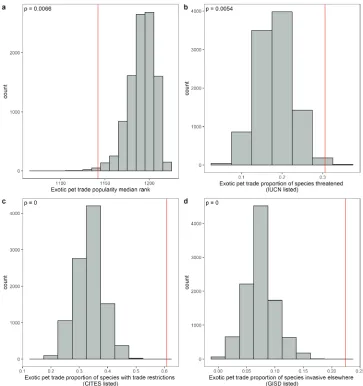
To test these hypotheses, we performed a series of empirical hypothesis tests (analo-gous to two-tailed t-tests but for ranked data; also known as bootstrap hypothesis test-ing) by randomly sampling from the U.S. imports dataset and comparing this to what was observed in the DAWE phone enquiries. To obtain the popularity of pets in the overall exotic pet trade, we uniformly randomly sampled species from the U.S. import records and calculated their collective median rank. To obtain the proportion of species threatened, with trade restrictions or invasive in the overall exotic pet trade, we ran-domly sampled species from the U.S. import records and recorded their collective pro-portions (respectively). The sample size of this sampling procedure was set to the total number of phone enquiries and was stratified by taxonomic class to account for taxo-nomic bias. For example, for the species popularity test, there was a total of 79 phone enquiries corresponding to species or subspecies, of which 42 enquiries were mam-mals (class Mammalia), 24 were birds (class Aves), 14 were reptiles (class Reptilia) and nine were fish (class Actinopterygii or Chondrichthyes). Therefore, for each iteration of sampling, we randomly sampled from the U.S. imports 42 mammals, 24 birds, 14 reptiles and nine fish. We repeated this sampling for 10,000 iterations for each analysis, with replacement. The sample size, stratified by taxonomic class, differed slightly for the proportion threatened (IUCN) test since some species are not yet evaluated by the IUCN or designated as Data Deficient and therefore excluded from analysis. We then compared the phone enquiry median rank or proportion (i.e. observed rank/propor-tion) with the resulting distribution of rank or proportions from sampling of the U.S. imports. P-values were calculated as the proportion of sampling iterations that were more extreme than the observed rank or proportion. For these analyses, we only consid-ered taxa that were resolved to the taxonomic level of species (i.e. no genus, family etc.).
Results
Summary statistics
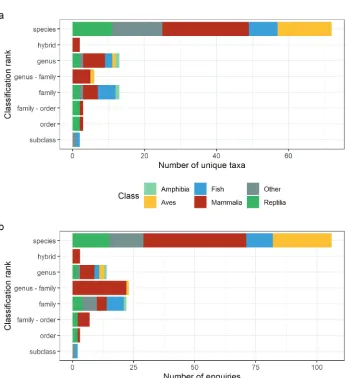
en-quiries, followed by parrots (Psittaciformes), then hedgehogs (Erinaceomorpha; Fig. 3b). Overall, the most enquired taxa were hedgehogs (Erinaceinae), fennec fox (Vulpes zerda), African grey parrot (Psittacus erithacus), monkeys (Simiiformes) and pygmy marmoset (Cebuella pygmaea; Fig. 3c). The two most commonly enquired non-vertebrate taxa were tarantula spiders (Theraphosidae, n = 14) and freshwater atyid shrimp (Caridina, n = 5). All remaining non-vertebrate taxa (n = 3) had a single enquiry each.
Comparative analysis
We found that enquired species were more popular than expected by chance compared to species in the U.S. exotic pet trade (p = 0.007, Fig. 4a). We found that the propor-tion of enquired species threatened by extincpropor-tion (IUCN listed) is higher than the
proportion in overall pet trade (p = 0.005, Fig. 4b). Additionally, we found that the proportion of enquired species with trade restrictions (CITES listed) is higher than the proportion in overall pet trade (p < 0.005, Fig. 4c). Finally, we found that the propor-tion of enquired species that are invasive species elsewhere (GISD listed) is higher than the proportion found in overall pet trade (p < 0.005, Fig. 4d).
Discussion
Australia imposes strict legislation to prevent the importation of alien vertebrate spe-cies (Henderson and Bomford 2011), yet the continual rise in illegally smuggled pets suggests that biosecurity efforts are being undermined (Toomes et al. 2019). Here, we characterised the attributes of desirable alien species. In the absence of direct informa-tion on which illegal alien species are most desirable, our approach serves as a reason-able first step to identify the characteristics of species that can be a future and conser-vation biosecurity threat. We revealed that the Australian desire for illegal alien pets is biased towards species threatened with extinction, species with global trade restrictions in place, species with a history of successful invasions and species frequently imported into the U.S., a western market with less stringent pet-trade regulations. In addition, we show a taxonomic bias towards a desire for mammal species. This knowledge is eas-ily interpretable and can be used to anticipate future trends in illegal animal imports and to focus biosecurity surveillance efforts.
Our findings that desired species were more likely to be IUCN-listed and CITES-listed compared to overall trade are consistent with the Anthropogenic Allee Effect, a process in which the trade and harvest of a species increases with rarity due to its effect on perceived value (Courchamp et al. 2006; Holden and McDonald-Madden 2017). Specifically, our results show a bias towards CITES-listed primates, some of which have previously been seized from illegal captivity in Australia, such as the pygmy marmoset (Cebuella pygmaea) (Toomes et al. 2019). In Thailand, Siriwat et al.(2019) found a high number of primates for sale in various social media groups, as well as price-rarity dynamics consistent with the Anthropogenic Allee Effect.
species, as well as the scale of potential impacts, should be considered alongside public desire in determining high-priority biosecurity threats (Bacher et al. 2018; Blackburn et al. 2014; Bomford et al. 2009; Cassey et al. 2014; Davidson et al. 2016).
Our analysis relied on information collected in the style of a self-selecting survey from people interested in acquiring alien species, particularly pets. This does not neces-sarily represent actual intentions to illegally acquire alien pets and it remains unknown how desirability and introduction efforts are correlated. Given the records of illegally smuggled animals and illegally kept pets in Australia (Toomes et al. 2019), it is clear that there are people in Australia intent on acquiring illegal-alien pets. Whether the enquirers’ desired pets are aligned with people who illegally acquire pets has not been tested. Therefore, one future avenue of research would be to interview people involved in the illicit trade. However, this is a problem with illegal activities in general; it is diffi-cult to acquire information as people are unwilling to disclose or admit to illicit actions (Gnambs and Kaspar 2015). Following survey methodologies developed in the field of criminology may be useful to acquire information about the species in the illicit trade and the motives behind the want to acquire these species (Kleck and Roberts 2012). Similarly, these methods could be used to contact existing Australian wildlife breeders/ traders and acquire a list of desired species that would be traded if legalised. Such a dataset would provide a representative sample of Australian wildlife traders and would help verify the extent to which anonymous enquiries are representative.
The legislative framework surrounding the import of alien pets, to which our enquiry data pertain, has a number of shortcomings that need to be addressed in order for the threat of alien imports to be reduced. In particular, there are discrepancies between what can be legally imported into Australia and what can be legally kept in domestic captivity as part of the national permitted list (Part 13A of the EPBC 1999) or State/Territory legislation. A large number of species are not permitted for live import, yet possession of live individuals within Australia is not necessarily a prosecutable offence unless evidence can be provided that the individuals have an illegal origin (Ciavaglia et al. 2015). Such evidence, requiring forensic analysis of provenance (e.g. Campbell et al. (2019)) is rarely available and costly to acquire. Thus, the purportedly captive-bred trade of species which potentially pose high biosecurity risks to Australia and which potentially originated from illegal import, continues unabated. We recommend renewed priority in addressing this legislative gap, including a national audit of alien species currently traded, in order to increase synergy between permitted imports and legal captive keeping.
predict-ing species that are likely to either be illegally present yet undetected, or arrive illegally in the short-term future. This is exemplified by the fact that the vast majority (98.7%) of the 75 alien reptile species detected in Australia are present in the U.S. trade (Toomes et al. 2019). Further research aims to test these hypotheses with a comparative analysis between U.S. imports and the interception records collated by Toomes et al. (2019).
Conclusions
Invasive alien species have the potential to be introduced into Australia despite sub-stantial investment in border and post-border biosecurity. We characterised a subset of domestic desire for alien pets via public import enquiries and identified several biases pertinent to both biosecurity and the conservation of threatened species. Specifically, desired species are more likely to be threatened by extinction and be invasive species elsewhere compared to species in the overall pet trade. Moreover, we emphasise the need for modifications to Australia’s live import list in order to maintain relevance with a rapidly changing international pet trade. Finally, the utility of the U.S. pet demand as a predictor of Australian desire for alien pets needs to be investigated further and for other regional pet markets, in order to foster greater biosecurity preparedness.
Acknowledgements
We would like to thank Jo Beath, Julie Quinn and Alex Blander from the Australian Government Department of Agriculture, Water and the Environment for providing access to de-identified digitised public enquiry data. This research was funded by the Centre for Invasive Species Solutions (Project PO1-I-002). The authors have declared that no competing interests exist.
References
Ashley S, Brown S, Ledford J, Martin J, Nash A-E, Terry A, Tristan T, Warwick C (2014) Mor-bidity and mortality of invertebrates, amphibians, reptiles, and mammals at a major exotic companion animal wholesaler. Journal of Applied Animal Welfare Science 17: 308–321.
https://doi.org/10.1080/10888705.2014.918511
Bacher S, Blackburn TM, Essl F, Genovesi P, Heikkilä J, Jeschke JM, Jones G, Keller R, Kenis M, Kueffer C (2018) Socio-economic impact classification of alien taxa (SEICAT). Meth-ods in Ecology and Evolution 9: 159–168. https://doi.org/10.1111/2041-210X.12844
Baker SE, Cain R, Van Kesteren F, Zommers ZA, D’cruze N, Macdonald DW (2013) Rough trade: animal welfare in the global wildlife trade. BioScience 63: 928–938. https://doi. org/10.1525/bio.2013.63.12.6
Bergin D, Atoussi S, Waters S (2018) Online trade of Barbary macaques Macaca sylvanus in Al-geria and Morocco. Biodiversity and Conservation 27: 531–534. https://doi.org/10.1007/ s10531-017-1434-5
Blackburn TM, Essl F, Evans T, Hulme PE, Jeschke JM, Kühn I, Kumschick S, Marková Z, Mrugała A, Nentwig W (2014) A unified classification of alien species based on the magnitude of their environmental impacts. PLoS Biology 12: e1001850. https://doi. org/10.1371/journal.pbio.1001850
Bomford M, Kraus F, Barry SC, Lawrence E (2009) Predicting establishment success for alien reptiles and amphibians: a role for climate matching. Biological Invasions 11: 713. https:// doi.org/10.1007/s10530-008-9285-3
Brooks, EG, Roberton, SI, Bell, DJ (2010) The conservation impact of commercial wildlife farming of porcupines in Vietnam. Biological Conservation 143: 2808–2814. https://doi. org/10.1016/j.biocon.2010.07.030
Bush ER, Baker SE, Macdonald DW (2014) Global trade in exotic pets 2006–2012. Conserva-tion Biology 28: 663–676. https://doi.org/10.1111/cobi.12240
Campbell CD, Pecon-Slattery J, Pollak R, Joseph L, Holleley CE (2019) The origin of exotic pet sugar gliders (Petaurus breviceps) kept in the United States of America. PeerJ 7: e6180.
https://doi.org/10.7717/peerj.6180
Capinha C, Seebens H, Cassey P, García-Díaz P, Lenzner B, Mang T, Moser D, Pyšek P, Rödder D, Scalera R (2017) Diversity, biogeography and the global flows of alien amphibians and reptiles. Diversity and Distributions 23: 1313–1322. https://doi.org/10.1111/ddi.12617
Cassey P, Delean S, Lockwood JL, Sadowski J, Blackburn TM (2018) Dissecting the null model for biological invasions: A meta-analysis of the propagule pressure effect. PLoS Biology 16: e2005987. https://doi.org/10.1371/journal.pbio.2005987
Cassey P, Prowse TA, Blackburn TM (2014) A population model for predicting the suc-cessful establishment of introduced bird species. Oecologia 175: 417–428. https://doi. org/10.1007/s00442-014-2902-1
Ciavaglia S, Dridan H, Paul Kirkbride K, Linacre A (2015) Current issues with the investiga-tion of wildlife crime in Australia: problems and opportunities for improvement. Journal of International Wildlife Law & Policy 18: 244–263. https://doi.org/10.1080/13880292 .2015.1074008
CITES (2019) The Checklist of CITES Species Website. CITES Secretariat, Geneva, Switzer-land. Compiled by UNEP-WCMC, Cambridge, UK. http://checklist.cites.org [accessed 11 July 2019]
Crowley SL, Hinchliffe S, McDonald RA (2017) Conflict in invasive species management. Frontiers in Ecology and the Environment 15: 133–141. https://doi.org/10.1002/fee.1471
Davidson A, Fusaro A, Sturtevant RA, Kashian DR (2016) Development of a risk assess-ment framework to predict invasive species establishassess-ment for multiple taxonomic groups and vectors of introduction. Management of Biological Invasions 8: 25–36. https://doi. org/10.3391/mbi.2017.8.1.03
Department of the Environment and Energy (2019) List of specimens taken to be suitable for live import. https://www.legislation.gov.au/Details/F2014C00647 [accessed 21 June 2019] Eskew EA, White AM, Ross N, Smith KM, Smith KF, Rodríguez JP, Zambrana-Torrelio C,
Karesh WB, Daszak P (2019) United States wildlife and wildlife product imports from 2000–2014. BioRxiv: 780197. https://doi.org/10.1101/780197
Fredberg J, McNeil DG (2010) Review of non-native ornemental fish species grey listed in Australia. Report to the Ornamental Fish Management Implementation Group (OFMIG). South Australian Research and Development Institute, Adelaide, South Australia.
García-Díaz P, Ramsey DS, Woolnough AP, Franch M, Llorente GA, Montori A, Buenetxea X, Larrinaga AR, Lasceve M, Álvarez A (2017) Challenges in confirming eradication success of invasive red-eared sliders. Biological Invasions 19: 2739–2750. https://doi.org/10.1007/ s10530-017-1480-7
García-Díaz P, Ross JV, Ayres C, Cassey P (2015) Understanding the biological invasion risk posed by the global wildlife trade: propagule pressure drives the introduction and establishment of Nearctic turtles. Global Change Biology 21: 1078–1091. https://doi.org/10.1111/gcb.12790
GBIF (2019) Home Page. https://www.gbif.org/en/citation-guidelines [accessed 01 July 2019] Global Invasive Species Database (2019) http://www.iucngisd.org/gisd/ [accessed 02 July 2019] Gnambs T, Kaspar K (2015) Disclosure of sensitive behaviors across self-administered sur-vey modes: a meta-analysis. Behavior Research Methods 47: 1237–1259. https://doi. org/10.3758/s13428-014-0533-4
Harfoot M, Glaser SA, Tittensor DP, Britten GL, McLardy C, Malsch K, Burgess ND (2018) Unveiling the patterns and trends in 40 years of global trade in CITES-listed wildlife. Bio-logical Conservation 223: 47–57. https://doi.org/10.1016/j.biocon.2018.04.017
Harrington L, Macdonald D, D’Cruze N (2019) Popularity of pet otters on YouTube: evidence of an emerging trade threat. Nature Conservation 36: 17–45. https://doi.org/10.3897/ natureconservation.36.33842
Henderson W, Bomford M (2011) Detecting and preventing new incursions of exotic animals in Australia. (Invasive Animals Cooperative Research Centre: Canberra, ACT, Australia). Henderson W, Bomford M, Cassey P (2011) Managing the risk of exotic vertebrate incursions
in Australia. Wildlife Research 38: 501–508. https://doi.org/10.1071/WR11089
Holden MH, McDonald-Madden E (2017) High prices for rare species can drive large popula-tions extinct: the anthropogenic Allee effect revisited. Journal of Theoretical Biology 429: 170–180. https://doi.org/10.1016/j.jtbi.2017.06.019
Holmes N, Campbell K, Keitt B, Griffiths R, Beek J, Donlan C, Broome K (2016) Correction: reporting costs for invasive vertebrate eradications. Biological Invasions 18: 2801–2807.
Jardine SL, Sanchirico JN (2018) Estimating the cost of invasive species control. Journal of Environmental Economics and Management 87: 242–257 https://doi.org/10.1016/j. jeem.2017.07.004
Johnson FA, Smith BJ, Bonneau M, Martin J, Romagosa C, Mazzotti F, Waddle H, Reed RN, Eckles JK, Vitt LJ (2017) Expert elicitation, uncertainty, and the value of information in controlling invasive species. Ecological Economics 137: 83–90 https://doi.org/10.1016/j. ecolecon.2017.03.004
Kauhala K, Kowalczyk R (2011) Invasion of the raccoon dog Nyctereutes procyonoides in Europe: history of colonization, features behind its success, and threats to native fauna. Current Zoology 57: 584–598 https://doi.org/10.1093/czoolo/57.5.584
Kitson H, Nekaris K (2017) Instagram-fuelled illegal slow loris trade uncovered in Marmaris, Turkey. Oryx 51: 394–394 https://doi.org/10.1017/S0030605317000680
Knight AR (2019) How can the social sciences work with ecology in informing feral horse policy and management in south-eastern Australia? Ecological Management & Restoration 20: 9–12 https://doi.org/10.1111/emr.12366
Lockwood JL, Welbourne DJ, Romagosa CM, Cassey P, Mandrak NE, Strecker A, Leung B, Stringham OC, Udell B, Episcopio-Sturgeon DJ (2019) When pets become pests: the role of the exotic pet trade in producing invasive vertebrate animals. Frontiers in Ecology and the Environment 17: 323–330 https://doi.org/10.1002/fee.2059
Lyons JA, Natusch DJ (2011) Wildlife laundering through breeding farms: illegal harvest, popula-tion declines and a means of regulating the trade of green pythons (Morelia viridis) from Indone-sia. Biological Conservation 144, 3073–3081. https://doi.org/10.1016/j.biocon.2011.10.002
Mandimbihasina AR, Woolaver LG, Concannon LE, Milner-Gulland E, Lewis RE, Terry AM, Filazaha N, Rabetafika LL, Young RP (2020) The illegal pet trade is driving Mada-gascar’s ploughshare tortoise to extinction. Oryx 54, 188–196. https://doi.org/10.1017/ S0030605317001880
McFadden MS, Topham P, Harlow PS (2017) A Ticking Time Bomb: Is the illegal pet trade a pathway for the establishment of Corn Snake (Elaphe guttata) populations in Australia? Australian Zoologist 38: 499–504 https://doi.org/10.7882/AZ.2017.006
Morgan J, Chng S (2018) Rising internet-based trade in the Critically Endangered ploughshare tortoise Astrochelys yniphora in Indonesia highlights need for improved enforcement of CITES. Oryx 52: 744–750 https://doi.org/10.1017/S003060531700031X
Natusch DJ, Lyons JA (2012) Exploited for pets: the harvest and trade of amphibians and reptiles from Indonesian New Guinea. Biodiversity and Conservation 21, 2899–2911.
https://doi.org/10.1007/s10531-012-0345-8
Pruett-Jones S, Appelt CW, Sarfaty A, Van Vossen B, Leibold MA, Minor ES (2012) Urban parakeets in Northern Illinois: A 40-year perspective. Urban Ecosystems 15: 709–719 htt-ps://doi.org/10.1007/s11252-011-0222-3
Rout T, Kirkwood R, Sutherland D, Murphy S, McCarthy M (2014) When to declare suc-cessful eradication of an invasive predator? Animal Conservation 17: 125–132 https://doi. org/10.1111/acv.12065
Shepherd CR (2010) Illegal primate trade in Indonesia exemplified by surveys carried out over a decade in North Sumatra. Endangered Species Research 11, 201–205. https://doi. org/10.3354/esr00276
Shepherd CR, Janssen J, Noseworthy J (2019) A case for listing the Union Island Gecko Gona-todes daudini in the Appendices of CITES. Global Ecology and Conservation 17: e00549
https://doi.org/10.1016/j.gecco.2019.e00549
Siriwat P, Nekaris K, Nijman V (2019) The role of the anthropogenic Allee effect in the exotic pet trade on Facebook in Thailand. Journal for Nature Conservation 51: 125726 https:// doi.org/10.1016/j.jnc.2019.125726
Siriwat P, Nijman V (2018) Illegal pet trade on social media as an emerging impediment to the conservation of Asian otters species. Journal of Asia-Pacific Biodiversity 11, 469–475.
https://doi.org/10.1016/j.japb.2018.09.004
Smith K, Zambrana-Torrelio C, White A, Asmussen M, Machalaba C, Kennedy S, Lopez K, Wolf T, Daszak P, Travis D (2017) Summarizing US wildlife trade with an eye toward assessing the risk of infectious disease introduction. EcoHealth 14: 29–39 https://doi. org/10.1007/s10393-017-1211-7
Smith KF, Behrens M, Schloegel LM, Marano N, Burgiel S, Daszak P (2009) Reducing the risks of the wildlife trade. Science 324: 594–595 https://doi.org/10.1126/science.1174460
Smith KF, Behrens MD, Max LM, Daszak P (2008) US drowning in unidentified fishes: scope, implications, and regulation of live fish import. Conservation Letters 1: 103–109 https:// doi.org/10.1111/j.1755-263X.2008.00014.x
Strecker AL, Campbell PM, Olden JD (2011) The aquarium trade as an invasion pathway in the Pacific Northwest. Fisheries 36: 74–85 https://doi.org/10.1577/03632415.2011.103 89070
Stringham OC, Lockwood JL (2018) Pet problems: Biological and economic factors that influ-ence the release of alien reptiles and amphibians by pet owners. Journal of Applied Ecology.
https://doi.org/10.1111/1365-2664.13237
Toomes A, García-Díaz P, Wittmann TA, Virtue J, Cassey P (2019) New aliens in Australia: 18 years of vertebrate interceptions. Wildlife Research 47: 55–67. https://doi.org/10.1071/ WR18185