Taxonomic revision of
Pachyptera
(Bignonieae, Bignoniaceae)
Jessica Nayara Carvalho Francisco1, Lúcia G. Lohmann1
1 Universidade de São Paulo, Departamento de Botânica, Rua do Matão, 277, 05508-090, São Paulo, SP, Brazil
Corresponding authors:Jéssica N.C. Francisco ([email protected]); Lúcia G. Lohmann ([email protected])
Academic editor:E. Fischer | Received 14 September 2017 | Accepted 5 January 2018 | Published 19 January 2018
Citation: Francisco JNC, Lohmann LG (2018) Taxonomic revision of Pachyptera (Bignonieae, Bignoniaceae). PhytoKeys 92: 89–131. https://doi.org/10.3897/phytokeys.92.20987
Abstract
Pachyptera DC. is a small genus of neotropical lianas included in tribe Bignonieae (Bignoniaceae). The ge-nus has a complicated taxonomic history but currently includes species distributed from Belize to South-ern Amazon. Pachyptera is characterised by four main synapomorphies, namely, a papery peeling bark, prophylls of the axillary buds organised in a series of three, patelliform glands arranged in lines in the upper portions of the calyx and corolla tube. Furthermore, members of the genus also have stems with four phloem wedges in cross-section and conspicuous extrafloral nectaries between the interpetiolar region and at the petiole apex, although these characters are also shared with other genera of tribe Bignonieae. Here, we present a taxonomic revision of Pachyptera, which includes a complete list of synonyms, detailed morphological descriptions of species and an identification key, as well as information on the habitat, distribution and phenology, nomenclatural notes, taxonomic comments and illustrations of all the spe-cies. In addition, we designate three lectotypes, propose one new combination, raise one variety to species status and describe a new species. After these adjustments, a Pachyptera with five well-defined species is recognised.
Keywords
Amazon, Flora, Pachyptera kerere, Neotropics, Taxonomy
http://phytokeys.pensoft.net
Copyright Jéssica N.C. Francisco, Lúcia G. Lohmann. This is an open access article distributed under the terms of the Creative Commons Attribution Li-cense (CC BY 4.0), which permits unrestricted use, distribution, and reproduction in any medium, provided the original author and source are credited.
Introduction
Pachyptera DC. (Bignonieae, Bignoniaceae) includes neotropical lianas that are distribut-ed from Belize to central Brazilian Amazon, with most species restrictdistribut-ed to wet Amazoni-an forests (LohmAmazoni-ann Amazoni-and Taylor 2014). The genus has a complicated taxonomic history, including a difficult generic circumscription and several poorly defined taxa. Here, a new systematic treatment of Pachyptera is proposed and five species are recognised using an integrative approach that includes data derived from a recent molecular phylogeny (Fran-cisco and Lohmann 2017, Fran(Fran-cisco and Lohmann submitted), coalescent approaches (Francisco and Lohmann submitted) and new morphological studies.
This new classification recognises a monophyletic genus that is characterised by four morphological synapomorphies, namely, a papery peeling bark, prophylls of the axillary buds organised in a series of three (Lohmann and Taylor 2014), patteliform glands arranged in lines on the upper portions of the calyx and corolla tube (Lohmann 2006, Lohmann and Taylor 2014). In addition, stems with four phloem wedges in cross-section, conspicuous extrafloral nectaries on the interpetiolar region and at the petiole apex also help to identify members of the genus (Lohmann and Taylor 2014).
Taxonomic history
Pachyptera was originally described by de Candolle (1845), who characterised the ge-nus by a compressed capsule and seeds with coriaceous wings. The gege-nus originally included six species, four of which [i.e. P. umbelliformis DC., P. striata DC., P. dasyan-tha DC. and P. perrottetii DC.] are synonyms of Tanaecium pyramidatum (Rich.) L.G. Lohmann, while P. puberula DC. is a synonym of Dolichandra uncata (Andrews) L.G. Lohmann. Only P. foveolata DC. remains in Pachyptera, although as a synonym of Pachyptera kerere (Aubl.) Sandwith.
Nearly five decades after being described, Pachyptera was synonymised into Adenocalymma Mart. ex Meisn by Baillon (1891) based on the broad and thick capsule shared amongst members of these genera. Subsequently, Bureau and Schumann (1896 [1897]) transferred P. foveolata to Adenocalymma section Pachyptera, which was characterised by villous anthers and plate-shaped glands arranged in lines outside the corolla tube, right below the lobes. At the same time, P. kerere was transferred to Adenocalymma section Hanburyophyton together with four species of Mansoa, i.e. A. alliaceum (Lam.) Miers, A. asperulum Bureau & K. Schum., A. splendens Bureau & Schum. [= Mansoa difficilis] and A. lanceolatum Miers. Pachyptera was subsequently segregated from Adenocalymma by Sprague and Sandwith (1932) and restored to generic rank, as a monotypic genus that only included P. foveolata.
morphological variation included in this group and the recognition of a single species. Five years later, Sandwith (1937) noted that Aublet’s epithet “kerere” was the correct name for P. foveolata and proposed the new combination Pachyptera kerere. Dugand (1955) also noted the high variation found in flower traits of specimens of Pachyptera kerere and described the new variety P. kerere var. erythraea Dugand. The variety P. kerere var. erythraea differs from P. kerere var. kerere in the red corolla (vs. white in P. kerere var. kerere). Gentry (1977) subsequently noted that P. kerere var. kerere and P. kerere var. erythraea also differed in the sub-exserted to exserted anthers (vs. included anthers in P. kerere var. kerere), campanulate corolla with 11–15 mm in diameter (vs. sub-bilabiate corolla with 3–7 mm in diameter in P. kerere var. kerere) and leaf blade puberulous (vs. leaf blade glabrous in P. kerere var. kerere), which led him to raise P. erythraea (Dugand) A.H. Gentry to species rank.
Although Bignonia incarnata Aubl. was described in the same work as Bignonia kerere Aubl. (1775), the close relationship between those two taxa was not noted. In fact, Bignonia incarnata was thought to be morphologically similar and perhaps more closely related to Cydista aequinoctialis (L.) Miers by various authors (see Sand-with 1937). Nearly two decades later, Gentry (1973) noted the similarity between individuals of B. incarnata and P. kerere, which led him to treat B. incarnata as a variety of P. kerere, i.e. Pachyptera kerere var. incarnata (Aubl.) A.H. Gentry. At the same time, Gentry (1973) reduced Pseudocalymma [= Mansoa] into Pachyptera due to the shared trifid tendrils, white to red or purple flowers, interpetiolar gland-fields, 3-colpate pollen and deciduous bracts. In this work, three species of Pseudocalymma were transferred to Pachyptera [P. alliacea (Lam.) A.H. Gentry, P. hymenaea (DC.) A.H. Gentry, and P. standleyi (Steyerm.) A.H. Gentry], all of which are currently placed in Mansoa.
Gentry (1979) and Gentry and Tomb (1979) used new palynological data as a basis to merge Pachyptera and Hanburyphython Bureau ex Warm. in Mansoa DC., resulting in seven new combinations: M. alliacea (Lam.) A.H. Gentry, M. erythraea (Dugand) A.H. Gentry, M. hymenaea (DC.) A.H. Gentry, M. kerere var. kerere (Aubl.) A.H. Gentry, M. kerere var. incarnata (Aubl.) A.H. Gentry, M. parvifolia (A.H. Gen-try) A.H. Gentry, and M. standleyi (Steyerm.) A.H. Gentry. In addition, a new species was described, Mansoa ventricosa A.H. Gentry, a taxon known from the type specimen plus one additional material whose placement was uncertain.
Phylogenetic based classifications of Pachyptera
characterised by white, pubescent and hypocrateriform corolla tubes and glands at the apices of the petioles and corollas. While the close relationship between Leucocalantha and Pachyptera was initially surprising, a careful morphological study recovered mul-tiple morphological features shared between these taxa (e.g. stems with four phloem wedges in cross-section, corollas with glands arranged in lines on the upper portions of the tube and racemose inflorescences). This observation led to the re-establishment of Pachyptera and the inclusion of Leucocalantha into Pachyptera in a revised generic classification of the whole tribe Bignonieae (Lohmann and Taylor 2014). Under this classification, Pachyptera included four species, i.e. P. aromatica (Barb. Rodr.) L.G. Lohmann, P. erythraea (Dugand) A.H. Gentry, P. kerere and P. ventricosa (A.H. Gentry) L.G. Lohmann. This circumscription was based on morphological observations for all taxa and a molecular phylogenetic framework of the whole tribe Bignonieae that sampled half of the species of Pachyptera (Lohmann 2006); two rare and morphologi-cally complicated species (i.e. P. erythraea and P. ventricosa) were not sampled in the phylogeny, raising their generic placement into question.
A recent phylogenetic and morphological study of Pachyptera (Francisco and Lohmann 2017) sampled all species recognised by Lohmann and Taylor (2014). In this phylogeny, Pachyptera ventricosa was more closely related to Mansoa than to other species of Pachyptera, which led to the reestablishment of Mansoa ventricosa (Francisco and Lohmann 2017). In addition, this study also provided further support for the inclusion of P. aromatica and P. erythraea into Pachyptera. As such, Pachyptera was rec-ognised as a monophyletic genus comprising three species. However, the infra-specific classification of the P. kerere species complex remained uncertain. More specifically, it remained dubious whether P. erythraea and P. kerere var. incarnata should be treated as separate species or varieties of P. kerere.
Figure 1. Schematic diagram summarising phylogenetic relationships within Pachyptera, with morpho-logical characters mapped on the diagram. Names of the terminal taxa indicate the taxon in which these species were previously included. The taxonomic updates proposed here are also indicated. Relationships depicted follow Francisco and Lohmann (submitted).
new species described here (P. linearis Francisco & L.G. Lohmann), both character-ised by white to cream coloured corollas, with ovaries pubescent (Fig. 1). Pachyptera kerere is separated from P. linearis by the fruit fusiform (vs. linear in P. linearis) and the seeds inflated, thick, corky and wingless (vs. seeds flattened, thin, membranaceous and winged in P. linearis).
Distribution
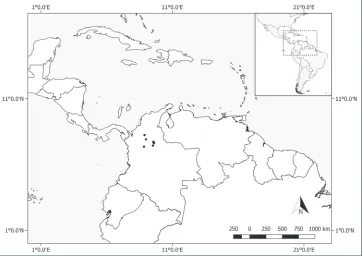
to Belize. Pachyptera aromatica is restricted to the Brazilian Amazon. Pachyptera erythraea is endemic to the middle Magdalena River Valley of Colombia, while P. incarnata is endemic to Eastern Amazon. Pachyptera linearis is known only by a few collections from Venezuela and Colombia.
Habitats
Species of Pachyptera occur in wet terra-firme forests, generally close to water bodies or riverbanks and are also found in flooded forests such as the Brazilian igapó. The majority of Pachyptera species has seeds with thin wings that are wind dispersed, while P. kerere has thick, corky and wingless seed adapted to water dispersal (Gentry 1976). Water dispersal arose several times independently in tribe Bignonieae, mostly from wind-dispersed ancestors (Gentry 1983, 1990, Lohmann 2004). Shifts between dispersal syndromes may have driven the speciation of P. kerere (Francisco and Lohmann submitted).
Reproductive biology
Pachyptera includes great diversity of floral morphology that is associated with dif-ferent pollination syndromes. Pachyptera aromatica has white, hypocrateriform corol-las and nocturnal anthesis (Barbosa Rodrigues 1891). The flowers of this species are classified as “Tanaecium type” and fit the hawkmoth pollination syndrome (Gentry 1974). Tanaecium type flowers evolved multiple times within Bignonieae (Alcantara and Lohmann 2010) and are found in Tanaecium and Bignonia nocturna (Barb. Rodr.) L.G. Lohmann. Pachyptera erythraea, on the other hand, have orange to red flowers that are tubular campanulate, with sub-exserted anthers. These flowers are classified as “Martinella type” and are likely pollinated by hummingbirds (Gentry 1974).
Pachyptera incarnata, P. kerere and P. linearis share infundibuliform and dorso-ven-trally compressed corollas, with two longitudinal ridges in the throat that form yellow nectar guides, as well as included anthers. Pachyptera incarnata has light pink to pale purple flowers, while P. kerere and P. linearis have white to cream flowers. These flowers are classified as “Anemopaegma type” and are pollinated by large to medium-sized bees, mainly euglossine and anthophorids (Gentry 1974).
Etymology
Morphology
Habit. All species of Pachyptera are lianas, although seedlings are initially herbaceous and free standing until ca. 80 cm (grow vertically).
Stems. The stems of Pachyptera exhibit four phloem wedges in cross-section, a type of cambial variation also found in Adenocalymma, Martinella, Cuspidaria, Fridericia and Tanaecium (Lohmann 2006, Lohmann and Taylor 2014). Moreover, the pith of the stem of Pachyptera is solid although a few specimens of P. aromatica also show a slightly hollow pith, a condition only known from Stizophyllum and Pleonotoma within tribe Bignonieae (Lohmann and Taylor 2014). Cylindrical to tetragonal stems are found in Pachyptera, sometimes within a single individual. Young stems are usually cylindrical, becoming tetragonal in more advanced stages of development. Tetragonal stems are only found in stems ≥ 6 cm2 of P. aromatica but are also found in stems with
a smaller diameter in other species of the genus (Francisco personal observation). Stem surface is striated and frequently bears lenticels (except in P. aromatica). The peeling bark is a morphological synapomorphy of the genus (Lohmann 2006, Lohmann and Taylor 2014).
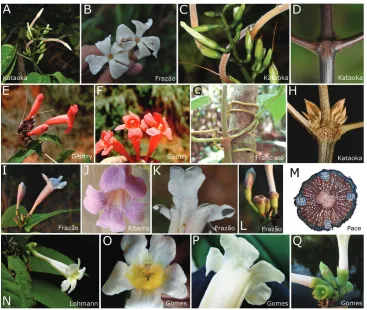
Prophylls of the axillary buds. Prophylls of the axillary buds, referred to as “pseu-dostipules” in the past (e.g. Gentry 1980), exhibit several shapes and are useful generic characters within Bignonieae (Lohmann and Taylor 2014). Species of Pachyptera usu-ally have multiple flattened and ensiform prophylls of the axillary buds (triangular and minute in P. aromatica, Fig. 5B), arranged in 3(–5) series (Fig. 2H). Sometimes the prophylls are so minute in P. aromatica that only the larger prophyll series is visible to the naked eye (Fig. 2D). The supra-numerary prophylls are an exclusive morphological synapomorphy of Pachyptera (Fig. 2G, H).
Extrafloral nectaries. Extrafloral nectaries (i.e. EFNs) are useful generic and species level markers within Bignonieae, aiding the identification of sterile materials (Seibert 1948, Lohmann and Taylor 2014). EFNs produce sugar that attracts ants which, in turn, have an important protective role against herbivores (Gentry 1974, Nogueira et al. 2015). In Pachyptera, EFNs are composed of large groups of patelliform glands located between the interpetiolar region (Fig. 2D, G, H) and at the petiole apex, right below the junction with the petiolules. Interpetiolar gland fields are also found in other Bignonieae genera (e.g. Fridericia, Lundia, Tanaecium) and have evolved multi-ple times within the tribe (Nogueira et al. 2013, Lohmann and Taylor 2014). On the other hand, clusters of patelliform glands located on petioles and petiolules are rare in Bignonieae and only known from a few species (e.g. Tanaecium pyramidatum and Mansoa standleyi).
Figure 2. Sample of morphological features of Pachyptera. A–DPachyptera aromatica: A Inflorescence B Frontal view of flowers C Detail of inflorescence and flowers, showing calyx partition D Interpetiolar region of stem with extra floral nectaries (EFNs) and prophylls of the axillary buds 3-seriated, triangular and minute E–FP. erythraea: E Inflorescence F Frontal view of flowers G–LP. incarnata: G Stem with tendril surrounding a tree H Interpetiolar region of stem with EFNs and prophylls of the axillary buds flattened, ensiform and seriated I Inflorescence J Frontal view of flower K Pink patelliform glands on flower lobes L Detail of calyx M–QP. kerere: M Stem cross-section with four phloem wedges N Inflores-cence O Frontal view of flower P White patelliform glands on flower lobes Q Detail of calyx.
Inflorescences. The inflorescence of Pachyptera is a simple raceme that can originate from the apical and axillary buds, producing terminal and axillary inflorescences re-spectively. Racemes can be lax, with a well-developed central axis, ca. 6-24 cm in P. aromatica (Fig. 2A, C) or reduced, with a short central axis (< 4.8 cm long) in all other species of the genus (Fig. 2E, I, N). In Pachyptera, inflorescence bears ca. 6-30 flowers, although only 1-2 flowers open at a time.
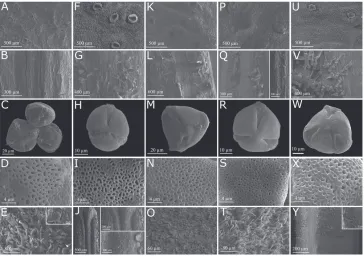
mor-Figure 3. Vertical lines show calyx with patelliform glands, region of stamen insertion, pollen grains, detail of pollen exine and ovary surface variation in all species of Pachyptera, respectively. A–EP. aromatica
F–JP. erythraeaK–OP. incarnataP–TP. kerereU–YP. linearis.
phology and arrangement within the tribe. These patelliform glands are conspicuous, sometimes wine-coloured (Fig. 1M) and thought to play an important role against nectar robbers (Gentry 1974).
Corollas. More than half of Pachyptera species have infundibuliform and dorso-ven-trally compressed corollas (Fig. 2I, N), with internal yellow nectar guides (Fig. 2F, O) and a villous portion where stamens and staminodes are included (Fig. 3G, L, Q, V). The corolla tube shape of P. erythraea is slightly modified and expands above the short basal constriction and becomes tubular-campanulate (Figs 2E–F, 8B). On the other hand, P. aromatica exhibits an extraordinary and distinctive morphology, showing a corolla hypocrateriform, not compressed (Fig. 2A–B), without nectar guides that are glabrous internally (Fig. 3B). Corolla colour is useful for species identification, rang-ing from white to red (see Figs 1, 2). All species display nectaries on the upper portion of the corolla tube and base of the corolla lobes that exude large globules of colourless and viscous liquid (Fig. 2K, P), likely associated with ant-plant interactions. This fea-ture is a morphological synapomorphy of the genus (Lohmann 2006; Lohmann and Taylor 2014).
The densely villous anthers, with curved thecae, are diagnostic of the majority of Pachyptera species (Fig. 2F, O). Only P. aromatica has glabrous anthers with straight thecae. Villous anthers are an important feature of Pachyptera (except P. aromatica), only shared with Lundia.
Pollen. Pollen has been shown to represent a useful trait for generic delimitation within the Bignoniaceae (Gentry and Tomb 1979). Members of Pachyptera generally have microreticulate 3-colpate pollen (Fig. 3H, M, R, W), a condition also found in Lundia, Pleonotoma and Tanaecium (Gentry and Tomb 1979). However, P. aromatica has psilate-foveolate to microreticulate 4-colpate pollen grains (Fig. 3C–D).
Gynoecium. Members of Pachyptera have capitate, elliptic and ovate stigmas. While the style and stigma are always glabrous, the ovary is pubescent (Fig. 3E, T, Y) or lepidote (Fig. 3J, O). As with most representatives of Bignoniaceae, Pachyptera has bilocular ovaries, with two ovules per locule and axillary placentation. All species have well-developed nectar discs.
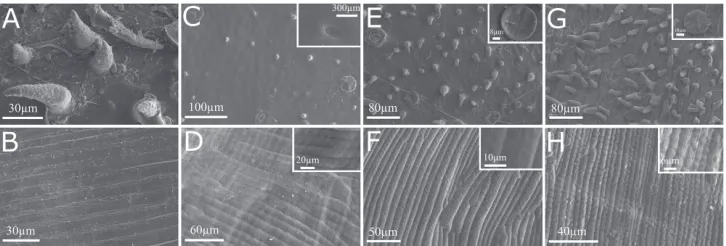
Fruits. Fruits are coriaceous to woody septicidal capsules, with two valves. The capsule is linear and flattened in most species (fusiform and inflated in P. kerere), pu-berulous, lepidote, covered with patelliform glandular trichomes and without lenticels (Fig. 4A, C, E, G). Each valve has an inconspicuous longitudinal midline (conspicuous and raised in P. kerere).
Seeds. The seeds of Pachyptera are mostly oblong, thin, chartaceous to coriaceous, with membranaceous and hyaline wings, except from P. kerere in which seeds are ir-regularly circular and obcordate, thick, corky and wingless. Seed surface has provided excellent information for the systematics of various plant groups (Barthlott 1981). The seed surface of Pachyptera species is striated, with a distinctive secondary sculp-ture in each species. More specifically, the seed surface of P. aromatica is striated and smooth, while the seed surface of P. incarnata is striated with randomly distributed micropores and the seed surface of P. kerere is striated with two pairs of medium micropores on each striation. In P. linearis, the seed surface is striated, with the stria-tions being regularly interrupted by lateral rays (Fig. 4B, D, F, H). The seed surface of P. erythraea is unknown.
Figure 4. Vertical lines show fruit and seed surface, respectively. A–BP. aromaticaC–DP. incarnata
Material and methods
Species delimitation. Molecular phylogenetic data (Francisco and Lohmann submitted) was used to aid species delimitation. While it is understood that not all species need to be monophyletic, species are evolutionary lineages that reach a status of reciprocal monophyly in advanced stages of the speciation process (de Queiroz 2007; Funk and Olmland 2003). As such, independent evolutionary units that share a unique combi-nation of features are treated here as separate species, following Cracraft (1983).
Morphological descriptions. Morphological descriptions of all species of Pachyptera were based on extensive fieldwork and on the analysis of multiple herbarium specimens. The authors examined 378 specimens deposited in the following herbaria: A, B, COL, ESA, F, G, HB, HERBAM, HRCB, HUA, IAN, INPA, K, LINN, MBM, MG, MICH, MO, NY, NX, P, R, RB, RBR, S, SPF, SP SPSF, UEC, UFACPZ, US, VEN and WU (acro-nyms following Thiers 2015). Images or the actual specimens of all type materials were also analysed. Fieldwork was conducted between 2014 and 2015, in the Brazilian states of Amazonas, Pará and Roraima, the centre of diversity of Pachyptera. Specimens collected during field expeditions were deposited at SPF and MO. All accepted names are listed al-phabetically, with nomenclatural discussions and citations following McNeill et al. (2012). Morphological descriptions and measurements were conducted on dried speci-mens and fresh materials following the terminology of Lohmann and Taylor (2014), with additional terms from Radford (1974), Gentry and Tomb (1979), Hesse et al. (2009), Hickey (1979), Nogueira et al. (2013) and Weberling (1992). Rare conditions are shown within parentheses. Calyx, corolla and ovary surfaces, fruit coat, pollen surface and seed coat were analysed from representative specimens of each taxon us-ing scannus-ing electron microscopy (SEM) (Appendix 1). The selected structures were mounted on stubs and sputter-coated with gold. Micrographs were obtained on a Zeiss DSM 970 scanning electron microscope.
Distribution maps and examined specimens. Distribution maps were prepared using QGIS 2.16.3 (QGIS Development Team 2016). A list of examined specimens was prepared and listed alphabetically using the R package monographaR (Reginato 2016) implemented in R (R Development Core Team 2017).
Taxonomic treatment
Pachyptera DC., Prodr. 9: 175. 1845
Pachyptera DC., Prodr. 9: 175. 1845. Type: Pachyptera foveolata DC. (lectotype, desig-nated by Sandwith [1932: 84]) [= Pachyptera kerere (Aubl.) Sandwith]
Sererea Raf., Sylva Tellur. 107. 1838. Type: Sererea heterophylla (Willd.) Raf., Sylva Tellur. 107. 1838. nom. illeg. superfl. [= Pachyptera kerere (Aubl.) Sandwith]
Nomenclatural note.Sererea Raf. was described to accommodate one species, Ser-erea heterophyla Raf., using a wrong spelling. However, Sererea heterophylla (Willd.) Raf. was actually based on Bignonia heterophylla Willd, a superfluous name for Bigno-nia kerere Aubl.
Number of species, distribution and habitat. Pachyptera comprises five species found in wet and flooded forest vegetation from Belize to Bolívia and Brazil.
Key to species of Pachyptera
1 Stems cylindrical (if tetragonal, then only on older portions), without lenti-cels; prophylls of the axillary buds triangular and minute; corolla hypocrateri-form ...P. aromatica
– Stems tetragonal (if cylindrical, then only on younger portions), with lenti-cels; prophylls of the axillary buds ensiform and flattened; corolla infundibu-liform or tubular-campanulate ...2
2 Corolla light pink to pale purple or orange to red; ovary densely lepidote ...3
– Corolla white to cream; ovary pubescent ...4
3 Calyx reddish-wine throughout, cupular; corolla orange to red, tubular cam-panulate; stamens sub-exserted; capsule linear, 34.0–41.0 cm long, ≥ 2.7 cm wide ...P. erythraea
– Calyx green, light pink at the apex, tubular; corolla light pink to pale purple, infundibuliform; stamens included; capsule linear, 10.5–42.6 cm long, ≤ 2.6 cm wide ...P. incarnata
4 Ovary densely pubescent; capsule fusiform, inflated, each valve with a con-spicuous midline; seeds thick, corky and wingless ...P. kerere
– Ovary sparsely to moderately pubescent; capsule linear, flat, each valve with an inconspicuous midline; seeds thin, coriaceous and winged ...P. linearis
1. Pachyptera aromatica (Barb. Rodr.) L.G. Lohmann, Ann. Missouri Bot. Gard. 99(3): 456. 2014
Fig. 5
Pachyptera aromatica (Barb. Rodr.) L.G. Lohmann, Ann. Missouri Bot. Gard. 99(3): 456. 2014. Leucocalantha aromatica Barb. Rodr., Vellosia. ed. 2. 1: 47, tab. 7. 1891. Pachyptera aromatica (Barb. Rodr.) L.G. Lohmann, Cat. Pl. Fung. Brasil 1: 770. 2010, nom. nud. Type: Brazil. Amazonas: in capoeiras prope Manáos, in Rio Negro, July, fl., B. Rodrigues 633. Lectotype (designated here): tab. 7, in Vellosia. 1891, excluding the pollen image.
Description. Liana; stems solid (hollow), cylindrical (tetragonal when ≥ 6 cm2
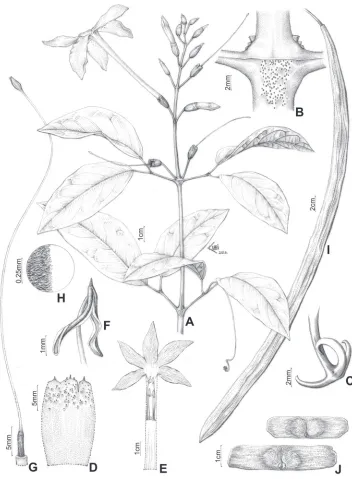
minute. Leaves with blades discolorous, chartaceous to coriaceous, elliptic, obovate or ovate-lanceolate, asymmetric (symmetric), apex acuminate or caudate, base cune-ate, obtuse or rounded, lateral blades 5.3–19.8 × 2.0–8.0 cm, apical blades 9.0–19 × 3.8–9.0 cm; petioles cylindrical, (0.3-)1.0–6.0 cm long; petiolules often pulvinated, lateral petiolules 0.5–6.0 cm long, apical petiolules 3.0–8.5 cm long. Inflorescence a lax raceme, 6–24 cm long; pedicel 0.5–1.8 cm long; bracts 0.4–2.1 mm long; bracteoles cymbiform or lanceolate, 0.7–0.8 mm. Calyx green, tubular, sub-bilabiate, 5-denticu-late (truncate), 1.0–1.8 × 0.3–0.6 cm. Corolla white, hypocrateriform, 6.3–12.2 cm long, 0.4–1.0 cm of diameter at the tube mouth; lobes elliptic or obovate, 1.9–4.0 × 1.1–1.9 cm. Androecium with the longer stamens 14.0–23.1 mm long, the shorter sta-mens 11.0–19.7 mm long, glabrous; anthers glabrous, included, with thecae straight, 3.8–6.2 × 0.3–0.6 mm; pollen 4-colpate, psilate-foveolate-microreticulate. Gynoecium ca. 5.4 cm long; ovary 2.7–4.8 × 1.0–1.2 mm, cylindrical, not-sulcate, smooth, moder-ately to densely pubescent, with simple and dentritic trichomes, sparsely lepidote, with glandular peltate trichomes, without patelliform glandular trichomes; stigma ovate, 2.3× 1.6 mm; nectar disc 0.3–1.4 × 1.3–2.1 mm. Capsule linear, flattened, 33.1–95.0 × 1.0–2.0 cm, each valve with an inconspicuous longitudinal midline; seeds oblong, 4.0–5.5 × 1.0–1.6 cm, thin, not-corky, chartaceous, striated, secondary sculpture smooth, winged, with membranaceous (chartaceous) and hyaline wings.
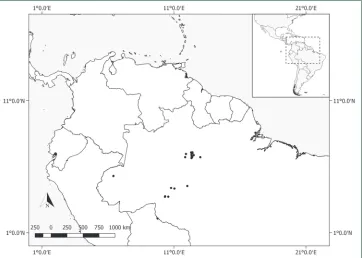
Distribution.Pachyptera aromatica grows in wet forest vegetation in the Brazilian Amazon (Amapá, Amazonas, Rondônia). Fig. 6.
Phenology. This species flowers from June to January. Fruits were collected in January, March and July through November.
Nomenclatural note. Like Lohmann and Taylor (2014), it was not possible to locate the holotype of P. aromatica during multiple visits to the RB, where the holotype was thought to be deposited. It was also not possible to locate any isotypes of any of the collections visited, indicating that the types of P. aromatica were likely lost, just like several other type materials collected by Barbora Rodrigues in the Amazon (Mori and Ferreira 1987). As such, we here designate the illustration used in the original descrip-tion of this species as the lectotype.
Taxonomic comments. P. aromatica is characterised by cylindrical (tetragonal when ≥ 6 cm2 diameter) and vinaceous stems with greyish striations, interpetiolar
Figure 6. Distribution of Pachyptera aromatica.
triangular and minute prophylls of the axillary buds (vs. well developed, flattened and ensiform prophylls of all other species of Pachyptera), glabrous region of stamen and staminode insertion (vs. villous region of stamen and staminode insertion of all other species of Pachyptera), glabrous anthers with straight thecae (vs. villous anthers with curved thecae of all other species of Pachyptera) and white hypocrateriform corollas (vs. white to red infundibuliform or tubular-campanulate corollas of all other species of Pachyptera) (Fig. 5A–B, E–F).
fl., L.G. Lohmann 794 (SPF). Rondônia: Porto Velho, 11 Sept 1963, fl., B. Maguire 56679 (MO); Ibid., Guaporé, 1 June 1952, fl., G.A. Black 52-14674 (IAN); Ibid., Rio Madeira, Aug 1936, fl., A. Ducke 35624 (MO, RB, US); Ibid., Aug 1936, fl., A. Sucre s.n. (RB); Rio Cuieras, 2 km below mouth of Rio Brancinho, 11 Sept 1973, fl., G.T. Prance 17773 (INPA, MO, NY). Ibid., Sub-base do Projeto RADAM, aeroporto in-ternacional local, 3 Sept 1975, fl., C.D.A. Mota 18 (INPA); Ibid., Sub-base do Projeto RADAM, aeroporto internacional local, 3 Sept 1975, fr., C.D.A. Mota 26 (INPA); s.loc., 1 Jan 1972, fr., B. Maguire s.n. (INPA).
2. Pachyptera erythraea (Dugand) A.H. Gentry, Phytologia 35(3): 186, fig. 2A. 1977
Fig. 7
Pachyptera erythraea (Dugand) A.H. Gentry, Phytologia 35(3): 186, fig. 2A. 1977. Pachyptera kerere var. erythraea Dugand, Caldasia 7(31): 16. 1955. Mansoa eryth-raea (Dugand) A. Gentry, Ann. Missouri Bot. Gard. 66(4): 782. 1979 [1980]. Type: Colombia. Santander: 10 leguas al S.E. de Barranca Bermeja, a 9 km de la margen izquierda del Río Opón, 200 m., 26 Aug. 1954, fl., R. Romero-Castañeda 4727 (holotype, COL000004375!).
Distribution. Pachyptera erythraea is endemic to wet forest vegetation from the Magdalena River Valley in northern Colombia (Antioquia, Santander). Fig. 8.
Phenology. Flowers collected in January, March and July to December. Two fruit-ing collections are known, one collected in July and the other in September.
Taxonomic comments.Pachyptera erythraea is distinguished by the orange to red corollas (vs. white, light pink to pale purple in all other species), cupular calyces (vs. tu-bular in all other species) and sub-exserted anthers (vs. included anthers in all other spe-cies). Moreover, P. erythraea is the sole species of Pachyptera with tubular-campanulate corollas. The fruit of P. erythraea is flat, without a visible longitudinal midline. The seeds are thin and winged, similar to those of P. incarnata and P. linearis. Pachyptera erythraea is closely related to P. incarnata, with which it shares a moderately to densely lepidote ovary (Fig. 1). However, these species are separated by the bi-sulcate ovary, with glan-dular peltate and patelliform trichomes arranged in vertical lines in P. erythraea vs. the non-sulcate ovary, fully covered by glandular peltate trichomes in P. incarnata.
7°03'36.0"N, 73°51'36.0"W, 200 m, 26 Aug 1954, fl., R. Romero-Castañeda 4727 (COL, MO); Ibid., 12 leguas al SE de Barranca Bermeja, orilla derecha del rio Opón, 200 m, 4 Oct 1954, fl., R. Romero-Castañeda 4979 (COL); Ibid., 2 km S. of Llanitas, 19 km N. of Barranca Bermeja, 7°03'36.0"N, 73°51'36.0"W, 160 m, 24 July 1975, fl., A.H. Gentry 15369 (MO); 11-13 km N of Barranca Bermeja on road to Puerto, 07°09'19"N, 73°50'28"W, 160m, 24 July 1975, fl., A.H. Gentry 15372 (MO); Cam-po CaCam-pote, Magdalena Valley, camCam-po CaCam-pote, 30 km E of Carare, 6.61, -73.91, 300 m, 29 Sept 1977, fr., A.H. Gentry 20050 (MO); El Centro, 3 km S. of El Centro on road to Yarima, 200 m, 25 July 1975, fl., fr., A.H. Gentry 15402 (MO).
3. Pachyptera incarnata (Aubl.) Francisco & L.G. Lohmann, comb. nov. urn:lsid:ipni.org:names:77175179-1
Fig. 9
Bignonia incarnata Aubl., Hist. Pl. Guiane. 2: 645, tab. 261, 262, fig. 1–8. 1775. Big-nonia incarnata Aublet sec. Splitg., Tijdschr. Nat. Geschied 9: 7. 1842. nom. nud. Cydista incarnata Miers, Proc. Roy. Hort. Soc. London. 3: 192. 1863. nom. nud. Pachyptera kerere var. incarnata (Aubl.) A.H. Gentry, Brittonia 25(3): 235. 1973. Mansoa kerere var. incarnata (Aubl.) A.H. Gentry, Ann. Missouri Bot. Gard. 66(4): 783. 1979 [1980]. Type: French Guiana. s.loc., s.d., (fl., fr), J.B.C.F. Aublet s.n. Lectotype (designated here): tab. 261 and 262, in Hist. Pl. Guiane 1775.
Figure 10. Distribution of Pachyptera incarnata.
chartaceous to sub-coriaceous, striated, secondary sculpture with randomly distributed micropores, winged, with membranaceous and hyaline wings.
Distribution. This species is found in wet forest vegetation in Brazil (Amazonas, Mato Grosso, Pará, Rondônia) and French Guiana. Fig. 10.
Phenology. Pachyptera incarnata flowers in February to May and July to Decem-ber. Fruiting material has been colected in April, May, July to October and DecemDecem-ber.
Etymology. The specific epithet “incarnata” refers to the corolla colour referred by Aublet as “of flesh”.
following Aublet (1775). As it was not possible to locate original material, the original illustration is here designated as the lectotype.
Taxonomic comments.Pachyptera incarnata is characterised by the infundibuli-form and light pink to pale purple corolla with ovary densely lepidote. The capsule is linear, flattened and coriaceous, with pink patelliform glandular trichomes throughout the surface and has an inconspicuous longitudinal midline. Seeds are oblong, thin, chartaceous to sub-coriaceous, winged, with membranaceous and hyaline wings.
próximo à Usina Hidrelétrica Curuá-Uma, solo areno argiloso, floresta de terra firme, 02°48'45.2"S, 54°18'08.8"W, 47 m, 19 Sept 2015, fl., J.N.C. Francisco 105 (SPF); São Miguel do Guamá, Rio Guamá, beira do rio, igapó, 21 Aug 1948, fl., fr., Dardano 48-3092 (IAN); Senador José Porfirio, margem direita do Rio Xingu, capoeira de terra firme, 02°34'00"S, 51°55'00"W, 3 Dec 1991, fr., G. Santos 282 (MG); Tucuruí, área de desmatamento, 1 Sept 1983, fl., F.E. Miranda 362 (NY); Ibid., BR-422, Km 45, Breu Branco, margem do rio Tocantins, 5 Nov 1983, fl., J. Ramos 1011 (INPA); Ibid., estrada para o lago 31 de março, 30 Aug 1983, fl., J. Revilla 8397 (NY); Ibid., margens da PA-149 até ca. Km 50, 22 Aug 1983, fr., J. Revilla 8326 (NY); Viseu, Serra do Piriá, à 13km de Açaiteua, 4 Dec 1993, fl., J. Sales 1539 (MG); Vitória do Xingu, 3°19'32"S, 52°00'16"W, 1 Aug 2015, fl., R.V. Pyramo PSACF_EX06147 (RB); V Ibid., 3°22'4"S, 52°02'23"W, 12 Aug 2015, fl., B.R. Silva PSACF_EX06201 (RB).
4. Pachyptera kerere (Aubl.) Sandwith, Recueil Trav. Bot. Néerl. 34: 219. 1937.
Fig. 11
Bignonia kerere Aubl., Hist. Pl. Guiane 2: 644, tab. 260. 1775, excluding the fruit description and tab. 263. Bignonia heterophylla Willdenow, Sp. Pl. 3: 298. 1800 [1801]. nom. superfl. illeg. Sererea heterophyla (Willd.) Rafinesque, Sylva Tellur. 107. 1838. nom. superfl. illeg.Adenocalymma kerere (Aubl.) Bureau & K. Schum. Fl. Bras. 8(2): 119. 1891. Adenocalymma stridula Miers, Ann. Mag. Nat. Hist. ser. 3 7: 392. 1861. nom. illeg., Petastoma kerere (Aubl.) Schnee in. Pittier, Cat. Fl. Venez. 2: 404.1947. Mansoa kerere (Aubl.) A. Gentry, Ann. Missouri Bot. Gard. 66(4): 783. 1979 [1980]. Type: French Guiana. Cayenne, s.d., fl., J.B.C.F. Aublet s.n. (holotype, BM000992379!).
Pachyptera foveolata DC., Prodr. 9: 175. 1845. Adenocalymma foveolatum (DC.) Bail-lon, Hist. Pl. 10: 7, fig. 9–16. 1891. Adenocalymma foveolatum (DC.) K. Schu-mann, Nat. Pflanzenfam 4(3b): 214, fig. 89 F–G. 1894. nom. superfl. illeg. Adeno-calymma foveolatum (Bureau) Bureau & K. Schumann, Fl. Bras. 8(2): 109. 1896. nom. illeg. Type: French Guiana, s.loc., 1819-1821, fr., M. Poiteau s.n. (lectotype, designated by Sprague and Sandwith 1929, p. 84: G-DC [G00014105]!).
Adenocalymma brachybotrys DC., Prod. 9: 202. 184. Type: French Guiana. s.loc., 1821, fl., G.S. Perrottet s.n. (holotype, P03578200!).
Adenocalymma symmetricum Rusby, Descr. S. Amer. Pl. 122. 1920. Type: Venezuela. Lower Orinoco, 1896, fl., Rusby & Squires s.n. (holotype, NY00313053!). Bignonia benensis Britton ex Rusby, Bull. Torrey Bot. Club 27: 70. 1900. Type: Bolívia.
Junction of Beni and Madre de Dios rivers, Aug. 1886, fl, H.H. Rusby 1143. (lecto-type, designated here, NY00313133!; iso(lecto-type, MICH01115822!, NY00313132!, US00603898!, US00125816!).
Description. Liana; stems solid, tetragonal (cylindrical in younger portions), green or brown, with greyish striations, lenticellate; prophylls of axillary buds 3(–5)-seriated, flattened and ensiform. Leaves with blades discolorous (concolor), membranaceous to chartaceous (coriaceous), elliptic, obovate or ovate-lanceolate, asymmetric, apex acute, acuminate or caudate, base cordate, oblique, lateral blades 4.4–22.5 × 2.1–14.3 cm, apical blades 5.2–22.5 × 2.0–11.5 cm; petiole semi-cylindrical, 0.3–6.9 cm long, peti-olules not puvinated, lateral petipeti-olules 0.3–6.0 cm long, apical petipeti-olules 0.8–6.0 cm long. Inflorescence a congested raceme, 0.6–4.8 cm long; pedicel (0.2–)0.5–5.7(–7.5) cm long; bracts 1.1–2.4 mm long; bracteoles cymbiform or filiform, 0.4–2.3 × 0.5–0.8 mm. Calyx green, sometimes with purplish apex, tubular, bilabiate or sub-bilabiate, truncate, minutely 5-lobed, 0.5–1.2 × 0.4–0.9 cm. Corolla white to cream, infundibu-liform, 4.0–9.5 cm long, 0.9–2.5 cm of diameter at the tube mouth; lobes rounded (sub-circular), 0.6–1.9 × 0.5–1.8 cm. Androecium with the longer stamens 18.0–29.1 mm long, the shorter stamens 11.9–20.3 mm long, glabrous; anthers villous, included, thecae curved forward, 1.9–3.1 × 0.3–1.0 mm; pollen 3-colpate, microreticulate. Gy-noecium 3.2–6.0 cm long; ovary 1.8–3.6 × 0.8–1.6, cylindrical, not-sulcate, smooth, densely pubescent, with simple and dentritic trichomes, sparsely lepidote, with glan-dular peltate trichomes, without patelliform glanglan-dular trichomes; stigma capitate or ovate, 1.6–3.1 × 0.9–3.5 mm; nectar disc 0.4–1.9 × 0.5–4.0 mm. Capsule fusiform, inflated (slightly flattened), 8.0–26.0 × 1.5–3.6 cm, each valve with a conspicuous and raised longitudinal midline; seeds irregularly circular and obcordate, 2.8–4.4 × 1.4–3.0 cm, thick, corky, striated, secondary sculpture with two pairs of medium micropores on each striation, wingless.
Distribution. This species is typically found in wet and often flooded forest vegeta-tion in Belize (Toledo), Costa Rica (Limón, Puntarenas), Guatemala (Izabal), Hondu-ras (Atlántida, Cólon), Nicaragua (Atlántico Sur, San Juan), Panama (Bocas del Toro, Colón, Darién, Panama), Bolívia (Beni), Brazil (Acre, Amapá, Amazonas, Maranhão, Mato Grosso, Pará, Rondônia, Roraima), Colombia (Amazonas, Antioquia, Bolívar, Chocó), French Guiana (Cayenne), Guyana (Cuyuni-Mazaruni, Upper Demerara-Berbice, Venezuela), Peru (Amazonas, Huánuco, Loreto, Madre de Dios), Suriname and Venezuela (Amazonas, Apure, Bolívar, Delta Amacuro). Fig. 12.
Phenology. This species flowers and fruits throughout the year.
Etymology. The specific epithet is derived from vernacular name “kéréré” or “té-réré” adopted by the indigenous group Galibis, from French Guiana, who use this plant as rope material.
Nomenclatural note. The original description of this species by Aublet (1775) included a mistake in the fruit illustration and description, which consists of the de-scription of Amphilophium magnollifolium (Kunth) L.G. Lohmann instead.
Figure 12. Distribution of Pachyptera kerere.
Pharmacy Herbarium, where Britton worked. Materials from this herbarium were only later incorporated into the NY collection along with other items. Therefore, the specimen originally deposited at NY (NY313133) is here designated as lectotype.
Taxonomic comments. Pachyptera kerere is easily recognised by the infundibuliform, white to cream corollas, with densely pubescent ovary. The fusiform, woody, inflated (sometimes slightly flattened) fruit, with a conspicuous and raised longitudinal midline, is very distinctive. The seeds are irregularly circular and obcordate, corky and wingless.
Pachyptera kerere shares infundibuliform corollas with P. incarnata and P. linearis. However, P. kerere can be differentiated by the densely pubescent ovary (vs. sparsely pubescent ovary of P. linearis and densely lepidote ovary in P. incarnata). Furthermore, P. kerere is easily separated from P. incarnata by the white corolla (vs. light pink to pale purple corolla of P. incarnata).
10°30'36.0"N, 83°30'00.0"W, 2 m, 29 Nov 1987, fr., R. Robles 1391 (MO); Puerto Viejo de Talamanca, along road in vicinity of beach between Punta Cocles and Punta Uva, E of Puerto Viejo de Talamanca, 9°37'48"N, 82°42'36"W, 0–5 m, 6 Nov 1984, fl., M.H. Grayum 4411 (MO); Rio Gandoca, Refugio Gandoca-Manzanillo Low-ly-ing coastal swamps and forests, Gandoca (slightly to N of trail from Mata de Limón), 9°36'N, 82°36'W, 0 m, 27 Jan 1987, fl., M.H. Grayum 8032 (MO); Talamanca, Six-aola, Gandoca, finca Cangrejo, Anai, 9°34'45"N, 82°36'20"W, 10 m, 24 Mar 1995, fr., G. Herrera 7551 (K). Puntarenas: Cantón de Osa, cuenca Térraba-Sierpe, Choc-uaco, 8°43'50"N, 83°27'17"W, 150 m, 29 Dec 1996, fl., R. Aguilar 4824 (MO); Golfo Dulce, Reserva Forestal Golfo Dulce Aguabuena, sector sur, 08°42'00"N, 83°31'12"W, 50 m, 15 Jan 1992, fl., R. Aguilar 818 (MO). GUATEMALA. Izabal:
Dartmouth, between Dartmouth and Morales toward Lago Izabel, Montana del Mico, 15°30'36.0"N, 88°46'48.0"W, 35 m, 7 Apr 1940, fl., fr., J.A. Steyermark 39022 (F, MO); Puerto Barrios, near Rio Pargueña, 38–40 km N of Puerto Ayacucho, 25 May 1939, fl., P.C. Standley 73082 (F). HONDURAS. Atlantida: Esparta, 41.5 km E of Tela on the Tela-Ceiba Hwy then ca. 6 km N along old timber road. In remaining patches of primary forest, 15°39'N, 87°16'W, 100 m, 24 Apr 1994, fl., fr., A.E. Brant 2917 (MO). Colón: Rio Guaimoreto, 1.8 mi strip on the north bank of rio Guaimor-eto between old bridge and opening of Laguna GuaimorGuaimor-eto 4.5 NE of Trujillo on old road to Castilla, 15°57'30"N, 85°54'30"W, 0 m, 10 July 1980, fl., J.G. Saunders 453 (MO); Trujillo, 1.8.mi strip on the north bank of rio Guaimoreto between old bridge and opening of Laguna Guaimoreto 4.5 mim, NE of Trijillo on old road to Castilla, 15°57'N, 85°54'W, 0 m, 19 June 1980, fl., J. Saunders 397 (MO). NICARAGUA. Atlántico Sur: Rio Pijibaye, 11°27'N, 83°54'W, 10–20 m, 18 Feb 1995, fl., fr., R. Rueda 3216 (MO). Río San Juan: Municipio de San Juan del Norte, Reserva Indio-Maíz, entre San Juan del Norte y la Finca de Chepelión, 50 m, 8 July 2002, fl., R. Rueda 16901 (MO). PANAMA. Bocas del Toro: Water Valley, vicinity of Chiriqui Lagoon, 23 Nov 1940, fl., H. von Wedel 1754 (MO). Colón: Chagres, Isthmus of Panama, 26 Mar 1850, fl., A. Fendler 206 (K); Portobello, ridge top, 1–3 miles W of Portobello, 7 Sept 1971, fl., A.H. Gentry 1766 (MO); premontane wet forest along Road S1 as it climbis the hill 1 Km SE of Camp Pina, 6 km WNW of Gatun Dam, 125 m, 21 Dec 1973, fl., M. Nee 8948 (MO); Western most part of province, site of proposed copper mine (INMET), Tailings Area, lowland forest on steep slopes, 8°53'50"N, 80°39'44"W, 40 m, 15 Apr 2009, fl., G. McPherson 20983 (MO).
Ibid., 01°29'24.9"N, 61°00'11.4"W, 67 m, 24 Sept 2014, fl., J.N.C. Francisco 39 (SPF); Igarapé Água Boa, Río Mucajai between Pratinha and Río Apiau, 22 Jan 1967, fl., G.T. Prance 4012 (INPA, K, MO, R, US);Rorainópolis, Rio Branco, 00°43'46.3"S, 61°51'24.0"W, 32 m, 14 May 2015, fl., V. Thode 424 (SPF); Ibid., Ponto 11, 0°56'24.0"S, 61°50'24.0"W, 22 m, 14 May 2015, fl., fr., A. Frazão 136 (SPF); Ibid., boca do Rio Branco com o Rio Negro, 1°23'8"S, 61°52'46"W, 40 m, 25 Apr 2014, fl., R.C. Forzza 8094 (RB); Ibid., 1°23'8"S, 61°52'46"W, 40 m, 25 July 2014, fl., R.C. Forzza 8113 (RB); Ibid., mata de igapó com interferência da água branca do rio Bran-co, 1°23'0.2"S, 61°51'6"W, 35 m, 13 May 2015, fl., B.M. Gomes 648 (SPF); Ibid., em direção à Caracaraí, mata de igapó, 1°12'12.7"S, 61°50'37.3"W, 34 m, 13 May 2015, fr., B.M. Gomes 651 (SPF); Ibid., ao encontro dos rio Branco com o Negro, mata de igapó com influência das águas do rio Negro, 1°5'46.5"S, 61°52'53"W, 28 m, 15 May 2015, fl., B.M. Gomes 659 (SPF); Ibid., mata de igapó, 1°14'42.7"S, 61°50'56.2’’W, 29 m, 16 May 2015, fl., B.M. Gomes 662 (SPF); Rorainópolis, Rio Negro, mata de igapó, 01°33'14.2"S, 61°30'27.8"W, 13 m, 12 May 2015, fl., M. Beyer 336 (SPF); Ibid., 01°33'14.2"S, 62°30'27.8"W, 13 m, 12 May 2015, fl., M. Beyer 337 (SPF); Ibid., 1°22'5.2"S, 61°45'55.3"W, 18 m, 13 May 2015, fl., B.M. Gomes 639 (SPF); Ibid., Rio Xixuaú, floresta beirando pequenos igarapés, 0°48'22"S, 61°33'32"W, 5 Mar 2010, fl., M.J.G. Hopkins 1961 (INPA); Ibid., Ilha da casa do Chris, 0°48'01"N, 61°33'29’’W, 25 m, 3 Feb 2011, fl., T. Marinho 208 (INPA). COLOMBIA. Llamos de Cumaral ad vedem Andim bogosensim orinocum versus, 386 m, Jan 1876, fl., L. Aruz 1035 (P). Amazonas: Araracuara, rocks along Rio Caqueta, Araracuara, 17 Jan 1989, fr., A.H. Gentry 64809 (MO). Antioquia: Chigorodo, Rio Leon 15 km W of Chigorodo, 07°45'N, 76°50'W, 100 m, 19 Mar 1962, fl., C. Feddema 1954 (MICH, MO, US); Necoclí, Reserva Indígena Cainán Nuevo, 76°46'W, 8°36"N, 2 m, Aug 1992, fl., L. Castaño 93a (HUA). Bolívar: La Raya, Achi, Inspeccion de la Raya, 8°19'48.0"N, 74°33'36.0"W, 30 m, 5 May 1987, fl., H.V. Cuadros 3601 (MO).
Chocó: Boca del Togoroma, Bank of Quebrada Togoroma, 13 June 1944, fl., fr., E.P. Killip 39122 (COL, F, MO, US); Las Animas, Jequedo, 42 km W of Las Animas, E of Rio Pato on Pan American (under construction) W of Las Animas, 5°16'48.0"N, 76°36'36.0"W, 250 m, 11 Jan 1979, fl., A.H. Gentry 23990 (MO); Truando, cativo swamps along Rio Truando, 18 Jan 1974, fl., A.H. Gentry 9313 (MO). FRENCH GUIANA. Javanes de Mana, 1855, fl., Gusllet s.n. (P); s.loc., 15 Dec 1956, fl., fr., A. Lemée 11 (P); s.loc., 1845, fl., fr., M. Melinón 64 (P); s.loc., 1856, fl., s.inf. s.n. (P); s.loc., 8 May 1874, fl., M. Melinón 121 (P); s.loc., Jan 1900, fl., F. Geay 1861 (P).
(MO); Carinagua, Dept Atures, alrededores de Puerto Ayacucho (ca. 9 Km al S), bosque de galeria del Caño Carinagua, alrededor del puente de la carretera Pto. cho-Samariapo, 10 Jan 1978, fl., O. Huber 1406 (MO); Dept. Átures, Puerto Ayacu-cho, end of road from airport to Rio Orinoco, gallery forest along river, 4 Apr 1984, fl., T. Plowman 13473 (F); Puerto Ayacucho, seasonally inundated forest at edge of Raudales del Orinoco, behind Pto. Ayacucho airport, sandy beach and adjacent laja, 5°39'36.0"N, 67°39'36.0"W, 100 m, 3 Apr 1984, fl., A.H. Gentry 46267 (MO); Rio Casiquiare, entre Piedra Guachapita y Curimacare, 2°00'00.0"N, 66°19'48.0"W, 150 m, 16 Jan 1987, fl., B. Stergios 9778 (MO); Rio Orinoco, caño Morocoto below San Fernando de Atabapo, 03°40'41"N, 67°14'15"W, 26 Mar 1974, fl., A.H. Gentry 10943 (MO). Apure: La Ceiba, between Rio Borgue and El Jordan, 7 km E de la Ceiba, 16 km E del Jordan, 350 m, 6 Apr 1968, fl., J.A. Steyermark 101948 (K); lo-cally frequent along Rio Cinaruco for 20 km above las Galeras de Cinaruco, 24 Jan 1956, fl., J.J. Wurdack s.n. (JBRJ, RB); San Fernando, mouth of Rio Arauca at Rio Orinoco, 7°24'N, 66°36'W, 35 m, 14 May 1977, fl., G. Davidse 13198 (MO). Bolí-var: Dpto. de Atures, Territorio Federal Amazonas, bosque humedo del rio Cataniapo, cercano a la desembocadura con el rio Orinoco, 6°24'36.0"N, 67°24'36.0"W, 37 m, 15 Feb 1983, fl., A. Castillo 1604 (MO); Moitaco, Distrito Sucre, rebalse del Orinoco, Hato Curumutopo, 11 Sept 1963, fl., fr., G. Martino 18 (MO, NY); Rio Orinoco, frequent on rocky outcrops on Isla Sta. Elena, opposite mouth of Rio Pargueni, 80 m, 13 Dec 1955, fl., J.J. Wurdack 39860 (K); Rio Parhueña, near Rio Pargueña, 38–40 km N of Puerto Ayacucho, 6°21'00.0"N, 67°09'36.0"W, 100 m, 30 June 1975, fr., A.H. Gentry 14686 (US, MO). Delta Amacuro: Depto. Antonio Diaz, Cano Atoiba, 9°15'N, 60°57'W, 50 m, 19 Oct 1977, fl., J.A. Steyermark 114985 (MO); Depto. Antonio Diaz, Cano Joba-Suburu, 8°59'N, 61°00'W, 50 m, 21 Oct 1977, fl., fr., J.A. Steyermark 115147 (MO); Rio Amacuro, between Amacuro and mouth of Deadwater Creak Moat, 8°31'12.0"N, 60°28'12.0"W, 65 m, 7 Nov 1960, fr., J.A. Steyermark 87341 (MO); Ibid., between Amacuro and mouth of Deadwater Creek Moat, 8°31'12.0"N, 60°28'12.0"W, 65 m, 7 Nov 1960, fl., J.A. Steyermark 87347 (MO).
5. Pachyptera linearis Francisco & L.G.Lohmann, sp. nov. urn:lsid:ipni.org:names:60475860-2
Fig. 13
Type. Colombia. Meta: Parque Nacional Natural Tinigua, Serrania Chamusa Centro de Investigación Primatologicas La Macarena, 120 m, Apr 1992, fr., P. Stevenson 403 (holotype: MO088944!; isotypes, COL000349706!, COAH21210, not seen).
Description.Liana; stems solid, tetragonal (cylindrical in younger portions), with greyish striations, lenticellate; prophylls of axillary buds 3-seriated, flattened and en-siform. Leaves with blades discolorous or concolor, membranaceous to chartaceous, elliptic, obovate-lanceolate, asymmetric, apex acute, acuminate, base cordate, lateral blades 6.0–12.4 × 3.0–4.9 cm, apical blades 8.0–14.7 × 3.4–6.0 cm; petiole semi-cylindrical, 1.0–4.2 cm long, petiolules not puvinated, lateral petiolules 0.5–1.6 cm long, apical petiolules 1.5–3.5 cm long. Inflorescence a congested raceme, 0.6–1.2 cm long; pedicel ca. 0.8 cm long; bracts ca. 0.7 mm long; bracteoles cymbiform, ca. 0.7 mm. Calyx green, tubular, minutely 5-lobed, 0.9 × 0.8 cm. Corolla white, infundibu-liform, ca. 6.7 cm long, ca. 1.4 cm of diameter at the tube mouth; lobes rounded, 0.8 × 0.9 cm. Androecium with the longer stamens ca. 32.0 mm long, the shorter stamens ca. 10.9 mm long, glabrous; anthers villous, included, thecae curved forward, 2.5 × 0.9 mm; pollen 3-colpate, microreticulate. Gynoecium 5.0–5.2 cm long; ovary 2.9–4.0 × 1.2 mm, cylindrical, not-sulcate, smooth, sparsely to moderately pubescent, with sim-ple trichomes, sparsely lepidote, with glandular peltate trichomes, without patelliform glandular trichomes; stigma capitate or ovate, 1.7–2.8 × 1.7–2.8 mm; nectar disc 1.8 × 2.0 mm. Capsule linear, flattened, 19.0–35.0 × 2.2–2.4 cm, each valve with an incon-spicuous longitudinal midline; seeds oblong, 4.0–7.0 × 1.5–1.8 cm, thin, not-corky, coriaceous to woody, striated, secondary sculpture regularly interrupted by lateral rays, wingless, with short membranaceous or chartaceous and hyaline wings.
Distribution. Pachyptera linearis is only known from wet forests of Venezuela (Apure, Bolívar) and Colombia (Meta). Fig. 14.
Phenology. Pachyptera linearis flowers in January and fruits in April.
Etymology. The epithet linearis makes reference to the linear fruit.
Nomenclatural note. Pachyptera linearis is a new species described here based on new morphological and molecular phylogenetic data (Fig. 1; Francisco and Lohmann submitted).The best quality material was selected as the holotype.
Taxonomic comments. Pachyptera linearis is characterised by white and infundibu-liform corollas, with a sparsely pubescent and sparsely lepidote ovary. Furthermore, the capsule is linear, flattened, coriaceous to woody, with an inconspicuous longitudinal mid-line on the valves. The seeds are oblong, thin, coriaceous to woody, winged, with short membranaceous or coriaceous and hyaline wings. Pachyptera linearis shares the white infundibuliform flowers with its sister species P. kerere (Fig.1). Nevertheless, P. linearis is easily distinguible from P. kerere by the fruit morphology.
Paratypes. VENEZUELA. Apure: galeras del Cinaruco, Rio Cinaruco, 29 km above Las Galeras de Cinaruco, 80 m, 24 Jan 1956, fl., J.J. Wurdack 41357 (K, MO, RB, S, VEN). Bolívar: Moitaco, rebalse del Orinoco, Hato Curumutopo, 8°00'00.0"N, 64°21'36.0"W, 24 Apr 1991, fr., G. Martino 22 (MO).
Doubtful and excluded names
Bignonia incarnata var. caribaea DC., Prodr. 9: 154. 1845. Type: Guadeloupe. s.loc., s.d., fl., F.L. L’Herminier s.n. (holotype, G-DC [G00133268]!) = Bignonia aequi-noctialis L.
Pachyptera alliacea (Lam.) A.H. Gentry Brittonia 25(1): 236. 1973. Type: French Gui-ana. s.loc., s.d., fl., J.B.C.F. Aublet s.n. (holotype, P-AD [P00307351]!) = Mansoa alliacea (Lam.) A.H. Gentry
Pachyptera dasyantha DC. Prodr. 9: 176. 1845. Type: Brazil. Bahia: Rio São Francisco, s.d., fl., J.S. Blanchet 2903 (holotype, G-DC [G00133367]!, K not seen) = Tanae-cium pyramidatum (Rich.) L.G. Lohmann
Pachyptera hymenaea (DC.) A.H. Gentry Brittonia 25(3): 236. 1973. Type: Brazil. Bahia, s.d., fl., J.S. Blanchet 1434 (holotype, G-DC [G00133196]!; isotype, P00481498!) = Mansoa hymenaea (DC.) A.H. Gentry
Pachyptera parvifolia A.H. Gentry Phytologia 26(6):447–450. 1973. Type: Colom-bia, Sur de Santander, vicinity of Puerto BerRío between carare and Magda-lena Rivers, raizudo, large liana, flowers light purple, forest at about 200m, 22 Apr 1937, fl., O. Haught 2179 (holotype, MO100091!) = Mansoa parvifolia (A.H.Gentry) A.H. Gentry
Pachyptera puberula DC. Prodr. 9: 175. 1845. Type: Brazil: Mato Grosso: close to Cuiabá, s.d., fr., S. Manso 105a (holotype, G-DC [G00133299]!) = Dolichandra uncata (Adrews) L.G. Lohmann
Pachyptera standleyi (Steyerm.) A.H. Gentry Brittonia 25(3): 236.1973. Type: Guate-mala, Quetzaltenango, between Finca Pirineos and Finca Soledad, lower southern slopes of Volcán de Santa María, between Santa María de Jesús and Calahuaché, 1300–1400 m, 5 Jan 1940, J.A. Steyermark 33533 (holotype, F1054546!; isotype, F1054531!, F-1054543! , US00125753!) = Mansoa standleyi (Steyerm.) A.H. Gentry Pachyptera striata DC. Prodr. 9: 176. 1845. Type: Brazil, São Paulo, s.d., P.W. Lund
783 (holotype, G-DC [G00133363]!) = Tanaecium pyramidatum (Rich.) L.G. Lohmann
Pachyptera umbelliformis DC. Prodr. 9: 175. 1845. Type: Brazil, São Paulo, s.d., fl., C.F.P. von Martius (syntype, M not seen; isosyntype, G-DC [G00133346]!), Bra-zil, Rio da Paraiba, Neuwied (syntype, M not seen) = Tanaecium pyramidatum (Rich.) L.G. Lohmann
Pachyptera ventricosa (A.H. Gentry) L.G. Lohmann Ann. Missouri Bot. Gard. 99(3): 456. 2014. Mansoa ventricosa A.H. Gentry Ann. Missouri Bot. Gard. 66 (4): 783. 1979 [1980]. Type: Brazil, Pará: along Belém-Brasilia hwy., Km 345, 9 Aug 1963, fl., B. Maguire et al. 56083 (holotype, MO2232816!; isotypes, COL000004276!, MG136673!, NY00328882!, US00289053!) = Mansoa ventricosa A.H. Gentry
Acknowledgements
The authors thank the Conselho Nacional de Desenvolvimento Científico e Tecnológi-co (CNPq) for a graduate fellowship to J.N.F. (163990/2014-0) and a Pq-1C grant to L.G.L. (307781/2013-5) and Fundação de Amparo à Pesquisa do Estado de São Paulo (FAPESP) for a regular research grant (2011/50859-2) and a collaborative FAPESP-NSF-NASA grant (2012/50260-6) to L.G.L. We are grateful for the curators of the herbaria listed herein for specimen loans; Klei Souza for preparing the illustrations; Annelise F. Nunez, Beatriz M. Gomes, Erik Kataoka, Marcelo Pace and Ricardo S. Ribeiro for providing us with beautiful photos; and, Carolyn E.B. Proença, Charlotte Taylor, Rafaela Campostrini Forzza and André Olmos Simões for valuable comments on the manuscript.
References
Aublet JBCF (1775) Histoire des plantes de la Guiane Française. Pierre-François Didot. (Paris) 2: 1−4563.
Baillon HE (1891) Histoire des Plantes. Libraire Hachette & Co, 112 pp.
Barthlott W (1981) Epidermal and seed surface characters of plants: systematic applicabil-ity and some evolutionary aspects. Nordic Journal of Botany 1: 345−355. https://doi. org/10.1111/j.1756-1051.1981.tb00704.x
Bureau E, Schumann KM (1896) Bignoniaceae. In: von Martius CFP, Eichler AG, Urban I (Eds) Flora Brasiliensis. Lipsiae apud Frid. Fleischer in Comm. Monachii (Leipzig) 8(2) [1897]: 1−452.
Candolle AP (1845) Bignoniaceae. In: de Candolle AP (Eds) Prodromus systematis naturalis regni vegetabilis. Fortin, Masson. (Paris) 9: 142−248.
Cracraft J (1983) Species concepts and speciation analysis. Current Ornithology 1: 159−187. https://doi.org/10.1007/978-1-4615-6781-3_6
De Queiroz K (2007) Species concepts and species delimitation. Systematic Biology 56: 879−886. https://doi.org/10.1080/10635150701701083
Dugand A (1955) Bignoniaceas nuevas o notables de Colombia. Caldasia 7: 7−32.
Francisco JNC, Lohmann LG (2017) Reestablishment of Mansoa ventricosa (Bignonieae, Big-noniaceae) based on molecular and morphological data. Phytotaxa 327: 141−156. https:// doi.org/10.11646/phytotaxa.327.2.3
Funk DJ, Omland KE (2003) Species-level paraphyly and polyphyly: Frequency, causes, and consequences, with insights from animal mitochondrial DNA. Annual Review of Ecol-ogy, Evolution, and Systematics 34: 397−423. https://doi.org/10.1146/annurev.ecol-sys.34.011802.132421
Gentry AH (1973) Generic delimitations of Central American Bignoniaceae. Brittonia 25: 226−242. https://doi.org/10.2307/2805585
Gentry AH (1974) Coevolutionary patterns in Central American Bignoniaceae. Annals of the Missouri Botanical Garden 61: 728−759. https://doi.org/10.2307/2395026
Gentry AH (1976) Bignoniaceae of southern Central America: distribution and ecological specificity. Biotropica 8: 117−131. https://doi.org/10.2307/2989632
Gentry AH (1977) Studies in Bignoniaceae: New taxa and combinations in northwestern South American Bignoniaceae. Phytologia 35: 183−198. https://doi.org/10.5962/bhl.part.2611 Gentry AH (1979) Additional generic mergers in Bignoniaceae. Annals of the Missouri Botanical
Garden 66: 778−787. https://doi.org/10.2307/2398918
Gentry AH (1980) Bignoniaceae. Part I (tribes Crescentieae and Tourretieae). Flora Neotropi-cal. Monografy 25: 1−131.
Gentry AH (1983) Dispersal and distribution in Bignoniaceae. Sonderbaende des Naturwis-senschaftlichen Vereins in Hamburg 7: 187–199.
Gentry AH (1990) Evolutionary patterns in neotropical Bignoniaceae. Memoirs of the New York Botanical Garden 55: 118–129.
Gentry AH, Tomb AS (1979) Taxonomic implications of Bignoniaceae palynology. Annals of the Missouri Botanical Garden 66: 756−855. https://doi.org/10.2307/2398917
Hesse M, Halbritter H, Zetter R, Weber M, Buchner R, Frosch-Radivo A, Ulrich S (2009) Pollen terminology: An illustrated handbook. Springer, Wien, 264 pp.
Lohmann LG (2004) Phylogeny, classification, morphological diversification and biogeography of Bignonieae (Bignoniaceae). PhD Dissertation, University of Missouri-St. Louis. Lohmann LG (2006) Untangling the phylogeny of Neotropical lianas (Bignonieae,
Bignoni-aceae). American Journal of Botany 93: 304−318. https://doi.org/10.3732/ajb.93.2.304 Lohmann LG, Taylor CM (2014) A new generic classification of Tribe Bignonieae (Bignoniaceae).
Annals of the Missouri Botanical Garden 99: 348−489. https://doi.org/10.3417/2003187 McNeill J, Barrie FR, Buck WR, Demoulin V, Greuter W, Hawksworth DL, Prud’homme
Van Reine WF (2012) International Code of Nomenclature for algae, fungi and plants. Regnum vegetabile, 154 pp.
Mori SA, Ferreira FC (1987) A distinguished Brazilian botanist, João Barbosa Rodrigues (1842–1909). Brittonia 39: 73−85. https://doi.org/10.2307/2806978
Nogueira A, El-Ottra JHL, Guimarães E, Machado SR, Lohmann LG (2013) Trichome struc-ture and evolution in Neotropical lianas. Annals of Botany 112: 1331−1350. https://doi. org/10.1093/aob/mct201
Nogueira A, Rey PJ, Alcántara JM, Feitosa RM, Lohmann LG (2015) Geographic mosaic of plant evolution: extrafloral nectary variation mediated by ant and herbivore assemblages. PloS One 10: e0123806. https://doi.org/10.1371/journal.pone.0123806
QGIS Development Team (2016) QGIS Geographic Information System. Open Source Geo-spatial Foundation Project.
Radford AE, Dickison WC, Massey JR, Bell CR (1974) Vascular plant systematics. Harper Collins, 891 pp.
Reginato M (2016) MonographaR: An R package to facilitate the production of plant taxo-nomic monographs. Brittonia 68: 212−216. https://doi.org/10.1007/s12228-015-9407-z Sandwith NY (1937) Notes on tropical American Bignoniaceae. Mededelingen van het
Bota-nisch Museum en Herbarium van de Rijksuniversiteit te Utrecht 40: 205–232.
Seibert RJ (1948) The use of glands in a taxonomic consideration of the family Bignoniaceae. Annals of the Missouri Botanical Garden 35: 123–137. https://doi.org/10.2307/2394389 Sprague TA, Sandwith NY (1932) Contributions to the flora of tropical America: X. Bulletin of
Miscellaneous Information (Royal Botanic Gardens, Kew) 2: 81−93.
Weberling F (1992) Morphology of flowers and inflorescences. Cambridge University Press, 1−344.
Appendix 1
Vouchers used in analysis on scanning electron microscopy micrographs study.
Pachyptera erythraea (Dugand) A.H. Gentry: COLOMBIA. Antioquia: Caucasia, along road to Nechi 24 km from Caucasia-Planeta Rica road, hacienda Costarica, margin of primary forest and trees remaining in cleared pasture, 8°03'36.0"N, 75°04'48.0"W, 60 m, 21 Mar 1987, fl., J.L. Zarucchi 4887 (K).
Pachyptera incarnata (Aubl.) Francisco & L.G. Lohmann: BRAZIL. Amazonas:
Presidente Figueiredo, Balbina, Rebio Uatumã, grade do PPBio, 6 Oct 2006, fr., J.R. Carvalho-Sobrinho 1078 (INPA). Pará: Belterra, Floresta Nacional do Tapa-jós, estrada para comunidade de Jamaraguá, km 72, 02°55'15.9"S, 55°01'39.4"W, 114 m, 16 Sept 2015, fl., J.N.C. Francisco 89 (SPF); Óbidos, lago Maria Teresa, floresta de várzea, 01°52'38.2"S, 55°35'27.4"W, 14 m, 23 Sept 2015, fr., J.N.C. Francisco 122 (SPF); Santarém, ramal próximo à Usina Hidrelétrica Curuá-Uma, solo areno argiloso, floresta de terra firme, 02°48'45.2"S, 54°18'08.8"W, 47 m, 19 Sept 2015, fl., J.N.C. Francisco 105 (SPF).
Pachyptera kerere (Aubl.) Sandwith: BRAZIL. Roraima: Caracaraí, Parque Nacional do Viruá, margem do Rio Branco, igapó, 01°40'29.0"N, 61°11'24.6"W, 42 m, 26 Sept 2014, fl., J.N.C. Francisco 41 (SPF); Caracaraí, Parque Nacional do Viruá, próximo da sede do Parque, floresta de terra firme, 01°29'23.3"N, 61°00'09.1"W, 68 m, 24 Sept 2014, fl., J.N.C. Francisco 40 (SPF); Rorainópolis, Rio Branco, Ponto 11, 0°56'24.0"S, 61°50'24.0"W, 22 m, 14 May 2015, fl., fr., A. Frazão 136 (SPF).
Pachyptera linearis J.N.C Francisco & L.G. Lohmann new sp.: VENEZUELA. Apu-re: galeras del Cinaruco, Rio Cinaruco, 29 km above Las Galeras de Cinaruco, 80 m, 24 Jan 1956, fl., J.J. Wurdack 41357 (K). Bolivar: Moitaco, rebalse del Orinoco, Hato Curumutopo, 8°00'00.0"N, 64°21'36.0"W, 24 Apr 1991, fr., G. Martino 22 (MO).
Appendix 2
Index to numbered collections
Specimens are listed by collector in alphabetical order, followed by collector’s number. Collections by anonymous collectors without date or other identifying features are not listed here. Type specimens are shown in bold.
Aguilar, R. 818, 4824 (kerere). Almeida, J.C. INPA137, INPA1540, INPA1687, INPA5722 (aromatica); INPA606, INPA6383 (kerere). Amaral, I.L. 1248 (incarnata). Andrade, A.G. 855 (kerere). Árbocz, G.F. 4256 (incarnata). Aruz, L. 1035 (kerere).