ePrints Soton
Copyright © and Moral Rights for this thesis are retained by the author and/or other
copyright owners. A copy can be downloaded for personal non-commercial
research or study, without prior permission or charge. This thesis cannot be
reproduced or quoted extensively from without first obtaining permission in writing
from the copyright holder/s. The content must not be changed in any way or sold
commercially in any format or medium without the formal permission of the
copyright holders.
When referring to this work, full bibliographic details including the author, title,
awarding institution and date of the thesis must be given e.g.
AUTHOR (year of submission) "Full thesis title", University of Southampton, name
of the University School or Department, PhD Thesis, pagination
FACULTY OF PHYSICAL SCIENCES AND ENGINEERING Electronics and Computer Science
Preemptive type checking in dynamically typed programs
by
Neville Grech
Thesis for the degree of Doctor of Philosophy
The research work disclosed in this publication is partially funded by the Strategic Educational Pathways Scholarship (Malta). This Scholarship is part-financed by the European Union – European Social Fund (ESF) under Operational Programme II – Cohesion Policy 2007-2013, “Empowering People for More Jobs and a Better Quality Of Life”.
Operational Programme II – Cohesion Policy 2007-2013
Empowering People for More Jobs and a Better Quality of LifeScholarship part-financed by the European Union European Social Fund (ESF)
Co-financing rate: 85% EU Funds; 15%National Funds Investing in your future
ABSTRACT
FACULTY OF PHYSICAL SCIENCES AND ENGINEERING Electronics and Computer Science
Doctor of Philosophy
PREEMPTIVE TYPE CHECKING IN DYNAMICALLY TYPED PROGRAMS byNeville Grech
With the rise of languages such as JavaScript, dynamically typed languages have gained a strong foothold in the programming language landscape. These languages are very well suited for rapid prototyping and for use with agile programming methodologies. However, programmers would benefit from the ability to detect type errors in their code early, without imposing unnecessary restrictions on their programs.
Here we describe a new type inference system that identifies potential type errors through a flow-sensitive static analysis. This analysis is invoked at a very late stage, after the compilation to bytecode and initialisation of the program. It computes for every expression the variable’s present (from the values that it has last been assigned) and future (with which it is used in the further program execution) types, respectively. Using this information, our mechanism inserts type checks at strategic points in the original program. We prove that these checks, inserted as early as possible, preempt type errors earlier than existing type systems. We further show that these checks do not change the semantics of programs that do not raise type errors.
Preemptive type checking can be added to existing languages without the need to modify the existing runtime environment. We show this with an implementation for the Python language and demonstrate its effectiveness on a number of benchmarks.
Declaration of Authorship xi
Acknowledgements xiii
1 Introduction 1
1.1 Dynamically typed languages. . . 5
1.2 Problem statement . . . 6
1.3 Research objectives . . . 8
1.4 Overview of approach. . . 9
1.5 Original Contributions . . . 11
1.6 Outline . . . 13
2 Background and literature review 15 2.1 Types . . . 15
2.1.1 Simply typed lambda calculus . . . 16
2.1.2 Subtyping . . . 17
2.1.3 Kinds of type systems . . . 18
2.1.4 Fixed Points . . . 21
2.2 Compiling dynamically typed programs . . . 22
2.2.1 Partial evaluation . . . 22
2.2.2 Tracing JIT compilation . . . 23
2.3 Gradual type systems . . . 24
2.3.1 Dynamic types . . . 25
2.3.2 Usage and evaluation . . . 26
2.4 Soft typing . . . 27
2.5 Static type inference for dynamically typed languages . . . 29
2.6 Control flow analysis . . . 32
2.7 Summary . . . 33
3 TheµPython language 35 3.1 µPython source code . . . 35
3.2 µPython bytecode . . . 37
3.3 Compiling and runningµPython . . . 38
3.4 Example . . . 39
3.5 Relationship to Python 3.3 . . . 42
3.6 Conclusion . . . 43
4 Type inference forµPython 45
4.1 Types . . . 45
4.2 Program execution points . . . 47
4.3 Type inference. . . 49
4.4 Type inference rules and trails . . . 51
4.5 Termination of type inference algorithm . . . 55
4.6 Soundness for present types. . . 56
4.7 Soundness for future use types . . . 63
4.8 Type inference examples . . . 70
4.9 Conclusion . . . 71
5 Type checking and assertion insertion 73 5.1 CheckedµPython semantics . . . 73
5.2 Maintaining error preserving simulations. . . 75
5.3 Optimality . . . 79
5.4 Type check insertions . . . 82
5.5 A worked example . . . 84
5.6 Conclusion . . . 86
6 FromµPython to full Python 87 6.1 Introduction . . . 87
6.2 Architecture of the tool . . . 88
6.3 Using the type checker on existing programs . . . 89
6.4 Control flow analysis . . . 94
6.5 Type analysis . . . 96
6.6 Modelling a stack . . . 97
6.7 Type check insertion . . . 98
6.8 Variables of interest at each point. . . 102
6.9 Experiments . . . 104
6.9.1 Synthetic examples . . . 104
6.9.2 Real world benchmarks. . . 108
6.10 Results. . . 114
6.11 Conclusions . . . 117
7 Conclusion and Future work 119 7.1 Main contributions . . . 119
7.2 Future work directions . . . 120
7.3 Concluding Remarks . . . 125
References 127
1.1 Dynamically typed program with type errors. . . 1
1.2 Modified main function. . . 3
1.3 Transformed version of thecomputefunction. . . 4
1.4 Phases of the type checking process. . . 12
2.1 Typing rules for the simply typed lambda calculus . . . 17
2.2 Constraints introduced for the simply typed lambda calculus. . . 17
2.3 Classifications of some common programming languages [21] . . . 19
3.1 Syntax of theµPython language . . . 36
3.2 TheµPython bytecodes . . . 37
3.3 µPython compiler . . . 39
3.4 Semantics of theµPython Bytecode . . . 40
3.5 A simpleµPython example . . . 40
4.1 Type lattice . . . 47
4.2 Correspondence between stacks and execution points. . . 49
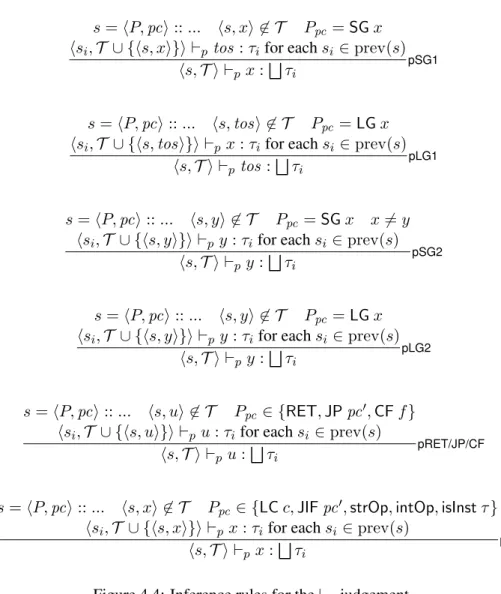
4.3 Inference rules for the`pjudgement (axioms).. . . 51
4.4 Inference rules for the`pjudgement. . . 52
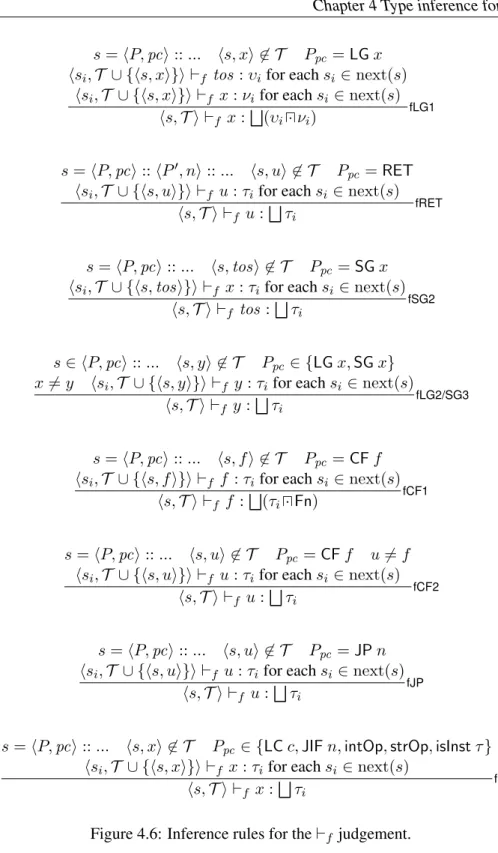
4.5 Inference rules for the`f judgement (axioms). . . 53
4.6 Inference rules for the`f judgement.. . . 54
4.7 Functions can redefine themselves . . . 70
4.8 Simple recursion . . . 70
4.9 Mutual recursion . . . 70
4.10 Analysing this example requires going around the loop several times.. . . 71
5.1 Syntax of checked states . . . 75
5.2 Algorithm for inserting type checks inµPython programs. . . 83
5.3 Macros for type checking insertions. . . 84
5.4 Control Flow for theµPython example . . . 85
5.5 Derivations of present and future use types. . . 85
5.6 The transformedµPython example with preemptive type checking. . . 86
6.1 Phases of the type checking process, outlined in the user code. . . 89
6.2 Outline of type checking process.. . . 90
6.3 Conceptual structure. . . 91
6.4 Instantiation and interaction of instruction objects.. . . 93
6.5 Algorithm for constructing the intra-procedural control flow graph . . . 95
6.6 Type check insertion algorithm.. . . 99 ix
6.7 Algorithm for emitting the bytecode. . . 100
6.8 Bytecode for the specialisedmainfunction. . . 101
6.9 Bytecode for the specialisedcomputefunction. . . 102
6.10 Bytecode for the second specialisedcomputefunction. . . 103
6.11 Original listing for example erasefile. . . 105
6.12 Transformed code for the example erasefile. . . 105
6.13 Original and transformed code for the example erasefile2. . . 106
6.14 Listing for the example erasefile3. . . 107
6.15 Original listing for example fixpoint . . . 108
6.16 Transformed code for example fixpoint. . . 109
6.17 Original vs. manually modified listing of mandelbrot-python3-3. . . 110
6.18 Code snippet from meteor-contest showing possible type error. . . 113
6.19 Code that raised type errors submitted by a stackoverflow user. . . 114
6.20 Table of results. . . 116
7.1 A Python decorator. . . 122
I,Neville Grech, declare that the thesis entitledPreemptive type checking in dynamically typed programsand the work presented in the thesis are both my own, and have been generated by me as the result of my own original research. I confirm that:
• this work was done wholly or mainly while in candidature for a research degree at this University;
• where any part of this thesis has previously been submitted for a degree or any other qualification at this University or any other institution, this has been clearly stated; • where I have consulted the published work of others, this is always clearly attributed; • where I have quoted from the work of others, the source is always given. With the
excep-tion of such quotaexcep-tions, this thesis is entirely my own work; • I have acknowledged all main sources of help;
• where the thesis is based on work done by myself jointly with others, I have made clear exactly what was done by others and what I have contributed myself;
• parts of this work have been published as: Neville Grech, Julian Rathke, Bernd Fischer. Preemptive Type Checking in Dynamically Typed Languages. InProceedings of ICTAC, 2013.
Signed:
Date: 7th November 2013
The expert guidance and patience of both my supervisors Julian Rathke and Bernd Fischer were instrumental to the completion of this doctoral thesis, and I cannot thank them enough for this. I would also like to thank the kind people around me, both in the UK and in Malta for their help and support. My parents and friends have given me their unequivocal support throughout. Thanks goes to my fianc´ee Marilyn for supporting me and accompanying me in Southampton. Finally, I would not have been able to pursue a doctorate without the competitive funding pro-vided by the School of Electronics and Computer Science and STEPS Malta.
Programming language theory is one of the most important branches in computer science, and I encourage people to learn more about this very interesting field.
Introduction
In a dynamically typed language such as Python [39], the principle type of any variable or expression in a program is determined through runtime computations and can change throughout the execution and between different runs. Type checking is typically carried out as the program is executing and type errors manifest themselves as runtime errors or exceptions rather than being detected before execution. However, badly typed programs are potentially dangerous. For example, the Mars climate orbiter crashed into the atmosphere due tometric mixup[1], a form of type incompatibility that can be detected by some type systems [59,60]. Type incompatibilities are an indication that the code has latent errors and therefore the earlier they are detected the earlier the code can be fixed.
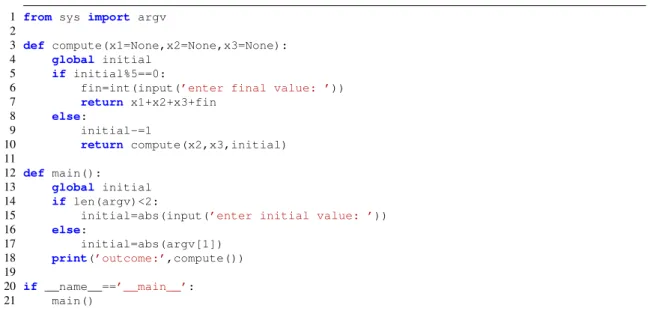
Figure1.1 shows a small example program that takes user input either from the screen or as command line arguments and calculates a result based on this and further input. In a statically typed language, compilation of this program should fail with multiple type errors. Namely, at
1 from sys import argv 2
3 def compute(x1=None,x2=None,x3=None): 4 global initial
5 if initial%5==0:
6 fin=int(input(’enter final value: ’)) 7 return x1+x2+x3+fin 8 else: 9 initial-=1 10 return compute(x2,x3,initial) 11 12 def main(): 13 global initial 14 if len(argv)<2:
15 initial=abs(input(’enter initial value: ’)) 16 else:
17 initial=abs(argv[1]) 18 print(’outcome:’,compute()) 19
20 if __name__==’__main__’: 21 main()
Figure 1.1: Dynamically typed program with type errors. 1
lines 15 and 17, functionabsis given a string instead of a numeric type. Also, at line 7, the addition operations could be called withNoneand Integer arguments. In a dynamically typed language, the program will fail at either line 15 or line 17, depending on the arguments passed to the program. If this program is executed using the standard Python interpreter without passing command line arguments, we get the following interaction on the shell prompt:
$ python foo.py
enter initial value: 45
Traceback (most recent call last): File "foo.py", line 21, in <module>
main()
File "foo.py", line 15, in main
initial=abs(input(’enter initial value: ’)) TypeError: bad operand type for abs(): ’str’
We can see that the program only raised aTypeError when it hit line 15, after user input has been taken.
In this thesis we introduce the concept of type error preemption for dynamically typed lan-guages. Our goal is to force the termination of the program execution as soon as it can be detected that a type error is inevitable. In some cases, this can be even before the program exe-cution starts. Our analysis, which is at the core of preemptive type checking, infers the potential types for every variable and expression and tries to find the earliest point from which a program is guaranteed to raise aTypeError. If we analyse this programstaticallywith preemptive type checking enabled, we are presented with a few “potential” type errors, among which is the error described above.
Furthermore, with preemptive type checking enabled, the main function gets automatically transformed to:
def main():
raise PreemptiveTypeError(’Type mismatch ...’) global initial
if len(argv)<2:
initial=abs(input(’enter initial value: ’)) else:
initial=abs(argv[1]) print(’outcome:’,compute())
This terminates the program as soon as themainfunction is called and therefore reduces the time required for testing since no user input is needed for the error to be raised. Now, we assume that the user “fixes” this bug and rewrites themainfunction as in Figure1.2.
12 def main(): 13 global initial 14 if len(argv)<2:
15 initial=abs(int(input(’enter initial value: ’))) 16 else:
17 initial=abs(int(argv[1])) 18 print(’outcome:’,compute())
Figure 1.2: Modified main function.
When this program is run without preemptive type checking, the user notices that depending on the input, the program will either raise aTypeErroror work as expected, for example:
$ python foo.py enter initial value: 3 enter final value: 3 outcome: 6
$ python foo.py enter initial value: 2 enter final value: 3
Traceback (most recent call last): File "foo.py", line 21, in <module>
main()
File "foo.py", line 18, in main print(’outcome:’,compute()) File "foo.py", line 10, in compute
return compute(x2,x3,initial) File "foo.py", line 10, in compute
return compute(x2,x3,initial) File "foo.py", line 7, in compute
return x1+x2+x3+fin
TypeError: unsupported operand type(s) for +: ’NoneType’ and ’int’
As we can see, not only is the manual testing process time consuming, but automated testing mechanism techniques will not necessarily produce the right combination of inputs to find these errors.
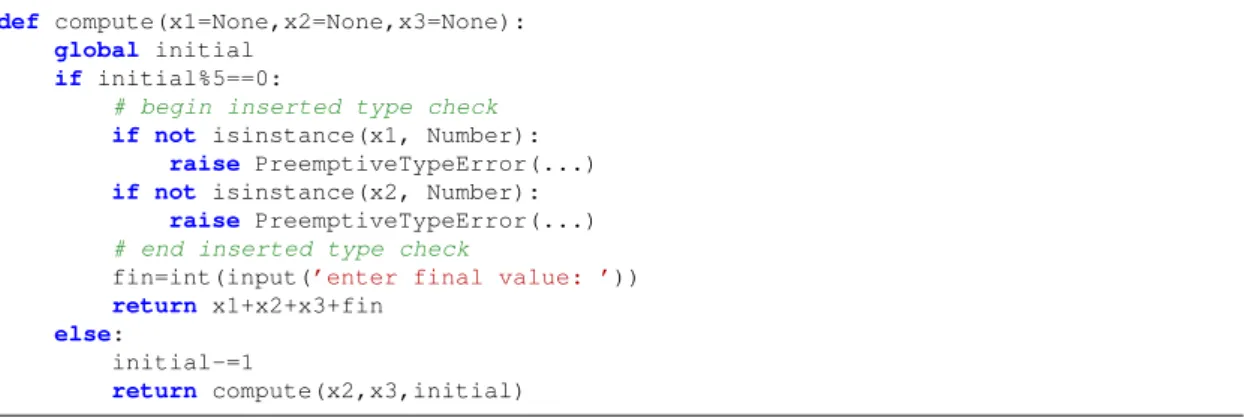
def compute(x1=None,x2=None,x3=None): global initial
if initial%5==0:
# begin inserted type check if not isinstance(x1, Number):
raise PreemptiveTypeError(...) if not isinstance(x2, Number):
raise PreemptiveTypeError(...) # end inserted type check
fin=int(input(’enter final value: ’)) return x1+x2+x3+fin
else:
initial-=1
return compute(x2,x3,initial)
Figure 1.3: Transformed version of thecomputefunction.
With preemptive type checking we can minimise this effort and preempt type errors much quicker. Our analysis infers thatx1andx2are either of typeNoneTypeor Integer, depending on the control flow taken by the program. Our analysis also concludes thatx1andx2need to be integers for the program not to raise type errors. By simplystaticallyanalysing this program with preemptive type checking, we can get the following output:
Failure 1 - partial Traceback: File "foo.py", line 18, in main File "foo.py", line 6, in compute
Variable x1 expected Number but found NoneType
Failure 2 - partial Traceback: File "foo.py", line 18, in main File "foo.py", line 10, in compute File "foo.py", line 6, in compute
Variable x1 expected Number but found NoneType
Failure 3 - partial Traceback: File "foo.py", line 18, in main File "foo.py", line 10, in compute File "foo.py", line 10, in compute File "foo.py", line 6, in compute
Variable x1 expected Number but found NoneType
We note that these are not the only failures that can occur, but our mechanism will only flag the failures that are guaranteed to happen first, so as not to confuse the user. We can see that for this particular example there are no false positives and all errors can occur when this program is executed. Another point is that determining the possible types ofx1andx2is difficult and expensive. For example, using data flow analysis techniques, the fact thatx1can be an integer is only discovered on a path that inlines functioncomputethree times. In this thesis we will be introducing an effective technique that usestrails(see Section4.4) to perform a flow sensitive type inference. Preemptive type checking can also transform the compute function so that any type errors are preempted (see Figure1.3). Note that the assertions cannot be inserted any earlier (i.e., before the if-statement) because there are possible control flow paths that do not raise type errors. Moreover, the inserted assertions would contain all details to identify the source of the type error, in particular the variable causing the type error, the location where the
type error would be raised and the present type there. Hence, the user can correct the program with minimal debugging. There are no implementations of soft typing [22] or gradual typing [96,98] that are sophisticated enough to handle this example. However, if soft typing or gradual typing were used in this case, any implementation would insert a type check right before the additions ofx1andx2. This however means that the user input still has to take place before the type error can be raised.
In dynamic, gradual or soft typing, these errors are only detected at the point when a value of an incorrect type is used. In our case, we guarantee that the inserted runtime checks preempt all type errors. Secondly, we guarantee that these do not affect the semantics of programs that do not raise runtime type errors. Finally, we guarantee, using our linear optimality condition, that type errors are preempted at an optimal (early) point.
The usefulness of a type system is not just its ability to simply reject bad (and sometimes good) programs. Rather, its usefulness is the ability to prevent failures from occurring and the ability to hand enough information to the programmer so that he can debug the errors. In dynamically typed languages, errors are raised when the arguments to a function application do not match the function’s signature. This is not always helpful. In contrast, with preemptive type checking, our generated runtime checks also indicate the locations where type errors can potentially originate. A programmer can therefore inspect these points to better understand where a type error can occur and where it can come from before executing the program.
1.1
Dynamically typed languages
Types are a very important concept in programming languages. A type is a set of values of a particular kind, for example, the set of all natural numbers. In this view, a type can be defined as a predicate over the universal set. Alternatively, types can also be seen as abstractions of terms in a programming language: a program is made up from operations, which are restricted by the type of the terms that they can operate upon. A program is called well-typed if for all the operations in the program, the type of the data that these operations operate upon matches the type of the operation. One way to perform type checking is to do so at runtime: just as an operation is about to be invoked at runtime, a type check is performed. If the operation was not originally defined over the type of the value passed to the operation, a type error exception is raised. This form of type checking is called dynamic type checking. Therefore, not all syntactically valid programs are well-typed. If a program is not well-typed, it is possible for an operation to be used on a value with an incompatible type. Such a program is said to be ill-typed. Atype checkeraccepts well-typed programs and rejects ill-typed programs. Hence, the role of type checking is to make sure that every operation is only called with values over which that operation is defined. The typing discipline typically dictates the way the type checking is carried out in a program-ming language. Instatic type checking, a proof is constructed that no operation is called with values over which the operation is not defined. If such a proof cannot be produced cheaply by
the type checking rules of the particular language, then the program is statically rejected and labelled as ill-typed. This is known as static type checkingsince the checking is done before executing the program.
Dynamic type checking is a mechanism where most of the type checking occurs at runtime. In a dynamically typed language, the type of any expression or variable is determined through runtime computations. In most popular [3] dynamic language implementations such as Python [39], Ruby [68], JavaScript [2] and PHP, type checking is carried out as the program is executing, while operations are being called. A type error manifests itself as a runtime error or exception rather than being detected by a static type checker.
Dynamically typed languages have been in existence since the 1950s. Lisp [69] was the first dynamically typed high level language. A number of features were pioneered or popularised in this language and new features continued to be introduced in dynamically typed languages. Some examples include hygienic macros andcall/ccin Scheme [103] and garbage collection in Smalltalk [46] and some versions of Lisp. Just-in-time compilation also originated from Lisp [12]. Dynamically typed languages are largely interpreted and tend to sacrifice performance and static safety guarantees to flexibility and simplicity. Several authors have been working on ways to speed up the execution of these languages [50,16,44, 43]. In our research, we tackle the problem of preempting type errors, since just-in-time compilation has significantly reduced the former problem in recent years [43].
A large body of work on reconciling both typing disciplines has emerged over the years. Soft typing [22] is a type system where the type checker implicitly converts a dynamically typed program into a statically typed one. It does this by inserting explicit runtime type checks (also called narrowing functions) around the arguments of primitive operations [22].Gradual typing [96,98] mostly focuses on allowing statically typed portions of code to interact with dynamically typed portions. In a type system which can make this happen, the statically typed portions of the program can be statically type checked, while the dynamically typed portions are checked at runtime. Similar technology has already been adopted in the software industry and C# [76,70] and Java [88] allow portions of the code to be dynamically typed. Other type systems are discussed in Chapter 2. The existing work simply allows statically typed portions of the code to interact with dynamically typed portions. No current work focuses on detecting runtime type errors as early as possible.
1.2
Problem statement
This thesis tackles the problem of preempting type errors in dynamically typed programs as early as possible. This is a difficult problem especially since we are trying to not restrict the power of the language.
The problem we are dealing with is multi-faceted. Firstly, we would like to find all possible type errors in a dynamically typed language. Secondly, we would also like to find these type errors as early as possible. Lastly, however, we do not want to transform a dynamically typed language into a statically typed one. We would like to retain a language with a dynamically typed semantics. This is a difficult requirement to satisfy, mainly because it is often impossible to statically resolve the actual functions that are called at every point in a program.
Early type error detection. In a statically typed program, type errors can be detected before running it. This is possible because given a program, it is possible to statically compute a type safety guarantee. The language implementation rejects any programs where this cannot be produced. In some languages, types are explicitly declared. In other languages, types can be determined by a decidable type inference process. In dynamically typed languages, the type of an expression or variable is resolved at runtime. A simple form of type checking is usually adopted in dynamically typed languages [39, 68, 2]. This is performed at runtime while the instruction is being executed. Such an approach can give no static type safety guarantees since a type error might be raised at any time and at any point during execution. In soft typing [22], type errors are not raised at an earlier point than traditional runtime type checking.
Easy to understand type error messages. The error messages from the type errors need to explain in relevant detail the reason why a type error can or will manifest itself. This information should reduce the debugging effort, and not increase it [36]:
“Type errors in Soft Scheme are pure torture ... explaining type errors in Soft Scheme remains for PhD-level experts.”
Ideally, the type error messages must contain the same dynamic information as type errors in dynamically typed languages, perhaps augmented with extra information.
Detecting all potential type errors. Proponents of unit testing and dynamically typed lan-guages [33] argue that exercising a program written in a dynamically typed language using unit testing is enough to find most type errors. In reality, testing only reveals a minority of potential type errors [34]. Testing programs that run for a long period of time, such as web or phone applications, naturally also takes a long time. Testing is also laborious: one needs to write mock objects and test cases, and also needs to execute these in a realistic environment. On some sys-tems, tests can take hours to execute. Programmers are naturally tempted to circumvent these tests during their development cycle and writing these gets increasingly more complex the larger the system one is testing.
The fact that a modest number of type errors cannot be detected statically should not preclude the use of type inference to detect type errors in dynamically typed programs. Indeed, a human reviewer can find a number of security and functional bugs by simply reviewing a piece of code [65]. In soft typing [22], a number of suspect program points can also be flagged in advance using a process of circular unification. The minimal text principle also originates from this
work [22]. This principle states that “the type system should acceptunannotateddynamically typed programs. Otherwise, the programming interface will be more cumbersome than that provided by a conventional dynamically typed programming language” [22]. We aim to respect this principle.
Dynamically typed semantics. Currently, type systems such as gradual typing [98] and other forms of typing [5,38,117] can statically flag some type errors but these rely on type information being explicitly present in the program. On the other hand previous work on static type inference for dynamically typed languages, such as Diamondback Ruby [41,40], RPython [10], Strongtalk [20] or Soft Scheme [116] introduce restrictions to the language, and force a statically typed semantics on a subset of the original language. The example in Figure1.1modified as in Figure
1.2is therefore not allowed to execute in these languages, despite the fact that the program will not raise type errors for some inputs.
Today’s most popular dynamically typed programming languages are compiled to dynamically typed bytecode before being executed. The process of analysing or transforming programs writ-ten in a dynamically typed language is more problematic than in languages that are compiled. For instance, code can be dynamically generated, loaded from a network and sometimes im-ports can only be resolved at runtime. Therefore, retrieving the source code of the function that is to be type checked and the functions that it calls is not always possible. At runtime, we can retrieve the bytecode of any loaded non-primitive functions. For this reason we use a similar approach to RPython [10]. This approach requires us to base the analysis onbytecode rather thansource code. Dynamically typed bytecode is different in nature from lambda calculus or similar languages. Therefore our formal analysis has to reflect this.
1.3
Research objectives
The goal of this work is to develop a type checking mechanism thateagerlytries to preempt any type errors in running programs. Under this checking mechanism, a program would compute the same result as a dynamically typed program if the program is well typed. Through a simple system of type checking assertions, if we can determine that the rest of the execution results in a type error, it is more sensible to halt the execution of the program and notify the user than to fail with a runtime exception later on. This can be achieved by strategically inserting explicit type check assertions in the running code.
More specifically, we have the following objectives:
1. We develop a small language called µPython, a dynamically typed language based on a subset of the Python language. This language compiles down to µPython bytecode instructions, which we also define.
2. We formalise a special type analysis for theµPython bytecode language, and prove that the information from our analysis is an overapproximation of the actual runtime types.
3. We formalise a checkedµPython semantics, and formally prove that this preempts all type errors at a linearly optimal point.
4. We propose a type check insertion and program transformation process to implement preemptive type checking onµPython programs, running on an unmodified interpreter. 5. We implement this type checking and transformation mechanism for a subset of the
origi-nal Python 3.3 language and evaluate it on some benchmarks from the computer language benchmarks game [4].
When formalising and implementing preemptive type checking we shall use the following cri-teria at every step in the process:
Full dynamicity: Can the type checker handle programs where a variable is assigned with a value of different types throughout different program locations?
Minimal text principle [22]: Does the type checker work for unannotated programs?
Rejecting correct programs: Does the type checker give out false positives?
Timing of type errors: Does the type checker catch type errors early?
Type error information: Are the error messages useful for debugging and is the right part of the code being blamed for the type error?
1.4
Overview of approach
Before defining the preemptive type checking mechanism, we need to define a language on which this will be working on. We define µPython, a dynamically typed core language mod-elled on Python. A key characteristic ofµPython (see Chapter 3) is that the types of variables may change during execution. It is a bytecode based language with dynamically typed variables and dynamically bound functions. Although small, the language is still sufficiently expressive to require a rich static type analysis. Our type analysis is actually performed on the bytecode rep-resentation ofµPython programs. It is however useful to define a source language and therefore we define both a source code syntax and a bytecode syntax. We also define a simple compiler to translate the source to bytecode. Most of our examples are written in the source language but we only define the semantics of theµPython bytecode.
An important part of our solution is the type inference algorithm. Unlike other type inference algorithms, our algorithm infers two kinds of types called present types and future use types (see Section4.1) for all variables for all program execution points. These are reconstructed using a forward and a backwards analysis respectively. The present type for a variable indicates the type of the value that a variable has last been assigned while the future use type indicates the type that
it is expected to be used as. This information enables us to pinpoint locations where to insert type checking assertions. In order to make sure that the type inference rules are correct, we use formal techniques. For example, we prove that the information for present and future use types is sound. In particular, we show that the present type of any variable is an overapproximation of the actual runtime type. Since we calculate overapproximations of possible runtime types, we use union types to represent sets of types. We use the type information gained from this type inference process to define a runtime semantics forµPython that implements preemptive type checking. We further prove an optimality property that states that any type errors are preempted at least as early as the start of the branch on the current sequence of instructions.
We then describe an algorithm that transforms bytecode programs by inserting type checks and explicit type error exceptions in such a way that the transformed program implements the checked semantics. This transformed bytecode can be executed using the unchecked seman-tics and the inserted type checks and exceptions implement preemptive type checking for that program.
For the implementation, we make use of Python’s reflective capability to analyse the program at runtime. Since we are implementing a just-in-time type analysis, we lose access to the syntax of the program and can only retrieve the bytecode.
There are also other reasons why we are modelling our type system on bytecode rather than concrete syntax:
• We can start our analysis at a later point during the execution, for example after initialisa-tion, and so get a more accurate analysis.
• We can leverage the work done by the bytecode compiler such as lexical analysis and identify which variables are locals or globals.
• We do not need to implement features that are just “syntax sugar”.
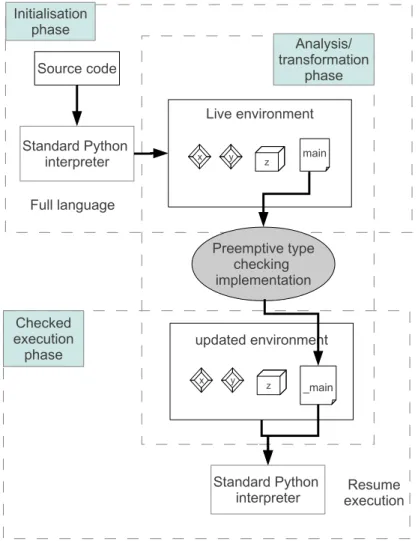
We also implement our type checking mechanism for a subset of the full Python language. Our type checking process is integrated with the runtime environment. Unlike most analysers, our type checker does not take a program’s source code. Instead, our type analysis works directly on a live program and environment, introspecting and analysing the environment for the currently executing program. This program is created and initialised by the standard interpreter. Thus the type checking process is divided into three phases, as shown by Figure1.4.
The first phase, or the initialisation phase, simply involves reading the source files, compiling to bytecode and executing the program until the type checker is called on a specific function, for examplemain. During this process the environment is initialised, classes and functions are created, and external modules are loaded. During this phase, the full power of the language can be used. In the case of Python, this includes metaclasses, functions such aseval/execand also dynamic code loading. In terms of the example of Figure1.1, this phase runs up to but not
including Line 21. At that point, the interpreter would have read the source file and compiled bothcomputeandmain. These functions would therefore be present in the environment. Once the initialisation process has stabilised, the analysis and program transformation process can be much more accurate. The analysis process initially involves a control flow analysis. This can be any kind of control flow analysis as long as the static control flow analysis is an overapproximation of the actual control flow at runtime. There are several algorithms which do this, one of the best known being k-CFA [93,94]. The analysis process is invoked by loading the preemptive type checking mechanism and invoking it in the code.
We also specialise the inserted type checks, depending on the call site of this function. For this reason, specialised versions of functions are generated with assertions inserted into them. Calls to the original functions are replaced with these specialised functions in the bytecode in the en-vironment. Once this process is complete, the execution of the program is continued. This time however, the program is executing using a preemptive type checking system which guarantees that preemptive type errors are raised earlier. These type errors are also more informative than standard type errors. In some cases the specific function that is being checked, for example
main, can fail with an error inserted at the first execution point. This happens ifmainis shown to raise a type error under all circumstances. At this point warnings can be issued to aid the programmer with the debugging process.
1.5
Original Contributions
Our main contribution here is the development of the concept of type error preemption for dynamically typed languages. Our type checking mechanism tries to preempt all type errors at the earliest possible point. This is a novel contribution, and a problem that we solve in our work. We also present a number of technological contributions that make this possible.
Analysis on bytecode rather than source code. Tools that work at a bytecode level tend to be more usable than those that work on source code, since they integrate better with the build process. Most type systems are however defined on source languages. In our case, we formalise our type system entirely at the bytecode level. This makes our formalism more useful when building a tool that implements our type checking mechanism.
Innovative implementation in Python. There are several innovations in our approach and implementation. Rather than proposing a type inference mechanism that tries to cope with the difficult programming styles employed in Python, we propose a mechanism that performs type inference at runtime. In general, this simplifies the analysis and increases its accuracy. This approach is also taken by Firefox [51] and arguably the .NET DLR. In our work, however, we do not make any changes to the implementation of Python but implement preemptive type checking as a third party library which can be deployed in existing Python installations. Our
Source code Standard Python interpreter Live environment x y z main Standard Python
interpreter executionResume updated environment x z _main y Preemptive type checking implementation Checked execution phase Initialisation phase Analysis/ transformation phase Full language
Figure 1.4: Phases of the type checking process.
implementation is able to substitute the bytecode of functions with specialised versions that have type checks inserted into them at initialisation time or runtime.
Helpful type error information. All potential type errors can be determined before execution of the transformed code. This information is available to the user as warnings and type error information. At runtime, the type errors are preempted much earlier than by using existing type checkers. If the statically generated constraints hold, then the program does not raise any type errors.
Present and future use types. Mainstream dynamically typed languages have side effects and a data flow analysis approach yields a more accurate type inference. Values are typically placed in memory before being used at a later point in the program. Our type system, which has present and future use types, distinguishes between variable assignments and operations consuming these variables.
Abstracting nodes in the control flow graph as truncated call stacks. When building our control flow graph of the program, we refer to our nodes asexecution points. These nodes do
not simply refer to actual locations in the program but are actual call stacks, truncated to a finite depth.
Nonrestrictive type checking. A common way to type check dynamically typed programming languages is to introduce restrictions on the language. In the process, the original language loses its dynamicity. Our type system does not enforce a statically typed semantics on a dynamically typed program. This sets it apart from systems such as DRuby [41] and RPython [10], as the expressiveness of the dynamically typed language is preserved.
1.6
Outline
We present the background on type theory, program analysis and other techniques together with related work in Chapter 2. Chapters 3, 4 and 5 contain the theoretical work of this report. In Chapter 3, we formally define a small dynamically typed language µPython, upon which we base our type inference research. This involves defining source and bytecode grammars, an interpreter and a compiler. In Chapter 4 we formalise our type system and original type inference mechanism while in chapter 5 we propose an alternative, preemptively type checked semantics to theµPython language and also show how this semantics can be mapped back to the original semantics.
In Chapter 6, we implement a type inference for a subset of the full Python language, based on the techniques described in the preceding Chapters. Here, we present a number of optimisations and methods that allow us to adequately implement our tool. We also evaluate the tool on a number of synthetic and also real world benchmarks. We demonstrate that we achieved the objectives outlined in Section1.3.
Finally, in Chapter 7 we conclude this thesis and we propose further research and work that can be carried out.
Background and literature review
This chapter gives an overview of the topics that inform this work on preemptive type checking. We start in Section 2.1 by looking at type theory and type systems. This section introduces the different kinds of typing strategies in programming languages and compares and contrasts dynamically typed and statically typed languages. We also look at compilation techniques for dynamically typed languages (see Section2.2). The remaining sections are dedicated to related or competing concepts and strategies in type checking. Approaches that include combinations of static and dynamic typing are described in Section2.3. Approaches where the type checking mechanism is soft or optional are described in Section 2.4. Other approaches to type check-ing utilise type inference and involve defincheck-ing a statically typed subset of a dynamically typed language. These are described in Section2.5. Finally, since our approach depends on accurate control flow analysis, we review relevant approaches in Section2.6.
2.1
Types
In set theoretical terms, a type can be described as a set of values of a particular kind, for example, the set of all natural numbers. Types are also useful abstractions of terms written in a programming language. In this section we introduce type theory concepts required to understand the rest of the thesis. Our presentation is based on [81].
Within the realm of software engineering, formal methods help us to ensure that a system be-haves according to some set of rules and specifications. A type system is a formal method which is an integral part of a programming language. Described as a “tractable syntactic method for proving the absence of certain program behaviours” [81], types work by “classifying phrases according to the kinds of values they compute” [81].
Initially, type systems were introduced by Bertrand Russell [89] in the beginning of the 20th century to avoid paradoxes in logic such as Russell’s paradox. Even though it was not their
original intended use, they have become indispensable in the design of programming languages. Type systems are ideal to detect bad behaviours of a program.
2.1.1 Simply typed lambda calculus
The lambda calculus is a formal system for function definition, function application and recur-sion. It is a small functional language, which is a very important part of modern type theory, and therefore relevant to this thesis. The simply typed lambda calculus, introduced by Alonzo Church [24], is a typed version of the lambda calculus. A common syntax of the simply typed lambda calculus is as follows:
e::=c|(λx:τ.e)|(e e)|x τ ::=T |τ →τ
In the above definitions, we may assume thatcis a primitive constant expression such as ‘34’, and thatx is a variable name. An expressionecan be a constant value. Expressions can also take the formλx:τ.ewhereτ is a type such asInt. Expressions of these kind are called lambda abstractions. When such an expression is applied, the expression eis evaluated according to the evaluation strategy for the language. The syntax of function applications is(e e). The first sub-expression in the structure is the function that is being called and the second sub-expression is the argument to that function application.
Free vs. bound variables. In the lambda calculus, variables can be either free variables or bound variables. For instancexis a bound variable in the termM =λx.T, and a free variable ofT. We sayxis bound inM and free inT. IfT contains a subtermλx.U thenxis rebound in this term. This nested, inner binding ofxis said toshadowthe outer binding. Occurrences of
xinU are free occurrences of the newx. Bound variables can be substituted by a non-captive fresh variable name to result in an equivalent expression. For example, the lambda expressions
λx:τ.xandλy:τ.yare equivalent.
Type inference. Figure 2.1 contains the typing rules for the simply typed lambda calculus. Typing rules are written as one or more premises at the top and one conclusion at the bottom. Γ ` x : τ is read as “x has type τ under the type environment Γ”. The type environment Γ is a mapping from variables to types. The semicolon operator adds a new binding to the environment. For example, in the T-ABS rule for typing abstractions, the premise adds one more assumption (x:τ1) to the environment.
Types can be automatically reconstructed or inferred by the Hindley-Milner type inference al-gorithm, which is designed to work with the Curry-style simply typed lambda calculus. Thanks to this algorithm, one does not need to manually annotate every lambda expression with a type annotation. A comprehensive description of this algorithm is given by Damas and Milner in
x:τ ∈Γ Γ`x:τ T-VAR Γ;x:τ1 `e:τ2 Γ`λx.e:τ1 →τ2 T-ABS Γ`e1 :τ1 →τ2 Γ`e2:τ1 Γ`e1e2 :τ2 T-APP
Figure 2.1: Typing rules for the simply typed lambda calculus
JΓ`x:τK= Γ(x) =τ
JΓ`(λx.e) :τK=∃α1α2.(JΓ;x:α1 `e:α2K∧α1 →α2 =τ) JΓ`(e1e2) :τK=∃α.(JΓ`e1 :α→τK∧JΓ`e2:αK)
Figure 2.2: Constraints introduced for the simply typed lambda calculus.
[28], which is also extended to handle polymorphic types. A more contemporary explanation of these algorithms is available in [82]. Although such an inference algorithm is not easily ap-plicable to dynamically typed programming languages, it is still relevant today in the context of functional languages such as ML and Haskell. Type inference generally consists of a process of constraint generation followed by unification, a process which unifies type variables with actual types. The constraints in Figure2.2 are introduced for the simply typed lambda calculus. By recursively applying these rules to a term, we introduce a number of fresh variables, together with some constraints. These are then solved through unification. A process that is the reverse of type inference is type erasure. In this process, the explicit type annotations are removed from a program, before it is executed.
2.1.2 Subtyping
In order to support the difficult programming styles employed in dynamically typed programs, we need a structure that enables multiple types to be assigned to the same variable. This leads us (in Chapter 4) to define a type system with union types and a partial ordering. Subtyping, also referred to as subtype polymorphism, is a means of relaxing the requirements of type matching in languages such as the simply typed lambda calculus. Subtyping is found in object-oriented languages as a means to implement inheritance. A complete explanation of subtyping is avail-able in [81].
A type system that supports subtyping has a subsumption relation, denoted for example by
S <:T. This can be read as “T subsumesS” [81], or “Sis a subtype ofT”. A typical example would beN <:Z. The subtype relation<:is both reflexive and transitive. In subtyping, there are two special types that can be introduced,⊥and>. The⊥type is the most specific type in a type system. Every type subsumes⊥and there are no values of type⊥. On the other hand,>is the most generic type - it subsumes any type.
Over-approximation. Over-approximation of a type occurs when the type of a value, contained in a variable at a specific location given by the type inference, is less accurate, i.e., is a supertype, than the actual runtime type. If the type of a value in a variablexat a locationnis inferred as
τi and the actual type at runtime is τr, ifτi :> τr andτi 6= τr, then we can say that the type inference is over-approximating the type of variablexat locationn.
Under-approximation. Under-approximation of a type occurs when the set of possible types of the value contained within a variable at a specific location during runtime is not a subset or equal to the set of types detected by type inference. Assuming that the type of a value in variable
xat a locationnis inferred asτi and that the actual type at runtime isτr, ifτi :> τrdoes not
hold, then we can say that the type inference is under-approximating the type of variablexat locationn.
2.1.3 Kinds of type systems
In this section we present a taxonomy of typing strategies. There are three main differentiating factors. We tend to describe a programming language according to whether it is dynamically typed or statically typed. A language with any typing strategy can be either strongly or weakly typed. If a language is statically typed, it can be either implicitly or explicitly typed.
Implicitly vs. explicitly typed. Whether a programming language has type annotations or not does not solely depend on whether the language is dynamically typed or statically typed. Statically typed languages may be eitherimplicitly typedorexplicitly typed. In explicitly typed languages, for example Java, any declaration of a variable, field or method has to be explicitly declared and its type has to be explicitly written in the declaration. For example, the types of arguments to a method and its return type are explicitly declared. In implicitly typed languages, these can often be left out and a type inference infers these from the usage of these variables and functions using a technique called unification. For example, in Haskell, a function that returns the factorial of a number can be implicitly typed:
fac 0 = 1 fac n = n * fac (n-1) or explicitly typed: fac :: Num a => a -> a fac 0 = 1 fac n = n * fac (n-1)
Liskov and Zilles [64] characterise a language as being either strongly typed or weakly typed. A strongly typed programming language prevents functions being applied on data that does not match the explicitly or implicitly declared type of the argument. Cardelli [21], on the other hand classifies type systems as being eithersafeorunsafe. Both typed and untyped languages can be either safe or unsafe languages.
Typed Untyped
Safe Haskell Lisp
Unsafe C Assembler
Figure 2.3: Classifications of some common programming languages [21]
A number of statically typed languages, for example C, allow the user to cast from any type to another without actually checking that the coercion preserves type safety. We therefore consider the type system of C to be unsafe. Most dynamically typed languages are safe. Some examples are Python, Ruby and Lisp/Scheme. Languages that have safe typing do not allow the user to subvert the type system, by placing runtime checks or disallowing typecasts altogether
Statically vs. dynamically typed languages
In practice, mainstream languages tend to have elements from both kinds of type disciplines. Our understanding of what constitutes a statically typed language is one where it is possible to overapproximate most of the types of any variables/expressions cheaply and accurately. This makes it possible to type check a program statically. In dynamically typed languages, most of the type checking is performed at runtime. In this section we explore the advantages and disadvantages of both types of languages and also some of their differences. A comprehensive review of dynamically typed languages is given in [110].
Statically typed languages
Statically typed languages have a number of advantages, namely:
• Type annotations add more information to the program and serve as documentation. • Most of the type checking does not need to be performed at runtime, and therefore the
program runs faster. Optimisations can be performed and runtime dispatching over the types of values can be avoided since assumptions can be made about the types of the program’s variables [22].
• Type errors can be detected at compile time, preventing runtime errors [22]. This reduces the testing effort.
Obtaining the types of variables and functions statically is straightforward. This information is either explicitly annotated or can be inferred using an algorithm, typically a variant of the Hindley-Milner algorithm. A type safety proof can be generated for a statically typed program, but typically cannot be generated for a dynamically typed one.
The expressiveness of the type system is sometimes limited. For example, statically typed lan-guages allow programs that divide an integer number by zero to run. In an idealised language, the divisor would be a non-zero integer. Most languages do not offer this degree of flexibility in their type system, and have to resort to runtime checks. Most type systems are therefore under-constrained [110]. On the other hand, a static type checker might reject a program that works perfectly in a dynamically typed language. It is possible to write a program that might work with a less constrained type. For example, aflattenfunction which takes an iterable that can contain other iterables and returns a single flat iterable can be expressed in Python as follows: def flatten(l):
for el in l:
if (isinstance(el, collections.Iterable) and not isinstance(el, basestring)):
for sub in flatten(el): yield sub
else: yield el
This function would however not pass a static type checker.
Rejecting programs that may not raise a type error limits the expressiveness of the language [22]. This is because the type checker conservatively errs on the side of safety. In many cases, this also limits generality [22] and hence reuse. This is one of the reasons why dynamically typed languages are more productive [83,26]. For example, the Pascal type checker makes it difficult to write a sort procedure that can work with arrays of different lengths [22]. Prechelt [83] also comes to the conclusion that programs written in statically typed languages tend to require more effort to write for the same sets of requirements.
Due to a compilation step, the turnaround time, i.e., the time to build and test a program, is typically higher than in dynamically typed languages. This is especially true in large projects, where code needs to be compiled before the program can start running.
Even though it is easy to write an interpreter for a statically typed language, most languages are typically implemented as a compiler. It would not be sensible to design a statically typed language and relinquish the advantages of static typing. A number of language features are how-ever more difficult to implement. For example, it is hard to support metaprogramming features since the program’s structure is lost at runtime. Also, if constraints are not placed on the expres-siveness of the metaprogramming features, type checking the code becomes undecidable [104]. It is however possible to support restricted metaprogramming in a statically typed language, and some examples include MetaML [104], Jumbo [58] and Meta-AspectJ [119].
Dynamically typed languages
• Lack of type annotations makes the syntax simpler, making the language easier to learn. • Implementations and programmer tools such as debuggers and profilers are easier to write. • Dynamically typed languages support higher-level language constructs such as
metapro-gramming and reflection.
Features such as macros (Lisp [69]), metaprogramming (Lisp [69]), reflection, continuations (Scheme [103]) and garbage collection (Lisp [69], Smalltalk [46]) were originally introduced in dynamically typed languages. Features such as first class functions are still not supported in some mainstream statically typed languages. Meanwhile, some mainstream dynamically typed languages such as Stackless Python [107] support continuations. These features are easier to implement if the programming language is interpreted rather than compiled.
Even though most dynamically typed languages are strongly typed (and alsosafe), most of them do not offer any form of static type checking. There are, however, some language extensions that are able to do more stringent type checking, at an early stage during execution. Some of them, such as traits [75] for Python, require the programmer to manually insert type annotations. Programming languages are increasingly allowing for both dynamically typed and statically typed programming features. Gradual typing [96] could be adopted to allow a fine grained level of detail to the programmer.
Flexibility of the type system is not an issue in dynamically typed languages, since type checking is done at runtime [110]. If a particular operation is supported on the runtime type of the value being used by the operation, then the operation succeeds. This also means that in order to discover all possible type errors, one has to exhaustively test the program, which is typically intractable.
2.1.4 Fixed Points
A number of predicates, sets and algorithms in this thesis require knowledge of fixed points, and therefore we explain these concepts at an early stage. In doing so, we use the same presentation as [77].
Consider a monotone functionf :L→Lon a complete latticeL= (L,v,t,u,⊥,>). Afixed pointoff is an elementl∈Lsuch thatf(l) =land we write
Fix(f) ={l|f(l) =l}
for the set of fixed points. The functionf isreductive atlif and only iff(l)vland we write
for the set of elements upon whichfis reductive; we say thatfitself isreductiveifRed(f) =L. Similarly, the functionf isextensive atlif and only iff(l)wland we write
Ext(f) ={l|f(l)wl}
for the set of elements upon whichfis extensive; we say thatf itself isextensiveifExt(f) =L. SinceLis a complete lattice, it is always the case that the setFix(f)has a greatest lower bound inLand we denote it bylfp(f):
lfp(f) =lFix(f)
Similarly, the setFix(f)has a least upper bound inLand we denote it bygfp(f):
gfp(f) =GFix(f)
Using theKnaster-Tarski Fixed Point Theorem[29], we can show thatlfp(f)is theleast fixed pointoff and thatgfp(f)is thegreatest fixed pointoff.
2.2
Compiling dynamically typed programs
Dynamically typed language implementations have traditionally been slow [4]. Recent ad-vancements have helped in raising the performance levels of these languages. In this section we explore the latest techniques in Just-in-time (JIT) compilation of dynamically typed lan-guages. This section is especially relevant as our type checking mechanism is implemented using some techniques that are used when implementing JIT compilers. Recently, a lot of work has specialised in JavaScript, and information gathered from type inference is used to optimise the execution of these languages. For instance, an interesting approach adopted in the Firefox JavaScript implementation [51] involves performing a fast but unsound type inference process. The type information is then used to compile specialised machine code versions of code snippets and functions.
2.2.1 Partial evaluation
Traditionally, compiler-compilers relied on the user to describe the syntax and semantics of a programming language in a domain-specific language. Unfortunately, this relies on the user to make a clear distinction between what happens during compile time and during runtime [35]. This is especially difficult in the case of elaborate languages with dynamic features. Partial eval-uation is a technique that can be used to generate compilers for dynamically typed languages. Partial evaluation is a program transformation technique for specialising a program with part of the input, thus giving a faster program for the rest of the inputs. A tutorial on partial evaluation
is given in [25]. A program can be seen as a function of input to output data:
prog:Istatic×Idynamic→O
whereIstaticis input to the program that can be determined statically andIdynamicis input that is
dynamically determined. The partial evaluator is another program. It takes as input the program and static inputs to specialise the program with. It returns a specialised program (calledresidual program), which takes only the dynamic inputs. The partial evaluation process is represented as follows:
(prog, Istatic)→(prog∗:Idynamic→O)
An original approach to build compilers from interpreters by Futamura [42] uses partial eval-uation.1 The technique is known as the Futamura projection, which can be described in three
stages:
1. Partially evaluating (specialising) an interpreter with a given source, generating an exe-cutable.
2. Partially evaluating (specialising) the interpreter as applied in (1), generating a compiler. 3. Partially evaluating the partial evaluator used in (2), generating a compiler-compiler that
given an interpreter returns a compiler.
The transformation process implemented in preemptive type checking involves inserting asser-tions in a function that are specialised according to a given call site. This resembles partial evaluation since we can statically determine type information. This information is not as accu-rate as the runtime type information. Hence, the static input to our inserted type checks is the inferred type information and the dynamic input is the actual runtime environment.
2.2.2 Tracing JIT compilation
Traditionally, programs are either interpreted or compiled. Just-in-time (JIT) compilation is a hybrid approach, in which the program is incrementally compiled while being executed. The compiled versions are also cached to improve performance. A considerable number of people have been working on tracing JIT compilers for the last ten years. These kind of JIT compilers record a linear sequence of frequently executed operations, and compile optimised versions of these to machine instructions.
1
Atraceis a path through the control flow graph of a program. Jumps are expensive operations that disrupt the efficiency gained by pipelining on superscalar CPUs. Tracing based methods are designed to avoid unnecessary jumps. If adominanttrace within the control flow graph (CFG) of a loop can be established then all effort should be invested in optimising that dominant trace. Dynamo [13] is the original tracing JIT compiler. The work was not originally meant to speed up dynamic languages but instead it presents a technique to re-structure compiled programs in such a way thatdominanttraces can be executed without jumps. In a dominant trace, code is inlined within traces and a trace is simply a sequential stream of instructions with some side-exits. Trace-based JIT compilers yield especially good results when applied to dynamically typed-languages [44,43]. The stream of consecutive instructions in a trace can be transformed to TSSA (trace static single assignment) and optimised aggressively. The Tracemonkey JavaScript engine [43] used in Firefox makes use of this technology. Further techniques have been implemented to enhance the performance of Tracemonkey, namely trace stitching, blacklisting of traces that often revert to the interpreter, nested traces and calling external functions.
Tracing JIT compilers switch between interpretation, compilation and execution of compiled traces during runtime. Because of this, program execution jitters when a tracing JIT com-piler pauses to compile a trace. Ha et al. [50] implement a concurrent tracing JIT compiler for JavaScript. While the program is interpreted on one thread, another thread compiles parts of it. When a trace is compiled, the compiled version is executed. In such an implementation, the challenge is seamlessly transferring the control from the interpreter to the compiled code. The advantage of a multithreaded JIT compiler is that more cores are utilised and that the program can execute without pausing between compilation and interpretation.
Our implementation of preemptive type checking as described in Chapter 6 statically analyses the structure of a running program at runtime. Therefore, our implementation performs type inference and program transformation at runtime in a similar way to a traditional JIT compiler.
2.3
Gradual type systems
In this section we discuss combinations of static and dynamic typing disciplines that enable statically typed code to interact with dynamically typed code and vice versa. We summarise the presented techniques and compare these with each other and also with our work. These type systems are often referred to asgradual type systems. Several languages in use today can be considered gradually typed languages. These include Boo [31], TypeScript [72] and even Scala [79], C# [15] and Java [88].
2.3.1 Dynamic types
The initial work combining static and dynamic typing focused on increasing the degree of dy-namic typing in statically typed languages; for example, Abadi et al. [5] introduced a dynamic typeDynto model finite disjoint unions or subclassing in object-oriented languages. They ar-gue [5] that finite disjoint unions (C, Algol68) or tagged variant records (Pascal) are a finite version ofDyn. A typical object-oriented language has subclasses and these can be thought of as infinite disjoint unions and are equivalent toDyn. Abadi et al. shed light on the uses of the dynamic types at that time, e.g., inter-process communication. In the type system proposed by Abadi et al. [5], an explicit injection construct (dynamic) is used when a statically typed value is used within a dynamically typed expression. This casts a value to the typeDyn by adding its type-code at runtime. An explicit projection construct (typecase) is also available. The use of dynamic types is therefore constrained, i.e., values of typeDyn can only be used in a
typecase-construct. This is similar to a switch statement that given an argument, dispatches on the types given to the construct. Dynamic types also appear in quasi-static typing [105]. The outcome from a quasi-static type checking process indicates in some cases whether a pro-gramme is guaranteed to raise a type error, or guaranteed not to. In other cases however, the outcome would be ambivalent, which means that the program might raise a type error.
The typeDynalso appears in gradual typing [96,97,98], which also allows dynamically typed and statically typed code to commingle. The authors suggest that dynamically typed programs are statically typed programs where the static type of any term is of typeDyn. As opposed to the type system by Abadi et al. [5], injection and projection are automated in gradual typing [98]. In gradual typing the notion of type consistency is introduced. Type consistency, denoted by v, is a reflective, symmetric but non-transitive relation on types. For example, Int v Int
and Int 6v Str. However, the Dyn type is statically consistent with any possible type. For example,Int v DynandInt → Dyn v Int → Int. Therefore, anything can be implicitly cast toDynandDyncan be implicitly cast to any other type [96,97,98]. This process does not use subtyping, which contrasts with the approach used in quasi-static typing [105]. In the latter, the typeDynsits on both the top and the bottom of a subtype lattice. Since the subtyping relation is transitive, the lattice collapses to one point and every type is a subtype of every other type [98]. The type system therefore does not reject any program. Therefore in gradual typing, the notion of a non-transitive type consistency relation is a key improvement compared to previous type systems.
Inspired by gradual and soft typing,liketyping [117] is yet another way to integrate dynamic and static typing. Inliketyping, values can be of typeDynand can also be of any static type
C. Any operation on objects of typeDynare type checked at runtime. Theliketyping system however is different from gradual typing because it has intermediary types betweenDynand the static types. A variable can be declared aslike C, whereCis a static concrete type. Variables declared with this type are checked statically within their scope. Runtime type checking can also occur as these variables may be bound to values of typeDyn. Therefore, uses of variables
![Figure 2.3: Classifications of some common programming languages [21]](https://thumb-us.123doks.com/thumbv2/123dok_us/10112823.2911843/34.893.212.742.121.190/figure-classifications-common-programming-languages.webp)