Improving Storage Performance with
Non-Volatile Memory-based Caching Systems
A THESIS
SUBMITTED TO THE FACULTY OF THE GRADUATE SCHOOL OF THE UNIVERSITY OF MINNESOTA
BY
Ziqi Fan
IN PARTIAL FULFILLMENT OF THE REQUIREMENTS FOR THE DEGREE OF
Doctor of Philosophy
Prof. David H.C. Du
c
Ziqi Fan 2017
Acknowledgements
I would like to express my sincere appreciation to my advisor, Prof. David H.C. Du. He taught me how to become an independent thinker with critical thinking. I learned from him how to identify valuable research issues and attack them directly and elegantly. His five-year mentorship leads my way into a deep understanding of the computer science field, invokes my tremendous interest in doing research, and will have long lasting impact on my future career.
I would also like to thank Prof. Tian He, Prof. Zhi-li Zhang, and Prof. David Lilja for serving as my committee members and for their invaluable comments and suggestions.
It is an honor for me to be a member of the Center for Research in Intelligent Storage (CRIS). I would like to thank my CRIS mentor, Doug Voigt (currently with HP Enterprise), for his great efforts in collaborating with me to conquer each research project. I also want to thank CRIS members and friends: Xiang Cao, Zhichao Cao, Jim Diehl, Hebatalla Eldakiky, Xiongzi Ge, Alireza Haghdoost, Weiping He, Bingzhe Li, Peng Li, Manas Minglani, Dongchul Park, Yaobin Qin, Fenggang Wu, Hao Wen, Jinfeng Yang, Ming-hong Yang, Baoquan Zhang, and Meng Zou. I learned so much through the discussion and collaboration. Thanks for their help and support.
Finally, I would like to thank NSF and CRIS sponsor companies for funding my projects as well as the Minnesota Supercomputing Institute for providing access to their research facilities and offering timely support.
Dedication
• To my paternal grandfather, who is always missed. May he rest in peace.
• To my family and my friends, who are always there for me. Especially to my mom (Shuang Qiu), my dad (Lilu Fan), and my wife (Yingxu Liu), whose love, support and understanding give me the strength to make it this far.
Abstract
With the rapid development of new types of non-volatile memory (NVRAM), e.g., 3D Xpoint, NVDIMM, and STT-MRAM, these technologies have been or will be integrated into current computer systems to work together with traditional DRAM. Compared with DRAM, which can cause data loss when the power fails or the system crashes, NVRAM’s non-volatile nature makes it a better candidate as caching material. In the meantime, storage performance needs to keep up to process and accommodate the rapidly generated amounts of data around the world (a.k.a the big data problem). Throughout my Ph.D. research, I have been focusing on building novel NVRAM-based caching systems to provide cost-effective ways to improve storage system performance. To show the benefits of designing novel NVRAM-based caching systems, I target four representative storage devices and systems: solid state drives (SSDs), hard disk drives (HDDs), disk arrays, and high-performance computing (HPC) parallel file systems (PFSs).
For SSDs, to mitigate their wear out problem and extend their lifespan, we propose two NVRAM-based buffer cache policies which can work together in different layers to maximally reduce SSD write traffic: a main memory buffer cache design named Hierarchical Adaptive Replacement Cache (H-ARC) and an internal SSD write buffer design named Write Traffic Reduction Buffer (WRB). H-ARC considers four factors (dirty, clean, recency, and frequency) to reduce write traffic and improve cache hit ratios in the host. WRB reduces block erasures and write traffic further inside an SSD by effectively exploiting temporal and spatial localities.
For HDDs, to exploit their fast sequential access speed to improve I/O throughput, we propose a buffer cache policy, named I/O-Cache, that regroups and synchronizes long sets of consecutive dirty pages to take advantage of HDDs’ fast sequential access speed and the non-volatile property of NVRAM. In addition, our new policy can dy-namically separate the whole cache into a dirty cache and a clean cache, according to the characteristics of the workload, to decrease storage writes.
For disk arrays, although numerous cache policies have been proposed, most are either targeted at main memory buffer caches or manage NVRAM as write buffers and separately manage DRAM as read caches. To the best of our knowledge, cooperative
storage systems using newer NVRAM technologies have not been well studied. Based on our elaborate study of storage server block I/O traces, we propose a novel cooperative HybrId NVRAM and DRAM Buffer cACHe polIcy for storage arrays, named Hibachi. Hibachi treats read cache hits and write cache hits differently to maximize cache hit rates and judiciously adjusts the clean and the dirty cache sizes to capture workloads’ tendencies. In addition, it converts random writes to sequential writes for high disk write throughput and further exploits storage server I/O workload characteristics to improve read performance.
For modern complex HPC systems (e.g., supercomputers), data generated during checkpointing are bursty and so dominate HPC I/O traffic that relying solely on PFSs will slow down the whole HPC system. In order to increase HPC checkpointing speed, we propose an NVRAM-based burst buffer coordination system for PFSs, named col-laborative distributed burst buffer (CDBB). Inspired by our observations of HPC ap-plication execution patterns and experimentations on HPC clusters, we design CDBB to coordinate all the available burst buffers, based on their priorities and states, to help overburdened burst buffers and maximize resource utilization.
Contents
Acknowledgements i
Dedication ii
Abstract iii
List of Tables viii
List of Figures ix
1 Introduction 1
2 Cooperative NVRAM-based Write Buffers for SSDs 6
2.1 Introduction . . . 6
2.2 Background . . . 10
2.3 Related work . . . 12
2.4 Proposed Design . . . 14
2.4.1 Host Write Buffer Cache: H-ARC . . . 14
2.4.2 Internal SSD Write Buffer: WRB . . . 21
2.5 Experiments . . . 25
2.5.1 Evaluation Setup . . . 25
2.5.2 Evaluation Results and Analysis . . . 26
2.6 Conclusion . . . 34
3 An NVRAM-based Buffer Cache Policy for HDDs 35 3.1 Introduction . . . 35
3.3 Our Proposed Approach: I/O-Cache . . . 40
3.3.1 Approach Overview . . . 40
3.3.2 Real Cache Hit . . . 41
3.3.3 Real Cache Miss, Ghost Cache Hit . . . 41
3.3.4 Both Real and Ghost Cache Misses . . . 43
3.3.5 Cache Eviction & Balance Algorithm . . . 45
3.3.6 Sequential List . . . 46
3.3.7 System Consistency and Crash Recovery . . . 46
3.4 Evaluation . . . 47
3.4.1 Experimental Setup . . . 47
3.4.2 System I/O Performance . . . 50
3.4.3 Cache Hit Ratio . . . 53
3.5 Conclusion . . . 54
4 A Cooperative Hybrid Caching System for Storage Arrays 55 4.1 Introduction . . . 55
4.2 Storage System Workload Properties . . . 58
4.3 Insight and Discussion . . . 59
4.4 Hibachi: A Hybrid Buffer Cache . . . 61
4.4.1 Architecture . . . 61
4.4.2 Right Prediction . . . 62
4.4.3 Right Reaction . . . 62
4.4.4 Right Adjustment . . . 64
4.4.5 Right Transformation . . . 65
4.4.6 Put Them All Together: Overall Workflow . . . 66
4.5 Performance Evaluation . . . 67 4.5.1 Evaluation Setup . . . 67 4.5.2 Evaluation Results . . . 68 4.6 Related Work . . . 74 4.7 Conclusion . . . 75 vi
5.1 Introduction . . . 76
5.2 Background and Related Work . . . 78
5.2.1 Checkpoint/Restart . . . 78
5.2.2 HPC Application Characteristics . . . 79
5.2.3 Non-volatile Memory . . . 81
5.3 Our Proposed Approach: CDBB . . . 81
5.3.1 CDBB Overview . . . 82 5.3.2 BB Coordinator . . . 84 5.3.3 BB . . . 84 5.3.4 CKPT Writer . . . 85 5.4 Performance Evaluation . . . 85 5.4.1 Implementation . . . 85 5.4.2 Testbed . . . 86 5.4.3 Evaluation Setup . . . 86 5.4.4 Evaluation Results . . . 87 5.5 Conclusion . . . 90 6 Conclusion 92 References 94 vii
List of Tables
2.1 Trace Characteristics . . . 26 3.1 Trace Characteristics . . . 52 4.1 Trace Characteristics . . . 67
List of Figures
1.1 Memory and Storage Technologies . . . 2
2.1 Overall System Architecture and Design . . . 8
2.2 H-ARC Architecture . . . 14
2.3 H-ARC Operation . . . 20
2.4 WRB Architecture . . . 21
2.5 Block-level LRU Policy and Victim Selection Example . . . 23
2.6 A Combination of Six Comprehensive Schemes and the Proposed Scheme 25 2.7 Total Write Traffics (block counts) From Host to NAND Flash (lower is better). The memory size in X-axis represents the number of 4K page. For example, 1K means 1024×4K pages. . . 27
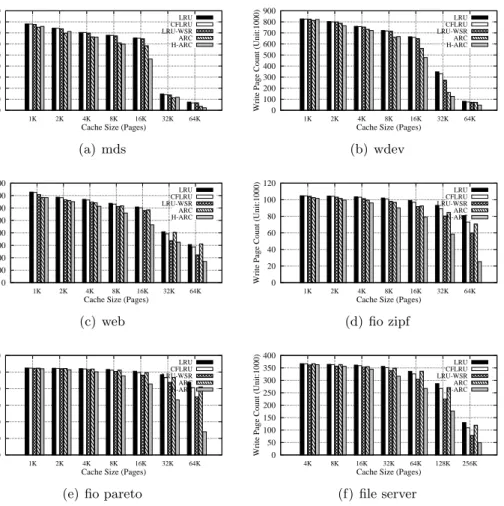
2.8 Total Write Page Count Reduction by Different Layers (higher is better). Here, LB-C and LRU-W stand for LB-CLOCK and LRU-WSR respectively. 28 2.9 Host-side Main Write Buffer Cache Performance (lower is better). Each chart shows total SSD write traffic (i.e., write page count) after each scheme processes write requests in main memory. . . 29
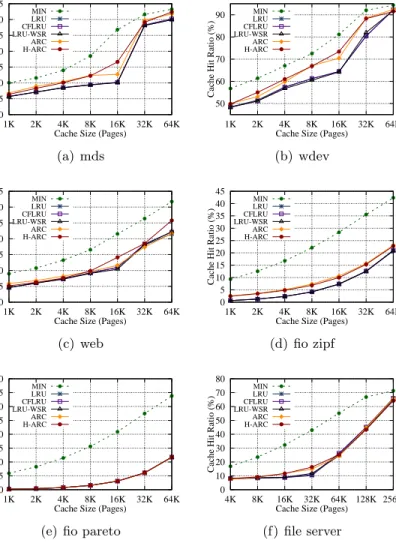
2.10 Cache Hit Ratios of Both Reads and Writes. . . 31
2.11 Cache Hit Ratios of Trace mds with Cache Size of 16K Pages. The read cache hit ratio and the write cache hit are separated. . . 32
2.12 Cache Hit ratios of Trace fio zipf under Cache Size of 32K Pages. The read cache hit ratio and the write cache hit are separated. . . 33
3.1 System Architecture . . . 37
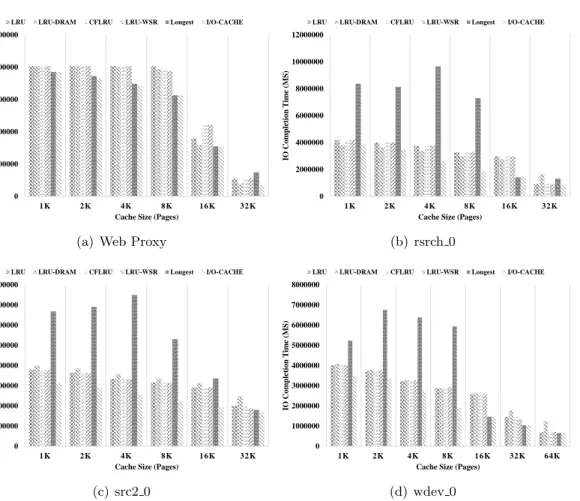
3.2 Sequential list update operations. Key is the beginning page number of consecutive dirty pages. Value is the length of the consecutive dirty pages. 44 3.3 I/O completion time including both storage reads and storage writes. . 48
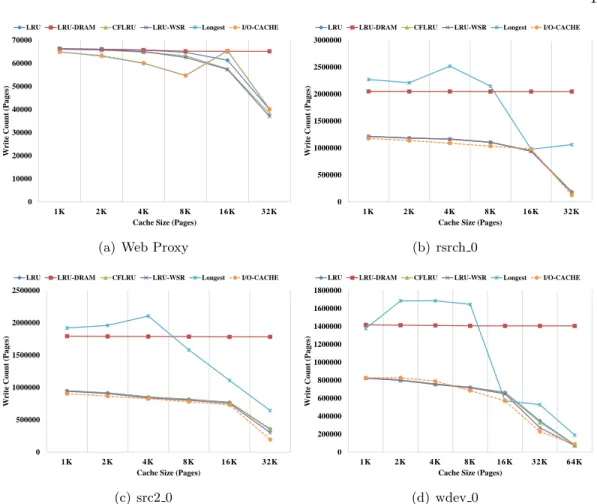
3.5 Storage write count in I/Os. . . 50
3.6 Cache hit ratio of both reads and writes. . . 51
4.1 Overall System Architecture . . . 56
4.2 Temporal distance histograms of a storage server I/O workload. Four figures represent temporal distance in terms of a read request after the same read request, write after write, read after write, and write after read. 57 4.3 Access and block distributions for various frequencies. Three figures show frequency in terms of combined read and write requests, read requests only, and write requests only. For a given frequency, the blocks curve shows the percentage of the total number of blocks that are accessed at least that many times, and the accesses curve shows the percentage of the total number of accesses that are to blocks accessed at least that many times. . . 58
4.4 NVRAM impact on storage write traffic. . . 60
4.5 Hibachi Architecture and Algorithm. . . 63
4.6 Average read hit rates . . . 69
4.7 Hibachi’s NVRAM and DRAM contribution to total read hit rates . . . 70
4.8 Normalized read cache latency for Hibachi. LatD stands for average DRAM access latency. LatN is average NVRAM access latency. . . 71
4.9 Total write hit rate comparison . . . 72
4.10 Average write throughput with disk arrays . . . 73
5.1 An example of HPC application execution patterns . . . 79
5.2 An overview of the CDBB coordination system . . . 80
5.3 A high-level illustration of CDBB checkpointing workflow . . . 82
5.4 The BB coordinator checkpointing workflow . . . 83
5.5 Applications used for Light, Medium, and Heavy experiments . . . 87
5.6 Combined total CKPT completion time for each experiment . . . 88
5.7 Total CKPT completion time for each application. Note that y-axes are in different scales for the three figures. . . 89
phylobayes, and pBWA. Note that y-axes are in different scales for the three figures. . . 90
Chapter 1
Introduction
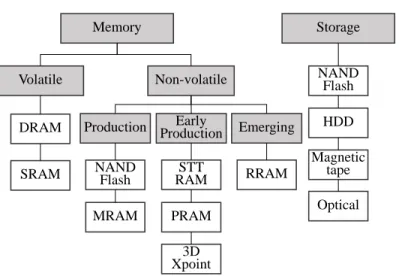
With the rapid development of new types of non-volatile memory (NVRAM), e.g., 3D Xpoint, NVDIMM, and STT-MRAM, these technologies have been or will be integrated into current computer systems to work together with traditional DRAM. Figure 1.1 is a summary of current memory and storage technologies. Compared with DRAM, which can cause data loss when the power fails or the system crashes, NVRAM’s non-volatile nature makes it a better candidate as caching material. In the meantime, storage performance needs to keep up to process and accommodate the rapidly generated amounts of data around the world (a.k.a the big data problem). Throughout my Ph.D. research, I have been focusing on building novel NVRAM-based caching systems to provide cost-effective ways to improve storage system performance. To show the benefits of designing novel NVRAM-based caching systems, I target four representative storage devices and systems: solid state drives (SSDs), hard disk drives (HDDs), disk arrays, and high-performance computing (HPC) parallel file systems (PFSs).
NAND Flash-based SSDs achieve much faster random access speed than traditional HDDs (up to 100×) and are widely deployed in computer storage systems [1, 2]. NAND Flash consists of data blocks, each of which contains a fixed number of pages (typically 64 or 128 pages). Flash supports page read and write operations and block erasure operations. Data are only written to clean pages because Flash does not support in-place updates. Due to slow erase operation speed (around 2 ms), Flash Translation Layer (FTL) firmware instead writes data to clean pages first and marks the original page as invalid. Later, a periodically triggered or on-demand garbage collection (GC)
Volatile Non-volatile
DRAM
SRAM
Production Production Emerging Early NAND Flash MRAM STT RAM PRAM 3D Xpoint RRAM Storage NAND Flash HDD Magnetic tape Optical Memory
Figure 1.1: Memory and Storage Technologies
mechanism reclaims the (invalid) blocks containing invalid pages, thereby reclaiming previously invalid blocks. However, Flash, by nature, allows a limited number of block cell erasures (about 1K for TLC and 10K for MLC). Thus, Flash-based SSDs cannot avoid low endurance problems (particularly MLC/TLC Flash-based SSDs). Moreover, SSD write speed (around 200 µs) is much slower than SSD read speed (around 25µs). Since many SSD write operations eventually cause many SSD erase operations, reducing SSD write traffic plays a crucial SSD reliability role.
To bypass this limitation, many write buffer cache schemes have been proposed [3, 4, 5, 6, 7]. All existing schemes belong to either a main memory buffer cache design (i.e., host-side) or an SSD write buffer design (i.e., inside SSDs). Thus, they only address only one facet. However, for better (optimal) performance, we must simultaneously consider two facets. Therefore, as our first work, we propose two cooperative buffer cache schemes within different layers: a main memory buffer cache (named H-ARC) and an internal SSD write buffer (named WRB). To the best of our knowledge, this is the first work simultaneously addressing both mechanisms. This comprehensive write buffer mechanism can provide a holistic SSD system view for write traffic reduction (i.e., combine each scheme’s write traffic reduction contribution).
Today hard disk drives (HDDs) are still the most common storage devices despite the rapid evolution and expansion of SSDs. As spinning devices, HDDs’ sequential
access speed for both read and write (on the order of 100MB/s) is orders of magnitude faster than random access speed (roughly 1MB/s) [8]. The slow random access speed is always a bottleneck constraining HDDs’ I/O performance. In order to solve the slow random write problem, two major approaches can be followed: (1) decreasing storage write traffic and (2) changing random write I/Os to sequential write I/Os. For the first approach, using NVRAM as main memory gives us opportunities to delay writes to storage. Using this delayed write property, many buffer cache polices have been designed for SSDs to increase their lifespan [9] [10]. Our evaluation results show that minimizing storage writes alone will not significantly improve performance. For the second approach, several buffer cache polices try to group many random writes to fewer sequential writes before issuing them to storage [11] [12]. However, these cache policies are designed for write buffers and deal with dirty pages only.
To solve the aforementioned HDDs’ random access problem, as our second work, we present a novel NVRAM-based buffer cache policy, termed I/O-Cache. I/O-Cache dynamically separates the whole buffer cache into a clean cache caching all the clean pages and a dirty cache caching all the dirty pages. To decrease storage writes, we prioritize the dirty cache more than the clean cache when dynamically resizing these caches. The dynamic separation enables our cache policy to suit various workloads: read intensive or write intensive. To improve storage performance when evicting from the dirty cache, instead of only synchronizing and evicting a single dirty page, I/O-Cache will try to synchronize the longest set of consecutive dirty pages (according to their page numbers) as long as the length of this longest set of consecutive dirty pages is above a threshold. Then one of the pages will be evicted and the rest will be migrated to the clean cache. If the length of the longest set of consecutive dirty pages is below the threshold, I/O-Cache will synchronize and evict the least recently used dirty page. The threshold is very necessary; without it, always choosing the longest set of consecutive dirty pages from the dirty cache will lead to a low cache hit ratio and bad storage performance. When evicting from the clean cache, I/O-Cache will always choose the least recently used page. We evaluate our proposed schemes with various traces. The experimental results show that I/O-Cache shortens I/O completion time, decreases write I/Os, and improves the cache hit ratio compared with existing cache policies.
centers, since their capacity per dollar cost is much lower than the “high-end” all-flash arrays [13]. Disk arrays consist of HDDs which are rotational devices. To gain hybrid buffer cache design insights, we make an in-depth study of storage system I/O workloads. These storage system level I/O workloads are very different from server-side I/O workloads due to server-server-side buffer/cache effects. We evaluate and analyze the impact of different NVRAM sizes, access latencies, and cache design choices on storage performance. Based on these key observations, as our third work, we propose a novel cooperative HybrId NVRAM and DRAM Buffer cACHe polIcy for storage disk arrays, named Hibachi. Hibachi transcends conventional buffer cache policies by 1) distinguishing read cache hits from write cache hits to improve both read and write hit rates; 2) learning workload tendencies to adjust the page caching priorities dynamically to shorten page access latencies; 3) regrouping cached dirty pages to transform random writes to sequential writes to maximize I/O throughput; and 4) using accurate and low-overhead page reuse prediction metrics customized for storage system workloads.
Parallel file systems (PFSs) are the centerpieces used to satisfy the storage needs of supercomputers. Supercomputers need to host high-performance computing (HPC) applications which can run days or even months. However, failures (hardware failures and software bugs) happen at many time and places that can cause the unexpected termination of HPC applications [14]. To prevent the restart of these time consuming applications, checkpoint/restart techniques were invented and are utilized to provide fault tolerance such that intermediate results are saved for data recovery and applica-tion resumpapplica-tion. As the HPC scale grows bigger and bigger, checkpointing has become a bottleneck that constrains its performance [15, 16, 17]. To improve checkpointing speed, an intermediate layer, called a burst buffer (BB), is often used to alleviate the burden on PFSs. BBs consist of fast storage media and/or dedicated software and net-work stacks that can absorb checkpoint data orders of magnitude faster than PFSs. Then the buffered data will be drained to PFSs in the background if necessary. Tradi-tional burst buffers mostly consist of solid state drives, but newly developed NVRAM technologies (e.g., 3D Xpoint, PCM, and NVDIMM) are better candidates due to their better performance.
In a centralized BB architecture, a big BB appliance or multiple BB appliances will ab-sorb checkpoint data from all the compute nodes [18, 19, 20, 21]. The checkpoint data must be transmitted through a network to reach the centralized BB. On the contrary, in the more popular distributed BB architecture, each BB is smaller capacity and put closer, or even attached directly, to each compute node [17, 16, 22]. Under the dis-tributed BB architecture, the absorption of checkpoint data is much quicker than using networks since BBs are closer to the data origin. It is also more scalable and flexible to add/remove distributed BBs to/from compute nodes as needed. However, the downside of the distributed BB architecture is potentially low BB resource utilization; without proper scheduling and coordination, some BBs are overburdened while others might be idle.
As mentioned above, while the distributed BB architecture has plenty of advan-tages it can suffer low resource utilization. This problem is particularly severe for NVRAM-based BBs since NVRAM is much more expensive than other storage media (e.g., SSD), which makes NVRAM much more valuable and scarce. Based on our obser-vations of HPC application execution patterns and experimentations on HPC systems, as our fourth work, we propose a novel BB coordination system, named collaborative distributed burst buffer (CDBB), to improve resource utilization and further increase HPC checkpointing speed. Specifically, we design a BB coordinator to monitor and control all BBs to make them work collaboratively. When an application performs checkpointing, instead of only relying on local BBs, the BB coordinator will globally select available remote BBs (based on their priority and on-the-fly status) in nodes running other applications to contribute and alleviate the burden of those local BBs.
The rest of this thesis is organized as follows. Chapter 2 provides two cache policies, H-ARC and WRB, to reduce SSD writes to extend their lifespan. Chapter 3 describes the proposed I/O-Cache to take advantage of HDD’s fast sequential write speed. Chap-ter 4 presents the proposed Hibachi as a second level hybrid cache to boost disk arrays’ performance. Chapter 5 shows the proposed CDBB coordination system to increase checkpointing speed for HPC parallel file systems. Finally, Chapter 6 concludes the dissertation.
Chapter 2
Cooperative NVRAM-based
Write Buffers for SSDs
2.1
Introduction
DRAM is the most common main memory technology. Despite DRAM’s high endurance and fast read/write access speed advantages, it suffers data loss in the event of power failures or system crashes [23]. To solve this problem, combining DRAM’s fast access speed and Flash’s persistence in non-volatile DIMMs [24] has recently occurred and proven to provide reliable main memory systems. In addition, new non-volatile memory (NVRAM) technologies, such as phase change memory (PCM), Memristor, and STT-RAM, have rapidly developed and are expected to replace computer system DRAMs in the near future. These emerging NVRAM technologies offer other advantages beyond non-volatility. For example, compared to DRAM, Memristor and PCM can achieve higher density, and Memristor and STT-RAM can provide faster read access and lower energy consumption [25, 26]. Therefore, we assume a computer system has a CPU, NVRAM as main memory, and SSDs as storage devices [27]. The SSD also contains an NVRAM write buffer. Figure 2.1 depicts an architecture we employ throughout this chapter.
NAND Flash-based solid state drives (SSDs) achieve much faster random access speed than the traditional hard disk drives (up to 100×) and are widely deployed in computer storage systems [1, 2]. NAND Flash consists of data blocks, each of which
contains a fixed number of pages (typically 64 or 128 pages). Flash supports page read and write operations and block erasure operations. Data are only written to clean pages because Flash does not support in-place updates. Due to slow erase operation speed (around 2 ms), Flash Translation Layer (FTL) firmware alternatively writes data to clean pages first and marks the original page as invalid. Later, a periodically triggered or on-demand garbage collection (GC) mechanism reclaims the (invalid) blocks containing invalid pages, thereby reclaiming previously invalid blocks. However, Flash, by nature, allows a limited number of block cell erasures (about 1K for TLC and 10K for MLC). Thus, Flash-based SSDs cannot avoid low endurance problems (particularly MLC/TLC Flash-based SSDs). Moreover, SSD write speed (around 200 µs) is much slower than SSD read speed (around 25 µs). Since many SSD write operations eventually cause many SSD erase operations, reducing SSD write traffic plays a crucial SSD reliability role.
To bypass this limitation, many write buffer cache schemes have been proposed [3, 4, 5, 6, 7, 28]. All existing schemes belong to either a main memory buffer cache design (i.e., host-side) or an SSD write buffer design (i.e., inside SSDs). Thus, they only address only one facet. However, for better (optimal) performance, we must simultaneously consider two facets. Therefore, in this chapter we propose two cooperative buffer cache schemes within different layers: a main memory buffer cache (named H-ARC) and an internal SSD write buffer (named WRB). To the best of our knowledge, this is the first work simultaneously addressing both mechanisms. This comprehensive write buffer mechanism can provide a holistic SSD system view for write traffic reduction (i.e., each scheme’s write traffic reduction contribution).
Most exiting DRAM-based main memory cache designs mainly focus on improving read cache hit ratios for clean pages because newly written or dirty pages (i.e., updated pages) must be frequently flushed to underlying storage for reliability. However, if NVRAM is a main memory, dirty pages can still safely remain, even across power failures or system crashes. As a result, main memory and dirty page storage synchronization can dramatically decrease without sacrificing data consistency [29]. This provides an opportunity to decrease SSD write traffic. A part of main memory must be reserved for the read cache (clean pages) whenever system performance is critical.
CPU
Host Buffer Cache
Flash Translation Layer SSD
File System
NAND Flash Memory
Host
Write
Write Buffer Cache
Read
Figure 2.1: Overall System Architecture and Design
memory as long as possible. However, this hurts a read cache hit ratio. It is very challenging to determine a proper cache size for both dirty pages and clean pages. Solving this problem requires designing a dynamic split-cache mechanism for dirty pages and clean pages that effectively accommodates unpredictable workloads. With hits on such a split-cache, dirty page write requests reduce storage write traffic and read request hits on either clean or dirty pages improve read performance. This implies the overall hit ratio is also an important factor. That is, when memory is full, a victim page must be judiciously selected to improve overall performance.
To meet all these challenges, we propose a novel main memory buffer cache algo-rithm named a Hierarchical Adaptive Cache Replacement (H-ARC). H-ARC is basi-cally inspired by the existing Adaptive Cache Replacement (ARC) cache algorithm [30]. However, unlike ARC that considers only recency and frequency, H-ARC considers four factors: dirty and clean as well as recency and frequency. H-ARC first determines the desired dirty and clean page cache size ratios by splitting the total cache space into a dirty page cache portion and a clean page cache portion. This split dynamically adjusts based on workload access patterns. For this, H-ARC maintains two ghost caches for each dirty page cache and clean page cache. A ghost cache is a data structure only storing recently evicted page metadata. Each cache can grow or shrink according to workloads. For example, if a cache hits in the ghost cache of the dirty page cache, the desired dirty page cache size increases. Similarly, if a cache hits in the ghost cache of the clean page cache, the desired clean page cache size increases. Note that due to a fixed
total cache size, the other cache size must decrease accordingly. To keep dirty pages in the cache longer, we prioritize enlarging the dirty page cache faster than enlarging the clean page cache.
Once the desired dirty (or clean) page cache size is determined, to select a victim, each page cache space is subdivided into a recency cache and a frequency cache. Similar to ARC, the recency cache stores pages recently referenced once. The frequency cache stores pages recently referenced at least twice. Both the recency cache and frequency cache in each dirty and clean page cache also have a correspondingly maintained ghost cache. Thus, if a cache hits in a ghost cache, the corresponding real cache size grows. Unlike dirty and clean caches, no priority is given to both recency and frequency caches. That is, both cache sizes symmetrically grow and shrink. When a cache fills, a page is evicted from one of the four real cache sections based on LRU policy.
The proposed H-ARC notably reduces SSD write traffic and increases cache hit ratios at the host-side main memory layer (i.e., outside SSDs). Now, these initially ‘filtered’ write traffics can be further reduced inside SSDs using an internal SSD write buffer mechanism. We propose a novel SSD write buffer scheme named Write Traffic Reduction Buffer (WRB). For SSD scalability, WRB employs hash tables for a fast block search (O(1) complexity), which is more appropriate than a sequential search (O(n) complexity). WRB effectively reduces Flash block erase operations by selecting a victim block with the highest block utilization to exploit spatial localities. Moreover, to exploit temporal localities, WRB first checks whether the number of cache pages belonging to the block is greater than a predefined threshold. WRB evicts the block with highest block utilization only if the number exceeds the threshold value. Otherwise, it chooses a victim block containing the LRU page based on a block-level LRU policy because this can help increase a write cache hit ratio and consequently reduces SSD write traffic.
The main contributions of this work are as follows:
• A novel host buffer cache scheme: This work proposes a novel main buffer
cache mechanism named H-ARC with dynamic features effectively adaptive to various workloads. Consequently, it significantly reduces SSD write traffic and improves cache hit ratios.
• A novel internal SSD write buffer scheme: In addition to the host buffer cache algorithm, this work proposes another internal SSD mechanism to further reduce SSD write traffic, named WRB. WRB is an internal SSD write buffer algorithm that reduces Flash block erasures as well as write traffic by exploiting both temporal and spatial localities.
• Implementation for a comprehensive mechanism: Since this is the first
work simultaneously addressing both host and internal SSD buffers, relevant schemes do not exist for fair evaluation. Thus, we select several representative algorithms at different layers and implement several holistic write buffer cache mechanisms by combining them.
The structure of this chapter is as follows. Section 2.2 provides background knowl-edge of current memory technologies and Section 2.3 discusses related studies on existing buffer cache policies. Section 2.4 describes the proposed write buffer cache design and operations. In Section 2.5, extensive evaluations and analyses demonstrate the proposed design’s effectiveness. Finally, Section 2.6 concludes this work.
2.2
Background
Current memory technologies such as DRAM and SRAM face technological limitations for continued improvement [31]. NAND Flash memory, unlike DRAM and SRAM, is a non-volatile memory and retains a variety of merits including light weight, lower power consumption, fast random access, and shock resistance [32, 33, 34, 2]. Thus, it is widely adopted in enterprise applications as well as personal mobile devices [35, 36, 37]. However, Flash memory has a longer access latency (about 50–100x) than DRAM, and cannot avoid a shortened lifespan due to its inborn physical limitation [38, 39, 40, 41]. Though there have been recent NAND Flash technical breakthroughs such as Samsung’s 3D V-NAND technology [42] and Micron’s NVDIMM [43], NAND Flash is unlikely to replace DRAM as main memory. Instead, it is expected to be used as a wholesale swap-out of entire disk-based enterprise data infrastructures [2].
As a result, there are intense efforts to develop new DRAM alternative memory technologies as well as a NAND Flash alternative. Most of these new technologies are
non-volatile memories because non-volatility can provide additional advantages such as new power saving modes for quick wakeup as well as faster power-off recovery and restart for HPC applications [31]. These new technologies include PRAM (or PCM), STT-RAM, MRAM, RRAM, and 3D XPoint. Phase Change Memory (PRAM or PCM) is one of the most promising new NVRAM technologies and can provide higher scalabil-ity and storage densscalabil-ity than DRAM [44, 45]. In general, PCM still has a 5–10×longer latency than DRAM. To overcome PCM’s speed deficiency, various system architec-tures have been designed to integrate PCM into current systems without performance degradation [25, 46, 47, 48, 49, 50, 51].
Magnetic RAM (MRAM) and Spin Torque Transfer RAM (STT-RAM) are expected to replace SRAM and DRAM within the next few years [52, 53, 54]. The attractiveness of replacing those volatile memories with high speed and high endurance non-volatile memory makes these new technologies very competitive [31]. STT-RAM reduces the transistor count and, consequently, provides a low cost, high-density solution. Many enterprise and personal devices use MRAM for an embedded cache memory. Due to MRAM and STT-RAM process compatibility with conventional CMOS processes, they can be built directly on top of CMOS logic wafers, unlike NAND Flash memory [31].
Resistive RAM (RRAM) is considered a potential candidate to replace NAND Flash memory [55]. SanDisk and HP (inventor of the memristor RRAM) are actively devel-oping next generation RRAM technology. However, technical breakthroughs have con-tinuously evolved NAND Flash memory technology for the last several generations and it has been industrially wide-spread. Thus, transitioning to RRAM, as a NAND flash replacement, is not expected within a decade [31].
Micron and Intel recently introduced 3D XPoint non-volatile memory technology and this technology is presently considered another DRAM alternative [56]. The companies claim that this technology is a resistive memory technology, but many researchers believe it is an existing type of Phase Change Memory (PCM) technology [31]. 3D Xpoint technology has high endurance, high density, and promising performance that is much better than NAND Flash, but slightly slower than DRAM. Thus, it is expected to target high performance in-memory processing applications [57].
2.3
Related work
Most DRAM-based cache algorithms primarily focus on improving read cache hit ratios because all dirty pages are frequently flushed to underlying storage [58]. Both recency and frequency are two main factors to improve cache hit ratios. Least Recently Used (LRU) [59] and Least Frequently Used (LFU) [60] consider only one factor and ignore the other one. To bypass this limitation, Megiddo et al. proposed Adaptive Replacement Cache (ARC) [30]. ARC divides the total cache space into two sections: recency cache and frequency cache. The recency cache stores pages referenced once and the frequency cache stores pages recently referenced at least twice. ARC maintains two ghost caches for each recency cache and frequency cache. The ghost cache is a data structure keeping only metadata of recently evicted pages. Due to a fixed total cache size, each ghost cache hit triggers enlarging the corresponding real cache size and shrinking the other real cache size. Consequently, each real cache dynamically grows or shrinks according to workload characteristics.
Unlike the aforementioned DRAM-based cache algorithms, existing NVRAM-based cache algorithms primarily concentrate on SSD write traffic reduction to extend flash-based SSD lifetimes. Existing caching algorithms for NAND flash memory can be largely classified into two main categories: a main memory buffer cache algorithm (i.e., external to an SSD) and an internal SSD write buffer algorithm. The main memory buffer cache algorithms operate in host NVRAM-based main memory systems and there are several existing studies examining them. Park et al. proposed a Clean First LRU (CFLRU) algorithm [61]. CFLRU splits the total cache space into a working region and a clean-first region. The clean-clean-first region is a cache area near the LRU end position. Clean pages are first evicted from the clean-first region with LRU policy. If there is no clean page in the clean-first region, dirty pages are evicted. However, CFLRU does not consider frequency and must pre-configure the clean-first region size. Thus, if the size is too large, the cache hit ratio suffers due to early hot clean page eviction. On the other hand, if the size is too small, dirty pages are evicted early. Qiu et al. proposed a cache policy in NVMFS [29]. NVMFS splits the whole cache into two smaller caches: a dirty page cache and a clean page cache. Each cache grows and shrinks based on page hits. However, it ignores frequency. Jung et al. improved the LRU algorithm with an add-on
page replacement strategy, named LRU Write Sequence Reordering (LRU-WSR) [5]. LRU-WSR provides dirty pages with a second chance before eviction to decrease write traffic. For each dirty page, it adds a hot/cold page indicator bit. LRU-WSR initially assumes all dirty pages are hot pages. If a victim is dirty and hot, LRU-WSR marks it as a cold page and migrates it to the MRU position. If a victim is clean, or dirty and cold, LRU-WSR evicts it right away. If a dirty page hits, it considers the page hot. However, giving a second chance may hurt a cache hit ratio. As an example, giving a second chance to some cold dirty pages causes some hot clean page evictions.
Unlike using NVRAM as main memory, some studies have investigated an internal SSD write buffer cache algorithm. Jo et al. proposed the Flash Aware Buffer man-agement (FAB) scheme. FAB considers block space utilization. It groups the pages belonging to the same block and evicts those pages with the largest number [6]. In case of a tie, FAB follows LRU order. However, FAB only considers block utilization and ignores temporal locality. Moreover, FAB is not scalable for SSD capacity be-cause it sequentially looks up all indexes. Kim et al. proposed Block Padding LRU (BPLRU) [3] that is also rooted in the grouping-based management. BPLRU is funda-mentally based on the LRU policy to select victims in a write buffer. Whenever any page in a block hits, the corresponding block moves to the Most Recently Used (MRU) position. When a buffer fills, a block in the LRU position is evicted. Since BPLRU only considers temporal locality (i.e., LRU) for victim block selection, for completely random workloads, it incurs a large number of additional reads for page padding, which significantly degrades overall performance. Debnath et al. proposed another SSD write buffer algorithm named Large Block CLOCK (LB-CLOCK) [62]. LB-CLOCK considers both recency and block utilization to select a victim. It dynamically varies a priority between these two metrics to adapt to workload characteristics. Kang et al. proposed a Coldest and Largest Cluster (CLC) algorithm [7]. CLC combines FAB and LRU. It maintains two lists: a size-independent cluster list and a size-dependent cluster list. The size-independent list is sorted with LRU policy to exploit temporal locality for hot clusters. The size-dependent list is sorted by a cluster size to exploit spatial locality for cold clusters. Initially, CLC inserts pages in the size-independent list. When the independent list is full, CLC moves clusters from the LRU position of the size-independent list to the size-dependent list. When the size-dependent list is full, CLC
Dirty cache Clean cache
Dirty ghost cache Clean ghost cache
Cache Cache directory Dirty frequency Dirty recency Recency
ghost Frequency ghost Recency ghost recency Clean frequency Clean Frequency ghost
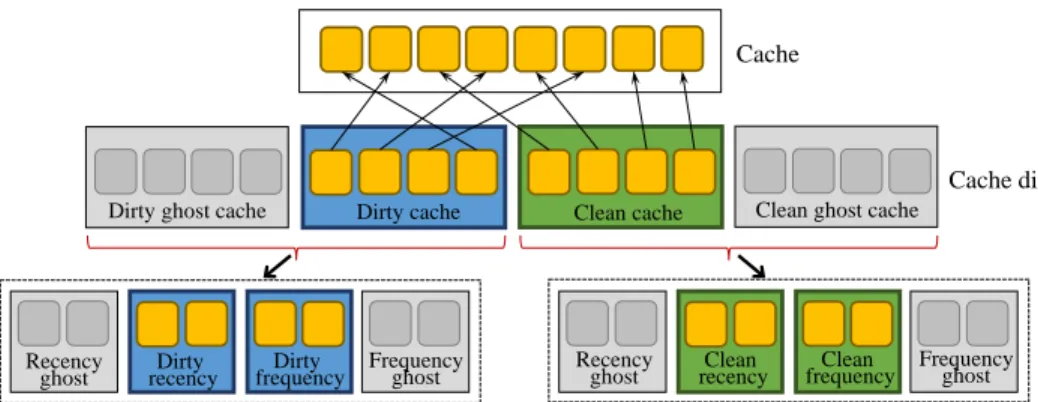
Figure 2.2: H-ARC Architecture
evicts the largest cluster from its tail. Wuet al. proposed a Block-Page Adaptive Cache (BPAC) [4]. BPAC is based on the CLC algorithm and tries to dynamically adjust each list size according to workloads.
2.4
Proposed Design
This section presents two NVRAM-based buffer cache policies: a host-side write buffer cache design (named H-ARC) and an internal SSD write buffer design (named WRB).
2.4.1 Host Write Buffer Cache: H-ARC
Architecture
The proposed Hierarchical Adaptive Replacement Cache (H-ARC) is an NVRAM-based main memory write buffer cache algorithm. Primary H-ARC design goals are to reduce SSD write traffic and to increase cache hit ratios for both reads and writes. Unlike existing DRAM-based algorithms that only consider recency and/or frequency, H-ARC considers four factors–dirty, clean, recency, and frequency–to exploit NVRAM non-volatility. H-ARC is fundamentally inspired by the learning process of the existing Adaptive Replacement Cache (ARC). It adopts a ghost cache concept [30]. However, the proposed H-ARC hierarchically applies the learning process. That is, at a higher level, H-ARC first divides a whole cache space into two sections to determine a desired cache size for both dirty pages and clean pages. At the next level, for each dirty page
cache and clean page cache, H-ARC further subdivides these two cache spaces into two respective subsections to determine a desired size for both a recency cache and a frequency cache. Now, the whole main cache space is split into four subsections (dirty-recency, dirty-frequency, clean-(dirty-recency, and clean-frequency). H-ARC also adopts a ghost cache for four respective real caches to dynamically adjust each cache size (please refer to Figure 2.2). Each ghost cache maintains only evicted data page metadata from each corresponding real cache. Each real cache stores data pages and their metadata.
Operations
This section describes H-ARC operations. A dirty page cache and a clean page cache are denoted by D and C respectively. The aforementioned four real cache regions are denoted as follows: a dirty-recency cache (D1i), a dirty-frequency cache (D2i), a clean-recency cache (C1i), and a clean frequency cache (C2i).
Four ghost caches are maintained: D1o,D2o,C1o, andC2owhich are the ghost caches of the corresponding real caches D1i, D2i,C1i, and C2i. For convenience, this section follows the notation convention: Ddenotes dirty, C denotes clean, subscript 1 denotes one time reference (to capture recency), subscript 2 describes at least two times reference (to capture frequency), subscript i describes cached pages in real caches, subscript o
presents cached pages in the ghost caches. A ghost cache only stores metadata of the recently evicted pages from corresponding real caches. Each cache size is the number of pages stored. Assuming the maximum physical cache size (i.e., memory size) is L, the summation of all four real cache sizes cannot be greater than L. The summation of all the real caches and ghost caches cannot be greater than 2∗L. ConceptuallyD1i andD2i can be grouped as dirty real cache denoted byDi, andC1i andC2i can be grouped as a clean real cache denoted by Ci. Similarly, each corresponding ghost caches are grouped together denoted by Do and Co.
All the real caches and ghost caches are initially empty. For each read/write request
r from workloads, one of the following three cases happens: (1) Real cache hit, (2) Real cache miss, but ghost cache hit, (3) Both real and ghost cache misses.
(1) Real Cache Hit
migrates the referenced data page from its original location to the most recently used (MRU) position to either C2i or D2i according to the original state of the referenced data page in the cache. This is because the page is now referenced at least twice in the real cache.
If a request r is a read request and hits in C1i or C2i, the referenced page state does not change (i.e., still remains a clean page). H-ARC migrates it from its original location in either C1i orC2i to MRU position in C2i. Similarly, if the r hits in D1i or
D2i, this also does not change the referenced page state (i.e., remains a dirty page). H-ARC migrates it from its original location either in D1i or D2i to MRU position in
D2i.
Unlike a read request, a write request changes the referenced page state. If a write request rhits in eitherC1i orC2i, it changes the page state from a clean page to a dirty page. H-ARC migrates it from its original location to the MRU position in D2i. If the write requestr hits inD1iorD2i, this page still remains a dirty page. H-ARC migrates it from its original location to the MRU position in D2i. Note that we consider both reads and writes for a reference count.
(2) Real Cache Miss, Ghost Cache Hit
When a requestrhits in a ghost cache and misses in the real caches, H-ARC follows three steps. First, H-ARC adjusts the real cache size to capture the current workload tendency (writes vs. reads, frequency vs. recency). Second, if the cache is full, a page must be evicted from a real cache. Third, the new page is inserted into its corresponding real cache. Figure 2.3 illustrates these steps.
To determine a real cache size, H-ARC dynamically adjusts the cache size hierarchi-cally. At the higher level, H-ARC first decides the desired size for Di (denoted by ˆDi) and the desired size forCi (denoted by ˆCi). We assume P represents the size of ˆCi and
L represents the total physical memory size. Thus,
ˆ
Ci =P (2.1)
ˆ
Di =L−P (2.2)
desired size forD1i (denoted by ˆD1i) andD2i (denoted by ˆD2i) for a dirty cache region. Similarly, for a clean cache region, both the desired size forC1i(denoted by ˆC1i) andC2i (denoted by ˆC2i) must be determined at the same time. Here, two fractionsPC andPD are adopted to denote the desired ratio for ˆC1i and ˆD1i inside Ci and Di respectively. The equations are shown below:
ˆ C1i=PC ∗Cˆi (2.3) ˆ C2i= ˆCi−Cˆ1i (2.4) ˆ D1i =PD∗Dˆi (2.5) ˆ D2i= ˆDi−Dˆ1i (2.6) At the higher level, if a page hits in Co (clean ghost cache), it implies the clean page should not have been evicted from the clean cache. To compensate for this, H-ARC enlarges the clean cache size ( ˆCi). Every time a ghost hit occurs inCo, ˆCi (orP) increases by 1. According to Equation (2.2), ˆDi decreases by the same size. Please note that P cannot be larger thanL. The equation of P adjustment is described as follows:
P =min{P + 1, L} (2.7)
If, on the other hand, a page hits in Do (dirty ghost cache), it implies the dirty page should not have been evicted from the dirty cache. Thus, H-ARC must enlarge the dirty cache size (Di). To meet our goal of write traffic reduction, H-ARC tries to keep dirty pages in the cache longer. Unlike the aforementioned ˆCi increment policy, H-ARC enlarges ˆDi much faster than ˆCi. If the clean ghost cache size (Co) is smaller than the dirty ghost cache size (Do), ˆDi increases by two. If the size of Co is greater than or equal to Do, ˆDi increases by two times the quotient of Co and Do. That is, if the Do size is smaller, ˆDi increases faster. According to Equation (2.1), ˆCi must be decreased by the same size. Again, the total size ofCi and Di cannot be larger thanL, and P cannot be smaller than 0. The equation of P adjustment is shown as follows:
P = ( max{P−2,0} if|Co|<|Do| max{P−2∗ |Co| |Do|,0} if|Co| ≥ |Do| (2.8)
After H-ARC determines both the dirty cache size and the clean cache size, H-ARC determines both a recency cache size and a frequency cache size for each dirty cache and clean cache. If a ghost page hits in either a clean-recency ghost cache (C1o) or a dirty-recency ghost cache (D1o), it implies this recency page should not have been evicted from the cache. So, H-ARC enlarges the corresponding clean-recency cache size ( ˆC1i) or the dirty-recency cache size ( ˆD1i) by increasingPC orPD accordingly. Similarly, if a page hits in either a clean-frequency ghost cache (C2o) or a dirty-frequency ghost cache (D2o), H-ARC enlarges the corresponding real cache sizes ( ˆC2ior ˆD2i) by decreasingPC or PD accordingly. Unlike the dirty and clean cache region adjustment, the frequency and recency cache size adjustment is symmetric since H-ARC does not provide any priority for these two factors. After the adjustment of PC (orPD), all four region sizes ( ˆC1i, ˆC2i, Dˆ1i and Dˆ2i) are recalculated with Equations (2.3)-(2.6). The equations of
PC and PD adjustments are presented below:
• A clean-recency ghost cache hit in C1o: H-ARC enlarges ˆC1i. Thus, PC increases.
PC = min{PC+P1,1} if|C2o|<|C1o| min{PC+ |C2o| |C1o| P ,1} if|C2o| ≥ |C1o| (2.9)
• A clean-frequency ghost cache hit in C2o: H-ARC enlarges Cˆ2i. Thus, PC in-creases. PC = max{PC−P1,0} if|C1o|<|C2o| max{PC− |C1o| |C2o| P ,0} if|C1o| ≥ |C2o| (2.10)
• A dirty-recency ghost cache hit inD1o: H-ARC enlarges ˆD1i. Thus,PD increases.
PD = min{PD+ L−1P,1} if|D2o|<|D1o| min{PD+ |D2o| |D1o| L−P,1} if|D2o| ≥ |D1o| (2.11)
• A dirty-frequency ghost cache hit in D2o: H-ARC enlarges Dˆ2i. Thus, PD in-creases. PD = max{PD−L−1P,0} if|D1o|<|D2o| max{PD− |D1o| |D2o| L−P,0} if|D1o| ≥ |D2o| (2.12)
Now, all desired cache sizes are determined. Please note that a desired cache size does not mean a real cache size, but a targeting cache size. That is, the real cache size is not adjusted until H-ARC performs the eviction and balance procedures. The eviction and balance procedures are as follows: After obtaining all the desired sizes, H-ARC compares them to each current real cache size. H-ARC gradually changes the real cache size until their desired size by evicting a page from a real cache that is larger than its desired size.
Specifically, at the higher level, if the size of Ci is greater than or equal to ˆCi and the requestr is inDo, H-ARC evicts a page fromCi. Otherwise, H-ARC evicts a page from Di. At the lower level, assuming H-ARC is evicting from Ci, if the size ofC1i is larger than ˆC1i, H-ARC evicts the LRU page from C1i and inserts its metadata into the MRU position in C1o. Otherwise, H-ARC evicts the LRU page out from C2i and inserts its metadata into the MRU position in C2o. Similar operations are applied to
Di if H-ARC evicts a page from Di.
Figure 2.3 illustrates this operation. Assuming a page hits in the dirty ghost cache, H-ARC must increase the dirty cache size and decrease the clean cache size accordingly following H-ARC policies. For this, H-ARC first evicts the page located in the clean cache LRU position and its page metadata is inserted in the clean ghost cache MRU position. Then, H-ARC increases the dirty cache size and shrinks the clean cache size accordingly. Finally, it stores the referenced page data into the MRU position of the dirty cache and removes the corresponding page metadata from the dirty ghost cache.
(3) Both Real and Ghost Cache Misses
When the real caches are not full, H-ARC simply inserts the page into the MRU position of C1i if r is a read request, or into the MRU position of D1i if r is a write request.
When the real caches are full, H-ARC must evict a page from a real cache to secure a space for the new page insertion. In addition, H-ARC tries to equalize the size ofDand
Dirty cache Clean cache
Dirty ghost Clean ghost
Cache hit!
(3) Insert data to a cache (1) Evict LRU data to a ghost cache (2) Increase a desired dirty cache size and decrease a desired clean cache size
Figure 2.3: H-ARC Operation
C. ForD, as an example, H-ARC makes an attempt to equalize the size ofD1 andD2.
Specifically, D includes D1i,D2i, D1o and D2o. D1 includes D1i and D1o. D2 includes D2i and D2o. This equalization process is required to avoid cache starvation. H-ARC can cause this cache starvation if one real cache size and its corresponding ghost cache size are both very large. Since the total cache size is fixed, the other real cache size and its corresponding ghost cache size are very small. Therefore, the small cache has difficulty growing quickly due to low cache hit probabilities even if the current workload favors it.
To solve this problem, H-ARC checks a C size. If the size of C is greater than L
(this means it already takes more than half of the total cache space including both real and ghost caches), H-ARC evicts a page fromC. Otherwise, H-ARC evicts a page from
D. Assuming H-ARC decides to evict a page fromC, H-ARC checks theC1 size. If the C1 size is greater than L/2 (this means it already takes half of the total cache space for C), H-ARC evicts a page from C1. Otherwise, it evicts a page from C2. The eviction
process in Dis similar to the process in C.
When H-ARC actually performs an eviction from a region (e.g., C1), H-ARC first
evicts the LRU page in C1o and executes the aforementioned eviction and balance pro-cedures. This is because a ghost page space for an evicted page from the real cache region must be secured first. If C1o is empty, H-ARC simply evicts the LRU page in
C1i.
BLK#1 Count:4 BLK#2 Count:3 BLK#N-3 Count:1 BLK#N-1 Count:2 Bucket 0 Bucket 1 Bucket 2 Bucket 3 … Bucket N-3 Bucket N-2 Bucket N-1 BLK#3 Count:6 NULL NULL LRU Tail LRU Head … Cache Hash table array Block node lists Figure 2.4: WRB Architecture
of C1i ifr is a read request, or into the MRU position of D1i ifr is a write request.
• Eviction&Balance (EB) Algorithm
In the last two cases, a new page needs to be inserted into the real cache. In case the real caches are full, we need to evict a page out of cache to reclaim space for this new page. We design an Eviction&Balance (EB) algorithm to identify a real page to be evicted and to balance the real cache sizes towards their desired sizes. With the defined
P, PD and PC, we can easily calculate the desired size of Ci, Di, C1i, C2i, D1i, D2i though Equations (2.1)-(2.6). After obtaining all the desired sizes, we compare them with the current size of each real cache. We will evict from one real cache that is larger than its desired size.
Specifically, at the higher level, if the size ofCi is larger than or equal to ˆCi and the request r is inDo, we will evict a page from Ci. Otherwise, we will evict a page from
Di. At the lower level assuming we are evicting fromCi, if the size ofC1i is larger than ˆ
C1i, we will evict the LRU page out fromC1i and insert its page number into the MRU position in C1o. Otherwise, we will evict the LRU page out fromC2i and insert its page number into the MRU position in C2o. Similar operation will happen in Di if we need to evict a page out from this side.
2.4.2 Internal SSD Write Buffer: WRB
The proposed H-ARC significantly reduces write traffic to SSDs and increases cache hit ratios at the host main memory layer. These initially ‘filtered’ write traffic can be further reduced inside SSDs by an internal SSD write buffer mechanism. This section proposes
a novel SSD write buffer algorithm named Write Traffic Reduction Buffer (WRB).
Architecture
Figure 2.4 shows WRB architecture. For each write request, WRB checks whether the request page exists in the buffer and then groups the page into a relevant block. Thus, an efficient data structure is important to minimize search overhead. Unlike personal mobile devices or small capacity SSDs that typically adopt a simple sequential search (O(n)complexity) [6], WRB uses hash tables for a fast block search (O(1) complexity). Block node lists are composed of double linked list of blocks to implement a block-level LRU policy (please refer to Figure 2.5). Each block node contains a block number, a page counter, two pointers for previous and next blocks, and a pointer array for data pages in the buffer cache. All block nodes are sorted by recency (i.e., block-level LRU policy). The block number represents a unique block number in NAND flash-based SSDs. The page counter shows the number of page allocated to the block. Two pointers are adopted to implement double linked list of blocks (i.e., forward and backward pointers). In addition, each block maintains a pointer array to indicate each data page in the buffer cache.
Operations
WRB is a write buffer inside SSDs and considers only write requests. WRB can take advantage of internal SSD knowledge. NAND Flash-based SSDs perform block unit erasures, each of which contains a fixed number of pages (e.g. 64). A single page update may shortly trigger a whole block erasure for garbage collection (GC) [32]. Moreover, if a GC block contains many valid pages, it causes a very low GC efficiency. Thus, to minimize block erase counts and to improve GC efficiency, judicious batch eviction of dirty pages without sacrificing a cache hit ratio is important. WRB considers the following three main operations: (1) search, (2) insertion, and (3) eviction.
(1) Search
When an SSD write page request arrives, it contains a page number in addition to a request operation type. WRB feeds this page number to a hash function to get a hash value. This hash value enables WRB to directly search for the relevant block the page
BLK#0 Count:4 14 15 18 3 8 12 13 4 6 0 7 5 16 17 BLK#1 Count:3 BLK#3 Count:1 BLK#4 Count:2 BLK#2 Count:6 24 25 LRU MRU Cache (full) Block node lists Hit! BLK#0 Count:4 14 15 18 3 8 12 13 4 6 0 7 5 16 17 BLK#1 Count:3 BLK#3 Count:1 BLK#4 Count:2 BLK#2 Count:6 24 25 LRU MRU Victim
(a) Before Referenced.
BLK#0 Count:4 14 15 18 3 8 12 13 4 6 0 7 5 16 17 BLK#1 Count:3 BLK#3 Count:1 BLK#4 Count:2 BLK#2 Count:6 24 25 LRU MRU Cache (full) Block node lists Hit! BLK#0 Count:4 14 15 18 3 8 12 13 4 6 0 7 5 16 17 BLK#1 Count:3 BLK#3 Count:1 BLK#4 Count:2 BLK#2 Count:6 24 25 LRU MRU
Victim candidate: LRU block Victim candidate: largest count
(b) After Referenced and Victim Selection.
Figure 2.5: Block-level LRU Policy and Victim Selection Example
belongs to. WRB harnesses this hash table data structure to achieve a fast block search. This efficient and fast search capability is a crucial factor when a buffer size increases.
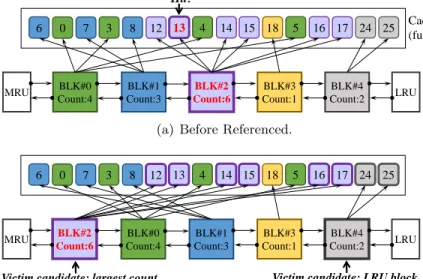
If WRB finds a relevant block node, it searches whether or not the page already exists in the write buffer. If the page hits the buffer, WRB changes the page status from clean to dirty and updates the page. If the page does not hit the buffer, WRB inserts the new page into the buffer and updates pointer information in the block node. Both cases (hit or miss) require the corresponding block node to move to the MRU position in the block node lists. This implies WRB follows a block-level LRU policy. Figure 2.5 provides a simple block-level LRU example. As in Figure 2.5 (a), when a page 13 hits in the buffer, unlike a typical page-level LRU policy, all pages (page 12, 13, 14, 15, 16, and 17) belonging to the same block (Block #2) move to the MRU position even though all the other pages are not referenced (Figure 2.5 (b)).
(2) Insertion
After a search operation, if the proposed scheme does not find a relevant block node (i.e., a hash table returns ‘null’) or the request page does not exist in the buffer, the page must be inserted in the buffer. If a block node does not exist, the proposed scheme first allocates a new corresponding block node to a head position (i.e., MRU position)
of the block node lists and sets a page counter value to 1. At the same time, it links the new block node to the hash table and inserts the new page into the buffer. Finally, the scheme sets the page pointer in the block node in order to link to the new page inserted. Although the block node exists, if the page does not exist in the buffer, WRB moves the block node to MRU position of the lists and increases the page counter by 1. Similarly, it sets the page pointer to the new page in the buffer.
(3) Victim selection and eviction
If the buffer is full and a new data page needs to be inserted, the proposed scheme must evict some pages from the buffer to make a room for the new page. To utilize spatial locality, WRB evicts all relevant pages belonging to the same block at once. This can reduce the number of block erasures. Thus, WRB first tries to choose a victim block with the largest page count. However, this simple policy overlooks temporal locality. Consequently, it may hurt a cache hit rate. As mentioned, the cache hit rate is also an important factor to reduce SSD write traffic. Therefore, we must consider the temporal locality as well as the spatial locality.
A more complicated algorithm and data structure may be able to help a little bit increase performance. However, the write buffer is very quickly filled with data and whenever a new data page comes into the buffer, this eviction operation must be per-formed every time. Considering the much lower computing capabilities of an embedded CPU (about 10×less than a typical host CPU) and resources inside SSDs, it may not be a practical solution [2, 1, 63]. Based on this observation, WRB adopts a simple and effective solution for temporal locality: a threshold value. That is, when the buffer is full, instead of always choosing a victim block node with the largest page count value, WRB first checks whether the page count is greater than a predefined threshold value. If the count is over than the threshold value, WRB chooses the block as a victim and evicts all the pages belonging to the block. If the count value is not greater than the threshold, WRB chooses the LRU block node and evicts all the pages in the block at once.
Figure 2.5 (b) shows this victim selection example. For a simple example, let’s assume the buffer is full, the block size is 6 pages, and the threshold value is 3. WRB can choose either a block node with a largest page count (Block #2) or LRU block
ARC LRU-WSR H-ARC
FAB BPLRU LB-CLOCK WRB
Host buffer cache design
SSD write buffer design Six combination schemes Proposed
Figure 2.6: A Combination of Six Comprehensive Schemes and the Proposed Scheme
node (Block #4) as a victim block. In this example, since the Block #2 has a greater page count (i.e., 6) than the threshold value (3), WRB chooses Block #2 as a victim. Assuming the Block #2 had a smaller page count (e.g., 2) than the threshold, WRB would choose the LRU block node (Block #4) and evict all the pages (page 24 and 25) at once.
2.5
Experiments
We propose two cooperative buffer cache schemes at different layers: a host-side buffer cache (named H-ARC) and an internal SSD write buffer (named WRB). Since this work is, to our knowledge, the first comprehensive write buffer mechanism simultaneously addressing both layers, relevant schemes do not exist for fair comparison. Thus, we implement six comprehensive schemes by selecting representative buffer algorithms for each layer and combining them. Both ARC [30] and LRU-WSR [5] are selected for a host-side buffer cache algorithm. FAB [6], BPLRU [3], and LB-CLOCK [62] are chosen for an internal SSD write buffer algorithm. As in Figure 2.6, a combination of six comprehensive schemes are implemented and evaluated.
2.5.1 Evaluation Setup
The proposed scheme is implemented on the basis of the ideal [64] simulator. Sim-ideal configures cache schemes (e.g., cache size, page size, etc.) based on a given config-uration file. Then, it loads a trace file into an internal data structure (i.e., queue) and processes each trace requests from the queue according to the time stamp information. All experiments assume a 4KB memory page size.
Table 2.1: Trace Characteristics
Trace Name Total Requests Unique Pages R/W Ratio mds 0 11,921,428 741,522 1:2.56 wdev 0 2,368,194 128,870 1:3.73 web 0 7,129,953 1,724,201 1:0.76 fio zipf 524,411 291,812 1:0.25 fio pareto 524,345 331,137 1:0.25 File server 1,417,814 406,214 1:0.35
synthetic workloads. Real workloads use MSR Cambridge traces [65]. MSR Cambridge traces consist of 36 volumes containing 179 disks from 13 Microsoft enterprise servers with different purposes for one week. They are classified into 13 categories based on server types. Each category consists of 2 or 3 traces. These traces represent data accesses from a typical enterprise data center. We simply adopt the first volume of traces from 3 categories (mds, wdev, and web) because the other traces in the same category show similar characteristics. All selected traces are relatively write-intensive.
We generate synthetic workloads using two benchmarks: fio [66] andFilebench[67]. Since MSR Cambridge traces are block I/O traces that can be observed by a block device layer, we enable direct I/O option for fio and Filebench. Then, the traces are collected by using Linux blkrace. This direct I/O enables the read/write requests to bypass the virtual file system layer (mainly a page cache in main memory) and to go to the block layer directly. In this way, we can collect the block layer traces and their actual access patterns are close to the access patterns of main memory. For fio benchmarks, we configure 80% read requests and 20% write requests because this is a common access ratio. In addition, the fio benchmark uses two different distribution types (zipf and pareto). For Filebench, we select a popular file server model. Table 2.1 describes these traces in detail.
2.5.2 Evaluation Results and Analysis
Overall performance
All write page requests first buffer in the host write buffer cache and then, these ‘filtered’ write requests are buffered again in the internal SSD write buffer to minimize SSD write traffic. Figure 2.7 presents total write traffics (i.e., write block counts) of each scheme
0 20 40 60 80 100 120 140 160 1k 2k 4k 8k 16k
Write Block Count (Unit:100)
Cache Size (Pages)
ARC+FAB ARC+BPLRU ARC+LB-CLOCK LRU-WSR+FAB LRU-WSR+BPLRU LRU-WSR+LB-CLOCK Proposed (a) mds 0 20 40 60 80 100 120 140 160 1k 2k 4k 8k 16k 32k
Write Block Count (Unit:100)
Cache Size (Pages)
ARC+FAB ARC+BPLRU ARC+LB-CLOCK LRU-WSR+FAB LRU-WSR+BPLRU LRU-WSR+LB-CLOCK Proposed (b) wdev 0 50 100 150 200 250 1k 2k 4k 8k 16k 32k
Write Block Count (Unit:1000)
Cache Size (Pages)
ARC+FAB ARC+BPLRU ARC+LB-CLOCK LRU-WSR+FAB LRU-WSR+BPLRU LRU-WSR+LB-CLOCK Proposed (c) web 0 100 200 300 400 500 600 700 1k 2k 4k 8k 16k 32k
Write Block Count (Unit:100)
Cache Size (Pages)
ARC+FAB ARC+BPLRU ARC+LB-CLOCK LRU-WSR+FAB LRU-WSR+BPLRU LRU-WSR+LB-CLOCK Proposed (d) fio zipf 0 100 200 300 400 500 600 700 800 1k 2k 4k 8k 16k 32k
Write Block Count (Unit:100)
Cache Size (Pages)
ARC+FAB ARC+BPLRU ARC+LB-CLOCK LRU-WSR+FAB LRU-WSR+BPLRU LRU-WSR+LB-CLOCK Proposed
(e) fio pareto
0 20 40 60 80 100 120 1k 2k 4k 8k 16k 32k
Write Block Count (Unit:1000)
Cache Size (Pages)
ARC+FAB ARC+BPLRU ARC+LB-CLOCK LRU-WSR+FAB LRU-WSR+BPLRU LRU-WSR+LB-CLOCK Proposed (f) file server
Figure 2.7: Total Write Traffics (block counts) From Host to NAND Flash (lower is better). The memory size in X-axis represents the number of 4K page. For example, 1K means 1024 ×4K pages.
after those two write buffer schemes (i.e., host-side and SSD-side) process the write traffics. As in the Figure 2.7, the proposed scheme outperforms the other schemes by up to 3×particularly in the fio zipf and pareto workloads. In addition to the proposed scheme, both LRU-WSR + BPLRU and LRU-WSR + LB-CLOCK schemes also show good overall performance compared to other combinations. Specifically, in web and file server workloads with small cache sizes of 1K through 4K, they exhibit slightly better performance than the proposed scheme by an average of 10.1% (1K), 9.6% (2K) and 9% (4K). However, as the memory size grows, the proposed scheme shows better performance than both schemes by an average of 17.8% (16K) and 51.4% (32K).
8460 8480 8500 8520 8540 8560 8580
ARC+FAB ARC+BPLRUARC+LB-C LRU-W+FAB LRU-W+BPLRULRU-W+LB-CProposed
Write Page Reduction(Unit:1000)
Comprehensive Schemes Host SSD (a) mds 1740 1760 1780 1800 1820 1840
ARC+FABARC+BPLRUARC+LB-C LRU-W+FAB LRU-W+BPLRULRU-W+LB-CProposed
Write Page Reduction(Unit:1000)
Comprehensive Schemes Host SSD (b) wdev 2400 2450 2500 2550 2600 2650 2700 2750
ARC+FAB ARC+BPLRUARC+LB-C LRU-W+FAB LRU-W+BPLRULRU-W+LB-CProposed
Write Page Reduction(Unit:1000)
Comprehensive Schemes Host SSD (c) web 0 20 40 60 80 100
ARC+FAB ARC+BPLRU ARC+LB-C LRU-W+FAB LRU-W+BPLRULRU-W+LB-CProposed
Write Page Reduction(Unit:1000)
Comprehensive Schemes Host SSD (d) fio zipf 0 20 40 60 80 100
ARC+FAB ARC+BPLRU ARC+LB-C LRU-W+FAB LRU-W+BPLRULRU-W+LB-CProposed
Write Page Reduction(Unit:1000)
Comprehensive Schemes
Host SSD
(e) fio pareto
0 20 40 60 80 100 120
ARC+FAB ARC+BPLRU ARC+LB-C LRU-W+FAB LRU-W+BPLRULRU-W+LB-CProposed
Write Page Reduction(Unit:1000)
Comprehensive Schemes
Host SSD
(f) file server
Figure 2.8: Total Write Page Count Reduction by Different Layers (higher is better). Here, LB-C and LRU-W stand for LB-CLOCK and LRU-WSR respectively.
Both ARC + FAB and LRU-WSR + FAB schemes tend to show lower performance than others. They exhibit significantly lower performance than the others, particularly in wdev, web, and file server workloads. To analyze this, we performed another extensive experiment to compare FAB with other write buffer schemes: FAB vs. BP-LRU, LB-CLOCK, and WRB. Unlike other workloads where FAB shows decent (2.1% and 1.9% better in fio zipf and fio pareto workloads) or slightly lower (16.7% lower in the mds workload) performance, it exhibits remarkably lower performance in wdev, web, and file server workloads. Specifically, FAB shows 2.1× (wdev), 4.2× (web), and 3.3×(file
0 100 200 300 400 500 600 700 800 900 1K 2K 4K 8K 16K 32K 64K
Write Page Count (Unit:1000)
Cache Size (Pages)
LRU CFLRU LRU-WSR ARC H-ARC (a) mds 0 100 200 300 400 500 600 700 800 900 1K 2K 4K 8K 16K 32K 64K
Write Page Count (Unit:1000)
Cache Size (Pages)
LRU CFLRU LRU-WSR ARC H-ARC (b) wdev 0 200 400 600 800 1000 1200 1400 1600 1K 2K 4K 8K 16K 32K 64K
Write Page Count (Unit:1000)
Cache Size (Pages)
LRU CFLRU LRU-WSR ARC H-ARC (c) web 0 20 40 60 80 100 120 1K 2K 4K 8K 16K 32K 64K
Write Page Count (Unit:1000)
Cache Size (Pages)
LRU CFLRU LRU-WSR ARC H-ARC (d) fio zipf 0 20 40 60 80 100 120 1K 2K 4K 8K 16K 32K 64K
Write Page Count (Unit:1000)
Cache Size (Pages)
LRU CFLRU LRU-WSR ARC H-ARC
(e) fio pareto
0 50 100 150 200 250 300 350 400 4K 8K 16K 32K 64K 128K 256K
Write Page Count (Unit:1000)
Cache Size (Pages)
LRU CFLRU LRU-WSR ARC H-ARC (f) file server
Figure 2.9: Host-side Main Write Buffer Cache Performance (lower is better). Each chart shows total SSD write traffic (i.e., write page count) after each scheme processes write requests in main memory.
server) lower performance than the others when configured with a 1K page buffer size. This is the root cause for both ARC + FAB and LRU-WSR + FAB schemes showing significantly lower performance than other schemes for those workloads, especially with a smaller buffer size.
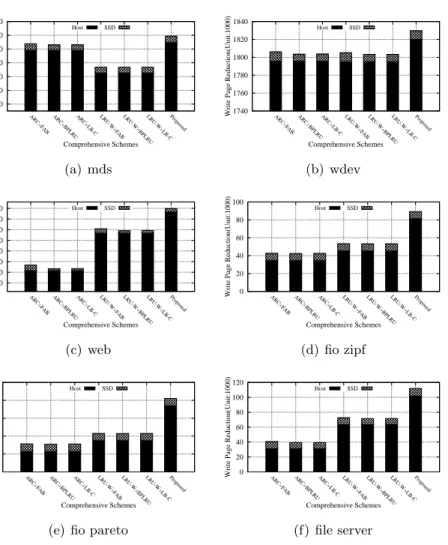
Even though each scheme in each different layer cooperatively reduces total SSD write traffic, investigating respective contributions is also meaningful because there were no studies exploring it. Figure 2.8 displays total write page count reduction for each scheme. This stacked column chart presents each scheme’s contribution to total write traffic reduction in each different layer. As in Figure 2.8, all host-side main buffer