Louisiana State University
LSU Digital Commons
LSU Doctoral Dissertations Graduate School
2014
A Persistent Storage Model for Extreme
Computing
Shuangyang Yang
Louisiana State University and Agricultural and Mechanical College
Follow this and additional works at:https://digitalcommons.lsu.edu/gradschool_dissertations Part of theComputer Sciences Commons
This Dissertation is brought to you for free and open access by the Graduate School at LSU Digital Commons. It has been accepted for inclusion in LSU Doctoral Dissertations by an authorized graduate school editor of LSU Digital Commons. For more information, please [email protected].
Recommended Citation
Yang, Shuangyang, "A Persistent Storage Model for Extreme Computing" (2014).LSU Doctoral Dissertations. 2910.
A PERSISTENT STORAGE MODEL FOR EXTREME COMPUTING
A Dissertation
Submitted to the Graduate Faculty of the Louisiana State University and Agricultural and Mechanical College
in partial fulfillment of the requirements for the degree of
Doctor of Philosophy in
The Department of Computer Science
by
Shuangyang Yang B.S., Zhejiang University, 2006 M.S., University of Dayton, 2008
Copyright © 2014 Shuangyang Yang All rights reserved
Acknowledgments
This dissertation would not be possible without several contributions. It is a great pleasure to thank Dr. Hartmut Kaiser @ Louisiana State University, Dr. Walter B. Ligon III @ Clemson University and Dr. Maciej Brodowicz @ Indiana University for their ongoing help and support.
It is a pleasure also to thank Dr. Bijaya B. Karki, Dr. Konstantin Busch, Dr. Supratik Mukhopadhyay at Louisiana State University for being my committee members and Dr. Kenneth Fasching-Varner at Louisiana State University for being my dean’s representative. A special thanks to Dr. Qiwen Zhan @ University of Dayton and Dr. Peter E. Powers @ University of Dayton (1965-2014) for their kindly support in both research and life all these years.
A warm thanks to the STE| |AR group @ Louisiana State University and the Orange file system group @ Clemson University and Omnibond LLC for all the help and great working environment.
This work was supported by NSF, Clemson University, the Center for Computation & Technology at Louisiana State University, and Center for Research in Extreme Scale Technologies at Indiana University. I would like to thank them for their continued efforts to fund projects that can bring the next generation research in high performance computing. Final thanks goes to my parents, my parents-in-law, my wife and our daughter Emily, for their great support throughout the journey.
Table of Contents
Acknowledgments . . . iv
List of Tables . . . vii
List of Figures . . . viii
Abstract . . . xiii Chapter 1 Introduction . . . 1 1.1 Research Objective . . . 2 1.1.1 Goal . . . 2 1.1.2 Hypothesis . . . 3 1.1.3 Objective . . . 3 1.2 Technical Strategy . . . 4 1.3 Main Contributions . . . 5 1.4 Dissertation Outline . . . 7 2 Background . . . 8
2.1 State of Parallel File System . . . 8
2.1.1 Overview . . . 8
2.1.2 PVFS and OrangeFS . . . 9
2.2 State of High Performance Computing System . . . 13
2.2.1 MPI - Message Passing Interface . . . 13
2.2.2 ParalleX - an Execution Model for Extreme Scale . . . 15
2.2.3 HPX - An Implementation of ParalleX . . . 19
2.3 Linda: Coordination and Communication Model . . . 23
3 PXFS: A Persistent Storage Model for Extreme Scale . . . 25
3.1 PXFS Design . . . 25
3.2 Asynchronous I/O Operations . . . 26
3.2.1 OrangeFS Asynchronous I/O Interface . . . 26
3.2.2 HPX Asynchronous I/O Class APIs . . . 30
3.3 Active TupleSpace Model . . . 35
3.3.1 Introduction . . . 35
3.3.2 HPX TupleSpace . . . 35
3.3.3 The Implementation . . . 37
3.3.4 Use Case: Micro Check-pointing . . . 39
3.4 Performance Evaluation . . . 42
3.4.1 Method . . . 42
3.4.2 Synchronous I/O v.s. Asynchronous I/O . . . 43
4 Distributed Directory Service in Orange File System . . . 91
4.1 Background . . . 92
4.2 Design and Implementation . . . 93
4.2.1 OrangeFS Structure . . . 93
4.2.2 Scalable Distributed Directory Design . . . 96
4.3 Performance Evaluation . . . 100
4.3.1 Experiment Setup . . . 100
4.3.2 Results and Analysis . . . 100
4.4 Chapter Conclusions . . . 101
5 Conclusions and Future Work . . . 105
References . . . 107
List of Tables
2.1 Comparison of the message passing computing system and
List of Figures
2.1 OrangeFS System Architecture Diagram. . . 12 2.2 Architecture of the HPX runtime system. HPX implements the
supporting functionality for most of the elements needed for the ParalleX model: Parcels (parcel-port and parcel-handlers), HPX-threads (thread-manager), LCOs, AGAS, HPX-processes, performance counters and a means of integrating application
specific components. . . 20 3.1 Design of PXFS storage component as a part of HPX runtime. . . 25 3.2 Prototype for the OrangeFS AIO write operation. . . 26 3.3 Data flow diagram illustrating an example I/O operation in the
AIO library. Thread 1 submits a pxfs write operation with a
continuation which spawns Thread 2. . . 27 3.4 An example code to show the integration of HPX and OrangeFS
AIO interface to make an asynchronouswrite call in HPX applications. . . 29 3.5 This code example shows the asynchronous file oriented API
ex-posed by the implementation of the local file class presented persistent storage model. The local file class is responsible to operate on local file systems using the HPX asynchronous
inter-faces and C++ standard file I/O libraries. . . 31 3.6 This code example shows the asynchronous file oriented API
exposed by the implementation of the orangefs file class pre-sented persistent storage model. The orangefs file class is re-sponsible to operate on OranegeFS using the HPX asynchronous
interface and OrangeFS synchronous user interfaces. . . 32 3.7 This code example shows the asynchronous file oriented API
exposed by the implementation of the pxfs file class presented persistent storage model. The pxfs file class is responsible to operate on OranegeFS using the OrangeFS AIO asynchronous
user interfaces. . . 33 3.8 This code example demonstrates an exemplar use of the file
orientedpxfs fileAPI to asynchronously create a new file and to write some chunks of data to it. The I/O operation is performed fully overlapping any other work which needs to be performed
3.9 Diagram of HPX Tuple structure. HPX tuple is composed of an
ordered list of any object, which can hold any type of object. . . 37 3.10 Diagram of HPX TupleSpace component. . . 38 3.11 This code example demonstrates an exemplar use of the
Tu-pleSpace and the three operations. There are synchronous and
asynchronous tuplespace operations. . . 39 3.12 This code example demonstrates an exemplar use of the
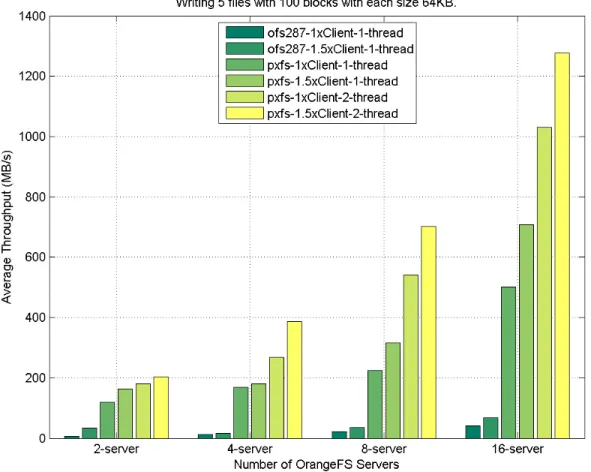
Tu-pleSpace serialization interfaces. . . 40 3.13 Use case of check-pointing of HPX application using the active TupleSpace. . . . 41 3.14 I/O performance of file test casew-5f-100x64KBbetween PXFS
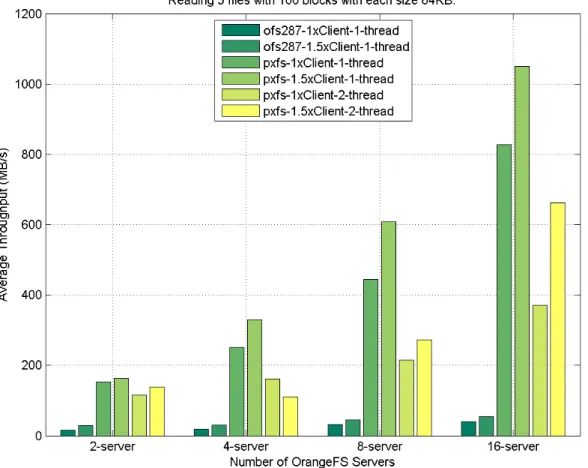
and direct interface on HPX and OrangeFS. . . 45 3.15 I/O performance of file test caser-5f-100x64KBbetween PXFS
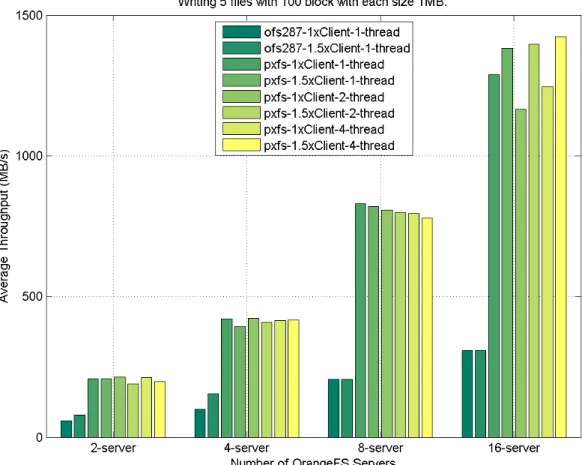
and direct interface on HPX and OrangeFS. . . 46 3.16 I/O performance of file test case w-5f-100x1MB between PXFS
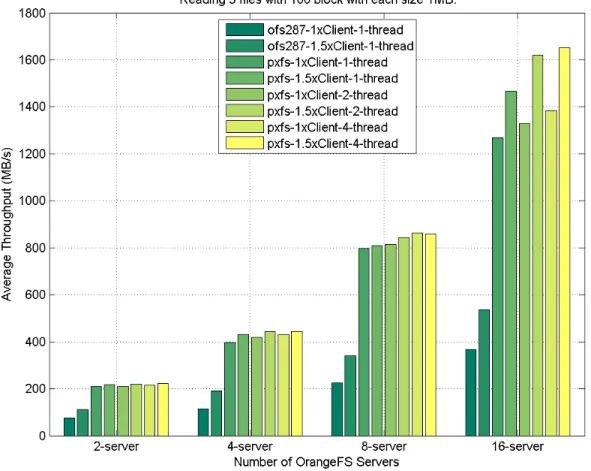
and direct interface on HPX and OrangeFS. . . 47 3.17 I/O performance of file test case r-5f-100x1MB between PXFS
and direct interface on HPX and OrangeFS. . . 48 3.18 I/O performance of file test case w-5f-1x100MB between PXFS
and direct interface on HPX and OrangeFS. . . 49 3.19 I/O performance of file test case r-5f-1x100MB between PXFS
and direct interface on HPX and OrangeFS. . . 50 3.20 I/O performance of file test casew-100f-1x64KBbetween PXFS
and direct interface on HPX and OrangeFS. . . 51 3.21 I/O performance of file test caser-100f-1x64KBbetween PXFS
and direct interface on HPX and OrangeFS. . . 52 3.22 I/O performance of all four file test cases between HPX+PXFS
module on OrangeFS and HPX on NFS. . . 53 3.23 I/O performance of file test case w-50f-100x64KB-1p of HPX
local-file, orangefs-file and pxfs-file asynchronous interfaces. . . 56 3.24 I/O performance of file test case r-50f-100x64KB-1p of HPX
3.25 I/O performance of file test case w-50f-10x64KB-1p of HPX
local-file, orangefs-file and pxfs-file asynchronous interfaces. . . 58 3.26 I/O performance of file test case r-50f-10x64KB-1p of HPX
local-file, orangefs-file and pxfs-file asynchronous interfaces. . . 59 3.27 I/O performance of file test case w-5f-1x100MB-1p of HPX
local-file, orangefs-file and pxfs-file asynchronous interfaces. . . 60 3.28 I/O performance of file test case r-5f-1x100MB-1p of HPX
local-file, orangefs-file and pxfs-file asynchronous interfaces. . . 61 3.29 I/O performance of file test case w-5f-100x1MB-1p of HPX
local-file, orangefs-file and pxfs-file asynchronous interfaces. . . 62 3.30 I/O performance of file test case r-5f-100x1MB-1p of HPX
local-file, orangefs-file and pxfs-file asynchronous interfaces. . . 63 3.31 HPX local-file asynchronous I/O performance of test casew-50f-100x64KB
with different number of threads on client nodes. . . 65 3.32 HPX local-file asynchronous I/O performance of test caser-50f-100x64KB
with different number of threads on client nodes. . . 66 3.33 HPX local-file asynchronous I/O performance of test casew-50f-10x64KB
with different number of threads on client nodes. . . 67 3.34 HPX local-file asynchronous I/O performance of test caser-50f-10x64KB
with different number of threads on client nodes. . . 68 3.35 HPX local-file asynchronous I/O performance of test casew-5f-1x100MB
with different number of threads on client nodes. . . 69 3.36 HPX local-file asynchronous I/O performance of test caser-5f-1x100MB
with different number of threads on client nodes. . . 70 3.37 HPX local-file asynchronous I/O performance of test casew-5f-100x1MB
with different number of threads on client nodes. . . 71 3.38 HPX local-file asynchronous I/O performance of test caser-5f-100x1MB
with different number of threads on client nodes. . . 72 3.39 HPX orangefs-file asynchronous I/O performance of test case
w-50f-100x64KB with different number of threads on client nodes. . . 74 3.40 HPX orangefs-file asynchronous I/O performance of test case
3.41 HPX orangefs-file asynchronous I/O performance of test case
w-50f-10x64KB with different number of threads on client nodes. . . 76 3.42 HPX orangefs-file asynchronous I/O performance of test case
r-50f-10x64KB with different number of threads on client nodes. . . 77 3.43 HPX orangefs-file asynchronous I/O performance of test case
w-5f-1x100MBwith different number of threads on client nodes. . . 78 3.44 HPX orangefs-file asynchronous I/O performance of test case
r-5f-1x100MBwith different number of threads on client nodes. . . 79 3.45 HPX orangefs-file asynchronous I/O performance of test case
w-5f-100x1MBwith different number of threads on client nodes. . . 80 3.46 HPX orangefs-file asynchronous I/O performance of test case
r-5f-100x1MBwith different number of threads on client nodes. . . 81 3.47 HPX pxfs-file asynchronous I/O performance of test casew-50f-100x64KB
with different number of threads on client nodes. . . 82 3.48 HPX pxfs-file asynchronous I/O performance of test caser-50f-100x64KB
with different number of threads on client nodes. . . 83 3.49 HPX pxfs-file asynchronous I/O performance of test casew-50f-10x64KB
with different number of threads on client nodes. . . 84 3.50 HPX pxfs-file asynchronous I/O performance of test caser-50f-10x64KB
with different number of threads on client nodes. . . 85 3.51 HPX pxfs-file asynchronous I/O performance of test casew-5f-1x100MB
with different number of threads on client nodes. . . 86 3.52 HPX pxfs-file asynchronous I/O performance of test caser-5f-1x100MB
with different number of threads on client nodes. . . 87 3.53 HPX pxfs-file asynchronous I/O performance of test casew-5f-100x1MB
with different number of threads on client nodes. . . 88 3.54 HPX pxfs-file asynchronous I/O performance of test caser-5f-100x1MB
with different number of threads on client nodes. . . 89 4.1 Illustration of a three-level splitting process in GIGA+. The
4.2 Diagram of structures of OrangeFS objects. A directory meta-data object only has one dirmeta-data object, which resides on the same metadata server. Usual file attributes fields are omitted in
this diagram. . . 95 4.3 Diagram of object structures in scalable distributed directory
OrangeFS design. A directory metadata object holds a number of dirdata objects across all metadata servers. Dirdata handles array and dirdata bitmap are added on the directory metadata
object and the dirdata object. . . 96 4.4 Illustration of the lookup process in scalable distributed
direc-tory on OrangeFS. N denotes the total number of dirdata
ob-jects. In this example, N=8 and the key starts at 7. . . 99 4.5 Scale and performance of scalable distributed directory
imple-mentation on OrangeFS with different number of OrangeFS servers. The UCAR metarates benchmark is used and the
num-ber of clients are selected to be 2x the numnum-ber of servers. . . 103 4.6 Scale and performance of 64 servers scalable distributed
Abstract
The continuing technological progress resulted in a dramatic growth in aggregate com-putational performance of the largest supercomputing systems. Unfortunately, these ad-vances did not translate to the required extent into accompanying I/O systems and little more in terms of architecture or effective access latency. New classes of algorithms de-veloped for massively parallel applications, that gracefully handle the challenges of asyn-chrony, heavily multi-threaded distributed codes, and message-driven computation, must be matched by similar advances in I/O methods and algorithms to produce a well per-forming and balanced supercomputing system. This dissertation proposes PXFS, a storage model for persistent objects inspired by the ParalleX model of execution that addresses many of these challenges. The PXFS model is designed to be asynchronous in nature to comply with ParalleX model and proposes an active TupleSpace concept to hold all kinds of metadata/meta-object for either storage objects or runtime objects. The new active TupleSpace can also register ParalleX actions to be triggered under certain tuple opera-tions. An first implementation of PXFS utilizing a well-known Orange parallel file system as its back-end via asynchronous I/O layer and the implementation of TupleSpace com-ponent in HPX, the implementation of ParalleX. These details are also described along with the preliminary performance data. A house-made micro benchmark is developed to measure the disk I/O throughput of the PXFS asynchronous interface. The results show perfect scalability and 3x to 20x times speedup of I/O throughput performance comparing to OrangeFS synchronous user interface. Use cases of TupleSpace components are dis-cussed for real-world applications including micro check-pointing. By utilizing TupleSpace in HPX applications for I/O, global barrier can be replaced with fine-grained parallelism to overlap more computation with communication and greatly boost the performance and efficiency. Also the dissertation showcases the distributed directory service in Orange file system which process directory entries in parallel and effectively improves the directory metada operations.
Chapter 1
Introduction
Over the coming decade the performance of the largest computing systems is expected to shift from Terascale and Petascale to Exascale. According to the TOP500 supercom-puter list [1] of June 2014, the performance of the top 37 systems breaks the PetaFLOPs barrier. These systems are composed of tens of thousands of cores and nodes running in parallel. For example, the top supercomputer, Tianhe-2, has 16,000 nodes equipped with 3,120,000 computing cores and achieves the performance of 33.86 petaFLOP/s on the Lin-pack benchmark [1]. The rapid growth in computing cores and high demand for parallelism imposes significant challenges for the parallel runtime and storage system.
Applications employing conventional parallel runtime systems, such as the Communi-cating Sequential Processes (CSP) [2] execution model as reflected by the Message Passing Interface (MPI) [3] programming model, are getting more and more difficult to make ef-fective use of the ever increasing number of processors to achieve desired scalability and performance. The main limiting factors are:
Starvation : insufficient concurrent work to maintain high utilization of resources, Latencies : delay of remote resource access and services,
Overheads : work for management of parallel actions and resources on critical path which is not necessary in a sequential variant,
Waiting for contention resolution : delays due to lack of availability of oversubscribed shared resources.
All of these factors (SLOW) are difficult to avoid using today’s prevalent programming models, and a new computational strategy is required to achieve dramatic increases in per-formance. The ParalleX execution model [4, 5, 6] is offered as a means of addressing these critical computational requirements. It is striving to expose myriad forms of parallelism,
hide system wide latencies, decouple hardware execution resources from executing software tasks to prevent the blocking of processor cores, and to enable runtime dynamic adaptive scheduling to employ real-time system state to resource management decisions.
In the meantime, parallel storage system is expected to handle the input/output (I/O) requests from parallel applications with good performance and great scalability. Many parallel file systems are developed to answer that challenge [7, 8, 9, 10]. Orange File System (OrangeFS) [8, 11, 12] is a production-quality parallel file system designed for use on high end computing (HEC) systems that provides very high performance access to disk storage for parallel applications. However, I/O for Exascale high-end computing (HEC) systems is still hampered by several unfortunate issues, including orders of magnitude slower speed and response time, storage distribution problem, fast growing volume of application data and complex data structures.
The challenges of Exascale computing suggest that not a simple extension of our current model of computation, but rather a new model of computation is needed upon which a new framework for mass storage may be built. It is both prudent and essential to consider a corresponding model of I/O along with the design of next generation computation ecosystem.
1.1 Research Objective
1.1.1 Goal
This dissertation presents PXFS (ParalleX File System), a new persistent storage model aiming for Exascale computing. It will be taking advantage of ParalleX execution model and OrangeFS parallel storage research to extract the maximum of parallelism and performance out of the storage resources. Based on some preliminary work [13, 14], this dissertation, for the first time, presents a novel design of PXFS model and a complete implementation using HPX and OrangeFS interfaces.
To be specific, the goals of PXFS research lie below
operations to hide the latency of I/O operations. And make it seamlessly incorporate into ParalleX model.
Goal 2 : Unify the storage objects and runtime objects under the same namespace. With PXFS, the objects in memory and in storage are treated in the same scope with dif-ferent corresponding implementations. And all objects can be moved to and restored from storage and memory.
Goal 3 : Better metadata management. Extend the concept of metadata of storage file to runtime objects and hold all information of different forms in one place for any entity to use, either program or user.
1.1.2 Hypothesis
The hypothesis of this dissertation are listed below.
Hypothesis 1 : I/O operations can be made asynchronous to hide I/O latencies with
communication and computation.
Hypothesis 2 : Storage items can be viewed as objects and managed under the ParalleX namespace.
Hypothesis 3 : Metadata of storage objects and runtime objects can be merged and
processed at the same scope and can help improve the performance and increase parallelism
1.1.3 Objective
The proposed research designs a new persistent storage model which takes advantage of develop experiences of parallel file system and parallel runtime system to explore the maximum of parallelism and performance in Exascale computing era. This model will utilize the asynchronous nature of ParalleX execution model and distributed file system design of OrangeFS to develop an innovative model to enhance parallel I/O performances.
The research provides a new and efficient method to target the upcoming storage challenges in the next decade.
The detailed objectives are list below.
1. Design asynchronous I/O interface with local file system, network file system, parallel file system using HPX asynchronous APIs.
2. Design PXFS asynchronous I/O interface which employs the Orange file system asyn-chronous I/O APIs and provide HPX interface.
3. Evaluate and compare performances of synchronous/asynchronous network file API, synchronous/asynchronous Orange file API and asynchronous PXFS API.
4. Design and implement HPX active TupleSpace to actively hold and keep all meta information of storage objects and runtime objects.
5. Migrate HPX objects to and from storage system by utilizing the meta information in TupleSpace.
1.2 Technical Strategy
The technical strategy that used to test the hypothesis is composed of the following steps.
Step 1 : Develop the asynchronous API in Orange file system which can register a callback function to be executed automatically when an I/O operation is completed.
Step 2 : Write HPX file classes using HPX asynchronous interface and synchronous file operations of local file system, network file system and Orange file system.
Step 3 : Write PXFS file class using HPX and asynchronous Orange file system APIs. Step 4 : Design the active ParalleX TupleSpace and implement in HPX.
Step 5 : Enable locality/application movement between memory and storage which uti-lizes TupleSpace and design other scenarios for TupleSpace.
1.3 Main Contributions
The goal of this research is to create a persistent storage framework for ParalleX exe-cution model with a parallel file system OrangeFS. As such it promises to have high impact on a broad spectrum of applications depending on high performance parallel I/O.
The main contributions of dissertation can be summarized as below:
• Pioneering attempt to address the challenges of parallel runtime and storage system of the next Exascale computing decade.
• Contributed new understanding, concepts, and methods for realizing advanced per-sistent storage management. It merges two innovative system classes: an advanced parallel file system, OrangeFS, and a unique execution model, ParalleX. The result will be an exploratory vehicle for establishing a new paradigm for mass storage at extreme scale. It will provide an event driven dynamic adaptive computation envi-ronment in response to the uncertainty of data access times, related asynchrony and imposed overheads through the embedding of futures-based synchronization.
• Proposed new syntax and semantics for asynchronous I/O in object-oriented parallel runtime system. Developed asynchronous AIO interface in Orange file system which is doing asynchrony on the file bytes level, and designed the asynchronous I/O operation semantics in ParalleX model for object level asynchrony. The work also provide basis to created storage classes for different file systems including network file system, local file system and parallel file systems, which enables asynchronous semantics on different layer in an abstract form.
• Unified the namespace of memory objects and storage objects. Translate traditional file-based storage system into object-based storage entities and include them into the same namespace scope with runtime objects. It will eliminate the division of programming imposed by conventional file systems through the unification of name spaces and their management.
• Introduced the active TupleSpace model for better metadata management. Metadata is becoming more and more important in parallel computing and the TupleSpace idea can provide an active and flexible way to manage metadata from all kinds of objects and entities. It can help the user and program to make smart decisions to improve performance and parallelism.
• Designed and implemented distributed directory service in Orange file system, which distributed directory entries among multiple data servers. This move will help par-allelize the directory operations and help improve metadata performances.
• Provided insights and directions on how to target the challenges of efficient I/O in the context of future Exascale systems. The conclusions will help scientists efficiently process an unprecedented amount of data in a science computation and shine the light on computer scientists of a new way to design the next generation storage system for massively parallel runtime systems.
• The research creates outputs that can lead to a thriving continuous work for both parallel file system and parallel runtime systems. The work follows can help shape the next generation computation system in the next decade and can improve productivity in both scientific and industrial fields
• This work of the dissertation has resulted in two full-length published papers: [12] and [15], one tech talk at [13] and one poster at [16].
1.4 Dissertation Outline
The remaining of the dissertation is organized as follows.
Chapter 2 introduces the related work of the parallel file system, the high performance computing system and the Linda coordination model. It provides the background of these research areas and provision the importance of this dissertation.
Chapter 3 details PXFS, the innovative persistent storage model established for ex-treme computing. It is designed as a HPX component and provides an asynchronous storage interface to the underlying storage system, including OrangeFS file system and network file system. At the meantime, an active TupleSpace is proposed to store the meta-data of all metameta-data of all object entities in one place including the storage objects and runtime objects. It can kill the gap between storage objects and memory objects. A micro benchmark is used to evaluate the performance of PXFS and the result shows much better I/O throughput.
Chapter 4 outlines the design and implementation of distributed directory service in Orange file system. By distributing the directory entries among storage servers, a much higher metadata throughput of directory creation and deletion is achieved.
Chapter 5 draws the conclusion and derives the key contribution of this dissertation. This chapter also points out the research directions that is beyond the scope of the dis-sertation. It also highlights the specifics on future work to be carried out beyond this research.
Chapter 2
Background
2.1 State of Parallel File System
2.1.1 Overview
The high-performance computing (HPC) community is walking into an new era where top clusters and systems are able to achieve a performance of petaFLOPs (1015) scale
easily. The rapid growth in computing power and high demand for parallelism imposes significant challenges for the storage system, which is expected to handle the input/output (I/O) requests from parallel applications with good performance and great scalability.
Many parallel and distributed file systems are developed to answer that challenge[17, 7, 8, 9, 10]. File data are distributed across multiple processing nodes in parallel file systems, each with its own storage resources. In that case, concurrent I/O requests can be spread across several servers to process rather than focusing I/O on a single server [18].
These parallel and distributed file systems can be roughly categorized into four types: commercial parallel file systems, distributed file systems, high performance general-purpose parallel file system and research parallel file systems.
The first type comprises commercial parallel file systems such as PFS for the Intel Paragon [19] , PIOFS and GPFS for the IBM SP [20], HFS for the HP Exemplar [21], and XFS for the SGI Origin2000 [22]. These file systems provide high performance and functionality desired for I/O-intensive applications but are available only on the specific platforms on which the vendor has implemented them.
Examples of distributed file systems are NFS [23], AFS/Coda [24], xFS [25], and GFS [26]. These file systems are designed to provide distributed access to files from mul-tiple client machines, and their consistency semantics and caching behavior are designed accordingly for such access. The types of workloads resulting from large parallel scien-tific applications usually do not mesh well with file systems designed for distributed access; particularly, distributed file systems are not designed for high-bandwidth concurrent writes
that parallel applications typically require.
Several parallel file systems are general-purposed and actively maintained/developed by companies, community and research organizations, including Lustre [7, 27] and Par-allel Virtual File System (PVFS) [10] / Orange File System (OrangeFS) [8]. They are designed for high performance computing and can be installed on computing clusters built on commodity hardwares. These file system are highly tunable and can provide reasonable amount of support. Lustre and OrangeFS are deployed on a lot of data centers at national labs and research institutions. Lustre runs in kernel mode and supports high availabil-ity. PVFS/OrangeFS runs most of the server/client in the user mode and are easier to install and configure. It also supports high availability and can support a lot more features detailed below.
A number of research projects exist in the areas of parallel I/O and parallel file systems, such as PIOUS [28], Ceph [17] and Galley [29]. PIOUS focuses on viewing I/O from the viewpoint of transactions, Ceph is designed to be both self-healing and self-managing and strives to reduce both administrator and budget overhead, and Galley looks at disk-access optimization and alternative file organizations. These file systems may be freely available but are mostly research prototypes, not intended for everyday use by others.
2.1.2 PVFS and OrangeFS
PVFS is a parallel file system that supports both distributing file data and metadata among multiple servers and coordinated access to file data by multiple tasks of a parallel program. PVFS has an object based architecture. The software consists of two major components: a storage server that runs as a daemon on an IO node and a client library that provides an interface for user programs running on a compute node. The storage server stores all data in objects known as dataspaces and all IO operations are preformed relative to one or more of these objects. A data space consists of two storage areas: a bytestream that stores arbitrary binary data as a sequence of bytes, and a collection of key/value pairs that allow structured data to be stored and quickly retrieved when needed.
Trove is a subsystem of PVFS that implements dataspaces with a non-blocking post and poll interface. The current implementation of Trove uses the host’s file system to implement bytestreams and a set of Berkeley DB databases to manage key/value pairs and dataspaces themselves. PVFS interacts over the network through an interface known as BMI. BMI provides a non-blocking post and poll interface for sending messages, receiving messages and checking to see if outstanding posts have completed. A special class of messages is unexpected messages those for which the server cannot predict their arrival. These are mostly requests from clients. Unexpected messages are limited in size but are useful for most client requests. Larger messages are managed using Flows. Flows combine network messages over BMI either with IO through Trove or directly to memory. Flows manage multiple buffers and complex data routing algorithms to transfer data associated with file IO from disk, across the network, to the client’s memory. BMI has implementations for TCP/IP, GM, MX, IB, and other networking fabrics. Multiple networks can be used at the same time, though there are performance issues in doing this and most installations do no. The PVFS server manages requests to Trove, BMI, and Flows through a Job layer. The Job interface is also a non-blocking post and poll design and provides a common interface for having many outstanding operations in flight on the server at one time. Jobs are issued by the server Request processor which is built using a custom state-machine language SM. SM allows programs to define fundamental steps in the processing of each request each ending in posting a job. Once a job is posted the state-machine is suspending until completion at which point it automatically resumes. SM allows return codes to drive the processing to different states. SM is designed to make the coding of server requests simpler by abstracting away many details including interacting with BMI and Trove, encoding and decoding messages, and asynchronous issues. The PVFS client code is built from many of the same components as the server including BMI, Flows, Jobs, and state-machines. The primary difference is that the state-machines are written to implement each function in the PVFS System Interface (sysint). The sysint is designed based on operations typically found
in a modern OS virtual file system. Thus, for example, there isn’t an open call, but rather a lookup that takes a path name and returns a reference to the file’s metadata. Metadata is read or written with getattr and setattr respectively. User programs are expected to use PVFS via one of several user level interfaces. These include a VFS kernel module for Linux, a FUSE interface, support via ROMIO (MPI-IO) and a User Interface (usrint) provided with PVFS.
Orange File System is a branch of the Parallel Virtual File System. Like PVFS, Or-angeFS is a parallel file system designed for use on high end computing (HEC) systems that provides very high performance access to disk storage for parallel applications. Or-angeFS is different from PVFS in that we have developed features for OrOr-angeFS that are not presently available in the PVFS main distribution. While PVFS development tends to focus on specific very large systems, Orange considers a number of areas that have not been well supported by PVFS in the past. OrangeFS development tends to be driven by input from users with specific needs. To become one of these users open a dialog with the Or-angeFS development team. PVFS design characteristics that are common with OrOr-angeFS include:
• Performance
• Reliability
• Optimized MPI-IO support
• Hardware Independence
• Painless Deployment
• Research Platform
The system architecture is illustrated in Figure 2.1. There are a number of specific areas where Orange development has been focused over the last couple of years including:
Client
Server
Figure 2.1: OrangeFS System Architecture Diagram.
Metadata operations OrangeFS uses server-to-server collective communication to
im-prove the scalability of metadata operations. OrangsFS is implementing distributed directories to make directory operations more scalable. Another project is developing the ability to search metadata as an alternative to traditional path lookup.
Small, unaligned accesses OrangeFS is developing middleware driven caching on the
client side including configurable semantics that provide a trade-off between perfor-mance and consistency management.
Cross-server redundancy Hardware failover provides a invaluable services for large stor-age systems. Some installations want additional redundancy, and smaller installations want redundancy without the high cost of hardware solutions. OrangeFS is devel-oping configurable redundancy and fail-over mechanisms into the file system. These allow different files to have difference levels of redundancy as required by the appli-cation and also allow FS redundancy to the turned off for maximum performance. Secure access control OrangeFS has developed an access control method based on signed
yet maintains performance characteristics. Current research is working on flexible ac-cess control schemas beyond simple userid based permissions.
Improved documentation The OrangeFS project is working to be production ready
including improving the documentation base for all of PVFS.
2.2 State of High Performance Computing System
There are two popular parallel computing systems in the high performance computing field when running applications on multiple machines: message passing system and virtual shared memory system. The message passing systems treat each computing node as an independent system and use message communication to coordinate and synchronize work. The best known protocol is Message Passing Interface (MPI). On the other end, the vir-tual shared memory model for parallel computing includes the computing resources on all computing nodes under the same namespace and depends on fine-grained synchronization among computing tasks as a coordination method. ParalleX is such a new execution model and HPX is one implementation. Table 2.1 shows the pros, cons and models of these two computing systems.
Table 2.1: Comparison of the message passing computing system and virtual shared mem-ory computing system.
message-passing virtual shared-memory
Pros scalable; workers are inde-pendent; data protection
scalable; easy to manage re-sources; fine-grained paral-lelism
Cons global barrier to synchro-nize; need to manage re-sources explicitly
setup overhead; concur-rency and synchronization problems
Models MPI, PVM, Titanium ParalleX, UPC
2.2.1 MPI - Message Passing Interface
MPI (Message Passing Interface) [3] is a message-passing application programmer in-terface, together with protocol and semantic specifications for how its features must behave in any implementation. It was defined by the MPI Forum [30], a broadly based group of parallel computer vendors, library writers, and applications specialists.
MPI includes point-to-point message passing and collective (global) operations, all scoped to a user-specified group of processes. Furthermore, MPI provides abstractions for processes at two levels.
• First, processes are named according to the rank of the group in which the commu-nication is being performed.
• Second, virtual topologies allow for graph or Cartesian naming of processes that help relate the application semantics to the message passing semantics in a convenient, efficient way. Communicators, which house groups and communication context (scop-ing) information, provide an important measure of safety that is necessary and useful for building up library-oriented parallel code.
There are several MPI implementations [31, 32]. Most MPI implementations consist of a specific set of routines (i.e., an API) directly callable from C, C++, Fortran and any language able to interface with such libraries, including C#, Java or Python. The advantages of MPI over older message passing libraries are portability (because MPI has been implemented for almost every distributed memory architecture) and speed (because each implementation is in principle optimized for the hardware on which it runs).
• MPI-IO - Parallel I/O for MPI
MPI-IO [33, 34] interface is designed as a widely used standard for describing parallel I/O operations within an MPI message-passing application. The interface establishes a flexible, portable, and efficient standard for describing independent and collective file I/O operations by processes in a parallel application. In a nutshell, MPI-IO is based on the idea that I/O can be modeled as message passing: writing to a file is like sending a message, and reading from a file is like receiving a message. MPI-IO intends to leverage the relatively wide acceptance of the MPI interface in order to create a similar I/O interface. The MPI-IO interface is intended to be submitted as a proposal for an extension of the MPI standard in support of parallel file I/O. The need for such an extension arises from three main reasons.
First, the MPI standard does not cover file I/O. Second, not all parallel machines support the same parallel or concurrent file system interface. Finally, the traditional UNIX file system interface is ill-suited to parallel computing.
Currently there are several implementation of MPI-IO library such as ROMIO [35]. In this paper we are trying to build a persistent storage model for the shared-memory model of distributed and parallel computing model ParalleX. The relation is comparable to MPI vs MPI-IO.
2.2.2 ParalleX - an Execution Model for Extreme Scale
ParalleX is an experimental execution model devised to support co-design and interop-erability of the component layers of extreme scale (strong scale and Exascale) numeric and symbolic computing systems. It is a synthesis of a number of key concepts from prior art extending back multiple decades (in some cases) combined with original contributions that together comprise a new paradigm (in detail) for governing the structure and operation of future generation of efficient, scalable, and programmable high performance computing. The development and employment of a new execution model is motivated by underlying changes in the trends of enabling technologies and the need for responding to them in order to continue the exponential growth in delivered sustained performance for numeric applications in science and technology as well as new application domains in knowledge management and data understanding. ParalleX is devised principally to expose and ex-ploit new forms of parallelism to extend scalability by the essential orders of magnitude required for extreme scale while hiding intrinsic latencies for necessary efficiencies in time and energy required for practical computer systems at the end of this decade including but not limited to Exascale processing capability.
ParalleX provides a conceptual framework for permitting dynamic adaptive runtime methods to achieve yet further improvements in efficiency by exploiting runtime informa-tion (not known at compile time) for adaptive load balancing and the circumveninforma-tion of hotspots due to contention for physical (e.g., memory banks, network channels) and logical
(e.g., semaphores) objects. In support of latency mitigation and adaptive contention avoid-ance ParalleX greatly expands the control space/state of a parallel execution by adding to conventional program counter and global barrier based flow control the use of a broad array of distributed control objects (LCO) based on dataflow semantics and the futures construct (among others). This second global layer of control allows the control state to migrate (literally move) across the computation and its physical computing medium. This global distributed structure of synchronization control state allows the management of asynchrony and at the same time reduces much of the data and service access latency.
A brief summary of the ParalleX model provides a foundation for the innovation an-ticipated and the research proposed in the domain of persistent storage model. There are seven primary constructs that comprise the ParalleX model, although substantial additional detail in their form and use is beyond the scope of this synopsis.
ParalleX complexes Like many emerging models of computation, ParalleX includes a
set of lightweight task objects that are often referred to as user runtime threads or equivalent terminology but here are identified as computational abstract complexes of just complexes. The change in naming is to reflect that such executables in ParalleX incorporate internal fine-grain static dataflow control semantics where intermediate private variables are concerned (suggestive of single-assignment semantics) to pre-clude anti-dependencies where possible and further that they are first class objects capable of being named and manipulated in the same name space as any program vari-able. Unlike some PGAS languages such as UPC, ParalleX complexes are ephemeral in that they can be created and terminated at any time as well as being suspended and transformed in to a synchronization object (LCO) with the same name.
ParalleX process Such complexes exist in the context of a ParalleX process. A process defines a logically localized name space in which is maintained and managed multiple first class objects besides the complexes such as other processes, data, code, and mapping of logical process resources to system physical resources (e.g., nodes). This
last suggests that unlike almost all other models, ParalleX permits logical processes to span multiple physical nodes. Multiple processes may also share the same node. A process is instantiated with operand values or references. Internal state may also be accessed by a limited set of methods by other processes. The hierarchical name space of a program comprises the tree of parent-child processes.
Local Control Objects LCO serve to provide the global layer of control state and are lightweight synchronization constructs that may be linked together in dynamic graphs for access and manipulation. While there are many forms including conventional semaphores and mutexes, the most important among these are the dataflow and futures constructs that manage asynchrony, establish constraint-based flow control, support anonymous producer-consumer computation, can exploit graph meta-data parallelism, balance eager versus lazy evaluation based on resource availability, and many other important functionality.
Parcels Parcels are a form of active message that facilitates message-driven computation to move the work to the data rather than always moving the data to the work. Parcels support split-phase transactions across nodes to reduce latency effects and improve both time and energy efficiencies. Parcels provide the means of asynchronous operation across the global distributed system within the name space of the process hierarchy.
Percolation Percolation is a variant of parcels that supports heterogeneous computation by providing the means to move both work and the data upon which it is to be performed to an ancillary subsystem like a new system node to add resources or a GPU accelerator to optimize specific idioms of execution. Percolation hides the latency for these costly resources and offloads their overhead to achieve their highest possible utilization.
that extends PGAS beyond conventional practices. Its critical distinction is that the virtual address of a first class object in AGAS is not localized to a particular pre-designated system node as in PGAS. Instead, AGAS permits the migration of first class objects across physical resources without having to change their virtual address. This is essential for load balancing and for the management of persistent storage data objects.
Synchronous Domains They are physical resources that serve as the nodes of
conven-tional systems. They establish the boundaries within which key operaconven-tional prop-erties can be guaranteed and between which asynchronous operation via Parcels is assumed. Such attributed include bounded operational time properties amenable to compile time optimization and atomic compound sequences of memory operations. It is also assumed that all threads within a Synchronous Domain sees the same address space which may include cache coherence.
ParalleX, is solidly rooted in the following governing principles:
• The utilization of an Active Global Address Space (AGAS), without the assumption of cache coherence. This implies the preference of using adaptive locality management over purely static data placement strategies.
• The exposure of new forms of program parallelism, including fine-grained parallelism, a fundamental paradigm shift from CSP and MPI as today’s prevalent programming model.
• The preference for mechanisms which allow hiding latencies over methods for latency avoidance.
• The preference for moving work to data over moving data to work.
• The elimination of (implicit and explicit) global barriers, replacing them with constraint-based synchronization built on Local Control Objects (LCOs) to enable the efficient
use of fine-grain parallelism.
• The facilitation of dynamic and heuristic resource management and task-queue based scheduling, to utilize information provided by runtime introspection and to allow active, dynamic, resource management, and locality control for applications.
2.2.3 HPX - An Implementation of ParalleX
High Performance ParalleX (HPX [36, 5, 37, 38]) is the first open-source implementation of the ParalleX execution model. HPX is a state-of-the-art runtime system developed for conventional architectures and, currently, Linux-based systems, such as large Non Uniform Memory Access (NUMA) machines and clusters. Strict adherence to Standard C++11 [39] and the utilization of the Boost C++ Libraries [40] makes HPX both portable and highly optimized. This modular framework facilitates simple compile- or runtime-configuration and minimizes the runtime footprint. HPX has been carefully designed as an alternative to mainstream parallel frameworks such as MPI. We have focused on overcoming conventional limitations such as global barriers, poor latency hiding, and lack of support for fine-grained parallelism. The current implementation of HPX (see Figure 2.2) supports most of the key ParalleX elements: Parcels, PX-threads, Local Control Objects (LCOs) and the Active Global Address Space (AGAS) .
Parcel Transport Layer: HPX parcels are a form of active messages used for com-munication between localities [41]. In HPX, parcels encapsulate remote method calls. A parcel contains the global name of an object to act on, a reference to one of the object’s methods and the arguments to call the method with. Parcels are used to either migrate work to data by invoking a method on a remote entity, or to bring pieces of data back to the calling locality. Each locality has a parcel port which reacts to inbound messages and asynchronously transmits outbound messages. After a parcel port receives and de-serializes a message, it passes the parcel to a parcel handler. The parcel handler is responsible for deciding how to process the parcel. The primary parcel handler currently used by HPX
Parcel Transport Layer Thread Manager Thread Pool LCOs AGAS Address Translation Action Manager Interconnect Parcel Handler Parcel Port
Process Manager Parallel Execution Manager Performance Monitor
Performance Counters
…
Figure 2.2: Architecture of the HPX runtime system. HPX implements the supporting functionality for most of the elements needed for the ParalleX model: Parcels (parcel-port and parcel-handlers), HPX-threads (thread-manager), LCOs, AGAS, HPX-processes, performance counters and a means of integrating application specific components.
is the action manager. If the target object of a parcel is local, then the action manager converts the parcel into a HPX-thread, which is scheduled by the HPX thread-manager.
HPX-threads and their management: The HPX thread-manager is responsible for
the creation, scheduling, execution and destruction of HPX-threads. In HPX, threading uses anM :N or hybrid threading model. In this model, N HPX-threads are mapped onto M kernel threads (OS-threads), usually one OS-thread per core. This threading model was chosen to enable fine-grained parallelization and low overhead context switches; HPX-threads can be scheduled without a kernel call, reducing the overhead of their execution and suspension. The thread-manager uses a work-queue based execution strategy with work stealing similar to systems such as Cilk++ [42], Intel Threading Building Blocks (TBB [43]) and the Microsoft Parallel Patterns Library (PPL [44]). HPX-threads are scheduled cooperatively, that is, they are not preempted by the thread-manager. HPX-threads voluntarily suspend themselves when they must wait for data that they require to continue execution, I/O operations, or synchronization.
Local Control Objects (LCOs): LCOs provide a means of controlling parallelization and synchronization in HPX. Any object that may create a new HPX-thread or reactivate a suspended HPX-thread exposes the required functionality of an LCO. Support for event-driven HPX-thread creation, protection of shared data structures, and organization of flow control are provided by LCOs. They are designed to allow for HPX-threads to proceed in their execution as far as possible, without waiting for a particular blocking operation, such as a data dependency or I/O, to finish. Some of the more prominent LCOs provided by HPX are:
• Futures [45, 46, 47] are proxies for results that are not yet known, possibly because they have not yet been computed. A future synchronizes access to the result value associated with it by suspending HPX-threads requesting the value if the value is not available at the time of the request. When the result becomes available, the future reactivates all suspended HPX-threads waiting for the value. These semantics allow
execution to proceed unblocked until the actual value is required for computation.
• Dataflow objects [48, 49, 50] provide a powerful mechanism for managing data
dependencies without the use of global barriers. A dataflow LCO waits for a set of values to become available and triggers a predefined function passing along all input data.
• Traditional concurrency control mechanisms such as various types of
mu-texes [51], counting semaphores, spinlocks, condition variables and barriers are also exposed as LCOs in HPX. These constructs can be used to cooperatively block an HPX-thread while informing the HPX thread-manager that other HPX-threads can be scheduled on the underlying OS-thread.
LCOs are first class objects in HPX, they enable intrinsic overlapping of computation and communication. This not only hides latencies, but also allows many phases of a computation to overlap, exposing greater application parallelism. They can be used to control parallelism across multiple localities. The mechanisms for naming and referencing first class objects such as LCOs are provided by AGAS.
The Active Global Address Space (AGAS): In HPX, AGAS currently is a set
of services that implement a 128-bit global address space that spans all localities. AGAS provides two naming layers in HPX. The primary naming service maps 128-bit unique, global identifiers (GIDs) to a tuple of meta-data that can be used to locate an object on a particular locality. The higher-level layer maps hierarchical symbolic names to GIDs. Unlike systems such as X10 [52], Chapel [53], or UPC [54], which are based on PGAS [55], AGAS exposes a dynamic, adaptive address space which evolves over the lifetime of an HPX application. When a globally named object is migrated, the AGAS mapping is updated, however, its GID remains the same. This decouples references to those objects from the locality that they are located on.
Performance Counter Framework: HPX performance counters provide an
exposing metrics from hardware, the OS, HPX runtime services, and applications. The data provided by performance counters facilitate the development of heuristic algorithms that use introspection to make smarter runtime decisions. A performance counter is a first class object associated with a symbolic name which exposes a uniform interface for col-lecting arbitrary performance data on demand. Instrumentation utilities can connect to a running HPX application through the parcel transport layer, query performance counters, and then disconnect.
2.3 Linda: Coordination and Communication Model
Programming a distributed or parallel system can be seen as the combination of two distinct activities: the actual computing part comprising a number of processes involved in manipulating data and a coordination part responsible for the communication and co-operation between the processes. Thus, coordination can be used to distinguish the com-putational concerns of some distributed or parallel application from the communication ones.
In a lot of computing systems, computation and coordination does not have clear dis-tinction. For example, the coordination in MPI is achieved by synchronizations like global barriers. And for the virtual shared memory model, LCOs can be used for coordination. However, the computation problem in the next decade can have larger coordination prob-lems on thousands and thousands of synchronizing probprob-lems which is very hard or inefficient by only using the current small-scale synchronization methods. Separating the coordina-tion model from the computacoordina-tion model is one way to target the problem from a brand new perspective.
Linda [56, 57] is historically the first genuine member of the family of coordination languages. It provides a simple and elegant way of separating computation from commu-nication concerns. Linda is based on the so-called generative commucommu-nication paradigm: if two processes wish to exchange some data, then the sender generates a new data object (referred to as a tuple) and places it in some shared dataspace (known as a tuple space)
from which the receiver can retrieve it. This paradigm decouples processes in both space and time: no process need to know the identity of other processes, nor is it required of all processes involved in some computation to be alive at the same time. In addition to passive tuples containing data, the tuple space can also contain active tuples representing processes which after the completion of their execution, turn into ordinary passive tuples. Linda is in fact not a fully fledged coordination language but a set of some simple coordination primitives. In particular, out(t) is used to put a passive tuplet in the tuple space, in(t) retrieves a passive tuple t from the tuple space, rd(t) retrieves a copy of t from the tuple space (i.e., t is still there) and eval(p) puts an active tuple p (i.e., a process) in the tuple space. The primitives rd and in are blocking primitives and will suspend execution until the desired tuple has been found. The primitives out and eval are nonblocking primitives. A process that executes eval(p) will carry on executing in parallel with p, which will turn into a passive tuple when it completes execution. Over the years, a number of additional primitives were introduced into the basic model; for instance rdp(t)andinp(t)are non-blocking variants ofrd(t)andin(t), respectively, which when the desired tuple is not found in the tuple space will return FALSE. Tuples are actually sequences of typed fields. They are retrieved from the tuple space by means of associative pattern matching. More to the point, the parameter t of the primitives in, inp, rd and rdpis actually a tuple schemata containing formal parameters; pattern matching oft with an actual tupleta in the tuple space will succeed provided that the number, position, and types of ts fields match those of ta.
The Linda primitives are indeed completely independent of the host language; thus, it is possible to derive natural Linda variants of almost any programming language or paradigm (imperative, logic, functional, object-oriented, etc.).
There are several implementations of Linda TupleSpace on various platforms, such as JavaSpaces [58], TSpaces [59] and GigaSpaces [60], etc.
Chapter 3
PXFS: A Persistent Storage Model
for Extreme Scale
3.1 PXFS Design
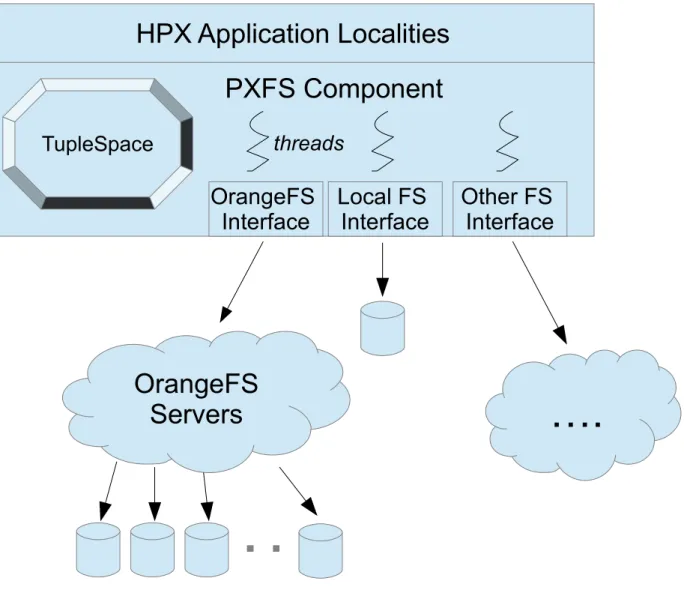
The PXFS model is designed as a layer on top of storage media and file systems, and as a part of the ParalleX runtime system. The system diagram is depicted in Fig. 3.1. It is implemented as a component of HPX and manages I/O operations and object meta properties through different levels.
HPX Application Localities
OrangeFS
Servers
OrangeFS
Interface
PXFS Component
Local FS
Interface
Other FS
Interface
….
threads
TupleSpace
The interfaces of different file systems can be expanded to more general storage media like tape or network. HPX threads are essential to guarantee the asynchronous properties of pxfs calls. The TupleSpace entities will be detailed below to active manage meta properties of both runtime objects and storage objects.
3.2 Asynchronous I/O Operations
3.2.1 OrangeFS Asynchronous I/O Interface
As a coordinated work, an OrangeFS asynchronous interface is designed and a proto-type has been implemented [14]. It is part of the PXFS model to interact with parallel file system in an asynchronous fashion. The asynchronous interface will use the OrangeFS system calls to schedule I/O operations and execute a callback function when the task is finished. PXFS will create HPX futures for I/O operations and set the future value in the callback function to integrate the parallel file system into the HPX runtime system seamlessly.
The HPX asynchronous interface will use the OrangeFS asynchronous I/O (AIO) sub-system which add a thread managing layer on top of OrangeFS sub-system interface. The AIO subsystem provides a set of asynchronous I/O functions to perform basic I/O operations. It will store the result in a pointer and enable a callback function.
Examplar OrangeFS AIO Write Call int pxfs_write(int fd, const void *buf, size_t count,
ssize_t *bcnt, pxfs_cb cb, void *cdat);
Figure 3.2: Prototype for the OrangeFS AIO write operation.
As an example, the asynchronouswritefunction call is listed in Fig. 3.2. The first three arguments correspond directly to the POSIX write definition: fd represents the associated file descriptor, buf points to the buffer of data to be written, and count specifies the amount of bytes to be written from the buffer. The next argument, bcnt, points to the location where the output value (number of bytes written) should be written. The last two arguments correspond to the continuation specifier: cb stores the associated callback function for the continuation and cdat stores the pointer to the user-supplied data block.
The function returns 0 on a successful asynchronous submission to PXFS and returns -1 if an error occurred before submission.
The AIO library contains most of the I/O operations provided in OrangeFS user inter-face, including read/pread, write/pwrite, lseekand directory operations.
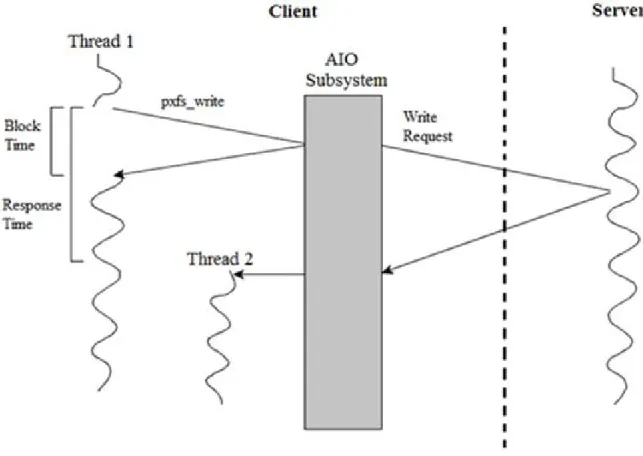
Figure 3.3: Data flow diagram illustrating an example I/O operation in the AIO library. Thread 1 submits a pxfs writeoperation with a continuation which spawns Thread 2.
A data flow diagram illustrating the asynchronous nature of the AIO subsystem is given in Fig. 3.3. This diagram provides an insight into how external threads submit I/O operations and respond to their completion. After a thread has submitted an I/O oper-ation, the PXFS AIO subsystem manages all client-side computation and communication necessary to service the operation, clearly alleviating the programmer from the burden of repeatedly checking for its completion. When the operation has finally completed, the AIO subsystem utilizes the provided continuation specifier to notify the initiating application. In the case of Fig. 3.3, the continuation spawns a new thread of execution, but could be
easily modified to notify the original thread or perform any other functionality.
To integrate the OrangeFS AIO interface with HPX, an HPX application can pass a future as the argument of the callback function and set the value of the future in the callback function. A simple code example is illustrated in Fig. 3.4. The callback function set promise cb will set the value of the future passed through the argument to notify the external HPX application when the I/O operations is finished. There are some register and unregister functions in the callback function to deal with the different thread mechanisms between HPX threads and posix threads.
Moreover, the AIO interface is highly configurable and the number of internal threads and the size of thread waiting queues can be tuned and changed according to the actual environment to fit the requirements.
Examplar HPX AIO Call typedef hpx::lcos::local::promise<int> int_promise_type; typedef hpx::runtime rt_type;
// structure to pass HPX runtime information struct promise_rt_ptr_type { std::string thread_name_; int_promise_type* p_p_; rt_type* rt_p_; }
// this function will be executed by an HPX thread void set_value(
hpx::lcos::local::promise<int> *p, int result)
{
// notify the waiting HPX thread and return a value p->set_value(result);
}
// the callback function to set the future value int set_promise_cb(void *cdat, int status) {
promise_rt_ptr_type *pr_p = (promise_rt_ptr_type *) cdat;
pr_p->rt_p_->register_thread(pr_p->thread_name_.c_str());
// Create an HPX thread to guarantee that the promise::set_value // function can be invoked safely.
hpx::threads::register_thread(hpx::util::bind(&set_value, pr_p->p_p_, status)); pr_p->rt_p_->unregister_thread(); return status; } // init promise_rt_ptr promise_rt_ptr_type promise_rt_ptr; // make the AIO call
pxfs_write(fd, buf, bufsiz, &num_written, set_promise_cb, &promise_rt_ptr);
Figure 3.4: An example code to show the integration of HPX and OrangeFS AIO interface to make an asynchronous write call in HPX applications.
3.2.2 HPX Asynchronous I/O Class APIs
While designing the API for the implementation of the presented persistent storage model special attention was directed towards a natural integration with the existing highly asynchronous programming model exposed by HPX. By design, all functionality in HPX which can potentially take longer than 100 microseconds to execute is exposed through asynchronous functions. An asynchronous function in HPX is a function which is return-ing a future representreturn-ing the result of that function. The caller can continue executreturn-ing immediately without being suspended or without having to wait for the function result. Three C++ classes, local file, orangefs file and pxfs fileare written to incorporate the asynchronous nature into I/O calls. The code example in Fig. 3.5, Fig. 3.6 and Fig. 3.7 show part of the developed file oriented APIs, respectively.
Note that the HPX future type exposes an interface consistent with the C++11 Stan-dard [39] with extensions as proposed to the C++ stanStan-dardization process [61, 62].
The file class and orangefs class interfaces are using the client/server architecture in HPX which creates a component on a designated server side and on current locality calls the server actions through a thin client interface to deal with the asynchronism mechanism. The client side interface is an asynchronous wrapper which schedules the asynchronous task and manages the results processed at the server side which is utilizing the synchronous I/O functions provided by the C++ fstream library and the OrangeFS synchronous user interfaces.
On the other hand, the pxfs file is directly employing the OrangeFS AIO interface which is already asynchronous by itself. Thus the pxfs file is merely an HPX client class which setup the interface and thread then handle the function to the OrangeFS AIO inter-face in OrangeFS client and then communicate with the remote OrangeFS servers.
HPX local file Asynchronous class API namespace hpx { namespace io {
class local_file {
~local_file(); // closes file synchronously
// asynchronous function by default
lcos::future<void> open(std::string const& name, std::string const& mode); void open_sync(std::string const& name, std::string const& mode)
lcos::future<void> close(); void close_sync();
lcos::future<int> remove_file(std::string const& file_name); int remove_file_sync(std::string const& file_name);
// read/write operations
lcos::future<std::vector<char> > read(size_t const& count) std::vector<char> read_sync(size_t const count)
lcos::future<std::vector<char> > pread(ssize_t const count, off_t const offset); std::vector<char> pread_sync(size_t const count, off_t const offset)
lcos::future<ssize_t> write(std::vector<char> const& buf); ssize_t write_sync(std::vector<char> const& buf);
lcos::future<ssize_t> pwrite(std::vector<char> const& buf, off_t const offset); ssize_t pwrite_sync(std::vector<char> const& buf, off_t const offset);
lcos::future<int> lseek(off_t const offset, int const whence); int lseek_sync(off_t const offset, int const whence);
}; }}
Figure 3.5: This code example shows the asynchronous file oriented API exposed by the implementation of the local file class presented persistent storage model. The local file class is responsible to operate on local file systems using the HPX asynchronous interfaces and C++ standard file I/O libraries.
HPX orangefs file Asynchronous class API namespace hpx { namespace io {
class orangefs_file {
~orangefs_file(); // closes file synchronously
// asynchronous function by default
lcos::future<void> open(std::string const& name, int const& flag); void open_sync(std::string const& name, std::string const& mode)
lcos::future<void> close(); void close_sync();
lcos::future<int> remove_file(std::string const& file_name); int remove_file_sync(std::string const& file_name);
// read/write operations
lcos::future<std::vector<char> > read(size_t const& count) std::vector<char> read_sync(size_t const count)
lcos::future<std::vector<char> > pread(ssize_t const count, off_t const offset); std::vector<char> pread_sync(size_t const count, off_t const offset)
lcos::future<ssize_t> write(std::vector<char> const& buf); ssize_t write_sync(std::vector<char> const& buf);
lcos::future<ssize_t> pwrite(std::vector<char> const& buf, off_t const offset); ssize_t pwrite_sync(std::vector<char> const& buf, off_t const offset);
lcos::future<int> lseek(off_t const offset, int const whence); int lseek_sync(off_t const offset, int const whence);
}; }}
Figure 3.6: This code example shows the asynchronous file oriented API exposed by the implementation of the orangefs file class presented persistent storage model. The or-angefs file class is responsible to operate on OranegeFS using the HPX asynchronous interface and OrangeFS synchronous user interfaces.
HPX pxfs file Asynchronous class API namespace hpx { namespace io {
class pxfs_file {
~pxfs_file(); // closes file synchronously
// asynchronous function by default
lcos::future<void> open(std::string const& name, int const& flag); void open_sync(std::string const& name, std::string const& mode)
lcos::future<void> close(); void close_sync();
lcos::future<int> remove_file(std::string const& file_name); int remove_file_sync(std::string const& file_name);
// read/write operations
lcos::future<std::vector<char> > read(size_t const& count) std::vector<char> read_sync(size_t const count)
lcos::future<std::vector<char> > pread(ssize_t const count, off_t const offset); std::vector<char> pread_sync(size_t const count, off_t const offset)
lcos::future<ssize_t> write(std::vector<char> const& buf); ssize_t write_sync(std::vector<char> const& buf);
lcos::future<ssize_t> pwrite(std::vector<char> const& buf, off_t const offset); ssize_t pwrite_sync(std::vector<char> const& buf, off_t const offset);
lcos::future<int> lseek(off_t const offset, int const whence); int lseek_sync(off_t const offset, int const whence);
}; }}
Figure 3.7: This code example shows the asynchronous file oriented API exposed by the implementation of the pxfs file class presented persistent storage model. The pxfs file class is responsible to operate on OranegeFS using the OrangeFS AIO asynchronous user interfaces.