ANITA GUDELJ, M.Sc. E-mail: [email protected] MAJA KRČUM, M.Sc. E-mail: [email protected]
University of Split, Faculty of Maritime Studies Zrinsko-Frankopanska 38, HR-21000 Split, Republic of Croatia
ELEN TWRDY, Ph.D.
E-mail: [email protected] University of Ljubljana,
Faculty of Maritime Studies and Transport
Pot pomorščakov 4, SI-6320 Portorož, Republic of Slovenia
Intermodal Transport Preliminary Communication Accepted: June 8, 2009 Approved: Feb. 2, 2010
MODELS AND METHODS FOR OPERATIONS
IN PORT CONTAINER TERMINALS
ABSTRACT
The management of a container terminal is a complex process that involves many decisions. Among the problems to be solved, there are the spatial allocation of containers on the terminal yard, allocation of ships to berths and cranes, scheduling priorities and operations in order to maximize performances based on some economic indicators. Since the container port facilities are very expensive, it is desirable to optimize their performance, making better management decisions. This paper wants to present the contribution of the simulation and optimization techniques with the aim of improving the cooperation between different types of equip-ments, increasing the productivity of the terminal and help-ing in minimizhelp-ing costs. In particular, the Petri net is used to present berth operations, and the genetic algorithm is used for scheduling container loading/unloading operations by cranes in order to minimize the maximum time it takes to serve a given set of vessels.
KEYWORDS
transportation, berth management, scheduling, simulation, optimization
1. INTRODUCTION
In the last 30 years the revolutionary development of container handling has increased the efficiency of worldwide trade (by about 9.5% per year) and will con -tinue to do so at an 8% growth rate in the coming years [1]. So the increasing demand for container transpor -tation results in various issues, including risk of termi -nal congestion, delivery delay, and economic loss. The main role of a container terminal is the transfer and storage of containers. Figure 1 shows a typical
contain-er tcontain-erminal layout composed of “Quayside area” and “Storage yard”.
In a container terminal, it is important to guarantee fast operations to reduce delays in delivering goods to ships, trains and trucks, and consequently, to reduce sea, road or rail transport time. Therefore, container terminals have a fundamental role in the interchange between roads, railway and sea networks, and there -fore they are usually equipped with modern equip -ment, advanced transport systems and up-to-date information and communication technologies. In this context, the efficiency of a given terminal depends on its internal organization according to its planning and control strategies.
Many optimization problems associated with a con -tainer terminal have been extensively studied in the past few years. Vis and De Koster (2003)1 gave a com-prehensive review of literature. Kim and Park (2002)1 treated quay cranes scheduling as an m-parallel ma -chine scheduling problem. Meersmans [2] provided models and algorithms for scheduling container han-dling equipment in an integrated way in an automated container terminal but considered only loading opera-tions.
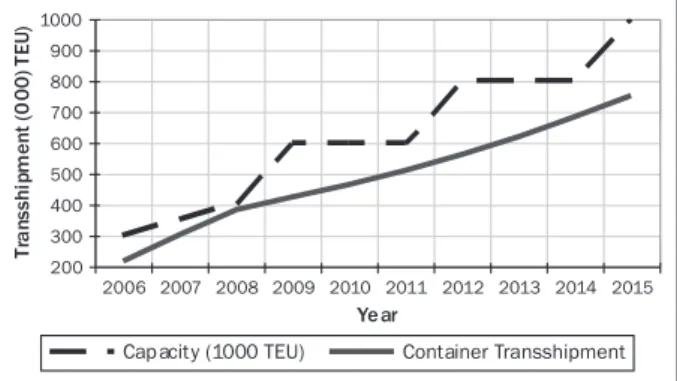
This paper considers the Container Terminal of the Port of Koper as case-study. With Slovenia’s ac -cession to EU on 1 May 2005, there was an increase in operations (Table 1, Figure 2) on the Port of Koper container terminal. The Port Master’s office therefore adopted a strategic decision on the expansion of the terminal (e.g. quay and yard extensions, new equip -ment, increased TEU capacity, infrastructure develop -ments) in order to meet the demands of the European markets. As the system is gaining in complexity and with the requirements for lower costs and efficiency
being competitive, the terminals are becoming more and more important. It is considered that research can help in the study of advanced models in representing, simulating, and in on-line control of the terminal activi -ties to achieve better productivity of the terminal and to make better strategic decisions.
2. SYSTEM DESCRIPTION
Container terminals (CT) provide many services, e.g. container loading/unloading to/from vessel and
QC QC seaside QC QC QC QC QC berths YV YV YV YV YV YV YC YC YC YC YC YC YV YV YV YV YV YV RAIL/ROAD INTERMODAL YV YV YV YV YV – Yard Vehicle Qc – Quay Crane Yc – Yard Crane Qu a y Area St orag e Yar d
Figure 1 - Typical layout of a maritime container terminal
Yard tractor
Yard tractor
Table 1 - Container transhipment and container terminal capacity from 2006 to 2015
Year 2006 2007 2008 2009 2010 2011 2012 2013 2014 2015
Capacity (1000 TEU) 300 350 400 600 600 600 800 800 800 1000
Traffic-10% growth 218.97 305.65 385.12 423.63 465.99 512.59 563.58 620.24 682.26 750.49 Source: U. Horvat, E. Twrdy: “The impact of introducing sea motorways on increase of container transhipment in the Port of Koper”, 11th International Conference on Traffic Science, Portorož, Slovenia, 2008
200 300 400 500 600 700 800 900 1000 2006 2007 2008 2009 2010 2011 2012 2013 2014 2015 Ye ar T ra n s s h ip m en t (0 00 ) T EU )
Figure 2 - Changes in container transhipment regarding container terminal capacity from 2006 to 2015
Cap acity (1000 TEU) Container Transshipment
feeder ships for import or export purposes, internal container movement from ships to stacking areas and vice versa, stacking containers in dedicated areas distributed in the terminal area, container inspection for customs requirements, reefer handling and stor -age, stuffing, etc. All the above processes need sev -eral shared and reusable resources and equipment, to fulfil the tasks involved in handling and transport -ing containers: quay cranes (QC) or yard cranes (YC), transport vehicles, e.g. multitrailers or automatically guided vehicles, straddle carriers, yard stacking de -posits, automatic stacking cranes or automatic stor -age/retrieval systems, railway tracks, human opera -tors. All processes and operations are usually planned, scheduled, monitored, and controlled by a central su -pervisor and make use of information technologies, to allow fast ship operations, optimization of the usage of facilities, and to reduce lag times.
Currently, the Port of Koper is among the ports being used for container transport for Central and Eastern Europe. In comparison to northern European ports, the sea route from Koper to the Mediterranean countries and countries beyond the Suez is shorter by over 2000 nautical miles. At the moment, this is the biggest advantage of the Slovenian port. The Port of
tive coastline). In the late 2005, the CT extended over 160,000m2 of storage area, its annual capacity was limited to 182,250 TEU (Twenty-foot equivalent units), one-time storage was limited to 11,500 TEU, and three moorings for container ships with sea depth of 9 to 12m, and 3 railway lines lead to the terminals. The Port of Koper was equipped with 4 shore-side gantry cranes, 4 transtainer cranes at the warehouse and 1 transtainer crane for loading and unloading wagons. It was also equipped with 4 manipulators and 3 forklift trucks for empty containers and tugs, 40 yard trucks and 30 trailers. Last but not least, skilled workforce and information and communication technologies are used for terminal management and real-time contain-er tracking.
2.1 General overview of operations in a container terminal
The main operations of a typical container port may be classified in one of the seven basic types [4]. These are:
– Manoeuvring of ships between anchorage areas and berths;
– Berthing and deberthing of ships; – Positioning of cranes alongside ships; – Loading and unloading of containers;
– Moving containers between the berth and the yard; – Configuring and operating the yard;
– Moving containers between the yard and the gate. Business-technical systems of CT are characterized by complicated, highly sophisticated logistic transport activities, which integrate physical freight flows, finan -cial flows and information flows (Figure 4).
The upper part of the circle shows the transport ac-tivities, while the lower part shows the subjects. Both, activities and subjects are directed to the two basic phases of cargo flow:
a) from freight receiving in the port to freight loading onto the ship,
b) from freight unloading from the ship to its delivery by truck or train.
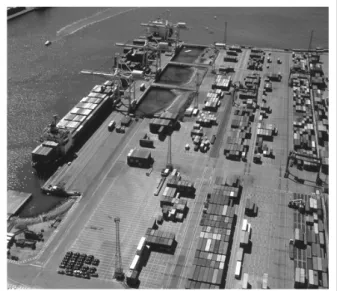
Koper is a multipurpose port, equipped and trained as transhipment and storage for any kind of goods. They achieved 15.4 million of ton of transhipment in 2007 and exceeded the amount of transhipment in 2006 by 10% 2. Container transhipment amounted to a record of 305,648 TEU. The containers are transported be -tween the terminal and hinterland by road or rail. Both container flows, inbound and outbound, are handled simultaneously. Thus, effective port operation deter -mines the terminal efficiency to a great extent.
The Port of Koper has ten terminals: Container and Ro-Ro Terminal (with 500m of operative coastline), Car Terminal (with 500m of operative coastline and four Ro-Ro wharfs for car acceptance), Fruit Terminal (with 427m of operative coastline), General Cargo Terminal (with 833m of operative coastline), Timber Terminal (with 250m of operative coastline), Livestock Terminal (with 86m of operative coastline), Alumina Terminal (with 200m of operative coastline), Terminal for Min -erals (with 500m of operative coastline), Terminal for Cereals and Fodder (with 200m of operative coastline) and Liquid Cargoes Terminal (with 200m of opera
-Figure 3 - Container terminal of the Port of Koper Source: Internal material of the Port of Koper
storage activities loading transport Port Master's Office subjects managers agents customs officers operators insurance according
accepting cargo in the port, unloading, handling,
loading cargo on vessels
unloading cargo from vessels, handling, loading cargo on trains,
trucks
sender
customer
The complexity of the terminal processes arises from several interactions between the operations and from the variety of stochastic processes [4] (e.g., ship arrival rates, times required for each step of contain -er’s movement, equipment failure times, equipment repair times, number of containers loaded and un -loaded). With simulation models it is possible to fully describe the system and they are long-lasting. On the other hand, analytical modelling of container terminal consists of setting up mathematical models and equa -tions which describe certain stages in the functioning of the system. The main problem of container termi -nal a-nalytical models relates to the fact that they lose in detail and flexibility, so they simplify the real situ -ation. Therefore, simulation modelling is better than analytical one in representing the random and com-plex environment of a container terminal. Analytical or simulation models can also be used for workload bal -ancing, for defining work rules and work crew sched -ules wsithin short and long periods.
3. TRENDS IN OPTIMIZATION AND
SIMULATION IN CONTAINER TERMINALS
The crucial terminal management problem is opti-mizing the balance between the ship-owners who re -quest quick service of their ships and economical use of allocated resources. Since both container ships and container port facilities are very expensive, it is desir -able to utilize them as intensively as possible.The manager can trust the computer-generated so-lutions only by validating them by means of a simula-tion model of the complex environment of container terminal. Thus, the simulation tool also becomes a means to introduce new approaches into traditional settings. A simulation model of a container terminal is basically a computer program written in a general purpose language (C/C++) or in a special simulation-oriented language – simulator (MODSIM, MES CTMS, Arena, Petri Nets).
The simulation models are used to analyze bottle -neck and deadlock problems, conflicts, container han -dling techniques, vehicle and vessel scheduling (de -parture and arrival rates), equipment utilization and operational efficiency (yard, gate and berth). So, a sim -ulation implements the most important aspects of the processes at the container terminal. The advantage of simulation modelling over analytical modelling of con-tainer terminals is that it allows for a greater level of detail and avoids too many simplifications. Universities and research institutes tend to demonstrate innova-tive optimization algorithms and apply them to the real world case-studies.
4. SOLUTION METHODOLOGY
The review of the literature has shown that various modelling paradigms are proposed to describe the operations carried out in a terminal. Discrete-event systems are well suited to representing various activi-ties performed in container terminals3. For this rea -son, some flexible models have been proposed, that can depict discrete events in solving the ship berthing problem in a container terminal. Petri nets (PN) seem to be a complete modelling tool for CT.
To increase the productivity of CT, the problem is how to realize all the processes within an optimal time, at a minimal cost. The objective of the scheduling sys -tem is to organize in time the realisation of interdepen -dent tasks considering the constraints regarding time, cost and resources. Several scheduling methods have been developed, but the decision was made to apply a genetic algorithm for the given example of berthing problem in CT.
4.1 Petri nets
Discrete-event simulation is a significant analysis tool for designing complex terminal systems. Typically, discrete-event simulation models the entities’ move -ment through the system and the changes caused in the state of the system. It is a very general modelling framework; the entities can represent the necessary operations, the shared resources, the synchronized and parallel operations. The CT can be seen as a dis -crete event system. For example, the container events include the following:
– Transport. The containers are transported by feed -er s-ervices between contain-er depots, custom-ers, and ports. A transport event may schedule a subse -quent load or unload event if the container is trans -ported to a consignor or a consignee.
– Load. The container is loaded with cargo. A load event schedules a subsequent transport event to the first port on the chosen path for the shipment. – Unload. The cargo on the container is unloaded.
If the container belongs to the carrier, an unload event schedules a subsequent transport event to a chosen container depot. If the container belongs to the customer, the simulation stops keeping track of the container when the unload event takes place.
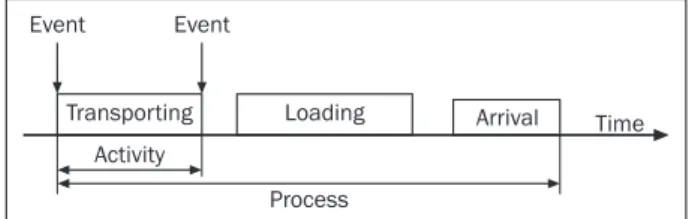
Figure 5 - Model of container transhipment logic Event Event Transporting Activity Loading Arrival Process Time
– Arrival. The container arrives at a port or at a con -tainer depot.
Other events include booking requests for con -tainer movement, and the movement of surplus empty containers between container depots.
Figure 5 shows the “Loading” process. Events are normally paired instances, i.e. start of transporting and end of transporting. An activity is described by the duration between the pair subsequent events, e.g. “Transporting”. The process combines the collection of events or activities and mimics the lifecycle of the entity; in this case “Loading”.
In particular, Petri nets are very powerful tools which give graphical representation of the discrete event systems model (for more details about Petri nets see Murata, 19893). Their basic capability is in the graphical representation and formal analysis of all the processes in a discrete event system. PN are suit -able to describe and simulate the dynamic behaviour of complex systems characterized by precedence rela -tions, concurrency, synchronization conflicts and mu -tual elimination of events.
When compared with other existing formalisms, PN show the possibility of allowing the identification of critical system conditions (blocking, deadlock, conges -tion). This can help the system designer in preventing these states, which can critically reduce the terminal performance.
An ordinary PN is a bipartite graph formalized by a four-tuple N = (P, T, A, MO), in which places in set P and transitions in set T are linked by arcs in set A to represent how the system state changes. The places may contain tokens, which represent certain objects, while the number of tokens may change during the ex -ecution of the net. A transition is enabled if each of its input places contains enough tokens and it can fire by consuming tokens from the input places and produc -ing tokens for the output places. The places are de -picted by a circle, transitions by bar and model events changing the state, directed arcs by → and tokens by ● in the schematic representation, as tokens, represent -ing resource-units (cranes, vehicles, etc.) or entities (i.e. containers) in the process, flow through the net.
4.2 Genetic Algorithms
The Genetic Algorithm (GA), proposed initially by John Holland (1975), is part of a bigger set called Evolutionary Algorithms. GA is a heuristic optimization method and it is inspired by the mechanism of natural selection, a biological process in which the rule is “the fittest will survive”. It weeds out the bad and tends to produce more of the good individuals.
The main idea behind the GA is smart exploration of a response surface, where simultaneous searches are performed through specific points from this sur
-face. GA presumes a potential solution as an indi -vidual, which can be represented by a chromosome. A chromosome must be represented by a codification and must comprise information which characterizes the individual. For the chosen type of solution repre -sentation it is necessary to define the genetic opera -tors as well. It is important for the opera-tors not to produce new individuals which represent impossible solutions because this reduces the efficiency of the al -gorithm. This idea is familiar to biological applications. Throughout the genetic evolution, starting from a pop -ulation of chromosomes, GA tends to yield good quality offspring, and this means better solutions to the prob -lem. The number of genes of this chromosome equals the number of variables of the proposed problem (for more details about GA see Gudelj3).
5. SHIP BERTHING PROBLEM
FOR PORT OF KOPER
The problem here is to assign berths to arriving vessels and determine the number of cranes allocated to each vessel4. The port turnaround time of the de -parting vessel and the allocation of the same berth and cargo handling resources to the next ship may serve as examples. The aim of this plan is to minimize the total stay or delay times of vessels at a port and increase capacity at the container terminal. To accom -modate process-orientation, the “if-else” statement is extensively used together with a combination of calcu-lations related to port operations.
The berth allocation task is complex due to dif -ferent ship arrival times, dif-ferent number and size of arriving ships, multiple quays, different lengths of berths, different number and capabilities of cranes, navigation constraints and so on [5,6].
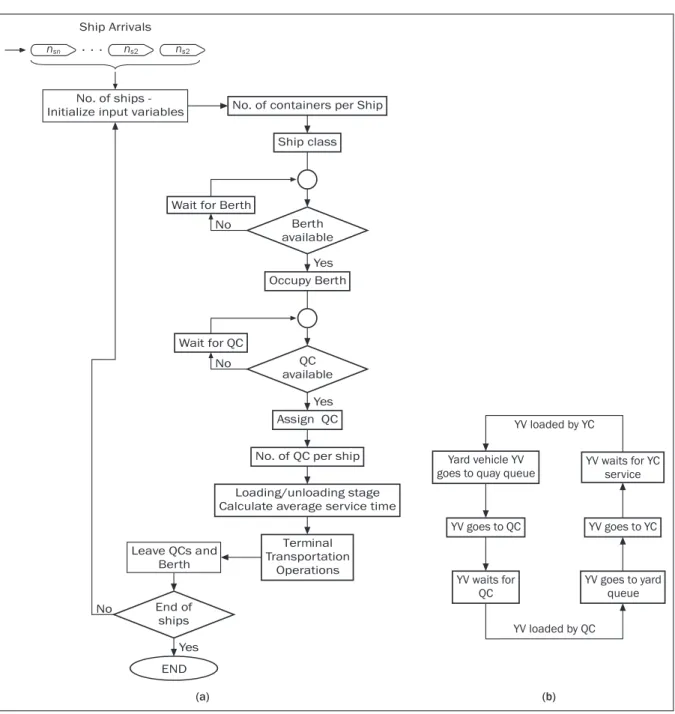
Upon arrival, a ship needs to be assigned a berth along the quay. If there is no ship in the queue, the available berths are allocated to each arriving ship. The first-come-first-served principle is employed for the ships without priority and ships from the same class with priority. In other cases ships are put in queue. Usually berth occupancy is based on the length of the container ship and the time it spends at the berth. After berthing, the ship is assigned the requested number of QCs. Cranes must be assigned to vessels over time and the availability of cranes has direct bearing on the port stay time or delay times. The operational crane assignment problem involves assigning a given set of cranes to serve all scheduled container vessels at minimum cost. If a crane is not available, it must be brought from adjacent berth. In case all QCs are busy, the ship is put in queue for the QCs. Finally, after completion of the loading process, the ship leaves the port. All operations have certain
duration. This procedure is presented in the flow dia -gram shown in Figure 6.
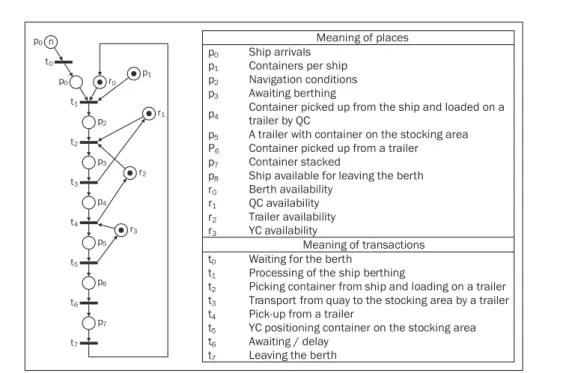
The process combines the collection of events or activities and mimics the lifecycle of the entity; in this case “Berthing”. This approach of process orientation applied in the PN is shown in Figure 7. The presence of a mark (black dot) in a given place means that the cor -responding condition is available. PN represents the initial state after ship arrivals in the port: the mark (n) in place p0 represents the number of ships in arrival queue and place p1 denotes the number of containers available for unloading by the considered QC.
If there are marks in places r1, r2 and r3, this will mean the number of available resources: QC, a trailer and YC (for adopted unloading plan obtained by
opti-mization algorithms). The dot in place p2 means that the nautical conditions allow their processing.
The choice of berth position and the crane assign-ment problem for the Port of Koper is solved by the same genetic algorithm which was used in [7]. This re -search is based on the date recorded for each arriving ship over a two year period at the container terminal of the Port of Koper2 [8]. Using data, the number of con -tainers exported with each ship averaged 450, which we used in our analysis. Also, it is estimated that an av -erage berthing time per ship is 21.90 hours. Then, the priority of the ship is assigned depending on its size. The ship size is important for making the ship service priority strategies.
(a) (b)
Figure 6 - (a) Model of berthing process logic; (b) Terminal transportation process YV loaded by QC YV loaded by YC YV waits for QC YV goes to yard queue YV goes to QC YV goes to YC Yard vehicle YV
goes to quay queue
YV waits for YC service Yes Yes No Yes No No No. of ships -Initialize input variables
END Ship Arrivals
No. of containers per Ship
Wait for Berth
Occupy Berth
Wait for QC
Assign QC
No. of QC per ship
Loading/unloading stage Calculate average service time
Terminal Transportation Operations Ship class QC available End of ships Berth available Leave QCs and Berth nsn ns2 ns2
Chromosome representation
The chromosomal structure needs to code the key features of the problem. In Holland’s work, chro -mosomes are usually represented in binary strings. However, when problems are related to a real environ -ment, binary encoding is not appropriate. Permuta -tion representa-tion and random keys representa-tion are two of the most widely used methods to represent chromosome syntax for scheduling types of problems. The population initialization technique used in this GA algorithm is a random real-number initialization (Fig -ure 8). Before encoding individuals, calling vessels are ordered by their arrival time and berths should be identified by their number No. To encode the solution of berth assignment problem, the length of the chro -mosome is set to the number of vessels to be docked at the yard area. Each integer in the chromosome rep -resents a unique identification of berth No., and the position of each gene represents the vessel number to which the berth is assigned.
The example has 10 calling vessels to be handled by a quay crane and six berths. Chromosome consist -ing of 10 integers, which represents the handl-ing se -quence of the yard crane for the 10 jobs. The symbols in the string are the identifications of berth No. Under ship 1, symbol “4” in the string shows that berth 4 serves vessel s1. Under vessel 8, “4” in the string says that ship 5 is also served at berth 4 and so on.
Fitness Measure
In this approach, berthing_Time is a multiobjec -tive cost function that depends on the distance from the berthing location of a vessel to the location in the marshalling yard where containers for the correspond-ing vessel are stacked, the penalty cost incurred by berthing earlier or later than the expected time of ar-rival, and the penalty cost incurred by the delay of the departure beyond the promised due time. It is repre -sented as follows: _ Berthing Time c xi i bi c ai i yi c yi i ai i N 1 2 3 1 = + + = - - + - + = ^ h ^ h " ,
/
(1) where z+ = max{0, z}ai = expected arrival time of i-th vessel in the
port;
yi = real arrival time of i-th vessel in the port;
xi = assigned berthing position of i-th vessel;
bi = the best berthing location of i-th vessel;
c1i = additional travel cost per unit distance for
delivering containers of i-th vessel resulting from deviation of berthing location from the best position;
c2i = penalty cost of i-th vessel per unit time of
arrival before ai;
c3i = penalty cost of i-th vessel per unit time of
arrival after ai. p2 r1 t1 p3 r0 r2 p1 t2 t3 p4 t4 p5 t5 r3 p6 t6 p7 p0 p0 n t0 t7
Figure 7 - PN model of berthing process
Source: This model was developed by using Visual Object Net ++ - Petri-Net CAD/CAE Tool
Meaning of places p0 Ship arrivals
p1 Containers per ship
p2 Navigation conditions
p3 Awaiting berthing
p4
Container picked up from the ship and loaded on a trailer by QC
p5 A trailer with container on the stocking area
P6 Container picked up from a trailer
p7 Container stacked
p8 Ship available for leaving the berth
r0 Berth availability
r1 QC availability
r2 Trailer availability
r3 YC availability
Meaning of transactions t0 Waiting for the berth
t1 Processing of the ship berthing
t2 Picking container from ship and loading on a trailer
t3 Transport from quay to the stocking area by a trailer
t4 Pick-up from a trailer
t5 YC positioning container on the stocking area
t6 Awaiting / delay
t7 Leaving the berth
Vessels s1 s2 s3 s4 s5 s6 s7 s8 s9 s10 String 4 3 6 3 2 3 5 4 3 1
Evaluation
All experiments were run on a PC with Pentium 4-M 2.20Mhz under Windows. The designed sched -uling procedure with Genetic Algorithm software has been developed in the Matlab software package. A tournament selection of parent solutions for mating, crossover rate ranging of 20% and mutation rate of 20% are used in simulation optimization. It has been estimated that the objective value of container ship cost has been reduced by about 18.69% (about 17.80 hours). Also, it was found that the two–point crossover took longer CPU time per simulation (about 50%) than single-point crossover, but the difference in solutions is not significant.
6. CONCLUSION
The main role of container terminal is the transfer and storage of containers. The performance of CT is of crucial importance for ship and cargo owners who request quick service. It is mandatory to ensure a sufficiently short lay time for container vessels in the port and to achieve further reduction of the terminal operating costs. For this reason, the management of CT must develop mechanisms to increase productivity when necessary.
This paper presented the use optimization and simulation techniques as decision support tools in the management of CT for the Port of Koper. It proposed the Petri net model and the genetic algorithm for solv-ing the problem of berth and crane assignments. The advantage of PN over many other graphical model-ling tools is that it has a mathematical formalism that makes the dynamic behaviour of the underlying sys -tem well-defined. PN has shown to be an important tool for easy-to-read modelling of information flows and different interactions in CT. The main contribution of this paper is the development of a rule-based meth-od for the berth dispatching problem and the use the multiobjective fitness function in GA to improve the CT production. Preliminary results seem to be promising.
Mr. sc. ANITA GUDELJ E-mail: [email protected] Mr. sc. MAJA KRČUM E-mail: [email protected]
Sveučilište u Splitu, Pomorski fakultet
Zrinsko-Frankopanska 38, 21000 Split, Republika Hrvatska Dr. sc. ELEN TWRDY
E-mail: [email protected]
Univerza v Ljubljani, Fakulteta za pomorstvo in promet Pot pomorščakov 4, 6320 Portorož, Republika Slovenija
SAŽETAK
MODELI I METODE ZA OPERACIJE NA KONTEJNERSKIM TERMINALIMA
Upravljanje kontejnerskim terminalom je veoma složen proces koji uključuje donošenje brojnih odluka. Među problemima koji se trebaju riješiti valja istaknuti prostorno raspoređivanje kontejnera u stovarištu, dodjeljivanje vezova i dizalica brodovima, određivanje i dodjeljivanje prioriteta veza, određivanje rasporeda operacija kako bi se povećala učinkovitost vrednovana nekim ekonomskim pokazateljima. Kako je oprema u kontejnerskim lukama veoma skupa, poželjno je optimizirati njihove značajke kako bi Uprava bila u mogućnosti donijeti što bolje odluke. U radu su korišteni model Petrijevih mreža kojim se prikazuju operacije vezivan-ja plovila, a genetski algoritam se koristi za određivanje ra-sporeda operacija ukrcaj/iskrcaj kontejnera pomoću dizali-ca u cilju minimiziranja ukupnog vremena koje je potrebno za posluživanje zadanog broja plovila.
KLJUČNE RIJEČI
prijevoz, upravljanje vezovima, raspored, simulacija, opti-malizacija
REFERENCES
1. Steenken, D. et al.: Container terminal operation and operations research - A classification and literature re-view, OR Spectrum, Vol. 26, No. 1, 2004, pp. 3-49 2. Horvat, U., Twrdy, E.: The impact of introducing sea
mo-torways on increase of container transshipment in the Port of Koper, 11th International Conference on Traffic
Science – ICTS 2008, Proceedings CD, Portorož, Slove-nia, June 2008
3. Gudelj, A., Vidačić, S.: Scheduling model of an auto-mated guided vehicle system in seaports, Modern Traf-fic, Vol. 27, No. 6, 2007, pp. 446-451
4. Gudelj, A., Krčum, M., Vlahinić, S.: Genetic Algorithm for Solving Berth and Quay Cranes Assignment Prob-lems, 2nd International Conference on Ports and
Wa-terways – POWA, Vukovar, Croatia, 2007, pp. 165-177 LITERATURE
[1] Steenken, D. et al.: Container terminal operation and operations research - A classification and literature re-view, OR Spectrum, Vol. 26, No. 1, 2004, pp. 3-49 [2] Meersmans, P.J.M.: Optimization of Container
Han-dling Systems, Ph.D. Thesis, Tinbergen Institute 271, Erasmus, University Rotterdam, 2002
[3] Horvat, U., Twrdy, E.: The impact of introducing sea mo-torways on increase of container transshipment in the Port of Koper, 11th International Conference on Traffic
Science – ICTS 2008, Proceedings CD, Portorož, Slove-nia, June 2008
[4] Pesenti, R., Ukovich, W., Castelli, L., Longo, G.: Quan-titative Models and Methods for Locating Logistics Nodes in Maritime Transportation, Quaderni di Tra-sporti Europei: Study on Location of Logistic Nodes, No. 8/9, 1998, pp. 47-58
[5] Lacksonen, T.: Empirical comparison of search algo-rithms for discrete event simulation, Computers & In-dustrial Engineering 40, 2001, pp. 133-148
[6] Gudelj, A., Vidačić, S.: Scheduling model of an auto-mated guided vehicle system in seaports, Modern Traf-fic, Vol. 27, No. 6, 2007, pp. 446-451
[7] Gudelj, A., Krčum, M., Vlahinić, S.: Genetic Algorithm for Solving Berth and Quay Cranes Assignment
Prob-lems, 2nd International Conference on Ports and
Wa-terways – POWA, Vukovar, Croatia, 2007, pp. 165-177 [8] Gudelj, A., Krčum, M., Twrdy, E.: A Case Study for
Im-proving Modeling and Simulation of Container Termi-nals”, 3rd International Conference on Ports and
Water-ways – POWA, Dubrovnik, Croatia, 2008
[9] Internal material of the Port of Koper. http://www.luka-kp.si