Porto Institutional Repository
[Proceeding] Per-user Policy Enforcement on Mobile Apps through Network
Functions Virtualization
Original Citation:
Sapio A.; Liao Y.; Baldi M.; Ranjan G.; Risso F.; Tongaonkar A. (2014).
Per-user Policy Enforcement
on Mobile Apps through Network Functions Virtualization.
In: Workshop on Mobility in the Evolving
Internet Architecture (MobiArch 2014), Maui, Hawaii, USA, September 2014. pp. 37-42
Availability:
This version is available at :
http://porto.polito.it/2560941/
since: April 2016
Publisher:
ACM
Published version:
DOI:
10.1145/2645892.2645896
Terms of use:
This article is made available under terms and conditions applicable to Open Access Policy Article
("Public - All rights reserved") , as described at
http://porto.polito.it/terms_and_conditions.
html
Porto, the institutional repository of the Politecnico di Torino, is provided by the University Library
and the IT-Services. The aim is to enable open access to all the world. Please
share with us
how
this access benefits you. Your story matters.
Per-user Policy Enforcement on Mobile Apps through
Network Functions Virtualization
Amedeo Sapio
Politecnico di Torino Torino, ItalyYong Liao
Narus, Inc. Sunnyvale, CAMario Baldi
Narus, Inc. Politecnico di TorinoGyan Ranjan
Narus, Inc. Sunnyvale, CAFulvio Risso
Politecnico di Torino Torino, ItalyAlok Tongaonkar
Narus, Inc. Sunnyvale, CAABSTRACT
Due to the increasing popularity of smartphones and tablets, mo-bile apps are becoming the preferred portals for users to access various network services in both residential and enterprise envi-ronments. Predominantly using generic HTTP or HTTPS proto-cols, traffic from different mobile apps is largely indistinguishable. This loss of visibility into mobile app traffic brings new challenges to network management and traffic analysis. It has became very hard to implement network policies based on the differentiation be-tween traffic from compliant and non-compliant mobile apps. This paper presents a system that not only provides network adminis-trators the much desired capability of enforcing policies on mobile app traffic, but also does that at a fineper-usergranularity. The proposed system takes aNetwork Functions Virtualization (NFV)
approach and virtualizes an edge router into multiple virtual data planes. Specifically, each data plane serves solely to one particu-lar user and consists of user-specific virtualized network functions. The independence of the virtual data planes facilitates enforcing network policies at the per-user level. To enable policy enforce-ment on mobile apps, our system includes a sophisticated mobile app identification module to recognize traffic from different apps using preloaded traffic signatures. By exploiting TLS proxying, our system can even enforce policies on those mobile apps adopt-ing traffic encryption. We have implemented a prototype of the proposed system as a wireless access point (AP) using a commod-ity small form factor PC. Our preliminary experimental evaluations show that the system can scale to modest number of users without much impacting user experience in using the network.
Categories and Subject Descriptors
C.2.0 [Computer-Communication Networks]: General—
Secu-rity and protection; C.2.1 [Computer-Communication Networks]:
Network Architecture and Design—Network communications
Permission to make digital or hard copies of all or part of this work for personal or classroom use is granted without fee provided that copies are not made or distributed for profit or commercial advantage and that copies bear this notice and the full cita-tion on the first page. Copyrights for components of this work owned by others than ACM must be honored. Abstracting with credit is permitted. To copy otherwise, or re-publish, to post on servers or to redistribute to lists, requires prior specific permission and/or a fee. Request permissions from [email protected].
MobiArch’14,September 11, 2014, Maui, Hawaii, USA. Copyright 2014 ACM 978-1-4503-3074-9/14/09 ...$15.00. http://dx.doi.org/10.1145/2645892.2645896.
Keywords
Network Functions Virtualization; Mobile Security; Policy Enforce-ment; Traffic Filtering
1.
INTRODUCTION
State-of-the-art firewall and network monitoring systems rely largely on IP address, domain-name, and port number based policy formu-lation and enforcement [6]. Such approaches are becoming unten-able as user-owned devices (mostly smartphones and tunten-ablets) are increasingly accepted within enterprise networks (a.k.a.the bring-your-own-device (BYOD) to work phenomenon). Such devices ex-ecute a multitude of mobile applications (roughly 1.75 million at the last count of Android and iOS markets), a significant portion of which use HTTP and HTTPS to interact with servers connected on Internet. To make matters worse, such servers are often times hosted by cloud providers or content delivery networks. Thus, con-ventional protocol and port number based traffic analysis tools can neither differentiate traffic from distinct mobile apps, nor separate mobile apps traffic from generic web-traffic[4, 14]. The advent of Web 2.0, which facilitates rapid development of web-based and distributed applications, has only accentuated the problem as many enterprise and consumer web applications use the same protocols.
While some mobile applications may actually be necessary or useful in corporate or residential context, others may compromise information security of a network [13]. Besides the issue of dif-ferent applications, the same application developed for difdif-ferent platforms (e.g. Android vs. iOS) may have different security vul-nerabilities. Finally, as mobile applications increasingly become multi-faceted and complex, the risks of them being used for data exfiltration have escalated [9, 7]. For example, popular services such as Facebook now functions as authentication gateways and substrates for a large eco-system of applications (e.g. FarmVille). This can provide indirect access to sensitive information to unde-sired, and potentially malicious, third parties.
Additionally, roles and privileges within a network might need to be different on a per-user basis. For instance, in an enterprise while certain employees might need to access and/or share sensitive in-formation with prospective clients for business objectives, others should not be permitted to do so. Similarly, in a residential net-work environment, parents may want to restrict their kids’ access to applications that are not child-safe.
Addressing these challenges calls for a new breed of policy for-mulation and enforcement systems based on a completely new de-sign. To guarantee network and information security, it is
impera-tiate traffic generated by different mobile applications, across plat-forms and devices, and impose policies based on users and their roles.
In this paper we propose the MAPPER(Mobile Application
Per-sonal Policy Enforcement Router)system, which can implement
per-user fine-grained policies on users’ mobile app usage by moni-toring network traffic. The presented MAPPERimplementation is a wireless network access point that, upon authenticating a connect-ing user, loads a set of modules to process network traffic to/from the user’s device, and implements user-specific access policies based on the user applications that generated the traffic. The design of MAPPERis inspired by research in the field ofNetwork Functions
Virtualization (NFV). More specifically, MAPPER allocates each
user a dedicated virtual execution environment to run network func-tions specialized to the user. The identification of mobile apps gen-erating traffic flows is provided by a sophisticated engine integrated into MAPPERas a virtualized network function. This engine pro-cesses HTTP flows and identifies rich information on the origins of those flows, such as the mobile apps that generated those flows and the platforms (Android, iOS, or Blackberry) of those apps. To max-imize the visibility into network traffic, MAPPERcan additionally instantiate a virtualized network function running a TLS-capable man-in-the-middle proxy, which transparently terminates HTTPS connections so as to retrieve plain-text data from encrypted flows.
NFV plays an essential role in the design of MAPPER. By Isolat-ing network functions operatIsolat-ing on the traffic of each user basis, it greatly eases the enforcement of per-user policies and separation of traffic from different users, which is key from both privacy and per-formance perspectives. Network functions, as well as the policies they implement, can migrate seamlessly across different MAPPER
access nodes, in order to follow the user and enforce the policy no matter which network access node she is connected (e.g., indepen-dently of the department or branch of her company she is visiting), providing a uniform security protection.
The design and development of MAPPER offers a number of technical contributions presented in this paper. To the best of our knowledge, MAPPERis the first system capable of enforcing rich policies on mobile app traffic on a per-user basis. The NFV ap-proach taken in MAPPERprovides extreme flexibility in architect-ing the system and facilitates some unique features of the system. We have implemented a prototype of MAPPERto demonstrate its feasibility. Our tests show that the ambitious goal of enforcing poli-cies on a vast number of mobile apps at the fine per-user granularity, even for apps encrypting their traffic, can be achieved with off-the-shelf commodity hardware.
The rest of this paper is organized as follows. Section2surveys the related works on remote policy enforcement, mobile app iden-tification, and network functions virtualization. Section3presents the design of MAPPER.Performance evaluation results are presented in Section4. Section5concludes this paper and discusses future steps to improve the system.
2.
RELATED WORK
The state-of-the-art remote policy enforcement schemes exploit dedicated middleboxes that inspect network traffic with certain de-gree of application level awareness (e.g. firewall) [6]. Approaches based on Virtual Private Networks (VPN) leveraging Trusted Plat-form Module (TPM) chips are proposed in literature as well [12]. These solutions are no longer suitable for networks serving mostly mobile devices. First, those mobile devices use a new communica-tion paradigm, mobile apps, that works mainly on HTTP/HTTPS protocol, and the state-of-the-art approaches do not have the deep
is often hard for enterprise network administrators to get control of the devices directly due to the lack of some software/hardware features in those devices, and the devices are usually not owned by enterprises (due to the BYOD trend).
The capability of deeply analyzing network traffic to identify which mobile apps have generated the traffic is studied in a series of recent works [15,4,14]. The richness of app identifier infor-mation embedded in advertisement traffic of mobile apps is studied in [14]. Dynamically executing mobile apps in sandbox environ-ment so as to generate state machine based mobile app traffic sig-natures is studied in [4]. The FLOWR system presented in [15] starts from a small set of seeding knowledge to automatically learn more mobile app signatures by observing large volume of network traffic. MAPPERintegrates those research results into its mobile app identification engine.
The basic architecture of MAPPERis inspired by the idea of Net-work Function Virtualization, which has long been an active re-search field. The virtualization on commodity network hardware has been proven to be a powerful and practical proposition by many works, such as Flowstream [5], RouteFlow [10], and NetVM [8]. We chose to base our work on the FROG system [11,2], because it offers a powerful and extensible architecture to separate the traf-fic on per-user basis by assigning each user a dedicated lightweight virtual machine. This capability was not provided and analyzed by the other above mentioned works.
3.
SYSTEM ARCHITECTURE
3.1
Overview
Leveraging the FROG system, MAPPERallocates isolated vir-tual environments to execute network functions. A network func-tion executed in a MAPPERvirtual environment is referred to as a
net-app. Each user connected to a MAPPERdevice is assigned with a dedicated virtual environment to execute net-apps specific to the user. Such a per-user virtual environment is referred to asPersonal
Execution Environment (PEX). A PEX is like an edge router, with
the capability to run arbitrary net-apps, designated to process traffic of only one user. MAPPERalso has a second type of virtual envi-ronment for executing net-apps that are not specific to any given user. Such a virtual environment is referred to as aGlobal Execu-tion Environment (GEX). A GEX can run services that (i) are not required to be executed in a per-user fashion and (ii) may be needed by multiple users. In that case, a GEX provides a certainservice
that is exposed via a pre-defined API. A net-app running in a user’s PEX can access the service by calling its API.
The capability to distinguish traffic from different mobile apps is provided by theMobile Application Identification (MAI)net-app running in a GEX. MAI runs a sophisticated engine to process HTTP flows and identify mobile apps that generated them. Visi-bility into encrypted traffic, such as HTTPS flows, is provided by a TLS-capableman-in-the-middle proxy (MiMP)net-app running in another GEX, which transparently terminates HTTPS connections so as to retrieve plain-text HTTP sessions from encrypted flows.
Separating virtual execution environments into PEXes and GEXes manifests MAPPER’s balance between flexibility and performance of the system. Providing each user a dedicated PEX enables adopt-ing user specific net-apps, enables security and privacy stemmadopt-ing from traffic separation and provides support for a user to program and customize her own net-apps. On the other hand, the GEX en-ables MAPPERto avoid the overhead of running several instances of the same net-app in multiple PEXes.
3.2
Virtualization Layer
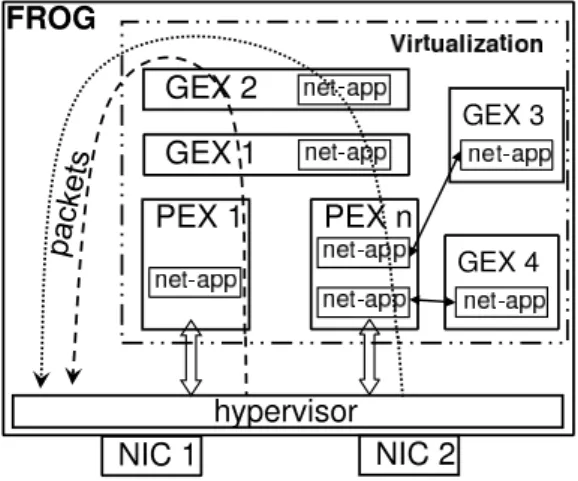
The virtualization layer that supports the creation of PEXes and GEXes in MAPPERis built on top of the FROG (Flexible and pRO-Grammable) edge router platform [11,2]. The high level architec-ture of FROG is depicted in Figure1. A PEX is a FROG execution environment that receives/sends data from the underlying network hypervisor through an high speed communication channel based on shared memory, while GEXes are reached through standard TCP/IP sockets. A GEX is an isolated container that shares the TCP/IP stack with other GEXes and the rest of the host (including the hy-pervisor) and uses standard TCP/IP primitives to communicate with the other components. The hypervisor forwards incoming packets to proper PEXes for user specific processing. In the FROG imple-mentation deployed in this work the source and destination MAC addresses of a packet are used by the hypervisor to determine which PEX the packet should be forwarded to. Packets are processed by net-apps running in PEXes and then they, or their content as ex-tracted by the net-apps, are processed by GEXes, if there are any. After that, the hypervisor relays the processed packets out of MAP
-PER.
Figure 1:Virtualization layer of MAPPER.
3.3
Network Applications (Net-apps)
We have developed a broad range of net-apps for MAPPER. Some of them are quite generic and can be adopted in a variety of scenar-ios. Examples of such generic net-apps include anetwork monitor
and aDNS filter, which collects traffic statistics and filters out mali-cious DNS queries, respectively. In this paper we focus on net-apps related to the enforcement of policies on mobile apps.
Man-in-the-middle Proxy (MiMP) Net-app:To provide the vis-ibility into encrypted traffic from mobile apps, MAPPER uses a GEX to run a TLS-capable proxy service. For this purpose we used
mitmproxy[3], which is a powerful and customizable transpar-ent HTTPS proxy. mitmproxyrelies on a TCP/IP stack to pro-vide TCP end-point functionalities, which are in turn required to support the TLS sessions terminated by the proxy. Rather than in-cluding a TCP/IP protocol stack implementation in the GEX, the proposed design leverages an additional virtual network interface
tap0bound to the OS TCP/IP stack. Themitmproxyrunning in a GEX uses its services through the common socket interface provided by the OS. Leveraging its full visibility into user’s traffic, the MiMP net-app also extracts relevant information from traffic required by other modules of the system, such as the Mobile App Filter net-app presented later.
MiMP Bridge Net-app:A user’s PEX runs a MiMP Bridge net-app to interact with the MiMP net-net-app running in a GEX. Once loaded into a user’s PEX, the MiMP Bridge net-app forwards all the (encrypted) user’s traffic toward the MiMP net-app, which returns a selected portion of the plain-text form of the encrypted traffic to another net-app. In the enforcement of per-user policies based on mobile apps, the returned plain-text form data is consumed by the Mobile App Filter net-app to enforce mobile app usage policies. It is worth highlighting that encrypted traffic is analyzed only for users that have the MiMP Bridge in their policy.
Mobile App Identification (MAI) Net-app: This MAPPER net-app runs in a GEX and identifies the mobile net-app generating network flows to enable the definition and enforcement of policies at mobile app granularity. The MAI net-app comes preloaded with a rule set [4,14] that extracts distinguishing mobile application features from individual flows. These per-flow features are then matched with a rich signature table to identify the app responsible for the flow. In addition, the MAI net-app also assigns device (e.g. iPhone, iPod, Samsung Galaxy) and platform (e.g. iOS and Android) labels to classified flows. Last but not least, MAI uses category trees to map each mobile app into a set of carefully pre-selected categories, such as social, gaming, etc. Therefore, network monitoring and management policies can be formed taking into account not only individual apps, but also broad app categories, platforms and device types; or any combination thereof.
Mobile App Filter Net-app: The service provided by the MAI net-app is consumed by theMobile App Filternet-app running in a user’s PEX to enable the enforcement of her specific policies on mobile app usage. For each HTTP/HTTPS bi-directional flow, the Mobile App Filter receives an extract of the flow from the MiMP and contains information needed by MAI to identify the appID of the originating mobile app. The XML formatted extract is passed from MiMP to Mobile App Filter and then to MAI through REST APIs, also used to return the appID from MAI to Mobile App Filter. The policy enforced for a user can be blacklisting a set of mobile apps, or even the entire categories of mobile apps (e.g. social, gam-ing, etc). Once Mobile App Filter determines that the originating app as identified by an appID is in the blacklist, the response to the REST API previously called to the Mobile App Filter indicates to the MiMP the corresponding flows should be blocked.
3.4
Policy Enforcement Example
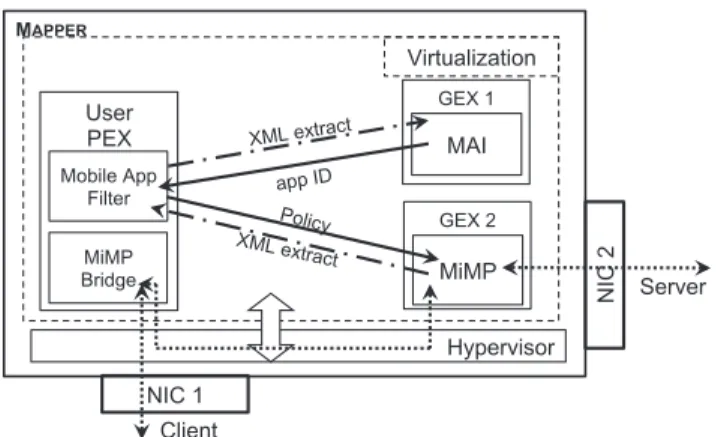
We present an example of policy enforcement to show the net-apps involved and the flow of information among them. Every time a new user is connected to a MAPPERwireless AP, the user is re-quired to authenticate via a captive portal web UI. Upon a success-ful authentication, a dedicated PEX is instantiated by MAPPERand the predefined policy, in the form of net-apps, is loaded into the PEX. Figure2shows an example of the net-apps deployed and the flow of information among them, where MAPPERenforces a pol-icy to require visibility into both HTTP and HTTPS traffic, and to blacklist a set of mobile apps.
Each packet from the user device is classified by the hypervisor and forwarded to that user’s PEX to be processed by a chain of net-app. First, the MiMP bridge net-app hijacks all HTTP and HTTPS traffic towards the MiMP GEX. The hijacking is done by chang-ing the destination IP address to the one bound to virtual interface
tap0, on which the MiMP is listening for incoming connections. The packets with modified destination IP address are then sent back to the hypervisor that forwards them to thetap0interface of the MAPPERmachine, where they are received by the MiMP. For each packet flow, the MiMP bridge net-app also informs the MiMP about the original 5-tuple (i.e. {sIP, sP ort, dIP, dP ort, proto}).
Hypervisor User PEX Mobile App Filter MiMP Bridge NIC 1 NIC 2 GEX 2 MiMP Virtualization GEX 1 MAI Client Server XML extract XML extract Policy app ID
Figure 2:Information flow among net-apps.
The 5-tuple information is consumed by the MiMP to build a map
MdI P, which maps{sIP, sP ort, dP ort, proto}todIP. MiMP
uses mapMdI P to recover the original destination IP of an
incom-ing connection, which is needed to create an outgoincom-ing TCP con-nection to the proper server and forward to it the HTTP/HTTPS session.
If an incoming connection is HTTP, the MiMP acts as a conven-tional HTTP proxy, which opens a new connection with the original web server and fetches the content. For a HTTPS incoming con-nection, the MiMP terminates the secure TLS tunnel and joins it with a new one to the external web server. The MiMP is able to ter-minate the secure tunnel because during the TLS negotiation phase it returns to the client application a self signed certificate of the web server, rather than the original one. The client host must have the MiMP certificate installed as a trusted Certification Authority, which might be performed in the initial authentication phase, or the user is required to accept the MiMP signed server certificate.
As shown on the right hand side of Figure2, the HTTP request to the original web server is sent through the OS TCP/IP stack with-out hitting the hypervisor of the MAPPER. The first HTTP message sent by mobile apps is allowed to reach the web, even if the mo-bile app should be blocked. We deliberately allow this because the server response could contain information useful for identifying the app. We believe that in general this does not represent a security threat since the first HTTP request/response is usually designed for the app to probe the server and render the app user interface.
Once the MiMP receives the response from the web server, it ex-tracts relevant data from the request and the response, encodes it in XML form, and sends it to the Mobile App Filter net-app, which then queries the MAI using the XML extract. The MAI returns information related to the mobile app that generated the traffic, in-cluding the unique app ID, category of the app, and OS of the app. The Mobile App Filter matches this data against the blacklist in the user policy to check if the app is permissible or not. The match result is sent back to the MiMP, which will act according to the result, by sending back to the client either the response or an HTTP error message.
The HTTP response is held by the MiMP while it waits for feed-back from the Mobile App Filter. Performance can be improved and latency reduced at the expenses of a small reduction in app identification probability by having the MiMP producing the XML extract from HTTP requests only. Hence, while the proxy contacts the server and awaits for a response, the MAI net-app can work with the XML extract distilled from the HTTP request to provide the Mobile App Filter with the information on the mobile app. The Mobile App Filter matches it against the policy and communicates
ward the HTTP response as soon as it is received.
Note that the visibility into HTTPS traffic is optional and can be disabled by user policy. Without the requirement to inspect HTTPS traffic, the MiMP bridge net-app forwards to the MiMP net-app only HTTP traffic, while HTTPS one is left unchanged.
4.
EVALUATION
4.1
Implementation and Experiment Setup
We have implemented a prototype of MAPPER using a small form factor machine – an IntelNext Unit of Computingbox, with an Intel Core i3-3217U CPU, 8G RAM, running Ubuntu Linux. The per-user PEXes are FROG virtual machines realized as stan-dard Java Virtual Machines (JVM). The MAI runs inside a FROG VM as a GEX net-app. At present, the MAI net-app is capable of identifying more than250Kmobile apps spanning the iOS and Android platforms. The MiMP GEX runs an open source python implementation available at [3]. To ease the prototyping, we did not port MiMP into Java. Instead, we did some small changes to the python code to enable the interaction between MiMP and other net-apps.
We setup a small testbed as our experiment environment to eval-uate the performance of MAPPER. In the testbed a MAPPERsystem works as a wireless AP serving smartphone and laptop devices. To easily automate some experiments, the laptop runscurl, a cus-tomizable command line web client, to emulate various mobile apps.
4.2
Single-user Tests
We start with testing the performance of MAPPERin serving only one user. To provide the baseline for fair comparison, we test three different settings of the access point machine. We configure the ma-chine as (1) a standalone software AP runninghostapd[1], (2) a standard FROG box running one per-user VM, and (3) a MAPPER
system running the MAI GEX, the MiMP module, and one per-user PEX. We refer to those three configurations as AP, FROG, and MAPPER, respectively. For the MAPPERsetting, the user policy is set to allow all traffic from user’s mobile apps.
To isolate our experiments from other interferences, we connect a web server and the access point machine to the same wired LAN. Then we run the command line web client to emulate the activity of a mobile appX by sending500HTTP requests to fetch500
different files from the web server. While the tests are running, we measure a number of metrics at both the laptop client and the access point machine.
We first evaluate the network throughput metric of the system by downloading500files from the web server, where each one is of size1M B. Figure3shows the average throughput measure-ments at the laptop’s wireless interface. We can see that the cur-rent MAPPERimplementation indeed has lower network through-put as compared to AP and FROG settings, i.e., the throughthrough-put is
20%lower. The main reason is that our current implementation requires the Mobile App Filter net-app and the MiMP GEX to in-teract synchronously, which results in considerable blocking and waiting among them. We are working extensively on removing this bottleneck from the system.
We also record the CPU and memory usage at the access point machine, and report the results in Table1. The results show that RAM is a more critical resource than CPU in our current prototype implementation, since MAPPERconsumes much more RAM than the other two settings. A closer look into each module of MAPPER
0
1
2
3
4
5
AP
FROG
MAPPER
throughput (MByte/s)
Figure 3:Network throughput test results.
because the app identification engine uses several big hash table data structures.
CPU peak CPU ave RAM peak RAM ave
AP 3.4% 1.82% 490 MB 487 MB
FROG 61.3% 17.88% 1241 MB 1190 MB
MAPPER 62.6% 36.5% 4080 MB 3698 MB
Table 1:CPU and RAM usage comparison.
We next evaluate how much additional delay added by MAPPER
to user’s traffic. We measure the time interval between the web client sending out a request and receiving the reply from the web server, and refer to that interval as theresponse time. For each set-ting of the access point machine, we measure the response time of 500 requests, where each one fetches a1KBfile from the web server, and plot their cumulative distribution in Figure4. As ex-pected, users do experience longer response time due to the addi-tional processing of user traffic by our current implementation of MAPPER. The response time is less than500msin more than80%
of the cases. The average additional delay is around300ms.
0.0 0.2 0.4 0.6 0.8 1.0 0 100 200 300 400 500 600 CDF Response time (ms) AP FROG MAPPER
Figure 4:CDF of the response time for three settings of the access point machine.
To evaluate how the additional overhead introduced by MAP
-PERaffects user experience, we have recruited several volunteers to connect their smartphones with MAPPERand use their mobile apps for a few minutes. According to the feedback, most users do not have any noticeable user experience degradation in surfing the web, checking online social network updates, etc.
4.3
Multi-user Tests
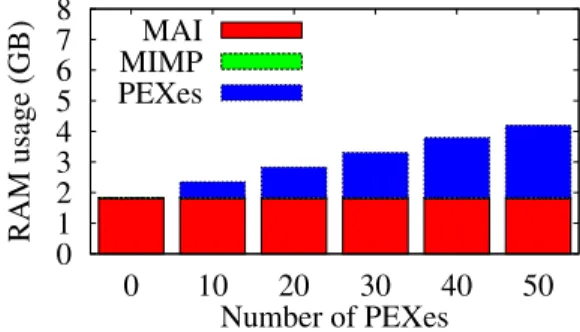
After having a good understanding of MAPPER’s performance in single user scenario, we proceed to evaluate the scenario where multiple users connect to the MAPPERdevice. To that end, we sim-ulate the presence of multiple clients by allocating various number of user PEXes in MAPPERand measuring the memory usage of the MAPPERmachine. We focus on memory usage because it is the
dominating factor that constrains MAPPERfrom scaling to large number of users. The results are reported in Figure5.
0
1
2
3
4
5
6
7
8
0
10
20
30
40
50
RAM usage (GB)
Number of PEXes
MAI
MIMP
PEXes
Figure 5:RAM consumption with growing number of users.
The benefit of having GEXes in MAPPERis obvious as shown in Figure5. Because we don’t replicate MAI and MiMP into each user’s PEX (although MiMP consumes very little memory, around
30M B), the memory footprint of each user PEX can be limited to around50M Bwhen the PEX is not processing any packets. Even after scaling the number of PEXes to50, the MAPPERmachine uses only half of its memory (4Gout of8G). We believe that most WiFi network deployments do not plan to have one AP serving more than
50users.
In order to test how the MAPPERbehaves in a more realistic sce-nario, we also emulate mobile devices using a public Internet web service on encrypted HTTPS channel. We connect two laptops to MAPPERto emulate that two different users (each one has a dedi-cated PEX) are using mobile appXto search athttps://www.
google.com. To maximally stress the system, both users’
poli-cies are configured to be allowing appX and hijacking that app’s encrypted traffic. We simultaneously set both laptops to emulate appX sending out500search queries. When the test is running, we measure the CPU and memory usage at the MAPPERmachine, as well as the network throughput and response time at both lap-tops. To provide a fair comparison baseline, we also repeat the same experiment using only one laptop to emulate one single user.
CPU RAM throughput response time 1 user 16.13% 3261 MB 104 Kb/s 778.8 ms 2 users 21.57% 3392 MB 102 Kb/s 751.6 ms
Table 2: Averaged performance measurements when users are using mo-bile appX to perform a web search athttps://www.google.com. Throughput in the 2-user test is the one measured at one client device.
Table2presents the test results. We can see that when serving two users instead of one, MAPPERconsumes slightly more CPU and RAM resources, without noticeable degradation in throughout and response time. Because the web server is on Internet instead of connected to the same LAN, the response time in Table2is larger than that shown in Figure4. The larger response time and lower network throughput result in slower traffic rate. Therefore, the CPU and RAM usage are lower than those presented in section4.2.
5.
CONCLUSION AND FUTURE WORK
This paper presents the MAPPER system that seamlessly inte-grates multiple techniques to facilitate enforcing policies on in-creasingly flourishing mobile apps running on portable devices. We described the design of MAPPERsystem in detail and evaluated its performance using a small scale testbed network. We showed that network function virtualization provides MAPPERthe flexibility to
head. MAPPERis a work-in-progress system and our future studies will be directed towards performance improvement on various as-pects of the system. First step in this is to improve the performance of MiMP. Currently the MiMP GEX represents a severe bottleneck. We strongly consider that a Java multithreading implementation of MiMP can scale up the overall performance. Besides, we plan to use shared buffers for faster inter-module communications and de-ploy a web-cache as a net-app to improve performance.
6.
ADDITIONAL AUTHORS
Additional authors: Ruben Torres (Narus, Inc.) and Antonio Nucci (Narus, Inc.).
7.
REFERENCES
[1] hostapd and wpa_supplicant.http://hostap.
epitest.fi/.
[2] I. Cerrato, M. Pramotton, and F. Risso. Moving applications from the host to the network: Experiences, challenges, and findings. InIEEE Workshop on Mobile Cloud Networking (MCN), 2013.
[3] A. Cortesi. mitmproxy - a man-in-the-middle proxy.
http://mitmproxy.org/.
[4] S. Dai, A. Tongaonkar, X. Wang, A. Nucci, and D. Song. NetworkProfiler: Towards Automatic Fingerprinting of Android Apps. InProceedings of IEEE INFOCOM, 2013. [5] N. Egi and et al. A platform for high performance and
flexible virtual routers on commodity hardware.ACM
SIGCOMM Computer Communication Review, 2010.
[6] A. D. Keromytis and J. L. Wright. Transparent network security policy enforcement. InProceedings of USENIX ATC, 2000.
and privacy considerations.It Professional, 14(5):0053–55, 2012.
[8] O. Morandi, F. Risso, P. Rolando, S. Valenti, and P. Veglia. Creating portable and efficient packet processing
applications.Design Automation for Embedded Systems, 15(1):51–85, 2011.
[9] B. Morrow. BYOD security challenges: control and protect your most sensitive data.Network Security, 2012(12):5–8, 2012.
[10] M. R. Nascimento, C. E. Rothenberg, M. R. Salvador, C. N. Corrêa, S. C. de Lucena, and M. F. Magalhães. Virtual routers as a service: the routeflow approach leveraging software-defined networks. InProceedings of the 6th International Conference on Future Internet Technologies, pages 34–37. ACM, 2011.
[11] F. Risso and I. Cerrato. Customizing data-plane processing in edge routers. InSoftware Defined Networking (EWSDN),
2012 European Workshop on, pages 114–120. IEEE, 2012.
[12] R. Sailer, T. Jaeger, X. Zhang, and L. Van Doorn.
Attestation-based policy enforcement for remote access. In
Proceedings of the 11th ACM conference on Computer and
communications security. ACM, 2004.
[13] Symantec. Internet security threat report 2014.http:// www.symantec.com/security_response/
publications/threatreport.jsp. [14] A. Tongaonkar, S. Dai, A. Nucci, and D. Song.
Understanding mobile app usage patterns using in-app advertisements. InPassive and Active Measurement. Springer, 2013.
[15] Q. Xu, T. Andrews, Y. Liao, S. Miskovic, Z. M. Mao, M. Baldi, and A. Nucci. FLOWR: A Self-Learning System for Classifying Mobile Application Traffic. InProceedings of