• No results found

2018 Indiana Primary Care Needs Assessment Report

N/A
N/A
Protected

Academic year: 2021

Share "2018 Indiana Primary Care Needs Assessment Report"

Copied!
71
0
0

Loading.... (view fulltext now)

Full text

(1)


2018

Indiana Primary Care Needs Assessment

(2)

INDIANA PRIMARY CARE NEEDS ASSESSMENT REPORT

Prepared for:

Indiana State Department of Health

Prepared by:

Bowen Center for Health Workforce Research and Policy

March 2018

Authors:

Analise Dickinson, BS

Sierra Vaughn, MPH

Hannah Maxey, PhD, MPH, RDH

Funding Disclosure:

This publication (journal article, etc.) was supported by the Cooperative Agreements to States/Territories for the Coordination

and Development of Primary Care Offices from Department of Health and Human Services. Its contents are solely the

responsibility of the authors and do not necessarily represent the official views of the Department of Health and Human Services.

(3)

Table of Contents

A

CKNOWLEDGEMENTS... 4 

E

XECUTIVE

S

UMMARY ... 5 

S

ECTION

I.

2017

HPSA

A

PPLICATIONS AND

D

ESIGNATIONS

U

PDATE ... 6 

Shortage Designation Management System and HPSA Applications

 ... 7 

Trends in HPSA Designations in Indiana, 2015-2017

 ... 8 

Primary Care: HPSAs

 ... 8 

Mental Health

 ... 10 

Dental Health

 ... 11 

S

ECTION

II.

T

RENDS IN

P

RIMARY

C

ARE

W

ORKFORCE

C

APACITY ... 12 

Preliminary HPSA Analysis Summary, 2015-2017

 ... 13 

Purpose

 ... 13 

Decreasing HPSA Scores

 ... 13 

Increasing HPSA Scores

 ... 18 

Consistent HPSA Scores

 ... 22 

Projected Need of Providers in Indiana Counties (Preliminary Analysis), 2015-2017

 ... 24 

Purpose

 ... 24 

Primary Care

 ... 24 

Mental Health

 ... 25 

Dental Health

 ... 27 

Travel Radius and Nearest Source of Care

 ... 30 

S

ECTION

III.

T

RENDS IN

P

OPULATION

H

EALTH

,

2015-2017

... 32 

Health Rankings in Indiana, 2015-2017

 ... 33 

Purpose and Methods

 ... 33 

Socio-economic Indicators

 ... 34 

Access to Care, 2015-2017

 ... 35 

Primary Care

 ... 35 

Mental Health

 ... 36 

Dental Health

 ... 37 

Risk Factors

 ... 38 

Health Outcomes

 ... 38 

(4)

Qualitative analysis: Key Informant Interviews

 ... 41 

Purpose and Methods

 ... 41 

Summary of Qualitative Analysis

 ... 42 

Major Health Issues by District

 ... 42 

Emerging Themes

 ... 44 

Changes in Community Health Needs: 2015 vs. 2017

 ... 46 

C

LOSING

S

UMMARY ... 47 

S

ECTION

V.

T

ECHNICAL

A

PPENDIX ... 49 

A

PPENDIX

A. Overutilization Status of Nearest Source of Primary Care

 ... 50 

A

PPENDIX

B. Overutilization Status of Nearest Source of Mental Health Care

 ... 52 

A

PPENDIX

C. Overutilization Rate for Nearest Source of Dental Care

 ... 58 

A

PPENDIX

D. 2015 Health Rankings Summary

 ... 60 

A

PPENDIX

E. 2016 Health Rankings Summary

 ... 62 

A

PPENDIX

F. 2017 Health Rankings Summary

 ... 65 

A

PPENDIX

G.

2018 PCNA Qualitative Key Informant Interview Protocol

 ... 68 


(5)

ACKNOWLEDGEMENTS


The Bowen Center for Health Workforce Research and Policy would like to acknowledge the

contributions and support provided by the Indiana State Primary Care Office (PCO) on this project.

Specifically, Ann Alley, PCO Director, for assistance in obtaining population health data and providing

guidance in the development of this report.

(6)

EXECUTIVE SUMMARY

The Indiana Primary Care Needs Assessment (PCNA) has been critical in the efforts to identify gaps in

access to health care and allocate resources to communities in greatest need. This five-year collaborative

project between the Bowen Center for Health Workforce Research and Policy (Bowen Center) and the

Indiana State Department of Health Primary Care Office, has encompassed numerous efforts to accomplish

these goals. These efforts have included 1) innovation of provider data management, 2) statewide analysis

of Health Professional Shortage Areas, and 3) providing resources and assistance to health care

administrators and community leaders. The 2018 Primary Care Needs Assessment Report provides a

summary of efforts from 2015-2017 and how this project has impacted communities throughout Indiana.

At the inception of the PCNA project, the Health Resources and Services Administration (HRSA) began a

modernization project that would streamline the application process for Health Professional Shortage Area

(HPSA) designations. In response to this, the Bowen Center has developed provider verification procedures

for collecting comprehensive information on providers’ clinical practice

1

. With this verified data, the

Bowen Center has been able to more effectively manage HPSA applications and obtain designations for

more communities than ever before. A summary of this effort is provided in Section I.

Another critical component of evaluating HPSAs is ongoing preliminary analysis of workforce capacity.

As is summarized in Section II, this analysis has allowed the state to identify counties with little to no

provider capacity, monitor the progress of health care access in various communities and determine the

amount of providers that are necessary to meet sufficient capacity. Such information enables the state to

determine where resources are needed for recruitment and retention efforts.

While accurate and timely information on providers is crucial for a needs assessment, evaluating population

data is also necessary for identifying emerging health outcomes. The Indiana PCNA project annually

evaluates population health data derived from the U.S. Census and the Robert Wood Johnson Foundation.

This ongoing evaluation, summarized in Section III, has shown that while certain health outcomes have

remained consistently prevalent (such as diabetes and infant mortality), other serious health concerns have

recently emerged (such as substance abuse).

In addition to managing provider and population data, maintaining positive and effective communications

with many health care administrators and community leaders throughout the state has been key for this

project. For the purpose of this report, key informant interviews were conducted to collect information

from health care facilities regarding key health issues, primary needs and ongoing health care services

initiatives. All findings have been summarized in Section IV. Information from these stakeholders assists

the PCO in identifying barriers to health care access and determining how best to allocate resources.

It is important to note that as community needs change so will the efforts to respond to these issues. This

report provides an outline of how previous efforts have improved outcomes, what changes still need to be

made and how Indiana can move forward to improve access to care and health outcomes. Such changes

have been and only will be possible with comprehensive information and collaborative efforts from

researchers, community leaders and health care facilities.

(7)
(8)

Shortage Designation Management System and HPSA Applications

National Shortage Designation Update

Between January and October 2017, HRSA administered monthly impact analyses, or preliminary

evaluations, of all geographic and population HPSA designations approved prior to August 2016. These

analyses were used to determine the possible changes that would occur to designations if re-evaluated by

HRSA during the National Shortage Designation Update, which took place between Oct. 28 and Nov. 4,

2017.

In response to results from the impact analyses, the Bowen Center conducted annual primary care needs

assessments, developed standard provider verification procedures and prepared new or updated HPSA

applications for communities that could potentially lose their designation. In 2017, the State of Indiana was

able to obtain 75 new designations and updated designations before the National Update occurred. Over

100 designations were obtained in all for 2017. The following three pages provide a summary of the new

designations Indiana has obtained since 2017.

The National Update resulted in 18 designations in Indiana being included in the re-evaluation process.

Five HPSA designation scores dropped by 1 to 5 points; two HPSA designations remained unchanged; five

HPSA designation scores increased by 3 to 5 points; and six designations were proposed for withdrawal,

three of which had been replaced by new designations. See Figure 1 for a summary of the results.

In addition to responding to the National Shortage Designation Update, the Bowen Center has continued

to conduct continual primary care needs assessments to identify communities in greatest need. The

summary provided on the subsequent pages demonstrates how efforts from the PCNA project have led to

more communities receiving much needed designations.

Figure 1. Impact of national shortage designation update on HPSAs for each discipline 

3

3

1

3

1

1

1

1

1

1

2

0

1

2

3

4

5

6

7

Increased HPSA

Score

Decreased HPSA

Score

No Change

Proposed for

Withdrawal

Impact to HPSA Designations from 

Nation Shortage Designation Update

(9)

Trends in HPSA Designations in Indiana, 2015-2017

Primary Care: HPSAs

Since 2015, Indiana has had many primary care

HPSAs throughout the state. However, limited

resources with data management have impact the

state’s ability to adequately manage HPSA

designations. After development of new provider

data management procedures, Indiana has been able

to obtain new geographic and population HPSA

designations and update existing designations with

higher scores that can qualify a community for

receiving more resources. In 2017, Indiana obtained

12 geographic designations and 22 population

designations, resulting in the greatest number of

primary care HPSAs that Indiana has ever had.

(10)

Primary Care: MUA/P

Relatively few counties in Indiana met the

minimum

requirements

for

a

Medically

Underserved Area or Population (MUA/P). A

significant number of counties have received this

designation as a Governor’s Exception as

demonstrated in the 2016 map below. Pursuit of

Governor’s Exception designations has and will

continue to direct resources to communities

serving unique health care needs. Between 2016

and 2017, the number of Indiana counties that met

the minimum requirements for a Medically

Underserved Area or Population (MUA/P) grew

from 10 to 20 counties. In 2017, Indiana obtained

4 Medically Underserved Area or Population

(MUA/P) designations for Blackford, Henry,

Randolph and Wabash counties.

(11)


Mental Health

Though there are few total mental HPSA (MHPSA)

designations in Indiana, many of these designations

are for Mental Health Catchment Areas (MHCAs)

that encompass multiple counties. Approximately

half of Indiana counties were covered under a

MHPSA in 2015. Since then, this number has

grown to where over 80% of state was covered

under a MHPSA. In 2017, Indiana obtained 11

mental HPSA designations, including designation

updates. There has also been an increase in federal

designations for correctional facilities. This could

aid in enhancing workforce capacity to meet the

mental health service needs of internees.

(12)


Dental Health

Despite the consistent shortage of dental health

professionals in Indiana, there has previously been

few to no organized initiatives in place for seeking

dental HPSAs. Between 2015 and 2016, little

change was seen in the number of geographic,

population and facility HPSA designations.

However, in response HRSA’s impact analysis in

2017, the Bowen Center has prepared 18

applications that included updates to the 12 existing

population dental HPSA applications. As of

December 2017, the Bowen Center also anticipates

preparing 75 new dental HPSA applications for

submission to HRSA in 2018.

(13)
(14)

Preliminary HPSA Analysis Summary, 2015-2017


Purpose

Preliminary HPSA scoring is useful to primary care offices for determining counties or communities that

could have a severe need for HPSA designation. Such information also informs the prioritization of more

comprehensive HPSA analysis in the online Shortage Designation Management System. Additionally,

ongoing analysis is the most effective approach to monitoring the progress of health care needs

throughout the state. The data presented in this section summarizes the changes in preliminary HPSA

scores for each county in Indiana by discipline.

Decreasing HPSA Scores

A summary of the overall primary care, mental and dental geographic HPSA scoring can be found in Tables

2.1-2.3. Several counties in Indiana have decreasing HPSA scores from the preliminary PCNA analysis

that have resulted in low scores in 2017. Such is the case for Jefferson County, where its Primary Care

HPSA score has decreased 13 points since 2015 to a current score of 2. The same is also true for White

County’s Mental Health HPSA score, which has decreased 9 points since 2015. Carroll County has also

seen a decrease in its Dental Health HPSA score by 10 points since 2015.

Table 2.1

Counties that have had decreasing primary care HPSA scores, 2015-2017

County

Primary Care HPSA Score

2015

Primary Care HPSA Score

2016

Primary Care HPSA Score

2017

Overall Difference

Gibson

2

1

1

-1

Floyd

2

1

1

-1

Hamilton

2

1

1

-1

Dubois

2

1

1

-1

Warrick

2

1

1

-1

Washington

7

8

6

-1

Montgomery

4

3

3

-1

Harrison

2

1

1

-1

Hancock

2

1

1

-1

Dearborn

2

1

1

-1

Clark

2

1

1

-1

Fayette

4

2

3

-1

Hendricks

2

1

1

-1

Kosciusko

3

1

1

-2

DeKalb

3

1

1

-2

Shelby

4

2

2

-2

Parke

3

2

1

-2

Clay

9

6

7

-2

Blackford

3

2

1

-2

(15)

Table 2.1

Counties that have had decreasing primary care HPSA scores, 2015-2017

County

Primary Care HPSA Score

2015

Primary Care HPSA Score

2016

Primary Care HPSA Score

2017

Overall Difference

Cass

4

1

2

-2

Madison

4

2

2

-2

Posey

9

5

7

-2

Howard

4

2

2

-2

Starke

4

3

2

-2

Jay

10

9

8

-2

Warren

9

7

7

-2

Carroll

11

9

9

-2

Henry

4

2

2

-2

Fountain

9

7

7

-2

Vanderburgh

5

2

2

-3

St. Joseph

4

1

1

-3

Wayne

6

3

3

-3

Porter

4

1

1

-3

Wabash

4

1

1

-3

Noble

8

5

5

-3

Lake

5

2

2

-3

Tipton

4

1

1

-3

Daviess

4

1

1

-3

Switzerland

15

14

12

-3

Randolph

12

8

8

-4

Pulaski

5

1

1

-4

Delaware

7

3

3

-4

White

9

3

5

-4

Marion

7

3

3

-4

LaGrange

9

5

5

-4

Allen

6

2

2

-4

Vigo

6

3

2

-4

Jackson

6

1

1

-5

Clinton

10

5

5

-5

Owen

14

10

9

-5

Greene

12

8

7

-5

Monroe

8

3

3

-5

Fulton

6

3

1

-5

Whitley

6

1

1

-5

Franklin

6

1

1

-5

(16)

Table 2.1

Counties that have had decreasing primary care HPSA scores, 2015-2017

County

Primary Care HPSA Score

2015

Primary Care HPSA Score

2016

Primary Care HPSA Score

2017

Overall Difference

LaPorte

7

2

2

-5

Wells

6

1

1

-5

Sullivan

8

2

2

-6

Elkhart

8

2

2

-6

Orange

10

4

4

-6

Johnson

7

1

1

-6

Steuben

8

1

1

-7

Spencer

8

1

1

-7

Decatur

8

1

1

-7

Knox

8

2

1

-7

Pike

9

1

1

-8

Ohio

11

1

3

-8

Huntington

10

1

1

-9

Scott

11

3

2

-9

Morgan

10

1

1

-9

Miami

10

2

1

-9

Perry

11

1

1

-10

Grant

13

3

2

-11

Tippecanoe

14

2

3

-11

Lawrence

13

1

1

-12

Jefferson

14

2

1

-13

Table 2.2

Counties that have had decreasing mental HPSA scores, 2015-2017

County

Mental HPSA Score

2015

Mental HPSA Score

2016

Mental HPSA Score

2017

Overall Difference

Wayne

9

8

8

-1

Marion

8

6

7

-1

Porter

6

3

5

-1

Kosciusko

10

8

9

-1

Floyd

6

3

5

-1

Franklin

13

10

11

-2

Tipton

13

11

11

-2

Allen

9

5

7

-2

Carroll

13

11

11

-2

Cass

8

4

6

-2

Gibson

13

11

11

-2

Noble

7

7

4

-3

(17)

Table 2.2

Counties that have had decreasing mental HPSA scores, 2015-2017

County

Mental HPSA Score

2015

Mental HPSA Score

2016

Mental HPSA Score

2017

Overall Difference

Newton

13

11

10

-3

Monroe

7

5

4

-3

Knox

9

6

6

-3

Delaware

10

6

7

-3

Lake

9

4

6

-3

Hamilton

5

2

2

-3

Montgomery

9

7

5

-4

Martin

13

11

9

-4

Boone

7

3

3

-4

Decatur

15

12

11

-4

Dearborn

9

6

5

-4

DeKalb

7

3

3

-4

Crawford

15

12

11

-4

Owen

15

12

11

-4

Orange

16

13

12

-4

Madison

12

7

7

-5

Warren

13

11

8

-5

Union

13

11

8

-5

Adams

10

11

5

-5

Ohio

13

11

7

-6

Bartholomew

10

4

4

-6

Hendricks

10

3

4

-6

Benton

14

11

8

-6

Washington

11

5

4

-7

Howard

12

6

5

-7

Vigo

13

6

6

-7

Tippecanoe

12

4

5

-7

Hancock

10

3

3

-7

Elkhart

12

4

4

-8

Switzerland

18

11

10

-8

Scott

14

6

6

-8

White

14

6

5

-9


(18)

Table 2.3

Counties that have had decreasing dental HPSA scores

County

Dental HPSA Score

2015

Dental HPSA Score

2016

Dental HPSA Score

2017

Overall Difference

Washington

11

6

10

-1

Benton

3

2

2

-1

Jackson

3

2

2

-1

Henry

7

4

6

-1

Owen

13

12

12

-1

Martin

9

10

8

-1

Vigo

5

6

4

-1

Jefferson

3

4

2

-1

Grant

5

6

4

-1

Montgomery

3

2

1

-2

Whitley

5

4

3

-2

Putnam

7

2

5

-2

Parke

9

8

7

-2

Greene

3

2

1

-2

Kosciusko

3

2

1

-2

Noble

5

2

3

-2

Newton

11

12

9

-2

Switzerland

15

14

12

-3

Decatur

5

2

2

-3

Fountain

11

8

7

-4

Wells

7

2

3

-4

Clay

11

8

7

-4

Franklin

7

2

2

-5

Cass

11

8

5

-6

Spencer

7

2

1

-6

Carroll

11

2

1

-10

(19)


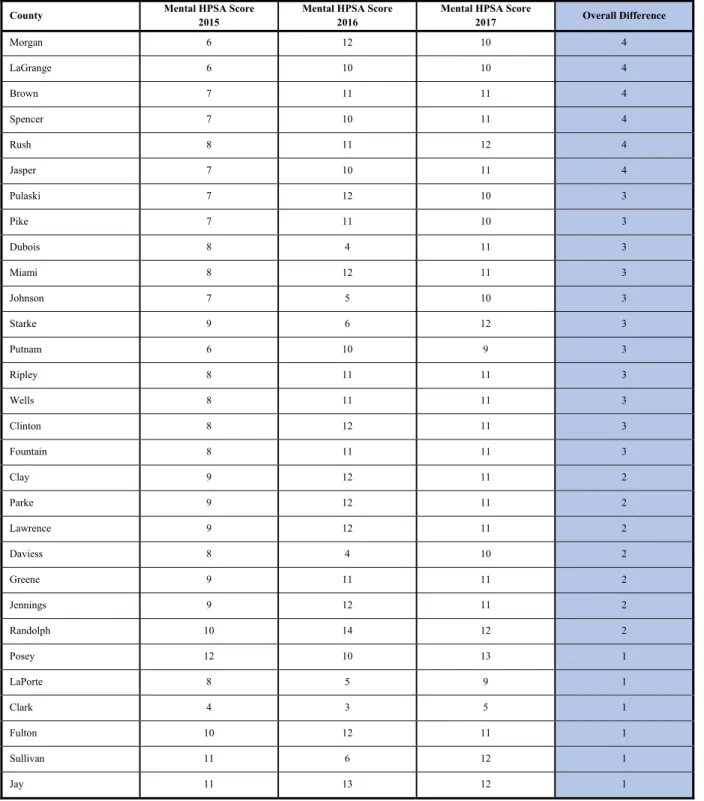
Increasing HPSA Scores

Tables 2.4-2.6 present counties with increasing HPSA scores for each discipline. Several counties in

Indiana have shown increasing HPSA scores and are in need of health care assistance. For example, three

counties (Ripley, Putnam and Vermillion) have had their primary care HPSA score increase by 5 points,

though Crawford County has had a consistently high primary care HPSA score ranging from 12 to 13.

Forty-three (43) counties in Indiana have had increasing mental health HPSA scores between 2015 and

2017. Huntington County saw the highest score increase of 7 points. However, Henry County had the

highest mental health HPSA score of 14 in 2017. In regards to dental HPSAs, Shelby and Blackford

counties have had the greatest increase in their scores. Despite this, Crawford, Randolph and Brown

counties have had consistently high scores between 2015 and 2017.

Table 2.5

Counties that have had increasing mental HPSA scores, 2015-2017

County

Mental HPSA Score

2015

Mental HPSA Score

2016

Mental HPSA Score

2017

Overall Difference

Huntington

6

10

13

7

Shelby

6

13

12

6

Wabash

7

11

13

6

Warrick

7

10

13

6

Vermillion

7

12

13

6

Marshall

6

3

11

5

Henry

9

13

14

5

Harrison

6

10

11

5

Whitley

6

10

11

5

Jefferson

6

5

11

5

Jackson

7

10

12

5

Fayette

9

14

13

4

Perry

7

12

11

4

Table 2.4

Counties that have had increasing primary care HPSA scores, 2015-2017

County

Primary Care HPSA Score

2015

Primary Care HPSA Score

2016

Primary Care HPSA Score

2017

Overall Difference

Ripley

2

5

7

5

Putnam

2

3

7

5

Vermillion

2

9

7

5

Martin

4

7

7

3

Jennings

6

6

8

2

Brown

7

11

9

2

Crawford

12

12

13

1

(20)

Table 2.5

Counties that have had increasing mental HPSA scores, 2015-2017

County

Mental HPSA Score

2015

Mental HPSA Score

2016

Mental HPSA Score

2017

Overall Difference

Morgan

6

12

10

4

LaGrange

6

10

10

4

Brown

7

11

11

4

Spencer

7

10

11

4

Rush

8

11

12

4

Jasper

7

10

11

4

Pulaski

7

12

10

3

Pike

7

11

10

3

Dubois

8

4

11

3

Miami

8

12

11

3

Johnson

7

5

10

3

Starke

9

6

12

3

Putnam

6

10

9

3

Ripley

8

11

11

3

Wells

8

11

11

3

Clinton

8

12

11

3

Fountain

8

11

11

3

Clay

9

12

11

2

Parke

9

12

11

2

Lawrence

9

12

11

2

Daviess

8

4

10

2

Greene

9

11

11

2

Jennings

9

12

11

2

Randolph

10

14

12

2

Posey

12

10

13

1

LaPorte

8

5

9

1

Clark

4

3

5

1

Fulton

10

12

11

1

Sullivan

11

6

12

1

Jay

11

13

12

1

Table 2.6

Counties that have had increasing dental HPSA scores, 2015-2017

County

Dental HPSA Score

2015

Dental HPSA Score

2016

Dental HPSA Score

2017

Overall Difference

Shelby

1

8

8

7

(21)

Table 2.6

Counties that have had increasing dental HPSA scores, 2015-2017

County

Dental HPSA Score

2015

Dental HPSA Score

2016

Dental HPSA Score

2017

Overall Difference

Ohio

5

12

11

6

Fayette

5

8

10

5

Pike

7

10

12

5

Vermillion

5

6

10

5

Ripley

3

6

8

5

Harrison

1

4

6

5

St. Joseph

3

6

8

5

Sullivan

3

4

7

4

LaGrange

7

6

11

4

Warren

7

12

11

4

Madison

3

4

6

3

Crawford

13

14

16

3

Lawrence

3

2

6

3

Dearborn

7

10

10

3

DeKalb

1

2

4

3

Perry

5

2

8

3

Wayne

5

6

8

3

Fulton

3

4

5

2

Marshall

1

4

3

2

Jay

7

10

9

2

Rush

3

4

5

2

Union

9

12

11

2

Pulaski

9

12

11

2

Marion

5

6

6

1

Floyd

1

2

2

1

White

3

4

4

1

LaPorte

3

4

4

1

Warrick

1

2

2

1

Wabash

5

4

6

1

Clinton

1

2

2

1

Dubois

1

2

2

1

Knox

3

4

4

1

Vanderburgh

3

4

4

1

Tippecanoe

5

4

6

1

Delaware

5

6

6

1

Jennings

9

10

10

1

(22)

Table 2.6

Counties that have had increasing dental HPSA scores, 2015-2017

County

Dental HPSA Score

2015

Dental HPSA Score

2016

Dental HPSA Score

2017

Overall Difference

Clark

1

2

2

1

Scott

3

6

4

1

Huntington

3

6

4

1

Johnson

1

2

2

1

Howard

3

4

4

1

Randolph

13

14

14

1

Hamilton

1

2

2

1

Orange

5

6

6

1

Morgan

1

2

2

1

Lake

3

4

4

1

Allen

3

4

4

1

Bartholomew

1

2

2

1

Brown

11

12

12

1

Daviess

5

6

6

1

Gibson

1

2

2

1

Monroe

5

6

6

1

(23)


Consistent HPSA Scores

Table 2.7-2.9 list counties that have nearly no change in their HPSA scores. Overall, counties with

unchanging HPSA scores have had low scores overall. However, some counties have had consistently high

scores. For instance, Benton, Newton and Union counties have had their primary care HPSA scores remain

at 11. St. Joseph has had a mental HPSA score remain at 11 while Blackford County has had its mental

HPSA score remain at 13. Starke County has had a consistently high dental HPSA score that has remained

at 13.

As has been shown, Crawford County has had consistently high HPSA scores across all three disciplines.

Currently, no providers with specialties in primary care, dentistry, or psychiatry are practicing in this

county. In 2017, a geographic primary care HPSA designation was awarded to this county. This designation

is important for the improvement of health care access for residents of Crawford County.

Table 2.8

Counties with no change in Mental HPSA Score, 2015-2017

County

Mental HPSA Score

2015

Mental HPSA Score

2016

Mental HPSA Score

2017

St. Joseph

11

11

11

Vanderburgh

6

6

6

Blackford

13

14

13

Grant

9

6

9

Steuben

7

4

7


Table 2.7

Counties with no change in primary care HPSA scores, 2015-2017

County

Primary Care HPSA Score

2015

Primary Care HPSA Score

2016

Primary Care HPSA Score

2017

Marshall

1

1

1

Jasper

3

1

3

Benton

11

11

11

Newton

11

11

11

Union

11

11

11

Adams

10

8

10

Bartholomew

2

1

2

Boone

1

1

1

Rush

2

1

2

(24)

Table 2.9

Counties with no change in dental HPSA scores, 2015-2017

County

Dental HPSA Score

2015

Dental HPSA Score

2016

Dental HPSA Score

2017

Tipton

1

4

1

Starke

13

14

13

Jasper

1

2

1

Miami

3

4

3

Posey

7

8

7

Hendricks

1

2

1

Steuben

1

2

1

Elkhart

5

4

5

Adams

3

4

3

Boone

1

2

1

Hancock

1

4

1

Porter

1

2

1

(25)

Projected Need of Providers in Indiana Counties (Preliminary Analysis), 2015-2017

Purpose

An analysis was conducted for counties identified as having an insufficient capacity of providers to project

the amount of full-time equivalent (FTE) needed for a county to obtain sufficient capacity. All counties

were assessed by analysis of population to provider ratio criteria based on discipline: 3,500:1 for primary

care, 30,000:1 for mental health and 4,000:1 for dental health

2

. The calculated FTE needed to reach

sufficient capacity is an indicator of the amount of providers needed to sufficiently care for the population.

Primary Care

Table 2.10 shows the amount of primary care FTE needed to reach sufficient capacity. Though Union,

Benton, Crawford and Switzerland Counties are in the greatest need of providers, Adams County has the

largest amount of FTE required to meet sufficient capacity 3.5. On the other hand, Washington County had

a population to provider ratio that was closest to meeting sufficient capacity in 2017 (3,627.3:1) and had

the smallest required FTE for sufficient capacity (0.3).

Table 2.10

Projected need for primary care providers in 2017

County

Population

Total PC FTE

PC Population to Provider

ratio

Primary Care Provider FTE

for Sufficient capacity

FTE needed to reach

sufficient capacity

Adams

34,642

6.4

5,412.8

9.90

3.5

Benton

8,752

0.0

2.50

2.5

Brown

15,011

1.6

9,381.9

4.29

2.7

Carroll

20,014

2.3

8,701.7

5.72

3.4

Clay

26,686

6.3

4,235.9

7.62

1.3

Clinton

32,835

8.5

3,862.9

9.38

0.9

Crawford

10,591

0.0

3.03

3.0

Greene

32,815

7.2

4,557.6

9.38

2.2

Jay

21,255

5.0

4,251.0

6.07

1.1

Jennings

28,113

6.1

4,608.7

8.03

1.9

LaGrange

38,084

10.0

3,808.4

10.88

0.9

Martin

10,262

2.5

4,104.8

2.93

0.4

Newton

14,057

1.3

10,813.1

4.02

2.7

Noble

47,546

12.6

3,773.5

13.58

1.0

Owen

21,192

3.7

5,727.6

6.05

2.4

Posey

25,567

5.6

4,565.5

7.30

1.7

Putnam

37,650

8.7

4,327.6

10.76

2.1

Randolph

25,596

6.0

4,266.0

7.31

1.3

Ripley

28,612

6.9

4,146.7

8.17

1.3

Switzerland

10,500

0.0

3.00

3.0

Union

7,299

0.1

72,990.0

2.09

2.0


(26)

Table 2.10

Projected need for primary care providers in 2017

County

Population

Total PC FTE

PC Population to Provider

ratio

Primary Care Provider FTE

for Sufficient capacity

FTE needed to reach

sufficient capacity

Vermillion

15,860

3.6

4,405.6

4.53

0.9

Warren

8,367

2.0

4,183.5

2.39

0.4

Washington

27,930

7.7

3,627.3

7.98

0.3

White

24,388

6.3

3,871.1

6.97

0.7


Mental Health

Table 2.11 shows the amount of mental health FTE needed in each county to reach sufficient capacity.

Though half of Indiana counties are without any psychiatrist, Johnson County has the highest required FTE

(2.6). Bartholomew County had the lowest insufficient capacity (31,795.2:1) and, along with White County,

had the lowest required FTE (0.1).

Table 2.11

Projected need for mental health professionals in 2017

County

Population

Total Psych FTE

psych population to provider

ratio

Mental Provider FTE for

Sufficient capacity

FTE needed for

Sufficient Capacity

Adams

34,642

1.0

34,642.0

1.15

0.2

Allen

363,453

10.5

34,552.9

12.12

1.6

Bartholomew

79,488

2.5

31,795.2

2.65

0.1

Benton

8,752

0.0

0.29

0.3

Blackford

12,476

0.1

124,760.0

0.42

0.3

Brown

15,011

0.0

0.50

0.5

Carroll

20,014

0.0

0.67

0.7

Cass

38,476

1.1

34,978.2

1.28

0.2

Clay

26,686

0.0

0.89

0.9

Clinton

32,835

0.5

65,670.0

1.09

0.6

Crawford

10,591

0.0

0.35

0.4

Daviess

32,411

0.0

1.08

1.1

Dearborn

49,679

1.3

38,214.6

1.66

0.4

Decatur

26,240

0.0

0.87

0.9

Dubois

42,291

0.0

1.41

1.4

Fayette

23,773

0.0

0.79

0.8

Fountain

16,888

0.0

0.56

0.6

Franklin

22,935

0.0

0.76

0.8

Fulton

20,527

0.0

0.68

0.7

Gibson

33,668

0.0

1.12

1.1

Grant

68,896

1.9

36,261.1

2.30

0.4

Greene

32,815

0.0

1.09

1.1

(27)

Table 2.11

Projected need for mental health professionals in 2017

County

Population

Total Psych FTE

psych population to provider

ratio

Mental Provider FTE for

Sufficient capacity

FTE needed for

Sufficient Capacity

Harrison

39,230

0.0

1.31

1.3

Hendricks

153,435

4.4

34,871.6

5.11

0.7

Henry

49,146

0.0

1.64

1.6

Huntington

36,863

0.0

1.23

1.2

Jackson

43,471

0.7

62,101.4

1.45

0.7

Jasper

33,448

0.0

1.11

1.1

Jay

21,255

0.0

0.71

0.7

Jefferson

32,453

0.0

1.08

1.1

Jennings

28,113

0.0

0.94

0.9

Johnson

145,645

2.3

63,323.9

4.85

2.6

Kosciusko

77,983

1.7

45,872.4

2.60

0.9

LaGrange

38,084

0.5

76,168.0

1.27

0.8

LaPorte

111,280

2.9

38,372.4

3.71

0.8

Lawrence

45,814

0.4

114,535.0

1.53

1.1

Marshall

46,962

0.0

1.57

1.6

Martin

10,262

0.0

0.34

0.3

Miami

36,211

0.0

1.21

1.2

Montgomery

38,172

1.2

31,810.0

1.27

0.1

Morgan

69,403

0.0

2.31

2.3

Newton

14,057

0.0

0.47

0.5

Noble

47,546

1.4

33,961.4

1.58

0.2

Ohio

6,033

0.0

0.20

0.2

Orange

19,725

0.0

0.66

0.7

Owen

21,192

0.1

211,920.0

0.71

0.6

Parke

17,107

0.0

0.57

0.6

Perry

19,414

0.0

0.65

0.6

Pike

12,687

0.0

0.42

0.4

Posey

25,567

0.1

255,670.0

0.85

0.8

Pulaski

13,047

0.0

0.43

0.4

Putnam

37,650

0.4

94,125.0

1.26

0.9

Randolph

25,596

0.0

0.85

0.9

Ripley

28,612

0.3

95,373.3

0.95

0.7

Rush

16,991

0.0

0.57

0.6

Scott

23,783

0.0

0.79

0.8

Shelby

44,441

0.4

111,102.5

1.48

1.1

(28)

Table 2.11

Projected need for mental health professionals in 2017

County

Population

Total Psych FTE

psych population to provider

ratio

Mental Provider FTE for

Sufficient capacity

FTE needed for

Sufficient Capacity

Spencer

20,856

0.0

0.70

0.7

Starke

23,117

0.0

0.77

0.8

Steuben

34,267

0.8

42,833.8

1.14

0.3

Sullivan

21,111

0.0

0.70

0.7

Switzerland

10,500

0.0

0.35

0.4

Tipton

15,573

0.0

0.52

0.5

Union

7,299

0.0

0.24

0.2

Vermillion

15,860

0.0

0.53

0.5

Wabash

32,358

0.0

1.08

1.1

Warren

8,367

0.0

0.28

0.3

Warrick

60,995

0.7

87,135.7

2.03

1.3

Wayne

67,866

1.9

35,718.9

2.26

0.4

Wells

27,796

0.0

0.93

0.9

White

24,388

0.7

34,840.0

0.81

0.1

Whitley

33,330

0.0

1.11

1.1

Dental Health

Table 2.12 shows the amount of dental FTE needed in each county to reach sufficient capacity. Crawford,

Ohio, Pike, Pulaski and Union counties are in the greatest need of dentists, as they currently have no dental

providers. At the same time, Blackford County had the largest population to provider ratio in 2017

(25,991.7:1) while Dearborn County had the greatest required FTE to reach sufficient capacity (7.4). Wayne

County had the smallest insufficient capacity based on population to provider ratio (4,065.3:1) and Rush

County had the lowest required FTE (0.1).

Table 2.12

Projected need for dentists in 2017

County

Population

Total Dentist FTE

Dental Population to

Provider ratio

Dental Provider FTE for

Sufficient capacity

FTE needed for

Sufficient Capacity

Blackford

12,476

0.5

25,991.7

3.12

2.6

Brown

15,011

1.0

15,636.5

3.75

2.8

Cass

38,476

7.7

4,994.3

9.62

1.9

Clay

26,686

4.0

6,618.6

6.67

2.6

Crawford

10,591

0.0

2.65

2.6

Daviess

32,411

5.7

5,736.5

8.10

2.5

Dearborn

49,679

5.0

9,986.6

12.42

7.4

DeKalb

42,449

9.7

4,398.5

10.61

1.0

Elkhart

200,685

49.1

4,087.1

50.17

1.1

Fayette

23,773

4.0

5,896.1

5.94

1.9

(29)

Table 2.12

Projected need for dentists in 2017

County

Population

Total Dentist FTE

Dental Population to

Provider ratio

Dental Provider FTE for

Sufficient capacity

FTE needed for

Sufficient Capacity

Fountain

16,888

2.4

7,036.7

4.22

1.8

Fulton

20,527

4.0

5,084.5

5.13

1.1

Harrison

39,230

6.6

5,963.8

9.81

3.2

Henry

49,146

11.4

4,294.3

12.29

0.8

Huntington

36,863

8.6

4,298.9

9.22

0.6

Jay

21,255

3.0

7,028.8

5.31

2.3

Jennings

28,113

4.2

6,721.0

7.03

2.8

Knox

38,062

9.2

4,137.2

9.52

0.3

LaGrange

38,084

3.8

10,098.0

9.52

5.7

Lawrence

45,814

8.7

5,275.6

11.45

2.8

Madison

130,280

31.1

4,195.5

32.57

1.5

Marshall

46,962

10.3

4,558.5

11.74

1.4

Martin

10,262

1.4

7,126.4

2.57

1.1

Miami

36,211

7.4

4,878.0

9.05

1.6

Newton

14,057

1.7

8,367.3

3.51

1.8

Noble

47,546

11.8

4,020.8

11.89

0.1

Ohio

6,033

0.0

1.51

1.5

Orange

19,725

4.5

4,380.6

4.93

0.4

Owen

21,192

1.5

13,942.1

5.30

3.8

Parke

17,107

2.8

6,198.2

4.28

1.5

Perry

19,414

3.2

6,105.0

4.85

1.7

Pike

12,687

0.0

3.17

3.2

Posey

25,567

3.9

6,555.6

6.39

2.5

Pulaski

13,047

0.0

3.26

3.3

Putnam

37,650

7.1

5,331.7

9.41

2.4

Randolph

25,596

1.8

14,220.0

6.40

4.6

Ripley

28,612

4.7

6,113.7

7.15

2.5

Rush

16,991

4.2

4,086.3

4.25

0.1

Scott

23,783

4.1

5,814.9

5.95

1.9

Spencer

20,856

3.4

6,207.1

5.21

1.9

Starke

23,117

1.5

15,411.3

5.78

4.3

Sullivan

21,111

3.8

5,550.7

5.28

1.5

Switzerland

10,500

1.3

8,203.1

2.63

1.3

Union

7,299

0.0

1.82

1.8

Vermillion

15,860

2.0

8,010.1

3.97

2.0

(30)

Table 2.12

Projected need for dentists in 2017

County

Population

Total Dentist FTE

Dental Population to

Provider ratio

Dental Provider FTE for

Sufficient capacity

FTE needed for

Sufficient Capacity

Wabash

32,358

5.5

5,926.4

8.09

2.6

Warren

8,367

0.7

11,620.8

2.09

1.4

Washington

27,930

4.5

6,206.7

6.98

2.5

Wayne

67,866

16.7

4,065.3

16.97

0.3

Wells

27,796

6.5

4,289.5

6.95

0.5

White

24,388

5.0

4,877.6

6.10

1.1

Whitley

33,330

8.0

4,145.5

8.33

0.3

(31)

Travel Radius and Nearest Source of Care

Travel time is another component considered in the analysis of health workforce capacity and access to

health care. Though patients may reside within a 30-40 minute travel radius of a provider, they may still

experience the burden of the time and resources needed to reach health care services. Furthermore, an

expanded travel radius for available providers does not guarantee increased workforce capacity. An

example of this is Brown County, where its 60-minute travel radius is large but only one psychiatrist falls

within the radius as a nearest source of care.

To indicate the limitations of available provides in contiguous areas, tables 2.13-2.15 outline accessible

providers within the travel radius of counties that have insufficient provider capacity. A complete list of

counties and the overutilization status for their contiguous areas can be found the technical appendix

(Appendices A – C). As is depicted below, the providers in many contiguous counties are overutilized.

For example, four of the five counties that are contiguous to Crawford County – which currently has no

practicing providers – have overutilized primary care, dental and mental health providers. This is also true

for Brown and Johnson counties in regards to mental health providers.

These results indicate that not only do residents in these counties have limited access to care where they

live, there is also limited capacity in surrounding areas. These compounded barriers to health care services

impact residents’ decision to seek primary care services and may also lead to overutilization of other forms

of health care, such as an emergency room or urgent care clinic. Barriers of transportation and

overutilization can become common reasons among patients for being late to appointments or missing

appointments altogether.

To tackle this issue, many local communities are implementing initiatives in which health care is delivered

at home. Such is the case in Boone County, where a community paramedicine program has been

implemented

3

. Under this program, paramedics deliver primary care to patients who have existing

conditions and are enrolled in the program by their physician. This helps patients with chronic conditions,

limited income or with a need for post-discharge follow-up care get the services they need. This program

is a way to help alleviate high provider demand and decrease overall health care costs. This program could

be beneficial in other communities that have insufficient provider capacity.

Table 2.13

Nearest Source of Primary Care Overutilization Status for Counties with Insufficient Capacity in Primary Care

County

Contiguous County

Provider Count

FTE

Population Population to Provider Ratio Over Utilized

Adams

Allen

291

239.6

354,586

1,479.90

No

Jay

5

4.5

20,908

4,646.20

Yes

Wells

17

13.6

27,093

1,992.10

No

Brown

Bartholomew

68

50.4

77,393

1,535.60

No

Jackson

33

25.7

42,099

1,638.10

No

Johnson

131

89.2

141,024

1,581.00

No

Monroe

93

77.6

126,552

1,630.80

No

Morgan

33

29.7

68,360

2,301.70

Yes


(32)

Table 2.13

Nearest Source of Primary Care Overutilization Status for Counties with Insufficient Capacity in Primary Care

County

Contiguous County

Provider Count

FTE

Population Population to Provider Ratio Over Utilized

Crawford

Dubois

29

26.3

41,308

1,570.60

No

Harrison

19

15.6

38,746

2,483.70

Yes

Orange

7

6.2

19,284

3,110.30

Yes

Perry

8

7.3

17,646

2,417.30

Yes

Washington

7

6.8

27,534

4,049.10

Yes


Table 2.14

Nearest Source of Care Overutilization Status for Counties with Insufficient Capacity in Mental Health

County

Contiguous County

Head Count FTE

Population Population to Provider Ratio Over Utilized

Brown

Morgan

n/a

n/a

n/a

n/a

Yes

Bartholomew

3

2.3

77,393

33,649.10

Yes

Jackson

1

0.7

42,099

60,141.40

Yes

Johnson

5

4.3

141,024

32,796.30

Yes

Monroe

15

11.8

126,552

10,724.70

No

Crawford

Dubois

2

1.8

41,308

22,948.90

Yes

Harrison

n/a

n/a

n/a

n/a

Yes

Orange

1

1

19,284

19,284.00

No

Perry

n/a

n/a

n/a

n/a

Yes

Washington

1

1

27,534

27,534.00

Yes

Johnson

Bartholomew

3

2.3

77,393

33,649.10

Yes

Brown

n/a

n/a

n/a

n/a

Yes

Marion

115

83.7

900,000

10,752.70

No

Morgan

n/a

n/a

n/a

n/a

Yes

Shelby

n/a

n/a

n/a

n/a

Yes

Table 2.15

Nearest Source of Care Overutilization Status for Counties with Insufficient Capacity in Dental Health

County

Contiguous County Head Count FTE

Population Population to Provider Ratio Over Utilized

Brown

Morgan

23

18.3

68,360

3,735.50

Yes

Johnson

62

47.3

141,024

2,981.50

No

Bartholomew

31

26.1

77,393

2,965.20

No

Jackson

11

8.9

42,099

4,730.20

Yes

Monroe

41

32.3

126,552

3,918.00

Yes

Crawford

Orange

5

3.7

19,284

5,211.90

Yes

Washington

4

3.4

27,534

8,098.20

Yes

Harrison

8

5.9

38,746

6,567.10

Yes

Dubois

18

13.9

41,308

2,971.80

No

Perry

6

4.9

17,646

3,601.20

Yes

Dearborn

Franklin

8

6.2

22,885

3,691.10

Yes

Ripley

6

4.7

28,097

5,978.10

Yes

(33)
(34)

Health Rankings in Indiana, 2015-2017


Purpose and Methods

As with changes in workforce capacity, health rankings also change to show a community’s progress in

tackling key health issues. To draw comparisons between the past three years of health rankings, this report

focuses on common themes that were identified as health priorities in Indiana between 2015 and 2017. In

reading the summary below, it is important to note that the most recent population statistics are available

for two years prior to the year of reporting. All tables that provide the county health rankings and data

sources can be found in the technical appendix (Appendices D – F).

Health Rankings Analysis

To conduct a more objective and standardized analysis of counties, the health rankings used in this report

are based on a formula developed by the Robert Wood Johnson Foundation. This formula involves

calculating the state average for each health indicator, then calculating the standard deviation (STDEV)

from the average for each county. Below is the formula for the equation.

Z-Score = (Measured value - Average of state counties)

(Standard Deviation)

Counties with negative STDEVs are considered as having indicator prevalence that fall below the state

average rank high within the state. On the other hand, counties with positive STDEVs are considered to

have health indicators that are above the state average and ranked lower. Four components are considered

when ranking population health indicators: socio-economic factors, access to care, risk factors and health

outcomes. In order to demonstrate the changes in population health indicators, geographic maps for years

2015-2017 been produced for major indicators in each component.

Rurality

The county rurality classification used for this report is based on the 2015 Office of Management and

Budget (OMB) metro and non-metro delineation

4

. It is important to note that this classification is not solely

based on population size and density but also encompasses whether counties are a part of larger

metropolitan statistical area (MSA). Counties that are considered to be a part of a MSA are considered

metro (or urban) while counties that are not considered to be a part of a MSA are considered non-metro (or

rural). Though there is an ongoing process to discontinue use of the terms ‘urban’ and ‘rural’, these terms

were used for the sake of consistency in this report. Future reports will begin using the more accurate metro

and non-metro to classify counties in Indiana.


Figure

Figure 1. Impact of national shortage designation update on HPSAs for each discipline 3313111111201234567Increased HPSAScoreDecreased HPSAScoreNo ChangeProposed forWithdrawalImpact to HPSA Designations from Nation Shortage Designation Update
Table 2.1 Counties that have had decreasing primary care HPSA scores, 2015-2017
+7

References

Related documents

Overview of the model: Using an individual-based spatial simulation approach, we modelled the dynamics of the main benthic components of a tropical coral reef (massive growth forms

In this thesis, we develop new computational methods for three classes of dynamic opti- mization problems: (i) A parameter identification problem for a general nonlinear time-

They have the option of maintaining their current strategy of continued consolidation and global distribution to maintain their market share, or they can aggressively pursue a

In their extreme form, the consequences of holding this misconception are disastrous for a data mining project, and such a project will fail to produce any useful results. In

 Card/ Certificate issuer: Ministry of Justice – Portuguese.. Registration Centre for Citizens and Enterprises ( DGRN- Direcção-Geral de Registos

To use one-half of any income from oil and gas leases on state land to fund temporary income tax reductions, to modify the law governing the use of new Ohio use tax collections

ownership or private equity can just go into a plant and extract the value, load it up with debt, make a fortune and then retire, the opportunity to have a long-term conversation

Such convergence in mobile technology and content raises debates: whether 3G TV and mobile broadcast TV shown on the same platform should be regulated under the same policy or