Improving the Flexible Thinking in Deaf and Hard of Hearing
Children with Virtual Reality Technology
David Passig and Sigal Eden
Bar Ilan University, IsraelPassig, David and Eden, Sigal (2000) Improving the Flexible Thinking in Deaf and Hard of Hearing Children with Virtual Reality Technology. American Annals of the Deaf. 145 (3), 286-291.
Abstract
The deficiency of the auditory sense in the deaf and hard of hearing children raises the question, to what extent this deficiency affects their cognitive development and intellectual abilities. In studies that have been carried out over the years, many theories have been presented on the cognitive development and performance of the deaf.
The purpose of this study was to discover whether the practice of rotating three-dimensional objects with Virtual Reality (VR) will have an effect on the flexible thinking in deaf and hard of hearing children.
The study was carried out with 60 subjects, of which 44 were deaf and hard of hearing. The deaf and hard of hearing subjects were distributed into two groups: the experimental group and the control group. The experimental group played virtual 3-D “Tetris” (VR) individually, for 15 minutes, once a week over a period of three months. The control group played 2-D regular “Tetris” over the same period of time. In addition, 16 children with normal hearing took part in the study as a second control group, in order to establish whether deaf children really are at a disadvantage in terms of their flexible thinking.
The experimental group and the deaf and hard of hearing control group were evaluated by the Torrance sub-test “Circles” (1966) before and after the experiment.
The results clearly indicate that practicing 3D spatial rotations with VR significantly
improved the flexible thinking in the experimental group as opposed to the deaf and hard of hearing control group, who did not improve significantly.
Also, before the experiment, it was discovered that the deaf and hard of hearing children attained lowers scores in flexible thinking than the children with normal hearing. After the
experiment, the difference between the experimental group and the control group of children with normal hearing became smaller.
Key Words
Deaf, Hard of hearing, Children, Creative thinking, Flexible thinking, Virtual Reality, Rotation.
Preface
The concept of “creativity” is regarded and defined in different ways by different researchers. The definitions differ from each other according to the difference in their approaches to creativeness. In general, one can divide the definitions into three categories (Nevo, 1997):
1. The definitions which emphasize the creative process.
2. The definitions which deal with the creative person and his/her personality. These definitions focus on inter-personal differences such as the characteristics of the creative person and how s/he differs from the “regular” person.
3. The definitions which deal with the product. They emphasize the realization of the potential of the main idea and the extent to which the final product differs from that which already exists.
The approach of Guilford (Guilford, 1967, 1970; Nevo, 1997) has been of great influence. He refers to factors in activating and factors of character, but his main contribution is in the detailed analysis of the elements found in the process of creative thinking. According to his approach, creative thinking is a complex and diversified phenomenon and it involves a number of capabilities which are almost independent of each other. Guilford distinguishes between a) convergent thinking b) divergent thinking. Convergent thinking includes processing information out of given information, with an emphasis on getting the only possible result or the best result.
Divergent thinkingflows in many possible directions and is connected to thinking functions in which there is not just one correct solution. This way of thinking is also known as creative thinking. Guilford identified four factors related to the ability to think creatively:
• Fluency—the ability to think of a number of possible solutions to a given need. • Flexibility—the ability to change approaches and points of view, and not stick to
• Originality—the ability to arrive at new and unconventional solutions. • Elaboration—the ability to develop and improve basic ideas.
Torrance (1980) points out that youngest children are creative, but that this ability wanes as they mature. Schools teach with conventional methods, which focus on precision, speed and the provision of correct answers. There exist specific teaching programs which attempt to develop creative skills using various activities such as: brainstorming, creative drama, activities related to creative art, unconventional uses of daily objects, etc.
This study focused on the child’s ability to think flexibly (the second aspect of creativity described by Guilford above).Sternberg & Powell(1983) define flexible thinking as the ability to look at things from different angles. They point out that during adolescence the ability of the child to think flexibly is more prominent. This flexibility is expressed in two opposite directions. On the one hand, children exhibit better ability to think consistently and adhere to methods which proved effective in solving problems. On the other hand, when necessary, they are capable of changing their work methods and exchanging them for more successful methods. Flexible thinking is one of the most important characteristics of intelligent behavior.
Guilford (1967, 1970) claims that flexible thinking is the ability to create a flow of ideas while changing direction or correcting information. In his opinion, there are two types of flexibility a) spontaneous flexibility—spontaneous change in the thinking process and the transition to another, and b) adaptive flexibility—the ability to adapt to changing instructions. The component of flexibility appears to Guilford to be related to the ability to generalize and abstract.
Researchers studied the ability of deaf and hard of hearing children to think flexibly both verbally and in terms of shapes. This study relates solely to non-verbal ability.
Laughton (1988) compared the traditional approach of teaching art to teaching programs geared to developing creative ability. He studied 28 deaf children between the ages of 8-10, who took part in one of the two programs for twelve weeks. The children were tested in the Torrance formal test before and after the intervention. It was found that there was a significant improvement in flexibility and originality among the children who studied according to the new program. Laughton (1988) summarizes and claims that by means of the appropriate teaching strategy it is possible to develop creative aptitudes with deaf children and to help them to become less concrete and rigid in their thinking.
Saraev & Koslov (1993) examined 100 deaf children and 164 hearing children between the ages of 7–12. One of their findings shows lesser ability in creative imagination among the deaf, and rigidity in their way of thinking.
King & Quigley (1985) also claim that hearing children surpass deaf and hard of hearing children in creative ability.
The teaching of art usually receives lower priority than academic subjects in the teaching programs for the deaf and hard of hearing children. Researchers have found that focusing more on strategies for creative thinking will have a favorable effect on abstract thinking, imagination, the attention paid to various details of patterns whose basis is visual but which can basically serve as linguistic behavior, potential emphasis on the creation of vocational opportunities, more efficient functioning in situations requiring the solving of problems, etc (Laughton, 1988).
Bunch (1987) also claims that teachers tend to concentrate on the areas in which the deaf and hard of hearing experience the most difficulty – the language, communication and reading. Studies show that the deaf and hard of hearing lack the aptitudes required for artistic
development. The investigator claims this is not due to lack of potential, but rather the lack of opportunities to develop the potential required for these aptitudes. In his opinion, if these pupils are given the opportunity to develop their potential and the teachers are provided with methods of encouraging creative thinking – deaf and hard of hearing children will progress and reach the level of hearing children. He sees music, dance, drama and visual art as creative tools which can be used to develop language and cognitive skills such as: problem solving, abstract thinking, clarity of thought, developing imagination, etc. Upon examination of various teaching programs, the author found three basic goals for the teaching of art to hearing impaired children: strengthening visual awareness; developing pre-artistic abilities; developing imagination.
In recent years, we are witnesses to active intervention in the cognition of the deaf, in an effort to improve their intellectual functioning. At the root of this trend is the belief that deaf students possess the same range of intellectual potential as hearing pupils. They can reach this potential if their environment, their instruction and the tools employed are appropriate and encourage learning. In addition, the authors point out the great importance of intervention programs for the improvement of the cognitive achievements of the deaf and hard of hearing (Gruler & Richard, 1990; Huberty & Koller, 1984; Martin, 1991).
Many researchers note the close link between creativity and imagination. The ability to imagine and transform images is important in many areas, including creativity (Kaufmann, 1985; Kosslyn, 1980; Shepard & Metzler, 1971). Singer (1966) found in his study, that children with developed imaginations were more creative than children with poor imaginative ability. That is to say, the ability to imagine different scenes and animals, to deal with a wide range of changes and imagined transformations and the ability to be flexible in thought – all these indicate a tendency toward creativity.
Studies have thus proven that deaf and hard of hearing children tend to be more concrete and rigid in their thought processes. They usually choose one familiar means of solving problems and use it to deal with most of the problems that they encounter. The purpose of this study was to prove that it is possible to improve the flexibility of thinking in deaf and hard of hearing children with the help of modern technology – Virtual Reality (VR). Pantelidis (1995) defines Virtual Reality as an interactive multimedia environment, based on the computer, in which the user is assimilated into, and becomes an active participant in the virtual world. This technology can present information in a three dimensional format in real time so that the user becomes an active participant in the environment which communicates interactively without the use of words. Virtual Reality makes it possible to convert the
abstract to more concrete by providing a perspective on processes which is not possible in the real world (Darrow, 1995; Durlach & Mavor, 1995; Osberg, 1995; Pantelidis, 1995).
Subjects
The study examined 44 deaf and hard of hearing children between the ages of 8-11 (average age 9.3). The hearing loss in the better ear of the children ranged from 50 dB to 120 dB with mean loss of 88.62 dB. Apart from that they had no additional problems. The children came from integrated classes in the only two schools under the ministry of education supervision, in the Tel-Aviv district. In these schools the deaf and hard of hearing children are being
primarily taught in small segregated classes, but do participate in general-school-activities and in some cases do take classes with the normal hearing children of their age. After taking into consideration the children background data, the children were placed into two groups-
experimental and control. The two groups were matched on age, degree of hearing loss, cause of deafness, equivalent prior computer experience and gender (see table 1). In addition, we chose 16 hearing children who were accessible to us, in order to establish whether deaf and hard of hearing children do achieve poorer results than hearing children, in
their ability to think flexibly. The ages of the hearing children ranged from 8-10 years old (average age 8.8) and studied in different schools in the central and Sharon area.
The sample included a total of 60 children according to the following divisions: • 21 deaf and hard of hearing children served as the experimental group. • 23 deaf and hard of hearing children served as the control group. • 16 hearing children served as an additional control group.
Table 1: Mean Class, Hearing loss and Number of Boys and Girls in the Sample
Group N Class M SD Hearing loss (dB) M SD Gender Boys Girls Experimental 21 3.00 .84 89.29 21.23 9 12 Control 1 23 3.60 1.35 87.95 18.30 12 11 Control 2 16 3.83 .83 ---- ---- 8 8 Total 60 3.42 88.62 29 31
Procedure
Each subject in the experimental group played, on his own, a 3D VR Tetris game, once a week, for 15 minutes, over a period of three months. The deaf and hard of hearing control group played, during the same time period, a 2D regular Tetris game. The control group of the hearing children did not experience any intervention at all.
The experimental group and the deaf and hard of hearing control group were tested before and after the intervention in the sub-test “Circles” – Torrance (1966). This test was used in order to study whether practice in the rotation of three dimensional objects, which requires the ability to view objects from different angles, will have an influence on the flexibility of thinking in the subjects. The test includes verbal and verbal tasks. We used the non-verbal tasks owing to the non-verbal insufficiency of the subjects. The test includes 36 identical circles. The subject has to produce as many associations as s/he can to a single stimulation. The subject accumulates points only if the circle is an integral part from the painting. The number of the different categories is equal to the amount of points that the subject gets.
This test has been carried out many times over the years and has received the high score of 90 in reliability (Torrance, 1966).
The instructions for the test were given orally, accompanied by the use of signed Hebrew (which is use in educational setting in Israel), in order to ensure that all the children understood them fully. The hearing children were tested only once.
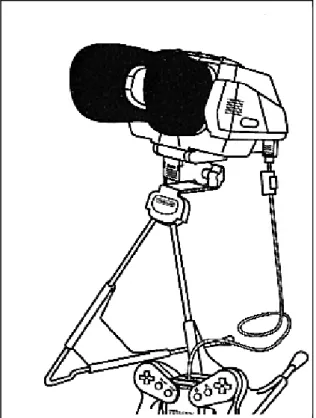
Virtual Boy – Nintendo 1995
The game used in the study is an interactive VR game, with a distinctive system, which can create a dramatic three-dimensional world. The software included three games (Tetris, Puzzle and Center-Fill), in all of which the objective is to carry out certain demands via control over three-dimensional blocks: the subject had to fill a three dimensional block with various shapes made up of smaller blocks. The subject must put the dropping blocks in the right place, and accordingly, accumulate points. In order to
accumulate more points, the user must act accurately and rapidly. This three
dimensional VR game presents to the user many ways of solving the problem. Because of the variety and quantity of possibilities, it is usually not possible to remember exactly how the problem was previously solved, and the user solves the problem placed before him differently each time he plays the game. Thus he learns that there are many and varied solutions.
Figure 1 :Virtual Boy- Nintendo 1995
Results
The research hypothesis claimed that a clear difference would be found between the experimental group of deaf and hard of hearing children and the control group of hearing children in their ability to think flexibly before practicing spatial rotation, by means of the VR game. After the practice, in contrast, the ability to think flexibly improved in the experimental
group to such an extent that no clear difference was found between this group and the control group of hearing children. That is to say, the scores of the deaf and hard of hearing children in the experimental group were similar to those of the hearing children in this examination. In order to verify this, we conducted a one-way analysis of variance.
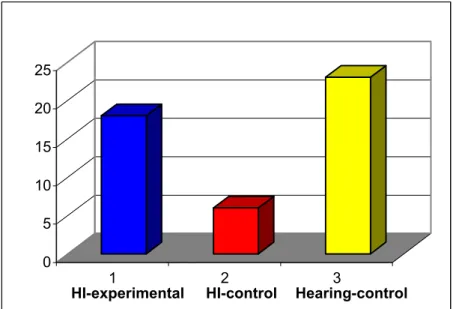
Table 2 presents the averages in the measurement of flexibility of thinking in the three research groups : the experimental group of deaf and hard of hearing, the control group of deaf and hard of hearing and the control group of hearing children, and the analysis of the variations among the groups.
Table 2: Results of the one-way variance test for the calculation of averages, standard deviation and variance analysis of flexible thinking by research groups and by time
Time HI experimental HI control Hearing control* Model P,F Group P Before Average SD Sample Size 7.05 2.85 21 5.91 3.50 23 23.00 2.37 16 F(2,57)=177.92 P<0.001 P(1,2)=n.s. P(1,3)<0.001 P(2,3)<0.001 After Average SD Sample Size 18.10 5.76 21 5.96 3.47 23 23.00 2.37 16 F(2,57)=102.04 P<0.001 P(1,2)<0.001 P(1,3)<0.001 P(2,3)<0.001
• HI= Hearing Impaired.
Comment: the control group of hearing children took the tests once only; that is to say, the data in the table was copied from “before” to “after”.
Figure 2 presents the average scores in flexible thinking of the three research groups – experimental, control hearing impaired and control hearing, before intervention.
Figure 2: Averages of flexible thinking according to research groups before intervention
0 5 10 15 20 25 1 2 3
HI-experimental HI-control Hearing-control
Figure 3 shows the averages in flexible thinking measured after the intervention.
Figure 3: Averages in flexible thinking according to research
groups after the intervention.
0 5 10 15 20 25 1 2 3
HI-experimental HI-control Hearing-control
A look at table number 2 and figures 2 and 3 indicate that prior to the practice there was a considerable gap in flexibility of thinking between the research group of deaf and hard of hearing children (both experimental and control groups) and the control group of hearing children. The difference favored the hearing children. No considerable difference was found
between both research groups of deaf and hard of hearing children (experimental and control groups). In contrast, after the practice, a clear difference was found between the experimental deaf and hard of hearing group and the deaf and hard of hearing control group in their ability to think flexibly, favoring the experimental group. A smaller but clear difference was found between the experimental group and the control group of hearing children; that is to say, the children in the experimental group improved their achievements significantly but did not yet reach the level of the hearing children in this index.
Discussion
One of the goals in the education of deaf and hard of hearing in Israel and throughout the world is the emphasis on the importance of nurturing thinking in these children. Studies have found that the functioning of the deaf and hard of hearing improved after appropriate learning, training and practice (Gruler & Richard, 1990; Martin, 1991). In addition, the existing
programs of intervention do not exploit the vast possibilities of modern technology, especially the modern, attractive technology - VR. This study is unique due to the use it makes of the virtual game, which trains in spatial rotation as a means of improving flexibility of thinking in deaf and hard of hearing children. To the best of our knowledge, this is the first experiment of its type to exploit the advantages of VR technology, and of this game specifically, as a means of intervention for nurturing the cognitive skills of the deaf and hard of hearing population. This study found a clear difference in the ability to think flexibly between deaf and hard of hearing children and hearing children before practicing, to the advantage of the hearing children. This finding is reinforced in previous studies which found that deaf and hard of hearing children possess lesser ability in creative imagination and have a tendency to rigidity in their thinking (Saraev & Koslov, 1993). After practice, the children in the experimental group improved in their ability to think flexibly with the help of the 3D VR game, and the gap between them and the hearing children narrow. In contrast, the control group of deaf and hard of hearing children continued to score poorly and the gap between them and the hearing children did not narrow. We can assume with caution that further practices might improve the results of the experimental group to the point where no noticeable difference will be between them and the group of the hearing children. This finding parallels that of Bunch (1987) who claimed that if deaf and hard of hearing children are afforded opportunities to develop their potential and the teachers are provided with methods of encouraging creative thinking – deaf children will progress and will reach the level of hearing children.
The results indicate a clear advantage of 3 dimensional VR (received by the experimental group) over the conventional 2 dimensional intervention (received by the deaf and hard of hearing control group). It is reasonable to assume that these findings were obtained due to the differences between the two types of practice. The children in both groups played, during the same period of time, rotation games via Tetris, with only one difference between the two groups – 3D VR versus a 2D regular game.
A logical explanation of these findings is found in the nature of VR technology and in earlier studies. This technology creates a “pre-symbolic” form of communication, and its users can communicate with imaginary worlds without the use of words. Thus, a world is created charged with sights, voices and sensations which surpass syntax and language (Passig, 1996). The deaf and hard of hearing children who used this technology, were able to realize their hidden potential without linguistic or auditory limitations. VR technology does not limit the player in either the manner in which information is presented or in his movements, and the user is able to immerse himself in the learning environment (Pantelidis, 1995). In this virtual manner, the deaf and hard of hearing users completely immersed themselves in the game. They felt as though they themselves were moving the blocks, searching for the right ones and rotating them. In other words, the abstract became less vague and more concrete. Various studies in the field of VR also found that this immersion serves to broaden the interface with the senses and also improves the ability to understand abstract concepts by converting them to more concrete ones (Darrow, 1995; Osberg, 1995).
Another unique quality of the technology is that the VR causes the user to be especially active. The increased liveliness and level of interactivity causes the user to become a part of the virtual world. This tool is able to present information in three dimensions and in real time. This permits the user to be an active participant in the environment and not merely a passive observer (Bricken & Byrne, 1992; Heim, 1992; Osberg, 1995; Powers & Darrow, 1994). Deaf and hard of hearing children require more active involvement in the learning process than hearing children (Marzam, 1998).
Another fitting explanation of these findings is the fact that this technological tool is fun and motivates the user. Studies have shown that children who use VR enjoy it and wish to continue to learn more using it (Bricken & Byrne, 1992; Talkmitt, 1996). It would appear that the high level of motivation of the children studied led to their continued participation in the intervention program and their success in it.
Summary
This study proved that a significant improvement in flexible thinking took place in deaf and hard of hearing children due to the use of a 3D virtual reality game. Another important contribution is the advancement of this field to the point where deaf and hard of hearing children almost reached the level of hearing children. It appears beneficial to do further work in this area.
References
Bunch, G. O. (1987). The Curriculum and the Hearing-Impaired Student. Boston: College- Hill Press.
Bricken, M., & Byrne, C. M. (1992) Summer Student in Virtual Reality: A Pilot Study on Educational Applications of Virtual Reality Technology. University of Washington. HIT Lab. http://www.hitl.washington.edu/projects/education/ (Last visited— Aug.1. 1998).
Darrow, M. S. (1995). Increasing Research and Development of VR in Education and Special Education. VR In The School. 1 (3), 5-8.
Durlach, N.I., & Mavor, A.S. (1995). Virtual Reality. Washington: National Academy Press. Guilford, J. P. (1967). The Nature of Human Intelligence. New York: McGraw-Hill.
Guilford, J. P. (1970). Creativity, Retrospect and Prospect. Journal of Creative Behavior, 4 (3), 149-168.
Gruler, H. E., and Richard, L. (1990) Active Work and Creative Thought in University Classrooms. In Schwebel, Maher, Fagley (eds.) Promoting Cognitive Growth over the Life Span. New-Jersey: Lawrence Erlbaun Associates (pp.137-164).
Heim, M. (1992) The Metaphysics of Virtual Reality. New-York: Oxford University Press. Huberty, T.S., Koller, J.R. (1984). A Test of the Learning Potential Hypothesis with Hearing and Deaf Students. American Annals of the Deaf ,78 (1), 22-28.
Kaufmann, G. (1985). A Theory of Symbolic Representation in Problem Solving. Journal of Mental Imagery, 9 (2), 51-70.
King, C.M., Quigley, S.P. (1985). Reading and Deafness. California: College-Hill Press. Kosslyn, S.M. (1980). Image and Mind. Cambridge: Harvard University Press.
Laughton, J. (1988). Strategies for Developing Creative Abilities of Hearing-Impaired Children. American Annals of the Deaf, 133 (4), 258-263.
Martin, D.S. (1991). Advances in Cognition Education and Deafness. Washington: Gallaudet University Press.
Marzam, I. (1998) Social Interaction, social Cognition and social-Moral Reasoning in 4th5th and 6th grades Children with Hearing Impairment Who are Fully Included in Regular Education…M.A dissertation, School of Education, Bar-Ilan University, Ramat-Gan, Israel. (in Hebrew).
Nevo, B. (1997). Human Intelligence. Tel-Aviv, Israel. (In Hebrew).
Osberg, K. M. (1995) Virtual Reality and Education: Where Imagination and Experience Meet. VR In The Schools. 1 (2), 1-3.
Pantelidis, V. (1995) Reasons to Use VR in Education. VR In The Schools. 1, 9.
Passig, D. (1996) Virtual Reality in Education. School of Education, Bar-Ilan University, Ramat-Gan, Israel. (in Hebrew)
Powers, D. A., & Darrow, M. (1994) Special Education and Virtual Reality: Challenges and Possibilities. Journal of Research on Computing in Education. 27 (1), 111-121.
Saraev, S.A., & Koslov, V.P. (1993). Characteristics of Pathological Personality Development in Deaf Children. Journal of Russian and East European Psychiatry, 26 (1), 54-60. Shepard, R.N., & Metzler, J. (1971) Mental Rotation of Three-Dimensional Objects.
Science.171, 701-703.
Singer, J. L. (1966) Daydreaming. New-York: Plenum Press. R In The Schools. 1 (4), 5-7. Sternberg, R.J., & Powell, J.S. (1983). The Development of Intelligence. In P.H. Mussen (ed.), Handbook of Child Psychology (pp.341-419). New-York: Wiley.
Talkmitt M. (1996). VESAMOTEX- Virtual Education Science and Math of Texas. VR In The Schools, 1 (4), 5-7.
Torrance, E P. (1966). Torrance Tests of Creative Thinking. New- Jersey: Personnel Press. Torrance, E P. (1980). Creativity and Futurism in Education: Retooling. Education, 100, 298-311.