ISSN: 2289-7208 print; 2289-9294 online 08 (2) 39-50
39
EFL Instructors’ Perceptions on the Integration and
Implementation of MALL in EFL Classes
Raja Muhammad Ishtiaq Khan
*1, Noor Raha Mohd Radzuan
2, Muhammad
Shahbaz
3, Ainol Haryati Ibrahim
21Deanship of Preparatory Year, Al-Majma’ah University, Zulfi, 15923, Saudi Arabia.
2Centre for Modern Languages & Human Sciences, Universiti Malaysia Pahang, 26600 Pekan, Pahang, Malaysia. 3Department of English, GC Women University Sialkot, Sialkot, Pakistan.
Abstract
Mobile assisted language learning (MALL) has opened new opportunities for language instructors to develop and use handheld technology and implement new teaching practices focused on learners. The increased use of technology in language learning means instructors can play a key role in motivating learners by integrating readily available technologies for language learning development into their teaching practices. The focus of this present investigation is to explore the attitudes of Saudi instructors teaching English as a foreign language (EFL) regarding the implementation of mobile-assisted language learning (MALL). The target population for this study was EFL instructors who are currently teaching English in Saudi Arabia. The research methods for the study included a questionnaire, as well as in-depth interviews that were conducted to explore the attitudes of EFL instructors. The results of the questionnaire and interviews revealed moderately positive attitudes among participants regarding the use of mobile phones for language learning and teaching activities. The findings also indicate the existence of some challenges that could prove to be a significant hurdle for mobile phone integration in EFL learning and teaching in Saudi Arabia. Most of the instructors reported that they did not use mobile phones or MALL activities in their EFL classes. The results also showed that EFL teachers do not have the required skills to use/develop MALL activities. This study concludes by offering recommendations and suggestions for how to implement MALL and remove potential barriers to MALL implementation in EFL instruction.
© 2018 Penerbit Universiti Malaysia Pahang
Keywords: Attitude; English as a Foreign Language (EFL); EFL Instructors; Mobile-assisted language learning (MALL).
INTRODUCTION
Technology plays a key role in the development of language learning. With the rapidly expanding availability of new technologies, the language learning process can be made more engaging and interesting for learners. One example of such technology is MALL (mobile-assisted language learning), which has been shown to have a significant influence on learners’ autonomy in language development. MALL involves the integration of technologies such as mobile phones, tablets, and PCs for language learning (Hsu, 2013; Stockwell & Hubbard, 2013).
__________________
* Corresponding author: Tel.: +00966590765925
E-mail addresses: [email protected] [Khan, R.M.I.]; [email protected] [Radzuan, N.R.M.], [email protected] [Shahbaz, M.], [email protected] [Ibrahim, A.H.].
40 According to Viberg and Grönlund (2012), the use of smartphones in language learning and teaching is the most researched area in the field of technology-assisted language learning. Many researchers and instructors have focused on the practical application of MALL in the conventional EFL classroom environment (Kim, 2018). This attention to MALL integration is due to the vast diversity of learning opportunities and applications that mobile phones can provide for EFL learning proficiency. The utility of mobile phones as an aid in language learning comes from their ability to facilitate educational activities for instructors and learners that are portable, user friendly, readily accessible, and affordable (Kukulska-Hulme, 2009; Stockwell, 2010). Research has shown that the use of mobile phones empowers EFL learners to interact with classmates and teachers more easily and effectively. Likewise, MALL researchers have found that the ease of communication with instructors and classmates is the primary reason that mobile phones are incorporated for educational purposes. The capabilities of mobile phones have led EFL researchers to promote the technology’s use as a way to improve the processes and quality of language teaching and learning.
Despite the prevailing research on the use and acceptance of MALL in language learning, a number of EFL investigators have highlighted significant challenges in the practice of using mobile phones for this purpose. A major concern is learners’ unwillingness to use mobile phones for academic and educational purposes (Stockwell, 2008). Similarly, Traxler, Barcena, and Laborda (2015) note that the small screens on mobile phones pose an additional challenge in the implementation and use of MALL for educational pursuits. Moreover, in some contexts, the costs of mobile phones might also discourage some learners and teachers from using the technology persistently (Stockwell, 2008). Another factor that could limit the implementation of mobile phones is the difficulty of working with both a mobile phone and a textbook at once. Moreover, language teaching is being aided by the technology integration in Saudi Arabian context but there is no clear indication of MALL incorporation in Saudi EFL classes (Aljumah, 2012). Most of the learners have modern smartphones and applications that can be utilized for the language learning process which can develop the process of language learning (Shahbaz & Khan, 2017).
On the other hand, the swift expansion of mobile technologies has helped MALL gain the attention of teachers and learners (Aldrich, 2017). Earlier efforts to use mobile phones for teaching were held back due to previous drawbacks and limitations of the technology (Hayati, Jalilifar, & Mashhadi, 2013), such as inadequate storage capabilities (Zhang, Wei, & Burston, 2011). Today, however, researchers consider mobile phones to be a valuable learning tool that can help foster the process of proficient language learning (Kim, 2018; Stockwell, 2010; Stockwell & Liu, 2015). Stockwell and Hubbard (2013) note that, while innovation in technology is evolving, new types of limitations might create hurdles in the use of mobile phones for language learning. Mobile phones will continue to change in form and appearances, yet their usefulness to language learners and teachers will likely grow (Stockwell & Hubbard, 2013). Because of this, it is likely that current restrictions and limitations on the use of mobile phones in conventional classroom will fade in the future.
In the same way, understanding of technology form learners’ aspect of MALL implementation and insights of mobile learning has been discussed widely. Whereas very little has been examined from teachers’ perspectives on the utilization of mobile phone based technology in language learning. Language instructors are capable of developing and integrating suitable MALL tasks and assignments which in turn motivate and reinforce the EFL learners to use mobile for learning purposes. More specially, they have the ability to incorporate and make EFL learners aware of potential benefits and practices of MALL for the EFL learning. Up to now, to the best of our knowledge, the research on implementation of MALL and challenges is limited form teachers’ perspectives. Additionally, the research on the implementation of MALL form instructors’ point of view is also limited for teaching and learning purposes. Therefore, there is need of an investigation on the implementation of MALL in EFL instructors’ context. The present study is an effort to specify insights into EFL instructors’ perceptions on the application of MALL in accordance with conventional classroom and EFL courses. Potential problems which might obstruct the implementation of MALL in EFL learning have been categorized and argued. The following questions were devised to attain the objectives of the present study:
41 2) What are the perceptions of Saudi EFL instructors on the potential challenges to integrate MALL
in EFL learning?
3) What are the perceptions of Saudi EFL instructors on the proficiency to develop MALL activities in EFL learning?
4) What are the perceptions of Saudi EFL instructors on the present usage of MALL in EFL learning?
LITERATURE REVIEW
Mobile phones have become an important part of daily life. While mobile phones are widely used in many settings, they can also be particularly useful to help learners or teachers in educational settings. The current literature reflects abundant research on learners’ acceptance and use of technology in educational pursuits, but there is less research exploring the attitudes of instructors regarding the integration of technology for language learning or educational purposes. Research on teachers’ perceptions towards the use of technology for education indicates that, overall, teachers around the globe largely agree on the appropriateness of such technology usage in the EFL context (Aydin, 2012; Ismail, Almekhlafi, & Al-Mekhlafy, 2010; Liu, Lin, Zhang, & Zheng, 2017; Mohammadi, 2015; Shahbaz & Khan, 2017). Technology is considered an effective and constructive teaching support in language learning which provides a large number of benefits and advantages for both learners and teachers.
More recently, AlTameemy (2017) conducted a study on teachers and learners’ attitudes towards the use of MALL. The study revealed that only a small number (4.79% out of N= 146) of public university instructors in Saudi Arabia use mobile phones for teaching and learning. The use of mobile phones for other purposes was limited to social media. This indicates that many learners and instructors still have negative attitudes regarding the use of mobile phones in EFL classes. AlTameemy suggested that the implementation of technology for teaching purposes seeks researchers’ consideration. Alresheed, Raiker, and Carmichael (2017) explored the effects of CALL in Saudi secondary schools. In the survey study, they asserted that CALL is a useful aid in developing language. Results of the pilot investigation have determined several aspects that are hindering the incorporation of CALL in Saudi institutions. Some of them are marked as covert, i.e. the undesirable attitude apprehend by the instructors. Regardless of this hindrance concerning CALL usage, some instructors used PCs to use multimedia. Ismail et al. (2010) examined the EFL teachers’ attitudes of using technology in EFL classes. They asserted that instructors reflected technology as an operative way in fostering the value in learning and teaching foreign languages. The most obvious finding of the study is that instructors established the important influence of technology and they showed their readiness to speed up the technology integration in EFL Classes.
Likewise, a substantial number of studies have been conducted on the teachers’ attitudes of MALL integration in many different aspects of educational environments. On the other hand, to date, research lacks the studies that deal with the problems of EFL instructors’ attitudes/perceptions of MALL integration and implementation in EFL classes. However, the results of several investigations on teachers’ perceptions about MALL have confirmed conventional acceptance and endorsed the importance of MALL in EFL context. For instance, Liu et al. (2017) examined the EFL teachers’ and learners perception about the acceptance of mobile learning. The findings of the quantitative data analysis indicated that instructors and learners had greater level of acceptance of mobile integration in EFL context. Moreover, a positive association between acceptance and perception was observed with noticeable level of positive perception. Saqlain and Mahmood (2013) carried out a study to investigate the perceptions of EFL instructors in a public university in Saudi Arabia. The results exhibit a comprehensive depiction of instructors’ attitudes about the utilization of language learning and teaching. The findings also depicted that some of the instructors were not sure about the efficiency of technology for teaching and learning language.
The problem of instructors’ willingness for the acceptance of the integration of mobile learning for teaching purposes was also explored by the researchers. For instance Domingo and Garganté (2016) examined that although instructors considered mobile integration as constructive and proficient but they did not show the desired willingness to integrate or utilize mobile phones for teaching pursuits. A considerable relationship was seen between awareness of technology and teachers’ motivation. In business education Cruz, Boughzala, and Assar (2014) explored similar type of study. The instructors indicated that the mobile
42 phone integration would display enormous advantages for learners. On the other hand, some instructors indicated individual, technological and educational issues to the effective application of mobile integration in EFL environment. Thus, the technology integration relies on the readiness of learners and instructors and they should not be parted away to get the effective useful of preexisting available technology.
There are several theories that validate the MALL instruction and teaching process, however for the present study Krashen’ (1981) seems to be more operative. Krashen (1981) has established the most significant theory of language learning. He recommended a “monitor model” containing five assertions of language learning: the input hypothesis, the natural order hypothesis, the acquisition-learning hypothesis, the monitor hypothesis, and the affective filter hypothesis. The hypothesis connected with current study is the Affective filter hypothesis. Krashan’s (1982) affective filter hypothesis, lead the evaluation of efficacy and rationality for each designated mobile application. Krashan’s affective filter hypothesis assists to govern whether the app is able to intrigue learners’ interest and meet their psychological needs when they are learning a second language. Grounded on Krashan’s affective filter hypothesis, language learners can be distracted by several factors in the process of language learning.
According to Krashen (1982) low self-esteem, low motivation, and anxiety avert the presence comprehensible input for being used to move from the current stage of learning. Language learning process impedes, when the filter is up and there is no distraction. Likewise, the positive affect is essential for acquisition to happen, which is not possible on its own. The input hypothesis convincingly requires the intention of language learners and its acquaintance to a form of second language information which should be comprehensive for the progression and development of language learning. (Krashen, 1981, p. 54) asserted that comprehensible language input as “the only causative variable in language learning”. This shows, for language learning to occur, language learners have to have exposure to comprehensible language input that involves language arrangement that are beyond their current level (i+1). So MALL application can perform the role of input for developing language learning process.
METHODOLOGY
To address the research questions, the present investigation used mixed-method research design. The use of mixed-method research design allow researchers to integrate the qualitative and quantitative methods (Creswell & Clark, 2007). The instruments of the present study are questionnaire which came up after reviewing previous studies and semi-structured interviews. The purpose of using two instruments was deliberated to direct a pedagogical triangulation of the required data. The pedagogical triangulations of the data would allow researchers to validate an enrich data (Leung, 2015). The aim of the present study was to deliver both qualitative and quantitative interpretation of the data on the perceptions of EFL instructors of MALL implementation in EFL learning setup of Saudi Arabia.
3.1
Instruments
Two instruments were employed to obtain the data for the present study. The instruments of the study were questionnaire and interview.
3.1.1 Questionnaire
The questionnaire was adopted from the preexisting literature (Kukulska-Hulme & Shield, 2008; Stockwell, 2007, 2010) and modified to suit the Saudi EFL context. The content of the questionnaire was validated by sending it to five experts who are researchers and university teachers in Saudi Context. Their feedback was incorporated and the questionnaire was uploaded to Google a form which is free software that allows the researcher to include as many as respondents as possible and it saves time also. The questionnaire was consisted of four sections and 25 five items. The first section of the questionnaire was on EFL instructors’ attitudes’ of MALL; seconded question was on the perspective challenges of MALL integration ; third section of the questionnaire was developed identify the proficiency in developing MALL activities and fourth section was on the current state of MALL integration. Five-point Likert-scale questionnaire
43 consisted of four sections with options from Strongly Disagree, Disagree, Neutral, Agree and Strongly Agree. Questionnaire was sent by using different modes of social media to EFL instructors. The responses were gathered and first converted into Excel sheet in order to import data in SPSS 22.0 and the data was coded accordingly. The reliability of questionnaire of four sections was (0.86: 0.83; 0.79 and 0.86) on Cronbach's Alpha.
3.1.2 Interviews
The second instrument of the study was semi-structured interviews, which were devised form the same literature as the questionnaire. The content of questionnaire was also validated from same five university teachers. Creswell (2012) exclaimed that diverse data sources are essential in an analysis to triangulate findings. Semi-structured interview were consisted of 5 open ended questions. The interview questions were sent to 15 FFL instructors through email and social media, 8 instructors replied to open ended questions. Their responses were coded and the major themes were discussed in the qualitative analysis.
3.2
Participants
The participants of the present study were 63 EFL teachers (40 males and 23 females) form different EFL teaching institutions in Saudi Arabia. Questionnaire was sent to 110 EFL participants by the means of email and WhatsApp. 63 participants replied voluntarily by filling the Google Forms. Based the responses of the online questionnaire the instructors had an average of 7.5 years EFL teaching experience in Saudi Arabia. All of the participants had relevant language teaching related qualification. A total of 6 EFL teachers were PhD holders, 53 Master’s degree holder and 5 were bachelor degree holders. These English teachers taught English from elementary to advanced level. After the administration of questionnaire, seven teachers were invited for interviews after their approval of participation.
3.3
Data Analysis and Procedure
After the designing and validating the content of questionnaire, a Google form is created in order to collect qualitative data. Then the Google form was sent to participants through different through email and different modes of the social media. Participants were given one week to complete the questionnaire. The data from Google forms was coded according to likert-scale numbers from 1 to and then file was saved in an Excel sheet in order to import data in SPSS software. SPSS 22.0 was used to interpret the statistical analysis of the teachers’ responses. Descriptive statistics was used to analyze quantitative data. The data for qualitative portion of the study was gathered thorough open ended questions sent to 15 participants. Codes were generated and the major themes were analyzed in the qualitative part of the study.
RESULTS
4.1
What are the Attitudes of Saudi EFL Instructors about Mobile Phone Integration in
EFL Learning?
In order to answer the first research question Saudi EFL teachers attitudes were analyzed in table 1. A total mean of (3.91) indicates that EFL instructors have reasonably positive attitude toward the MALL integration in EFL classes. Most of the teachers showed positive attitudes towards the possibility of the use of mobile phones for teaching and integration containing portability, learning opportunities, multimedia functions, accessibility, scaffolding, availability and connectivity of data, ubiquitous form of learning and time-efficiency in EFL classes. 62% of the participants asserted that the use of mobile phone can effectively facilitate language learning. However, a considerably, small numbers (5%) indicated that mobile phones cannot support EFL learning.
44 Table 1. Attitudes of Saudi EFL Instructors about Mobile Phone Integration.
Item Strongly
Agree Agree Neutral Disagree
Strongly
Disagree Mean SD
Mobile phone usage will expedite
language learning process 21% 62% 14% 0% 3% 3.81 0.91
Portability is a key feature of mobile
phones 14% 60% 24% 0% 2% 3.97 0.80
Mobile phone usage can create
collaborative learning environments 21% 65% 11% 0% 3% 3.86 0.72
Multimedia attribute of mobile phone
is useful for EFL learning 19% 56% 24% 0% 2% 4.00 0.78
Mobile phone can provide
scaffolding for each learner 13% 63% 19% 0% 5% 3.91 0.76
Mobile phones can be integrated for
language learning 30% 49% 19% 0% 2% 3.79 0.85
Mobile phone integration is cost effective of EFL learning and teaching
15% 61% 24% 0% 0% 4.06 0.80
Mobile phone integration is
time-efficient 6% 62% 30% 0% 2% 3.90 0.62
Mobile phones can be connected to
the Internet at any time 13% 35% 44% 0% 8% 3.81 0.91
Mobile Phones can facilitate
Ubiquitous learning for EFL learners 14% 43% 32% 0% 11% 3.97 0.80
Teachers who participated in survey were also interviewed after getting their consent to participate in study. They were asked to specify their perceptions on the current usage, perspectives challenges in mobile integration, their ability to use MALL and their attitudes towards mobile phone in EFL classes. The findings of the interview illustrate that most of EFL instructors (63%) indicated positive attitudes to afford the mobile integration for teaching English language. Majority of EFL teachers also report that the availability and high speed connectivity of Internet is clear affordance of mobile phone assimilation with EFL classes.
Teacher 3 To me the greatest advantage of the mobile phones usage in EFL classes is that leaners have the chances to link the internet for language learning in the formal classroom and out of the classroom. This attribute might assist learners to be more independent and provide the opportunity of self-directed learning.
Teacher 5 In my opinion the persistent availability of mobile phone technology will provide EFL learners the possibility to be connected in EFL classrooms. The cell phones are mainly efficient to be integrated with EFL curriculum. The availability of mobile phones will play significant function in EFL courses where Classrooms are not connected with internet based learning.
Teacher 1 I think use of mobile phone in the ESL classroom can be very affective especially for unmotivated and lazy students. The contribution of MALL is equally distribution of activities at the same time, to engage the shy, uncooperative and unmotivated students and participation of all the students.
Similarly, in the survey questionnaire, it was indicated that a considerable number of teachers (59%) assumed that the audio and visual capacities of mobile phones can aid learners to understand more
45 effectively and easily. Moreover, the portability of the mobile phones also creates space for its usage with formal classroom.
Teacher 2 It appears that mobile phone has the capacity to initiate interaction by the use of their multimedia applications. The usages of audio-visual properties are suitable and beneficial to develop learners’ pronunciation and listening skills. Though, our classrooms are equipped with basic technological facilities but still learners’ do not use these facilities, so mobile phone can serve in a better ways in this regard.
4.2
What are the Perceptions of Saudi EFL Instructors on the Potential Challenges to Integrate MALL in EFL Learning?Table 2 present the results of teachers’ perspective challenges of MALL integration in EFL classes. Most of the teachers approved some of the challenges in MALL integration in EFL classes. Contrarily, it is also obvious form the data table that a considerable (48%) proportion of teachers did not express their perceptions on challenges to the MALL integration. However, Most EFL teachers (11% strongly agreed, 48 % agreed) indicated the learners’ use of mobile phones for non-academic purpose and learners’ inefficiency in using mobile phones are the key challenges in MALL integration.
Table 2. Teachers’ Perspectives on the Challenges of MALL Integration.
Item Strongly
Agree Agree Neutral Disagree
Strongly
Disagree Mean SD
The small screen size of
mobile phones 6% 32% 49% 0% 13% 3.71 0.66
Internet or data speed 5% 30% 62% 0% 3% 3.44 1.00
Internet connectivity hitches 12% 25% 62% 0% 2% 3.49 1.11
Students’ non-use of mobile phones for academic purposes
11% 48% 35% 0% 5% 3.19 1.03
Price of mobile phones 8% 40% 42% 0% 10% 3.29 0.77
High cost of data bundle or
WiFi Charges 10% 51% 33% 0% 7% 3.42 0.82
Students’ incapability to use mobile phones for academic purposes
8% 44% 37% 0% 11% 3.60 0.87
Incompatibility of mobile software with language teaching/learning
2% 10% 46% 37% 6% 3.35 1.00
Students’ resistance to the use of mobile phones for academic purposes
0% 14% 46% 27% 13% 3.59 0.91
Lack of language learning mobile-based software and activities
0% 0% 38% 50% 13% 3.37 1.04
With regards to the constraints of the mobile phone implementation, instructors also indicated some limitations of MALL application in EFL classes. Though, most of the instructors are aware of the availability of MALL application software and tools but they did not have the knowledge and skills to integrate these available applications to use them with textbooks in EFL classes.
46 Teacher 7 From my standpoint a key challenge in the implementation of MALL in EFL classes is to
choose the right type and appropriate application for learning pursuits. Designing and modification of MALL application for EFL teaching learning purpose is another hurdle in this regard.
Moreover, some instructors also considered Internet connectivity constraints as depressing for some of the EFL activities. Cost of the internet data in particular and connectivity in general were the additional significant obstacles to the integration of mobile phones in EFL context.
Teacher 8 Using mobile phone in language learning is beneficial but we may face the challenge at the same time. For instance; connectivity and battery life, checking instructions, limited memory, misuse of phone, printing issues, limited device specifications etc.
Furthermore, most of the instructors also proclaimed that though all learners in KSA have most updated smartphones but their use of mobile phone is limited to use of social media chat. It is hard to convince them to practice some activities on their mobile phones for educational purposes. However, some instructors indicated that their learners use dictionary for checking the translation of words on their mobile phones.
Teacher 6 If learners are not yet mature, they can't use mobile based activities properly, most learners start using different apps and rather than getting benefits they absolutely don't focus on their studies. When you will draw their attention to any subject, they will not be able to focus the way they should.
4.3
What are the Perceptions of Saudi EFL Instructors on the Proficiency to Develop MALL Activities in EFL Learning?Table 3 shows the teachers’ perceptions of the ability to develop and use MALL activities. The total mean of (3.43) demonstrates that a large mainstream of EFL teachers did not indicate their proficiency in developing MALL activities. However, a significant numbers of teachers perceived themselves as proficient in developing MALL software and activities. It is also notable that a reasonable number (25 %) EFL teachers are not proficient in developing and evaluating MALL activities.
Table 3. EFL Teachers’ Perceptions of the Ability to Develop MALL Activities
Item Not
proficient
Fairly
Proficient Undecided Proficient
Very
proficient Mean SD
Designing and creating
MALL activities 24% 10% 38% 29% 0% 3.71 0.66
Ability to adapt your teaching
styles/techniques to MALL
24% 3% 40% 32% 2% 3.44 1.00
Ability to evaluate
MALL software tools 24% 6% 41% 27% 2% 3.49 1.11
Your ICT knowledge to use mobile phones for EFL
14% 5% 40% 35% 6% 3.19 1.03
Ability to use MALL
software tools 14% 6% 48% 30% 2% 3.29 0.77
Most language instructors during the interview affirmed that they know the usage of mobile phones in the EFL teaching context but they do not have the expertise to integrate the MALL application with formal
47 classes. Some instructors indicated that they were unacquainted with the MALL association and how to integrate MALL for language teaching and learning.
Teacher 5 I am not aware of the using smartphone techniques and approaches that can be implemented to integrate mobile phones for language learning. I am sure I need to identify the pedagogical and theoretical of MALL integration in language teaching. Teacher 3 The use of smartphones in teaching English, in my opinion, requires certain skills to attain
its positive aspect for language teaching. I guess language teachers needs to master these skills to avoid the problems.
Teacher 1 By and large, I don’t have enough knowledge and skills to associate MALL technology for language teaching. The integration of smartphone is not an exception.
4.4
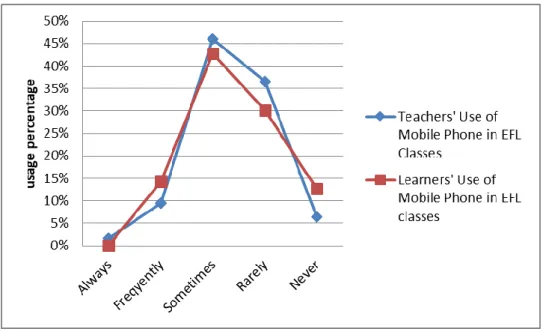
What are the Perceptions of Saudi EFL Instructors on the Present Usage of MALL in EFL Learning?Figure 1 summarizes instructors’ perceptions about the teachers and learners present use of mobile phones in EFL classes and EFL learners for learning and teaching purposes. Most EFL teachers (37%) specified that they rarely use mobile phones in their EFL classes. However, it also reported by a considerable number of teachers that they as well as learners use Cell phones for looking and searching some of the words for translation. This asserts the presence of MALL in EFL classes.
Figure 1. Current use of Mobile Phones in EFL Classes; Teachers' Perspectives.
DISCUSSION
The present study was an effort to highlight the EFL instructors’ attitudes and perception of the integration of MALL in Saudi Arabia. Analysis of the data collected form EFL teachers from interviews and questionnaire established that EFL teachers approve reasonably positive perceptions on the incorporation and application of MALL activities in EFL classes. Likewise, the findings of the present study endorsed that Saudi EFL teachers have the awareness of the potential advantages of the MALL integration in teaching languages. On the most important feature of the modern mobile phones is that it facilitates learners and teachers to be linked with internet in and out of the classroom. Particularly, the usage of the internet connectivity develops the process of interaction, communication, and discussion with conventional EFL classrooms (Alfaki, 2016). The use of internet for academic can benefit teachers to design a collection
48 of collaborative and attractive activities by using MALL software. For instance, the use of WhatsApp and podcasts to access to the online activities and contents can foster language learning process (Kukulska-Hulme, Norris, & Donohue, 2015). Subsequently, educational managers and teachers can affect learners’ practice of technology; constructive views of EFL teachers can pave the path for technology integration in learners’ language learning process (Levy & Stockwell, 2013).
Despite the fact, that integration of MALL greatly relies on the learners’ assent and positive attitude, the utilization of MALL technology for academic purposes would not be practicable if teachers do not show positive attitudes to it (Şad & Göktaş, 2014). The results are in the line with previous investigations which revealed teachers’ positive attitude to MALL integration (Alfaki, 2016; AlTameemy, 2017; Cruz et al., 2014; Ismail et al., 2010; Şad & Göktaş, 2014). As a result of this, it is suggested that EFL academic supervisors and institutions pay their consideration to EFL instructors’ insights of advanced technologies and make efforts to harmonize the perceptions of teachers to need of technology integration for EFL learners. Teaching and learning process will flourish if both learners and teachers are interested and ready to integrate the different use of technologies for academic purposes. So, for MALL integration and implementation, further investigations should be conducted on the EFL teachers’ use of MALL in their EFL classes for academic purposes.
The findings of preset study also identified some notable challenges that would obstruct the development of the MALL integration in EFL teaching. Teachers and learners should be tolerant about the limits of MALL and explore the techniques to lessen the impact of these hurdles (Stockwell, 2012). One vital obstacle that can be eliminated by authorities and EFL instructors is learners’ usage of mobile phone for non-educational and non FEL accomplishments, which is very common among Saudi EFL learners. It requires an extended time efforts of to induce and motivate EFL learners to master the use technology for educational pursuits in Saudi EFL context (Al-Kathiri, 2014). Domingo and Garganté (2016) specified the similar type of the pedagogical and technical problems is MALL incorporation. They recommend that these sorts of challenges should be eradicated to enable the integration of MALL in educational settings.
CONCLUSION AND RECOMMENDATIONS
The result of the present investigation can be marked as an exploration of EFL teachers’ technological requirements and essentials. Additionally, positive attitudes of EFL instructors about MALL integration and implementation can be clear indication of higher level of motivation for the practice of MALL application and activities in EFL classes. MALL is an emerging subdivision of CALL and the removal of its hurdles and barriers might need intensive efforts and time. So, further explicit studies should be managed to appraise and determine the consequences of each hindrance. More significantly, the context should be considered to which MALL activities can be incorporated. Understandings of teachers’ perception on the technology integration should also be blended with evaluation of teaching environment and context (Margaryan, Littlejohn, & Vojt, 2011). As a result of this scenario, future research on the type of hurdles in MALL integration in different EFL contexts would deliver valuable understandings on the acceptances of approaches and strategies to abolish or control these problems.
Stockwell (2008) proposes that learner’s refusal to accept the technology incorporation for EFL learning might be associated with lack of their readiness to incorporate mobile phones for language learning. This readiness might not be associated with learners’ interest about the practice of technology as it is straightforwardly linked to learners’ expertise and skills to convene the necessities of MALL. EFL researchers and teachers should investigate the EFL learners’ motivation and willingness on the MALL usage in EFL classes. Moreover, teachers’ attitudes towards the integration of MALL can also be examined in many different aspects of language learning, particularly on listening and speaking skills. Evaluation of teachers’ and learners’ perspectives on MALL for teaching and learning requires careful planning. Currently, it is vital that MALL has been applied to various different EFL contexts depending upon the learners’ recognition of technology. Obviously, teachers’ can play an integral role in the effective integration of MALL in EFL classrooms. On the other hand, these expertise and skills also be demonstrated to EFL learners if the teachers have the desired skills. Likewise EFL teachers also need pedagogical and practical coaching for the designing and evaluating MALL activities for operative implementation of MALL in Saudi
49 Arabia. For this department weekly trainings, MALL projects and MALL experience sharing session can also inspire teachers to develop their proficiencies.
Finally, MALL integration and implementation is unexamined field of research in the Saudi EFL context. Very little is investigated on the appropriateness of the practical implementation of MALL in Saudi EFL context. Further research is important to examine the suitability of MALL implementation from learners’ background. In addition, future studies should concentrate on investigating teachers’ MALL using readiness and prior skills for MALL implementation in in EFL Saudi EFL context. Experimental research is also mandatory for practical efficiency of MALL.
REFERENCES
Al-Kathiri, F. (2014). Beyond the classroom walls: Edmodo in Saudi secondary school EFL instruction, attitudes and challenges. English Language Teaching, 8(1), 189.
Aldrich, S. T. (2017). Students' and teachers' perceptions of the use of mobile technology in university preparation classes. A Master’s Thesis, Massey University, Manawatu Campus, New Zealand. Alfaki, M. E. S. (2016). The Impact of Using Computer'Proficiency in English on Secondary Schools
Students. Alzaeim Alazhari University.
Aljumah, F. H. (2012). Saudi learner perceptions and attitudes towards the use of blogs in teaching English writing course for EFL majors at Qassim University. English Language Teaching, 5(1), 100.
Alresheed, S., Raiker, A., & Carmichael, P. (2017). Integrating computer-assisted language learning in Saudi schools: A change model. In Marcus-Quinn, A., & Hourigan, T. (Eds.), Handbook on Digital Learning for K-12 Schools (pp. 369-380). Boston: Springer.
AlTameemy, F. (2017). Mobile Phones for Teaching and Learning: Implementation and Students’ and Teachers’ Attitudes. Journal of Educational Technology Systems, 45(3), 436-451.
Aydin, S. (2012). A review of research on Facebook as an educational environment. Educational
Technology Research and Development, 60(6), 1093-1106.
Creswell, J. W., & Clark, V. L. P. (2007). Designing and conducting mixed methods research. Thousand Oaks, CA: Sage Publications.
Cruz, Y., Boughzala, I., & Assar, S. (2014). Technology acceptance and actual use with mobile leraning: first stage for studying the influence of learning styles on the behavioral intention. Proceedings of the European Conference on Information Systems (ECIS) 2014, Tel Aviv, Israel.
Domingo, M. G., & Garganté, A. B. (2016). Exploring the use of educational technology in primary education: Teachers' perception of mobile technology learning impacts and applications' use in the classroom. Computers in Human Behavior, 56, 21-28.
Hayati, A., Jalilifar, A., & Mashhadi, A. (2013). Using short message service (SMS) to teach English idioms to EFL students. British Journal of Educational Technology, 44(1), 66-81.
Hsu, L. (2013). English as a foreign language learners’ perception of mobile assisted language learning: a cross-national study. Computer Assisted Language Learning, 26(3), 197-213.
Ismail, S. A. A., Almekhlafi, A. G., & Al-Mekhlafy, M. H. (2010). Teachers’ perceptions of the use of technology in teaching languages in United Arab Emirates’ schools. International Journal for Research in Education, 27(1), 37-56.
Kim, N.-Y. (2018). CALL and MALL: Effects on Foreign Language Writing and Impacts on Perceptions of Language Learning. 응용언어학, 34(1), 143-167.
Kukulska-Hulme, A. (2009). Will mobile learning change language learning? ReCALL, 21(2), 157-165. Kukulska-Hulme, A., Norris, L. & Donohue, J. (2015). Mobile pedagogy for English language teaching: a
guide for teachers. London: British Council.
Kukulska-Hulme, A., & Shield, L. (2008). An overview of mobile assisted language learning: From content delivery to supported collaboration and interaction. ReCALL, 20(3), 271-289.
Leung, L. (2015). Validity, reliability, and generalizability in qualitative research. Journal of Family Medicine and Primary Care, 4(3), 324.
Levy, M., & Stockwell, G. (2013). CALL dimensions: Options and issues in computer-assisted language learning. London: Routledge.
50 Liu, H., Lin, C.-H., Zhang, D., & Zheng, B. (2017). Language teachers' perceptions of external and internal
factors in their instructional (non-) use of technology. In Lin, C. H., Zhang, D., & Zheng, B. (Eds.).
Preparing foreign language teachers for next-generation education (pp. 56-73). London: IGI Global. Margaryan, A., Littlejohn, A., & Vojt, G. (2011). Are digital natives a myth or reality? University students’
use of digital technologies. Computers & education, 56(2), 429-440.
Mohammadi, H. (2015). Investigating users’ perspectives on e-learning: An integration of TAM and IS success model. Computers in Human Behavior, 45, 359-374.
Şad, S. N., & Göktaş, Ö. (2014). Preservice teachers' perceptions about using mobile phones and laptops in education as mobile learning tools. British Journal of Educational Technology, 45(4), 606-618. Saqlain, N., & Mahmood, Z. (2013). English language instructors' perceptions about technology-based
language learning at Northern Border University in Saudi Arabia. TOJET: The Turkish Online Journal of Educational Technology, 12(2).
Shahbaz, M., & Khan, R. M. I. (2017). Use of Mobile Immersion in Foreign Language Teaching to Enhance Target Language Vocabulary Learning. MIER Journal of Educational Studies, Trends and Practices, 7(1).
Stockwell, G. (2007). Vocabulary on the move: Investigating an intelligent mobile phone-based vocabulary tutor. Computer Assisted Language Learning, 20(4), 365-383.
Stockwell, G. (2008). Investigating learner preparedness for and usage patterns of mobile learning. ReCALL, 20(03), 253-270.
Stockwell, G. (2010). Using mobile phones for vocabulary activities: Examining the effect of the platform.
Language Learning & Technology, 14(2), 95-110.
Stockwell, G. (2012). Mobile-assisted language learning. Contemporary computer-assisted language learning, 201-216.
Stockwell, G., & Hubbard, P. (2013). Some emerging principles for mobile-assisted language learning. The International Research Foundation for English Language Education, 1-15.
Stockwell, G., & Liu, Y. C. (2015). Engaging in mobile phone-based activities for learning vocabulary: An investigation in Japan and Taiwan. Calico Journal, 32(2), 299.
Traxler, J., Barcena, E., & Laborda, J. G. (2015). Mobile Technology for Foreign Language Teaching: Building Bridges between Non-formal and Formal Scenarios J. UCS Special Issue. Journal of Universal Computer Science, 21(10), 1234-1247.
Viberg, O., & Grönlund, Å. (2012). Mobile assisted language learning: A literature review. Paper presented at the 11th World Conference on Mobile and Contextual Learning, Helsinki, Finland.
Zhang, H., Wei, S., & Burston, J. (2011). Reexamining the effectiveness of vocabulary learning via mobile phones. TOJET: The Turkish Online Journal of Educational Technology, 10(3).