The changing role and structure of the local state in
economic development
Anja Skeide McCarthy
Doctor of Philosophy
School of Geography, Politics and Sociology
June 2018
Abstract
Decentralisation to a variety of spatial scales is a prominent global trend in government and governance. Uneven decentralisation of powers, responsibilities and resources has placed a greater focus on local actors and the governance of cities and city-regions to coordinate local institutions and capacity.
This thesis examines the changing role and structure of the local state in the evolving sub-national frameworks of government and governance for economic development and how this has been unfolded by national and local actors across different scales. The empirical study focuses upon the cases of Greater Manchester and the North East in England.
The English case presents an advanced example of local state restructuring within a highly centralised governance system marked by continuous reorganisation of sub-national governance arrangements in the post-war period, including the abolition of the regional tier by the Coalition government in 2010.
Critically engaging with the literature on the autonomy and agency of the local state, and local institutions and economic development, a framework is proposed to understand and explain the implications for local government within a shifting landscape of decentralisation and austerity. The framework is used to examine and explain how sub-national government and governance has changed in the North East and Greater Manchester.
The research demonstrates that amidst a reconfiguration of responsibilities involving (re)centralisation and decentralisation, and unprecedented reductions and incremental moves towards the localisation of funding and financing; local government remains pivotal in the sub national governance of economic development but in new and reworked approaches and institutional forms.
This research contributes empirically towards questions on the role and contribution of local institutions in economic development by examining what these changes mean for the elected and unelected local state in the development of localities. Emerging from this are contributions to theorising the local state and its role in economic development in terms of institutional permanence and inter-generational outcomes and on adapting accountability and scrutiny in shifting institutional forms.
Acknowledgements
This PhD has been a long journey and I am grateful to those whom I have shared it with and for the opportunities and experiences along the way.
First, I would like to thank my supervisors Prof. Andy Pike and Prof. John Tomaney for the opportunity and for their investment in me to undertake the research. Also for their
professional and personal support and guidance throughout, and for helping me to get over the final hurdle. I am incredibly grateful to you both. Also to Prof. Andy Gillespie for joining my supervisory team later on in the process and providing a fresh perspective and challenge.
I would also like to thank my Collaborative Partner Newcastle City Council and specifically Andrew Lewis and Rob Hamilton for their cooperation and support throughout, the
opportunity to discuss ideas and for giving me the space to develop them. Also to Geraldine Smith and Beverley Linsley for their guidance and input at different stages and to the Economic Policy Team whom I enjoyed working with.
To those I interviewed for my research in the North East, Greater Manchester and London, thank you for your contributions and candid insights which made this such a fascinating project to work on.
I would also like to thank the Economic and Social Research Council as the sponsor and funder of this research.
To colleagues and students in CURDS and Geography that I have had the pleasure to work with and get to know, thanks for the laughs, and particularly Sophie Yarker and Becky
Richardson for convincing me to do it and to Peter O’Brien for keeping me informed! Also to Open Lab who I have been fortunate to work with in my writing up year and to my
colleagues at the National Innovation Centre for Ageing for their encouragement.
Finally, but by no means least, I would like to thank Dan, Jack and Finn for keeping me going and to the rest of my family for their love and support.
Table of Contents
Abstract………..…..iii
Acknowledgements………...…v
Table of Contents ………vii
List of Figures and Tables ……….x
Chapter 1: Introduction ……….1
1.1 Towards decentralisation and localism in a centralised state?……….1
1.2 Revisiting conceptualisations of the local state………..….…….2
1.3 The framework for research: a comparative case study approach …..………3
1.4 Conceptual and theoretical contributions……….………. …..6
1.5 Structure of the thesis………...10
1.6 Research aim and questions………...11
Chapter 2: Local institutions, the local state and economic development………13
2.1 Local institutions and economic development: contemporary relevance and developing a critical approach ………...……… 2.1.1 Defining institutions in relation to economic development………….. .14
2.1.2 Political institutions critical in the local state……….16
2.1.3 The role and functions of institutions in economic development...…18
2.2 Local government in economic development in the local state……….19
2.2.1 Defining, conceptualising and theorising local government and the local state………...20
2.2.2 The autonomy and agency of the local state………...24
2.2.3 Geographies of the local state ………....27
2.2.4 Politics of the local state………..29
2.3 General changes impacting on the local state………31
2.3.1 ‘Hollowing out’ the state……… ….. ….33
2.3.2 Urban entrepreneurialism, entrepreneurial government and New Public Management (NPM)………... 35
2.3.3 From government to governance……… ….. …….37
2.3.4 Austerity………..39
2.4 Decentralisation, rescaling and transformations of the local state……….41
2.4.1 State rescaling……… ...43
2.4.2 Decentralisation and the local state………47
2.4.3 The state at different scales………50
2.5 Research framework and questions………..………..52
Chapter 3: Examining local government in the local state: methodology and approach……….56
3.1 Research design……….56
3.1.1 Approach and justification……… …56
3.1.2 Case study method……….57
3.1.3 Comparative research focus and rationale ……..………..58
3.1.4 Selection strategy and criteria for the case studies………60
3.2.1 Context selection rationale: Creeping centralisation and uneven localism in
England…… ………..64
3.2.2 Case study selection rationale: North East and Greater Manchester…………. 68
3.3 Data collection………73
3.3.1 Data sources, collection strategies and techniques………..73
3.3.2 Semi-structured interviews and interviewing elites………74
3.3.3 Positionality, methodological reflexivity and role of the interviewer….78 3.3.4 Researching policy change in real time………...79
3.3.5 Ethical considerations: Confidentiality, anonymity and informed consent…………...80
3.3.6 Substantiation, corroboration and triangulation……….80
3.4 Reflections on the PhD Collaborative Studentship………82
Chapter 4: What is the local state’s role in the sub-national governance of economic development and how is it shaped by new and dominant approaches to local and regional development?...…...83
4.1 A renewed focus on cities and agglomeration economies: implications for scale and governance……….84
4.1.1 GM: Embedding and unfolding a strategy for agglomeration……..…….89
4.1.2 NE: Coordinating a city region with multiple centres……….…..94
4.2 Defining and implementing a framework locally………..96
4.2.1 GM: Continuation and consolidation of existing structures………...……98
4.2.2 NE: Central steer and institutional upheaval………101
Chapter 5: What characterises and explains the government’s programme of changes to the sub-national governance of economic development?………106
5.1 ‘Crisis’, deficit reduction and restructuring the state………..106
5.1.1 GM: Political pragmatism, a coherent narrative and credibility……...111
5.1.2 NE: Party politics, fairness and discord………114
5.2 Reassertion of the role of the local government in economic development……117
5.2.1 GM: Power, relationships and influencing the national agenda ……..124
5.2.2 NE: Contestations, deliberations and lack of clarity………127
Chapter 6: How and why have changes to powers and resources unfolded differently across and between actors, scales and places?...131
6.1 Building governance coordination and capacity across scales, places and actors……...132
6.1.1 GM: Established footprint and governing capacity through leadership………...134
6.1.2 NE: Disruption, upheaval and lack of learning……….139
6.2 Negotiating the politics of local growth……….…..142
6.2.1 GM: Politics of technocracy, power and persuasion……….143
6.2.2 NE: Territorial politics, leadership and evidence………..147
Chapter 7: What do these changes mean for centre-local relations in the sub-national governance of economic development? ……….…152
7.1 Centrally prescribed and orchestrated decentralisation and deal-making………152
7.1.1 GM: Shaping the approach to deals and deal-making………...156
7.1.2 NE: Moving from individual to collective negotiation………….……161
7.2 Centre-local relations: limited accountability, scrutiny and transparency……...164
7.2.1 GM: The politics of technocracy……….………..167
Chapter 8. The changing role and structure of the local state in economic development:
conclusions and reflections……… 175
8.1 Addressing the research questions: a summary of findings……… 176
8.1.1 Question 1: What is the local state’s role in the sub-national governance of economic development and how is it shaped by new and dominant approaches to local and regional development?...177
8.1.2 Question 2: ‘What characterises and explains the government’s programme of changes to the sub-national governance of economic development?’………179
8.1.3 Question 3: ‘How and why have changes to powers and resources unfolded differently across and between scales, actors and places?...181
8.1.4 Question 4: ‘What do these changes mean for centre-local relations in the sub-national governance of economic development?’………183
8.2 The local state and economic development: conceptual and theoretical contributions……….185
8.2.1 Local government remains a pivotal actor in the local state in the governance of economic development but in new and changed forms……185
8.2.2 Local government and centre-local relations remain critical multi-actor and multi-level arrangements ……….………….187
8.2.3 A centrally-prescribed version of localism has shaped the agency of the local state to deliver governance and development outcomes………...188
8.2.4 Economic development has become further integrated with social policy through austerity and funding cuts……….190
8.3 Reflections and limitations………..…… 191
8.3.1 Future Research Agenda………..193
List of Figures
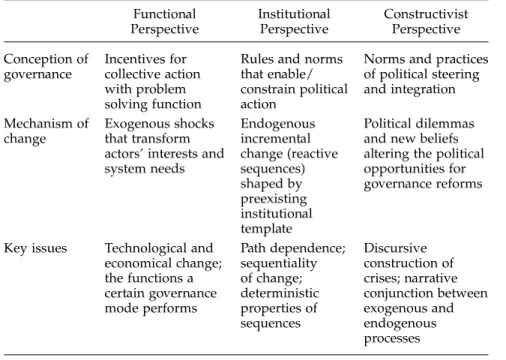
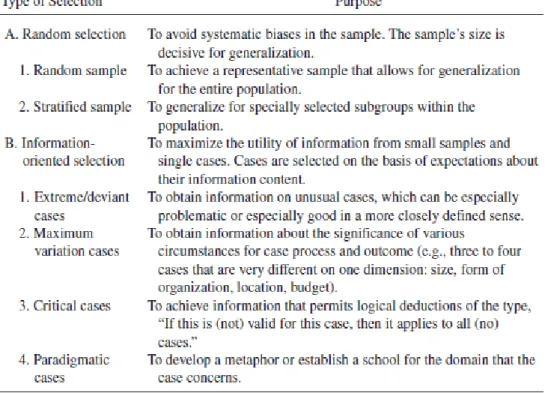
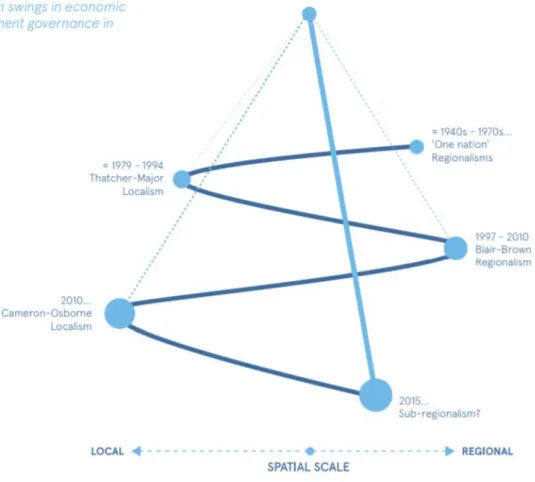
Figure 2.4: Theoretical perspectives on Governance Change………..45 Figure 3.1: Flyvbjerg’s strategies for case selection………61 Figure 3.2: Taxation revenue attributable to sub-national and central/federal government as a percentage of GDP, 2010……….64 Figure 3.3: Pendulum swings in economic development governance in England…………..66 Figure 3.4 Map of Greater Manchester Local Enterprise Partnership geography...69 Figure 3.5 Map of North East Local Enterprise Partnership geography………..72 Figure 4.2 Government spending on Regional Development Agencies and new local growth funds and structures, 2005-06 to 2014-15………....………98
Figure 5.1. ‘Change in spending power by local authority type, 2010-11 to 2015-16’…….109
List of Tables
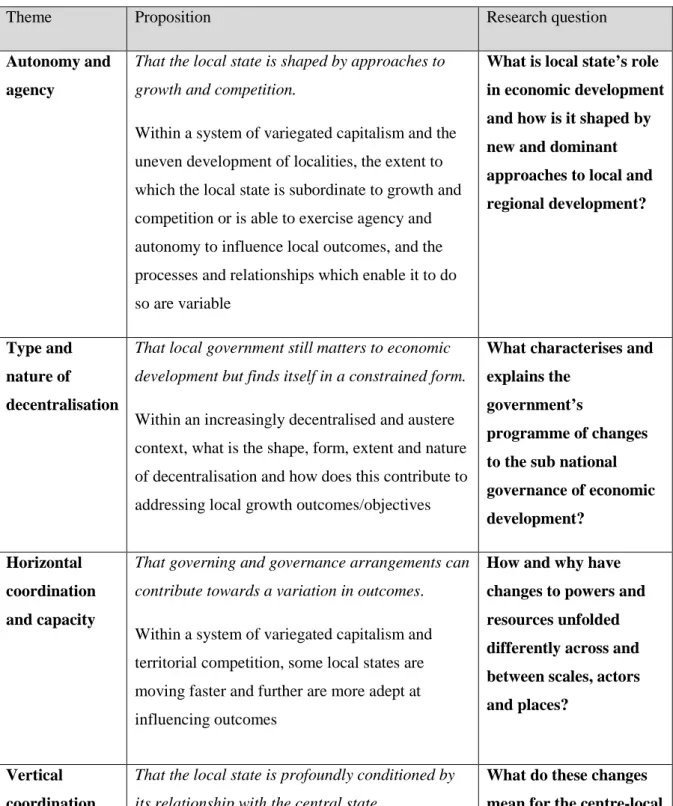
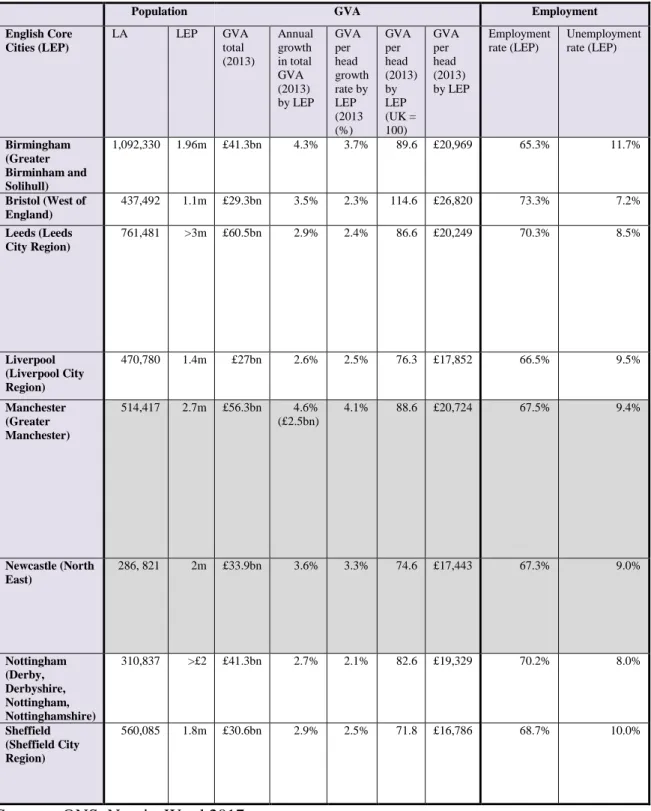
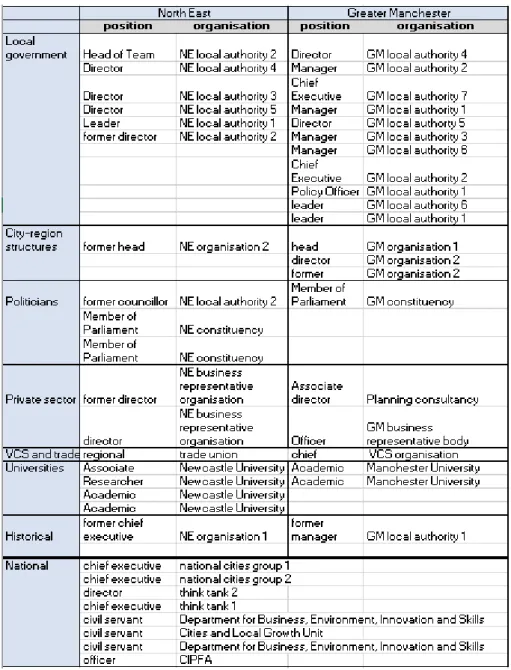
Table 2.5. Research framework and questions………55 Table 3.2 Core Cities comparison………....63 Table 3.3 Breakdown of interviewees………..76 Table 4.1 Summary of Coalition government critique and new proposals for local growth...85 Table 4.2: Governance changes in Greater Manchester ……….91 Table 4.3: Governance changes in the North East………101
Chapter 1. Introduction
1.1 Towards decentralisation and localism in a centralised state?
Decentralisation to a variety of spatial scales is a prominent global trend in government and governance. However, the type and nature of decentralisation and localism made available to sub-national tiers is highly uneven and variegated (Rodríguez-Pose and Ezcurra, 2010;
CURDS and LSE, 2011). While the principle of subsidiarity and transferring decision making to the lowest possible level is generally accepted as necessary for effective and efficient sub-national economic development (Tiebout, 1956), the interpretation and implementation of decentralisation and localism in practice, by central governments, presents an uneven picture. In the UK economy, which is embedded in a highly centralised state, the uneven (and partial) implementation of decentralisation is even more pronounced.
Alongside this trend, the growing importance of cities and city-regions as a critical scale in decentralisation and localism has brought greater attention to the capacity and capability of the local state (see for example Harding, 2007; Jonas and Ward, 2007). A particular concern is how local state actors adapt and reconfigure in new frameworks of government and governance at the city-region scale, to enable and facilitate an economic development and growth agenda. A pivotal actor in the local state is local government with a unique set of objectives and responsibilities. However, in this latest episode of decentralisation, the role and contribution of local government in the local state has been reshaped and challenged in the broader context of restructuring, crisis and austerity within the distinctive political-economy and institutions of a highly centralised state.
The roles of local government in the local state in shifting cycles of decentralisation and localism have continued to be questioned over time (Cockburn, 1977; Cochrane, 1993; Ward et al., 2015). More recently, contributions on networks and governance theory have
overlooked the role and contribution of the local government in these institutional
arrangements, perhaps reflecting a decline in the theoretical interest in local government as well as its power base (Ward et al., 2015).
This research aims to understand and explain the changing role and structure of the local state in new frameworks of government and governance for economic development and how this has unfolded unevenly across scales, places and actors. In doing so the research examines the extent to which local government remains a pivotal actor in the governance of economic development in increasingly multi-level and multi-actor configurations of the local state. The
motivation for this study was twofold. First, to critically examine and explain this episode of decentralisation and localism and make explicit the underpinning assumptions and arguments of the local and central actors involved. Second, to explore the unique role of local
government in the context of the governance of uneven development and across relational spaces. Chapter 2 explores these questions and contributions in more detail. This next section explains how these terms are defined in the research and why this focus was selected.
1.2 Revisiting conceptualisations of the local state
This research examines the changing role and structure of the local state in economic development. The focus on local government in the local state is to address a gap in the literature in understanding the role of political institutions in economic development and how their qualities and capacities shape the activity of other actors and economic outcomes
(Helpman, 2004; Tomaney, 2013).
The definition of the local state used in this research draws on the distinction between local administration (local governance) and local democratic representation (local government) (Williams, 1998) to describe the local state in terms of the different local governance actors for economic development working alongside local government – as one element in the local state (Cochrane, 1993). Developing this further, this research argues that local government is not just one actor in the state but the pivotal actor, shaping the coordination and capacity of other actors, and this has become even more important with decentralisation and austerity. The distinction between local government and the local state is addressed in this research by examining frameworks of both government and governance simultaneously and recognising the role that local government plays within a broader multi-scalar and multi-agent context. In the context of a Schumpeterian workfare state (SWS), focused on the promotion of innovation and competitiveness (Goodwin et al., 1993; Osborne and Gaebler, 1992), local government’s transition towards an enabler, facilitator and commissioner of services in a market-oriented, neoliberal governance system has placed local government in a complex web of agents involved in the development of local economies (Bennett, 1997). A renewed territorial policy and decentralisation focus on cities and metropolitan governance has also turned attention to the local state. In particular, in the context of declining state capacity, relational interpretations of place, and a broadening field of economic development under decentralisation encompassing a greater number of interests and policy domains. This
research develops the argument that these changes have also increased local government’s relevance in the local state.
Chapter 2 provides a comprehensive discussion of the themes and transformations of local government and the local state. This builds on a critique of the local state’s linear depiction in earlier conceptualisations and questions on its conceptual relevance in a fragmented context. The review of the literature identified four perspectives in understanding and conceptualising the local state relevant to this study. First, how the relationship between local government and the local state is defined in new approaches to economic development and growth (Section 2.2.1). Second, examining the autonomy and agency of the local state in relation to frameworks of government and territorial development (Section 2.2.2). Third, examining both territorial and relational perspectives on the local state to understand how new localities are formed (Section 2.2.3). Fourth, exploring the politics of the local state to examine the interrelations between different sets of actors operating in and across the local state (Section 2.2.4). Examining these perspectives alongside a better understanding of the way local economies are governed for economic development (2.3) and of how processes of
decentralisation and rescaling have unfolded at the local level (2.4) allow for a multi-scalar and multi-actor analysis of the local state.
The review of the literature on local institutions, the local state and economic development (Chapter 2) identified further questions or ‘gaps’ to be explored through the empirical research and these informed the research questions for this study:
1. What is the local state’s role in economic development and how is it shaped by new and dominant approaches to local and regional development?
2. What characterizes the government’s programme of changes to the sub-national governance of economic development?
3. How and why have changes to powers unfolded unevenly across scales, actors and places?
4. What do these changes mean for centre-local relations in the sub-national governance of economic development?
1.3 The framework for research: a comparative case study approach
This was an in-depth and qualitative study to be able to uncover and explain the complexities of local institutions in frameworks of government and governance for economic
development. The research drew on the analysis of interviews and secondary data to construct case studies to explain how the role of local government has unfolded in a city-region context.
To address the aim of the research and examine how decentralisation changes have unfolded across and between different spatial scales, geographic contexts, and actors; the research was comparative and looked beyond the core case study to other city-region examples to develop a rich and nuanced understanding of the governance changes as well as a finer grained analysis of the core case study itself. The focus of the comparison was on how
decentralisation changes for the government and governance of economic development have unfolded across economically similar cases within a single national context but with different governance and economic development outcomes.
The UK was selected as the focus of the empirical research to understand processes of
decentralisation within a highly centralised state. There have been studies that have addressed local state reform in more decentralised countries, for example in Western Europe (Tselios et al., 2012) and across OECD countries (Charbit, 2011). Despite experimenting with
decentralisation to the sub-national level in various spatial imaginaries (regions, city-regions, pan-regions), successive governments have failed to redress the balance of fiscal
decentralisation and local autonomy (CURDS and LSE, 2011; CLG Committee, 2014; London Finance Commission, 2013: Pike et al., 2015). The 2010 Coalition government identified decentralisation, rebalancing and localism as a priority. This study examined decentralisation changes for the sub-national government and governance of economic development over the five year parliamentary term and continuing into the Conservative’s administration. This was to understand the particular type and nature of decentralisation and how it has unfolded, shaped by the distinctive political-economy and institutions of the local and central state.
The North East (NE) and Greater Manchester (GM) were selected as the case studies using Flyvbjerg’s information-oriented strategy and an ‘extreme/deviant’ case selection approach to obtain information on unusual cases that can be especially problematic or especially good (Flyvbjerg 2006: 229-30). Both case studies are in the North of England and have an industrial past and post-industrial legacy, with sector strengths in innovation but also with some of the of the most deprived wards in England. Both case studies were former
metropolitan councils in the early 1980s, and city region development pilots in the 2000s (albeit the NE had a different city-region geography) and have Core Cities, Manchester and
Newcastle, in their city-regions. Greater Manchester was the first to establish a Combined Authority in 2011 based on an already-functioning city-region geography, were in the first wave of Local Enterprise Partnerships in 2011, secured the first devolution deal in 2014, in addition to subsequent deals and became the Coalition’s trailblazer for devolution and model of governance for others to look to (Blond and Morrin, 2014). The North East established a new city-region governance scale in 2010, formed a Local Enterprise Partnership also in the first wave in 2011, and a Combined Authority at a later stage in 2014. To date, the NE has been unable to agree a devolution deal between local partners and with central government with prospective deals being abandoned through local and central negotiations. In contrast to the coherent local state collaboration over decades in GM, the NE’s history of collaboration is one of churn and fragmentation between local actors.
This study draws upon academic work that has examined the political economy and social, and cultural evolution of the Greater Manchester and North East local economies and in relation to urban governance. In the North East, the earlier work on the politics of local state (Shaw, 1990a; Shaw, 1990b; Shaw, 1993), on post-industrial Tyneside (Byrne, 1989) and on moving forward from the 2004 referendum on an Elected Regional Assembly for the North East (Shaw and Robinson, 2007) and emergence of city-regions (OECD, 2006). From 2010, analyses of the changes to the sub national level and implications for the local level (Shaw and Greenhalgh, 2010; Shaw and Robinson, 2012; Shaw, 2012) and promoting local growth (OECD, 2012; OECD, 2015). In Greater Manchester, the seminal work of Tickell and Peck (1996) on who governs Manchester has informed a body of critical work examining the urban transformation and restructuring of Manchester and Greater Manchester (e.g. Peck and Ward, 2002). More recent work has examined the role of Manchester and progress under the
Coalition government’s programme of devolution (Ward et al., 2015; Haughton et al. (2016) as well as the evolution of the city-region (Deas et al., 2014; OECD, 2015).
In total, 50 in-depth interviews were undertaken with local economic actors in GM and the NE, in addition to a small number of interviews in central government and cities networks. The framework of analysis was developed through a series of research propositions that emerged from a review of the literature and guided analysis of the empirical material. A relational comparative approach (Ward, 2010) encouraged cross-case examination critical insight and reflection on the core case study and comparator case study. This helped to draw out and reflect upon the similarities and differences between the cases and how the broader processes of change were mediated and attenuated in different institutional, spatial and
temporal settings. The outcome of the comparative research was a more detailed
understanding of the diversity of cities in relation to theories rather than identifying ideal types of governance (Robinson, 2002; Ward, 2010).
The study commenced in September 2011 and the fieldwork was conducted between June 2015 and February 2016. There were a number of reasons for this. First, arriving at this stage in the research following a period of maternity leave. Second, waiting until after the May 2015 General Election so all interviews could be conducted in the same political context and reflect back on the 2010-2015 Coalition government term. Third, delaying approaching potential interviewees in the North East due to the sensitive devolution discussions underway at that time.
The outcome of the General Election saw political control shift from the
Conservative-Liberal Democrats Coalition government to overall Conservative control. The Rt Hon George Osborne remained as Chancellor for the new political term and continued to prioritise
reducing the deficit and cuts to local government funding in order to balance the budget by 2020, thus presiding over the ongoing challenging circumstances for local government that began under the Coalition government. The research sought to understand and explain the different implications for local government from policy and funding changes introduced over the period 2010-15, which was the term of the Coalition government. As the study period as well as the fieldwork and analysis came before the 23 June 2016 Referendum to Leave the European Union, this has not been reflected upon. The study was written up over the course of 2016-17.
1.4 Conceptual and theoretical contributions
The aim of the study was to understand and explain how new frameworks of government and governance for economic development have unfolded across scales, places and actors. The purpose was to examine the extent to which local government remained a pivotal actor in economic development in increasingly multi-level and multi-actor contexts and in a climate of reduced public resources. A review of the literature on local institutions, the local state and economic development provided an understanding of existing conceptual frameworks to examine the local state in economic development in addition to highlighting gaps and opportunities to build new insight in a number of areas relating to the autonomy and agency, type and nature of decentralisation, horizontal coordination, and centre local relations.
The analysis showed that this was an expanding area of both academic and policy interest and particularly in the context of addressing uneven development. However, within debates on approaches to sub national growth (OECD, 2012; Glaeser, 2012, Pike et al., 2017), there are diverging perspectives on both where development and growth activity should be spatially concentrated in a national context, on the capacity and capability of city-region actors to mobilise in response to opportunities and through new forms of urban governance (Nelles, 2012; Ahrend et al., 2014), and on role of state institutions in facilitating and enabling development and growth (Tomaney, 2013). In increasingly multi-level and multi-actor configurations of government and governance for economic development and with Urban Economics as a dominant paradigm of growth shaping where growth happens as well as who is involved in shaping it; the role and contribution of local government to new forms of urban governance has been overlooked.
The research offers distinctive contribution to these academic and policy debates by
providing a finer grained understanding and appreciation of: first, why institutions matter and how they influence the governance of economic development (Rafiqui, 2009; Farole et al., 2011; Pike et al., 2015); second, of local government in the local state in order to understand its unique role as a political institution and the political factors that “shape incentives for economic action” (Tomaney 2013: 6); third, to understand how new frameworks of government and governance have unfolded differently for city-regions in England to understand and explain the variation in governance and decentralisation outcomes (Gertler, 2010); fourth, through a relational comparative approach, reveal the uneven ways in which the broader processes are mediated in particular city and city-regional contexts, drawing out similarities and differences. Also to provide a critical and in-depth analysis of the Greater Manchester model of governance that has been the template and shaped the Coalition
government’s approach to decentralisation and devolution to cities, to sit alongside the many normative accounts of its success (cf. Emmerich et al., 2013; Holden and Harding, 2015; OECD, 2015), alongside a less successful and less well interrogated example from the North East. Finally, to provide lessons on collaboration across the local state as well as the role of the centre for future local governance experiments.
The first contribution from the research demonstrates that local government remains a pivotal actor in the local state in the governance of economic development but in new and changed forms. The review of the literature showed that analyses of urban governance can overlook the role and contribution of local government as an economic actor in local state
governance to government (Koch, 2013) and the contribution of a qualitative state (Pike and Tomaney, 2009) by exploring the unique role of local government in a level and multi-actor context of the local state. The empirical analysis showed how local government remains a pivotal in the local state for economic development with new enhanced responsibilities at a sub-national level, working in new institutional forms of groups of local authorities, and in both a reduced climate of resources and shift towards an increased reliance on growth incentivised funding. The fundamental characteristics of local government – of democratic representation and delivering a unique set of public missions such as justice and equality – are critical roles and responsibilities that are being implemented and challenged in new ways. This includes acting as representative governance at new city-region scales and having economic and social levers at their disposal in a broadening field of economic development. Analysis of the two cases showed the territorial challenges of relational ways of working and how dominant political actors and interests can lead to ‘political lock-in’ of established approaches.
The second contribution demonstrates the need for a greater consideration of multi-actor and multi-level arrangements in the local state, in which local government and centre-local relations are critical. This argues for not only examining horizontal governance and the interests of different actors in the local state, but also understanding this in relation to
frameworks of government. This is to understand and explain how the autonomy and agency of the local state is contingent upon local and central government. This is important to understanding explaining the autonomy and agency of the local state particularly in the context of a broadening field of economic development powers and responsibilities.
This includes how the role and responsibilities of the central state are often largely undefined and unaccounted for in supporting sub-national economic development, despite this being critical to the agency and autonomy of the local state. This research has found that by leaving opaque the contingencies of the local state on the central state this can undermine its agency and autonomy as well as prevent local actors holding central government to account for commitments to resources and implementation, to also reduce uncertainty. Second, with more integrated approaches to economic development across different policy areas and
geographies (see below) and more open and ‘bottom up’ approaches to collaboration and governance giving a greater number of local actors a stake in determining priorities and investment, the governance mechanisms required to negotiate a more diverse range of interests and how this will be coordinated and by whom, link back to representative democracy becomes a challenge in multi-level and multi-actor governance systems.
The third contribution of the thesis demonstrates that a ‘centrally-prescribed’ version of localism has shaped the agency of the local state to implement new forms of governance and economic development. This refers to the type and nature of decentralisation and localism implemented by the Coalition government and explains how and why it has unfolded differently across scales, places and actors. The literature shows that different forms of variegation of decentralisation and localism are not sufficiently examined and this can explain the uneven outcomes of localities. The research showed that local states were not only shaped by the type of decentralisation and localism on offer, but also how changes were implemented. In this latest episode of decentralisation in England, the Coalition government pursued a process and form of politics which resulted in deep and fast reductions to local government funding, and rescaling of the financial crisis to the local and urban scale. These insights build on the work of Peck (2012) and Meegan et al. (2014) looking at austerity urbanism and urban politics, and Wills (2016) on localism.
The empirical analysis showed how an overriding focus on reducing the deficit and austerity underpinned all decentralisation and localism activity. These objectives were not always explicit, nor was their consideration of the impact of cumulative changes to local government and the local state. A clear example of centrally-prescribed localism was the Coalition’s focus on decentralisation of economic development powers and responsibilities to, arbitrarily defined, functional economic areas as the preferred scale. Also the specific governance requirement to have a directly-elected metro mayor to acquire substantive powers and local flexibility. Some interviewees perceived this to be backdoor restructuring and rationalising of local government, particularly given the scale of austerity borne by the local level through cuts and expectation to absorb further savings as reduced pots of funding were decentralised. The Chancellor’s advocacy of the GM model of governance and devolution for other places to follow, also provided a challenge for local areas configured differently.
The fourth contribution is that economic development has become further integrated with social policy through a focus on economic growth, austerity and changes to local government finance. This emerging contribution finds that a more explicit link between economic and social policy at the sub-national level has emerged under decentralisation. Social policy is now more geared and linked to economic policy and its focus upon economic
competitiveness and growth at the sub-national and city-regional scale.
The empirical analysis showed that greater integration of economic development and social policy was developed through an economic discourse and narrative on how spending in social
policy made economic sense to reducing the deficit. Also through the shifting nature of local government finance, away from grant funding to growth-incentivised funding sources, such as business rates and council tax, creating a dependency for local authorities to fulfil their statutory duties through economic development and growth.
1.5 Structure of the thesis
Chapter 2 provides a critical review and analysis of the underpinning literature on local institutions, the local state and economic development. This grounds the study, frames the empirical research and sets out its contemporary relevance. The chapter is organised into four sections to examine: the contemporary relevance and focus of examining local institutions in economic (2.1); critically examining definitions and conceptualisations of the local state (2.2); critically reflecting on the general changes that have shaped, and are continuing to shape, the way local economies are governed for economic development (2.3); and how processes of decentralisation and rescaling have unfolded at the local level (2.4).
Breaking this down, in Section 2.1, an institutionalist perspective is developed that recognises the politics of governance and complex political-economy of the local and central state, to examine and interpret decentralisation changes and how they have unfolded across scales, places and actors. Section 2.1.1. examines how institutions are defined in order to understand the different manifestations and configurations that emerge and highlighting the interaction between formal and informal institutions as important to understanding the institutional framework. Section 2.1.2 identifies political institutions as a critical institution in economic development. Examining how politics interacts with institutions in the local state for
economic development is a central aim of this study and this section discusses the importance and focus of addressing this. In Section 2.1.3 the role and functions of institutions in
economic development are explored to understand the variety of demands and relationships involved in the governance of economic development and examining not just what they do but the processes that enable or constrain them.
Section 2.2 introduces the local state in economic development and explores different frameworks of analysis to develop an understanding of urban governance within multi-level and multi-actor settings and to identify gaps to address through empirical research. Section 2.2.1 explores definitions and conceptualisations of the local state to understand and explain the distinctive role of local government in the local state and to identify the limitations of existing interpretations. Section 2.2.2 explores the agency and autonomy of the local state
and in particular the exogenous and endogenous sources that generate institutional change and how these are mediated and negotiated locally. In Section 2.2.3, the geographies of the local state are examined to understand the territorial and relational perspectives and tensions that manifest in governing across new economic geographies and in multi-scalar frameworks of governance. Following on from this discussion, Section 2.2.4 explores what these multi-level and multi-actor relationships means for negotiating the politics of the local state across political and administrative boundaries and with the central state. Sections 2.3 and 2.4 examine the general changes and transformations in the local state.
Chapter 3 introduces the methodological approach in the study to address the aim and research questions, explores important considerations in undertaking comparative research and in economic geography, and provides the justification and context for the study focus and case studies.
Chapters 4-7 introduce and discuss the empirical analysis. The chapters begin with examining the national context and the distinctive political economy and institutions of the central state that interacted with the local state to shape governance outcomes. The experiences of the two case studies are then examined and discussed to explain how and why changes have unfolded unevenly across places, scales and actors.
Chapter 8 draws together the study conclusions, addresses the research questions, and offers theoretical and conceptual contributions in addition to reflections on future research.
1.6 Research aim and questions
The overall aim of the research was to examine the changing role and structure of the local state in new frameworks of government and governance for economic development and how this has unfolded differently across scales, places and actors. The main argument of the research – and its contemporary theoretical and policy relevance – is that local government remains a pivotal actor in the governance of economic development. In the context of what appears to be constant restructure and upheaval of the local state; local government, as suggested by Barnett (2013), maintains a degree of permanence despite constant talk of its demise. This research demonstrates how local government has become more important in the context of decentralisation and austerity, but in new and changed forms. The research
therefore sought to: first, critically review the emergent concepts and theories on the local state in the context of new approaches to local and regional development and policy. Second,
identify the new and emergent forms of institutions, governance arrangements and policy for local and regional development in an international context. Third, examine the actors and explain the structures, roles and relationships involved in economic development for the case studies. Fourth, develop an analytical framework to interpret and assess the sub-national changes. The research questions are set out below:
1. What is the local state’s role in economic development and how is it shaped by new and dominant approaches to local and regional development?
2. What characterises the government’s programme of changes to the sub-national governance of economic development?
3. How and why have changes to powers unfolded unevenly across scales, actors and places?
4. What do these changes mean for centre-local relations in the sub-national governance of economic development?
Chapter 2. Local institutions, the local state and economic development
2.1 Local institutions and economic development: contemporary relevance and developing a critical approach
This chapter examines and grounds the study in the literature on local institutions, the local state and economic development to frame the research in wider theoretical debates as well as to highlight gaps in the literature that the research will seek to address. The chapter explores this in two parts. First, the role and contribution of local institutions in economic
development is examined. Crucial to this is defining institutions and then examining those institutions that are critical to economic development and their role and functions. This analysis argues that the role of local government as a political institution in the local state is critical to the overall functioning of economic development activities. Second, the chapter examines in depth the role and contribution of local government to economic development in the local state to understand and explain how governance processes and relationships unfold.
The local level and city-region scale is a relevant geographic scale to examine how
institutions seek to structure and shape the agency and relationships of economic actors, to examine the role of extra-local relations and processes in establishing and conditioning how institutions operate, and to explore how institutions adapt and cope with change, disruption and uncertainty (Pike et al., 2015). Furthermore, the scale of city region and metropolitan areas plays an important role in the governance of economic development (Wills, 2016).
The role and contribution of institutions in economic development as a source of inquiry in economic geography research, continues to generate both interest and scrutiny as scholars and practitioners explore ways to explain the geographically differentiated growth of cities and localities. The global trend of political and administrative decentralisation to a variety of spatial scales (Tomaney, 2013; Faguet, 2013) has opened up regions and localities to the opportunities and challenges of territorial competition and sparked a search for ‘multi-scalar fixes’ (Brenner, 2009; Pike and Tomaney, 2009; Pike et al., 2015). However these
institutions and local actors are embedded in multilevel hierarchies that define to a large extent their scope and action and how they interact with existing forms and structures (Pierre, 2011), and in an increasingly contested space of scale and urban politics. Furthermore, the recent economic downturn and austerity state has cast a more critical lens on public institutions in a context of declining state capacity (Streeck and Mertens, 2013), declining democratic capacity and electoral disengagement (Crouch, 2011).
Recent academic contributions (Gertler, 2010; Rodriguez-Pose, 2013; Tomaney, 2013; Pike et al., 2015), building on a longstanding institutionalist strand of literature (cf. North, 1990; Rodrik, 2003; Faguet, 2013) have sought to re-examine the relationship between institutions and economic development and to provide a “richer account” (Rodrik 2003: 12) and more “finely grained appreciation of the geography of institutional variation” (Gertler 2010: 5). These studies contribute towards a better understanding of the origins of institutions, relationship between scales, and their ability to effect evolutionary change over time.
2.1.1 Defining institutions in relation to growth and development
To examine and explain the “distinctive institutional manifestations and configurations” (Pike et al. 2015: 188) that emerge in different geographical contexts, at different scales and at different speeds, institutions must first be defined. The most commonly cited definition is that by North who describes institutions as “the rules of the game in a society; (and) more formally, (as) the humanly devised constraints that shape human interaction” (North 1990: 477). According to Rodríguez-Pose and Storper, most of the literature tends to agree with a “two-tier division” (2006: 10): ‘formal’ or ‘hard’ institutions or ‘society’, and, ‘informal’, ‘tacit’, ‘soft’ institutions, ‘community’ or social capital (Amin, 1999; Pike et al., 2015). Expanding on North’s definition, Fukuyama describes how ‘formal’ institutions (also known as ‘hard’ institutions or ‘society’) can be regarded as universal and transferable rules and generally include constitutions, laws, charters, bylaws and regulations, as well as elements such as the rule of law and property rights and contract and competition monitoring systems (Fukuyama 2000: 6). In contrast ‘informal’ institutions (also known as ‘soft’ institutions, ‘community’ or social capital) include a series of features of group life “such as norms, traditions and social conventions, interpersonal contacts, relationships, and informal networks” which Fukuyama describes as essential for generating trust (2000: 3).
An important distinction to draw upon in North’s work, is to separate institutions, “rules of the game”, from organisations, “players of the game” to understand and analyse the evolution of economic systems (Rafiqui 2009: 335-336). A distinction also made by Storper (1997) who describes institutions (underlying rules of practice and conventions between individuals and organisations) and organisations (specific administrative and political forms). North emphasises the constant interaction between the institutions and organisations, “what organizations come into existence and how they evolve is influenced by the institutional framework. In turn they influence how the institutional framework evolves” (1990: 5). This
interaction can also be examined using Martin’s description of the ‘institutional environment’ and ‘institutional arrangements’ (2000: 79),
“The ‘institutional environment’ [that] refers to both the systems of informal conventions, customs, norms, and social routines… and the formal… structures of rules, regulations… which constrain and control socioeconomic behaviour… [and the] ‘institutional arrangements’ … used to denote the particular organisational forms… which arise as a consequence of, and whose constitution and operation are governed by, the institutional environment.”
From this analysis, Pike et al. (2015) recommend further examination the interaction between the institutional environment and arrangements and how this shapes economic behaviours and outcomes across and between different spatial levels and in particular geographical contexts through the “institutional regime”, as an important issue that requires further examination (Pike et al. 2015: 5). Further to this, and in order to better understand the approaches and methods used to shape economic behaviours and why some approaches are more effective than others, a finer grain analysis of the interrelations between formal and informal institutions (Rodriguez-Pose and Storper, 2006) within the institutional environment could reveal more about these processes. The OECD (2012: 25) underscores the important interplay between formal and informal institutions that creates opportunities for negotiation and dialogue among key actors that mobilises and integrates them into the development process, the focus being on enhancing policy continuity, creating a cohesive voice external to the locality and region and fostering linkages between private and public sectors. Nelles (2012) research on intermunicipal cooperation stresses the importance of flexible
arrangements, partnerships and collaboration, alongside structures, in tackling metropolitan issues. Also, the relationship between institutional quality and economic performance is widely recognised – better, stable institutions contribute to better economic performance however it is more difficult to demonstrate this (OECD Regional Outlook, 2014).
Notwithstanding a growing policy salience of the role of institutions in local and regional development, there remain limitations in the theory and understanding of institutions and the difference they make (Tomaney, 2013) and particularly at the local level (Pike et al., 2015). It is argued that institutions remain “poorly understood and under-appreciated in specific
disciplinary domains relevant to economic development at specific spatial levels and in particular geographical contexts” (Pike et al. 2015: 3). Empirical studies point to the difficulty of determining the impact of effective (and ineffective) institutions on economic
development prospects (e.g. OECD, 2012; Rodriguez-Pose and Garcilazo, 2013), pointing to the importance of qualitative case study research to address this. A qualitative research approach can help to explain “which institutions, when they matter, and precisely how they shape growth” (Farole et al. 2011: 59, emphasis in original). However, the challenge for comparative research is to move beyond the idea that institutions matter and differ between places to “pin point exactly how they influence economic development” (Rafiqui 2009: 339) and to examine interactions between institutions and economic development at different geographic scales (Gertler 2010: 5-6). The imperative for this being the growing evidence that local solutions may not have sufficient scale to address economic development issues that span political and administrative boundaries, requiring increasingly “interlocal and interorganizational” forms of governance (Peck and Tickell 2002: 393). For urban or metropolitan areas within regions, the evidence points to coordinated intervention across functional economic areas to capitalise on economic flows (Katz and Bradley, 2013). Also forms of intermunicipal cooperation and collaboration, both formally binding and informal, are becoming more prevalent (Nelles, 2012; OECD, 2012).
How we come to understand the role and contribution of institutions and the local state is also shaped by different approaches to local and regional development and growth. The dominant approaches to growth advanced in the 2000s include New Economic Geography and Urban Economics and the work of Glaeser (2012; see Tomaney, 2013 for a critique). These perspectives advocating concentrating growth in larger cities and connecting smaller places through supply side measures to benefit from external spillovers from agglomeration economies. A counter-perspective to this is ‘place based’ policies for development – which point to sources of growth being diverse as well as locations (OECD, 2012) and is providing a counterweight to these hegemonic ideas (cf. Barca et al., 2012; OECD, 2012). This
approach highlights the instrumental role of institutions in supporting growth but equally where institutions are ineffective this can have a negative impact.
2.1.2 Political institutions critical in the local state
Recognising the role of informal and soft institutions alongside the more traditional and hard institutions assigns an important role for political institutions in the governance of economic development. Political institutions at the local and city-region level refer to local government or groups of individual local authorities and their associated structures. However, in
recognising that institutions cannot be reduced to specific organisations using the
institutions can therefore be expressed as, an important actor within the system of economic development government and governance at the city-region level (formal institution) and also part of the traditions of cooperative working between public, private and civic institutions (informal institution) (Rodríguez-Pose, 2013).
In the human geography literature on institutions and development, Tomaney (2014) highlights a gap in understanding how politics interacts with institutions in shaping
development policies and outcomes and why there are differences in subnational economic performance (Dellephiane-Avellaneda, 2009). North (2005: 57) ascribes this to the “primacy of politics”, in that “it is the polity that defines and enforces the economic rules of the game and therefore is the primary source of economic performance”. This includes affecting the ability to innovate and to implement new technologies through political institutions framing the struggle between proponents of change and their opponents (Helpman 2004: 315). In evolutionary economic geography, this is also described as “political lock-in” (Hassink 2007: 1147), which can occur when institutions aimed at preserving existing traditional structures slow down industrial restructuring, thereby obstructing the development of indigenous potential and creativity. In contrast to economic decisions, political decisions are of a
different nature, reflecting “complex, moral, ethical and ‘non-rational’ reasoning – or diverse rationalities (DiMaggio, 1998), and “create the conditions in which markets and economies evolve” (Tomaney, 2014: 135-136). Tomaney argues that a better understanding of the qualities and capacities of local political institutions would lead to a better understanding of how political factors shape incentives for economic action (2014).
Around the world, the political system at the local level varies from, the small, fragmented and powerless American municipalities to the politically and financially strong local authorities of Scandinavian countries (Pierre, 2011). Notwithstanding this, in the United States of America there have been recent examples of local and metropolitan scale
governance innovation not least in response to a post-recession federal state hiatus (Katz and Bradley, 2013) and reported downscaling of austerity impacts (Peck, 2012). The process for how economic development takes place and who is involved is the topic of contemporary academic and policy discussions. This is particularly the case for political institutions that seek to make sense of a context defined by austere growth and fiscal constraints, shifting scales and economic territories, electoral disengagement, and a lack of trust in political parties within modern democracies. Also, the suitability of politicians, to set tough,
discriminating objectives in economic development cannot be assumed (Hanssen et al. 2011: 48).
2.1.3 The roles and functions of institutions in economic development
There are many ways of defining local economic development including whether
development is seen as being a ‘top-down’ versus a ‘bottom-up’ intervention. The following definition is employed here to highlight the collective nature of the process of economic development and one that is focused on outcomes,
“the purpose of local economic development is to build up the economic capacity of a local area to improve its economic future and the quality of life for all. It is a process by which public, business and non-governmental sector partners work collectively to create better conditions for economic growth and employment generation” (Swinburn et al. 2006: 1).
The collaborative focus described above has implications for the role and focus of
institutions. The role and functions performed by institutions in economic development at the local level depends upon the nation state context and both the ‘formal’ and ‘informal’
institution characteristics, introduced in the previous section (Rodriguez-Pose and Storper, 2006). However there are some more general themes that can be extracted from the literature in the context of political institutions. Governance frameworks for economic development are increasingly multi scalar and multi agent, this places demands on new and existing
institutions to negotiate vertically (with supranational, national and regional structures) and horizontally (in coordinating and mobilising other actors in the public, private and civic sectors) - across scales and agents - to achieve development outcomes. An important role for institutions in these frameworks is therefore,
“…reducing uncertainty for local actors, for example, institutions undertake important work in diagnosing local economic development circumstances and issues, leading actors in deliberation and selection of priorities, formulating development strategies appropriate to local contexts and situations, and pooling and aligning resources and investments” (Pike et al. 2015a: 11).
In addition to the range of role and functions of institutions in local economic development, Pike et al. (2015a), attention should also be given to not just what institutions do in terms of responsibilities, but how those responsibilities are implemented in practice and the
democratically accountable and politically autonomous arrangements in place, in addition to the extent to which they further these goals. Analysing the role of functions of local
institutions in economic development in isolation is not sufficient to determine the contribution. For political institutions, such as local government, the ability of these
institutions to exercise their role and function in economic development as with other policy areas is also determined by autonomy and resources. Using Pierre’s (2014) distinction of two types of autonomy: ‘vertical autonomy’ referring to constitutional arrangements and
‘horizontal autonomy’ referring to the relationship between the local authority and other actors on the local level, Pierre stresses that formal, vertical autonomy both facilitates and constrains political action (2014: 880-881), a reminder that the relationship between central and local government is an important dimension to examine.
In summary, this introduction to institutions and economic development has examined the main concepts and theories to understand the role and contribution of institutions in the context of uneven development. This has shown a recognition that institutions can shape economic development but that a more finely grained analysis of exactly how is currently lacking to understand and explain the distinctive institutional manifestations and
configurations. In particular there is limited knowledge relating to the interrelations between formal and informal institutions and on the qualities and capacities of political institutions in shaping incentives for economic action which will be examined in this study. The next section will focus on examining the political institution of local government in the local state in the context of economic development, by exploring transformations in the state.
2.2 Local government and economic development in the local state
A growing research interest in the role and contribution of local institutions in economic development has prompted questions concerning the role and structure of local government and whether this is being redefined (cf. Peters et al., 2011; Peck, 2013; Barnett, 2011; Ward et al., 2015). Local government is an important political institution among a plethora of local economic actors that make up the local state. This section is structured in three parts: first, it will explore different conceptualisations and themes of the local state to emerge from a review of the literature; second, it will examine general changes restructuring and impacting on the local state; and finally examine transformations in the local state to draw out historical and contemporary insights. The synthesis and analysis of the literature will inform the
theoretical and analytical framework (see Section 2.5 at the end of the chapter) that underpins this research and guides the empirical analysis.
Western states, typically, have longstanding structures for local government and have undergone processes of reform and restructuring following an uneven transition towards a post-Keynesian welfare state and post-industrial economy (Peck and Tickell, 2002). This has had implications for the role and structure of the local state for economic development, particularly in the context of uneven development and territorial competition, responding to new approaches to local and regional development, and more recently with the global financial crisis and austerity state (Schäfer and Streeck 2013: 9). Increased inter-locality competition, reinforces the importance of the local level as a source of political activity and territorial competition (Bennett, 1997). The city has long been seen as a relevant unit for understanding how wealth is created (Jacobs, 1984) and is therefore also a significant level of geography at which to examine the economic, political and social implications of austerity (Donald et al., 2014; also Peck, 2013).
2.2.1 Defining, conceptualising and theorising local government and the local state This section examines conceptualisations of the local state to understand and explain the role of local government in the local state and to identify the limitations of existing
interpretations.
“the fragmentation of local government has led to a proliferation of different agencies which need to be considered as part of the local state, both in the fields of welfare and economic development […] local government can only be understood as one element alongside others within the welfare state” (Cochrane 1993: 5-6)
Local government, whilst rooted in the historical foundations and jurisdictions of national contexts, generally comprises a “governing institution which has authority over a subnational territorially defined area: in federal systems a sub state territorially defined area” (Bradbury 2013). The fiscal, legislative and executive authority therefore extends over the smallest geographical areas distinguished for administrative and political purposes (OECD 2001: 6). Some form of local government is found in virtually all developed polities as a complement to central government and is generally seen as a sign of healthy democracy (Kingdom 2003: 593). Local government can therefore be said to “maintain some degree of permanence” (Barnett 2013: 9), however increasingly this must be seen within sub-national systems of multi-level governance as states adapt towards increased multi-scalar and multi-agent relations.
Why do we need a better understanding of local government and the local state? First, the economic geography of places extends beyond political and administrative boundaries with a focus on functional economic areas and city-region/metropolitan areas as the context for wider growth processes. This in turn is challenging the “material and imagined coherence” of localities (Jones and Woods 2013: 39; see also Nelles, 2012). Second, economic development does not take place in a vacuum, the processes of globalisation, urbanisation and decentralisation have promoted and undermined capacity building and the empowerment of local actors leading to greater emphasis on the participation of stakeholders (Rodríguez-Pose and Palavicini-Corona 2013). This process draws in stakeholders from the private and third sectors, alongside the public sector, in formulating economic development visions and strategies for localities, in addition to developing new funding and delivery models. However, following the financial crisis, and in an austerity context, there is arguably a greater imperative for local government to work with stakeholders to develop new funding and delivery models. Third, following a trend of decentralisation that has spanned several decades - but that has manifested itself differently in different places - there is a growing body of literature that support “place-based” and more “bottom-up” approaches to growth (Barca., 2009; Barca et al., 2012; OECD, 2012) and localism (e.g. Featherstone et al., 2012). This, in turn, places demands on the capacity of local areas to build evidence, assessing and appraising the locality for investment, bidding for resources, negotiating with central government and across localities. Finally, the role of institutions in helping to facilitate growth is receiving research attention (Tomaney, 2013; Pike et al., 2015a) and this has implications for local states and the way they are manifested and configured to address, among other things, issues of legitimacy and accountability, the relationship with the centre and also the inter-relations with local government. These factors demonstrate what makes local government in the local state an important actor and focus in the governance of local economic development.
The following contextual points are worth highlighting here in order to explain how and why the interpretation of local government and the local state has evolved. Local governments in the post-industrial economies of the US and Western Europe, have a long and varied history of involvement in economic development, since the post-war period. This is usefully understood as part of the transition from a centrally driven Keynesian welfare state (KWS) ensuring a strong social safety net and, which saw local governments seeking to influence the location of companies (Jessop, 1994), to a Schumpeterian workfare state (SWS), focused on the promotion of innovation and competitiveness (Goodwin et al., 1993; Osborne and Gaebler, 1992; Brenner, 2004; Harvey, 2005; Lobao and Adua, 2011). In a market-oriented, neoliberal governance
system, the shift towards an ‘enabler’, ‘facilitator’ and ‘commissioner’ of services, has placed local government in a “complex web of agents involved in the development of local economies” (Bennett, 1997: 333; Sullivan, 2011).
As local governments became responsible for a widening range of functions and had greater local discretion, moving away from a universal state and collective consumption, this led to fragmentation of the local state and this was particularly pronounced in the United States and Great Britain (Eisenschitz and Gough, 1998). This resulted in a plethora of agencies responsible for aspects of the economy and neighbourhoods and with weak coordination overall coordination (ibid). Despite this, it is argued that fragmentation mobilised innovatory forms of ‘socialisation’ as agencies involved in the wider governance of local economic initiatives were freer from public scrutiny, expectations and accountability (Eisenschitz and Gough, 1998). The role of the local state in innovatory approaches became increasingly more important as time went on. In the US, this approach translated into the idea of “laboratories of democracy”, coined by Supreme Court Justice Louis Brandeis in 1932 (Brandeis, 1932). Within a federal framework, states and local government could act as “laboratories” and try novel and social experiments without risk to the rest of the country.
There are a number of defining aspects of local government while different across and within national contexts. These include: the rules of government and/or constitution; historical foundations; the nature of central-local relations; organisational and financial structure; and policy administration versus policy discretion (Bradbury, 2013). It is this final point, also referred to as local administration alongside the role of local democratic representation (Williams, 1998), that is pivotal to examining the relationship between local government and the local state and provides a useful distinction in highlighting the sometimes conflicting democratic (local) versus administrative (national) objectives of local government. Other definitions of the local state, however, argue that given the involvement of other actors in the process of local development - with potentially shared objectives and responsibilities - the focus of the local state should be wider than the narrow concentration on the institutions and organisations of local government (Duncan and Goodwin 1988: 32). Examining frameworks of both government and governance therefore takes into account the role that local government plays within a broader multi scalar and multi agent context.
The earlier literature on the local state raised critical questions on, the contractual and conflicting relationship between central and local (Duncan and Goodwin, 1988; Rhodes,