169d
A Study on the Interfacial Characteristics of Nitramine Explosive-Polymer Binder
Jung S. Shim, Hyoun S. Kim, Keun D. Lee and Jeong K. Kim
Agency for Defense Development (ADD) Yuseung P.O.Box 35-5, Daejon, Korea
Keyword : Interfacial Characteristics, Surface Free Energy, Explosive
Prepared for Presentation at the 2004 Annual Meeting, Austin, TX, Nov., 7-12 Copyright ⓒ J. S. Shim, Agency for Defense Development
AIChE shall not be responsible for statements or opinions contained in papers or printed in its publications.
Abstract
A Plastic Bonded Explosive (PBX) is mainly composed of nitramine explosive and polymer binder. PBX is characterized by high velocity and pressure of detonation, low vulnerability and good thermal stability. Many important applications of PBX require the good adhesion between nitramine crystals and the binder. Adhesion depends on the surface characteristics of filler and binder. In order for the better design for adhesion, profound knowledge of the surface and interfacial characteristics of explosive and binder is required.
The influence of interfacial properties of PBXs - such as interfacial tension, work of adhesion, spreading coefficient and density - on impact sensitivity were investigated.
1. Introduction
Interfacial properties of Plastic Bonded Explosive (PBX) have been widely investigated because these properties have an important effect on sensitivity and performance of PBX. Therefore, several investigators have studied interfacial properties such as interfacial tension, work of adhesion, spreading coefficient, dilation etc. in PBX interface [1-3].
Nitramine-polymer composites suffer from a problem known as dewetting. When the adhesion between a nitramine crystals and a binder is not particularly strong and can be fail under stress, dewetting occurs rather suddenly and this leads to a significant drop in tensile strength of explosives [4]. Dewetting adversely affects the performance and sensitivity characteristics of an explosive composition. Voids, which are generated between nitramine and binder on dewetting, act as initiation sites if they are adiabatically compressed by an impact or a shockwave.
In this study, explosive (RDX) and 5 kinds of polymers are selected, since they are widely used in many plastic bonded explosives. Surface free energy determined from wettability data is a proper method to describe the properties of a solid surface. Since the surface free energy of solids cannot be measured directly, the contact angles of filler and binders are measured by Wilhelmy plate method and liquid penetration method. And then the surface free energies are calculated from contact angle values by the method of Kaelble. And interfacial tension and work of adhesion of PBXs are calculated by geometric mean method. This paper discusses an influence of interfacial properties of PBXs on impact sensitivity.
2. Theoretical Backgrounds 2.1 Contact angle
Contact angle of a series of test liquids such as water, glycerol, formamide, ethylene glycol, trycresyl phosphate and 1-ethoxy ethanol etc. on the surface of explosive and
polymer specimen were measured using Cahn dynamic contact angle analyzer (DCA-312 system) [5].
Test samples for the Wihelmy plate method [6] were prepared by dipping microscopic slip cover glasses in the liquid uncured binder and then cured upside down to prevent the build up of binder on the side used for measurement. Contact angles of powder were determined by the liquid penetration method [7] based on the Washburn’s equation.
θ
cos
0pr
F
=
(1)h
kr
Lt
η
θ
2
cos
2=
(2)2.2 Surface Free Energy
Surface free energy is an important physicochemical property of a material that can be assessed indirectly from wettability measurement. In this study, the method proposed by Kaelble [8] is used for the surface energy analysis of solids. According to the semiempirical theory, the intermolecular forces contributing to surface and interfacial tensions, and subsequent phenomena such as wetting, could be broken down into independent and additive terms. For example, a polar molecule such as an ester would have two terms making up its surface tension, dispersion force (d) and dipolar interaction (p), so that
r
=
r
d+
r
p (3)where rd and rp are the dispersion and dipolar contributions to the total surface tension.
This principle produces a reasonable approximation for the work of adhesion for interactions involving only dispersion and dipole forces.
W
a=
W
sd+
W
ap (4)The principal relations for describing the dispersion and polar interactions between liquids and solids are stated as follows:
r
LV=
r
LVd+
r
LVp=
α
L2+
β
L2 (5) 2 2 S S p SV d SV SVr
r
r
=
+
=
α
+
β
(6))
(
2
L S L S aW
=
α
α
+
β
β
(7)(
/
)
2
S S L L L aW
α
β
β
α
α
=
+
(8)where αS and βS are square root of the respective dispersion
r
SVd and polarr
SVP parts ofSV
r
. From equation (8) we recognize a simple method of graphical analysis wherein a plot of Wa/2αL versus (βL/αL) defines αS and an intercept at (βL/αL)=0 and βS as a slope.2.3 Interfacial Tension
The geometric mean method (Eqs. (9)) is used to calculate the interfacial tension between explosive (RDX) and binder. When two materials are adhered by an interface, the more similar the two materials are, the lower the interfacial tension will be and the better the adhesion will be between them.
2 1 2 1
)
(
2
)
(
2
D LV D SV P LV P SV LV SV SLr
r
r
r
r
r
r
=
+
−
⋅
−
⋅
(9)2.4 Spreading coefficient
When solid-surface free-energy parameters are known, the spreading coefficient (S) may be calculated to predict the interactions of binder with a explosive [2]. During wet granulation, spreading of binder over a powder mass is preferred. The spreading coefficient is the measure of the spreading degree of one explosive over another and is calculated as a difference between work of adhesion (Wa) and work of cohesion (Wc). The spreading
coefficient of a binder over the explosive (S12) or explosive over the binder (S21) can be
calculated. These calculations can be carried out according to the methods of Wu (Eqs. (10) and (11)),
−
+
+
+
=
2
4
1 2 1 2 1 2 1 2 1 12r
r
r
r
r
r
r
r
r
S
p p p p d d d d (10)
−
+
+
+
=
2
4
2 2 1 2 1 2 1 2 1 21r
r
r
r
r
r
r
r
r
S
p p p p d d d d (11)where the subscripts 1 and 2 refer to phases 1 and 2, respectively. r d is the disperse phase of surface free energy, r p is the polar phase of surface free energy.
3. Materials and Methods
3.1 Materials
RDX was selected as a model explosive because it is widely used in many high energy PBX. Binders were 3 EVAs (USI Chem, USA) with VA contents ranging from 15 to 60%, Hytemp (Zeon Chemical, USA) and Viton (DuPont, USA). Liquids used for wetting assessment were: distilled water, glycerol (Aldrich, USA), formamide, diiodomethane, ethylene glycol, trycresyl phosphate, 2-ethoxy ethanol etc. and the surface tension properties of test liquid is listed in table 1.
Table 1. Surface Tension Properties of Test Liquids at 20℃
Surface Tension (dyne/cm) Test liquid Density
(g/cc) Viscosity (cP) rLV rLVd rLVp Water 0.997 0.97 72.8 21.8 51.0 Glycerol 1.251 1412 64.0 34.0 30.0 Formamide 1.134 3.76 58.3 32.3 26.0 Ethylene glycol 1.114 21 48.3 29.3 19.0 Dimethyl sulfoxide 1.096 1.99 43.5 34.8 8.7 Trycresyl phosphate 1.143 2.91 40.9 39.2 1.7 Dimethyl formamide 0.949 0.92 37.3 32.4 4.9 2-ethoxy ethanol 0.930 2.05 28.6 23.6 5.0 3.2 Wetting measurements
For contact angle measurement, small pellet of EVA15, EVA31, and Viton were pressed
and EVA60, HyTemp were coated to glass microscope slides (2.5 × 7.5 ㎝). The
experiments were performed by immersing the coated glass slides and press samples (3 × 4 ㎝) in the vertical position to a depth of about 10 mm in one of the liquids listed in table 1.
Wetting of the powder was also determined by means of a liquid penetration method with the use of dynamic contact angle analyzer. The penetrating liquids were water, formamide, diiodomethane, ethylene glycol and Trycresyl phosphate. Glass capillaries (100 mm long, inner diameter 9 mm) were filled with dried powder.
3.3 PBX (molding powder)
PBX’s are prepared by modified water-solvent slurry method. The RDX is dispersed in water with a suitable surfactant to form slurry. Then a lacquer solution composed of binder, in a suitable solvent, is added to the slurry. The binder is coated onto the surface of the explosive crystals by the system to distill off the solvent. The coated explosive is filtered, washed, and dried.
3.4 Impact Sensitivity Test
A Julius-Peter’s impact machine was used to determine the impact sensitivity of the PBX formulations. Test was conducted in accordance with MIL-STD-1751A [9]. The H50 value is the height in centimeters at which the probability of explosion is 50%.
4. Results and discussion
4.1 Contact angles of binders and explosive
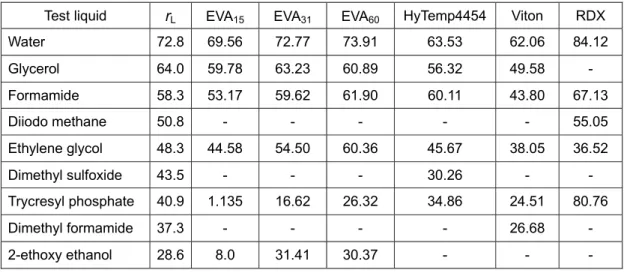
The contact angles of nine tested liquids on the various binders and explosive are shown in table 2. As we can see from table 2, the contact angles of binder and explosive were in the range of 8.0 ∼ 84.12 dyne/cm. Unfortunately, due to the fact that as contact angle of the liquids was cosθ > 1, penetration with low-surface tension liquids, such as hexane, decane and hexadecane, was not achievable.
Table 2. Contact angles of binders and explosive
Test liquid rL EVA15 EVA31 EVA60 HyTemp4454 Viton RDX
Water 72.8 69.56 72.77 73.91 63.53 62.06 84.12 Glycerol 64.0 59.78 63.23 60.89 56.32 49.58 - Formamide 58.3 53.17 59.62 61.90 60.11 43.80 67.13 Diiodo methane 50.8 - - - - - 55.05 Ethylene glycol 48.3 44.58 54.50 60.36 45.67 38.05 36.52 Dimethyl sulfoxide 43.5 - - - 30.26 - - Trycresyl phosphate 40.9 1.135 16.62 26.32 34.86 24.51 80.76 Dimethyl formamide 37.3 - - - - 26.68 - 2-ethoxy ethanol 28.6 8.0 31.41 30.37 - - -
4.2 Surface free energy
According to equation (8), plotting of Wa/2αL against (βL/αL) would result in αs (square root of dispersive solid surface free energy) as the intercept and βs (square root of polar solid surface free energy) from the slope. The results are shown in figure 1∼2 and table 3.
The α and β values are converted to their corresponding dispersive (rd) and polar free energy (rp) term. The total solid surface free energy (rs) is the sum of rsd and rsp. Also the
critical surface tension (rc) of solid are calculated using contact angle. A plot of cosθ versus
rLV, the known surface tension of liquid, is usually made and the line extrapolated to cosθ=1. It can be found from table 3 that surface free energy of EVA was range of 36.22 to 30.14 dyne/cm, an increasing solid surface free energy with decreasing VA content and rs of HyTemp4454 was 38.10 dyne/cm and rs of viton was 41.96 dyne/cm. Also, rs of RDX was
35.25 dyne/cm. We known that the rs of explosive similar to that of polymer binder.
Table 3. Surface free energy of binders and explosive
Material rC αs βs rsd rsP rs EVA15 35.67 4.98 3.38 24.80 11.42 36.22 EVA31 32.28 4.60 3.41 21.16 11.63 32.79 EVA60 30.90 4.35 3.35 18.92 11.22 30.14 HyTemp4454 27.34 4.65 4.06 21.62 16.48 38.10 Viton 35.54 4.88 4.26 23.81 18.15 41.96 RDX 41.62 5.55 2.11 30.80 4.45 35.25 0.0 0.4 0.8 1.2 1.6 5 6 7 8 9 WA /2 αL βL/αL αs=5.55 βs=2.11 γs=35.25 0.2 0.4 0.6 0.8 1.0 1.2 1.4 1.6 5 6 7 8 9 10 11 12 αs=4.65 βs=4.06 rs=38.10 WA /2 αL βL/αL
4.3 Effects of interfacial properties on impact sensitivity
The geometric mean method (Eqs. (9)) is used to calculate the interfacial tension between explosive and binder. Materials with similar surface energy properties will have low interfacial tension when joined and more energy will be required to separate or dewet the surfaces. It is therefore desirable to have a low interfacial tension between RDX and binder. The sensitivity characteristics of a PBX were influenced by these properties.
The interfacial tension, work of adhesion, density and spreading coefficient between RDX and binder are depicted in table 4. The results show the impact sensitivity factor (H50)
of the PBX increases with decreasing interfacial tension, while work of adhesion, density and spreading coefficient is not as straightforward as one would expect. From table 4, it is easy to know that the major contribution factor to H50 is interfacial tension, compare to any other
factors.
We acknowledged that a desensitizing efficiency depends strongly on coating efficiency. Consequently, a lower interfacial tension of binder to explosive could guarantee a better coating and thus a better desensitizing efficiency.
Table 4. Interfacial properties of RDX-based PBXs.
Spreading Coefficient PBXs Materials Interfacial Tension (dyne/㎝) Work of Adhesion (dyne/㎝) Density (g/㎤) S12 S21 (㎝) H50 RDX-EVA15 1.937 69.54 1.666 -4.68 -2.74 56 RDX-EVA31 2.594 65.45 1.669 -2.53 -7.45 43 RDX-EVA60 2.978 62.42 1.687 -.065 -10.87 36 RDX-HyTemp4454 4.689 68.75 1.708 -11.56 -5.72 34 RDX-Viton 5.075 72.14 1.802 -14.2 -0.8 18 5. Conclusions
The surface free energies of explosive and five binders have been determined from the contact angle measurements. The interfacial characteristics between explosive and binder
were calculated from the surface free energies. These values have been used to predict adhesion between explosive and each binder as well as the impact sensitivity of PBX. The major contribution factor to impact sensitiveness of PBX was the interfacial tension, compare to other surface properties.
Reference
1. H. Hengjian, D. Haishan, Z. Ming, C. Kemei and Z. Yufen, “A Quasi-Theoretic Method for the Selection of Desensitizers in the Designs of Explosive Formulations”, 2003 International Autumn Seminar on Propellants, Explosive and Pyrotechnics, Vol. V, pp.54(2003).
2. O. Planinsek, R. Pisek, A Trojak, S. Srcic, “The utilization of surface free-energy parameters for the selection of a suitable binder in fluidized bed granulation”, International Journal of pharmaceutics, Vol. 207, Issues 1-2, pp.77-87(2000).
3. J.S. Shim, H.S. Kim and K.D. Lee, “The Analysis of surface free energy of RDX/EVA from contact angle measurements”, KIMST, Vol. 3, part. 2, pp.219-230(2000).
4. E.S. Barak and T. Kaully, “Sensitivity of pressed PBX: Influence of binder and mechanical properties”, Proceedings of the 35th International Conference of ICT, pp.(99) 1-7(2004).
5. Cahn Instruments Inc., “DCA-312 Instruction manual”, 1994. 6. L. Wilhelmy, Ann. Phy., Vol. 119, pp.177(1963).
7. Wu, S. : “Polymer Interface and Adhesion”, Dekker, NY(1982).
8. D.H. Kaelble, P.J. Dynes and E.H. Cirlin, “Interfacial binding and environmental stability of polymer matrix composites”, J. Adhesion, Vol. 6, pp.23-48(1974).