Policy Research Working Paper
5281
The Global Apparel Value Chain,
Trade and the Crisis
Challenges and Opportunities for Developing Countries
Gary Gereffi
Stacey Frederick
The World Bank
Development Research Group
Trade and Integration Team
April 2010
WPS5281
Public Disclosure Authorized
Public Disclosure Authorized
Public Disclosure Authorized
Abstract
The Policy Research Working Paper Series disseminates the findings of work in progress to encourage the exchange of ideas about development issues. An objective of the series is to get the findings out quickly, even if the presentations are less than fully polished. The papers carry the names of the authors and should be cited accordingly. The findings, interpretations, and conclusions expressed in this paper are entirely those Policy Research Working Paper 5281
This paper examines the impact of two crises on the global apparel value chain: the World Trade Organization phase-out of the quota system for textiles and apparel in 2005, which provided access for many poor and small export-oriented economies to the markets of industrialized countries, and the current economic recession that has lowered demand for apparel exports and led to massive unemployment across the industry’s supply chain. An overarching trend has been the process of global consolidation, whereby leading apparel suppliers (countries and firms alike) have strengthened their positions in the industry. On the country side, China
This paper—a product of the Trade and Integration Team, Development Research Group (Global Trade and Financial Architecture project supported by DFID)—is part of a larger effort to explore the effects of the world economic crisis on global value chains. Policy Research Working Papers are also posted on the Web at http://econ.worldbank.org. The authors may be contacted at [email protected] and [email protected].
has been the big winner, although Bangladesh, India, and Vietnam have also continued to expand their roles in the industry. On the firm side, the quota phase-out and economic recession have accelerated the ongoing shift to more streamlined global supply chains, in which lead firms desire to work with fewer, larger, and more capable suppliers that are strategically located around the world. The paper concludes with recommendations for how developing countries as well as textile and apparel suppliers can adjust to the crisis.
The Global Apparel Value Chain, Trade and the Crisis:
Challenges and Opportunities for Developing Countries
Gary Gereffi
(Department of Sociology, Duke University)
and
Stacey Frederick
(College of Textiles, North Carolina State University)
JEL Codes: L67, L22, L23, O57, F14, F23
Keywords: global value chain, apparel, economic crisis, recession, Multifiber Arrangement, international trade, upgrading
1. Introduction
Apparel is one of the oldest and largest export industries in the world. It is also one of the most global industries because most nations produce for the international textile and apparel market. Apparel production is a springboard for national development, and often is the typical starter industry for countries engaged in export-oriented industrialization due to its low fixed costs and emphasis on labor-intensive manufacturing (Adhikari & Weeratunge, 2006; Gereffi, 1999).
Although the global apparel industry has been expanding at a rapid rate since the early 1970s and providing employment to tens of millions of workers in some of the least-developed countries in the world, the industry has experienced two major crises in the past five years. The first crisis is regulatory. The Multi-Fiber Arrangement (MFA), which established quotas and preferential tariffs on apparel and textile items imported by the United States, Canada, and many European nations since the early 1970s, was phased out by the World Trade Organization (WTO) between 1995 and 2005 via its Agreement on Textiles and Clothing. The concern of many poor and small developing economies that relied on apparel exports was that they would be pushed out of the global trading system by much larger, low-cost rivals, such as China, India, and Bangladesh.
The second crisis is economic. The recent global recession, which was sparked by the banking meltdown in the United States in 2008 and quickly spread to most of the major industrialized and developing economies, brought the world to the brink of the most severe economic crisis since the Great Depression of the 1930s. Plant closures and worker layoffs in the industrialized nations led to slumping consumer demand, which resulted in fewer orders and shrinking markets for export-oriented economies in the developing world. The recession hit the apparel industry especially hard, leading to factory shutdowns, sharp increases in unemployment, and growing concerns over social unrest as displaced workers sought new jobs.
This paper will examine the impact of the MFA phase-out and the current economic crisis on the changing patterns of supply and demand in the global apparel value chain from 1995 to 2010, and also look at how these crises have affected global sourcing and production networks among firms. Has there been greatly increased consolidation by the most successful exporting countries and among the leading firms in the apparel value chain? Who are the winners and losers in this industry, and what are the most viable upgrading strategies in today’s global economy? Finally, we discuss recommendations and strategic options for how developing countries can deal with these challenges.
2. Two Crises in the Apparel Global Value Chain A. MFA Phase-Out in 2005
Global expansion of the apparel industry historically has been driven by trade policy. Apparel is one of the most protected of all industries, ranging from agricultural subsidies on input materials (cotton, wool, rayon) to a long history of quotas under the General Agreement on
Tariff and Trade within the MFA and its successor pact under the WTO, the Agreement on Textiles and Clothing (ATC) (Adhikari & Yamamoto, 2007). The MFA/ATC restricted exports to the major consuming markets by imposing country limits (quotas) on the volume of certain imported products. The system was designed to protect the domestic industries of the United States and the European Union (EU) by limiting imports from highly competitive suppliers such as China (Thoburn, 2009).
Trade restrictions have contributed to the international fragmentation of the apparel supply chain, whereby low-wage countries typically sew together imported textile components and re-export the finished product. This reconfiguration began when exports from Hong Kong, South Korea, Taiwan, and later China reached their maximum levels under the quota system. Clothing assembly processes were then sub-contracted to low-wage developing countries throughout the Asian Pacific region and elsewhere that had unused export quotas, such as Bangladesh, Sri Lanka, and Vietnam (Gereffi, 1999; Audet, 2004).
The removal of quotas on January 1, 2005 marked the end of over 30 years of restricted access to the markets of the European Union and North America. Retailers and other buyers became free to source textiles and apparel in any amount from any country, subject only to a system of tariffs and a narrow set of transitional safeguards that expired at the end of 2008. This caused a tremendous flux in the global geography of apparel production and trade, and a restructuring of firm strategies seeking to realign their production and sourcing networks to accommodate new economic and political realities (Gereffi, 2004; Rasmussen, 2008; Tewari, 2006).
Apparel protectionism has declined in the past several years, with more garment-importing countries removing barriers to clothing trade than ever before (Frederick & Gereffi, 2009a, 2009b; just-style.com, 2009a). The economic recession and subsequent import slowdown in the United States, Europe and Japan has sparked a reinvigoration of government policies to support the textile and clothing sector in leading apparel exporting countries (see Table A-1 in the Appendix), but overall, international restrictions on apparel trade are still relatively limited.
B. The Current Economic Crisis and Its Impact on Global Apparel Supply and Demand
Consumption in the global apparel industry is highly concentrated in three main regions: the United States, the European Union, and Japan. In 2008, the European Union (EU-27, including intra-EU-27 trade) accounted for nearly half (47.3%) of total world apparel imports of US$ 376 billion, while the United States accounted for 22%, Japan for 6.9%, and the Russian Federation for 5.7% (see Table 1). Together, the United States, the EU-27, and Japan represented over three-quarters of world apparel imports in 2008, which is down from the 82.4% they accounted for in 1995. Particularly notable is the steady decline in the U.S. share of global apparel imports, which fell from a peak of 32.1% in 2000 to 22% in 2008, and Japan’s drop from 11.5% in 1995 to 6.9% in 2008.
At the onset of the current recession, global apparel imports increased by nearly 7% ($22.3 billion) between 2007 and 2008. U.S. imports declined during this period, but those of
the EU-27, Japan, and the Russian Federation grew. Thus, the negative impact of the economic recession was not yet apparent in the annual import statistics for 2008 (see Table 1).
Table 1: Shifts in Top 15 World Apparel Importers: 1995, 2000, 2005, & 2007-2008
[Top 15 by Year; Values in $US Billions, at Current Prices]
Country/ Region 1995 2000 2005 2007 2008 Value % Value % Value % Value Value % World 162.9 208.9 291.2 358.1 375.6 EU-27 (h) 74.2 45.5 83.2 39.8 131.5 45.2 165.0 177.7 47.3 United States 41.4 25.4 67.1 32.1 80.1 27.5 84.9 82.5 22.0
Japan 18.8 11.5 19.7 9.4 22.5 7.7 24.0 25.9 6.9
Russian Federation (a) -- 2.7 1.3 7.9 2.7 14.5 21.4 5.7
Canada (b) 2.7 1.7 3.7 1.8 6.0 2.1 7.8 8.5 2.3
Switzerland 3.8 2.3 3.2 1.5 4.5 1.5 5.2 5.8 1.5
United Arab Emirates (c) 1.3 0.8 -- 1.8 0.6 5.0 5.5 1.5
Australia (b) 1.3 0.8 1.9 0.9 3.1 1.1 3.7 4.3 1.1 Korea, Republic of 1.1 0.7 1.3 0.6 2.9 1.0 4.3 4.2 1.1 Norway 1.4 0.9 1.3 0.6 1.8 0.6 2.3 2.7 0.7 Mexico (b, d) 1.9 1.2 3.6 1.7 2.5 0.9 2.5 2.5 0.7 China (e) 1.0 0.6 1.2 0.6 1.6 0.6 2.0 2.3 0.6 Singapore 1.6 1.0 1.9 0.9 2.1 0.7 2.4 2.2 0.6 Turkey -- -- -- -- 2.2 0.6 Saudi Arabia -- -- 1.5 0.5 1.9 -- Honduras (f) -- 1.3 0.6 -- -- -- Taipei, Chinese 0.9 0.5 1.0 0.5 -- -- --
Top 15 Share & % of World Total Imports
151.3 92.9 193.0 92.4 269.9 92.7 325.5 347.8 92.6
Hong Kong, China (g) 12.7 16.0 18.4 19.1 18.5
Source: (WTO, 2010); Apparel represented by SITC Code 84 --Indicates country not in Top 15 that year
(a) Estimated value: coverage: includes intra-trade; (b) Method of valuation: imports are valued f.o.b.; (c) Estimated value; (d) Coverage: Includes processing zones; (e) Trade system: prior to 1992: CT data reported in HS; (f) First year processing zone trade included; break in data continuity with data from earlier years; (g) Value of Hong Kong, China not included in world totals due to large portion re-exported and not retained; (h) EU values include intra-EU trade; values only represent EU-15 in 1995.
A closer look at the shifting apparel imports of the United States, the EU-15, and Japan provides more detailed evidence of the impact of the economic recession on global apparel supply and demand.
United States. In 2008, U.S. consumers spent $200 billion on apparel, down 3.6% from 2007, and apparel spending in the first quarter of 2009 was also down 10% from the same period in the previous year (Driscoll & Wang, 2009). Apparel sold and consumed in the United States has a very high import ratio, which has been increasing for decades. In 2006, the estimated overall apparel import penetration was 94% (Clothesource, 2008). In 2008, the percentage of imports to apparent U.S. consumption of men’s, women’s, and children’s apparel ranged from a
low of 77.2% for finished socks to a high of 100% for men’s dress and sports coats (in volume terms) (U.S. Census Bureau, 2009a; 2009b).
Table 2 charts trends over time in the top 15 countries that supply U.S. apparel imports. Most striking is the dramatic increase in China’s import share, which climbed from 13.3% of all U.S. apparel imports in 2000 to 26.4% in 2005 and 34.7% in 2008. The big losers during this period were Mexico, whose apparel import share fell from 13.1% in 2000 to just 5.2% in 2008, and the DR-CAFTA (Dominican Republic and the five countries in the Central American Free Trade Agreement), whose import share dropped from 13.9% in 2000 to 9.6% in 2008. A more graphic illustration of the shifts in the regional structure of U.S. apparel imports is found in the Appendix, Figure A-1.
Table 2: U.S. Top 15 Apparel Import Shifts: 1995, 2000, 2005, & 2007-2009
[Value in $US Million; % Represents Country/Region’s % of Year’s World Value] Country/
Region
1995 2000 2005 2007 2008 2009
Value % Value % Value % Value Value Value %
World 41,367 67,115 80,071 84,853 82,466 China 6,170 14.9 8,924 13.3 21,138 26.4 28,530 28,575 28,201 39.1 DR-CAFTA 4,920 11.9 9,341 13.9 9,413 11.8 8,199 7,903 6,405 8.9 Vietnam -- -- 2,911 3.6 4,619 5,527 5,332 7.4 Indonesia 1,376 3.3 2,333 3.5 3,163 4.0 4,306 4,358 4,154 5.8 Mexico 2,904 7.0 8,809 13.1 6,374 8.0 4,743 4,250 3,580 5.0 Bangladesh 1,142 2.8 2,279 3.4 2,537 3.2 3,286 3,657 3,580 5.0 India 1,379 3.3 2,157 3.2 3,376 4.2 3,505 3,412 3,126 4.3 Cambodia -- -- 1,818 2.3 2,559 2,508 1,950 2.7 Thailand 1,209 2.9 2,276 3.4 2,351 2.9 2,311 2,238 1,765 2.4 EU-15 2,003 4.8 2,644 3.9 2,535 3.2 2,602 2,412 1,646 2.3 Pakistan -- -- 1,447 1.8 1,696 1,691 1,467 2.0 Sri Lanka 1,029 2.5 1,609 2.4 1,796 2.2 1,711 1,620 1,319 1.8 Malaysia 1,253 3.0 1,380 2.1 -- 1,422 1,505 1,300 1.8 Philippines 1,685 4.1 2,037 3.0 1,949 2.4 1,821 1,443 1,071 1.5 Jordan -- -- -- -- -- 791 1.1 Hong Kong 4,566 11.0 4,808 7.2 3,738 4.7 2,162 1,645 -- Korea 1,923 4.6 2,591 3.9 1,319 1.6 -- -- -- Taiwan 2,261 5.5 2,285 3.4 -- -- -- -- Canada 896 2.2 1,933 2.9 -- -- -- --
Top 15 Totals and % of World Total
34,715 83.9 55,407 82.6 65,866 82.3 73,470 72,744 72,064 91.2 -- Indicates country not in the Top 15 apparel suppliers that year.
Source: UN Comtrade; Apparel represented by SITC 84
European Union-15. In 2008, Europe accounted for 41% of global apparel retail sales of $1,026 billion (Datamonitor, 2009). In the EU-15, the apparel import penetration varies significantly among countries. In 2006, the estimated import shares for the main consuming countries were: the United Kingdom and Germany 95%, France 85%, Italy 65%, and Spain 55% (Clothesource, 2008).
Table 3 highlights trends in the EU-15’s source of apparel imports over time. China is the market leader, with 24% of total EU-15 apparel imports in 2009, up from 9.6% in 2000. The next three top importers in 2009 are Turkey (6.3%), Bangladesh (4.7%), and India (3.9%). The shifting regional structure of EU-15 apparel imports between 1996 and 2008 can also be seen in Figure A-2 in the Appendix.
For the EU-15, it is important to note that all leading apparel suppliers, with the exception of China and Hong Kong, receive either duty-free or preferential tariff treatment. Tunisia and Morocco are part of the Euro-Mediterranean Partnership, and Romania, Bulgaria, Poland, Hungary, and Turkey are part of the EU-27 or EU Customs Union. To varying degrees, Indonesia, Thailand, Pakistan, Vietnam, India, Sri Lanka, and Bangladesh receive benefits from the Generalized System of Preferences (GSP) program. Whereas the United States excludes textiles and apparel items from its GSP agreements, the EU-15 includes textiles and apparel, thereby favoring many of the least-developed exporters in the global economy.
Table 3: EU-15 Top 15 Apparel Import Shifts: 2000, 2005-2009
[Values in Euros; % Represents Country/Region’s % of Year’s World Value]
2000 2005 2006 2007 2008 2009
Value % Value % Value Value Value Value % World Totals 64,517 73,909 80,392 84,172 86,935 81,300 EU15_INTRA 26,180 40.6% 29,544 40.0% 30,993 33,710 34,601 31,507 38.8% China 6,190 9.6% 13,061 17.7% 14,789 16,865 19,139 19,491 24.0% Turkey 4,437 6.9% 5,648 7.6% 5,730 6,109 5,739 5,137 6.3% Bangladesh 1,907 3.0% 2,596 3.5% 3,381 3,208 3,536 3,800 4.7% India 1,805 2.8% 2,455 3.3% 2,922 2,838 2,998 3,138 3.9% Tunisia 2,496 3.9% 2,359 3.2% 2,386 2,500 2,526 2,196 2.7% Morocco 1,822 2.8% 1,858 2.5% 2,007 2,165 2,089 1,809 2.2% Romania 2,196 3.4% 2,881 3.9% 2,791 2,060 1,982 1,521 1.9% Poland 1,539 2.4% 854 1.2% 812 890 1,185 1,335 1.6% Vietnam 650 1.0% 522 0.7% 768 843 947 935 1.1% Indonesia 1,281 2.0% 891 1.2% 1,052 899 899 865 1.1% Bulgaria 722 1.1% 977 1.3% 1,088 1,054 1,035 823 1.0% Pakistan 645 1.0% 697 0.9% 787 802 813 779 1.0% Thailand 730 1.1% 663 0.9% 761 703 717 690 0.8% Switzerland 377 -- 519 -- 528 636 642 548 0.7% Sri Lanka 338 -- 331 -- 426 488 529 555 0.7% Hungary 1,001 1.6% 687 0.9% 706 677 582 445 -- Hong Kong 1,885 2.9% 1,006 1.4% 1,557 1,005 510 258 --
Source: Eurostat: Apparel Imports to Euro Area EU-15; Apparel represented by SITC 84
Japan. Like the United States and the EU-15, Japan relies heavily on apparel imports. In 2006, the estimated apparel import penetration ratio was 93% (Clothesource, 2008). Furthermore, Japan is highly dependent on one country, China, which represented 83% of total apparel imports in 2008 (WTO, 2009). The top 5 countries/regions (EU-27, Vietnam, Thailand, and Korea, plus China) accounted for 93.9% of total imports in 2008 (see Table 4).
Table 4: Japan: Top 5 Apparel Import Shifts: 1995, 2000, 2005, & 2007-2008
[Value in $US Million; % Represents Country/Region’s % of Year’s World Value]
Country/ Region 1995 2000 2005 2007 2008 Value % Value % Value % Value Value % World 18,758 19,709 22,541 23,999 25,866 China 10,626 56.6 14,713 74.7 18,243 80.9 19,795 21,350 82.8 EU-15 2,398 12.8 1,476 7.5 1,556 6.9 1,515 1,457 5.6 Vietnam -- 591 3.0 610 2.7 717 865 3.4 Thailand 503 2.7 -- -- 271 313 1.2 Korea 1,847 9.8 951 4.8 436 1.9 258 227 0.9 USA 1,096 5.8 468 2.4 296 1.3 -- --
Top 5 Total & % of World Imports
16,469 87.8 18,200 92.3 21,141 93.8 22,555 24,213 93.9
--Indicates country not in Top 5 for the year
Source: UN Comtrade, SITC 84, Rev. 3., Imports to Japan
C. Characteristics of Top Apparel Exporting Countries
By the end of 2009, the economic recession that hit the apparel retail markets of all the advanced industrial countries had rippled throughout the supply chain in developing economies as well. A striking trend is that the largest low-cost apparel producers in the developing world, such as China, India, Bangladesh, and Vietnam, have actually managed to increase their export shares in major global markets (see Tables 2, 3 and 4 below). This may reflect a substitution effect of the economic recession, in which the lowest cost suppliers gain market share vis-à-vis more expensive rivals.
China is the clear winner by far in the global apparel export race during the past 15 years. Between 1995 and 2008, China more than doubled its share of global apparel exports from 15.2% to 33.2 %, and it had a fivefold increase in the value of its apparel exports, from $24 billion to $120 billion. Other than the EU-27, which includes intra-European Union trade, the next six apparel exporters combined (Turkey, Bangladesh, India, Vietnam, Indonesia, and Mexico) account for less than half (15.4%) of China’s export total in 2008 (see Table 5).
Table 5: Shifts in Top 15 World Apparel Exporters: 1995, 2000, 2005, & 2007-2008
[Top 15 by Year; Values in $US Billions; in US Dollars at Current Prices]
Country/ Region 1995 2000 2005 2007 2008
Value % Value % Value % Value Value % World 158.4 197.7 277.1 345.8 361.9 China 24.0 15.2 36.1 18.2 74.2 26.8 115.2 120.0 33.2 EU-27 (c) 48.5 30.6 56.2 28.4 85.5 30.8 105.1 112.4 31.1 Turkey 6.1 3.9 6.5 3.3 11.8 4.3 13.9 13.6 3.8 Bangladesh (b) -- 5.1 2.6 6.9 2.5 8.9 10.9 3.0 India 4.1 2.6 6.0 3.0 8.6 3.1 9.8 10.9 3.0 Vietnam (b) -- -- 4.7 1.7 7.4 9.0 2.5 Indonesia 3.4 2.1 4.7 2.4 5.0 1.8 5.9 6.3 1.7 Mexico (a) 2.7 1.7 8.6 4.4 7.3 2.6 5.1 4.9 1.4 United States 6.7 4.2 8.6 4.4 5.0 1.8 4.3 4.4 1.2 Thailand 5.0 3.2 3.8 1.9 4.1 1.5 4.1 4.2 1.2 Pakistan -- -- 3.6 1.3 3.8 3.9 1.1 Tunisia 2.3 1.5 -- 3.1 1.1 3.6 3.8 1.0 Cambodia (b) -- -- -- 3.5 3.6 1.0 Malaysia 2.3 1.4 -- -- -- 3.6 1.0 Sri Lanka (b) -- 2.8 1.4 2.9 1.0 -- 3.5 1.0 Hong Kong (d) 9.5 6.0 9.9 5.0 7.2 2.6 5.0 -- -- Morocco -- -- 2.8 1.0 3.5 -- -- Korea, Republic of 5.0 3.1 5.0 2.5 -- -- -- -- Taipei, Chinese 3.2 2.0 3.0 1.5 -- -- -- -- Dominican Republic -- 2.6 1.3 -- -- -- -- Philippines 2.4 1.5 2.5 1.3 -- -- -- -- Poland 2.3 1.5 -- -- -- -- --
Top 15 Total and % Share of World Exports
127.5 80.5 161.5 81.7 232.6 83.9 299.1 315.0 87.0
Source: (WTO, 2010); Apparel exports represented by SITC 84
(a) Includes significant shipments through processing zones; (b) Some years include estimates; (c) EU values include intra-EU trade; values only represent EU-15 in 1995; (d) Domestic exports only.
i. Capabilities of Leading Global Apparel Exporters
Table A-3 in the Appendix lists the production capabilities of several of the main apparel exporting countries. As countries such as China, Turkey, and India develop capabilities that permit vertical integration in apparel, their reliance on apparel exports tends to diminish because their upgrading processes facilitate broader industrial diversification. Table A-4 in the Appendix, which provides export dependence ratios for major apparel suppliers, lends support to this argument. Those countries with the greatest apparel export dependence – such as Cambodia (85%), Bangladesh (71%), and Sri Lanka (41%) – emphasize CMT assembly and have limited
full-package capabilities. Vietnam also emphasizes CMT assembly, but its apparel export dependence ratio is relatively low (14%) because of the importance of its agricultural exports.
The main apparel exporting countries can be placed into the following categories:
Steady Growth Suppliers (overall increasing market share since the early 1990s):
China, Bangladesh, India, Vietnam, and Cambodia; Pakistan and Egypt as well, but with smaller market shares.
Split Market Suppliers: Indonesia is increasing its market share in the United States and Japan, and decreasing in the EU-15; conversely, Sri Lanka is increasing market share in the EU-15 and decreasing in the United States.
Pre-MFA Suppliers (sharp declines after MFA quota phase-out that have accelerated during the crisis): Canada, Mexico, CAFTA, EU-12, Tunisia, Morocco, and Thailand.
Past-Prime Suppliers: (decreasing since early 1990s): Hong Kong, South Korea, Taiwan, Malaysia; also countries with smaller market shares: Philippines, Singapore, and Macau.
The last two years have reinforced many of the trends occurring after the phase-out of quotas. China, Bangladesh, Vietnam, and Indonesia are increasing their market shares in North America and the European Union, primarily at the expense of near-sourcing options such as Mexico and the Central American and Caribbean suppliers to the United States, as well as apparel exporters from North Africa and Eastern Europe to the EU-15 (see Figures A-1 and A-2 in the Appendix).
Leading apparel suppliers like China, India and Turkey, concerned about a slowdown in global exports, have also begun to focus more on sales to their domestic markets. This trend not only taps into the added purchasing power of those emerging economies, but it also allows them to accelerate the upgrading process associated with moving beyond assembly and full-package supply to original design manufacturing (ODM) and original brand manufacturing (OBM).
ii. Regional Trends
From a regional perspective, how have different apparel exporters managed to cope with the MFA phase-out and the economic recession? Since our export data for 2008 only captures the initial year of the economic recession, these findings are provisional yet they reveal some interesting trends.
The growth of regional suppliers for finished apparel to the European Union and the United States has decreased markedly since 2005, largely due to the expansion of China’s exports to these markets (see Tables 2 and 3). Regional and bilateral trade agreements in Asia are also increasing, such as those in the South Asian region (SAFTA) and those involving the Association for South East Asian Nations (ASEAN), including the new China link that went into full effect starting Jan. 1, 2010 (see Table A-1 in the Appendix).
East Asia – Rise of China with Functional Upgrading: Winners
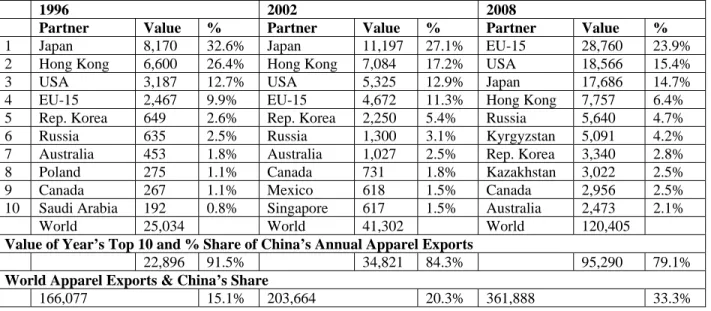
In East Asia, China has not only increased its share of overall exports, but it has also significantly diversified its export partners. In 1996, Japan and Hong Kong represented nearly 60% of China’s apparel exports of $25 billion, with the United States and the EU-15 accounting for another 22.6%. By 2008, China’s apparel exports nearly quintupled to $120 billion, and the EU-15 and the United States were the top two export partners, but they accounted for only 39.3% of China’s apparel exports, while Japan and Hong Kong held 21.1% (see Table 6). Thus, China’s top four export markets in 2008 had about the same share of China’s total exports as did Japan and Hong Kong alone in 1996. In this respect, China is lessening its dependence on its traditional export partners while adding important new markets, such as Russia and countries from the former Soviet bloc. This pattern can help China to withstand the demand slump in advanced industrial markets.
It is also important to recognize the size of China’s apparel production for its domestic market. In 2007, the estimated value of sales to the Chinese apparel market totaled $93 billion for the year, indicating that 56% of the overall apparel production activities in China were for local consumers (Clothesource, 2008).
Table 6: China’s Top 10 Apparel Export Markets: 1996, 2002, & 2008
[Values in $US Millions; %: Partner’s Share of China’s Annual Apparel Exports to World]
1996 2002 2008
Partner Value % Partner Value % Partner Value %
1 Japan 8,170 32.6% Japan 11,197 27.1% EU-15 28,760 23.9% 2 Hong Kong 6,600 26.4% Hong Kong 7,084 17.2% USA 18,566 15.4% 3 USA 3,187 12.7% USA 5,325 12.9% Japan 17,686 14.7% 4 EU-15 2,467 9.9% EU-15 4,672 11.3% Hong Kong 7,757 6.4% 5 Rep. Korea 649 2.6% Rep. Korea 2,250 5.4% Russia 5,640 4.7% 6 Russia 635 2.5% Russia 1,300 3.1% Kyrgyzstan 5,091 4.2% 7 Australia 453 1.8% Australia 1,027 2.5% Rep. Korea 3,340 2.8% 8 Poland 275 1.1% Canada 731 1.8% Kazakhstan 3,022 2.5%
9 Canada 267 1.1% Mexico 618 1.5% Canada 2,956 2.5%
10 Saudi Arabia 192 0.8% Singapore 617 1.5% Australia 2,473 2.1%
World 25,034 World 41,302 World 120,405
Value of Year’s Top 10 and % Share of China’s Annual Apparel Exports
22,896 91.5% 34,821 84.3% 95,290 79.1%
World Apparel Exports & China’s Share
166,077 15.1% 203,664 20.3% 361,888 33.3%
Source: UN Comtrade: SITC code 84 rev. 3: Exports from China World Textile Export Values from WTO Statistics Database
South Asia: Steady Winners
In the long-term, the South Asian countries have all increased market share to both the EU-15 and the United States. Post-MFA and during the crisis, Bangladesh has performed well in both markets, but India, Sri Lanka, and Pakistan have performed differently to the two markets. The U.S. market share and export value of India, Sri Lanka, and Pakistan has been decreasing,
whereas it has increased since 2007 to the EU-15. South Asian countries receive preferential access to the EU under the GSP scheme, yet they do not receive U.S. benefits.
Southeast Asia: Split Effects
Both Vietnam and Cambodia have been gaining EU-15 and U.S. market share since the early 1990s. During the crisis, however, Vietnam has managed to maintain its value, volume and market share far better than Cambodia. Indonesia and Malaysia are more important suppliers to the U.S. market than the EU market, and their post-2007 export values and market shares have affected exports to the two markets differently, with increases in their share of the U.S. market and decreases in the EU-15. Furthermore, Indonesia and Malaysia have both started to focus on growth in textile exports as well. Thailand has been negatively impacted by the MFA phase-out, and the Philippines’ market share in the United States and EU-15 has fallen since the early 1990s.
Regional Suppliers: Declines in Market Share
The EU’s outward processing trade (OPT) arrangement is analogous to the U.S. production sharing system (807) (Gereffi, 1997). The United States and its periphery include: NAFTA members (United States, Mexico, Canada), the DR-CAFTA signatories (Central America and the Dominican Republic), and other economies in the Caribbean Basin Initiative. The EU and its periphery include: EU-27, Turkey, Central and Eastern Europe, and North Africa. Nearly all of the U.S. regional suppliers have been negatively impacted by the MFA phase-out. 15 regional suppliers are also experiencing declines in market share to the EU-15, but the EU as a whole is increasing its share of global apparel exports. Apparel exports from the EU-27 are increasing to emerging markets such as Russia.
3. The Global Apparel Value Chain: Shifting Roles, Capabilities and Networks
The global industry has undergone several production migrations and has undergone a transformation in production network configurations over the last 30 years. As production and sourcing networks evolved and expanded to different global regions, they embodied different kinds of governance structures and upgrading opportunities in the apparel value chain.
A. Upgrading in the Buyer-Driven Apparel Value Chain
The apparel industry is the quintessential example of a buyer-driven production chain marked by power asymmetries between the producers and global buyers of final apparel products. The most valuable activities in the apparel value chain are not related to manufacturing per se, but are found in the design, branding, and marketing of the products. These activities are performed by lead firms, which are large global retailers and brand owners in the apparel industry. In most cases, these lead firms outsource the manufacturing process to a global network of suppliers. Apparel manufacturing is highly competitive and becoming more consolidated, with increasing barriers to upgrading. Developing countries are in constant competition for foreign investments and contracts with global brand owners, leaving many suppliers with little leverage
in the chain. The result is an unequal partition of the total value-added along the apparel commodity chain in favor of lead firms.
Beginning in the 1970s, East Asian suppliers extended their upgrading opportunities in the apparel value chain from simple assembly to a series of new roles that included OEM (full-package) production, ODM (design), and OBM (brand development) stages (Gereffi, 1999). As intangible aspects of the value chain (such as marketing, brand development, and design) have become more important for the profitability and power of lead firms, “tangibles” (production and manufacturing) have increasingly become “commodities.” This has led to new divisions of labor and hurdles if suppliers wish to enter these chains (Bair, 2005; Gereffi, Humphrey, Kaplinsky, & Sturgeon, 2001).
The main stages of functional upgrading in the apparel value chain are described below (Gereffi & Memedovic, 2003). Table A-5 in the appendix highlights the shift in roles, and associated governance structures and required skills for contemporary upgrading in the global apparel value chain.
Assembly/CMT: A form of subcontracting in which garment sewing plants are provided with imported inputs for assembly, most commonly in export processing zones (EPZs).
CMT stands for “cut, make and trim” or CM (cut and make) and is a system whereby a
manufacturer produces garments for a customer by cutting fabric provided by the customer and sewing the cut fabric into garments in accordance with the customer’s specifications. In general, companies operating on a CMT basis do not become involved in the design of the garment, but are merely concerned with its manufacture. Under CMT, a factory is simply paid a processing fee, not a price for the garment, and uses fabric sourced by, and owned by, the buyer.
Original Equipment Manufacturing (OEM)/FOB/Package Contractor: A business model that focuses on the manufacturing process. The contractor is capable of sourcing and financing piece goods (fabric) and trim, and providing all production services, finishing, and packaging for delivery to the retail outlet. In the clothing industry, OEMs typically manufacture according to customer specifications and design, and in many cases use raw materials specified by the customer. Free on Board (FOB) is a common term used in industry to describe this type of contract manufacturer. However, it is technically an international trade term in which, for the quoted price, goods are delivered on-board a ship or to another carrier at no cost to the buyer.
Original Design Manufacturing (ODM)/Full Package: A business model that focuses on design rather than on branding or manufacturing. A full package garment supplier carries out all steps involved in the production of a finished garment—including design, fabric purchasing, cutting, sewing, trimming, packaging, and distribution. Typically, a full package supplier will organize and coordinate: the design of the product; the approval of samples; the selection, purchasing and production of materials; the completion of production; and, in some cases, the delivery of the finished product to the final customer.
Original Brand Manufacturing (OBM): A business model that focuses on branding rather than on design or manufacturing; this is a form of upgrading to move into the sale of own brand products. For many firms in developing countries, this marks the beginning of brand development for products sold in the home or neighboring countries.
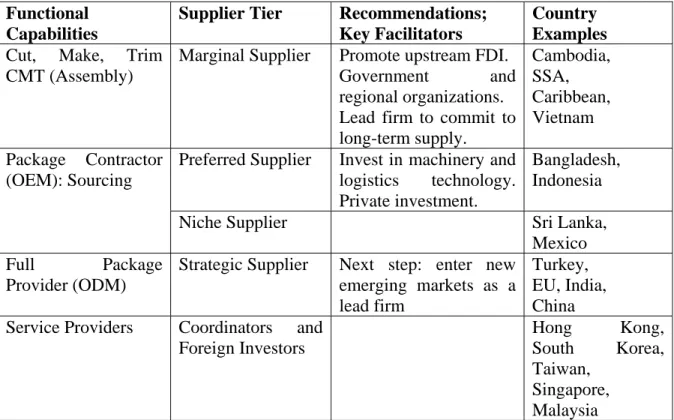
The desire of buyers to reduce the complexity of their own operations, keep costs down and increase flexibility to enable responsiveness to consumer demand has spurred the shift from CMT to OEM package contractors. Establishing and maintaining captive, buyer-supplier dependent relationships is costly for the lead firm and leads to inflexibility because of transaction-specific investments. Modular production networks provide the lowest costs to lead firms. Therefore, logistics coordination and sourcing are frequently the first functional activities lead firms are willing to give up, and shift the responsibility to their first tier suppliers. The CMT model is unnecessarily complex and has finally become obsolete. The recession has accelerated awareness of the existing flaws in this model. Countries without sourcing capabilities are at a disadvantage moving forward. Table 7 summarizes the current capabilities of the main apparel export countries.
Table 7: Summary of Country Capabilities with Examples Functional
Capabilities
Supplier Tier Recommendations; Key Facilitators
Country Examples
Cut, Make, Trim CMT (Assembly)
Marginal Supplier Promote upstream FDI.
Government and regional organizations.
Lead firm to commit to long-term supply. Cambodia, SSA, Caribbean, Vietnam Package Contractor (OEM): Sourcing
Preferred Supplier Invest in machinery and
logistics technology. Private investment.
Bangladesh, Indonesia
Niche Supplier Sri Lanka,
Mexico Full Package
Provider (ODM)
Strategic Supplier Next step: enter new
emerging markets as a lead firm
Turkey, EU, India, China
Service Providers Coordinators and
Foreign Investors Hong Kong, South Korea, Taiwan, Singapore, Malaysia
B. Upgrading of Regional Capabilities within the Apparel Supply Chain
In the past, the global apparel industry has been characterized by a large number of exporting countries due to the MFA quota system, but the level of export concentration is sharply increasing. The apparel supply chain is also marked by substantial country specialization. Higher income nations generally predominate in more capital-intensive segments, while lower income countries dominate labor-intensive segments (Kilduff & Ting, 2006). The most labor-intensive
activity is apparel production, followed by textile (yarn and fabric) production. The most capital-intensive segments, such as man-made fiber production and machinery manufacturing, are located upstream where barriers become progressively higher (Gereffi & Memedovic, 2003). As countries grow richer and wages rise, the comparative advantage in manufacturing is eroded, and the focus shifts to high value-added products or to other manufactured products with lower labor intensity (Adhikari & Weeratunge, 2006).
Figure A-3 (see Appendix) illustrates how this division of labor between countries at different levels of development shapes the pattern of industrial upgrading in the Asian apparel value chain. The main segments of the apparel chain – garments, textiles, fibers, and machinery – are arranged along the horizontal axis, and they reflect low to high levels of relative value-added as capital intensity increases. Countries are grouped on the vertical axis by their relative level of development, with Japan at the top, China and India in the middle tier, and the least-developed exporters like Bangladesh, Cambodia, and Vietnam at the bottom.
Figure A-3 reveals several important dynamics about the apparel value chain in Asia, and the GVC approach more generally (see (Gereffi, 2005): 172). First, individual countries tend to progress from low to high value-added segments of the chain in a sequential fashion over time. This shows the importance of looking at the entire constellation of value-added steps in the production process (raw materials, components, finished goods, related services, and machinery), rather than just the end product. Second, there is a regional division of labor in the apparel value chain, whereby countries at very different levels of development form a multi-tiered production hierarchy with a variety of export roles (e.g., the United States generates the product designs and large orders, Japan provides the sewing machines, the East Asian newly industrializing economies (NIEs) supply fabric, and low-wage Asian economies like China, Indonesia or Vietnam sew the apparel). Industrial upgrading occurs when countries change their roles in these export hierarchies. Finally, advanced economies like Japan and the East Asian NIEs do not exit the industry when the finished products in the chain become mature, as the “product cycle” model (Vernon, 1966) implies, but rather they capitalize on their knowledge of production and distribution networks and thus move to higher-value-added stages in the apparel chain.
C. Lead Firms in the Contemporary Apparel Value Chain
In the apparel value chain, there are three main types of lead firms (retailers, brand marketers, and brand manufacturers), which are highlighted in Figure 1. These lead firms not only have significant market power because of their size (reflected in sales), but they also have moved beyond production to different combinations of high-value activities, including design, marketing, consumer services, and logistics.
Figure 1: Types of Lead Firms in the Apparel Value Chain
Table 8 provides regional examples of each type of lead firm. Within the retailer category, we can distinguish between mass merchants (who sell a diverse array of products) and specialty retailers that only sell apparel items. Brand manufacturers traditionally formed production networks in which the brand owner was involved in the production process, either through ownership or supplying inputs to production. In contrast to brand manufacturers, brand marketers and retailers opt for sourcing strategies that involve constructing networks with OEM or full-package producers. In this model, the buyer provides detailed garment specifications and the supplier is responsible for acquiring the inputs and coordinating all parts of the production process: purchase of textiles, cutting, garment assembly, laundry and finishing, packaging and distribution (Bair & Gereffi, 2001; Bair, 2006). As capabilities in the global apparel supply base improved, brand manufacturers, marketers, and retailers expanded their sourcing networks.
Table 8: Lead Firm & Brand Types with Regional Examples
Lead Firm Type
Type of Brand Description Examples
U.S. EU-27 Retailers:
Mass Merchants
Private Label:
the retailer owns or licenses the final product brand, but in almost all cases, the retailer does
not own manufacturing.
Department/discount stores that carry private label, exclusive, or licensed brands that are only available in the retailers’ stores in addition to other brands.
Walmart, Target, Sears, Macy’s, JC Penney, Kohl’s & Dillard’s Asda (Walmart), Tesco, C&A, Marks & Spencer Retailers: Specialty Apparel Retailer develops proprietary label brands that commonly include the stores’ name. Gap, Limited Brands, American Eagle Abercrombie & Fitch, H&M, Benetton, Mango, New Look, NEXT Brand Marketer National Brand: the manufacturer is also the brand owner and goods are distributed through multiple retail outlets.
Firm owns the brand name, but not manufacturing,
“manufacturers
without factories.” Products are sold at a variety of retail outlets.
Nike, Levi’s, Polo, Liz Claiborne Ben Sherman, Hugo Boss, Diesal, Gucci Brand Manufacturer
Firm owns brand name and manufacturing; typically coordinate supply of intermediate inputs (CMT) to their production networks often in countries with
reciprocal trade agreements
VF, Hanesbrands, Fruit of the Loom, Gildan
Inditex (Zara)
In the following section, we look more closely at how global production and sourcing networks in the apparel value chain have been affected by the crisis.
D. Shifts in Apparel Sourcing Strategies
Two major changes occurred during the MFA phase-out that caused a shift in the sourcing strategies of lead firms in the apparel value chain. On the demand side, brand manufacturers were replaced by the suppliers of private label merchandise (store brands) sourced by retailers. Retailers’ strengths are in marketing and branding and they tend to have limited knowledge of how to make the products they are procuring. Thus, retailers needed suppliers (or agents) capable of bundling and selling the entire range of manufacturing and logistics activities (OEM or ODM). On the supply side, network relationships in the apparel supply chain became increasingly complex due to the breadth and specialization of apparel products and the growth of countries with advanced production capabilities. The MFA had facilitated the entry of
These two shifts led to the need for new forms of coordination and management in the apparel supply chain. Two groups emerged to provide the key links between producers and retailers: East Asian transnational manufacturers with established buyer relationships who set up and managed global production networks, and traders (import-export companies) and agents who emerged as intermediaries between established buyers and sellers in the apparel value chain.
The traditional agent-sourcing model is most popular with buyers that require smaller volumes or larger buyers that need small quantities of certain items. Benefits of using a third-party sourcing agent include scale of operations, buying power, flexibility, and ability to spread risk among suppliers. Li & Fung has been the pioneer in the agent-sourcing model and is continuing to expand its roles into areas such as product development, marketing, and branding. Recently, Li & Fung has adopted a more prominent role as the primary purchasing agent for giant retailers such as Walmart, and well known apparel brands like Liz Claiborne.
Alternatively, as buyers developed expertise in assessing local capabilities, they started to establish direct sourcing relationships. To reduce cost and mitigate risk, many buyers established overseas sourcing offices in their main producing countries. Over the years retailers shifted more responsibilities to these overseas sourcing offices, driven by cost and the skills of the staff based there. Many are also moving product development and design offices closer to the manufacturing process. Direct sourcing requires manufacturers to provide faster reaction times and better factory understanding of a retailer’s particular needs. Sourcing agents charge clients 4-8% of the wholesale price as commission, representing an area to realize savings if this step is eliminated.
Tables A-6, A-7, and A-8 describe the sourcing channels and destinations used by several categories of lead firms in the global apparel value chain. Most retailers use a range of different
channels depending on their levels of expertise and volumes(just-style.com, 2009c).
E. New Roles and Relationships in the Apparel Value Chain
The roles and relationships among national and global lead firms, apparel manufacturers, and intermediaries have become increasingly blurry in recent years. The following trends are closely tied to buyers’ strategies and long-term objectives. These shifts began before the economic crisis and will likely persist after the crisis is over.
Brand Owners Becoming Specialty Retailers: Brand manufacturers and marketers are increasingly opening their own stores. In addition, brands with existing retail operations are likely to focus more on their own stores rather than meeting the needs of their external customers (Euromonitor, 2009).
Full-Package ‘Manufacturers’ Becoming Intermediaries: Rather than manufacture, they establish a network of global suppliers. Essentially, these suppliers are doing what brand marketers and manufacturers did 10 to 20 years ago. There are a host of firms in countries around the world that make products for multiple brands, based on the buyers’ requirements. They provide full-package services along with production capabilities.
Intermediaries/agents are expanding their roles to include an array of services to buyers, including design, product development, and quality control in addition to providing a network of suppliers and logistics.
Increase in Private-label Brands: There is a sharp increase in the volume and diversity of retailer private labels. Retailers that develop proprietary brands use in-house design teams and outsourced manufacturing capacity, often by direct foreign product sourcing. By eliminating the middleman associated with national brands, retailers can shave costs and widen profit margins. Today, retailers are expanding the range of private-label products offered and developing higher-margin private-label goods (Euromonitor, 2009).
Brand Marketers Creating Exclusive Product Lineswith Mass Merchant Retailers:
Exclusive product lines are a new way for mass merchants to offer unique merchandise. Retailers are striking agreements with brand marketers to develop and distribute brands that are sold exclusively through the one retailer’s stores instead of the traditional brand marketer model in which goods are sold via multiple retail outlets. (Asaeda, 2008; Euromonitor International, 2009).
Importance of Social and Environmental Standards: This began with corporate social responsibility (CSR) campaigns and social advocacy groups. Now environmental compliance requirements and green initiatives are moving to the forefront (Asaeda, 2008; Barrie & Ayling, 2009; Driscoll & Wang, 2009; International News Services, 2009; Tucker, 2009). Consumers are demanding that lead firms become more responsible and transparent about their practices. Success of ethical clothing brands (e.g., Patagonia) is a testament to the power of consumer demand and green credentials.
Dual Sourcing Strategies: Quick Response and Fast Fashion: Buyers tend to source fashion-sensitive products from suppliers that can deliver in a flexible and speedy manner, while basic products are sourced from the lowest-cost countries (Technopak,
2007). This leads to the distinction between fast fashion and quick response.Fast fashion
emerged from quick response, but the two are different. Quick response is associated with replenishment purchases for basic products (Jassin-O'Rourke, 2008). Fast fashion is quick response in new merchandise (with little or no replenishment), involving shipping fewer pieces, in a great variety of styles, and more often. Predictions thought fast fashion would lead to local sourcing, but this has not been the case. Asian suppliers have quickly adapted the capabilities to serve fast-fashion buyers, including reducing minimum-run requirements. These suppliers have also lowered the cost of goods, thus putting intense
pressure on regional manufacturers (The clothing industry, 2009).
F. Trends in Lead Firm Sourcing Strategies Accelerated by the Crises
The activities and strategies of lead firms have a profound effect on supply chain relationships and the capabilities expected from suppliers. Key trends affecting lead firms in the apparel value chain that have been accentuated by the MFA phase-out and economic recession include:
Buyers’ Risk Avoidance & Diversity: Maintaining a diversified portfolio of vendors and regions is a necessity for successful sourcing organizations (Sauls, 2008). The recession has increased buyers’ interest in having back-up suppliers in place in case factories go under and to cope with general uncertainty about the future (Barrie & Ayling, 2009). Some predicted the recession would lead to more local sourcing, but this
has not yet happened (The clothing industry, 2009).
Reduce Reliance on China: Lead firms continue to source the majority of products from China, but they also seek to diversify into other countries to avoid putting all their eggs in one basket. The Japanese government has openly declared its interest in reducing reliance on China. This could have major impacts since Japan is the world’s second largest clothing importer, and Southeast Asia and Bangladesh currently only account for 7% of imports. Japan’s plan could double or triple the total current exports from these countries, putting price pressure on European and U.S. Asian importers (“Talking strategy”, 2008; “Japan mulls”, 2009; just-style.com, 2009b).
Decrease in Supplier Captivity: Lead firms no longer desire to be the main buyer for any suppliers, due to the risks associated with controlling the majority of a factory’s output. Buyers tend to follow the “30/70” rule in which 30% of a factory’s business is desirable, but not more than 70% (Fung, Fung, & Wind, 2008).
Decrease in Short-Term Relationships: During the era of quotas, trade was dominated by short-term, market relationships. Now that quotas are gone, buyers are streamlining the number of suppliers they work with and focusing on developing long-term strategic partnerships with their most important suppliers. These strategic suppliers are increasingly multinational manufacturers or network coordinators that do the logistics legwork for the lead firms.
Supply Chain Rationalization: Most lead firms in the apparel industry are committed to significant reductions in the size and scope of their supply chains. They want to deal with fewer, larger, and more capable suppliers, who are strategically located near major markets around the globe. Retailers are seeking to consolidate the number of wholesalers they purchase from and they want to buy a more comprehensive line of clothing, accessories, and footwear from these wholesalers (Barrie & Ayling, 2009; Euromonitor, 2009). The recession has caused lead firms to ‘cut the fat,’ and they are confining their relationships to their most capable and reliable suppliers.
4. Impact of the Crisis on Apparel Suppliers in Developing Economies
One can detect several structural impacts of the economic crisis on apparel suppliers in developing countries:
Decrease in Number of Employees and Factories: Survival of the Fittest
During the recession, buyers are transferring business away from marginal suppliers to
their core operations. This is creating a major problem in countries that are highly dependent on the apparel industry (Birnbaum, 2009) (see Table A-4). Lower demand from international customers and the recession have caused a large number of vulnerable, developing-country
garment manufacturers to go out of business (Barrie & Ayling, 2009; Driscoll & Wang, 2009; International News Services, 2009).
Table A-4 in the Appendix includes employment figures and estimated job losses in the textile and apparel industries Upper estimates for job losses attributable to the economic crisis in different developing countries include: China – 10 million jobs; India – 1 million jobs; Pakistan – 200,000 jobs; Indonesia – 100,000 jobs; Mexico – 80,000 jobs; Cambodia – 75,000 jobs; and
Vietnam – 30,000 jobs (Forstater, 2010). Job losses are causing rising levels of poverty and
geographical shifts from urban areas focused on export markets to rural areas focused on agriculture and traditional employment, thus reducing the number of skilled textile and apparel laborers.
Decline in Export Volume and Value
For those companies that are surviving, many are experiencing a decline in exports in some product categories. By May 2009, apparel imports to the United States market dropped by 15.7% with every major garment supplier reporting declines (WTO, 2009). Right now, most view the decline in U.S., EU, and Japanese consumption as temporary. However, the longer the recession lasts, the longer consumers will become accustomed to living with less. If the decrease in consumption becomes permanent, the current slow shift towards domestic markets in developing economies will accelerate and production networks will become more national or regional in nature.
New Sources of Credit & Trade Finance
Perhaps the most lasting effect of the recession on existing and new suppliers is access to credit and finance. The recession brought the importance of suppliers’ financial stability to the attention of all buyers. The crisis has made access to credit much more difficult, leading to new types of financial arrangements (and thus dependence) created by retailers. In the future, firms will have to prove their financial stability in order to become suppliers.
To make matters worse, some customers are delaying payments and banks are becoming stricter with credit access (just-style.com, 2009a). The general decline in credit availability is affecting all suppliers, but particularly hard hit are small and medium-sized firms and locally owned firms (Barrie & Ayling, 2009; Driscoll & Wang, 2009).
The credit crunch is spurring new financial arrangements. Some buyers fear that when demand returns, it may be difficult to find qualified suppliers (Driscoll & Wang, 2009). Retailers such as Kohl’s and Walmart are offering financial support to their suppliers. Kohl’s offered 41% of its suppliers a “Supply Chain Finance” program that lets suppliers get paid early once their invoices are approved for payment, and 11% had signed on to the deal by mid-2009 (O'Connell, 2009). Walmart also offered about 1,000 suppliers, primarily apparel manufacturers, an alternative to their traditional means of financing. Walmart informed its suppliers of its new "Supplier Alliance Program," in which eligible suppliers can get payment for their orders within 10 to 15 days of Walmart’s receipt of goods, compared with the more typical 60 to 90 days (O'Connell, 2009). Li & Fung is also moving into financing by becoming a lender of last resort to factories and small importers, whose credit was cut off during the global financial meltdown
Increase of Government Support
In the aftermath of the MFA quota phase-out and more recently the recession, the governments of nearly all major apparel exporting countries have provided various forms of support to local industry. During the recession, the actions of individual governments have become critical steps to recovery. Government interventions in developing economies have taken various forms—tax relief, suspending tariffs or export duties, and assuring financing and
liquidity for enterprise (see Table A-1 in the Appendix).1
Necessity to Form Strategic, Long-Term Relationships with Lead Firms
Strategic, long-term relationships are beneficial for buyers and suppliers. Buyers benefit from these relationships by virtue of their ability to exert influence over a supplier in order to achieve efficiencies in the supply chain, including reduced lead times, standardizing production processes to suit the nature of the buyer’s product (asset specificity and tacit knowledge—lead firm setting standards), establishing preferential logistics and transportation arrangements, and increasing the transparency of the supplier’s inventory (Technopak, 2007). Suppliers benefit because these relationships provide security in the form of guaranteed demand for the supplier’s output.
The strategic-supplier relationship is likely to become increasingly prominent in the
apparel value chain in the post-MFA and post-crisis era. As global supply chains become more rationalized and consolidated, lead firms realize that future efficiency gains will require closer, more integrated linkages among all parts of the chain. The question today cannot be limited to “how successful is my firm?” Today firms must ask themselves, “how successful is my network, and what role does my firm play in the bigger picture?”
More Stringent Supplier Capabilities
The following factors have long been important in apparel sourcing strategies, but the crisis has heightened the need for suppliers to meet all or most requirements as opposed to just one or two:
Cost/Price: During the recession, consumers are placing more emphasis on price, thus causing retailers and brand marketers to focus on reducing costs (MSN, 2009; Tucker, 2009).
Product Quality: Firms must provide quality in addition to low prices, flexible production, and services (Driscoll & Wang, 2009).
Supplier Flexibility: Firms are under pressure to make multiple products in small runs in order to deal with decreased demand and niche markets (MSN, 2009).
Visibility/Transparency: Growing consumer demand for higher social and environmental standards has increased the need for supply chain transparency in both the
1
For a more detailed review of protectionist actions in the textile and apparel industries, see (Frederick & Gereffi, 2009a, 2009b).
United States and the European Union. Lead firms want to know more about their
suppliers to ensure they uphold the principles of the brands (Sauls, 2008).
Full Package Capabilities: Suppliers need to be able to offer full package options that expand their capabilities to other parts of the value chain—including design, inventory management, and transportation of goods, and adopt the appropriate technologies to facilitate this transition (Technopak, 2007).
Since the removal of quotas, the global apparel industry is faced with overcapacity that is
creating intense competition in low-cost countries. Quotas created too many factories in too
many countries, and now these factories are competing for fewer orders. In the short term, this has significantly raised the bar to be a global competitor; manufacturers must be more creative and comprehensive in the development of their products and services (Technopak, 2007). Buyers place stricter demands on manufacturers and are asking for better products (quality), more services, and faster turnaround times, all for lower costs. Suppliers must meet buyer demands to keep orders, increase volume, and reduce costs (“Talking strategy”, 2008). When this is coupled with the ongoing consolidation in the retail sector, the result is more power in the hands of the global buyers (i.e., retailers, global brands, and large manufacturers that have outsourced their production).
5. Recommendations for Economic Development
This final section provides recommendations for economic developers, governments and the private sector that can provide assistance to developing countries in order to better face the challenges and harness opportunities created by the crisis. How can developing countries best use current times to make critical reforms that will enable them to be amongst the benefactors of global growth once the economy recovers?
Short-Term Suggestions to Get Through the Crisis
Implement the equivalent of “furlough” days rather than lay off workers. By reducing the
number of hours or wages, firms and countries can maintain the labor force and industry expertise that will be needed when production returns.
Improve access to credit.
Encourage production for the local market to keep companies in business. For example,
MOL Magazalari (Turkey) is a consortium of 38 local clothing manufacturers that have recently set-up manufacturer-owned shops selling goods “Made in Turkey” (including design and marketing). The group would like to expand retail operations to other countries, but success will depend on the group developing a real competitive edge (like Inditex in Spain). These Turkish firms have used the crisis as an opportunity to upgrade their skill sets in marketing and retailing that is helping them survive the recession and
become more competitive in the future (The clothing industry, 2009).
Long-Term Suggestions to Enable Growth After the Crisis
Education and Training: Invest in both education and training opportunities to overcome the skills deficits that could hinder economic upgrading. Whereas quotas
helped to initiate a textiles and clothing industry in developing countries, maintaining or improving a country’s position in the global apparel value chain requires a continuous process of workforce development. In the long run, innovative capacities depend on suitable human capital. Education should include technical skills as well as soft skills in areas such as management, product development, design, and market research.
Marketing & Networking: Create organizations to market and network the country/region and align firms with international organizations dedicated to standards development, industry advocacy, research and development, and best practices. Provide assistance to attend and participate in international trade shows to increase visibility to
potential buyers.
Promote Foreign Direct Investment or Joint Ventures to Develop Vertical Capabilities: Countries without domestic textile production should promote FDI in countries that do not have vertical capabilities. This is a good strategy for countries that are still dominated by assembly or CMT production models, such as Africa, Southeast Asia, and the Caribbean. This will help to establish backward linkages and to develop skills not in the country. Economic authorities need to provide a one-stop shop for any investor or supplier wishing to set up a new firm (Knappe, 2008).
Technology Investment and Flexible Production Systems: Stakeholders with a long-sighted vision of recovery are prepared to invest in technology that enables more efficient and flexible business and production models. Investments are needed to upgrade production machinery as well as logistics and information technologies that enable suppliers to become more integrated into their buyers’ networks. Enterprises willing to invest in creative solutions are likely to be the winners in the aftermath of the recession.
Develop Full Package Capabilities: Buyers not only want to purchase a final product, they want to purchase services. Firms must be able to (or have alliances with firms that can) provide additional services related to product development, design, logistics, and quality control. Global brands and retailers are starting to move product development and design divisions closer to regional manufacturing. Suppliers able to offer these services can be indispensable to the buyer (strategic suppliers) and are likely to maintain market share through tough economic times.
International and Regional Standard Certifications: Encourage and provide assistance to firms with product and process standards required by international buyers, such as ISO 9000 & 14000, the Global Organic Textile Standard (GOTS), and the European Union’s REACH directive.
Promote Sustainable Practices and Production: Surviving suppliers will be companies that chose to compete on their environmental credentials in addition to cost, quality, and other traditional factors. Whether legally enforceable or “voluntary,” making adjustments to have a more green and transparent firm and supply chain will be mandatory to compete in the future. Countries that develop policies that facilitate the transition to more sustainable practices will be the winners.
Diversify Buyers, Products, and End Markets: Encourage firms to diversify into multiple product lines and end-use markets as well as different geographic markets. Equally important, suppliers should expand their export focus to emerging countries with
growing disposable incomes. These markets are often less demanding than traditional export markets in the United States and the European Union, but they offer more opportunities to upgrade skills to higher value-adding functions such as product design, marketing, and branding. Bilateral and regional trade agreements can help facilitate this process and build future long-term relationships.
6. Conclusions
Developing countries in the global apparel value chain have been beset by two major crises in recent years: the WTO phase-out of the quota system in 2005, which provided access for many poor and small export-oriented economies to the apparel markets of industrialized countries, and the current economic recession that has lowered demand for apparel exports and led to massive unemployment across the industry’s supply chain. Beyond the need to adjust to these two crises, our analysis has also highlighted a longer term process of global consolidation, whereby a handful of leading apparel suppliers (countries and firms) has strengthened their positions in the apparel value chain, which complicates the adjustment strategy of smaller or more vulnerable players who have lost ground in the crisis.
On the country side, China has been the big winner. It has increased its dominant position in all of the major industrial economies (the United States, the European Union, and Japan). It has also diversified its export reach by gaining ground in many of the world’s top emerging economies as well, such as Russia for finished goods, and India, Brazil and Turkey for intermediate goods, such as textiles. Other developing economies have also gained in the post-MFA era, such as Bangladesh, India, Vietnam, and Indonesia. But regional suppliers have been hard hit, especially Mexico and CAFTA-DR in North America, and East European and North African suppliers to the European Union.
On the firm side, the quota phase-out and economic recession have accelerated the ongoing shift to a rationalization of global supply chains. Major retailers, brand marketers, and brand manufacturers have been stressing their desire to work with fewer, larger, and more capable suppliers, strategically located around the world. In addition, there has been a consolidation among the lead firms, as the largest retailers (Walmart), traders (Li & Fung), brand marketers (Nike), and brand manufacturers (VF Corporation) are increasing their market shares through mergers, acquisitions and bankruptcies within the textile and apparel chain.
Within the developing world, the dual crises outlined in this paper pose the biggest threat to two kinds of vulnerable actors. The “trade impact” will be most significant for the smaller countries that were privileged by the MFA quota system, who no longer have guaranteed access to developed country markets. Regional trade agreements can ameliorate, but not eliminate, this pressure from dominant global exporters. A more specific “recession impact” is likely to hurt the weaker manufacturers in large developing economies, like India, China and Bangladesh. This could lead to major unemployment in these economies as supply-chain consolidation occurs inside these economies. We have offered suggestions to apparel suppliers in developing economies for coping with these competitive pressures, but there is no quick fix or certain solution.
![Table 1: Shifts in Top 15 World Apparel Importers: 1995, 2000, 2005, & 2007-2008 [Top 15 by Year; Values in $US Billions, at Current Prices]](https://thumb-us.123doks.com/thumbv2/123dok_us/11041627.2991437/6.918.126.797.238.693/table-shifts-apparel-importers-values-billions-current-prices.webp)


![Table 5: Shifts in Top 15 World Apparel Exporters: 1995, 2000, 2005, & 2007-2008 [Top 15 by Year; Values in $US Billions; in US Dollars at Current Prices]](https://thumb-us.123doks.com/thumbv2/123dok_us/11041627.2991437/10.918.122.802.163.752/shifts-apparel-exporters-values-billions-dollars-current-prices.webp)