Service-Oriented Architecture for
High-Dimensional Private Data Mashup
Benjamin C. M. Fung,
Member, IEEE,
Thomas Trojer, Patrick C. K. Hung,
Member, IEEE,
Li Xiong,
Member, IEEE,
Khalil Al-Hussaeni, and Rachida Dssouli,
Member, IEEE
Abstract—Mashupis a web technology that allows different service providers to flexibly integrate their expertise and to deliver highly customizable services to their customers.Data mashupis a special type of mashup application that aims at integrating data from multiple data providers depending on the user’s request. However, integrating data from multiple sources brings about three challenges: (1) Simply joining multiple private data sets together would reveal the sensitive information to the other data providers. (2) The integrated (mashup) data could potentially sharpen the identification of individuals and, therefore, reveal their person-specific sensitive information that was not available before the mashup. (3) The mashup data from multiple sources often contain many data attributes. When enforcing a traditional privacy model, such asK-anonymity, the high-dimensional data would suffer from the problem known asthe curse of high dimensionality, resulting in useless data for further data analysis. In this paper, we study and resolve a privacy problem in a real-life mashup application for the online advertising industry in social networks, and propose a service-oriented architecture along with a privacy-preserving data mashup algorithm to address the aforementioned challenges. Experiments on real-life data suggest that our proposed architecture and algorithm is effective for simultaneously preserving both privacy and information utility on the mashup data. To the best of our knowledge, this is the first work that integrates high-dimensional data for mashup service.
Index Terms—Privacy protection, anonymity, data mashup, data integration, service-oriented architecture, high dimensionality
F
1
I
NTRODUCTIONM
ASHUP service is a web technology that com-bines information from multiple sources into a single web application. An example of a successful mashup application is the integration of real estate information into Google Maps [1], which allows users to browse on the map for properties that satisfy their specified requirements. In this paper, we focus on data mashup, a special type of mashup application that aims at integrating data from multiple data providers depending on the service request from a user (a data recipient). An information service request could be a general count statistic task or a sophisticated data mining task such as classification analysis. Upon receiving a service request, the data mashup web application (mashup coordinator) dynamically deter-mines the data providers, collects information from them through their web service interface, and thenin-• B. C. M. Fung and K. Al-Hussaeni are with CIISE, Concordia University, Canada. E-mail:{fung, k alhus}@ciise.concordia.ca • T. Trojer is with the University of Innsbruck, Austria. E-mail:
• P. C. K. Hung is with the University of Ontario Institute of Technology, Canada. E-mail: [email protected]
• L. Xiong is with Emory University, USA. E-mail: [email protected] • R. Dssouli is with CIISE, Concordia University, Canada, and Re-search Cluster Hire, FIT, United Arab Emirate University. E-mail: [email protected]
tegrates the collected information to fulfill the service request. Further computation and visualization can be performed at the user’s site or on the web application server. This is very different from a traditional web portal that simply divides a web page or a website into independent sections for displaying information from different sources.
A data mashup application can help ordinary users explore new knowledge; it could also be misused by adversaries to reveal sensitive information that was not available before the mashup. In this paper, we study the privacy threats caused by data mashup and propose a service-oriented architecture and a privacy-preserving data mashup algorithm to securely inte-grate person-specific sensitive data from different data providers, wherein the integrated data still retains the essential information for supporting general data exploration or a specific data mining task.
1.1 The Challenges
The research problem presented in this paper was discovered in a collaborative project with a social network company, which focuses on the gay and les-bian community in North America. The problem can be generalized as follows: social network companies A and B observe different sets of attributes about the same set of individuals (members) identified by the common User ID, e.g., TA(U ID, Gender, Salary) and TB(U ID, J ob, Age). Every time a social network member visits another member’s webpage, an adver-tisement is chosen to be displayed. CompaniesAand
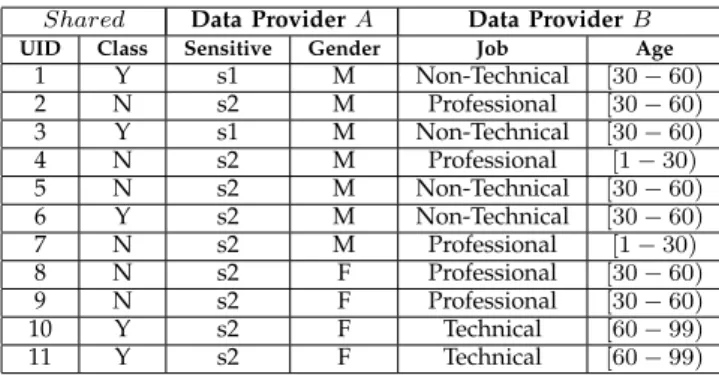
TABLE 1 Raw data
Shared Data ProviderA Data ProviderB
UID Class Sensitive Gender Job Age
1 Y s1 M Janitor 34 2 N s2 M Doctor 58 3 Y s1 M Mover 34 4 N s2 M Lawyer 24 5 N s2 M Mover 58 6 Y s2 M Janitor 44 7 N s2 M Doctor 24 8 N s2 F Lawyer 58 9 N s2 F Doctor 44 10 Y s2 F Carpenter 63 11 Y s2 F Technician 63
B want to implement a data mashup application that integrates their membership data, with the goal of improving their advertisement selection strategy. The analysis includes gathering general count statistics and building classification models [2]. In addition to companies A and B, other partnered advertising companies need access to the final mashup data. The solution presented in this paper is not limited only to the social networks sector but is also applicable to other similar data mashup scenarios. The challenges of developing the data mashup application are sum-marized as follows:
Challenge#1: Privacy concerns. The members are
willing to submit their personal data to a social net-work company because they consider the company and its developed system to be trustworthy. Yet, trust to one party may not necessarily be transitive to a third party. Many agencies and companies believe that privacy protection means simply removing explicit identifying information from the released data, such as name, social security number, address, and tele-phone number. However, many previous works [3], [4] show that removing explicit identifying informa-tion is insufficient. An individual can be re-identified by matching other attributes called quasi-identifiers (QID). The following example illustrates potential privacy threats.
Example 1: Consider the membership data in
Ta-ble 1. Data Provider A and Data Provider B
own data tables TA(U ID, Class, Sensitive, Gender) andTB(U ID, Class, J ob, Age), respectively. Each row (record) represents a member’s information. The two parties want to develop a data mashup service to integrate their membership data in order to perform classification analysis on the shared Class attribute with two class labels Y andN, representing whether or not the member has previously bought any items after following the advertisements on the social net-work websites. Let QID ={J ob, Gender, Age}. After integrating the two tables (by matching the shared U ID field), there are two types of privacy threats:
Record linkage: If a record in the table is so specific that not many members match it, releasing the data
TABLE 2
Anonymous mashup data (L= 2,K= 2,C= 0.5) Shared Data ProviderA Data ProviderB
UID Class Sensitive Gender Job Age
1 Y s1 M Non-Technical [30−60) 2 N s2 M Professional [30−60) 3 Y s1 M Non-Technical [30−60) 4 N s2 M Professional [1−30) 5 N s2 M Non-Technical [30−60) 6 Y s2 M Non-Technical [30−60) 7 N s2 M Professional [1−30) 8 N s2 F Professional [30−60) 9 N s2 F Professional [30−60) 10 Y s2 F Technical [60−99) 11 Y s2 F Technical [60−99)
may lead to linking the member’s record and his/her sensitive value. Lets1 be a sensitive value in Table 1. Suppose that the adversary knows the target member is a M over and his age is 34. Hence, record #3, together with his sensitive value (s1in this case), can be uniquely identified since he is the onlyM overwho is34years old.
Attribute linkage: If a sensitive value occurs fre-quently along with some QID attributes, then the sensitive information can be inferred from such at-tributes, even though the exact record of the member cannot be identified. Suppose the adversary knows that the member is a male (M) of age34. In such case, even though there are two such records (#1 and #3), the adversary can infer that the member has sensitive value s1 with 100% confidence since both records contains1.
Many privacy models, such as K-anonymity [3], [4],ℓ-diversity [5], and confidence bounding [6], have been proposed to thwart privacy threats caused by record and attribute linkages in the context of rela-tional databases owned by asingle data provider. The traditional approach is to generalize the records into equivalence groups so that each group contains at least K records sharing the same qid value on the QID, and so that each group contains sensitive values that are diversified enough to disorient confident inferences. The privacy models can be achieved by generalizing domain values into higher level concepts and, therefore, more abstract concepts.
The data mashup problem further complicates the privacy issue because the data is owned by multi-ple parties. In addition to satisfying a given privacy requirement in the final mashup data, at any time during the process of generalization no data provider should learn more detailed information about any other data provider other than the data in the final mashup table. In other words, the generalization pro-cess must not leak more specific information other than the final mashup data. For example, if the fi-nal table discloses that a member is a P rof essional, then no other data providers should learn whether she is a Lawyer or an Accountant. There are two
obvious yet incorrect approaches. The first one is mashup-then-generalize: first integrate the two tables and then generalize the mashup table using some single table anonymization methods [7], [8], [9], [10]. This approach does not preserve privacy in the stud-ied scenario because any data provider holding the mashup table will immediately know all private infor-mation of both data providers. The second approach is generalize-then-mashup: first generalize each table locally and then integrate the generalized tables. This approach fails to guarantee the privacy for a quasi-identifier that spans multiple tables. In the above example, the K-anonymity on (Gender, J ob) cannot be achieved by the K-anonymity on each of Gender and J obseparately.
Challenge#2: High dimensionality. The mashup
data from multiple data providers usually contain many attributes. Enforcing traditional privacy models on high-dimensional data would result in signifi-cant information loss. As the number of attributes increases, more generalization is required in order to achieve K-anonymity even if K is small, thereby resulting in data useless for further analysis. This chal-lenge, known as the curse of high dimensionality on K-anonymity, is confirmed by [8], [11], [12]. To overcome this bottleneck, we exploit one of the limitations of the adversary: in real-life privacy attacks, it is very difficult for an adversary to acquireallthe information of a target victim because it requires non-trivial effort to gather each piece. Thus, it is reasonable to assume that the adversary’s prior knowledge is bounded by at most L values of the QID attributes. Based on this assumption, in this paper we extend the privacy model called LKC-privacy [13], originally proposed for asingle partyscenario, to apply to amultipartydata mashup scenario.
The general intuition of LKC-privacy is to ensure that every combination of values in QIDj ⊆ QID with maximum lengthLin the data tableT is shared by at leastK records, and the confidence of inferring any sensitive values inS is not greater thanC, where L, K, C are thresholds and S is a set of sensitive values specified by the data provider. LKC-privacy limits the probability of a successful record linkage to be≤1/K and the probability of a successful attribute linkage to be≤C, provided that the adversary’s prior knowledge does not exceedL.
Table 2 shows an example of an anonymous table that satisfies (2,2,50%)-privacy by generalizing the values from Table 1 according to the taxonomies in Figure 1. (The dashed curve can be ignored for now.) Every possible value of QIDj with maximum length 2 in Table 2 (namely, QID1 ={J ob, Gender},
QID2 = {J ob, Age}, and QID3 = {Gender, Age}) is
shared by at least 2 records, and the confidence of inferring the sensitive value s1 is not greater than 50%. In contrast, enforcing traditional 2-anonymity with respect to QID = {Gender, J ob, Age} will
re-quire further generalization. For example, in order to make⟨P rof essional, M,[30-60)⟩satisfy traditional 2-anonymity, we may further generalize [1-30) and [30-60)to[1-60), resulting in much higher information utility loss.
Challenge#3: Information requirements.The data
recipients want to obtain general count statistics from the mashup membership information. Also, they want to use the mashup data as training data for building a classification model on theClassattribute, with the goal of predicting the behavior of future members. One frequently raised question is: to avoid privacy concerns, why doesn’t the data provider release the statistical data or a classifier to the data recipients? In many real-life scenarios, releasing data is preferable to releasing statistics for several reasons. First, the data providers may not have in-house experts to perform data mining. They just want to share the data with their partners. Second, having access to the data, data recipients are flexible to perform the required data analysis. It is impractical to continuously request data providers to produce different types of statistical information or to fine-tune the data mining results for research purposes for the data recipients.
1.2 Contributions
This paper is the first work that addresses all the aforementioned challenges in the context of mashup service. The contributions are summarized as follows.
Contribution#1: We identify a new privacy
prob-lem through a collaboration with the social networks industry and generalize the industry’s requirements to formulate the privacy-preserving high-dimensional data mashup problem (Section 3). The problem is to dynamically integrate data from different sources for joint data analysis in the presence of privacy concerns.
Contribution#2: We present a service-oriented
ar-chitecture (Section 4) for privacy-preserving data mashup in order to securely integrate private data from multiple parties. The generalized data has to be as useful as possible to data analysis. Gener-ally speaking, the privacy goal requires anonymiz-ing identifyanonymiz-ing information that is specific enough to pinpoint individuals, whereas the data analysis goal requires extractinggeneraltrends and patterns. If generalization iscarefully performed, it is possible to anonymize identifying information while preserving useful patterns.
Contribution#3: Data mashup often involves a
large volume of data from multiple data sources. Thus, scalability plays a key role in a data mashup system. After receiving a request from a data re-cipient, the system dynamically identifies the data providers and performs the data mashup. Experimen-tal results (Section 5) on real-life data suggest that our method can effectively achieve a privacy requirement without compromising the information utility, and the proposed architecture is scalable to large data sets.
Blue-collar White-collar Non-Technical Carpenter Manager ANY Technical Lawyer Professional Job Technician Mover Janitor [1-30) ANY [1-99) [1-60) [60-99) [30-60) Age ANY Male Female Gender Doctor
Fig. 1. Taxonomy trees andQIDs
2
R
ELATEDW
ORKInformation integration has been an active area of database research [15], [16]. This literature typically assumes that all information in each database can be freely shared [17]. Secure multiparty computation (SMC) [18], [19], [20], on the other hand, allows shar-ing of the computed result (e.g., a classifier), but com-pletely prohibits sharing of data. An example is the secure multiparty computation of classifiers [21], [22], [23]. In contrast, the privacy-preserving data mashup problem studied in this paper allows data providers to share data, not only the data mining results. In many applications, data sharing gives greater flexibility than result sharing because the data recipients can perform their required analysis and data exploration [8].
Samarati and Sweeney [24] propose the notion of K-anonymity. Datafly system [4] and µ-Argus sys-tem [25] use generalization to achieve K-anonymity. Preserving classification information inK-anonymous data is studied in [8], [10]. Mohammed et al. [13] extend the work to address the problem of high-dimensional anonymization for the healthcare sector usingLKC-privacy. All these works consider a single data source; therefore, data mashup is not an issue. Joining all private databases from multiple sources and applying a single table anonymization method fails to guarantee privacy if aQIDspans across mul-tiple private tables. Recently, Mohammed et al. [14] propose an algorithm to address the horizontal in-tegration problem, while our paper addresses the vertical integration problem.
Jiang and Clifton [26], [27] propose a cryptographic approach and Mohammed et al. [28] propose a top-down specialization algorithm to securely integrate two vertically-partitioned distributed data tables to a K-anonymous table, and further consider the partic-ipation of malicious parties in [29]. Trojer et al. [30] present a service-oriented architecture for achieving K-anonymity in the privacy-preserving data mashup scenario. Our paper is different from these previous works [26], [27], [28], [29], [30] in two aspects. First, ourLKC-privacy model provides a stronger privacy
guarantee than K-anonymity because K-anonymity
does not address the privacy attacks caused by at-tribute linkages, as discussed in Section 1. Second, our method can better preserve information utility in high-dimensionalmashup data. High dimensionality is
a critical obstacle for achieving effective data mashup because the integrated data from multiple parties usually contain many attributes. Enforcing traditional K-anonymity on high-dimensional data will result in significant information loss. Our privacy model resolves the problem of high dimensionality. This claim is also supported by our experimental results.
Yang et al. [23] develop a cryptographic approach to learn classification rules from a large number of data providers while sensitive attributes are protected. The problem can be viewed as a horizontally partitioned data table in which each transaction is owned by a different data provider. The output of their method is a classifier, but the output of our method is an anony-mous mashup data that supports general data analy-sis or classification analyanaly-sis. Jurczyk and Xiong [31], [32] present a privacy-preserving distributed data publishing for horizontally partitioned databases. The mashup model studied in this paper can be viewed as a vertically partitioned data table, which is very different from the model studied in [23], [31], [32].
Jackson and Wang [33] present a secure communi-cation mechanism that enables cross-domain network requests and client-side communication with the goal of protecting the mashup controller from malicious code through web services. In contrast, this paper aims to preserve the privacy and information utility of the mashup data.
3
P
ROBLEMD
EFINITIONWe first define the LKC-privacy model [13] and
the information utility measure on a single data table, then extend it for privacy-preserving high-dimensional data mashup from multiple parties.
3.1 Privacy Measure
Consider a relational data table
T(U ID, D1, . . . , Dm, S1, . . . , Se, Class) (e.g., Table 1). U ID is an explicit identifier, such as User ID or SSN. In practice, it should be replaced by a pseudo identifier, such as a record ID, before publication. We useU IDto ease the discussion only. EachDiis either a categorical or numerical attribute. Each Sj is a categorical sensitive attribute. A record has the form ⟨v1, . . . , vm, s1, . . . , se, cls⟩, whereviis a domain value inDi,sj is a sensitive value in Sj, and cls is a class
value in Class. The data provider wants to protect against linking an individual to a record or some sensitive value inT through some subset of attributes called aquasi-identifierQID⊆ {D1, . . . , Dm}.
One data recipient, who is an adversary, seeks to identify the record or sensitive values of some target victimV inT. As explained in Section 1, we assume that the adversary knows at most L values of QID attributes of the victim. We use qid to denote such prior known values, where |qid| ≤ L. Based on the prior knowledge qid, the adversary could identify a group of records, denoted byT[qid], that containsqid. |T[qid]| denotes the number of records inT[qid]. The adversary could launch two types of privacy attacks based on T[qid]:
• Record linkage: Given prior knowledgeqid,T[qid] is a set of candidate records that contains the vic-timV’s record. If the group size ofT[qid], denoted by |T[qid]|, is small, then the adversary may identifyV’s record fromT[qid]and, therefore,V’s sensitive value. For example, ifqid=⟨M over,34⟩ in Table 1, T[qid] = {U ID#3} and |T[qid]| = 1. Thus, the adversary can easily infer that V has sensitive value s1.
• Attribute linkage: Given prior knowledge qid, the adversary can identify T[qid] and infer that V has sensitive value swith confidence P(s|qid) =
|T[qid∧s]|
|T[qid]| , where T[qid ∧ s] denotes the set of
records containing bothqidands.P(s|qid)is the percentage of the records in T[qid] containing s. The privacy ofV is at risk ifP(s|qid)is high. For example, given qid=⟨M,34⟩ in Table 1,T[qid∧ s1] = {U ID#1,3} and T[qid] = {U ID#1,3}, hence P(s1|qid) = 2/2 = 100%.
To thwart the record and attribute linkages onany individual in the table T, we require every qid with a maximum length L in the anonymous table to be shared by at least a certain number of records, and the percentage of sensitive value(s) in every group cannot be too high. The privacy model, LKC-privacy [13], reflects this intuition.
Definition 3.1 (LKC-privacy): Let L be the maxi-mum number of values of the adversary’s prior knowledge. Let S ⊆ ∪Sj be a set of sensitive values. A data tableT satisfiesLKC-privacyif and only if for any qidwith |qid| ≤L,
1) |T[qid]| ≥ K, where K >0 is an integer repre-senting the anonymity threshold, and
2) P(s|qid) ≤ C for any s ∈ S, where 0 < C ≤ 1 is a real number representing the confidence threshold.
The data provider specifies the thresholdsL,K, and C. The maximum lengthLreflects the assumption of the adversary’s power. LKC-privacy guarantees the probability of a successful record linkage to be≤1/K and the probability of a successful attribute linkage to be≤C. Sometimes, we writeC in percentage.LKC
-privacy has several nice properties that make it suit-able for anonymizing high-dimensional data. First, it only requires a subset ofQIDattributes to be shared by at leastK records. This is a major relaxation from traditionalK-anonymity, based on a very reasonable assumption that the adversary has limited power. Second, LKC-privacy generalizes several traditional privacy models.K-anonymity [3], [4] is a special case
of LKC-privacy with L = |QID| and C = 100%,
where|QID| is the number ofQID attributes in the data table. Confidence bounding [6] is also a special case of LKC-privacy with L = |QID| and K = 1. (α, k)-anonymity [34] is a special case ofLKC-privacy withL=|QID|,K=k, andC=α. One instantiation of ℓ-diversity is also a special case of LKC-privacy withL=|QID|,K= 1, and C= 1/ℓ. Thus, the data provider can still achieve the traditional models.
3.2 Utility Measure
The measure of information utility varies depending on the user’s specified information service request and the data analysis task to be performed on the mashup data. Based on the information requirements specified by the social network data providers, we define two utility measures. First, we aim at preserv-ing the maximal information for classification analy-sis. Second, we aim at minimizing the overall data distortion when the data analysis task is unknown.
In this paper, the general idea in anonymizing a table is to perform a sequence of specializations starting from the topmost general state in which each attribute has the topmost value of its taxonomy tree. We assume that ataxonomy tree is specified for each categorical attribute in QID. A leaf node represents a domain value and a parent node represents a less specific value. For numerical attributes inQID, taxon-omy trees can be grown at runtime, where each node represents an interval, and each non-leaf node has two child nodes representing some optimal binary split of the parent interval [2]. Figure 1 shows a dynamically grown taxonomy tree forAge.
Aspecialization, writtenv→child(v), wherechild(v) denotes the set of child values ofv, replaces the parent value v with the child value that generalizes the do-main value in a record. A specialization isvalidif the resulting table still satisfies the specifiedLKC-privacy requirement after the specialization. A specialization is performed only if it is valid. The specialization process can be viewed as pushing the ”cut” of each
taxonomy tree downwards. A cut of the taxonomy
tree for an attribute Di, denoted by Cuti, contains exactly one value on each root-to-leaf path. Figure 1 shows a solution cut indicated by the dashed curve representing theLKC-privacy preserved Table 2. The specialization procedures start from the topmost cut and iteratively pushes down the cut by specializing some value in the current cut until violating theLKC
-privacy requirement. In other words, the specializa-tion process pushes the cut downwards until no valid specialization is possible. Each specialization tends to increase information utility and decrease privacy because records are more distinguishable by specific values. We define two utility measures (scores) to evaluate the ”goodness” of a specialization depending on the information service request requirement. 3.2.1 Utility Measure for Classification Analysis For the requirement of classification analysis, we use information gain[2] to measure the goodness of a spe-cialization. LetT[x]denote the set of records in table T generalized to the valuex. Let|T[x∧cls]|denote the number of records in T[x] having the class cls. Note that |T[v]|=∑c|T[c]|, where c ∈child(v). Our selec-tion criterion, Score(v), is to favor the specialization v→child(v)that has the maximum information gain:
Score(v) =E(T[v])−∑ c
|T[c]|
|T[v]|E(T[c]). (1) whereE(T[x])is theentropy[35] of T[x]and:
E(T[x]) =−∑ cls |T[x∧cls]| |T[x]| ×log2 |T[x∧cls]| |T[x]| , (2) Intuitively, E(T[x]) measures the mix of classes for the records inT[x], and the information gain of v (or Score(v) in this case) is the reduction of the mix by specializing v intoc∈child(v).
For a numerical attribute, the specialization of an interval refers to the optimal binary split that maxi-mizes information gain on theClassattribute. See [2] for details.
3.2.2 Utility Measure for General Data Analysis Sometimes, the mashup data is shared without a spe-cific task. In this case of general data analysis, we use discernibility cost[36] to measure the data distortion in the anonymous data. The discernibility cost charges a penalty to each record for being indistinguishable from other records. For each record in an equivalence group qid, the penalty is |T[qid]|. Thus, the penalty on a group is|T[qid]|2. To minimize the discernibility
cost, we choose the specialization v → child(v) that maximizes the value of
Score(v) =∑ qidv
|T[qidv]|2 (3) over all qid containingv. Example 5 shows the com-putation ofScore(v)in more details.
3.3 Privacy-Preserving High-Dimensional Data Mashup
Consider n data providers {Provider 1,. . .,Provider n}, where each Provider y owns a private ta-ble Ty(U ID, QIDy, Sy, Class) over the same set of
records.U ID andClass are shared attributes among all data providers.QIDy is a set of quasi-identifying attributes and Sy is a set of sensitive values owned by providery.QIDy∩QIDz=∅ andSy∩Sz=∅for any 1 ≤ y, z ≤ n. These providers agree to release ”minimal information” to form a mashup table T (by matching the U ID) for conducting general data analysis or a joint classification analysis. The notion of minimal information is specified by anLKC-privacy requirement on the mashup table. A QIDj islocal if all attributes in QIDj are owned by one provider; otherwise, it isglobal.
Definition 3.2: (Privacy-Preserving High-Dimensional Data Mashup): Given multiple private tables T1, . . . , Tn, an LKC-privacy requirement, QID = ∪QIDy, S ⊆ ∪Sy, and a taxonomy tree for each categorical attribute inQID, the problem of privacy-preserving high-dimensional data mashup is to efficiently produce a generalized integrated (mashup) table T such that (1) T satisfies the LKC-privacy requirement, (2) T contains as much information as possible for general data analysis or classification analysis, (3) each data provider learns nothing about the other providers’ data more specific than what is in the final mashup tableT. We assume that the data providers are semi-honest [18], [19], [20], meaning that they will follow the algorithm but may attempt to derive sensitive information from the received data.
We use an example to explain condition (3). If a record in the final tableThas valuesF andProfessional on Gender and J ob, respectively. Condition (3) is violated if ProviderAcan learn thatP rof essionalin this record comes from Lawyer. Our privacy model ensures the privacy protection in the final mashup table as well as in any intermediate tables. To ease the explanation, we present our solution in a scenario of two parties (n = 2). A discussion is given in Sec-tion 4.3 to describe the extension to multiple parties. Given a QID, there are (|QIDL |) combinations of
decomposed QIDj with maximum size L. For any
value of K and C, each combination of QIDj in LKC-privacy is an instance of the (α, k)-anonymity problem withα=Candk=K. Wong et al. [34] have proven that computing the optimal(α, k)-anonymous solution is NP-hard; therefore, computing the optimal LKC-privacy solution is also NP-hard.
4
SOA
FORP
RIVACY-P
RESERVINGD
ATAM
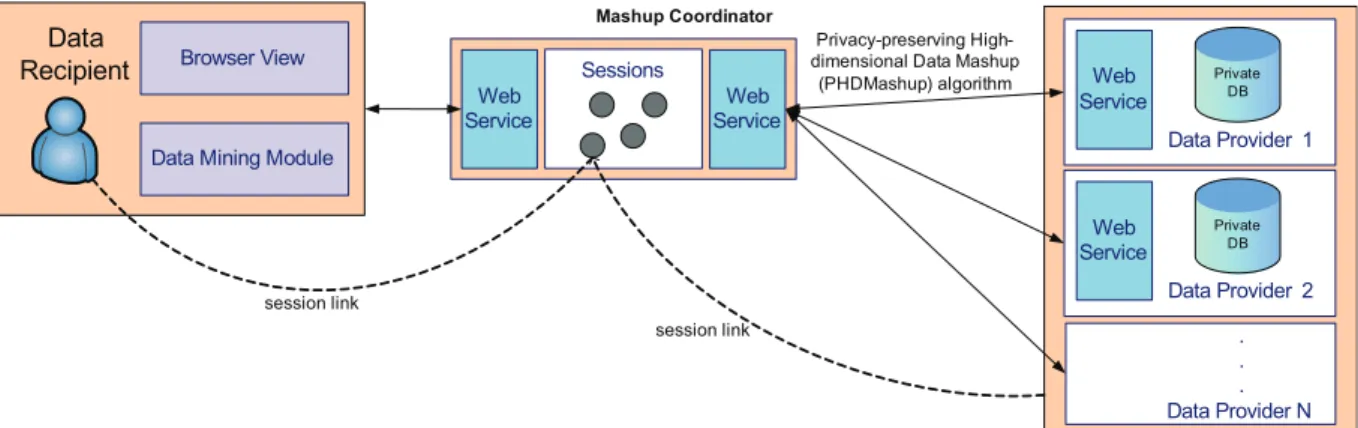
ASHUPWe first present a service-oriented architecture (SOA) that describes the communication paths of all partici-pating parties, followed by a privacy-preserving high-dimensional data mashup algorithm that can effi-ciently identify a suboptimal solution for the problem described in Definition 3.
Browser View
Data Mining Module
Sessions Mashup Coordinator . . . Data Provider N Data Provider 1 Private DB Privacy-preserving
High-dimensional Data Mashup (PHDMashup) algorithm Web Service Web Service session link session link Web Service Data Provider 2 Private DB Web Service Data Recipient
Fig. 2. Service-Oriented Architecture for Privacy-Preserving Data Mashup
SOA is an architectural paradigm for developing and integrating heterogeneous information systems with strict message-driven communication paradigm. Following the SOA design principles, the result-ing system has several desirable properties includ-ing interoperability and loosely coupling. Interoperabil-ity refers to the capabilInteroperabil-ity of allowing platform-independent design of the system components based on a common understanding of service component interfaces. Loosely coupling refers to the capability of minimizing dependencies among the system compo-nents and, therefore, improving the overall flexibility, scalability, and fault tolerance of a system [37]. In the mashup system described in this paper, data sources can be dynamically composed to serve new mashup requests depending on the data analysis tasks and privacy requirements. SOA with the capabilities of interoperability and loosely coupling has become a natural choice to tackle the heterogeneity of different potential data providers.
Referring to the architecture shown in Figure 2, the data mashup process can be divided into two phases. In Phase I, the mashup coordinator receives an information service request from the data recipient and establishes connections with the data providers who can contribute their data to fulfill the request. In Phase II, the mashup coordinator executes the privacy-preserving algorithm to integrate the private data from multiple data providers and to deliver the final mashup data to the data recipient. Note that our proposed solution does not require the mashup coordinator to be a trusted party. Though the mashup coordinator manages the entire mashup service, our solution guarantees that the mashup coordinator does not gain more information than the final mashup data, thereby protecting the data privacy of every partici-pant. The mashup coordinator can be any one of the data providers or an independent party. This makes our architecture practical because a trusted party is not always available in real-life mashup scenarios.
4.1 Phase I: Session Establishment
The objective of Phase I is to establish a common session context between the data recipient and the contributing data providers. An operational context is successfully established by proceeding through the steps of data recipient authentication, contributing data providers identification, session context initial-ization, and common requirements negotiation.
Authenticate data recipient: The mashup coordinator first authenticates a data recipient to the requested service, generates a session token for the current recip-ient interaction, and then identifies the data providers accessible by the data recipient. Some data providers are public and are accessible by any data recipients.
Identify contributing data providers: Next, the mashup coordinator queries the data schema of the accessible data providers to identify the data providers that can contribute data for the requested service. To facilitate more efficient queries, the mashup coordinator could pre-fetch data schema from the data providers (i.e., the pull model), or the data providers could update their data schema periodically (i.e., the push model). Initialize session context: Next, the mashup coordi-nator notifies all contributing data providers with the session identifier. All prospective data providers share a common session context that represents a stateful presentation of information related to a specific ex-ecution of the privacy-preserving mashup algorithm calledPHDMashup. This algorithm will be discussed in Section 4.2. An established session context con-tains several attributes to identify a PHDMashup pro-cess, including the data recipient’s address; the data providers’ addresses and certificates; an authentica-tion token that contains the data recipient’s certificate; and a unique session identifier that uses anend-point reference (EPR) composed of the service address, a PHDMashup process identifier and runtime status in-formation about the executed PHDMashup algorithm. Negotiate privacy and information requirements: The mashup coordinator is responsible to communicate the negotiation of privacy and information require-ments among the data providers and the data
recip-ient. Specifically, this step involves negotiating cost, LKC-privacy requirement, sensitive information, and expected information quality. For example, in the case of classification analysis, information quality can be estimated by classification error on some testing data.
4.2 Phase II: Privacy-Preserving High-Dimensional Data Mashup
The objective of Phase II is to integrate the high-dimensional data from multiple data providers such that the final mashup data satisfies a given LKC -privacy requirement and preserves as much infor-mation as possible for the specified inforinfor-mation re-quirement. Recall that Definition 3.2 specifies three requirements. Requirements (1) and (2) specify the properties of the final mashup data. Requirement (3) states that no data provider should learn more detailed information than the final mashup data dur-ing the process of integration. To satisfy requirement (3), we propose a top-down specialization approach calledPrivacy-preserving High-dimensional Data Mashup (PHDMashup). We first present an overview of the algorithm followed by the details of each step.
To ease the discussion, we present the algorithm in a scenario of two data providers. An extension to multiple (>2) data providers will be given in Sec-tion 4.3. Consider two private tablesTA andTB with a common keyU ID, where ProviderAholdsTAand Provider B holds TB. Initially, every data provider generalizes all of its own attribute values to the topmost value according to the taxonomy trees, and maintains a cutCuti that contains the topmost value for each attributeDi inQID. The union cut∪Cuti on all attributes represents a generalized tableT, denoted by Tg. ∪Cuti also contains the set of candidates for specialization. A specialization v → child(v) is valid, written asIsV alid(v), if the table Tg still satisfies the LKC-privacy requirementafter the specialization on v. At each iteration, PHDMashup identifies the winner specialization, i.e., the valid candidate that has the highestScore, among all the candidates, performs the winner specialization, and updates theScoreand the IsV alid status of the new and existing candidates in the cut. PHDMashup terminates when there are no valid candidates in the cut.
Note, there is no need to further specialize a value once it becomes invalid because any further special-izations also must be invalid. Thisanti-monotonic [12] property ofLKC-privacy with respect to a specializa-tion significantly reduces the search space and ensures that the resulting solution is sub-optimal.
Algorithm 1 describes the procedure of ProviderA (same as ProviderB). ProviderAfinds the local win-ner specialization using the utility measure discussed in Section 3.2, and communicates with ProviderB to identify the global winner candidate, denoted by w. Suppose thatwis local to ProviderA (otherwise, the
Algorithm 1 PHDMashup for Provider A (same as
ProviderB)
1: initializeTg to include one record containing top-most values;
2: initialize ∪Cuti to include only topmost values and updateIsV alid(v)for every v∈ ∪Cuti;
3: while∃v∈ ∪Cuti s.t.IsV alid(v)do
4: find the local winner α that has the highest Score(α);
5: communicate Score(α) with Provider B to de-termine the global winnerw;
6: ifthe winnerw is localthen
7: specializew onTg;
8: instruct ProviderB to specializew;
9: else
10: wait for the instruction from ProviderB;
11: specializew onTg using the instruction;
12: end if
13: replace w with child(w) in the local copy of ∪Cuti;
14: updateScore(x)and IsV alid(x)for every can-didatex∈ ∪Cuti;
15: end while
16: return Tg and∪Cuti;
discussion below applies to Provider B). Provider A performsw→child(w)on its copy of ∪Cuti and Tg. This means specializing each record t ∈ Tg contain-ing w into those t′1, . . . , t′z containing child values in child(w). Similarly, ProviderB updates its∪Cuti and Tg, and partitions TB[t] into TB[t′1], . . . , TB[t′z]. Since ProviderBdoes not have the attribute forw, Provider Aneeds to instruct ProviderBhow to partition these records in terms ofU IDs.
The nature of the top-down approach implies that Tg isalwaysmore general than the final mashup table and, therefore, does not violate requirement (3) in Definition 3.2. At each iteration, the data providers co-operate to perform the same identified specialization by communicating some count statistics information that satisfies requirement (3) in Definition 3.2. Below, we describe the key steps: find the winner candidate (Lines 4-5), perform the winner specialization (Lines 7-11), and update the score and status of candidates (Line 14). For ProviderA, alocal attribute refers to an attribute fromTA.
Example 2: Consider Table 1 and theLKC-privacy requirement with L = 2, K = 2, C = 50%, QID = {Gender, J ob, Age}, andS={s1}. Initially,
Tg=⟨AN Y Gender, AN Y J ob,[1-99)⟩ and
∪Cuti={AN Y Gender, AN Y J ob,[1-99)},
and all specializations in ∪Cuti are candidates. To
find the winner candidate w, Provider A
com-putes Score(AN Y Gender), and Provider B com-putesScore(AN Y J ob)andScore([1-99)).
Link[1-60)
Head of Link[1- 60)
Gender Job Age
ANY_Gender ANY_Job [1-99)
Head of Link[60- 99)
[1-99) {[1-60), [60-99)}
11 # of Recs. ANY_Job { White-collar, Blue-collar }
2 # of s1 ANY_Gender Blue-collar [1-99) 2 6 Provider B Provider A ANY_Gender White-collar [1-99) 0 5
ANY_Gender Blue-collar [1-60) 2 4 ANY_Gender Blue-collar [60-99) 0 2 ANY_Gender White-collar [1-60) 0 5
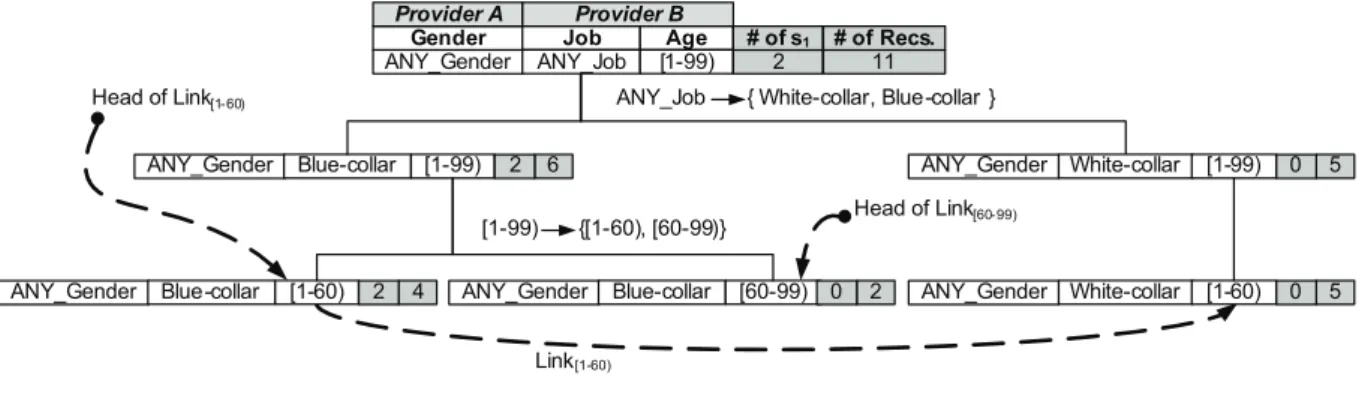
Fig. 3. The TIPS data structure
4.2.1 Find the Winner Specialization
ProviderAfirst finds a valid candidateαthat has the highest Score(α)among all the local attribute values in ∪Cuti. Then, Provider A communicates Score(α)
with Provider B to determine the global winner
specialization, denoted by w, that has the highest Score(w)among all candidates in∪Cuti.Score(x)and IsV alid(x) for every x ∈ ∪Cuti are updated from Line 14 in the previous iteration or the initialization prior to the first iteration. The updating procedure is discussed in Section 4.2.3. In case all local candidates are invalid, ProviderAsends a defaultScore=−1to ProviderB to indicate its status. To avoid sharing the Score between the data providers, PHDMashup em-ploys the secure multiparty maximum protocol [20] to determine the highestScoreamong the participating data providers.
4.2.2 Perform the Winner Specialization
Suppose that the winner specialization w is local at Provider A (otherwise, replace Provider A with Provider B in the procedure). For each record t in Tg containingw, ProviderA accesses the raw records in TA[t] to tell how to specialize t. To facilitate this operation, we represent Tg by the data structure called Taxonomy Indexed PartitionS (TIPS). The idea is to group the raw records in TA according to their generalized recordst inTg.
Definition 4.1 (TIPS): TIPS is a tree structure. Each node represents a generalized record over ∪QIDj. Each child node represents a specialization of the parent node on exactly one attribute. A leaf node represents a generalized record t in Tg and the leaf partition containing the raw records generalized to t, i.e.,TA[t]. For a candidatexin∪Cuti,Pxdenotes a leaf partition whose generalized record contains x, and Linkx links up all partitionsPx.
With TIPS, we can efficiently find all raw records generalized toxby followingLinkxfor any candidate x in ∪Cuti. To ensure that every data provider has only access to its own raw records, a leaf partition at Provider A contains only raw records from TA and a leaf partition at Provider B contains only raw records from TB. Each provider maintains a local
copy of TIPS, representing the current state of the integrated table. Initially, the TIPS has only the root node representing all data records with the most gen-eral values. In each iteration, the two data providers cooperate to perform the specializationw by refining the leaf partitions Pw on Linkw in their own copy of TIPS. As both providers perform exactly the same specialization, both copies of TIPS are always identical after every specialization.
Example 3: Continue with Example 2. Initially, TIPS has only one partition containing all data records and representing the generalized record ⟨AN Y Gender, AN Y J ob,[1-99)⟩,TA[root] = TA and TB[root] = TB. The root is on LinkAN Y Gender, LinkAN Y J ob, and Link[1-99). See Figure 3.
Suppose the first winner specialization is
AN Y J ob → {White-collar,Blue-collar}. We
create two new partitions under the root
partition as shown in the figure, and split data records between them. Both partitions are on LinkAN Y Gender and Link[1-99). ∪Cuti is updated into {AN Y Gender,White-collar,Blue-collar,[1-99)}. Suppose that the second winner specialization is [1-99) → {[1-60),[60-99)}, which specializes the two partitions on Link[1-99), resulting in the leaf partitions in Figure 3.
We summarize the operations at the two data providers, assuming that the winner w is local at ProviderA.
Provider A. Provider A refines each leaf partition
PwonLinkwinto child partitionsPc.Linkc is created to link up the newPc’s for the samec. AddPcto every Linkx other thanLinkw to whichPw was previously linked. While scanning the records inPw, ProviderA also collects the following information.
• uids for ProviderB. If a record inPwis specialized to a child valuec, collect the pair (uid,c), where uidis theU IDvalue of the record. Then, Provider Asends these (uid,c) pairs to ProviderB for spe-cializing the corresponding leaf partitions there.
• Count statistics for updating Score. (1) For each c in child(w): |TA[c]|, |TA[d]|, |TA[c∧cls]|, |TA[d∧ cls]|,|TA[c∧s]|, and|TA[d∧s]|for every sensitive values∈S, whered∈child(c)and clsis a class
label. Refer to Section 3 for these notations.|TA[c]| (similarly|TA[d]|) is computed by
∑
|Pc|forPcon Linkc. (2) For eachPconLinkc:|Pd|, wherePd is a child partition underPc as if c is specialized.
Provider B. On receiving the instruction from
ProviderA, ProviderB creates child partitionsPc in its own TIPS. At ProviderB’s site, the child partitions Pc contain raw records from TB. The child partitions Pc are obtained by splittingPw among Pc according to the (uid, c) pairs received.
Example 4: Let us revisit the first specialization in Example 3. Provider B performs the first special-ization AN Y J ob → {White-collar,Blue-collar} on its own TIPS and then sends the following instruction to ProviderA:
uid#1,3,5,6,10,11 go to the node withBlue-collar. uid#2,4,7,8,9 go to the node withWhite-collar. On receiving this instruction, Provider A creates the two child nodes under the root in its copy of TIPS and partitionsTA[root]. In general, the data providers update their own TIPS data structures either by spe-cializing the winning candidate on their own local attributes or by receiving specialization instructions from the other data provider.
Updating TIPS is the only operation that accesses raw records in our algorithm. Subsequently, updating Score(x) (in Section 4.2.3) makes use of the count statistics without further accessing raw records. The overhead of maintaining Linkx is small. For each attribute in∪QIDj and each leaf partition onLinkw, there are at most |child(w)| ”relinkings.” Therefore, there are at most | ∪QIDj| × |Linkw| × |child(w)| ”relinkings” for performingw.
4.2.3 Update the Score
The key to the scalability of our algorithm is updating Score(x) and IsV alid(x) using the count statistics maintained in Section 4.2.2 without accessing raw records again. For any valid candidate x ∈ ∪Cuti, its Score(x) and IsV alid(x) need to be updated if some qidx containing x also contains the winner candidate w in the current specialization. Updating Score(x) depends on Inf oGain(x) or |T[qidx]|. Up-datingIsV alid(x)depends on |T[qidx]|and|T[qidx∧ s]| for every sensitive value s∈S. We consider both updates below.
Updating Inf oGain(x): We need to compute
Inf oGain(c) for the newly addedc inchild(w). The owner provider ofwcan computeInf oGain(c)while collecting the count statistics forc in Section 4.2.2.
Example 5: Let us revisit the first specialization in Example 3. We show the computation of Score(AN Y J ob) for the specialization AN Y J ob→ {Blue-collar,White-collar}. For general data analysis, Score(AN Y J ob) = 62+ 52 = 61. For classification analysis, E(T[AN Y J ob]) =−6 11×log2 6 11− 5 11×log2 5 11 = 0.994 E(T[Blue-collar]) =−2 6×log2 2 6 − 4 6×log2 4 6 = 0.918
E(T[White-collar]) =−55×log255−05×log205 = 0.0
Inf oGain(AN Y J ob) =E(T[AN Y J ob])−(116× E(T[Blue-collar]) +115 ×E(T[White-collar])) = 0.493 Inf oGain(AN Y J ob) = 0.493.
UpdatingIsV alid(x)and|T[qidx]|: Given anLKC
-privacy requirement, a specialization on value x is valid (i.e., IsV alid(x) = true) if |T[qidj]| ≥ K and P(s|qidj) =|
T[qidj∧s]|
|T[qidj]| ≤Cfor anyqidjwith|qidj| ≤L
containing x and for any s ∈ S. The following
data structure, called Quasi-Identifier Tree(QIT), can efficiently maintain these counts.
Definition 4.2 (QIT): For each QIDj = {D1, . . . ,
Dq}, QITj is a tree of q levels, where level i > 0 represents generalized values for Di. A root-to-leaf path represents an existingqidj onQIDj in the gen-eralized dataTg. The leaf nodes store the|T[qidj]|and |T[qidj∧s]|for every sensitive value s∈S. A branch is trimmed if its|T[qidj]|= 0.
QITj is kept at a data provider if the data provider owns some attributes in QIDj. On specializing the winner w, a data provider updates its QITjs that contain the attribute of w: creates the nodes for the new qidjs and computes |T[qidj]| and |T[qidj ∧s]|
for every sensitive value s ∈ S. We can obtain
|T[qidj]|and |T[qidj∧s]|from the local copy of TIPS: |T[qidj]| =
∑
|Pc|, where Pc is on Linkc and qidj is the generalized value onQIDjforPc.|T[qidj∧s]|can be computed similarly. Note that|Pc|is given by the count statistics forwcollected in Section 4.2.2.
4.3 Analysis
Our approach produces the same integrated table as thesingle data provider anonymization algorithm [13] on a joint table, and ensures that no data provider learns more detailed information about any other provider other than what they agreed to share. This claim follows from the fact that PHDMashup per-forms exactly the same sequence of specializations as in [13] but in a distributed manner where TA and TB are kept locally at the sources. The only information revealed to each other is ∪Cutj and Tg at each iteration. However, such information is more general than the final mashup table that the two data providers have agreed to share.
PHDMashup (Algorithm 1) is extendable for mul-tiple (more than two) data providers with minor changes: In Line 5, each data provider should commu-nicate with all the other data providers for determin-ing the winner. In Line 8, the data provider holddetermin-ing the winner specialization should instruct all the other data providers. In Line 10, a data provider should wait for instruction from the winner data provider. Our algorithm is based on the assumption that all the data providers are semi-honest. An interesting extension would be to consider the presence of malicious and selfish data providers [29], [38], [39], [40]. In such
TABLE 3
Attributes for theAdultdata set
Attribute Type Numerical Range
# Leaves # Levels
Age (Ag) numerical 17 - 90
Education-num (En) numerical 1 - 16
Final-weight (Fw) numerical 13492 - 1490400
Relationship (Re) categorical 6 3
Race (Ra) categorical 5 3
Sex (Sx) categorical 2 2
Marital-status (Ms) categorical 7 4
Native-country (Nc) categorical 40 5
Education (Ed) categorical 16 5
Hours-per-week (Hr) numerical 1 - 99 Capital-gain (Cg) numerical 0 - 99999 Capital-loss (Cl) numerical 0 - 4356
Work-class (Wc) categorical 8 5
Occupation (Oc) categorical 14 3
a scenario, the algorithm has to be both secure and incentive compatible.
The overhead cost of session establishment in Phase I involves creating a session link between a mashup coordinator and a data recipient, and a session link between a mashup coordinator and each contributing data provider. A session link is simply an integer value (e.g., a Job ID) and is either used to actively keep the data recipient connected or to allow for asynchronous polling for the status of a current job. The data structure size for maintaining a session of a mashup request is linear to the number of contribut-ing data providers; therefore, the overhead is limited. In case the number of data recipients or the number of mashup requests is large, the load of the mashup coordinator can be balanced across multiple servers.
The computational cost of PHDMashup in Phase II can be summarized as follows. Each iteration involves the following work: (1) Scan the records inTA[w]and TB[w]for updating TIPS and maintaining count statis-tics (Section 4.2.2). (2) UpdateQITj,Inf oGain(x), and IsV alid(x)for affected candidatesx(Section 4.2.3). (3) Send ”instruction” to the remote data providers. The instruction contains onlyuids of the records in TA[w] or TB[w] and child values c in child(w), therefore, is compact. Only the work in (1) involves accessing data records; the work in (2) makes use of the count statis-tics without accessing data records and is restricted to only affected candidates. This feature makes our approach scalable. We will evaluate the scalability of the algorithm on real-life data in the next section.
For the communication cost (3), each data provider communicates (Line 5 in Algorithm 1) with others to determine the global winner candidate. Thus, each data provider sends n−1 messages, where n is the number of data providers. Then, the data provider of the winner specialization (Line 8) sends instruction to other data providers. This communication process continues for at moststimes, wheres is the number
10 12 14 16 18 20 20 40 60 80 100
MCE (L=2) MCE (L=4) MCE (L=6) SE(A)=17.7% SE(B)=17.9% Threshold K C la ss ifi ca " o n E rr o r (% )
Fig. 4. Benefits of Mashup (C= 20%)
of valid specializations bounded by the number of distinct values in ∪QIDj. Hence, for a given data set, the total communication cost is s×[n(n−1) + (n −1)] = s×(n2 −1) ≈ O(n2). If n = 2, then
the total communication cost is 3s. In real-life data mashup application, the number of contributing data providers for an information request is usually small.
5
E
MPIRICALS
TUDYWe implement the proposed PHDMashup in a dis-tributed web service environment. Each data provider is running on an Intel Core2 Quad Q6600 2.4GHz PC with 2GB RAM connected to a LAN. The objectives of the empirical study are to evaluate the benefit of data mashup for joint data analysis, and the impacts of anonymization and dimensionality on the data quality with respect to the information requirements. We first describe the data set and the settings, followed by the results.
Due to the privacy agreement, we cannot use the raw data from the social network companies for experiments, so we employ the de facto benchmark census data set Adult [41], which is also a real-life data set, to illustrate the performance of our proposed architecture and algorithm. TheAdult data set has 6 numerical attributes, 8 categorical attributes, and a binaryClassattribute representing two income levels ≤50K or >50K. Table 3 describes each attribute. It contains 45,222 records after removing records with missing values. We model a 2-data provider scenario with two private tables TA and TB as follows: TA contains the first 9 attributes, and TB contains the remaining 5 attributes. We considerDivorcedand Sep-arated in the attribute Marital-status as sensitive, and the remaining 13 attributes asQID. A common U ID is added to both tables for joining. The taxonomy trees for all categorical attributes are from [8].
5.1 Benefits of Mashup
A trivial yet incorrect solution to avoid privacy con-cerns is to not integrate the data; each data provider
14 18 22 26
20 40 60 80 100
MCE (L=2) MCE (L=4) MCE (L=6) BE=14.7% UE=24.6% Threshold K C la ss ifi ca ! o n E rr o r (% )
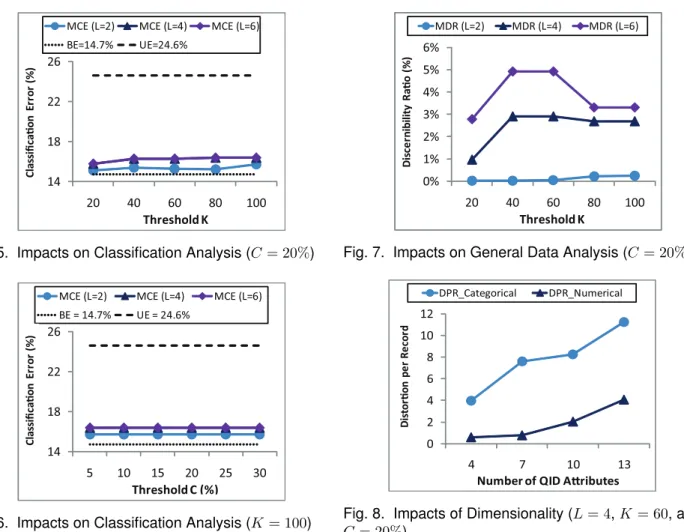
Fig. 5. Impacts on Classification Analysis (C= 20%)
14 18 22 26
5 10 15 20 25 30
MCE (L=2) MCE (L=4) MCE (L=6) BE = 14.7% UE = 24.6% Threshold C (%) C la ss ifi ca " o n E rr o r (% )
Fig. 6. Impacts on Classification Analysis (K= 100)
simply performs the classification analysis on its own attributes and releases the data mining result, such as the classifier, to the data recipient. Our first goal is to illustrate the benefit of data mashup over this trivial solution with respect to the classification requirement. To evaluate the impact on classification quality (Case 1 in Section 3.2.1), we use all records for anonymization, build a C4.5 classifier [2] on 2/3 of the anonymized records as the training set (30,162 records), and measure the classification error on 1/3 of the anonymized records as the testing set (15,060 records). Both the training and testing steps use all 14 attributes. Lower classification error means better data quality. We collect two types of classification errors from the testing set:Mashup Classification Error(M CE) is the error on the mashup data produced by our PHDMashup algorithm.Source error(SE) is the error on individual raw data table without generalization. SE for TA, denoted by SE(A), is 17.7% and SE for TB, denoted bySE(B), is17.9%.SE−M CEmeasures the benefit of data mashup over individual private table.
Figure 4depicts theM CEfor the adversary’s prior
knowledgeL= 2, L= 4, andL= 6with confidence
threshold C = 20% and anonymity threshold K
ranging from 20 to 100. For example, M CE= 16.3% for L = 4 and K = 60, suggesting that the benefit
0% 1% 2% 3% 4% 5% 6% 20 40 60 80 100 MDR (L=2) MDR (L=4) MDR (L=6) Threshold K D is ce rn ib il it y R a ! o ( % )
Fig. 7. Impacts on General Data Analysis (C= 20%)
0 2 4 6 8 10 12 4 7 10 13 DPR_Categorical DPR_Numerical
Number of QID A!ributes
D is to r" o n p e r R e co rd
Fig. 8. Impacts of Dimensionality (L= 4,K= 60, and
C= 20%)
of mashup,SE−M CE, is approximately 1.5%. This experiment demonstrates the benefit of data mashup over a wide range of privacy requirements. The ben-efit for all test cases illustrated in Figure 4 spans from 1.3% to 2.1%. The benefit decreases as L increases because more generalization is required in order to thwart the linkage attacks. In practice, the benefit is more than the accuracy consideration because our method allows the participating data providers to sharedatafor joint data analysis, rather than sharing aclassifier from each provider.
5.2 Impacts of Anonymization
Our second goal is to illustrate the impacts for achiev-ingLKC-privacy with respect to classification analy-sis and general data analyanaly-sis.
To evaluate the impacts on classification quality (Case 1 in Section 3.2.1), we collect several classifica-tion errors, in addiclassifica-tion toM CE, from the testing set: Baseline Error(BE) is the error measured on all 14 raw data attributes without generalization. BE −M CE represents the cost in terms of classification quality for achieving a given LKC-privacy requirement. A naive method to avoid record and attributes linkages is to simply remove allQIDattributes. Thus, we also measure Upper bound Error (U E), which is the error
on the raw data with all QID attributes removed. U E−M CErepresents the benefit of our method over the naive approach. The experimental results below suggest that our method PHDMashup can yield a smallM CE−BE (low cost) and a largeU E−M CE (high benefit).
Figure 5depicts theM CEfor the adversary’s prior
knowledge L = 2, L = 4, and L = 6 with confi-dence threshold C = 20% and anonymity threshold K ranging from 20 to 100. For example, at L = 4, K = 60, and C = 20, M CE = 16.3%. The cost is M CE−BE = 1.6%, whereBE = 14.7%. The benefit is U E−M CE = 8.3%, where U E = 24.6%. For all test cases in Figure 5, the costM CE−BE spans from 0.4% to 1.7% and the benefitU E−M CE spans from 8.2% to 9.5%. This result illustrates that the cost of anonymization is low and the benefit of anonymiza-tion is high, suggesting that accurate classificaanonymiza-tion and privacy protection can coexist even for a wide range of anonymity threshold K. Typically, there are redundant classification patterns in the data. Though generalization may eliminate some useful patterns, other patterns emerge to help the classification task.
Figure 6depicts theM CEfor the adversary’s prior
knowledge L = 2, L = 4, and L = 6 with K = 100 and confidence thresholdC ranging from 5% to 30%. M CEstays flat at15.7%forL= 2, at16.4%forL= 4 and L = 6. For all test cases in Figure 6, the cost M CE−BE spans from 1% to 1.7% and the benefit U E −M CE spans from 8.2% to 8.9%. This result suggests that the M CE is insensitive to the change of the confidence threshold C, implying that it does not cost much to thwart attribute linkages.
To evaluate the costs on general analysis quality (Case 2 in Section 3.2.2), we use all records for gen-eralization and measure themashup discernibility ratio (M DR) on the final mashup data.
M DR(T) = ∑
qid|T[qid]| 2
|T|2 . (4)
M DR is the normalized discernibility cost [36], with 0≤M DR≤1. The lowerM DR indicates the higher data quality.
Figure 7depicts theM DRfor the adversary’s prior
knowledgeL= 2, L= 4, andL= 6with confidence
threshold C = 20% and anonymity threshold K
ranging from 20 to 100. For all test cases in Figure 7, M DR spans from 0.02% to 4.92%, suggesting that it costs very little to achieve a given LKC-privacy re-quirement even for a wide range of adversary’s prior knowledgeLand anonymity thresholdK. Similar to the measure on classification error, M DR is insensi-tive to the change of the confidence threshold C.
The result in Figure 7 also shows that M DR does not increase monotonically with respect to the in-creaseK because PHDMashup employs a greedy ap-proach for selecting a specialization at each iteration. The greedy approach can guarantee the identified
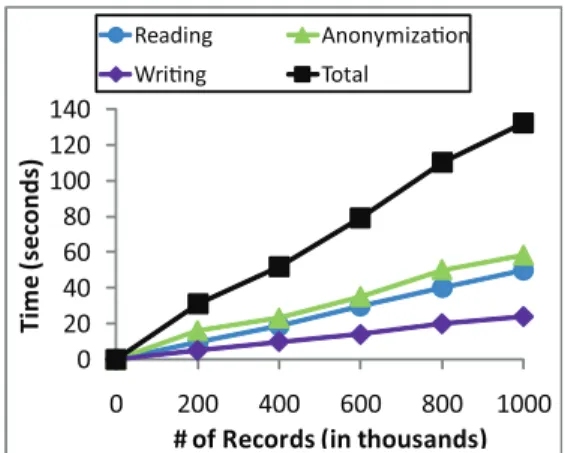
0 20 40 60 80 100 120 140 0 200 400 600 800 1000 Reading Anonymiza on Wri ng Total
# of Records (in thousands)
T im e ( se co n d s)
Fig. 9. Scalability (L= 4,K= 20, andC= 100%)
solution is sub-optimal but not necessarily global op-timal. Although a global optimal solution is desirable, finding the optimal solution significantly degrades the efficiency and scalability of the method, which are also important requirements for real-life data mashup.
5.3 Impacts of Dimensionality
Our third goal is to evaluate the impact of dimen-sionality, i.e., the number of QID attributes, on the data quality with respect to the distortion metric proposed in [42]. Each time a categorical value is generalized to the parent value in a record, there is one unit of distortion. For a numerical attribute, if a value v is generalized to an interval [a, b), there is (b−a)/(f2−f1) unit of distortion for a record containing v, where [f1, f2) is the full range of the numerical attribute. The distortion is normalized by the number of records. Thedistortion per record(DP R) is separately computed for categorical attributes and numerical attributes, denoted by DP R Categorical andDP R N umerical, respectively.
Figure 8 depicts the DP R Categorical and
DP R N umericalfor the adversary’s prior knowledge
L = 4 with confidence threshold C = 20% and
anonymity threshold K = 60 for 4, 7, 10, and 13 QID attributes. DP R Categorical spans from 3.98 to 11.24 and DP R N umerical spans from 0.62 to 4.05. This result illustrates that the distortion per record generally increases as the number of QID attributes increases because more generalizations are required in order to achieve the sameLKC-privacy requirement.
5.4 Efficiency and Scalability
Our method takes at most 20 seconds for every pre-vious experiment. Out of the 20 seconds, approx-imately 8 seconds is spent on initializing network sockets, reading data records from disk, and writing the generalized data to disk. The actual costs for data anonymization and network communication are relatively low.