Theses and Dissertations
8-2012
Multiliteracies in the Classroom: An Explanatory
Sequential Mixed Methods Approach to Teachers'
and Students' Perspectives Toward Integration of
Technology
Laura Janine Chitty
University of Arkansas, Fayetteville
Follow this and additional works at:http://scholarworks.uark.edu/etd
Part of theEducational Methods Commons, and theSecondary Education and Teaching Commons
This Dissertation is brought to you for free and open access by ScholarWorks@UARK. It has been accepted for inclusion in Theses and Dissertations by an authorized administrator of ScholarWorks@UARK. For more information, please [email protected], [email protected].
Recommended Citation
Chitty, Laura Janine, "Multiliteracies in the Classroom: An Explanatory Sequential Mixed Methods Approach to Teachers' and Students' Perspectives Toward Integration of Technology" (2012).Theses and Dissertations. 514.
MULTILITERACIES IN THE CLASSROOM: AN EXPLANATORY SEQUENTIAL MIXED METHODS APPROACH TO TEACHERS’ AND STUDENTS’ PERSPECTIVES TOWARD
INTEGRATION OF TECHNOLOGY
A dissertation submitted in partial fulfillment of the requirements for the degree of
Doctor of Philosophy in Curriculum and Instruction
By
Laura Janine Chitty University of Central Arkansas
Bachelor of Arts in French and English Language Arts, 1989 Webster University
Master of Arts in Human Resources Development, 1995
August 2012 University of Arkansas
An increased number of students graduating from high school lack college and career readiness skills to earn credit in entry-level college courses or begin a career in an entry-level position. Many schools across America have prepared to address students’ college and career readiness with the adoption of Common Core State Standards. Twenty-five teachers and 92 students participated in this dissertation study conducted at a high school (grades 10-12) in the southern United States. The purpose of this study was to describe and explain teachers’ and students’ perspectives toward the integration of technology that enhances multiliteracies in the classroom. An explanatory sequential mixed methods approach was used to guide this study. Data were collected from surveys to describe teachers’ and students’ beliefs, perceived barriers, and
technology skill levels associated with multiliteracies enhanced by technology in the classroom. Descriptive statistics and independent t-tests were used for analysis of the quantitative data. Open thematic coding and axial coding were used for analysis of the qualitative data. Teachers’ and students’ interviews and classroom observations were used to further explain, clarify, and enhance the data collected from the surveys. Data results indicated that teachers and students strongly support the integration of technology in the classroom. Teachers and students indicated a statistically significant difference in technology skills associated with social literacy and multimedia. Teachers perceived time as the most significant barrier to integrating technology into the classroom; students viewed the school filter as the most significant barrier. Teachers viewed the role of technology as a tool to support students’ cognitive development, to obtain and maintain students’ attention, to facilitate administrative tasks, and to facilitate and promote students’ college and career readiness. Students viewed the role of technology as a tool to gather information from the Internet and to enhance students’ cognitive learning processes.
Dissertation Director: __________________________________________ Dr. Christian Z. Goering Dissertation Committee: __________________________________________ Dr. Barbara C. Gartin __________________________________________ Dr. Janet Penner-Williams __________________________________________ Dr. Michael J. Wavering
I hereby authorize the University of Arkansas Libraries to duplicate this dissertation when needed for research and/or scholarship.
Agreed ___________________________________________
Laura Janine Chitty
Disagreed ___________________________________________
There are many people to whom I am grateful for helping me through my educational journey and helping me obtain my goal of earning my PhD.
I would like to thank Dr. Chris Goering, my chair and program advisor, for all the time, support, encouragement, and direction he has given to me throughout this incredible educational experience. I would like to thank my dissertation committee for the time and encouragement they shared with me to complete this dissertation: Dr. Barbara Gartin, Dr. Janet
Penner-Williams, and Dr. Michael Wavering. Throughout my doctoral program, I have had the privilege to learn and practice under the direction of some of the most prestigious University professors— and for that I am truly grateful.
I would like to thank my daughter, Lauren, for her understanding when “mom had to study,” or when “mom had homework to do.” My daughter has grown up to be a wonderful young lady in spite of my absence as “mom.” Her father, my husband, frequently filled an incredible void with our daughter by assuming the roles of “Mr. Mom” and dad.
I would like to thank my husband, Chuck, for the endless sacrifices he made for me to follow my dream of earning a PhD. Without his support, encouragement, sacrifices, and love I would not have made it through this doctoral program. My husband is my hero—my knight in shining armor.
I would like to thank my friends who have offered words of encouragement and support to me over the years.
Finally, I would like to thank the teachers and students who participated in this
dissertation study. Your contributions were invaluable to the completion of this dissertation and to the future studies of multiliteracies enhanced by technology integration in the classroom.
I dedicate this dissertation to my husband and my daughter—whose unending sacrifice, support, love, and encouragement allowed this dream to come true for me. Thank you Chuck and Lauren—I love you both.
I dedicate this dissertation to my merciful Lord Jesus Christ who freely gave me eternal life and strength when I felt I could not go on.
CHAPTER ONE: MULTILITERACIES IN THE CLASSROOM ... 1
Introduction ... 1
Statement of Problem ... 3
Research Questions ... 5
Purpose of the Study ... 5
Significance of the Study ... 6
Theoretical Background of the Study ... 8
Post positivist ... 8
Constructivist ... 9
Research Design of the Study ... 9
Explanatory sequential mixed methods research design ... 10
Mixing ... 10
Phase I: Survey ... 11
Phase II: Interviews and classroom observations ... 11
Research Data Collection Design ... 12
Sampling procedures ... 12
Obtaining permission ... 13
Collecting information ... 13
Recording the data ... 14
Administering the procedures ... 14
Limitations of the Study... 14
Scope of the Study ... 15
Organization of the Study ... 16
Definition of Terms... 16
CHAPTER TWO: LITERATURE REVIEW ... 18
Introduction ... 18
Background Information ... 20
Common Core State Standards ... 21
A Brief History of Literacy Instruction ... 24
Multiliteracies ... 31
Digital literacy ... 32
Information literacy ... 34
Critical literacy... 35
Critical media literacy ... 36
Visual literacy ... 37
Multimedia/multimodal literacy ... 38
Cultural literacy ... 39
Social literacy... 41
Multiliteracies in the Classroom ... 42
Teachers’ and Students’ Perspectives toward Integration of Technology ... 45
Summary ... 54
CHAPTER THREE: METHODS ... 56
Methodology ... 56
Explanatory Sequential Mixed Methods Design ... 56
Research Questions ... 59
The Role of the Researcher ... 59
Setting and Participant Selection ... 60
Setting selection ... 60
Participant selection ... 61
Phase I: Participant selection ... 62
Phase II: Participant selection ... 63
Measuring Instruments... 64
Survey ... 65
Interviews ... 66
Classroom observations ... 67
Validity of survey instrument ... 67
Protocol for Data Collection ... 70
Quantitative data collection ... 71
Protocol for Data Analysis ... 72
Data reduction ... 73
Data display ... 73
Data connection and interpretation ... 73
Summary ... 74
CHAPTER FOUR: RESULTS ... 76
Results ... 76
Reliability of Survey Instrument ... 76
Phase I - Data Collection and Data Analysis ... 78
Participant demographics ... 78
Quantitative survey data ... 79
Qualitative survey data ... 80
Data analysis ... 80
Thematic coding, axial coding, and frequency counts ... 85
Phase II - Data Collection and Data Analysis ... 89
Teachers’ interviews ... 89
Students’ interviews ... 90
Classroom observations ... 90
Data analysis ... 96
Thematic coding, axial coding, and frequency counts ... 96
Summary ... 100
CHAPTER FIVE: CONCLUSIONS TO MULTILITERACIES IN THE CLASSROOM ENHANCED BY TECHNOLOGY ... 101
Discussion ... 101
Summary of the Study ... 101
Research Questions ... 103
How do teachers and students define literacy and multiliteracies? ... 103
What are the teachers’ and students’ perspectives toward technology integration that enhances multiliteracies in the classroom? ... 104
Critical literacy... 108
Cultural literacy ... 109
Information literacy ... 109
Visual literacy ... 110
Other uses of technology in the classroom ... 110
What are the teachers’ and students’ perceived levels of proficiency in integrating technology in the classroom that enhances multiliteracies in the classroom? ... 112
Technology literacy ... 112 Social literacy... 112 Digital literacy ... 114 Visual literacy ... 115 Information literacy ... 116 Multimedia ... 118 Cultural literacy ... 119 Multimodal ... 120
21st century skills for college and career readiness ... 120
Technology to enhance multiliteracies in the classroom ... 120
What are the teachers’ and students’ perceived barriers to integrating technology in the classroom?... 122
Access ... 122
Knowledge about technology ... 122
Software programs ... 123 Equipment ... 124 Technical support ... 125 Pedagogy ... 125 Time ... 126 Budget ... 126 School filter ... 126 Limited technology ... 126
What steps do teachers need to take to prepare for literacy (multiliteracies) expectations of
the Common Core State Standards? ... 130
Limitations of this Dissertation Study ... 130
Self-reported data ... 130
Generalizability of this dissertation study... 131
Reliability of the survey instrument ... 131
Time of this dissertation study ... 132
Implications for Practice ... 132
Changing attitudes and beliefs ... 133
Sharing a vision and technology integration plan ... 133
Conducting quality professional development ... 134
Providing sufficient and accessible equipment ... 136
Recognizing technical and instructional support ... 137
Introducing technology integration with CCSS ... 137
Scheduling time for training, practice, and integration... 138
Considerations for Future Research ... 138
Summary ... 140
REFERENCES ... 142
APPENDICES ... 148
List of Tables Page 1. Cronbach’s Alpha for Survey Items.………..184 2. Response Distribution: Participants’ Beliefs toward the Integration of Technology………185 3. Response Distribution: Participants’ Perspectives of Technology Skill Levels Associated
with Multiliteracies ………...189 4. Response Distribution: Participants’ Perspectives of Barriers to Integrating Technology
that Enhances Multiliteracies in the Classroom ………..193 5. Descriptive Statistics: Participants’ Beliefs toward the Integration of Technology……..…195 6. Descriptive Statistics: Participants’ Perspectives of Technology Skill Levels Associated
with Multiliteracies………..…197 7. Descriptive Statistics: Participants’ Perspectives of Barriers to Integrating Technology that
Enhances Multiliteracies in the Classroom………..…200 8. Comparison of Means: Participants’ Beliefs toward the Integration of Technology……....201 9. Comparison of Means: Participants’ Perspectives of Technology Skill Levels Associated
with Multiliteracies………..203 10. Comparison of Means: Participants’ Perspective of Barriers to Integrating Technology that
Enhances Multiliteracies in the Classroom………..205 11. Thematic Coding: Teachers’ Responses to “What is the role of technology in the
classroom?”………..206 12. Axial Coding: Teachers’ Responses to “What is the role of technology in the
classroom?”………..208 13. Thematic Coding: Teachers’ Responses to “What new literacy skills must be learned
by any 21st century student in order to prepare for college and career?”………209
14. Axial Coding: Teachers’ Responses to “What new literacy skills must be learned by any 21st century student in order to prepare for college and career?”..………...211 15. Thematic Coding: Teachers’ Responses to “What are the steps you as a teacher need
to take to prepare yourself for the literacy (multiliteracies) expectations of the
16. Axial Coding: Teachers’ Responses to “What are the steps you as a teacher need to take to prepare yourself for the literacy (multiliteracies) expectations of the Common Core State Standards?”…………..……….….214 17. Thematic Coding: Teachers’ Suggestions or Comments about the Integration of
Technology………..215 18. Axial Coding: Teachers’ Suggestions or Comments about the Integration of
Technology………..217 19. Thematic Coding: Students’ Responses to “What is the role of technology in the
classroom?”………..218 20. Axial Coding: Students’ Responses to “What is the role of technology in the
classroom?”………..220 21. Thematic Coding: Students’ Responses to Literacy Skills for 21st
Century Students….…221 22. Axial Coding: Students’ Responses to Literacy Skills for 21st Century Students…….…..223 23. Thematic Coding: Students’ Suggestions or Comments about the Integration of
Technology in the Classroom………..224 24. Axial Coding: Students’ Suggestions or Comments about the Integration of Technology in
the Classroom………..………228 25. Thematic Coding: Teachers’ Interviews – Technology to Enhance Multiliteracies in the
Classroom………229 26. Axial Coding: Teachers’ Interviews – Technology to Enhance Multiliteracies in the
Classroom……..……….….231 27. Thematic Coding: Teachers’ Interviews – Other Uses of Technology………232 28. Axial Coding: Teachers’ Interviews – Other Uses of Technology………..234 29. Thematic Coding: Teachers’ Interviews – Barriers to Integrating Technology to Enhance
Multiliteracies………..235 30. Axial Coding: Teachers’ Interviews – Barriers to Integrating Technology to Enhance
31. Thematic Coding: Students’ Interviews – Technology to Enhance Multiliteracies in the Classroom………238 32. Axial Coding: Students’ Interviews – Technology to Enhance Multiliteracies in the
Classroom………....240 33. Thematic Coding: Students’ Interviews – Barriers to Integrating Technology to Enhance
Multiliteracies in the Classroom………..……241 34. Axial Coding: Students’ Interviews – Barriers to Integrating Technology to Enhance
CHAPTER ONE: MULTILITERACIES IN THE CLASSROOM
Multiliteracies in the classroom: An explanatory sequential mixed methods approach to teachers’ and students’ perspectives toward integration of technology
Introduction
Policy makers indicate a strong commitment to support the expansion and use of technology in the K-12 classrooms (NCLB, 2001; CCSI, 2010; ISTE, 2011; PARCC, 2012). The adoptions of National Educational Technology Standards (NETS) and Common Core State Standards (CCSS), and the assessment system by Partnership for Assessment of Readiness for College and Careers (PARCC) represent evidence of this commitment.
The “new” literacies of the 21st
century embrace the expansion of technologies in the K-12 classroom. Being literate in the 21st century classroom requires students to be able to do more than just read and write using a traditional textual format. Literacy has taken on an expanded definition to include digital literacy, information literacy, cultural literacy, critical literacy, visual literacy, social literacy, multimedia/multimodal literacy—the interplay of which is multiliteracies. Various technology tools support many of these literacies. According to the National Educational Technology Standards for Students (NETS-S, 2007), student technology standards focus on 21st century skills, Web 2.0 technologies, and collaboration. Students integrating technology with literacy develop (1) creativity and innovation; (2) communication and collaboration; (3) research and information literacy; (4) critical thinking, problem solving, and decision making; (5) digital citizenship; and (6) technology operations and concepts (ISTE, 2011; Shrum & Levin, 2009, p. 14).
The National Educational Technology Standards for Teachers (NETS-T, 2008) goal is to make teachers aware of, model, and design instruction to move students into the 21st century
digital-age. These standards direct teachers to (1) facilitate and inspire student learning and creativity, (2) design digital-age learning experiences and assessments, (3) model digital-age work and learning, (4) promote digital citizenship and responsibility, and (5) engage in professional growth and leadership (ISTE, 2011; Shrum & Levin, 2009, p. 19).
Technology in the classroom takes on increased importance in the success of 21st century students with the widely adopted Common Core State Standards of 2010. New technologies have “accelerated the speed at which connections between speaking, listening, reading and writing can be made, requiring that students be ready to use these modalities nearly
simultaneously” (CCSI, 2010, p. 48). Adoption of and compliance with the Common Core State Standards (CCSS) presents challenging curriculum changes for teachers and students, as well as technology driven assessment changes. The CCSS further supports literacy and mathematic standards for college and career readiness by setting the educational standards for students K-12. The College and Career Readiness (CCR) initiative as defined in the blueprint for the
Reauthorization of the Elementary and Secondary Education Act (ESEA; 2010) requires that all students upon graduation be college and career ready with the knowledge and skills necessary in literacy and mathematics to gain entrance into an entry-level, credit-bearing college course or entry-level position in the student’s chosen career field.
On the classroom level, multiliteracies in the 21st century classroom address the needs and interests of all students in 2D and 3D (print and virtual) dimensions. A 21st century
classroom involves students in “problem-solving, analysis and practices using print and visual, electronic, face-to-face media in combinations that are occurring in new, civic, media and workplace contexts” (Pahl & Rowsell, 2005, p. 114).
According to Pahl and Rowsell (2005), the 21st century classroom engages students in opportunities to practice critical literacies, collaborative work, and intercultural communications. Students engaged in critical literacy skills learn to second-guess, criticize and argue with a range of texts (p. 114). Students involved in learning communities develop collaborative working skills through collaborative reading, writing and decision-making activities (p. 115). Students of the 21st century are global students and learn to negotiate a global world outside the classroom, negotiating and solving problems across cultures and languages (p. 115). Problem solving, collaborative work, intercultural communication, and multiliteracies are skills that prepare students for 21st century colleges and careers.
Statement of Problem
Standardized exams, such as ACT or SAT, assess traditional literacy and do not take into consideration the multiliteracies students master. According to ACT, an increasing number of students across the nation are graduating high school unprepared to enter college or start careers. The ACT College and Career Readiness 2011 stated that only 25% of graduating seniors met the college readiness benchmarks in all four subjects: English, reading, mathematics, and science (ACT, 2011). Standards in colleges and careers are becoming increasingly rigorous; however, the students are not showing increased preparedness to meet those standards. The Programme for International Student Assessment (PISA) reported that in 2009 the United States ranked 14th in reading literacy, 25th in mathematics literacy, and 17th in science literacy when compared to other Organization for Economic Cooperation and Development (OECD) countries (NCES, 2010). Comparison of literacy skills of 2000 to 2009, and 2003 to 2009 indicated no measurable change in student achievement (NCES, 2010). According to National Assessment of
since 2004 after the decline in the 1990s (NAEP, 2012). Approximately thirty-six percent of first-year undergraduate students in 2007-08 reported having taken remedial courses in college or trade schools (NCES, 2011). Students enrolling in remedial English, reading, or writing courses are less likely to eventually earn a degree or certificate (Alliance, 2011). Wagner (2008) and Schrum and Levin (2009) discuss the challenges facing 21st century schools: (a) to prepare students for jobs that do not yet exist, (b) to use technology that has not yet been invented, and (c) to solve problems that have not yet been identified. The Common Core State Standards proposes to address these challenges with the rigorous literacy expectations outlined for English language arts, social studies, science, math, and technical subjects.
In 2013, secondary schools adopting the Common Core State Standards will be
challenged further to align curriculum to meet college and career readiness standards of CCSS for all students. Meeting the literacy expectations in English language arts, social studies, science, math, and other technical courses as outlined in the Common Core State Standards is strongly dependent upon the integration of technology in the classroom. This technology integration is driven in 23 states by the assessment system being developed by PARCC:
Alabama, Arizona, Arkansas, Colorado, District of Columbia, Florida, Georgia, Illinois, Indiana, Kentucky, Louisiana, Maryland, Massachusetts, Mississippi, New Jersey, New Mexico, New York, North Dakota, Ohio, Oklahoma, Pennsylvania, Rhode Island, and Tennessee (PARCC, 2012). The remaining states are part of the Smarter Balanced Assessment Consortium that is also a state-led consortium working to develop assessments that accurately measure student progress toward college and career readiness (Smarter Balanced, 2012). Teachers who are looking for a coherent and practical framework that consolidates fundamental aspects of traditional literacy pedagogy with the multiliteracy competencies that students will need to
negotiate in the 21st century may be the teachers at highest risk of not meeting the CCSS standards, thus, failing to make ready graduating students for college and careers. The focus of this dissertation study was on teachers’ and students’ perspectives of the integration of
technology to enhance multiliteracies in the classroom that will develop college and career ready students and meet the rigorous literacy expectations of the Common Core State Standards. This dissertation study delved into the teachers’ and students’ perspectives about the integration of technology that enhances multiliteracies in all content area classrooms in order to address the issue of an increasing number of students graduating from high school who are unprepared to start college or enter careers because of poor literacy skills. So, how are teachers and students prepared to meet the rigorous literacy expectations of the Common Core State Standards that establish a college and career readiness for all students?
Research Questions
1. How do teachers and students define literacy and multiliteracies?
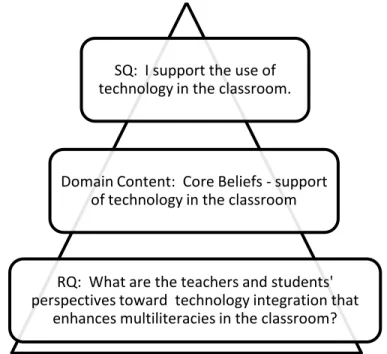
2. What are the teachers’ and students’ perspectives toward technology integration that enhances multiliteracies in the classroom?
3. What are the teachers’ and students’ perceived levels of proficiency in integrating technology in the classroom that enhances multiliteracies in the classroom?
4. What are the teachers’ and students’ perceived barriers to integrating technology in the classroom?
Purpose of the Study
The purpose of this dissertation study was to describe and explain the teachers’ and students’ perspectives of technology integration that enhances multiliteracies in the classroom. An explanatory sequential mixed methods design was used that involved collecting quantitative
data first and then explaining the quantitative results with in-depth qualitative data. From the surveys “Teachers’ Perspectives toward Integration of Technology to Enhance Multiliteracies in the Classroom” and “Students’ Perspectives toward Integration of Technology to Enhance Multiliteracies in the Classroom,” data were collected from teacher participants and student participants to describe teachers’ and students’ perspectives toward the integration of technology at a high school in the southern United States. The qualitative phase was conducted as a follow up to the quantitative results to help explain the quantitative results. The intent of the follow up qualitative phase was to explain and clarify with the teacher and student participants at the high school the definition of multiliteracies and the integration of technology that enhances
multiliteracies in the classroom. The rationale for this mixed methods research approach was for significance enhancement (Collins, Onwuegbuzie, & Sutton, 2006, pp. 83-84) by collecting a combination of qualitative and quantitative data to obtain richer data than would be obtained using only one type of data.
It was my desire through this dissertation study: (a) to broaden the definition of literacy with teachers and students, (b) to describe best practices of integration of technology in the classroom that enhances multiliteracies, (c) to encourage a student-centered curriculum that integrates technology that enhances multiliteracies in the classroom, (d) to identify needs for teachers’ professional development that encourages proficient integration of technology that enhances multiliteracies in the classroom; and (e) to promote improved literacy skills that impact students’ college and career readiness.
Significance of the Study
Provisions of the No Child Left Behind Act of 2001 (NCLB) encourage ongoing professional development programs for teachers to promote 21st century learning in the
classroom. These programs provide access to training and updated research in teaching and learning that meets the teachers’ needs and encourages proficient use of technology in all classrooms. This dissertation study identified and described teachers’ needs that will promote effective integration of technology that enhances multiliteracies in the classroom and allow for development of productive and effective professional development for teachers.
This dissertation study is important to education in support of an authentic, student-centered 21st century education for all students. An authentic, student-centered 21st century education includes the new literacy skills needed to “effectively communicate such technologies as text messaging, email, Facebook, Google, YouTube, and Second Life” (Baker, Pearson, & Rozendal, 2010, p. 2). The Enhancing Education through the Technology Act of 2001 (U.S. Dept. of Education, 2001) presents initiatives that provide school personnel with the means to incorporate technology into curricula and instruction that will align with the state academic content and student academic achievement standards that are reflective of 21st century learning. A significant goal of the Common Core State Standards is to ensure that upon graduation all students are college and career ready. Developing an authentic, student-centered curriculum that enhances literacy (multiliteracies) through the use of technology can promote college and career readiness for all students.
This dissertation study is important to education by adding to the discussion of multiliteracies and technology integration that enhances multiliteracies in the classroom.
Multiliteracies is a relatively new concept acknowledged in education in the 1990s by the New London Group (Cazden, Cope, Fairclough, Gee et al., 1996, p. 63). While the number of studies addressing multiliteracies in the classroom is growing, there have been few studies considering both the secondary level teachers’ and students’ perspectives on technology integration that
enhances multiliteracies in the classroom. Knowledge gained from this dissertation study may be used to initiate and/or guide development and improvement of school instructional policies and/or the development of student-centered curricula to increase and support instructional and educational use of technology by teachers and students to enhance multiliteracies in the classroom.
Finally, this dissertation study is important to support the discussion of the mixed methods research approach. The approach of mixing qualitative and quantitative methods of research has met with discord for nearly a century. Only recently has the mixed methods
research approach gained acceptable and reputable acknowledgement. In a 2004 article, Johnson and Onwuegbuzie discussed the paradigm “wars” and presented the position of mixed methods research as a natural complement to the traditional qualitative and quantitative research methods (Johnson & Onwuegbuzie, 2004). Since 2004, mixed methods research has been more accepted and used in studies including Palak and Walls’ (2009) study on teachers’ beliefs and technology practices.
Theoretical Background of the Study
This dissertation case study was based on the theoretical framework of post positivism transitioning to constructivism. This explanatory sequential mixed methods design began with a quantitative approach to data that typically lends itself to post positivist perspectives in the development of the survey instrument, followed by a qualitative approach to data that transitioned into assumptions of constructivism.
Post positivist. Post positivist views embrace (a) the ontology that reality exists but is intangible; (b) the epistemology that there are only approximations of reality; (c) the
(d) the products of knowledge produced represent generalizations, descriptions, patterns, and a grounded theory (Hatch, 2002, p. 13). Post positivist research is most commonly aligned with quantitative methods of data collection and analysis. The survey instrument allowed for the collection of quantitative and qualitative data that described the teachers’ and students’
perspectives, or interpretation of their reality, toward the integration of technology that enhances multiliteracies in the classroom. Post positivism allows for “data collection and analysis
processes [that] lead to descriptions of patterned behavior that participants use to make sense of their social surroundings” (Hatch, 2002, p. 15). As the researcher, I collected data that
represented an accurate description of the teachers’ and students’ perspectives, while maintaining an objective position in relation to the participants and the data. From a deductive quantitative and qualitative data analysis, my theoretical framework transitioned to that of constructivism.
Constructivist. Constructivist views embrace (a) the ontology that multiple realities are constructed, (b) the epistemology that knowledge is a human construction of the researcher and participant; (c) the methodology that knowledge is gained through naturalistic qualitative methods; and that (d) the products of knowledge produced are represented through case studies, narratives, interpretations, and reconstructions (Hatch, 2002, p. 13). Constructivists assume that absolute reality is unknowable, and that individual perspectives construct individual realities. As the researcher, I relied on the qualitative data presented through interviews and classroom observations to inductively construct and explain in more depth the teachers’ and students’ perspectives of technology integration that supports multiliteracies in the classroom.
Research Design of the Study
The research designframework for this dissertation study was based on the explanatory sequential mixed research design by Creswell and Plano Clark (2011).
Explanatory sequential mixed methods research design. An explanatory sequential mixed methods research design is a two-phase research design that begins with quantitative data collection and analysis followed by qualitative data collection and analysis that leads to an overall interpretation of the data (Creswell & Plano Clark, 2011, p. 71). The initial quantitative phase (Phase I) is designed to address the study’s research questions. The second, qualitative phase (Phase II) is designed to follow the results of the quantitative Phase I in order to explore and explain in more depth the results from the quantitative Phase I.
The purpose of this research study’s design was to explain the quantitative results in more depth. An explanatory sequential mixed methods design was based on the post positivist
paradigm in Phase I and the constructivist paradigm in Phase II. This design had a quantitative emphasis with the quantitative strand first, followed by the qualitative strand. The primary point of mixing was in data collection using a primary mixing strategy of connecting the two strands from quantitative data analysis to qualitative data collection. Results from the quantitative data were used to make decisions about sampling and data collection in Phase II. Finally, I—the researcher—interpreted the results to determine to what extent and in what ways the qualitative results explained and enhanced the quantitative results (Creswell & Plano Clark, 2011,
pp. 81-86).
Mixing. “Mixing at the level of design occurs when the quantitative and qualitative
strands are mixed during the largerdesign of the research process” (Creswell & Plano Clark, 2011, p. 67). Mixing for this dissertation study occurred at the theoretical framework level by mixing the post positivist paradigm then transitioning to a constructivist paradigm; and by mixingquantitative, qualitative, and mixed research questions for this dissertation study.
“Mixing during data collection occurs when the quantitative and qualitative strands are mixed during the stage of the research process when the researcher collects a second set of data” (Creswell & Plano Clark, 2011, p. 67). By connecting data, the results of one strand guided the collection of data for the other strand. For this dissertation study, the qualitative data collection from interviews and classroom observations were guided by the results of the survey data.
“Mixing during interpretation occurs when the quantitative and qualitative strands are mixed during the final step of the research process after the researcher has collected and analyzed both sets of data” (Creswell & Plano Clark, 2011, pp. 66-67). At this point in the study, I drew conclusions and inferences that reflected what had been learned from the study and how well the study answered the research questions.
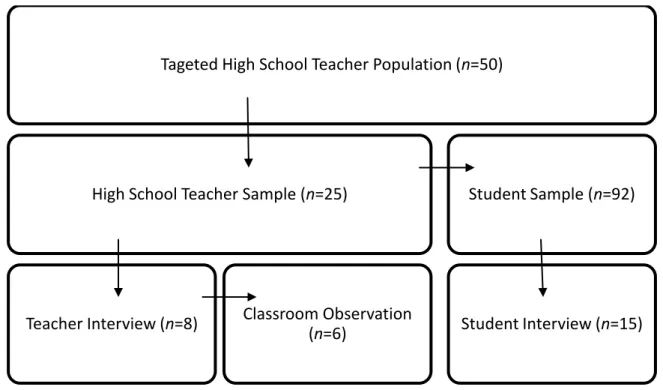
Phase I: Survey. Fifty teachers in the high school were asked to voluntarily complete the survey: Teachers’ Perspectives toward Integration of Technology to Enhance Multiliteracies in the Classroom. The survey consisted of Likert-type scale questions and open-ended written responses. From the teachers who completed the survey, teacher participants were selected based on volunteering to participate further in the study and the established selection criteria: (a) content area currently teaching, (b) demographically representative of the population, and (c) availability to participate in an interview and classroom observation. Initial student participants were selected from the teacher participants’ classes, again based on student voluntary participation.
Phase II: Interviews and classroom observations. Teachers’ interviews and classroom observations were conducted with teacher participants based on their willingness to continue in the study, the content area in which they taught, and availability. Student interviews were
conducted with student participants based on their willingness to participate in the study, parent/guardian consent, and availability.
A donation to Relay for Life was made in honor of all teacher and student participants.
Research Data Collection Design
The primary purpose of collecting data in any research study is to gather data that will address the research questions. The key elements of this data collection design included:
(a) sampling procedures, (b) obtaining permission, (c) collecting data, (d) recording the data, and (e) administering the procedures (Creswell & Plano Clark, 2011, p. 173).
The school site selected for this dissertation study was based on convenience. This high school (grades 10-12) is recognized locally and statewide for its commitment to “Excellence in Education.” Due to the technology rich classrooms and open Wi-Fi for students and guests, this school site provided an excellent location for a study in technology that enhances multiliteracies.
Sampling procedures. Participant selection was based on a multistage convenience sampling design (Berg, 2009, p. 50). Teacher participants were selected from the population of the high school based on the content area in which they taught: English language arts,
history/social studies, science, and vocational/technical subjects. The teacher participant sample was generated from selected teachers who demonstrated a willingness to participate in the study. Following administration and analysis of data collected from the teachers’ surveys, teacher participants were selected to participate in a teacher interview and classroom observation based on specific criteria: (a) a willingness to continue in the study, (b) a representation of a cross section of content areas, grade levels, and gender, and (c) availability to continue with the interview and classroom observation.
Student participants were selected randomly from the classes of the sample teacher participants. Following the administration and analysis of data collected from the students’ surveys, student participants were selected to participate in a student interview. Students were selected based on specific criteria: (a) a willingness to continue in the study, (b) an approval to continue in the study from a parent/guardian, (c) a representation of a cross section of grade levels, gender, and ethnicity of the school population, and (d) availability to be interviewed.
Obtaining permission. A written request to conduct the study was submitted to the building principal and to the school district superintendent (Appendices A-B). A written request was submitted to the University’s Institutional Review Board. Approvals to conduct the study were received in writing before the study commenced. Participation in this dissertation study was voluntary. At each phase of the study, the participants were given the opportunity to
participate or to withdraw. A letter of introduction to the study and letters of consent were issued to the teacher participants, student participants, and the parent/guardian of student participants (Appendices C-G). At the time of the surveys, interviews, and classroom observations, the participants were notified of their choice to participate or withdraw. Failure to withdraw from the study confirmed implied consent to participate. Participants were assured of their anonymity throughout the study to the fullest extent possible. Teachers were assured that the results of the study would in no way be associated with future employment with the district, and students were assured that the results of the study would in no way be associated with their academic records.
Collecting information. Quantitative and initial qualitative data were collected first, followed by additional qualitative data. The quantitative and initial qualitative data were collected from the survey instruments Teachers’ Perspectives toward Integration of Technology to Enhance Multiliteracies in the Classroom (Appendix H) and Students’ Perspectives toward
Integration of Technology to Enhance Multiliteracies in the Classroom (Appendix I). Following the analysis of the teachers’ and students’ survey data using descriptive analysis and frequency counts, the additional qualitative data were collected via teacher and student semi-structured interviews, and open-ended classroom observations.
Recording the data. Through the administration of Qualtrics, quantitative and qualitative data from the teachers’ and students’ surveys were collected and recorded in the Qualtrics system. Both sets of data were recorded electronically. The qualitative data from participant interviews and classroom observations were collected and recorded personally by me—the researcher—using audio recording devices, transcriptions, and field notes.
Administering the procedures. Access to teacher and student participants were scheduled in accordance to school policy and the teacher’s convenience and availability. Established protocols were followed for the collection, recording, and analysis of quantitative and qualitative data. All participant data were collected, recorded, and reported maintaining strict confidentiality and anonymity of teacher and student participants. All data were stored in password-protected programs with only the researcher having knowledge of the password to access the information. All information collected was kept confidential to the extent allowed by law and University policy.
Limitations of the Study
Generalizability cannot apply beyond the specific research site to the greater population due to the small sample size and the research on one institution. This dissertation study is representative of the participants from the selected school site. The sample size was limited due to the convenience sample design relying on the availability of participants. The availability of participants was affected by the time-period in which the study was scheduled. The 4th quarter of
the school year proved to be an inopportune time for a study for teachers and students engaged in standardized testing, competitions, playoffs, and activity schedules. Although a timetable was a voluntary impediment set by this researcher, the limited time established for this dissertation study did limit the sample size, sample design, and the time-period for data collection. Limited sample size and limited time with teachers and students resulted in adequate, but not abundant, data for this study.
Further limitations included the design of the survey instruments. The survey instruments addressed only the teachers’ and students’ perspectives of educational use of technology in the classroom. The survey instruments did not address the teachers’ and students’ perspectives of technology use outside the classroom. Outside experience with technology may have skewed the teachers’ and students’ perspectives of technology integration in the classroom, resulting in questionable validity of the survey instrument. To address the validity issue of the survey instruments, selected participant interviews and classroom observations clarified and explained the results from the survey instruments and minimized potential problems with validity. Cronbach’s alpha was calculated to test the internal consistency of the survey items.
Scope of the Study
This explanatory sequential mixed methods study was limited in scope to a single case study of high school teachers and students who volunteered to be part of this dissertation study. This dissertation study consisted of teachers and students grades 10-12 in the southern United States. Data (quantitative and qualitative) were collected sequentially from the survey
instrument first, followed by data collection from selected participant interviews and classroom observations.
Organization of the Study
This dissertation of the study is organized in five chapters. Chapter One contains
discussions of introductory material, statement of the problem, research questions, purpose of the study, significance of the study, theoretical background, research design, research data collection design, limitations of the study, scope of the study, and definition of terms. Chapter Two
contains discussions of related literature on the Common Core State Standards, history of literacy, theory and research of literacy, defining literacy, multiliteracies, and teachers’ and students’ perspectives toward integration of technology in the classroom. Chapter Three contains discussions of research methodology, explanatory sequential mixed methods design, research questions, role of the researcher, setting and participants, measuring instruments,
protocol for data collection, and protocol for data analysis. Chapter Four contains discussions of quantitative and qualitative data analysis. Chapter Five contains discussions of research
findings, conclusions, limitations of this dissertation study, implications for practice, and considerations for future research.
Definition of Terms
(a) 21st century skills – critical thinking, problem solving, creativity, innovation, communication, collaboration, and literacy
(b) Benchmark exams - a term used to describe the standard for judging a performance; used to tell what students should know by a particular stage in their education
(c) Connecting – connection of data results from one strand to the development of data collection of another strand; one strand supports data discovery for another strand (d) Data comparison – comparing data from different sources
(e) Data display – reducing the quantitative data to tables and the qualitative data to charts and rubrics
(f) Data reduction – reducing data collected through statistical analysis of quantitative data or writing summaries of qualitative data
(g) Explanatory sequential design – a two-phase research design that begins with quantitative data collection and analysis followed up by qualitative data collection and analysis ending with interpretation
(h) Integration - the act or process of combining into an integral whole, as if a natural part of one’s culture or way of life; being in harmony with the environment
(i) Mixed methods research – research method using both quantitative and qualitative research methods in the same study
(j) Mixing – the explicit interrelating of the study’s quantitative and qualitative strands (k) Multiliteracies - no longer just reading and writing; includes information literacy, media
literacy, technology literacy, critical literacy, visual literacy, multimedia literacy, cultural literacy, etc.; literacy skills necessary to survive in the 21st century
(l) Perspective – point of view; the state of one’s ideas; a way of regarding situations, facts, etc., and judging the relative importance
(m)Qualtrics – online survey software
(n) Technology – the making, usage, and knowledge of tools, machines, techniques, crafts, systems, or methods of organization in order to solve a problem or perform a specific function
CHAPTER TWO: LITERATURE REVIEW Introduction
“Although literacy has been commonly defined as the ability to read and write, we now live in an age of multiple literacies” (McLaughlin & DeVoogd, 2011, p. 278).
Being literate in the 21st century requires students to be able to do more than just read, write, listen, and speak. According to the National Educational Technology Standards for Students (NETS-S, 2007), student technology standards focus on 21st century skills, Web 2.0 technologies, and collaboration. Students integrating technology with literacy develop
(1) creativity and innovation; (2) communication and collaboration; (3) research and information literacy; (4) critical thinking, problem solving, and decision making; (5) digital citizenship; and (6) technology operations and concepts (ISTE, 2011; Shrum & Levin, 2009, p. 14).
Technology to enhance literacy in the classroom takes on increased importance in the success of 21st century students with the adoption of the Common Core State Standards of 2010: students employ technology to enhance their reading, writing, speaking, listening, and language skills while becoming familiar with various technological tools and mediums (CCSI, 2010, p. 7). New technologies have “accelerated the speed at which connections between speaking, listening, reading, and writing can be made, requiring that students be ready to use these modalities nearly simultaneously” (CCSI, 2010, p. 48). The nature of literacy is changing. “Literacy in the new communications environment is more productively approached by considering the broader affordances of the new digital communications technology for the production of different modes of meaning and their multimodal combinations” (Kalantzis, Cope, & Cloonan, 2010, p. 64). To prepare the 21st century generation of students with the literacy skills necessary for success in the
21st century, technology integration that enhances multiliteracies in the classroom should be an integral part of what and how the students learn and the teachers teach.
Society has changed dramatically in the past 20 years from manufacturing to service and technology. Alvin Toffler (1970), American writer and futurist, claimed that technology would revolutionize the world in three waves: agrarian, industrial, and post-industrial. The first wave was during the agricultural age, the second wave during the industrial age of the 1600s, and the third wave came during the 1950s that introduced basic technologies. Society has surpassed Toffler’s ideas of basic technologies to full conception of the Information Age. “Today’s children have grown up in an environment in which technology is everywhere and much of it is invisible” (Rosen, 2010, p. 26). These children are preparing for jobs that do not yet exist. The current job growth comes from a heuristic work—work that requires the creativity and novel solutions based on the 21st century skills of creativity and innovation, critical thinking and problem solving, and communication and collaboration. “If our schools continue to limit the literacy curriculum to reading and writing traditional, alphabetic, printed texts, then our children will be well prepared for 1950 but ill prepared for 2050” (Baker et al., 2010, p. 2). Becoming literate in today’s culture requires a rethinking of what constitutes literacy in the 21st
century. This literature review focuses on related literature that discusses (a) the definition of literacy and multiliteracies, (b) the teachers’ and students’ beliefs, barriers, and level of
proficiency in integrating technology that enhances multiliteracies in the classroom, and (c) the theory, research, and pedagogy of integrating technology that enhances multiliteracies in the classroom.
Background Information
Integrating technology into the classroom is not about teaching computer skills, but about creating engaging learning experiences in a 21st century literacy rich environment. Skills needed for success in the 21st century include critical thinking, problem solving, creativity, innovation, communication, collaboration, and multiple literacies (Schrum & Levin, 2009; Wagner, 2008). Technology in the classroom takes on increased importance in the success of 21st century students with the widely adopted Common Core State Standards of 2010: students employ technology to enhance their reading, writing, speaking, listening, and language skills while becoming familiar with various technological tools and mediums (CCSI, 2010, p. 7). A primary goal of the Common Core State Standards is to ensure that all students are career and college ready. In 2013, secondary schools adopting the Common Core State Standards (CCSS) will be challenged to align curriculum to meet career and college readiness standards of CCSS for all students. To prepare the 21st century generation of students, technology in the classroom should be an integral part of what and how the students learn and the teachers teach. One specific attribute of the Common Core State Standards is that learning outcomes from the standards will be assessed through a computer-driven assessment system developed by the Partnership for Assessment of Readiness for College and Careers (PARCC) in the state where this study occurred; other states are using a different consortia—Smarter Balanced Assessment Consortium.
PARCC is a consortium of 23 states working together to develop a common set of K-12 assessments in English language arts and math that correlate to the Common Core State
Standards. These assessments are sequential in grades 3-12 and direct the student progress toward college and career readiness by the end of the high school experience. The projected
PARCC assessments will begin administration during the 2014-15 school-year. The PARCC assessment system will produce a more complete description of student performance grades 3-12 and utilize new technologies in assessment to report student data to educators in real time to provide time appropriate intervention. According to PARCC Assessment Design online, the “overall assessment system design will include a mix of constructed response items,
performance-based tasks, and computer-enhanced, computer-scored items” (PARCC, 2012). This development is significant to the school site as it resides in one of the southern U.S. states participating in the PARCC consortium.
Common Core State Standards
As discussed in E.D. Hirsch, Jr.’s books Cultural Literacy (1987) and The Knowledge Deficit (2006), Wagner’s The Global Achievement Gap (2008), and Willingham’s Why Don’t
Students Like School (2009), the achievement gaps in education among American students widen at the close of each school year. To address and narrow these gaps (perceived global
achievement gap and knowledge achievement gap) in education the Common Core State Standards for English Language Arts and Literacy in History/Social Studies, Science, and Technical Subjects established a standard for education that was adopted across America. According to the Merriam-Webster online dictionary, a standard is “something established by authority, custom, or general consent as a model and/or example…something set up and established by authority as a rule for the measure of quantity, weight, extent, value, or quality” (http://www.merriam-webster.com/dictionary/standard). While states across America
established a “standard” for education in the particular state, the standard did not necessarily meet the expectations of national standards, thus promoting an inequitable education among students across America. To develop a national, equitable education for all students, the
Common Core State Standards for English Language Arts and Literacy in History/Social Studies, Science, and Technical Subjects was designed to be a model for all states to follow to promote college and career readiness in literacy for all students by the end of their high school experience. According to the National Governors Association Center for Best Practices and the Council of Chief State School Officers, “the Standards are (1) research and evidence based, (2) aligned with college and work expectations, (3) rigorous, and (4) internationally
benchmarked” (CCSI, 2010).
According to the Common Core State Standards (CCSI, 2010), the standards establish the following literacy expectations for reading, writing, speaking, listening, and language:
(a) to read and comprehend complex literary and informational texts independently and proficiently (p. 35);
(b) to write routinely for a range of tasks, purposes, audiences, and modes (p. 41); (c) to adapt speech to a variety of context, communication tasks, and modes (p. 48); and (d) to acquire and use accurately a range of general academic and domain-specific words
and phrases sufficient for reading, writing, speaking, and listening (p. 51).
The standards establish a “staircase” of increasing complexity in the literacy expectations for students as they progress through the grades. To meet the literacy expectations for reading, students must masterfully attempt the works of increasing complexity across genres, cultures, and centuries. The diverse exemplary literary and informational texts support the elements of cultural literacy encouraged through the standards. Through the various literary and
informational texts (traditional and digital texts) students gain insights into knowledge and human conditions that serve as models for students’ thinking and writing.
To meet the literacy expectations for writing, students must demonstrate a mastery of conveyance and defense of positional arguments. College and career ready students take the task, purpose, and audience into careful consideration—choosing words, information, structures, and formats purposefully; and combine elements of various types and modes of writing to produce a complex display of written expression. College and career ready students must demonstrate a mastery of technology skills when creating, refining, and collaborating on written projects.
Technology expanded the role of communication beyond just speaking and listening. Technology supports the acquiring and sharing of knowledge and information nearly
simultaneously through various technological modalities. The standards require that students gain, evaluate, and present increasingly complex information, ideas, and evidence through listening and speaking as well as through media. Skills related to media use (both critical and production of media) are integrated throughout the standards.
The Common Core State Standards support the multiliteracies of digital literacy, information literacy, cultural literacy, visual literacy, critical literacy, multimedia, and multimodal literacy. In the CCSS document English Language Arts and Literacy in
History/Social Studies, Science and Technical Subjects (CCSI, 2010), the college and career readiness anchor standards for reading, writing, speaking and listening state that all students must demonstrate skills ability:
(a) to integrate and evaluate content presented in diverse formats and media (p. 35), (b) to use technology, including the Internet, to produce and publish writing and to
(c) to gather relevant information from multiple print and digital sources, assess the credibility and accuracy of each source, and integrate the information while avoiding plagiarism (p. 41),
(d) to integrate and evaluate information presented in diverse media and formats, including visually, quantitatively, and orally (p. 48), and
(e) to make strategic use of digital media and visual displays of data to express information and enhance understanding of presentations (p. 48).
CCSS encourages students to become self-directed learners who seek out and use resources effectively. Students are encouraged to use technology thoughtfully to enhance their reading, writing, speaking, listening, language, and critical thinking skills. Students develop a sense of strengths and limitations of various technological tools and mediums when selecting and using those that are best suited to obtain the goal.
A Brief History of Literacy Instruction
Literacy has made revolutionary changes since the time of oral storytelling of the Medieval times to the digital literacies of the 21st century. Early American colonies linked religious instruction with the teaching of reading. American colonists began to develop their
own educational resources sometime between 1686 and 1690 resulting in The New England
Primer. This primer included the letters of the alphabet, syllabarium, the Lord’s Prayer, a catechism, and various religious and instructional pieces (Applebee, 1974, pp. 2-3). Noah Webster set out to reform American spelling with his Blue-Backed Speller in 1783 and The American Dictionary in 1828 (Applebee, 1974, pp. 3-4). In 1836, William Holmes McGuffey introduced the McGuffey Readers—a six-book series of graded readers (Applebee, 1974,
reading instruction—reading for meaning and understanding. High school students began to read newspapers critically and were encouraged “to bring their everyday life experiences to comprehending literary texts” (Alvermann, 2010, p. 57).
At the turn of the 20th century, educational philosophy began to make dramatic changes in the way educators approached educational pedagogy. In 1901, one of the oldest active educational organizations in this country was founded—New England Association of Teachers of English, later to be known as the National Council of Teachers of English (NCTE)—to address the issue of prescribed reading lists for college entrance. Today, NCTE embraces language, linguistics, literature, speaking, writing, listening, media, technology, standards, accountability, testing, pedagogy, English language acquisition, and social justice in education and society (Christenbury, 2010, pp. 3-4). As technology emerged into society, NCTE seized the opportunity to expand literacy beyond the traditional reading and writing of printed text. From the early 1930s through the early 1960s, NCTE produced “literacy recordings of writers reading their works and of professional readers rendering versions of poems” (Christenbury, 2010. p. 7) and “advocated the incorporation of television in schools” (Christenbury, 2010, p. 9). Walter Ginsberg promoted the use of film in the classroom in the 1930s; Ginsberg understood the need for pedagogical focus, so “his work outlined quality resources available to teachers that included a variety of films edited to suit the classroom in terms of content and length” (Christel & Hayes, 2010, p. 220). In the mid-twentieth century, NCTE advocated the development of reading skills deemed necessary for supporting the wartime effort—“reading for meaning, for evaluating newspaper accounts, and for practical purposes” (Alvermann, 2010, p. 59). As time progressed, literacy instruction was not solely concentrated on reading, but also on writing.
In 1973, a group of University and school-based teachers concerned with the declining skills of student writers joined together to create the National Writing Project (NWP, 2012). The National Writing Project has been promoting the craft of writing for over 35 years. By the 1980s, literacy was moving beyond the printed text. Word processors allowed for rapid and creative changes in the writing processes that in essence allowed writing to be a work in progress at all times (Herrington & Moran, 2009, p. 3-4); writing was becoming a multimodal literacy— the combination of the “print, spoken, visual, and digital processes in composing a piece of writing” (Herrington & Moran, 2009, p. 7). In the past twenty-five years, technology has
become a significant focus of NCTE. Adopted by the NCTE Executive Committee, February 15, 2008, NCTE declared that 21st century readers and writers need:
(a) to develop proficiency with the tools of technology;
(b) to build relationships with others to pose and solve problems collaboratively and cross-culturally;
(c) to design and share information for global communities to meet a variety of purposes; (d) to manage, analyze and synthesize multiple streams of simultaneous information; (e) to create, critique, analyze, and evaluate multi-media texts; and
(f) to attend to the ethical responsibilities required by these complex environments. (NCTE, 2012)
Literacy continues to be a rapidly changing phenomenon—from orality to digital, multimodal, and beyond.
Theory and Research of the Understanding of Literacy
The seminal study “A pedagogy of multiliteracies: Designing social futures” conducted by the New London Group (1996) prompted a new way in which to view the pedagogy of
literacy. The purpose of the study was to “extend the idea and scope of literacy pedagogy to account for the context of our culturally and linguistically diverse and increasingly globalized societies, for the multifarious cultures that interrelate and the plurality of the texts that circulate” [among those cultures] (Cazden et al., 1996, p. 61). A second purpose of the study was to “argue that literacy pedagogy now must account for the burgeoning variety of text forms associated with information and multimedia technologies” (Cazden et al., 1996, p. 61). The conclusion and agreement resulting from the New London Group discussions were (a) what students needed to learn was changing, and (b) the nature of literacy pedagogy was changing radically. The New London Group developed a programmatic manifesto of “theoretical overview of the current social context of learning and the consequences of social change for the content (the “what”) and the form (the “how”) of literacy pedagogy” (Cazden et al., 1996, p. 63). From these discussions, the term “multiliteracies” was coined to mean (a) the “multiplicity of communication channels and media, and the increasing saliency of cultural and linguistic diversity” (Cazden et al., 1996, p. 63); and (b) a “focus on the realities of increasing local diversity and global connectedness” (Cazden et al., 1996, p. 64). The changes in literacy pedagogy by the New London Group meant a design change in the elements of meaning-making processes: linguistic, visual, audio, gestural, spatial, and multimodal patterns of meaning that relate to the first five modes of meaning. According to Cazden et al. (1996), changes in literacy pedagogy requires a restructuring of pedagogy that incorporates instructional methods of situated practice (p. 85), overt instruction (p. 86), critical framing (p. 86), and transformed practice (p. 87). Cazden et al. (1996)
determined that by restructuring literacy pedagogy in schools, teachers would be:
Simulating work relationships of collaboration, commitment, and creative involvement; using the school as a site for mass media access and learning; reclaiming the public space
of school citizenship for diverse communities and discourses; and creating communities of learners that are diverse and respectful of the autonomy of life-worlds. (pp. 72-73) Labbo and Reinking (1999) considered the relationship between literacy research and practice in their study taking the position that “multiple realities unifies diverse writings over an extended period by those who have considered the role of new digital technologies in literacy instruction” (p. 478); that as technologies change, so will literacy. Resulting from their study, Labbo and Reinking (1999) developed a framework for integrating technology with literacy instruction:
(a) new digital technologies should be available for literacy instruction,
(b) new digital technologies should be used to enhance the goals of conventional literacy instruction,
(c) new technologies should be used to positively transform literacy instruction,
(d) new technologies should be used to prepare students for the literacy of the future, and (e) new technologies should be used to empower students. (p. 481)
Tierney and Sheehy (2005) presented a longitudinal study of secondary students with high access to digital literacies. These students were found to experience major shifts in their thinking about text, attitudes toward text, and approach to the presentation of their ideas. The researchers were able to demonstrate that the students with high exposure to digital literacies were able to embed ideas within other ideas, and present varied perspectives—all of which represented the complex, multilayered, multifaceted 21st century digital text (Tierney & Sheehy, 2005, pp. 116-117). Tierney and Sheehy’s research supports the premise of the paradigm shift from traditional literacy to 21st century multiliteracies.
Mills (2009) addressed the “need for literacy pedagogy to respond to the changes in the multimedia textual environment” (p. 103). Mills (2009) cited three reasons as to why a
multiliteracies pedagogy has not been embraced: (1) “multiliteracies aim to move literacy education forward from an antiquated pedagogy of exclusively formal standard, monomodal” (p. 105) literacy to one that is “inclusive of informal, open-ended, multimodal forms of communication, which cross national boundaries and support productive diversity” (p. 105); (2) “advocates of multiliteracies see reading as a critical, social practice, rather than purely a means of cultural transmission” (p. 105); and (3) “historically valued texts are not representative of the kaleidoscope of texts and literacies that children encounter in the society [21st century]” (p. 106). Mills (2009) proposed a multimodal design that “expresses the complexity and interrelationship of more than one mode of meaning—combining linguistic, visual, auditory, gestural, and spatial modes” (p. 106). Mills (2009) further claimed:
To continue to teach to a narrow band of print-based genres, grammars, and skills [would be] to ignore the reality of textual practices outside of schools. Students must be free to engage in new and multimodal textual practices, rather than simply reproduce a tightly confined set of linguistic conventions. (p. 108)
Discussions started with the New London Group served to be a starting place for literacy pedagogical changes. There will continue to be arguments for and against this change in literacy pedagogy; therefore, a continued need for research is warranted.
Defining Literacy in the 21st Century Classroom
“Literacy [is] paramount in learning, not only for language development, but also as the foundation of all academic disciplines including science and mathematics” (Huffaker, 2005, p. 91). What is literacy? The term literacy has expanded beyond the basic reading and writing in