Università degli Studi di Padova
Dipartimento di Territorio e Sistemi Agro-Forestali (TESAF)
Bangor University, United Kingdom
College of Natural Sciences, School of Environment, Natural Resources and Geography ___________________________________________________________________
SCUOLA DI DOTTORATO DI RICERCA IN: Territorio, Ambiente, Risorse e Salute
CICLO XXVII
MEASURING THE EFFECTIVENESS OF CONSERVATION GOVERNANCE, POLICIES AND PROGRAMMES IN FOREST PROTECTED AREAS
Direttore della Scuola: Ch.mo Prof. Mario Aristide Lenzi Supervisore: Prof. dr. Laura Secco
Co-supervisore: Prof. dr. Andrew S. Pullin
Failures of governance underlay many problems in natural resource management. In-situ conservation strategies, such as forest protected areas (FPAs), are currently one of the main strategies for forest and terrestrial biodiversity conservation. Nevertheless, there is no clear evidence in the current literature on the exact role of governance arrangements and cause-effect relationships between decision-making style and conservation outcomes of forest protected areas. Governance theory deals with the inquiry of how decisions are made and how decisions are implemented given the existing institutional frame and interactions of different actors. This work aims to clarify the role of governance, its diversity, quality and change, in the functioning of forest protected areas to deliver the desired social and ecological outcomes. Accordingly, the dissertation has three specific objectives: 1) to characterise and collate an evidence base on the role of governance in forest protected areas and their conservation outcomes globally; 2) to analyse potential for a shift from hierarchical to collaborative governance in a case example of tiger conservation; and 3) to evaluate inclusive policies and their implementation through state-driven decentralization programmes on the ground. This work applies a combination of qualitative and quantitative methods, including systematic review methodology, qualitative data analysis and quantitative impact assessment. The first part of the dissertation (Chapter 2) collates the evidence on conservation success of FPAs conditional on the type of their governance. This chapter explores protected areas globally and synthesizes the published literature up-to-today to create a global map of the evidence and knowledge base on the role of governance in the conservation effectiveness of protected areas with respect to social and ecological outcomes. The current evidence base is small and fragmented with the low explanatory power and methodological weaknesses. Conservation research often does not account for local governance elements while making judgement on conservation success. In case where it does, it measures conservation success through mainly one type of conservation outcome (ecological). However, social-related issues such as actors’ attitudes and behaviour (intermediate outcomes on the change pathway) might contribute to more complete picture of the protected area success. The second part of the dissertation (Chapters 3 and 4) uses tiger conservation in central India as a case example to analyse governance change and the gaps between socially-inclusive and collaborative policies and actual practices on the ground. Chapter 3 investigates, from an institutional perspective, enabling and disabling factors for a shift towards “landscape-level conservation” that implies collaboration between PA managers and different actors in central India. The results show how a mix of institutional and cognitive factors can constrain a shift to the collaboration. Organisational structure of the public management agency and its “fortress conservation” mentality is perceived to be a major constrain for a change. Chapter 4 examines the case of two participatory projects around Pench Tiger Reserve in Madhya Pradesh and evaluates the effects of project participation through local community’s attitudes towards biodiversity and trust and satisfaction with reserve authorities. The existing participatory approach seems to have only a small effect, mainly to people’s conservation knowledge but not to their biodiversity attitudes and institutional trust. The main findings of this dissertation calls attention to the understanding of the decision-making process, informal and formal
Riassunto
Fallimenti di politiche e di governance sottendono molti problemi nella gestione delle risorse naturali. Interventi di conservazione in situ, come la creazione e gestione di aree forestali protette (AFP), sono attualmente una delle principali strategie per la conservazione delle risorse forestali e della biodiversità terrestre. Tuttavia, in letteratura, non vi è alcuna chiara evidenza sul ruolo dei meccanismi di governance e sulle relazioni di causa-effetto tra processo decisionale ed esiti della conservazione di AFP. La teoria della governance si occupa di come vengono prese e attuate le decisioni in un determinato contesto istituzionale e in presenza di determinate interazioni tra i diversi attori. Questo lavoro si propone di chiarire il ruolo dei meccanismi di governance, della loro diversità, qualità e degli eventuali cambiamenti, sul funzionamento di aree forestali protette affinché queste ultime possano offrire i risultati sociali ed ecologici desiderati. A questo scopo, la tesi ha tre obiettivi specifici: 1) caratterizzare, raccogliere e sistematizzare le conoscenze esistenti a livello globale sul ruolo della governance in AFP e sui loro risultati in termini di conservazione; 2) analizzare le potenzialità di un cambiamento da un approccio gerarchico ad una governance collaborativa in un caso esemplificativo di area protetta finalizzata alla conservazione della tigre; e 3) valutare le politiche di inclusione e la loro attuazione attraverso i programmi di partecipazione pubblica e decentramento dello Stato, sulla base degli interventi operativi realizzati a scala locale. In questo lavoro si applica una combinazione di metodi qualitativi e quantitativi, tra cui una metodologia di revisione sistematica della letteratura, un’analisi qualitativa di dati raccolti tramite interviste semi-strutturate ed una valutazione di impatto basata su medoti quantitativi. La prima parte della tesi (Capitolo 2) raccoglie le evidenze dei casi di successo ed efficacia di interventi di conservazione di AFP in ragione del tipo di governance cui le aree protette stesse sono soggette. Questo capitolo esplora aree protette a livello globale e sintetizza la letteratura ad oggi pubblicata al fine di creare una mappa globale delle evidenze ed una base di conoscenze sul ruolo della governance nell'efficacia della conservazione di AFP in relazione ai risultati sociali ed ecologici attesi. Le evidenze attualmente disponibili sono limitate e frammentate, hanno un potere esplicativo contenuto e debolezze metodologiche. La ricerca in questo campo spesso non tiene conto degli elementi di governance locale nel formulare un giudizio sul successo delle strategie e degli interventi di conservazione. Nel caso in cui lo fa, spesso misura il successo della conservazione soltanto (o soprattutto) attraverso i risultati dal punto di vista ecologico. Tuttavia, risultati sociali quali nuovi atteggiamenti e comportamenti (outcome intermedi lungo un percorso di cambiamento indotto da interventi di conservazione) potrebbero contribuire a fornire un quadro più completo dell’efficacia e del successo dell'area protetta. La seconda parte della tesi (Capitoli 3 e 4) usa il caso della conservazione della tigre in India centrale come esempio per analizzare il cambiamento nei meccanismi di governance e il divario tra le politiche e pratiche reali sul campo dal punto di vista dell’inclusione sociale e della collaborazione. Il Capitolo 3 indaga, da un punto di vista istituzionale, i fattori favorevoli e quelli che invece potrebbero ostacolare uno spostamento delle politiche e degli interventi verso una conservazione “a livello di paesaggio" (a scala meso, e non di singola unità boschiva, per esempio), che implica una maggior collaborazione tra i gestori dell’area protetta e i diversi attori, con un focus sempre in India centrale. I risultati mostrano
come un mix di fattori istituzionali e cognitivi siano in grado di limitare il passaggio alla collaborazione e di conseguenza di limitare la possibilità di proteggere e conservare in maniera efficace zone più ampie ed integrate di territorio. La struttura organizzativa interna dell’ente pubblico che si occupa della gestione dell’area protetta e la sua mentalità da "fortezza della conservazione" è percepita dagli operatori locali come un vincolo importante per un cambiamento. Il Capitolo 4 esamina il caso di due progetti partecipativi attuati nelle aree limitrofe alla Pench Tiger Reserve, nello Stato del Madhya Pradesh in India, e valuta gli effetti dei progetti/programmi di partecipazione e gestione congiunta dell’area attraverso l’analisi delle attitudini/atteggiamenti della comunità locale nei confronti della biodiversità, nonché la fiducia ed il grado di soddisfazione rispetto alle autorità pubbliche che operano nella riserva. Gli approcci e gli strumenti finora attuati sembrano avere un effetto molto limitato, solo in relazione alla conoscenza dei concetti di conservazione della biodiversità da parte delle persone residenti nell’area. Non si sono riscontrati effetti sulle attitudini, o sugli atteggiamenti/comportamenti dei membri della comunità locale nei confronti della biodiversità né sul loro grado di fiducia verso le istituzioni pubbliche. I principali risultati di questa tesi richiamano l'attenzione sull'importanza della comprensione del processo decisionale, le istituzioni informali e formali ed una più profonda comprensione delle interazioni tra attori per essere in grado di misurare il successo/efficacia degli interventi di conservazione di aree forestali protette ai fini della protezione della biodiversità.
CONTENTS
Annex list ... 10
Acknowledgements ... 11
Chapter 1 ... 18
Introduction ... 18
Background and problem statement ... 18
Objectives and research questions ... 20
Theoretical framework ... 21
Governance theories ... 22
Conservation and governance evaluation ... 27
Shifting discourses and governance modes in conservation ... 30
Dissertation structure ... 33
References ... 36
Chapter 2 ... 45
The role of Governance in forest protected areas: mapping the evidence ... 45
References ... 46
Chapter 2.1 ... 49
Systematic Review Protocol ... 49
Background ... 49
Objectives of the Review ... 53
Methods ... 57
Search strategy ... 57
Study inclusion criteria ... 62
Potential reasons for heterogeneity and effect modifiers ... 64
Study quality assessment ... 65
Data extraction ... 66
Data synthesis ... 68
References ... 69
Chapter 2.2. ... 75
What evidence exists on the role of governance in the conservation effectiveness of forest protected areas? Knowledge base and evidence gaps ... 75
Background ... 75
Objective of the map ... 77
Evolving objective of this research ... 77
Primary and secondary objectives ... 78
Methods ... 79
Searches ... 80
Article retrieval ... 84
Article screening and study inclusion criteria ... 84
Amendments and clarifications to the inclusion criteria published in the protocol ... 85
Study coding ... 87
Critical Appraisal ... 87
Results ... 89
Evidence identification, retrieval and screening ... 89
Systematic Map database ... 91
Database description and findings ... 92
Mapping the quality of the studies relevant to the question ... 115
Discussion ... 117
Mapping limitations ... 117
Limitations in the evidence base on the governance role in conservation effectiveness ... 119
Conclusions ... 121
Implications for practice and policy ... 121
Implications for synthesis ... 122
Implications for research ... 123
References ... 125
Chapter 3 ... 131
Potential for social connectivity in landscape-scale tiger conservation of central India ... 131
Introduction ... 131
Methodology ... 135
Case Study ... 137
Results ... 143
Tiger reserves in Central India ... 144
The Forest Department: legacies and working culture ... 147
Interaction between the Forest DepaRTment and other actors in the landscape ... 151
Discussion ... 157
Changing FD values and behaviour ... 157
Improving information flow and trust ... 158
Working with local people in the corridors ... 159
Concluding thoughts ... 160
References ... 161
Chapter 4 ... 167
Effects of two state-driven participatory projects on conservation knowledge, attitudes and trust: a case of a Central Indian Tiger Reserve ... 167
Introduction ... 167
Case Study ... 172
Study site ... 172
Joint Forest Management around PTR ... 173
Ecodevelopment around PTR ... 174
Methods ... 175
Data collection ... 175
Empirical strategy ... 176
Defining treatments, counterfactual and reasons to participate ... 179
Results ... 184
Describing the unmatched sample ... 184
Average effect of participation compared to no participation (H1) ... 190
Average effects of participation in ED compared to JFM (H2) ... 191
Discussion ... 192
Do local people’s conservation knowledge and biodiversity attitudes differ between participants and non-participants? ... 192
Does the type of participatory intervention - JFM or ED – matters in terms of people’s conservation knowledge, biodiversity attitudes, trust and satisfaction with the management authorities? ... 194
Study limitations ... 196
Conclusions ... 196
References ... 198
CHAPTER 5 ... 207
ADVANCING ANALYSIS AND EVALUATION OF CONSERVATION POLICY AND PRACTICE ... 207
Directions for future research ... 211
References ... 213
LIST OF FIGURES
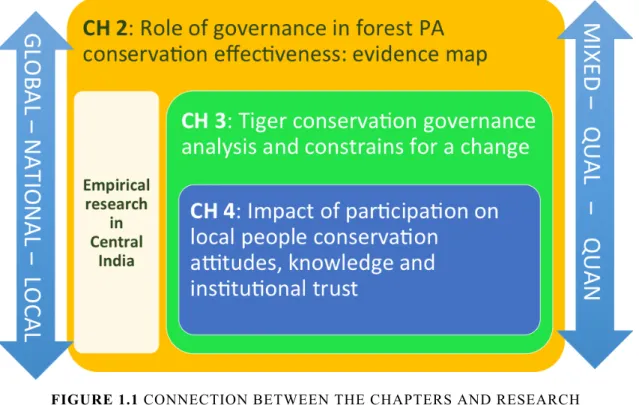
Figure 1.1 Connection between the chapters and research logic………..36
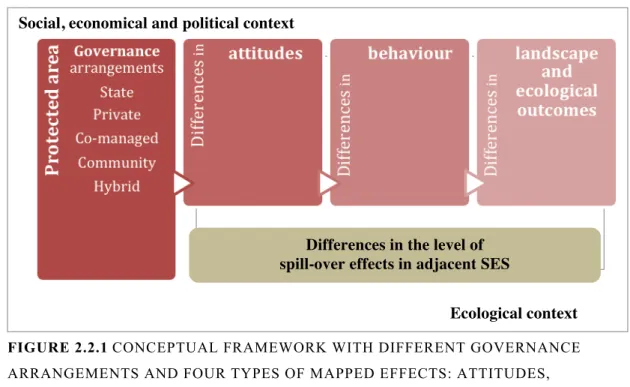
Figure 2.2.1 Conceptual framework with different governance arrangements and four types of mapped effects……….77
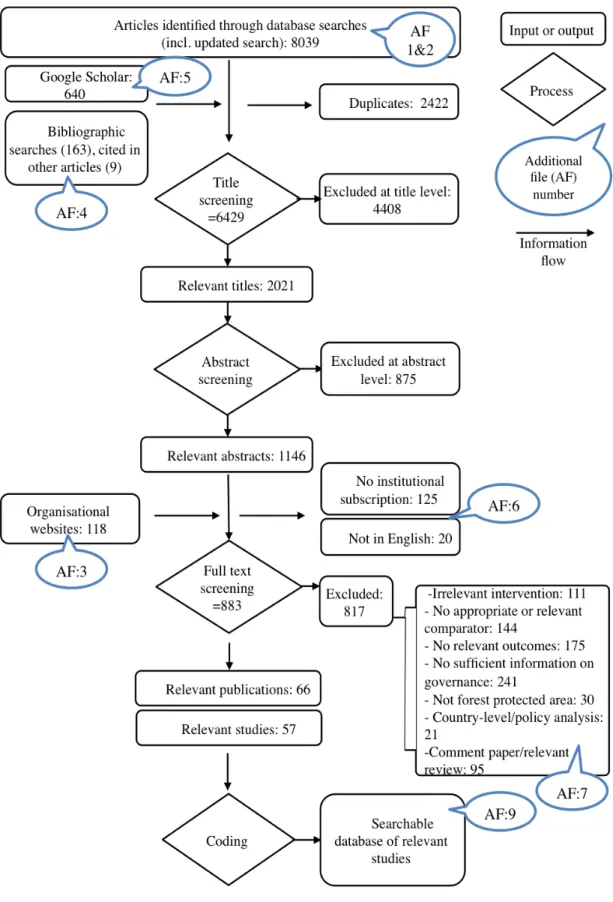
Figure 2.2.2 Flow diagram of mapping stages from searching, identification of relevant literature and coding………..90
Figure 2.2.3 Numbers of articles included in the map by publication year……….92
Figure 2.2.4 Number of study locations per country and per continent/region…. 93 Figure 2.2.5 Governance modes in included studies………..97
Figure 2.2.6 Nature of study comparators in included studies……….97
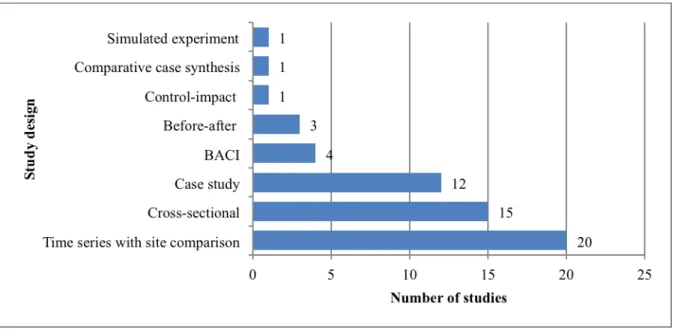
Figure 2.2.7 Study design in the included studies………115
Figure 2.2.8 Appropriateness of comparator in included quantitative and mixed-methods observational and quasi-experimental studies………...116
Figure 3.1 Central Indian & Eastern Ghat Landscape complex………134
Figure 4.1 Theory of change showing inputs, activities and the effects of participatory conservation interventions through hypothesised and theoretical cause-effect relations between participation, behaviour and conservation………168
Figure 4.2 Study location: PTR, Madhya Pradesh with sampled villages……….172
LIST OF TABLES Table 1.1 Summary of research questions, methods and outputs……….35
Table 2.1.1 Elements of the systematic review question……….56
Table 2.2.1 Elements of critical appraisal and their coding………...88
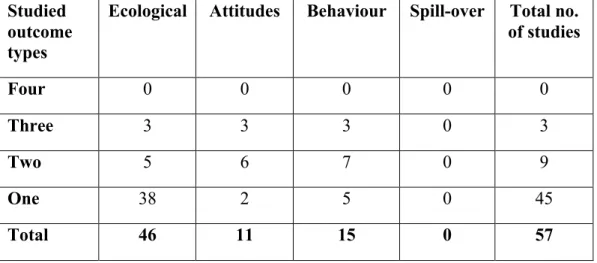
Table 2.2.2 Number and kind of reported outcomes per study………..94
Table 2.2.3 Overview of the mapped governance modes, outcomes and comparators ………98
Table 3.1 Overview of interviewed actors, their role in the landscape and administrative level of activities………....136
Table 3.2 Evolution of forestry and conservation policies………..139
Table 3.3 Actors in the landscape around tiger reserves in Maharashtra………144
Table 4.1 Measured effects and related questions for participant (both ED and JFM) and non-participant households………..177
Table 4.2 Models for specification of the PSs for testing H1 (logit) and H2 (probit)……….182
Table 4.3 Descriptive statistics for unmatched samples………..185
Table 4.4 Effect of participation (in either ED or JFM) versus no participation (H1) for four measured effects (ATT)………..190
Table 4.5 Effect of household participation in ED versus participation in JFM (H2) for measured effects (ATT)………191
ANNEX LIST
Annex 1: Scoping exercise, search string development and finalized search string in
Web of Science...……….220
Annex 2: Database search and differences in search strings according to DB search facility………..223
Annex 3: Search through specialist search………...239
Annex 4: Bibliographic search………...…………...254
Annex 5: Search through web search engine……….…………...268
Annex 6: List of unobtainable studies ………...269
Annex 7: List of excluded studies with reasons for exclusion………281
Annex 8: Coding tool with code definitions and rationale for coding, including critical appraisal codes and scoring system………...350
Annex 9: Systematic map database (a link to the full database)……….355
Annex 10: Project Information Sheet………...356
Annex 11: Participant Consent Form………...360
Annex 12: Interview guide for Federal and National actors………...361
Annex 13: Questionnaires for the local community: Eco-development …………362
Annex 14: Questionnaires for the local community: Joint Forest Management…383 Annex 15: Balancing diagnostics of matching for logit model and testing H1..…403 Annex 16: Balancing diagnostics of matching for probit model and testing H2…406
ACKNOWLEDGEMENTS
My doctoral research can be described as a multicultural journey with countless collaborations along the way.
First, I would like to thank to all the local people and Forest Department officers who gave me their precious time and had enough patience to answer my questions and participate in this research!
I extend my greatest gratitude to dr. Laura Secco, my first supervisor and to my co-supervisor, dr. Andrew Pullin. Thank you both for your trust in my capabilities and being always so patient with me.
I am grateful to Wildlife Institute of India and my sincere thanks goes to dr. VB Mathur, director and dean of Wildlife Institute of India for facilitating research permits and to dr. Bilal Habib, my local contact in this institute.
I extend my deepest gratitude to Mr Alok KUMAR and Ms Kiran BISAN from Pench Tiger Reserve, Madhya Pradesh. Without their constant support and encouragements, my fieldwork would be impossible! Many thanks!
Thanks to my Indian host and friend, Shivaji Chavan without whom doing fieldwork in India would be just an unaccomplished dream. Thank you Shiva! Many thanks to the team, always willing to help and being with me when I needed them the most: Ishteyaque, Aslesha and Nudrat. Ishteyaque, dhost, many thanks for all!
Thanks to TRIPS team from Mumbai and their excellent help with data collection and digitalisation.
My social science enquiry commenced with prof. Joan Martinez Alier and dr. Victoria Reyes Garcia from Autonomous University of Barcelona in Spain. I will always be grateful for everything I learned from them!
Moreover, I’m thankful to my colleagues from TESAF department for their support in specific phases of this research: Elena Pisani and Riccardo Da Re. I am also thankful to Nathan Deutsch.
Many thanks to all my friends from Wildlife Institute of India for hosting, sharing, teaching and helping, specially Sabuj and his paikas, Monika, Shikah, Thirta. Many thanks!
This research is funded by the FONASO Erasmus Mundus Joint Doctorate Programme. I am thankful for the generous scholarship and the network that I was part of. I am grateful for getting the opportunity to be a member of the FONASO family. Thanks to my lovely FONASO colleagues and special gratitude goes to Habtamu, Kathrin, Anna, Eefke, Lucia, Fritz, Marina.
I am in debt to my “protected area team” from Thor Heyerdahl Summer School in Environmental governance – Monika S, Bibhu PN, Tendro T! Thanks for all the support my dear friends! Im also in debt to professor Arild Vatn who brought us all together and made the summer school wonderful learning experience with the best researchers in the field of environmental governance!
Special thanks goes to my lovely friends for listening, laughing, supporting and encouraging, proofreading: Milan K, Iva K, Maja A, Hyerim Y, Elisabeth G, Ivana L, Jelka C.I., Santi G, Neal Haddaway – my lovely Bangor host, friend and co-author, John G, Salamatu F, Shareefa S, Paul W. I am indebt to Ramy and Sabrina – for making Trio Fantastico fantastic, and for helping me to survive last months of the thesis writing. Lucia, thanks for sharing your living space with me. Marija - Mata and David - Davidovich, thanks for making my life easier and for receiving me in your lovely house – thank you forever. I cannot forget all the help I received from Dragana B, I will be always grateful.
Special gratitude goes to my family for their endless love, unfailing support, trust, comfort and source of strength. Mum, dad, Mico, Branka, Petra, Ruzica and Marija – ovo putesestvije ne bi bilo moguce bez vas! Hvala puno!
Declaration and Consent Details of the Work
I hereby agree to deposit the following item in the digital repository maintained by Bangor University and/or in any other repository authorized for use by Bangor University. Author Name: ……… …….. Title: ………..… ………. Supervisor/Department: ... Funding body (if any):
... Qualification/Degree obtained:
……….
This item is a product of my own research endeavours and is covered by the agreement below in which the item is referred to as “the Work”. It is identical in content to that deposited in the Library, subject to point 4 below.
Non-exclusive Rights
Rights granted to the digital repository through this agreement are entirely non-exclusive. I am free to publish the Work in its present version or future versions elsewhere.
I agree that Bangor University may electronically store, copy or translate the Work to any approved medium or format for the purpose of future preservation and accessibility. Bangor University is not under any obligation to reproduce or display the Work in the same formats or resolutions in which it was originally deposited.
Bangor University Digital Repository
I understand that work deposited in the digital repository will be accessible to a wide variety of people and institutions, including automated agents and search engines via the World Wide Web.
I understand that once the Work is deposited, the item and its metadata may be
incorporated into public access catalogues or services, national databases of electronic theses and dissertations such as the British Library’s EThOS or any service provided by the National Library of Wales.
I understand that the Work may be made available via the National Library of Wales Online Electronic Theses Service under the declared terms and conditions of use (http://www.llgc.org.uk/index.php?id=4676). I agree that as part of this service the National Library of Wales may electronically store, copy or convert the Work to any approved medium or format for the purpose of future preservation and accessibility. The National Library of Wales is not under any obligation to reproduce or display the Work in the same formats or resolutions in which it was originally deposited.
Statement 1:
This work has not previously been accepted in substance for any degree and is not being concurrently submitted in candidature for any degree unless as agreed by the University for approved dual awards.
Signed ……….. (candidate) Date ………..
Statement 2:
This thesis is the result of my own investigations, except where otherwise stated. Where correction services have been used, the extent and nature of the correction is clearly marked in a footnote(s).
All other sources are acknowledged by footnotes and/or a bibliography.
Signed ………. (candidate) Date ……….
Statement 3:
I hereby give consent for my thesis, if accepted, to be available for photocopying, for inter-library loan and for electronic storage (subject to any constraints as defined in statement 4), and for the title and summary to be made available to outside
Signed ………. (candidate) Date ……….
Statement 4:
Choose one of the following options
a) I agree to deposit an electronic copy of my thesis (the Work) in the Bangor University (BU) Institutional Digital Repository, the British Library
ETHOS system, and/or in any other repository authorized for use by Bangor University and where necessary have gained the required permissions for the use of third party material.
b) I agree to deposit an electronic copy of my thesis (the Work) in the Bangor University (BU) Institutional Digital Repository, the British Library
ETHOS system, and/or in any other repository authorized for use by Bangor University when the approved bar on access has been lifted.
c) I agree to submit my thesis (the Work) electronically via Bangor University’s e-submission system, however I opt-out of the electronic deposit to the Bangor University (BU) Institutional Digital Repository, the British Library ETHOS system, and/or in any other repository authorized for use by Bangor University, due to lack of permissions for use of third party material.
Options B should only be used if a bar on access has been approved by the University. In addition to the above I also agree to the following:
1. That I am the author or have the authority of the author(s) to make this
agreement and do hereby give Bangor University the right to make available the Work in the way described above.
2. That the electronic copy of the Work deposited in the digital repository and covered by this agreement, is identical in content to the paper copy of the Work deposited in the Bangor University Library, subject to point 4 below.
3. That I have exercised reasonable care to ensure that the Work is original and, to the best of my knowledge, does not breach any laws – including those relating to defamation, libel and copyright.
4. That I have, in instances where the intellectual property of other authors or copyright holders is included in the Work, and where appropriate, gained explicit permission for the inclusion of that material in the Work, and in the electronic form of the Work as accessed through the open access digital repository, or that I have identified and removed that material for which adequate and appropriate permission has not been obtained and which will be inaccessible via the digital repository.
5. That Bangor University does not hold any obligation to take legal action on behalf of the Depositor, or other rights holders, in the event of a breach of intellectual property rights, or any other right, in the material deposited.
6. That I will indemnify and keep indemnified Bangor University and the National Library of Wales from and against any loss, liability, claim or damage, including without limitation any related legal fees and court costs (on a full indemnity bases), related to any breach by myself of any term of this agreement.
Signature: ……… Date : ……….
ABBREVIATIONS AND ACRONYMS CCB Community Conserved Areas
ED Eco-development – a form of integrated conservation and development project ICDP Integrated Conservation and Development Project
IED India Ecodevelopment – a project operational in 7 protected areas in India from 1994-2004
FD Forest Department
FRA Forest Rights Act Scheduled Tribes and Other Traditional Forest Dwellers (Recognition of Forest Rights) Act 2006 (or simply Forest Rights Act) FPAs Forest protected areas
JFM Joint Forest Management
NTCA National Tiger Conservation Authority TRs Tiger Reserves
TTF Tiger Task Force PAs Protected Areas
PSM Propensity Score Matching
PTR Pench Tiger Reserve, Madhya Pradesh, India SR Systematic Review
WPA Wildlife Protection Act, 1972
CHAPTER 1 INTRODUCTION
Background and problem statement
In-situ conservation strategies, such as forest protected areas (FPAs), are currently one of the main strategies for forest and terrestrial biodiversity conservation. The global protected area network is growing at an ever-increasing rate, covering 12% of Earth surface at present and protecting 13.5% of world’s forests (Schmitt et al. 2009). However, biodiversity still continues to decline globally (Butchart et al. 2010).
The level of effectiveness of protected areas in producing desired ecological and social outcomes is unclear, including ambiguous evidence on a win-win solutions. A recent systematic review on the ecological impacts of terrestrial protected areas concluded that protected areas are proven to be effective in conserving habitat cover, but it is not entirely clear if they can successfully maintain species populations (Geldmann et al. 2013). Evidence on social impacts of protected areas is more ambiguous, and associated impacts are highly context-dependent with both negative and positive impact pathways (Pullin et al. 2013). Moreover, projects that combine development (e.g. poverty alleviation) and conservation (e.g. biodiversity conservation) goals are argued to be rarely successful, but the current evidence base is still not strong enough to provide any conclusive proofs (Adams et al. 2004; Brooks et al. 2006). Overall, there is a weak understanding of the factors under which protected areas provide desirable conservation or development outcomes.
Governance and institutional arrangements play an important role in determining efficacy of conservation policies and practice (Barrett et al. 2005). Some authors argue that governance influence: 1) management effectiveness through level of achievement of protected area objectives; 2) management equity through decisions on cost and benefit allocation; and 3) protected area viability through the establishment of
community, political and financial support (Eagles 2008; Borrini-Feyerabend et al. 2013). The important governance-relevant questions such as: Who is accountable to whom? Who has decision powers? How decisions are made and implemented? are frequently disregarded while examining PA effectiveness. Therefore, the cause-effect relationship between governance arrangements, PA (management) effectiveness and social and ecological outcomes is largely unclear (Pullin et al. 2013). There is a need for synthesis of existing evidence and provision of empirical answers on how different local governance arrangements and specific characteristics of decision-making and implementation process may influence conservation outcomes.
Conservation enforcement and implementation are frequently a difficult task, especially in developing tropical countries (Barrett et al. 2005). Effectiveness of implementation and enforcement frequently depends on the behaviour, values and motives of an implementing agency (Fleischman 2012).
With the recent paradigm shifts from strict and exclusive enforcement to participatory and collaborative policy implementation, the role of public agencies that manage parks is evolving. They are expected to abandon their traditions and exclusionary “mentality”, to adapt their working culture to people-oriented approaches, while increasing flexibility and improving communication skills, building trust with local community and other actors in the participatory and collaborative networks (Wyborn & Bixler 2013). Nevertheless, in the collaborative and participatory conservation literature, research on the behaviour of local conservation authorities, their possible resistance to change and influence on conservation policy implementation is limited (Lawrence 2007).
On the other side of the implementation effectiveness, it is argued that compliance with PA rules and support for conservation might be challenging if there is a lack of meaningful and active participation of local communities in decision-making positions (Andrade & Rhodes 2012). However, the final effects of participatory policies are often unclear and ambiguous. This is because existing evidence is frequently based on case studies and it is hard to create clear causal links between participation and resultant change in peoples’ conservation attitudes, behaviour and compliance. Therefore, there is a need for more rigorous evaluation studies with more robust designs to remove various
rival explanations of participatory effect, adjust for selection bias that occurs due to non-random assignment of such interventions (Miteva et al. 2012; Ferraro & Hanauer 2014; Baylis et al. 2015)
The following sections give an overview of the research objectives and research questions to fill the above identified knowledge gaps. Moreover, theoretical concepts that guide this research and a general overview of the whole work and forthcoming chapters are presented.
Objectives and research questions
Governance theory deals with the inquiry of how decisions are made and how decisions are implemented given the existing institutional frame and interactions of different actors (Kjaer 2004; Secco et al. 2014). This work aims to clarify the role of governance, its diversity, quality and change, in the functioning of forest protected areas to deliver the desired social and ecological outcomes.
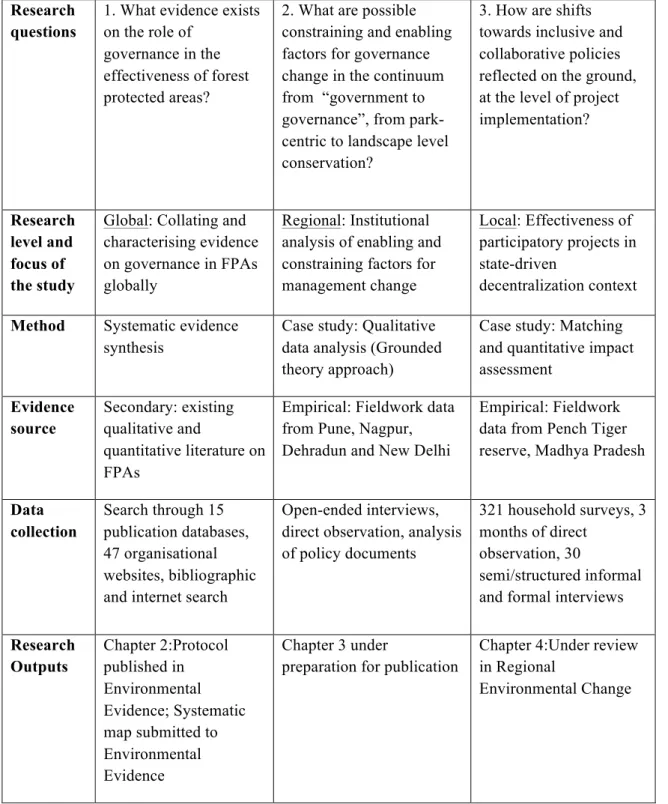
Connected to different levels of enquiry, this dissertation has three main objectives: 1) to characterise and collate evidence base on the role of governance in forest protected areas and their conservation outcomes globally (Chapter 2); 2) to analyse the potential for a shift from hierarchical to collaborative governance in the case example of tiger conservation on the landscape level (Chapter 3); and 3) to evaluate inclusive policies and their implementation through state-driven decentralization programmes on the local level (Chapter 4).
Accordingly, this dissertation has three specific research questions:
1. What evidence exists on the role of governance in the effectiveness of forest protected areas?
• Is there sufficient evidence on the comparative effectiveness of participatory versus top-down approaches in delivering conservation outcomes?
2. What are possible constraining and enabling factors for governance change in the continuum from “government to governance”, from park-centric to landscape level conservation?
• Can park authority change to follow the participatory politics and calls for collaboration?
3. How are shifts towards inclusive and collaborative policies reflected on the ground, at the level of project implementation?
• Is participation effective in a state-driven decentralization context?
The research connected to research questions 2 and 3 is conducted on the case of tiger conservation, placed in central Indian tiger landscape complex, in Central Indian highlands (chapter 3) and in Pench Tiger reserve, Madhya Pradesh (Chapter 4). The reasons and justification for the specific research locations are given in respective chapters.
Theoretical framework
This dissertation is based on the perspectives from social research for and on conservation (Sandbrook et al. 2013). It pragmatically tries to connect and integrate different data, various methods and theories from disparate disciplines to understand how different actors and institutions interact and influence conservation outcomes in more or less effective way.
I consider FPAs as part of coupled systems of humans and the environment i.e. social-ecological systems (SES). FPAs exist through both social-ecological and social matrices; they are well connected to and functionally dependent on the political, social and economic structures in society. Governance modes of FPAs are equally complex and they exist on multiple interconnected (often uncoordinated) levels and scales: from local to international. Governance is context dependent and embedded in the cultural, political and social systems. To understand the links and feedback between governance modes and the success of FPAs it is necessary to use pluralistic approaches to obtain knowledge and best understanding of these complex systems, focus at different spatial and temporal scales, understand wider policy context and their history (Ostrom & Nagendra 2006).
This research starts from governance theories and link them to practice of conservation through critical examination of different aspects of conservation policy, its implementation and effectiveness. This is to ultimately emphasise the role of frequently forgotten local socio-political processes in the conservation success (Brechin et al. 2002). In order to achieve research objectives, this dissertation draws on findings and literature from political science, conservation biology, social psychology, development studies, and systems thinking. The application of these theories is evident within each of the data chapters.
Here, an overview of the governance theories is given with explanation of the shifts in conservation policy and practice thinking, and a critique to participation in order to introduce the rest of the dissertation.
GOVERNANCE THEORIES
“[…]meanings and interpretations of governance—which determine its actual elaboration and deployment—are framed by the historically contingent and constitutive interdependence between knowledge, representation and relations of power” (Batterbury & Fernando 2006).
“Governance” is a highly contested concept used in various scientific fields and political processes, and it has many definitions and meanings. The definition depends on the particular research field and context, level at which policy and decision-making is analysed, views of relationships between governance actors, role of the state, researcher understanding of the institutional change, etc. Here, are explained in brief different interpretations of governance, starting from the institutional grounding of the concept.
Theories of governance have grounding in the institutionalism (Kjaer 2004). Institutions1 are basic components of natural resource governance and are structures that shape and influence human behaviours, interests and values (Vatn 2005). Institutions can influence human behaviour through formal bureaucratic rules (e.g. official laws and contracts) or through more tacit, informal, socially embedded and unwritten rules (e.g. social norms). Institutions can be understood from two different perspectives. Individualist view defines institutions as external constraints that influence an individual “in her calculation of what is the most optimal to do” (Vatn, 2006: 2). They are informal and formal “rules of the game” that are concisely designed to decrease uncertainty (North 1990; Ostrom 1990). Social constructivists argue how institutions are not only external constraints, but are rules that can form individuals and their values (Vatn 2006). Institutions can be also explained through the “bricolage” concept that emphasises the role of power (asymmetries), social relationships and historical legacy in the institutional crafting and rule enforcement, which is missing in previous accounts of institutions (Cleaver 2001, 2002). New institutions are created refurbishing the old ones, patched together from different social, cultural and political sources, through constant adaptation, innovation and legitimisation (Koning and Cleaver, 2012).
Governance research introduces missing human agency in the structure and analysis of institutions. From the institutional perspective, a broad definition of governance refers to the rules’ setting, application and enforcement (Kjaer 2004).
Applicable for more local and protected area levels, governance can be defined as a “set of processes, procedures, resources, institutions and actors that determine how decisions are made and implemented” (Secco et al., 2010: 105). It is essentially about “who has the influence, who decides and how decision makers are held accountable” (Graham et al. 2003; Borrini-Feyerabend et al. 2006:116). The research presented in the dissertation uses this overarching governance definition.
1 Institutions can also be understood as organisations. Organisations are “set of institutional arrangements
and participants who have a common set of goals and purposes, and who must interact across multiple action situations at different levels of activity” (Polski & Ostrom 1999:4). They are agencies, multi-lateral organisations (UN, WB), universities etc. In this dissertation, institutions are understood in their first meaning as “rules of the game”.
However, distinction between terms “management” and “governance” are often blurred in the conservation literature. Governance of natural resources and protected areas investigates policy, decision-making and implementation processes and corresponds to actors and their networks that facilitate formulation and implementation of a policy (Pahl-Wostl, 2009). Management is about “resources, plans and actions that are a product of applied governance” (Lockwood 2010:755). Management is composed of activities ”of analysing and monitoring, developing and implementing measures to keep the state of a resource within desirable bounds” (Pahl-Wostl 2009:355).
Governance scholars often focus on the role of the state in the regulation, policy making and implementation. In this stream of thinking, governance literature explores transformed roles of the state in today’s society and analyses shifts “from government to governance” (Bodegom et al. 2008).
The terms government and governance should not be confused although they have the same roots and they were traditionally understood as synonyms (Jabeen 2007). The notion of government refers to an “old” governance model (Peters 2000). It is a top-down, monocentric, hierarchical and formal way of governing where the state steers, exerts control over society, economy and resources (Termeer et al. 2010). This is the traditional state-centric system of command-and-control. Therefore, the issue at focus in the literature on “old” governance is the level and capacity of a state to control (Pierre 2000). However, it is argued that ‘old’ forms of hierarchical governance frequently fail to give proper answers to current multi-scale complex environmental issues (Bulkeley 2005; Lemos & Agrawal 2006), especially with the current processes of neoliberalization, decentralisation and individualisation (Van Tatenhove et al. 2000). Governance, as a “new” form of decision-making (Peters 2000) refers to co-ordination and implies involvement of not only a state, but also of a private sector and civil society in the decision-making process (Borrini-Feyerabend et al. 2006). The new governance model mainly rests upon less formal governing and soft laws i.e. non-binding documents and voluntary instruments such as standards (Mörth 2005).
This division to “old” and “new” governance can help in focusing on novel forms of power distribution and solving collective problems. Nevertheless, in contemporary
decision-making these boarders are blurred, as there is continuum rather than a complete shift of control from government (state power) to governance (non-state actors (Hezri & Dovers 2006). Rhodes further writes: “the most fascinating puzzles may be found at the boundaries of governing modes, both old and new, where they overlap, merge into one another and develop hybrid forms” (Rhodes 2005:4).
Moreover, the state is still present and needed, not only to monitor activities of new governance instruments (Lemos & Agrawal 2006), but also to “back up the authority and legitimacy of new governance solutions” (Paavola et al. 2009:3)
Governance is seen as a tool for solving environmental dilemmas and conflicts (of interest) over environmental resources (Davidson & Frickel 2004; Paavola 2007). This definition is argued to eliminate distinction between government and governance, as it rather emphasises the importance of social justice (over pure economical efficiency) in governance studies (Paavola 2007).
Some authors, within the “new” governance thinking, focus on governance as networks. According to Kjaer (2004), the network governance refers to interaction of a centre with the society, implying the notion of the connectivity and both horizontal and vertical relations within the society (Kjaer 2004). Rhodes sees governance as “self-organising, interorganisational networks” (Rhodes 1996:660). Similarly Jessop defines governance as heterarchy that implies “self-organising interpersonal networks, negotiated inter-organisational co-ordination and decentred, context mediated inter-systematic steering” (Jessop 1998:29)
Apart from hierarchies and networks, governance as a model of governing can also be developed and enforced by markets. Due to dissatisfaction with the regulatory control by the state, voluntary, incentive-based mechanisms and free-market solutions such as: eco-tax, certification, eco-labelling, voluntary conservation agreements are becoming well established in the environmental governance (Lemos & Agrawal 2006).
Other authors point to broader issues of governing and focus on the importance of scale and interactions between different governance levels. Governance operates at various scales and levels. According to Gibson et al. (2000), scales are defined as “the spatial, temporal, quantitative, or analytical dimensions used to measure and study any
phenomenon”, while levels are “the units of analysis that are located at the same position on a scale”, but not necessarily hierarchically ordered.
Governance is characterised as multi-level (Hooghe & Marks 2003) and functioning on “local, national, international and intermediate levels simultaneously” (Paavola 2007:94), emphasising upward, downward and sideways reallocation of authority from central states (Hooghe & Marks 2003). This conceptualisation of governance emphasises importance of jurisdictional or spatial scale, their levels and cross-level interactions in governance research (Termeer et al. 2010). The notion of multi-level governance has emerged from EU-studies(Kjaer 2004)
The notion of polycentric governance refers to organisation of authorities and tackles inter-sectoral problems. This approach implies existence of numerous decision-making centres being formally independent of each other (Ostrom et al. 1961, 2010). Where facts are uncertain, values in dispute, stakes high and decisions urgent (Funtowicz & Ravetz 1991), multi-layered polycentric governance efficiently linked across scales, is perceived to provide a variety of responses to the complex problems, encouraging necessary innovation and self-organisation (Ostrom 1998)
Adaptive governance is about change, complexity and uncertainty in socio-ecological systems (Folke et al. 2005). Governance is closely related to ability of society to manage system resilience (Lebel et al. 2006) that is a measure of amount of change a system can undergo and still retain the same controls on structure or function (Folke et al. 2002; Lebel et al. 2006). Multi-scale interactions, institutional “interplay” between scales, and “fit” between social and ecological systems are focal points of this approach (Young 2002; Termeer et al. 2010). These authors argue that the most common problem in the governance of the natural resources is the fit problem (Young et al. 2006; Bruyninckx 2009; Paavola et al. 2009). Namely, frequently there is a mismatch between scales of decision-making and policy intervention (social scale) and the resources we want to govern (ecological scale).
Despite diversity of definitions and uses of the term, Kjaer (2004) points out that essentially focus of governance is on efficiency and democracy. These two pivots are further connected to “output” and “input” legitimacy respectively.
Legitimacy is about recognition of different actors and their values, fair participation and legitimate distribution in order to produce compliance with the established rules (Paavola 2007). Output-oriented legitimacy originates in “effectiveness of rules to produce tangible results”. Input-oriented legitimacy deals with democratic governance processes and comes from “agreement of those who are asked to comply with the rules” (Kjaer 2004:12).
CONSERVATION AND GOVERNANCE EVALUATION
According to the Oxford dictionary of English, effectiveness is the degree to which something is successful in producing a desired result, whereas success is the accomplishment of an aim or purpose, i.e. it is the effectiveness of the treatment.
One of the most important steps in policy cycle is thorough policy analysis and robust evaluation, which drive further policy advancement. Evaluation of governance is also a precondition for its improvement. Yet, there is still no consolidated way of measuring governance effectiveness in forestry and biodiversity conservation (Giessen & Buttoud 2014). Moreover, there are very few attempts to evaluate forest and conservation governance at the local (intervention) level where the concrete decisions are taken (Borrini-Feyerabend et al. 2013; Secco et al. 2014)
There are, however, two general approaches in governance evaluation: process-oriented and outcome-oriented (Wesselink & Paavola 2008; Rauschmayer et al. 2009). Process-oriented evaluation looks at how process or procedures are conducted during formulation and/or implementation of the governance arrangements and assumes that the governance outcomes will be effective if the implementation procedure is good (Secco et al. 2014). This approach refers to measurements of governance quality under the “good governance” concept that is a set of normative principles such as legitimacy, accountability, participation, transparency, etc. (Giessen & Buttoud 2014).
Outcome - oriented approach implies that “an outcome of a governance process can be analysed with regard to its direct outputs and to the assumed consequences of such outputs, in terms of changes in the system-to-be-governed” (Wesselink & Paavola 2008:18). However, one of the major disadvantages of this approach is that frequently one cannot see the clear direct link i.e. establish causality between adopted governance measures and the changes in the system. Uncertainty and methodological weaknesses connected to both process and outcome evaluation could be solved with their integration (Rauschmayer et al. 2009)
Then again, there are more developments in the field of policy and programme impact evaluation and conservation scientists are trying to mainstream these developments into evaluation of conservation policies and practices (Baylis et al. 2015). An evaluator needs to create a proper counterfactual (What would have happened if there had been no intervention at all?) and eliminate rival explanations to measure observed impacts2 (Ferraro 2009:77). Appropriate study designs that can attribute impact to the intervention, having baseline data (condition before intervention), and control for confounding variables are the basics of reliable and robust measurement of impacts (Ferraro & Pattanayak 2006). Confounding can arise from: 1) contemporaneous factors occurring along with the project and affecting its outcomes (historical trends, unobserved ecological or socio-economical characteristics, etc.); 2) selection bias as conservation interventions are not randomly distributed in the landscape (Ferraro & Pattanayak 2006; Ferraro 2009). I will further explain types of study designs, counterfactual outcomes and reasons for problem of attribution in evaluation.
Impact measurement is operationalized through experimental or quasi-experimental designs that try to identify exogenous3 variation of an intervention (Ferraro, 2009). However, experimental design requires that there is a random assignment of intervention across study area, which is rare and unethical (in some cases) in the conservation context (Ferraro and Pattanayak, 2006). Quasi-experimental design tries to overcome randomization issue. A counterfactual is generated through: 1) chance/natural
2 In this dissertation, impacts are considered to be longer-term effects of an intervention, while outcomes
are shorter-term or intermediately effects (see also Figure 4.1 for illustration of this)
3 Exogenous variable is “a variable in a model or system that is causally independent of other variables in
the model or system.” Endogenous variable is “a variable in a model or system that is causally dependent
circumstances create a control group (natural experiment); 2) statistical matching where a control group is created by matching area or a subject under an intervention to a very similar non-intervention area or a subject; 3) creating instrumental variables as a source of exogenous variation (Ferraro & Hanauer 2014).
Moreover, non-experimental designs are applicable when control group or comparison is not available. This design does not have the same scientific rigour as experimental and quasi-experimental designs due to smaller power to detect causal relationships. However, non-experimental designs can have higher external validity than for example experimental designs, as stronger generalisability is implied by a natural setting (Margoluis et al. 2009:88)
Quantitative research designs (experimental, quasi-experimental and non-experimental) are subject to time and funding and, hence, often difficult to implement in the real-life conservation. In such circumstances, qualitative evaluation allows for in-depth analysis of intervention pathways. It does not use a counterfactual, but it can be applied also along quasi- and non-experimental designs to better understand their findings. Here, the main element of the robust evaluation design is a sampling strategy (Margoluis et al., 2009).
A key issue that needs to be considered in the evaluation is a question of validity. External validity considers wider applicability or generalizability of the evaluation to other people, locations and times. Internal validity is about estimating casual relationship (controlling for hidden bias). Construct validity is independent of the study design and is about whether the reported treatments and outcomes are the ones actually measured (Margoluis et al. 2009)
Finally, non-linear response outcomes, lack of appropriate comparator, multiple interventions of a single conservation program, time lag between intervention and a response, spill-over effects, etc. question applicability of impact evaluation due to attribution problem. Modifying effects of governance and local-political process in PAs are adding to the complexity of evaluation. Therefore, linking conservation interventions (e.g. protected areas) with resulting biophysical changes in the environment (e.g. forest cover) becomes extremely difficult. This could be surpassed by
measuring impact on the intermediate scale such as changes or differences4 in human behaviour (Ferraro, 2009) or even changes in people’s attitudes that lead to that behaviour. A theory of change helps evaluator to hypothesize the pathway from an intervention to different or intermediary outcomes and impacts and to develop alternative explanations for observed effects (see Chapter 4, Figure 4.1).
Finally, scale misconceptions might affect effectiveness and efficiency of policy intervention. The scale in the field of policy evaluation “has an impact on defining issues, collecting data at the appropriate level, identifying resources and stakeholders that function at this particular scale, and formulating policy” (Bruyninckx, 2009:32).
SHIFTING DISCOURSES AND GOVERNANCE MODES IN CONSERVATION Conservation is inherently political process (Leader-Williams et al. 2010) practiced in “a world laden with power differentials between governments, between institutions, and between people” (Lewis 2005:186).
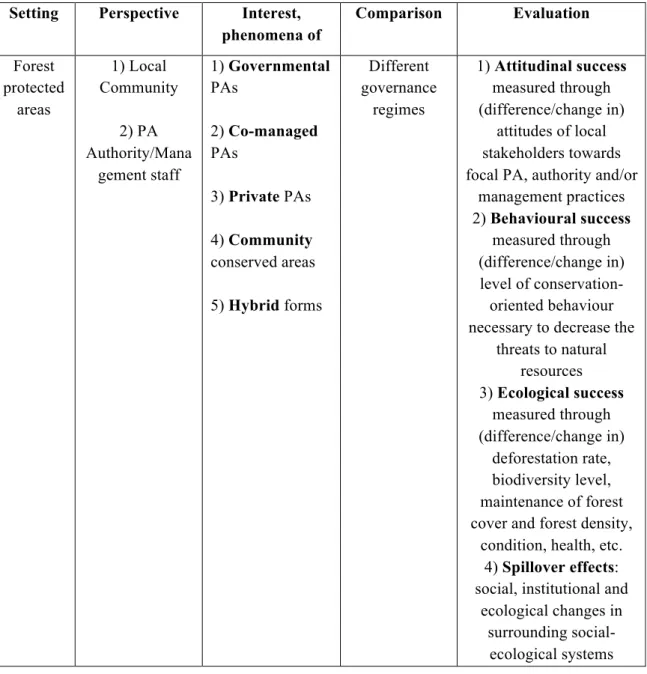
Protected areas are spaces set aside to restrict access to the resources. The governing rules, restrictions and the access rights can be agreed upon and executed by the national government, local communities, privates or combination of these actors. Moreover, distribution of power, decision-making scale, types of actors and nature of their collaboration classifies governance into 4 modes: 1) governance by government, 2) shared governance or co-management, 3) private governance and 4) governance by communities and indigenous people. (Borrini-Feyerabend 2003; Borrini-Feyerabend et al. 2006) (see also Chapter 2.1). These different approaches to conservation are frequently determined by global political economy and are exercised through international conservation agreements (Macura et al. 2013).
Command-and-control5 government-led approach has been dominant in conservation practice and introduced to developing countries, making nature-culture divide and often
4 Difference in wording comes from a type of comparator. Before/after comparison can show outcome
changes, while control/impact comparison can show outcome differences
5 Also called in the literature as “fence and fine approach”, “fortress conservation” or “conservation by
dissolving pre-existing traditional community resource governance (Philip 2004). This is “old governance” with monocentric hierarchical structure, valuing expert over local knowledge and excluding local people both from the meaningful decision-making and from the physical park territory (by forcefully evictions and involuntary relocations). Despite a view that government-run protected areas with defined and restricted resource uses is the successful strategy to keep the forests intact, other scholars argue that these exclusive approaches create high social costs locally through increasing conflicts among protected areas and local people (Wilshusen et al. 2002). This unequal distribution of benefits can ultimately lead to negative attitudes among local people (for a review see: Macura et al. 2011), lack of compliance and anti-conservation behaviour (retaliation), which can negatively reflect on biodiversity level (White et al. 2009)
Pushed by international conservation agreements and donor funding (such as World Bank), since 1980’s and early 1990’s these protected areas frequently have some level of people involvement through integrated conservation and development projects (ICDPs). However, the idea behind the ICDP is purely conservation-centric – it is usually based on the provision of alternative livelihood sources to adjacent local communities in order to wean them away from parks (Brown 2002)
After early 1980’s “new” and more inclusive governance of the protected areas emerged. This “populist” discourse and inclusive paradigm recognised local people as valid and legitimate actors in conservation (Reyes-Garcia et al. 2013).
Power sharing, decentralization or devolution and multi-level interactions among actors frame this “new” paradigm. Co-managed or multi-stakeholder protected areas are arrangements between a governmental agency and local/mobile/indigenous communities, user associations, private entrepreneurs and landowners that together share power and responsibility, make and enforce decisions. Community conserved areas rely on the self-enforcement, and are governed and voluntarily conserved by indigenous groups, local and mobile communities through customary laws and other traditional institutions. More recently and following global governance trends, private protected areas came into fore where private landowners, individuals, NGOs and other
not-for profit and for-profit organisations make and enforce decisions, have control and/or ownership over resources (Borrini-Feyerabend et al. 2006).
Since recently there are calls for “back to barriers” movement arguing against inclusive protected areas based on their presumably unsuccessful record in conserving the biodiversity and shifting attention from conservation to development goals (Hutton et al. 2005)
Protected areas continue to extend. Landscape-level and trans-boundary governance approaches emerged recently and it is especially applicable to the conservation of wide-ranging large carnivores (such as tigers). These complex governance arrangements extend the governance scales from local to regional and above to solve the problem of “fit” or align ecological with the governance scale. They require more intensive collaboration across scales, sectors and levels, coordination between landscape actors so their actions have meaningful direction, nested governance that can accommodate different decision levels and arena for consensus building, negotiation over land tenure (for illustration see: Wyborn & Bixler 2013)
Participation in protected area governance may have several different roles (Lawrence 2007; Niedzialkowski et al. 2012): a) shift responsibility from governments to local level actors and help (donor- or state-propelled) decentralization, b) increase legitimacy of conservation by inclusion (process legitimacy) and solve local conflict, c) create better conservation outcomes (output legitimacy) trough increasing awareness of locals about resources or simply regenerate resources at lower cost.
Depending on different institutional designs, social (sometimes exclusive) norms that moderate interactions among participants and the final aim of participation, there are several modes or participating: passive, nominal, consultative, activity-specific, active and finally interactive (empowering) participation.
However, participation is frequently criticised on various grounds. It means so may things to so many people as the term may refer to: share of intention, an action or an impact (Lawrence 2007). In their book, Cooke and Kothari (2001), argue that participation usually serves the interests of donors, but also it can be manipulated by the local people. Participation focus on achieving efficiency does not actually lead to
empowerment of local people (which is often a moral stand in the reasons to use participation)(Reed 2008).
When being implemented (or imposed by donor requirements) where it does not fit the local culture and social structures, it creates participatory “exclusions” instead (Agarwal 2001)or it can even erode positive conservation and institutional attitudes (Macura et al. 2011). Even where culturally accepted, when requiring participation as a tool (regardless of purpose) it is frequently (but wrongly) assumed that local communities are homogenous group of people with the same motives (Agrawal & Gibson 1999). In such circumstances, participation can often create deeper structural gaps in the local community. Moreover, participation arenas can also serve as re-assertion of the control and power by dominant actors (elite capture- (e.g. Balooni et al. 2010)) or for shifting responsibility from practitioners to locals, making local community convenient scapegoat for failures of conservation and undesired ecological outcomes (Cooke & Kothari 2001)
Finally, earlier mentioned conservation evaluation implies measurement of success. However, the question is what success means to different actors in the conservation. Having in mind presented complexity of the protected areas, success is not easy to define. Protected areas are increasingly established not only to conserve biodiversity, but also to provide ecosystem benefits and socio-economical support to adjacent communities, have tourism purpose (Watson et al. 2014). Therefore, it is frequently not possible to evaluate conservation success only based on the ecological outcomes such as species abundance or forest cover. This cannot inform about local conflicts or retaliatory behaviour (White et al. 2009). Focusing on ecological measures of success might disregards objectives of local power actors, which may produce negative conservation outcomes in the future (Murray 2005). It is argued that calls for fortress conservation become more frequent out of the reductionist view of conservation success (Brechin et al. 2010)
Dissertation structure
This dissertation is composed of five chapters, with three standalone data chapters, all revolving around different facets of governance in FPAs. The work presented here uses
a combination of qualitative and quantitative approaches including systematic review methodology, qualitative data analysis and quantitative impact assessment that are all separately described in the data chapters.
First part of the dissertation (Chapter 2) collates the evidence on conservation success of FPAs conditional on the type of their governance. This chapter explores protected areas globally and synthetizes the published literature up-to-day to create a global map of the evidence and knowledge base on the role of governance in the conservation effectiveness of protected area with respect to social and ecological outcomes. The results of the map call attention to the knowledge-gaps in the field of conservation governance, provide inputs for future research and generate questions for potential evidence syntheses.
Second part of the dissertation (Chapters 3 and 4) uses tiger conservation in central India as a case example to analyse governance change and the gaps between socially-inclusive and collaborative policies and actual practices on the ground. Chapter 3 investigates, from institutional perspective, enabling and disabling factors for a shift towards “landscape-level conservation” that implies sectoral integration, inclusion and collaboration between PA managers and different actors in central Indian tiger landscape. Chapter 4 focuses on the local level participatory policy implementation. It examines the case of two participatory projects around Pench Tiger Reserve in Madhya Pradesh and evaluates the effects of project participation through local community’s attitudes towards biodiversity and trust and satisfaction with reserve authorities. Chapter 5 contains discussion, policy and practice recommendations and conclusions. Table 1.1. provides a brief overview of research questions, methodology and research outputs.