Dealing with multiple representations in the
mathematics classroom: Teachers’ views, knowledge,
and their noticing
Dissertation
zur Erlangung des Grades eines Doktors
der Philosophie (Dr. phil.)
der P¨
adagogischen Hochschule Ludwigsburg
vorgelegt von Anika Dreher aus L¨
orrach
Ludwigsburg
2015
Erstgutachter:
Prof. Dr. Sebastian Kuntze
Zweitgutachter:
Prof. em. Dr. Stephen Lerman
Drittgutachterin:
Prof. Dr. Laura Martignon
Viertgutachter:
Prof. Dr. Markus Vogel
Danksagung
Mein Dank gilt in erster Linie Herrn Prof. Dr. Sebastian Kuntze, der dieses
Disser-tationsprojekt erm¨
oglicht und meine Arbeit hervorragend betreut hat. Besonders
bedanken m¨
ochte ich mich f¨
ur die anregenden Diskussionen und seine unerm¨
udliche
Unterst¨
utzung im Hinblick auf Ver¨
offentlichungen und Konferenzteilnahmen.
Bei meinem Zweitgutachter Herrn Prof. em. Dr. Stephen Lerman m¨
ochte ich
mich nicht nur f¨
ur seine freundliche Unterst¨
utzung bei sprachlichen Angelegenheiten
und bei der Rekrutierung von englischen Lehramtsstudierenden bedanken, sondern
insbesondere auch f¨
ur seine ermutigenden Worte und st¨
andige Hilfsbereitschaft. Des
Weiteren gilt mein Dank auch Frau Prof. Dr. Laura Martignon und Herrn Prof. Dr.
Markus Vogel f¨
ur ihre Bereitschaft diese Dissertation zu begutachten.
Um die Befragung der zahlreichen Lehrpersonen und Lehramststudierenden,
die im Zentrum dieser Arbeit steht, zu erm¨
oglichen, war die Unterst¨
utzung einer
Reihe von Personen maßgeblich, denen ich an dieser Stelle ganz herzlich danken
m¨
ochte: Frau Prof. Dr. Silvia Wessolowski, Herrn Prof. em. Dr. Stephen Lerman,
Herrn Dr. Ulrich Groh und Frau Dr. Edyta Nowinska danke ich f¨
ur die er¨
offneten
M¨
oglichkeiten Lehramtsstudierende im Rahmen von Lehrveranstaltungen zu befragen
und bei Herrn Dr. Martin Haas, Ute Sproesser, Annemarie Dreher und Carolin Kern
m¨
ochte ich mich f¨
ur Ihre Hilfe bei der Rekrutierung von Lehrpersonen bedanken. In
diesem Zusammenhang gilt mein Dank auch den Hilfskr¨
aften Anna D¨
urr, Bianca
Fink, Thomas H¨
abe und Katharina Dreher, die mich bei der Durchf¨
uhrung der
Befragung, der Dateneingabe und auch bei der Kodierung der Antworten unterst¨
utzt
haben. Insbesondere verdienen an dieser Stelle auch die zahlreichen Lehrpersonen
und Lehramtsstudierende, die sich bereit erkl¨
arten an der Studie teilzunehmen und
sich die Zeit daf¨
ur genommen haben, ein großes Dankesch¨
on.
Ganz herzlich bedanken m¨
ochte ich mich außerdem bei meinen Kolleginnen und
Kollegen des Instituts f¨
ur Mathematik und Informatik f¨
ur die positive
Arbeitsatmo-sph¨
are und eine unvergessliche Zeit an der PH Ludwigsburg. Insbesondere danke ich
in diesem Zusammenhang Marita Friesen, Ute Sproesser, Christoph Till und Tanja
Walz f¨
ur ihr offenes Ohr und die aufmunternden Worte bei auftretenden Problemen,
f¨
ur die anregenden Diskussionen und hilfreichen Anmerkungen zu meiner Arbeit.
Daniel Keller m¨
ochte ich besonders danken f¨
ur seine Hilfe bei der Erstellung und
Optimierung von Graphiken f¨
ur diese Arbeit.
Schließlich gilt mein pers¨
onlicher Dank meiner Familie und meinen Freunden,
die mich w¨
ahrend dieser Promotionszeit moralisch unterst¨
utzt und f¨
ur den n¨
otigen
Ausgleich zur Arbeit an der Dissertation gesorgt haben.
Abstract
In the last three decades many research studies focused on the topic of multiple
representations and their role for learning mathematics. As a result, there is a broad
consensus in the scientific community that dealing with multiple representations in
the mathematics classroom is a highly relevant matter. However, research addressing
the role of the teachers in this context is still scarce. Consequently, this dissertation
study raises the question of how much teachers know about and acknowledge this
key role of multiple representations for the mathematics classroom. To this end, not
only different aspects of teachers’ specific professional knowledge and their views
were investigated, but also their noticing of changes of representations in instances
of student-teacher interaction, which can be seen as a theme-specific noticing. Using
a multi-layer model of professional knowledge, this study addresses in particular
questions of how such specific aspects of professional knowledge are interrelated and
what components of knowledge and views play a role for the teachers’ theme-specific
noticing.
These research interests were addressed in the scope of three substudies, each
of them including two different subsamples (English pre-service teachers/German
pre-service teachers, pre-service teachers/in-service teachers, respectively in-service
teachers at academic track secondary schools/in-service teachers at secondary schools
for lower attaining students), in order to explore the possible roles of cultural
background, teaching experience, and school types.
The different aspects of specific professional knowledge and views were assessed
by means of a questionnaire instrument. For eliciting the teachers’ theme-specific
noticing, vignette-based questions were implemented. The data was analyzed mainly
by quantitative methods, was however complemented by a qualitative in-depth
analysis focusing on how the teachers’ theme-specific noticing was informed by
different components of their professional knowledge.
The results of this study suggest that the participants did not fully understand
the key role of multiple representations for learning mathematics in the sense of their
discipline-specific significance and thus indicate specific needs for teacher education
and professional development. Differences between the subsamples of teachers became
apparent especially regarding the teachers’ more situated professional knowledge and
their noticing with respect to dealing with multiple representations. Furthermore,
the findings of this study underpin the assumption that within the spectrum between
teachers’ situated and global professional knowledge and views regarding dealing
with multiple representations, different components may be distinguished and suggest
that in particular all of these components may play a role for teachers’ theme-specific
noticing.
Contents
1
Introduction
1
2
Theoretical Background
5
2.1
The role of representations in mathematics
. . . .
5
2.2
Consequences for learning mathematics
. . . .
9
2.3
Multiple representations in the domain of fractions . . . .
12
2.4
Teachers’ noticing, their professional knowledge, and views
. . . . .
14
2.5
Theme-specific noticing, professional knowledge, and views about
dealing with with multiple representations in the mathematics classroom 19
2.6
Potential differences between different groups of teachers . . . .
26
3
Research Questions
29
4
Design & Methods
31
4.1
The questionnaire
. . . .
31
4.2
The sample . . . .
37
4.3
Data analysis . . . .
39
5
The Overall Study: A Puzzle of Three Pieces
41
5.1
Article 1 . . . .
45
5.2
Article 2 . . . .
61
5.3
Article 3 . . . .
85
6
Discussion & Conclusion
103
6.1
Discussion of the results . . . .
103
6.2
Limitations of the study . . . .
111
6.3
Implications of the findings and need for further research
. . . .
111
A ¨
Uberblick ¨
uber Artikel und Konferenzbeitr¨
age
115
B Deutsche Zusammenfassung
117
C Darlegung des eigenen Anteils
125
References
127
Lebenslauf
139
List of Figures
1.1
Different mathematics teachers’ views on how to deal with multiple
representations . . . .
2
2.1
Some representations for a rational number . . . .
7
2.2
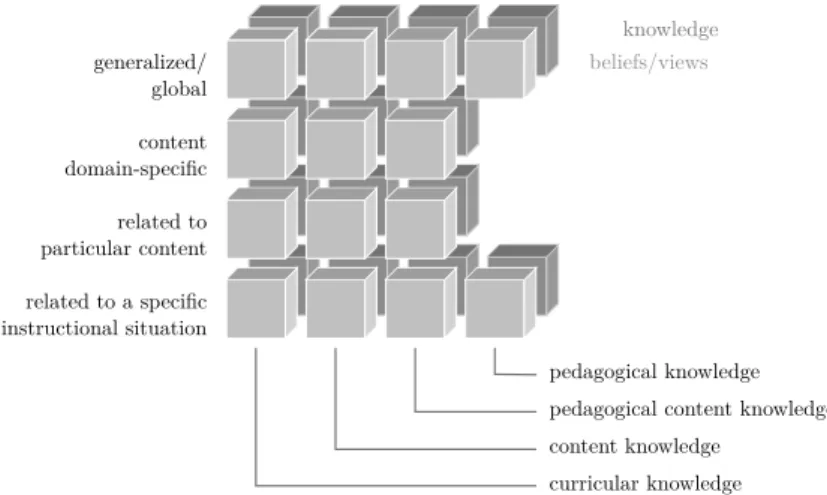
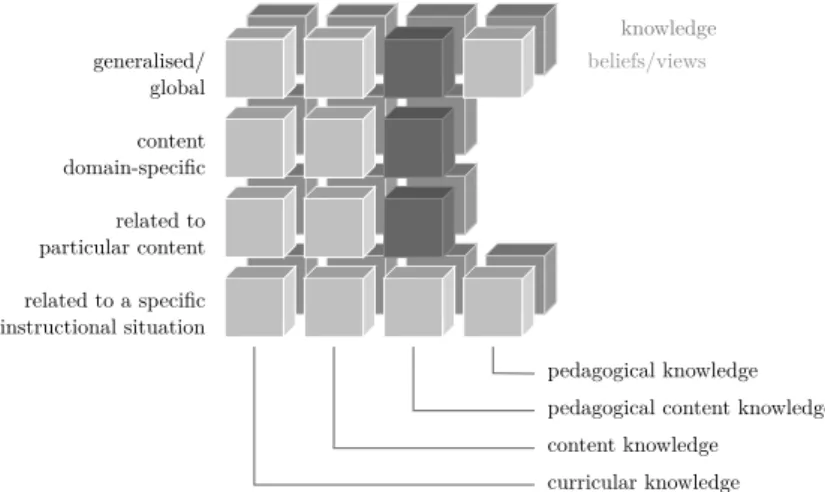
Overview model of components of professional knowledge (see Kuntze,
2012, p. 275) . . . .
18
4.1
Samples for tasks of type 1 (left) and of type 2 (right) . . . .
33
4.2
Sample vignette # 1 (T: teacher, S: student)
. . . .
34
4.3
Sample vignette # 2 (T: teacher, S: student)
. . . .
35
4.4
Sample item # 1 of the CK test
. . . .
37
4.5
Sample item # 2 of the CK test
. . . .
37
5.1
Some representations for a fraction . . . .
47
5.2
Overview model of components of professional knowledge (see Kuntze,
2012, p. 275) . . . .
48
5.3
Samples for tasks of type 1 (left) and of type 2 (right) . . . .
53
5.4
Sample item of the CK test . . . .
54
5.5
Views on the importance of reasons for using multiple representations
55
5.6
Views on the role of multiple representations for teaching fractions .
55
5.7
Evaluations of the learning potential regarding the two types of tasks
56
5.8
Specific CK scores (means and their standard errors) . . . .
57
5.9
Some representations for the fraction
23. . . .
63
5.10 Overview model of components of professional knowledge (see Kuntze,
2012, p. 275) . . . .
64
5.11 Sample vignette # 1 (T: teacher, S: student)
. . . .
70
5.12 Sample vignette # 2 (T: teacher, S: student)
. . . .
71
5.13 Sample item of the CK test . . . .
73
5.14 Views related to reasons for using multiple representations (means
and their standard errors) . . . .
73
5.15 Views on the role of multiple representations (MR) for teaching
frac-tions (means and their standard errors)
. . . .
74
5.16 Mean number of answers (out of four) that indicate theme-specific
noticing . . . .
74
5.17 Mr. A’s answer (in-service teacher) . . . .
76
5.18 Ms. B’s answer (in-service teacher) . . . .
76
5.19 Ms. C’s answer (pre-service teacher) . . . .
76
5.20 Mr. D’s answer (in-service teacher) . . . .
77
5.21 Mr. E’s answer (in-service teacher) . . . .
77
5.22 Mr. F’s answer (in-service teacher) . . . .
78
5.23 Mr. G’s answer (pre-service teacher) . . . .
79
x
List of Figures5.24 Ms. H’s answer (in-service teacher) . . . .
79
5.25 Ms. J’s answer (pre-service teacher)
. . . .
79
5.26 Mr. K’s answer (pre-service teacher) . . . .
80
5.27 Specific content knowledge scores (means and their standard errors)
80
5.28 Some representations for the fraction
34. . . .
87
5.29 Samples for tasks of type 1 (left) and of type 2 (right) . . . .
92
5.30 Sample vignette (T: teacher, S: student) . . . .
95
5.31 Views on the role of MR for teaching fractions (means and their
standard errors) . . . .
97
5.32 Means and their standard errors of the three clusters . . . .
97
5.33 Evaluations of the learning potential regarding the two types of tasks
98
5.34 Mean number of answers (out of four) that indicate theme-specific
noticing . . . .
98
5.35 Comparison of the three clusters regarding their average score for
theme-specific noticing . . . .
99
B.1 Schematischer ¨
Uberblick ¨
uber Komponenten professionellen Wissens
List of Tables
4.1
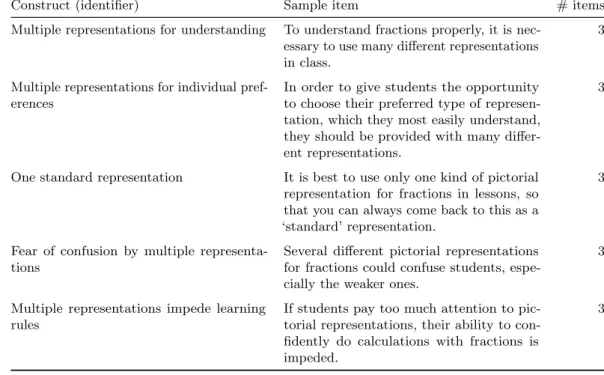
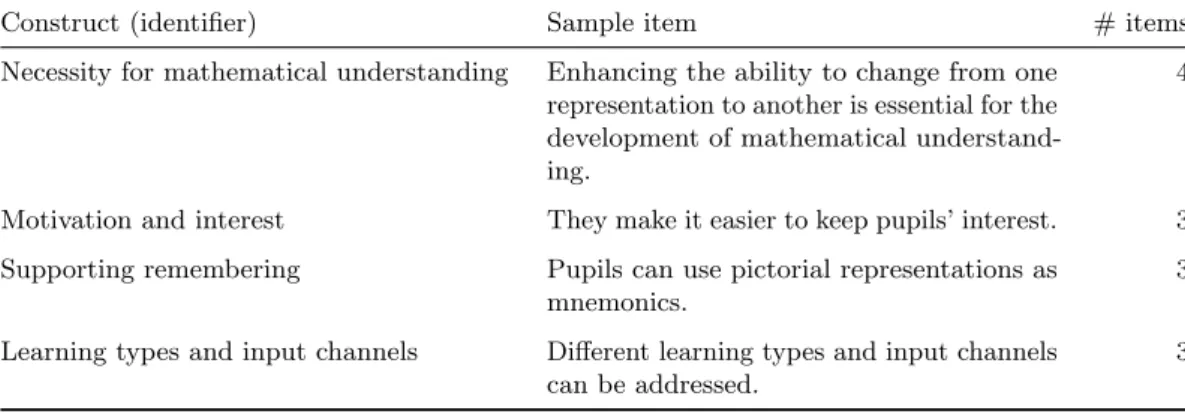
Scales regarding reasons for using multiple representations in the
mathematics classroom . . . .
32
4.2
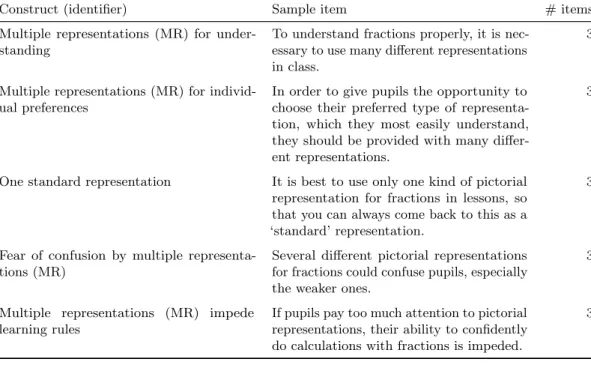
Scales regarding views on dealing with multiple representations for
teaching fractions . . . .
32
4.3
Coding illustrated by means of sample answers to the vignette shown
in Figure 4.2; bold answers were considered to indicate theme-specific
noticing . . . .
36
5.1
Overview of the three substudies . . . .
41
5.2
Scales regarding reasons for using multiple representations in the
mathematics classroom . . . .
52
5.3
Scales regarding views on dealing with multiple representations for
teaching fractions . . . .
53
5.4
Pearson’s correlation coefficients for the scale ”necessity for
mathemat-ical understanding” . . . .
57
5.5
Scales regarding reasons for using multiple representations in the
mathematics classroom . . . .
69
5.6
Scales regarding views on dealing with multiple representations for
teaching fractions . . . .
69
5.7
Categories and sample answers (answers related to item in Figure 5.11) 72
5.8
Pearson’s correlation coefficients for the score ”theme-specific noticing” 75
5.9
Scales regarding views on dealing with multiple representations for
teaching fractions . . . .
93
5.10 Coding illustrated by means of sample answers to the vignette shown
in Figure 5.30; bold answers were considered to indicate theme-specific
noticing . . . .
95
Chapter 1
Introduction
A broad base of research into students’ learning with multiple representations in
the mathematics classroom has led to a better understanding of the difficulties that
many students have with understanding mathematics by emphasizing the crucial role
of multiple representations and making connections between such representations
(e.g., Duval, 2006; Renkl, Berthold, Große, & Schwonke, 2013). However, teachers’
views about how to deal with multiple representations in the mathematics classroom
diverge widely: Figure 1.1 presents two statements by German secondary mathematics
teachers (translation by the author) that were elicited by the same vignette which is
shown in the Figure as well. In the light of empirical findings providing evidence for
the influences of teachers’ views on their teaching practice (e.g., Staub & Stern, 2002),
there is good reason to assume that such contrary views will impact the way these
teachers deal with representations in their mathematics classrooms. Consequently,
mathematics teachers’ views on the role of multiple representations for learning
mathematics merit close attention. Corresponding research is however still scarce.
As teachers’ views on dealing with multiple representations in the mathematics
classroom may be interrelated with what they know about mathematical
representa-tions and their role for students’ learning, such views should be investigated together
with the teachers’ specific knowledge.
Bearing in mind that it depends delicately on the context, whether a certain
change of representations is rather aid or obstacle for students’ understanding
(see Acevedo Nistal, van Dooren, Clarebout, Elen, & Verschaffel, 2009), not only
views and knowledge about dealing with multiple representations in general, but in
particularly more situated, context-specific views are worth focusing on. Consider,
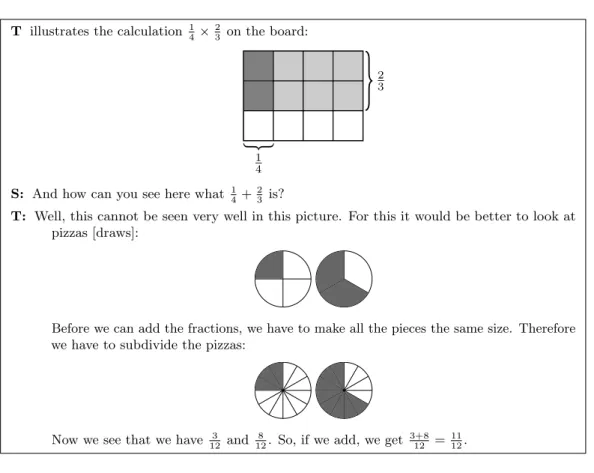
for instance, the classroom situation described by the transcript in Figure 1.1 There
may certainly be situations in which it is reasonable for a teacher to change from
the rectangle representation to the pizza representation for showing how to add
fractions – for example, when a student has difficulties identifying the unit and
holding it constant. However, in the specific situation outlined above, the student’s
question refers to the rectangle representation and hence an explanation using another
representation without making connections to the original one may lead to difficulties
in understanding. For investigating rather situated teachers’ views on dealing with
multiple representations in the mathematics classroom a situated context has to be
provided, for instance by vignettes or specific tasks, which can elicit such views (e.g.,
Kuntze, 2012).
However, eliciting a teachers’ views on dealing with representations by means of
a vignette presenting a specific classroom situation (or a real classroom situation)
requires the teacher to pay attention to corresponding aspects of the specific situation.
In the example above, for evaluating whether the change of representations by the
teacher is helpful for the student’s understanding, it is obviously necessary to pay
2
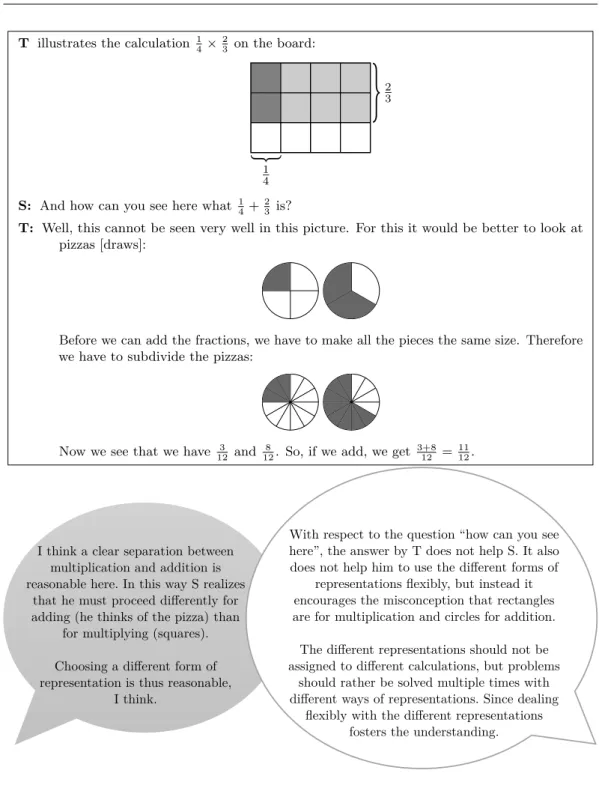
IntroductionT illustrates the calculation 1 4×
2
3 on the board:
}
}
S: And how can you see here what 14 +23 is?
T: Well, this cannot be seen very well in this picture. For this it would be better to look at pizzas [draws]:
Before we can add the fractions, we have to make all the pieces the same size. Therefore we have to subdivide the pizzas:
Now we see that we have 123 and 128. So, if we add, we get 3+812 = 1112.
With respect to the question “how can you see here”, the answer by T does not help S. It also does not help him to use the different forms of
representations flexibly, but instead it encourages the misconception that rectangles are for multiplication and circles for addition. The different representations should not be assigned to different calculations, but problems
should rather be solved multiple times with different ways of representations. Since dealing
flexibly with the different representations fosters the understanding. I think a clear separation between
multiplication and addition is reasonable here. In this way S realizes
that he must proceed differently for adding (he thinks of the pizza) than
for multiplying (squares). Choosing a different form of representation is thus reasonable,
I think.
3
attention to this change, to notice it. That is, situated contexts require extracting
what is relevant in the specific classroom situation or the specific task against the
background of corresponding professional knowledge in the sense of noticing (van Es
& Sherin, 2002). Hence, in particular the teachers’ situated views on dealing with
multiple representations in the mathematics classroom are likely to be intertwined
not only with their corresponding knowledge, but also with their noticing.
Consequently, the whole complex of specific views, knowledge, and teacher noticing
regarding the idea of using multiple representations in the mathematics classroom
merits attention. Then again, within the scope of this work it is certainly not possible
to provide an extensive investigation of all facets of this complex. Therefore, this
work’s objective is to spotlight several important facets and also to explore their
interrelations. In this way a first, rough sketch can be drawn, which may serve as a
starting point for further research which can then investigate particular aspects in
greater depth, add further facets or aim at an even broader perspective.
The process of making a reasonable selection regarding the focus of the present
study started by choosing a content-domain for setting the content- and
situation-specific aspects. As the domain of fractions is particularly well-studied regarding the
use of different representations and the significance of multiple representations for
the construction processes of students’ conceptual understanding (e.g., Ball, 1993a;
Padberg, 2009) this domain was chosen for the study of corresponding aspects of
teachers’ views, knowledge, and noticing.
The following second chapter gives insight into the theoretical background of this
study by defining its key terms as well as reviewing literature and research which
is important for its design and implications. On this basis, the research questions
which are central to this work are derived in the third chapter. Subsequently the
design of the study is described, including its methodology and samples. As the
study comprises of three substudies which take different perspectives and focus on
different subsamples, these three substudies are presented in the fifth chapter, which
also outlines how they complement each other with respect to finding answers to
the overall research questions. Within this fifth chapter, the three substudies are
presented in the form of separate articles, which means that each of them is embedded
in an individual, more specific theoretical framework. The results of the substudies,
which are at first presented separately within the corresponding articles, are then
summarized and discussed from the perspective of the overall research interest in
the sixth chapter. Moreover, this last chapter points out theoretical and practical
implications of the results of this study and makes suggestions for further research
into teachers’ views, knowledge, and their noticing with respect to dealing with
multiple representations in the mathematics classroom.
Chapter 2
Theoretical Background
The first section of this chapter focuses on the essential role that representations play
in the discipline of mathematics. Against this background, in the second section,
consequences for learning mathematics are deduced and underpinned by corresponding
empirical findings on students’ learning with multiple representations of mathematical
objects. As this dissertation study focuses in its domain-specific parts on fractions,
the role of multiple representations for the students’ conceptual understanding of
fractions is looked at in more detail in the third section. Subsequently, the focus is
moved from the students to the teachers: First, the notions of mathematics teachers’
noticing and teachers’ professional knowledge are introduced and briefly discussed
in general, before they are viewed from the perspective of dealing with multiple
representations in the mathematics classroom. Thereby, important aspects of specific
views, knowledge, and teacher noticing are spotlighted and possible interrelations are
discussed. The last section motivates the investigation of different groups of teachers
by focusing on potential differences regarding these aspects of their knowledge, views,
and noticing. The distinction between the groups of teachers refers to the country
they come from, their teaching experience as being pre-service or in-service teachers,
and the type of school they teach at.
2.1
The role of representations in mathematics
Mathematics is the art of giving the same name to different things.
Henri Poincar´
e (1854 – 1912)
Poincar´
e (1908/1914) explained this famous quote of his in the following way:
When language has been well chosen, one is astonished to find that all
demonstrations made for a known object apply immediately to many new
objects: nothing requires to be changed, not even the terms, since the
names have become the same. (p. 34)
Reviewing his work further shows that he had in mind structures such as groups
that can be found in many different fields of mathematics and beyond, and that have
played an important role for mathematical achievements in the past two centuries. In
the words of Poincar´
e’s quote, the “name” group can be given to superficially different
“things”, since they share an underlying structure. Indeed, it is easily observed that
the effectiveness of mathematics often lies in unmasking seemingly different things as
“being the same”. In particular this is an important reason for why mathematics can
often solve problems emerging in other disciplines. Sturmfels (2009), for instance,
pointed out that statisticians, computer scientists, physicists, engineers, and biologists
have used many different terms in the literature for a certain mathematical object
6
Theoretical Background(a specific prime ideal) and that “the concise language of commutative algebra and
algebraic geometry can be an effective channel of communication for the[se] different
communities” (p. 352).
One may ask however, whether these different things that we can give the same
name to are really “different objects” or whether they can rather be seen as different
designations for the same object. The latter describes the perspective of Gottlob
Frege (1892/1960): In his well-known article Ӭ
Uber Sinn und Bedeutung” [On sense
and reference], he gave the following example:
Let a, b, c be the lines connecting the vertices of a triangle with the
midpoints of the opposite sides. The point of intersection of a and b is
then the same as the point of intersection of b and c. So we have different
designations for the same point, and these names (’point of intersection
of a and b’, ’point of intersection of b and c’) likewise indicate the mode
of presentation; and hence the statement contains actual knowledge. (p.
57)
According to Frege (1892/1960), a designation or a name for a mathematical object
can take the form of symbol(s) or word(s). Disagreeing with the formalist view that
these designations may be equated with the mathematical objects they represent,
Frege (1895/1970) has emphasized that designation and object must be distinguished
carefully:
So it is necessary not to overrate words and symbols [. . . ] by mistaking
them for the actual things of which they are at most the (more or less
accurate) representations. [. . . ] When I write down
1 + 2 = 3
then I am
putting forward a proposition about the numbers
1
,
2
and
3
, but it is not
those symbols that I am talking about. (p. 482)
In this quote Frege pointed out that designations for mathematical objects can be
seen as representations. In the present dissertation study the notion representation
is understood as “something that stands for something else” (Duval 2006, p. 103).
Since, however, not only symbols and words can stand for mathematical objects,
representations for mathematical objects can also take different forms, such as
graphics or diagrams. Nevertheless, the designations that Frege (1892/1960) referred
to in his work are understood as representations for mathematical objects. Figure
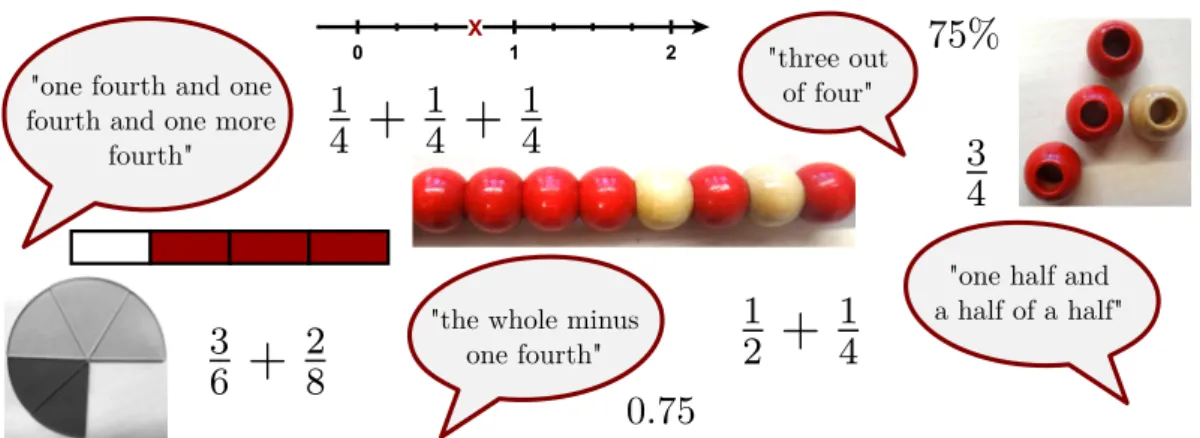
2.1 shows an example of some representations for the rational number
34.
Frege (1892/1960) argued that mathematical objects are neither palpable nor
directly perceivable, but have to be represented. Taking into account the gap between
a designation of a mathematical object and the object itself, Frege (1892/1960, p.
57) came up with his famous distinction between the
sense
(Sinn) and the
reference
(Bedeutung) of a designation: The reference is the object the designation refers to
and the concept of sense accounts for the mode of presentation, hence refers to the
particular aspect of the mathematical object which is revealed by the designation
(Radford, 2002). In Frege’s example mentioned above, the designations “point of
intersection of a and b” and “point of intersection of b and c” have the same reference,
that is, they refer to the same object, namely a specific point in the Euclidean plane,
but their sense is different, since they show different aspects of this object.
One of Frege’s (1892/1960) remarkable insights concerns the role that different
designations of mathematical objects play for the processes of knowledge acquisition in
2.1 The role representations
7
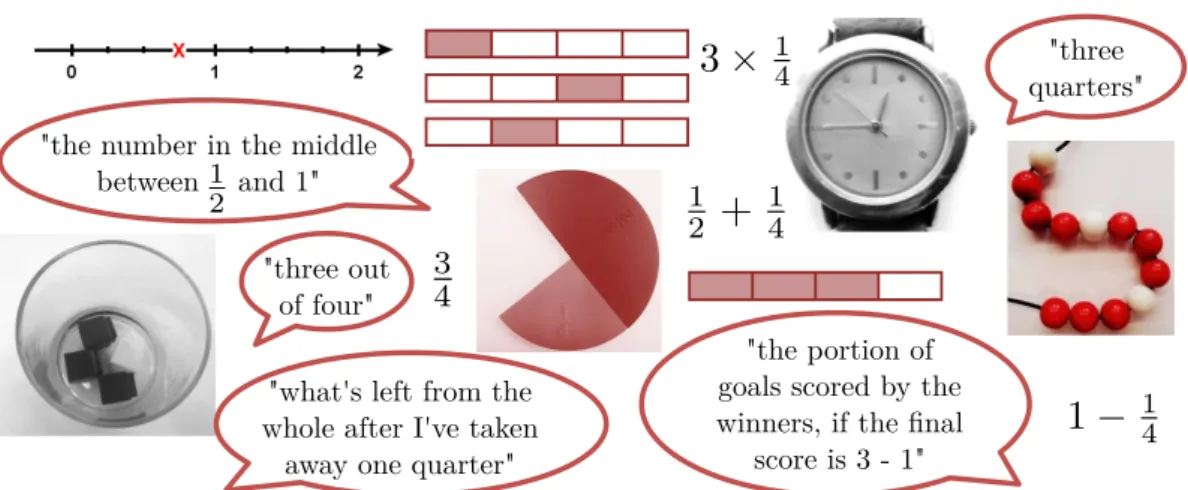
"one fourth and one fourth and one more
fourth"
"three out of four"
"the whole minus one fourth"
"one half and a half of a half"
75%
0.75
Figure 2.1: Some representations for a rational number
the discipline: He observed that becoming aware of links between different senses of the
same object is what discloses knowledge (Radford, 2002). This Fregean perspective
can thus be condensed by modifying the above-quoted citation of Poincar´
e (see
Schnotz, 2014a):
Mathematics is the art of giving different names to the same thing.
In this case, the “different names” are different designations or representations
and the “same thing” is the mathematical object they refer to. “Giving different
names to the same thing” can thus be understood as making connections between
different representations of the same mathematical object – which plays an essential
role for mathematical understanding as it will become clear in the following sections.
Inspired by Frege’s ideas, Raymond Duval (1993; 2006) developed a framework for
analyzing the processes of mathematical activity, which he then used for identifying
reasons for the difficulties that many students have with comprehension of
mathe-matics, as it will be explained in the following section. Like Frege, Duval pointed out
that mathematical objects cannot be perceived directly, but accessing them is bound
to the use of representations. Duval focused however not on single representations,
but on systems of representations which have rules for performing transformations of
representations within the system without changing the mathematical object that
is represented. He referred to these systems of representations by the notion of
representation
registers
(Duval, 2006, p. 111). The reason why Duval emphasized the
possibility of transforming representations of the same object into each other is his
observation that transformations of representations are at the heart of mathematical
activity (Duval, 2006, p. 107). Building on Frege’s insight, Duval (2006) pointed
out that mathematical activities always involves substituting some representation
for another and that disclosure of mathematical knowledge requires to deal with
and to link different senses of a mathematical object. Analyzing the predominant
role of transformations of representations regarding mathematical activities more
closely, Duval was led to distinguish two types of transformations:
treatments
and
conversions
(Duval, 2006, p. 111). While the notion treatment is used for a
transfor-mation of representations within a register of representations, the term conversion
refers to a transformation from one register to another. Consider for instance the
representations shown in Figure 2.1: Transforming the representation
14+
14+
14into
8
Theoretical Backgroundthe representation
12+
14would be a treatment, whereas the transformation from
the number line representation to the strip representation of the fraction would be a
conversion, since these representations belong to different registers even though both
of them are pictorial. Duval (2006) observed that these two types of transformations
have different meanings for mathematical processing. While treatments are often in
the foreground of mathematical activities and hence appear to be most important, in
many cases it is the conversions of representations which are crucial to gain insight
and to facilitate problem solving as well as mathematical argumentation. The reason
for this is that the treatments which can be carried out are usually very specific to
the register that is used. Thus “passing from one register to another changes not
only the means of treatment, but also the properties [of the mathematical object]
that can be made explicit” (Duval, 2006, p. 114). Consequently, it is quite often
the case that for proving a statement or for solving a problem it is necessary to
carry out a conversion into another register, where some insight can be gained (by
means of treatments) which can subsequently be carried to the original register by a
conversion.
Although Duval’s framework appears to be influenced mainly by philosophical
ideas, similar insights can be found in psychological research on problem solving, where
representations are also considered to play a pivotal role. For the Gestalt psychologists
(e.g., Kohler, 1947; Wertheimer, 1959) insight in solving a problem occurs when the
problem is restructured, that is, transformed into a suitable representational form,
so that the solution becomes suddenly obvious. For the psychologists focusing on
information processing (e.g., Newell & Simon, 1972), however, not finding a convenient
representation is paramount for successful problem solving, but finding a way to get
from an initial state to a goal state in a so-called problem space (see Schnotz, 2014b).
Ohlson’s (1992) representational change theory constitutes a synthesis of these two
perspectives: He observed that problem solving usually requires transforming the
problem into a suitable representational form where the initial state can be easily
transferred into the goal state (Schnotz, 2014b). This insight of Ohlson’s (1992) can
be expressed very well using Duval’s theory of registers: For solving (mathematical)
problems it is often necessary to conduct conversions of representations in order
to facilitate expedient treatments. While the Gestalt psychologists focused mainly
on the crucial role of conversions for problem solving, the information-processing
perspective emphasizes primarily the significance of treatments (see Schnotz, 2014b).
This can be seen as an example for how powerful Duval’s theory of registers is for
explaining how mathematics and in particular mathematical problem solving work.
Moreover, it has been proven very useful for identifying reasons for the difficulties that
a lot of students have with understanding mathematics, as it will be discussed in the
following section. For these reasons this work uses mainly his framework as basis for
developing ideas about what aspects of teachers’ knowledge, views, and their noticing
regarding dealing with multiple representations merit particular attention. It should
however be noted at this point that of course also other authors have developed
theories regarding the role of representations in mathematics and in mathematics
education. One famous example is for instance Jerome Bruner’s (1966) work which
proposed three modes of representation: enactive representation (action-based), iconic
representation (image-based), and symbolic representation (language-based). Like
Bruner, many researchers have focused on classifying representations according to
2.2 Consequences for learning mathematics
9
different dimensions such as the sensory channel, the modality, the level of abstraction,
the specificity or the type of the representation (for an overview, see Ainsworth,
2006). Such distinctions are often used to explain why one kind of conversion is more
difficult for learners to conduct than another.
Duval’s theory may in particular be complemented by theoretical frameworks
taking the perspective of social constructivism on dealing with mathematical
repre-sentations (e.g., Cobb, 2002; Font, Godino, & Gallardo, 2013; Meira, 2002): They
can give further insight into the role that representations play in the mathematics
classroom, since such frameworks emphasize the role of the subject(s) interacting
with the representations for the construction processes of their meaning. Meira (1998)
pointed out for instance that a representation does not stand for a mathematical
object in any obvious, self-explanatory way, but this connection is subject to
interpre-tation and negotiation processes. Similarly, according to Steinbring (2000) creating a
connection between representation and object depends on the interaction between
the participants in a learning environment. The so-called onto-semiotic approach
(Font et al., 2013) argues moreover that even mathematical objects only emerge from
the actions and discourse through which they are expressed and communicated.
All of these discipline-specific characteristics of the role of representations for
doing mathematics that have been described so far have implications for learners of
mathematics. The following section will focus on such emerging consequences for
learning mathematics referring in particular to Duval’s (2006) theoretical framework.
2.2
Consequences for learning mathematics
Duval (2006) did not only develop a theoretical framework regarding the role of
repre-sentations in mathematical activity, but he also analyzed problems of comprehension
in learning mathematics from the perspective of the framework:
Here we get to the root of trouble in mathematics learning: the ability to
understand and to do by oneself any change of representation register.
The troubles that many students have with mathematical thinking lie in
the mathematical specificity and the cognitive complexity of conversion
and changing representations. (p. 122)
According to Duval (2006) the main reason for the cognitive complexity of
con-versions of representations is the following problem: On the one hand concon-versions
of representations require to dissociate the represented mathematical object from
its particular representation through which it was first used and introduced in the
classroom. However, on the other hand, there is a cognitive impossibility of
disso-ciating any mathematical object from its representation, since there is no access
to the object apart from representation. He explained further that this conflict
often leads to the misconception of learners that two representations of the same
object are considered to be two different mathematical objects. Consequently, for
these learners the registers of representation remain compartmentalized, disabling
them from changing flexibly between different representations. The phenomenon of
“compartmentalization” – namely the lack of ability to make connections between
different representation registers – has been described and investigated by several
researchers in the field (e.g., Gagatsis, Elia, & Mousoulides, 2006; Michaelidou,
10
Theoretical BackgroundGagatsis, & Pitta Pantazi, 2004; Yang & Huang, 2004). Gagatsis, Kyriakides, and
Panaoura (2004) examined for instance the role of the number line representation
for the ability of second graders to add and subtract natural numbers and for most
learners they found a compartmentalization between their ability to carry out the
tasks in the symbolic form and their ability to perform the same tasks using the
number line representation.
However, since different representations usually emphasize different properties and
aspects of the corresponding mathematical object, several distinct representations
have to be integrated by learners in order to develop an appropriate concept image
(Ainsworth, Bibby, & Wood, 1998; Even, 1990; Janvier, 1987; Tall, 1988; Wittmann,
1981). Consequently, the ability to link different representations and to change
flexi-bly between them has often been seen as an indicator for conceptual mathematical
understanding (e.g., Stern, 2001; vom Hofe & Jordan, 2009; Zbiek, Heid, & Blume,
2007). In her article on research in the field of intelligence, Stern (2001, p. 184) even
claimed that mathematical competence can be understood as the ability to transform
different forms of representation into each other. Students’ abilities in dealing flexibly
with multiple representations have thus been investigated by several researchers,
who have used notions such as “representational fluency”, “representational
flexibil-ity, “representational versatility” or “representational competence” to describe the
underlying construct and to emphasize slightly different aspects (Acevedo Nistal,
van Dooren, Clareboot, Elen, & Verschaffel, 2009; Graham, Pfannkuch, & Thomas,
2009; Zbiek et al., 2007). Furthermore, many empirical studies (e.g., Hughes, 1986;
Huinker, 1993; Gerster & Schulz, 2000; Moser-Opitz, 2007) have operationalized such
constructs as an indicator of mathematical understanding. Stern (2002) emphasized
moreover that mathematical knowledge of experts and novices is not distinguished
by different degrees of abstraction, but instead the difference lies in its
interconnect-edness: Accordingly, experts can more easily make connections between symbolic
representation registers and corresponding content-related representation registers
such as real world situations.
As it was pointed out in the previous section, making connections between different
representations and conducting suitable conversions of representations often play
an important role for problem solving. It appears hence obvious that mathematical
problem solving is facilitated by representational flexibility (e.g., Acevedo Nistal
et al., 2014; Ainsworth, 2006; Gagatsis & Elia, 2004; Lesh, Post, & Behr, 1987;
Verschaffel, de Corte, & de Jong, 2010).
In this context, Lesh and colleagues
(1987) stated that “good problem solvers tend to be sufficiently flexible in their
use of relevant representational systems that they instinctively switch to the most
convenient representation to emphasize at any given point in the solution process
(p. 38). Acevedo Nistal and colleagues (2009) dealt with the question as to what
characterizes the “most convenient” representation in the problem solving process
and they have found that the answer does not only depend on properties of the task
at hand, but also on characteristics of the learner and the context. Subsequently,
this research group conducted an intervention study regarding the domain of linear
functions showing that it is possible to improve students’ ability to make flexible
representational choices in problem solving in the sense of taking into account such
variables (Acevedo Nistal et al., 2014). Improving students’ abilities in flexibly
using multiple representation is particularly significant in the light of the fact that
2.2 Consequences for learning
11
intelligence is not sufficient for such flexibility, but instead also intelligent learners
have to learn it (Stern, 2001).
Consequently, it appears highly relevant to foster students’ abilities in making
connections and conversions between different representations and in dealing flexibly
with such multiple representations in the mathematics classroom (e.g., Graham et al.,
2009; Schnotz, 2014b). Accordingly, the national standards in many countries point
out the significance of dealing with multiple representations for learning mathematics
(e.g., KMK, 2003; NCTM, 2000; Qualifications and Curriculaum Authority, 2007). For
example, in the German standards for the mathematics classroom “using mathematical
representations” is referred to as one out of six general aspects of mathematical
competence. It encompasses “applying, interpreting, and distinguishing different
representations for mathematical objects and situations”, “recognizing connections
between representations” as well as “choosing different representations depending on
the situation and purpose and changing between them” ( KMK 2003, p 8, translation
by the authors). The American standards emphasize among other aspects subsumed
under the topic “representation” in particular that all students should be enabled to
“select, apply, and translate among mathematical representations to solve problems”
(NCTM, 2000, p. 67).
However, using multiple representations in the mathematics classroom is per se
no panacea for fostering learners’ mathematical understanding and problem solving.
The highly demanding cognitive processes pointed out by Duval (2006) lead to
negative side effects of learning with multiple representations. The complex cognitive
demands associated with using representations start already when considering a single
representation, since this representation does usually not stand for any mathematical
object in an obvious, self-explanatory way (e.g., Ainsworth, 2006; Font et al., 2013;
Meira, 1998). As it was pointed out at the end of the previous section, the connection
between representation and represented object is subject to interpretation as well
as negotiation processes and has to be established among the participants of the
mathematics community or in a learning environment (e.g., Gravemeijer, Lehrer, van
Oers, & Verschaffel, 2002; Steinbring, 2000). Therefore, every time when students
are faced with a new representation, they have to learn how it is used and interpreted
– in the discipline of mathematics or at least in their mathematics classroom. These
requirements for learners add to the cognitive demands associated with making
necessary connections and conversions between representation registers, which were
pointed out at the beginning of this section.
Due to these demanding cognitive processes learning with multiple representations
carries the risk of creating obstacles to understanding for students (Ainsworth, 2006;
Duval, 2006; Sfard, 2000). There is a broad base of empirical evidence for this
phenomenon which shows that learners have difficulties in dealing with multiple
representations and fail sometimes to benefit from them (e.g., Ainsworth, Bibby,
& Wood, 2002). Ainsworth and colleagues (2002) for instance conducted a study
comparing students’ learning after they were taught in computational estimation
using either formal representations, pictorial representations or a combination of
both. Although both of the single representations were found to support learning,
the combination had even detrimental effects. In particular students with low prior
knowledge in the specific content domain often have problems with the integration
of multiple representations (Yerushalmy, 1991). It was observed that they frequently
12
Theoretical Backgroundconcentrated on a single representation, in many cases the more familiar or concrete
one (Cox & Brna, 1995; Scanlon, 1998; Tabachnek & Simon, 1998).
In summary, it can therefore be said that multiple representations play a double
role for learning mathematics: On the one hand conversions of representations are
essential for mathematical understanding, but on the other hand such conversions
can involve excessive demands and thus hinder learning (e.g., Ainsworth, 2006). In
other words, the benefits of learning with multiple representations come at the cost
of highly demanding cognitive processes. Therefore, learners need to be supported
in making connections between different representations in order to benefit from
them (Bodemer & Faust, 2006; Rau, Aleven, & Rummel, 2009; Renkl et al., 2013).
Several empirical studies have explored different support measures: On the one
hand such measures encompass techniques which make salient the elements in the
different representations corresponding to each other, such as the use of an integrated
format or color coding (e.g., Kalyuga, Chandler, & Sweller, 1999; Renkl et al.,
2013). On the other hand instructional procedures encouraging metacognition were
implemented, which either use self-explanation prompts or inform the learners about
the function of multiple representations (Renkl et al., 2013). Although both kinds
of measures were found to help students to benefit from learning with multiple
representations, Renkl et al. (2013) argued that the first kind of measures can merely
foster making connections between multiple representations on a surface level, but
they do not support the integration of these representations in the sense of developing
an appropriate multi-faceted concept image.
2.3
Multiple representations in the domain of fractions
As it was emphasized in the previous sections, the significant epistemological role
of multiple representations is inherent to the discipline of mathematics and thus
applies to all kinds of mathematical contents. The overarching idea of using multiple
representations in the mathematics classroom (Kuntze, Lerman, Murhphy,
Kurz-Milcke, Siller, & Winbourne, 2011) has however content-specific facets as well, since
each content domain typically emphasizes different kinds of representations which
are central for the understanding of the corresponding concepts (e.g., Acevedo Nistal
et al., 2009; Graham et al., 2009; Kuhnke, 2013). Besides the domain of functions,
fractions is one of the best studied content domains regarding the use of multiple
representations and their significance for the construction processes of students’
conceptual understanding (e.g., Ball, 1993a; Charalambous & Pitta-Pantazi, 2009;
Deliyianni, Elia, Panaoura, & Gagatsis, 2008; Niemi, 1996; Padberg, 2009). Hence,
corresponding research focusing on mathematics teachers can optimally build on
and relate to this research. Since moreover, fractions is a content domain that is
a relevant topic at different types of schools, it was chosen for the content-specific
parts of the study of teachers’ views, knowledge, and their noticing about dealing
with multiple representations in the mathematics classroom.
In the following brief overview, a content-specific perspective is adopted in order
to take another look at the key role of multiple representations for conceptual
understanding in the domain of fractions. Among researchers and practitioners in
mathematics education, it is widely acknowledged that teaching and learning fractions
is one of the most problematic topics in school mathematics (e.g., Charalambous
2.3 Multiple representations in the domain of fractions
13
& Pitta-Pantazi, 2009; Niemi, 1996; Padberg, 2009; Winter, 1999). In the light of
the above reasoning it may not be surprising that one of the main reasons which
was identified for learners’ problems in understanding fractions is the fact that the
concept of fractions is very multi-faceted in the sense of requiring the integration of
many different representations (Charalambous & Pitta-Pantazi, 2009; Kieren, 1976;
Lamon, 2001; Niemi, 1996). Several authors (e.g., Ball, 1993a; Charalambous &
Pitta-Pantazi, 2009; Hefendehl-Hebeker & Prediger, 2006; Kieren, 1976; Malle, 2004;
Padberg, 2009; Winter, 1999) have presented a number of different so-called core
aspects or subconstructs which are encompassed in the notion of fractions. Whereas
these lists of aspects differ slightly from each other in different works and some of the
aspects overlap with others, some of the main aspects which are often emphasized
are the following: part-whole, operator, ratio, quotient, point on the number line,
and measure. Different kinds of fraction representations emphasize typically different
aspects of the concept (e.g., Lamon, 2001; Wittmann, 2006). Reconsidering the
representations of the rational number
34presented in Figure 2.1, it may be noted
for instance that the pie chart representation highlights in particular the part-whole
aspect. In the representation with the four pearls however, the whole as the unit
is less visible, whereas in turn the ratio aspect is emphasized more than in the pie
chart representation. The fact that usually for each representation there are certain
aspects of the construct which are visible only to a limited extent or even not at all,
leads to limitations in their usability for teaching and learning purposes. Wittmann
(2006) pointed out for instance that the exclusive or predominant use of pie chart
representations (e.g., pizza) for fractions is not appropriate as it may lead to an
impasse in the learning process, since the operator aspect needed for multiplying
fractions is not emphasized by such representations. Similarly, Charalambous &
Pitta-Pantazi (2007) argued that representations focusing on the part-whole aspect
of fractions are necessary, but not sufficient for building up conceptual understanding
of fractions. Consequently, the development of an appropriate multi-faceted concept
image of fractions requires integrating and connecting multiple representations (e.g.,
Ball, 1993a; Brenner, Herman, Ho, & Zimmer, 1999; Siegler et al., 2010).
Even on the symbolic-numerical level there are many different representations for
the same rational number: Firstly, expanding and reducing can be seen as treatments
of representations not changing the mathematical object that is referred to and
secondly, there are also the possibilities to represent a rational number in terms of
percentage or a decimal. Despite or even because of this great variability which already
exists in symbolic numerical representations of fractions, it is particularly important
to go beyond merely formal notations for the sake of conceptual understanding
(e.g., Hefendehl-Hebeker & Prediger, 2006). Padberg (2009) emphasized for instance
that understanding fraction calculations instead of merely manipulating fractions
according to error-prone rules requires making connections between different kinds
of representations. Several authors have argued that in particular fostering students’
abilities to match symbolic-numerical representations with appropriate pictorial
(diagrams, sketches, illustrations) and content-related representations such as real
world situations plays a key role for sustainable learning of operations with fractions
(e.g., Malle 2004; Prediger 2011; Schnotz, 2014b; see also Stern, 2002).
What was stated in the previous section about the importance of flexibility
in dealing with multiple representations for problem solving, is in particular true
14
Theoretical Backgroundwith respect to the domain of fractions (e.g., Deliyianni et al., 2008; Niemi, 1996).
Focusing on this specific content domain, Deliyianni and colleagues found that
flexi-bility in multiple representations was important for solving problems. Furthermore,
empirical evidence regarding the double role of multiple representations for learning
mathematics was provided: Rau and colleagues (2009) for instance conducted a
study using so-called intelligent tutoring systems and they have found that students
learned more with multiple pictorial representations of fractions than with a single
pictorial representation – however only when they were prompted to self-explain how
the pictorial representations relate to the symbolic fraction representations.
2.4
Teachers’ noticing, their professional knowledge, and views
In view of the findings about the double role of multiple representations as being both
aid and obstacle for learning mathematics, consequences for teaching mathematics
and in particular for teaching fractions can be deduced. Firstly, learning
environ-ments should provide learners with the opportunity to get to know and to integrate
multiple representations of a mathematical object in order to develop an appropriate
multi-faceted concept image and flexibility in dealing with multiple representations.
Secondly, conversions of representations should not be carried out carelessly, but
learners should be fostered explicitly to make connections and to reflect on
conver-sions between representations, so that multiple representations do not become an
obstacle to learning in the mathematics classroom. Therefore, teachers have to decide
situation-specifically in the classroom interaction whether introducing further
repre-sentations is helpful and worth the effort of sufficiently fostering connection making
or if these representational changes would rather hinder students’ understanding.
Therefore it is important to pay attention to conversions of representations in the
classroom interaction, which may be “critical” in the sense of posing an obstacle to
learners’ understanding. Consequently, teacher noticing appears to play a significant
role for dealing with multiple representations in the mathematics classroom. Before
taking a closer look at specific teacher noticing regarding students’ learning with
multiple representations in the next chapter, the following section briefly focuses on
the construct of teacher noticing in general.
2.4.1
Teacher noticing
In recent years the construct of teacher noticing has increasingly drawn the attention
of researches in mathematics education, since noticing in the sense of paying attention
to and interpreting key features of complex classroom interactions is likely to be a
prerequisite for teachers’ ability to act adaptively in these situations (Berliner, 2001;
Kersting, Givvin, Thompson, Santagata, & Stigler, 2012; Schwindt, 2008; Sherin &
van Es, 2009). However, different conceptualizations regarding the notion of teacher
noticing can be found in the growing body of research (Sherin, Jacobs, & Philipp,
2011). Whereas according to some authors teacher noticing is merely the act of
identifying what is noteworthy in a classroom situation (e.g., Star, Lynch, & Perova,
2011), most researchers also include aspects of reflecting such as interpreting and
evaluating these noteworthy events (e.g., Goldsmith & Seago, 2011; Sherin, 2007;
van Es & Sherin, 2002). Furthermore, there are also conceptualizations of teacher
2.4 Teachers’ noticing, their professional knowledge, and views