DOI:
10.1016/j.neubiorev.2018.07.010
Document Version
Peer reviewed version
Link to publication record in King's Research Portal
Citation for published version (APA):
Bozhilova, N. S., Michelini, G., Kuntsi, J., & Asherson, P. (2018). Mind wandering perspective on ADHD.
Neuroscience and Biobehavioral Reviews, 92, 464-476. https://doi.org/10.1016/j.neubiorev.2018.07.010
Citing this paper
Please note that where the full-text provided on King's Research Portal is the Author Accepted Manuscript or Post-Print version this may differ from the final Published version. If citing, it is advised that you check and use the publisher's definitive version for pagination, volume/issue, and date of publication details. And where the final published version is provided on the Research Portal, if citing you are again advised to check the publisher's website for any subsequent corrections.
General rights
Copyright and moral rights for the publications made accessible in the Research Portal are retained by the authors and/or other copyright owners and it is a condition of accessing publications that users recognize and abide by the legal requirements associated with these rights. •Users may download and print one copy of any publication from the Research Portal for the purpose of private study or research.
•You may not further distribute the material or use it for any profit-making activity or commercial gain •You may freely distribute the URL identifying the publication in the Research Portal
Take down policy
If you believe that this document breaches copyright please contact [email protected] providing details, and we will remove access to the work immediately and investigate your claim.
Title
MIND WANDERING PERSPECTIVE ON ATTENTION DEFICIT HYPERACTIVITY DISORDER
Authors
Natali Bozhilova¹, Giorgia Michelini¹, Jonna Kuntsi¹, & Philip Asherson¹
Affiliations
¹King’s College London, Social, Genetic and Developmental Psychiatry Centre, Institute of Psychiatry, Psychology and Neurosciencethe De Crespigny Park, SE5 8AF
Keywords:
Mind wandering perspective on attention deficit hyperactivity disorder
Abstract
Attention-Deficit/Hyperactivity Disorder (ADHD) is a common neurodevelopmental disorder associated with a range of mental health, neurocognitive and functional problems across the lifespan. Although the diagnosis is based on descriptions of behaviour, individuals with ADHD characteristically describe excessive, spontaneous and unaware mind-wandering (MW) that interferes with function in daily life. MW in individuals with ADHD reflects constant mental activity which lacks topic stability and content consistency. Based on this observation and a review of the literature on neural correlates of ADHD symptoms and mind-wandering, we outline a new perspective on ADHD: the MW hypothesis. We propose that altered deactivation of the default mode network, and dysfunctional interaction with the executive control network, leads to excessive and spontaneous MW, which underpins symptoms and impairments of ADHD. We highlight that processes linked to the normal neural regulation of MW (context regulation, sensory decoupling, salience thresholds) are deficient in ADHD. MW-related measures could serve as markers of the disease process, as MW can be experimentally manipulated, as well as measured using rating scales, and experience sampling during both cognitive tasks and daily life. MW may therefore be a potential endophenotype of ADHD, and its neural markers targeted for individualised treatment and diagnosis.
Introduction
Attention-Deficit/Hyperactivity Disorder (ADHD) is a common neurodevelopmental disorder affecting 5-6% of children and 3-4% of adults worldwide (Fayyad et al., 2007; Polanczyk, de Lima, Horta, Biederman, & Rohde, 2007). ADHD is characterised by developmentally inappropriate and impairing levels of inattentive, hyperactive and impulsive behaviours. The disorder is often accompanied by emotional lability (Skirrow, McLoughlin, Kuntsi, & Asherson, 2009), cognitive performance deficits (Banaschewski et al., 2012; Kofler et al., 2013) and mental health problems including anxiety, mood, personality and substance use disorders (Fayyad et al., 2007). ADHD is further linked to detrimental outcomes including educational and occupational failure, transport accidents with increased mortality (Kooij et al., 2010) and criminal behaviour (Lichtenstein & Larsson, 2013).
Despite considerable progress in understanding the symptoms and impairments of ADHD and the availability of effective treatments (NICE, 2008), key clinical issues remain to be resolved. ADHD, particularly in adults, remains a disorder that often goes undiagnosed and untreated. One explanation is diagnostic uncertainty due to the high rates of psychiatric comorbidity and overlap of ADHD symptoms with other common mental health disorders (Asherson, Buitelaar, Faraone, & Rohde, 2016). The diagnosis also relies on subjective reports of symptoms and behaviour, leading to both under and over reporting of symptoms (Barkley, Fischer, Smallish, & Fletcher, 2002; Du Rietz et al., 2016; Faraone & Biederman, 2016). Another problem is that current medications provide short-term control of ADHD symptoms, but do not bring about longer-term symptom remission, or adequate control of symptoms in all cases. Further progress in diagnosis, prevention and treatment will likely require a better understanding of the underlying neural and cognitive mechanisms that lead directly to the symptoms and impairments of ADHD, and can be targeted by treatment interventions.
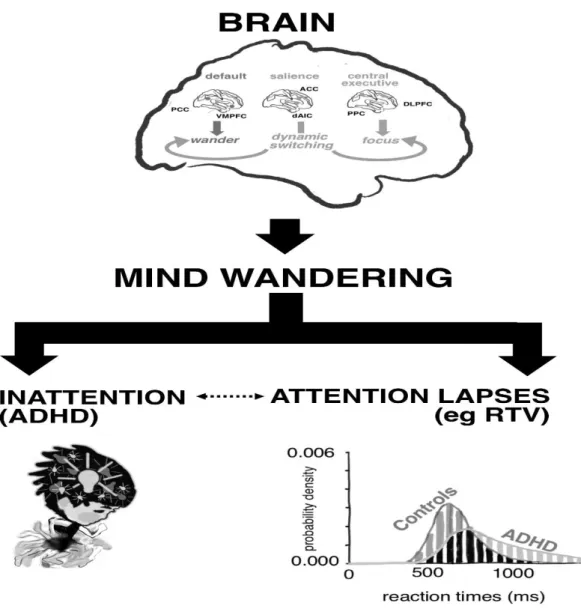
Here we propose a novel approach that focuses on a measurable component of ADHD psychopathology: excessive, spontaneous mind wandering (Mowlem et al., 2016). We put forth a new hypothesis for ADHD (see Figure 1) in which aberrant regulation within the default mode, and between default mode and executive control networks, leads to spontaneous mind wandering, which in turn leads to symptoms and impairments of ADHD, and may also underlie some of the cognitive performance deficits seen in ADHD. This is an alternative to the usual model, which views measures of cognitive function, such as sustained attention and inhibitory control deficits, as intermediate endophenotypes on the pathway from genes to behaviour (Castellanos & Tannock, 2002; Rommelse et al., 2008).
We propose this as a promising new avenue for research as mind wandering has been linked to ADHD and ADHD-associated impairments, and unlike ADHD symptoms such as inattention, mind wandering can be measured using a range of direct and indirect measures. These include
rating scale state and trait measures, experience sampling in daily life, experience sampling during experimental paradigms, and the neural correlates of MW. Potentially these may provide new clinical and neural biomarkers of ADHD that could provide new insights into the neurobiological basis of ADHD, which can be used for diagnosis and prediction and monitoring of treatment effects, and could lead to novel treatments targeting the regulation of mind wandering in ADHD.
ADHD, mind wandering and the default mode network What is mind wandering?
Mind wandering (MW) occurs when one’s mind drifts away from the primary task and focuses on internal, task-unrelated thoughts and images. MW is a universal experience that represents up to 50% of daily thinking time (Smallwood & Schooler, 2015). While some forms of MW can be beneficial to individuals (e.g. strategic thinking about a grant proposal while driving a car), other forms can be detrimental (e.g. spontaneous uncontrolled thoughts that interfere with tasks such as listening to a lecture). These two types of MW have been referred to as deliberate and spontaneous, respectively, and are thought to reflect a different balance of regulatory processes on internal self-generated thought (Christoff, Irving, Fox, Spreng, & Andrews-Hanna, 2016; Seli, Cheyne, Xu, Purdon, & Smilek, 2015). Spontaneous MW, detrimental to performance, has been proposed as a mechanism explaining many of the symptoms and impairments of ADHD (Mowlem et al., 2016; Seli et al., 2015) believed to reflect dysfunctional connectivity between the brain’s default mode network (DMN) and executive control networks (Fox, Spreng, Ellamil, Andrews-Hanna, & Christoff, 2015; Sripada, Kessler, & Angstadt, 2014).
Spontaneous mind wandering is associated with ADHD
The first study of MW in ADHD was conducted using an experience sampling technique to measure on-task and off-task thoughts during a simple attention task (Shaw & Giambra, 1993).The frequency of task-unrelated thoughts was found to be increased in college students with a childhood history of ADHD diagnosis, compared to controls. Among the controls, male and female groups that reported high levels of childhood ADHD symptoms also demonstrated more task-unrelated thoughts than controls reporting low levels of childhood ADHD symptoms.
A further study, using the MW Deliberate and Spontaneous scales (Carriere, Seli, & Smilek, 2013) found that a group who had been diagnosed with ADHD showed more spontaneous than deliberate MW (Seli et al., 2015). They further showed that spontaneous MW (but not deliberate MW) was significantly correlated with ADHD symptom severity. In another study using an adult community sample, a composite index of ADHD symptoms was positively correlated with a composite index of MW derived from experience sampling data of task-unrelated thoughts during a lab session, and daily life (Franklin et al., 2017). Furthermore, ADHD symptoms were related to MW episodes that were detrimental to the task at hand, and a sub-clinical group with high ADHD symptom scores had disruptive MW episodes that impaired daily-life function. ADHD symptomatology was also positively correlated with a lack of awareness of engaging in MW. In this study, lacking awareness of MW mediated between ADHD symptoms and impairment, suggesting that increasing awareness of MW in ADHD might lead to functional improvements (Franklin et al., 2017).
In our own studies, we developed a clinical scale reflecting ADHD patient reports of excessive spontaneous MW (Mowlem et al., 2016). The 12-item Mind Excessively Wandering Scale (MEWS) captures three characteristics of MW in ADHD: thoughts constantly on the go, thoughts flitting from one topic to another, and multiple thoughts at the same time. Exploratory factor analysis found the 12-item MEWS to be unidimensional, with a single factor explaining 70% of the variance(Mowlem et al., 2016). Two independent samples revealed significantly elevated ratings of MW in ADHD, and that MW successfully discriminated between cases and controls to a similar extent as rating scale measures of DSM-IV ADHD symptoms (sensitivity and specificity around 0.90 in both studies). MEWS scores were also correlated strongly and positively with measures of inattention (r=.77), hyperactivity/impulsivity (r=.69) and ADHD-related impairment (r=0.81). Furthermore, repeated analysis over a 6-month period showed moderate to high covariation of change in MEWS scores with change in inattention (r=.53), hyperactivity/impulsivity (r=.31) and impairment (r=.62). Regarding impairment, MEWS scores were the strongest predictor of functional impairment, followed by inattention and hyperactivity/impulsivity, indicating the clinical relevance of MW as a predictor of impairment in daily life.
Overall, these findings suggest that asking about the subjective experience of MW alone, provides a better prediction of ADHD associated impairment than the traditional ADHD inattention and hyperactive/impulsive symptoms. Moreover, as we will discuss, MW may reflect the primary deficit arising directly from dysregulated neural network activity in ADHD that underpins the symptoms and impairments currently used to define ADHD.
Mind wandering and the default mode network
The neural basis of MW has generated considerable interest since 2006 (Callard, Smallwood, Golchert, & Margulies, 2013). The DMN has been implicated as a potential source of self-generated thoughts unrelated to external goal-directed tasks. The DMN reflects a network of interacting brain regions (i.e. medial prefrontal cortex, posterior cingulate cortex and medial temporal regions) which show correlated neural activation, most active during the resting state, when the person is awake but in a daydreaming or MW state. The network can be conceptualized as switching off during external goal-directed tasks, and switching on when there are internal self-generated thoughts (Buckner & Vincent, 2007).
Among the first investigations of MW-associated neural activity were two fMRI studies using tasks with low cognitive demand (McKiernan, D'angelo, Kaufman, & Binder, 2006), or highly practiced cognitive tasks (Mason et al., 2007),during which episodes of MW were frequent. These studies found a strong correlation between the reduced deactivation of the DMN during on-task conditions and frequency of subjectively-reported MW. The MW-associated neural activity patterns were in stark contrast with those seen during novel or high cognitive demand conditions, when MW was less frequent. (McKiernan et al., 2006) conducted three different cognitive tasks under three levels of task difficulty, making a total of nine different task/difficulty conditions, each associated with a different frequency of task-unrelated thoughts. They reported that 81% of the variance in the frequency of task-unrelated thoughts was explained by task-induced deactivation of the DMN, which is remarkably high for an association between a direct measure of brain function using functional magnetic resonance imaging (fMRI), and subjective reports of a mental phenomenon. Similarly, (Mason et al., 2007) found activation in DMN regions during episodes of MW, including the precuneus. A limitation of these early studies was that the frequency of task-unrelated thoughts was measured outside the scanning sessions. To provide a more direct investigation of neural activity during periods of MW, (Christoff, Gordon, Smallwood, Smith, & Schooler, 2009) used in-scanner experience-sampling probes to identify periods of task-related and task-unrelated thoughts during a sustained attention task. The experience-sampling probes asked two questions: “Where was your attention focused just before the probe – on task or off task?”, and “How aware were you of where your attention was focused – aware or unaware?”. The strongest activation was seen in two normally anti-correlated networks (default mode and executive control networks) during MW episodes, and even stronger during “unaware” compared to “aware” MW.
The finding of co-activation of both executive and default networks during periods of task-unrelated thoughts in control subjects was subsequently confirmed by meta-analysis of fMRI studies (Fox et al., 2015). Examining 24 functional neuroimaging studies of spontaneous
thought processes, meta-analysis using activation likelihood estimation (ALE) found that both DMN regions (medial prefrontal cortex, posterior cingulate cortex, medial temporal lobe, bilateral inferior parietal lobule), and non-DMN regions (rostrolateral prefrontal cortex, dorsal anterior cingulate cortex, insula, temporopolar cortex, secondary somatosensory cortex, and lingual gyrus) were consistently recruited during periods of spontaneous thoughts. They concluded that in addition to DMN activity, fronto-parietal network (FPN) and other non-DMN regions also played a central role in the neuroscience of MW and other forms of spontaneous thoughts.
However, not all studies have reported co-activation of DMN and executive control regions during periods of MW. (Andrews-Hanna, Reidler, Huang, & Buckner, 2010) introduced longer delays between stimuli. These delays induced MW which was most strongly correlated with DMN hubs rather than co-activation of both DMN and executive control networks. Likewise, in another study, task-unrelated thoughts were associated with the highest level of DMN (medial prefrontal cortex) activation compared to intermediate levels of activation for external distraction and task-related inferences, and the lowest DMN activity during periods of on-task thoughts (Stawarczyk, Majerus, Maquet, & D'Argembeau, 2011a). Further evidence comes from studies focusing on the role of executive control mechanisms in MW.
Mind wandering and executive control
Overall the findings discussed above confirm the association of DMN activity with the frequency of task-unrelated thoughts. However, the role of executive control networks may depend on task conditions or type of MW and other forms of spontaneous thought. Typically, executive control and DMN function in an anti-correlated manner. Early work showed increased activation in executive control and decreased activation in DMN regions with increasing attentional demands, and vice versa (Fox et al., 2005). Likewise, attenuated DMN activity during periods of on-task was linked with poor adjustment to attentional demands, or attentional lapses (Weissman, Roberts, Visscher, & Woldorff, 2006). Therefore, task-unrelated thoughts are expected to be associated with anti-correlation (or reduced co-activation) between executive control and DMN regions.
However, as discussed, fMRI research has been inconclusive on the role of executive control on MW, which sparked off a debate. One argument is that MW results from a failure in executive control to prevent automatic task-unrelated thoughts from becoming conscious (McVay & Kane, 2012). For example, the emergence and increased frequency of MW under high demand conditions is associated with deficits in executive control, including working memory capacity and response inhibition (McVay & Kane, 2012). An opposing argument
states that executive control is required to maintain personally salient task-unrelated thoughts (i.e. strategic/deliberate MW) during low cognitive demand conditions, and is associated with reduced MW under high cognitive demand conditions to prevent performance decrements (Smallwood, 2010; Smallwood & Schooler, 2006). In line with this view, MW increased linearly with time-on-task in low demand vigilance paradigms (Randall, Oswald, & Beier, 2014; Thomson, Besner, & Smilek, 2015) and is more frequent in practiced compared to novel tasks (Mason et al., 2007).
To investigate the relative role of different neural networks, an ALE meta-analysis was conducted on different types of internal thoughts, including experimentally directed episodic future thinking, and spontaneous MW (Stawarczyk & D'argembeau, 2015). The results showed that while these domains of internal thought activated a common set of brain regions within the default network (e.g. medial prefrontal cortex); regions supporting executive control processes (e.g. dorsolateral prefrontal cortex) were also recruited to a lesser extent during undirected MW than during directed episodic future thinking. Thus, different types of internally generated thoughts may recruit varying levels of executive control.
To address the various findings, recent models of MW better reflect the complexity of internally generated thoughts. They clarify that MW is not a unitary construct, but rather an umbrella term that captures different types of MW experiences in the general population. A key conceptual paper proposes a dynamic framework in which MW is understood as a subtype of spontaneous-thought phenomena that also includes creative thought and daydreaming (Christoff et al., 2016). The authors propose a dimension of deliberate constraints related to executive control activity, with unconstrained daydreaming at one end, and constrained goal-directed thought at the other. Creative thought is proposed to reflect a more constrained form of spontaneous thought that is under greater executive control than daydreaming or MW, but less than goal-directed thoughts. They further propose a second dimension of automatic constraints on content of thought, which is weakest for common forms of daydreaming, and strongest for mental phenomenon such as ruminations and obsessions. (Christoff et al., 2016) proposed that under their model, ADHD would be reflected by a problem with excessive variability in thought movement, with low deliberate constraints (excessive MW and dream-like thoughts) and low automatic constraints (thoughts that flit from one topic to another).
ADHD is associated with deficient regulation of DMN activity
Resting state connectivity studies of ADHD in children and adults have examined interactions between the DMN and executive control network, as well as connectivity within the DMN
itself. These studies consistently find that anti-correlation between the executive control (fronto-parietal) network and DMN is attenuated, and that resting state connectivity within the DMN itself is reduced (Posner, Park, & Wang, 2014). ADHD is associated with hyperactivation (deficient deactivation) of the DMN in task compared to resting state conditions (Fassbender et al., 2009; Helps et al., 2010; Liddle et al., 2011; Peterson et al., 2009).
The observation of DMN abnormalities in ADHD led to a hypothesis known as the DMN interference model. This model proposed that increased very low frequency oscillations (0.01 - 0.1Hz) and synchronization within the DMN, which usually attenuate during goal-directed tasks, persist and interfere with task-specific neural processes, leading to lapses in attention and performance deficits (Sonuga-Barke & Castellanos, 2007). Reduced DMN deactivation from rest to task, and suppressed DMN activity (up-regulation) at the transition to rest conditions, suggest inadequate neural switching in response to changes in context in ADHD compared to controls (Liddle et al., 2011; Sidlauskaite, Sonuga-Barke, Roeyers, & Wiersema, 2016). Consistent with this hypothesis, (Liddle et al., 2011) found that failure to deactivate DMN regions during a low-salient (slow, boring, unrewarded) inhibition task requiring sustained attention, was reversed by methylphenidate in children with ADHD. In a further study both improvement of inattentive symptoms and normalisation of very low EEG frequencies as well as omission errors followed the use of methylphenidate (Cooper et al., 2014).
Related to the default mode interference hypothesis, it has also been proposed that activation of DMN hubs will depend on motivation, cognitive load, attentional demands and individual state regulation/capacity (Stawarczyk et al., 2011a). This is in line with the cognitive-energetic model which proposes that the efficiency of task performance in ADHD is determined by the interplay of basic cognitive processes (e.g. stimulus encoding, memory search, binary decision and motor preparation), and the availability of these processes related to arousal and activation levels and is further modulated by interplay with executive control functions (Sergeant, 2005). Both the DMN interference and cognitive-energetic models point to an inability to adapt neural network activity to changing task demands.
The DMN interference hypothesis also proposed that a certain threshold of DMN activity needs to be reached before DMN interference occurs (Sonuga-Barke & Castellanos, 2007). In relation to our model of MW in ADHD, we propose that this critical threshold of DMN activity is linked to excessive spontaneous MW, which leads to the inattentive symptoms of ADHD and detrimental effects on daily-life function. Cognitive performance deficits associated with ADHD may be a direct result of internal distractibility secondary to excessive MW, or may be secondary to the direct effects of high default mode activity interfering with task-dependent neural functions. We further propose that this critical threshold of DMN activity may not be
reached when there is a continuous co-activation of DMN and executive control regions associated with deliberate/strategic forms of MW. For example, individuals without a clinical diagnosis of ADHD may more readily co-activate DMN and executive control regions, and engage in deliberate rather than uncontrolled/excessive forms of spontaneous MW. Previous authors have also proposed that reduced deactivation of the DMN during task performance may explain MW and interference with task positive processes, leading to the symptoms and impairments of ADHD (Liddle et al., 2011; Mowlem et al., 2016; Posner et al., 2014). However, at the time of writing this has yet to be formally evaluated.
A comparative analysis of ADHD and MW
So far, we have outlined studies that link ADHD to MW, MW to DMN activity, and DMN activity to ADHD. These studies raise the possibility that deficient regulation of DMN activity leads to excessive spontaneous MW in individuals with ADHD, which might underpin the inattentive symptoms of ADHD and deficits in cognitive task performance. Further support for this hypothesis comes from several observations that draw parallels between processes that underlie the regulation of MW in neurotypical controls, and processes found to be deficient in ADHD. These parallels include: (1) context regulation of MW in controls, and deficient context regulation of neural activity in ADHD; (2) perceptual decoupling of somatosensory processing during MW, and in ADHD; (3) sensitivity of MW and MW-associated neural processes to task salience and rewards; (4) impairments in cognitive task performance, and function in daily life. Below we outline these areas in more detail.
Context regulation of MW
The context regulation hypothesis states that an adequate capacity to self-regulate MW within a context will reduce a potential negative impact on the primary task performance (Smallwood & Andrews-Hanna, 2013). Context regulation of MW is characterized by adaptation of neural processes and frequency of MW to changing task demands. In community samples, MW frequency is higher during low perceptual and low cognitive demand conditions (Filler & Giambra, 1973; Giambra & Grodsky, 1989) and lower under more cognitively demanding conditions, such as tasks with high working memory demands (Antrobus, Singer, & Greenberg, 1966). As discussed above, Mason and colleagues (Mason et al., 2007) manipulated the frequency of MW by varying task cognitive-demands, and correlated MW frequency with DMN task induced deactivations, and similar findings have been replicated by others (Forster & Lavie, 2009; Levinson, Smallwood, & Davidson, 2012; McVay & Kane, 2012; Metcalfe & Xu, 2016; Ruby, Smallwood, Engen, & Singer, 2013; Rummel
& Boywitt, 2014; Smallwood, McSpadden, & Schooler, 2007; Xu & Metcalfe, 2016). Related to these findings, shifts from task-related to task-unrelated thoughts are observed during low cognitive demand tasks (Stawarczyk, Majerus, Maj, Van der Linden, & D'Argembeau, 2011b; Thomson, Seli, Besner, & Smilek, 2014)
Regarding the potential role of executive control and working memory capacity, individuals with both low and high working memory capacity report greater levels of MW under low cognitive demand conditions (Kane et al., 2007). However, under high demand conditions, task-unrelated thoughts are greater in individuals with low working memory capacity, compared to those with higher working memory capacity (Kam & Handy, 2014; Kane et al., 2007; Unsworth & Robison, 2016). This effect is consistent with the role of executive control in the appropriate regulation of MW during cognitively demanding tasks.
Furthermore, higher working memory capacity predicted greater frequency of task-unrelated thoughts in a low demand breath-awareness task (Levinson et al., 2012) but fewer errors (regarded as a behavioural index of less frequent MW) in a high demand 3-back working memory task (Rummel & Boywitt, 2014). Similarly, the level of linguistic expertise (reflecting executive control and working memory capacity) determined the frequency of MW since individuals with high levels of linguistic ability showed more frequent task-unrelated thoughts for easy items, compared to individuals with low to medium linguistic ability (Xu & Metcalfe, 2016). Thus, both working memory capacity and linguistic capacity had a moderating effect on the level of MW under low and high demand conditions.
In summary, these findings indicate that higher working memory/executive control capacity, moderate frequency of MW according to task demands. In general, greater working memory capacity is predictive of more MW during low demand conditions, whereas it is predictive of less MW during high demand conditions.
Context regulation in ADHD
Context regulation of MW in ADHD has yet to be investigated. However, there is consistent evidence for deficient neural adaptation to task demands in ADHD compared to controls, with deficient upregulation of executive control regions, accompanied by deficient deactivation of the DMN. Thus, the neural networks that show deficient context regulation in ADHD are the same networks associated with context regulation of MW in neurotypical controls.
For example, deficient context regulation was seen in ADHD compared to controls using electroencephalography (EEG) recordings during the Flanker Task. This task contrasts a low cognitive demand (no conflict) with a high cognitive demand (conflict) condition. In contrast
to the ADHD group, controls showed a significantly greater increase in frontocentral theta amplitude and decreased phase variability (which correlated with less reaction time variability, RTV) in response to the higher cognitive demands of the conflict condition (McLoughlin et al., 2009; McLoughlin, Palmer, Rijsdijk, & Makeig, 2014). Low phase variability over trials is thought to reflect an adaptive mechanism to maintain stable neural processing of a stimulus (Makeig et al., 2004; Papenberg, Hämmerer, Müller, Lindenberger, & Li, 2013). Therefore, the relationship between increased theta phase variability and reaction time variability in ADHD points to a reduced ability to maintain efficient neural adaptation and cognitive performance over trials with increasing cognitive demands.
Similarly, there was greater RTV in ADHD compared to controls, under high demand (very fast or very slow event rates), compared to low demand (medium event rates) conditions(Metin et al., 2016) reflecting deficient behavioural adaptation of task performance to changing task demands. Deficient context regulation of neural (EEG) activity in ADHD is also seen in the transition from rest to task conditions (Rommel et al., 2016; Skirrow et al., 2015); a finding that was reversed in response to methylphenidate (Skirrow et al., 2015).
fMRI studies also demonstrate deficient context regulation in ADHD. Compared to controls, ADHD is associated with under-activation of the FPN (left dorsolateral prefrontal cortex) during on-task conditions (Castellanos & Proal, 2012; Cortese et al., 2012) and reduced deactivation of the DMN (medial prefrontal cortex) when transitioning from rest to task (Valera et al., 2010). Attenuated deactivation and hyperactivation within the DMN in ADHD compared to controls was also observed with time-on-task during a sustained attention task, in response to high working memory load, and with longer inter-stimulus delays (Christakou et al., 2013; Liddle et al., 2011; Metin et al., 2015; Paloyelis, Mehta, Kuntsi, & Asherson, 2007; van Rooij et al., 2015)
Taken together, the evidence from cognitive-EEG and fMRI studies points to a reduced ability to modulate task positive and negative neural processes in ADHD. Since the networks involved are the same as those linked to context regulation in neurotypical controls, deficient context regulation in individuals with ADHD may explain the high frequency of task-unrelated thoughts. This hypothesis has yet to be formally tested.
Perceptual Decoupling in MW
A key characteristic of MW is the association with attenuated somatosensory processing, referred to as perceptual decoupling. This means that during periods of MW there is a reduced somatosensory response to sensory stimuli (Schooler et al., 2011; Smallwood, Ruby, & Singer, 2013). One hypothesis is that perceptual decoupling explains the co-activation of
the FPN and DMN, during low demand conditions; reflecting active executive control over attention to disengage from perceptual input, so as to enable mental processing of personal goals (Smallwood, Brown, Baird, & Schooler, 2012). In line with this, MW has been linked to anti-correlation and lack of synchronisation between sensory cortices and DMN (Christoff, 2012; Kirschner, Kam, Handy, & Ward, 2012) and a positive correlation between sensory cortices and FPN hubs during on-task conditions. A novel concept suggests that the depth of perceptual decoupling might be able to distinguish between spontaneous and deliberate MW (Seli et al., 2015).
EEG research has consistently reported that event-related potential (ERP) components (P1) , markers of early visual information processing within 100 ms are attenuated during periods of task-unrelated compared to task-related thoughts (Baird, Smallwood, Lutz, & Schooler, 2014; Broadway, Franklin, & Schooler, 2015; Kam & Handy, 2014). Phase-locking factor analyses reflect phase synchrony of a particular frequency at a particular time across multiple trials of an event (Tallon-Baudry, Bertrand, Delpuech, & Pernier, 1996). Episodes of MW were further linked to diminished theta phase synchronisation within 50-150ms following a visual stimulus confirming a neural state of perceptual decoupling during MW (Baird et al., 2014). Cortical source activity analyses during a visual Sustained Attention to Response Task (SART) also confirm the attenuation of early visual information processing, during periods of MW (Kirschner et al., 2012). In this study, there was also deficient intra-regional (occipital cortex) and inter-regional (visual cortex and right medial temporal lobe) connectivity when attention was focused on internal thoughts (Kirschner et al., 2012). In contrast, during periods when the participants were focused on the visual task, there was greater inter-regional connectivity between the visual cortex and task-positive regions including the anterior/posterior cingulate, orbitofrontal cortex and posterior parietal gyrus. Similarly, MW was linked to both an increase in occipital and parieto-central theta and fronto-central delta power and a decrease in occipital alpha and frontal lateral beta power (Braboszcz & Delorme, 2011).
Collectively, these findings suggest a switch from active cognitive processing to MW, which is facilitated by a state of perceptual decoupling, or detachment of perception from attention. Consequently, a reduced P1 amplitude is regarded as a marker of perceptual decoupling during episodes of MW.
Perceptual decoupling in ADHD
Somatosensory responses are far less studied in ADHD, and the association between sensory decoupling and ADHD is not well established. Furthermore, there have been no studies that directly investigate the relationship of perceptual decoupling to periods of MW in ADHD. Yet,
the few studies that have focused on early sensory processing in ADHD find deficits that are similar to those seen during periods of MW in neurotypical controls.
Initial reports found decreased slow frequency fluctuations within the left sensorimotor cortex (Yu-Feng et al., 2007) and suppression of visual event-related potential amplitudes during cognitive-performance tasks in children with ADHD compared to controls (Steger, Imhof, Steinhausen, & Brandeis, 2000). Using magnetoencephalography (MEG), adults with ADHD showed reduced event-related desynchronization in the alpha band, and synchronisation in the beta bands, in primary and secondary somatosensory cortices in response to median nerve stimulation (Dockstader et al., 2008). A similar attenuated cortical sensory response was found in children with ADHD, which improved following successful treatment with methylphenidate (Lee et al., 2005).
Using ERP, a larger P1 (100 ms post-stimulus) amplitude has been seen in children with ADHD compared to controls; a finding that was interpreted as a compensatory mechanism in the absence of performance differences (Kóbor et al., 2015; Shahaf et al., 2012). In contrast, when children with ADHD made more omission errors than controls, P1 amplitude was significantly reduced (Nazari et al., 2010). At the time of writing, preliminary findings from our group support this result. Using the SART, we found reduced P1 amplitude in 33 adults with ADHD compared to 30 controls (p<0.02), which was associated with trait measures of inattention, and MW measured using the MEWS as a state measure of excessive MW in ADHD (Bozhilova et al., unpublished data). We further found that in the ADHD cases there was a reduced P1 amplitude prior to errors compared to correct responses (p<.001). Under the assumption that MW will be higher prior to error than non-error responses, these findings suggest that somatosensory processing deficits could be linked to excessive MW in ADHD. This hypothesis has yet to be formally tested.
The effects of salience and reward on MW
Several studies find that the frequency of MW is related to task salience or incentives designed to increase motivation. This is not surprising, since almost everyone finds it easier to remain focused on tasks that are inherently interesting, compared to mundane or boring tasks. A high degree of task-related motivation and interest were both associated with lower frequency of MW during the SART (Seli et al., 2015; Seli, Wammes, Risko, & Smilek, 2016) as well as better information retention on a film comprehension task (Kopp, Mills, & D’Mello, 2016).
A related phenomenon is the response to unexpected infrequent stimuli, which tend to be of high salience in auditory oddball paradigms. Infrequent and deviant auditory stimuli were
associated with an increased mismatch negativity amplitude, which is a marker of attention allocation to these stimuli, during episodes of task focus compared to a decreased amplitude during MW (Braboszcz & Delorme, 2011). Therefore, MW is linked to poorer attentional engagement with task-salient stimuli. An automatic, momentary coupling of attention and perception for visually salient stimuli (coloured no-go targets) during MW, also occurred in a variation of the no-go task (Smallwood, 2013) again suggesting switch away from MW. In another study, monetary incentives increased the number of reports of self-caught MW compared to conditions that were unrewarded (Zedelius, Broadway, & Schooler, 2015). The incentive for accuracy of MW self-report was associated with less probe-caught MW in the absence of greater overall MW (Zedelius et al., 2015). This last finding indicates that reward is likely to increase awareness of MW. Overall, these findings suggest that the effects of task salience and reward have the potential to reduce MW and MW-associated neural activity.
The effects of salience and reward on ADHD
There are numerous examples of enhanced sensitivity to the effects of task salience and rewards in children and adults with ADHD. Here we discuss some of the most pertinent studies related to MW-associated task performance and neural activity.
In a key fMRI investigation, a sample of children with ADHD and controls completed a Go/No-go task under low- and high-incentive conditions (Liddle et al., 2011). In the low-incentive condition (with low rewards linked to task performance), there was attenuated DMN deactivation in the ADHD group compared to controls. When higher rewards were introduced to increase the salience of the task, DMN deactivation normalised to the same level as controls. Methylphenidate was also found to have the same effect on DMN deactivation in the ADHD group, as increasing the salience of the task through rewards. The authors concluded that both methylphenidate and enhanced salience normalised DMN deactivation and suggested that this had an impact on inattention.
In a series of publications from Kuntsi and colleagues, fast-rewarded (high incentive) conditions compared to slow-unrewarded (low incentive) conditions on tasks requiring sustained attention, reduced or abolished ADHD case-control differences for arousal measures using skin conductance (James, Cheung, Rijsdijk, Asherson, & Kuntsi, 2016) reaction time variability (Andreou et al., 2007; Cheung et al., 2017; Kuntsi, Wood, Van Der Meere, & Asherson, 2009; Tye et al., 2016) and omission errors (Uebel et al., 2010) but not commission errors (Kuntsi et al., 2009).
Based on the findings that enhancing task saliency alters neural responses, task performance and frequency of MW, we hypothesise that adequate rewards will modulate the frequency of MW in both neurotypical and ADHD populations. In particular, a decrease in MW will lead to better early attentional orienting in ADHD, or successful detection of visual information early on at presentation. Despite similar effects on DMN activity of task saliency (reward) and stimulants in ADHD (Liddle et al., 2011), different mechanisms could be involved. For instance, rewards may moderate the degree of early visual information detection via interactions between the DMN and visual cortex. In contrast, stimulants might lead to changes in MW by altering interactions between large-scale networks: for example, FPN and DMN; DMN and ventral attention network; and DMN and the salience network. Providing both reward and stimulants reduce the frequency of MW and/or facilitate a more controlled form of MW, a combination of both might further enhance treatment effects. Further research is needed to investigate the effects of reward and stimulants on MW in ADHD and mechanisms involved in both ADHD and controls.
Cognitive performance and daily life impairments associated with mind wandering
MW has an adverse impact on both cognitive task performance and daily life in control populations. Measured performance deficits associated with MW include greater stimuli-response error rates (Forster & Lavie, 2009; Stawarczyk et al., 2011b) slower reaction times (Smallwood et al., 2013; Stawarczyk et al., 2011b) reduced accuracy of response (Kam & Handy, 2014; McVay & Kane, 2009; Rummel & Boywitt, 2014; Smallwood, Beach, Schooler, & Handy, 2008; Thomson et al., 2014; Unsworth & Robison, 2016; Xu & Metcalfe, 2016) and greater mean error percentage (Thomson et al., 2015).
Similarly, attenuation in the amplitude of ERPs reflecting late cognitive analysis of stimuli (e.g. attentional resource allocation, response execution/preparation and attentional orienting) has been observed during periods of MW. Examples include reduced N400, mismatch negativity (Braboszcz & Delorme, 2011) and P3 amplitudes (Barron, Riby, Greer, & Smallwood, 2011; Riby, Smallwood, & Gunn, 2008; Smallwood et al., 2007; Villena-González, López, & Rodríguez, 2016) as well as greater central negativity (N2) (Riby et al., 2008). Further, frequent MW and poorer effort were related to poorer accuracy (Brown & Harkins, 2016; Seli et al., 2016).
MW has also been associated with several daily life impairments, including deficits in reading comprehension (Mooneyham & Schooler, 2013) negative mood (Smallwood, Fitzgerald, Miles, & Phillips, 2009; Smallwood, Nind, & O’Connor, 2009; Smallwood & O'Connor, 2011) poorer learning (Metcalfe & Xu, 2016; Xu & Metcalfe, 2016) higher number of car accidents
(Galéra et al., 2012) less cautious driving (Yanko & Spalek, 2013) poorer academic performance, life-satisfaction, self-esteem and greater stress (Mrazek, Phillips, Franklin, Broadway, & Schooler, 2013).
Cognitive performance and daily life impairments associated with ADHD
Similar impairments in cognitive task performance and daily life associated with MW are also seen in ADHD. Examples include attentional orienting, performance monitoring, response preparation and inhibitory processes; manifesting in increased error rates, reaction time variability and attenuation in Cue-P3 and No-Go N2 and P3 amplitudes (Albrecht et al., 2014; Cheung et al., 2017; McLoughlin et al., 2009, 2010; Michelini et al., 2016a; Tye et al., 2014; Uebel et al., 2010).
ADHD is also associated with impairments in daily life including poorer psychosocial, educational and global function (Asherson et al., 2012; Pitts, Mangle, & Asherson, 2015). Individuals with ADHD compared to controls are more prone to car accidents (Vaa, 2014) academic underachievement (Fischer, Barkley, Edelbrock, & Smallish, 1990; Weyandt & DuPaul, 2008) reading comprehension difficulties (Ghelani, Sidhu, Jain, & Tannock, 2004; Miller et al., 2013; Stern & Shalev, 2013) and low self-esteem (Shaw-Zirt, Popali-Lehane, Chaplin, & Bergman, 2005).
In summary, the findings on impairment show that both ADHD and MW in non-ADHD controls appear to be linked to similar performance deficits. This is consistent with our MW hypothesis for ADHD since we propose that episodes of MW in controls and excessive spontaneous MW in individuals with ADHD lead to similar functional and cognitive impairments. Potentially, excessive spontaneous MW in ADHD can be expected to lead to typical impairments experienced by people with ADHD in their daily lives. Examples could include problems following a conversation, reading and watching a film; maintaining a coherent train of thought for problem solving and holding thoughts in mind; difficulties falling asleep to constant mental restlessness associated with excessive MW; and feeling exhausted by the mental effort required to sustain focus on daily activities. Further research is required to investigate the extent to which impairment seen in individuals with ADHD can be explained by excessive, spontaneous MW.
Identifying causal processes
As discussed extensively in this review, deficient deactivation of the DMN during cognitive task performance has been consistently reported in ADHD. However, ADHD is associated with a wide range of cognitive and neural deficits, anyone of which could be contributing to the generation of ADHD symptoms, and be potential targets for treatment. Indeed, the range of deficits associated with ADHD has led many to argue that the neuropathological basis for ADHD is highly heterogeneous (Coghill, Nigg, Rothenberger, Sonuga‐Barke, & Tannock, 2005; Faraone, 2015).
Key additional processes highlighted in the literature include: deficits in the dorsal attention network of dorsolateral prefrontal cortex, basal ganglia and parietal regions during tasks of selective and sustained attention (Hart, Radua, Nakao, Mataix-Cols, & Rubia, 2013) ; inhibitory control deficits supported by fMRI studies of reduced activation in key regions of inhibitory (Plichta & Scheres, 2014). Furthermore stimulants, the first line treatment for ADHD, has been shown to have effects on several of these processes (Rubia et al., 2014; Rubia et al., 2009; Smith et al., 2013).
Despite the findings linking various neural functions to ADHD, it remains unclear which of these play a direct causal role in the generation of the inattentive and hyperactive/impulsive symptoms currently used to define ADHD. This is a critical point, because numerous non-causal associations are expected to arise through the process of pleiotropy, in which shared genetic (and environmental) risks can lead to multiple different phenotypic outcomes at the level of brain structure, function, cognitive performance and behaviour. Yet, only a subset of the associated neural deficits may reflect underlying causal processes in ADHD (Kendler & Neale, 2010). There are several approaches that can be used to address this problem ( Kendler & Neale, 2010), including conducting mediation analyses with experimental trial data, or longitudinal outcome data, or taking advantage of genetic data to test for causal associations using Mendelian randomisation (Sheehan, Meng, & Didelez, 2011).
Remission and persistence of ADHD
In relation to ADHD, important new insights have come from longitudinal outcome studies that investigate the cognitive and neural correlates of remission and persistence in ADHD (Franke et al., under review). A central question in causal models of ADHD has been the separation of executive control measures (e.g. inhibition and working memory) from preparation-vigilance measures. Earlier work showed that measures reflecting these
processes are both associated with ADHD in children, but are genetically largely uncorrelated, reflecting distinct aetiological pathways (Kuntsi et al., 2014; Kuntsi et al., 2010).
Regarding developmental change, in a 6-year longitudinal outcome study of children with DSM-IV ADHD, adolescents and young adults who no longer met ADHD criterial (ADHD remitters), but not those who still had ADHD (ADHD persisters), showed a similar profile to controls without ADHD, of cognitive and neural measures. These measures indicated response preparation, attention and vigilance processes (RTV, omission errors, delta activity, errors in low-conflict conditions and contingent negative variation) and were significantly correlated to the severity of inattention at outcome. In contrast, executive control measures of working memory, and inhibitory processes did not distinguish in persisters and remitters, and did not correlate with ADHD symptoms at outcome; including commission errors, digit span backwards, and ERP activity of inhibitory control (No-go P3) and conflict monitoring (N2) (Cheung et al., 2016; Michelini et al., 2016b).
Similarly, in another follow-up study there was no an association between ADHD remission and improvements in executive functioning (Biederman et al., 2009), interference control (Pazvantoğlu et al., 2012), and response inhibition (McAuley, Crosbie, Charach, & Schachar, 2014). Working memory impairments (e.g. reduced caudate activation) in young adults diagnosed with ADHD in adolescence compared to controls have also been observed regardless of whether they still met an ADHD diagnosis (Roman-Urrestarazu et al., 2016). A recent study reported increased resting-state fMRI connectivity in ADHD remitters compared to controls in the executive control network, with intermediate connectivity profiles in persisters (Francx et al., 2015). Two other connectivity studies (Michelini et al., 2017) also indicated that connectivity within the executive control network or during executive tasks may not distinguish between ADHD persisters and remitters. Both persisters and remitters showed an increased EEG connectivity during executive control (Michelini et al., 2017) and reduced negative functional correlation between medial (DMN hub) and dorsolateral prefrontal cortex (FPN hub) during resting state fMRI (Mattfeld et al., 2014). However, in a resting study fMRI, only ADHD persisters showed reduced positive functional correlation between DMN hubs (posterior cingulate and medial prefrontal cortices) (Mattfeld et al., 2014). Reduced posterior cingulate cortex and medial prefrontal cortex connectivity (i.e. DMN intra-connectivity) may therefore be a neurobiological marker of persistence of ADHD (Uchida, Spencer, Faraone, & Biederman, 2015).
From these findings we conclude that, potentially, DMN activity and preparation-vigilance processes (associated with MW) may have direct aetiological significance in ADHD since they track the symptoms of ADHD during child to adult development. In contrast, deficits in
executive control functions appear to dissociate from the clinical course of ADHD symptoms during development and are therefore less likely to play a direct causal role in the ongoing generation of symptoms. Since, the neural processes tracking the clinical disorder are closely aligned to those thought to underpin MW, we propose that targeting the regulation of MW or MW-associated neural dysfunctions could potentially lead to reductions in ADHD symptoms and remission of the disorder.
Developmental perspective on mind wandering in ADHD
Mind wandering and typical development of functional networks
Finally, we provide a developmental perspective on the neural processes linked to MW, since the frequency and impact of MW may vary throughout development. “Small-world” properties represent quantifiable metrics of topographic properties of large-scale/global brain organisation (Achard, Salvador, Whitcher, Suckling, & Bullmore, 2006). These properties are present by the age of 7, and resemble functional brain organisation in young adults (Supekar, Musen, & Menon, 2009). The two major hubs of the DMN (PCC and mPFC; also neural correlates of MW), are visible very early on, with DMN formation completed by 2 years of age (Gao et al., 2009). However, formation of the DMN is thought to precede functional specialisation for self-referential cognition and mentalising such as mind wandering (Gao et al., 2009).
An increase in long-range connections, as well as a decrease in short-range connections (segregation) and strengthening of within-network interactions (integration), are thought to govern functional brain development and functional specialisation (Di Martino et al., 2014; Kelly et al., 2008; Power, Fair, Schlaggar, & Petersen, 2010; Rubia, 2013; Rubia et al., 2009). The childhood to adolescent years (ages 7-15) are a particularly sensitive period for such functional brain network development (Mak et al., 2017), which is the same age that ADHD symptoms and impairments often emerge (Asherson & Agnew-Blais, 2018). We also propose MW is likely to become more frequent during daily life, or even emerge. During this period greater integration develops between DMN and somatosensory regions, contrasting their complete segregation in adulthood. Additionally, early adolescence is marked by a similar degree of DMN deactivation contrasting less task-related deactivations in somatosensory regions compared to adults (Thomason et al., 2008). This deactivation pattern was linked to better task performance in childhood (Thomason et al., 2008), suggesting that the recruitment of somatosensory areas might be a compensatory strategy during high cognitive demand task conditions in children. In summary, while children exhibit a DMN activity similar to adults, the system does still undergo important changes between middle childhood and
young adulthood. Therefore, frequency and type of MW may vary with age as function of DMN development.
Within-network integration of DMN hubs (Fair et al., 2008) and segregation from other networks is considered to be a good marker of brain maturation (Dosenbach et al., 2010; Rubia et al., 2009), and better than executive control networks whose functional development is less affected by age (Sato et al., 2014). However, executive control networks also show a pattern of strengthening of intra-network and weakening of inter-network connections from childhood to middle adulthood (Fair et al., 2007). These developmental changes are reflected in functional improvement, or greater adaptive control and greater working memory capacity with age (Fair et al., 2007). Similarly, a pattern of increasing anti-correlation between large-scale networks (DMN and FPN) and task-related DMN deactivations is likely to support improved regulation of both executive control and MW (Fair et al., 2008). Potentially, a maturational delay in the functional specialisation of these networks could result in a disrupted regulation of executive control and MW.
Mind wandering and “Maturational lag hypothesis” of brain development in ADHD
Related to the findings on typical functional brain development, El‐Sayed, Larsson, Persson, Santosh, & Rydelius, (2003) proposed a maturational lag hypothesis. The hypothesis suggests that a persistent maturational lag in functional brain development might become a sustained functional abnormality leading to symptoms and impairments of ADHD. We further propose that abnormalities in resting-state functional connectivity resulting from co-activation of functionally related brain regions (Power et al., 2010) may lead to the self-generation of excessive, spontaneous and context-independent thought, typical of MW, which are externalised as inattentive behaviours over the lifespan. Consistent with this view, recent work in ADHD has shown a maturational lag in major large-scale brain networks, especially within-network integration (DMN and FPN) and interactions between default mode, frontoparietal, ventral attention and salience networks (Sripada et al., 2014). A recent review also summarised findings for decreased synchrony/connectivity between the two major DMN hubs in ADHD (Castellanos & Aoki, 2016). The lagged maturation was associated with DMN interference, poor performance (e.g. greater reaction time variability) during cognitively demanding tasks, and was proportionate to the severity of inattention (Sripada et al., 2014). With regard to the development of MW in ADHD, to date there has been only one published study, which compared the frequency of MW in children and adults with ADHD (Van den Driessche et al., 2017). Using an experience sampling method, similar frequencies of “mind blanking” (MW without awareness of the content) were seen in 6-12-year-old children and
young adults with ADHD. While the authors found no case-control performance differences on the SART, medication-naïve children and adults reported twice as much mind blanking, but fewer episodes of task focus and MW with awareness than controls. We propose that individuals with ADHD in this study tended to report mind blanking rather than MW due to the lack of a coherent reportable content. When comparing a group of children with ADHD treated with methylphenidate, with drug naïve children and controls, there was reduced frequency of mind blanking to the level of controls; although the treated group still had a greater frequency of MW with awareness of content than controls (Van den Driessche et al., 2017). Medication was therefore proposed to allow access to awareness of MW. The authors (Van den Driessche et al., 2017) further hypothesised that this effect could be due to restoration of executive resources. These findings suggest similar abnormalities in the frequency of MW-related measures in ADHD during both childhood and young to middle adulthood.
Overall, the developmental studies suggest that understanding the cortical maturation of key networks leading to aware/unaware and spontaneous/deliberate forms of MW, may be important to understanding the onset, course and development of ADHD.
Discussion
This review sets out to draw parallels between MW and ADHD, and guide new insights into ADHD psychopathology. The theoretical conceptualisations outlined are designed to set the scene for further hypothesis testing. The basis for this work is the observation that a spontaneous and poorly controlled type of MW is strongly associated with ADHD, and ADHD-related impairments. Currently, there are only a small number of studies that measure MW in ADHD, and none that simultaneously measure ADHD, MW and neural functions associated with both ADHD and MW. The relationship of MW to ADHD symptoms such as inattention is therefore not yet well understood. We therefore set out to summarise what is known about the links between ADHD, MW and their neural correlates.
At the level of neural networks, there are strong parallels in the association of both ADHD and MW with DMN activity during task conditions. Reduced deactivation of DMN activity during tasks requiring sustained attention is associated with the frequency of MW in controls, and is also associated with ADHD compared to controls. Since ADHD is also linked to a specific pattern of spontaneous and poorly controlled MW, a simple hypothesis can be proposed that the normal neural processes that regulate MW are disturbed in ADHD, leading to excessive levels of spontaneous and uncontrolled MW. Furthermore, cognitive and functional impairments that are associated with periods of MW in controls are comparable to the range
of impairments associated with ADHD, suggesting that excessive spontaneous MW may underpin functional deficits in ADHD.
In support of our hypothesis we draw on evidence that the usual processes regulating MW are disrupted in ADHD. First, we see that the usual context regulation of DMN and executive control network activity to increasing task demands is associated with MW, and deficient in ADHD. Furthermore, deficient regulation of these processes appears to be reversed by stimulant medications used to treat ADHD. Second, we see that the processes associated with both MW and ADHD are sensitive to the salience of task conditions. In ADHD increasing the salience of task conditions may “normalise” performance and associated neural processes. Finally, we see that both MW and ADHD may be associated with sensory decoupling such as the reduced early P1 response of the occipital cortex to a visual stimulus. We therefore propose that by understanding the processes of normal regulation of MW in the general population, we can identify with more precision aberrant processes in ADHD.
One question that arises from this model is whether measures of MW can be considered distinct from the inattentive symptoms of ADHD. For example, measures of MW may merely reflect alternative measures of the same underlying construct. Currently, there is almost no evaluation of the incremental information provided by measures of MW, although we did report that a rating scale measure of MW was an independent predictor of impairment in ADHD after controlling for ADHD inattention and hyperactivity/impulsivity symptoms (Mowlem et al., 2016). Further research is therefore required to addresses this question. However, since many of the findings related to ADHD also apply to measures of MW, it is a reasonable hypothesis that one reflects the other.
If there is a very close relationship of MW with ADHD-inattention, this would open new avenues for research. MW has the advantage that it can be measured using simple rating scale trait measures, but also experience sampling data in daily life (considered to be more objective reflections of the mental state); and experience sampling during experimental paradigms such as sustained attention tasks, which have been used to investigate the neural correlates of MW in control samples. Measures of MW may also be less dependent than the inattentive symptoms of ADHD on behavioural adaptation, which is influenced by learnt coping strategies, so perhaps a better reflection of the underlying neural condition.
The model we propose views the inattentive symptoms of ADHD as outcomes of MW (i.e. internal distractibility), and MW in ADHD may be a direct outcome of altered neural regulation of internal thought processes. Cognitive performance deficits seen in ADHD may also be a direct outcome of MW. We propose that dysregulated neural functions (DMN overactivity during task conditions for example), are reflected in excessive spontaneous MW, and that such internal distractibility explains behavioural symptoms such as losing track during
conversations, avoiding tasks that require sustained attention, not completing tasks, and misplacing things.
Further research is required to investigate heterogeneity the range of internally generated thoughts, and understand the regulatory processes involved. A key question is to fully understand the differences in studies which find that episodes of MW are associated with both reduced or absent (Kucyi, Esterman, Riley, & Valera, 2016; Stawarczyk & D'argembeau, 2015) and present (Christoff, 2012; Spreng, Stevens, Chamberlain, Gilmore, & Schacter, 2010) co-recruitment of DMN and executive control network regions. In our view, this likely reflects that MW is a multidimensional construct and different types of MW recruit the executive control network differentially.
Spontaneous, unaware (‘zone-off’) MW was associated with decreased functional connectivity (Golchert et al., 2017) and a negative functional correlation (Gruberger, Ben-Simon, Levkovitz, Zangen, & Hendler, 2011) between the DMN and FPN. This pattern contrasts with increased functional connectivity between these two networks during deliberate MW (Christoff et al., 2016). Potentially, both spontaneous and deliberate MW might involve the co-activation of both networks initially. This co-activation allows both deliberate MW and task performance under low demand to be maintained, as well as the controlled and adequate shift to task focus under high demand. Alternatively, this co-activation might also reflect an inability to suppress the DMN activity during on-task conditions. Therefore, constant engagement in spontaneous MW might represent a neural state of overly active DMN hubs during on-task, and hypoconnectivity within the entire DMN at rest. The uncontrolled and spontaneous occurrences of MW will then result in poor context regulation.
In our review, we identified two existing fMRI accounts proposing specific dynamics of MW. The dynamic framework (Mittner, Hawkins, Boekel, & Forstmann, 2016) proposes a greater activation of the dorsal attentional network during on-task that transitions to increasing connectivity/activity within the DMN during an off-focused state (selecting between returning to the task or entering a state of MW). Finally, if task-unrelated thoughts appear more salient, an individual enters a state of MW marked by reduced functional connectivity between large-scale networks (Mittner et al., 2016). Other fMRI accounts speculate on initial recruitment of the right medial temporal lobe, or limbic regions (Golchert et al., 2017) and later FPN (Fox et al., 2015) during MW. However, the dynamics of MW remain poorly understood (Smallwood, Mrazek, & Schooler, 2011).
Future research could focus on the use of EEG, which can capture fast and covert cognitive processes such as MW. The increased use of state-of-the-art EEG approaches that provide improved source localisation of EEG signals, combined with EEG’s millisecond temporal
resolution, has already demonstrated their better potential to explain the dynamics of MW compared to more traditional scalp-level EEG analyses (Braboszcz & Delorme, 2011; Kirschner et al., 2012).
Specific predictions from the MW hypothesis for ADHD
The MW hypothesis proposes that altered interaction between the four large scale networks (DMN, executive control network, salience network and visual network), and that deficient DMN deactivation during task activities will lead to excessive spontaneous MW, lacking in coherence and topic stability, which in turn will lead to ADHD symptomatology.
To investigate this hypothesis, future work could apply experimental designs that have been successfully applied to manipulate and measure MW and measures the neural correlates of MW in controls samples, to ADHD case-control studies, or by investigating correlations to dimensional measures of ADHD symptoms. Examples include sustained attention and inhibitory control tasks, varying cognitive load by using manipulations such as altering the stimulus presentation rate (Christakou et al., 2013) or introducing a working memory component (Baird et al., 2014). This would enable investigation of context regulation and sensory decoupling in relation to ADHD. A further manipulation would be to the comparison of high and low reward conditions, to investigate the effects of salience (Liddle et al., 2011). Inferring causal directions may be difficult because of the close temporal timing of neural, cognitive performance and MW events if they covary strongly with each other. One approach to infer causal relationships is to use treatment interventions such as stimulant mediation, to bring about change in the various outcome measures (Kendler & Neale, 2010). Then the causal relationships between these can be modelled. Mindfulness training is another intervention that is thought to act on the regulatory processes involve in MW and ADHD (Mrazek, Mooneyham, & Schooler, 2014). Recent studies suggest effects of mindfulness training that are potentially comparable to those seen for ADHD medications (Hepark et al., 2015).
To guide future work, we outline specific predictions derived from this hypothesis.
Perceptual decoupling
We propose that individuals with ADHD will experience greater perceptual decoupling driven by the proposed ADHD-specific MW, compared to controls during long-lasting (>30min) sustained attention paradigms. A potential neural correlate is absent or reduced
inter-regional synchronisation or positive functional correlation between DMN and visual networks. Using EEG, reduced mean P1 and N1 amplitudes will reflect inefficient early perceptual processes in ADHD.
Context regulation
We propose that individuals with ADHD will be unable to adapt to increasing cognitive (attentional, control) demands both at the neural level, and behaviourally; and that deficient context regulation of neural activity in ADHD will be related to the frequency of MW. Regarding neural correlates of these processes, we propose that a reduced positive functional connectivity between DMN and salience network will reflect the deficit in switching from rest to task, task to rest and from a low to high demand condition. Another neural correlate will be an absent change in frontal midline theta power from rest to task, hypoactivation in the DMN from task to rest and hypoconnectivity or reduced positive functional connectivity within the DMN (posterior cingulate cortex and medial prefrontal cortex) during rest.
Behavioural correlates of DMN and FPN dysregulation
We propose that variable reaction times will stem from MW and serve as a behavioural correlate of reduced negative functional correlation (or even disconnection) between default mode and executive control network and hyperactivity within the DMN during cognitive paradigms.
The neural inefficiency in the large-scale networks will manifest in increased phase inconsistency/variability of parietal or frontal theta in response to task-related stimuli, which will coincide with excessively frequent episodes of MW.
Changes in the content and context of MW is likely to reflect differential recruitment of DMN regions (Stawarczyk & D'argembeau, 2015). For instance, depressive thoughts might result in greater connectivity between the core DMN and salience network, and a weaker connectivity between these two networks with the FPN and the medial temporal lobe (DMN hub). Excessive MW was correlated with the highest degree of DMN activation, suggesting that overactivity of the DMN might reflect the frequency rate of MW (Kucyi et al., 2016). Therefore, MW in ADHD will be characterized by hyper-connectivity within both right medial temporal lobe and right medial prefrontal cortex (DMN hubs) during on-task.