(An Experimental Research of SMPN 1 SAMALANGA) THESIS
Submitted by:
MAUIZATUL HAYATI
Student of English Education Department Faculty of Education and Teacher Training
FACULTY OF EDUCATION AND TEACHER TRAINING AR-RANIRY STATE ISLAMIC UNIVERSITY
DARUSSALAM–BANDA ACEH
2018 M / 1440 H NIM. 140203225
iii
Alhamdulillahirabbil ‘alamin, all praise to Allah SWT, for the strengths and His blessing in completing this thesis. Shalawat and salam always dedicated to our beloved prophet Muhammad S,A.W, who has struggled whole-heartedly to deliver the truth to human being and guide hisummahto right path.
I realize that I cannot complete this thesis without the aid of others and I would like to thank some people for their love, support, and encouragement for helping me to overcome the final hurdle of this undergraduate journey – a thesis; a culmination of an academic journey that has colored my life. First and foremost, I would like to specifically thank to my sincere supervisor Mr. Dr. Maskur, M.A and Mrs. Khairiah Syahabuddin, M.HSc.ESL., M.TESOL, Ph.D for their thoughtful and guidance, suggestions and critical constructive comments which have definitely stretched my potential and ability as evident in this thesis. Without their continuous and encouragement, this thesis would not have been accomplished successfully.
I also thank the big family of SMPN 1 Samalanga, especially the principal, Mr. Anwar S.Pd, the English teacher, Mrs. Nurfitriya Rahmi S.Pd.I, and all students in VII grade of SMPN 1 Samalanga.
I would like to express my appreciation to my family. First, I would like to thank my parents, who had given me much love, affection, and attention until the
iv me in accomplishing this thesis.
Also, I would like to thank my best mates: Zaitun Mastura, Irma Farida, Raudhah, Putri, Muna, Yuyun, Nufus and others whose names cannot mentioned one by one. Thank you for your continuing spirits and memorable moments.
I hope that this thesis would be useful for the readers. However, I realize that this thesis is far from being perfect. Any criticisms, ideas and suggestions for the improvement of this thesis are greatly appreciated.
Mauizatul Hayati
v
CONTENTS... v
LIST OF TABLE ... vii
LIST OF APPENDICES ... viii
DECLARATION LETTER ... xi
ABSTRACT ... x
CHAPTER I: INTRODUCTION A. Background of Study ... 1
B. Research Questions ... 4
C. The Aim of Study... 4
D. The Significance of Study... 4
E. Terminology... 5
CHAPTER II: REVIEW OF LITERATURE A. The Conception of Reading Comprehension ... 7
B. The Kinds of Reading ... 8
C. Technique and Methods of Reading Learning Process... 11
D. Cooperative Learning... 14
E. The Strengths of CIRC Method ... 33
F. Assessment of Reading Comprehension... 34
CHAPTER III: RESEARCH METHODOLOGY A. Research Design... 38
B. A Brief About Research Location... 39
C. Population and sample ... 42
D. Research Instrument... 43
E. Technique of Collecting Data ... 45
F. Technique of Data Analysis ... 49
vi
CHAPTER V: CONCLUSSION AND SUGGESTIONS
A. Conclusion ... 63 B. Suggestion ... 64
REFERENCES……….66 APPENDICES
vii
II. Recommendation Letter of Conducting Research from Faculty of Education and Teacher Training
III. Confirmation Letter of Conducted Research from SMPN 1 Samalanga
IV. Lesson Plan
V. Reading Text
VI. Pre-test and Post-test Questions VII. Questionnaire
viii
Table 3.2 : The name of English teacher in SMPN 1 Samalanga Table 3.3 : The students of SMPN Samalanga
Table 4.1 : The result of students pre-test Table 4.2 : The result of students post-test Table 4.3 : The result of Normality test Table 4.4 : The result of homogeneity test Table 4.5 : The result of paired samples statistic Table 4.6 : The result of paired samples test Table 4.7 : The result of questionnaire 1 Table 4.8 : The result of questionnaire 2 Table 4.9 : The result of questionnaire 3 Table 4.10 : The result of questionnaire 4 Table 4.11 : The result of questionnaire 5 Table 4.12 : The result of questionnaire 6 Table 4.13 : The result of questionnaire 7 Table 4.14 : The result of questionnaire 8 Table 4.15 : The result of questionnaire 9 Table 4.16 : The result of questionnaire 10
x
Student Program : English Education Department
Title : Using Cooperative Integrated Reading and Composition
(CIRC) Method to Improve Students’ Reading Comprehension (An Experimental Research of SMPN 1 Samalanga).
Advisor I : Dr. Maskur M.A
Advisor II : Khairiah Syahabuddin, M.HSc.ESL.,M.TESOL.,Ph.D
This present research was conducted in order to find out the improvement in
students’ reading comprehension by using cooperative integrated reading and composition (CIRC) method. This research used a quantitative method with pre-experimental design, namely pre-test post-test involving only the experiment group. The population of this research was all students of the seventh-grade who are studying at SMPN 1 Samalanga which amount to 155 students. In addition, the sample of this research was 31 students of class VII 2 that was chosen using purposive sampling. Moreover, this research used pre-test and post-test as well as questionnaires as data collection instruments. The research found that using cooperative integrated reading and composition (CIRC) Method improve
students’ reading comprehension. The results of this study were analyzed by using
T-test on SPSS program and statistic formula. According to the result of the study,
using CIRC method could improve students’ reading comprehension. It was
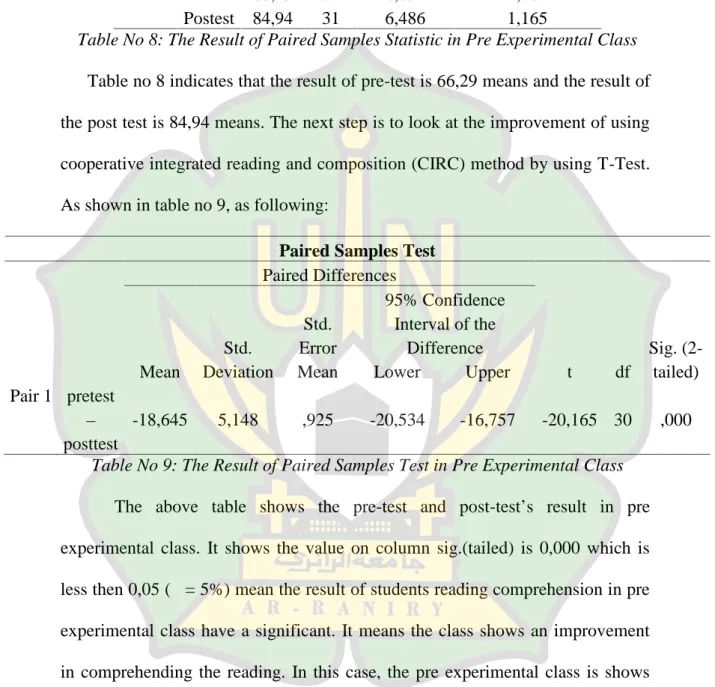
proven by the result of T-test on pre-test and post-test scores, which shown To as T-table (α = 0,05) has more value than Tt as T-result (0,000). The scores mean there is a significant difference in pre experimental class by using CIRC method. Moreover, based on the analysis of the questionnaire, most of the students gave positive response to CIRC method.
1
Those consist of the background of the study, the research question of the problem, the aim of the study, the significance of the study and terminology.
A. Background of the Study
English is an international language. Almost all countries have adopted English used as a compulsory subject at schools. The national education has decided that English as a foreign language taught in Indonesian schools. It is learned started from primary schools up to university. Studying English as a foreign language in Junior High School is getting important. In Indonesia, English subject has been included in the curriculum of Junior High School and also as one subject that is examined in the National Examination. It means that English cannot be ignored to the students of Junior High School. The process of teaching and learning, the learners is supposed to master the four language skills in order to use English well. As it is known, English has the main four skills namely: listening, speaking, reading and writing. The main goal of teaching these skills is to enable students to interact successfully with native and non-native users of English in a variety of social and academic settings. One of the skills is reading comprehension.
Reading is one of four language skills that has an important role for
strong correlation with reading. Reading can be defined as the ability to get understanding from written text. L2 reading can best be understood as a combination of skills and abilities that individuals bring to bear as they begin to read (Grabe, 2002). Brown (1982) says that a person must be able to understand what the author writes in order to be an effective reader. It means that the readers have to catch the information which writer writes so that it can be seen the benefits in doing the reading.
Besides that, the importance of reading to students is quite vast. By reading, we learn things, develop new skills, improve in literature, train our brains and develop spelling, vocabulary skills, and so many things. Thomas and Eskey (2002:5) suggest that reading is a process of obtaining information from a written text that does not involve converting written language into spoken, this possess our first problem for teachers because reading aloud is a favorite classroom activity in their reading classes.
Unfortunately, in reading skill, almost all of the seventh-grade students of SMPN 1 Samalanga have the crucial difficulties in comprehending the contents of the text. They cannot pronounce, spell, identify, and understand all words in any kind of text. They do not know what the text tells about, and then there are many unfamiliar words, difficulties in finding the main idea, the meaning of word phrases and sentences in the text, also determining kind of texts.
Reading comprehension is not only a matter of knowing a lexical meaning of a word by word but also what information or ideas are explicitly starting in
both. Besides that, Reading comprehension is not a simple process but it is very complex activities. It needs preparation for learners to read because they will have to recognize the difference in word length and word shape, they will have to learn, to organize and interpret what they have read. The condition above naturally
happens because the strategy of teaching reading is not appropriate with students’
ability, because the teacher usually teaches with a central teaches method, so the students cannot try to more active in the class and not have motivated to study hard beside that the minimum completeness criteria are 75, so the students hard to get the scores of minimum completeness criteria.
From this point of problems faced by the subject under study, a good method of teaching reading should be able to stimulate high motivation, interest, and attention of the students. In other words, a good method can motivate and promote students to comprehend text in reading activities in the class. In this research, the writer chooses Cooperative Integrated Reading and Composition
(CIRC) methods to teach students’ reading comprehension for VII grade junior
high school.
The purpose of implementing CIRC method is to generate opportunities for the students to become more active in learning. In this case study, the students will be engaged in pairs, group discussion, and whole class discussion activities, therefore the students will have a much deeper understanding of the reading text they have read. Based on the background above, this condition inspires the researcher to conduct research under the title “Using Cooperative Integrated
Reading and Composition (CIRC) Method to Improve Students Reading Comprehension (An Experimental Research of SMPN 1 Samalanga)”.
B. Research Questions
From the identification and limitation of the problem above, the problems are formulated as follows:
1. Does cooperative integrated reading and composition (CIRC) method improve the students’ reading comprehension of seventh grade students in SMPN 1 Samalanga?
2. How do students respond towards the use of cooperative integrated reading and composition (CIRC) method in teaching reading comprehension?
C. The Aims of Study
The purposes of the study are:
1. To know the improvement of reading comprehension of seventh grade students in SMPN 1 Samalanga after being taught through cooperative integrated reading and composition (CIRC) method.
2. To know student’s respond of using cooperative integrated reading and composition (CIRC) in teaching reading comprehension method.
D. Significance of Study
The results of this study are expected to give both theoretical and practical significances. Theoretically, the findings of this study are expected to provide theoretical evidence of CIRC Method in improving students in reading comprehension. Practically, the result of this study is highly expected to be
valuable for students, teacher, researcher, and for an institution. There are some advantages that can be taken from this research. The following presents some possible ways.
1. This study is expected to be useful as an effort to improve the reading learning process in SMPN 1 Samalanga.
2. For the junior high schools in general, the result of this research hopefully canbe used as recourse to improve the reading learning process.
3. For teacher, this finding of the study is expected to be an informative feedback which could be used as indicator showing their relative success and failure in teaching Reading Comprehension. English teacher demands to be more skillful, active, creative and innovative in their teaching process make the students serious participation in learning process.
4. The researchers, it would be useful for the researcher because it can improve the researcher knowledge in learning teaching.
5. The institution, the research is expected to be useful as reference and to increase the number of catalogues in the library.
E. Terminology
In order to avoid misunderstanding of the reader, it is necessary to define the key terms on this study. Those are clarified as follows.
a. Reading comprehension
Reading comprehension is the process of recognition, interpretation, and perception of written or printed material. (Thomas and Eskey, 2002:5). It is an active activity that tries to catch some information from the text. Related to the
study being conducted, reading comprehension is defined as the ability of the subject under study in understanding English reading text as suggested by English teaching syllabus of seventh-grade junior high school.
b. Cooperative Integrated Reading and Composition
CIRC is kind of techniques in teaching reading (Slavin 1987). It is an effective technique to help the students in comprehension reading the passage in which the teaching and learning processes are mainly in group learning activities. In which specifically the students under study engage in a small group discussion which consist of maximum 4 students in each group and this method can improve
7
According to Heinemann (2009), reading is a process very much
determined by what the reader’s brain, emotions, and beliefs bring to the reading
the knowledge or information strategies for processing text, moods, fears and joys all of it. The strategies one may vary according to one’s purpose, including
whether one is reading for oneself only or for somebody else, such as reading to answer comprehension questions, reading to perform for listeners (including the teacher and classmates), and much more. Of course, these social factors may generate confidence, fear, anger, defiance, or other emotions it just depends.
Reading is both a psycholinguistic process (involving the mind actively processing the text) and a sociolinguistic one (with multiple social factors that can affect how one reads, how much one gleans from the reading, and more). Even word identification itself can be affected by these factors because reading is as much or more a brain to text process as a text to brain process. These characterizations of the reading process are developed throughout this book, not only with references to research but through examples and do it yourself activities.
Furthermore, Eskey (2002) writes reading is a complex process, because it involves both conscious and subconscious by the readers. The actions that occur subconsciously cannot be seen by anyone. They suggest that reading is a process
of obtaining information from a written text that does not involve “converting written language into spoken”.
In this case, Elizabeth and Pressley (2002:14) write that comprehension is the process of deriving meaning from connected text. It involves word knowledge as well as thinking and reasoning. Therefore, comprehension is not a passive process but an active one. The reader actively engages with text to construct meaning. This active engagement includes making use of prior knowledge. It involves drawing inferences from the words and expression that a writer uses to communicate information, ideas, and viewpoints. Reading is something many of us take for granted. We read with what appears to be little effort and little planning.
Based on the definitions of reading comprehension, the present study refers to the theory which is proposed by Eskey (2002:14) that reading comprehension is a complex process involving more than one skill in which readers make sense of the text by combining their prior knowledge and the information given in the text itself.
B. Kinds of Reading
Reading is an important skill for people. Based on the theory of reading comprehension highlight in preceding discussion, there are four types for classroom reading performance such as reading aloud, silent reading, intensive reading, and extensive reading.
a. Reading Aloud
Reading aloud is one kind of reading activity that can be used to check the pronunciation of the students. They make accurate connections between graphemes and phonemes. It is vital in reading in order to speed word recognition and to help pronounce and learn new words. Reading aloud forces students to make and practice these connections. Students should read aloud prepared texts at the appropriate level to the teacher and support groups or other individuals so that they have feedback as possible on their decoding skills. For the success of this activity, the teacher must consider many factors such as the material which teacher present before students should be according to previous knowledge of the students or related to their own experience, the teacher should emphasize the stress of learners and the teacher should be very careful while the process of reading is going on. If any mistake is committed by learners, they should correct it with friendly and productive (Petel, 2008).
The benefit of using this activity in the classroom enables the learner to develop the skill of reading very well by speaking or expressing ideas and also develop their pronunciation. Language learning is a kind of imitation. When the teacher says anything or read any text, the learner also tries to imitate that. The teacher should have innovative ideas so that it can make this activity very effective.
b. Silent Reading
Silent reading is a very important skill in the teaching of English, in this activity the students more comprehend and understand about what they read
because there are not any noisy to disturb when they read. This reading should be employed to increase reading ability among learners.
The benefit of using silent reading in the classroom activity does not only enable the students to be more active and accurate but, also need a minimal time because this activity is done at a time. All students participate together in this activity at a time. This activity also helps the students to develop the skill of reading fast, but only bright and intelligent students can learn this skill and average students learn it hardly (Petel, 2008).
c. Intensive Reading
Intensive reading is related to further progress in language learning under
the teacher’s guidance. Intensive reading will provide a basis for explaining the difficulties of structure and for extending knowledge of vocabulary and idioms. It will also provide material for developing greater control of the language in speech and writing (Petel, 2008).
d. Extensive Reading
Extensive reading is the reading for pleasure. The reader wants to know about something. The reader does not care about specific or important information after reading. Usually, people read to keep them update. It is used to obtain a general understanding of a subject and includes reading longer texts for enjoyment only. The use of extensive reading skills can improve the learner general knowledge. It is not like intensive reading that focuses only on translating and
extracting the printed symbol, word, phrases, or sentence to find the detailed information of the text being read.
Harmer (2007) states that one of the fundamental conditions of a successful extensive reading program is that students should be reading material which they can understand. If they are struggling to understand every word, they can hardly be reading for pleasure. This means that students at the appropriate level can read them with ease and confidence.
Extensive reading assignment may direct students to articles of current interest in foreign language magazine or newspaper. To ensure that students do not become bogged down in reading which is too complicated, the teacher will be well advised to discuss the relation of articles to be read, with due regard to the special interest of the reader.
C. Techniques and Methods of Reading Learning Process
Brown (2005) and Larsen-Freeman (2000) propose some techniques and methods for reading learning process. They are:
a. Identify the Purpose in Reading
After the teacher teaches reading techniques, make sure that the students know their purpose in reading something.
b. Use Grapheme Rules and Patterns to Aid Bottom-Up Decoding (especially for beginning level learners)
Teaching reading in the beginning level is emphasized on oral reading. Thus, explanation about orthographic rules is needed.
c. Use Efficient Silent Reading Techniques for Relatively Rapid Comprehension(for intermediate to advance levels)
In intermediate to advance level, the students don’t need to be speed
readers, but they should increase the efficiency of reading by silent reading rules. The activity can reduce their pronunciation, limited vocabulary and trying to perceive grammatical patterns.
d. Skim the Text for Main Idea
Skimming is used to quick gather the most important information. This strategy is used to predict the purpose of the passage, the main topic or message and supporting details. The teacher can ask the students to skim the passage afterthey look a few pages of materials.
e. Scan the Text for Specific Information
Scanning is used to find a particular piece of information. In scanning, thereader looks for specific information he need without reading through the wholetext. Scanning activities may ask students to look for names or dates, find adefinition of a key concept or supporting details. Scanning is very important inacademic English. In general English, scanning is important dealing with genreslike schedules, manuals, forms, etc.
f. Use Semantic Mapping or Clustering
The strategy of semantic mapping or grouping ideas into meaningfulcluster helps the students to provide some order to chaos.
g. Guess When You Aren’t Certain
Guessing is used to find the meaning of a word, a grammaticalrelationship, a discourse relationship, implied meaning between the lines, acultural reference, and content messages of a text. The teacher helps the studentsto become accurate guessers by applying compensation strategies in which theyfill gaps by intelligent attempts to use any available clues.
h. Analyze Vocabulary
When the students don’t know a word at once in guessing strategy,
thereare many techniques are useful to practice. They will be described as follows:
1) Look for prefixes (co-, inter-, un-, etc) to get clues
2) Look for suffixes (-tion, -tive, -ally, etc) to show the part of speech 3) Look for roots that are familiar to get the meaning of a word 4) Look for grammatical contexts to get signal information 5) Look at the semantic context (topic) to get clues
i. Distinguish Between Literal and Implied Meaning
This strategy is the application of top down processing skills. Not alllanguage can be interpreted by attending its literal meaning. Therefore, the readershould also take account into syntactic surface structure to get the impliedmeaning.
j. Capitalize on Discourse Markers to Process Relationship
The relationship among ideas in an English text is expressed throughphrases, clauses, and sentences. Thus, comprehension on these
k. Learning Strategy Training
This is one of innovative ways in learning. The idea of learning strategytraining is training students in the use of learning strategies in order to improvetheir learning effectiveness. Teacher will begin class with presentation. He tellsstudents that they are going to work on a learning strategy called advanceorganization. They will be working on improving their reading by learning topreview and to skim to get gist of reading passage. Learning this strategy willimprove their comprehension and the speed at which they read. He begins asmodeling. He uses the think-aloud technique, telling students what he is doing as he is modeling. He has distributed a reading passage.
D. Cooperative Learning
a. Definition of Cooperative Learning
There are various definitions of cooperative learning written by differentexperts. According to Slavin (1995:287), cooperative learning is instructionalmethods in which students work together in small group to help each other tolearn. Meanwhile, Norman (2005:1) stated that cooperative learning is astructured, systematic instructional strategy in which small group of students worktogether toward a common goal. Other definition of cooperative learning wasstated by Burden and Byrd (1999:99) who states that cooperative learning is a mean of grouping students in small, mixed – ability learning teams. The teacher presents the group with a problem to solve or task to perform. Students in the
group then work among themselves, help one another, praise and criticize one
another’s contributions, and receive a group important performance’s score.
Moreover, Horman (2005:2) states that cooperative learning is important for creating inclusive classroom environments that meet the needs of all students because it takes heterogeneity into account, encouraging, support and connection. Borich (2000:310) add that cooperative learning is important in helping learners acquire from the curriculum the basic cooperative attitudes and value they need to think independently inside and outside of the classroom. Meanwhile,Jones (1998:213) propose that cooperative learning is perhaps the most popular and
effective method for meeting students’ varied learning styles and
activelyinvolving students in the learning process.
In relation to cooperative learning, Kinsvatter et.al (1996:319) proposesome definitions of cooperative learning: (a) is the instructional use of
smallgroups to enable students to work together to enhance their other group’s
learning;(b) uses peer interaction, positive interdependence, individual accountability, andcooperation to accomplish group-learning projects and to receive group award; (c)involves teacher structuring the curriculum into units with objects that can beachieved cooperatively; (d) is most effective in teaching collaborative skills andpromoting group identity; and (e) is an effective strategy to use when teachingdiverse groups of students.
b. Theories of Cooperative Learning
There are many theories influencing cooperative learning which are presented as follows:
1) Motivational Theories
Motivation can affect students’ achievement in learning. There are some
definitions of motivational proposed by different experts. Wlodkowski in Burden and Byrd (1999:276) propose that most educators use the word motivation todescribe those processes that can arouse and initiate behavior, give direction andpurpose to behavior, continue to allow behavior to persist, and lead to choosing orpreferring a particular behavior.
According to Ford in Jones and Jones (1998:179), they state thatmotivation is and integrative construct representing the direction a person isgoing, the emotional energy and effective experience supporting or inhibitingmovement in that direction, and the expectancies a person has about whether theycan ultimately reach their destination.
Meanwhile, Brown (2000:72) definesmotivation as the extent to which you make choices about goals to pursue and theeffort you will devote to that pursuit.Williams and Burden in Harmer (2007: 98) suggest that motivation is a
“state of cognitive arousal” which provokes a “decision to act”, as a result of
whichthere is ‘sustained intellectual and/or physical effort’ so that the person
canachieve some“previous set goal”.
In general, motivation is divided into two categories: intrinsic motivation and extrinsic motivation.
a) Intrinsic Motivation
According to Harmer (2007:98) intrinsic motivation is motivation which
intrinsic motivation as a response to needs that exists within the students such as curiosity, the need to know, the feeling of competence and growth, and internal
satisfaction of the students’ feeling about a particular task. In line with Burden
and Byrd, Harmer (2001:51) states that intrinsic motivation makes a person might be motivated by the enjoyment of the learning process itself or by desire to make themselves feel better.
In the relation to intrinsic motivation, Edward Deci (1975:23) in Brown defines intrinsic motivation as:
Intrinsically motivated activities are ones for which there is no apparentreward except the activity itself. People seen to engage in the activities fortheir own sake and not because they lead to an extrinsic reward.Intrinsically motivated behaviors are aimed at bringing about certaininternally rewarding consequences, namely, feelings of competence andself-determination.
A students who is intrinsically motivated undertake an activity for ownsake, for the enjoyment it provides, the learning it permits, or the feelings ofaccomplishment it evokes. Condry and Chambers in Lumden (1994) say thatwhen students were confronted with complex intellectual tasks, those with anintrinsic orientation used more logical information-gathering and decision-making strategies than did students who were extrinsically oriented.
b) Extrinsic Motivation
Harmer (2005:51) states extrinsic motivation comes from outside thelearners and external rewards for the completing if tasks such as words of
praisesfrom the teacher, a higher grade, or privilege. It means that someone is doingsomething because he expects some external rewards. He also defines
extrinsic asmotivation which comes from ‘outside’, it is the result of any number
of outsidefactors (Harmer, 2007:98).
A similar definition is also proposed by Burden and Byrd (1999:276) who state that extrinsic motivation is motivation from outside the learner and has to do with external rewards for completing of a task. Brown (2000:76) also states that extrinsically behaviors are carried out in anticipation of a reward from outside and beyond itself.
From the definitions of motivation above, it can be concluded
thatmotivation is somebody’s inner or outer drive to achieve a goal. From thosetheories, the researcher believes that students’ motivation is not affected just
bythe students themselves but there are many factors that influence
students’motivation. The researcher also believes that teachers have a significant role inmotivating their students to learn. Teacher can stimulate their students’
need andcharacteristics. 2) Cognitive Theory a) Developmental Theories
The fundamental assumption of the developmental theories is thatinteraction among children around appropriate tasks increases their mastery ofcritical concepts. Besides, collaborative activity among children promotes growth; modeling in the collaborating group behavior more advanced that those they could perform as individuals (Slavin, 1995:17). Furthermore, Piaget in Slavin
(1995:17) states that social-arbitrary knowledge – language, values, rules, morality andsymbol systems (such as reading and math) –can be learned only in interaction with others.
Moreover, many Piagetians argue that interactions among students
onlearning tasks will lead in to improve students’ achievement. Students will
learnfrom one another because in their discussions of the content, cognitive conflicts will arise, inadequate reasoning will be exposed, and higher quality understanding will emerge.
b) Cognitive Elaboration Theory
Wittrock in Slavin (1995:18) states that research in cognitive psychologyhas found that if information is to be retained in memory and related toinformation already in memory, the learner must engage in some sort of cognitive restructuring or elaboration of the materials. According to Devin –
Shehaan,Feldman, and Allen in Slavin (1995:18), one of the effective means of elaboration is explaining the material to someone else.
c. Principle Characteristics of Cooperative Learning
There are six principles characteristics of cooperative learning (Slavin,1995:12-13).
1. Group Goals
Most cooperative learning methods use some forms of group goals. In theStudent Team Learning Methods, these may be certificates or other recognitiongiven to teams that meet a preset criterion.
Individual accountability is achieved in two ways. One is to have groupscores to be sum or average of individual quiz scores or other assessments. Theother task is task specialization, whereby each student is given a uniqueresponsibility for part of the group task.
3. Equal Opportunities for Success
A characteristic unique to the Student Team Learning method is the use of scoring methods that ensure all students have equal opportunity to contribute to their teams.
4. Team Competition
There are some types of cooperative learning method which use competition between teams as means of motivating students to cooperate within teams, such as STAD and TGT.
5. Task Specialization
The use of task-specialization methods is the assignment of a uniques ubtask to each group member.
6. Adaptation to Individual Needs
Most cooperative learning method use a group paced instruction, but two TAI and CIRC-adapt instruction to the students’ individual needs.
d. Elements of Cooperative Learning
Johnson and Johnson in Burden and Byrd (1999:100) outline five keycomponents for effective cooperative learning as presented as follow:
1. Positive Interdependence
which creates a positive interdependence among students with all group members work together and help each other to accomplish the common goal. This success of the group depends on the success of each member. Thus, each member seeksoutcomes which are beneficial to himself and the group member.
2. Face-to-Face Interaction
In cooperative learning, students are grouped in a small heterogeneous group which creates a face-to-face interaction among the students. This encourages students to help, share, and support each other’s learning. Besides, by working closely together, students can promote each other’s success trough
explanations, teaching, checking for understanding, discussions, and connecting new and old learning.
3. Individual Accountability
Slavin (1995:19) argues that when cooperative learning is poorly
constructed, cooperative learning can allow for the “free rider” effect, in which
some group members do all or most of the work (and the learning) while othersdo little or nothing. This can be eliminates by creating individual account ability to ensure that students learn and no one is ignored. Johnson and Johnson in Norman (2005:4) highlight key factors for structuring individual accountability:
a. keeping the group size small
b. giving students individual tests where they cannot seek help from others
d. observing the group and record frequency on contribution of each member
e. assigning one member to be “a checker” who asks other more
member, toexplain the reasoning and rational underlying group answershaving students teach what they have learnt to someone else
4. Interpersonal and Small Group Skills
Johnson and Johnson in Norman (2005:4) argue that when the students have more social skills and the teachers pay attention to the teaching and reward these of social skills, the students will get higher achievement within cooperative learning group. In this method, students learn interpersonal skills, such as active listening, staying on the task, asking questions, conflict management and resolution and so forth.
5. Grouping Processing
Johnson and Johnson in Norman (2005:5) state that group processing takes place on two levels, in small groups and whole class. To allow for group processing at the group level, the teachers allow time in the end of each class for groups to process how effectively the members work together. Besides, they also propose that the teacher should do the followings tomake a good group processing. They are presented as follows:
a) Enable learning groups to focus on maintaining good working relationships among members
c) Ensure that members receive feedback on their participation in the group d) Ensure that students think on the meta-cognitive as well as cognitive level e) Provide a means to celebrate the success of the group and reinforce
positive behaviors
e. Components of a Cooperative Learning Activity
There are four aspects in planning a cooperative learning activity (Borich,2000:331-333). They are:
1. Teacher-Student Interaction
One purpose of teacher-student interaction during cooperative learning is to promote independent thinking. It exchanges between teacher and learners in the classroom focus on getting learners to think for themselves, independently oftext. On the other hand, cooperative learning occurs in groups that share acommon purpose and task, so the teacher must broaden interactions to fit the zone of maximum response opportunity that is common to most group members.
2. Student-Student Interaction
Interaction among students in cooperative learning groups is intense and prolonged. In cooperative learning groups, students gradually take responsibility
for each other’s learning. During cooperative learning, the feedback, reinforcement, and support come from student peers in the group. Student Interaction constitutes the majority of time and activity during cooperative learning. Groups of four or five, working together in the physical closeness promoted by a common task, encourage collaboration, support, and feedback from the closest, most immediate source-one’s peers. An essential ingredient of
cooperative learning is each learner’s desire to facilitate the task performance of fellow group members.
3. Task Specialization and Materials
Another component of cooperative learning is the task to be learned and the materials that comprise a cooperative learning activity structure. Cooperative learning tasks are preplanned activities; they are time, completed in stages, and placed within in the context of the work of others. This promotes the sharing if ideas and/or materials and the coordination of efforts among individuals. Thechoice of task and supporting materials is important to promote meaningful student interaction.
4. Role Expectations and Responsibilities
Proper assignment of roles is important to the success of cooperative learning activities. In addition to groups being assigned specialized tasks, individuals often are assigned specialized roles to perform within their groups.
The success of a cooperative learning activity depends on teachers’
communication of role expectations and responsibilities and modeling them when necessary. This is another reason why cooperative learning has little resemblance to loosely formed discussion groups.
f. Types of Cooperative Learning
Slavin (2007) proposes some techniques in cooperative learning. They will bedescribed below:
1. STAD (Student Teams-Achievement Divisions)
STAD is one of the simplest of all cooperative learning methods, and is agood model to begin with for teachers who are new to the cooperative approach. In STAD, students are assigned to four-member learning teams that are mixed in performance level, gender, and ethnicity.
STAD consists of five major components-class presentations, teams, quizzes, individual improvement scores, and team recognition. The teacher presents a lesson, and then students work within their teams to make sure all team members have mastered the lesson. Then, all students take individual quizzes on the material, at which time they may not help one another.
The main idea behind Student Teams-Achievement Divisions is to motivate students to encourage and help each other master skills presented by the teacher. If students want their team to earn team rewards, they must help their teammates to learn the material. They must encourage their team mates to do their best, expressing norms that learning is important, valuable, and fun.
Students work together after the teacher’s lesson. They may work in pairs
and compare answers, discuss any discrepancies, and help each other with any misunderstandings. They may discuss approaches to solving problems, or they may quiz each other on the content they are studying. They work with their team mates, assessing their strength and weakness to help them succeed on their quizzes.
2. TGT (Teams-Games-Tournament)
TGT is the same as STAD in every respect but one: instead of the quizzes and the individual improvement score system, TGT uses academic tournaments, in which students compare as representatives of their teams with members of other teams who are like them in past academic performance. TGT is very frequently used in combination with STAD, adding an occasional tournament tothe usual STAD structure. A description of the components of TGT follows:class presentation, teams, games, tournaments, team recognition, materials and assigning students to teams.
3. Jigsaw
In jigsaw technique, students work in the same four-member, heterogeneous teams as in STAD and TGT. The students are assigned chapters or other units to read, and are given “expert sheets” that contain different topics for each team member to focus on when reading. When everyone has finished reading, students from different teams with the same topic meet in an
“expertgroup” to discuss their topic about thirty minutes, the experts then return to
their teams and take turns teaching their team mates about their topic. Finally, students take assessments that cover all the topics, and the quiz scores become teamscores, as in STAD.
Also in STAD, the scores that students contribute to their teams are based on the individual improvement score system, and students’ onhigh-scoring teams may receive certificates or other recognition. Thus, student sire motivated to study the material well and to work hard in their expert groups so that they can help
their team do well. The key to jigsaw is interdependence every student depends on his or her teammates to provide the information needed to do well on the assessments.
4. TAI (Team Assisted Individualization)
Teams Accelerated Instruction shares with STAD and TGT the use of four-member mixed ability learning teams and certificates for high-performing teams. However, STAD and TGT use a single space of instruction. Also, STAD and TGT apply to most subjects and grade levels, but TAI is specially designed to teach mathematics to students in grades 3-6.
5. CIRC (Cooperative Integrated Reading and Composition) a. Definition of CIRC
Cooperative Integrated Reading and Composition (CIRC) is one of thetypes of a cooperative learning method. It is a comprehensive program forteaching reading and writing. Slavin (1995:104) proposes that CIRC is a comprehensive program for reading and writing in the upper elementary grades. Madden (2004) studies that CIRC is teaching technique that focuses ontwo skills,
reading and writing. This two skills drill students’ mastery of language arts. The technique guides teachers in motivating students to work in group at the same or different reading level.
CIRC technique activities are suitable to increase students reading comprehension. It is noted by her three main elements of the technique, there are basic activity, direct teaching of reading comprehension, and language art (Sharan, 1999). As Durukan’s (2010) research, CIRC technique is realization of
cooperative learning that accommodates reading, writing and other language skills. He adds that skill-based reading groups approach encourages development of this technique.
b. Principle Issues of development process of CIRC
The development of CIRC proceeded from analysis of the problems oftraditional reading, writing, and language arts instruction. There are someprincipal issues in the development process of CIRC (Slavin, 1995:104-106)presented as follows.
1) Follow-up
One major focus of the CIRC activities is on making more effective useof follow-up time: Students work within cooperative teams which are coordinated with reading group instruction in order to meet objectives in suchareas as reading comprehension, vocabulary, decoding, and spelling. Students are motivated to work with one another on these activities by the use of reward.
2) Oral Reading
Reading aloud is a standard part of most reading programs. Oral reading
has positive effects on students’ decoding and comprehension skills (Dahl and
Samuels in Slavin, 1995: 105). One objective of the CIRC program is to greatly
increase students’ opportunities to read aloud and receive feedback on their reading by having students need to team mates and by training them in how
3) Reading Comprehension Skills
Several studies showed the explicit instruction in reading comprehension strategies and meta-cognitive monitoring processes can increase students’
comprehension skills, or at least those skills especially taught in theintervention. For example, comprehension can be improved by teaching students summarizing, questioning, clarifying, and predicting skills (Slavin (1995:105).
A major objective of CIRC is to use cooperative teams to help studentslearn broadly applicable reading comprehension skills. For example, duringfollow-up students work in pairs to identify five critical features of eachnarrative story characters, setting, problem, attempted solutions, and finalsolutions.
4) Writing and language Arts
A major objective of CIRC is to design, implement, and evaluate awriting-process approach to writing and language cuts that would make extensive use of peers. In the CIRC program, students plan, revise, and edit theircomposition in collaboration with teammates. Language arts instruction is integrated with writing and writing is integrated with reading comprehension instruction both by the incorporation of writing process in reading program andby the use of newly learned reading comprehension skills on writing instructions.
c. The Major Components of CIRC
The major components of CIRC are presented as follows
1. Reading Groups
If reading groups are used, students are divided into two or these groupsaccording to their reading level as determined by the teacher.
2. Teams
Students are assigned to pairs or triads within their reading groups, and then the pairs make a team composed from different level. For example, a team might be composed from two students from high level group and two from low level group. Team members receive points based on their individual performanceon all quizzes, compositions, and book reports, and these points from teams score.
3. Story-Related Activities
Students use novels or basal readers. Stories are introduced and discussed in teacher–led reading groups. In these groups, teacher set a purpose of reading, introduce new vocabulary, review old vocabulary, discuss the story after students have read it, and etc. After the stories are introduced, students are given a story pocket which contains a series of activities from them to do in their teams. The sequence ofactivities is as follows.
a) Partner Reading
Students read the story silently, and take turns with other to read aloud, alternating each paragraph. These listeners correct any errors the readers make.
The teachers assess the students’ reading by going around from one group to
b) Story Grammar and Listening to them
Students are given questions related to the story that emphasize storygrammar. In the middle of the story, the students are asked to stop reading and to identify the characters, the setting, and the problems in the story, and to predict how the end of the story is. At the end, students are asked to respond the story as awhole and write a few paragraphs on a topic related to it.
c) Word out loud
Students are given a list of new of difficult words, and asked to read the word correctly. They practice with their partners or teammates until they can read the words correctly.
d) Word meaning
Students are given a list of new words, and asked them to look for the definition in the dictionary, paraphrase, and make sentence by using those words.
e) Story Retell
After reading the story and discussing it in their groups, students summarize the main points of the story to their partner.
f) Spelling
Students pretest one another a list of spelling words each week, and thenover the course of the week to help one another master the list.
4. Tests
At the end of class period, students are given a comprehension test on thestory, asked to read aloud the list of difficult words, and write meaningfulsentences for those words.
5. Independent Reading and Book reports
Students are asked to read a book of their choice and make book reports.They contribute bonus points for their teams if they complete book reportsregularly.
d. Steps of CIRC
CIRC consists of three principal elements: basal-related activities, directinstruction in reading comprehension, and integrated language arts and writing. Slavin (1995: 106) proposes some steps in CIRC, they are teacher presentation, team practice, independent practice, peer pre-assessment, additional practice, and testing.
Huda (2011: 126-127) states some steps in conducting CIRC as follows: 1. Students are placed in small groups, not only homogeny but also
heterogeneously
2. They follow teacher’s instructions in reading and writing ability
3. Practice
4. Pre-assessment 5. Quiz
While, Suprijono (2009: 130-131) also proposes some steps of conducting CIRC that students can be active in joining the teaching learning process.
1. Grouping the class that consists of four students heterogeneously 2. Teacher gives a text/clipping which is appropriate with the topic
3. Students work together in reading and finding main idea and giving idea toward the discourse/clipping which is and they are written on paper
4. Presenting/reading the result 5. Teacher gives conclusion together 6. Closing
In reference to the explanation above, the steps of CIRC used in the
classroom activities contribute to the students’ reading learning process. The steps
of CIRC should be appropriate to the students. So, the teacher can achieve the target of achievingstudents’learning process. From the explanation of the steps of CIRC from some experts above, it can be concluded that the steps of CIRC should be included with teacher presentation, grouping consisted of four or three students, giving a text that appropriate with the topic, working in group in doing some tasks based on the text and topic, discussion, presenting the result of
students’ work, teacher’ conclusion, and closing. E. The strengths of CIRC method
CIRC Method gives the students many advantages. Huda (2013:222) explains the strengths of CIRC as follows:
1. Students experience and learning activity will be always relevant with the level of child development.
2. The chosen activity appropriate with and depart from students’ interest and
requirement.
3. All of learning activities are more meaningful for the students, so the result of learning is more meaningful for the students and will be able to hold out longer.
5. Integrated learning provides pragmatic activities (useful) that appropriate
with the problem that is often found in students’ environment.
6. Integrated learning is able to grow students’ learning motivation to the
dynamic, optimal and expeditors learning.
7. Integrated learning is able to grow students’ social interaction, like cooperation, tolerance and respect toward the others’ idea.
8. Arousing learning motivation and expand teachers’ perception and
aspiration in teaching.
F. Assessment of Reading Comprehension
The purpose of reading assessment is to measure the student’s ability in
reading comprehension. The nature of the assessment of reading in classroom context is should be directly and intimately related to the nature of the instruction. Much those things, instruction are indeed assessment anyway, sometimes quite explicitly. So, as when homework assignments are marked and grades are recorded in some form of continues assessment. Much instruction may be assessment like, but learners may not be being directly evaluated on their performance, but rather a performance is being elicited in order to help learners understand or improve their understanding of the text.
Alderson and Bachman (2000) state that the objective of scoring in short answer question depends upon the completeness of the answer key and the possibility of students responding with answer or wordings which were not anticipated. Short answer question is not easy to construct. The question must be worded in such a way that all possible answers are foreseeable. Otherwise, the
marker will be presented with a wide range of responses which she will have to judge as to whether they demonstrate understanding or not.
In practice, the only way to ensure that the test constructor has removed ambiguities in the question, and written a question which requires certain answers and not others, is to try it out on colleagues or students similar to those who will be taking the test. It is very difficult to predict all responses and interpretations of short answer questions, and therefore some form of pre-testing of the questions is essential wherever possible. One way of developing short-answer questions with some texts is to ask oneself what questions a reader might ask, or what information the reader might require, from a particular text.
In addition, a test is important to know the level of the students and know how a good the students' ability. The teacher can organize a good test for knowing those things. In order to judge the effectiveness of any test, it is sensible to lay down criteria against which the text can be measured, as follows: Validity: a test is valid if it is supposed to test. A particular kind of validity that concerns most test designers is face validity. This means that the test should look as if it is valid. Reliability: a good test should give a consistent result. In practice, reliability is enhanced by making the test instructions absolutely clear, restricting the scope for variety in the answer, and making sure that test conditions remain constant (Harmer, 2002).
After considering the criteria of the test above, the teacher can use some types of test to measure the students‟ achievement. Nation (2009) states some types of
test that can be used to measure the students‟ reading comprehension. The reading tests can be explained below:
a. Pronominal Questions, Imperatives
These questions require learners to make a written answer which can range in length from a single word to several paragraphs. Usually for comprehension, short answers are required and these forms of questions are called short answer questions.
b. True/False, Yes/No, Alternative Questions and Multiple-choice
These question forms are all grouped together because the answer to the questions is contained within the question or instructions, and thus the learners do not have to compose their answer. This simplifies marking. In the following discussion we will focus on multiple-choice questions because these are the most difficult to make. Typically there is a stem with four choices, one of which is correct, for example:
Peter is the youngest in our family. He is fourteen years old and four years younger than me. He has long, straight hair, bright eyes and a friendly smile. Sometimes he is rather naughty at home, but he usually does what he is asked to do. Peter is interested in sports very much, and at school, he plays football and tennis. He is the best badminton player in our family.
1. How old is Peter? He is ………. years old.
a. four c. forty
b. fourteen d. ten
2. What is Peter’s hobby?
37 A. Research Design
Research method is concerned with how the design is implemented and how the research is carried out. The method often used to determine the quality of data collection. This study used a quantitative method. According to Evelyn (2001), quantitative method suggests investigation involving numbers. This method collects numerical data through evaluation sheet that administrated by the writer. It involves answering questions concerning the current status of the subject of the study.
In doing this study, an experimental research is used which requires the careful collection, analysis, and interpretation of quantitative data. Wireman (1991) explains that an experiment research is a research situation in which at least one independent variable, called the experimental variable, is deliberately manipulated or varied by researcher, while quantitative research is the collection and analyses of numerical data in order to explain, predict, or control phenomena of interest.
In this study, one group pre-test and post-test design was used to collect the data. This study was measured by pre-test before giving the treatment and post-test after giving the treatment. Evelyn (2001) proposes the procedure used in pre-experiment one group pre-test-post-test design as in the following:
Participant selection Pre-test Treatment Post-test.
This method collects numerical data through evaluation sheet that administrated by the writer. It is aimed to answer the questions concerning the current status of the subject of the study. Questionnaire sheet are used to find out
the students’ responses toward using cooperative integrated reading and
composition in promoting their reading skill.
B. A brief description about research location
1. The school
The writer conducted at junior high school of SMPN 1 Samalanga for a week from November 26thuntil 2ndof December, 2018. The researcher focused on using cooperative integrated reading and composition (CIRC) method to improve students reading comprehension at seventh grade of junior high school. the location of the school is in street Harapan No.03 Keude Aceh, Samalanga. The school was established in October 1958.
Since it has built, there were numbers of headmasters who led this school and the current headmaster is Anwar S.Pd.I. SMPN 1 Samalanga has a permanent building consisting of a number of classroom and offices. There is one
headmaster’s office, one teacher’s office, one security room, and one computer
laboratory. There are also one parking area and one praying room.
For the teaching-learning process, SMPN 1 Samalanga has 21 classrooms but only used 18 classrooms for a teaching-learning process. The first year has 5 classrooms, the second year has 6 classrooms and the third year has 7 classrooms.
Furthermore, it has a few facilities that can accelerate students’ motivation and
support them to study and to do other activities. For example, a library that provides many books so that students can read, borrow and learn during their free time. Then, the school also has a science laboratory that provides some facilities that can help students to learn science like Biology, Physic, and Mathematics.
2. The teachers
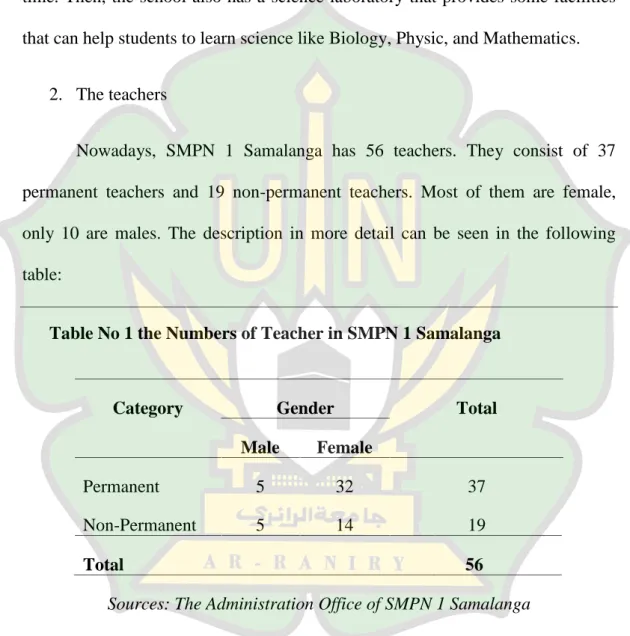
Nowadays, SMPN 1 Samalanga has 56 teachers. They consist of 37 permanent teachers and 19 non-permanent teachers. Most of them are female, only 10 are males. The description in more detail can be seen in the following table:
Table No 1 the Numbers of Teacher in SMPN 1 Samalanga
Category Gender Total
Male Female
Permanent 5 32 37
Non-Permanent 5 14 19
Total 56
Sources: The Administration Office of SMPN 1 Samalanga
This school has 5 English teachers, one of them graduated from IAIN Ar-raniry, while four of them others graduated from FKIP Unsyiah. The description in more detail can be seen in following table:
Table No 2 the Name of English Teacher in SMPN 1 Samalanga The Name of Teachers Graduated Instuition
Hj. Zubaidah S.Pd FKIP Bahasa Inggris Unsyiah
Hj. Faudhiah S.Pd FKIP Bahasa Inggris Unsyiah
Nurfitriya Rahmi S.Pd.I Bahasa Inggris IAIN Ar-raniry
Junina Rahmah S.Pd FKIP Bahasa Inggris Unsyiah
Irfayani S.Pd FKIP Bahasa Inggris Unsyiah
Sources: The Administration Office of SMPN 1 Samalanga
3. The students
Based on data, the students of SMPN 1 Samalanga were classified in three grades. Those are the first, the second and the third grade. For the first grade, they were including in class VII, the second-grade students in class VIII and the third grade were categorized in class IX. The following table shows the numbers of students in each class.
Table No 3 the Students at SMPN 1 Samalanga
No Class Students Total
Male Female
1 VII 83 72 155
2 VIII 93 82 175
3 IX 75 78 153
Total 486
Sources: The Administration Office of SMPN 1 Samalanga
From the table above, it can be seen that the total number of students of SMPN 1 Samalanga in academic year 2018/2019 was 486 students, consisting of 251 males and 235 females. The students of class VII consisted of 83 males and
72 females, and they were set in five classes. Class VIII students had an aggregate students of 93 males and 82 females, and they used six classes. Lastly, students were included in class IX consisted of 75 males and 78 females and they were put in seventh classes.
4. Curriculum and Syllabus
The curriculum that was used in SMPN 1 Samalanga was School-Based
Curriculum (K13). It stressed on the students’ centered approach that was hoped
to make students more active in studying. Based on this curriculum, that was important to English teachers and students to be active in English learning. English was only taught twice in a week and the all allocation of time for each meeting was 2x45 minutes. The allocation of time was used to teach all of English aspect such as; Grammar, Reading, Listening, Speaking and Writing.
C. Population and Sample
a. Population
Acording toHomby(2005) “Population is the people who live in an area, a
city, a country etc”.In other words, the population is group of objects those aimed to be investigated and observed by the researcher. The targets of population in this research will take place at SMPN 1 Samalanga, especially for VII grade students of junior high school.
b. Sample
Acording to Murpy (2009) “Definition of sample is part of population reach that has the same character with population”. The samples selected by the
grade students of SMPN 1 Samalanga on academic year 2018-2019. There were 31 students as the subjects of the study in class seventh (VII-2), which consisted of 15 male and 16 female. The researcher decided to choose the seventh grade students of SMPN 1 Samalanga because they had crucial problem in reading. It could be clearly seen from the participation of the students in every classroom activities where most of them feel bored with the reading activities that had been applied by their teacher in every classroom reading activities.
D. Research Instruments
The researcher instruments were tools which were used by the researcher to collect the required data. There are several instruments that were used in this study in obtaining the data: lesson plan, test and questionnaire.
1. Test
The test is a set of question and exercise used to measure the achievement or capability of the individual or group. Tests were used to find out the students ability in reading comprehension. There were two kinds of tests administered in this research. Those tests were pre-test and post-test. The pre-test was used to know the students' pre-existing ability in reading comprehension before they were given the treatment through CIRC Method. The post-test was used to find out the improvement that the students made in terms of mastering reading text after CIRC was applied.
The Pictures of Pre-test and Post-test 2. Questionnaire
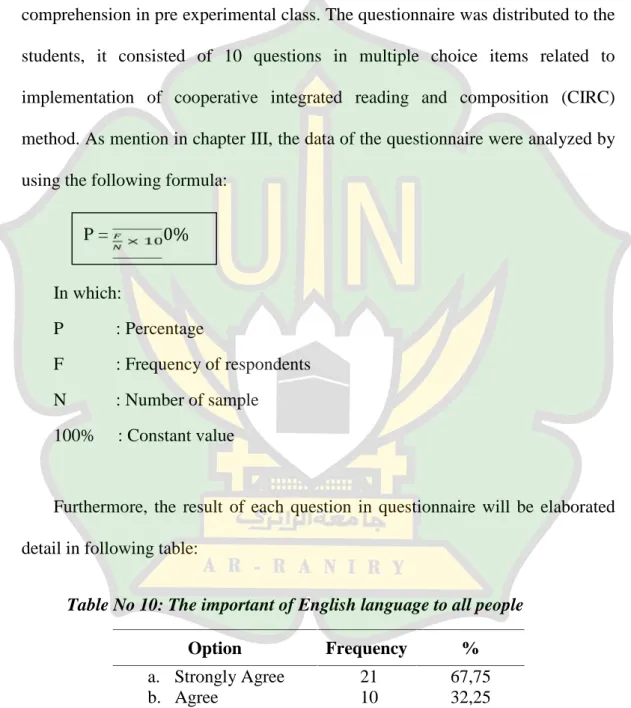
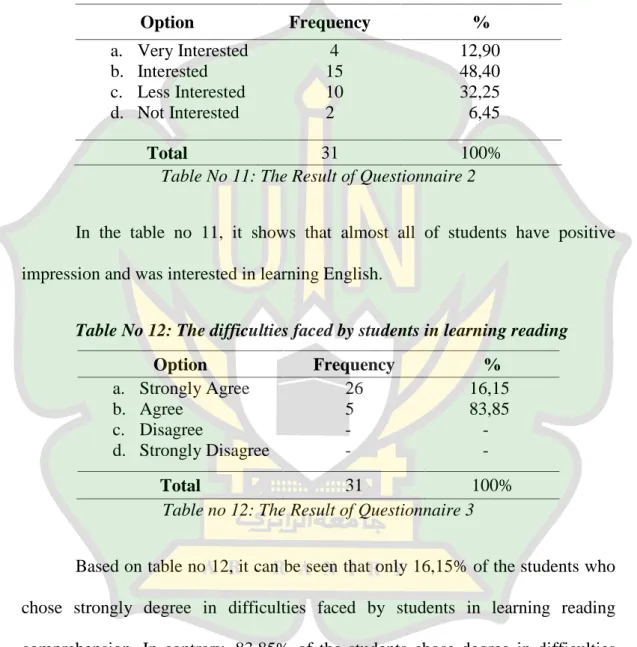
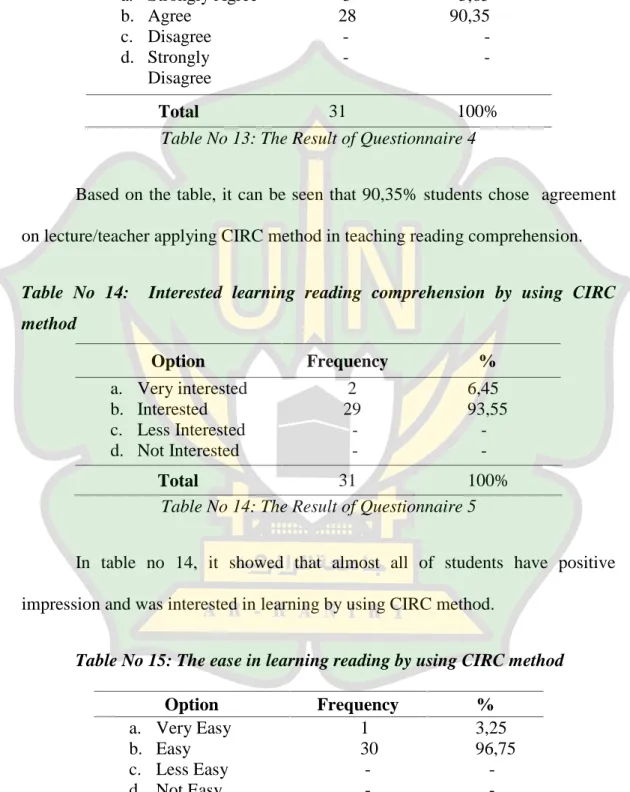
The questionnaire was given to the seventh-grade students of Junior high school after the completion of post-test. It was carried out to measure the changing behavior after the method had been applied, such as motivation, interest, and reaction. It consisted of 10 items. The response of the subjects in the questionnaire was in the form of objective test (with multiple choice answers). The questionnaire was measure about how they perceived reading and in order to
know whether or not the student’s responses toward the application of CIRC
method.
E. Technique of Collecting Data
To support this study, the writer needs to collect data. To carry out the data needed, the writer applies some technique which is considered appropriate; they are pre-experimental research teaching, test, and questionnaire. The explanation would be discussed as follow:
1. Pre-experimental teaching
In conducting the research of the researcher used experimental teaching. The researcher assigned one class as a sample, because the researcher wanted to know
students’ activity and the result of a study in comprehending the reading text by using cooperative integrated reading and composition method. In collecting the data, the researcher gave the students two kinds of test they were pre-test and post-test. The process of teaching for experimental class can be described as follow:
a. Preparation
First, when the writer came to SMPN 1 Samalanga, she meets the headmaster and gave him a recommendation letter from academic faculty of Tarbiyah Department. After telling him about the purpose of her coming to the school, she met the English teacher who taught English subject for the seventh year students, Mrs. NurfitriyaRahmiS.Pd.I. Then, she asked permission to conduct the research. After that, the teacher allowed her to teach for four meetings, including the meeting for pre-test and post-test.