Using Art to develop Mathematical concepts in Deaf learners
Using Art to develop Mathematical concepts in Deaf learners
an investigation
Desiree S. Seekola
In fulfilment of the requirements for the degree of Master of Education by dissertation, in Deaf Education, School of Education, Faculty of Humanities,
University of the Witwatersrand, Johannesburg
Supervisor: Dr. Claudine Storbeck 2009
DECLARATION
I declare that this dissertation is my own, unaided work. It is being submitted for the degree of Master of Education (M Ed) at the University of the Witwatersrand, Johannesburg. It has not been submitted before for any degree or examination at this or
any other university.
Signed
________________________ Desiree S. Seekola
Acknowledgements
It is with gratitude that I acknowledge and thank all of those who supported me during my studies.
Firstly I am indebted to the staff, students and parents associated with the school for the Deaf that I taught in during this study and for the transparent stance they adopted in affording me opportunities to conduct this study.
I am especially grateful to my colleague and friend Rina Scott-Wilson for believing in me when I did not, and for coaxing me across the finish line;
To my supervisor, Dr. Claudine Storbeck who in many ways made a significant contribution to my dissertation;
To my husband Gerald for his love, support and encouragement and my children Gabriella and David for enduring without their mum during the last few months.
Abstract
The current poor mathematical results in Grade 9 at a school for the Deaf in
South Africa are a cause for concern. Consequently, various endeavours of
teaching mathematics in the hope of elevating the grades have followed. This
research focuses on using art to teach mathematical concepts prior to the
mathematics lesson. Review of the literature reveals visual and pedagogic
similarities inherent in both art and mathematics. The visual nature of art
aligns itself directly to Deaf learners who access information visually. It
therefore seems a logical application to explore art as a gateway to educating
Deaf learners into mathematical concepts/literacy. Following on from the input
received through research, this dissertation makes a case for the potential art
has to expound world knowledge, elevate the confidence and personal self
esteem in the Deaf learner and so augur mathematical literacy. The research is
designed around individual case studies and an art intervention program.
Through the intervention learners managed to take implicit knowledge acquired
through activities and make the knowledge explicit. Art was found to encourage
theory building through the conscious construction and exploration of
TABLE OF CONTENTS List of Figures
List of Tables
CHAPTER ONE - INTRODUCTION 15
1.1 Background 15
1.2 Problem identification 15
1.3 Significance of the study and rationale 17
1.4 Critical questions 20
1.5 The definition of key concepts 20
1.6 Explanation of codes 24
1.7 Progression of the study 25
CHAPTER TWO - THEORETICAL FRAMEWORK AND LITERATURE REVIEW
2.1 Introduction 27
2.2 Theoretical framework 27
2. 2.1 Socio-cultural vs the medical model 28 2.2.2 Modelling mathematical concepts 30 2.2.3 Constructing a mental category of a concept 32
2.2.4 Subject integration 34
2.2.5 Social integration 38
2.2.6 The impact of concept development of deaf learners 44
2.2.7 Cognitive integration 45
2.3 The literature review 48
2.3.1 Why it is necessary to raise the mathematical standard among deaf
children?
49
2.3.2 Helping the deaf child adjust to the knowledge age 53
2.3.3 Poor mathematic results 54
2.3.4 Causes of poor mathematic results among deaf children 55
a) Barriers to language 56
b) Challenges educators face in putting the new transformational theories
into practice 58
c) The paradigm shift in the transformation of education 60 d) Difficulties associating classroom mathematics to real world
e) Questioning the attainability of the National Curriculum Statement 63 f) Cultural background of the students and its effect on poor
mathematical results 65
g) Poorly qualified mathematics teachers 67
h) Low expectations 70
i) Further barriers to learning 71
j) Recall 72
k) Anxiety 73
l) Negative attitudes towards mathematics 74 m) Negative attitudes mathematics teachers 76 2.3.5 Proposed solution using art 77
2.3.6 Similarities between art and mathematics 80
a) The golden ratio 80
b) An example of the golden ratio as seen in the human head 83
c)An example of the golden ratio as seen in the Parthenon 86
d) An example of the golden ratio as seen in sculpture: the statue of David 90
e) An example of the golden ratio and other mathematical principles as seen in painting 2.3.7 Value of implementing art 97
2.3.8 The role of the teacher 100
2.3.9 Summary 102
CHAPTER THREE - RESEARCH DESIGN AND METHODOLOGY 3.1 Introduction 105
3.2 Research design 105
3.2.1 Qualitative and Quantitative Research 106
a) The goal of critical research and its relevance to the deaf learner 108
3.3 Methodological Paradigm 110
3.3.1 Defining the case study method 111
a) Advantages of case studies 111
b) Describing the case study context 113
c) Limitations to the case studies 114
3.3.2 Data collection tools 114
3.3.3 The intervention programme 116
a) Focus groups 121
c) Video recordings and photographs as instruments of research 123
d) Teacher interviews 125
e) Parent interviews 126
3.4 Ethics 126
3.5 Conclusion 127
CHAPTER FOUR - DATA ANALYSIS 4.1 The demographical characteristics of the learners 128
a) Case study one: Andre 129
b) Case study two: Drew c) Case study three: Erin 130
d) Case study four: Kris 135
e) Case study five: Charles f) Case study six: Uttar 137
g) Case study seven: Nkoli 138
4.2 The art intervention test analysis 142
a) Andre: Pre and post intervention tests 143
b) Drew: Pre and post intervention tests 144
c) Erin: Pre and post intervention tests d) Kris: Pre and post intervention tests 145
e) Charles: Pre and post intervention tests 145
f) Uttar: Pre and post intervention tests 145
g) Nkoli: Pre and post intervention tests 147
4.3 The learner questionnaire 148
a) Reasons for learners negative attitude towards mathematics 148
b) Learners‟ reflection of their own positive change of attitude towards mathematics 149
c) Changes learners envisioned would help improve mathematics 149
d) Study habits 149
e) Associating concepts across the curriculum 150
4.4 Focus group sessions CHAPTER FIVE - PRESENTATION OF FINDINGS AND DISCUSSION 5.1 Art and OBE 168
5.1.1 The interpretation of OBE 168
a) Time management 170
b) Parent involvement within the OBE framework 170
5.2 Art as a vehicle for therapy 178
a) A case of Nkoli 178
b) A case of Andre 180
c) A case of Erin 181
5.3 Art as a tool of conceptual development 184
a) The cognitive benefits of a prototype 185
i) The connection between recall and homework 189
ii) The connection between recall and speech therapy 191
iii) The connection between recall and teaching methods of the past192 5.4 Art as a language builder 193
a) English as an additional language 196
b) A background of multiple languages 198
c) Dyslexia 199
5.5. Refining social skills 201
5.6 Teacher qualifications 208
5.7 Summary 209
CHAPTER SIX – CONCLUSIONS 210
6.1 Introduction 210
6.1.1 A summary of the art intervention 212
a) Pre-intervention test 212
b) The art intervention 213
c) Post intervention test 214
6.2 Summary 214
6.3 Recommendations 218
6.4 Limitations of the study 220
6.5 Suggestions for further research 222
6.6 Conclusion 222
To my parents
CHAPTER ONE
1.1 Introduction
The mathematic results at the school were cause for concern as it has taken a downward plunge year on year decline which has had a negative impact on the attitude of learners towards mathematics ( Naidoo & Parker, 2000). The poor results leads to learners becoming increasingly uninspired and lack perseverance towards mathematics. However, with mathematics being a compulsory subject at high school level, the DoE, the need to see its relevance in real life was not happening as envisaged (DoE, 2005). In view of this context at the research school, it was hypothesised that art would be a realistic device to use in the quest for attitude changes, improved results and in realising the ultimate goal: for learners to be able to apply themselves to forming a link between mathematical theory and practice (Isbell & Raines, 2007). Research reveals that art has been used to foreshadow a learners‟ scope of world knowledge and psychology. Therefore applied to mathematics, it was deemed an apt tool and feasible strategy to enhance mathematical progress at school 1(Bart, 2007). The aim of this research is consequently to investigate the potential function that both practical and history of art can play in fulfilling mathematics curriculum requirements.
From the outset of this project it is evident that I am a practitioner at this school for the deaf where the research was conducted. My experiences here as a result, led to certain assumptions that informed the consequent research project. As the grade 9 learners‟ art teacher, and equally as an involved researcher the following arrangements were made to secure validity. I engaged the services of the mathematics teacher, who was also a teacher/researcher working jointly and yet independently on this research. The role of the mathematics teacher in my study was to objectively observe and record the students‟ responses during the art lessons. (Aside from the research, the mathematics teacher like other subject teachers at this school frequented my art classroom curious to observe the development of the learners‟ practical works of art. Therefore it was not unusual for the learners to experience the presence of another teacher in the classroom other than myself.)
1
This was to support my own observational focus on learners‟ attitudes and academic progress.
1.2 Background
The need for computer skilled work has increased since post World War II from 25 per cent to 75 per cent. Today the need is close to 90 per cent (Spady, 1995 cited in Macdonald, 2001). Pressure for an information-literate, technologically competent skills workforce growth is being felt at all levels of society and is proving a challenge to the education system (Macdonald, 2001) including schools for the deaf. Of these skills literacy may be one of the biggest challenges that face teachers, parents and other caregivers in the lives of the deaf child. The booming technological age and the introduction of the Further Education and Training(FET) syllabus at schools compels deaf learners to keep pace with their peers in mainstream education. Although a welcome challenge for deaf students, understanding the many new concepts they are faced with, within given contexts has proved to be a strain. The practical challenge I was faced with arose as an opportunity to test the premise that art can be used as a gateway to conceptual comprehension and as a result subject content. This was an exploration worthy of endeavour.
1.3 Problem Identification
I was teaching a class certain aspects of art: symmetry and reflection with particular reference to Islamic patterns. Islamic patterns are based on the concept of reflection as may be seen in Figure 1. To reflect an object means to produce its mirror image. Every reflection has a mirror line. For example a reflection of an "R" is a backwards "R". Reflecting an object creates a balance, symmetry. Islamic Art used this system of reflection to create patterns which then decorated mosques.
Figure1: Reflection
At about the same time the mathematics teacher was teaching the reflection of graphs across the Cartesian plane. Within a few weeks the learners remarked to their parents and their mathematics and I, their art teacher that they were confused about whether they were learning mathematics or art. They would also regularly comment and give examples of symmetry and reflection they noticed in school and at home wholly animated by their findings. Such observations were relevant in revealing a spontaneous link the learners were making between mathematics, art and the real world. The findings are pertinent to learning outcome one and two in the Department of Education National Curriculum Statement (NCS) 10-12 Mathematics (General). It points learners to “explore real-life….mathematical number patterns…and…provides learners with powerful tools for understanding their world” (DoE, 2005: 21). It also became evident that through these specific art examples on Islamic patterns, learners seemed to understand the mathematical concepts by means of the visual data base that art provided (Skemp, 1986). The mathematics teacher, familiar with the mathematics NCS, began pointing out to me the association learners were making as a result of the art intervention. Further prominent observations in the mathematics classroom according to the mathematics teacher were the enthusiastic responses from previously docile learners. These included elevated levels of confidence at attempts to answer questions.
Prior to the art intervention learners were afraid to get their answers wrong and had to be coaxed to attempt an answer. It was as a result of these positive responses that the mathematics teacher and I pondered on ways in which to create a visual data base in the form of a prototype to model each mathematical concept. We researched the „maths-art‟ link for this purpose through an on-line investigation of an assortment of educational institutions including deaf, hearing, secondary and tertiary.
1.4 Significance of the study and rationale
It was discovered that using art to teach mathematics is not a new phenomenon but is exercised at schools and at universities globally producing a myriad of benefits, ranging from changed attitudes in learners to excellent results 2(Bart, 2007). Bart (2007) investigated the poor mathematical results of first year students. Thereafter, proactively, a way forward was devised to improve these results. After her research was complete, a group of students with improved results, enthusiastic towards mathematics emerged. This study replicates Bart‟s method with changes in three areas: firstly, the learners at the current school are at secondary level where as Bart‟s students are at a tertiary institute. Secondly, the student‟s in Bart‟s research participated from a first world country and the learners in this research, a third world country. Thirdly, Bart‟s students were hearing. The learners in this study are deaf. However, similar to their South African counterparts, Bart‟s students experienced a transformation in the form of a domino effect of an enthused succession of attitude and behaviour changes in the learners. Bart‟s dissertation and step by step workshop on how these successes through introducing her learners to art may be seen online.
Henceforth, these psychological changes acted as a trigger for perceptibly improved results in mathematics. Heartened by such encouraging grades, a sense of self determination was activated in each student. Having thus accepted ownership of their improved marks a group of self-assured students emerged. Parents at home were subjected to optimistic conversations about mathematics which they had never experienced before and the natural science and English teachers observed and reported their positive attitudes, increasing confidence and self-esteem. For the mathematics teacher, the class tests evidenced these findings.
This cycle of change happened within a period of one month and provoked my pursuit of the interdisciplinary use of art as a launch pad to create visual mathematics at schools for the deaf.
2
Prior to this rapid, radical transformation in the class where the pilot study was conducted, the observed lack of interest in mathematics among deaf learners in this class and at the school in general, had been cause for concern for both the management team and staff. Their blatant refusal, in the form of bad attitudes, to learn classroom mathematics culminated in poor results. A key reason for initiating this research is the pattern of poor mathematic performance being experienced at the school by learners from their primary level onwards. Naidoo & Parker (2000) corroborate the adverse effect negative attitudes have on Mathematics performance. Yet it is these same learners who produce surprisingly good results in art. Firstly according to research and from my own personal experience as art teacher, learners come into the art class enthusiastically (Isbell & Raines, 2007). They then sit and wait for information about the next task eagerly. Research by Isbell & Raines (2007) confirms that from their focussed expressions learners enjoy the process of working with the paint, clay and other media and experience satisfaction when the task is completed. I deliberated ways in which art could be used to create a visual mathematical model to facilitate mathematical comprehension. The sequence of the art lessons would make a strong foundation; I hypothesised, for the start of a mathematics lesson.
From the start of the art lesson to the end students are engaged in the process of acquiring four outcomes; that of conceptualising, making, management and presentation and culture studies. During the conceptualising period, learners „research from a variety of sources, work within time and resource constraints, and develop both personal imagery and a personal visual vocabulary‟ (NCS, 10-12 Visual Arts, 2003, p 12). I wondered about the possibilities of the mathematics teacher teaching mathematics in a visual way, by using paints and constructing projects. Such a possibility becomes more feasible in light of the following consideration that „deaf learners are predominantly visual learners‟ (Cotton, 1991). Art, in turn, is a visual language and therefore creates a direct correspondence to the visual needs of deaf learners. Moreover, art can be used as a tool for ciphering information from other subjects. According to Clark, (1973) cited in Forseth (1998, p 22) this is possible as „art education supports an interdisciplinary use of art as a medium for coding information from other subjects‟. Although this scheme of the interdisciplinary use of art is theoretically sound, it would be impractical and impossible in the current situation at my school for three reasons. The first is that in order to teach visual mathematics the mathematics teacher must also be skilled in teaching art or the art teacher, a skilled mathematician. This was not the case and
thus presented a drawback to the hypothesis. The second problem encountered is time constraints enforced by curriculum requirements. The third challenge which both the teachers faced, and which seems a contradiction is that lessons were being taught through the natural language of the learners, that of sign. Although a seemingly faultless pedagogy may be predicted in light of this perfectly viable communication strategy, this study is underpinned by a multitude of barriers that language presents to each learner differently. The premise for this apparent paradox, points to late detection of deafness, little or no parental support in dealing with a deaf baby and therefore lack of communication skills on the part of the parent. Art therefore plays a pivotal role in bridging the language barrier as may be seen in the exemplars of art lessons in this study and in 2.2.3: constructing a mental image of a concept.
.
It is for this reason that the mathematics teacher and I decided to graft our abilities towards mutual intent. The intent was to develop mathematical concepts using art. The research was guided by the following critical questions.
1.5 Critical questions
1.5.1 What are the main causes of poor mathematical results among deaf learners? 1.5.2 What is the quality of mathematical concepts deaf learners currently possess? 1.5.3 How can a comprehensive concept be constructed and modelled in deaf learners? 1.5.4 What are the factors which inhibit or advance the development of a prototype in deaf
learners?
1.6 The definition of key concepts
The key concepts used in the study will now be discussed.
Art: In the context of this research art is used in an educational setting to mean the area of learning that is based upon the visual, tangible practical art such as drawing, painting, sculpture, art appreciation the history of art and design in jewellery, pottery, weaving, fabrics.
Constructive education as in OBE: It advocates that knowledge can be generated by the student engaging in the subject matter whilst the educator acts as a facilitator of knowledge (Spady, 1998, as cited in Macdonald, 2001).
Deaf/deaf: “deaf” usually takes on a generic audiological definition in its reference to the condition of having some degree of hearing loss (Stewart, 1994). The term “Deaf” is taking a foothold in our consciousness. Most of us will define a Deaf person as being someone with a hearing loss who is also part of a culture that uses a sign language. Events and entities associated with the Deaf population are similarly named which give us such terminology as Deaf community, Deaf culture, Deaf folklore, Deaf sports, and Deaf way. However, a person may have a hearing loss, use SASL and not be Deaf. Must a deaf student be Deaf? Many may answer “yes”. But such a narrow stance does little justice to improving our understanding of the diversity within the deaf population. There are many deaf people who are fluent in SASL but have little to do with the Deaf community as well as those deaf people who never sign. They are comfortable in their interactions with people who are not deaf and who speak. It is the thoughts and actions of Deaf people that provide the definition of what it means to be “Deaf.” The identities deaf people choose are shaped by the social context in which they interact.
Ultimately then, two definitions to the word deaf have come into existence: a cultural and clinical definition. These are identified by a capital „D‟ as in the case of culturally Deaf and a small letter „d‟ in the context of non-specific deaf (Steward, 1994).
Mathematics: This research refers to mathematics as a subject taught at schools. Mathematics is the body of knowledge centred on such concepts as quantity, structure, space, and change. Mathematics is the science of pattern. Through the use of abstraction and logical reasoning, mathematics evolved from counting, calculation, measurement, and the systematic study of the shapes and motions of physical objects.
Outcomes Based Education (OBE): Outcomes-based education has been the basis for South African education. Its goal: that all learners acquire maximum education according to their ability. No prescribed texts were prearranged. Instead educators were encouraged to use as wide a range of resources as possible including the internet. OBE encouraged a learner centred and activities-based curriculum (DoE, National Curriculum Statement, Visual Arts, 2003, p 2). Many schools struggled to change from traditional methods of teaching and implement OBE since its introduction in 1997 for a number of reasons. Educators‟ cries to scrap OBE echo today in the echelons of the DoE.
Prototype: Used in the context of this research, a prototype is a general internal image or a common average of the concept. An active prototype consists of three separate mental systems viz. the recognition system, in which stored representation of the concept is held; the semantic system, in which the general knowledge one possesses about the concept is located, and lastly a system from which the written forms of words (the names) are retrieved. Example: If we choose a well-known concept, red; and imagine that we are explaining the concept to a man, blind from birth, who has been given sight by a corneal graft. The meaning of the word is the concept associated with that word, so our task is to enable the person to form the concept red and associate it with the word „red‟. Intuitively, we would point to various objects and say „This is a red diary, this is a red tie, and this is a red jumper…‟ We would arrange for him to have, close together in time, a collection of experiences from which we hope he will abstract the common property-red. The same process of abstraction could take place in silence, but it would probably be slower‟ (Skemp, 1998:23-24) and the word „red‟ would be attached in Sign Language. The words prototype and model will be interchanged within this text.
Traditional education: In essence traditional education evolves around the teacher as authority and the students as passive learners. The curriculum assessment systems are treated as ends in themselves and everybody is assessed and measured by the same standard (Spady, 1998, as cited in Macdonald, 2001)
Transformative Education: This term is coined from The Constitution of the Republic of South Africa (Act 108 of 1996 cited in DoE, NCS Visual Arts, 2003: 1) and in this thesis refers to the transformation of the education system to reflect the changes that are taking place in our society and to strengthen the values and practices of our new democracy. The higher education system is being transformed to redress past inequalities, to serve a new social order, to meet pressing national needs and to respond to new realities and opportunities. Transformative education during this period of change refers specifically to methods in teaching. The new system envisions a drastic change in teaching methods from the traditional approach to a learner centred constructive approach in order to overcome the fragmentation, inequality and inefficiency of the past, and create a learning society which
releases the creative and intellectual energies of all our people towards meeting the goals of reconstruction and development (DoE, NCS Visual Arts, 2003: 2)
1.6 Explanation of codes
The codes used during direct quotation of interviews are explained below by an example.
Teacher Interviews: T represents teacher, the initial next to it, the name of the teacher and the numbers that follow, the actual numbers as taken from the raw data. Example TC 22 should be interpreted as Teacher Cayla extracted from line 22 of this teacher‟s interview.
Codes beginning with the letter S represent Student, FG represents Focus Group and P represents Parent.
1.7 Progression of the study
Chapter 1 provides a broad introduction to the current state of mathematics at schools for the deaf, and the rationale that art may be used as a way to advance mathematics among deaf students in South Africa..
Chapter 2 deals with theories that framed the research and a review of relevant literature.
Chapter 3 is a description of the methodology that was used in carrying out the research. It provides detailed descriptions of the research design, procedure, sample, data analysis and ethical considerations.
Chapter 4 contains a report on the case studies and emergent themes are outlined in each case.
Chapter 5 provides a discussion of the results in relation to conceptual frameworks. Chapter 6 gives a conclusion and recommendations on the role of art in the mathematics classroom.
CHAPTER TWO
Theoretical Framework and Review of Literature
For the inhabitants of a built environment, the very obviousness of certain patterns can make them invisible. We don‟t realize that we are surrounded by the shapes of Euclid – circles, rectangles and triangles, etc. (Eglash & Odumosu, 2005,p.1)
2.1 Introduction
In light of the premise that deaf students struggle to understand mathematical concepts due to inadequate access to language ((Pagliaro& Kritzer, 2007; Simms & Thumann, 2007; Easterbrooks, Stephenson, Mertens, 2006; Ray, 2001), and the hypothesis that the subject art, aside from its well known aesthetic and therapeutic functions, can also be used as a tool to building concepts, the cognitive benefits of art will first be explicated.
The question may arise as to whether art is an undemanding discipline suitable only to amuse and divert the mind but not suited to cultivate thinking. Research does not answer this question directly. What it does suggest is that the each domain of the brain makes different demands on thinking and that art is placed in the cognitive landscape where the power to formulate interpretations becomes dominant (Efland, 2002). On the other hand, art in education is not given the prominence in line with its cognitive function that it deserves.
The theoretical framework to the topic highlighting cognition in art will be followed by a review of related literature.
2.2 Theoretical Framework
As far back as 1939, it was believed that teachers of art should attempt to relate art instruction to such fields as history, geography and social studies to name but a few (Efland,2002). However the school experience at the time favoured subject matter divided by boundaries. Current arguments however, are stated in terms of cognitive benefits which are likely to arise when subject matter is made meaningful by pointing out its inter-relationships. More often than not a work of art draws its knowledge from differing domains. As a result,
artworks can lie at the core of integrated conception of general education including mathematics (Efland, 2002).
Furthermore, art might serve as an integrating vehicle within the curriculum since the interpretation of art works requires that it be situated in its social and cultural context (Efland, 2002) It is for this reason that the framework, from which mathematical concepts are hypothesised to develop in this research, lies in creating a visual prototype of commonly used mathematical words and with reference to the learners environment during the art period at school. It is put forward that possessing a visible model (Lang & Pagliaro, 2007) of certain mathematical concepts can help bridge gaps and assist the deaf child in his/her mathematical learning. Given that reference to mathematical terminologies will be used during art lessons, the art period thus simultaneously serves to expand understandings of words such as symmetry, rotation or reflection. How these concepts and their associated meanings will be modelled to the learners is discussed below. However, the educators view of the learner and the learners‟ response to the educator further contributes to conceptual insight.
It is important to this study that the perspectives of deafness are elucidated as it has become clear that one can adopt either of two opposing perspectives when interacting with the Deaf learner. While these perspectives have been given different names or labels by different authors and researchers, we will refer to the differing perspectives as the "pathological model" and the "cultural model." It is essential to understand which of these perspectives one might hold for each result in vastly different ways of dealing with and treating the Deaf Community.
Indeed, the first perspective, at least in some of its extreme manifestations, would seek to deny the very existence of the Deaf Community.
2.2.1 Socio-cultural vs the medical model of deafness
The pathological view of deafness has also been called the clinical-pathological view or the medical model. Essentially this view accepts the behaviours and values of people who can hear as "standard" or "the norm" and then focuses on how Deaf people deviate from that norm. This is the perspective that has been traditionally held by a majority of non-deaf professionals who interact with the Deaf Community only on a professional basis. In a sense this is the "outsider's" view - a view that focuses on how Deaf people are different from
non-deaf people and a view that generally perceives those differences negatively. It is also a view that deaf people have something wrong with them, something that can and must be "fixed." Those who hold a pathological view might define the Deaf Community as: a group of people whose hearing loss interferes with the normal reception of speech; a group of people who have learning and psychological problems due to their hearing loss and their perceived communication difficulties; a group of people who are not "normal" because they cannot hear. It should be fairly easy to see that this view, the "pathological" one, results in
paternalistic and oppressive behaviours and attitudes towards Deaf people. Recently this way of dealing with Deaf people, of treating them as incapable of self-determination, has been called "audism" to emphasize the fact that this view shares much with other paternalistic perspectives such as racism, sexism, and anti-Semitism. The "pathological" view stands in sharp contrast to the view based on linguistic and sociological research findings which is the cultural view.
The cultural view recognizes that there is a complex set of factors that must be considered when examining the Deaf Community. Indeed, it is this very fact that makes defining the Deaf Community a complex task.
Those who hold a cultural view might define the Deaf Community as: a group of persons who share a common means of communication (sign language) that provides the basis for group cohesion and identity; a group of persons who share a common language (SASL) and a common culture; those whose primary means of relating to the world is visual and who share a language that is visually received and gesturally produced.
Understanding the view of deafness one holds is crucial for it will, in large measure, determine ones relationship to and with the Deaf Community. One‟s attitude towards the community's language and its culture determines ones perspective towards deaf pedagogy. One may either maintain a medical/pathological or cultural view of the deaf child.
2.2.2 Modelling mathematical concepts
With regards to the model which I aspire to create in order to develop mathematical concepts, the term prototype is used. A prototype is a cognitive representation of mathematical concepts. The value of possessing an expanded and more coherent prototype
should not be underestimated. Ausubel et al. (1978, p 167) argue that having representational functioning in the form of an acquired stable cognitive structure is “also in its own right the most significant independent variable influencing the learner‟s capacity for acquiring more new knowledge in the same field”. His emphasis in this regard is very strong and also links with Vygotsky‟s Zone of Proximal development which will be discussed later on in this study:
If we had to reduce all of educational psychology to just one principle, we would say this: The most important single factor influencing learning is what the learner already knows. Ascertain this and teach him accordingly (Ausubel et al. 1978, p 163).
The prototypes in this research will evolve around particular mathematical concepts and will consist of generating a web of many different visual images that connect to that particular concept. The vastness of this semantic dimension of the word depends on the richness of its stored meaning. Said differently, and applied to mathematics, the embryonic stage of understanding a mathematic concept will be unfolded during the art period as meanings are explained in a variety of real life settings. The question that emerges foregrounds how one would then account for this type of conceptual development in research?
For an educator to accurately assess students‟ understanding of a concept it would be ideal to identify what is going on inwardly, i.e. inside their minds. Since this is not possible the outward indications of conceptual understanding need to be considered (Harlen & Osborne, 1985, cited in Macdonald, 2001). Therefore, indicators of children generating novel conceptual structures may be by them relating new ideas (their own or others) to earlier experiences and ideas recalled from memory, and also by questioning original ideas (their own and others) and testing them against additional experiences (Harlen & Osborne, 1985, cited in Macdonald, 2001). Moreover, for the student to experience concept development finding similarities among objects must be encouraged. This in place, a further strategy needs consideration before a concept is created in the minds of deaf learners.
Given that the students at this school are deaf, and learn by way of Sign Language, conceptual development for them must include not only recognising and learning to finger spell the written English word and the associations attached to it but also incorporating knowledge of a sign for the concept each time a word is used. The next section details how these characteristics are applied within this study.
2.2.3 Constructing a mental category of a concept
As was indicated by Skemp‟s work, we build concepts through mediation in words.
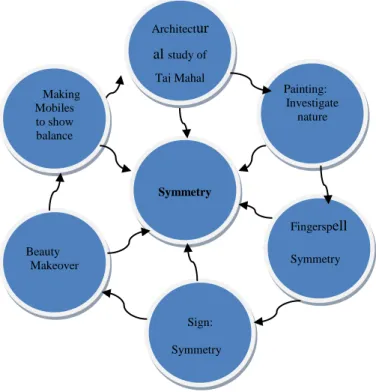
The observations in the pilot class revealed that having seen and in some instances come into contact with the concept in its every day form, facilitated the speed and ability with which the learners were able to manipulate the concepts on an abstract plane. Below is a diagrammatic explanation of how this is envisioned to have happened. In this manner, I integrate each of the specified mathematical concepts into the prescribed art syllabus. Overlapping the subject content is essentially one of the tenants of OBE; that of integration (DoE NCS General,Visual Arts :6) After a period of guidance, when students have acquired the knack of collapsing specifics into concepts by this means extracting the attributes, they will in essence be defining a concept on the own.
Figure 2: Developing a model of the word “symmetry”
Symmetry Architectur al study of Taj Mahal Sign: Symmetry Painting: Investigate nature Fingerspell Symmetry Making Mobiles to show balance Beauty Makeover
The following example serves to elucidate how learners can learn mathematics with the use of a visual prototype. It also explains why the art had to be done in the art room and could not have been done in the mathematics classroom by the mathematics teachers. A theory supporting this plan is that mathematical understandings of concepts are not easily understood by the lay person (Livio, 2006). Therefore in the case of facilitating deaf learners understanding, art is used to soften the setback. Moreover, time constraints did not allow the mathematics teacher to complete the syllabus and execute an art lesson during the time allocated for mathematics. This would have firstly been construed as wasted time. Secondly, it would not be part of the mathematics curriculum and thirdly, the mathematics teacher would also have had to be familiar with art practical and history subject content.
Let me tell you what we do in the classroom. Learners are given a background to introduce symmetry: “Symmetry, as wide or as narrow as you may define its meaning, is one idea by which man through the ages has tried to comprehend and create order, beauty, and perfection” Hermann Wey (2008). From the mathematical background of symmetry we understand symmetry to refer to an object that is preserved by a transformation (Bart & Clair, 2008). Its more familiar English vindication makes reference to balance, equilibrium and proportion. Initially, as the baseline discussion will show, students are given exercises in creating patterns from rotational symmetry, reflectional symmetry and transformational symmetry. Much symmetry is found in folk art. Therefore as a historic point of reference, learners may be shown creations of these symmetrical patterns. Discussions thereafter evolve around how symmetry differs. I have chosen one lesson to explicate this phenomenon. An example of an art lesson on reflectional symmetry:
Baseline discussion
If one side of the image is the mirror image of the other side, then we say the figure has reflectional symmetry. Sometimes we would say that the image has a mirror line. Here we have some images from real life that have such mirror lines. In the first picture is a piece of a Persian rug. Here again you can see that the left side is an exact mirror image of the right hand side. The bug right next to it also has a vertical mirror line, and the left side is a mirror
image of the right side. The image of the ducks shows that the mirror line can also run in other directions. In the duck picture the mirror line runs from left to right.
A rug A Beetle Ducks
To make the idea of symmetry a bit more precise, we would say that if points of a figure are equally positioned about a line, then the figure has reflection symmetry. Note that mirror symmetry is just another word for reflection symmetry. You can use either one of these terms. The line is known by several different names. Sometimes it's called the reflection line, others may call it the mirror line, or the axis of symmetry. The important part to remember is that this line separates the figure into two parts, one of which is a mirror image of the other part.
Here are several more examples of this mirror symmetry:
The heart and smiley each have a vertical mirror line, and the lobster has a horizontal mirror line. The arrow has a mirror line at an angle. If you draw the mirror line though any one of these figures, you will notice that for every point on one side of the line there is a corresponding point on the other side of the line. If you connect any two corresponding points with a segment, that segment will be perpendicular to the axis of symmetry and bisected by it (cut into two equal length segments):
Mirror or reflection symmetry is the most common type of symmetry found in nature, occurring in almost all animals and many plants. Scientists have shown that our brain is rather good at recognizing this type of symmetry. In fact, people are especially good at detecting mirror symmetry when the mirror line is oriented vertically (up-down). Remember that your eyes are hard wired to do this well when the axis is vertical, and so it will be a big help to turn the images (or your head) as you look for symmetries. Try this with the picture of the ducks for instance: turn your head to the right and the look at the picture again. Do you notice the mirror line even more?
Some objects or images can have more than one mirror line. Here are some examples, with the mirror lines shown as dotted red lines:
Pay special attention to the diagonal mirror lines in the cross. These are easy to miss, and do show up quite often.
Practical Task
Students are then asked to create their own symmetrical patterns based on either an example from nature (such as a butterfly, flower, leaf, fruit or reflections in water etc.) or a symbol. Compositions may take the form of a wall paper pattern or landscape painting.
This is just one example of creating an understanding of the concepts reflection and rotation as it is done in the art class. When learners proceed to the mathematics class they would
already have a wealth of knowledge of the concepts. The mathematics teacher may therefore teach mathematics instead of delving into a lesson illuminating a concept first before teaching mathematics. It is therefore hypothesised that learners will learn mathematics more
effectively as a result of this baseline knowledge.
The literature review continues to throw light on the overlying factors associating mathematics and art that makes learning mathematical concepts through art a viable option.
Success at constructing concepts implies the ability to apply this process and abstract words in other subject areas including mathematics. For example: an even number is an integer that is a multiple of 2. Thus the attributes of the concept even number are (a) integer and (b) multiple of 2. Students should thus recognise that any specific that meets these two attributes is an even number. Furthermore, using art to teach mathematics in this manner encompasses one of the critical outcomes of OBE to „collect, analyse, organise and critically evaluate information‟ (DoE: Design 2003, p2) which points to the quintessence of developing a concept.
To facilitate a more stable conceptual structure in deaf learners this study is inclusive of literature relating to the establishment and maintenance of more powerful cognitive connections through subject integration, social integration and cognitive integration.
2.2.5 Subject integration
The subject integration perspective based on the theory by John Dewey (1993) cited in Isbell & Raines (2007) is followed through in the current education curriculum as set out in the Revised National Curriculum Statement (RNCS). Dewey‟s viewpoint is especially apt for deaf learners in developing concepts as integrating subjects serve to link one notion with the next across the curriculum.
It was Dewey (1993) in Isbell & Raines (2007) who argued that a student must connect new knowledge with previous experiences to develop clear understanding of the new
concepts. This notion is hypothesised in this study as a way forward to developing concepts among deaf learners. Constructivism is based on John Dewey‟s work and shaped by the efforts of Piaget (1976) and Vygotsky (1978) cited in Isbell & Raines (2007). A more detailed exposition of Dewey and his educational philosophy is detailed below.
Dewey (1933) cited in Isbell & Raines (2007) contends that learning takes place by doing i.e. the student must be actively involved in the learning process. The OBE curriculum encourages and spirals around such practice. Individuals construct their own meaning as they reflect on their interactions with their environment. The pilot study in Section 1.3 adds more depth to this particular perspective since the class was taught concepts during the art class. These were concepts which the mathematics teacher wanted them to understand before she taught the mathematics. During this process of developing an understanding of concepts, the students indulged in selecting their own materials and creating works of art in a relaxed environment almost unaware of their growing knowledge.
The epistemology of constructivism argues that learners generate knowledge and meaning from their experiences. A major theme in the theoretical framework of Bruner (1977) is that learning is an active process in which learners construct new ideas or concepts based upon their current/past knowledge. The learner selects and transforms information, constructs hypotheses, and makes decisions, relying on a cognitive structure to do so. Constructivism as a paradigm or worldview posits that learning is an active, constructive process. The learner is an information constructor. People actively construct or create their own subjective representations of objective reality. New information is linked to prior knowledge (von Glaserfeld, 2002). It departs from the premise that knowledge is in every persons mind and that a person constructs or builds new knowledge based on life‟s experiences (von Glaserfeld, 2002).
Vygotsky‟s (1978) theory is one of the foundations of constructivism. It asserts three major themes:
1. Social interaction plays a fundamental role in the process of cognitive development. In contrast to Jean Piaget‟s understanding of child development (in which development necessarily precedes learning), Vygotsky felt social learning precedes development. He states: “Every function in the child‟s cultural development appears twice: first, on the
social level, and later, on the individual level; first, between people (interpsychological) and then inside the child (intrapsychological).” (Vygotsky, 1978).
2. The facilitator or mediator refers to anyone who has a better understanding or a higher ability level than the learner, with respect to a particular task, process, or concept. The mediator is normally thought of as being a teacher, coach, or older adult, but the mediator could also be peers, a younger person, or even computers.
On the other hand, Piaget saw knowledge developing in stages. How our thinking is organised and structured is key to Piaget‟s philosophy. The manner in which individuals interact and react depends on their own set of internal cognitive structures that they have erected over the years (Piaget, 2003).A central component of Piaget's developmental theory of learning and thinking is participation of the learner. Knowledge is not merely transmitted verbally but must be constructed and reconstructed by the learner. The learner must be active; he is not a vessel to be filled with facts. He emphasized that children cannot learn something until maturation gives them certain prerequisites. The ability to learn any
cognitive content is always related to their stage of intellectual development. Children who are at a certain stage cannot be taught the concepts of a higher stage (Piaget, 2003). The theories of both Vygotsky and Piaget have implications for constructivism.
The implications of Dewey‟s theory of constructivism for education is that learners are encouraged to follow their personal interests, make choices and combine materials in their own way (Isbell & Raines, 2007). As they interact with their environment, they develop schema (a mental representation or visual plan) to organize their experiences (Isbell & Raines, 2007). The Dewey ideal is that learners can communicate effectively using visual, symbolic and/or language skills in various modes and, in keeping with the DoE Design syllabus, demonstrate an understanding of the world as a set of related systems by recognising that problem solving contexts do not exist in isolation (DoE: Design 2003, p2). Unpacking the visual implications of this theory may have a positive impact on deaf learners, and will be used in the art intervention programme, since one of the ways information is acquired is through their sense of sight. A hands-on, visual approach allows the deaf learner to engage in activities which serve to reinforce integration of acquired knowledge and new concepts developed from old ones in the different learning areas. This particular method of using art to introduce mathematical concepts to deaf learners is innovative and contrary to
“the continued use of a traditional mathematics curriculum that is both outdated and inappropriate for preparing deaf and hard of hearing students for today‟s world” (Pagliaro & Kritzer, 2005, p 259).
Typical classroom mathematics today involves a presentation of a multitude of theories of mathematical learning. One of the main factors for this is that mathematics education is heavily influenced by cultural, social and political forces. Towards the end of 1980 there was a switch to mathematical learning as a social product (English & Sriraman, 2005). Social constructivism which draws on the works of Vygotsky has been the dominant research paradigm ever since. On the other hand, cognitive theories have emphasised the mental structures that constitute and underlie mathematical thinking and the extent of which the curricula should capture the essence of school mathematics. If our theoretical view is that children learn through practicing to produce the correct response to a given stimulus then they should be given more practice. If on the other hand we believe that they should learn by making sense of the world then we should provide them with stimulus in the appropriate environment. Any attempt to hasten the child by learning using rote methods may persuade the child that mathematics is meaningless (Orton, 2004). The South African education system by the implementation of OBE has attempted to steer clear of the rote learning theory.
The original intention of OBE to facilitate meaningful integration forms a bridge which links the social and cognitive perspective of this learner-centred and learner-paced constructivist philosophy Spady (2007). It was based on four principals by Spady (2007).
First, each of them had clear, tangible performance criteria that defined what it meant to be competent, proficient, qualified, and/or professional – often at clearly distinguishable levels of
demonstrable expertise. Second, these criteria were used to define/shape three key things: 1) the credential or license the learner received for successfully demonstrating the established criteria, 2) the precise nature of the performance assessment that would be conducted so that the learner could demonstrate what had been learned, and 3) the design of the instructional experiences that would directly and eventually assist the learner in demonstrating
the defining performance criteria successfully. Third, “success” occurred WHEN, and WHENEVER, the learner could demonstrate ALL of the defining performance criteria in a “live”/authentic performance. Learners were not penalized for making mistakes while learning and they were allowed multiple opportunities to develop and demonstrate their eventual/required/highest level of performance. Fourth, in most cases learners could proceed at a pace that suited their particular rate of learning – meaning that neither instruction, assessment, nor credentials were defined by, or limited to, specific calendar dates or specific blocks of time.
OBE was positioned so central in the South African education curriculum that it became synonymous with C20053. The new curriculum supports subject integration across as many learning areas as possible thus requiring major changes in education. School subjects were replaced in the OBE system by abandoning the previous separate subject content and instead 8 learning areas with new and alternative assessment structures were encouraged. These learning areas were formed by grouping subjects. For example, History, Geography and General Science were at one time separate subjects, however these three are now a
component of one learning area called Natural Science. Art is now more specifically Art and Culture. Drama, Music and Art were separate subjects are now included in the art and culture syllabus. At grassroots level, however, many schools struggled to put Spady‟s (2007)
principles into practice. Spady‟s said: “I quickly came to realize that the four distinctive features combined to form a “paradigm”of learning and credentialing that was just about the opposite of how the education systems” operate. In the OBE, successful outcome
performance is the clear/fixed/pre determined/known/constant factor in the equation, and time is the flexible/variable/adaptable factor. In formal education, however, exactly the opposite pattern exists: time is the clear/fixed/pre-determined/known/constant factor, and learning success is the flexible/variable/ adaptable factor”.
Despite very real implementation difficulties, OBE may be especially beneficial to the deaf leaner as it allows opportunities to develop a broader understanding of concepts by
3
allowing education within school to overlap. Such intersection of knowledge allows learners to broaden what they learn in the classroom to real world settings making school life an educational experience that may continue at home. These encounters create pathways to real life. Supporters of OBE believe that “there is no reason why all schools can‟t emulate” this system of education (Spady, 1998, as cited in Macdonald, 2001, p83) rather than to continue with the more insulated characteristics of traditional teaching. It is posited that in the past school subjects were compartmentalised and that such a boxed type of education facilitated further fragmenting of concepts (Efland, 2002) which in turn impeded the progress of conceptual development in deaf learners. Conversely, research shows that the current broader curriculum refers to the cognitive benefits of art.
The use of art in contemporary education in Africa is evident in the Africa meets Africa project: Making a Living through the Mathematics of Zulu Design. The project includes a work book and a video with instructions on a step by step guide to Zulu beadwork. It clearly demonstrates how art and mathematics are linked conceptually. Learners use Smut‟s (2006) ideas to develop beadwork skills from the Zulu cultural heritage and in doing so work with mathematical ideas prescribed by the Revised National Curriculum Statement (Smut, 2006).
Apart from content integration, one also needs to consider social integration within the deaf context.
2.2.6 Social integration
The social integration perspective is based on the theories of Lev Vygotsky (1978) cited in Isbell & Raines (2007), who advocates a social constructivist view to education inherent in the South African OBE system. Vygotsky‟s notion regarding concept formation is based on his idea that mediation is used to guide the student‟s thought processes (Dixon-Krauss, 1996, cited in Storbeck, 2003).The abstract thought processes can be traced to the start of the of the interaction between mother and child who acts as the child‟s first mediator of knowledge to the world around him.
Although we think of language as in words, the mediation of meaning of these words takes place between the mother and child when interaction is still at the preverbal stage. The mother makes the child aware of a certain scope of reality through various modes of
communication, through kinaesthetic, through body language, through the redundancy and frequency of the stimuli mediated (Feuerstein, Klein & Tannenbaum, 1994). Accordingly the child‟s wish to throw objects is given a significant meaning when the mother bends down and picks up the thrown toy repeatedly. The expression of joy on the child‟s face is evidence of the preferred play (Feuerstein, Klein & Tannenbaum, 1994). Consequently language is happening between all of these explained non-verbal interactions between mother and child. An analogy may be drawn between the child‟s expression of joy and the words „thank you‟. The mother‟s response to the joy stimulates a thought process which may be hypothesised as an association made between the throwing picking action: baby throws, mother picks. In time thank you will become words learnt and then a symbol to mean gratitude and may accompany the expression of joy. „A definition of a concept is only possible if one knows, to some extent, the thing that is to be defined‟ (van Hiele, 2009, p1). For instance if a child is exposed to apples, pears, oranges and bananas, he can over a period of time deduce that these are all fruit by regular reference to these objects through experiencing it (Ausubel, 1978 cited in Macdonald, 2001). In this way the mother has acted as a guide, a facilitator of the child‟s understanding of the concept fruit.
Mediating the deaf learner‟s thinking is facilitated best by means of the teacher signing or using whatever means it takes to provide the learner access to understanding a word. In forming concepts, Vygotsky explains that mediation is the word which later becomes the symbol. To a deaf child, the visual word written on the classroom board must first have meaning in itself before it is processed to take on its abstract form. Therefore mediation involves a facilitator analysing a word in different contexts until the learner is able to use it with understanding. It is for this reason that the teacher as a mediator is constantly aware of the vital role he plays in extending the deaf child‟s world knowledge. For in the case of deaf education how the word is transmitted may make a difference to how the deaf learner understands it. If concepts are mediated within contexts as is advocated in OBE, students will learn more by the mediation of the word than through individual isolated experiences (Dixon-Krauss, 1996, cited in Storbeck, 2003). Concepts are also often developed by repeated use through verbal interaction. Therefore in-class group discussions around a particular topic are encouraged as learners communicate information in a language they can all understand (Secada, 1996 cited in English, 2008). Furthermore, learners are more comfortable clarifying
misunderstandings they may have with their peers (Secada, 1996 cited in English, 2008) than with a teacher who struggles to understand their signs.
Apart from the linguistic emphasis in the socio-cultural approach a further application of Vygotsky‟s theory which also marks a pivotal feature in OBE is the emphasis on collaboration amongst students. Learners are encouraged to relate to their peers during group discussions as a means of generating new knowledge. Not only is interactive dialogue amongst peers encouraged but active partnerships between teachers and students are also deemed crucial.
Constructive socialising among each other is an important tool especially among deaf students in so far as it can reinforce and clarify information that students sometimes miss from having a hearing teacher not fluent in Sign Language. This is unfortunately the case in many schools for the deaf in the country. Not only can one identify communication barriers between teachers and learners, but different cultural groups of deaf learners have a different signing vocabulary at this school thus hindering learner- to- learner interaction. Furthermore the teachers at this school also have various modes of communication that they are comfortable with other than SASL. Each student in this class also has a different communication preference developed from the previous school attended together with the type of communication they are exposed to at home. Of the 7 students in the class being investigated the communication preferred is South African Sign Language and Total Communication. English and Zulu is the language of speech used. One student only uses speech but is slowly developing a Sign Language vocabulary this year. It is for this reason that social integration is advocated in order to address such communication issues. To this end, Secada‟s (1996 cited in English, 2008), reiteration of Vygotsky‟s notion on „revoicing‟ and its effects on students in a multilingual classroom is applicable. Revoicing occurs when a teacher facilitates a lesson in such a way that every appropriate answer or comment is repeated by another student in a way that is clearly understood by other learners in the class. For example the learner might use words or phrases acceptable and more clearly comprehended by his peers. I conjecture a type of signed „revoicing‟ (my own term) among the students in this class as although each student owns varied modes of communication as was noted; they share a unique understanding of each other‟s language. This is so because they also share a common culture and identity, setting them apart from the hearing teacher. A
hearing teacher may sign in a way he thinks best. A peer signs in a way he knows for sure is understood by the class. This is evident from the confident manner of signing apparent during classroom discourse. Repeating what the teacher says reinforces an understanding for the signer and an appreciation of the subject content by the peer/s. Furthermore, by using signed revoicing the stronger students can intervene in the learning process of the weaker ones thereby successfully assisting them to reach a higher level of understanding. This corroborates with the Vygotskian view of directing educators and peers to their social role in facilitating higher level thought processes through interaction in the zone of proximal development (ZPD) (Isbell & Raines, 2007). My interest in Vygotsky‟s theory of ZPD lies in the value of my art intervention programme which is the crux of this research. My hypothesis is that in the process of creating a visual mathematical model the art intervention programme acts as a stepping stone to the next level of understanding mathematical concepts and therefore may be used as a device within the zone of proximal development.
The zone of proximal development originates from the work of Vygotsky (1978) and implies that the guidance of a teacher plays a pivotal role in assisting students to problem solve. The teacher or facilitator coerces the learner to make progress by acting as a sign post in the development of individual functions of the child (Wertch, 1980, as cited in Macdonald, 2001, p 252). In other words, the development of a child does not lie solely within the child‟s mind, but is advanced in the zone of proximal development as he/she is guided along by more capable adults who prove to be „mediators of learning‟ (DoE: Design, 2003, p3). It is hypothesised that this theory coupled with OBE‟s hands-on-activity approach in the art intervention program will serve to guide deaf learners to higher level thinking and subsequently to acquiring new concepts.
Vygotsky‟s work on collaboration proposes that such guided interaction with more knowledgeable peers and facilitators is essential for learners to maximize their own potential (Isbell & Raines, 2007). Taken further, knowledgeable deaf peers obviously erudite signers, may facilitate the interactive process with greater proficiency. More relevant to this research, using peers, the art intervention within the zone of proximal development may act as a visual buttress in the educational life of the deaf learner. Vygotsky‟s mediation during learning is advanced by Feuerstein in his theory of mediated learning experience (MLE) The theory of MLE was developed between 1950 and 1963 by Reuven Feuerstein. MLE describes the