FLEX: A Flexible Code Authentication Framework
for Delegating Mobile App Customization
Gabriele Costa
†, Paolo Gasti
‡, Alessio Merlo
†, and Shung-Hsi Yu
‡ †DIBRIS – University of Genoa (Italy) ‡New York Institute of Technology (USA)[email protected], [email protected], [email protected], [email protected]
ABSTRACT
Mobile code distribution relies on digital signatures to guar-antee code authenticity. Unfortunately, standard signature schemes are not well suited for use in conjunction with pro-gram transformation techniques, such asaspect-oriented pro-gramming. With these techniques, code development is per-formedin sequenceby multiple teams of programmers. This is fundamentally different from traditional single-developer/ single-user models, where users can verify end-to-end (i.e., developer-to-user) authenticity of the code using digital sig-natures. To address this limitation, we introduce FLEX, a flexible code authentication framework for mobile applica-tions. FLEX allows semi-trusted intermediaries to modify mobile code without invalidating the developer’s signature, as long as the modification complies with a “contract” issued by the developer. We introduce formal definitions for secure code modification, and show that our instantiation of FLEX is secure under these definitions. Although FLEX can be in-stantiated using any language, we design AMJ—a novel pro-gramming language that supports code annotations—and implement a FLEX prototype based on our new language.
1.
INTRODUCTION
In recent years, software development has evolved from a centralized to a distributed activity. Modern development techniques and paradigms emphasize multiple code contrib-utors, often working “in series” by adding further functionali-ties, components, and refinements to an application. Promi-nent examples of distributed development paradigms include Aspect Oriented Programming [15] (AOP), Reflection [24], andContract-driven development [18]. Because of the flex-ibility of these approaches, and because they fit well within the BYOD paradigm, the research community has started to apply distributed development approaches to smartphone software [2].
Smartphones have traditionally relied on closed market-places for code distribution. This model involves three par-ties: (i) one or moredevelopers, who builds smartphone apps
Permission to make digital or hard copies of all or part of this work for personal or classroom use is granted without fee provided that copies are not made or distributed for profit or commercial advantage and that copies bear this notice and the full cita-tion on the first page. Copyrights for components of this work owned by others than ACM must be honored. Abstracting with credit is permitted. To copy otherwise, or re-publish, to post on servers or to redistribute to lists, requires prior specific permission and/or a fee. Request permissions from [email protected].
ASIA CCS ’16, May 30-June 03, 2016, Xi’an, China © 2016 ACM. ISBN 978-1-4503-4233-9/16/05. . . $15.00 DOI:http://dx.doi.org/10.1145/2897845.2897887
in its entirety; (ii) theapp marketplace(e.g., the Google Play Store [12], the Apple App Store [1], and the Firefox Market-place [9]), which distributes smartphone apps; and (iii) the userwho runs apps downloaded from the app marketplace. As a prominent example of this model, the Google Play Store guarantees app authenticity by requiring that all apps are cryptographically signed by their respective developers [23]. This prevents code modifications, because it allows users to verify end-to-end (i.e., developer-to-user) app authenticity.
Unfortunately, this approach to code authentication is not well suited for distributed development processes. By hav-ing multiple independent developers who contribute code at different points in time, each (legal) code modification in-validates all previously issued signatures.
Further, the current code authentication approach pre-vents app marketplaces from implementing benign code mod-ifications. For instance, Armando et al. [2] introduced the notion ofmeta-market—an entity that redistributes mobile apps to a group of federated mobile devices. The meta-market performs security analysis of apps and, if needed, refines the apps’ code to neutralize possible vulnerabilities, and to add code instrumentation. However, by modifying the application’s code, the meta-market invalidates the de-veloper’s signature.
Any modification implemented by the meta-market re-quires a new signature, which can be issued by either the developer or the meta-market itself. We argue that neither option is satisfactory. Clearly, requiring the developer to review and sign potentially hundreds of different modifica-tions is not sustainable. On the other hand, replacing the developer’s signature with a new one from the meta-market prevents the user from performing end-to-end app authen-tication, and gives the developer no control on which mod-ifications are performed by the meta-market. In addition to security issues, this approach can potentially raise both legal (e.g., does any modifications violate the developer’s li-cense agreement?) as well as technical concerns (how can modifications be implemented reliably when the app’s source code is not available?).
To address these problems, in this paper we introduce FLEX, a flexible code authentication framework. FLEX al-lows: (i) the developer to define constraints on modifications of his mobile apps, (ii) a third party (e.g. the meta-market) to perform targeted modifications and, (iii) the user to ver-ify end-to-end app authenticity. In addition, it lets the user check which modifications have been applied to an app.
As a proof of concept, and to provide formal proofs on the framework’s properties, we developed a simple programming
language calledAnnotated Middleweight Java(AMJ), which extends Middleweight Java [4]. At the core of AMJ there arerewriting rules: the developer annotates the app’s source code using these rules, which specify legal modifications that can be implemented by the meta-market. Annotations have no effect on the semantics of the app at runtime, and are ignored by the execution environment. We emphasize that FLEX can be instantiated with languages other than AMJ. In fact, rewriting rules equivalent to those presented in this work can be developed for any languages that supports late binding, including Java and C#.
In the rest of this paper, we denote the list of all anno-tations in an app ascontract. The developer signs the app and the contract, and then sends the resulting package to the app marketplace for distribution. The meta-market re-trieves the app from the marketplace, and uses thecontract
to determine which modifications can be implemented with-out invalidating the developer’s signature. Once the meta-market has implemented its modifications, it sends the app, the contract, and the modifications to the user. Upon re-ceipt, the user is able to verify the authenticity of the orig-inal app, and that the modifications implemented by the meta-market comply with the developer’scontract.
The proposed approach has the following benefits: (i) de-velopers can easily enforce restrictions on meta-market mod-ifications. The impact of those modification on the develop-ment of the app is limited; (ii) the meta-market can safely implement modifications according to the specifications pro-vided by thecontract; (iii) users can verify the integrity of the developer’s code, as well as the compliance of the modi-fications carried out by the meta-market with the restriction imposed by the developer. Moreover, because the original code and thecontractare signed by the developer, the user and the meta-market can keep the developer accountable if the application does not work properly; and (iv) FLEX in-troduces no additional overhead during app execution: all checks are performed by the userbeforeinstalling the app. Organization. The rest of the paper is organized as fol-lows. Section 2 presents a case study. Section 3 reviews related work. In Section 4 we introduce our system and ad-versary model. Section 5 presents our programming model and defines AMJ. We show how code and annotations are signed and how AMJ is used to guarantee the validity of applications in Section 6. Section 7 presents our prototype. We conclude in Section 8.
2.
UNIVERSAL REMOTE: A CASE STUDY
To highlight the benefits of FLEX, we consider auniversal remoteas a case study for our approach. A universal remote is a smartphone app that can control a wide variety of de-vices, including smart lights, HVAC, garage doors, smart deadbolts, electric shades, and kitchen appliances. Example of universal remotes include Google’s OpenHAB [21] and the Wink app [27]. An important challenge when developing a universal remote is to provide support for a large number of protocols, required by different classes of smart devices.1
These protocols vary, among other things, in their security requirements. For example, a universal remote connected to the same WiFi as a smart lightbulb should be allowed to turn the light on or off. However, the same universal remote
1For example, OpenHAB includes support for tens of
protocols.http://www.openhab.org/features-tech.html
might not be authorized to unlock arbitrary smart deadbolts on the same network.
Ideally, the developer of a universal remote app should not be concerned with implementing each individual protocol. Instead, vendors should be responsible for adding appliance-specific code to the universal remote, without invalidating the app signature.
In this section, we argue that FLEX is well suited to securely enable this model. To do so we discuss how a simplified universal remote, which supports only “on” and “off” commands, can be implemented using our framework. The following AMJ code represents a “toy” universal remote class:2 1 c l a s s U R e m o t e { 2 3 D e v i c e d ; 4 5 // ... 6 7 v o i d on () { 8 M e s s a g e m , r in { 9 m = new M e s s a g e ( t r u e ); 10 t h i s . d . s e n d ( m ); 11 r = t h i s . d . r e c e i v e (); 12 if (! r . i s A C K ()) { t h i s . p r o m p t ( . . . ) ; } 13 } 14 } 15 }
ClassURemote has a fielddthat represents a device con-nector, i.e., an object that is used to exchange messages with the device. Among the methods included in URemote, we highlight one that is used to turn on the device (void on()), and another that is (possibly) invoked to request the user PIN (Message askPIN()).
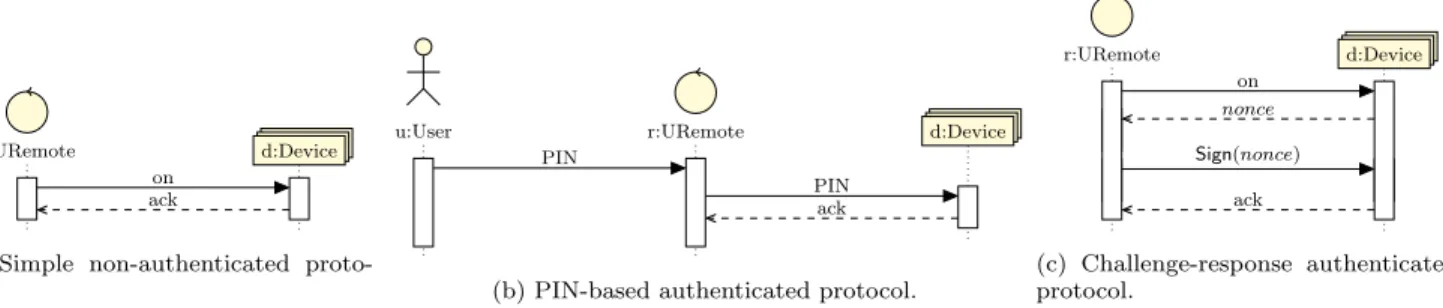
A generic interaction between the universal remote and a device, implementing the protocol in Figure 1a, includes the following steps. The remote creates a new Message ob-ject that indicates that device dshould be turned on (line 9). Then, the message is sent to the device (line 10), which returns a message (r, line 11) that indicates whether the command was executed successfully. Otherwise, the univer-sal remote handles negative responses at line 12.
Because of the lack of authentication, this code is only suitable for controlling non-security-critical devices. Fig-ures 1b and 1c exemplify two of the many protocols suit-able for devices that require authentication. The former is based on a user-provided PIN, while the latter uses a crypto-graphic challenge-response mechanism. Each smart device will implement one of many variants of these or possibly other protocols.
Allowing the manufacturer to provide a “plugin” or a “de-vice driver”, which implements a de“de-vice-specific protocol, ad-dresses this issue only from a functionality standpoint. We believe that this plug-in- or driver-based approach is far from ideal in terms of security and vendor/developer accountabil-ity. In fact, the driver provided by the device manufacturer must be allowed to run together with (or in place of) the app code, and therefore requires the user to trust both the app developer and the manufacturer. Additionally, the de-veloper might not be able to specify meaningful restrictions on the driver’s behavior.
2
The syntax of AMJ is formally introduced in Section 4. However, for this example, the reader may assume a Java-like syntax.
on ack
r:URemote d:Device
(a) Simple non-authenticated proto-col.
PIN ack PIN
u:User r:URemote d:Device
(b) PIN-based authenticated protocol.
nonce Sign(nonce) on ack r:URemote d:Device (c) Challenge-response authenticated protocol.
Figure 1: Three alternative protocols for the universal remote.
We believe that FLEX represents a satisfactory approach for addressing both the functionality and security aspect of this and other related use cases. With FLEX, the developer annotates the code, marking not only which section can be modified by the vendor (who in this context acts as meta-market), but also which restrictions must be enforced on the vendor’s code. Upon receiving the universal remote app from the vendor, the user verifies that the original app code has not been illegally modified, and that the legal modifi-cations are valid according to the developer’s specifimodifi-cations. We detail this approach in the rest of the paper, and com-plete this use case in Section 6.
3.
RELATED WORK
Proof-carrying Code. Proof-carrying code [20] is a method for augmenting an application with a formal proof (either manually or automatically generated) that guaran-tees that the app adheres to a set of rules. The proof can be verified automatically, and therefore does not impact usabil-ity. This makes proof-carrying code very useful, especially when the security properties can be completely specified by the user within the language supported by the proof frame-work, and the application can function correctly within these restrictions. Nevertheless, this approach has major limita-tions in the scenario highlighted in this paper. It is in fact very unlikely [22] that code producers and consumers will agree on a specific set of properties. As a consequence, a variant calledmodel-carrying code [22] has been more suc-cessful. Model-carrying code consists in instrumenting a model of the application behavior instead of providing a proof of compliance. Although this approach is more flexible than the one based on proof-carrying code, the parties must still agree on the elements appearing in the model.
Secure Meta-Market. Secure meta-market is an applica-tion distribuapplica-tion paradigm proposed by Armando et al. [2] to enforce “Bring Your Own Device” (BYOD) security policies on personal mobile devices. A meta-market stands between the app marketplace, the user’s organization and the device owner, allowing the organization to automatically enforce BYOD security policies on mobile devices. The enforce-ment of a policy usually requires modifications to the app (e.g., to instrument it). The modifications are performed by the meta-market, and have the side effect of invalidating the developer’s signature. This requires the meta-market to re-sign the app before it can be installed on mobile devices. The meta-market model has been recently adopted out-side the BYOD context. For instance, Cassandra [17] is a meta-market architecture that verifies whether Android
ap-plications comply with the user’s privacy policy. Cassandra allows users to restrict installed applications to those that comply with a particular security policy. Users do not need to trust the meta-market because applications carry their own proof of compliance.
Code Rewriting. The current literature includes sev-eral paradigms for program transformation. Among them, Aspect-Oriented Programming [14] (AOP) and reflection [26] are probably the most commonly used. Informally, an as-pect consists of a fragment of code and a rewriting rule. When aspects are defined, a program can be modified by inserting invocations to the aspects’ code. Also, using As-pect Weaving [5] the fragments carried by the asAs-pects are directly injected in the application code. Instead, reflection allows programs to manipulate their own elements (e.g., pro-cedures and classes) through specific APIs and data struc-tures. Both AOP and reflection are compatible with our ap-proach, and can be used for implementing a program trans-formation framework similar to FLEX. However, we believe that code annotations contained within comments are easier to understand and use under our assumptions of program-ming under a contract (see below).
The idea of using comments for annotating programs has been proposed before. For instance, the Java modeling lan-guage [16] (JML) allows a developer to attach specifications to her code as comments. A specification can serve for many purposes, such as automatic verification, and contract-based software design. Extending JML with the syntax of our an-notation language is feasible and allows the integration of FLEX with a state-of-the-art specification language. How-ever, since we target mobile code, BML [8] is a better choice, as it implements JML specifications at the byte-code level. Redactable and Sanitizable Signatures. Redactable signatures [13] allow an authorized semi-trusted party to obtain a valid signature from a redacted document with-out any interaction with the original signer. Unfortunately, redactable signatures are not a viable tool for adding code to signed applications. In fact, redactable signatures only support removal of document components.
A more promising approach consists in using sanitizable signatures [3, 7]. Sanitizable signatures allow authorized semi-trusted parties to modify parts of a signed message in a limited fashion. In our scenario, this includes adding and removing code from the mobile app without invalidat-ing the original signature. Although this approach might sound appealing, it has two critical drawbacks: (i) by us-ing sanitizable signatures, the developer is able to indicate what parts of the code can be modified, but cannot impose any restriction on the modifications. Because the language
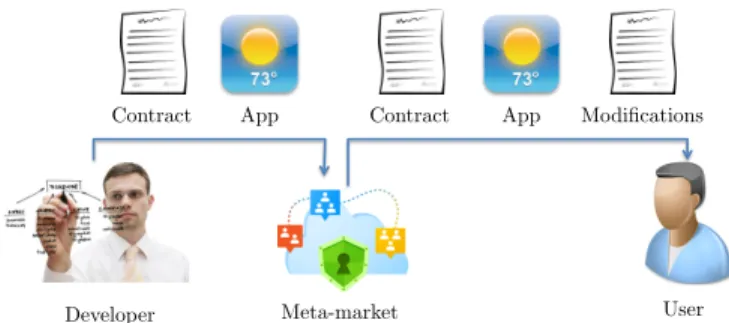
Developer! Meta-market! User!
Contract! App! Contract! App! Modifications!
Figure 2: Parties and their interaction.
used by the developer (and therefore by the meta-market) is Turing-complete, arbitrary code injection performed by the meta-market implies virtually no restrictions on the re-sulting modified code; and (ii) the user cannot reliably and securely determine the exact modifications implemented by the meta-market. Hence, there can be no end-to-end trust between the developer and the user.
4.
SYSTEM AND ADVERSARY MODEL
In this section, we present the components of our system, and discuss their interaction. Our system includes a oper, a meta-market, and a user (see Figure 2). The devel-oper creates an annotated source code in AMJ, and compiles it using the FLEX compiler. The result of this process is a standard (signed) smartphone application, and a contract. Thecontractis automatically generated from the code an-notations, and specifies which parts of the application can be modified by the meta-market, and how. (The language of our code annotations is discussed in Section 5.4).
The meta-market is in charge of implementing modifica-tions to the developer’s app, and to distribute the result-ing code to the users. App modifications, also written usresult-ing AMJ, are distributed in source format, and are signed by the meta-market. After receiving the original app, thecontract
and the list of modifications from the meta-market, the user verifies all signatures, and checks if the meta-market’s modi-fications comply with thecontract. If they do, the user runs a small tool that compiles the modifications and merges them with the original app.
Integrity and authenticity of the contract, the app, and the modifications are guaranteed using a standard signature scheme. The developer and the meta market have access to their respective private (signing) keysskdev and skmm, while all parties have access to all public keys.
More formally, let appbe an application,contracta con-tract that lists valid modifications to app, andmods a set of modifications that can be applied toapp. The developer issues tupleD = (app,contract, γD), where γD is auxiliary information on D (e.g., a signature on app and contract), while the meta-market generates tupleM = (app,contract,
mods, γM) where γM is auxiliary information on M. The meta-market runs algorithmcheckmm(D, pkdev), which
re-turns 1 if the application and the contract are valid and have been constructed by a honest developer (i.e., all signatures verify), and 0 otherwise. The user has access to algorithm
checkuser(M, pkdev, pkmm), which returns 1 if checkmm(D, pkdev) = 1 and if the modifications inM are valid with re-spect toappand contract, and have been produced by the meta-market—and 0 otherwise.
We assume that the adversary can be internal (i.e., one of
the protocol participants) or external. In the former case, we consider a malicious meta-market. This meta-market is willing tocovertlyperform modifications to the mobile appli-cation in violation of the developer’s contract. In the latter, we consider an adversary who relays messages between par-ties, and can therefore modify them in transit. Although this can be addressed, in some cases, by using tools such as TLS/SSL, there are scenarios in which this is not possible. For example, the meta-market might store applications on a cloud server that is used for distributing applications. If the adversary is able to subvert the cloud server, it can perform arbitrary modifications to the apps or to thecontractbefore they are retrieved by the user.
Internal Adversaries. We allow a malicious meta-market to arbitrarily deviate from the intended behavior by implementing any feasible (i.e., polynomial-time) strat-egy. The goal of the meta-market is to construct a tuple
Mi= (appi,contracti,modsi, γMi) such thatcheckuser(Mi, pkdev, pkmm) returns 1, andDi= (appi,contracti, γDi) was
never issued by the developer. In other words, the malicious meta-market wants to surreptitiously construct a valid ap-plication,contract, and set of modifications such that either the applications or thecontract(or both) have not been gen-erated by the developer, or the modifications do not match with thecontractand the application.
To formally define internal adversaries, we introduce the Forging Application Attack (FAA):
ExperimentFAAA(κ)
1. A receives pkdev and (skmm, pkmm), and adaptively requests arbitrary tuplesDi= (appi,contracti, γDi) to the honest developer.
2. Eventually, AoutputsM∗= (app∗,contract∗,mods∗, γM∗). The experiment outputs 1 if and only if
checkuser(M∗, pkdev, pkmm) = 1 and D∗ = (app∗,
contract∗, γD∗) was never issued by the developer. Oth-erwise, the experiment outputs 0.
Definition 1 (FAA-security). A FLEX instantiation is secure under Forging Application Attack if there exists a negligible function negl such that for any PPT A, Pr[FAAA(κ) = 1]≤negl(κ).
External Adversaries. In this scenario, an external ma-licious party is allowed to perform arbitrary modifications to the messages exchanged by the protocol participants. In-formally, the goal of the malicious party is to provide a tuple
Mi= (appi,contracti,modsi, γMi) to the user such that
ei-therDi= (appi,contracti, γDi) was not issued by the
devel-oper, ormodsi was not issued by the meta-market, or both,
and such thatcheckuser(Mi, pkdev, pkmm) = 1. To formalize
external adversaries, we introduce the Application Poisoning Attack (APA):
ExperimentAPAA(κ)
1. A receives pkdev and pkmm. It then adaptively re-quests arbitrary tuplesDi = (appi,contracti, γDi) to
the developer, and sends tuplesDj= (appj,contractj, γDj) and modifications modsj to the meta-market,
which returns Mj = (appj,contractj, modsj, γMj) if
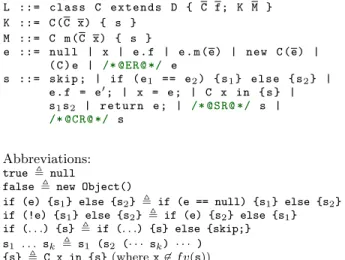
Table 1: Syntax of MJ L ::= c l a s s C e x t e n d s D { C f; K M } K ::= C (C x) { s }
M ::= C m (C x) { s }
e ::= n u l l | x | e . f | e . m (e) | new C (e) | ( C ) e | /* @ E R @ */ e s ::= s k i p ; | if ( e1 == e2) { s1} e l s e { s2} | e . f = e0; | x = e ; | C x in { s } | s1s2 | r e t u r n e ; | /* @ S R @ */ s | /* @ C R @ */ s Abbreviations: true , null
false , new Object()
if (e) {s1} else {s2} , if (e == null) {s1} else {s2}
if (!e) {s1} else {s2} , if (e) {s2} else {s1}
if (. . .) {s} , if (. . .) {s} else {skip;} s1 . . . sk , s1 (s2 (· · · sk) · · · )
{s} , C x in {s}(wherex6∈f v(s))
C x; C y in {s} , C x in { C y in {s}}(withx6=y)
2. Eventually,Aoutputs M∗ = (app∗,contract∗,mods∗, γM∗). The experiment outputs 1 iff checkuser(M∗, pkdev, pkmm) = 1 and D∗ = (app∗, contract∗, γD∗) was never issued by the developer, or M∗ was never issued by the meta-market, and 0 otherwise.
Definition 2 (APA-security). A FLEX instantiation is secure under Application Poisoning Attack if there ex-ists a negligible function negl such that for any PPT A, Pr[APAA(κ) = 1]≤negl(κ).
In the rest of the paper we define howcontract,mods,γM, and γD are constructed, and how checkuser and checkmm
are computed in order to guarantee that the aforementioned security properties hold.
5.
PROGRAMMING MODEL
In this section we present our programming framework for developing annotated applications.
5.1
Annotated Middleweight Java
Middleweight Java (MJ) is an object-oriented imperative programming language proposed by Bierman et al. [4]. The main goal of MJ is to provide a compact—yet expressive— subset of the features of Java. With FLEX we introduce an extension of the syntax of MJ, called AMJ, in which some elements of the language can be alsoannotatedwith patterns for term rewriting. The syntax of MJ is given in Table 1.
With AMJ, a new class C is defined by specializing an existing class D (Object is the predefined, empty class). Each class definition consists of three elements: (i) a list of typed fieldsC f; (ii) a constructor K; and (iii) a list of methods M. The constructor of a class C consists of a list of typed parametersC xand a statement s. Each method has a name m, a return type C, a list of parameters (e.g., constructors) and a statement s. An expression can be the constant null, a variable x, a field e.f, a method in-vocation e.m(e), an object constructor new C(e), a class cast(C)eor an annotated expression /*@ER@*/e. A state-ment is either: an effect-free commandskip;, a conditional branchif (e1 == e2) {s1} else {s2}, a field assignment
e.f = e0;, a variable assignmentx = e;, a blockC x {s}, a sequences1 s2, a return instructionreturn e;, or an
an-notated statement/*@SR@*/sand/*@CR@*/s.
Annotations for expressions and statements are discussed in Section 5.4. In the rest of this section, the reader can con-sider annotations as code comments, which have no effects on the execution of programs.
To improve the readability, we introduce some syntactic sugar. We writevoidin method signature when its return type is irrelevant. Also we use expressione.m(e)as a state-ment in place ofC x in {x = e.m(e);}.
Example 1. A subset of the classMessagecan be defined as follows. class M e s s a g e e x t e n d s O b j e c t { O b j e c t v ; M e s s a g e ( O b j e c t u ) {this. v = u ;} O b j e c t i s A C K () { if(this. v == null) {r e t u r n null;} else {r e t u r n new O b j e c t ( );} } }
A Message has a payload represented by v. The method
isACK returnsnullwhen the payload isnull. Otherwise it returns a new Object(). (Recall that we treat nullas the boolean valuetrue.)
5.2
Operational Semantics
The operational semantics of AMJ is defined in terms of transitions betweenconfigurations, which represent the cur-rent state of a running program.
Definition 3. Aconfigurationis a tuple(E, H, F)where
• E:V*O∪ {null} is a variable environment map-ping variables into object identifiers (o,o0), ornull;
• H :O *(C, E) is a heap function mapping object identifiers into object records;
• F::=s|e|o|null| • is a term.
We write E(x) =⊥whenx6∈dom(E). E|x is the
environ-ment that assigns ⊥toxand otherwise behaves asE. Aterminal configurationis a configuration(E, H, u)where
u is either a value (i.e., a pointero or null), or the void element•.
The operational semantics of expressions and statements is presented in Appendix B. An expressionnullis reduced to the constantnull(rule (EE-Null)), a variablexis evalu-ated to the valuevprovided by the variable environmentE
(rule (EE-Var)), while a field accesse.fresults in a value
vif ecan be evaluated to a pointero, associated to a record (C, E) such that (i) Cis a class declaring a field fand (ii)
E assignsvtof. As a side effect, the evaluation ofemight result in a new heapH0.
A method invocation (EE-Mth)e.m(¯e) consists in evalu-ating whethere(or a valueowhicheevaluates to) points to a record (C, E) such thatCdeclares a methodm, with formal parameters¯xand bodys.3 Then, thenexpressions of¯e(i.e.,
3
Additionally, we require that the number of actual param-eters is the same as that of the formal paramparam-eters, which amounts to require that¯xand¯ehave the same length.
e1, . . . ,en) are evaluated to obtain the corresponding values v1, . . . , vn. Each evaluation can result in a transformation of the heap, therefore leading to the chainH1. . . Hn. The body of mis evaluated after adding the mappings between the parameters’ names¯xand values ¯v toE. The resulting configuration (Eo, H0 0, v) defines the heap H0 and the value
vof the result of the application of rule (EE-Mth). After applying the rule, the environment Eo0 is dropped, and is
replaced by the external environmentE.
A constructornew C(¯e) follows rule (EE-New). This rule requires the evaluation of the n expressions of ¯e (as for method invocations). Then, it creates a new environment
Eo by initializing the fields of Cmapping parameter names to the values computed up to this point, and assigns a fresh pointer o to the reserved name this. Finally, it adds a new record (C, Eo) to the heap and evaluates the body s of the constructor underEo, until termination (because no return value is allowed for constructors). The resulting con-figuration consists of the original environmentE, the heap modified by the execution ofsand the pointero. The cast expression(C)eis defined through rule (EE-New). The be-havior on(C)e is similar to that one, except for the side condition requiringeto return a pointer associated to a sub-type of C.
Rules for statements are shown in the second part of Ap-pendix B. Askip;command does not changeEandHand reduces to the terminal symbol•. Thereturn e;statement results in the evaluation ofeand a final configuration where the resulting valuevis returned. Conditional statements re-quire the evaluation of the expressions in their guards. If the comparison between the returned values succeeds (SE-Iftt),
the conditional behaves like the first statement s1.
Oth-erwise (rule (SE-Ifff)) s2 is executed. Provided that x is
defined in the current environmentE, an assignment ( SE-Asgn) creates a binding betweenxand the value obtained by evaluatinge. Also, the assignment succeeds only if the declared type (functionDT ype) of x, i.e., the type appear-ing in the declaration of the variable, is compatible with the actual type (functionV T ype) of the valuev. Details on the types and the subtyping relation are provided in Section 5.3 as well as in Appendix A. Field assignments (rule (SE-Fld)) behave similarly, with the exception that expressionemust evaluate to a pointer which refers to a record ofCdeclaring a fieldf. If this is the case, the record is updated with the new valuesvforf. A block (rule (SE-Blk)) behaves like its bodys, with the additional side effect that a new definition forxis added toE when entering the block, and then re-moved when leaving it.4 Sequences consist of the execution ofs1, possibly followed bys2. Ifs1 reduces to•(rule ( SE-Seqc)), then s2 is executed. Otherwise (rule (SE-Seqr))
the value generated bys1 is returned.
Example 2. Consider the classMessagefrom Example 1. We show the execution of statement s , Message x in { x = new Message(null); }starting from the configuration (∅,∅,s).
([x\null],∅,null)→([x\null],∅,null) A ([x\null],∅,new Message(null))→([x\null], Ho0, o) ([x\null],∅,x=new Message(null);)→([x\o], Ho0,•)
(∅,∅,s)→(∅, H0
o,•) 4Operator|
xmust remove all the entries forxcreated inside
the body of the block fromE.
where A stands for the execution of the body of the con-structor of Message, that is:
([u\null]◦Eo, Ho,this)→([u\null]◦Eo, Ho, o) ([u\null]◦Eo, Ho,u)→([u\null]◦Eo, Ho,null) ([u\null]◦Eo, Ho,this.v=u;)→
([u\null]◦Eo,[o\(Message,[v\null]◦Eo)]◦Ho,•)
To simplify presentation, we use abbreviationsEo,[this\ o,v\null],Ho ,[o\(Message, Eo)]andHo0 ,[o\(Message,[v\ null]◦Eo)]◦Ho.
Following the rules of the operational semantics, a con-figuration can getstuck, i.e., it is not a final configuration, and it admits no further reductions according to the next definition:
Definition 4. A configuration(E, H, F)is said to bestuck if F is not a value and6 ∃E0, H0, F0 such that (E, H, F)→
(E0, H0, F0). We denote a stuck configuration as(E, H, F) 6→.
5.3
AMJ Type System
In this section we present the type system of AMJ. We begin by defining the basic elements:
Definition 5. Types are defined as follows. Expression types: τ, τ0::=C| >
Statement types: σ, σ0::=τ|void Method types: µ, µ0::=τ1×. . .×τn→τ
The type of an expression can be either C or the value
>. Apart for the expression types, statements can also be typed tovoid. Methods admit arrow type from input types
τ1, . . . , τn to output typeτ.
Typing judgements have the form ∆; Γ ` t : ω where
t∈ {e, s}andω∈ {τ, σ}. We use Γ and ∆ to denote type environments for variables and classes, respectively. A vari-able environment can be either the empty environment (∅) or the environment obtained by adding a mapping to an exist-ing one (e.g., Γ, x:τ). Instead, ∆ consists of an immutable mapping between method and field names (unambiguously identified through their class name) and their declared type (we use functional types · → ·for methods). For instance, ∆(C)(m) = C×D → D denotes that class C declares a method mwhich has two arguments of type C and D and returns an object of typeD.5
Typing rules for expressions and statements are presented in Appendix C. Expressions are typed as follows. The type of thenullconstant is the top element>(TE-Null), while the type of a variable x is provided by the current type environment Γ(TE-Var). The weakening rule(TE-Wkn) allows for typing an expression to τ0 if it can be typed to
τ, being a τ a subtype of τ0. Types of fields (TE-Fld) and methods (TE-Mth) are given by the definition of C, contained in ∆, as far as the base expression has type C (and the actual parameters of a method have compatible types). A constructor of C(TE-New)behaves similarly to a method invocation, except for the return type which is Citself. The cast operation(TE-Cst)types an expression
5For the sake of presentation, here we omit details on
method typing. In general, we assume that the type that ∆ associates to a method is always correct w.r.t. the method body. For more details, we refer the reader to [4].
Table 2: Rewriting rules syntax ER ::= e r e w SX ; EX | e r e w EX
EX ::= e | EX + EX SR ::= s r e w SX SX ::= s | SX + SX
to C if it can be typed to the subclass C0. Finally, (TE-Erew)states that if an annotated expression is typed toτ, then it can be typed to both its base expression and to the annotation (annotation typing is discussed in Section 5.4).
With respect to statements, askip;command(TS-Skip) has typevoid, while areturnstatement(TS-Ret)has the same type of the returned expression. A conditional state-ment(TS-If) is typed toσ if both its branches are typed to σ. Assignments to a field (TS-Fld) or variable (TS-Asgn)are typed tovoidas far as the assigned expression has a type which is compatible with that of the identifier, i.e.,fandx, respectively. The type of the identifiers is pro-vided by the environment functions ∆ and Γ, respectively. A block (TS-Blk) has the same type as the statement it contains (typed under an environment which defines vari-ablex). The weakening rule (TS-Wkn) behaves similarly to the rule for expressions, i.e., it allows to type a statement to a more general typeσ0. The rules for sequences behave as follows. Rule(TS-Seq1)says that a sequence is typed toσ (withσ6=void) if so can be typed the two sub-statements. Also, rule(TS-Seq2)states that a sequence is typed as its second statement if the first one is typed tovoid. Finally, rule(TS-Srew)says that we can type an annotated state-ment toσwhenever its annotation and base expression can be typed so.
Example 3. Consider once again the classMessagefrom Example 1. We type the statementsof Example 2 as follows.
∆;x:Message`null:> (TE-New)
∆;x:Message`new Message(null) :Message
(TS-Asgn)
∆;x:Message`x=new Message(null); :void
(TS-Blk)
∆;∅ `s:void
When applying rule(TE-New), the typing procedure also ver-ifies that∆(Message)(new) =Object→Message.
An important property of typed terms is that they do not lead to stuck configurations. In fact, for allclosed (i.e., containing no free variables) termst∈ {e, s}, iftis typed to
ω, thentdoes not get stuck, and the value obtained when runningtis of typeω(or a subtype ofω). In other words, typed terms do not cause faulty computations, and always return values of the expected type. These properties are formalized in Appendix A under Theorem 1.
5.4
Code Annotations
In this section we extend the type system of AMJ with rules for code annotations. The syntax of the annotations for defining rewriting rules is presented in Table 2.
Expression rewriting annotationsERcan be either a state-ment rewriting termSXfollowed by an expression rewriting termEX, or simply an expression rewriting termEX. Expres-sion rewriting termsEXcan either be an expressione, or the union/choice of two sub terms EX + EX. Statement rewrit-ing annotations only consist of a statement rewritrewrit-ing term
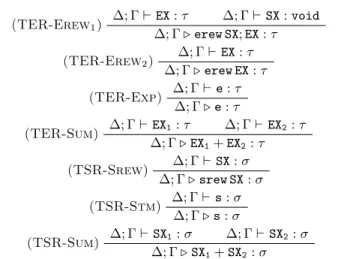
Table 3: Annotation typing rules. ∆; Γ`EX:τ ∆; Γ`SX:void (TER-Erew1) ∆; Γ.erew SX; EX:τ ∆; Γ`EX:τ (TER-Erew2) ∆; Γ.erew EX:τ ∆; Γ`e:τ (TER-Exp) ∆; Γ.e:τ ∆; Γ`EX1:τ ∆; Γ`EX2:τ (TER-Sum) ∆; Γ.EX 1+EX2:τ ∆; Γ`SX:σ (TSR-Srew) ∆; Γ.srew SX:σ ∆; Γ`s:σ (TSR-Stm) ∆; Γ.s:σ ∆; Γ`SX1:σ ∆; Γ`SX2:σ (TSR-Sum) ∆; Γ.SX 1+SX2:σ
SX. These terms can be either a simple statements, or the union of two termsSX + SX.
To simplify presentation, we write /*@ srew SX @*/s in-stead of /*@ srew SX + s @*/s, and we use/*@ sins SX @*/
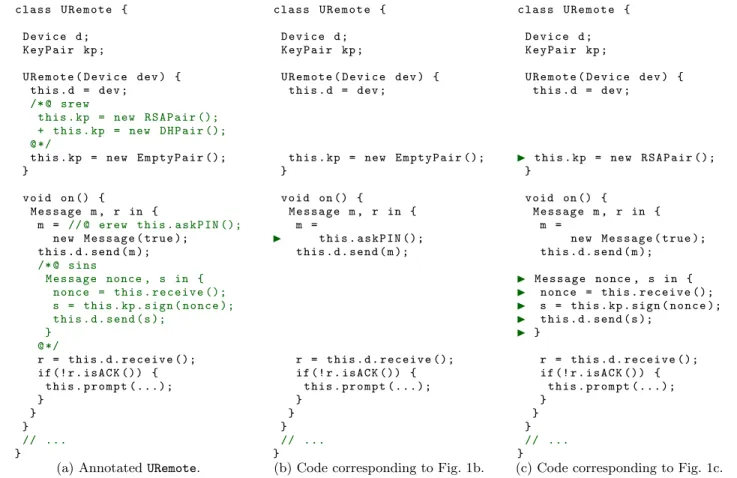
as an abbreviation for/*@ srew SX + skip;@*/skip;. Example 4. We annotate class URemote from Section 2 as shown in Figure 3a. (To simplify exposition, we omitted field KeyPair kp in Section 2.) The annotated construc-tor can be modified to assign new RSAPair() (which repre-sents an RSA key pair), new DHPair() (a Diffie-Hellman key pair), or new EmptyPair() (a placeholder that repre-sents no key) to kp. The default behavior of method on is to initializemwith a device-specific payload. The annotation associated with this statement allows the meta-market to re-place the payload with a message containing the user’s PIN, obtained calling method askPIN() (not shown). Before re-ceiving the confirmation messager, the code can be extended with a block of instructions. In the challenge-response pro-tocol (Figure 1b) the universal remote signs a nonce received from the device. The corresponding code is made legal by a set of annotations that allow receiving the nonce, signing it, and handling possible errors.
Extending the Type System. We complete the type system presented in Appendix C with the annotation typing rules reported in Table 3, which assign a type to each anno-tation. Rules(TER-Erew1)and(TER-Erew2)state that an expression rewriting annotation is typed toτ if it can be typed to its base termEX. Rule(TER-Erew1)also requires SX to have typevoid. Rule(TER-Exp)reduces to typing expressione, while (TER-Sum)assigns type τ toSX1+SX2
if the two sub expression scan be typed τ. The rules for statements behave similarly.
6.
CODE VERIFICATION
In this section we show how a meta-market can verify the authenticity and validity of the code from the developer, and how the user verifies the same properties on the code and modifications received from the meta-market.
We use digital signatures to guarantee the authenticity of the data exchanged by the parties. Our instantiation
of the auxiliary informationγD corresponds to a signature on all files that compose the application and the contract. Similarly,γM is a signature computed overγD and over all files that constitute the modification implemented by the meta-market.
A FLEXcontractis a file containing all annotations from the app’s source code. Each annotation is augmented with an absolute reference to the specific piece of code it applies to. modsconsist of one or more AMJ source files, created by the meta-market according to thecontract. Each file extends and overrides portions of the app’s code via late binding.
Given a tuple D, the meta-market invokes checkmm(D, pkdev) to determine the validity of thecontract. This func-tion verifies that the signature on the app and thecontract
is correct. Then, it runs AMJ’s type checking to deter-mine if the contract can be honored, as detailed in sec-tions 5.3 and 5.4. If the type system returns no errors and all signatures verify correctly, tupleD is accepted and
checkmm(D, pkdev) returns 1. Otherwise, it returns 0.
A tupleMis checked by the user by invokingcheckuser(M, pkdev, pkmm). First, this function extracts γD from γM
and uses it to computecheckmm(D, pkdev) whereD is
con-structed from M as D = (app,contract, γD). If checkmm
returns 1, then the user learns that the app has not been tampered with since it was issued by the developer. Next,
checkuser verifies the signature on γD and mods. A
pos-itive verification indicates that the modification from the meta-market have not been altered by an external adver-sary. Finally,checkuserverifiesmodsagainstcontractas
dis-cussed next. If the verification is successful, it compilesmods
againstapp. The resulting binary incorporates all modifica-tions from the meta-market, applied to the authentic app from the developer.
The correctness of code modifications is verified as fol-lows. Each annotationER(orSR) corresponds to a recursion-free finite language LER (LSR, respectively). Given an
an-notation ER = erew EX, LER = LEX where Le = {e}, and
LEX1+EX2 = LEX1 ∪ LEX2. Similarly, if ER = erew SX; EX,
LER=LSX· LEX (being·the sequence operator). Thus,
ver-ifying the compliance of the modifications and thecontract
amounts to checking whether a term, i.e., either an expres-sioneor a statements, belongs to the annotation language. In other words, we say that/*@ ER @*/ e(/*@ SR @*/ s, respectively) is legal if and only if e∈ LER (s ∈ LSR). An
app is legal if every annotation appearing in it is legal. Example 5. Fragments in figures 3b and 3c implement the protocols illustrated in figures 1b and 1c respectively. The two figures do not show annotations, presented in Figure 3a, and highlight code changes with “I”. The annotation in the constructor in Figure 3a defines the following language:
L= kp = new RSAPair();, kp = new DHPair();, kp = new EmptyPair();
Both the constructors in figures 3b and 3c are valid, because they are obtained by replacing a statement inLwith another statement inL. A similar argument applies to methodon.
To summarize, each annotation defines a finite language that the meta-market uses to perform modifications to the app. Given acontract(i.e., a list of annotations), the user can verify the membership of each modification to the lan-guage defined by the corresponding annotation. Violating
thecontractis equivalent to producing one or more modifi-cations that are not in the language defined by annotations. Thus, the adversary cannot covertly provide illegal app mod-ifications to the user without either violating, or altering the contract. Next, we discuss why the user can always deter-mine if the contract has been altered by the adversary. Security of FLEX. We argue that FLEX is secure against both internal and external adversaries, under the assump-tion that the underlying signature scheme is secure against existential forgeries. As discussed earlier in this section, given a tuple M = (app, contract, mods, γM), the user can verify that the modifications in modscomply with the
contract. What we need to show next is that because of signaturesγD andγM, our instantiation of FLEX is secure against Forging Application Attacks (Definition 1) and Ap-plication Poisoning Attacks (Definition 2).
Theorem 1. Assuming that the underlying signature scheme is secure against existential forgeries, the instantia-tion of FLEX presented in this paper is FAA-secure.
Proof Proof of Theorem 1 (Sketch). Assume that the adversary can construct, with non-negligible probabil-ity, a tuple M∗ = (app∗,contract∗,mods∗, γM∗), such that D∗= (app∗,contract∗, γD∗) was never issued by the devel-oper. BecauseγD∗is a signature computed on bothapp∗and
contract∗, and γD∗ was never computed by the developer, D∗ represents a valid forgery for the underlying signature scheme. This contradicts our hypothesis.
Theorem 2. Assuming that the underlying signature scheme is secure against existential forgeries, the instantia-tion of FLEX presented in this paper is APA-secure.
Proof Proof of Theorem 2 (Sketch). Assume that the adversary can win the APA experiment with non-negligible probability. Following the same argument as in the proof of Theorem 1, D∗ = (app∗,contract∗, γD∗) must have been issued by the developer. Therefore, the adver-sary can win if and only if M∗ = (app∗,contract∗,mods∗, γM∗) was never issued by the meta-market. However, be-causeγM∗ is a signature computed onapp∗,contract∗, and
mods∗, and the adversary has no access to the meta-market signing key,M∗represents a valid forgery for the underlying signature scheme. This contradicts our hypothesis.
7.
FLEX PROTOTYPE
In this section we provide further details on our prototype implementation of AMJ. The goal of our prototype is to show the feasibility of FLEX, and to provide a codebase that can be used and extended by the research community. The AMJ interpreter consists of the following components: a lexer, a parser, an abstract syntax tree (AST) builder, an abstract semantic graph (ASG) constructor, a type checker, and an operational semantic executor. To build these com-ponents, we used Xtext [29] and Xsemantics [28]. Xtext is a framework for developing programming languages. It is based on the Eclipse Modeling Framework, and provide tools for building custom lexers, parsers and class models. We used Xtext to construct the lexer and parser used in FLEX from AMJ’s grammar specifications. The AST re-sulting from parsing AMJ code is refined using Xtext to add cross-links between elements (e.g., method invocations
c l a s s U R e m o t e { D e v i c e d ; K e y P a i r kp ; U R e m o t e ( D e v i c e dev ) { t h i s . d = dev ; /* @ s r e w t h i s . kp = new R S A P a i r (); + t h i s . kp = new D H P a i r (); @ */ t h i s . kp = new E m p t y P a i r (); } v o i d on () { M e s s a g e m , r in { m = // @ e r e w t h i s . a s k P I N (); new M e s s a g e ( t r u e ); t h i s . d . s e n d ( m ); /* @ s i n s M e s s a g e nonce , s in { n o n c e = t h i s . r e c e i v e (); s = t h i s . kp . s i g n ( n o n c e ); t h i s . d . s e n d ( s ); } @ */ r = t h i s . d . r e c e i v e (); if (! r . i s A C K ()) { t h i s . p r o m p t ( . . . ) ; } } } // ... } c l a s s U R e m o t e { D e v i c e d ; K e y P a i r kp ; U R e m o t e ( D e v i c e dev ) { t h i s . d = dev ; t h i s . kp = new E m p t y P a i r (); } v o i d on () { M e s s a g e m , r in { m = I t h i s . a s k P I N (); t h i s . d . s e n d ( m ); r = t h i s . d . r e c e i v e (); if (! r . i s A C K ()) { t h i s . p r o m p t ( . . . ) ; } } } // ... } c l a s s U R e m o t e { D e v i c e d ; K e y P a i r kp ; U R e m o t e ( D e v i c e dev ) { t h i s . d = dev ; I t h i s . kp = new R S A P a i r (); } v o i d on () { M e s s a g e m , r in { m = new M e s s a g e ( t r u e ); t h i s . d . s e n d ( m ); I M e s s a g e nonce , s in { I n o n c e = t h i s . r e c e i v e (); I s = t h i s . kp . s i g n ( n o n c e ); I t h i s . d . s e n d ( s ); I } r = t h i s . d . r e c e i v e (); if (! r . i s A C K ()) { t h i s . p r o m p t ( . . . ) ; } } } // ... }
(a) AnnotatedURemote. (b) Code corresponding to Fig. 1b. (c) Code corresponding to Fig. 1c. Figure 3: Annotation of URemoteand two instantiations of modified code. Methods other than the constructor andonare omitted.
and corresponding method implementation). This process transforms the AST into the corresponding ASG.
Xsemantics is a plugin for Xtext that allows developers to build custom type systems. We used Xsemantics to im-plement the typing rules and operational semantic rules pre-sented in Section 5. These rules are compiled by Xsemantics into theAnnotatedMjTypeSystem class, which maps judge-ments (e.g. type, or exec) to individual Middleweight Java methods with the corresponding name. Those methods take as input the environment (composed of heap environmentH, variable environment E, and type environment Γ), and an AST element to type.
To check the validity of thecontract, our prototype gen-erates an ASG using Xtext, and uses the AnnotatedMj-TypeSystem class to check for typing correctness, as well as operational semantics correctness of the ASG. It then outputs either typing is successful, or typing has failed. If typing is successful, all the statements and expressions can be typed, and therefore they comply with thecontract.
Our prototype relies on the BouncyCastle [6] cryptographic library for signature generation and verification. The imple-mentation of our prototype is available at [10].
8.
CONCLUSION
In this paper we introduced FLEX, a framework for code authentication. FLEX allows a semi-trusted third party (e.g. an app meta-market) to perform limited modifications to a
mobile app. The user can verify the authenticity of the ap-plication at each step of the modification process. In partic-ular, after downloading an app authenticated using FLEX, the user can: (i) ascertain that the original app is authentic; (ii) check if the meta-market modifications comply with the developer’s specifications; and (iii) determine if the mod-ifications carried out by the semi-trusted third party have been tampered.
In order to test the practicality of FLEX, we instanti-ated it using AMJ—a language we designed to support code annotations. Because all verification steps are performed beforethe app is installed on the user’s smartphone, FLEX introduces no additional overhead to the app at runtime.
By allowing the user to verify end-to-end authenticity of both developer’s code and meta-market modifications, we believe that FLEX overcomes the major limitations of cur-rent approaches in this space. Moreover, code annotations do not add substantial complexity to the code development process because they do not affect the semantics of the code, making FLEX easy to use for the developer.
Although FLEX is meant for smartphone apps, it can be easily adapted to authenticate any mobile code, i.e., code sourced from a remote system and executed locally without explicit installation (e.g., JavaScript code included in HTML or PDF documents, Flash animations, etc.) [19]. As part of our future work, we will extend FLEX to support in-browser JavaScript authentication. Developers will be able to specify
which parts of their JavaScript code can be modified with-out invalidating the web page. Companies providing WiFi connectivity to the user (e.g., Gogo Inflight Internet [11], Starbucks [25], etc.), could then apply limited modification to the page’s source. The user would still be able to au-thenticate (and possibly run) the original code. Because thecontractwould be entirely specified within comments, it would simply be ignored by legacy web browsers.
9.
REFERENCES
[1] Apple App Store. http://www.apple.com/itunes/. Accessed: July 2015.
[2] Alessandro Armando, Gabriele Costa, Alessio Merlo, and Luca Verderame. Enabling BYOD Through Secure Meta-market. InProceedings of the ACM Conference on Security and Privacy in Wireless and Mobile Networks, WiSec 2014, pages 219–230. [3] Giuseppe Ateniese, Daniel Chou, Breno de Medeiros,
and Gene Tsudik. Sanitizable Signatures. In
Proceedings of the European Symposium on Research in Computer Security, volume 3679 ofESORICS 2005, pages 159–177. Springer Berlin Heidelberg.
[4] Gavin Bierman, Matthew Parkinson, and Andrew Pitts. MJ: An Imperative Core Calculus for Java and Java with Effects. Technical Report
UCAM-CL-TR-563, University of Cambridge, 2003. [5] Kai Bollert. On weaving aspects. In Ana M. D.
Moreira and Serge Demeyer, editors,ECOOP Workshops, volume 1743 ofLecture Notes in Computer Science, pages 301–302. Springer, 1999. [6] The Legion of the Bouncy Castle.
https://www.bouncycastle.org/. Accessed: July 2015. [7] Christina Brzuska, Marc Fischlin, Tobias
Freudenreich, Anja Lehmann, Marcus Page, Jakob Schelbert, Dominique Schroder, and Florian Volk. Security of Sanitizable Signatures Revisited. In Proceedings of the International Conference on Practice and Theory in Public Key Cryptography, volume 5443 ofPKC 2009, pages 317–336. Springer Berlin Heidelberg.
[8] Lilian Burdy, Marieke Huisman, and Mariela Pavlova. Preliminary Design of BML: A Behavioral Interface Specification Language for Java Bytecode. In Proceedings of the Fundamental Approaches to Software Engineering, volume 4422 ofFASE 2007, pages 215–229. Springer Berlin Heidelberg.
[9] Firefox Marketplace. http://marketplace.firefox.com. Accessed: July 2015.
[10] FLEX Prototype. http://cl.ly/1L3n2P1i2F2d. [11] Gogo Inflight Internet. http://www.gogoair.com. [12] Google Play Store. http://play.google.com/. Accessed:
July 2015.
[13] Robert Johnson, David Molnar, Dawn Xiaodong Song, and David Wagner. Homomorphic Signature Schemes. InProceedings of the Cryptographer’s Track at the RSA Conference on Topics in Cryptology, CT-RSA 2002, pages 244–262. Springer-Verlag.
[14] Gregor Kiczales. Aspect-oriented Programming.ACM Computer Survey, 28(4es), December 1996.
[15] Gregor Kiczales, John Lamping, Anurag Mendhekar, Chris Maeda, Cristina Lopes, Jean-Marc Loingtier, and John Irwin. Aspect-oriented programming. In
Mehmet Ak¸sit and Satoshi Matsuoka, editors, ECOOP’97 – Object-Oriented Programming, volume 1241 ofLecture Notes in Computer Science, pages 220–242. Springer Berlin Heidelberg, 1997.
[16] Gary Leavens, Albert Baker, and Clyde Ruby. JML: a Java Modeling Language. InProceedings of the Workshop on Formal Underpinnings of Java, OOPSLA 1998.
[17] Steffen Lortz, Heiko Mantel, Artem Starostin, Timo B¨ahr, David Schneider, and Alexandra Weber. Cassandra: Towards a Certifying App Store for Android. InProceedings of the Workshop on Security and Privacy in Smartphones and Mobile Devices, SPSM 2014, pages 93–104.
[18] Bertrand Meyer. Applying ”design by contract”. Computer, 25(10):40–51, October 1992.
[19] Refik Molva and Fran¸coise Baude. Mobile Code, Internet Security, and E-Commerce. InProceedings of the European Conference on Object-Oriented
Programming, ECOOP 2000, pages 270–281.
[20] George Necula. Proof-carrying Code. InProceedings of the ACM SIGPLAN-SIGACT Symposium on
Principles of Programming Languages, POPL 1997, pages 106–119.
[21] OpenHAB project homepage.
http://www.openhab.org/. Accessed: July 2015. [22] R. Sekar, C. R. Ramakrishnan, I. V. Ramakrishnan,
and S. A. Smolka. Model-Carrying Code (MCC): A New Paradigm for Mobile-code Security. In Proceedings of the Workshop on New Security Paradigms, NSPW 2001, pages 23–30.
[23] Signing Your Applications. http://developer.android. com/tools/publishing/app-signing.html.
[24] Brian Cantwell Smith.Procedural Reflection in Programming Languages. PhD thesis, Massachusetts Institute of Technology, Laboratory for Computer Science, 1982.
[25] Starbucks. http://www.starbucks.com. Accessed: July 2015.
[26] Gregory Sullivan. Aspect-oriented Programming Using Reflection and Metaobject Protocols.Communications of the ACM, 44(10):95–97, October 2001.
[27] Wink Smart Hub. http://www.wink.com. Accessed: July 2015.
[28] Xsemantics. http://xsemantics.sourceforge.net/. Accessed: July 2015.
[29] Xtext. A framework for development of programming languages and domain specific languages.
APPENDIX
A.
TECHNICAL PROOFS
Definition 6. We define the functionV T ypeas follows:
V T ype(v, H) = > ifv=null void ifv=• C ifv=oandH(o) = (C, E) Definition 7. We writeE, H|= Γif and only if:
∀x.V T ype(E(x), H) =τ∧τ vΓ(x)
Lemma 1. For each expression e and statement s, and for allE, H,Γsuch thatE, H|= Γ, the following holds:
∆; Γ`e:τ∧(E, H, e)→(E0, H0, v) =⇒E0, H0|= Γ ∆; Γ`s:τ∧(E, H, s)→(E0, H0, v) =⇒E0, H0|= Γ
Proof. The property trivially holds for expressions. In fact, expressions have no effect onE(i.e.,E0=E), and the types associated to the entries ofHare immutable. With re-spect to statements, we proceed by induction over the struc-ture ofs:
• Caseskip;. Trivially,E0=E andH0=H.
• Casereturn e;. A direct consequence of the property for expressions.
• Case x = e;. Since the property holds fore, we know that E, H0 |= Γ. Hence, we just need to show that [x\v]◦E, H0 |= Γ, which is a consequence of the fact thatV T ype(v)vDT ype(x).
• Case if (e1==e2) { s1 } else { s2 }. We
itera-tively apply the inductive hypothesis toe1,e2 and s1
(ors2, depending on the applied rule of the operational
semantics).
• Casee.f = e0;. We apply the inductive hypothesis to eande0and we conclude by noticing that the operation does not change the type of the records inH.
• Case C x in {s}. A direct consequence of the induc-tive hypothesis applied tosand [x\null]◦E.
• Cases1s2. We conclude by applying the inductive
hy-pothesis tos1ands2, in this order.
Lemma 2. For each expressioneand statementsand for allE, H,Γsuch thatE, H|= Γthe following properties hold ∆; Γ`e:τ=⇒ ∃v, E0, H0.(E, H, e)→(E0, H0, v)∧V T ype(v, H0)vτ
∆; Γ`s:σ=⇒ ∃v, E0, H0.(E, H, s)→(E0, H0, v)∧V T ype(v, H0)vσ
Proof. We proceed by structural induction one.
• Case null. By(TE-Null), ∆; Γ` null :>and, by (EE-Null)(E, H,null)→(E, H,null). Trivially, by definition,V T ype(null, H0) => v >.
• Case x. By (TE-Var), ∆; Γ` x: Γ(x) and, by (EE-Var)(E, H,x)→(E, H, E(x)). We conclude by notic-ing that by assumptionE, H|= Γ, V T ype(E(x), H)v
Γ(x).
• Case e.f. We instantiate rule (TE-Fld) and apply the inductive hypothesis to e. As a consequence, we have that ∆; Γ` e:C (such that ∆(C)(f) = τ) and (E, H,e) →(E, H0, o) withH(o) = C0 C. We can conclude since C0 C implies ∆(C0)(f) = τ (fields cannot be redefined).
• Case e.m(¯e). We follow the same reasoning as above, but we apply rule (TE-Mth). Hence we obtain that ∆; Γ ` e : C (such that ∆(C)(m) = ¯τ00 → τ) and (E, H,e) → (E, H0, o) with H(o) = C0 C. Also, we iteratively apply the inductive hypothesis to all the elements of¯estarting from the configuration (E, H0,e1)
(withH0=H0).6 We obtain that ¯eare typed ¯τ∗ and generaten values ¯vsuch that ∀i.V T ype(vi, Hi) vτi∗.
Since ¯τ∗vτ¯00we can conclude by applying rule (EE-Mth) (and the assumption that the method body is correctly typed w.r.t. ∆).
• Casenew C(¯e). The proof follows the same reasoning as in the previous case.
• Case (C)e. By inductive hypothesis, we have ∆; Γ`e:
τ and, by rule(TE-Cst), we know thatτ =C0 such thatC04C. The property holds, sinceV T ype(o, H0)v C0vC.
• Case /*@ ER @*/e. Trivially from the inductive hy-pothesis.
• Case skip;. By (TS-Skip), ∆; Γ` skip; : void and, by(SE-Skip)(E, H,skip;)→(E, H,•). By definition,
V T ype(•, H0
) =voidwhich suffices to conclude.
• Casereturn e;. We conclude by applying the induc-tive hypothesis.
• Case x = e;. We start by applying the inductive hy-pothesis to e. Then, we apply the typing rule (TS-Asgn)and the operational semantics sule(SE-Asgn) and we conclude as in the previous case.
• Caseif (e1==e2) { s1} else { s2}. We apply the
inductive hypothesis toe1ande2(in this order). Then,
we have two symmetric cases depending on whether the guard evaluates to tt or ff. In both cases, we conclude by applying the inductive hypothesis (tos1ands2,
re-spectively).
• Casee.f = e;0. We follow the same reasoning applied for variable assignments. The only difference is that here we apply the inductive hypothesis to bothe and e0.
• Case C x in {s}. We apply and assume the premise of rule (TS-Blk) to obtain ∆; Γ, x : C ` s : σ. To apply the inductive hypothesis and conclude, we need to show that [x\null]◦E, H|= Γ, x:C. However, this trivially follows fromE, H|= Γ and> vC.
• Cases1s2. Here we have two sub-cases (depending on
which typing rule is applied).
– (TS-Seq1). Again we have two branches, one for rule(SE-Seqr)and one for(SE-Seqc). The first one simply requires to apply the inductive hypoth-esis to s1. Instead, applying (SE-Seqc) we ob-tain that (E, H,s1)→(E0, H0,•). By Lemma 1 we
know thatE0, H0 |= Γ which suffices to apply the inductive hypothesis tos2and conclude.
6
– (TS-Seq2). In this case rule (SE-Seqr)does not apply (as v 6= • entails that V T ype(v) 6= void). Hence we consider rule (SE-Seqc) and we have (E, H,s1)→(E
0
, H0,•). Again, we apply Lemma 1 and the inductive hypothesis to conclude.
• Case /*@ SR @*/s. Trivially from the inductive hy-pothesis.
Theorem 1. For all closed expressionseand statements
sthe following properties hold
∅,∆`e:τ=⇒ ∃v, E, H.(∅,∅, e)→(E, H, v)∧V T ype(v, H)vτ
∅,∆`s:σ=⇒ ∃v, E, H.(∅,∅, s)→(E, H, v)∧V T ype(v, H)vσ
Proof. A corollary of Lemma 2.
B.
OPERATIONAL SEMANTICS
Name Rule Side
(EE-Null) (E, H,null)→(E, H,null)
(EE-Var) (E, H,x)→(E, H, v) E(x) =v (EE-Fld) (E, H,e)→(E, H0, o) (E, H,e.f)→(E, H0, v) H(o) = (C, Eo) f∈F ields(C) Eo(f) =v (EE-Mth) (E, H,e)→(E, H0, o) (E, H0,e1)→(E, H1, v1) . . . (E, Hn−1,en)→(E, Hn, vn) ([¯x\v¯]◦Eo, Hn,s)→(Eo0, H0, v) (E, H,e.m(¯e))→(E, H0, v) H(o) = (C, Eo) (m,¯x,s)∈M ethods(C) (EE-New) (E, H,e1)→(E, H1, v1) . . . (E, Hn−1,en)→(E, Hn, vn) ([¯x\v¯]◦Eo, H0,s)→(Eo0, H00,•) (E, H,new C(¯e))→(E, H00, o) (¯x,s)∈Constructor(C) ofresh inHn ¯ f=F ields(C) Eo= [this\o,¯f\null] H0= [o\(C, E o)]◦Hn (EE-Cst) (E, H,e)→(E, H 0, o) (E, H,(C)e)→(E, H0, o) H(o) = (D, E) D4C (SE-Skip) (E, H,skip;)→(E, H,•) (SE-Ret) (E, H,e)→(E, H 0, v) (E, H,return e;)→(E, H0, v) (SE-Iftt) (E, H,e1)→(E, H0, v) (E, H0, e2)→(E, H00, v0) (E, H00, s1)→(E1, H1, v1) (E, H,if(e1==e2)s1else s2)→(E1, H1, v1) v=v0 (SE-Ifff) (E, H,e1)→(E, H0, v) (E, H0, e2)→(E, H00, v0) (E, H00, s2)→(E2, H2, v2) (E, H,if(e1==e2)s1else s2)→(E2, H2, v2) v6=v0 (SE-Asgn) (E, H,e)→(E, H 0, v) (E, H,x=e;)→([x\v]◦E, H0,•) x∈Dom(E) V T ype(v)vDT ype(x) (SE-Fld) (E, H,e)→(E, H0, o) (E, H0, e0)→(E, H00, v) (E, H,e.f=e0;)→(E,[o\(C, E0)]◦H00,•) H00(o) = (C, E o) f∈F ields(C) E0= [ f\v]◦Eo (SE-Blk) ([x\null]◦E, H,s)→(E0, H0, v) (E, H,C x in{s})→(E0|x, H0, v) (SE-Seqc) (E, H,s1)→(E0, H0,•) (E0, H0, s2)→(E00, H00, v) (E, H,s1s2)→(E00, H00, v) (SE-Seqr) (E, H,s1)→(E0, H0, v) (E, H,s1s2)→(E0, H0, v) v6=•
C.
TYPING RULES FOR
EXPRESSIONS AND STATEMENTS
Name Rule Side
(TE-Null) ∆; Γ`null:> (TE-Var) ∆; Γ`x:τ Γ(x) =τ (TE-Wkn) ∆; Γ `e:τ ∆; Γ`e:τ0 τvτ 0 (TE-Fld) ∆; Γ`e:C ∆; Γ`e.f:τ ∆(C)(f) =τ (TE-Mth) ∆; Γ`e:C ∆; Γ`¯e: ¯τ ∆; Γ`e.m(¯e) :τ ∆(C)(m) = ¯τ00→τ0 ¯ τv¯τ00 (TE-New) ∆; Γ`¯e: ¯τ ∆; Γ`new C(¯e) :C ∆(C)(new) = ¯τ00→C ¯ τv¯τ00 (TE-Cst) ∆; Γ`e:C 0 ∆; Γ`(C)e:C C 0 4C (TE-Erew) ∆; Γ`e:τ ∆; Γ.ER:τ ∆; Γ`/*@ER@*/e:τ
(TS-Skip) ∆; Γ`skip; :void
(TS-Ret) ∆; Γ`e:τ ∆; Γ`return e; :τ (TS-If) ∆; Γ`s1:σ ∆; Γ`s2:σ ∆; Γ`if(e1==e2)s1else s2:σ (TS-Fld) ∆; Γ`e:C ∆; Γ`e 0 :τ ∆; Γ`e.f=e0; :void ∆(C)(f) =τ (TS-Asgn) ∆; Γ`e:τ ∆; Γ`x=e; :void Γ(x) =τ (TS-Blk) ∆; Γ,x:C `s:σ ∆; Γ`C x in{s}:σ (TS-Wkn) ∆; Γ `s:σ ∆; Γ`s:σ0 σvσ 0 (TS-Seq1) ∆; Γ`s1:σ ∆; Γ`s2:σ ∆; Γ`s1s2:σ σ6=void (TS-Seq2) ∆; Γ`s1:void ∆; Γ`s2:σ ∆; Γ`s1s2:σ (TS-Srew) ∆; Γ`s:σ ∆; Γ.SR:σ ∆; Γ`/*@SR@*/s:σ