• No results found

Extraction of Heavy Metals from Water-Stable Soil Aggregates Using EDTA

N/A
N/A
Protected

Academic year: 2021

Share "Extraction of Heavy Metals from Water-Stable Soil Aggregates Using EDTA"

Copied!
7
0
0

Loading.... (view fulltext now)

Full text

(1)

Procedia Environmental Sciences 18 ( 2013 ) 679 – 685

1878-0296 © 2013 The Authors. Published by Elsevier B.V. Open access under CC BY-NC-ND license.

Selection and peer-review under responsibility of Beijing Institute of Technology. doi: 10.1016/j.proenv.2013.04.092

2013 International Symposium on Environmental Science and Technology (2013 ISEST)

Extraction of heavy metals from water-stable soil aggregates

using EDTA

Zhuhong Ding

a,

*, Quyi Wang

a

, Xin Hu

b

aSchool of Environment, Nanjing University of Technology, Nanjing 211816, China.

bCenter of Material Analyses, Nanjing University, Nanjing 210093,.China.

Abstract

Surface soil samples (0-15cm) were collected from a lead/zinc tailing site in Nanjing, China, and separated into four size fractions of water-stable aggregates. Metal contents in the bulk soil were

7479±370 mg·kg-1 for Zn, 4189±82 mg·kg-1 for Pb, 58.0±0.4 mg·kg-1 for Cd and 544±22mg·kg-1 for Cu,

respectively. Contents of Zn, Pb, Cd and Cu in 0.02-0.002 mm fractions were lower than them in other size fractions. Extraction of heavy metals from each size fractions of aggregates as function of extraction time and pH value of EDTA was performed. Also, the effects of the extraction process on metal fractions in the samples were investigated. The molar ratio of EDTA/total heavy metals (Zn+Pb+Cu+Cd) was adopted as 1 for all extraction experiments. The extraction kinetics of the four metals in each fraction could be well fitted with Elovich formula. Pb had the highest extraction efficiency at time 24h, 82.7% (2-0.2 mm), 73.6% ((2-0.2-0.02 mm), 75.0% (0.02-0.002), and 72.2% (<0.002 mm), among the four tested metals. The highest desorption rate for four metals in different size fractions was Zn in <0.002 mm fraction and Pb, Cd, and Cu in 2-0.2 mm fraction. Extraction of the tested metals negatively depended on the original pH value of extraction solution and the relationship could be described linearly. Exchangeable/acid soluble Zn, exchangeable/acid soluble and reducible fraction of Pb, Cd and Cu were influenced greatly by the extraction using EDTA.

© 2013 The Authors. Published by Elsevier B.V.

Selection and/or peer-review under responsibility of Beijing Institute of Technology.

Keywords: Soil aggregates; heavy metal; tailing soil; EDTA; extraction

1.Introduction

Soil contamination with heavy metals is one of the major environmental problems in the world,

* Corresponding author. Tel.: +0-000-000-0000 ; fax: +0-000-000-0000 . E-mail address: E-mail address: [email protected].

© 2013 The Authors. Published by Elsevier B.V. Open access under CC BY-NC-ND license.

(2)

considering their almost indefinite persistence in the environment and the danger they pose [1-2]. Mining/smelting is one of the main sources of heavy metal pollution in the environment, and the tailings generally contain higher concentration of heavy metals. Therefore, many researches have been done on different metal mining tails and surroundings on the behavior of the heavy metals, and how to remove or immobilize them to relieve the risks [3-6].

Soil aggregates are the basic units of soil constructer, formed by the cohesion and adhesion of soil mechanical composition of different organic matter, mineral and other materials. Many important reactions occur on the interface of soil aggregates, e.g. the deposition and release of heavy metals from/into soil solution. Soil aggregates of different sizes separated from contaminated soil are distinct in the heavy metals contents [7-9]. Furthermore, sorption/desorption of heavy metals by them is also distinct due to their different physicochemical properties [10]. Chelating agents can improve soluble metal contents in soil solution and have been widely used in leaching/washing remediation techniques for contaminated soils [11-13]. However, most of the researches were carried out for bulk soil. Only a few concerns the release of heavy metals from soil aggregates of contaminated soil with chelating agents.

The objective of the present study is to investigate the effects of EDTA, a typical chelating agent, on release of heavy metals (Zn, Pb, Cd and Cu) from water-stable soil aggregates collected at a lead/zinc tailing site. Extraction kinetics and extraction with EDTA at different pH value were performed. Fractionation of Zn and Pb in samples after extraction with EDTA was also analyzed to help the understating of the reaction between EDTA and heavy metals in soil aggregates.

2.Materials and methods

2.1.Soil preparation

Surface soil sample (0-15cm) (S0) was collected from the lead/zinc tailing site at Qixiashan in Nanjing, P.R. China. The sampling site was bare, no plantation. The soil sample was air-dried, and sieved through a 2mm nylon mesh. Soil aggregates were separated using methods described by Balabane (2004) [14], slightly modified. The soil was immersed by distilled water for 10min, and than was shaken laterally for 4h for dispersion. After dispersed, the sample was wet-sieved to 0.02mm and mass of <0.02mm were separated through centrifugation/sedimentation. The size fractions were 2-0.2mm (S1), 0.2-0.02mm (S2), 0.02-0.002mm (S3), <0.002mm (S4). The sample pH was measured using a pH meter (PHs-2F, Relax,

China) with 0.01 M CaCl2 at a 1:5 ratio (w/v). Soil organic matter content, free iron/aluminum oxide (Fed,

Ald) were measured by the method described by Lu (2000) [15]. Soil samples were digested with

HNO3+HClO4+HF before determine of the heavy metal contents [15]. Concentrations of Zn, Cu and Pb in

the solution of the digested samples were determined by ICP-OES (Optima 5300DV, PerkinElmer, USA)

and Cd by ICP-MS (Elan 9000, Perkin–Elmer, USA). The contents of Si and some mineral elements

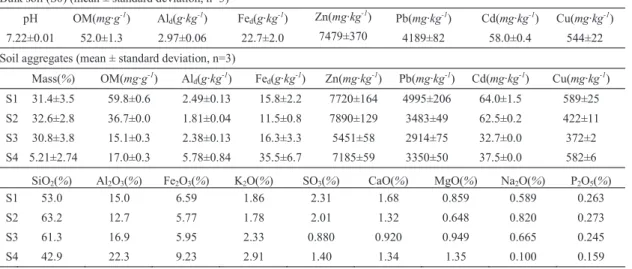
(expressed as the contents of the corresponding oxides) in the aggregates were analyzed with X-ray fluorescence instrument (ARL-9800, ARL, Switzerland). XRD spectrum of the aggregates was also analyzed with X-ray Diffraction instrument (X'TRA, ARL, Switzerland). The results are shown in Table 1 and Fig .1.

2.2.Extraction experiment

Extraction of heavy metals with different extraction time. The EDTA / total heavy metals (Zn+

Pb+ Cu+ Cd) molar ratio was set as 1 for all extraction experiments. 5mL EDTA (Na2EDTA in 0.01mol

L-1KNO

3) solution was added into 7 mL PE tube containing 0.1 g soil sample, followed by shaking on a

(3)

and 24h. All the treatments were triplicate. Then the extraction tubes were centrifuged at 4000r min-1 for

15min. The supernate was filtered through 0.45 μm membrane and then kept in PE tube at 4ć in

refrigerator. Concentrations of heavy metals in the solution were determined by ICP-OES (Zn, Cu and Pb) or ICP-MS (Cd).

Extraction of heavy metals with EDTA solution of different pH value. The pH values of the EDTA

extraction solutions were adjusted using NaOH solution and HNO3 solution and set as 3.00, 4.00, 5.00,

6.00, 7.00, 8.00, and 9.00. The extraction systems were shaken for 24h. Other treatments were the same as described above.

Metal fractionations in soil size fractions after EDTA extraction. 25mL EDTA (in 0.01mol L -1KNO

3, pH7.0) solution was added into 50mL PE tube contained 0.5g soil or soil aggregate sample. The

control treatments were set without EDTA. The extraction was the same as described above. After washed with distilled water, the residual soil samples were analyzed with modified BCR sequential

extraction procedure described by Rauret et al (2000) to determine the heavy metals’ fractionations [16].

All the treatments were triplicate.

Table 1. Properties of the test soil sample. Bulk soil (S0) (mean ± standard deviation, n=3)

pH OM(mg·g-1) Al

d(g·kg-1) Fed(g·kg-1) Zn(mg·kg

-1)

Pb(mg·kg-1) Cd(mg·kg-1) Cu(mg·kg-1) 7.22±0.01 52.0±1.3 2.97±0.06 22.7±2.0 7479±370 4189±82 58.0±0.4 544±22 Soil aggregates (mean ± standard deviation, n=3)

Mass(%) OM(mg·g-1) Al d(g·kg-1) Fed(g·kg-1) Zn(mg·kg-1) Pb(mg·kg-1) Cd(mg·kg-1) Cu(mg·kg-1) S1 31.4±3.5 59.8±0.6 2.49±0.13 15.8±2.2 7720±164 4995±206 64.0±1.5 589±25 S2 32.6±2.8 36.7±0.0 1.81±0.04 11.5±0.8 7890±129 3483±49 62.5±0.2 422±11 S3 30.8±3.8 15.1±0.3 2.38±0.13 16.3±3.3 5451±58 2914±75 32.7±0.0 372±2 S4 5.21±2.74 17.0±0.3 5.78±0.84 35.5±6.7 7185±59 3350±50 37.5±0.0 582±6

SiO2(%) Al2O3(%) Fe2O3(%) K2O(%) SO3(%) CaO(%) MgO(%) Na2O(%) P2O5(%)

S1 53.0 15.0 6.59 1.86 2.31 1.68 0.859 0.589 0.263

S2 63.2 12.7 5.77 1.78 2.01 1.32 0.648 0.820 0.273

S3 61.3 16.9 5.95 2.33 0.880 0.920 0.949 0.665 0.245

S4 42.9 22.3 9.23 2.91 1.40 1.34 1.35 0.100 0.159

3.Results and discussion

3.1.Desorption of Zn, Pb, Cd and Cu at different time

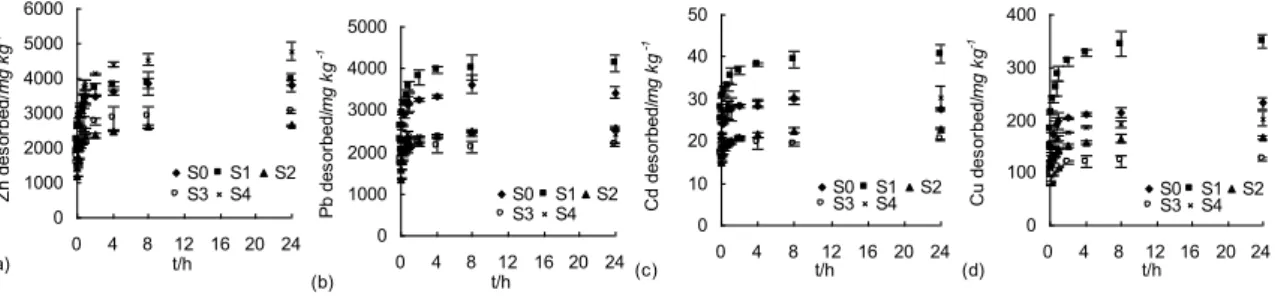
Fig. 2 shows the extraction of Zn, Pb, Cd and Cu with EDTA at different time. Extractable contents of

metals with EDTA from the soil fractions follow the order of S4 > S1 ĬS0 > S3 > S2 for Zn, S1 > S0 >

S2 ĬS4 > S3 for Pb, S1 > S4 ĬS0 > S2 > S3 for Cd, and S1 > S0 > S4 > S2 > S3 for Cu, respectively.

About 51.5% (S1), 33.5% (S2), 55.9% (S3) and 66.3% (S4) of Zn were extracted at time 24h. Pb had the highest extraction efficiency at time 24h, 82.7% (S1), 73.6% (S2), 75.0% (S3), and 72.2% (S4), among the four tested metals. For Cu, the extraction efficiency from S1 was much higher than from the aggregates of other size. For Cd, the extraction efficiency from S4 was the highest, while the lowest from S2.

The kinetic dependence of extraction of the four metals could be well described by Elovich formula (Table 2). Heavy metals may exist in soils as absorbed ions, simplex minerals of carbonates, hydroxide,

(4)

Fig. 1. XRD spectrum of the aggregates separated .

Fig. 2. Contents of heavy metals extracted with different extraction time.

Table 2. Kinetic dependence of the desorption of the metals described by Elovich formula (S=A+ Blnt).

S0 S1 S2 S3 S4 R2 B R2 B R2 B R2 B R2 B Zn 0.880** 307±40 0.931** 346±33 0.913** 239±26 0.953** 247±19 0.951** 463±37 Pb 0.859** 238±34 0.944** 304±26 0.934** 191±18 0.794* 71.0±12.8 0.768* 56.3±11.0 Cd 0.747* 1.35±0.28 0.964** 2.48±0.17 0.968** 1.29±0.08 0.758* 0.529±0.106 0.951** 0.851±0.068 Cu 0.906** 19.6±2.6 0.956** 33.5±2.5 0.925** 13.7±1.4 0.938** 7.84±0.71 0.974** 15.1±0.9

S: amount of the metals desorbed at time t (mg kg-1); t: time (min)

*:p<0.01; **:p<0.001

and sulfide and so on, or are combined in the matrix of other minerals and organics [17-18]. Therefore, desorption of the metals from the contaminated soil is controlled by different processes: diffusion of the ions in the solid particulates or on the solid surface, reactions of the minerals and the extractor. Elovich formula is an empirical equation, useful in describing reactions composed of a series of complex processes, especially reactions occurring on the solid/liquor interface of soil/water and sediment/water. In current study, though specific complex forms of the tested metals in the samples were unknown, it was obvious that the tested metals appeared in the samples with various forms of different mobility (Fig. 4). So desorption of the heavy metals from both the bulk soil and the soil aggregates could all fit the Elovich

formula well. Value of constant B implied the reaction rate – bigger B, higher reaction rate [19-20]. The

(a) 0 1000 2000 3000 4000 5000 6000 0 4 8 12 16 20 24 t/h Z n des or bed/ mg k g -1 S0 S1 S2 S3 S4 (b) 0 1000 2000 3000 4000 5000 0 4 8 12 16 20 24 t/h P b des or bed/ mg k g -1 S0 S1 S2 S3 S4 (d) 0 100 200 300 400 0 4 8 12 16 20 24 t/h C u des or bed/ mg k g -1 S0 S1 S2 S3 S4 (c) 0 10 20 30 40 50 0 4 8 12 16 20 24 t/h C d des or bed/ mg k g -1 S0 S1 S2 S3 S4

(5)

highest desorption rate appeared in the extraction of S4 for Zn and S1 for Pb, Cd, and Cu, and the lowest desorption rate appeared in extraction of S2/S3 for Zn, S4/ S3 for Pb, and S3 for Cd and Cu.

3.2.Extraction of heavy metals with EDTA solution of different pH value

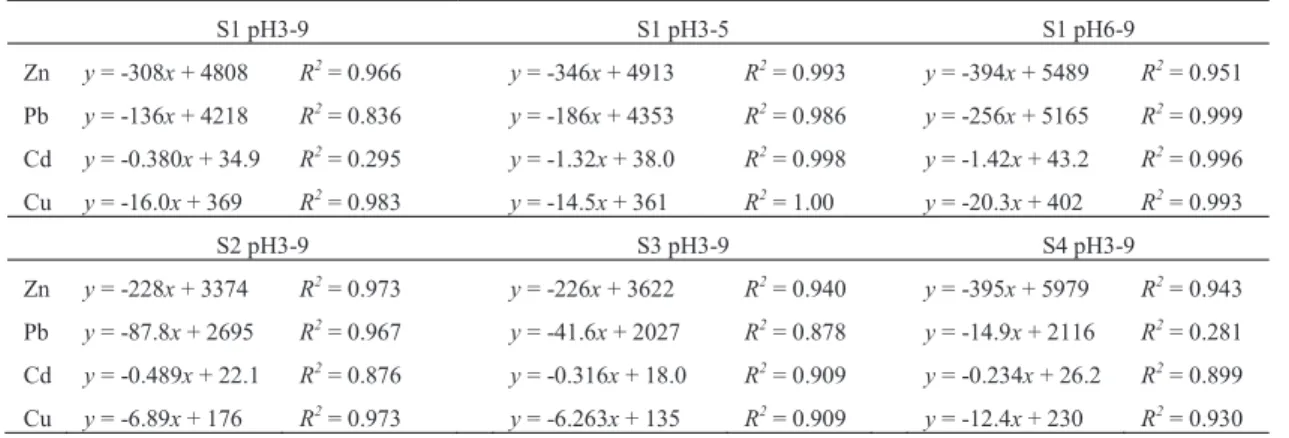
Fig. 3 shows the extraction of Zn, Pb, Cd and Cu with EDTA solution of different pH. There were significant decreases of Zn and Cu contents extracted when pH of EDTA solution changes from 3 to 4 for aggregates of all sizes investigated. When pH value of EDTA solution increased from 5 to 9, the contents of Zn and Cu extracted decreased gradually for S2, S3 and S4, and Pb the same. There were no significant differences (P>0.05) between the contents of Zn or Cu extracted at pH 4 and pH5 from S2, S3 or S4. The contents of Cd extracted varied slightly when pH of EDTA solution exchanged from 3 to 9 for S2, S3 or S4. The four metals extracted from S1 decreased significantly when pH of EDTA solution exchanged from 3 to 5. Then Cd or Pb extracted from S1 increased at pH6, while Zn or Cu extracted from S1 at pH6 were close to their contents extracted at pH 5. From pH 6 to pH 9, contents of the four metals extracted from S1 decreased gradually. Generally, desorption of the heavy metals will decrease when pH value of the extractor goes up, as many metal compound has lower solubility at higher pH. Consequently, the extraction amount of the four target metals decreased when pH of EDTA solution increased, although EDTA may have higher the extraction ability at higher pH. The extracted contents of the metals and pH value of EDTA solution were linearly correlated. However, it may be more suitable to describe the relationship between Cd or Pb amount extracted and EDTA pH value with different equations at pH3 to pH5 and pH 6 to pH9 for S1 (Table 3).

Fig. 3. Content of Zn, Pb, Cd and Cu extracted with EDTA solution of different pH.

Table 3. Regression using linear equation(x– pH; y–amount of heavy metals extracted, mgkg-1).

S1 pH3-9 S1 pH3-5 S1 pH6-9 Zn y = -308x + 4808 R2 = 0.966 y = -346x + 4913 R2 = 0.993 y = -394x + 5489 R2 = 0.951 Pb y = -136x + 4218 R2 = 0.836 y = -186x + 4353 R2 = 0.986 y = -256x + 5165 R2 = 0.999 Cd y = -0.380x + 34.9 R2= 0.295 y = -1.32x + 38.0 R2= 0.998 y = -1.42x + 43.2 R2= 0.996 Cu y = -16.0x + 369 R2 = 0.983 y = -14.5x + 361 R2 = 1.00 y = -20.3x + 402 R2 = 0.993 S2 pH3-9

S3 pH3-9 S4 pH3-9 Zn y = -228x + 3374 R2 = 0.973

y = -226x + 3622 R2 = 0.940 y = -395x + 5979 R2= 0.943 Pb y = -87.8x + 2695 R2 = 0.967

y = -41.6x + 2027 R2 = 0.878 y = -14.9x + 2116 R2 = 0.281 Cd y = -0.489x + 22.1 R2 = 0.876

y = -0.316x + 18.0 R2 = 0.909 y = -0.234x + 26.2 R2 = 0.899 Cu y = -6.89x + 176 R2 = 0.973

y = -6.263x + 135 R2 = 0.909 y = -12.4x + 230 R2 = 0.930 (a) 1000 2000 3000 4000 5000 6000 2 3 4 5 6 7 8 9 10 pH Zn / mg k g -1 S0 S1 S2 S3 S4 (b) 1500 2000 2500 3000 3500 4000 4500 2 3 4 5 6 7 8 9 10 pH Pb / mg k g -1 S0 S1 S2 S3 S4 (c) 10 15 20 25 30 35 40 45 2 3 4 5 6 7 8 9 10 pH Cd / mg k g -1 S0 S1 S2 S3 S4 (d) 50 100 150 200 250 300 350 400 2 3 4 5 6 7 8 9 10 pH Cu / mg k g -1 S0 S1 S2 S3 S4

(6)

3.3.Effects of EDTA extraction on the fractionation of the tested metals

Extraction with EDTA resulted in the significant reduction of exchangeable/acid soluble Zn, exchangeable/acid soluble and reducible fraction of Pb, Cd and Cu (Fig. 4). It has been reported that exchangeable/acid soluble fraction and reducible fraction are the main fractions that affected by chelating agents during column extraction and batch experiment [21-23]. In present study, most of the extracted Zn or Cd by EDTA was from exchangeable/acid soluble fraction, while most of the extracted Pb was from reducible fraction. Both exchangeable/acid soluble fraction and reducible fraction contributed significantly to the amount of EDTA extracted Cu. According to the modified BCR sequential extraction procedure, metals liberated in step 1 (0.11M acetic acid) (B1) consisted of exchangeable ions and carbonates, and reducible fraction (B2) comprised hydroxide or oxide related to Fe/Mn oxides [18, 24]. Of course, exchangeable ions can be desorbed by chelating agents. Solubility of the carbonates will greatly increase at the presence of chelating agents [25]. Therefore, exchangeable/acid soluble fraction is more easily extracted by EDTA. Metal oxide can also react with chelating agents, resulting in the release of the associated metals [11]. Compared with B1 and B2 fraction, it is rather difficult for B3 fraction (associated with the sulfide and the organics) and the residual fraction (combined in the matrix of the crystal) to release at the presence of chelating agents, considering their combined phase.

Fig. 4. Fractions of Zn, Pb, Cd and Cu in soil samples analyzed with BCR sequncial extraction procedure after extraction with EDTA (B1 – exchangeable/acid soluble fraction, B2 – reducible fraction, B3 – oxidizible fraction, R – residual fraction).

4.Conclusions

Desorption of heavy metals from soil aggregates of a lead/zinc tailing soil with EDTA was carried out. Extraction of heavy metals with different extraction time shows that extractable content of heavy metals was the highest in S2 for Zn or S3 for Pb, Cd and Cu, while lowest extraction efficiency was found in S2 for Zn, Pb and Cd or S3 and S4 for Cu, considering the total amount of the concerned metals in the aggregates. The extraction kinetics of the four metals could be well fitted with Elovich formula. The highest desorption rate appeared in the extraction of S4 for Zn and S1 for Pb, Cd, and Cu, and the lowest appeared in extraction of S2 and S3 for Zn, S4 and S3 for Pb, and S3 for Cu. The extraction of the tested metals strongly depended on the original pH value of EDTA extraction solution. Extractable metal contents decreased with pH value. Exchangeable/acid soluble fraction and reducible fraction of four soil metals were mainly affected by EDTA extraction.

(a) 0 1000 2000 3000 4000 5000 6000 CK ED T A CK ED T A CK ED T A CK ED T A CK ED T A S0 S1 S2 S3 S4 Zn / mg k g -1 B1 B2 B3 R (b) 0 1000 2000 3000 4000 5000 6000 CK ED T A CK ED T A CK ED T A CK ED T A CK ED T A S0 S1 S2 S3 S4 Pb / mg k g -1 B1 B2 B3 R (c) 0 10 20 30 40 50 CK ED T A CK ED T A CK ED T A CK ED T A CK ED T A S0 S1 S2 S3 S4 Cd / mg k g -1 B1 B2 B3 R (d) 0 100 200 300 400 CK ED T A CK ED T A CK ED T A CK ED T A CK ED T A S0 S1 S2 S3 S4 Cu / mg k g -1 B1 B2 B3 R

(7)

Acknowledgements

The work was supported by the National Natural Science Fund of China (21007026).

References

[1]Alam MGM., Snow ET and Tanaka A. Arsenic and heavy metal contamination of vegetables grown in Samata village, Bangladesh. Sci Total Environ 2003; 308: 83-96.

[2]Uraguchi, S., Watanabe, I., Yoshitomi, A., Kiyono, M. and Kuno, K. Characteristics of cadmium accumulation and tolerance in novel Cd-accumulating crops, Avena strigosa and Crotalaria juncea. J Exp Bot 2006; 57: 2955-2965.

[3]Lowry GV, Shaw S, Kim CS, Rytuba JJ, Brown GE. Macroscopic and microscopic observations of particle-facilitated mercury transport from New Idria and Sulphur Bank mercury mine tailings. Environ Sci Technol 2004; 38:5101-5111.

[4]Moncur MC, Ptacek CJ, Blowes DW, Jambor JL. Release, transport and attenuation of metals from an old tailings impoundment. Appl Geochem 2005; 20:639-659.

[5]Romero FM, Armienta MA, Gonzalez-Hernandez JL. Solid-phase control on the mobility of potentially toxic elements in an abandoned lead/zinc mine tailings impoundment, Taxco, Mexico. Appl Geochem 2007; 22:109-127.

[6]Rodrguez L, Ruiz E, Alonso-Azcaratec J, Rincon J. Heavy metal distribution and chemical speciation in tailings and soils around a Pb-Zn mine in Spain. J Environ Manag 2009; 90:1106-1116.

[7]Ilg, K., Wilcke, W., Safronov, G., Lang F, Fokin A, Kaupenjohann M. Heavy metal distribution in soil aggregates, a comparison of recent and archived aggregates from Russia. Geoderma 2004; 123: 153-162.

[8]Ajmone-Marsan F, Biasioli M, Kralj T, Grěman H, Davidson CM, Hursthouse AS, Madrid L, Rodrigues S. Metals in particle-size fractions of the soils of five European cities. Environ Pollut 2008; 152: 73-81.

[9]Fedotov, G.N., Omel’yanyuk, G..G., Bystrova, O.N., et al. Heavy-metal distribution in various types of soil aggregates. Doklady Akademii Nauk 2008; 420(3): 346-350.

[10]Wang, F., Pan, G..X., Li, L.Q. Effects of free iron oxyhydrates and soil organic matter on copper sorption-desorption behavior by size fractions of aggregates from two paddy soils. Ch J Environmental Sciences 2009; 21: 618-624

[11]Nowack B. Environmental Chemistry of Aminopolycarboxylate Chelating Agents. Environ. Sci. Technol., 2002; 36(19): 4009-4016.

[12]Tandy, S., Bossart, K., Mueller, R., Ritschel, J., Hauser, L., Schulin, R. and Nowack, B. Extraction of heavy metals from soils using biodegradable chelating agents. Environ Sci Technol 2004; 38: 937-944.

[13]Polettini, A., Pomi, R. and Rolle, E. The effect of operating variables on chelant-assisted remediation of contaminated dredged sediment. Chemosphere 2007; 66: 866-877.

[14]Balabane M, Plante A. Aggregation and carbon storage in silty soil using physical fractionation techniques. European journal of soil science 2004; 55(2): 415-427.

[15]Lu, R.K. Analitical methods for soil and agrochemistry. Chinese agricultural Science and Technology Press, Beijing. 2000 (in Chinese)

[16]Rauret, G., López-Sánchez, J.F., Sahuquillo, A., Barahona, E., Lachica, M., Ure, A.M., Davidson, C.M., Gomez, A., Lu¨ck, D., Bacon, J., Yli-Halla, M., Muntau, H. and Quevauviller, P. Application of a modified BCR sequencial extraction (three-step) procedure for the determination of extractable trace metal contents in a sewage sludge amended soil reference material (CRM483), complemented by a three-year stability study of acetic acid and EDTA extractable metal content. J Environ Monit 2000; 2: 228-233.

[17]Tessier, A., Campbell, P.G.C. and Bisson, M. Sequential extraction procedure for the speciation of particulate tracemetals. Anal Chem 1979; 51: 844-851.

[18]Cappuyns, V., Swennen, R. and Niclaes, M. Application of the BCR sequential extraction scheme to dredged pond sediments contaminated by Pd-Zn mining: A combined geochemical and mineralogical approach. J Geochem Explor 2007; 93: 78-90. [19]Tu C. Equations of chemical kinetics and their application to soil system. Ch J Tropical and Subtropical Soil Science 1994; 3(3):

175-182. (in Chinese)

[20]Yu QF. Chemical kinetics in soil and clay. Ch J Soil Science 1992; 23(2): 92-96. (in Chinese)

[21]Tandy, S., Schulin, R., Nowack, B., Column extraction of heavy metals from soils using the biodegradable chelating agent EDDS. Environ Sci Technol 2005; 39(17): 6819-6824.

[22]Ding ZH, Hu X, Extraction of Metals Using EDTA, DTPA and NTA and Its Effects on Metals' Fractions. Ch. J. Agro-Environment Science 2009; 28(10): 2075-2079. (in Chinese)

[23]Ding ZH, Hu X, Wu X, Yin DQ. Metal contents and fractionation in contaminated soil after column leaching using [S,S]-EDDS. Chemical Speciation and Bioavailability 2010; 22(4): 247-255.

[24]Gleyzes, C., Tellier, S. and Astruc, M. Fractionation studies of trace elements in contaminated soils and sediments: a review of sequential extraction procedures. Trends Anal Chem 2002; 21: 451 –467.

Figure

Table 1. Properties of the test soil sample.
Table 2. Kinetic dependence of the desorption of the metals described by Elovich formula    (S=A+ Blnt)
Fig. 3. Content of Zn, Pb, Cd and Cu  extracted with EDTA solution of different pH.
Fig. 4. Fractions of Zn, Pb, Cd and Cu in soil samples analyzed with BCR sequncial extraction procedure after extraction with  EDTA (B1 – exchangeable/acid soluble fraction, B2 – reducible fraction, B3 – oxidizible fraction, R – residual fraction)

References

Related documents

The main objectives of this study were to evaluate the degree of Pb, Cu, Zn, Cd, Cr and Ni pollution using pollution indexes and geostatistical approach, and to assess metals

Keputusan pencernaan ultrasonik menunjukkan pada pecahan 1, Cu, Pb dan Zn memberikan dapatan yang tertinggi dalam masa 40 minit, sementara Cd, Cr dan Ni telah didapati

Two differently contaminated soils – Fluvisol (fluvial contamina- tion) and Cambisol (atmospheric contamination) – were used for the detection of Pb, Cd, and Zn mobilization

The water samples were analysed for eight metals, namely, Cu, Mn, Cd, Pb, Zn, Cr, Fe and As from four different groundwater sources of Lachchiwala Gram

The results obtained from heavy metals determination in this research showed that concentration of Pb from (97.3) to (266) ppm ,Cd concentration was from (7.3) to (13.9) ppm ,

In this study, the contents of five representative heavy metals (Cr, Pb, Zn, Cd and Cu) were deter- mined in soil and propolis samples from four locations in southwestern

Ethylenediaminetetraacetic acid (EDTA) is an effective chelating agent in removing heavy metals from contaminated soils, although extraction efficiency depends on many

So this study was carried out the following objectives: (1) to determine the concentrations of Cd, Co, Cr, Fe, Cu, Mn, Zn, Ni, Pb and Al in soils from major