Finding Security Bugs in Web Applications using a
Catalog of Access Control Patterns
Citation
Near, Joseph P., and Daniel Jackson. "Finding Security Bugs in
Web Applications using a Catalog of Access Control Patterns."
38th International Conference on Software Engineering (May
2016).
As Published
http://2016.icse.cs.txstate.edu/technical-research
Publisher
Association for Computing Machinery (ACM)
Version
Author's final manuscript
Accessed
Sun Jun 12 12:11:55 EDT 2016
Citable Link
http://hdl.handle.net/1721.1/102281
Terms of Use
Creative Commons Attribution-Noncommercial-Share Alike
Detailed Terms
http://creativecommons.org/licenses/by-nc-sa/4.0/
The MIT Faculty has made this article openly available.
Please share
how this access benefits you. Your story matters.
Finding Security Bugs in Web Applications using a
Catalog of Access Control Patterns
Joseph P. Near
University of California, Berkeley
[email protected]
Daniel Jackson
Massachusetts Institute of Technology
[email protected]
ABSTRACT
We propose a specification-free technique for finding missing security checks in web applications using acatalog of access control patterns in which each pattern models a common access control use case. Our implementation,Space, checks that every data exposure allowed by an application’s code matches an allowed exposure from a security pattern in our catalog. The only user-provided input is a mapping from application types to the types of the catalog; the rest of the process is entirely automatic. In an evaluation on the 50 most watched Ruby on Rails applications on Github,Space reported 33 possible bugs—23 previously unknown security bugs, and 10 false positives.
Categories and Subject Descriptors
D.2.4 [Software Engineering]: Software/Program Verifi-cation
Keywords
web application security, access control, bug finding
1
Introduction
Web application security holes represent a large and growing class of bugs. Programming frameworks and static analysis tools have begun to address bugs that violate generic, cross-application specifications (for example, injection, cross-site scripting and overflow vulnerabilities). However, applica-tion-specific bugs (like missing security checks) have received less attention. Traditional solutions, such as verification and dynamic policy-enforcement techniques, ask the user to write a specification of the intended access control policy.
We propose a specification-free technique for finding appli-cation-specific security bugs using acatalog of access control patterns. Each pattern in our catalog models a common access control use case in web applications. Our catalog is based on the assumption that developers usually intend for a particular pattern to be applied uniformly to all uses of a given resource type—an assumption supported by our Permission to make digital or hard copies of all or part of this work for personal or classroom use is granted without fee provided that copies are not made or distributed for profit or commercial advantage and that copies bear this notice and the full citation on the first page. Copyrights for components of this work owned by others than the author(s) must be honored. Abstracting with credit is permitted. To copy otherwise, or republish, to post on servers or to redistribute to lists, requires prior specific permission and/or a fee. Request permissions from [email protected].
ICSE ’16, May 14 - 22, 2016, Austin, TX, USA c
2016 Copyright held by the owner/author(s). Publication rights licensed to ACM.
ISBN 978-1-4503-3900-1/16/05. . . $15.00
DOI:http://dx.doi.org/10.1145/2884781.2884836
experience with real-world applications.
Our approach checks that for every data exposure allowed by an application’s code, our catalog also allows the ex-posure. When the application allows a data exposure not allowed by the catalog, we report that exposure as a secu-rity bug. This process requires only that the user provide a mapping of application resources to the basic types (such as user, permission, etc.) that occur in our catalog. From this information alone, application-specific security bugs are identified automatically.
We have implemented this technique inSpace (Security Pattern Checker). Space uses symbolic execution to ex-tract the set of data exposures [25] from the source code of a Ruby on Rails application. The constraints associ-ated with these exposures and the user-provided mapping are passed through a constraint specializer, which re-casts the constraints in terms of the types in our pattern catalog. Then,Spaceuses the Alloy Analyzer to perform automatic bounded verification that each data exposure allowed by the application is also allowed by our catalog.
We applied Space to the 50 most watched open-source Rails applications on Github. We found that 30 of the 50 implement access control, and Space found bugs in 8 of those 30—a total of 23 unique bugs. Both the symbolic execution and bounded verification steps of our technique scale to applications as large as 45k lines of code—none of our analyses took longer than 64 seconds to finish.
This paper makes the following contributions:
• A highly automated technique for finding security bugs based on the idea of matching extracted access pat-terns to known safe patpat-terns;
• An initial catalog of common security patterns, based on those we encountered in an analysis of real-world applications;
• An open-source implementation,1Space, that has been used to find previously unknown bugs in open-source Rails applications.
In section 2, we describeSpacefrom the user’s perspec-tive and demonstrate its use to find a bug. In section 3, we formalize our catalog of patterns and the technique used to check them against an application. Section 4 describes our implementation of Space, and section 5 details our evalu-ation of its effectiveness. In section 6, we discuss related work, and section 7 contains our conclusions.
1
class UserController < ApplicationController
before filter : signed in user , : only =>[:show, : edit , : update]
before filter : correct user , : only =>[:show, : edit ] ...
defshow
@user = User.find (params[: id ])
@posts = find posts by user id @user. id @editing =true if signed in ?
end def edit
@user = User.find (params[: id ]) @url = ’/user/’ + params[:id]
end defupdate
@user = User.find (params[: id ])
if @user. update attributes (user params)
redirect to @user, success : ’ Editing successful ! ’
else
redirect to edit user path (@user. id ) , error : ’ Editing failed ! ’
end end end
Figure 1: Controller Code for MediumClone
2
Description & Example
Space (Security Pattern Checker) finds security bugs in Ruby on Rails2web applications, and requires only that the user provide a mapping from application-defined resource types to the object types of the standard role-based model of access control (RBAC) [30, 15]. Spaceis otherwise com-pletely automatic: it analyzes the target application’s source code and returns a list of bugs.
Spaceis designed primarily to find mistakes in the imple-mentation of an application’s security policy. Most often, these mistakes take the form of missing security checks. In this section, we describe an example open-source applica-tion (MediumClone) and demonstrate how we usedSpace to find security bugs in its implementation.
2.1
Example Application: MediumClone
MediumClone3 is a simple blogging platform designed to mimic the popular web site Medium. Using MediumClone, users can read posts and log in to create new posts or update existing ones. The site requires users to sign up and log in before writing posts, and prevents users from modifying others’ posts.
A Rails application is composed ofactions, each of which handles requests to a particular URL within the applica-tion.Controllers are collections of actions; each controller’s actions implement an API for interacting with aresource ex-posed by the site. Resources are defined using the ActiveRe-cordlibrary, which implements anobject-relational mapper to persist resource instances using a database, and which provides a set of built-in methods for querying the database for resource instances.
Figure 1 contains a part of the controller code for Medi-umClone’s UserController, which provides a RESTful API for user profiles. Following the REST convention, theshow 2http://rubyonrails.org/
3
https://github.com/seankwon/MediumClone
action is for displaying profiles, the editaction displays an HTML form for editing the profile, and submitting that form results in a POST request toupdateaction, which actually performs the database update (using update attributes). The call to before filter installs afilter—a procedure that runs before the action itself—for theshow andeditactions. The filter checks that the logged-in user has permission to per-form the requested action, and redirects them to an error page if not. This use of filters to enforce security checks is common in Rails applications, and helps to ensure that checks are applied uniformly.
MediumClone’s Security Bug. The code in Figure 1 fails to apply the correct user filter to theupdateaction, so an attacker can send an HTTP POST request directly to the update URL of the MediumClone site to update any user profile. The filter is properly applied to the edit ac-tion. In our experience, this kind of mistake is common: the developer assumes the user will use the interface provided by the site (in this case, the editpage), and will not craft malicious requests to constructed URLs. Developers often fail to consider alternative paths not accessible through the interface, and therefore omit vital security checks.
Finding the Bug Using Space. Space compares the checks present in the application code against its built-in catalog of common security patterns. When the applica-tion code is missing security checks required by the patterns, Spacereports a bug in the code.
Space’s security patterns are formalized in terms of role-based access control (RBAC), which defines sets of users, roles, operations, objects, andpermissions. Space’s formal models of security patterns enforce security checks by con-straining relations between these sets. In order to check these patterns against a piece of code, the user provides a mapping of the application’s resources to the sets of objects defined in the RBAC model. MediumClone’sUsertype rep-resents theUser type in the RBAC pattern, andPostsare special RBAC objects that have an owner. Theowns rela-tion is defined by our model of ownership, and user: owns
means that theuser field of aPostspecifies its owner. The user provides this mapping for MediumClone as follows:
Space.analyze do
mapping User: RBACUser,
Post: OwnedObject(user: owns)
end
Space requires the mapping above and MediumClone’s source code—it needs no further input or guidance from the user. The mapping provided by the user translates between the RBAC objects constrained by the pattern catalog and the resource types defined in the application code. Space uses this mapping to specialize the constraints derived from the checks present in the code to the set of RBAC objects, so that the two sets of security checks can be compared.
Space compares the specialized constraints against the constraints required by the pattern catalog. When Space finds a missing check, it builds a counterexample demon-strating the security vulnerability caused by the missing check. The counterexample is specific to the application code under analysis: it involves resource types defined in the code, rather than RBAC concepts.
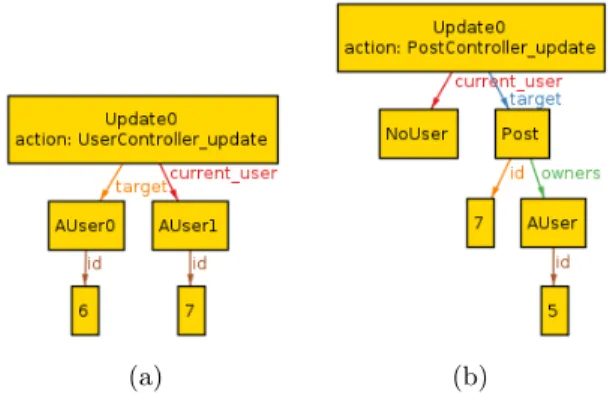
For MediumClone, Space produces the counterexample shown in Figure 2(a). The “Update0” box indicates that an update is possible on the profile of “AUser0” (the “target”—a
(a) (b)
Figure 2: Space Counterexample Showing Medium-Clone Security Bugs: (a) user can update another user’s profile; (b) unauthenticated user (“NoUser”) can update any post
renaming of “User” to avoid clashes) by the distinct “AUser1” (the “current user”, or currently logged-in user). This coun-terexample demonstrates a user updating another user’s pro-file using theupdateaction—a situation that is not captured by our security pattern catalog. The User Profile Pattern explicitly requires that users can update their own profiles, but no pattern exists that allows updating another user’s profile. The bug can be fixed by adding:updateto the list of actions for which the : correct user filter is applied. More Bugs in MediumClone. Fixing the bug and run-ning Space again yields a new counterexample, shown in Figure 2(b). This counterexample suggests that Post re-sources in MediumClone can be updated not only by users who did not create them, but by users who are not logged in (“NoUser”) at all! The code forPostControllerchecks that the user is logged in before performing thenew, create,and
editactions, but omits this check for theupdateaction: class PostController < ApplicationController
before filter : signed in user , : only =>[:new, :create , : edit ]
...
end
This bug is interesting because the intended security policy— that users only modify their own posts—is forgotten across the entire application codebase. This mistake exemplifies a class of bugs that are difficult to detect with testing or with our previously-developed consistency checker, Derailer [25].
3
Formal Model
This section formalizes our catalog andSpace’s method for comparing it to a web application’s code. The first step is to derive a list ofdata exposures from the application code, representing the different ways users of the application can read or update data stored in the database. Second,Space uses themappingdefined by the user to specialize each expo-sure’s constraints to the objects constrained by the catalog. Finally,Space verifies that each data exposure allowed by the application code is also allowed by the catalog.
3.1
Web Applications
We consider web applications in terms of sets ofDatabases, Requests, and Resources. An application defines relations response and update describing (in the context of a given database) the resources sent to the requester and updated
in the database, respectively. Note that the updates do not specify the resulting state of the database; our concern is only whether modifications can be made to particular re-sources, and not the actual values of those modifications.
Databases ⊆ P(Resources×Values)
response ⊆ Databases×Requests×Resources update ⊆ Databases×Requests×Resources Spaceapproximates these relations by using symbolic ex-ecution to build theexposuresrelation, representing the ap-plication’s set of data exposures:
Operations = {read,write}
Constraints ⊆ first-order predicates over requests and databases
exposures ⊆ Requests×Constraints×
Operations×Resources
The exposures relation characterizes the conditions (φ) under which the application code allows a particular re-source to be read or written. The formula (db, req, res) ∈
response⇒φmeans that if the application exposes resource
res, itmust be under conditionsφ.
∀db, req, res, φ .((db, req, res)∈response⇒φ) ⇐⇒
(req, φ,read, res)∈exposures
∀db, req, res, φ .((db, req, res)∈update⇒φ) ⇐⇒
(req, φ,write, res)∈exposures
Spacebuilds theexposuresrelation by symbolically eval-uating each action of the web application under analysis, passing symbolic values for the database and user-supplied parameters. Spaceenumerates the symbolic values that can appear on a rendered page and constructs an exposure for each one. These exposures have the form (req, φ,read, res), wherereqis the original symbolic request,φis the path con-dition derived from the symbolic execution, andres is the symbolic expression representing the exposed resource. Sim-ilarly, whenSpacefinds a database update, it constructs an exposure of the form (req, φ,write, res), wherereqis the re-quest,φis the current path condition, andresis a symbolic expression representing the resource being updated. Example. As a running example, we take MediumClone’s
UserControllerbug from section 2. For this controller’s buggy
updateaction,Spacegenerates the exposure: (update(user.profile),true,write,user)
meaning that when the application receives a request to up-date a user profile ofuser, it performs the modification with-out enforcing any constraints. The exposure thatcorrectly enforces the desired security policy (by enforcing that the modified profile is the current user’s) is instead:
(update(user.profile),user=current user,write,user)
3.2
Role-Based Access Control
As a basis for representing security policies, we adopt the role-based access control model of Sandhu et al. [30] (specif-ically, RBAC0). The standard model of role-based access
control consists of setsUsers,Roles,Permissions, and Ses-sions, over which the following relations are defined to assign permissions and users to roles:
permissiona ⊆ Permissions×Roles usera ⊆ Users×Roles
We adopt the extension of this model by Ferraiolo et al. [15] withObjectsandOperations, whereObjectscontains the
targets of permissions (which will correspond to the web ap-plication’s resources) andOperations (for our applications) contains the operation typesreadandwritealready used in the definition of theexposures relation. This model defines Permissionsto be a set of mappings between operations (ei-therreadorwrite) and objects allowed by that permission:
Permissions = P(Operations×Objects)
3.3
Security Pattern Catalog
The patterns in our catalog constrain the relations of the generic RBAC model to specifically allow certain behaviors. Each one of these pattern definitions corresponds to a stan-dard use case for resources in web applications; in effect, the patterns “whitelist” common kinds of correct data accesses. Access Pattern 1: Ownership. In most applications, resources created by a user “belong” to that user, and a resource’s creator is granted complete control over the re-source. To express this use case, we define a relationowns between users and objects, and then allow those owners to perform both reads and writes on objects they own:
owns ⊆ Users×Objects
∀u, o .(u, o)∈owns⇒ ∃r .(u, r)∈usera∧
((read, o), r)∈permissiona∧
((write, o), r)∈permissiona
Access Pattern 2: Public Objects. Many applications make some resources public. A blog, for example, allows anyone to read its posts. This pattern definesPublicObjects to be a subset of the larger set ofObjects, and allows anyone to read (but not write) those objects:
PublicObjects ⊆ Objects
∀u, r, o, p . o∈PublicObjects∧(u, r)∈usera⇒ ((read, o), r)∈permissiona
Access Pattern 3: Authentication. Every application with access control has some mechanism for authenticating users, and many security holes are the result of the program-mer forgetting to check that the user is logged in before al-lowing an operation. To model authentication, this pattern defines logged in, a (possibly empty) subset of Users rep-resenting the currently logged-in users, and constrains the system to allow permission only for logged-in users (except for public objects):
logged in ⊆ Users
∀u, r, o, op, p .
(u, r)∈usera∧((op, o), r)∈permissiona⇒ (op=read∧o∈PublicObjects)∨
u∈logged in
Access Pattern 4: Explicit Permission. Some applica-tions define a kind of resource representing permission, and store instances of that resource in the database. Before al-lowing access to another resource, the application checks for the presence of a permission resource allowing the access. To model this use case, this pattern definesPermissionObjects to be a subset of Objects, defines a relation permits relat-ing a permission object to the user, operation, and object it gives permission to, and allows users to perform operations allowed by permission objects:
PermissionObjects ⊆ Objects
permits ⊆ PermissionObjects×Users×
Operations×Objects
∀u, o, p, op .(p, u, op, o)∈permits⇒
∃r .(u, r)∈usera∧((op, o), r)∈permissiona
Access Pattern 5: User Profiles. Applications with users tend to have profile information associated with those users. Programmers commonly forget checks requiring that the user updating a profile must be the owner of that profile; this pattern constrains the allowed writes so that no user can update another user’s profile:
profile⊆Users×Objects
∀u, p .∃r .(u, r)∈usera∧(u, p)∈profile∧ ((write, p), r)∈permissiona
Access Pattern 6: Administrators. Many applications distinguish a special class of users calledadministratorsthat have more privileges than normal users. We can represent these users with a special role calledAdmin, which grants its users full permissions on all objects:
Admin ∈ Roles
∀o .((read, o),Admin)∈permissiona∧
((write, o),Admin)∈permissiona
Access Pattern 7: Explicit Roles. A few applications specify distinct roles and represent them explicitly using a resource type. They then assign roles to users and allow or deny permission to perform operations based on these assigned roles. This pattern introduces a level of indirection to allow mapping these resource-level role definitions to the RBAC-defined set of roles:
RoleObjects ⊆ Objects
object roles ⊆ RoleObjects×Roles user roles ⊆ Users×RoleObjects
∀ro, r, u .(ro, r)∈object roles∧
(u, ro)∈user roles⇒
(u, r)∈usera
3.4
Mapping Application Resources to RBAC
Objects
To compare the operations allowed by an application to those permitted by our security patterns, a mapping is re-quired between the objects defined in the RBAC model and the resources defined by the application. In many cases, this mapping is obvious (a resource named “User” in the appli-cation, for example, almost always represents RBAC users), but in general it is not possible to infer the mapping directly. Spaceasks the user to define this mapping. Formally, it is a mapping fromtypesof application resources totypesof RBAC objects; the mapping is a relation, since some appli-cation resources may represent more than one type of RBAC object. The set of resource types can be derived from the ap-plication’s data model (which is present in its source code), and the set of RBAC object types is based on the formal model of RBAC defined here.
τResource = application-defined types
τRBAC = {User, Object, PermissionObject,
OwnedObject, PublicObject, RoleObject}
map ⊆ τResource×τRBAC
We also need to provide definitions from the application for the new concepts introduced in our pattern definitions: PublicObjects,PermissionObjects, and theownsandpermits
relations. Themaprelation can be used to define public and permission objects, but we must define a separate mapping from field names of resources to the corresponding relations they represent in our security patterns. We usemapfields for this purpose.
FieldNames = application-defined field names RelationNames = {owns, permits, logged in,
object roles, user roles}
mapfields ⊆ FieldNames×RelationNames Finally, we definesessionrelating web applicationRequests and the currently logged-in RBACUser:
session ⊆ Requests×Users
The session relation is needed to determine the currently logged-in user (if any—some requests are sent with no au-thentication) of the application. Since Rails has session management built in, this mapping can be inferred auto-matically.
Example. Based on the mapping provided for Medium-Clone in section 2,Spacepopulates the mapping relations as follows:
τResource = {MUser, MPost} map = ((MUser, User),
(MPost, OwnedObject)) FieldNames = {author, ...}
mapfields = ((author, owns))
3.5
Finding Pattern Violations
To find bugs in a given application, the goal is to find expo-sures that are not allowed by some security pattern. For each exposure inexposures, this process proceeds in two steps. To check exposure (req, φ, op, res):
1. Build aspecialized constraintφ0fromφby substituting RBAC objects for application resources using themap relation supplied by the user.
2. Determine whether or not some pattern allows the ex-posure by attempting to falsify the formula:
φ0⇒(u, r)∈usera⇒((op, obj), r)∈permissiona where u, r and obj are RBAC objects corresponding to the current user sendingreq and the resourceres. Intuitively, this formula holds when the conditions im-posed by the application imply that some pattern al-lows the exposure.
Buildingφ0. We usemap to build a specialized constraint
φ0 fromφas follows:
• Replace each reference resto an application resource inφwith an expression{τ|(res, τ)∈map} represent-ing the correspondrepresent-ing set of possible RBAC objects.
• Replace each field referenceo.f ldinφwith an expres-sion{o0|(f ld, r)∈mapfields∧(o
0
, o)∈r}representing a reference to the corresponding relation defined by our security patterns.
Intuitively, this means replacing references to application re-sources with the corresponding RBAC objects (based on the user-suppliedmap), and replacing references to fields of re-sources that represent object ownership, permission type, or permission for a particular object with formulas representing those concepts in terms of RBAC objects.
Checking Conditions.For each (req, φ, op, res)∈exposures:
• Let φ0 be the result of performing substitution on φ
using the user-suppliedmap.
• Let obj be the RBAC objects corresponding to the application resourceres, so that if (res, o)∈mapthen
o∈obj.
• Letube the current user, so that (req, u)∈session.
• LetC be the conjunction of all of the constraints de-fined by our pattern catalog.
• Then the following formula must hold:
C ∧φ0⇒ ∃r.(u, r)∈usera∧((op, obj), r)∈permissiona This process checks that if both the pattern catalog and the specialized condition hold, then the current user u is allowed to perform operation opon the RBAC object obj
corresponding to the resourceres acted upon by the appli-cation code. If a counterexample is found, it means that the application allows the user to perform a particular operation on some object, but no security pattern exists allowing that action. In other words, such a counterexample represents a situation that does not correspond to one of our common use-cases of web applications, and is likely to be a security bug.
Example. To check the buggy exposure in our running example, Space sets op = write, φ0 = true, obj = user, and u=current user. Then,Space attempts to falsify the formula:
C ∧ true⇒ ∃r.(current user, r)∈usera∧ ((write,user), r)∈permissiona
This formula is falsified by any assignment under which
user6=current userand usera andpermissiona do not give the current user permission to update user’s profile, since the user profile pattern requires only that the current user be able to update his or herownprofile. An example of such an assignment is the one that Space reports for this bug, shown earlier in Figure 2.
The exposure corresponding to thecorrect security policy, in contrast, yieldsφ0= (user=current user), so the formula to be falsified is:
C ∧ user=current user⇒ ∃r.(current user, r)∈usera∧ ((write,user), r)∈permissiona
Since this formula requires that the profile being updated is the current user’s, any assignment that falsifies it also falsi-fies the user profile pattern. Substituting the (specialized) user profile pattern forC results in a tautology:
∃r .(current user, r)∈usera∧
((write,current user), r)∈permissiona∧
user=current user⇒
∃r.(current user, r)∈usera∧ ((write,user), r)∈permissiona
4
Implementation
Our implemented tool, Space(SecurityPatternChecker), finds security bugs in Ruby on Rails web applications. Fig-ure 3 contains an overview of Space’s architecture. Space extracts the data exposures from an application using sym-bolic execution, specializes the constraints on those expo-sures to the types of role-based access control using the mapping provided by the user, and exports the specialized constraints to an Alloy specification. Then,Spaceuses the
SPACE Application Code Symbolic Evaluator Exposures Constraint Specializer Object Mapping Alloy Analyzer Specialized Constraints Access Control Patterns Bugs
Figure 3: Summary of the Architecture ofSpace
Alloy Analyzer—an automatic bounded verifier for the Al-loy language—to compare the specialized constraints to our pattern catalog (which is also specified in Alloy).
4.1
Symbolic Execution
Implementing a standalone symbolic evaluator is difficult for any language, but especially so for Ruby. Ruby is dynamic, has no formal specification, and changes quickly. Since Rails is a large library using nearly all of Ruby’s features, however, a symbolic evaluator for Ruby on Rails applications must implement all of those features too.
Rather than attempt to build a standalone symbolic eval-uator, we used a symbolic executionlibraryto coerce Ruby’s standard interpreter into performing symbolic execution. We developed this approach for Rubicon [24], which performed bounded verification of user-defined properties on Rails ap-plications, and Derailer [25], which interacts with the user to find mistakes in the uniform application of a security policy. We present a brief explanation of the library-based ap-proach to symbolic execution here for completeness. De-tailed descriptions of our approach to symbolic execution is available as part of our earlier work; a formal description of the technique, including an embedding in a simplified Ruby-like language with a formal semantics and a proof that it produces the same results as the standard approach to sym-bolic execution, is available in [26].
Symbolic Values. Our library defines Ruby classes for symbolic objects and expressions. When a program invokes a method on a symbolic object, Ruby’smethod missing fea-ture is used to produce a new symbolic expression.
defmethod missing(m,∗a) Exp.new(m, [self]+a)
end def==(o)
Exp.new(:==,[self,o ])
end end
class Exp<SymbolicObject
def initialize (m, a) @meth = m @args = a
end end
These class definitions define symbolic values, and can be used to perform simple symbolic execution. For example, the following three statements evaluate to (written⇒) the
result of symbolically evaluating the given method call: x = SymbolicObject.new
y = SymbolicObject.new x. foo(y)
⇒Exp(foo, [x, y ])
Similarly, since Ruby’s infix operators are interpreted as method calls, the symbolic evaluator we have defined works for these operators as well:
x+y == y+x ⇒Exp(==,[Exp(+,[x,y]),Exp(+,[y,x]) ]) Conditionals. Symbolic execution runs both branches of each conditional. Ruby does not allow redefining condition-als, so we rewrite the source code of the target application to call our own definition of if.
x = SymbolicObject.new if x.even?then (x+1).odd? end ⇒ Exp(if,[ Exp(even?,[x ]) , Exp(odd?,[Exp(+,[x,1]) ]) ])}
Side effects. Programs may perform side effects inside of conditionals; the results should be visible only if the con-dition holds. We split the current state into two versions, recording the condition and values using aChoiceobject.
x = SymbolicObject.new
if x.even?thenx = 1
else x = 2end
x
⇒ Choice(Exp(even?,[x ]) ,1,2)
4.2
Analyzing Rails Applications
Space symbolically evaluates each action in a Rails appli-cation and collects the set of symbolic objects appearing on a page or written to the database. These symbolic objects represent the set of possible exposures of the application. Wrapping ActiveRecord. Rails applications interact with the database using ActiveRecord, an object-relational map-per (ORM) that provides methods like “find” and “all.” These methods are wrappers around database queries: they al-low the specification of queries (including features of SQL like whereand group by) directly in Ruby, and are trans-lated by the ORM into SQL queries. Spaceprovides a new implementation of the ActiveRecord API that ignores the concrete database and instead returns symbolic values rep-resenting the set of possible results foralldatabases. Given a “User” class extending ActiveRecord, for example, the fol-lowing code would normally find users with the name “Bob,” but it returns a symbolic expression representing the query under our redefinition of ActiveRecord.
User. find : name =>”Bob”
⇒Exp[User, [Exp(query, [name =>”Bob”])]]
Rendering. The Rails renderer evaluates a template— which contains both HTML and Ruby expressions—to pro-duce an HTML string. Space wraps the Rails rendering API, recording the symbolic objects referenced during eval-uation of the Ruby expressions contained in the template. This strategy allows the existing renderer to run unchanged, which is valuable because Rails developers often replace the standard Rails renderer with other versions.
4.3
Constraint Specializer
Using the user-provided mapping from application resources to role-based access control objects, the constraint special-izer substitutes one for the other in each exposure’s con-straints and translates the result into the Alloy language.
User-provided Mapping.As in the example in Section 2, the user provides the mapping between application resources and role-based access control objects using aSpace-provided embedded domain-specific language. The mapping specifi-cation is written according to this grammar:
<map spec> ::= <Clause>∗
<Clause> ::= <Resource>: <Object>
| <Resource>: <Object>(<FMap>∗)
<FMap> ::= <FieldName>:<MapRelation>
where Resource is the set of resource names in the appli-cation under analysis, Object is the set of object names in the role-based access control model, FieldName is the set of resource field names defined by the application code, and MapRelation is the set of relation names defined by our se-curity patterns (in section 3.4).
Resource/Object Substitution. As in Section 3.5, the specializer replaces all references to names in theResource set with references to their corresponding RBAC objects in Object. A field referencer.f is replaced by a reference to one of the relations defined by our patterns using the mapping fromFieldName toMapRelation (if one is present). Some field references are not security-related; since no mapping is provided, the specializer leaves these unchanged.
Translation to Alloy. Finally, the specializer translates the substituted constraints into Alloy for comparison to the security pattern models. Since Alloy is based on first-order relational logic, this translation is straightforward.
4.4
Bounded Verification
Alloy [17] is a specification language based on first-order re-lational logic with transitive closure. Space uses Alloy to represent both the complete pattern catalog and the spe-cialized constraints derived from an application’s exposures. Due to the kinds of quantifier alternation present in our pat-tern catalog, analysis of first-order formulas is required, and so Space’s verification task is not decidable. Unbounded tools such as SMT solvers are therefore less suited than a bounded verifier like Alloy. As detailed in Section 5.4, our experience suggests that Alloy’s analysis is a good fit for the kinds of bugs Space is designed to find: it scales well to the bounds required to find the bugs we discovered in our experiments.
We model web applications, role-based access control, and our security pattern catalog in Alloy after the formal descrip-tion given in Secdescrip-tion 3. Each pattern consists of a set of Al-loy constraints on RBAC objects. The patterns that define new subsets of the set of RBAC objects are modeled Alloy’s extends keyword, and the relations defined by the pattern catalog are represented using Alloy’s global relations.
Spaceuses the Alloy Analyzer to compare the specialized constraints to the security pattern models and find bugs. The Alloy Analyzer is a tool for automatic bounded analysis of Alloy specifications; it places finite bounds on the number of each type of atom present in the universe, then reduces the specification to propositional logic.
Space builds a single Alloy specification containing the model of role-based access control, the definitions of secu-rity patterns, and for each exposure, anOperationdefinition and a predicate imposing its specialized constraints. Finally, Space invokes the Analyzer to check that each operation predicate is implied by the pattern catalog.
4.5
Limitations
Space’s analysis sacrifices soundness for compatibility and scalability, and is therefore capable of analyzing real-world applications. This compromise leads to several limitations: Dynamic environment changes. No static analysis can provide guarantees about a Ruby program without making assumptions about the environment, since Ruby allows re-placing any method’s implementation at any time. Space assumes that the environment at analysis time is the same as in production.
Unexpected API calls. Spacedetects only information flowing from ActiveRecord calls to rendered pages. It there-fore misses leaks through native code, direct network con-nections, or non-ActiveRecord data sources. Spacerelies on the application developer to ensure that these mechanisms do not introduce security bugs.
Bugs outside the finite bound. Spaceuses a bounded model finder to find violations of its pattern library. If the counterexample exposing a bug contains a large number of objects, the model finder may not be able to represent it within its finite bound. In this situation, the model finder may report no bugs even when one exists. In practice, all of the bugs we encountered require only a handful of objects to represent a counterexample.
5
Evaluation
In evaluatingSpace, we examined three questions:
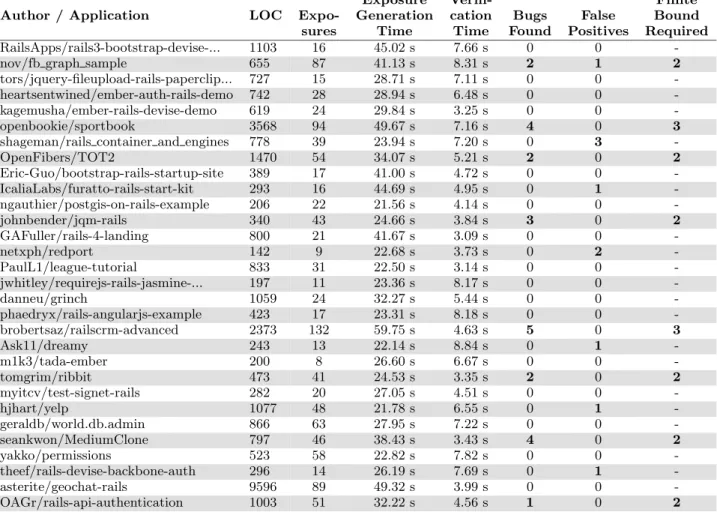
IsSpaceeffective at finding bugs? We appliedSpaceto the 50 most watched open-source Ruby on Rails applications on Github. 30 of those implement access control; Space found bugs in 8 (a total of 23 bugs). Space reported 10 false positives in addition to these actual bugs. These results suggest thatSpaceis effective at finding security bugs and does not produce excessive false positives.
Does Space’s analysis scale to real-world applica-tions? We recorded analysis times for the 30 analyses per-formed in the experiment above; every analysis finished within 64 seconds, and the average time was 38 seconds. We also tested Space’s symbolic execution step on the 1000 most watched Rails applications on Github; every execution fin-ished within one minute. These results suggest thatSpace’s symbolic evaluator scales to applications of many sizes. How does the bound selected for verification affect the number of bugs found and the scalability of the analysis? For the bugs found in the experiment described above, we re-ran the bounded verification step at progres-sively lower finite bounds until the verifier no longer detected the bug. A finite bound of 3 was sufficient to find these bugs; Spaceuses a bound of 8 (thus considering 8 objects of each type) by default—a bound well in excess of that required to find the bugs we discovered. For a bound of 8, the verifi-cation step finished in under 10 seconds for all appliverifi-cations. These results suggest thatSpace’s default bound of 8 scales well and is large enough to catch most bugs.
5.1
Experimental Setup
We considered the 50 most-watched open-source Ruby on Rails applications hosted by Github, assuming that the num-ber of “watchers” a repository has is proportional to its pop-ularity. These applications fall into two categories: applica-tions intended for installation by end-users and fragments of example code intended to help programmers build new
ap-Exposure Verifi- Finite
Author / Application LOC Expo- Generation cation Bugs False Bound
sures Time Time Found Positives Required
RailsApps/rails3-bootstrap-devise-... 1103 16 45.02 s 7.66 s 0 0
-nov/fb graph sample 655 87 41.13 s 8.31 s 2 1 2
tors/jquery-fileupload-rails-paperclip... 727 15 28.71 s 7.11 s 0 0
-heartsentwined/ember-auth-rails-demo 742 28 28.94 s 6.48 s 0 0
-kagemusha/ember-rails-devise-demo 619 24 29.84 s 3.25 s 0 0
-openbookie/sportbook 3568 94 49.67 s 7.16 s 4 0 3
shageman/rails container and engines 778 39 23.94 s 7.20 s 0 3
-OpenFibers/TOT2 1470 54 34.07 s 5.21 s 2 0 2 Eric-Guo/bootstrap-rails-startup-site 389 17 41.00 s 4.72 s 0 0 -IcaliaLabs/furatto-rails-start-kit 293 16 44.69 s 4.95 s 0 1 -ngauthier/postgis-on-rails-example 206 22 21.56 s 4.14 s 0 0 -johnbender/jqm-rails 340 43 24.66 s 3.84 s 3 0 2 GAFuller/rails-4-landing 800 21 41.67 s 3.09 s 0 0 -netxph/redport 142 9 22.68 s 3.73 s 0 2 -PaulL1/league-tutorial 833 31 22.50 s 3.14 s 0 0 -jwhitley/requirejs-rails-jasmine-... 197 11 23.36 s 8.17 s 0 0 -danneu/grinch 1059 24 32.27 s 5.44 s 0 0 -phaedryx/rails-angularjs-example 423 17 23.31 s 8.18 s 0 0 -brobertsaz/railscrm-advanced 2373 132 59.75 s 4.63 s 5 0 3 Ask11/dreamy 243 13 22.14 s 8.84 s 0 1 -m1k3/tada-ember 200 8 26.60 s 6.67 s 0 0 -tomgrim/ribbit 473 41 24.53 s 3.35 s 2 0 2 myitcv/test-signet-rails 282 20 27.05 s 4.51 s 0 0 -hjhart/yelp 1077 48 21.78 s 6.55 s 0 1 -geraldb/world.db.admin 866 63 27.95 s 7.22 s 0 0 -seankwon/MediumClone 797 46 38.43 s 3.43 s 4 0 2 yakko/permissions 523 58 22.82 s 7.82 s 0 0 -theef/rails-devise-backbone-auth 296 14 26.19 s 7.69 s 0 1 -asterite/geochat-rails 9596 89 49.32 s 3.99 s 0 0 -OAGr/rails-api-authentication 1003 51 32.22 s 4.56 s 1 0 2
Figure 4: Results of Running Spaceon Access Control-Enabled Open-Source Rails Applications on Github
plications. Security bugs are a serious issue in both types of application: in end-user applications, they make user data vulnerable, while in example code, they can propagate to applications that have copied the code.
Selecting Applications. We used the Github Archive database4to make a list of the most-watched Rails-associated
repositories. We developed a Ruby script to automatically clone each repository in the resulting list, check that it con-tains a Rails application, install its dependencies, and run the application. We used this script to filter the original list of 4000 repositories down to the 1000 most-watched reposi-tories containing actual Rails applications. We used the first 50 of these to perform our bug-finding experiments, and the full list of 1000 applications for our scalability tests. Building Mappings. We first eliminated those applica-tions with no access control through manual inspection, leav-ing 30 applications with some access control checks. For each of these, we constructed a mapping from application resources to RBAC types as detailed in section 3. We used application documentation and the code itself as a guide; in most cases, it was a straightforward process, involving map-ping the “User” type to RBAC users, a “Permission” type to permission objects, a subset of resources to owned objects, and perhaps a role type to role objects. This process took us approximately 15 to 25 minutes per application.
4
https://www.githubarchive.org/
Experimental Setup. We used Ubuntu GNU/Linux on a virtual machine equipped with a single Intel Xeon core at 2.5GHz and 2GB of RAM. We used RVM to install the version of Ruby required by each application and Bundler to install each application’s dependencies. We ranSpaceon each application using its default finite bound of 8 (atoms per data type) for the verification step. After running the experiment, we examined each reported bug and classified it as either a duplicate, a false positive, or a real bug. Limitations. The 50 applications we considered contained a number of abandoned and “toy” projects that likely have few real-world users. Our experimental design—sorting ap-plications by number of watchers—was an attempt to miti-gate this factor in an objective way; we speculate that a large number of real-world Rails codebases are not open source, causing a bias in open-source applications towards example and toy projects.
5.2
Bug Finding
The results of the experiment are summarized in Figure 4. In total,Spacereported 23 bugs and 10 false positives. The longest analysis took 64 seconds, while the average time was 38 seconds. In most cases, the symbolic execution step (gen-erating exposures) took most of the time.
Bugs Found. Figure 5 classifies the 23 bugs we found ac-cording to the pattern we believe the programmerintended to implement. The largest category is Authentication,
indi-No. Bugs Pattern Violated 5 Ownership 2 Public Objects 10 Authentication 3 Explicit Permission 3 User Profiles
Figure 5: Classification of Bugs Found by Pattern Violated
cating that the check programmers forget most often is the one ensuring that the user is logged in. The next largest, Ownership and Explicit Permission, indicate situations in which a user is allowed to view or modify a resource owned by someone else without permission. The User Profiles cat-egory includes situations where a user can modify another user’s profile, and the Public Objects category includes bugs where a resource was marked public when it should not have been. We did not find any bugs violating the Administrator or Explicit Roles patterns; developers, it seems, tend to use these patterns correctly.
The vast majority of vulnerabilities we discovered fell out-side the standard use cases of the applications. To exploit these, an attacker must craft a URL or form submission manually; exposing the bug using the application’s exposed user interface is impossible. This is the kind of security bug that is difficult to detect using testing, because the program-mer writing the test cases is biased towards the standard use cases of the application, and often ignores access paths out-side of those use cases.
False Positives. In our experiment, Space produced a total of 10 false positives. All of these were situations in which the application exposed a particular field of a resource in a different way from the other fields of that resource. For example, the redport photo manager allows users to provide “feedback” on a photo that another user owns, but does not allow changing any of that photo’s other fields. Because Spacemaps whole resource types to RBAC objects, it does not allow per-field permissions to be specified.
However, this limitation is not inherent in our approach— it is a conscious decision to make the resource mapping easier to construct. A finer-grained mapping would eliminate these false positives, but would require more effort to construct. False Negatives. The possibility of false negativesis in-herent to our approach: our security patterns are intended to capture common use cases of web applications, but some applications may intend to implement a security policy that ismore restrictive than the common cases expressed by our patterns. A mistake in such an implementation would not be caught by our technique.
For example, an e-commerce web site may implement ad-ministrative access, but may disallow even administrators from viewing customers’ saved credit card numbers. Our catalog, on the other hand, includes a pattern allowing ad-ministrators to view everything.Spacewould therefore miss a bug allowing administrators to view card numbers, since the intended policy is actually more restrictive than the pat-tern in our catalog.
We examined the code of the applications in our experi-ment for precisely this situation—security policies intended (based on evidence in the code itself) to be more restrictive
5 15 25 35 45 1 10 100 1000 10000 100000 Exposure Generation T ime (s)
Application Source Lines of Code
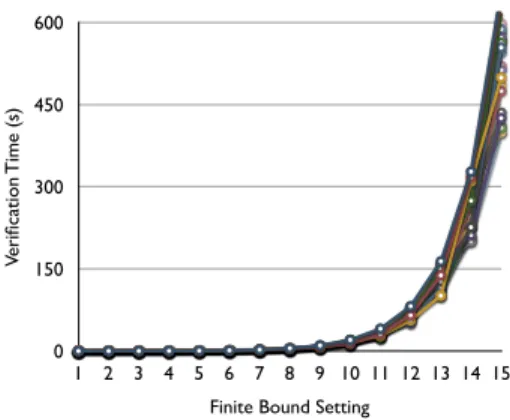
Figure 6: Scalability of Exposure Generation: Gen-eration time vs application lines of code for 1000 applications 0 150 300 450 600 1 2 3 4 5 6 7 8 9 10 11 12 13 14 15 Veri fica tio n Ti me (s )
Finite Bound Setting
Figure 7: Effect of Finite Bound on Verification Time
than the corresponding patterns in our catalog—and found none. Given the correct user-provided mapping, the pat-terns applied by Space were always at least as restrictive as those enforced by the target applications. However, the number of applications we considered was limited: we do not consider this enough evidence to conclude that security policies are generally less restrictive than our patterns.
5.3
Scalability
Since exposure generation time dominates verification time, we performed an additional experiment to test the scalability of the exposure generator more thoroughly. We ran the ex-posure generation steponlyon the 1000 most-watched Rails applications on Github. Figure 6 plots exposure generation time against lines of source code for each of these applica-tions. Exposure generation finished within one minute for every application, with most taking much less time.
5.4
Choice of Finite Bounds
Space uses the Alloy Analyzer, which requires the user to place finite bounds on the number of objects it will consider. Since these bounds both scalability and bugs found (because bugs requiring a counterexample larger than the finite bound will be missed), choosing the default bound carefully is vi-tal. We ran the verification step against the applications in Figure 4 using finite bound settings from 3 to 15. The re-sults, in Figure 7, indicate that the verification step runs in
an acceptable time at finite bound settings below 10. Above that bound, the verification time grows quickly.
We chose the default bound of 8 based on these perfor-mance results and the counterexample sizes required for the bugs we discovered. Bugs may exist beyond this bound, but the distribution of bounds required to find the bugs we dis-covered (100% of bugs with bound 3, and 0% of bugs from bounds 3-15) suggests that more bugs have small counterex-amples than have large ones. Users ofSpacecan easily select a different bound in order to tune the verifier.
6
Related Work
Modeling Security Patterns. Conceptually, our cata-log of security patterns is similar to the built-in specifica-tions of common bugs that static analysis tools have used for decades: memory errors, race conditions, non-termination, null pointer exceptions, and so on. LikeSpace, tools that attempt to find these classes of bugs can run without user input. However, these specifications represent a blacklist— a model of situations that shouldnot occur—in contrast to our catalog of patterns, which whitelist only those situa-tions that should occur. Our pattern catalog is similar in approach to the formal model of web security by Akhawe et al. [1], which defines a general model of the actors (browsers, servers, attackers etc.), and threats (XSS, CSRF, etc.) in-volved the larger picture of web security problems, then uses a constraint solver to discover attacks that potentially in-volve several different components; the model is not directly applicable to code. Our technique, by contrast, focuses on mistakes in access control policies, and compares the model against the code automatically.
Symbolic Execution. Symbolic execution was first pro-posed by King [20] and Clarke [11] in 1976, and recent sym-bolic evaluators [7, 18, 28, 33, 32, 16] have made improve-ments in scalability and applicability of the idea. Symbolic execution has also seen application to dynamic languages in recent years, with systems for evaluating Javascript [32, 13, 32], PHP [2, 19], Python [31], and Ruby [9]. In contrast to Space, all of these use standalone symbolic evaluators.
Other recent efforts implement symbolic execution as a library, like Space. NICE-PySE [8] and Commuter [12] both implement library-based symbolic execution in Python, but only for particular domain-specific languages. Yang et al. [36] and K¨oskal et al. [21] use the same technique in Scala, but to enforce security policies and perform constraint pro-gramming, respectively. Rosette [35] uses a library to sym-bolically execute Racket for verification and program syn-thesis. None of these systems allow symbolic execution of arbitrary programs, however.
Chef [5] produces symbolic evaluators for interpreted lan-guages by symbolically executing the standard interpreter itself on the target program. Like our approach, Chef re-sults in a system that is 100% compatible with the standard interpreter; however, the indirection of symbolically execut-ing the interpreter incurs significant overhead (at least 5x over NICE-PySE [8], which is implemented likeSpace). Static Analysis of Web Applications. Existing work on the application of static analysis to web applications fo-cuses on modeling applications, and especially on building navigation models. Bordbar and Anastasakis [4], for exam-ple, model a user’s interaction with a web application using UML, and perform bounded verification of properties of that interaction by translating the UML model into Alloy using
UML2Alloy; other approaches ( [22, 34, 29]) perform similar tasks but provide less automation. Nijjar and Bultan [27] translate Rails data models into Alloy to find inconsistencies, but do not examine controller code. Boci´c and Bultan [3] and Near and Jackson [24] check Rails code, but require the user to write a specification. Space, in contrast, requires only that the programmer provide a simple object mapping. Techniques that do not require the programmer to build a model of the application tend to focus on the elimina-tion of a certain class of bugs, rather than on full verifica-tion. Chlipala’s Ur/Web [10] statically verifies user-defined security properties of web applications, and Chaudhuri and Foster [9] verify the absence of some particular security vul-nerabilities for Rails applications; unlikeSpace, neither ap-proach can find application-specific bugs. Derailer [25] can find application-specific bugs but lacksSpace’s automation: it requires the user to interact with the tool to discover bugs. Run-Time Approaches to Web Application Security. Resin [37] is a runtime system that enforces information flow policies attached to data objects; it has been successfully ap-plied to web applications. Jeeves [36], a similar language for enforcing information flow policies, has also been applied to the web. Jif [23], an extension of Java, also supports checking policies at runtime. GuardRails [6] allows the pro-grammer to annotate ActiveRecord classes with access con-trol information, then performs source-to-source translation of the application’s implementation, producing a version of the application that enforces, at run time, the access con-trol policies specified by the annotations. Nemesis [14] is a similar effort for PHP applications: it is a tag-based system that enforces authentication and access-control at runtime. All of these approaches, in contrast to Space, require the programmer to write some form of specification to encode the application’s security policy.
7
Conclusion
In this project, we explored the idea that a small set of formal models—our catalog of access control patterns—is enough to capture a large portion of the access control poli-cies that web applications use in practice. We have presented a technique leveraging this idea to find security bugs in web applications, based on checking that if the application allows some data to be exposed, then some pattern in the catalog must also allow it. To be effective, this approach relies on the premise that real-world web applications share common patterns of access control.
Our implementation,Space, demonstrates that our cat-alog of patterns, plus a mapping from application types to the types of the catalog, is sufficient to find bugs in real-world applications automatically. The results of our evalua-tion indicate that this approach is effective: Spacescales to large applications, produces few false positives, and found a significant number of previously unknown bugs, suggesting that our pattern-based approach is a promising strategy for eliminating application-specific security bugs.
Acknowledgements
We are grateful to the anonymous reviewers for their in-sightful comments. We also thank Eunsuk Kang, Aleksan-dar Milicevic, and Jean Yang for their helpful discussions. This research was funded in part by the National Science Foundation under grant 0707612 (CRI: CRD - Development of Alloy Tools, Technology and Materials)
8
References
[1] Devdatta Akhawe, Adam Barth, Peifung E Lam, John Mitchell, and Dawn Song. Towards a formal
foundation of web security. InComputer Security Foundations Symposium (CSF), 2010 23rd IEEE, pages 290–304. IEEE, 2010.
[2] Shay Artzi, Adam Kiezun, Julian Dolby, Frank Tip, Danny Dig, Amit Paradkar, and Michael D Ernst. Finding bugs in dynamic web applications. In Proceedings of the 2008 international symposium on Software testing and analysis, pages 261–272. ACM, 2008.
[3] Ivan Boci´c and Tevfik Bultan. Inductive verification of data model invariants for web applications. In
Proceedings of the 36th International Conference on Software Engineering, pages 620–631. ACM, 2014. [4] B. Bordbar and K. Anastasakis. Mda and analysis of
web applications.Trends in Enterprise Application Architecture, pages 44–55, 2006.
[5] Stefan Bucur, Johannes Kinder, and George Candea. Prototyping symbolic execution engines for
interpreted languages. InProceedings of the 19th international conference on Architectural support for programming languages and operating systems, pages 239–254. ACM, 2014.
[6] J. Burket, P. Mutchler, M. Weaver, M. Zaveri, and D. Evans. Guardrails: a data-centric web application security framework. InProceedings of the 2nd USENIX conference on Web application development, pages 1–1. USENIX Association, 2011.
[7] C. Cadar, D. Dunbar, and D. Engler. Klee: Unassisted and automatic generation of high-coverage tests for complex systems programs. InProceedings of the 8th USENIX conference on Operating systems design and implementation, pages 209–224. USENIX Association, 2008.
[8] Marco Canini, Daniele Venzano, Peter Peresini, Dejan Kostic, Jennifer Rexford, et al. A nice way to test openflow applications. InNSDI, volume 12, pages 127–140, 2012.
[9] A. Chaudhuri and J.S. Foster. Symbolic security analysis of ruby-on-rails web applications. In
Proceedings of the 17th ACM conference on Computer and communications security, pages 585–594. ACM, 2010.
[10] A. Chlipala. Static checking of dynamically-varying security policies in database-backed applications. In Proceedings of the 9th USENIX conference on Operating systems design and implementation, page 1. USENIX Association, 2010.
[11] L.A. Clarke. A system to generate test data and symbolically execute programs.Software Engineering, IEEE Transactions on, (3):215–222, 1976.
[12] Austin T Clements, M Frans Kaashoek, Nickolai Zeldovich, Robert T Morris, and Eddie Kohler. The scalable commutativity rule: Designing scalable software for multicore processors.ACM Transactions on Computer Systems (TOCS), 32(4):10, 2015. [13] Charlie Curtsinger, Benjamin Livshits, Benjamin G.
Zorn, and Christian Seifert. Zozzle: Fast and precise in-browser javascript malware detection. InUSENIX
Security Symposium. USENIX Association, 2011. [14] M. Dalton, C. Kozyrakis, and N. Zeldovich. Nemesis:
preventing authentication & access control
vulnerabilities in web applications. InProceedings of the 18th conference on USENIX security symposium, pages 267–282. USENIX Association, 2009.
[15] David F Ferraiolo, Ravi Sandhu, Serban Gavrila, D Richard Kuhn, and Ramaswamy Chandramouli. Proposed nist standard for role-based access control. ACM Transactions on Information and System Security (TISSEC), 4(3):224–274, 2001.
[16] Patrice Godefroid, Michael Y. Levin, and David A. Molnar. Automated whitebox fuzz testing. InNDSS. The Internet Society, 2008.
[17] D. Jackson.Software Abstractions: logic, language, and analysis. The MIT Press, 2006.
[18] S. Khurshid, C. P˘as˘areanu, and W. Visser. Generalized symbolic execution for model checking and testing.Tools and Algorithms for the Construction and Analysis of Systems, pages 553–568, 2003. [19] Adam Kieyzun, Philip J Guo, Karthick Jayaraman,
and Michael D Ernst. Automatic creation of sql injection and cross-site scripting attacks. InSoftware Engineering, 2009. ICSE 2009. IEEE 31st
International Conference on, pages 199–209. IEEE, 2009.
[20] J.C. King. Symbolic execution and program testing. Communications of the ACM, 19(7):385–394, 1976. [21] Ali Sinan K¨oksal, Viktor Kuncak, and Philippe Suter.
Constraints as control. In John Field and Michael Hicks, editors,POPL, pages 151–164. ACM, 2012. [22] DR Licata and S. Krishnamurthi. Verifying interactive
web programs. InAutomated Software Engineering, 2004. Proceedings. 19th International Conference on, pages 164–173. IEEE.
[23] A.C. Myers, L. Zheng, S. Zdancewic, S. Chong, and N. Nystrom. Jif: Java information flow.Software release. Located at http://www. cs. cornell. edu/jif, 2005, 2001.
[24] Joseph P Near and Daniel Jackson. Rubicon: bounded verification of web applications. InProceedings of the ACM SIGSOFT 20th International Symposium on the Foundations of Software Engineering, page 60. ACM, 2012.
[25] Joseph P Near and Daniel Jackson. Derailer: interactive security analysis for web applications. In Proceedings of the 29th ACM/IEEE international conference on Automated software engineering, pages 587–598. ACM, 2014.
[26] Joseph P. Near and Daniel Jackson. Symbolic execution for (almost) free: Hijacking an existing implementation to perform symbolic execution. Technical Report MIT-CSAIL-TR-2014-007, Computer Science and Artificial Intelligence Lab, Massachusetts Institute of Technology, Cambridge, Massachusetts, April 2014.
[27] Jaideep Nijjar and Tevfik Bultan. Bounded verification of ruby on rails data models. In Matthew B. Dwyer and Frank Tip, editors,ISSTA, pages 67–77. ACM, 2011.
[28] C. Pasareanu and W. Visser. Verification of java programs using symbolic execution and invariant
generation.Model Checking Software, pages 164–181, 2004.
[29] Filippo Ricca and Paolo Tonella. Analysis and testing of web applications. In Hausi A. M¨uller, Mary Jean Harrold, and Wilhelm Sch¨afer, editors,ICSE, pages 25–34. IEEE Computer Society, 2001.
[30] Ravi S Sandhu, Edward J Coyne, Hal L Feinstein, and Charles E Youman. Role-based access control models. Computer, 29(2):38–47, 1996.
[31] Samir Sapra, Marius Minea, Sagar Chaki, Arie Gurfinkel, and Edmund M Clarke. Finding errors in python programs using dynamic symbolic execution. InTesting Software and Systems, pages 283–289. Springer, 2013.
[32] P. Saxena, D. Akhawe, S. Hanna, F. Mao, S. McCamant, and D. Song. A symbolic execution framework for javascript. InSecurity and Privacy (SP), 2010 IEEE Symposium on, pages 513–528. IEEE, 2010.
[33] Koushik Sen, Darko Marinov, and Gul Agha. Cute: a concolic unit testing engine for c. In Michel
Wermelinger and Harald Gall, editors,
ESEC/SIGSOFT FSE, pages 263–272. ACM, 2005. [34] P. Tonella and F. Ricca. Dynamic model extraction and statistical analysis of web applications. 2002. [35] Emina Torlak and Rastislav Bodik. A lightweight
symbolic virtual machine for solver-aided host languages. InProceedings of the 35th ACM SIGPLAN Conference on Programming Language Design and Implementation, page 54. ACM, 2014.
[36] Jean Yang, Kuat Yessenov, and Armando
Solar-Lezama. A language for automatically enforcing privacy policies. pages 85–96, 2012.
[37] A. Yip, X. Wang, N. Zeldovich, and M.F. Kaashoek. Improving application security with data flow assertions. InProceedings of the ACM SIGOPS 22nd symposium on Operating systems principles, pages 291–304. ACM, 2009.