University of Nebraska - Lincoln University of Nebraska - Lincoln
DigitalCommons@University of Nebraska - Lincoln
DigitalCommons@University of Nebraska - Lincoln
Library Philosophy and Practice (e-journal) Libraries at University of Nebraska-Lincoln Winter 11-3-2020
Colorectal Cancer Research in SAARC Countries: A Scientometric
Colorectal Cancer Research in SAARC Countries: A Scientometric
analysis
analysis
Dr Murugan Chinnaraj
Periyar University, [email protected]
Richa Narzary
Periyar University, [email protected]
Follow this and additional works at: https://digitalcommons.unl.edu/libphilprac Part of the Library and Information Science Commons
Chinnaraj, Dr Murugan and Narzary, Richa, "Colorectal Cancer Research in SAARC Countries: A Scientometric analysis" (2020). Library Philosophy and Practice (e-journal). 4543.
Colorectal Cancer Research in SAARC Countries: A Scientometric analysis
Richa Narzary
Research Scholar, Department of Library & Information Science, Periyar University, Tamil Nadu, Salem- 636011.
Email: [email protected]
C. Murugan
Professor & Head, Department of Library & Information Science, Periyar University, Tamil Nadu, Salem- 636011.
Email: [email protected]
Abstract
The study examined 2053 papers related to the publications of SAARC Countries on Colorectal cancer indexed in the web of science databases during 2010- 2018. The world colorectal cancer output (116203 publications) was formed from several countries. The present study analyzed the research output, authorship pattern, collaborative pattern, and activity index of five SAARC Countries viz. India, Pakistan, Bangladesh, Sri Lanka, and Nepal. The study revealed that India is a leading country among the five SAARC Countries with major research contributions. India’s continuous collaboration with other developed countries shows a higher activity index particularly in the context of individual research productivity. Developed countries like the USA, Australia, and the UK are the top collaborating countries with SAARC regions.
Keywords: Scientometrics, Colorectal Cancer, SAARC, Research trends, Collaborative Coefficient, Degree of Collaboration.
Introduction:
Colorectal cancer (CRC) is a common and deadly disease. The risk of developing CRC is influenced by both environment and genetic factors. CRC incidence and mortality rates vary around the world (Arnold et al., 2017). According to the World Health Organization GLOBOCAN database; Globally, CRC is the third most commonly diagnosed cancer in males and second in females, with 1.8 million new cases and led to 861000 deaths in 2018. Rates are substantially higher in males than females. The figure presented below shows the estimated number of incidents and mortality worldwide of which Colorectal Cancers are among the major cases found (Bray et al., 2018). The estimated number of cancer incidents and mortality in SAARC Countries also shows Colorectal cancer is one of the most common causes.
Source: Globocan, 2018. International Agency for Research in Cancer, WHO Figure 1: Estimated number of Cancer incident and mortality of SAARC
Chandrasinghe et al., 2017 in their observation, colorectal cancer (CRC) related incidence have been significantly increasing in the south Asian region due to changing socio-economic landscape and population demographics. They also pointed out that the observed pattern may vary due to the lack of robust high-quality data from this region to evaluate the disease pattern and comparison. South Asian Association for Regional Cooperation (SAARC) is the geopolitical, economic and regional intergovernmental organization union of nations in South Asia. SAARC includes eight countries viz. Afghanistan, Bangladesh, Bhutan, India, Nepal, Maldives, Pakistan and Sri Lanka. SAARC comprises 3% of the world’s area and 9.12% of the global economy. The population across all of the member countries is over 1.7 billion, accounting for 21% of the world’s population. Therefore, it is important to study the CRC related research collaboration undertaken in this region to counter the increasing cases.
Source: Globocan, 2018. International Agency for Research in Cancer, WHO Figure 2: Estimated number of incident cases 2018-2040
Review of Literature:
There were ample numbers of literature that considered various aspects globally few studies are related to the SAARC region on various disciplines. The studies related to various disciplines such as Chronic Liver Disease (CLD) research output by Naheem et al., (2017) in SAARC Countries during 1996- 2005; using the Scopus database. They focused on the pattern of literature growth, global publications share and ranking, authorship pattern, collaborative coefficient, productivity and impact of most productive institutions and authors, sources and highly cited papers; on authorship pattern and collaboration in biotechnology, research Singh, (2018) used Scopus database from 2007- 2016. Their studies showed that India is the most productive and highest contributor among the SAARC countries. Batcha, (2018) evaluated the research output in cardiovascular disease research for five SAARC countries and found that India is the principal contributor among the SAARC nations. A study on research productivity was also found in other disciplines like social science wherein they (Dhawan et al., 2015) examined composition and dynamics of social science research output in five South Asian countries during 1996- 2013, by using Scopus and Scimago database. It reveals that social sciences research in South Asia shows to be growing exponentially, doubled in publication every six years. Among five South Asian countries, India’s share 84%; followed by Pakistan 6.4% and Bangladesh 3.2%. Research performance in Library & Information Science of SAARC countries during 1996-2015 were also evaluated by using the Scopus database and found India is the most productive country in LIS research (Shukla & Maurya, 2018); (Uddin & Singh, 2014a), examined computer science research in SAARC countries during the last 25 years, focusing on global share and rank, growth trends and impact, collaboration levels within and outside of SAARC countries, top-ranking institutions and individuals in the region, most preferred journals in the region, and text-based research. We also found that they (Uddin & Singh, 2014b) also measured the overall research output and collaboration in South Asian countries and their contribution globally. To our knowledge from previous literature search, no studies have examined the productivity in CRC research output particularly in the SAARC region. The previous studies (Chinnaraj, M., & Narzary, R., 2018), (Narzary, R., & Murugan,
C., 2018)failed to focus on the SAARC region. Hence the present study is set to throw light on CRC research productivity of the SAARC region using the Scientometrics approach.
Objectives:
The main objective of the study is to analyze colorectal cancer research output among five SAARC Countries like India, Pakistan, Bangladesh, Sri Lanka, and Nepal; based on publications output as indexed in the web of science database. The study is set to focuses on the following aspects like; trends in growth of Colorectal Cancer research in SAARC Countries, document wise distribution of CRC research in SAARC, authorship pattern, collaboration coefficient analysis of SAARC Countries, Activity Index and its top international collaborating countries.
Materials and Methods:
The global publication data of five SAARC Countries in colorectal cancer has been retrieved from the web of science databases for the last 9 years (2010-2018). A keyword “colorectal cancer” was used in “title, abstract and keyword” field tag and 2010-2018. An additional filter was set according to the affiliation country to include the publication of eight SAARC countries. Data extracted were saved into text format files for further analysis. A total of 2053 records were retrieved as a research output of five SAARC Countries. For analyzing data, Bibexcel and MS-Excel were used.
The following are some of the measures adopted in this study: Degree of Collaboration (DC)
The degree of collaboration of authorship was calculated using the formula given by (Subramanyam, 1983).
C= Degree of Collaboration.
NM= No. of Multi-authored papers. NS= No. of Single author papers. Collaboration Coefficient (CC)
The measure has been suggested by (Ajiferuke et al., 1988)and based on fractional productivity defined by (Price & Beaver, 1966).
Where,
Fj denotes the number of j authored research papers, N denotes the total number of research papers published, K is the greatest number of authors per paper.
According to Ajiferuke et al., CC tends to zero as single author paper dominated and to 1-1/j as j authored papers dominated. This implies that the higher the value of CC, the higher the probability of multi or mega authored papers.
Modified Collaboration Coefficient (MCC)
Modified Collaboration Coefficient (MCC) can be defined as (Savanur & Srikanth, 2010)
Where,
A is the total number of authors in a collection.
MCC is not defined for A=1, i.e., for all single-author publications which are not a factor since collaboration is meaningless unless the existence of two authors available. CC approaches MCC only when A→∞, but otherwise strictly less than MCC by the factor 1-1/A.
Activity Index (AI)
Activity Index (AI) characterizes the relative research efforts of a country in a given subject. In the present study, the Activity Index has been calculated for different years to show the performance of the SAARC Countries during different years. Activity Index was first suggested by Frame and used among others by (Schubert & Braun, 1986), (De Solla Price, 1981), (Karki & Garg, 1997). It is defined as:
Where,
nij- Indian output of papers in a particular field nio- Total Indian output on all subjects
noj- World output of papers in a particular field noo- Total world output on all subjects
Results and Discussion:
Table 1 shows the year-wise growth of Colorectal Cancer analysis of 5 SAARC Countries. Table 1: Year-wise growth of Colorectal Cancer output
Year India Pakistan Bangladesh Sri Lanka Nepal Total SAARC
2010 91 5 2 4 0 102 2011 96 8 1 0 0 105 2012 120 11 1 2 1 135 2013 146 15 1 0 1 163 2014 174 16 6 1 2 199 2015 214 33 4 2 5 258 2016 310 29 3 7 5 354
2017 293 50 10 4 3 360
2018 307 46 13 7 4 377
Total 1751 213 41 27 21 2053
% out of 2053 85.289 10.375 1.997 1.315 1.022 100
The world has published 116,203 publications in colorectal cancer during 2010-2018, out of which, the total research output of 5 SAARC Countries amounted to 2053 publications. Among 5 SAARC Countries, India is the highest contributor with 1751 (85.289%) publications; followed by Pakistan with 213 (10.375%), Bangladesh with 41 (1.997%), Sri Lanka with 27 (1.315%) and Nepal 21 with (1.022%). The five SAARC Countries showed the linear growth rate in colorectal cancer research output during the study period. It shows that India has the highest research output in 2016 whereas Bangladesh in 2017, Sri Lanka in 2016 and 2018, and Nepal 2015 and 2016.
Table 2: Document type of Colorectal Cancer research
Document type Records % Citations Citation
Per papers h-index Article 1588 77.350 27169 17.108 45 Review 318 15.489 5345 16.808 34 Letter 99 4.822 38 0.383 4 Editorial Material 25 1.217 45 1.800 3 Meeting Abstract 14 0.681 11 0.785 2
Article; Proceedings Paper 5 0.243 13 2.600 2
Article; Book Chapter 2 0.097 17 8.500 1
Article; Retracted Publication 1 0.048 1 1.00 1
Correction 1 0.048 0 1.00 0
Total 2053 100 32639 0.062
Table 2 shows that the document type distribution of Five SAARC Countries and its contribution to Colorectal Cancer research. It shows nine document types such as Article, reviews, letters, Editorial Material, Meeting Abstract, Article; Proceedings Paper, Article; Book Chapter, Article; Retracted Publication, and Correction. Among them the highest publications were published in the form of Article with 1588 (77.350%), citations with 27169, citation per papers with 17.108 and h-index with 45; followed by Review 318 (15.489%), citations 5345, citation per papers 16.808 and h-index with 34. The lowest publication was found in Article; Retracted Publication and Correction with 1 (0.048%), a citation with 1 and 0, citation per papers with 1.00 and h-index is 1 and 0.
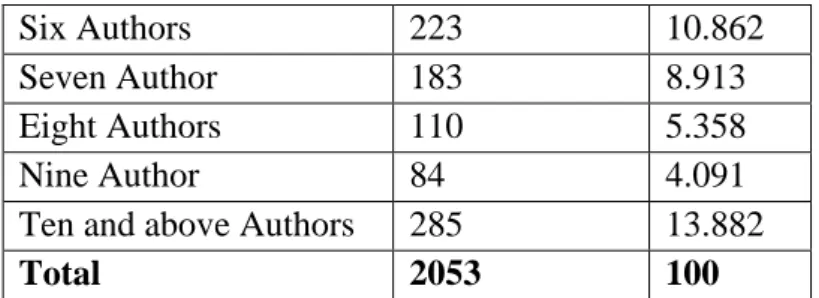
Table 3: Authorship pattern of Colorectal Cancer No. of Authors No. of Papers %
Single Author 52 2.532
Two Authors 202 9.839
Three Author 292 14.223
Four Authors 312 15.197
Six Authors 223 10.862
Seven Author 183 8.913
Eight Authors 110 5.358
Nine Author 84 4.091
Ten and above Authors 285 13.882
Total 2053 100
Table 3 indicates the authorship pattern on colorectal cancer research of five SAARC Countries. The highest number of the papers was published by four authors i.e.312; followed by five authors i.e.310, three authors with 292, ten and above authors with 285, six authors with 223, two authors with 202 respectively. The least number of papers was published by a single author with i.e.52. Table 4 shows that the Collaboration Coefficient Analysis of India. Among the five SAARC Countries, India has the highest publication records of 1751.
Table 4: Collaboration Coefficient analysis of India Year Single Author Two authors Three authors Four Authors Five and above authors Total CC MCC DC 2010 2 13 16 11 49 91 0.289 0.292 0.538 2011 3 19 9 16 49 96 0.305 0.308 0.510 2012 3 19 15 23 60 120 0.293 0.295 0.500 2013 3 15 19 31 78 146 0.275 0.276 0.534 2014 2 13 25 25 109 174 0.257 0.258 0.626 2015 5 18 25 25 141 214 0.265 0.266 0.658 2016 8 31 46 47 178 310 0.278 0.278 0.574 2017 10 29 43 29 182 293 0.281 0.281 0.621 2018 10 28 48 51 170 307 0.282 0.282 0.553 Total 46 185 246 258 1016 1751 0.278 0.278 0.580
CC= Collaboration Coefficient; MCC= Modified Collaborative Coefficient; DC= Degree of Collaboration.
India’s author collaboration implies that the multi-authored contributed the highest number of papers i.e.1016; followed by four authors with 258, three authors with 246, and two authors with 185. And the least number of publications was contributed by a single author. The average CC and MCC are the same as 0.278 and DC is 0.580. The highest CC of 0.305 and MCC of 0.308 is identified in 2011 and the lowest of CC is 0.257 and MCC is 0.258 in 2014.
Table 5: Collaboration Coefficient analysis of Pakistan Year Single author Two authors Three authors Four authors Five and above authors Total CC MCC DC 2010 0 1 1 1 2 5 0.704 0.880 0.400 2011 0 1 2 2 3 8 0.717 0.819 0.375 2012 0 0 1 3 7 11 0.774 0.851 0.636 2013 0 1 4 5 5 15 0.728 0.779 0.333 2014 0 0 2 7 7 16 0.761 0.811 0.437
2015 0 0 11 3 19 33 0.751 0.774 0.575
2016 0 1 2 3 23 29 0.775 0.802 0.793
2017 1 8 5 8 28 50 0.722 0.736 0.560
2018 4 1 7 3 31 46 0.700 0.715 0.673
Total 5 13 35 35 125 213 0.732 0.735 0.586
CC= Collaboration Coefficient; MCC= Modified Collaborative Coefficient; DC= Degree of Collaboration.
Table 5 represents the author's collaboration analysis of Pakistan. A total of 213 records were published. The contribution was mostly in the form of multi-authored publications with 125; followed by three and four authored with 35, two authors with 13. The least publication was by a single author. The average number of CC is 0.732, MCC is 0.735 and DC is 0.586. The highest CC of 0.775 is found in 2016 and the lowest is 0.700 in 2018. The highest MCC is 0.880 in 2010 and the lowest of 0.715 in 2018. The highest DC 793 was in 2016.
Table 6: Collaboration Coefficient analysis of Bangladesh Year Single author Two authors Three Authors Four authors Five and above authors Total CC MCC DC 2010 0 0 1 0 1 2 0.735 1.470 0.500 2011 0 0 0 0 1 1 0.800 0.000 1.000 2012 0 0 0 0 1 1 0.800 0.000 1.000 2013 0 0 0 0 1 1 0.800 0.000 1.000 2014 1 0 0 1 4 6 0.658 0.789 0.666 2015 0 0 0 2 2 4 0.775 1.033 0.500 2016 0 1 0 0 2 3 0.700 1.050 0.666 2017 0 1 0 2 7 10 0.760 0.844 0.700 2018 0 0 1 3 9 13 0.778 0.842 0.692 Total 1 2 2 8 28 41 0.749 0.767 0.682
CC= Collaboration Coefficient; MCC= Modified Collaborative Coefficient; DC= Degree of Collaboration
Table 6 indicates theauthor's collaboration coefficient analysis of Bangladesh. The total output of 41 records was published during 2010-2018. In the case of a single-author publication, it was found only one record during our study period. The papers were contributed by multi-authors with 28 records; followed by four authors’ i.e.8, two and three authors with 2 publications. The average number of CC is 0.749, MCC is 0.767 and DC is 0.682. The highest CC of 0.800 is found in 2011, 2012, 2013 and the lowest is 0.658 in 2014. The highest MCC is 1.470 in 2010 and the lowest of 0.842 in 2018. The highest DC of 1.000 is found in 2011, 2012 and 2013.
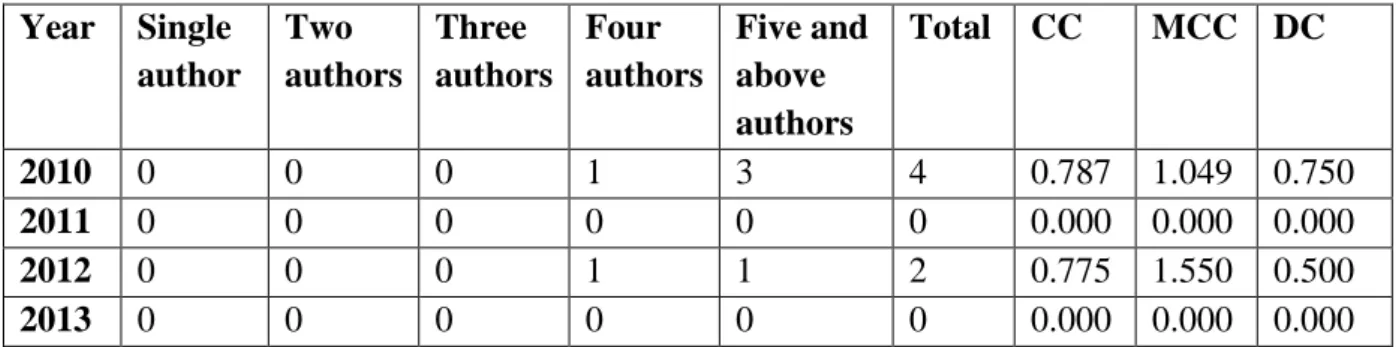
Table 7: Collaboration Coefficient analysis of Sri Lanka Year Single author Two authors Three authors Four authors Five and above authors Total CC MCC DC 2010 0 0 0 1 3 4 0.787 1.049 0.750 2011 0 0 0 0 0 0 0.000 0.000 0.000 2012 0 0 0 1 1 2 0.775 1.550 0.500 2013 0 0 0 0 0 0 0.000 0.000 0.000
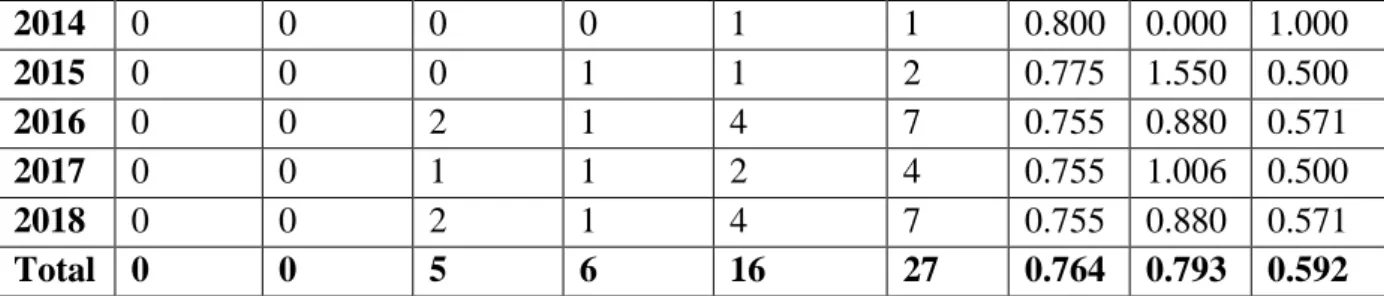
2014 0 0 0 0 1 1 0.800 0.000 1.000 2015 0 0 0 1 1 2 0.775 1.550 0.500 2016 0 0 2 1 4 7 0.755 0.880 0.571 2017 0 0 1 1 2 4 0.755 1.006 0.500 2018 0 0 2 1 4 7 0.755 0.880 0.571 Total 0 0 5 6 16 27 0.764 0.793 0.592
CC= Collaboration Coefficient; MCC= Modified Collaborative Coefficient; DC= Degree of Collaboration
Table 7 explains the collaboration coefficient analysis of Sri Lanka. The total output of 27 records has been published during the study period. The single author and two authors have not contributed during the study. The multi-authored publication has the highest record with 16; followed by four authored 6, three authors with 5 publications. The average number of CC is 0.764, MCC is 0.793 and DC is 0.592. The highest CC of 0.800 is observed in 2014 and the lowest is 0.755 in 2016, 2017 and 2018. The highest MCC is 1.550 in 2015 and the lowest of 0.880 in 2016 and 2018. The highest DC of 1.000 is found in 2014.
Table 8: Collaboration Coefficient analysis of Nepal Year Single author Two authors Three authors Four authors Five and above authors Total CC MCC DC 2010 0 0 0 0 0 0 0.000 0.000 0.000 2011 0 0 0 0 0 0 0.000 0.000 0.000 2012 0 1 0 0 1 2 0.650 1.300 0.500 2013 0 0 1 0 0 1 0.670 0.000 0.000 2014 0 0 0 0 2 2 0.800 1.600 1.000 2015 0 0 1 1 3 5 0.764 0.955 0.600 2016 0 1 0 1 3 5 0.730 0.912 0.600 2017 0 0 2 0 1 3 0.713 1.069 0.333 2018 0 0 0 0 3 3 0.800 1.200 1.000 Total 0 2 4 2 13 21 0.741 0.430 0.619
CC= Collaboration Coefficient; MCC= Modified Collaborative Coefficient; DC= Degree of Collaboration.
Table 8 shows the collaboration coefficient analysis of Nepal. The total output recorded by Nepal is 21. Single authors have no publications. The multi-authors published the highest number of papers with 13; followed by three authors with 4, two and four authors with 2 publications. The average number of CC is 0.741, MCC is 0.430 and DC is 0.619. The highest CC of 0.800 is observed in 2014 and 2018 and the lowest is 0.650 in 2012. The highest MCC is 1.600 in 2014 and the lowest of 0.912 in 2016 and 2018. The highest DC of 1.000 is found in 2014 and 2018.
Table 9: Activity Index of five SAARC Countries
Yea r Wo rld O utput Ind ia Act iv it y Ind ex P a kis ta n Act iv it y Ind ex B a ng la des h Act iv it y Ind ex Sri La nk a Act iv it y Ind ex Ne pa l Act iv it y Ind ex T o ta l SAARC 2010 9230 91 65.365 5 29.471 2 61.335 4 186.901 0 0.000 102
2011 9809 96 64.928 8 44.431 1 28.791 0 0.000 0 0.000 105 2012 11100 120 71.727 11 54.031 1 25.445 2 77.486 1 49.842 135 2013 11647 146 83.133 15 70.259 1 24.275 0 0.000 1 47.504 163 2014 12495 174 92.372 16 69.860 6 136.093 1 43.418 2 88.558 199 2015 14410 214 98.548 33 124.919 4 78.629 2 59.677 5 191.935 258 2016 15554 310 132.286 29 101.718 3 54.633 7 193.721 5 177.877 354 2017 16192 293 120.100 50 168.485 10 175.089 4 106.317 3 102.512 360 2018 15766 307 129.277 46 138.421 13 233.775 7 191.150 4 140.412 377 Total 116203 1751 1.506 213 0.183 41 0.035 27 0.023 21 0.018 2053
Table 9 shows the Activity Index of SAARC Countries in colorectal cancer research output. The world CRC research output shows an increasing pattern from 2010-2018. India has recorded an overall activity index of 1.506. India’s highest Activity Index came in 2016 (132.286) and the lowest found in 2011 (64.928). Pakistan has recorded 0.183 overall activities in the present study. Pakistan's highest Activity Index came in 2017 (168.485) and the lowest was in 2011 (29.471). Bangladesh has recorded 0.035 overall activities. The highest percentage of activity index by Bangladesh recorded in the year 2018 (233.775) and the lowest activity output in 2012 (25.445). The overall activity index of Sri Lanka is 0.023. Nepal has recorded 0.018 overall activities during the study period.
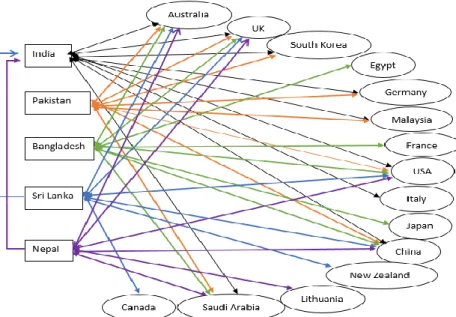
Figure 3: International Collaboration of SAARC Countries
Figure 3 shows the top international collaborating countries with SAARC. For example, if we see at the figure the black line with the arrow indicates India’s major collaborating countries are Australia, UK, USA, South Korea, Malaysia, Italy, China, Saudi Arabia. The highest collaborating partner in the case of India in the US. Similarly, an orange line with an arrow shows Pakistan's collaborating country. The Peoples Republic of China is the highest
collaborating partner of Pakistan; Bangladesh's highest collaborating partner is Australia; Sri Lanka with Australia and Nepal’s collaborating country is India.
Findings and Conclusion:
The findings from the study revealed that out of 116,203 publications in colorectal cancer, 2053 research output was published by 5 SAARC Countries. Among the SAARC, India is the highest contributor with 1751 (85.289%) publications of which publications were published in the form of Article i.e. 1588 (77.350%), with 27169 citations per paper with 17.108 and h-index of 45. The authorship pattern on colorectal cancer research of five SAARC Countries under shows that most of the papers were published by the collaboration of four authors i.e. 312, while the least number of papers was published by a single author with 52 records. Collaboration Coefficient among five SAARC countries shows that India has the highest publication records with a total of 1751 publications, out of which 1016 publications were contributed by multi- authors. The average CC and MCC are the same as 0.278 and DC is 0.580. The author's collaboration of Pakistan also shows that most of the publications are multi-authored i.e. of 125 records. The average number of CC is 0.732, MCC is 0.735 and DC is 0.586. The author's collaboration coefficient of Bangladesh shows the total output of 41 records from 2010-2018. Most of the papers (28) were Multi-authored with an average number of CC as 0.749, MCC as 0.767 and DC as 0.682. Sri Lanka too exhibited the same results with most of the publication by multi-authored collaboration with 16 records. The average number of CC is .764, MCC is 0.793 and DC is 0.592. Nepal also had most of its contributions to multi-authored collaboration with 13 records. The average number of CC is 0.741, MCC is 0.430 and DC is 0.619.
Activity Index of five SAARC Countries in colorectal cancer research output during shows that for India’s highest activity was observed during 2016 (132.286) and the lowest in 2011 (64.928); Pakistan’s highest activity Index came in 2017 (168.485) and lowest in 2011 (29.471). In the case of Bangladesh, the highest percentage of activity was recorded in 2018 (233.775) and the lowest activity in 2012 (25.445). The overall activity index of Sri Lanka is 0.023. Nepal has recorded 0.018 overall activities during the study period.
References:
1. Ajiferuke, I., Burell, Q., & Tague, J. (1988). Collaborative coefficient: A single measure of the degree of collaboration in research. Scientometrics, 14(5–6), 421–433.
2. Arnold, M., Sierra, M. S., Laversanne, M., Soerjomataram, I., Jemal, A., & Bray, F. (2017). Global patterns and trends in colorectal cancer incidence and mortality. Gut, 66(4), 683–691. 3. Batcha, M. S. (2018). Cardiovascular Disease Research in SAARC Countries: A Scientometric
Study. Information Studies, 5(4), 34–44.
4. Bray, F., Ferlay, J., Soerjomataram, I., Siegel, R. L., Torre, L. A., & Jemal, A. (2018). Global cancer statistics 2018: GLOBOCAN estimates of incidence and mortality worldwide for 36 cancers in 185 countries. CA: A Cancer Journal for Clinicians, 68(6), 394–424.
5. Chandrasinghe, P. C., Ediriweera, D. S., Hewavisenthi, J., Kumarage, S. K., Fernando, F. R., & Deen, K. I. (2017). Colorectal cancer burden and trends in a South Asian cohort: Experience from a regional tertiary care center in Sri Lanka. BMC Research Notes, 10(1), 535.
6. Chinnaraj, M., & Narzary, R. (2018). An analysis of Research publication on Colorectal Cancer in Asian Countries. Library Philosophy and Practice (e-journal), 2018. 1932. http://digitalcommons.unl.edu/libphilprac/1932.
7. De Solla Price, D. (1981). The analysis of scientometric matrices for policy implications. Scientometrics, 3(1), 47–53.
8. Dhawan, S. M., Gupta, B. M., & Gupta, R. (2015). Social Science research landscape in South Asia: A comparative assessment of research output published during 1996-2013. Library Philosophy and Practice (e-Journal), 1251. http://digitalcommons.unl.edu/libphilprac/1251. 9. Karki, M. M. S., & Garg, K. C. (1997). Bibliometrics of alkaloid chemistry research in India.
Journal of Chemical Information and Computer Sciences, 37(2), 157–161.
10.Naheem, K. T., Nagalingam, U., & Ramesha, B. (2017). Chronic liver disease (CLD) research in SAARC countries: A scientometric analysis of research output during 1996-2015. Annals of Library Information Studies, 64(1) 59-68.
11.Narzary, R., & Murugan, C. (2018). Mapping of Colorectal Cancer Research output with a focus on India. Library Philosophy and Practice (e-Journal), 1732. http://digitalcommons.unl.edu/libphilprac/ 1732.
12.Price, D. de S., & Beaver, D. (1966). Collaboration in an invisible college. American Psychologist, 21(11), 1011–1018.
13.Savanur, K., & Srikanth, R. (2010). Modified collaborative coefficient: A new measure for quantifying the degree of research collaboration. Scientometrics, 84(2), 365–371.
14.Schubert, A., & Braun, T. (1986). Relative indicators and relational charts for comparative assessment of publication output and citation impact. Scientometrics, 9(5–6), 281–291.
15.Shukla, A., & Maurya, S. K. (2018). Research performance of South Asian Association for Regional Cooperation (SAARC) Countries in Library and Information Science: A scientometric analysis. COLLNET Journal of Scientometrics and Information Management, 12(1), 73–81. 16.Singh, M. K. (2018). Biotechnology research pattern in four SAARC countries from 2007 to
2016. Library Philosophy & Practice (e-Journal), 2084. https://digitalcommons.unl.edu/libphilprac/2048.
17.Subramanyam, K. (1983). Bibliometric studies of research collaboration: A review. Journal of Information Science, 6(1), 33–38.
18.Uddin, A., & Singh, V. K. (2014a). Mapping the computer science research in SAARC countries. IETE Technical Review, 31(4), 287–296.
19.Uddin, A., & Singh, V. K. (2014b). Measuring research output and collaboration in South Asian countries. Current Science, 31–38.