© 2019.Md. Manik Ahmed, Md. Anwar Hossain & A F M Zainul Abadin. This is a research/review paper, distributed under the terms of the Creative Commons Attribution-Noncommercial 3.0 Unported License http://creativecommons.org/licenses/by-nc/3.0/), permitting all non-commercial use, distribution, and reproduction in any medium, provided the original work is properly cited.
Global Journal of Computer Science and Technology: D
Neural & Artificial Intelligence
Volume 19 Issue 3 Version 1.0 Year 2019
Type: Double Blind Peer Reviewed International Research Journal
Publisher: Global Journals
Online ISSN: 0975-4172
& Print ISSN: 0975-4350
Implementation and Performance Analysis of Different Hand Gesture
Recognition Methods
By Md. Manik Ahmed, Md. Anwar Hossain & A F M Zainul Abadin
Rabindra Maitree University
Abstract-
In recent few years, hand gesture recognition is one of the advanced grooming technologies in
the era of human-computer interaction and computer vision due to a wide area of application in the real
world. But it is a very complicated task to recognize hand gesture easily due to gesture orientation, light
condition, complex background, translation and scaling of gesture images. To remove this limitation,
several research works have developed which is successfully decrease this complexity. However, the
intention of this paper is proposed and compared four different hand gesture recognition system and
apply some optimization technique on it which ridiculously increased the existing model accuracy and
model running time. After employed the optimization tricks, the adjusted gesture recognition model
accuracy was 93.21% and the run time was 224 seconds which was 2.14% and 248 seconds faster than
an existing similar hand gesture recognition model. The overall achievement of this paper could be
applied for smart home control, camera control, robot control, medical system, natural talk, and many
other fields in computer vision and human-computer interaction.
Keywords:
convolutional neural network, deep learning, hand gesture recognition, PCA.
GJCST-D Classification:
I.4.8
ImplementationandPerformanceAnalysisofDifferentHandGestureRecognitionMethods
Implementation and Performance Analysis of
Different Hand Gesture Recognition Methods
Md. Manik Ahmed
α, Md. Anwar Hossain
σ& A F M Zainul Abadin
ρAbstract- In recent few years, hand gesture recognition is one
of the advanced grooming technologies in the era of human-computer interaction and human-computer vision due to a wide area of application in the real world. But it is a very complicated task to recognize hand gesture easily due to gesture orientation, light condition, complex background, translation and scaling of gesture images. To remove this limitation, several research works have developed which is successfully decrease this complexity. However, the intention of this paper is proposed and compared four different hand gesture recognition system and apply some optimization technique on it which ridiculously increased the existing model accuracy and model running time. After employed the optimization tricks, the adjusted gesture recognition model accuracy was 93.21% and the run time was 224 seconds which was 2.14% and 248 seconds faster than an existing similar hand gesture recognition model. The overall achievement of this paper could be applied for smart home control, camera control, robot control, medical system, natural talk, and many other fields in computer vision and human-computer interaction.
Keywords: convolutional neural network, deep learning,
hand gesture recognition, PCA.
I.
I
ntroductionn natural communication with another person, hand gesture recognition plays a vital role to interact with them naturally, convey rich and meaningful information in various ways. Because Gestures are one of the general forms of communication when people from different languages meet, and no one knows in which language they should express their feelings [1]. In compare to other body parts, a human hand which has been treated as a natural organ for a human to human interaction has been used widely for gesturing and can be best suitable for communication between humans and computers [4]. Recently a computer is an essential machine in our society which accomplishes our daily tasks. Human-computer interaction (HCI) is not only the keyboard, mouse interaction but also interaction computer with the human-like gesture, natural language, emotion and body expressions, etc. [2].
Author : α Lecturer, Department of Information and Communication Engineering, Rabindra Maitree University, Bangladesh.
e-mail: [email protected]
Author : σρ Assistant Professor, Department of Information and Communication Engineering, Faculty of Engineering and Technology, Pabna University of Science and Technology, Bangladesh.
e-mails: [email protected], [email protected]
For example, if we consider today’s world without a computer, then we can easily realize HCI in our society. It is the most critical issue of advanced technology to recognize, classify and interpret various simple hand gestures and apply them in a wide range of application through HCI and computer vision.
In early, there were many gesture recognition techniques have been developed for recognizing and tracking various hand gesture images. Previously developed available hand gesture recognition techniques are instrumented gloves, optical markers and some advanced methods based on image features, color-based, vision-based, depth-based models but have their advantages and limitation [2]. But the previous gesture recognition technique fails to obtain the satisfiable result. Some automatic feature extraction based hand gesture recognition techniques have developed which was remove the limitation of previous work and made a revolutionary change on HCI and computer vision era.
In this paper provides four different hand gesture recognition techniques and compare performance among machine learning based semi-automatic and deep neural network based semi-automatic system. These four methods tested on the same testing data with the same epoch. The classification task usually depends on the two-factor one is time, and another is recognition accuracy. A recognition method will perfect if the method takes low time and high accuracy during the train and test dataset. In this paper provides principal component analysis with backpropagation neural network based model but it showed very poor accuracy close to 77.86%. To remove this limitation presented a deep learning based primary two-layer convolutional neural network (PCNN) model that achieves the accuracy of 91.07% but consumes more time than the previous modes. Then proposed an adjustable CNN model (ACNN) which is similar to the PCNN model but there applied batch normalization and regularization that provide higher accuracy and minimize the running time half of the PCNN model. Finally, we applied two extra CNN layers with the PCNN model but it takes long running time, but provides 96.43% accuracy. There are several typical applications of hand gesture recognition such as virtual game controller, sign language recognition, Directional indication through pointing, making young children to interact with the computer, human-computer interaction, robot control,
I
Global Journal of Computer Science and Technology Volume XIX Issue III Version I
13 Year 2 019
(
)
D
lie detection, home appliance, Camera control, entertainment, and medical systems, Gesture talk, etc. [3].
The paper has organized as follows: Section 2 gives some literature review of present and previous work. Section 3 describes the methods of the proposed system. Experiment results and discussion have shown in Section 4. Finally, Section 5 concludes this paper.
II.
L
iteratureR
eviewRecognition of hand gesture offers a new era and plays a vital role in nonverbal communication and interact with the machine naturally. There is various bodily motion which can originate gesture, but the general form of gesture origination comes from the face and hands. The entire procedure of tracking gestures to their representation and converting them to some purposeful command is known as gesture recognition [4]. The hand gesture is the easiest and potential research area of machine learning and computer vision [5]. In a few years, several methods have been proposed to recognize hand gesture with the adaptive manner. The authors [6] [8] proposed a vision-based hand gesture recognition system that based on skin color model and thresholding approach which is segmented by the skin color model in YCbCr color space and separate hand region from the background by the Otsu thresholding method. Finally, they developed a template-based matching technique by Principal Component Analysis (PCA) for recognition. Their experiment tested on 80 images achieved 91.25% average accuracy and 30 images with 91.43% accuracy on the independent database.
Flores [12] proposed an approach to recognize static hand gestures whose features varied in scale, rotation, translation, illumination, noise, and background. Their approach included applying various digital image processing filter techniques to reduce noise, to improve the contrast under a variant illumination. They separate the hand from the background of the image and finally, and to detect and cut the region containing the hand gesture. Their approach achieved 96.20% recognition accuracy. Bui T.T.T [7] proposed a novel algorithm for face and hand gesture recognition system based on wavelet transform and principal component analysis that processes with two stages. At this stage, they extract object features using wavelet transformation and save it to the database so that they can compare this feature with PCA based extracted feature through the result. They achieved an efficient performance of face recognition (98.40 %) on 7320 testing face images and hand gesture recognition (94.63%) on digital image
Nasser H. Dardas and Shreyashi Narayan Sawant [9][10] proposed traditional PCA algorithm for gesture recognition which hand feature or train weight
was extracted by projecting each training image onto the most eigenvectors then the small image that contains the detected hand gesture is projected onto the most eigenvectors of training images to form its test weights. Finally, they utilized the euclidian distance to recognize the hand gesture.
The above recognition method doesn’t provide sustainable and remarkable results due to their limited accuracy and high time consumption and semi-automatic behavior. Nowadays, Deep learning based Convolutional Neural Networks (CNN) have shown substantial performance in different recognition tasks on computer vision that extend the traditional artificial neural network by adding additional constraints to the earlier layers and increased the depth of the network. A. Krizhevsky [11] proposed an ImageNet Large Scale Visual Recognition Challenge work which is mainly focused on the architecture to achieve great performance on a large number of data set during training.
Gongfa Li [12] proposed a convolutional neural network that removes the traditional feature extraction method and reduces the number of training parameter. They utilized the error backpropagation algorithm for learning the network in an unsupervised way. Finally, they added the support vector machine act as a classifier to improve the validity and robustness of the whole classification function of the convolution neural network. They achieved an efficient performance of gesture recognition average 98.52 % on 7320 gesture images of 10 different people. Yingxin [13] proposed an approach for hand gesture recognition based on the Adapted Deep convolutional neural network (ADCNN) with regularization technique which took shifted and rotated version of hand gesture images that extend the 20% of the original image dimension randomly. Their experiments conducted with a regularization technique on 3750 hand gesture images that remove the overfitting. Their result revealed the ADCNN approach achieved higher recognition accuracy of 99.73% and 4% improvement over the traditional CNN model. Guillaume Devineau [14] proposed an approach using a 3D deep convolutional neural network(3DCNN) for hand gesture recognition using only hand-skeletal data without depth image information. Their proposed 3DCNN only processed sequences of hand-skeletal joints’ positions by parallel convolutions. Their experiment achieved a 91.28% classification accuracy for the 14 gesture classes case and an 84.35% classification accuracy for the 28 gesture classes case. In Pei Xu [15] Proposed a hand gesture classification method which is the modified CNN version from LENET 5 using only one cheap monocular camera. Their experiment also introduced the Kalman filter to estimate the hand position based on which the mouse cursor control had realized stably and smoothly. But their implemented
Global Journal of Computer Science and Technology Volume XIX Issue III Version I
14 Year 2 019
(
)
D
system only supported static gesture and worked on 3200 gesture images.
III.
M
ethods andM
ethodologiesThis section provides literature behind the Principal component analysis (PCA), a description of Backpropagation neural network (BPNN), a brief discussion of primary 2-layer convolutional neural network (PCNN) architecture and the basic overview of adjusted convolutional neural network (ACNN) which is the optimized version of PCNN, Description of Primary 4-layer CNN to gain better performance. Also, this section provides the Layer operation and configuration table of all neural network that has proposed in this paper.
a) PCA Based BPNN Architecture
Principal component analysis (PCA) is a dimensionality reduction technique based on extracting the relevant information of gesture images which is multidimensional. The main objectives of PCA in gesture recognition techniques are data dimension reduction and feature selection to train the Multilayer BPNN. The gesture recognition using PCA based BPNN architecture involves two phases: i) Feature Extraction Phase ii) Classifier Phase.
Fig. 1: Thebasic flow of PCA based hand gesture
recognition method
During feature extraction Phase PCA is to reduce the dimensionality of the gesture images while retaining as much information as possible in the original gesture images. Each hand gesture images in the database concatenate form into one matrix. Then PCA is to move the origin to mean of the data by averaging all column matrix database images divided by the total number of hand gesture images. Next, find the normalized images by subtracting the computed average image from each image in database form into a mean centered data matrix. These adjusted images determine how each of the gesture images in the database differs from the average image which has calculated previously. Next, the PCA algorithm calculates and finds the eigenvectors using covariances matrix of normalized hand gesture images that speed up the technique and reduce the number of parameters. Eigenvectors with low eigenvalues that contribute little information in the data representation. In this step also data reduction technique is achieved by truncating the eigenvectors with small eigenvalues. Then this eigenvectors matrix multiplied by each of the normalized gesture vectors to obtain their corresponding gesture space projection. Finally, each image in normalized
matrix multiplied with gesture space and created a new gesture descriptor or strong weight that is ready to feed as the input of BPNN.
In the classifier phase, A Backpropagation neural network has used as a classifier which is reverse propagates the error and adjusts the weights to near the target output. In particular, the internal (hidden) layers of multilayer networks learn to represent the intermediate features that are useful for learning the target function and that are only implicit in the network inputs. The classification of hand gesture images involves in two stages one is training stage another is the testing stage. During the training stage, BPNN design is composed of two hidden layers, Input layer, and output layer. The model of BPNN has described in (Table 01). In this stage, the gesture feature vectors that belong to the same classes have used as positive examples, i.e. network gives “1” as output, and negative examples for the others network, i.e. Network gives “0” as output which is the target value. The algorithm used to train the network is the Backpropagation Algorithm. The general idea with the Backpropagation algorithm is to use gradient descent to update the weights to minimize the squared error between the network output values and the target output values. Then, each weight is adjustedusing gradient descentaccording to its contribution to the error. The activation or transfer function used in the Back Propagation neural network is the sigmoid function which maps the output 0 to 1. When the neural network met the stopping condition, then it stops and gives the training output. During the testing stage, it is necessary to extract the feature of all unknown hand gesture images. Then calculate the projection of the test gesture to project the gesture on gesture space and form into a new descriptor. These new descriptors have inputted to every network, and the networks are simulated with these descriptors. The network outputs have compared. If the maximum output exceeds the predefined threshold level, then these new gesture images have decided to belong to the same class gesture with this maximum output. Finally, this architecture calculates overall accuracy depend on correctly recognize of hand gesture images out of total images.
Table 1:BPNN Configuration
Parameter types Parameter
Layer 4
Input layer neuron 1080 Hidden layer neuron 75 (H1) 50 (H2)
Transfer function Logsig
Epochs 1000
Learning rule Backpropagation based gradient descent INPUTIMAGES FEATUREEXTRACTION BY PCA BPNN Classified Hand Gesture
Global Journal of Computer Science and Technology Volume XIX Issue III Version I
15 Year 2 019
(
)
D
b) Convolutional Neural Network
In the field of image recognition and computer vision, convolutional neural network (CNN) has achieved the most remarkable results [16]. Recently, with the development of hardware, much research about object recognition using CNN becomes practical and achieves success [11] [17]. CNN usually learn features directly from input data and often provides a better classification result in the case where features are hard to be extracted directly, such as image classification.
Traditional CNN contains two parts, namely the feature extraction part also called the hidden layer and the classification part. In feature extraction part the CNN can perform a series of convolutions and pooling operationsduring which the features have detected. In the case of a CNN, the convolution has performed by sliding the filter or kernel over the input images with some stride which the size of the step the convolution filter moves each time and the sum of the convolution produces a feature map. The most common thing in CNN network is to add a pooling layer in between CNN layers which function is to continuously reduce the dimensionality to reduce the number of parameters and computation in the network model. In CNN, two types of pooling layer available are average, and another is maxpool which are reduce the training time and controls overfitting [11]. In the classification part which contains some fully connected layers that can only accept one- dimensional data. The output of this layer produces the desired class using an activation function and classifies given images.
c) Primary CNN Architecture (PCNN)
In this section of this paper provides the primary structure of deep CNN which contains two convolutional layers, two pooling layers and with two fully connected layers with rectified linear unit (RELU) and one softmax activation function. The structure of the PCNN has shown in Figure 02 (Fig.2). In this architecture, it also contains a dropout procedure after the first convolution layer and the second dropout has performed after the first fully connected layer. The overall objectives of this primary deep CNN network have automatically extracted the feature from the direct gesture image as input that removes the traditional machine learning semi-automatic and manual techniques.
In PCNN, the first layer starts with a convolutional layer that has a kernel size of 3×3 pixels and contains 32 feature maps that followed by traditional RELU activation function with no padding. This layer performed by fed the hand gesture images with 64×64×3 pixel values and extracts the deeper information for every image in the database. The next layer is a Dropout also called regularization layer that was configured to randomly remove 20 percent of neurons to reduce overfitting or underfitting. The next deeper layer is another convolutional layer that has a
kernel size of 3×3 pixels and also contains 32 feature maps followed by a RELU activation function that is the same as the previous layer. The next layer is a MaximumPooling layer that has designed with a pool dimension of 2×2 pixels. The MaxPoolinglayer uses the maximum value to progressively deduct the negative of the representation to reduce the number of parameters and computation in the network, and hence to also control overfitting. The MaxPooling layer extracts subregions of 2×2 of the feature map, keeps their maximum value and discards all other minimum values. A layer called Flatten that converts the two-dimensional image matrix data to a vector, hence allowing the final output to be processed by standard fully connected layers to obtain the next layers. The first fully connected layer in this PCNN with the RELU activation function contains 512 neurons. This layer is followed by a dropout layer toexclude 20% of neurons to reduce overfitting. The final part of the CNN structure is the output layer and acts as aclassifier which is mapped by a Softmax activation function, and contains six neurons represents every class of gesture image. The architecture of the PCNN network has shown in (Figure 02).
.
Fig. 2: Configuration of PCNN
Global Journal of Computer Science and Technology Volume XIX Issue III Version I
16 Year 2 019
(
)
D
Implementation and Performance Analysis of Different Hand Gesture Recognition Methods
Images
Convolution
Dropout
Convolution
Pooling
Flatten
Fully Connected
Dropout
RELU
RELU
RELU
Fully Connected
RELU
Classifier
Class
Gesture Probability
d) Adjusted CNN Architecture (ACNN)
In this section, provides the fine regulated design of PCNN with a simple modification to get better accuracy and low running time for the real-world applications. There are existed several techniques to optimize the CNN. CNN was parameter sensitive neural network where accuracy and running time largely depend on network parameters. There are several strategies to extend recognition accuracy and running time. In this paper, the overall performance of ACNN was improved by a simple modification of the network parameter that includes i) Downsample, ii) Batch normalization and Kernel size and iii) Regularization. The ACNN is the modified version of PCNN that contains some optimization technique compare with another CNN model shown in (Table 02):
Downsample: In this ACNN architecture provides two
extra downsample operation after two convolutional layers with 1×1 kernel size through pooling layer that reduces the feature map dimensionality for computational efficiency, which can, in turn, improve actual performance accuracy.
Kernel Size and Batch normalization: To preserve the low running time it will be necessary to replace filter or kernel size from a higher value to lower. In the very initial step, an acceptable kernel of suitable dimensions is decided to convolve over the input image and identify key features in the images. A larger size kernel can disregard the features and could skip the essential details in the images whereas a smaller size kernel could provide more information leading to more confusion. This ACNN model contains the second convolutional layer that has a kernel size of 2×2 pixels and also holds 64 feature maps followed by a RELU activation function which differs from PCNN. Batch normalization isthe another key factor that speeds up the model run time. This model batch size is 32 that means 32 samples from the training dataset will be used to estimate the error gradient before the model weights are updated.
Regularization: This Deep ACNN deals with a large
number of parameters while training the model leads to overfitting. Regularization is the technique that decreases the complexity by constructing the model structure as simple as possible. This model contains two regularizations after the first convolutional layer and the first fully connected layer with 20% and 27% dropout.
e) Larger CNN Architecture (LCNN)
This section proposed the Larger CNN (LCNN) architecture that contains four convolutional layers with 3×3 pixels and each convolutional layer followed by RELU activation function, max-pooling layer with 2×2 pool size and batch normalization. The first convolutional layer only contains 32 feature maps, and the rest of the three convolutional layers contains 64,64
and 96 feature maps accordingly. One flattens layer that converts image to vector. Also, this structure presents two fully connected layers with RELU and Softmax activation function and output layer gives the probability value of the recognized class. This architecture did not use any regularization technique to reduce model complexity.
IV.
E
xperimentalR
esults andD
iscussionsThis section presents the basic description of Hand gesture Datasets which was used to perform the experiments and fed into PCA with Backpropagation, PCNN, LCNN model and adapted version of the PCNN model called ACNN. Besides this section provides the evolution parameters and performance among these four models. Then it discusses the accuracy and running time and evaluates and measures the best network performance among them.
The presented four architecture are trained and tested on hand gesture dataset taken from the deeplearning.ai (DLAI) [17] dataset which contains 1080 randomly organized hand gesture datasets. This dataset contains six unique class from 0 to 5 that depends on the corresponding hand finger. The dimension of the individual image is 64×64×3 where 64 represents the width, the height of the corresponding images and 3 represents the channeli.e., the hand gesture data used in this experiment are color images. We divided the datasets 800 images for training and 280 images for testing from 1080 individual image datasets as shown in (Table 02).
Table 2: Dataset characteristics for our model
Dataset Dimension Dimension Input Training Testing No. of Data Classes DLAI (64,64,3,1080) (12288,1080) 800 280 6
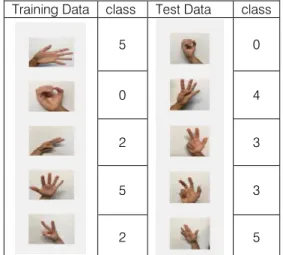
Figure 03 (Fig.3) shows a sample of five hand gestures that haveused for our experiments that taken under different scale, rotation, translation, and noise.
Training Data class Test Data class
5 0
0 4
2 3
5 3
2 5
Fig. 3: Five samples of training and test hand gesture for
this experiment
Global Journal of Computer Science and Technology Volume XIX Issue III Version I
17 Year 2 019
(
)
D
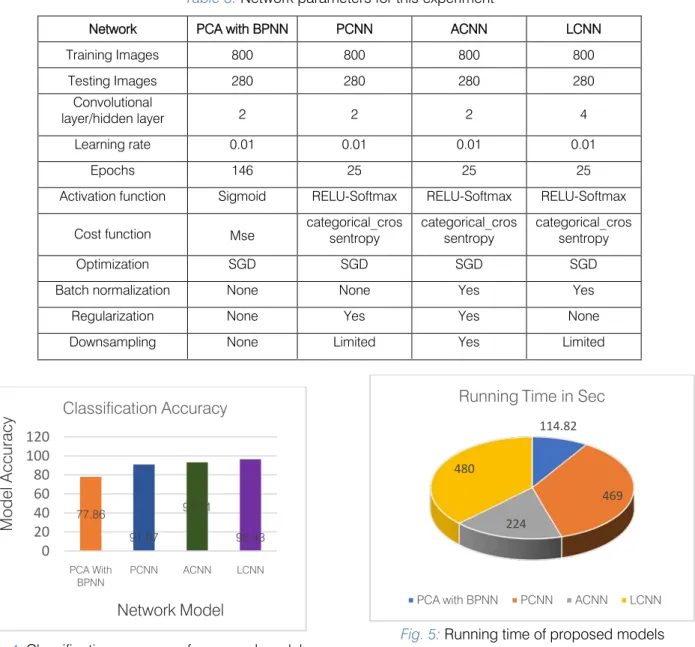
This paper represents four different hand gesture methods which are tested on the same database and show different accuracy and running time depends on their architecture and network characteristics and parameters. Table 03 shows the parameters have been used in this experiment by different gesture recognition technique. From Table 03 it has been shown that only PCA with BPNN is a semiautomatic hand gesture recognition technology that only took grayscale converted images from the RGB datasets. But all models took three channel RGB data as input. The PCA with BPNN training process based on
the backpropagation algorithm with stochastic gradient descent (SGD) method. The cost functions chosen for this model is mean squared error (MSE) and SGD has used as the optimization function. Besides Table 03 shows three CNN based automatic hand gesture recognitionnetwork model parameters that have been used by this experiment. The three variations of this deep CNN training process have based on the backpropagation algorithm with SGD. The cost functions chosen for this model are categorical cross-entropy as loss function, and SGD has used as the optimization function.
Table 3: Network parameters for this experiment
Network PCA with BPNN PCNN ACNN LCNN
Training Images 800 800 800 800 Testing Images 280 280 280 280 Convolutional layer/hidden layer 2 2 2 4 Learning rate 0.01 0.01 0.01 0.01 Epochs 146 25 25 25
Activation function Sigmoid RELU-Softmax RELU-Softmax RELU-Softmax
Cost function Mse categorical_crossentropy categorical_crossentropy categorical_crossentropy
Optimization SGD SGD SGD SGD
Batch normalization None None Yes Yes
Regularization None Yes Yes None
Downsampling None Limited Yes Limited
Fig. 4: Classification accuracy of proposed models
Figure 04 (Fig.4) and Figure 05 (Fig.5) shows the gesture recognition accuracy and model running time when using the four architecture on gesture datasets. The running time includes both training and testing time to classify the gesture images.
Fig. 5: Running time of proposed models
The LCNN presents the highest hand gesture recognition accuracy 96.43%, but it consumes more time approximately 480s than other recognition models. The PCA with BPNN is semiautomatic feature extraction based machine learning approach that shows very inferior accuracy closer to 78%, but it takes very quiet time both training and testing than other recognition 77.86 91.07 93.21 96.43 0 20 40 60 80 100 120 PCA With BPNN PCNN ACNN LCNN
M
ode
l A
ccu
ra
cy
Network Model
Classification Accuracy
114.82 469 224 480Running Time in Sec
PCA with BPNN PCNN ACNN LCNN
Global Journal of Computer Science and Technology Volume XIX Issue III Version I
18 Year 2 019
(
)
D
models. The PCNN presents overall accuracy 91.07%, but it consumes more power close to the LCNN network model. We proposed a model adjusted version of the PCNN model with fine-tuning of the network parameter. But the only difference between them is some optimization step namely batch normalization, downsampling, and regularization. This ACNN model provides better accuracy is 93.21% and less consume running time close to 224s which was 2.14% higher and 248s faster than the performance achieved by the PCNN model and compared to other models in this paper. Though the accuracy of the ACNN model is 3.22% lesser than the LCNN model, but the running time is very tiny as compared to the LCNN model.
Figure 06 (Fig.6) depict the architecture training and testing accuracy during every epoch. This figure shows that training and testing performance of different experiment during the separate epoch. In Figure 06, (iii)
and (iv) depict the best training and testing performance which ismisclassified in PCA with BPNN and PCNN model.
The overall CNN model performance depends on the training a model without overfitting the data. To remove this limitation, we have used three optimization technique in the ACNN model. As a result, it shows the adequate training and recognition accuracy with very less running time compared to other models. The LCNN provides the best recognition accuracy inside this experiment, but it takes extra two convolutional layers compared to our adjusted CNN model and takes a long time to train and test the model. If we increase a convolutional layer, then it can affect the accuracy of the model. So, to get better accuracy depth is one of the proper significance factors, but it consumed more time for training and testing.
Fig. 6:Recognition accuracy curve of i) PCA with BPNN ii) PCNN iii) ACNN iv) LCNN
V.
C
onclusionIn this paper, we presented and compared four semi-automatic and automatic gesture recognition methods that classify hand gesture data from a large number of datasets. The semi-automatic method works in a two way. First, it extracts feature from given datasets and feeds it to the classifier for recognition. We
presented PCA with BPNN methods which feature were extracted by the PCA method and the BPNN model act as a classifier that classifies the gesture class. Though this method has a low run time model accuracy was very poor. To remove the limitation, we presented three CNN based model for automatic gesture recognition from the given dataset. The proposed ACNN model provides a better optimization result from PCNN and
Global Journal of Computer Science and Technology Volume XIX Issue III Version I
19 Year 2 019
(
)
D
LCNN in this paper. Because the ACNN model consumes low running time and provides an overall accuracy compared with the LCNN model. Due to the four convolutional layers in LCNN, it provided high accuracy for gesture classification and the model running time was low.
In the future work, we would like to apply different optimization technique on the LCNN network so that we can speed up the model run time and the proposed system apply to many applications such as home appliance, Camera control, entertainment, and medical systems, Gesture talk, etc.
R
eferences
R
éférences
R
eferencias
1. Nidhibahen Patel, Dr. Selena (Jing) He,A Survey on
Hand Gesture Recognition Techniques,Methods and Tools, International Journal of Research in Advent Technology, Vol.6, No.6, June 2018.
2. Meenakshi Panwar, Pawan Singh Mehra, Hand
Gesture Recognition for Human Computer Interaction, International Conference on Image Information Processing, (ICIIP 2011)
3. Ram Pratap Sharma and Gyanendra K. Verma,
Human Computer Interaction using Hand Gesture, Eleventh International Multi-Conference on Information Processing-2015, Elsevier, Science Direct, 721 – 727, 54 ( 2015)
4. S. S. Rautaray and A. Agrawal, Vision Based Hand
Gesture Recognition for Human Computer Interaction: A survey, Springer Transaction on Artificial Intelligence Review, pp. 1–54, (2012).
5. R.Pradipa, MsS.Kavitha, Hand Gesture Recognition
Analysis of Various Techniques, Methods and Their Algorithms, International Journal of Innovative Research in Science, Engineering and Technology, Volume 3, Special Issue 3, March 2014.
6. Mandeep Kaur Ahuja and Amardeep Singh, Static
Vision Based Hand Gesture Recognition Using Principal Component Analysis, Innovation and Technology in Education (MITE), IEEE, 3rd Interational Conference on MOOCs, (2015).
7. Bui T.T.T., Phan N.H. and Spitsyn V.G., Face and
Hand Gesture Recognition Algorithm Based on Wavelet transforms and Principal Component Analysis, 2012 7th International Forum on Strategic Technology (IFOST), (2012).
8. Mandeep Kaur Ahuja and Amardeep Singh, Hand
Gesture Recognition Using PCA, IJCSET, Vol 5, Issue 7,267-271, July 2015.
9. Nasser H. Dardas and Emil M. Petriu, Hand Gesture
Detection and Recognition Using Principal Component Analysis, 2011 IEEE International Conference on Computational Intelligence for Measurement Systems and Applications (CIMSA) Proceedings, Sept. 2011.
10. Shreyashi Narayann Sawant, M. S. Kumbhar, Real
time sign language recognition using pca, international conference on advanced control and computing technologies, IEEE, (2014)
11. A. Krizhevsky, I. Sutskever, and G. Hinton,
"Imagenet classification with deep convolutional neural networks", In NIPS, 2012.
12. Gongfa Li, Heng Tang, Hand gesture recognition
based on convolution neural network, Springer transaction, 29 december, (2017)
13. Ali A. Alani, Georgina Cosma, AboozarTaherkhani,
T.M McGinnity, Hand Gesture Recognition Using an Adapted Convolutional Neural Network with Data Augmentation, International Conference on Information Management, IEEE, (2018)
14. Guillaume Devineau1 and Wang Xi, Deep Learning
for Hand Gesture Recognition on Skeletal Data, 13th International Conference on Automatic Face & Gesture Recognition, IEEE, (2018)
15. Pei Xu, A Real-time Hand Gesture Recognition and
Human-Computer Interaction System, arXiv.org, Cornell University, 24 April, (2017).
16. Razavian AS, Azizpour H, Sullivan J (2014) CNN
features off-the-shelf: an astounding baseline for recognition[C]. IEEE conference on computer vision and pattern recognition workshops (CVPRW). IEEE, pp 512–519
17. Convolutional Neural Network, https://www.
coursera.org/learn/convolutional-neural-networks.
Global Journal of Computer Science and Technology Volume XIX Issue III Version I
20 Year 2 019