Procedia Computer Science 58 ( 2015 ) 552 – 557
1877-0509 © 2015 The Authors. Published by Elsevier B.V. This is an open access article under the CC BY-NC-ND license (http://creativecommons.org/licenses/by-nc-nd/4.0/).
Peer-review under responsibility of organizing committee of the Second International Symposium on Computer Vision and the Internet (VisionNet’15) doi: 10.1016/j.procs.2015.08.072
ScienceDirect
Available online at www.sciencedirect.com
Second International Symposium on Computer Vision and the Internet (VisionNet’15)
Fingerprint Recognition Using Zone Based Linear Binary Patterns
Gowthami A T
a, Dr. Mamatha H R
ba Department of ISE, P.E.S Institute of Technology, VTU, Bangalore, 560085, India b Department of ISE, P.E.S Institute of Technology, VTU, Bangalore, 560085, India
Abstract
Many of the applications used to recognize humans are based on fingerprints. Fingerprint recognition is the most popular biometric technique widely used for person identification. This paper proposes a fingerprint recognition technique which uses the linear binary patterns for fingerprint representation and matching. An entire fingerprint image is divided into 9 equal sized zones. In each zone the linear binary patterns are identified and used for recognition. Neural network and Euclidean distance similarity measures are used for recognition. The proposed method is experimented using eight databases, comprising of 3500 samples in total. On an average accuracy of 94.28% and 91.15% are obtained for neural network and nearest neighbour classifiers respectively.
© 2015 The Authors. Published by Elsevier B.V.
Peer-review under responsibility of organizing committee of the Second International Symposium on Computer Vision and the Internet (VisionNet’15).
Keywords:Fingerprint Recognition; Linear Binary Patterns; Zones; Neural network; nearest neighbour classifier.
1.Introduction
Biometrics is the automatic identification of an individual based on his or her physiological or behavioural characteristics. Fingerprints are the physiological biometric, mainly used to distinctly identify an individual. Fingerprint recognition refers to the automated method of verifying a match between two fingerprints of humans1.
Fingerprints are distinctive across individuals, and also distinctive across fingers of the same person. The distinctiveness and © 2015 The Authors. Published by Elsevier B.V. This is an open access article under the CC BY-NC-ND license
(http://creativecommons.org/licenses/by-nc-nd/4.0/).
Peer-review under responsibility of organizing committee of the Second International Symposium on Computer Vision and the Internet (VisionNet’15)
permanency of fingerprints are main motive to choose among all biometric forms for identification of an individual. There is
one in 64 billion chances that one’s fingerprint will match up exactly with someone else's fingerprints2. The characteristics of
fingers will not vary with time (age factor). 2. Related work
A brief review of the work done towards fingerprint recognition is as follows: Loris and Lumini3 have proposed a hybrid
fingerprint matcher system based on local binary patterns, where fingerprints are pre-aligned using minutiae, and then image-based features are extracted by invariant linear binary patterns (LBP) from the fingerprint image convolved with Gabor filters. This image based approach for fingerprint verification, is quite computationally expensive. In4 author have presented
minutiae-based fingerprint matching algorithm. Minutiae matching algorithm solves two problems: correspondence and similarity computation. In5 a minutia matching method based on global alignment of multiple pairs of reference minutiae is implemented.
These reference minutiae are commonly distributed in various fingerprint regions. In Fingerprint recognition using texture measures6 three statistical features are extracted from fingerprint images and represented using a mathematical model. These
features are an entropy coefficient, a correlation coefficient, an energy coefficient.
Ravi. et al7 have presented fingerprint recognition using minutia score matching. They have calculated the FMR (False Matches
Rate) and FMNR (False Non-matching Rate). A review of various minutia feature extraction techniques are reported in8. In9
pixel-level, ridge-orientation, singularity and other approaches are used to extract the various minutia features. In10 gabor filters
are used to enhance the fingerprint images and Ransac algorithm is implemented for extracting fingerprint features.
Most of the papers have used minutiae based feature extraction methods for fingerprint recognition; this motivated us to use different feature extraction techniques like linear binary pattern method for more accurate fingerprint recognition.
The paper is organized as follows: Fingerprint patterns are explained in section 3. The description of proposed methodology is given in section 4. Experimentation and results, conclusion are discussed in section 5 and section 6 respectively.
3.
Fingerprint patterns 3.1. Fingerprint patterns
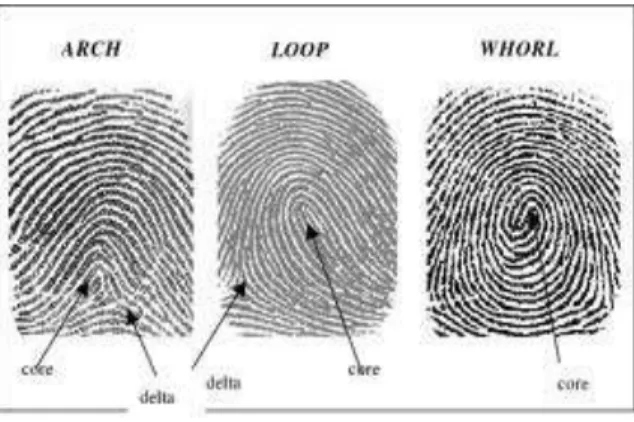
Loop, arch and whorl are the three basic patterns of fingerprints in Henry classification system. These patterns are shown in (Fig 1). In Henry classification system fingerprints are sorted by physiological characteristics for one-to-many searching.
Fig. 1. Fingerprint Patterns
An arch is a pattern where the ridges(lines) enters one side of the finger, then rises in the centre forming an arch shape, and exits on the other side of the finger. In loop the ridges (lines) enters at one side of the finger, then forms a curve structure, and exits on the same side of the finger from which it entered. Loops are the most common pattern in fingerprints. A whorl is the pattern where ridges (lines) form circularly around a central point.
4. Proposed Methodology
The proposed method consists of the following steps:
x Pre-processing and feature extraction. x Classification.
4.1. Pre-processing and Feature Extraction
Pre-Processing: It is necessary to bring the input image into an acceptable form which is recognized by the computer for feature extraction. The pre-processing methods used are resizing and binarization.
Feature Extraction: For extracting the features linear binary patterns are used. Table 1 shows the few examples of linear binary patterns. For our experimentation we used “10” as a linear binary pattern.
Table 1. Examples for linear binary patterns Linear Binary Patterns 00 01 10 11 Algorithm:
Input: Set of fingerprint images.
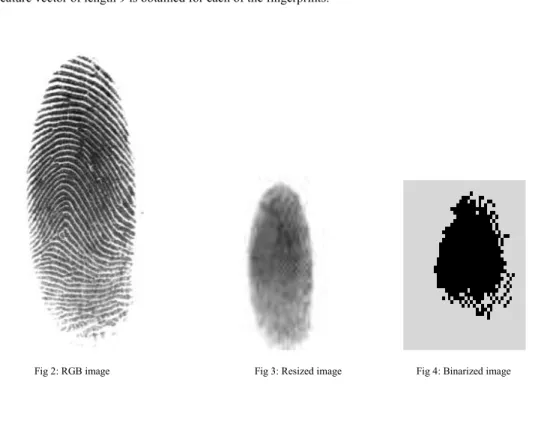
Output: Feature vector for the fingerprint images. Step 1: Load the RGB fingerprint image. (Fig 2) Step 2: Resize the image into 60X60. (Fig 3)
Step 3: Resized image is binarized using threshold value. (Fig 4) Step 4: Binarized image is divided into 9 equal zones as shown in Fig 5.
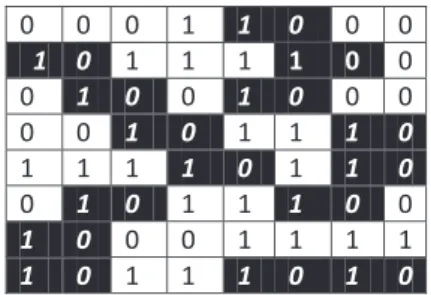
Step 5: For each block linear binary pattern is found horizontally. Fig 6 illustrates the procedure to find the linear binary pattern for each block. Linear binary pattern considered is 10 in this case.
(Linear binary pattern count is 15 for Fig 6)
Step 6: A feature vector of length 9 is obtained for each of the fingerprints. End
Fig 2: RGB image Fig 3: Resized image Fig 4: Binarized image
Zone1 Zone2 Zone3
Zone4 Zone5 Zone6
Zone7 Zone8 Zone9
Fig 5: Image Zoning
Fig 6: Illustration of linear binary pattern “10” (calculated horizontally)
4.2. Classification
The classification stage in fingerprint recognition system is the decision making part of a recognition system and it uses the feature vector generating from linear binary patterns during feature extraction stage.
Neural network and nearest neighbour classifiers are used for classification.
Neural network classifier: A feed forward back propagation neural network with one hidden layer is used to perform the classification. In this network, the information moves in only one direction, forward, from the input nodes, through the hidden nodes (if any) and to the output nodes. There are no cycles or loops in the network. The hidden layer uses the sigmoid activation function, and the third layer i.e., output layer is competitive layer, since it has to identify one of the fingerprints.
Nearest neighbour classifier: distance between the multi-dimensional feature vectors generated from the fingerprint images is measured for recognizing the fingerprints. The distance between the feature vectors of all the training patterns and input pattern is calculated. The feature vector, for which the distance is minimum, is matched with the input pattern.
We compute the distance between features of the test sample and the features of every training sample using equation 1 as shown below.
(1) Where and represents feature vector values in training samples and testing samples respectively.
5. Experimental Results
Datasets used for experimentation are FVC200214 and FVC200415.
In FVC2002 we have four databases DB1, DB2, DB3, and DB4, based on the type of sensor used for capturing the fingerprint and image size. For the experimentation we have selected 55 x 7 fingerprints from databases DB1, DB2, DB3, and DB4. This
means we have samples of 55 persons and each person’s 7 fingerprints. For training five samples of each person is used. For
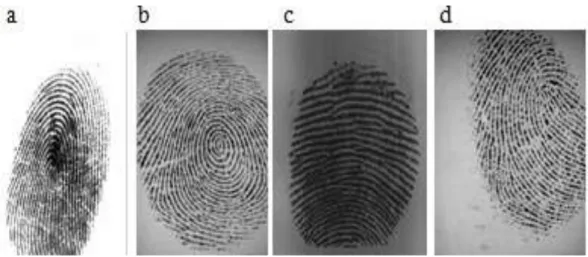
testing two samples of each person is used. Random samples from DB1, DB2, DB3, DB4 of FVC2002 dataset are shown in Fig 7 (a), Fig 7 (b), Fig 7 (c), Fig 7 (d) respectively.
In FVC2004 we have four databases DB1, DB2, DB3, and DB4, based on the type of sensor used for capturing the fingerprint and image size. For the experimentation we have selected 70 x 7 fingerprints from databases DB1, DB2, DB3, and DB4. This
means we have samples of 70 persons and each person’s 7 fingerprints.
Properties of fingerprint images in various databases of FVC2002 and FVC2004 are illustrated in table 2. Number of samples used for testing and training are mentioned in table 3. For our experimentation we used linear binary pattern 10 (As mentioned in table1). In experimentation 72% of the data is used for training the dataset. 28% of the data is used for testing the dataset.
Table 4 summarizes the accuracy of various fingerprint databases for different classifiers.
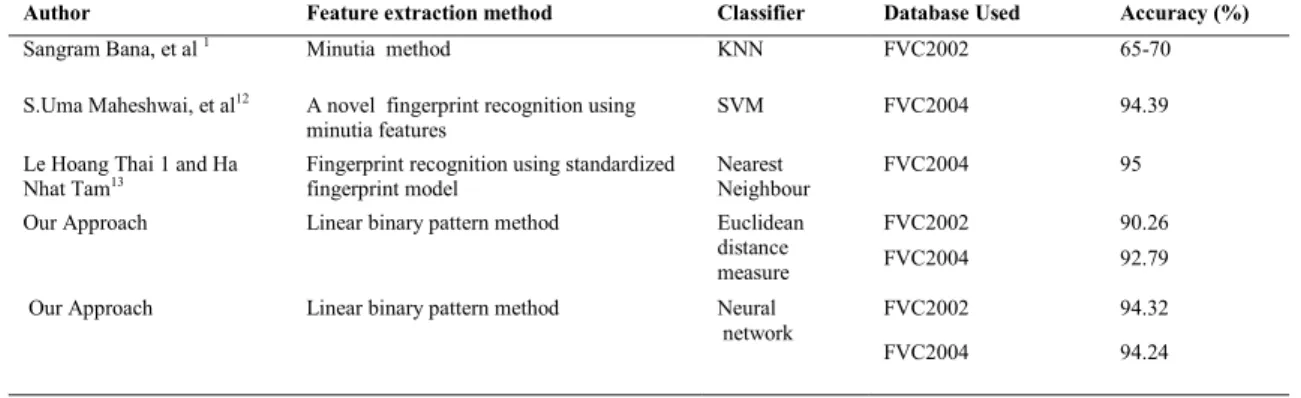
Table 5 shows the comparison of recognition accuracy of our proposed method with existing fingerprint recognition methods with different classifiers.
0
0 0
1
1
0
0
0
1 0
1
1
1
1
0
0
0
1 0
0
1
0
0
0
0
0
1
0
1
1
1
0
1
1 1
1
0
1
1
0
0
1 0
1
1
1
0
0
1
0
0
0
1
1
1
1
1
0
1
1
1
0
1
0
Fig 7 (a); Fig 7 (b); Fig 7 (c): Fig 7 (d) Table 2. Properties of fingerprint images
Database
Name Sensor type Image size (width x height) Resolution
FVC2002DB1 Optical sensor 388 x 374 500 dpi
FVC2002DB2 Capacitive sensor 296 x 560 569 dpi
FVC2002DB3 Capacitive sensor 300 x 300 500 dpi
FVC2002DB4 Synthetic 288 x 384 500 dpi
FVC2004DB1 Optical sensor 640 x 480 500 dpi
FVC2004DB2 Optical sensor 328 x 364 500 dpi
FVC2004DB3 Thermal sweeping sensor 300 x 480 512 dpi
FVC2004DB4 SFinGe v3.0 288 x 384 500 dpi
Table 3. Number of samples used of training and testing
Database Name Number of samples
in training set Number of samples in testing set Total number of samples
FVC2002DB1 55 x 5 55 x 2 385 FVC2002DB2 55 x 5 55 x 2 385 FVC2002DB3 55 x 5 55 x 2 385 FVC2002DB4 55 x 5 55 x 2 385 FVC2004DB1 70 x 5 70 x 2 490 FVC2004DB2 70 x 5 70 x 2 490 FVC2004DB3 70 x 5 70 x 2 490 FVC2004DB4 70 x 5 70 x 2 490
Table 4. Accuracy of various fingerprint databases
Database name Neural network classifier (%) Euclidean distance similarity measure (%) FVC2002DB1 96.66 92.10 FVC2002DB2 92.00 88.14 FVC2002DB3 94.14 89.98 FVC2002DB4 94.50 90.84 FVC2004DB1 94.00 92.56 FVC2004DB2 92.32 91.23 FVC2004DB3 95.00 93.00 FVC2004DB4 95.67 94.39 Overall average 94.28 91.15
Table 5. Comparison of the recognition accuracy of proposed method with the existing methods.
7
.
ConclusionIn this paper we have implemented linear binary pattern based feature extraction method for fingerprint images. Linear binary pattern “10” is used to generate the feature vector for all fingerprint images. Neural network and nearest neighbour classifiers are used for the recognition. From the experimentation we noted that the neural network classifier recognizes the fingerprint images more accurately nearest neighbour classifier. We got an average recognition accuracy of 94.28% and 91.15% for neural network and nearest neighbour classifiers respectively.
References
1. Sangram Bana and Dr. Davinder Kaur, Fingerprint Recognition using Image Segmentation, International Journal of Advanced Engineering Sciences and Technologies (IJAEST).2011, page no 12-23.
2. Pankaj Bhowmik, Kishore Bhowmik, Mohammad Azam, Fingerprint Image Enhancement And It’s Feature Extraction For Recognition,
International Journal of Scientific and Technology Research. 2012.
3. Loris Nanniכ, Alessandra Lumini, DEIS, University of Bologna, Local binary patterns for a hybrid fingerprint matcher, Pattern Recognition 41 (2008).
4. Jianjiang Feng, Combining minutiae descriptors for fingerprint matching, 2007 Pattern Recognition Society. Published by Elsevier Ltd, Pattern Recognition 41 (2008) 342 – 352
5. En Zhu, JianpingYin, Guomin Zhang, Fingerprint matching based on global alignment of multiple reference minutiae, Pattern Recognition 38 (2005) 1685 – 1694.
6. Manidipa Saha, Jyotismita Chaki, Ranjan Parekh, Fingerprint Recognition using Texture Features, International Journal of Science and Research (IJSR), December 2013.
7. Ravi.J, K.B.Raja and Venugopal. K. R, Fingerprint Recognition Using Minutia Score Matching, International Journal of Engineering Science and Technology Vol.1 (2), 2009, 35-42.
8. Roli Bansal, Priti Sehgal and Punam Bedi, Minutia extraction from Fingerprint Images-a Review, IJCSI International Journal of computer Issues, Vol. 8, Issue 5, No 3, September 2011.
9. Naser Zaeri, Arab Open University, Kuwait, Minutia Based Fingerprint Extraction and Recognition, www.intechopen.com.
10. Philippe Parra, , Fingerprint minutiae extraction and matching for identification procedure, University of California, San Diego, La Jolla, CA 92093-0443.
11. http://www.astroml.org/book_figures/appendix/fig_neural_network.html
12. S Umamaheshwari, Dr.E Chandra, A novel fingerprint recognition using Minutia features, International Journal of Engineering Science and Technology (IJEST)
13. Le Hoang Thai and Ha Nhat Tam, Fingerprint recognition using standardized fingerprint model, IJCSI International Journal of Computer Science Issues.
14. http://bias.csr.unibo.it/fvc2002/databases.asp 15. http://bias.csr.unibo.it/fvc2004/download.asp
Author Feature extraction method Classifier Database Used Accuracy (%)
Sangram Bana, et al 1 Minutia method KNN FVC2002 65-70
S.Uma Maheshwai, et al12 A novel fingerprint recognition using minutia features
SVM FVC2004 94.39
Le Hoang Thai 1 and Ha
Nhat Tam13 Fingerprint recognition using standardized fingerprint model Nearest Neighbour FVC2004 95 Our Approach Linear binary pattern method Euclidean
distance measure
FVC2002 90.26
FVC2004 92.79
Our Approach Linear binary pattern method Neural network
FVC2002 94.32