East Tennessee State University
Digital Commons @ East
Tennessee State University
Electronic Theses and Dissertations Student Works
12-2007
Parental Involvement in Two Elementary Schools:
A Qualitative Case Study.
Vonda K. Stevens
East Tennessee State University
Follow this and additional works at:https://dc.etsu.edu/etd Part of theEducational Sociology Commons
This Dissertation - Open Access is brought to you for free and open access by the Student Works at Digital Commons @ East Tennessee State University. It has been accepted for inclusion in Electronic Theses and Dissertations by an authorized administrator of Digital Commons @ East Tennessee State University. For more information, please [email protected].
Recommended Citation
Stevens, Vonda K., "Parental Involvement in Two Elementary Schools: A Qualitative Case Study." (2007).Electronic Theses and Dissertations.Paper 2067. https://dc.etsu.edu/etd/2067
Parental Involvement in Two Elementary Schools: A Qualitative Case Study
________________________
A dissertation presented to
the faculty of the Department of Educational Leadership and Policy Analysis East Tennessee State University
In partial fulfillment of the requirements for the degree
Doctor of Education ________________________ by Vonda K. Stevens December 2007 ________________________
Dr. Kathy Franklin, Ed.D, Chair Dr. Glenn Bettis, Ph.D. Dr. Pam Evanshen, Ed.D.
Dr. Eric Glover, Ed.D.
Keywords: Elementary Education, Family Involvement, Parental Involvement, Title I, NCLB
ABSTRACT
Parental Involvement in Two Elementary Schools: A Qualitative Case Study
by
Vonda K. Stevens
Parent involvement is essential if students are to succeed in school. In fact, “parental involvement is more important to student success, at every grade level, than family income or education” (Starr, 2004). Yet many schools struggle to effectively engage
parents in the education of their children as the No Child Left Behind (NCLB) Act of 2001
now requires.
The purpose of this study was to explore parents’, administrators’, and guidance counselors’ perceptions of parent involvement at a Title I elementary school and a non-Title I elementary school, both of which are located in the southern Appalachian region of the United States, to identify successful parental involvement practices, and to
determine the perceived impact of parent involvement on student achievement and school improvement. Specifically, this study explored the strategies employed within the 2 elementary schools to encourage parent involvement, identified effective practices of highly involved parents at the 2 schools, and determined barriers to parental involvement at the 2 elementary schools.
The findings of this study suggested that parents in both elementary schools have very similar perceptions of parent involvement. Parents from each school reported that they feel welcome in their children’s school, communicate regularly with school personnel,
engage in parent-child learning activities, and serve on decision making bodies within the school. Surprisingly, parents in both schools expressed a desire for more parent
involvement and perceived some parents as not having an equal opportunity to participate in school functions.
School personnel identified barriers to parent involvement and described the manner in which they were working to overcome challenges in their respective schools. While principals articulated the desire for greater parent involvement, they perceived their schools as providing opportunities for all parents to be actively engaged in the educational process.
Recommendations from the study include providing parents with a specific definition of parent involvement so there is a clear understanding that parent involvement
encompasses more than “physical presence,” and establishing parent-to-parent outreach programs to mentor those who are reluctant or new to the school.
DEDICATION
This study is dedicated to—
My mother, Marie, and father, Gordon, who instilled in me a sense of absolute wonder, insatiable curiosity, and an unquenchable love of learning. Had it not been for their encouragement, their involvement, and their patience—especially their patience, I
would not be the person I am today. I thank my mother for reading The Lorax with me,
and pointing out the “funny little yellow things” as we sat at the kitchen table, and my father for waking me each morning with the familiar phrase borrowed from one of my first-grade readers, “Good morning, Rabbit.” Smiling, I would respond, “Good morning, Turtle.” My mother and father made reading fun and started me on a journey of lifelong learning, and for that, I will always be grateful.
To my sister, Tonda, who has always been a reader. I can still remember watching her as she wrote essays and read novels at the dining room table. I have always admired her intelligence and her fortitude, and I am thankful for the example she set for her “little” sister.
To my daughter, Bretta, who has been my source of inspiration since the day she was born. It is Bretta who taught me that I am limited only by my own will and
imagination.
To my aunt, Helen, and my grandmother who supported me in my pursuit of a teaching degree through their active involvement during my daughter’s early school years.
To the many teachers I have known throughout my schooling including: Ms. Elaine Towns and Ms. Carolyn Tiller for providing hands-on learning opportunities in elementary school and subsequently inspiring me to teach; Mr. Jim Bishop in junior high school who inadvertently taught me the importance of maintaining a sense of humor; Mr. Frank Buchanan in high school who always found time to listen without passing
judgment, Ms. Barbara Holbrook at Virginia Highlands who shared with me that “making a B is not a bad thing,” and Mr. Ben Jennings, also at Highlands, whose constructive criticism and positive feedback allowed me to come to see myself as a writer.
Finally, to all of my good friends who have encouraged me and stood beside me throughout this process.
ACKNOWLEDGEMENTS
I wish to thank my mother and father for their continued support and
encouragement throughout my education; for having high expectations of me; for holding me accountable for my actions, and for all the times they said, “You can do it.”
I also wish to express my appreciation to my daughter whose love and understanding are paramount.
I am very grateful to my chairperson, Dr. Kathy Franklin. Her advice and wisdom were always welcome and often reassuring.
I also wish to thank the other members of my committee, Dr. Eric Glover, Dr. Glenn Bettis, and Dr. Pam Evanshen. Their challenges, insight, and suggestions were much appreciated throughout my time at East Tennessee State University.
I am also very appreciative of Dr. Nancy Dishner, whose words of encouragement
throughout my coursework always came at just the right time.
I extend a special thank you to Dr. Terry Caldwell, who served as my external auditor, Dr. Diane Schlauch, my peer debriefer, and Dr. Jim Geiger, my editor. Their willingness to assist me in this journey is greatly appreciated.
Finally, I would like to thank the parents, the principals, and the guidance
counselor who opened their doors, their minds, and their hearts to me. If not for their help and authenticity this study would have been impossible.
CONTENTS Page ABSTRACT ……….. 2 DEDICATION ……….. 4 ACKNOWLEDGEMENTS.………. 6 Chapter 1. INTRODUCTION ……….. 11
Statement of the Problem ………... 22
Research Questions ………. 23
Significance of the Study ………. 23
Scope of the Study ………... 24
Limitations of the Study ……….. 25
Delimitations of the Study……… 25
Definitions of Terms ……… 26
Overview of the Study ………. 27
2. REVIEW OF RELATED LITERATURE ………... 28
Overview ………. 28
Barriers to Parental Involvement ……… 31
Strategies for Engaging Parents ………... 33
Key Components of Parental Involvement ……… 35
Parenting ………. 36
Communication ……….. 39
Learning at Home ……….. 42
Decision-Making ………... 42
Collaborating with Community ………. 43
The Principal’s Role ……… 45
Summary ……….. 46
3. METHODS AND PROCEDURES 48 Methodology ……… 48 Study Design…..………. 48 Setting…………..……… 50 Research Participants ……….. 51 Data Collection ……… 52 Interviews ……….……….. 53 Document Review ……….. 55 Observations ……… 55
Data Recording, Analysis, and Interpretation ………. 56
Interviews ……….. 57 Document Review ………. 57 Observations ………. 58 Biases……….. 58 Summary ………. 58 4. DATA ANALYSIS ……… 59 Introduction ……….. 59 Participating Schools ……… 59
Study Participants ……… 60
Research Questions (Restated) ... 62
Understanding Parent Involvement ……… 63
Parents as Decision Makers……… 69
Parenting and Collaborating with the Community………. 73
Benefits of Parental Involvement ……….. 74
Barriers to Parental Involvement ……… 81
The School’s Role ……… 86
Parental Involvement and Student Achievement………. 93
5. FINDINGS, RECOMMENDATIONS, AND CONCLUSION ………... 102
Introduction ……….. 102
Summary of Findings ……… 103
Defining Parental Involvement ………. 105
Factors Affecting Parental Involvement ………. 106
Promoting Student Achievement and Improving School Performance……….. 109
Recommendations ……….. 109
Limitations and Delimitations ……… 110
Recommendations for Further Research ……… 111
Conclusion ……….. 112
REFERENCES ……….. 115
APPENDICES……… 120
APPENDIX A: Letter of Introduction to Parents ……….. 120
APPENDIX C: Interview Guide for School Administrators and Guidance Counselors………...
122
APPENDIX D: Document Review Guide ……….. 123
APPENDIX E: Observation Guide ………. 124
APPENDIX F: Informed Consent .……...………... 125
APPENDIX G: Letter from Auditor ………... 127
APPENDIX H: Letter from Peer Reviewer ……… 129
CHAPTER 1 INTRODUCTION
“No significant learning occurs without a significant relationship.” ~ Dr. James Comer (Washington State University, 2007, n. p.)
I sat in the gymnasium of our small elementary school looking into the bleachers that should have been filled with involved parents eager to learn more about their
children’s academic progress and how they could play a more active role in the educational process. What I saw, however, was 13 teachers, their children and six parents— including the four that were serving on the Parent Teacher Association (PTA) Executive Board, and, therefore, hosting the meeting that was about to take place.
I thought back to the days when I was in elementary school. It seemed that the auditorium was always filled with parents at PTA meetings. Classroom parties were organized and conducted by smiling homeroom mothers, mine included. My parents read with me most every night, helped me with my homework and attended awards programs regularly. They participated in classroom field trips, hosted pizza parties, and even brought my new puppy, Brute, to school to meet my classmates and teacher in third grade.
I knew school was important, not so much because of what my parents said about education, but by the way they supported my sister and me as we worked our way
through the public education system. They stressed the importance of learning over the attainment of grades and always encouraged and expected us to achieve our personal best regardless of the task. They valued learning and taught us to do the same. Wherever we traveled, whether near or far, my mother had a newspaper in hand, and my father always took the time to show us something new. He often said, “Learning occurs everywhere;
you just have to ‘see’ with your mind.” Through the words and actions of our parents, we did begin to “see” with our minds, and, in turn, my sister and I became lifelong learners.
As I reflected on my own education, I began to think of my daughter, Bretta. Was I as involved in her elementary education as I should have been? How would her teachers rate my level of participation? How many PTA meetings had I attended?
I began working full-time and married my high school sweetheart shortly after graduating from a southern Appalachian high school. Within a year of my marriage, I became pregnant and gave birth to a beautiful baby girl. A few short years later, my husband and I began to experience growing pains and were divorced before our daughter was enrolled in kindergarten. It became very clear, very quickly, that I needed to return to school. The test anxiety that had once deterred me from attending college paled in
comparison to the importance of becoming financially able to support my child, and I had a strong desire to teach. I also wanted to set a good example for my daughter, Bretta. As she entered her first year of school, I began my third year of college: a single mom working three jobs.
As I thought about it, I came to the conclusion that my level of parent
involvement, in terms of serving as a homeroom mother and attending PTA meetings, was minimal at best; however, I had very high expectations for Bretta, and, fortunately, I had the support of my parents, my sister, my aunt, and my grandmother. While I was attending class and trying to provide for my daughter, I knew there was someone to take her to and from school and to pack her lunch when necessary. My aunt served as a volunteer reader in Bretta’s classroom. If I did not have time to make cookies for a class party, my mother or my sister did. When I was too tired to read with Bretta at night, my
father was there to share a story and make sure she completed her assignments for the next day. I was, and still consider myself, very blessed. My parents and extended family members have always been involved in my education as well as the education of my daughter. Even today, as I sit writing my dissertation, they call to see how I am
progressing and how my daughter, now in her third year of college, is fairing. I laugh and tell them that perhaps Bretta and I will walk across the stage together, and I acknowledge that learning has always been, and will always be, a way of life for me. I can only hope that my daughter will share my passion.
---Sitting in the gym of the school where I was teaching on that warm spring evening in April 2005, I thought how sad to see only 19 adults at our PTA meeting and realized that without the support and active involvement of my parents and other family members, there was no way I would be where I am today, a library media specialist working toward a doctorate degree in educational leadership. Moreover, my daughter, now 21 years of age, would not be where she is either: a college junior with a mind for business, pursuing a bachelor’s degree in economics and public relations.
After thinking about my situation, I was saddened by the thought of our 194 students who seemingly lacked this type of academic, emotional, and social support from their families. Having served as the school librarian and a lead mentor and prevention coordinator through America’s Promise, I had come to know many of the families throughout the school. From the outside looking in, many appear to have the desire to help their children, but they lack the skills, the knowledge, or the time to do so. Without the support and active involvement of their parents, how many of our school children will
succeed much less thrive? How many will complete high school? How many will set and pursue goals of higher education? How many will find themselves poverty-stricken and hungry? More poignantly, how many will find themselves homeless?
As educators and humanitarians we must ask ourselves these questions and work to find a way to increase parental involvement in public education. In our efforts to “leave no child behind,” educational leaders must employ methods to inform and engage parents from all walks of life: the wealthy, the poor, the educated, and those with little or no education, regardless of race, religion, gender, or ability level. If we are to excel in our quest to prepare children for the future, we must find ways to engage parents in every aspect of formalized schooling—from volunteering as chaperones for field trips and helping with homework to serving on decision-making bodies such as the School Improvement Planning Team. Parent involvement is not only essential to student achievement and school improvement; it is now mandated by the federal government.
According to Section 1118 of the No Child Left Behind (NCLB) Act (United States Department of Education [USDE], 2005) public schools must:
1. Provide parents with key information regarding curriculum, student
performance on state assessments, qualifications of teachers and overall school and district performance.
2. Allow parents to transfer their child to another public school if the school in
which they are enrolled is deemed persistently dangerousor if the child is a
victim of a violent criminal act on school grounds.
3. Establish a Committee of Practitioners in which districts, parents, teachers and
implement Title I and the Title I or consolidated state plan.
4. Develop a written school and district parental involvement policy for schools
qualifying for Title I funding, which is to include a school-parent compact on the roles of the teacher, school, and parent in raising the academic
achievement of the student and conductan annual meeting for parents to
explain the Title I program and opportunities for parental involvement.
5. Notify parents with children enrolled in a Title I school of their rights to
participate in the development of the School Improvement Plan. (pp. 59-63) Nevertheless, Appleseed (2006) found that:
1. Too many parents fail to receive clear and timely information about their
children and their schools.
2. Poverty, limited English proficiency, and varying cultural expectations are
among the biggest barriers to parental involvement.
3. Poor communication with parents hinders their ability to exercise NCLB’s
choice and supplemental education services options.
4. Creative, multi-faceted communication and engagement strategies can
promote better parental involvement in schools.
5. Parental involvement is not uniformly valued by school leaders as a key
accountability strategy. (p. 2)
In light of these findings, it is imperative that educators employ new, innovative ways to fully engage parents. As Epstein and Jansorn (2004a) noted:
Research shows that most parents who are not presently involved would like to be, if only their children’s teachers, administrators and counselors showed them
how to help their children increase reading and math scores, improve attendance, and meet other important goals. (p. 10)
Yet school personnel have often reported that effectively engaging parents is difficult to accomplish. To address this need, a program of partnerships consisting of school, family, and community should be developed and implemented (Epstein & Jansorn, 2004a). Epstein (2001) ascertained:
This approach, developed with educators in the National Network of Partnership Schools at Johns Hopkins University, recognizes that students learn and grow at home, at school, and in their communities, and that they are influenced and assisted by their families, teachers, principals, and others in the community. (p. 12)
This program, dubbed the Action Team for Partnerships (ATP) would cultivate
productive partnerships that involve schools, parents, and community stakeholders and sustain the work of these partnerships over time to improve schools and student
achievement (Epstein & Jansorn, 2004a). The ATP would be responsible for preparing the annual action plans as well as coordinating and marketing the activities associated with the plan and would be accountable for evaluating the programs and reporting results to the school council and relevant others (Epstein & Jansorn).
Community partnerships such as the ATP are becoming more and more important as the gap between those living in wealth and those living in poverty continues to expand (Gumbel, 2007). Gumbel stated that such partnerships can facilitate communication and understanding for all involved parties and provide on-site services within the school while enhancing learning opportunities and achievement for all students.
In the southern Appalachian region of the United States, specifically the area served by the school district described in this study, the differences among those living in wealth and those living in poverty are highly visible. According to the Elm Elementary School Improvement Plan (2006), the population of approximately 25,000, served by the school district described herein, is predominately white, non-Hispanic. The median household income is “below” the state average, and the median house value is
“significantly below” the state average ([Elm] Elementary, School Improvement Plan). The [Elm] Elementary School Improvement Plan (2006) stated that 17.4% of the city’s residents, 25 years or older, hold a bachelor’s degree or higher while 5.8% of the population hold a professional or graduate degree and acknowledged that the most common industries for citizens in this area include construction, accommodation and
food services, machinery, education services, and health care.
Driving through area neighborhoods, passers-by become painfully aware of the aging school buildings in various states of disrepair. Box air conditioners are seen hanging from the weathered window frames, and paint peels from the wood trim. “The maintenance department works throughout the calendar year to maintain a safe learning environment; yet limited resources provide very few aesthetic enhancements” (Guidance Counselor, personal communication, August 15, 2007).
Of the 3,803 students, grades pre-school through 12, attending school in this district, 91.7% are white; 5.4% are African American, 1.7% are Hispanic, 0.8% are Asian, and 0.4% are Native American ([City] Report Card 2006, [State] Department of Education, 2006c). The [City] Report Card 2006 ([State] Department of Education) identified 1% of the students as Limited English Proficient, 14.6% as having disabilities,
and 46.8% as economically disadvantaged, therefore qualifying for the free and reduced lunch program.
Administrators and teachers within the school system report that, all too often, many of the children in the district come to school hungry, sleep deprived, and in need of medical attention. Educators throughout the school system are finding that in addition to teaching, they must now assume the roles of parent, guardian, coach, advisor, and mentor. These new roles, along with inadequate funding and unattainable goals for student achievement (Hoff, 2007) prescribed by the federal government have made it
very difficult for schools and school districts to embrace No Child Left Behind.
Nonetheless, this piece of legislation has ushered in an era of accountability far beyond that of any of its predecessors (Guilfoyle, 2006), demanding that all schools make adequate yearly progress (AYP) as measured by student performance on standardized, state-wide tests or face punitive sanctions imposed by the federal government.
Of the six southern Appalachian elementary schools located within this school district, two stand out with respect to parent involvement. Elm Elementary, with an enrollment of 449 students, and a rate of 37.0% economically disadvantaged students ([State] Department of Education, 2006a) is acknowledged by administrators and teachers throughout the school system as having a high degree of parent involvement. Approximately 123 of the students attending Elm Elementary are tuition or transfer students ([Elm] Elementary, School Improvement Plan, 2006).
Conversely, Oak Elementary has an enrollment of 218 students with a rate of 83.3% economically disadvantaged students ([State] Department of Education, 2006b). Approximately 20% of the student body receives special education services, in addition
to the 12%-15% who qualify for speech and language services ([Oak] Elementary, School Improvement Plan, 2006).
Elm Elementary School was built in 1954 and renovated in 1985. The building is situated on a sprawling campus with several area businesses located nearby. A little league field and a new condominium development sit adjacent to the physical building. The surrounding area also includes one low-income apartment complex.
Currently, Elm Elementary employs one full-time principal, 22 full time teachers, one part-time kindergarten through third grade teacher, one time librarian, one full-time physical education teacher, one full-full-time special education teacher, one part-full-time music teacher, one part-time art teacher, and one part-time speech therapist ([Elm] Elementary, School Improvement Plan, 2006). School support staff include two secretaries, one bookkeeper, one full-time school nurse, five cafeteria staff, and one custodian ([Elm] Elementary, School Improvement Plan, 2006).
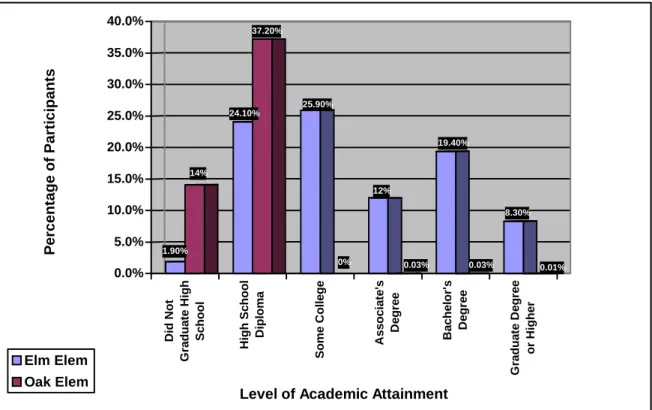
According to the National Study of School Evaluation (NSSE) Parent Opinion Inventory conducted by Elm Elementary in 2005, 24.1% of the parent population completed high school, 25.9% had completed some college courses, 12% had obtained associate’s degrees, 19.4% had earned bachelor’s degrees, and 8.3% held a graduate degree or higher ([Elm] Elementary, School Improvement Plan, 2006). See Figure 1 for a comparison of the educational backgrounds of NSSE Parent Opinion Inventory
respondents as reported by parents at Elm and Oak elementary schools.
Elm Elementary is a school rich in student achievement and parent involvement. In fact, Elm has been identified by area educators as being a benchmark school for parent involvement ([Principal], personal communication, 2006). According to school
personnel, parents frequently volunteer to help in the classroom and actively participate in school governance.
In contrast, it is commonly known that Oak Elementary, designated as a Title I school due to the high percentage of economically disadvantaged students, struggles to effectively and consistently engage parents in decision-making and volunteer
opportunities. Although teachers actively recruit parents, consistency has been difficult to establish and almost impossible to maintain ([Guidance Counselor], personal
communication, 2006). The principal and teachers at Oak Elementary have openly expressed their desire to increase parental involvement and strive daily to do so ([Principal], personal communication, July 10, 2006).
Oak Elementary School is situated off the main thoroughfare of the city in which it is located. Built in 1939, the facility was renovated in 1984. The small, neighborhood school sits close to the street, surrounded by sidewalks. A small playground sits adjacent to the aging building.
The Oak Elementary community consists of low-income housing, including mobile home parks and federally-funded duplexes, two homeless shelters, low to
moderate income rentals, and a modicum of privately owned homes ([Oak] Elementary, School Improvement Plan, 2006). Many of the houses directly surrounding the school are older and in need of repair.
In addition to the principal, full-time faculty members include 13 classroom teachers, a librarian, a guidance counselor, a Title I reading teacher, two behavior modification specialists, and a physical education teacher ([Oak] Elementary, School Improvement Plan, 2006). Part-time faculty members include a music teacher, an art
teacher, and a speech therapist. The school also employees a secretary, a bookkeeper, a school nurse, four educational assistants designated to support the inclusion of students with disabilities, 11 teaching assistants, a special education teacher, a behavior
modification teacher, three cafeteria staff members, and one custodian ([Oak]
Elementary, School Improvement Plan). According to the Oak Elementary School School Improvement Plan, approximately 87% of the Title I funds have been allocated for
personnel.
The [Oak] Elementary School Improvement Plan (2006) reported that Oak Elementary administered the NSSE Parent Opinion Inventory in 2005. Of those responding, 14.1% indicated that they did not graduate from high school while 37.2% reported that they did graduate from high school. Two parents responding to the survey, or 0.025%, hold an associate’s degree; 0.025% hold a bachelor’s degree, and 0.013% hold a graduate degree ([Oak] Elementary School Improvement Plan). See Figure 1.
1.90% 14% 24.10% 37.20% 25.90% 0% 12% 0.03% 19.40% 0.03% 8.30% 0.01% 0.0% 5.0% 10.0% 15.0% 20.0% 25.0% 30.0% 35.0% 40.0% Pe rc e n ta g e of Pa rt ic ip a n ts Di d No t G ra dua te H igh Sc hool H igh Sc hool D iplom a S o me C o lle ge A sso ci at e' s De g re e B ach el o r' s De g re e G ra dua te D e gr e e or H ighe r
Level of Academic Attainment Elm Elem
Oak Elem
Figure 1. Comparison of the educational background reported by respondents at Elm and Oak elementary schools on the 2005 NSSE Parent Opinion Inventory.
Statement of the Problem
In our efforts to “leave no child behind,” educational leaders must employ
methods to inform and engage parents from all walks of life: the wealthy and the poor; the educated and the undereducated in every aspect of education—from helping parents understand phenomena associated with childhood development to serving on decision making bodies such as school improvement planning teams—parent involvement is essential for school improvement and student achievement. However, barriers to parent involvement including “cultural differences . . . parental illiteracy, family problems . . . economic conditions . . . and lack of resources needed for participation” (Plevyak, 2003, p. 32) do exist and can prove challenging for school systems to overcome.
Research Questions
The following research questions provided the focus for this qualitative case study as the researcher attempted to determine the factors that influence the level of parental involvement present at each of the schools:
1. How do highly involved parents describe parent involvement with respect to their
child’s education?
2. What do highly involved parents and school administrators perceive as factors
affecting the level of parent involvement within public schools?
3. How does parent involvement promote better student achievement and school
performance?
Significance of the Study
The No Child Left Behind Act of 2001 (NCLB) has ushered in an unprecedented era of accountability for public schools nationwide (Guilfoyle, 2006). Under this law, schools and districts must demonstrate annual yearly progress (AYP) in raising student achievement with all students proficient by the end of the 2013-2014 academic school year.
As schools attempt to achieve this goal, teachers, and administrators must
effectively engage parents as partners in education. NCLB plainly states that parents
should be “1) informed of the academic progress of their children and the performance of their schools; and 2) involved in meaningful ways as a partner with school officials” (Appleseed, 2006, Preface section, para. 4). Even so, it is widely reported that many schools fail to effectively engage parents in school functions. Even more disturbing, some
parents report feeling uncomfortable in the school setting, and various teachers feel as if they are “under attack” when parents frequent the classroom (Starr, 2004, para. 1).
Considering the plethora of research documenting the importance of parental involvement and federal legislation which mandates it, this qualitative case study investigated, a Title I elementary school and a non-Title I elementary school, both of which are located in the southern Appalachian region of the United States. This case study also explored parental involvement as perceived by parents, school administrators, and an elementary school guidance counselor and attempted to determine the factors that influence the level of parental involvement present at each of the schools.
Although generalizations are not appropriate, Merriam (2002) noted “working hypotheses that take account of local conditions can offer practitioners some guidance in making choices—the results of which can be monitored and evaluated in order to make better decisions in the future” (p. 28). Therefore, the information gained throughout the course of this study adds to the existing body of research and serves as a reference for educators and parents in schools with similar demographics wishing to replicate practices for recruiting and retaining parents as partners in education. Furthermore, policy-makers, looking to effect positive change in education-related legislation can benefit from this study as it discusses the factors affecting parent involvement as related to student achievement and school performance.
Scope of the Study
The researcher conducted a qualitative case study of parent involvement as it occurs within two elementary schools located in the southern Appalachian region of the United States. Parents, school principals, and an elementary school guidance counselor
were interviewed to determine the degree and perceptions of parental involvement in the two urban elementary school settings: a Title I elementary school and a non-Title I
elementary school. To increase validity, documents including School Improvement Plans, school Web sites, and school newsletters were also reviewed, and participant
observations were conducted at each site, permitting the researcher “to hear, to see, and experience reality as the participants do” (Marshall & Rossman, 2006, p. 100).
Limitations of the Study
This qualitative case study is limited to two elementary schools located in the southern Appalachian region of the United States. When conducting a case study, “a small sample is selected precisely because the researcher wishes to understand the
particular in depth, not to find out what is generally true of the many” (Merriam, 2002, p. 28).
Personal biases as a working mother, a former classroom teacher, and a full-time advocate for parental involvement are fully acknowledged by the researcher. Therefore, precautions have been taken to guard against the skewing of data including the
participation in an audit process (Marshall & Rossman, 2006) and the use of an Institutional Review Board (IRB) certified peer examiner.
Delimitations of the Study
The findings of this study were limited to two elementary schools located in the southern Appalachian region of the United States; therefore, results should not be generalized to other populations.
Definitions of Terms
1. Annual Yearly Progress (AYP) – A measure of a school’s or school system’s
ability to meet required federal benchmarks with specific performance standards from year to year ([State] Report Card, 2006d).
3. Casual Register – Language between friends characterized by a general word choice consisting of a 400-800 word vocabulary (Payne, 2005, p. 27).
4. Formal Register – The standard sentence syntax and word choice of work and school. Uses complete sentences and specific word choice (Payne, 2005, p. 27).
5. No Child Left Behind (NCLB) – Implemented during the 2002-2003 school year;
amended the Elementary and Secondary Education Act of 1965. NCLB, which was signed into law in January 2002 by President George W. Bush, requires schools to have 100% proficiency among students in math and reading by the academic year ending 2014. Schools and school districts must also meet graduation and attendance standards ([State] Report Card, 2006d).
6. Parent – For the purpose of this study, the term parent is defined by the researcher
as including biological parents, legal guardians, and primary caregivers.
7. Parent Involvement – Participation of parents in regular, two-way communication
involving student academic learning and other school activities (United States Department of Education, 2004).
7. Student Achievement – For the purpose of this paper, student achievement is
defined by the researcher as student gain in academic areas as measured by year-end standardized tests.
8. Title I Funding – Federal money distributed to states and then to schools, based on their percentage of low-income students as measured by the number of students receiving free or reduced-price lunches (Furger, 2005).
Overview of the Study
Chapter 1 includes an introduction to the study, a statement of the problem, research questions, the significance of the study, the scope of the study, limitations of the study, delimitations of the study, definitions of terms, and an overview of the study. Chapter 2 contains a review of available literature pertaining to parent involvement as it relates to public education and student achievement. Chapter 3 describes the methods and procedures used in this qualitative case study including demographic information of participants, the research design, instruments used to collect data, and how the data were analyzed. Chapter 4 presents the findings of the research and the data analysis. Chapter 5 consists of a summary of the study with findings, limitations and delimitations,
CHAPTER 2
REVIEW OF RELATED LITERATURE
Do not confuse physical presence with parental involvement.
~ Ruby Payne (2006 p. 1)
Introduction
Parental involvement is essential for student success and school improvement (Appleseed, 2006; District Administration, 2003; Hopkins, 2000). In light of heightened accountability for schools and school personnel with respect to student achievement and school performance, it is becoming increasingly important to engage parents as partners in the education of America’s children, yet “schools and districts do not universally embrace parental involvement as a central strategy for accomplishing academic gains” (Appleseed, 2006, p. 2). In fact, many parents report feeling “uncomfortable in their children’s schools,” and “teachers often feel under attack by parents who are highly involved” (Starr, 2004, para. 1).
Parental involvement is not only critical to the academic success of our students;
it is federally mandated as well. The Elementary and Secondary Education Act (ESEA) of
1965, signed by President Lyndon B. Johnson, was the first federal education law to provide funding for kindergarten through 12th grade education. The purpose of the act was to improve academic achievement among disadvantaged students by allocating funds for professional development for educators, instructional materials, resources to support educational programs, and the promotion of parental involvement programs.
In 1994, President Bill Clinton signed the Improving America’s Schools Act,
thereby, amending ESEA and heightening requirements for parental involvement.
called for partnerships to be established for the purpose of increasing parental
involvement and developing the whole child: socially, emotionally, and academically (Starr, 2004).
Public eye turned once again to America’s schools and the need for improvement
in 2002 when President George W. Bush signed the latest amendment to ESEA into law:
the No Child Left Behind Act (NCLB). This landmark piece of educational legislation ushered in a new era of accountability for public schools far beyond any of its
predecessors (Guilfoyle, 2006) and, in doing so, has been highly praised by some while
being greatly criticized by others.
In a letter to the editor of the Cincinnati Enquirer, Regional Representative for Secretary of Education Margaret Spellings, Cohn (2007) noted:
It's also awesome to see the progress that our students have made under the law. According to the Nation's Report Card, more reading progress was made by 9-year-olds in five years (1999-2004) than in the previous 28 years combined. Math scores have reached new heights. And achievement gaps between young African-American and Hispanic students and their white peers have narrowed
significantly, in many cases to record lows. (n. p.)
While it is difficult to argue with hard data collected by the federal government through state-wide, standardized testing measures, one might question the absolute reason for such gains. Are public schools doing a better job of providing appropriate staff development for teachers? Are educators responding to the call for greater
accountability? Are school administrators and teachers becoming more successful at involving parents in meaningful ways for the purpose of increasing student achievement?
No Child Left Behind holds teachers, schools, and school districts accountable for student achievement as well as graduation and attendance rates, issuing sanctions if annual yearly progress (AYP) is not made. This law also requires two-way, significant parent
involvement, yet there are no consequences prescribed by NCLB for parents who fail to
take part in their children’s education. Nonetheless, schools and districts are still responsible for involving parents in the day-to-day operations of the school.
Despite federal legislation and research findings, many administrators and
teachers find it difficult to engage parents in meaningful ways (Hopkins, 2000). Although many schools strive to involve families in the education of their children, “they can improve results by taking a team approach to organize their partnership program,
reaching out to more families, and linking involvement activities to student achievement goals” (Epstein & Jansorn, 2004a, p.15).
Mary Ellen Imbo, principal at Westwood Elementary School in Broken Arrow, Oklahoma stated, “Any activity that involves parents…enhances ownership in the education process and directly contributes to the achievement of children” (as cited in Hopkins, 2000, para. 5). Yet public schools must do more than conduct a few activities to
involve parents. NCLB is a call to action for schools and school districts to build capacity
to effectively implement parent involvement policy.
No Child Left Behind requires that each state include parents in the development of its Title I plan. Likewise, school districts and schools receiving Title I funds must have a parent involvement policy developed jointly with and approved by parents (Public
Education Network, 2004). NCLB also requires schools to use at least 1% of their Title I
assessment to parents, develop a parent-school compact outlining procedures for collaboration between families and the school to increase student achievement, and provide parents with detailed information regarding students’ academic progress (Appleseed, 2006).
Moreover, NCLB requires that districts provide technical assistance to schools
failing to make Annual Yearly Progress (AYP) for 2 consecutive years, subsequently identified as “high priority” ([State] Report Card 2006). Schools unable to make AYP for 3 consecutive years must offer tutoring and enrichment services in addition to instruction provided during the regular school day (Appleseed, 2006). Districts must also provide parents with written notification of the school’s status and be given the choice to move their child to a higher performing school within the district.
Barriers to Parental Involvement
Numerous studies have demonstrated that students experience greater achievement when parents are actively involved in their children’s education.
“School-aged children in both two-parent and single-parent families are more likely to get mostly A’s, to enjoy school, and to participate in extracurricular activities, and are less likely to have ever repeated a grade and to have ever been suspended or expelled if their fathers or mothers have high as opposed to low levels of involvement in their schools” (United States Department of Education, National Center for Education Statistics, 1997). (p. 53)
Yet educators struggle daily to actively engage parents. According to Appleseed (2006) reasons for the inability to enlist parents as partners in education include:
• The challenge of defining clear and meaningful benchmarks by which effective parental involvement can be evaluated;
• A preoccupation with the accountability elements of NCLB, such as
testing and teacher quality; and
• A lack of awareness and training on how to effectively engage parents
(p. 2)
While many educators openly acknowledge the value of parental involvement, implementing an effective parental involvement plan can be cumbersome and time-consuming for classroom teachers. “Limited professional development at the school or district levels” and the “lack of pre-service training” (Ferrara & Ferrara, 2005, p. 77) contribute to the deficit of parents actively engaged in their children’s learning. Until educational professionals understand the importance of implementing a successful parental involvement program for the purpose of increasing student achievement and improving school performance they will not devote the time and energy necessary for doing so (Ferrara & Ferrara).
To further complicate the matter, the extent to which schools are implementing parental involvement programs in children’s education is unclear because defining and accurately measuring the degree and success of parental involvement is a difficult task (Appleseed, 2006). This is due, in part, to uncertainty regarding the activities and desired outcomes of various parent involvement programs (Baker & Soden, 1998).
Unfortunately, barriers to parent involvement exist far beyond pre-service and in-service deficits. “Cultural differences, fear of authority-based institutions, parental illiteracy, family problems, negative education experiences, job-related issues, economic
conditions, health, living arrangements, and lack of resources needed for participation” (Plevyak, 2003, p. 32) are among those often cited.
Social constructs such as culture and socioeconomic conditions often influence the manner and the degree to which parents become involved in their children’s
education (Payne, 2005). For example, parents living in poverty view the importance of education very differently than their working class or wealthy counterparts (Keller, 2006; Payne, 2005). For example, “If the school asks parents to read to their children, for instance, and a parent sees reading as what the school does, the demand is not likely to be honored” (Keller, p. 13). Therefore, it is imperative that school staff dialogue with
parents to define and clarify role expectations for all involved parties, providing appropriate training when necessary.
Strategies for Engaging Parents
“Research shows that students with involved parents—regardless of their background or income level—reap a bevy of benefits, including attending school
regularly, enrolling in more advanced classes, getting better grades, graduating from high school, and pursuing post-secondary education” (District Administration, 2003, para. 3). Still, it is widely held that schools and school districts struggle to effectively engage parents in the educational process of their children (Keller, 2006).
In order to bring about systemic, positive change, school and district
administrators must allocate the time and resources necessary for educators to have a thorough understanding of the factors influencing parents and their decision to assume an active role in the school (Ferrara & Ferrara, 2005). Only with this support will “teachers,
students, parents, community members, and others work closely together for the benefit of schools and the children they serve” (Epstein & Jansorn, 2004b, p. 23).
Additional factors influencing the degree of parent involvement include:
1. Parents’ beliefs about what is important, necessary, and permissible for them to do with and on behalf of their children;
2. The extent to which parents believe that they can have a positive influence on their children’s education; and
3. Parents’ perceptions that their children and school want them to be Involved (Hoover-Dempsey and Sandler, 1997, as cited in American Educational Research Association, 1997). (n. p.)
Culture, education, and socioeconomic status influence personal beliefs and perceptions and often affect a child’s academic achievement (Lee & Bowen, 2006; Payne, 2006); therefore, these factors must be considered when implementing an effective parental involvement program. Lee and Bowen found “that levels of parent involvement and child achievement varied significantly across demographic groups” and “significantly higher academic achievement among European American children than among Hispanic Latino and African American children” (p. 204).
According to Lee and Bowen (2006), European American parents are more frequently involved at school and spend less time managing their children’s use of time at home than both Hispanic Latinos and African American parents. European American parents also report more frequent parent-child educational discussions than Hispanic Latino parents (Lee & Bowen).
Although culture had no apparent effect on educational expectations and the amount of time spent in helping with homework, the same does not hold true for socioeconomic status (Lee & Bowen, 2006). Parents with children participating in the free and reduced lunch program reported less involvement at school, fewer parent-child educational discussions, and lower educational expectations for their children (Lee & Bowen).
Payne (2006) affirmed when planning for parental involvement, consideration must be given to the fact that public schools are largely organized for the middle class, yet, in addition to students from middle class homes, children and youth from both poverty and affluence attend these institutions. This knowledge dictates that school personnel embrace economic diversity in addition to cultural and social diversity and work to eliminate the social, emotional, and financial barriers associated with poverty that hinder or prevent parents from becoming involved in the education of their children (Payne).
Key Components of Parental Involvement
To better understand the dynamics of parent involvement and assist in the
development of a comprehensive parental involvement plan, Epstein and Jansorn (2004a) defined six types of parent involvement:
1. parenting,
2. communicating,
3. volunteering,
4. learning at home,
6. collaborating with community.
A discussion of each of the six types of involvement follows.
Given the knowledge that demographic factors such as socioeconomic status, culture, and educational attainment of parents directly influences their degree and types of parent involvement activities (Lee & Bowen, 2006), the question remains, do parents have the skills necessary to convey high expectations and provide academic support to their children? Schools must be willing and able to provide parents, especially those who are reluctant to be involved in the educational process, with appropriate training that will equip them with the skills necessary to facilitate the learning process at home (Payne, 2006).
So what, then, can school personnel do to assist parents and ensure their active involvement in the education of their children?
Parenting
Parents often have the desire to help their children succeed in school but lack the knowledge, the time, or the skills necessary for doing so (District Administration, 2003; Epstein & Jansorn, 2004b); therefore, it is the responsibility of the school district and the school to provide parents with the tools that will allow them to become more engaged. Administrators, guidance counselors, and classroom teachers alike have a shared responsibility for meeting parents on their terms and training them to effectively work with their children (Ferrara & Ferrara, 2005). Parents, in turn, carry the responsibility of learning to help their children. “The goal is to hold parents and schools mutually
accountable and to have the knowledge, skills, and confidence to succeed at improving the academic achievement of all students” (Christie, 2005, p. 646). Regardless of the goal
or the desire, however, entering a school can be somewhat threatening for parents born of poverty and deemed unnecessary by more affluent families (Payne, 2006). Nonetheless, school personnel and parents share the responsibility for raising student achievement and facilitating the learning process (Christie).
Understanding the family background of individual students is imperative to enlisting parental support for learning. Lee and Bowen (2006) stated:
Parents from non-dominant groups may exhibit less parent involvement at school . . . . Parents with low levels of education, for example, may be less involved at school because they feel less confident about communicating with school staff owing to a lack of knowledge of the school system, a lack of familiarity with educational jargon, or their own negative educational experiences. Or parents from different cultures may value home educational involvement more than involvement at school, . . . . the same parents may still be actively involved at home in one or more ways consistent with the values and practices of the school system. (p. 198)
Regardless of the students’ social or cultural background, educators must not assume that the lack of physical presence within a school indicates a lack of interest on behalf of the parent population (Payne, 2006). According to Payne, factors such as inadequate transportation, conflicting work schedules, and illness can affect the ability of parents to attend school meetings or events but have no impact on the parents’ desire to see their children succeed in school. Moreover, an understanding of economic diversity is essential if school personnel are to appreciate the role of parent involvement for each family in the school community (Payne). Payne also noted, “For many parents in
generational poverty, school is not given a high priority. It is often feared and resented” (p. 6). When working with parents living in poverty Payne suggested that:
The first issue to address when working with parents from poverty is mutual respect. The second is the use of casual register. The third is the way discipline is used in the household. The fourth is the way time is viewed. And the fifth is the
role of school and education in their lives. (p. 6)
To assist this population, Payne (2005) recommended training classes so they [those living in poverty] may learn to speak English and be taught to complete job applications.
Conversely, when working with parents from wealth, Payne (2005) recommended addressing parents through formal register, getting straight to the point, and emphasizing issues of safety and legal parameters. When engaging parents of affluence, Payne (2006) noted educators must “understand that a primary motivator for wealthy parents is the financial, social, and academic success of their child” (p.18).
Regardless of socioeconomic status, it is of vital importance to assist families with parenting skills, knowledge of child development, and family support (Epstein & Jansorn, 2004a). By equipping parents with these tools and providing academic,
emotional, and social support, schools enable parents to become effective partners in their child’s education. Tableman (2004) noted:
The most accurate predictor of a student’s achievement in school is not income or social status, but the extent to which that student’s family is able to create a home environment that encourages learning; communicate high, yet reasonable,
expectations for children’s achievement and future careers; become involved in children’s education at school and in the community. (p. 1)
Although socioeconomic status is only one predictor of student achievement (Lee & Bowen, 2006; Plevyak, 2003), it is, nonetheless, a factor that impacts learning (Fantuzzo, McWayne, & Perry, 2004). It is our duty as educators to effectively engage parents from all social classes and to encourage and assist them as they endeavor to support their children as they journey through the learning process (Chavkin, 2005).
Communication
The Parent, Family, and Community Involvement Guide published by the Massachusetts Department of Education (2000) stated that communication is a critical element when developing partnerships that result in positive relationships, conflict resolution, and increased student achievement. Effective home-school communication, therefore, is a two-way exchange of information involving all parties and engaging them in give-and-take conversation, goal setting, and timely follow-up (Massachusetts
Department of Education [MDE]).
As with parent training, administrators, teachers, and guidance counselors share the responsibility of effectively communicating with parents (Epstein & Jansorn, 2004a). Signage should be displayed prominently at school entrances, and the use of school directories, guest books, and displays should be developed with the purpose of conveying the message that parents are welcome in the building (Payne, 2006).
In addition to behavioral and emotional concerns, communication should include information related to school performance and student achievement, school programs, events, and extra-curricular activities (Payne, 2006). Web sites, school newsletters, handbooks, and informal notes, to and from school, in addition to phone calls, as ways in
Parents: Building Relationships for Future Success, Paynesuggested, “For all activities, organizations, handbooks, etc., use simpler formats for giving the information. Liberally use visuals to appeal to the illiterate, the immigrant, and the busy.” (p. 5)
Expectations for behavior and achievement should be presented clearly and conferences should be conducted at a time convenient for parents (Payne, 2006). Written communications should be translated to ensure non-English speaking parents have access
to information (Payne).Adults and students should be given the opportunity to learn
together, and activities should be organized that encourage all school stakeholders the opportunity to get to know one another (Payne).
Volunteering
To encourage parents to volunteer in the school, Epstein and Jansorn, (2004a) found it necessary “to improve recruitment, training, activities, and schedules to involve families as volunteers and audiences” (p. 21). Educators should be “enabled to work with regular and occasional volunteers who assist and support students and the school”
(Epstein & Jansorn, 2004a, p. 21) and trained on the legalities of establishing and
maintaining volunteer programs (Marzano, 2003). Schooland district administrators
wishing to impact student achievement through increased parental involvement must provide time and appropriate staff development opportunities to equip teachers with the knowledge and skills necessary for engaging parents of differing cultures and economic backgrounds (District Administration, 2003; Ferrara & Ferrara, 2005): recruiting and retaining them as volunteers throughout the school while enlisting parental support for learning at home.
“Research shows that most parents not presently involved would like to be, if their children’s teachers, administrators, and counselors showed them how to help their children increase reading and math scores, improve attendance, and meet other important goals” (Epstein & Jansorn, 2004b, p. 10).
Payne (2006) suggested the use of technology to increase the level of parent involvement present in schools specifically recommending training videos, child-focused and short in length, as a means to facilitate parent engagement. These videos, placed on the school Web site and made available in VHS and DVD formats, will ensure that almost 100% of the school’s population will have access to information (Payne). Payne further recommended that online and printed communication tools such as newsletters and surveys should also be streamlined and laden with graphics for non-English speaking or illiterate parents. Translated versions should also be available to accommodate parents of varying nationalities (Payne).
Enlisting the support of parents who are already involved can also be an effective
strategy for increasing parent involvement. In her book, Debunking the Middle-Class
Myth: Why Diverse Schools Are Good For All Kids, Kugler (2002) stated that schools enlisting the services of involved parents to serve as mentors for those less involved can build networks that strengthen their parental involvement program and school culture. Parent mentoring programs may also provide a platform for breaking down cultural and socioeconomic barriers (Kugler) especially if they involve an outreach component in which volunteers are willing to meet parents off school grounds (e.g., home visits, community venues, and faith-based events) (Long, 2007).
Learning at Home
Successful parental involvement programs “involve families with their children in academic learning activities at home, including homework, goal-setting, and other
curriculum-related activities” (Epstein & Jansorn, 2004b, p. 12). According to Payne (2006), “When a parent provides support, insistence, and expectations to the child, the presence or absence of a parent in the physical school building is immaterial. Training for parents should concentrate on these issues” (p.1). Appleseed (2006) noted “with the guidance and support of teachers, family members can supervise and assist their children at home with homework assignments and other school-related activities” (p. 7).
Therefore, teachers should design homework assignments that spark conversation and involve family members (Epstein & Jansorn, 2004b). Such assignments encourage parents to model interest and learning as a lifelong process, thereby, allowing them to “communicate clear expectations for achievement” (McWayne, Hampton, Fantuzzo, Choen, & Sekino, 2004, p. 364).
Decision-Making
Public participation in school governance was given a major boost in the 1960s and early 1970s with federal requirements for the establishment of parent advisory councils (PACs) under Title I of the Elementary and Secondary Education Act, Head Start, Follow Through, and the Education for All Handicapped Children Act (Marzano, 2003, p. 49).
“Although the requirement for PACs has been lifted” (Marzano, 2003, p. 49) No Child
Left Behind now requires that “districts, parents, teachers, and others make up a
regulations to implement Title I and the Title I or consolidated state plan” (Appleseed,
2006, p. 13). Moreover, NCLB ensures parents in Title I schools of the right to participate
in the development of the school improvement plan. However, with or without federal legislation, schools should strive to “include families as participants in school decisions, governance, and advocacy activities through school councils or improvement teams, committees, PTA/PTO, and other parent organizations” (Epstein & Jansorn, 2004a, p. 21).
“Specific structures that allow parents and community some voice in key school
decisions” (Marzano, 2003, p. 48) are imperative if educators hope to effect positive and systemic change in the academic environment
Fege (2007) ascertained:
Parental and public engagement is a critical element in the process of creating and sustaining educational equity. It is often a civic process, one that not only focuses on volunteerism, supporting individual children, and conducting fund raisers, but
alsoorganizes and mobilizes the community; knows how to collect and evaluate
school performance information; builds collaborations between the school and community; votes for education-oriented candidates; pressures the school board and decision makers; knows how to "work the system"; and understands big public education issues such as equitable funding, teacher quality, instructional leadership, broad school curriculum, and modern school construction. (pp. 572)
Collaborating with Community
(2004a) advocated the organization of an “Action Team for Partnerships (ATP),
consisting of teachers, parents, the principal, other educators, and community partners” (p. 12). According to Epstein and Jansorn (2004a) this ATP would be responsible for “preparing annual action plans, organizing committees, implementing and coordinating activities, monitoring progress, evaluating results, publicizing activities, and reporting regularly to the school council, faculty, parent organizations and other school and community groups” (p.12).
Similar to the concept of an Action Team for Partnerships is the philosophy of the Safe Schools/Healthy Students initiative which awards federal dollars through the
Department of Justice, the Department of Health and Human Services, and the Department of Education in the form of grants to school districts wishing to form
partnerships with local agencies, including mental health agencies, the police department, juvenile justice, and after-school care providers for the purpose of preventing violence and substance abuse among the nation’s youth (Safe Schools-Healthy Students Initiative, 2007). Grantees are required to provide outreach services to school and community members, evaluate results of programs initiated through federal funds, and plan for sustainability (Safe Schools-Healthy Students Initiative, 2007).
Research by Mediratta and Fruchter (2001) supported such partnerships with their findings: engaging others for the purpose of increasing student achievement benefited the school in a number of ways including upgraded facilities, improved leadership, and the availability of higher quality learning programs. Moreover, Payne (2006) confirmed that community agencies, local businesses, faith-based institutions, and civic organizations can provide a wealth of resources for families in need (Payne, 2006).
The Principal’s Role
The principal’s role is vital to the success of any parent involvement program. “Only with their leadership and ongoing support will teachers, students, parents,
community members, and others work closely together for the benefit of schools and the children they serve” (Epstein & Jansorn, 2004b, p. 23).
As the school leader, the principal must convey that the school is part of the community and that all members of the schools’ population will work together to maximize student potential. Effective principals can support teachers by providing professional development opportunities for the purpose of improving school, parent, and community partnerships (District Administration, 2003). “Many studies confirm that when schools develop excellent programs of partnership, even hard-to-reach families become involved in their children’s education” (Epstein & Jansorn, 2004a, p. 23). Likewise, “educators want and need specific preparation about the knowledge, attitudes, and skills it takes to enhance the involvement of diverse families in their children’s education” (Chavkin, 2005, p. 16). Yet many teacher preparation programs neglect to deliver instruction in forming partnerships with families.
Epstein and Jansorn (2004a) stated:
principals, successful in creating a learning community, frequently remind school stakeholders that a partnership among personnel, parents, and community exists within the school and that team members will work together to assist all students as they strive to achieve their fullest potential. Likewise, successful principals make known to all students the importance of their families to the school and to the students’ success. In addition to providing in-service opportunities for