UNIVERSAL DESIGN FOR
LEARNING AS A CONTEXT FOR
EMBEDDING TECHNOLOGY IN
PRIMARY SCHOOL
MATHEMATICS
Lorraine Harbison & Shauna McGill
1 | P a g e
Table of Contents
UNIVERSAL DESIGN FOR LEARNING AS A CONTEXT FOR EMBEDDING
TECHNOLOGY IN PRIMARY SCHOOL MATHEMATICS ... 2
INTRODUCTION ... 2
LITERATURE REVIEW ... 6
Universal Design for Learning ... 6
Mathematical Knowledge for Teaching ... 8
Subject Matter Knowledge ... 9
The relationship between Subject Matter Knowledge and Pedagogical Content Knowledge. ... 11
Technological, Pedagogical and Content Knowledge ... 11
METHODOLOGY ... 12
Ethical considerations ... 13
RESULTS AND DISCUSSION... 14
Participants ... 14
Subject Matter Knowledge ... 14
Pedagogical Content Knowledge ... 19
Technological, Pedagogical and Content Knowledge ... 22
CONCLUSION ... 24
Multiple means of representation ... 24
Multiple means of action and expression ... 25
Multiple means of engagement ... 25
Summary ... 26
Next steps ... 27
Dissemination of results ... 27
Editorial correspondence ... 27
2 | P a g e
UNIVERSAL DESIGN FOR LEARNING AS A CONTEXT FOR
EMBEDDING TECHNOLOGY IN PRIMARY SCHOOL MATHEMATICS
Lorraine Harbison1 and Shauna McGill2
1Institute of Education,Dublin City University and 2University of Ulster, Coleraine
In this cross-border comparative study, 29 Postgraduate Certificate in Education students in Northern Ireland and 28 final year Bachelor of Education students in the Republic of Ireland were given a questionnaire to assess their baseline Technological, Pedagogical, and Content Knowledge for teaching mathematics (Mishra & Koehler, 2006). A teaching intervention followed in which students engaged in modules on mathematics education, digital learning and assessment, as part of their compulsory studies in Initial Teacher Education. What was novel with the approach taken, was that the students were introduced to the educational framework, Universal Design for Learning (Rose & Meyer, 2000) in order to successfully integrate all three modules and to embed technology in planning mathematics lessons. The students undertook school placement where technology was an integral part of planning to support children’s mathematical understanding through providing multiple means of representation, action and expression, and engagement (CAST, n.d.). After this, the students retook the questionnaire. Findings show that by embedding the three key principles of Universal Design in Initial Teacher Education modules; multiple means of representation, action and expression, and engagement; an ideal context is provided for which to develop students’ Technological, Pedagogical, and Content Knowledge for teaching mathematics in the primary school classroom.
Key Words: Universal Design for Learning, Primary Mathematics, Technology. INTRODUCTION
When designing lessons to meet the needs of our increasingly diverse population of children, educators need to rethink how they plan and structure lessons so that all children have a rounded and fulfilling educational experience that enables them to develop the skills necessary to address the mathematical challenges they face in daily life with confidence and competence. Therefore, teacher education programmes need to prepare pre-service teachers accordingly.
One of the key objectives of the National Strategy for Literacy and Numeracy was that Initial Teacher Education (ITE) programmes of study be reconfigured to both “Ensure the development
3 | P a g e of teachers’ skills in numeracy teaching” and to “Provide adequate time for courses and learning experiences that will develop and assess all student teachers’ understanding and ability to apply current knowledge of how ICT may be used to support and enrich learning numeracy”
(Department for Education and Skills (DES), 2011, p. 34 - 35). More recently, the Digital Strategy for Schools called on teacher educators to develop mathematics education programmes of study to embed familiarisation of, and competence in, the use of technology to support teaching, learning and assessment (DES, 2015).
Similar issues have arisen in Northern Ireland. In March 2012, an investment of £170 million in Information and Communication Technology (ICT), encouraged schools across Northern Ireland to purchase various technologies to transform learning through digital classrooms with the
Trends in International Mathematics and Science Study (TIMSS) stating that “teachers in Northern Ireland reported among the highest availability of computers for teaching of all participating countries ….teachers of 82 per cent of pupils reported that they used computer software as a supplement to their teaching of mathematics” (Sturman, Twist, Burge, Sizmur, Bartlett, Cook, Lynn, & Weaving, 2012, p. 83 & p. 75).
Nevertheless, as funding is allocated to update infrastructure, minimal investment has been provided to up-skill the teachers and pre-service teachers in effectively using technology to teach the curriculum. Cuban (2001, p. 823) notes that, “solely providing technology is insufficient for the successful integration of technology into teaching.” Recent studies have shown (English, 2006; Monaghan, 2004; Condre & Munro, 2007) that the exponential growth of innovative technology is not matched in the same way to teachers’ effective use of technology despite governments’ apparent willingness to shoehorn computer technology into education. Lyons (2006, p. 2) acknowledges that this “probably stems from the ubiquity of technology in today’s world.”
Speaking at a teacher education conference in 2013, the then Minister of Education for Northern Ireland, John O’Dowd, spoke of the growing importance of ICT skills among school leavers:
As schools transform to new technology, pupils will get access to the full range of new services. In recognition of the changing nature of technology, a key aspect of the new service is to facilitate the increasing use of personal smart mobile devices. In effect, this means anytime, anywhere learning, study and guided research.
4 | P a g e Despite the apparent accessibility and visibility of ICT, there remains a concern that technology is not being utilised to fulfil the teaching and learning needs of the various educational
environments. English (2006, p. 15) writes that ICT “has the potential to make a good teacher better, but at the same time it can make a poor teacher even worse and on its own it’s never going to compensate for poor-quality teaching.” Earle (2002, p. 8) forecasted this difficulty writing, “Technology involves the tools with which we deliver content and implement practices in better ways…Integration is not defined by the amount or type of technology used, but by how and why it used.” Furthermore, research has consistently shown that technology, if not utilised effectively, does not enhance teachers’ capacity to respond to a diversity of learning needs and to deepen mathematical understanding, but becomes just a further bolt-on to an already
overcrowded primary school curriculum.
With both jusisdictions in Nothern Ireland and the Republic of Ireland facing similar issues, the two researchers decided to collaboratively explore how to reconfigure their respective
programme of study for ITE students to better support the development of their Technological, Pedagogical, and Content Knowledge (TPACK) for teaching mathematics in the primary school classroom. It was decided to utilise the educational framework, Universal Design for Learning (UDL), in order to provide a necessary lens through which technology could be embedded successfully in primary mathematics classrooms in order to address the needs of all learners. This theoretical framework is represented below (Figure 1).
5 | P a g e Figure 1. TPACK in the context of UDL adapted from Benton-Borghi, 2013, p. 256
Technological Knowledge (TK) Subject Matter Knowledge (SMK) Pedagogical Content Knowledge (PCK) Technological Content Knowledge (TCK) Mathematical Knowledge for Teaching (MKT) Technological Pedagogical Knowledge (TPK)
Technological, Pedagogical and Content Knowledge (TPACK)
Context
6 | P a g e The research questions were guided by the three UDL principles for curriculum development that give all individuals equal opportunities to learn (CAST, n.d.).
1. What elements of Subject Matter Knowledge need to be considered when teaching is to be informed by the educational framework, UDL? (Multiple means of representation) 2. How do ITE students’ Pedagogical Content Knowledge in each jurisdiction compare?
(Multiple means of action and expression)
3. What issues arise in relation to successfully embedding technology in mathematics teaching and learning? (Multiple means of engagement)
The following literature review will define and explore current academic thinking around both UDL and TPACK and describe the UDL principles in detail.
LITERATURE REVIEW
The report of the Science, Technology, Engineering and Mathematics Education Review Group (STEM ERG) advocated the use of technology to enhance mathematics learning with a particular recommendation to “Exploit advances in digital technology to support multiple approaches to learning, including personalised and adaptive learning pathways that will enable students to learn in a manner optimised for their own personal needs” (STEM ERG, 2016, p. 52). This proposed action resonates with the key principles of UDL in adapting the curriculum to suit the learning styles and individual needs of all children in the mathematics classroom and presumes that teachers have proficient TPACK required to implement same.
Universal Design for Learning
This UDL approach recognises a dichotomy between a ‘one size fits all’ mathematics curriculum and the needs for understanding diversity, technology and learning and calls for the embedding of three fundamental principles. The most salient features of these three principles adapted from CAST (n.d.) are:
1. Multiple means of representation to customise how mathematical content is presented from the outset rather than differentiating the curriculum retrospectively.
2. Multiple means of action and expression to provide options on how learners can interact and respond. This principle also provides learners with alternatives for assessment to allow children to demonstrate what they know.
7 | P a g e 3. Multiple means of engagement to provide choice, taps into learners’ interests, offers
appropriate challenges and increases motivation.
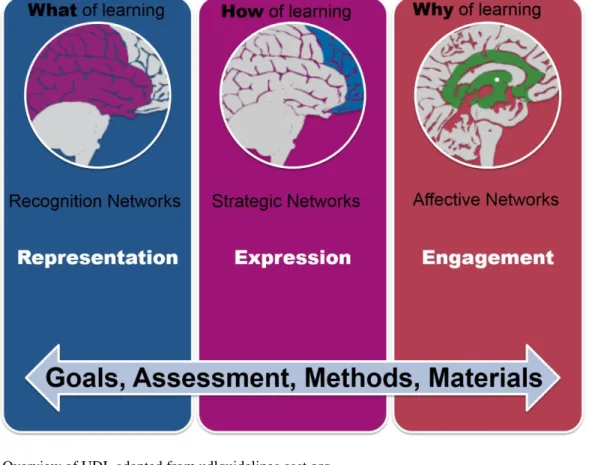
The four tenets of UDL comprise customising the learning environment to accommodate the needs of all learners from the outset by providing flexible goals, methods, materials and assessments. UDL draws on the theoretical underpinnings of guided-discovery learning and constructivism (Vygotsky, 1978); brain research about learner differences (Rose & Meyer, 2002); as well as Gardner’s theory on multiple intelligences (2000). UDL recommends offering learners various ways of acquiring information and knowledge; providing learners with
alternatives for demonstrating what they know; tapping into learners’ interests, giving
appropriate challenges, and increasing motivation (Katz, 2014; Kumar, 2010). UDL is flexible and supportive for all learners, including those with learning difficulties, so that teaching goals, assessments, methods and materials are usable and accessible by all from the outset (Figure 2; Rose et al., 2015).
8 | P a g e Critical to successfully implementing UDL theory is the use of digital materials which have an inherent flexibility to provide learners with multiple ways to perceive, engage with, and interact with content (Horwitz & Tinker, 2005; Mannheimer Zydney & Hasselbring, 2014). Horwitz and Tinker (2005) further state that curriculum materials should be varied and diverse and should include digital and online resources rather than centring on a single textbook, flexibly
accommodating all learner differences. Researchers such as Heinrich (2012), and Henderson and Yeow (2012), identify teacher education as a necessary support for effective integration of technology. Similarly, Mannheimer et al. (2014) state that a UDL technology based TPACK instructional model may be a valuable approach for creating adaptable learning environments.
Mathematical Knowledge for Teaching
The concept of Mathematical Knowledge for Teaching has its foundation in interrelated notions of fundamental understanding of both Subject Matter Knowledge and Pedagogical Content Knowledge (Shulman, 1986). Within each domain, there are underlying premises of what constitutes such understandings as indicated below (Figure 3; Hill, Ball, & Shilling, 2008, p. 377).
9 | P a g e Figure 3. Domain map for mathematical knowledge for teaching
Subject Matter Knowledge
“The ‘subject knowledge’ of teachers of mathematics, especially but not only those in primary schools, has been a high-profile issue in the UK and beyond for more than a decade” (Rowland & Turner, 2008, p. 91). Shulman (1986, p. 15) first coined the phrase Subject Matter Knowledge by explaining it as “the amount and organisation of the knowledge per se in the mind of a
teacher.” Sometimes known as Subject Matter Content Knowledge, Shulman (1988) indicated that Subject Matter Knowledge could be separated into two entities; syntactic and substantive. Where substantive knowledge permits the learning of concepts, structures, principles and
Mathematical knowledge for teaching
Subject Matter Knowledge
Specialised content knowledge Common content knowledge Knowledge at the mathematical horizon Pedagogical Content Knowledge Knowledge of curriculum
Knowledge of content and students
Knowledge of content and teaching
10 | P a g e explanatory frameworks that underpins the subject of mathematics, syntactic knowledge refers to the nature of enquiry into how new mathematical knowledge is introduced and accepted.
The three subsets of mathematical Subject Matter Knowledge refer to:
(a) common content knowledge or general mathematics not unique to primary school teaching and tends to be taught during compulsory schooling;
(b) specialised content knowledge necessitates teachers to have a deep knowledge of mathematics for teaching in order to explain concepts to their learners, interpret responses, scaffold learning and address misconceptions;
(c) knowledge of mathematics on the horizon such as at the point of transition from primary to secondary school education as detailed in a further cross-border study by O’Meara, Prendergast, Cantley, Harbison and O’Hara (2019).
Goulding et al. (2002) as cited in Rowland and Turner (2008, p. 92) “suggests that syntactic knowledge cannot be adequately addressed or learned within teacher education.” Ball, Hill and Bass (2005) concur and allude to the difficulty for teacher education institutions providing sufficient study towards Subject Matter Knowledge. This presents many challenges for teacher educators as Aubrey (1997) cited in Thompson (1997, p. 16) writes, ‘Whilst knowledge of learning and teaching and classrooms increases with experience, knowledge of subject content does not.”
Pedagogical Content Knowledge
The improvement of student teachers’ Subject Matter Knowledge has challenged teacher educators for many years (Hourigan, 2010; Huckstep, 2003 & Goulding, 2002). However, Subject Matter Knowledge alone is not enough to teach mathematics and so ITE programmes combine three further elements that fuse to form Pedagogical Content Knowledge.
Introduced as the “professional adjunct to Subject Matter Knowledge” (Shulman, 1987, p. 15) Pedagogical Content Knowledge “goes beyond knowledge of the subject and refers to content knowledge for teaching” (Kleve, 2009, p. 67). For student teachers acquiring the skills associated with Pedagogical Content Knowledge, emphases are placed on transforming their Subject Matter Knowledge into powerful pedagogical experiences for their learners. Furthermore, Williams and Lockley (2012, p. 42) state; “the academic construct of Pedagogical Content Knowledge is the
11 | P a g e recognition that teaching is not simply the transmission of concepts and skills from teacher to students but rather a complex and problematic activity that requires many and varied on the spot decisions and responses to students’ on-going learning needs.” Therefore, it must be
acknowledged then that curriculum knowledge, or in this case, knowledge of the primary school mathematics curriculum covering content and skills to be taught in each year group; has to be further separated into two entities namely, knowledge of content and students, which refers to how the learner interacts with the content being taught; and also, knowledge of content and teaching, which is focused on supports for teaching, teaching materials and pedagogical approaches to teaching the mathematical content (Grossman et al., 1989).
The relationship between Subject Matter Knowledge and Pedagogical Content Knowledge.
Parker and Heywood (2000, p.89) concluded from their study of 74 teachers and student teachers that there was a relationship between Subject Matter Knowledge and Pedagogical Content
Knowledge. This was reiterated by Goulding et al. (2002, p. 689) when they highlighted that “the link between insecure subject knowledge and poor planning and teaching,” was prevalent in student teachers.
This comparative study puts forward an argument that current approaches in ITE towards developing Mathematical Knowledge for Teaching (Hill, 2008) needs to consider the use of technology to enrich both Subject Matter Knowledge and Pedagogical Content Knowledge. Therefore, it employs a conceptual framework that expands and extends on Mathematical Knowledge for Teaching to integrate TPACK (Mishra & Koehler, 2006) to primary mathematical teaching and learning.
Technological, Pedagogical and Content Knowledge
Attard and Curry (2012, p. 76) acknowledge that TPACK “builds on Shulman’s pedagogical content knowledge framework (1986).” Central to the construction of their TPACK framework is the idea that “learning to teach a subject matter requires not only understanding the content itself but also developing appropriate instructional strategies and skills that are appropriate for
learners” (Koehler et al., 2013, p. 102). Attard and Curry (2012, p. 76) comment that TPACK is “A framework that addresses what teachers need to know to successfully integrate technology into teaching and learning.” Furthermore, Koehler and Mishra (2009) discuss that at the heart of outstanding teaching and learning are three main components; content, pedagogy and
12 | P a g e technology. Guerrero (2010, p. 134) illustrates this thinking in the diagram above (Figure 1) which has been extended to define the context for embedding TPACK as that of UDL.
In terms of mathematics teaching and learning, Niess et al. (2009) evolve the TPACK model to include five keys components:
1. Recognizing (Knowledge); where teachers can see the use of the technology and
recognise the alignment of the technology with mathematics content yet do not integrate the technology in teaching and learning of mathematics.
2. Accepting (Persuasion); where teachers form a favourable or unfavourable attitude towards teaching and learning mathematics with an appropriate technology.
3. Adapting (Decision); where teachers engage in activities that lead to a choice to adopt or reject teaching and learning mathematics with an appropriate technology.
4. Exploring (Implementation); where teachers actively integrate teaching and learning of mathematics with an appropriate technology.
5. Advancing (Confirmation); where teachers evaluate the results of the decision to integrate teaching and learning mathematics with an appropriate technology.
The researchers, acting at the confirmation stage, synthesised the educational framework, UDL, with the TPACK framework in order to better prepare student teachers to utilise technology effectively in teaching and learning mathematics in the primary school classroom (children aged 4 – 12).
METHODOLOGY
The chosen data collection instrument used in this study was that of a questionnaire as this is consistently “the most preponderant quantitative measure used for researching TPACK during the past decade” (Chai et al.,2010, cited in Herring et al., 2016, p. 88). The TPACK
questionnaire sought to evaluate “the kinds of knowledge needed...for effective technology integration” (Koehler et al., 2007, p. 101) in the primary school mathematics classroom. At the beginning of the semester, the students in both jurisdictions were invited to complete the TPACK questionnaire. The layout of the questions offered the opportunity to collect both quantitative and qualitative data. The biographical profile survey aimed to gather factual
13 | P a g e gathered on all areas of TPACK using a 7-point Likert Scale ranging from Strongly Disagree to Strongly Agree.
After the survey was a teaching intervention where the students engaged in modules on
mathematics education, digital learning, and assessment. The researchers used Niess et al. (2009) five principles as detailed earlier for the TPACK intervention as guided by the principles of UDL. Furthermore, the teaching intervention encouraged students to consider (CAST, n.d.):
1. How UDL can complement the required expertise of teaching skills and systematic planning of mathematical experiences.
2. How UDL can provide multiple scenarios for advancement and excellence in mathematics.
3. How UDL can guide the development of flexible, accommodating, mathematics-rich environments from the outset.
4. How technological resources can be used to enhance mathematics teaching within the UDL framework.
This was followed by school placement experience in which students were recommended to ensure that “Time in lessons should be balanced between using and not using the technology according to the needs of the learner and the suitability of the technology in supporting the learning objectives” (British Education Communications Technology Agency (BECTA), 2003, as cited by McAteer, 2012, p. 62). Planning was also informed by CAST’s (n.d.) research on brain networks in order to better understand differences between learners, and on how UDL principles can be used as prompts to identify and remove barriers and improve mathematics lesson design.
After school placement, the TPACK questionnaires were used once again. This report compares student responses on the three main areas namely Subject Matter Knowledge, Pedagogical Content Knowledge (which together constitute Mathematical Knowledge for Teaching), and TPACK.
Ethical considerations
The researchers acknowledge the impact of having the dual role of both researcher and teacher educator during the process of data collection. All steps to conceal the identity of the participants were taken. Voluntary informed consent was obtained from the participants. The researchers
14 | P a g e took all the necessary steps to ensure all participants are aware of the confidentiality of any information provided. Each participant completed a biographical profile survey which complied with the legal requirements in relation to the storage and use of personal data as set down by the Data Protection Act (1998). To ensure anonymity of responses, each student was randomly allocated an identifier number to match up to the biographical profile survey and for the purposes of thematic analysis of the qualitative data.
RESULTS AND DISCUSSION
In this results section, we present the findings from the pre-intervention and post-intervention TPACK questionnaires from both jurisdictions.
Participants
29 students undertaking a PGCE took part in the study in Northern Ireland, of whom 10 were male and 19 were female. The age profile ranged from 22 to 36+ years of age with 22 in the category between 22 and 26; four between the ages of 27 and 32; one aged between 32 and 36, and a further two students who were older than 36. In Ireland, 28 students in their 4th and final year of ITE took part in the study of which four were male and 24 were female. The age profile of this cohort was younger. Whereas they ranged in age from 21 to 30, all except one student was either 21 or 22 years of age.
Subject Matter Knowledge
The participants were presented with five statements to which they were asked to respond with a progressive range of possible responses from ‘strongly disagree’ to ‘strongly agree’ which could be presented as a Likert Scale. Responses to the statement before and after the intervention were analysed using a statistical shift analysis, an Extended Mantel-Haenszel chi square for linear trend. In studies or surveys where possible, gradated responses are available, this analysis allows for evaluation of a trend of change between levels of various responses and adds a greater power and validity than the use of post-hoc dichotomisation of responses at a single point. This analysis was used for all statements and a p-value of 0.05, representing a chance of less than 1in 20 of a random effect, was applied to define a statistically significant change.
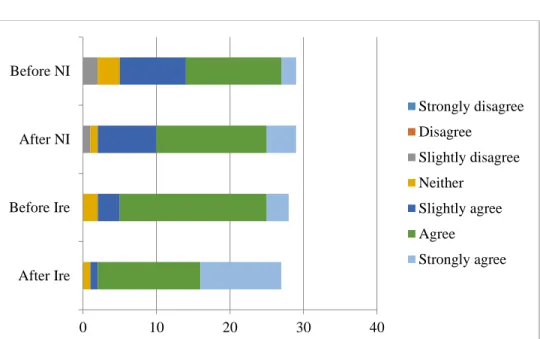
The first statement related to knowledge of the curriculum; ‘I have a wide and deep understanding of the mathematics curriculum I plan to teach’ (Figure 4; Table 1).
15 | P a g e Figure 4. & Table 1. I have a wide and deep understanding of the mathematics curriculum I plan to teach.
NI before vs. after study Ire before vs. after study
Extended Mantel-Haenszel chi square for linear trend = 19.22
Extended Mantel-Haenszel chi square for linear trend = 9.57
p-value (1 degree of freedom) = 0.00001 p-value (1 degree of freedom) = 0.002
In both jurisdictions, there was a significant positive shift in understanding of the primary school mathematics curriculum. This was to be expected in Northern Ireland as prior to their PGCE year, students would not have been exposed to such specific curricular knowledge. In the Republic of Ireland however, Subject Matter Knowledge would have been built up by the students over the previous three years and consolidated in their final year.
The second statement examined the students’ self-perceived ability to provide concrete examples to the children of how mathematics applies outside of the confines of the classroom to other real-life contexts; ‘I know about various examples of how mathematics applies in the real world’ (Figure 5; Table 2). 0 10 20 30 40 After Ire Before Ire After NI Before NI Strongly disagree Disagree Slightly disagree Neither Slightly agree Agree Strongly agree
16 | P a g e Figure 5. & Table 2. I know about various examples of how mathematics applies in the real world
NI before vs. after study Ire before vs. after study
Extended Mantel-Haenszel chi square for linear trend = 3.64
Extended Mantel-Haenszel chi square for linear trend= 7.43
p-value (1 degree of freedom) = 0.06 p-value(1 degree of freedom) = 0.006
The shift analysis showed significant improvement as indicated by students in the Republic of Ireland in their ability to apply mathematics in realistic contexts. Whilst there was some improvement for students in Northern Ireland, this did not quite reach statistical significance (p=0.06).
The third statement looked more generally at students’ perceptions of their own mathematical knowledge and competency; ‘I have sufficient knowledge about mathematics’ (Figure 6; Table 3). 0 10 20 30 40 After Ire Before Ire After NI Before NI Strongly disagree Disagree Slightly disagree Neither Slightly agree Agree Strongly agree
17 | P a g e Figure 6. & Table 3. I have sufficient knowledge about mathematics.
NI before vs. after study Ire before vs. after study
Extended Mantel-Haenszel chi square for linear trend = 0.66
Extended Mantel-Haenszel chi square for linear trend = 8.23
p-value (1 degree of freedom) = 0.4 p-value (1 degree of freedom) = 0.004
It is notable that students in the Republic of Ireland all agreed that they had sufficient subject knowledge of mathematics by the end of the study period. This was not true for students in Northern Ireland. The Williams Review (2008, p. 9) commented that “evidence from Goulding and Rowland (2002) [shows], that for primary PGCE students, mathematical subject knowledge alone is not necessarily the overriding issue.” More of the concern derives from the effect that PGCE students’ lack of Subject Matter Knowledge has on their well-being which is often manifested by physical and psychological symptoms of high anxiety with symptoms increasing as preparation begins to cover the curriculum content of the upper years of primary school commonly known as Key Stage Two (Friel-Myles, 2012). Although this is a particularly
pertinent finding and worthy of further analysis, at this stage, it was considered to be beyond the scope of this project.
0 10 20 30 40 After Ire Before Ire After NI Before NI Strongly disagree Disagree Slightly disagree Neither Slightly agree Agree Strongly agree
18 | P a g e Statement 4 was a more open question that looked at mathematics more from the perspective of habits of mind or the skill of working mathematically rather than on content per se; ‘I can use a mathematical way of thinking’ (Figure 7; Table 4).
Figure 7. & Table 4. I can use a mathematical way of thinking.
NI before vs. after study Ire before vs. after study
Extended Mantel-Haenszel chi square for linear trend = 2.05
Extended Mantel-Haenszel chi square for linear trend = 8.99
p-value (1 degree of freedom) = 0.2 p-value (1 degree of freedom) = 0.003
There was a significant shift in students strongly agreeing to this statement after both the teaching intervention and experience on school placement with a statistically significant change noted in the Republic of Ireland and a trend in Northern Ireland.
The final statement hoped to establish whether students felt in a position to develop their own ability to understand mathematics should they consider that there is a shortfall in any particular area; ‘I have various ways and strategies of developing my understanding of mathematics’ (Figure 8; Table 5). 0 10 20 30 40 After Ire Before Ire After NI Before NI Strongly disagree Disagree Slightly disagree Neither Slightly agree Agree Strongly agree
19 | P a g e Figure 8. & Table 5. I have various ways and strategies of developing my understanding of mathematics.
NI before vs. after study Ire before vs. after study
Extended Mantel-Haenszel chi square for linear trend = 7.78
Extended Mantel-Haenszel chi square for linear trend = 3.93
p-value (1 degree of freedom) = 0.005 p-value(1 degree of freedom)= 0.05
This was an interesting finding as the researcher in Northern Ireland went further in the pursuit of improving student teachers’ own Subject Matter Knowledge using technology rather than solely looking at technology as a pedagogical tool and as a support for children’s learning in mathematics. It may be that one of the ways and strategies for developing understanding in mathematics could actually be attributed to the use of technology. Statistically significant
increases in more positive student responses were noted in both Northern Ireland and Republic of Ireland.
Pedagogical Content Knowledge
The data on Pedagogical Content Knowledge was dichotomised into two groups of agree or strongly agree and other responses. In direct contrast to the results on Subject Matter Knowledge, there was a statistical improvement in all areas of Pedagogical Content Knowledge reported by students in Northern Ireland on their ability to meet the needs of all learners in the mathematics
0 10 20 30 40 After Ire Before Ire After NI Before NI Strongly disagree Disagree Slightly disagree Neither Slightly agree Agree Strongly agree
20 | P a g e classroom. This is not surprising as Northern Irish students have come from a variety of
backgrounds into ITE whereas the students in Republic of Ireland have already completed three years of a four-year degree. However, there was a statistical improvement for ITE students in the Republic of Ireland in areas of planning learning goals to meet the ability of children in their class, adapting methodologies to suit learner differences, considering the classroom setting and organising to meet learning styles, and assessing children in multiple ways, all of which are informed by the four pillars of UDL (See Figure 2. above).
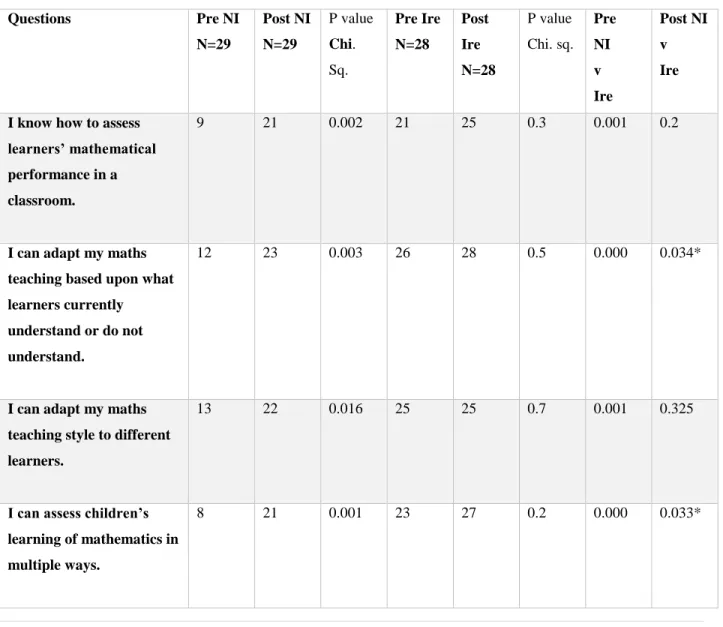
Statistical evaluations of proportion of positive responses to statements were performed using simple 2 x 2 Chi-Square analyses, again defining a p value of <0.05 statistically significant and not likely to have occurred by chance (Table 6).
Table 6. A comparison of student teachers self-reported pedagogical knowledge
Questions Pre NI N=29 Post NI N=29 P value Chi. Sq. Pre Ire N=28 Post Ire N=28 P value Chi. sq. Pre NI v Ire Post NI v Ire
I know how to assess learners’ mathematical performance in a classroom.
9 21 0.002 21 25 0.3 0.001 0.2
I can adapt my maths teaching based upon what learners currently understand or do not understand.
12 23 0.003 26 28 0.5 0.000 0.034*
I can adapt my maths teaching style to different learners.
13 22 0.016 25 25 0.7 0.001 0.325
I can assess children’s learning of mathematics in multiple ways.
21 | P a g e I can use a wide range of
mathematical teaching approaches in a classroom setting. 6 22 0.000 27 27 0.5 0.000 0.147 I am familiar with common learners’ understandings and misconceptions of mathematics. 3 27 0.000 18 26 0.02 0.000 0.6
I know how to organise and maintain classroom management during mathematics lessons. 7 23 0.000 26 27 1.0 0.000 0.3 I know when it is appropriate to use a variety of mathematical teaching approaches in a classroom setting. (Collaborative learning, direct inquiry learning, project/problem-based learning etc.)
7 22 0.000 24 28 0.12 0.000 0.02*
I have an understanding of how children learn
mathematics. 9 26 0.000 22 27 0.12 0.000 1.0 I can promote a mathematics lesson to promote children’s learning. 10 20 0.009 21 27 0.13 0.002 0.02*
22 | P a g e Technological, Pedagogical and Content Knowledge
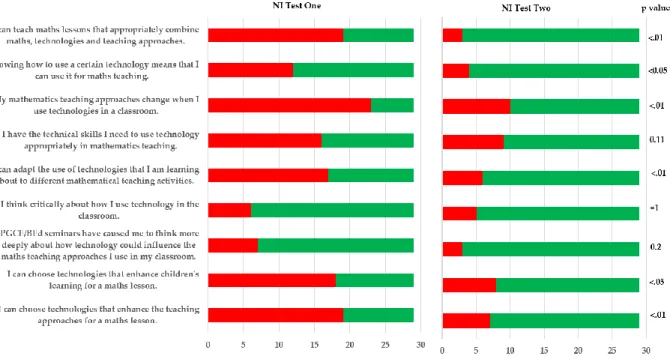
The data on TPACK was dichotomised into two groups of agree or strongly agree and other responses. Fisher’s two-tailed exact test was used as predicted group size fell below 5 for several analyses and Chi-Square could not be legitimately applied. On analyses it was noted that responses were significantly more positive in Northern Ireland in all areas at the end of the study except for having the technical skills to use technology appropriately in mathematics teaching and thinking critically about how technology is used in the classroom (Figure 9).
Figure 9. Comparison of TPACK responses before and after study in Northern Ireland
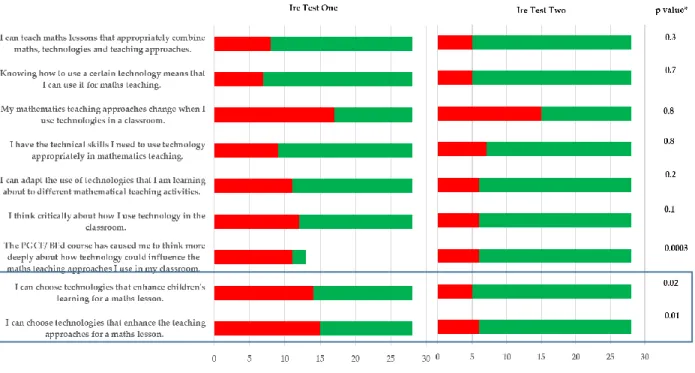
In the Republic of Ireland, there were only two occasions where responses showed a significant change at the pre-defined level. These were both in relation to choosing technologies specifically with a purpose of enhancing teaching and learning in the mathematics classroom. The question on the B.Ed. was discounted in this analysis as a number of responses were missing due to the initial questionnaire only having reference to the PGCE (Figure 10).
23 | P a g e Figure 10. Comparison of TPACK responses before and after study in the Republic of Ireland.
In comparing students’ responses in Northern Ireland versus those in the Republic of Ireland, we see that there were no significant findings between the two cohorts (Table 7). The question in relation to the PGCE/B.Ed. was discounted as per the reasons outlined above.
Table 7. A comparison of student teachers Technological, Pedagogical and Content Knowledge
Question NI v Ire Pre-test NI v Ire Post-test
I can teach mathematics lessons that appropriately combine mathematics, technologies and teaching approaches.
p<0.1 p=1
Knowing how to use a certain technology means that I can use it for mathematics teaching.
p=0.3 p=0.7
My mathematics teaching approaches change when I use technologies in a classroom.
p=0.1 p=0.2
I have the technical skills I need to use technology appropriately in mathematics teaching.
24 | P a g e I can adapt the use of technologies that I am learning about to
different mathematical teaching activities.
p=0.2 p=0.6
I think critically about how I use technology in the classroom. p=0.09 p=0.7
PGCE/B.Ed. seminars have caused me to think more deeply about how technology could influence the mathematics teaching approaches I use in my classroom.
p<.01 p=0.3
I can choose technologies that enhance children's learning for a mathematics lesson.
p=0.4 p=0.5
I can choose technologies that enhance the teaching approaches for a mathematics lesson.
p=0.4 p=0.5
CONCLUSION
This project was motivated by research which demonstrated that even a simple introduction to UDL can help teachers to design lessons that are accessible for all children (Spooner et. al., 2015). This required that the researchers address both entities of Mathematical Knowledge for Teaching; Subject Matter Knowledge and Pedagogical Content Knowledge; within their ITE programmes of study. The specific aim was to apply the UDL framework to Mathematical Knowledge for Teaching. The purpose was to ensure that students’ Mathematical Knowledge for Teaching would drive the use of technology to address learner diversity rather than the
technology dictating what mathematics and how mathematics is taught in the primary school classroom (Attard & Northcote, 2011, p. 29).
Multiple means of representation
The first principle, multiple means of representation, requires that students have robust Subject Matter Knowledge in order to be able to customise how the curriculum is presented from the outset; how to guide the development of flexible, accommodating, mathematics-rich
environments; and how to give learners various ways of acquiring information (CAST, n.d.). Poor mathematics Subject Matter Knowledge has ramifications on Pedagogical Content Knowledge.
25 | P a g e By the end of the study, all students in the Republic of Ireland, and all except for two students in Northern Ireland, at least slightly agreed that they had sufficient knowledge of mathematics in general and a deep understanding of the primary school curriculum. Similar results were found for applying mathematics in real world contexts and using a mathematical way of thinking with the exception of two students in Northern Ireland and only one student in the Republic of
Ireland. Finally, all students at least slightly agreed that they knew various ways and strategies of developing their own understanding of mathematics. It can therefore be concluded, that at the end of this project, nearly all students reported a high sense of Subject Matter Knowledge and therefore should be in a position to provide multiple means of representing mathematics in the primary school classroom.
Multiple means of action and expression
The second principle of multiple means of action and expression requires strong Pedagogical Content Knowledge in order to offer learners options on how to interact and respond; to complement the required expertise of teaching skills and systematic planning of mathematical experiences; and to provide alternatives for assessment to allow learners to demonstrate what they know (CAST, n.d.).
From the outset, the students in the Republic of Ireland had a higher self-reported sense of pedagogical knowledge. By the end of the project, both cohorts of students had improved across all areas with the students in Northern Ireland improving to a greater degree. However, this was primarily due to having a lower initial sense of pedagogical knowledge. There were four areas at the end of the project in which there was still a statistical difference between the cohorts with the students in the Republic of Ireland agreeing or strongly agreeing with the statements on adapting their teaching to suit the learners’ level of understanding; assessing learners in multiple ways; using a variety of methodologies; and promoting children’s learning.
Multiple means of engagement
The third principle of multiple means of engagement requires that students have a high level of TPACK to be able to provide various scenarios for advancement and excellence; present choice to tap into interests, and to offer appropriate challenges and increase motivation.
Overall, the responses from Northern Ireland were significantly more positive in all areas by the end of the study except for two. These were having the technical skills to use technology
26 | P a g e appropriately in mathematics teaching and thinking critically about how technology is used in the classroom. Neither of these statements were positively significant as reported by students in the Republic of Ireland either.
In both Northern Ireland and the Republic of Ireland, there were two statements to which both cohorts reported to have made a significant improvement. These were the ability to choose technologies that can enhance children’s learning in a mathematics lesson and the ability to choose technologies that can enhance the teaching approaches for a mathematics lesson.
Summary
In this study, ITE students in Northern Ireland and the Republic of Ireland were encouraged to consider the use of technology within the UDL framework for teaching, learning and assessment to provide the opportunity for mathematical progression for all learners. “Whereas technology has not always been the panacea of educational practice (Pierce & Ball, 2009), we know that “When good pedagogy drives the incorporation of technology into mathematics teaching and learning, ICTs have immense potential to enhance student experiences with mathematics (Attard & Northcote, 2011, p. 30).” This required that the students develop strong TPACK for teaching mathematics in the primary school classroom as evidenced by this report and highlights the appropriateness of embedding the principles of UDL in ITE programmes of study.
Limitations of the study
Initially it had been envisaged that we would develop a shared lesson planning template, adapted from the work of Causton-Theoharis, Theoharis and Trezek (2008), to use with the ITE students to guide them in their design of inclusive mathematics lessons using technology. We had further hoped that the lesson plans would be peer-reviewed using the UDL checklist developed by CAST (2011) to audit lesson planning for its responsiveness to diversity (E.g. high achievers, active learners etc.). This collaborative exercise would have greatly enhanced the project but was not possible due to time constraints.
A further limitation maybe that although the students expressed confidence in their mathematical skills, this study did not objectively evaluate them. A further study comparing self-evaluated versus objectively evaluated assessment would also be of value.
27 | P a g e Next steps
There is a need to consider the development of a toolkit for teacher educators to support the process of translating the UDL guidelines into how modules are planned, delivered and assessed in order to model and extend best practice in teaching and learning.
Dissemination of results
McGill, S. (2018). Measuring the impact of using iPads to improve mathematics content
knowledge and pedagogical content knowledge among primary PGCE student teachers. Galway: Mobile Technology in Initial Teacher Education Conference (MiTE).
Harbison, L., & McGill, S. (2017). A universal design for learning approach to frame the use of technology in primary mathematics education. Dubrovnik: Association for Teacher Education in Europe (ATEE).
Harbison, L. (2017). DCU Spotlight on Research. Accessed at https://www.youtube.com/watch?v=aE1LyjrwIx8
Acknowledgements
The authors would like to acknowledge the support of the Standing Conference on Teacher Education, North and South (SCoTENS) for funding this project.
Editorial correspondence
DR. LORRAINE HARBISON, Institute of Education, Dublin City University, Ireland. [email protected] @lbharbison / @DCU_IoE
ORCID ID: https://orcid.org/0000-0002-1945-7241
SHAUNA McGILL, Ulster University, Coleraine, Northern Ireland [email protected] @semcgill80 / @UlsterEducation
28 | P a g e REFERENCES
British Education Communications Technology Agency (BECTA). (2003). Primary schools: ICT and standards. In M. McAteer (Ed.) (2012). Improving primary mathematics teaching and
learning. Berkshire: Open University Press, McGraw-Hill Education.
Benton-Borghi, B. (2013). A universally designed for learning (UDL) infused technological pedagogical content knowledge (TPACK) practitioners’ model essential for teacher preparation in the 21st century. Journal of Educational Computing Research, 48(2), 245-265.
British Educational Suppliers Association. (2017, January 23). Schools highlight urgent need for teacher CPD in EdTech in major BESA report. Retrieved from
https://www.besa.org.uk/news/schools-highlight-urgent-need-teacher-cpd-edtech-major-besa-report/
Burden, K., Hopkins, P., Male, T., Martin, S., & Trala, C. (2012). iPad Scotland evaluation. Hull: Faculty of Education, University of Hull.
Center for Applied Special Technology (CAST). (n.d.). The CAST homepage. Retrieved from www.cast.org.
Churchill, D., Fox, B., & King, M. (2012). Study of affordances of iPads and teachers’ private theories. International Journal of Information and Educational Technology. 2(3), 251-254. In B. Clarke, B. & S. Svanaes, (2014). Tablets for schools. An updated literature review on the use of tablets in education. UK: Family, Kids & Youth.
Clark, W. & Luckin, R. (2013). What the research says; iPads in the classroom. UK: London Knowledge Lab, University of London.
Clarke, B. & Svanaes, S. (2014). Tablets for schools. An updated literature review on the use of tablets in education. UK: Family, Kids & Youth.
Condie, R. & Munro, B. (2007). The impact of ICT in schools - a landscape review. Coventry: BECTA.
Courey, S., Tappe, P., Siker, J., & LePage, P. (2012). Improved lesson planning with universal design for learning (UDL). Teacher Education and Special Education, 36(1), 7–27.
29 | P a g e Department for Education and Skills. (2011). Literacy and numeracy for learning and life: The national strategy to improve literacy and numeracy among children and young people 2011-2020. Dublin: DES.
Department for Education and Skills. (2015). Digital strategy for schools 2015-2020. Enhancing teaching, learning and assessment. Dublin: DES.
Earle, R. (2002). The integration of instructional technology into public education: Promises and challenges. Educational Technology, 42(1), 5-13.
English, R. (2006). Maths and ICT in the primary school: A creative approach. London: David Fulton Publishers Ltd.
Gardner, J. (2000). The Disciplined Mind: Beyond Facts and Standardized Tests, the K-12 Education that Every Child Deserves. Middlesex: Penguin Books.
Koehler, M. & Mishra, P. (2009). What is technological pedagogical content knowledge?
Contemporary Issues in Technology and Teacher Education, 9(1), 60-70.
Hill, H. et al. (2008) Mathematical knowledge for Teaching and the Mathematical Quality of instruction: An exploratory Study, Cognition and Instruction, 26(4), 430-511. Routledge. Horwitz, P. & Tinker, R. (2005). Universal design with technology. The Concord Consortium, 9(1), 1&4.
Lyons, C. (2006). Exploring the relationship between ICT and literacy, numeracy and preferred learning styles. (Unpublished MSc Education and ICT dissertation). University of Ulster,
Londonderry.
Mishra, P. & Koehler, M. (2006). Technological pedagogical content knowledge: A framework for teacher knowledge. Teachers College Record, 108(6), 1017-1054.
Monaghan, J. (2004). Teachers’ activities in technology-based mathematics lessons.
International Journal of Computers for Mathematical Learning, 9(3), 327-357.
Niess, M. L., Ronau, R. N., Shafer, K. G., Driskell, S. O., Harper S. R., Johnston, C., Browning, C., Özgün-Koca, S. A., & Kersaint, G. (2009). Mathematics teacher TPACK standards and development model. Contemporary Issues in Technology and Teacher Education, 9(1), 4-24.
30 | P a g e O’Dowd, J. (2013, August 29). Minister emphasises the importance of ICT at Primary School Teacher Conference. Retrieved from
https://www.belfasttelegraph.co.uk/opinion/columnists/press-feed/minister-emphasises-the-importance-of-ict-at-primary-school-teacher-conference-29537469.html
O’Meara, N., Prendergast, M., Cantley, I., Harbison, L., & O’Hara, C. (2019). Teachers’ self-perceptions of mathematical knowledge for teaching at the transition between primary and post-primary school. International Journal of Mathematical Education in Science and Technology, DOI: 10.1080/0020739X.2019.1589004
Parker, J. & Heywood, D. (2000). Exploring the relationship between subject knowledge and pedagogic content knowledge in primary teachers’ learning about forces. International Journal of Science Education.22(1), 89-111.
Rose, D., Meyer, A., & Hitchcock, C. (2005). The universally designed classroom: Accessible curriculum and digital technologies. Cambridge, MA: Harvard University Press. Cited in Friesen, S. (2010). Raising the floor and lifting the ceiling: Math for all. Education Canada, 48(5).
Rose, D. & Meyer, A. (2002). Teaching every student in the digital age. Cited in J. Katz (2014). Implementing the Three Block Model of Universal Design for Learning: Effects on teachers’ self-efficacy, stress, and job satisfaction in inclusive classrooms K-12. International Journal of Inclusive Education. Accessed at http://dx.doi.org/10.1080/13603116.2014.881569
Şahin, T. (2003). Student teachers’ perceptions of instructional technology: Developing materials based on a constructivist approach. British Journal of Educational Technology, 34(1), 67-74. Shulman, L.S. (1986). Those who understand. Knowledge growth in teaching. Educational Researcher,15(2), 4-14.
Sturman, L., Twist, L., Burge, B., Sizmur, J., Bartlett, S., Cook, R., Lynn, L., & Weaving, H. (2012). PIRLS and TIMSS 2011 in Northern Ireland: Reading, mathematics and science. Slough: NfER.
STEM Education Review Group. (2016). STEM Education in the Irish School System. A Report on Science, Technology, Engineering and Mathematics (STEM) Education. Dublin: DES.