Teaching jazz:
A study of beliefs and pedagogy using
Legitimation Code Theory
Saul Richardson
A thesis submitted in fulfilment of the requirements for the degree of
Doctor of Philosophy
Department of Sociology and Social Policy
Faculty of Arts and Social Sciences
Statement of Originality
This is to certify that to the best of my knowledge, the content of this thesis is my own work. This thesis has not been submitted for any degree or other purposes.
I certify that the intellectual content of this thesis is the product of my own work and that all the assistance received in preparing this thesis and sources have been acknowledged.
Signature
Saul Richardson September 2019
Abstract
This thesis explores how playing jazz can be taught to children and young people in a field that can hide its own basis of achievement. How to play jazz, how achievement is measured, and how it can be taught are problematic. The thesis looks at why the basis may be invisible to new
players and what can be done. Research highlights that many Australian and US school music teachers may lack expertise in jazz, it is uncommon for jazz musicians to be trained in pedagogy, and the public face of jazz may hide teaching and expertise, with potential implications for students’ learning or access to jazz for the those who may wish to engage creatively with playing it.
Using a qualitative approach, the study first examines the field of jazz education, through a corpus of documentary sources, to explore the basis of achievement in rhetoric about pedagogy. Second, the research utilises case studies of three jazz educators at a jazz camp for young people, looking at what knowledge and ways of knowing were taught and how knowledge and knowing were built over time. Each teacher’s beliefs about the basis of jazz achievement was examined through interviews. Data analysis enacted the Legitimation Code Theory concepts of
specialisation codes, semantic gravity, and semantic density. The corpus showed a disconnect between a public face of jazz that emphasises knower aspects of jazz while minimising skills, techniques, or other expertise and a jazz education reality of formal training, practice, and
specialist knowledge. Analysis of pedagogy in the case studies uncovered different specialisation codes embodied by each of the teachers, but each illustrative of codes active in the field and with educational implications and affordances. Key conclusions include: (1) widespread assumptions that successful jazz musicians of the past universally learnt through informal means or were self-taught are overstated; (2) the emphasis on knowers and absence of knowledge in public rhetoric about education, and even the absence of pedagogy itself, has implications that restrict
legitimacy to certain categories of people or experiences. Neglecting either the knowledge or the knowing aspects of jazz problematises student’s potential to succeed. The study shows that there are ways the ‘rules of the game’ can be made explicit to support more effective pedagogy.
Acknowledgements
I thank Karl Maton, my supervisor, for believing that this research mattered and that I could make it happen, and for getting me through it. I am deeply grateful for his scholarship, his insight, teaching skill, advice, encouragement, friendship and keen interest. Karl has created not just a theory in LCT, but a community with a shared commitment to seeing knowledge and social justice that has been an inspiration to me.
A key part of that community has been Elena, Jodie, Karl, Kirsten, Matt, Mauricio, Patrick, and Yeagan who together formed the weekly ‘S-club’ in Sydney, a discussion group, problem-solving forum, sounding-board, and inspiration. Additionally, fortnightly LCT roundtables at the University of Sydney exposed me to an amazing array of scholars and ideas as well as the opportunity to present work-in-progress to a high-powered audience for constructive feedback. Showing that the experience of being a PhD student in the Sydney LCT community is far from an isolating experience, a weekly reading group ‘LCT-OG’ offered yet another forum to engage with friends and colleagues and try out new ideas or explore data.
I am deeply grateful to Sarah Howard for her invaluable advice on data-gathering and
methodology and to Kylie Lowe for her proofreading. I also thank the teachers and students who participated in the research for allowing me into their classes and sharing their insight and experiences. Thanks to Yutaro for helping with filming lessons and helping me to transcribe the recordings. I am grateful to the jazz camp management for being so accommodating of this research.
Most of all, I thank Karen and Michael not only for shouldering too much of the burden at work to allow me to do this, but for their astonishing support, patience, encouragement, and energy. Thank you.
Table of Contents
Abstract ... iii Acknowledgements ... iv Table of Contents ... v List of Tables ... ix List of Figures ... x Chapter 1 Introduction... 11.1 Introduction to the Problem ... 2
1.2 Expanding on the Problem ... 3
1.2.1 Summary of the problem and contributions of the research ... 4
1.3 Research Questions ... 5
1.4 Structure of the Thesis ... 6
Chapter 2 Literature Review ... 8
2.1 Introduction ... 8
2.2 Surveys of Jazz Education ... 9
2.2.1 Questionnaires ... 9
2.2.2 Affordances and limitations of survey studies ... 12
2.3 Interviews ... 13
2.3.1 Affordances and limitations of interview-based studies ... 14
2.4 Historical Studies ... 14
2.4.1 Affordances and limitations of historical studies ... 18
2.5 Experimental Studies ... 19
2.5.1 Affordances and limitations of experimental studies... 22
2.6 Ethnographic and Observational Studies ... 23
2.6.1 Holistic ethnographies of musicians’ learning practices ... 23
2.6.2 Curriculum and classroom studies ... 26
2.6.3 Affordances and limitations of ethnographies and observational studies ... 28
2.7 Conclusion ... 29
Chapter 3 Theoretical Framework and Methodology ... 31
3.1 Introduction ... 31
3.2 Legitimation Code Theory ... 31
3.3 Seeing Education ... 32
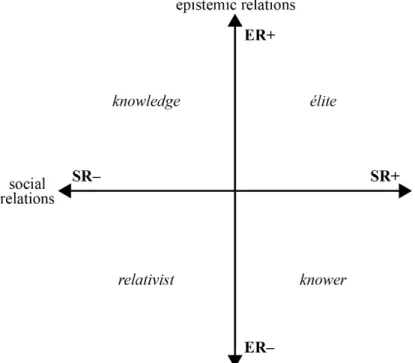
3.4 Specialisation Codes ... 36
3.4.1 Uses of specialisation codes in studies ... 38
3.4.2 How specialisation codes will be used in this study ... 40
3.5 Semantic Gravity and Semantic Density ... 42
3.5.1 Uses of semantic gravity and semantic density in studies ... 44
3.5.2 How semantic gravity and semantic density will be used in this study ... 45
3.8 Illustrative Case Studies ... 52
3.8.1 Context ... 53
3.8.2 Participants ... 54
3.8.3 Classroom video: procedure and analysis ... 54
3.8.4 Interviews: procedure and analysis ... 56
3.9 Ethical Considerations ... 57
3.10 Quality of the Research ... 58
3.11 Conclusion ... 60
Chapter 4 The Public and Private Faces of Jazz Education ... 61
4.1 Introduction ... 61
4.2 The Public Face of Jazz Performance ... 62
4.2.1 Defining the social arena of jazz ... 62
4.2.2 Emphasising personal qualities of musicians ... 64
4.2.3 Obscuring training and expertise ... 66
4.2.4 Foregrounding social categories and interactions ... 69
4.2.5 Conflating fields of practice and pedagogy ... 72
4.2.6 Summary ... 74
4.3 The Private Face of Jazz Pedagogy ... 74
4.3.1 Jazz greats were largely formally-educated ... 74
4.3.2 Reality of jazz education ... 80
4.3.3 Summary ... 84
4.4 Reflections of Practice in Discourse About Pedagogy ... 85
4.4.1 ‘It’s not jazz’ ... 85
4.4.2 Formal training in jazz is inauthentic ... 87
4.4.3 Jazz education has harmed jazz performance ... 90
4.4.4 Summary ... 94
4.5 Conclusion ... 94
Chapter 5 The Public Face of Jazz in the Classroom: The Case of ‘Drew’ ... 96
5.1 Introduction ... 96
5.2 Personal Beliefs ... 97
5.2.1 Self-understanding ... 97
5.2.2 Beliefs about what it means to be ‘good at’ jazz ... 100
5.2.3 Views on jazz education and teaching and learning ... 103
5.2.4 Summary ... 105
5.3 Teaching Practices ... 107
5.3.1 The lessons in summary ... 107
5.3.2 Teaching jazz knowledge, cultivating jazz knowers: what the lessons taught ... 109
5.3.3 Teaching values and signalling authentic practices ... 117
5.3.3.1 Valorised ways of knowing jazz ... 117
5.3.3.2 Valorised ways of playing jazz ... 123
5.3.4 Summary ... 124
5.4 Implications and Affordances for Building Knowledge and Knowers ... 126
5.4.1 Knowledge and knower-building in two contrasting phases of a 12-bar blues lesson ... 126
5.4.2 Forms of knowledge and knowing through all four lessons ... 133
Chapter 6 Jazz Rhetoric Meets Educational Reality: The Case of Julian ... 138
6.1 Introduction ... 138
6.2 Espoused Beliefs ... 139
6.2.1 Self-understanding ... 139
6.2.2 Teaching and learning jazz ... 141
6.2.3 Summary ... 144
6.3 Teaching Practices ... 145
6.3.1 Summary outline of the four lessons ... 145
6.3.2 Teaching jazz knowledge ... 147
6.3.3 Teaching how to be knowers ... 153
6.3.4 Summary ... 159
6.4 Knowledge and Knower-Building: Affordances and Implications ... 160
6.4.1 Building jazz knowledge ... 161
6.4.2 Building jazz knowers ... 164
6.4.3 Summary ... 168
6.5 Conclusion ... 168
Chapter 7 A Knowledge-Code Teacher: The Case of Pascal ... 171
7.1 Introduction ... 171
7.2 Pascal’s Espoused Beliefs About Jazz ... 172
7.2.1 Playing jazz: what it is, where it comes from, and how it is done ... 172
7.2.2 How Pascal characterised his own jazz playing ... 173
7.2.3 Teaching and learning jazz ... 175
7.2.4 Summary ... 176
7.3 Classroom Practice ... 177
7.3.1 The lessons ... 177
7.3.2 Teaching jazz knowledge ... 179
7.3.2.1 Procedures ... 179
7.3.2.2 Features of lead sheets, compositions, and genres and principles for their interpretation ... 182
7.3.2.3 Jazz theory ... 183
7.3.2.4 Explicit instruction in techniques... 185
7.3.3 Jazz knowing ... 189
7.3.4 Summary ... 193
7.4 Affordances for Knowledge and Knower-Building ... 195
7.4.1 Knowledge-building in Pascal’s teaching ... 195
7.4.2 Cultivation of jazz knowing in Pascal’s lessons ... 200
7.4.3 Summary ... 206
7.5 Conclusion ... 206
Chapter 8 Conclusion ... 209
8.1 Introduction ... 209
8.2 Synthesis of Findings ... 210
8.3.1 A new way of seeing jazz pedagogy ... 217
8.3.2 Implications of the study ... 219
8.4 Limits and Limitations ... 220
8.4.1 Recommendations for research ... 221
8.4.2 Recommendations for practice ... 222
8.5 Conclusion ... 224
References ... 225
Appendix A: Tools for translating between semantic gravity and semantic density and jazz musical improvisation practices ... 244
Appendix B: Details of the corpus and bibliography of biographical sources ... 247
Appendix C: Rhetorical themes emergent in the corpus ... 281
Appendix D: Sample of notable jazz musicians 1885–1972 with formal music education 282 Appendix E: Questions for jazz educator interviews ... 288
Appendix F: Human research ethics approval for the study ... 290
Appendix G: Jazz educator participant information statement and consent (samples) .... 292
Appendix H: Parent & student participant information statement and consent (samples) ... 296
List of Tables
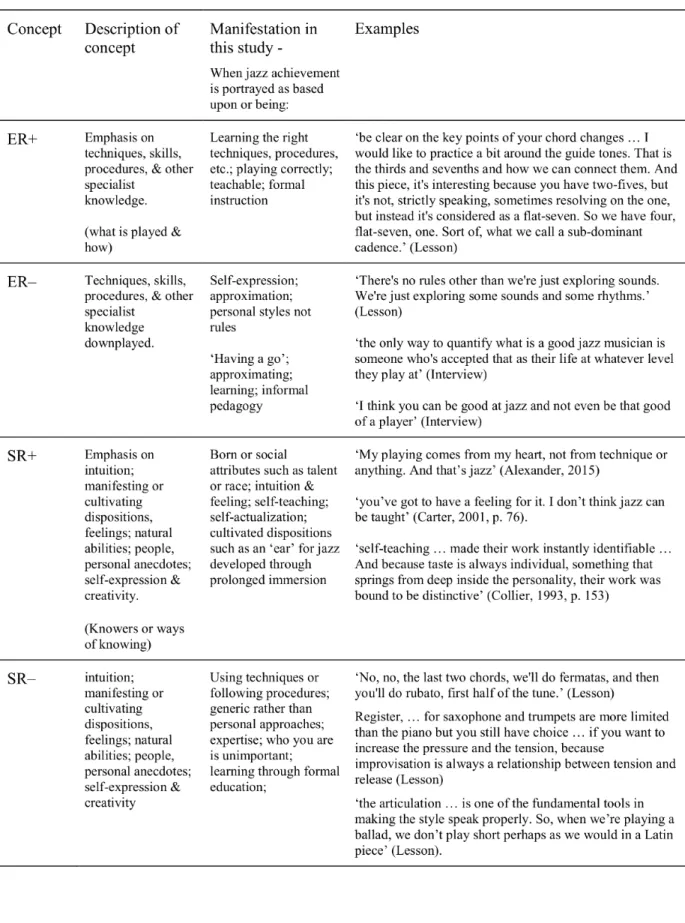
Table 3.1. Translation device for Specialisation ... 41
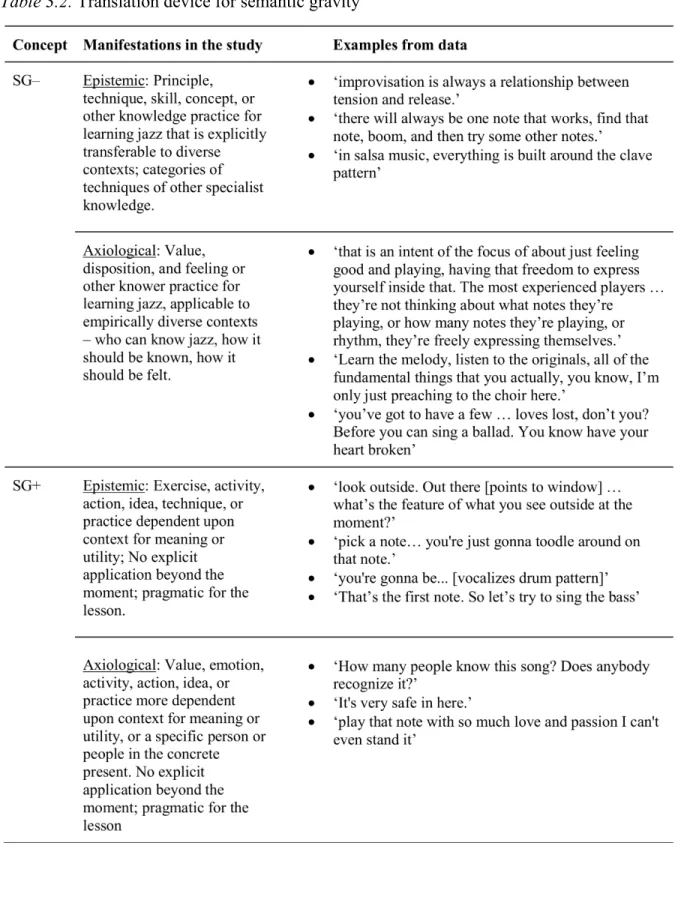
Table 3.2. Translation device for semantic gravity ... 47
Table 3.3. Translation device for semantic density ... 48
Table 4.1. Sample of 143 prominent jazz musicians with formal musical training ... 77
Table 5.1. Summary of Drew’s evaluation of jazz practices and values in the lessons ... 125
Table 5.2. Knowledge and knowing content in ‘the talented girl’ anecdote ... 129
List of Figures
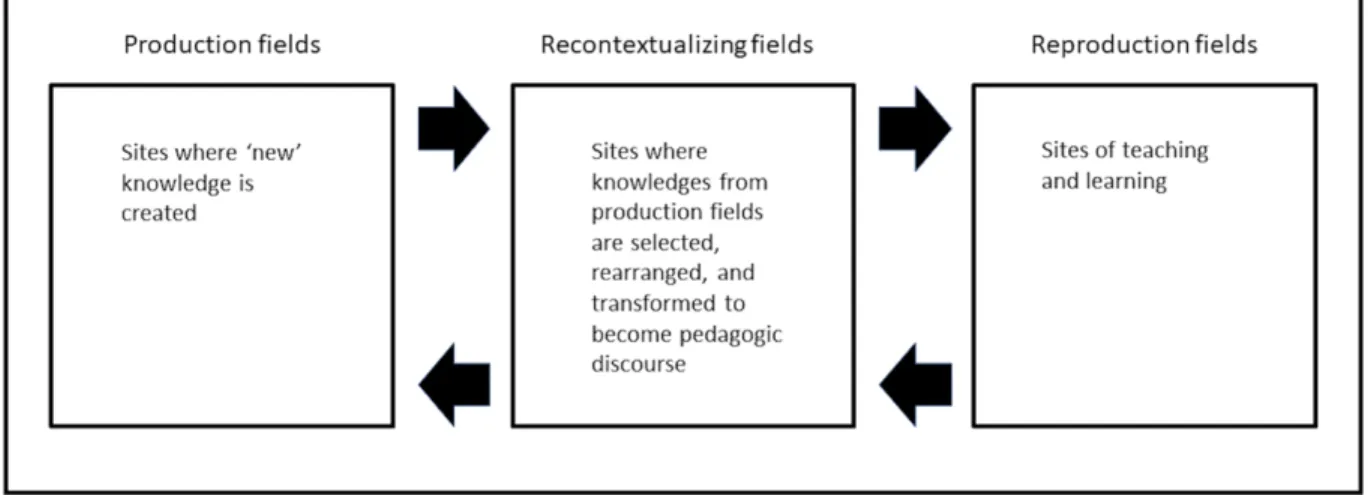
Figure 3.1. Arena created by the ESP device (simplified from Maton, 2014, p. 51). ... 34
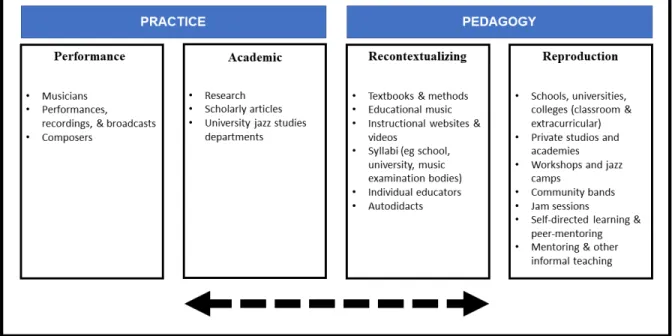
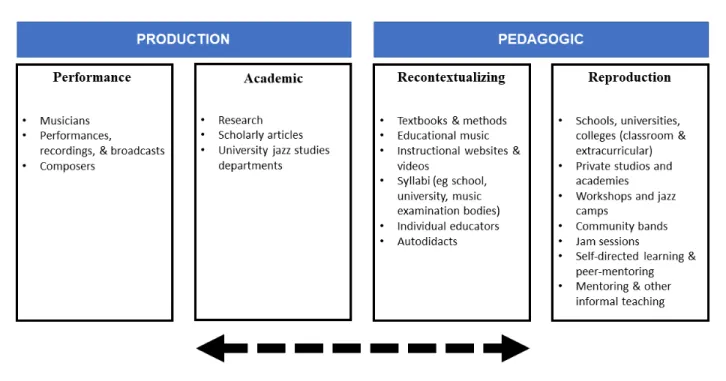
Figure 3.2. The four fields comprising the jazz education arena, after Maton (2014, p. 51, & 2019 personal communication). ... 35
Figure 3.3. The specialisation plane (Maton, 2014, p. 30). ... 37
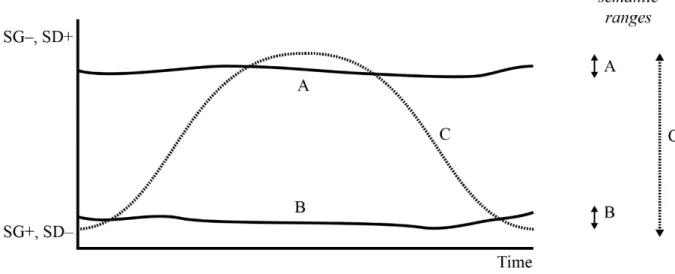
Figure 3.4. Three illustrative semantic profiles (Maton, 2013, p. 13). ... 44
Figure 4.1. The four fields comprising the jazz education arena, after Maton (2014, p. 51). ... 63
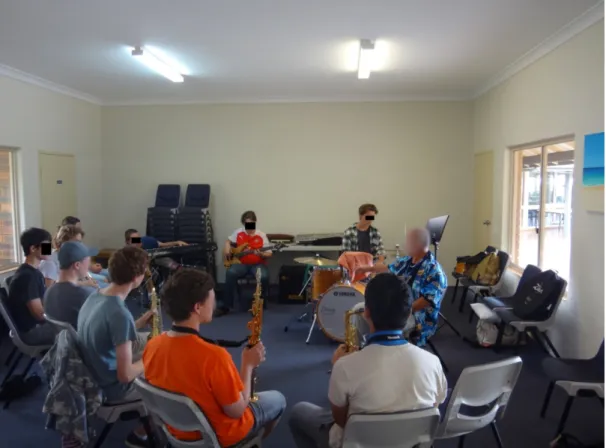
Figure 5.1. Drew with his students. ... 108
Figure 5.2. Drew’s class improvising to the storm. ... 111
Figure 5.3. Students rehearsing ‘Too close for comfort’ with Drew directing. ... 114
Figure 5.4. Excerpt from ‘Too close for comfort’ (Wolpe [arranger], 2004, p. 14). ... 115
Figure 5.5. semantic profile of the ‘talented girl’ lesson (Drew, Lesson 1). ... 131
Figure 6.1. Epistemic-semantic profile of the blues procedure lesson. ... 164
Figure 6.2. ‘How to listen’ excerpt (Lesson 3) as an axiological-semantic profile. ... 167
Figure 7.1. Overall epistemic-semantic profile of Pascal’s lessons... 197
Figure 7.2. Epistemic-semantic profile of Pascal’s musical concepts lesson showing the five phases of the sequence. ... 200
Figure 7.3. Axiological-semantic profile of knowing in the musical elements excerpt, (Pascal, Lesson 1). ... 202
Figure 7.4. Axiological-semantic profile of knowing in the Maceo Parker/jazz-funk excerpt (Pascal, Lesson 1). ... 204
Figure A.1. Translation device for semantic gravity in jazz improvisation (variation). ... 244
Figure A.2. Translation device for ensemble interaction. ... 245
Chapter 1
Introduction
i.His playing sounded awesome to me. I was 16, and my solos did not even resemble what Bobby, my jazz band teacher played. Of course, he was better than me, but in what way was he better? Clearly, Bobby was doing something that was objectively unlike just ‘using the blues scale’ as he had taught us.
I asked him, ‘what were you doing just then?’ and, ‘how do you do that?’
‘Well’, Bobby replied, ‘learn your scales, and listen a lot’. That is as much as he would say. I already knew scales and practiced them all the time because I knew that was something you are supposed to do. But then what? How could they be used to play music recognisable as jazz? Why would Bobby not tell me? I left that lesson frustrated, confused, disillusioned, and with little to take away besides what seemed to me an unhelpful platitude.
*** ii.
A group of youngsters sat, transfixed by the dazzling, virtuoso display of trumpet wizardry they had just heard from the famous jazz musician at the workshop. High notes, dazzling technique, magnificent flurries of notes up and down and all over that golden horn. And everything working so perfectly with the rhythm section. When he asked if anyone in the audience had a question, dozens of eager hands shot skywards.
1.1
Introduction to the Problem
There is a popular jazz adage, often attributed to Miles Davis, that states ‘it’s not the notes you play, it’s the notes you don’t play’. Similarly, it was what my teacher ‘Bobby’ (a pseudonym) did not say that mattered to me as a 16-year-old who aspired to learn how to play jazz. The
problem is that what he would not say is exactly what we students in that lesson needed to know.
In terms of that need, Bobby’s evasion of the question was profoundly unhelpful. It was obvious that Bobby was doing something differently, playing different notes from different scales and putting them together in ways that I did not know, just as it was obvious that of course that trumpet virtuoso had practiced, a lot. That lesson has stayed with me all my life, because of what Bobby would not say. It did nothing to help me learn to play jazz but has influenced my nearly 30 years of jazz teaching. Energised and intrigued over decades by the frustration, anger even, I felt at 16, I have personally remained committed to the idea of making knowledge explicit and accessible.
This study is about teaching jazz to children and young people, exploring why it is problematic or even invisible, how it is done, and how it could be done better. Driven by personal
experiences as a student and long-time teacher of jazz, this thesis examines the basis of the ‘troubling’ relationship between jazz education and jazz performance (Prouty, 2005, p. 79) and seeks ways to help teachers and students see what is needed to teach and learn jazz effectively. The overwhelming majority of public discourse and scholarship about jazz teaching and learning focuses on just two contexts: formal tertiary training and informal professional development. However, students who pass university auditions to study jazz, and early career professionals refining their craft ‘on the bandstand’ represent those who can already play. How young people get to a level good enough for university or to start performing has been little-researched. A dominant image of jazz musicians is of intuitive autodidacts whose ability is expressed spontaneously ‘on the bandstand’, where they learn without pedagogy, through proximity to
master musicians, before establishing themselves as ‘jazz greats’ with unique styles and sounds1.
Obscured by camouflaging narratives of oral-traditions, self-teaching and preternatural talent, the
techniques and training of jazz players are kept hidden, trade secrets protected by rhetorical
armour such as ‘you can learn jazz, but you can’t teach it’. Expertise, knowledge, learning, and
most of all teaching or its possibility, are invisible in the public face of jazz.
Another adage beloved by jazz aficionados and attributed to Louis Armstrong, proclaims ‘if you have to ask, you’ll never know’, implying that playing jazz is intuitive. Singer, Betty Carter, said ‘You’ve got to have a feeling for it. I don’t think jazz can be taught … if you don’t have that little ingredient that makes you a jazz player you never will be’ (2001, p. 76). Similar assertions are widespread in discourse about jazz and the apparent prevalence of such rhetoric raises question about teaching jazz that are the focus of this thesis. This study explores why Bobby would not teach us, why the virtuoso downplayed his expertise, and what Armstrong and Carter meant.
1.2
Expanding on the Problem
Histories of jazz gloss over or ignore jazz education (Ake, 2012), and biographies downplay musicians’ training (Beale, 2001; Kelly, 2013). Where jazz education does appear in
commentaries from within the jazz community, it is typically to denounce teaching as inauthentic, profit-driven, or homogenising (Collier, 1993; Galper, 1993; Nisenson, 1997), dismiss it as a failure (G. Kennedy, 2002) or proclaim it impossible (Carter, 2001; Galper, 2000; Shaw, 2001; Swallow, 2008). Confusingly and contra to that rhetoric, it seems that many if not most current leading jazz professionals are formally trained through private lessons, school music, and university (Ake, 2012; Jeffri, 2003).
Despite evidence of a long history of jazz teaching (Ferriano, 1974; A. Kennedy, 2005; May, 2005; Suber, 1978; Whyton, 2010), it is routinely characterised in the discourse of the field as new, alien to tradition, controversial, or experimental, (Galper, 1993; Javors, 2001; C. Watson, 2012) and musicians may claim to have been self-taught or to have learnt informally, despite formal education and even university training (Burrows, 2001; Louth, 2004). Even where musicians acknowledge their training, biographers and commentators frequently ignore it
institutional jazz education has been an established part of the jazz landscape for most of its history, and the historical evidence of formal jazz teaching from the first decades of the twentieth century points to an even longer-established educational tradition (A. Kennedy, 2005; Suber, 1978).
Outside of the specialist field of jazz education is a world of music education that evidence suggests may effectively be blind to jazz. Problems with jazz in school music education have been well-documented. For instance, few school music teachers in the USA receive serious training in jazz, and many feel under-prepared to teach it (Fisher, 1981; Hinkle, 2011; Regier, 2019; West, 2013, 2019), and the involvement of jazz in school curricula can be sporadic (F. Murphy, 1974; Treinen, 2011; West, 2013; Wiggins, 1997). Conversely, in the USA and
Australia, jazz performers who teach tend to lack expertise or training in pedagogy (Barr, 1974; Bennet, 2007; Libman, 2014; D. Murphy, 1993; University of Sydney, 2019). This problematises the potential of students to learn and of teachers to teach jazz and points both to the low status of jazz in the field education and education in the field of jazz.
1.2.1Summary of the problem and contribution of the research
To recap, teaching of jazz performance to young musicians is problematic in four key issues: (1) education is often overlooked in studies of jazz; (2) jazz teaching is obscure or invisible in the public face of jazz; (3) education seems to have a low status in jazz; (4) how jazz playing is taught to young players prior to university or early career professional development is under-researched and poorly understood. The issue of the status of jazz in tertiary and school education has been one of the more-studied issues in jazz education and is of ongoing interest to
researchers (Balfour, 1988; F. Murphy, 1968; Regier, 2019; Wiggins, 1997). Improvisation in schools for general music or aesthetic education has also been relatively well-studied (Borgo, 2007; Elliott, 1983; Hickey, 2009; Siljamäki & Kanellopoulos, 2019). On the other hand, how improvisational jazz playing is taught to children and young people is little-understood,
especially outside of school curricula and needs research. The original contribution of this study is that it examines jazz pedagogy for young people in an extra-institutional setting and analyses potential affordances and implications of the teaching practices involved. Here,
institutions. The effectiveness of pedagogy is of concern to the many students, teachers, and others who are stakeholders in jazz education. This study’s implications reach beyond jazz to other musical, creative, and sporting fields which may share the problem of mystification in learning to perform (Hoberman, 1997; Sloboda, 2014; Vincent & Maxwell, 2016).
1.3
Research Questions
These issues raise the broad questions of why teaching is problematic in jazz education, why pedagogy may be invisible to actors in the field or denied by them, and what the educational implications of that might be. More specific questions also arise that will be a main focus for this research:
1. How do jazz educators believe playing jazz is taught and learnt?
This question is about the basis of achievement in jazz education, or what it means to be ‘good at’ jazz. This basis constitutes the ‘rules of the game’ that new players and teachers need to know
if they are to succeed. Is it who you are (knowers), how you know (ways of knowing), what you
can do, what you know (knowledge), or something else, or nothing2?
2. What do jazz educators teach, and what are the potential implications for student learning and access to achievement?
This question looks at knowledge and ways of knowing in lessons. It explores how whatever it is that constitutes achievement in lessons is taught, looking beyond the surface features of music or practices to the organising principles of pedagogy.
3. How are knowledge and knowing built in jazz lessons and what are the potential implications for student learning and access to achievement.
Building knowledge and/or cultivating knowers generally are the fundamental goals of teaching and can often be synonymous with teaching. This question looks at how this goal can be
addressed by jazz pedagogy.
The focus of the study is on jazz performance training for young and less-experienced students stemming from the gap in knowledge of the area and driven by my personal interest as a teacher working in that field. Through addressing the research questions, the study also aims to point to ways in which improvisational jazz performance training for children and young people might be improved to enhance the effectiveness of teaching and promote fair access to achievement. The following section summarises how this study addresses these questions and summarises the structure of the thesis.
1.4
Structure of the Thesis
Chapter 2 reviews diverse jazz education literatures to assess the substantive, methodological and theoretical affordances and limitations of studies from the point of view of addressing the research questions. Where there could be many ways of reviewing the research, the chapter organises the literature in terms of the various approaches used in studies of jazz education. Chapter 3 takes the theoretical issues raised in Chapter 2 and explains how and why Legitimation Code Theory (LCT) is used as a framework and approach in this study. The chapter also outlines the research strategies that were used including methodology, methods, and how data were analysed. The findings of the substantive study are reported in Chapters 4, 5, 6, and 7. Chapter 4 examines the public face of jazz education through analysis of a corpus of
documentary sources ranging from online blog posts and magazine articles to biographies of musicians and scholarly research. The basis of achievement in jazz education is explored using
LCT concepts of specialisation codes. The chapter conceptualises public and private ‘faces’ of
Chapters 5, 6, and 7 comprise illustrative case studies of three jazz educators who were observed and filmed teaching a series of lessons to young people at a summer jazz camp and interviewed. The case studies examine the specialisation codes represented by the teachers’ pedagogic practices in lessons. Specialisation codes are enacted in analysis of classroom videos of four lessons by each teacher to uncover the roles of knowledge and knowers in constructing the basis
of legitimation in their teaching practices. The concepts semantic gravity and semantic density
are used to explore the forms of knowledge and knowing in the lessons and to unpack the ways knowledge and knowing are built over time by the teaching. The interviews are analysed using specialisation codes to reveal the basis of achievement underlying each teacher’s beliefs about jazz education, their espoused rhetoric as distinct from their enacted practice.
Chapter 8 concludes the thesis by synthesising the findings and summarising results in relation to the research questions. Implications of the study are considered including values and limitations, directions for further research, and recommendations for jazz teaching practice.
Chapter 2
Literature Review
2.1
Introduction
This chapter reviews ways in which relevant literature has addressed the questions of what it means to be ‘good at’ playing jazz, how playing jazz is learnt, and how jazz performance can be taught to beginning and intermediate students. The focus of this study is on teaching and learning of idiomatic instrumental jazz performance to less-experienced students. That is, how beginners and intermediate-level students learn what is needed to succeed in established styles, genres, and contexts. Where jazz itself is the subject of debate and may be understood in different ways by different people, this study looks at how it is taught, whatever it might be and however it has been defined. There is a voluminous and diverse range of different literatures about jazz education potentially relevant to my research focus.
One way to look at the literature is to see different types of study: studies of beliefs about jazz education, surveys, historical studies, experimental studies, and ethnographic studies. Literature within each category is not uniform, but categorising it so provides a useful map. I shall draw from across this literature in terms of its specific relevance to teaching and learning
improvisational jazz performance. Studies of pedagogy in lessons for inexperienced musicians are most relevant, while discussions of teaching in other music education contexts can also offer insights into the focus. Section 2.2 reviews studies that have used a survey-approach. Section 2.3 considers studies that have drawn largely on interviews to look at beliefs about jazz education. Section 2.4 reviews studies that have used historical methods. This includes studies of jazz education as a field and historical approaches to jazz pedagogy. Section 2.5 discusses studies that have used experimental-style methods and Section 2.6 discusses ethnographic studies of jazz teaching and learning both in and outside of institutions. Each group of studies will be assessed in terms of its affordances and limitations for the research questions and substantive, theoretical and methodological implications arising will establish a rationale for the research reported in this dissertation.
2.2
Surveys of Jazz Education
Studies have used surveys to look at jazz in classroom music teacher training, the presence of jazz in school curricula, pedagogical training of jazz educators, and the absence of women from higher levels of jazz education. Surveys of tertiary teacher education have looked particularly at the extent and manner of involvement of jazz in music teacher training. An issue driving many of these studies is that jazz is often excluded from teacher training, despite its widespread presence in school classroom and extracurricular programs (Jones, 2005; Kelly, 2013; Knox, 1996; Marks, 1994; Regier, 2019; Treinen, 2011). Also, despite that presence, studies have also found large numbers of schools where jazz enjoys at best a sporadic involvement (Hinkle, 2011; Rummel, 2010). The preparedness of professional performers to teach jazz is a second issue that
researchers have used surveys to explore. Teaching is a major activity of musicians (Bartleet et al., 2018), and many spend more time teaching then performing (Bennet, 2007). While many school music teachers seem underprepared to teach jazz, many jazz educators seem similarly underprepared to teach (D. Murphy, 1993). A third issue of interest to survey researchers is the absence of women from higher levels of jazz education (McKeage, 2004). First, I discuss a landmark survey of jazz educators by Barr (1974) and a number of similar studies that followed it. Next, I look at surveys of musicians’ pedagogical training and women in jazz education. The section concludes with an evaluation of the affordances and limitations of the survey literature for the research focus.
2.2.1Questionnaires
There have been many surveys using mixed methods to investigate jazz in music teacher training. Foci have included, first, the preparation of music teachers to teach jazz and their expertise as performers; and second, research into what a formal jazz education curriculum should include. In a pivotal study, Barr (1974) surveyed American professional jazz performers to determine what skills and competencies they believed are needed to play jazz. A sample of secondary school and college teachers of jazz-related ensembles who were also members of the then National Association for Jazz Educators were surveyed to see what competencies they
tertiary jazz education and music teacher training. While not the first survey of jazz in education (for instance, see F. Murphy, 1968; F. Murphy, 1974), Barr’s work has been influential,
subsequently forming the basis or model of enquiry for many other studies and gaining the official approval of the International Association for Jazz Education (Knox, 1996).
Barr’s findings noted that in the USA that few of the teachers surveyed had training in jazz pedagogy and less than half the sample had ever played jazz. Barr’s recommendations included courses in jazz ensemble for student music teachers affording the opportunity to participate in a jazz group, regardless of instrument, and courses on jazz pedagogy. Nearly forty years later researchers using similar methods to Barr are still finding preservice jazz training of teachers to be inadequate and that outside of academic studies Barr’s recommendations have been widely ignored in teacher training (Hinkle, 2011; Kelly, 2013; Regier, 2019; Rummel, 2010; Treinen, 2011; West, 2013).
Later researchers responded to Barr’s national survey by further exploring the demographics and status of jazz in tertiary training through questionnaires, analysis of curriculum documents, and interviews. Data have typically been subjected to a mixture of statistical and qualitative analysis. A number of geographically-specific studies have investigated the preparedness of school
teachers to teach jazz by surveying the jazz training of music teachers, or the availability of jazz-related offerings in teacher training courses (Balfour, 1988; Hinkle, 2011; Jones, 2005; Knox, 1996; Rummel, 2010; Treinen, 2011). The state of jazz in teacher training revealed by these studies has been grim. For instance, Knox (1996) found that no Alabama university offered jazz ensemble to education majors or required them to study any jazz and studies of Californian universities found they fell short of Barr’s requirements (Balfour, 1988; Marks, 1994), and Regier’s (2019) survey of band teachers in Oklahoma found fewer than 7% said their university training included jazz pedagogy. Other studies have made similar findings in other locations (such as Jones, 2005; Knox, 1996; Rummel, 2010; Wiggins, 1997). Using similar methods other studies have shown jazz to have a sporadic presence in school music programs (Jones, 2005). Schools have been found either to teach no jazz performance whatsoever, or where it is taught, it is by someone with limited expertise in jazz (Hearne, 1985; Hepworth, 1974; F. Murphy, 1974; Wiggins, 1997). Finally, in an email survey of Canadian jazz educators, Mantie (2008) found
that where many schools had jazz ensembles, they were over-focused on performing notated music with little or no improvisation involved, raising questions of the nature and purpose of school jazz bands.
Where surveys have shown that jazz expertise or training is rare among school music teachers, other researchers have highlighted a lack of pedagogy training among jazz musicians working as teachers (D. Murphy, 1993). Kelly (2013) concludes ‘It seems those with a performance
background are as under-prepared to teach as music education majors are to teach jazz’ (p. 200), a characterisation supported by Libman’s (2014) case studies of university jazz performance students and Barr’s (1974) national survey of American performers. In 2019 only one major Australian university included a jazz pedagogy elective for jazz performance students, a one-semester option (University of Sydney, 2019). Similarly, Bennet (2007) found that in 2003 a mean of 1.1% of teaching time in Australian undergraduate music performance courses was allocated to pedagogy training. However, despite this general absence of teaching preparation, Bennett found in a longitudinal survey of close to 500 Australian musicians that ‘the most common role for musicians is teaching, where 82% of musicians spend an average of 56% of their time’ ( 2.1 "Musicians’ work"). These data are all from institutional education and it is possible that musicians are receiving pedagogical training somewhere else, but that is little-studied. A major implication of these survey-based studies, mainly from the USA but also
including Australia and the UK, is that music teachers are under-trained in jazz or jazz pedagogy, and jazz performers tend to be under-prepared as teachers.
The low representation of women in higher levels of jazz education is another issue explored in the survey literature (McKeage, 2002/2014, 2004; Wehr-Flowers, 2006). An influential study was made by McKeage (2002/2014, 2004) who found that women tended to either drop out of institutional jazz education or were excluded, often by structural issues including the refusal of band directors or programs to admit non-standard instruments more frequently played by girls, such as woodwinds. McKeage’s work is located in wider scholarship on gender that addresses the exclusion of women from jazz performance and jazz histories (Porter, 2002; Rustin &
transgender musicians (Drake, 2011). A key point in this literature is that the absence of these groups from discourse is not evidence that there are no women, gay, or transgender people playing jazz but that there is a disconnect between the public face of jazz and the private realities of the field.
2.2.2Affordances and limitations of survey studies
Survey-based studies have been particularly useful for highlighting problems that may impact on young jazz students, including school teachers who may lack jazz expertise or do not teach jazz at all (Hinkle, 2011; Regier, 2019; Wiggins, 1997), a dearth of pedagogy training among private instrumental or jazz ensemble tutors (Kelly, 2013), and structural biases or discrimination that can exclude girls and women from higher levels of jazz education (McKeage, 2004). These are important issues that point to ongoing problems in jazz education. This survey-based literature has the advantage of being able to look at large numbers of people and places, encompassing beliefs and demographic data, showing the widespread extent of the issues raised and their relevance to many teachers and students. Surveys also help to map the extent of jazz education and describe some of its key forms and contexts. More fundamentally, this literature looks at education, an essential first-step towards understanding jazz teaching and learning, and its challenges, in ways that could lead to positive change. However, despite these affordances, from the perspective of this study, the survey approaches have limitations.
Surveys fall short of the needs of this research in that they do not show pedagogy. The approach can gather beliefs about education and experiences or perceptions of it, such as accounts of teaching, but does not see enacted pedagogy—essential for addressing questions of how jazz is taught. For instance, Regier (2019) finds that school jazz band teachers report low self-efficacy but further research that looks at their pedagogy would be needed to see what knowledge is involved, what their teaching is like, or to explore underlying principles and potential implications. Without seeing pedagogy, surveys cannot show knowledge and knowers in
teaching practices, nor how knowledge is built and ways of knowing cultivated over time. Where surveys may employ techniques to improve credibility and reliability (Cohen et al., 2007), as a single method, especially for studying practices, they can suffer from triangulation issues (Flick, 2014; Maxwell, 2018). A final limitation is that surveys can be highly descriptive and contextual,
such as the numerous studies of the status of jazz in various geographically- and time-specific contexts, constraining the potential for transferability. These limitations indicate that more is needed methodologically and theoretically to see knowledge- and knower-building in jazz lessons and explore its organising principles.
2.3
Interviews
Interviews have been widely used in jazz education research to explore beliefs, perceptions, and individual experiences of jazz educators and students. Here I review studies that have used interviews exclusively or as their predominant research strategy, as opposed to detailed ethnographic-style studies, referred to later (Section 2.6), that may use interviews as one technique among many or surveys which may use interviews together with questionnaires. Studies of school music teachers’ beliefs about jazz education have looked at different aspects of individual experiences. Some research has looked at jazz educators’ feelings about teaching jazz in psychological terms such as self-efficacy (Regier, 2019; West, 2013, 2019), while other interview-based studies have examined the attitudes of musicians and specialist jazz educators about teaching and learning jazz (Beale, 2001; Chessher, 2009; Coss, 2018; de Bruin, 2019a; Javors, 2001; Louth, 2004, 2006; Mantie, 2008). Some interview studies have found that
musicians may see formal or institutional jazz education as establishing a rudimentary technical basis for self-expression but relatively insignificant to students’ development as creative
improvisers (Javors, 2001; Louth, 2004) where others have reported musicians as seeing value in the fusion of technical and creative learning offered by institutional pedagogy (Berliner, 1994; de Bruin, 2019a). Monson (1996) stresses the importance of situated learning for developing real-time interactive skills and relatively-intangible qualities such as ‘groove or feeling’ (Monson, 1996, p. 26). De Bruin (2019a) found that musicians see situated apprenticeship as most significant in lifelong learning that occurs following the commencement of professional work. Other studies have explored what knowledge practices musicians and educators think should be included in jazz education (Barr, 1974; Beale, 2001) or their perceptions of their teaching (Beale,
2.3.1Affordances and limitations of interview-based studies
Interview-based studies, with their diversity of foci, have a number of affordances for the needs of this research. The first stems from the capacity of qualitative interviews to capture depth and detail about people’s experiences and beliefs (Flick, 2014) and to flexibly explore complex issues (Cohen et al., 2007). Like surveys, interview-based studies highlight the importance in jazz pedagogy of beliefs and the ways people think. Where the questionnaire-based surveys can access large samples, interviews afford a deeper exploration of beliefs, a characteristic that is needed for this research into the basis of achievement in jazz educators’ beliefs about jazz pedagogy. In other ways, however, the interview-based approach involves limitations for this study’s focus.
From the point of view of studying pedagogy, interviews as the sole data gathering strategy are limited in that they only show beliefs and cannot see pedagogy. What people do in practice, or what they experienced as students, may not be the same as what they say in an interview (Cohen et al., 2007; Thompson, 1998). For instance, Louth (2004) found that his subjects attributed so little significance to their sometimes extensive formal music education that he concluded ‘they received their training exclusively through informal means’ (Louth, 2006, p. 2). However,
distinct from the musician’s perceptions of their education, what that training was like or what its affordances might have been cannot be seen with an interview alone. The example of Louth’s subjects highlights a second interview issue, which is that education itself can be invisible in personal accounts. This study needs to be able to see education and study pedagogy. That interviews alone cannot show pedagogy is a limitation for exploring teaching practices. The weakness for this research, then, lies in a lack of triangulation that could be addressed by the use of multiple methods. Therefore, interviews have value for this study for exploring jazz
educators’ beliefs, but additional methods are needed for looking at enacted pedagogy and knowledge- and knower-building.
2.4
Historical Studies
Historical research into jazz pedagogy has focused on how musicians learned to play jazz in the past. It is distinct from ethnographies, that may also include oral history interviews, in that it
looks mainly at historical accounts of pedagogy, though Fraser (1983) combined history and ethnography. There has been relatively little research into teaching and learning among early jazz musicians (May, 2005). As Kelly (2013) observes, historical studies are often overlooked in other jazz pedagogy literature and yet they reveal a record of formal and informal education reaching back to the earliest years of the artform and afford insights into musical training in the early lives of jazz musicians. These studies contradict a widely-held position in other literature which characterises formal jazz teaching as a recent practice (for instance: Ciorba & Russell, 2014; Collier, 1993; Coss, 2018; Javors, 2001; Palmer, 2016; Virkkula, 2016) and/or, as Prouty (2005) argues, conflates jazz education with institutional teaching. Their recognition of
education makes these historical studies relevant to the research focus and worth discussing here. These studies are distinct from general histories of jazz music and musicians (Giddins &
DeVeaux, 2009; Gioia, 2011; Shipton, 2007; Tirro, 1993), in which education is absent or minimised, or chronologies of institutions (D. Murphy, 1994) that do not look at pedagogy. In this section I discuss key examples of historical studies starting with landmark studies by Fraser (1983) and Suber (1978) before discussing other relevant examples that address pedagogy. Fraser (1983) drew on documentary analysis of 25 jazz musicians’ autobiographies plus other publicly-available accounts, personal interviews with 14 recognised jazz artists, and participant observation of an improvisation training workshop to study the tradition in which jazz musicians learn to improvise. Fraser reported a diversity of educational experiences among the musicians including both informal learning and formal training among different musicians and at different stages of their development and arrived at a developmental theory of jazz learning, identifying five sequential stages of development through which jazz students progress:
(1) attraction to jazz music; (2) ear training and observation; (3) music per se and manipulation of instruments; (4) emulation of models and refinement; (5) self actualization and individual stylistic development. (Fraser, 1983, p. 233)
provided a basis for much jazz education scholarship (for instance: Bailey, 1992; Brumbach, 2017; Javors, 2001; Kevin E. Watson, 2010; Wetzel, 2007).
Suber (1978) outlines the early history of extra-institutional or extracurricular and institutional jazz education from the 1920s to the 1970s. Extracurricular here refers to teaching and learning and performance training activities in or out of school that are outside the normal academic or classroom coursework of an educational institution. Suber’s full range of data sources is not made explicit, but he refers to documentary sources from each decade including articles and advertisements from print media, official records and ephemera from schools, and textbooks. Of relevance to the question of how jazz is taught and learnt, Suber describes venues, contexts, and features of jazz education in each decade, such as private and studio jazz teachers, lessons-by-correspondence, improvisation and theory method books for private study, and sporadic presence in schools since well before institutional jazz education began its rise to prominence in the late 1950s. Less formal methods are also described, such as using recordings, ‘the first jazz
textbooks’ (Suber, 1978, p. 366), to study and emulate the playing of others. In this manner some pedagogic practices are described and, in general terms, some of the skills involved. However, less usefully for this study, Suber’s approach is more to chronicle people and places than to look at pedagogy, which tends to be obscured by that focus.
Other historical studies have also focused on education and describe types of pedagogic practice. For instance, Kennedy (1996, 2005) explored the influence of public school teachers on the development of jazz in New Orleans through interviews with musicians and former teachers, case studies, and historical research, finding evidence of school teachers teaching and nurturing jazz by 1916 and charting a subsequent growth their prevalence in the institutional,
extracurricular, and informal training of New Orleans jazz musicians. Kennedy describes in general terms the content of some lessons, such as reading notation, learning syncopation, and studying music theory, but explicit detail about pedagogy or the skills and knowledge involved is lacking. Similarly, Ferriano (1974) examined the history of American school jazz ensembles from the early twentieth century until the 1970s, finding evidence of extracurricular, often student-organised, jazz bands from pre-World War I and onwards. Some lesson contents are described, but pedagogy is not meaningfully addressed.
Other historical studies have looked outside of schools and universities. For instance, Torregano (2014) and Wilkinson (1994) investigated jazz teaching and learning in New Orleans outside institutional settings. Torregano studied extracurricular jazz education from 1897 to 2014, using interviews with musicians and teachers and analysis of primary and secondary archival data. Torregano found evidence of formal extracurricular jazz education including private and intrafamilial music lessons and community training organisations. These were found to have been supplemented, since the 1960s and 1970s with the acceptance of jazz into schools and universities, by institutional training as well as informal learning and self-teaching. Torregano interprets the findings in part as evidence of a West African-influence on traditional jazz pedagogies based upon the principles of ‘Slow absorption rather than formal training’, ‘Active participation’, and training within an ‘Extended family structure’ (Torregano, 2014, pp. 16-17). These principles were derived from Wilkinson (1994) who found in a meta-study of early jazz literature that in addition to formal instrumental training in a ‘European’ tradition:
There is much evidence to support the assertion that the educational process by which a jazz musician was trained in New Orleans was largely derived from African approaches to music education. (Wilkinson, 1994, p. 39)
However, Wilkinson flagged the ‘speculative character’ (1994) of his findings and highlighted their critical, interpretive-nature:
There are no references to African cultural heritage in textual accounts given by African– American musicians—not in the numerous interviews they gave, nor in their memoirs, nor in others’ studies of their achievements. (Wilkinson, 1994, p. 28)
Other historical research has focused on the educational experiences of individual jazz
musicians. For instance, May (2005) researched the early musical learning of ten professional performers who grew up in Indianapolis in the 1930s and 1940s. May drew upon personal interviews supplemented by a variety of other primary and secondary historical sources for triangulation. She found that most of the subjects had learnt to play instruments in public school.
formal and informal activities. The extracurricular music education May describes replicates the kinds of experience revealed by Wilkinson’s (1994) and Torregano’ s (2014) studies of
musicians in New Orleans. These findings are also reflected in Green’s (2002) study of learning among popular musicians. In common with the other historical studies, details of pedagogy or of the specific skills, knowledge, or values taught in the various contexts is lacking, a general limitation of an historical approach for the focus of this study.
A final example of this approach is an oral history of the jazz education of five current Australian jazz musicians. Drawing on interviews, de Bruin (de Bruin, 2019a) explored the impact on their improvisation learning of informal and formal education and situated practical experience. Data were analysed thematically using what the author describes as an ‘interpretive phenomenological’ approach (p. 99). The emergent themes de Bruin found in the interview data and their interpretation were: ‘Practice–learning as doing; Community—learning through participation and collaboration; and Identity … learning as becoming’ (pp. 105-108). de Bruin challenges notions of a mutually-exclusive dichotomy between formal and informal pedagogies, finding fusions of the two in the experiences recounted by the musicians. Learning experiences preceding and following formal education are also emphasised as important. Where the study refers to skills and knowledge, knowledge itself is obscured, with learning and ways of knowing foregrounded. The framework lacked analytical tools for seeing knowledge. The reliance on musicians’ recounts in interviews is methodologically not particularly robust for the purposes of this study that seeks pedagogic practices as well as beliefs and values.
2.4.1Affordances and limitations of historical studies
Historical studies of jazz pedagogy make an essential, albeit often overlooked (Kelly, 2013), contribution to understanding of a tradition of formal and informal training that has shaped generations of jazz musicians, from long before institutional jazz education became
commonplace. These studies question an ‘institutional narrative’ (Prouty, 2005, p. 80), dominant in jazz education scholarship, that defines jazz education only in terms of its institutional history and overlooks extra-institutional teaching and learning. Studies such as Suber (1978) and May (2005) are relevant to the focus of this study in that they see organised and formal jazz education as possible in diverse settings, including extra-institutional ones. In addition to May, Fraser
(1983) and Kennedy (2005) address the issue of jazz performance training for young musicians. As well as seeing education and addressing teaching, some historical studies offer descriptions of pedagogic practices (Fraser, 1983; Wilkinson, 1994). From the perspective of this study, those descriptions represent an advance on the interview-based studies that may deny the existence or significance of education in musicians’ learning. The potential to reveal education in the
backgrounds of musicians is relevant to this study. However, the histories do not move beyond descriptions and simple types and cannot show what the teaching was like or the knowledge and knowing involved, or how knowledge and knowing were built, or according to which principles. All of these are needed to address this study’s aim of seeing how jazz is taught and learnt. To summarise, seeing education and describing the diverse contexts for pedagogy is a strength for this study’s research focus. However, the reliance upon musician’s recollections in oral history interviews can be problematic because memories may not always be a straightforwardly factual recount (Thompson, 1998), a methodological limitation mitigated to an extent by
triangulation with other historical records, affording a broader perspective and highlighting the value of multiple approaches to probing the complexities of jazz education. These historical studies are invaluable for shedding light on teaching and learning in both the early periods of
jazz and in often-obscured extracurricular settings. What tends to remain less clear in this
small-but-valuable literature is detail about teaching itself, raising questions for this study of what lessons were like, what forms of knowledge or knowing were involved and how, and with what affordances for students’ knowledge-building.
2.5
Experimental Studies
Where empirical studies of jazz improvisation have most often used qualitative methods (Siljamäki & Kanellopoulos, 2019), researchers have also used quasi-experimental or experimental-style designs and quantitative or mixed method analysis to test aspects of jazz pedagogy. These include ways of teaching improvisation (Brumbach, 2017; Burnsed, 1978; Marino, 2019; Kevin E. Watson, 2010), the effect of different personal attributes on
evaluating the effectiveness of different ways of teaching or learning jazz improvisation; and experimental studies of relationships between personal attributes and jazz playing.
To facilitate assessment of improvisation and jazz performance in academic and competitive settings as well as to aid measurement in experimental studies, various assessment instruments have been developed (Horowitz, 1994; Madura, 1995; K. Moore, 2016; Smith, 2009;
Wesolowski, 2017). Criteria for such rubrics are based on criteria provided by expert performers or teachers. Other experimental researchers have created bespoke rulers for use in studies, a widely-adopted example being May (2003) who developed the ‘Instrumental Jazz Improvisation Evaluation Measure’, the ‘Measure of Jazz Theory Achievement’, the ‘Measure of Aural Skills’, and the ‘Measure of Aural Imitation’ (pp. 147-248). Such measurement techniques have been applied in numerous experimental research designs.
To support jazz teachers and students, researchers have used experimental-style approaches to determine the most effective methods for teaching, learning, and rehearsing jazz. A common approach within studies of this type has been to test students before and after an instructional intervention designed by the researcher. An early example of this approach that subsequent studies have built on is Burnsed (1978), who used an experimental design to test the efficacy of a researcher-developed program of improvisation instruction for Grade Seven, Eight, and Nine school band students. It was found that the teaching had had a positive effect on students’ improvising according to researcher-defined criteria and judged by a panel of three expert
judges. Among the studies that have built on this, Brumbach (2017) found instruction to be more effective than no instruction for teaching improvisation to high school students. Others building on Burnsed have included Bash (1983), Laughlin (2001) and Watson (2010), who used
experimental designs to compare the relative effectiveness of notated and aural methods of teaching jazz improvisation finding in favour of aurally-based pedagogy. In contrast, Davison (2006) found no difference between teaching improvisation through theory or aurally in a study of middle school band students.
The effect of instruction on improvisation achievement was also studied by Hart (2011) who used mixed methods to evaluate the efficacy of a teaching intervention of 14-weeks duration for eight third- and fourth-year college music education students. Students’ general musicianship
was pretested and post-tested, and recordings of their improvisations were assessed by expert judges during and after the training course and students were interviewed about their improvising background and to gauge their personal responses to the training. Hart concluded that students were able to learn to improvise with the support of the training, that their general musicianship improved following the improvisation course, and that the training increased students’
confidence and comfort with improvising. Rather than instruction, Watson (2015) made an exploratory investigation of the relationship between methods of practicing and improvisation achievement, an area that has been little-researched. Quasi-experimental designs, without using control groups, have also been used to test a range of researcher-designed curricular programs for teaching improvisational jazz (Borgo, 2007; Hickey, 2009; Renick, 2012; Rettke, 2008; Wetzel, 2007).
Marino (2019) looked at teaching jazz improvisation to middle school students (ages 10 to 13 years) during a 12-week program of group jazz improvisation lessons developed and taught by the researcher. Mixed methods were used to analyse data which were derived from classroom video, surveys of students to measure self-efficacy, and tests of students’ musical aptitude and improvisational achievement before and after the intervention. Marino’s research is relevant to this study’s focus in that it explores pedagogy for younger students, looks specifically at some aspects of skills and knowledge, and uses of a range of methods to investigate perceptions and practices. Theoretically, the analysis is only in terms of knowers and ways of knowing, such as who the participants were and what they felt, omitting the skills, techniques, concepts, or other specialist knowledge involved, representing a limitation for the needs of this study.
Other experimental studies have explored relationships between personal attributes of jazz learners. In a foundational example, May (2003) used an experimental design to investigate factors influencing jazz improvisation achievement in a study of 85 college wind players. Attributes considered included knowledge of jazz theory, aural skills, and aural imitation with other variables considered as potentially relevant including ‘year in school, instrument, piano experience, jazz listening, and improvisation class experience’ (pp. 248-249) and self-assessment
achievement. Ciorba and Russell (2014) found a correlation between student motivation and jazz theory learning, which they argue can facilitate musicianship and improvisation. Using a quasi-experimental design Palmer (2016) developed a taxonomy of novice, intermediate, and advanced student improvisers. Palmer conducted tests on high school and university jazz students to measure aural perception, recall, and jazz theory knowledge and had trained judges rate the perceived level of their improvising according to a researcher-developed rubric. Using
quantitative and qualitative analysis, a developmental continuum model was proposed as an aid in assessing students’ pedagogical needs. In similar research but outside the focus of this study, other researchers have investigated the potential relationships between learning jazz
improvisation and personal attributes or achievement in other non-music areas. For instance, Norgaard et al. (2019) tested the effects of a program of improvisation instruction on executive functions in middle school band students, compared to a control group, the study found
improvements in the group who received training. This research is part of a voluminous and diverse literature of interest to music teachers and musicians seeking relationships between
music and non-musical achievements (Črnčec et al., 2006; Schellenberg, 2011; Wolff, 2004).
2.5.1Affordances and limitations of experimental studies
In terms of addressing the question of how jazz is taught and learnt or uncovering principles for effective jazz teaching, the various experimental approaches taken have value in that they show education, generally study pedagogy, and often explicitly address skills and knowledge. Marino (2019) addressed the focus of this research by studying jazz improvisation training for children and describes some of the pedagogy involved, but analytically only looks at knowers—who was involved, and ways of knowing— how they know what they feel, leaving knowledge and teaching obscure.
In general, the experimental-style studies involve limitations in terms of the needs of this
research. The main issue is that where they may study pedagogy, it is not in a naturalistic setting and so the approach does not look at what jazz teaching is like in its everyday contexts. To understand what and how jazz educators teach and examine knowledge building and knower cultivation requires observation of situated pedagogic practice, a need that is not met by
of delivering or interacting with knowledge but without seeing the knowledge itself. Knowledge and practices may be categorised in terms of dichotomous binaries such as aural/notated (Kevin E. Watson, 2010), theory/practice (Brumbach, 2017), or authentic/exotic (Wetzel, 2007) that give a sense of the practices but do not necessarily show what is being listened to or studied. To transcend context and potentially uncover principles for how to play, teach, and learn jazz requires an approach that sees pedagogy, knowers, and knowledge, a utility generally not afforded by experimental studies.
2.6
Ethnographic and Observational Studies
One key approach used by researchers to study jazz pedagogy has been ethnography and observational studies. Drawing on a range of data sources including interviews, participant and non-participant observation, documents and ephemera, informal conversations, and immersion in the world of their subjects, ethnographic studies have sought to learn how jazz musicians in various contexts learn to play jazz and improvise. The term ‘ethnography’ is used here flexibly to encompass studies that draw on multiple qualitative techniques to look at jazz pedagogy in its everyday contexts, without introducing instructional interventions for testing (Hammersley, 1998; Hammersley & Atkinson, 1983). I begin this section by discussing two key examples of ethnography that have looked holistically at the jazz training of individuals over time, starting with Berliner (1994), probably the best known and most influential ethnographic study of jazz learning. Second, I review examples that have built on Berliner but limited their focus to specific schools or private lessons. The section ends with an evaluation of affordances and limitations with regards to my research focus in terms of objects of study, methodology, and theory.
2.6.1Holistic ethnographies of musicians’ learning practices
Some ethnographic studies have looked holistically at the jazz training of musicians over time and across contexts. Probably the best-known study of this type is Berliner (1994), widely-cited, including in literature on jazz education (for instance de Bruin, 2019a; Goodrich, 2007; Javors, 2001; Monson, 1996; Palmer, 2016; C. Watson, 2012; Wetzel, 2007), improvisation pedagogy
was on how and in what contexts jazz musicians learn the skill of idiomatic improvisation. Berliner’s data come mainly from a 15-year ethnomusicological study relying heavily on oral history interviews with musicians, supplemented by field notes and participant observation that included the author immersing himself in New York and Chicago jazz culture and taking private trumpet and improvisation lessons, participating in workshops, and engaging in practices such as learning by ear from recordings. Berliner found a long process of immersion and apprenticeship in which students, often from an early age, progress through what he called ‘the jazz
community’s educational system’ (p. 57). This ‘educational system’ included jam sessions, modelling and mentoring by more experienced musicians, ‘hanging out’ with other musicians, ‘sitting in’ or playing as a guest at another musician’s gig, formal and informal lessons, and extensive listening to recorded and live jazz. The emphasis of this ‘system’, he argued, was on ‘learning rather than teaching, shifting to students the responsibility for determining what they need to learn, how they will go about learning, and from whom’ and students themselves were expected to take initiative and prove their seriousness through a process of ‘paying dues’ (p. 51). Berliner is organised into sections that detail early cultivation into music and procedures, skills, techniques, and other knowledge towards learning improvisation, creativity, interactional aspects of playing jazz, and a consideration of the impact of audiences and venues on performances. Where most attention in jazz discourse has been on the informal pedagogic practices in Berliner and their valorisation by his participants, he also described formal training including music lessons, workshops, and institutional study. The author himself participated in such formal activities as part of his immersion in the experience of learning jazz, yet these aspects of teaching and learning have been generally overlooked in interpretations of Berliner.
Berliner has been influential in the field and is widely-cited in other studies. It is valuable and significant for its rich description of teaching and learning practices among successful
professional jazz musicians and for affording insight into extra-institutional and informal
pedagogy. Another strength of the Berliner study is that it addressed knowledge and also showed knowers and ways of knowing. It gave voice to the experiences and understandings of jazz musicians who may often feel themselves marginalised by jazz research they see as imposing alien perspectives lacking the requisite standpoint to comment with authority on their practices
(Berliner, 1994, p. 5; Monson, 1996). A limitation for my research focus is that the Berliner study encompassed lifelong learning and much of what is described involves advanced learning among emerging and established professionals. Additionally, pedagogy is not made explicit, and descriptions of practices are based upon musicians’ personal accounts rather than observations. This reliance upon self-reporting and oral history is potentially a limitation of the approach for this thesis, for people’s recollections of historical events can be unreliable and as much
expressive of values or ‘collective memory’ as they are straightforward factual recounts (Thompson, 1998, p. 27). The complexities of teasing apart social text and ‘truth’ in memories for attempting to understand musical practices are explored by Ramsey (2003) in a study spanning the fields of ethnomusicology and jazz studies. This nuance problematises the straightforward interpretation of musicians’ recollections that underpins much jazz discourse. Where Berliner looked at lifelong learning, Kelly (2013) used ethnographic techniques to explore musicians’ early jazz education experiences. Kelly used in-person interviews with students and teachers, email interviews with musicians, site visits to schools and extracurricular jazz learning locations, ephemera such as social media and educational materials, participant observation as student and teacher, and ‘auto-ethnography’ such as autobiographical
self-reflection. Kelly provides thick description of diverse teaching and learning activities, in and out-of-school, involving multiple actors and locations. Employing techniques of ‘narrative inquiry’ (p. 46) and ‘literary non-fiction’ (p. 16) findings are reported in the form of a novella tracing the jazz learning experiences of a composite secondary school student and a cast of supporting characters. Kelly finds that jazz teaching and learning involve multiple extracurricular
experiences such as cultivation and support through family and community, music camps and community music programs, private lessons, mentorship from teachers and other more
experienced musicians, jamming, private practice, listening and transcribing, and peer teaching. These experiences are supplemented by curricular teaching and learning in school music
programs and classroom music lessons. The study makes a landmark contribution to the field showing that the complexity of jazz education cannot be understood by looking at institutional music alone. The contexts and subjects make the study relevant to my research focus. However,