2019
L1 audio and textual glosses for incidental vocabulary learning
L1 audio and textual glosses for incidental vocabulary learning
through reading
through reading
Rebecca Severin Iowa State UniversityFollow this and additional works at: https://lib.dr.iastate.edu/etd
Part of the Linguistics Commons
Recommended Citation Recommended Citation
Severin, Rebecca, "L1 audio and textual glosses for incidental vocabulary learning through reading" (2019). Graduate Theses and Dissertations. 17559.
https://lib.dr.iastate.edu/etd/17559
This Thesis is brought to you for free and open access by the Iowa State University Capstones, Theses and Dissertations at Iowa State University Digital Repository. It has been accepted for inclusion in Graduate Theses and Dissertations by an authorized administrator of Iowa State University Digital Repository. For more information, please contact [email protected].
by
Rebecca Severin
A thesis submitted to the graduate faculty
in partial fulfillment of the requirements for the degree of MASTER OF ARTS
Major: Teaching English as a Second Language/Applied Linguistics (Literacy in English as a Second Language)
Program of Study Committee: James Ranalli, Co-major Professor
John Levis, Co-major Professor Cristina Pardo-Ballester
The student author, whose presentation of the scholarship herein was approved by the program of study committee, is solely responsible for the content of this thesis. The
Graduate College will ensure this thesis is globally accessible and will not permit alterations after a degree is conferred.
Iowa State University Ames, Iowa
2019
TABLE OF CONTENTS
Page
ACKNOWLEDGMENTS ... iii
ABSTRACT ... iv
CHAPTER 1. INTRODUCTION ... 1
Statement of the Problem ... 2
Scope and Focus of the Study ... 3
Structure of the Study ... 3
CHAPTER 2. LITERATURE REVIEW ... 5
Incidental Vocabulary Learning ... 5
Glosses ... 8
Glossed Versus Unglossed ... 9
Vocabulary studies ... 9
Reading comprehension studies ... 11
Gloss Location ... 13 Gloss Types ... 16 L1 versus L2 glosses ... 16 Audio glosses ... 17 CHAPTER 3. METHODS ... 21 Participants ... 21 Materials ... 21 Instruments ... 22 Scoring ... 23 Statistical Analysis ... 26 Procedure ... 27 CHAPTER 4. RESULTS ... 29
CHAPTER 5. DISCUSSION AND CONCLUSIONS ... 34
Implications ... 36
Limitations and Future Studies ... 36
Conclusions ... 38
REFERENCES ... 40
APPENDIX A. SPANISH TEXT ... 44
ACKNOWLEDGMENTS
I would like to thank my major professors, Dr. James Ranalli and Dr. John Levis, and my outside committee member, Dr. Cristina Pardo-Ballester, for their guidance and support throughout my studies and during the course of this research.
I would also like to thank a number of others who were instrumental in the design and creation of the materials and in helping me to conduct the research and analyze the data. For helping to create the code, and the design of the website and course reading, my thanks go to Bremen Vance and Albert Boss. Bremen, thank you for putting so many hours into the display of my materials and making sure everything would run smoothly. Thank you so much to Dr. James Nemiroff. I cannot thank you enough for all of your help and guidance in conducting this study. Thank you for your time, expertise, and patience. Thank you also to Audrey McCombs for helping with the statistical analyses.
I am especially grateful to my family and friends who have supported me throughout my studies. My family has endured many hours of listening to me read my work aloud, and both family and friends have provided childcare, spaces to study and write, good food, and their love and support.
In addition, I would also like to thank the department faculty and staff for their guidance and assistance throughout my time at Iowa State University. I want to also offer my appreciation to those who were willing to participate in my study, without whom this thesis would not have been possible.
ABSTRACT
Reading is often an important source of input for language learners, but learning vocabulary through reading can be a slow process. Glossing has the potential to increase the speed and accuracy with which learners incorporate new words into their vocabulary by providing context-specific information about target words. Although there are many studies on glossing, few studies have examined the usefulness of audio versus textual glosses as aids in acquiring vocabulary while reading foreign language texts. This study sought to understand the effect of gloss condition (audio-gloss, textual-gloss, no-gloss) on incidental vocabulary acquisition while reading for language learning purposes. A total of 11 undergraduate participants read a text in Spanish in either the unglossed (control), text-gloss, or audio-gloss condition. They completed both a vocabulary pre-test and post-test consisting of a modified version of the Vocabulary Knowledge Scale (VKS) to measure vocabulary growth through reading. Results showed that all participants were able to acquire target vocabulary through reading. The higher means of the audio and text-gloss groups, though not statistically significant, suggest that a future study with a larger sample size, may provide more insight about the relative advantage of audio versus textual glosses for vocabulary learning through reading in a foreign language.
CHAPTER 1. INTRODUCTION
Reading in a second language (L2) is a central skill for developing L2 proficiency. It is one of the four core skill areas which include reading, listening, speaking, and writing (Nation, 2015). Instructors use reading to expose learners to cultural information, vocabulary, and new grammatical structures. For the L2 learner, reading is an important source of
language input that also assists in the development of orthographical and lexical knowledge (Ehri, 1997; Lee & Schallert, 2015; Rott, 2007).
One of the most important predictors of successful reading comprehension is the quantity of vocabulary known to the reader (Schmitt, Jiang, & Grabe, 2011). Both reading skills, and an extensive vocabulary, are necessary for academic progress in an L2 and are fundamental for succeeding in post-secondary studies (Schmitt, Jiang, & Grabe, 2011). One way in which students acquire additional vocabulary is through incidental learning, which is the “picking-up of linguistic features when learners are not making deliberate efforts to learn them” (Ellis, 2015, p. 267). In incidental vocabulary learning, the learner reads for some other purpose, such as reading for comprehension, and acquires previously unknown vocabulary words from context. Reading can be incorporated into coursework by including and encouraging it as part of the curriculum. An extensive reading program, which exposes learners to a large quantity of written input through an individualized, leveled reading program is one such approach (Nation, 2015).
Since reading has the potential to expose learners to a wider range of vocabulary than they might experience through spoken input, and it is not possible for instructors to teach all the words of a language, researchers and instructors have an interest in determining the most
effective means of increasing learners’ vocabulary through reading (Duan, 2018).Learning words incidentally through reading has been found to be a lengthy process which is
susceptible to error (Hulstijn, Hollander, & Greidanus, 1996; Khezrlou, Ellis, & Sadeghi, 2017). Therefore, researchers have explored the effectiveness of a text enhancement technique called glossing for helping second language students improve their reading comprehension and vocabulary acquisition. Glosses have the potential to speed up and reduce the errors in this process of vocabulary acquisition by presenting context-specific definitions or translations of target vocabulary words.
Adding various types of text, pictures, video, and audio to texts, alone or in
combination, are some ways that difficult texts may be made more accessible by providing information about unknown words, phrases, or topics. These types of additions to a text are known as glosses. Computers bring new ways that words can be glossed–from text to multimedia glosses–and new locations in which glosses can be placed on the screen compared to a traditional, paper-based text. For example, on a computer, glosses can be placed in the margin, within the text, or in a pop-up window or box and can be made so they appear only when the learner interacts with the text, such as through clicking on a target word. Glosses can give learners access to important unknown vocabulary and allow them to easily access context-specific definitions or translations, among other options, to increase vocabulary learning and reading comprehension (Golonka, Bowles, Frank, Richardson, & Freynik, 2014).
Statement of the Problem
This study sought to better understand the effects of in-text audio and textual glosses on incidental vocabulary learning. As previously stated, learning vocabulary incidentally through reading has been found to be a slow and error-prone process (Hulstijn, Hollander, &
Greidanus, 1996; Khezrlou, Ellis, & Sadeghi, 2017), and personal electronics have changed the options for incorporating glossed words into a text. Therefore, research is needed to determine the most effective types of glosses to assist language learners in acquiring vocabulary through reading.
While there has been considerable research on glosses in general, there is still a need for research comparing specific types of glosses that have not been well studied. One of these areas in need of further research is the comparison of audio glosses versus text glosses. It is not well established which type of gloss can aid students the most in acquiring vocabulary through reading.
Scope and Focus of the Study
This small-scale, classroom-based study took place in a university-level foreign language classroom. Audio and text-gloss translations of key words in a reading passage were provided to compare vocabulary learning gains between gloss groups as well as to a no-gloss control. To be able to determine this, participants were told to read for comprehension as they would in normal life and schoolwork. With the students reading for comprehension, it was possible to gather data about the effect of the text enhancement conditions on incidental vocabulary learning.
Structure of the Study
This thesis begins with a review of the literature on incidental vocabulary learning and shows how glosses have been demonstrated to be a useful tool for enhancing texts for language learning purposes. The literature review highlights the gap in sufficient studies comparing audio glosses versus textual glosses, which is the topic of this study. The methods section is divided into Participants, Materials, Instruments, Scoring, Statistical Analysis, and Procedure. The results section contains an explanation of the results and is followed by the
discussion section which discusses the results and how they relate to previous research in the field. The discussion section also contains implications for how audio-glossed texts can fit into L2 pedagogy, as well as limitations of the current study and recommendations for future research.
CHAPTER 2. LITERATURE REVIEW
When learners study a new language, generally one of the first tasks is to acquire enough vocabulary to be able to begin to understand and communicate with others in the target language. As language learners advance, reading often becomes an important source of language exposure in both second and foreign language settings. In a foreign language setting, reading may act as a principal source of language exposure since students may not have access to as immersive of an environment, and to the same quantity of spoken input, as second language students (Sadeghi & Ahmadi, 2012). Although reading can provide
important opportunities for vocabulary growth, unknown words may present challenges to language learners by impeding reading comprehension and the acquisition of these new vocabulary items if language learners are not able to accurately guess at the meaning of the unknown words (Lenders, 2008).
This review of the literature begins with a look at incidental vocabulary learning through reading and highlights a number of difficulties with acquiring vocabulary
incidentally that language learners may encounter. Making use of glossed texts is highlighted in this paper as a possible solution to some of the difficulties of acquiring vocabulary through reading. The topic of glossing is further elaborated on with an examination of the literature relating to glossed versus unglossed texts, gloss locations, first (L1) versus second language glosses, and concludes with a section on audio glosses which highlights the lack of research comparing audio versus textual glosses.
Incidental Vocabulary Learning
Incidental vocabulary gains from reading have been shown in both L1 and L2 learners. Swanborn and De Glopper (1999) performed a meta-analysis on twenty previous
studies examining incidental vocabulary learning in L1 children and found that they learned vocabulary incidentally as they read. They also found that the quantity of words students were able to learn increased with higher grade levels. Reynolds (2014) sought to compare vocabulary gains between L1 and L2 undergraduate students reading the same fiction novel. Results showed that both groups acquired target vocabulary words with the L1 students acquiring more words on average than L2 students.
In order for vocabulary growth through reading to occur, learners must be able to comprehend the text they are reading (Liu & Nation, 1985; Chun & Plass, 1996). Studying the effects of varying levels of vocabulary knowledge on the comprehension of a text, Hsueh-Chao and Nation (2000) calculated that 98% of the words needed to be known for the majority of readers to adequately comprehend the text. If a learner cannot understand the context that a new word is found in, then the acquisition of new vocabulary is unlikely to occur. Therefore, Hsueh-Chao and Nation recommend that learners use texts with one unknown word for every 50 words when reading for language learning purposes.
Even if 98% coverage is present, there are other obstacles that can make it difficult for learners to acquire vocabulary incidentally. In order to learn a new word while reading, learners must notice the new word, recognize that it is a word they do not know, and choose not to ignore it (Hulstijn, Hollander, & Greidanus, 1996; Laufer & Yano, 2001). In
investigating whether learners are able to recognize words they encounter as being unknown, Laufer and Yano (2001) found that learners thought they knew or had understood many more words from a target text than they actually did. The authors expressed concern that if learners erroneously think that they have understood a word, they will not take the time to look up the definition of the word in a dictionary.
Fraser (1999) describes three strategies that an L2 reader might employ when encountering an unknown word. Readers may “ignore and continue reading, consult a dictionary or another individual, or infer word meaning on the basis of linguistic and contextual cues” (p. 226). If learners notice an unknown word and decide to look it up, the use of a dictionary presents its own set of issues. If learners look up an unknown vocabulary word as they are reading, they may interrupt the flow of their reading and impede
comprehension (Lomicka, 1998; Varol & Erçetin, 2016).
In looking up a word, learners may also choose the incorrect definition of a word with multiple meanings or they may guess at the meaning of the word and continue to read
without being assured of their accuracy (Khezrlou, Ellis & Sadeghi, 2017; Ko, 2005; Lenders, 2008; Sadeghi & Ahmadi, 2012). In a study of 80 participants from introductory German courses, Carpenter, Sachs, Martin, Schmidt, and Looft (2012) found that when trying to infer meaning from context while reading, students in the “infer” groups incorrectly inferred the meaning of the word 77% of the time. Fraser (1999) studied inferencing coupled with strategy training with eight intermediate-level ESL participants and found that
participants were unable to fully infer word meanings 48% of the time. In a study with 21 adult learner participants who attended an intermediate ESL program, Nassaji (2003) found that participants were unsuccessful at inferring meaning 55.8% of the time and were only completely successful in 25.6% of responses.
Fraser (1999) and Paribakht and Wesche (1999) found that trying to infer word meaning was the preferred method used by their university-level participants when
encountering an unknown word while reading. Paribakht and Wesche (1999) also found that approximately half of the unknown words in the tasks were ignored by the 10
university-level, intermediate ESL participants. If university students are inferring word meanings incorrectly or ignoring unknown words much of the time, language instructors need to be aware of this to find ways to assist students with difficult texts. This assistance could be in the form of inference strategy training as recommended by Fraser (1999) or in explicit vocabulary teaching as advocated by Khezrlou et al. (2017). Another solution useful for classroom purposes, possibly in conjunction with other strategies, is to create or make use of glossed texts. Glossed texts tailored by the instructor or materials developers have the potential to decrease the difficulty of the reading, ensure that important keywords are not overlooked, and enable students to obtain accurate, context-specific word meanings.
Glosses
Glosses can be defined as “definitions or translations of unknown words presented at the end of a text or near the unknown words” (Türk & Erçetin, 2014, p. 4). Traditionally, printed glosses often appear at the end of a reading, the bottom of a page, or in the page margin. For first language (L1) readers, glosses usually appear as synonyms, translations, definitions, or explanations. Glosses can be used for second or foreign language learning as well. As with glosses created for native speakers, glosses for L2 learners may include synonyms or definitions in the L2 that assist with reading, but they may also include a translation into the reader’s L1. With the use of technology, multimedia glosses are able to include additional options, such as pictures, videos, and audio, and they can be placed in different locations on the screen. Researchers have sought to understand the effects of these various gloss types and combinations as well as the role of location and presentation of glosses on reading comprehension and vocabulary learning.
There have been many studies that lend their support to glossing for aiding students in vocabulary acquisition and/or improving reading comprehension. The following section
reviews work on whether and how glossed texts can be useful to students by comparing studies of glossed versus unglossed reading conditions, first versus second language glosses, the research on gloss placement, and finally the studies on some of the various types of multimedia glosses, with a specific focus on audio glosses.
Glossed Versus Unglossed
This section summarizes research on reading with glossed words compared to reading an unglossed text. There are two subsections with the first subsection summarizing studies of vocabulary learning and the second subsection focusing on gains in reading comprehension facilitated by glosses.
Vocabulary studies
Rassaei (2018) compared audio and textual computer gloss conditions with a no-gloss condition in a study with 93 participants from upper-intermediate, adult EFL classes in Iran. The audio and textual glosses contained the same L1 definitions. The results of production and recognition post-tests showed that participants in the glossing conditions scored significantly higher than their counterparts in the unglossed condition.
Ko (2012) investigated the conditions of L1 gloss, L2 gloss, and an unglossed
condition with paper-based texts. Ninety undergraduate engineering majors from a university in South Korea who were taking an English conversation course participated in the study. The students had an intermediate level of English proficiency. Participants in the glossed conditions received either L1 or L2 definitions or synonyms at the bottom of the page. Participants in both glossed conditions scored significantly higher on immediate and delayed multiple-choice vocabulary post-tests given in English and Korean than the participants in the unglossed condition.
AbuSeileek (2011) looked at locations of glosses on a page as well as length of gloss text and compared the findings with a no-gloss control. The gloss locations were margin, bottom, pop-up, and a gloss inserted within the text next to the word itself. The gloss lengths ranged from one to seven words in the L2. The participants were 78 students at a university in Jordan who were taking an English language course. Their English proficiency was judged to be beginner to pre-intermediate. Results of the post-tests showed that those in the gloss conditions significantly outperformed the unglossed condition on vocabulary recall as a measure of vocabulary acquisition.
Poole (2012) compared computer glosses that used modified corpus concordance lines with glosses from dictionary definitions and a no-gloss condition. Participants were 26 undergraduate students from six different countries attending a U.S. university. The students had an intermediate to advanced English language proficiency. Results of the receptive knowledge post-test showed that there was improvement in the mean scores of both gloss groups, while the mean score of the unglossed condition did not change appreciably. The concordance condition and unglossed condition were found to differ significantly. On the productive test, the concordance condition was again found to have had the most
improvement; however, the statistical analysis showed no significant difference between groups.
Yanguas (2009) studied textual glosses, picture glosses, a combination of textual and picture, and an unglossed condition. The participants were 94 students taking fourth semester Spanish at a university in the United States. No significant difference was found between groups on the productive knowledge post-test. However, students in the glossed conditions scored significantly higher on the immediate and three-week recognition post-tests.
To summarize, Rassaei (2018), Ko (2012), AbuSeileek (2011), Poole (2012), and Yanguas (2009) found that glossed conditions outperformed unglossed conditions on
measures of vocabulary gains. This result of glossed conditions outperforming the unglossed condition was across different types of glosses utilized in the studies. Yanguas (2009) and Poole (2012) found statistically significant differences between gloss groups and the unglossed conditions in terms of recognition, but not in production. Yanguas (2009)
hypothesized that glosses provide support for reading comprehension, but by themselves do not bring students to a production stage in their vocabulary learning.
Reading comprehension studies
Alharbi (2018) examined the effects of three gloss and one no-gloss condition on reading comprehension. The 72 participants were students majoring in English at a university in Saudi Arabia with an estimated English proficiency between intermediate and advanced. The four conditions tested were L1 gloss, L2 gloss, both L1 and L2 glosses, and no gloss. It was found that all of the gloss groups significantly outperformed the no-gloss condition on measures of reading comprehension.
As previously noted, significant results for vocabulary acquisition were found by AbuSeileek (2011) in the analysis of gloss locations and gloss length compared to an unglossed text. The investigation by Yanguas (2009) of definition, picture, and a combined definition and picture condition compared to an unglossed text was also discussed in the vocabulary studies section. Both of these researchers also examined the effects of these conditions on reading comprehension, finding that participants in the gloss conditions significantly outperformed the no-gloss groups on measures of reading comprehension.
Hong (1997) compared results from students studying Chinese as they read multimedia glossed texts with online assistance functions in the form of a glossary, definitions, and audio
compared with paper-based texts with access to a dictionary. The groups reading the
multimedia texts not only significantly outperformed the paper-based groups in measures of reading comprehension, but also took less than half the time to complete the readings. Hong (1997) hypothesized that the context-specific glosses increased students’ understanding of the text and the speed with which they were able to perform the reading task.
However, other studies have not found an effect of glossing on reading comprehension, such as Jung (2016) and Cheng and Good (2009). Jung (2016) found that although
participants in a glossed condition performed better than those in an unglossed condition, the differences were not statistically significant. This was a similar finding to Cheng and Good (2009) who also found that the differences in reading comprehension scores were not statistically significant. Jung (2016) hypothesized that the reading comprehension tests may not have had the proper level of difficulty to differentiate participants. Cheng and Good (2009) mention the difficulties of finding the right level of text difficulty, length, and number of comprehension questions to match with the proficiency level of the participants, which may have played a role in their results.
In summary, reading comprehension can be aided by various types of glosses compared to texts which were not glossed. Alharbi (2018), AbuSeileek (2011), Yanguas (2009), and Hong (1997) found that students scored higher on post-test measures of reading comprehension when reading glossed texts compared to unglossed conditions. Overall, the research suggests that students should perform better on measures of vocabulary acquisition and reading comprehension when reading glossed texts. Having established that learners can benefit from reading with glossed texts, the following sections explore the literature related
to choices and consideration of the placement and types of glosses that can be used for language learning purposes.
Gloss Location
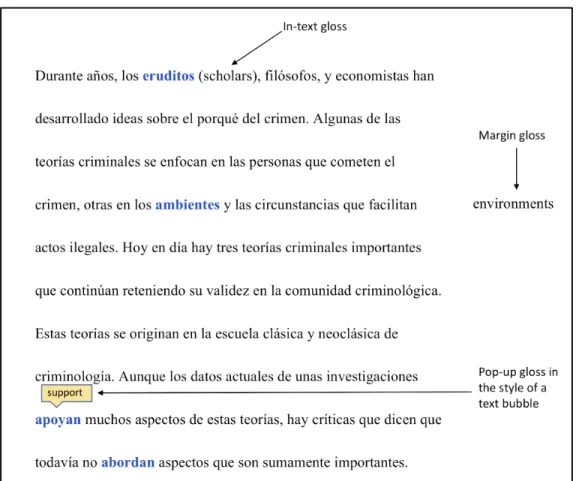
Computer-based glossing offers opportunities for multiple gloss locations since they can be made to appear anywhere on the screen. There are a number of common options available for gloss locations. These frequently used locations, which may or may not require an action on the part of the user to view them, are in-text (i.e., text appearing next to the target word in the same line of reading), margin gloss (a gloss appearing on the side margin or bottom margin of the screen), and pop-up (a gloss appearing in response to a click or mouse rollover that opens in a separate window or text bubble) as seen in Figure 1.
Given that there are many options for where to place glosses on a screen, researchers have investigated various gloss placements in terms of the effect on vocabulary learning and reading comprehension. Al-Seghayer (2003) stresses the importance of making sure that the gloss does not cover the area being read by the learner so that reading is not interrupted. The suggestion made by Al-Seghayer is that the gloss should therefore appear in a separate area such as a split screen or something similar to a margin gloss. On the other hand, research by AbuSeileek (2011), Marefat, Rezaee, and Naserieh (2016), and Chen (2016) found evidence for in-text glosses being of greater use to learners based on higher reading comprehension and vocabulary learning scores, likely as a result of their close proximity to the target word and text being read.
Research by AbuSeileek (2011) using margin, bottom, pop-up, and in-text glosses found an effect for proximity of the gloss to the target word. In-text glosses resulted in the highest mean scores on vocabulary recall and text comprehension post-tests, and all of the other gloss conditions outperformed the bottom gloss, which was the furthest from the target words. Similar results were obtained by Marefat et al. (2016) in which participants using in-text glosses achieved higher reading comprehension scores and completed their tasks more quickly than those supplied with margin glosses.
In a 2016 study, Chen found that use of in-text glosses resulted overall in the highest performance on tests of reading comprehension and vocabulary acquisition compared to the other gloss conditions of margin and pop-up. Specifically, participants using in-text glosses outperformed the other gloss conditions on post-tests of vocabulary acquisition (translation and matching) and the summary writing post-test which tested reading comprehension. The
highest performance on the reading comprehension multiple choice test was attained in the marginal gloss condition.
AbuSeileek (2008) examined effects of gloss location using side margin, bottom margin, end of text (like a traditional glossary), and pop-up conditions. Of these conditions, the vocabulary post-test scores for the side margin were significantly higher compared to those of the other gloss conditions, and the scores for the bottom margin condition were also significantly higher compared to the end-of-text and pop-up conditions. In terms of reading comprehension, it was again found that side margin and bottom margin groups performed significantly better. These margins were closer in proximity than the end-of-text glosses and therefore follow the trend that proximity is an important factor in performance. However, the pop-up glosses should have been close to the target words as well. AbuSeileek hypothesizes that the design of the pop-up glosses may have distracted participants by drawing their attention away from the text.
To summarize, AbuSeileek (2008, 2011), Marefat et al. (2016), and Chen (2016) found that the proximity of the gloss to the target word was an important factor in performance on measures of vocabulary acquisition and reading comprehension. In addition to different gloss locations, computers also create opportunities for adding a variety of gloss types. The type of gloss used (translation, picture, audio, video, definition, etc.) will be an important
determining factor in the screen locations that the gloss can occupy. A single word
translation can easily be placed immediately adjacent to a target word in an in-text position, whereas a gloss that takes up more room on the page, such as an L2 dictionary-style
definition or a picture or video gloss, would need a different presentation in order to accommodate the size of the gloss.
Gloss Types
Computer-based glossing allows for variety in the types of information that can be presented to learners. Glosses can include text (translations, synonyms, definitions, concordances), pictures, audio, and video, often in combination. Instructors and materials developers must decide which types of glosses to include in their materials. Researchers have sought to understand which types and combinations of glosses can assist learners the most in acquiring vocabulary and understanding the text they are reading.
L1 versus L2 glosses
One choice for instructors or materials developers is between first and second
language glosses. Often this choice is governed by practicality and resources and can depend on the composition of a class. In a second language setting, it may not be possible to provide all students with L1 glosses, while in a foreign language setting, all, or a majority of students, may share a first language, making L1 glosses a potential resource.
The research on whether it is better to gloss using L1 or L2 glosses has so far been inconclusive. Some studies have found no significant differences between L1 and L2 gloss groups (Yoshii, 2006; Ko, 2012; Alharbi, 2018), while a vocabulary learning study by Ghahari and Heidarolad (2015) found that students presented with L2 multiple-choice glosses, in which participants needed to choose the correct translation from three given options, scored significantly higher on both immediate and delayed vocabulary recognition and production post-tests compared to those who had access to multiple-choice L1 glosses. In a study of incidental vocabulary learning among Chinese junior high school learners of English, Hu, Vongpumivitch, Chang, and Liou (2014) found that higher-level learners had better vocabulary retention when exposed to L2 glosses versus when they used L1 glosses. A similar result was found in a 2002 study of high school students in Japan who were studying
English. Miyasako (2002) found that more proficient students tended to benefit more from the L2 glosses and hypothesized that L1 glosses may have aided only the lower-proficiency learners in the study. Based on their findings, Hu et al. (2014) suggest making both types of glosses available to students.
Learner preferences regarding the choice of language in glosses also vary. For example, Alharbi (2018) found that over half of the participants preferred having L1 and L2 glosses presented together as a single gloss, with L1 glosses receiving the next largest preference, followed by L2 glosses. Ko (2012), on the other hand, found that the majority of participants preferred L2 glosses and a combination of L1 and L2 glosses being the least preferred of the glossing options.
The choice of language may often be dictated by the composition of the class. L1 glosses may only be possible with a uniform L1 classroom population. The evidence for the use of L1, L2, glosses or both is inconclusive. It may be that whether L1 or L2 glosses are chosen makes no significant difference, as found in the studies by Yoshii (2006), Ko (2012), and Alharbi (2018), or alternatively the best choice of gloss may depend on the level of learner proficiency as in Hu et al. (2014) and Miyasako (2002). Clearly, more research is needed in this area to gain further understanding of if and when it might be better to utilize one type of gloss or the other, or if a combination of the two is indicated.
Audio glosses
A great deal of research has addressed various types and combinations of glosses, such as text, video, picture, and audio (Al-Seghayer, 2001; Chun & Plass, 1996; Ercetin, 2003; Garrett-Rucks, Howles, & Lake, 2015; Khezrlou et al., 2017; Lomicka, 1998; Pardo-Ballester & Rodríguez, 2010; Türk & Erçetin, 2014; Yanguas, 2009; Yeh & Wang, 2003; Yoshii, 2006; Yoshii & Flaitz, 2002).However, few studies have focused specifically on
audio glosses compared to other types of glosses (Rassaei, 2018; Sadeghi & Ahmadi, 2012). As with textual glosses, audio glosses can provide additional information to the learner to aid in reading comprehension and vocabulary acquisition. Audio glosses can be in the L1, L2, or a combination of both. They can provide a single word translation, pronunciation of a word, a definition, an example sentence, or other explanatory information.
L2 audio glosses were investigated by Antes (2014) in a study of twenty participants from an American university who were taking an introductory French class. The participants in the audio-gloss condition used a computer to drag and drop furniture items onto a design of a floor plan based on a conversation with a partner in an information-gap activity. When clicking on the item to be moved, students could hear the item named in French through their headphones. Another group performed the same exercise on the computer without access to the audio while a third group performed the task without audio and using a felt board instead of a computer. Compared to the groups without access to the L2 audio, participants in the gloss condition used the target French nouns more frequently and with greater accuracy.
A review of the literature identified only two studies that compared the effectiveness of audio versus textual glosses. Sadeghi and Ahmadi (2012) researched the effects of an L2 audio gloss and what they called an extended audio gloss that consisted of the audio gloss with an example sentence in the L2. These two conditions were compared with a condition featuring a paper-based text with marginal glosses and a no-gloss control. Sixty upper-intermediate ELLs from an Iranian language institute participated in the study. Post-test measures of reading comprehension showed significantly higher scores in the gloss
audio gloss compared to the other gloss conditions. There was no statistically significant difference between the text group and the single audio-gloss group.
Rassaei (2018) investigated vocabulary learning using L1 audio and textual glosses compared with a no-gloss control, as well as the role of auditory and visual learning styles. Ninety-three upper-intermediate level ELLs from a teaching institute in Iran took part in the study. The audio and textual glosses contained the same information and consisted of definitions in Persian of the target English words. Participants in the audio-gloss condition heard the L1 audio gloss when clicking on the glossed word. Participants in the textual gloss condition were taken to another screen to view the L1 gloss before needing to navigate back to the reading screen. The results of recognition and production post-tests measuring
vocabulary learning showed that participants in both the audio and textual gloss conditions significantly outperformed those in the no-gloss condition and that the audio condition group significantly outperformed the text-gloss condition group. As Rassaei notes, the difference in the presentation of the textual versus audio glosses may have been a confounding factor in the results.
This study sought to fill a gap in the research comparing audio and textual glosses for vocabulary learning through reading in an L2. Although there have been many L2 studies of glosses, few have compared the usefulness of audio-gloss translations versus text-gloss translations for assisting students with vocabulary acquisition or reading comprehension. This study sought to add to the knowledge about audio glosses and their potential to support vocabulary learning for students studying a foreign language. The limiting of the study’s focus to vocabulary acquisition over reading comprehension was simply to give this single outcome variable the necessary attention within the scope of an MA thesis project.
Specifically, the study investigated the effects of L1 audio glosses versus L1 textual glosses compared with a no-gloss control on incidental vocabulary learning by addressing the following research question:
What is the effect of gloss condition (audio-gloss, textual-gloss, no-gloss) on vocabulary acquisition?
CHAPTER 3. METHODS Participants
Participants were 11 undergraduate students enrolled in an intermediate to advanced Spanish language class at a large Midwestern university. All participants were native English speakers. There were four male and seven female participants ranging in age between 18 and 20 with an average age of 19.2. The participants represented a variety of majors with
approximately half listing Spanish as a minor. Thirteen students were originally enrolled in the study. One student dropped the class, and so was no longer eligible to participate, and the other student was absent at the time of the pre-test and so also had to be excluded from the data.
The Spanish class in which the participants were enrolled had a focus on assisting students with developing relevant skills and vocabulary needed in the business and professional world. Reading was a key component of the course, and many of the course readings were enhanced with glosses. Therefore, before beginning the study, students were already familiar with using glosses while completing readings for the course.
Materials
Participants read a text in one of three conditions: audio glosses, text glosses, or unglossed. The text was titled “Las teorías del crimen.” The text, based on sections from the book Delinquency in Society (Regoli, Hewitt, & DeLisi, 2010) was translated and adapted from the original for the Spanish course. The text was chosen from the from the students’ regularly scheduled course readings. The text length was 818 words with 20 words glossed by means of English translations (Appendix A). Of these 20 words, there were eight nouns, five verbs, five adjectives, one preposition, and one adverb. The text difficulty level was
aimed at intermediate to advanced students of Spanish. I consulted with the course instructor to choose words that were likely to be unknown to the majority of the students and to
determine appropriate context-specific translations for each. Each target word was presented in blue, bolded font in all three conditions.
A website was designed using PHP to display the text in the three treatment formats. The textual glosses were coded to appear in parentheses next to the target word (Figure 2) when the word was clicked. The audio glosses, recorded by the researcher, consisted of the same L1 translations as the text glosses. Participants clicked on a glossed word to hear the audio translation of the word in English through their headphones (Figure 3). Each of the 20 target words was glossed only the first time it appeared in the text. The majority of words appeared only once, although four of the target words appeared twice each, though not always in the same inflected form. Figure 2 shows side-by-side examples of a text gloss first in the unclicked and then in the clicked form, while Figure 3 shows the appearance of the glossed text in the audio and no-gloss conditions.
Figure 2. Unclicked and clicked example of a textual gloss.
Figure 3. Example of an audio gloss and the same text presentation in the no-gloss condition.
Instruments
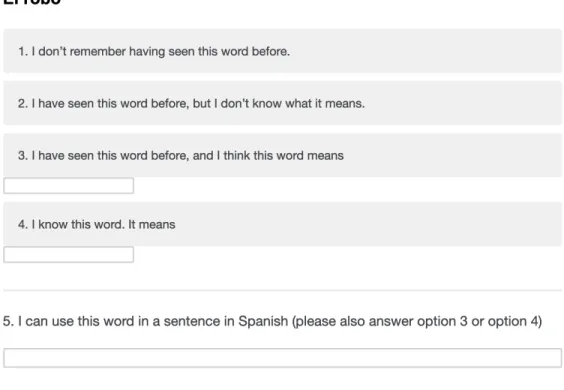
The instrument used for gathering and measuring participants’ initial vocabulary knowledge, and knowledge gains, is the vocabulary knowledge scale (VKS) developed by Paribakht and Wesche (1997). The scale asked participants to rate their knowledge of each Spanish word according to a five-point scale (described below under "Scoring") ranging from student self-report of never having seen a word before through being able to provide a correct
translation or synonym and use the word in a sentence. The scale was chosen with the intention of being able to measure smaller changes in the progression of vocabulary acquisition.
The 20 words tested were those that had been glossed in the reading text. On both tests, verbs were presented in their infinitive forms and nouns were preceded by indefinite articles to minimize confusion about word forms, such as a noun being misunderstood to be a conjugated verb. The same 20 items were presented on the pre- and post-test. The pre-test and post-test were created using Qualtrics. To make administering the pre-test more
convenient for the instructor, a paper version of the pre-test was provided to be administered in class. The post-test was administered through Qualtrics immediately after completing the reading and consisted of three multiple-choice reading comprehension questions in addition to the 20 vocabulary items presented in the VKS format.
Before starting the reading, participants were informed that they would need to respond to reading comprehension questions after reading the text. They were told this to ensure that they would keep their focus on meaning while reading the text. The reading comprehension questions appeared first and were followed by the vocabulary items given in random order. The reading comprehension questions consisted of three general questions about the content of the reading text and did not make use of any of the target words.
Scoring
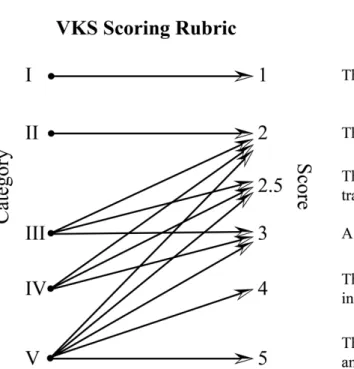
The VKS was scored using a modified scale from the scale used in Paribakht and Wesche (1997). The scale consisted of five categories which corresponded to the five statements presented to participants to rate their knowledge of each of the 20 target words (Figure 4). These five statements are referred to as Categories I through V. Categories I and II always received scores of 1 and 2, respectively. Scores awarded to Categories III-V
depended on the accuracy of the translation and sentence written by the participant; they ranged from 2, meaning the student was possibly familiar with the word but did not provide a correct translation, to 5, which indicated that an accurate translation was provided and the word was used in a sentence accurately and appropriately.
Figure 4. Example of the VKS format presented to participants on the vocabulary pre- and post-tests.
The scoring system for the VKS can be seen in Figure 5. Participants received a score of 1 if they self-reported that they were not familiar with the word, a score of 2 if reported that they were familiar with the word but were unable to venture a translation, a score of 3 if they could provide a correct translation of the target word, a score of 4 if the word could be used accurately in the sentence in terms of the meaning of the word (semantic
grammar. Errors unrelated to the target word were ignored when scoring sentences. If participants wrote a sentence, they also had to provide a translation for the target word.
An additional score of 2.5 was added to the scale to represent partial word
knowledge, such as when participants responded with a word in the same word family but a different grammatical category. For example, for the target noun “entendimiento,” meaning “understanding,” one participant translated the word as “to understand” and wrote the following sentence, “yo entendimiento la lectura en clase,”using the noun in place of the verb “entender.” Thus, 2.5 represented a stage between recognizing the word while being unfamiliar with its meaning (Category II), versus being able to provide a correct translation (Category III).
Figure 5. VKS scoring rubric showing possible scores and score meaning for each category.
Adapted from “Vocabulary enhancement activities and reading for meaning in second language vocabulary acquisition,” by T. S. Paribakht and M. Wesche, in J. Coady and T. Huckin (Eds.), Second language vocabulary acquisition: A rationale for pedagogy, (p. 181), 1997, Cambridge, UK: Cambridge University Press. Copyright 1997 by Cambridge
As an example of how a sentence response was scored, the following sentence
received a score of 4. The target adjective was the word “exitosa,” meaning “successful,” and appears here in bold: los niños fueron exitosas en sus classes. The participant used the target word accurately in the sentence in terms of meaning, but not with grammatical accuracy, and so received a score of 4. To be grammatically accurate, the word should have appeared as “exitosos” in the sentence the participant created.
It should be noted that I scored responses for Categories I through IV, and the course instructor scored the Category V responses. As I am not proficient in Spanish to the level needed, I was unable to score the sentence-level responses by myself. I also verified any difficult scoring choices with the course instructor and contacted T.S. Paribakht, who co-created the VKS, for further clarification on scoring. It was Paribakht who suggested the addition of a score of 2.5 to account for some of the response data (personal communication, February 16, 2019).
Statistical Analysis
Descriptive statistics for total scores and score differences between the pre-test and post-test were calculated in Excel. To test for significance, a one-way between subjects ANOVA was run to compare the effect of group condition on score difference (post- minus pre-test score). The R library package ggplot2 was used in R version 3.5.0 to generate point and boxplots using geom_boxplot and geom_point functions. R is a free software program that can be downloaded and used to perform statistical analyses and generate figures (R Core Team, 2018). Changes in the percentage of words at each VKS score level for control, text, and audio were calculated and plotted in Excel. A one-way between subjects ANOVA was run to compare the effect of group condition on proportion of words learned of words available to learn.
Procedure
Data collection took place within a three-week span and all data was collected during regular class time. Recruitment for the study and a request to fill out a demographics survey were completed after receiving approval from the Institutional Review Board (IRB) at Iowa State University (Appendix B). The course instructor administered a paper pre-test the following week, and the reading and post-test were completed nine days later in a computer lab.
Each participant was randomly assigned to the audio-gloss group, the text-gloss group, or the control group by utilizing the RAND function in Excel. This originally resulted in two groups of four and one of five. Due to a participant dropping the class, the final participant who had been added to the group of five was reassigned to create even groups of four. The loss of a second participant, as that participant was absent during the pre-test, resulted in final groups of four participants each in the audio-gloss and control groups and three participants in the text-gloss condition.
The learners were assigned the reading in a computer lab during a regular class period. I sent an email at the start of class to each participant with instructions about the task they needed to complete in the computer lab. If they were in the audio or text-gloss group, this email included the information that as they read there would be some words they could click on for additional information if they wanted. The email contained a request for all students (in all groups) to put on their headphones so that it would not be evident that
participants were in different groups. It also reminded participants to read for comprehension as they would be answering reading comprehension questions at the end. It then contained a link to either the audio-gloss, text-gloss, or control webpage with the correct reading. Students in the class who did not participate in the study were sent a link to the control text
by the course instructor. The next instruction in the email was for the participants to close out of the reading before beginning to answer the comprehension questions and to not use any outside materials. These instructions were followed by a link to the post-test in Qualtrics.
CHAPTER 4. RESULTS
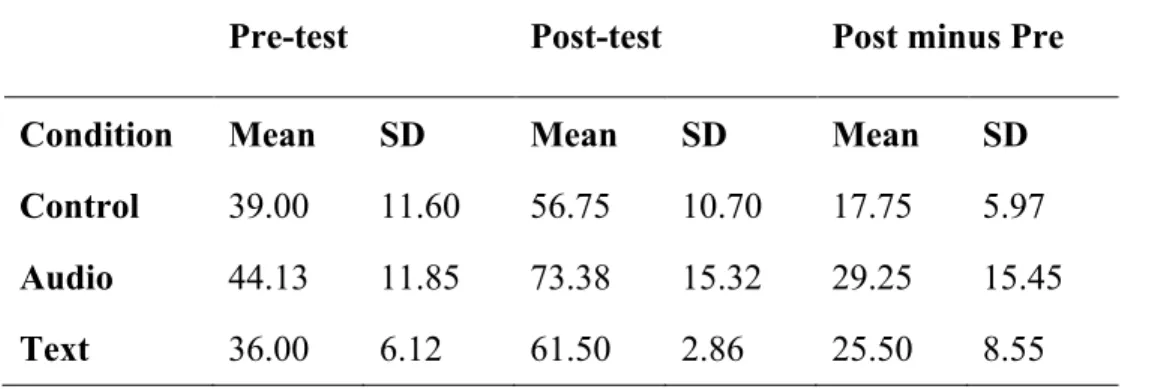
For each participant, the total scores, as defined as the sum of the scores of the 20 target words, were calculated for the pre-test and post-test along with the difference in the total scores between the post-test and pre-test (post minus pre) for each participant. Means (M) and standard deviation (SD) were calculated for each of the experimental groups from the total scores. As shown in Table 1, the control (no-gloss) condition had a mean pre-test score of 39.00 (SD = 11.60) and a post-test score of 56.75 (SD = 10.70). The audio-gloss condition had a mean pre-test score of 44.13 (SD = 11.85) and a post-test mean score of 77.38 (SD = 15.32). The text-gloss condition had a mean pre-test score of 36.00 (SD = 6.12) and a post-test score of 61.50 (SD = 2.86). From the mean differences in the scores, it can be seen that the largest difference was in the audio-gloss group (M = 29.25, SD = 15.45), followed by the text-gloss group (M = 25.50, SD = 8.55), and finally the control group (M = 17.75, SD = 5.97).
Table 1. Descriptive statistics for vocabulary test scores by group.
Pre-test Post-test Post minus Pre Condition Mean SD Mean SD Mean SD Control 39.00 11.60 56.75 10.70 17.75 5.97
Audio 44.13 11.85 73.38 15.32 29.25 15.45
Text 36.00 6.12 61.50 2.86 25.50 8.55
To test for significance, a one-way between subjects ANOVA was run to compare the effect of group condition on score difference (post- minus pre-test score). No difference was found, F(2,8) = .83, p = .471. However, there is an upward trend in the data which is visible
in the boxplots as shown in Figure 6. The medians increase from lowest at the control, text in the middle, and audio with the highest median. The large spread of the data, especially in the audio condition is also visible.
Figure 6. Boxplot of score differences between the pre-test and post-test by treatment group.
Although the findings for score differences were not significant, the higher means for the text and audio conditions merited further investigation. In order to examine the data in more detail, I performed two additional analyses. The first of the additional analyses examined the breakdown of the percentage of words per assigned VKS score. The second analysis took the more detailed score data and grouped it into unknown words (scores between 1 and 2.5) and known words (scores between 3 and 5). Words learned were then calculated by comparing the known words on the pre-test and post-test. The percentage of words learned was then calculated and reported by treatment group. This grouping of the data enabled the testing for statistical significance of percentage of words learned in each group using an ANOVA analysis.
In the first additional analysis, the VKS scores for the pre-test and post-test are reported as percentages to normalize for the total words scored in each experimental condition. In Figure 7, it can be seen that the majority of the words were unknown to participants, with high percentages of words receiving scores of 1 and 2 on the pre-test. On the post-test, scores of 1 from Category I (never having seen the word before), decrease, while scores of 2, from Category II (words being familiar but still unknown), increased. The text-gloss group was the only condition to exhibit a decrease in the percentage of words assigned to Category II. In the control and text-gloss conditions, the percentage of words with scores of 2.5, 3, 4, and 5 increased while in the audio group scores of 2.5 and 3
decreased and scores 4 and 5 increased. In the audio-gloss and text-gloss conditions, a greater percentage of words achieved the highest score of 5 than in the control condition.
Figure 7. Percentage of words per VKS score on the pre-test and post-test for the text category (A), control (B), and audio (C).
The second of the additional analyses divided the VKS scores into “known” and “unknown” words. Results for each participant were grouped into the categories of “known” words, with scores greater than or equal to 3, and “unknown” words with scores less than 3. These score groupings were chosen because scores of 3 and above required the learners to demonstrate their knowledge of the target words. Scores below 3 were assigned to words that the learner had indicated they either hadn’t seen, looked familiar but did not know the
meaning of, or to incorrect responses to the higher VKS categories. Words learned was defined as the difference between the “known” words on the post-test minus the “known” words on the pre-test divided by the unknown words from the pre-test (i.e., percent learned was post-known minus pre-known divided by possible words that could be learned). The scores are reported as percent of words learned, out of available words, in order to normalize for the total words learned in each experimental condition, since the groups did not contain equal numbers of participants, and in one case, a participant skipped a question on the pre-test.
To test for significance, a one-way between subjects ANOVA was run to compare the effect of group condition on proportion of words learned of words available to learn. No difference was found F(2,8) = .92, p = .437. However, as in the original analysis there is an upward trend in the means as seen in Figure 8. The averages and SDs for percent of words learned, out of possible words that could be learned, were 28.02% (SD = 16.8%), 40.46% (SD = 15.39%), and 48.90% (SD = 22.69%) for the control, text-gloss, and audio-gloss conditions, respectively.
Figure 8. Boxplots showing percent of words learned out of available words by treatment group.
CHAPTER 5. DISCUSSION AND CONCLUSIONS
This study sought to better understand the effect of gloss condition (audio-gloss, textual-gloss, no-gloss) on vocabulary acquisition. In all gloss conditions, participants showed evidence of learning the target vocabulary through reading the assigned text. Average learning gains were highest in the audio-gloss group followed by the text-gloss group with the lowest gains in the control. No differences between the three groups were found to be significantly different.
As described in the scoring section, the Vocabulary Knowledge Scale is used to rate the knowledge of the participant for each target word with scores ranging from 1 (no knowledge) to 5 (using the word accurately in a sentence). For the mean difference in total VKS scores per experimental group, the largest score gains between the pre-test and post-test were in the audio-gloss group followed by the text-gloss group. The control group averaged the lowest gains between pre-test and post-test scores. Despite the promising results of the glossing condition means, the statistical analysis showed no significance. Though not statistically significant, the results were suggestive of an effect of gloss condition and merited a more detailed investigation of the data. This was accomplished by looking at the pre- and post-test changes in relative frequency of words in each VKS score.
The detailed view of the percentage of words per VKS score showed the expected outcome that scores should drop from the first category on the post-test, as participants had seen all of the words previously when they took the pre-test. It can be seen that a large percentage of words remained unknown to participants from the scores of 2 on the post-test. However, movement up to scores of 3, 4, and 5 indicates that participants in all three
Scores of 5 increased the most between the pre-test and post-test in the audio condition followed by the text-gloss condition. The fact that the gloss groups had a larger percentage of words in the highest (sentence) level of vocabulary knowledge compared with the no-gloss control, seems to point to a positive effect of using glossed texts. To take a closer look at knowledge gained, the VKS scores were divided into two groups: known and unknown words.
Taking the detailed scores and dividing them into known and unknown words allowed for a more direct comparison between groups in terms of percent of words learned out of those available to learn. There was a positive effect in the glossing groups with the audio-gloss group learning the highest percentage of words out of those available compared to the other groups. Although the statistical analysis showed no significant difference, the data, as seen in Figure 8, show a more pronounced separation between the gloss and no-gloss conditions. Compared to the separation as seen in Figure 6, there is considerably less overlap of data points between treatment groups. This indicates that grouping of the data in this way may improve our ability to distinguish between treatment conditions.
The higher total average scores and the higher percentage of words learned out of words available in the audio group are in alignment with Rassaei (2018) who found statistically higher scores for vocabulary learning in the audio-gloss condition compared to text-gloss and no-gloss conditions. The current study is also in alignment with Sadeghi and Ahmadi (2012), who found that the audio-gloss conditions (single and extended audio gloss) as well as the text-gloss condition outperformed the control group on measures of reading comprehension. Rassaei (2018) hypothesized that the different modality (i.e., auditory rather than visual) of the audio glosses may have caused learners to pay more attention to them. Rassaei also speculated
that, due to the fact that learners were sent to a different screen to view the text gloss and needed to navigate back, the audio glosses may have had the advantage of not interrupting the flow of reading. However, the current study presented the textual glosses in-text and adjacent to the target word and still maintained an advantage for the audio glosses over the text glosses.
Implications
The findings of this study, though not conclusive, indicate that glossing a text with audio glosses is likely to be beneficial to learners. Glossed texts can be included in the classroom as part of students’ overall exposure to target vocabulary words. These words can then be repeated across multiple readings or through classroom activities, helping students to attain a high level of knowledge of the words and to retain them over time.
Additionally, an instructor or materials developer might create a library of glossed readings on different topics that may not be covered in class. Lack of class time for teaching all the words of a language is one of the reasons for interest in incidental vocabulary learning and in glossing. Making a wide variety of audio-glossed texts available to students would allow learners to tailor their reading, and therefore vocabulary acquisition, to their own interests and goals.
Limitations and Future Studies
There were some important limitations to the study which should be taken into consideration when interpreting the results and for the design of future studies. First, the positive effect found for the gloss groups, with the highest performance in the audio-gloss condition, was not statistically significant. This lack of significance is likely due to the small scale of the study, with only 11 participants, which did not yield a large amount of data for analysis.
Another limitation to the study was the lack of multiple independent raters to score the participant responses on the VKS. To increase the robustness of the scoring, it would be beneficial to have a second, independent rater for assigning scores to eliminate any biases introduced by the rater. There would also be advantages to incorporating other measures of vocabulary learning, such as a multiple-choice recognition test, cloze test, or other measures to better gauge learners’ vocabulary gains, as well as a delayed post-test to measure retention over time.
A more robust system for collecting click data would also be beneficial. It was my intention to include click data in the study to verify the use of glosses and correlate gloss use with total scores. This data was collected, but it was not included in the final analysis. A flaw discovered in the click-logging technology made it unclear how much the participants were actually making use of the glosses.
Finally, the nature of the study, being an incidental vocabulary study, meant that participants were not given instructions to use the glosses. Participants were told that there would be some words they could click on for more information if they wanted to. This may not mimic a true classroom setting in which instructors would be likely to demonstrate to students how to use the glosses and might encourage them to do so. Khezrlou et al. (2017) included an intentional condition in their study in which participants were asked to make use of the glosses. A future study might include incidental as well as intentional conditions or might include a training session to encourage the use of glosses.
To summarize, recommendations for future research based on the current study include: 1) obtaining a greater number of participants, 2) employing multiple raters for scoring the VKS and incorporating additional measures of vocabulary learning, and 3)
ensuring accuracy in the click data. A larger study in the future may be able to bring more clarity to the question of the value of audio glosses compared to textual glosses for incidental vocabulary acquisition through reading.
Conclusions
This study sought to gain a better understanding of the effect of gloss condition (audio-gloss, textual-gloss, no-gloss) on incidental vocabulary acquisition. A course reading was prepared with 20 target words with the target words in blue, bolded font. In the textual-gloss condition, the text textual-gloss appeared adjacent to the target word when that word was clicked. In the audio condition, the audio gloss was also activated upon clicking the target word, whereas in the no-gloss condition, the target words could not be interacted with. Eleven participants took part in the study. Participants were divided into three groups with four in the audio group, three in the text group, and four in the control group. Participants took a vocabulary pre-test and post-test that asked them to rate their knowledge of each of the 20 target vocabulary words on a modified version of the vocabulary knowledge scale (VKS) developed by Paribakht and Wesche (1997). Participant responses were scored according to a modified version of the VKS scoring rubric.
The VKS scores were used to perform three analyses. The first analysis compared the average difference in the total scores between the pre-test and post-test. Both of the gloss conditions outperformed the no-gloss control with the audio group having the highest mean difference in scores. There were no statistically significant differences between groups. The second analysis was undertaken to examine the percent of words per VKS score. These were displayed graphically with bars corresponding to the percent of words per VKS score on the pre-test and post-test. The graphs showed higher increases in scores of 5 for the audio and text-gloss groups, compared to the no-gloss control, indicating that glosses were likely able
to facilitate an increase in knowledge of target vocabulary words up to the highest score level. The third analysis grouped the VKS scores into known (scores greater than or equal to 3) and unknown (scores less than 3). The percent of words learned out of those available to learn between the pre-test and post-test was calculated for each treatment group. The largest gains were in the audio-gloss group followed by the text-gloss group, which again supports that the glosses seemed to have a positive impact on participant performance. The results of this analysis also lacked statistical significance.
The results of the current study indicate that learners would likely benefit from reading using glossed texts. Glossed texts can be incorporated into classroom readings to support acquisition of target course vocabulary. A library of glossed texts made available to students would also allow students to tailor their language learning to their own interests and goals.
All participants in all groups acquired target vocabulary incidentally over the course of the study. The audio-gloss condition showed the largest average gains on measures of vocabulary acquisition followed by the text-gloss condition when compared to the control (no-gloss) condition. Although none of the tests showed statistical significance, the data is suggestive that with a larger sample size in a future study, clearer conclusions may be reached about the value of presenting students with audio glosses as a resource for reading texts for language-learning purposes.
REFERENCES
AbuSeileek, A. F. (2008). Hypermedia annotation presentation: Learners' preferences and effect on EFL reading comprehension and vocabulary acquisition. CALICO Journal,
25(2), 260-275.
AbuSeileek, A. F. (2011). Hypermedia annotation presentation: The effect of location and type on the EFL learners’ achievement in reading comprehension and vocabulary acquisition. Computers & Education, 57(1), 1281-1291.
Alharbi, B. (2018). The impact of glossed texts on reading comprehension among tertiary Saudi students. English Language Teaching, 11(3), 153-161.
Al-Seghayer, K. (2001). The effect of multimedia annotation modes on L2 vocabulary acquisition: A comparative study.Language Learning & Technology,5(1), 202-232. Al-Seghayer, K. (2003). Technological and pedagogical considerations for a more effective
electronic glossary. The Reading Matrix, 3(1). 1-15.
Antes, T. A. (2014). Audio glossing during information-gap activities: The effect on learner output. System, 45, 163-174.
Carpenter, S. K., Sachs, R. E., Martin, B., Schmidt, K., & Looft, R. (2012). Learning new vocabulary in German: The effects of inferring word meanings, type of feedback, and time of test. Psychonomic Bulletin & Review, 19(1), 81-86.
Chen, I. J. (2016). Hypertext glosses for foreign language reading comprehension and vocabulary acquisition: Effects of assessment methods. Computer Assisted Language Learning, 29(2), 413-426.
Cheng, Y. H., & Good, R. L. (2009). L1 glosses: Effects on EFL learners' reading comprehension and vocabulary retention. Reading in a Foreign Language, 21(2), 119-142.
Chun, D. M., & Plass, J. L. (1996). Effects of multimedia annotations on vocabulary acquisition. The Modern Language Journal, 80(2), 183-198.
Duan, S. (2018). Effects of enhancement techniques on L2 incidental vocabulary learning.
English Language Teaching, 11(3), 88-101.
Ehri, L. C. (1997). Learning to read and learning to spell are one and the same, almost. In C. A. Perfetti, L. Rieben & M. Fayol (Eds.), Learning to spell: Research, theory, and practice across languages (pp. 237-268). Mahway, NJ: Lawrence Erlbaum
Associates.
Ellis, R. (2015). Understanding second language acquisition (2nd ed.). Oxford, UK: Oxford University Press.