The K4D helpdesk service provides brief summaries of current research, evidence, and lessons learned. Helpdesk reports are not rigorous or systematic reviews; they are intended to provide an introduction to the most important evidence related to a research question. They draw on a rapid desk-based review of published literature and consultation with subject specialists.
Helpdesk reports are commissioned by the UK Department for International Development and other Government departments, but the views and opinions expressed do not necessarily reflect those of
Helpdesk Report
Lessons learned from education
programmes' contribution to peace
and stability
Roz Price
Institute of Development Studies 08 April 2019
Question
1. How education programming can contribute to peace and stability/address conflict and fragility?
2. How donor support for education interacts with these links?
Contents
1. Summary2. Education and peacebuilding 3. Lessons learned and insights 4. Further resources
5. References
1. Summary
This paper provides a brief summary of the connections between education, conflict and peacebuilding, focusing on education programming and lessons learned. A growing body of research is exploring the dynamic relationship between education, conflict and peacebuilding, with the aim of understanding how education is both affected by and affects insecurity and violence (Herrington, 2015; Lopes Cardozo & Scotto, 2017), as well as on education for
peacebuilding. However, there remain a number of gaps in knowledge about what has worked, why and the transferability and scalability of findings related to education programming in conflict settings. Peacebuilding itself is complex and means different things to different actors.
Furthermore, different understandings of conflict inform approaches to education policy in conflict and post-conflict reconstruction adopted by global actors. Hence, the integration of education in peacebuilding processes is not only complex but also highly context dependent, and there are no ‘one-size-fits-all’ solutions (Datzberger et al., 2016). Other gaps in the literature include limited research on the relationship between education and inequality in the outbreak of armed conflict. This review draws on a mix of academic research and grey literature from NGOs and donors. In particular, the review draws on the resources from the Research Consortium on Education and Peacebuilding (2012-2016), which included extensive literature reviews in this area. Specifically, see Datzberger et al. (2016), Lopes Cardozo and Scotto (2017), and Smith and Ellison (2015) for more in-depth understanding. There are a number of GSDRC1 helpdesk reports relevant to this topic (see Haider, 2014, Naylor, 2015, and Rohwerder, 2015a, 2015b). In particular, the helpdesk report by Thompson (2015) provides a review of literature on the links between education and peace. This report does not duplicate these findings and instead aims to build on these helpdesk reports in the first section, mostly focusing on literature from 2015 onwards. The second part focuses on donor experiences and programming relating to education and peacebuilding, highlighting general lessons learned and insights. However, it is important to recognise the wide range of fragile states and experiences, and consequently how difficult it is to generalise across these diverse development settings. Nevertheless, a number of research programmes have been able to provide some general recommendations and lessons learned that have already been used to influence and inform recent programming (such as the multilateral Education Cannot Wait fund). The final section provides some additional key online resources.
Key findings in relation to education, conflict and peacebuilding:
The literature discussed the ‘two faces of education’. One face of education includes experiences of deepening societal injustice and inequality through uneven access to all levels of educational achievements; indoctrination; and divisive rhetoric and promotion of intolerance through textbooks and curriculum content. Another face of education includes experiences of healthy and inclusive identity formation; social cohesion and
reconciliation; and just and equal access.
Key themes around education, conflict and peacebuilding include: education as a peace dividend: education governance and reform: education as an entry point for conflict transformation and peacebuilding (Smith & Ellison, 2015).
More understanding of youth agency for peacebuilding is needed, and both formal and non-formal forms of education have the potential to strengthen youth transformative
agency for peacebuilding (but also for conflict, e.g. when they fail to match up to the promise of serving and supporting a better future for all) (Lopes Cardozo & Scotto, 2017).
Education has become a more prominent feature in emergency response, especially in situations where there are protracted refugee crises. However, there is limited evidence on how to programme education to address the needs of refugees, or indeed of
populations caught up in conflict (Cambridge Education, 2017).
General recommendations emerge from the literature in relation to programming:
Prioritise long-term funding and political commitment to integrate education within sustainable peacebuilding approaches;
Foster collaborative partnerships which would enhance the integration of education system reforms into broader policy frameworks for social justice and social cohesion;
Protect educational spaces and actors (including students and educators) from direct (physical) and structural (exclusionary) forms of violence;
Ensure fair redistribution of resources and training and remuneration for educators. Some general lessons learned are included in the literature (but it is important to bear in mind that these are often context specific and based on individual (or a small number of) programmes and countries):
Importance of coordination and collaboration of stakeholders. Getting stakeholders behind a joint planning process is probably the area over which donors have the most control, but even so there are only partial examples of success. Also the need for collaboration between education specialists, peacebuilding specialists, and the broader development field in a systems thinking approach.
(Beyond) ‘do no harm’. Equitable access to education services and inclusive polices at the school level are crucial to long-term efforts to build robust institutions in fragile states. A combination of weak government capacity, limited geographical access, and
contended curriculum, makes it extremely challenging to tackle these issues in the education sector.
Importance of local contextual factors such as capacity and the existence of local supporters.
Incorporate or link policies to conflict sensitive programming guidance.
Importance of programme design, management and sequencing. Including importance of flexibility – on scale, location, intervention approach tied to contextual needs.However, most education programming is not planned in advance from a peacebuilding
perspective.
Ensure clear linkages between education in emergencies and education in development settings support with clear overarching and allocated objectives and transition
approaches. Donors are increasingly concerned about linkages between education in emergencies and education in development settings, and increasingly emphasise the importance of flexibility in scale, location and approach tied to contextual needs.
Increased donor focus on quality and content. Donors have strengthened their emphasis on education quality outcomes, as well as standards for quality and accountability through monitoring and evaluation requirements.
Remain flexible and include contingency plans and/or funds in development education projects to allow for reallocation in the event of an emergency.
2. Education and peacebuilding
This first section provides a brief overview of the linkages between education, conflict and peacebuilding, focusing on literature and insights from 2015 onwards (see Datzberger et al., 2016, Lopes Cardozo & Scotto, 2017, Smith & Ellison, 2015, and Thompson, 2015 for more extensive literature reviews in this area).
The ‘two faces of education’
Bush and Saltarelli’s (2000) pioneering report, ‘The Two Faces of Education in Ethnic Conflict’, describes the two fundamental ways in which education can be experienced. One face of education includes experiences of deepening societal injustice and inequality through uneven access to all levels of educational achievements; indoctrination; and divisive rhetoric and promotion of intolerance through textbooks and curriculum content. Another face of education includes experiences of healthy and inclusive identity formation; social cohesion and
reconciliation; and just and equal access. The ‘two faces of education’ interact at three levels of society: macro (policy) level, meso (community) level, and micro (individual) level (Herrington, 2015, p. 8).
Pherali and Lewis (2017, p. 13) summarised these two faces by stating that:
While education can become a victim of war, it can also play a complicit role in the production of violent conflict by exacerbating socioeconomic divisions, denying
educational access to disadvantaged social groups and promoting manipulative historical narratives. Furthermore, it can be a powerful tool for political indoctrination and
extremism. However, on the positive side, it can act as a catalyst for peacebuilding by addressing the drivers of conflict…While peace is crucial for quality education, conflict sensitive education can be a driver for social transformation and sustainable peace. Lopes Cardozo and Scotto (2017, p. 13) explored young people’s roles in peacebuilding and argue that a more comprehensive understanding of youth agency for peacebuilding is needed. They show that both formal and non-formal forms of education have the potential to strengthen youth transformative agency for peacebuilding (but also for conflict).
An extensive literature review by Smith and Ellison (2015) as part of the Research Consortium on Education and Peacebuilding, provides a good overview of the links between peacebuilding, education and conflict. Some of its key themes/findings from analyses of theories of change include (Smith and Ellison, 2015, p. 4-7):
Education as a Peace Dividend: According to the theory of change, by quickly restoring social services (such as education), confidence in the state’s ability to deliver these is restored, and people see the benefits of peace. Speed and visibility of restoration of education services is important in terms of a ‘peace dividend’. However, speedy
restoration of education is only likely to contribute positively to peacebuilding if it is seen to benefit all, particularly where there have been inequalities, discrimination against or marginalisation of certain regions or groups. The peacebuilding key is that these injustices are seen to be addressed quickly. Visibility is important, but it will only
contribute to confidence in the state if it is provided in a way that generates trust between the state and all its citizens. The literature also raises questions about the extent to which education provision that is insensitive to local context may be perceived as an imposition by government, and whether the use of non-state providers may undermine confidence in the state and have a negative impact on peacebuilding.
Education Governance and Reform: The second theory of change is that good
governance across sectors can create conditions to constructively manage conflict and to overcome horizontal inequalities among groups. The broad conclusion from the literature is that impact is highly context specific and success is dependent on a thorough
understanding of the political economic processes that shape society. The literature also shows that the effects of policies relating to redistribution and decentralisation in post-conflict contexts may be an important element in (re)legitimising the state, but it may also be a source of conflict and needs to be managed sensitively. The key from a
peacebuilding perspective may be a careful balance between centralised and
decentralised powers and functions, rather than total centralisation control or complete decentralisation of the education system.
Education as an Entry Point for Conflict Transformation and Peacebuilding: The third theory of change contends that social services can provide entry points that begin to address underlying causes of conflict. The evidence in relation to four aspects of education policy and programming was examined: protection, addressing inequalities and redistribution, social cohesion, and reconciliation and transitional justice. These issues can still be addressed through education policies even when it not possible to make explicit reference to peacebuilding.
Recommendations for programming
Bush and Saltarelli’s (2000) pioneering report suggested that re-establishing educational provision after an armed conflict is insufficient for the restoration of peace. Lopes Cardozo and Scotto (2017, p. 29) further highlight “how failure to meet the potential and promise of quality and meaningful education for everyone will likely exacerbate rather than reduce long-standing
inequalities in societies around the world”. Formal systems of schooling in cases such as South Sudan, Kenya, Uganda, Pakistan, South Africa and Myanmar largely fail to match up to the promise of serving and supporting a better future for all, as findings from the work of the
Research Consortium on Education and Peacebuilding applying the 4Rs framework2 have shown (Datzberger et al, 2016; Lopes Cardozo & Scotto, 2017). Lopes Cardozo and Scotto (2017, p. 53) recommend the need to:
Prioritise education (funding and resources) for young women and men as a key component with which to achieve the goals formulated in UNSCR 2250, to address the
2 The 4Rs analytical framework for researching education systems was utilised in the Research Consortium on
Education and Peacebuilding. It aims to move beyond a narrow technical framing of education to “an approach that starts from a more comprehensive 4Rs-inspired conflict analysis, while simultaneously planning for future outcomes that address the interconnected dimensions of redistribution (addressing inequalities), recognition (respecting difference), representation (encouraging participation) and reconciliation (dealing with past, present and future injustices).” (Novelli, Lopes Cardozo & Smith, 2017, p.23). The framework provides a useful tool to analyse the extent to which education might support cross-sectoral programming for conflict transformation and as an analytical tool for the education sector. While aspects of the model are potentially relevant across different contexts, it must be tailored to the specific needs of each area of research or intervention.
root causes of inequalities and violent conflict and prioritise reconciliation across generations and groups in society;
Embed education’s progressive and preventive potential for addressing inequalities and building and sustaining peace via improved support for teachers and a more meaningful representation of young people’s realities and needs;
Adequately assess and respond to education’s potentially negative contributions to conflict and violence, and ensure that educational institutions, students and teachers are protected from direct attacks;
Create partnerships to translate conflict-sensitive, gender-responsive and youth-informed reforms of formal/non-formal education into system-wide approaches at, above and below state level to better serve young people’s peacebuilding potential;
Enact more holistic and relevant educational opportunities, as demanded by young people, in order to fully develop all (socio-cultural, political and economic) aspects of youth empowerment and, as a result of this support, meaningful participation, (dis)engagement and (re)integration.
Specifically in relation to governments, bilateral donors and international organisations, key recommendations include (Lopes Cardoza & Scotto, 2017, p. 53):
Prioritise long-term funding and political commitment to integrate education within sustainable peacebuilding approaches (especially in emergencies and post-conflict transition)
Foster collaborative partnerships which would enhance the integration of education system reforms into broader policy frameworks for social justice and social cohesion, including participation of grassroots stakeholders such as students and student representative organisations, and teachers and their representative bodies
Protect educational spaces and actors (including students and educators) from direct (physical) and structural (exclusionary) forms of violence
Ensure fair redistribution of resources and training and remuneration for educators.
International community
A growing body of research by practitioners, academics, and institutions is exploring the dynamic relationship between education, conflict and peacebuilding (or the ‘two faces of education’), with the aim of understanding how education is both affected by and affects insecurity and violence (Herrington, 2015; Lopes Cardozo & Scotto, 2017). This is also reflected in the international community’s increased attention on the role of education in conflict-affected areas and peacebuilding.
However, the concept of peacebuilding is “often unclear” and “its relationship to education underdeveloped” among agencies and practitioners working in the education sector (Novelli, 2017, p. 21). The term peacebuilding itself is interpreted differently by a variety of actors and so “the role education plays might look very different, depending on various conceptualisations of peacebuilding” (Novelli, 2017, p. 16). Furthermore, recent UN resolutions introduced the term ‘sustaining peace’, which, rather than redefining peacebuilding, provides for more clarity and an expanded scope and encompasses activities aimed at preventing the outbreak, escalation, continuation and recurrence of conflict (UN, 2017, p. 1). The integration of education in
peacebuilding processes is not only complex but also highly context dependent, and there are no ‘one-size-fits-all’ solutions (Datzberger et al., 2016, p. 95).
Approaches to education and peacebuilding
Education sector policy and planning can contribute to building sustainable peace through: redistribution (fair distribution of education access, resources, opportunities); recognition (respecting diversity and identity through education); representation (ensuring equitable
participation in decision making at all levels); and reconciliation (leveraging education to deal with legacies of past human rights violations, or addressing historical or contemporary injustices) (Novelli, Lopes Cardozo & Smith, 2017). As a demonstrative case study, Novelli, Lopes Cardozo and Smith (2017, p. 36) applied the 4Rs framework to their analysis and work in Myanmar. Overall, their application illustrated
“the closely interrelated connections, and often the contested nature, between the four dimensions of redistribution, recognition, representation, and reconciliation…[T]he analysis and recommendations that emerged from the research help to challenge education reforms currently taking place in Myanmar. These reforms are supported by both national and international actors that bypassed the nuanced and complex issues raised and instead reproduced a generic “education menu” that appears ill-suited to the contexts and scale of the conflicts and education challenges in these countries. (Novelli, Lopes Cardozo & Smith, 2017, p. 36).
Dryden-Petersen (2016, p. 198-199) explains how understandings of conflict inform approaches to education policy adopted by global actors in conflict and post-conflict reconstruction. The humanitarian approach conceptualises education as one component of a rapid emergency response, and emphasises education as a human right to be realised as well as being protective against human rights abuses. This is necessarily emergency-driven and short-sighted, with little coordination with governments or focus on long-term institution-building. The development approach to education takes institution-building as its starting point, recognising education as an investment and taking a long-term view of education, with international actors supporting the existing system or developing capacity for transformation. There is a growing overlap between these two approaches with the protracted nature of contemporary conflict (Dryden-Petersen, 2016, p. 198-199).
UNICEF commissioned an extensive literature review in 2011 on education, conflict and
peacebuilding. Smith et al. (2011) examined the education programme literature of UNICEF and its partners, looking at 326 programming documents (including donor reports,
agency-commissioned studies, situation analyses, education materials, evaluations, agency strategy papers and policy papers). The literature analysis revealed “a fairly clear pattern of sequencing that suggests different forms of education programming relevant to early humanitarian response, through early recovery and into post-conflict reconstruction and development” (p. 35). The review identified the following programme types (p. 35-37):
Humanitarian response: Education in humanitarian response is largely about
programmes that protect legal, physical and psychosocial needs, and often combines both education and protection-sector approaches into one intervention.
Demobilisation, disarmament and rehabilitation (DDR): DDR programmes constitute another humanitarian response programme with education components. This programme type is aimed to protect school-age children, youth and adults who were engaged in the
war in some way. Programming for these groups often has an educational component to gain skills, re-enter formal schooling or take part in non-formal educational activities during transitions from war to a time of peace.
Refugee and IDP education: Formal education is often set up in camp settings and incorporates primary and sometimes secondary education services. The vast majority of agencies, however, focus on primary-level schooling. All educational activity is
coordinated with the camp committees, and very often youth who have missed out on years of education are overlooked, as they tend not to attend primary-level classes due to being overage.
Early recovery, reconstruction and development: During early recovery, there is often an emphasis on physical reconstruction of school infrastructure and return-to-school
programmes that may focus on resettlement and reintegration. These include Accelerated Learning Programmes (ALPs), which are cost-effective ways of concentrating formal education programmes into fewer years of schooling.
Psychosocial support and recovery: Many examples of psychosocial programmes both in and outside of school settings aim to increase the well-being of students and learning capacities by reducing stress and allowing for greater concentration in the classroom. Psychosocial support mechanisms are put in place for teachers by training them on how to care for themselves and identifying particular stress-related behaviours in the
classroom.
Promoting inclusion: Education programmes that promote inclusion are designed to include minorities, vulnerable groups and girls in education.
Herrington (2015, p. 9) highlights how various organisations have developed conflict-sensitive education programming and begun incorporating peacebuilding aims and methodology in their programmes in recent years. This has primarily involved non-formal education programmes, although there has been a more recent shift to incorporating peacebuilding into the formal education systems, as well as the entire education cycle: early childhood development (ECD), primary education, secondary education, and tertiary education. However, as highlighted by Novelli, Lopes Cardozo and Smith (2017, p 21) there is a lack of common understanding or coherent vocabulary to:
differentiate between long-term, structural education interventions that contributed to peacebuilding (e.g., curriculum reform, reorganising education funding to redress inequalities); short-term educational interventions that targeted particular conflict and security-related phenomena (e.g., the educational reintegration of child soldiers,
refurbishing schools); and more specific thematic education interventions that supported reintegration, economic growth, social cohesion, etc., as part of broader peacebuilding interventions (e.g., technical and vocational education and training for ex-combatants). Novelli, Lopes Cardozo and Smith (2017, p. 21) sum up that “[t]he absence of such a language causes education and peacebuilding communities to remain in silos and results in missed opportunities for both sectors.” Reflecting on more than a decade of ‘peace’ in Sierra Leone, Novelli and Higgins (2017, p. 42-43) emphasise the importance of grounding “education programming in context and conflict-sensitive analysis that is firmly rooted in dialogue and participation with local and national stakeholders.”
(Lack of) evidence on what works
There remain a number of gaps in knowledge about what has worked, why and the transferability and scalability of findings related to education programming in conflict settings. A report by the EU (2017, p.9) highlights how “[o]verall there is less evidence on what works in practice to ensure access to quality basic education in fragile and protracted crisis environments”. A number of papers and studies have drawn out general lessons learned from conflict and emergency area education programming. But careful consideration and recognition of the context-specific nature of lessons learned from education programmes in conflict and emergency settings is needed, as these are often generated from case-specific insights and recommendations based on individual (or a small number of) projects, programmes, and countries.
3. Lessons learned and insights
Bearing in mind that each context requires a unique evaluation, this next section explores some general lessons learned from some previous and current programmes related to education and peacebuilding.
General lessons on the role of education in peacebuilding
In 2011, a study was commissioned by UNICEF to examine the role of education in peacebuilding in post-conflict contexts. The main conclusions that arose from the literature review relevant to general lessons learned about education and peacebuilding included (Smith et al., 2011, p. 43-44):
Peacebuilding theory has not had a strong influence on education programming.
Education for peacebuilding goes beyond ‘do no harm’.
Most education programming is not planned in advance from a peacebuilding perspective.
The sequencing of education programming is important.
The transition from humanitarian to development funding is an important concern.
Peacebuilding requires more attention to education sector reform as well as timing and sequencing.
Education in Emergencies Guidance Note
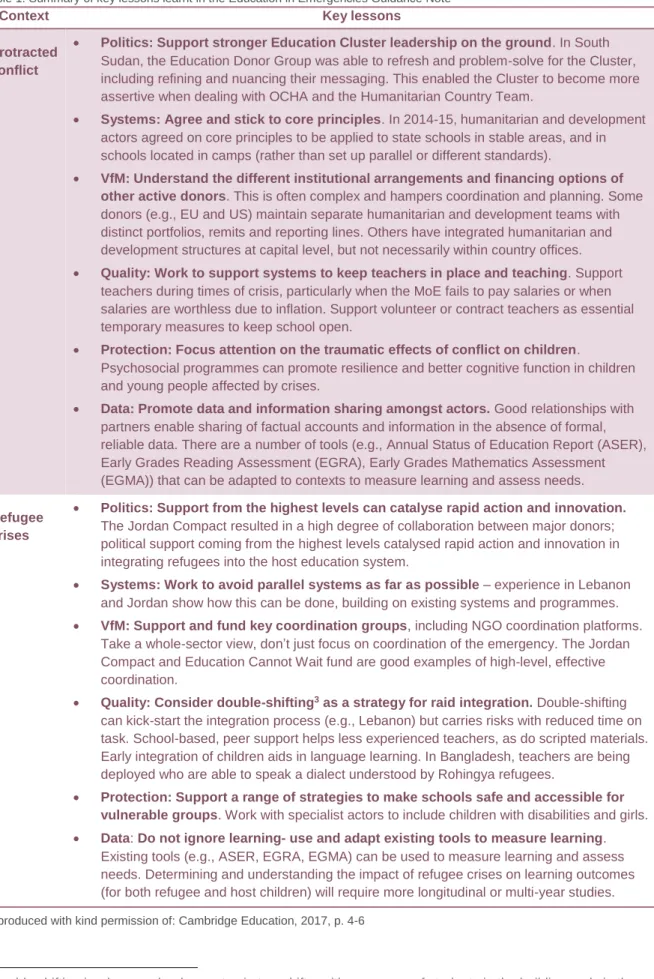
A 2017 guidance note by the Expert Advisory Call-Down Services (EACDS) for DFID aimed to begin bridging the gap between evidence and programming in education in emergencies by combining the most robust evidence available with DFID adviser experience of programming in three different emergency contexts: protracted conflict, refugee crises and natural disasters in non-conflict settings. Table 1 summarises some of the key lessons learnt in the guidance in relation to protracted conflict and refugee crises.
Table 1: Summary of key lessons learnt in the Education in Emergencies Guidance Note
Context Key lessons Protracted
conflict
Politics: Support stronger Education Cluster leadership on the ground. In South Sudan, the Education Donor Group was able to refresh and problem-solve for the Cluster, including refining and nuancing their messaging. This enabled the Cluster to become more assertive when dealing with OCHA and the Humanitarian Country Team.
Systems: Agree and stick to core principles. In 2014-15, humanitarian and development actors agreed on core principles to be applied to state schools in stable areas, and in schools located in camps (rather than set up parallel or different standards).
VfM: Understand the different institutional arrangements and financing options of other active donors. This is often complex and hampers coordination and planning. Some donors (e.g., EU and US) maintain separate humanitarian and development teams with distinct portfolios, remits and reporting lines. Others have integrated humanitarian and development structures at capital level, but not necessarily within country offices. Quality: Work to support systems to keep teachers in place and teaching. Support
teachers during times of crisis, particularly when the MoE fails to pay salaries or when salaries are worthless due to inflation. Support volunteer or contract teachers as essential temporary measures to keep school open.
Protection: Focus attention on the traumatic effects of conflict on children.
Psychosocial programmes can promote resilience and better cognitive function in children and young people affected by crises.
Data: Promote data and information sharing amongst actors. Good relationships with partners enable sharing of factual accounts and information in the absence of formal, reliable data. There are a number of tools (e.g., Annual Status of Education Report (ASER), Early Grades Reading Assessment (EGRA), Early Grades Mathematics Assessment (EGMA)) that can be adapted to contexts to measure learning and assess needs.
Refugee crises
Politics: Support from the highest levels can catalyse rapid action and innovation.
The Jordan Compact resulted in a high degree of collaboration between major donors; political support coming from the highest levels catalysed rapid action and innovation in integrating refugees into the host education system.
Systems: Work to avoid parallel systems as far as possible – experience in Lebanon and Jordan show how this can be done, building on existing systems and programmes. VfM: Support and fund key coordination groups, including NGO coordination platforms.
Take a whole-sector view, don’t just focus on coordination of the emergency. The Jordan Compact and Education Cannot Wait fund are good examples of high-level, effective coordination.
Quality: Consider double-shifting3 as a strategy for raid integration. Double-shifting
can kick-start the integration process (e.g., Lebanon) but carries risks with reduced time on task. School-based, peer support helps less experienced teachers, as do scripted materials. Early integration of children aids in language learning. In Bangladesh, teachers are being deployed who are able to speak a dialect understood by Rohingya refugees.
Protection: Support a range of strategies to make schools safe and accessible for vulnerable groups. Work with specialist actors to include children with disabilities and girls. Data: Do not ignore learning- use and adapt existing tools to measure learning.
Existing tools (e.g., ASER, EGRA, EGMA) can be used to measure learning and assess needs. Determining and understanding the impact of refugee crises on learning outcomes (for both refugee and host children) will require more longitudinal or multi-year studies.
Reproduced with kind permission of: Cambridge Education, 2017, p. 4-6
Donor humanitarian policies on education
A 2015 review was commissioned by the Norwegian Refugee Council and Save the Children to better understand the landscape of donors’ humanitarian policies on education and the role such policies play in influencing education in emergencies practice. The sample of donors analysed for the review included Australia, Canada, Denmark, EU/EC, Finland, Germany, Japan,
Netherlands, Norway, Sweden, Switzerland, UK and US. Key findings from the review included (Wilson et al., 2015, p. 8):
Need for improved coordination and delivery: Donor coordination in a humanitarian crisis remains a challenge. Context-specific factors, such as difficult operating environments and limited data availability, can be compounded by individual donors’ policies, strategic approaches and chosen funding modalities where these are not flexible enough to respond to evolving needs.
The humanitarian–development divide must be bridged: Donors are increasingly concerned about linkages between education in emergencies and education in
development settings, and increasingly emphasise the importance of flexibility in scale, location and approach tied to contextual needs.
Increased donor focus on quality and content: Donors have strengthened their emphasis on education quality outcomes, as well as standards for quality and accountability through monitoring and evaluation requirements.
The review identified the following elements of good practice for donor policies through key informant interviews or the document review (Wilson et al., 2015, p. 71):
Incorporate or link policies to conflict sensitive programming guidance.
Include resilience and sustainability objectives, linked to DRR.
Ensure clear linkages between education in emergencies and education in development settings support with clear overarching and allocated objectives and transition
approaches.
Include standards for quality and accountability, monitoring and evaluation requirements.
Explain importance of flexibility – on scale, location, intervention approach tied to contextual needs.
Emphasise education quality outcomes and approaches.
Include contingency plans and/or funds in development education projects to allow for reallocation in the event of an emergency.
Require funding recipients to adhere to the Inter-agency Network for Education in Emergencies (INEE) minimum standards.4
Research Consortium on Education and Peacebuilding
Datzberger et al. (2016) as part of the Research Consortium on Education and Peacebuilding (2012-2016) produced a final synthesis report on the integration of education and peacebuilding, looking at findings from Myanmar, Pakistan, South Africa and Uganda. The consortium
emphasised the need for thorough, historically informed and context-specific conflict analysis that
includes a focus on education. Based on the case studies, the report observed the following general recommendations in relation to education and peacebuilding (Datzberger et al., 2016, p. 95-102):
More attention should be given to the potential of formal and non-formal education to contribute to political, cultural and socio-historical change in the process of developing peacebuilding frameworks. This would necessitate moving beyond the perception of education as mainly a driver of economic development.
Ensure greater participation of actors in decision-making and planning processes of peacebuilding frameworks including inputs from education experts and the participation of under-represented groups (e.g. minorities).
Ensure greater alignment of education sector plans with peacebuilding frameworks and policies, including a stronger focus on the potential of education to contribute to social cohesion and reconciliation.
Financing for peacebuilding elements of national education sectors plans will always be difficult to secure against other competing demands. This suggests that more attention needs to be given to effective use of existing resources for peacebuilding through education.
Countries most in need of peacebuilding efforts may also be those with the least commitment of funding to education, therefore better advocacy mechanisms and more sustained work with education authorities are needed to secure resources for
peacebuilding efforts.
The politics of funding distribution and resource allocation and their impact on peacebuilding efforts should not be underestimated.
Policymakers should be encouraged to think beyond explicit approaches to
peacebuilding that simply involve ‘peace education’ programmes, but also consider how implicit approaches that promote equity, social cohesion and reconciliation can be implemented.
Policy makers should be encouraged to consider where policies that promote
peacebuilding are targeted at individual / inter-group level, or institutional and systemic level. This will require different approaches to implementation and will have different implications for funding, monitoring and likely impact.
It has to be acknowledged that, in peacebuilding contexts, education governance is likely to be highly politicised. This will have an impact on any peacebuilding plans for education in terms of prioritisation and funding as well as the implementation of macro-reforms such as decentralisation. Planning at the technical level needs to take into account the political perceptions of peacebuilding.
The debate about ‘high’ versus ‘low’ quality education, or the consequences of low-cost private schooling is still in its infancy. The long-term consequences of how unequal access to high quality education impacts social transformation in conflict-affected societies need to be examined and debated among a wide range of actors.
As far as decentralisation processes in the education sector are concerned, thorough assessments are needed on existing and missing capacities and resources, concomitant with national training strategies in order to enhance governance of and representation within education sector planning.
Current approaches to equity in education tend to focus on wealth inequalities but a common feature of peacebuilding contexts is that these often map onto horizontal inequalities between groups. Whilst there are sensitivities, there needs to be more commitment to gathering and monitoring data related to horizontal inequalities as well as income differentials as a means of monitoring peacebuilding impacts.
There is a need to thoroughly interlink aspects of inequality in education with social cohesion and to analyse them as complementary challenges to peacebuilding.
This study looked at four aspects of social cohesion, but much more work needs to be done on which aspects of education policy are most relevant to social cohesion from a peacebuilding perspective. This would be beneficial for policymakers in terms of areas that might be prioritised, but it should also identify relevant indicators for education and peacebuilding as a means of monitoring the impact of policies.
For education to contribute towards reconciliation as part of a wider truth and
reconciliation process, it is crucial to secure political commitment from various actors.
If education is to be used as a tool towards reconciliation, one has to move away from a strict ‘peace education’ approach (e.g. sole emphasis on attitudes of peace at the individual level or within school or community environments). In order to fulfil education’s potential in co-creating a ‘social truth’, attention should be given to multiple experiences, perspectives and interpretations of past and present conflicts and grievances.
UNICEF’s Education Programme in Somalia
Williams and Cummings (2015) considered UNICEF’s generally well-regarded Education Programme in Somalia (despite low enrolment rates), which operated from 1996 to 2010. They found that the programme’s achievements could be attributed to a variety of factors, including attention to local context, aid modalities, community ownership and particular programme design elements. Further insights included (Williams & Cummings, 2015, p. 428-431):
Role of Local Context:
o Religious and cultural sensibilities and institutions were respected.
o UNICEF has a longstanding presence and enjoys legitimacy due to its focus on local needs.
Aid Modalities/Programme design:
o Parallel with support to schools and communities, UNICEF provided nascent sub-zonal and sub-zonal education systems with levels of support in line with their developing capacity and ability to absorb new ideas and demands.
o A reasonable effort was devoted to monitoring and evaluation, and subsequent correction.
o The breadth of activities was consciously varied; components in particular areas were added following the acceptance of earlier components.
o UNICEF programming supported linkages between emergency provision and long-term development.
Local Ownership of the Programme/Project:
o Communities were given responsibility (and provided training) to assume a primary ownership, management role in schools.
Education Cannot Wait fund
This is the most recent and visible attempt to “bridge the humanitarian-development divide” in education, and aims to support coordination and collaboration between public and private actors (Lopes Cardozo and Scotto, 2017). The Education Cannot Wait (ECW) fund is a key outcome of the World Humanitarian Summit (WHS) held in 2016, which committed to a new way of working in emergencies and protracted crises. In line with the WHS transformative Agenda for Humanity, ECW fund’s added value can be summarised as: less bureaucracy - more accountability; bridges relief to development during emergencies and crises; translates WHS vision into action (ECW, n.d.). It was conceived as an inclusive platform and fund to bring quality education to crisis-affected children. Working through the established humanitarian coordination architecture, the fund aims to reach 8 million crisis-affected children and youth with safe, free and quality education by 2021 (ECW, 2018, p. 11). ECW’s investments and modalities are flexible and geared to adapt to context-specific realities, optimising and linking humanitarian and development coordination structures to support national ownership and alignment with national plans. The fund is focused on bridging the divide between acute emergency response and longer-term education system strengthening.
Lessons learned and demonstrated added-value from ECW includes (ECW, 2018, p. 101-103; European Union, 2017, p. 10):
At country level, the capacity of stakeholders are instrumental to success.
By optimising the existing multilateral humanitarian coordination structure designed for crisis, ECW has showcased the possibilities for success by bringing humanitarian and development actors/coordination mechanisms together around quality education.
It is beneficial to bring together different stakeholders to develop efficient education responses. This leads to programmes that are better aligned with ECW objectives and principles.
ECW can play a role in bridging humanitarian and development interventions through financing. Such financial bridging is very important in sustaining the education gains made thus far in countries.
Translating the New Way of Working into real action on the ground by strengthening coordination and joint programming in crisis, especially through Multi-Year Resilience programmes.
Importance of implementing a capacity development framework and localising its support where possible, especially through the new Acceleration Facility.
Promising Practices in Refugee Education
There is growing recognition of, and support for, providing education services to refugees. The Promising Practices in Refugee Education initiative was a joint initiative of Save the Children, the UN refugee agency (UNHCR), and Pearson, launched in March 2017. It set out to identify, document and promote innovative ways to effectively reach refugee children and young people with quality educational opportunities. Bergin (2017) synthesised the key findings and lessons learned from across more than twenty projects that were selected as part of the initiative, using these to identify ten recommendations, grouped under three overarching pillars, aimed at improving refugee education policy and practice. These included (Bergin, 2017, p. 2):
Approaching the immediate crisis with a long-term perspective: 1. Strengthen inclusive national systems.
2. Commit to predictable multi-year funding for education programming and research in refugee responses.
3. Improve collaboration and develop innovative partnerships. Understanding different contexts and meeting distinct needs:
4. Adopt user-centred design and empowering approaches. 5. Establish diverse pathways that meet distinct needs. 6. Use space and infrastructure creatively.
Improving outcomes for all:
7. Support teachers to help ensure quality. 8. Prioritise both learning and well-being.
9. Use technology as an enabling tool in pursuit of education outcomes. 10. Build a robust evidence base.
Uganda
Uganda, which hosts the largest number of refugees in Africa, provides a model
multi-stakeholder approach for humanitarian education response. The government, with the support of development and humanitarian partners, drafted and approved a Refugee and Host Community Education Response Plan in May 2018, allocating US$ 395 million over three years (to the end of June 2021) to reach about 675,000 refugee and host community students per year. It is a rare example of an in-depth plan that bridges humanitarian and development actors (Uganda Ministry of Education and Sports, 2018 cited in UNESCO, 2018, p. 253).
Education for peacebuilding programming
Herrington (2015, p. 13) explains that Education for peacebuilding is a systems approach which “utilises quality education and peacebuilding programming (whether formal, non-formal, or extracurricular) as a mediumto engage children, youth, Ministry officials, school administrators, teachers, and parents in activities that build social cohesion and applied learning of
peacebuilding competencies.”
There remains knowledge gaps in the cross-section between education and peacebuilding programmes and the ways in which education and peacebuilding can contribute to one another. A practical guide by Herrington (2015) tried to bridge this gap by pulling together lessons learned from experiences and expertise of education for peacebuilding programming, mainly from
UNICEF’s Learning for Peace programme, Search for Common Grounds work in education, USAID’s ECCN organisations, and INEE member expertise. The guide concludes with the following overarching principles to consider in education for peacebuilding programmes (Herrington, 2015, p. 57):
1. The importance of participation in process, design, and even implementation to ensure reflective programming with opportunities for ownership leading to sustainability;
2. The need for conflict-sensitive processes, programming, implementation, and monitoring- applying Do No Harm practically throughout all aspects of an intervention;
3. Remaining flexible in order to respond to fluctuating contexts and building relations; 4. Implementation of improved feedback loops to monitor incremental progress towards
outcomes, effectiveness of the intervention at achieving change towards the outcomes, and for use in helping refine and evolve theories of change; and
5. The need for collaboration between education specialists, peacebuilding specialists, and the broader development field in a systems thinking approach to achieving sustainable, long-term change.
4. Further resources
General information on education and peacebuilding
Education in Emergencies guidance note (2017). To strengthen its education in emergencies (EiE) programming, DFID drew on the DAI-led Expert Advisory Call Down service (EACDS) on resilience programming to research evidence on which interventions work to support high-quality schooling for displaced children—and where the evidence falls short. Six Evidence Briefs about EiE, focusing on quality and learning; protection and inclusion; cost-effective delivery; data, monitoring, and evaluation; political settlements; and accountability were produced from which this guidance note was developed. https://www.dai.com/uploads/EiE_Guidance_Note-8fc7f4.pdf
The UNESCO Centre at the University of Ulster – Research – International
Development, Education, Conflict & Peacebuilding, established in 2001, aims to provide research on children and young people, education and conflict and international development that impacts debate locally and globally.
https://www.ulster.ac.uk/faculties/arts-humanities-and-social- sciences/schools/education/research/unesco-centre/research/education-and-peacebuilding
Peacebuilding, Education and Advocacy Programme (“Learning for Peace” Collection) (2012-2016). UNICEF and the Government of the Netherlands multi-year partnership. The full collection of the partnership’s resources is available on their website. https://www.ineesite.org/en/learning-for-peace
The USAID Education in Crisis and Conflict Network (ECCN). A global community of practice comprised of USAID staff and implementing partners, the network gathers, develops and disseminates knowledge, information, tools and resources on education in crisis and conflict at global, regional and country levels. https://eccnetwork.net/repository/
GSDRC – Service Delivery. A partnership of research institutes, think-tanks and
consultancy organisations, GSDRC provides applied knowledge services on demand and online, and their expertise is in issues of governance, social development, humanitarian response and conflict.https://gsdrc.org/category/governance/service-delivery/
Search for Common Ground’s DM&E for Peace – Resources. A platform for peacebuilding evaluation. https://www.dmeforpeace.org/learn/resources/
Academic research programmes
Research Consortium Education and Peacebuilding (July 2014 – June 2016). A partnership between UNICEF and the University of Amsterdam (AISSR Programme Group Governance and Inclusive Development), the University of Sussex (Centre for International Education) and Ulster University (UNESCO Centre):
https://educationanddevelopment.wordpress.com/rp/research-consortium-education-and-peacebuilding/
UCL programme Education, Conflict and Peacebuilding, has a growing portfolio of research that focuses on the intersections between: educational inequalities and violence/ conflict; protecting education from attacks; education in emergencies and refugee contexts or forced migration; and the role of education in peace building and state building. https://www.ucl.ac.uk/ioe/departments-and-centres/centres/education-and-international-development/education-conflict-and-peacebuilding
Education and Development, Research Cluster of Governance and Inclusive
Development (GID), University of Amsterdam. An interdisciplinary team of researchers focusing on issues related to global and local governance and multilevel politics of education and development, with a specific focus on processes of socio-economic, political and cultural (in)justices. https://educationanddevelopment.wordpress.com/
Key multilateral funds
Education cannot wait. The first global fund dedicated to education in emergencies and protracted crises, established during the World Humanitarian Summit in 2016 (UK contribute). http://www.educationcannotwait.org/
Global Partnership for Education. A multi-stakeholder partnership and funding platform that aims to strengthen education systems in developing countries, GPE 2020, the partnership’s new strategic plan, makes support for countries affected by fragility and conflict a focus over the next five years (UK contributes).
https://www.globalpartnership.org/
Key networks
Early Childhood Peace Consortium (ECPC) is a network of stakeholders across sectors dedicated to leveraging social services to mitigate conflicts and promote social cohesion, who champion peacebuilding and violence prevention through an Early Childhood Development (ECD) agenda. https://ecdpeace.org/
Global Coalition to Protect Education from Attack (GCPEA), established in 2010 by organisations from the fields of education in emergencies and conflict-affected fragile states, higher education, protection, international human rights, and international humanitarian law, it advocates for the protection of students, teachers, schools, and universities from attack. http://protectingeducation.org/
Global Education Cluster, established in 2007 by the Inter-Agency Standing Committee as part of the cluster approach, the Education Cluster works to uphold education as a basic human right and core component of humanitarian response. It is co-led at global level by UNICEF and Save the Children.
The Inter-agency Network for Education in Emergencies (INEE) is an open,
international network of UN agencies, NGOs, donors, governments, universities, schools, and affected populations working together to ensure all persons the right to quality education in emergencies and post-crisis recovery. INEE plays a facilitative as opposed to an operational role and serves its members through community building, convening diverse stakeholders, knowledge management, advocating and amplifying ideas and knowledge, facilitating collective action, and providing members with the resources and support. https://www.ineesite.org/en/
5. References
Bergin, C. (2017). Promising Practices in Refugee Education: Synthesis Report. London: Save the Children.https://www.promisingpractices.online/synthesis-report
Bush, K. & Saltarelli, D. (Eds.). (2000). The Two Faces of Education in Ethnic Conflict: Towards a Peacebuilding Education for Children. Florence, Italy: UNICEF Innocenti Research Centre.
https://www.unicef-irc.org/publications/pdf/insight4.pdf
Cambridge Education. (2017). Education in Emergencies Guidance Note: Strengthening Resilience and Response to Crises. London: DFID
http://www.camb-ed.com/download/file/127/729/eieguidancenotedec2017pdf
Cambridge Education. (2017). Education in Emergencies Guidance Note: Strengthening Resilience and Response to Crises. Introduction. London: DFID http://www.camb-ed.com/download/file/127/728/eieevidencebriefsmethodologynov2017pdf
Datzberger, S., Smith, A., & McCully, A, M. (2016). The Integration of Education and Peacebuilding - Synthesis Report on findings from Myanmar, Pakistan, South Africa and Uganda. Ulster University. https://educationanddevelopment.files.wordpress.com/2014/11/policy-synthesis-report-final-16.pdf
Dryden-Peterson, S. (2016). ‘Policies for Education in Conflict and Post-Conflict Reconstruction’. In Mundy, K., Green, A., Lingard, B., & Verger, A. (Eds.). (2016). Handbook of global education policy. John Wiley & Sons. P.189-205.
https://www.wiley.com/en-gb/Handbook+of+Global+Education+Policy+-p-9781118468050
ECW. (n.d.). Education Cannot Wait: Investing in Humanity: Understanding the Fund’s Added Value. http://www.educationcannotwait.org/wp-content/uploads/2017/09/ECW-Paper-Investing-in-Humanity-Understanding-the-Funds-Added-Value.pdf
ECW. (2018). Education Cannot Wait: Results Report | April 2017 – March 2018. ECW Secretariat. http://www.educationcannotwait.org/downloads/reports-and-publications/
European Union. (2017). Annex 1 of the Commission Implementing Decision on the annual action programme 2017 part 3 for the theme Human Development of the Global Public Goods and Challenges Program.
Haider, H. (2014).Conflict sensitivity in education, the private sector and infrastructure
development(GSDRC Helpdesk Research Report 1136).Birmingham, UK: GSDRC, University of Birmingham. http://gsdrc.org/docs/open/hdq1136.pdf
Herrington, R. (2015). Emerging Practices in Design, Monitoring, and Evaluation for Education for Peacebuilding Programming. 1st ed. Washington DC: Search for Common Ground.
https://www.ineesite.org/en/resources/emerging-practices-in-design-monitoring-and-evaluation-for-education-for-pe
Lopes Cardozo, M.T.A. & Scotto, G. (2017). Youth, peacebuilding and the role of education. INEE/YPS Thematic Paper. Education and Development Working Papers 29.
https://educationanddevelopment.files.wordpress.com/2017/12/lopes-cardozo-scotto_yps-thematic-paper-youth-peacebuilding-the-role-of-education-2017.pdf
Naylor, R. (2015). Curriculum development in fragile states to encourage peace and reduction of conflict. GSDRC Helpdesk Research Report 1313. Birmingham, UK: GSDRC, University of Birmingham. https://gsdrc.org/wp-content/uploads/2015/12/HDQ1313.pdf
Novelli, M., Lopes Cardozo, T.A. & Smith, A. (2017). The 4Rs framework: analysing the contribution of education to sustainable peacebuilding in conflict-affected contexts. Journal of Education in Emergencies, 3 (1). ISSN 2518-6833 http://sro.sussex.ac.uk/id/eprint/69179/ Novelli, M. & Higgins, S. (2017). The violence of peace and the role ofeducation: insights from Sierra Leone, Compare: A Journal of Comparative and International Education, 47:1, 32-45, DOI: 10.1080/03057925.2015.1119650.
Pherali, T. & Lewis, A. (2017). Higher education partnerships for peace and development. In T. Pherali and A. Lewis (Eds) Education and Conflict Review Special Issue: Education, Peace and Development in Somali Society. London: UCL Institute of Education.
https://www.ucl.ac.uk/ioe/departments-and-centres/centres/education-and-international-development/higher-education-conflict-2
Rohwerder, B. (2015a). Delivering education during conflict (GSDRC Helpdesk Research Report 1209). Birmingham, UK: GSDRC, University of Birmingham.
https://assets.publishing.service.gov.uk/media/57a08966ed915d622c0001d3/HDQ1209.pdf Rohwerder, B.(2015b). Education and building legitimacy during conflict (GSDRC Helpdesk Research Report 1213).Birmingham, UK: GSDRC, University of Birmingham. [not publically available]
Smith, A. & Ellison, C. (2015). The Integration of Education and Peacebuilding: A Review of the Literature. The Research Consortium on Education and Peacebuilding. UNICEF, Learning for Peace. https://educationanddevelopment.files.wordpress.com/2014/11/integration-of-education-and-peacebuilding.pdf
Smith A, McCandless E, Paulson J & Wheaton W. (2011). The Role of Education in Peacebuilding: Literature Review. New York: UNICEF.
Thompson, S. (2015). Links between education and peace. GSDRC Helpdesk Research Report 1308. Birmingham, UK: GSDRC, University of Birmingham / Oxford: HEART.
https://gsdrc.org/wp-content/uploads/2016/01/HDQ1308.pdf
UN. (2017). What does “sustaining peace” mean? UN Peacebuilding Support Office/Policy.
https://undg.org/wp-content/uploads/2017/01/Guidance-on-Sustaining-Peace.170117.final_.pdf UNESCO. (2018). Global Education Monitoring Report 2019: Migration, Displacement and Education – Building Bridges, not Walls. Paris, UNESCO. https://en.unesco.org/gem-report/report/2019/migration
Williams, J.H. & Cummings, W.C. (2015). Education from the Bottom-Up: UNICEF's Education Programme in Somalia, International Peacekeeping, 22:4, 419-434,
DOI:10.1080/13533312.2015.1059284. https://doi.org/10.1080/13533312.2015.1059284
Wilson, E., Majewski, B. & Tebbe, K. (2015). Walk the Talk: Review of Donors’ Humanitarian Policies on Education. Oslo: Norwegian Refugee Council and Save the Children Norway.
http://www.nrc.no/news/2015/june/walk-the-talk/#.VZpAZfmqpBc
Acknowledgements
We thank the following experts who voluntarily provided suggestions for relevant literature or other advice to the author to support the preparation of this report. The content of the report does not necessarily reflect the opinions of any of the experts consulted.
Brigitte Rohwerder, Institute of Development Studies
Paul Knipe, Institute of Development Studies
Stephen Thompson, Institute of Development Studies
Susy Ndaruhutse, Education Development Trust
Suggested citation
Price, R.A. (2019). Lessons learned from education programmes' contribution to peace and stability. K4D Helpdesk Report 577.Brighton, UK: Institute of Development Studies.
About this report
This report is based on six days of desk-based research. The K4D research helpdesk provides rapid syntheses of a selection of recent relevant literature and international expert thinking in response to specific questions relating to international development. For any enquiries, contact [email protected].
K4D services are provided by a consortium of leading organisations working in international development, led by the Institute of Development Studies (IDS), with Education Development Trust, Itad, University of Leeds Nuffield Centre for International Health and Development, Liverpool School of Tropical Medicine (LSTM), University of Birmingham International Development Department (IDD) and the University of Manchester Humanitarian and Conflict Response Institute (HCRI).
This report was prepared for the UK Government’s Department for International
Development (DFID) and its partners in support of pro-poor programmes. It is licensed for non-commercial purposes only. K4D cannot be held responsible for errors or any
opinions expressed do not necessarily reflect those of DFID, K4D or any other contributing organisation. © DFID - Crown copyright 2019.