
BOILING CRISIS DYNAMICS: LOW GRAVITY EXPERIMENTS AND MODELING
V. Nikolayev1, Y. Garrabos2, C. Lecoutre2, D. Hitz3, D. Chatain3, R. Guillaument2, V. Janeˇcek4,5, D. Beysens3,4 1Service de Physique de l’Etat Condens´e, CNRS UMR 3680, IRAMIS/DSM/CEA Saclay, 91191 Gif-sur-Yvette, France
2CNRS, Univ. Bordeaux, ICMCB ESEME, UPR 9048, 33600 Pessac, France
3Univ. Grenoble Alpes, INAC-SBT, 38000 Grenoble, France and CEA, INAC-SBT, 38000 Grenoble, France 4Physique et M´ecanique des Milieux H´et´erog`enes, UMR 7636 ESPCI - CNRS - Univ. Paris-Diderot - Univ. P.M. Curie,
10 rue Vauquelin, 75005 Paris, France
5Present address: ArcelorMittal Global R&D, Voie Romaine, BP 30320, Maizi`eres-l`es-Metz, 57283, France
ABSTRACT
To understand the boiling crisis mechanism, one needs to slow it down experimentally. One can take advantage of the strong drop of thermal diffusivity near the liquid-vapor critical point that leads to the slowing down of boil-ing. We report here two kinds of low gravity saturated boiling experiments performed in the vicinity of the liq-uid vapor critical point. First, we discuss experiments carried out on board of the International space station in the DECLIC apparatus with SF6 fluid at46◦C. Second,
the experiments conducted in a ground-based magnetic gravity compensation installation at Grenoble with H2at
33 K. We compare both kinds of experiments and show their complementarity. During observations through a transparent heater made with a metal oxide film, where the dry spots are visualized. We evidence two regimes of growth of the dry spots under the vapor bubbles: the regime of circular dry spots and chain coalescence of dry spots.
1. INTRODUCTION
When during boiling, the supplied heat flux exceeds a critical value (the Critical Heat Flux, CHF) the vapor bub-bles on the heating surface form abruptly a film that ther-mally insulates the heater from the liquid. The heat trans-fer is blocked and the temperature of the heater rapidly grows. This transition is known under the names of “boil-ing crisis” (BC) or “departure from nucleate boil“boil-ing”. In the engineering literature, the term “critical heat flux” (CHF) is often used both as a synonym to the term “boil-ing crisis” (BC) and as a particular heat flux value. To avoid the ambiguity, we use the term CHF only to desig-nate the threshold heat flux.
Correct CHF estimation requires a clear understanding of the physical phenomena that triggers it. However,
the number of parameters and interactions involved in a quantitative description of boiling is so large that no definitive theory has been achieved yet. Since the discov-ery of BC [1], a large amount of both experimental data and theoretical models has been accumulated. On one hand, the mechanisms governing the bubble formation, growth and detachment, and their dependence on diverse parameters are quite clear [2]. On the other hand, the trig-gering factors of the vapor film formation are much more elusive.
During the last decade, advanced methods of observation and measurement (as high speed and high resolution op-tical and infrared cameras, microscopic thermal sensors and structured heating matrices, etc.) were applied to access experimentally the length scales smaller than the vapor bubbles and time scales below the bubble growth time. A consensus about the local nature of BC has be-gun to emerge. Contrary to previous idea of BC as being triggered by bulk hydrodynamic phenomena [2], the phe-nomena responsible for the BC are considered to act in a thin fluid layer adjacent to the heater [3–11], down to the level of the triple (liquid-solid-vapor) contact. The accent is made on the growth dynamics of dry heater area. It is important to understand how drying impacts the BC triggering. Boiling crisis can be either triggered by the growth of dry spots under individual vapor bub-bles [3, 6, 12, 13] that coalesce later, or result from a col-lective phenomenon of the avalanche-like multiple bub-ble coalescences [14, 15]. It is still an open question that requires further investigations.
2. BOILING CRISIS SCENARIO
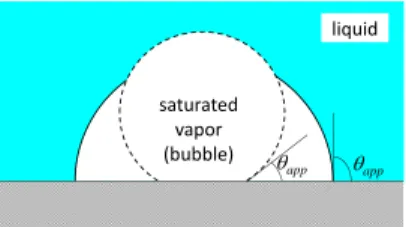
The dry spot formed on the heater under a vapor bubble depends on its shape defined by its apparent contact an-gleθapp(Fig. 1). Underθappwe mean the contact angle
defined on a scale comparable to the bubble size. The re-lation between the apparent contact angle and the size of the dry spot was evidenced both experimentally [16] and
liquid
saturated vapor (bubble)
app app
Figure 1. Increase of the dry spot under a bubble caused by the increase of apparent contact angle.
by numerical simulation [12]. The apparent contact an-gle may differ from its equilibrium (usually small) value
θmicro [17, 18]. It increases with the local heater tem-perature at the contact line position that varies with time. Therefore,θappincreases during the bubble growth [13]. At near critical pressure, where the hydrodynamic flow is very slow, the vapor recoil is the main cause of the apparent contact angle increase [6, 19]. On the contrary, farther away from the liquid-vapor critical point, the vis-cous pressure drop of the liquid flow toward the contact line is the main cause of the apparent contact angle in-crease [17, 18].
Based on the discussed above experimental observations, the BC scenario suggested in [13] can be summarized here. At low heat fluxes,θapp remains low throughout
bubble growth; the bubble grows and departs from the heater under the gravity influence. At large heat flux, the apparent contact angle may attain 90◦ during bub-ble growth. Such an event is important for the follow-ing reasons. First, the dry area attains its maximum value with respect to the bubble size leading to heater temper-ature rise. Second, the bubble adhesion to the heater in-creases, which facilitates bubble coalescence with neigh-boring bubbles. Third, and the most important, the dry areas under bubbles merge simultaneously with bubble coalescence, which leads to a fast heater temperature rise. In the caseθapp < 90◦, the coalescence of neighboring bubbles does not result in immediate dry spot merging and spreading; the heater continues to be cooled under the newly formed bubble (because of the latent heat con-sumption) even after the coalescence of bubble volumes. The dry spot coalescence is slow because large viscous dissipation in the thin liquid film appearing in the contact line vicinity and pinning at solid surface defects causes the slowness of the contact line motion.
All these reasons suggest that the triggering of BC oc-curs whenθappbecomes larger than90◦while the bubble grows on the heater. Therefore, we think that CHF corre-sponds to the situation whereθappattains90◦exactlyat
the moment of bubble departure. Such an assumption is confirmed by direct optical observations [11]. Note that a very close to this criterion (the equality of the radii of curvature of the bubble and of the dry spot) was adopted earlier by [10].
Such a criterion allows the CHF value to be calculated as a function of various system parameters. A
calcula-tion that used a quasistatic approach in the bulk fluid (no fluid motion) allowed some of us calculating CHF as a function of wetting properties of the heater (i.e.,θmicro) and gravity [13]. As expected, such calculations led to zero CHF value at zero gravity in agreement of all previ-ous approaches [2]. This means that under zero gravity, BC occurs whatever the supplied to fluid heat flux is, pro-vided it does not vary in time and the experiment time is long enough.
Violent boiling conditions under which BC occurs com-plicate a detailed analysis and hinder a deeper under-standing of the process. Experimental studies at normal conditions are very difficult to perform [5, 9] since the required heat fluxes are huge: CHF for water at atmo-spheric pressure is 1-10 MW/m2. The main obstacle to
observations is the highly non-equilibrium nature of the crisis, which makes impossible a steady state study. In addition, the BC characteristic time is very small, below 1 ms.
Near the critical point, thermal diffusivity tends to zero and controlled by it bubble growth slows down. The over-all liquid flow slows down either and the optical distor-tions associated with the strongly deformed vapor-liquid interfaces and turbulence disappear. In addition, the CHF becomes very small [6], thus facilitating the experimen-tal implementation. However, such boiling experiments are more complicated than those at low pressures. Since the surface tension reduces, the capillary length becomes small at normal gravity, which leads to flattening of the gas-liquid interfaces. Reduced gravity conditions are thus necessary to preserve conventional bubble shapes. While approaching closely the critical point, temperature should be stabilized with extremely high precision to avoid fluid transition to the single phase (i.e., supercritical) regime.
3. DECLIC/ALI EXPERIMENTS
The first series of experiments discussed here has been performed with the CNES DECLIC (French abbreviation for Dispositif pour l’Etude de la Croissance et des LIq-uides Critiques – facility for studies of crystal growth and near-critical fluids) apparatus operated by NASA. It is lo-cated in the Kibo module of the ISS. It allows the use of different interchangeable modules (inserts). The ALI module (Alice-like insert) is called after the CNES Al-ice apparatus that functioned on board of the Mir space station [19]. ALI has been used for boiling experiments using pure SF6fluid, the critical temperature (i.e. that of
the liquid-vapor critical point) of which isTc ' 46◦C. ALI contains two sealed cells filled at nearly critical av-erage density of SF6, which means that nearTc the gas
and liquid volumes inside the cell are nearly equal inde-pendently of the cell temperature. One of the cells is the direct observation cell (DOC) where boiling can be ob-served through a transparent film heater [20] supplying the powerPh. The second cell is the interferometry ob-servation cell (IOC), where the light ray direction is, in contrast, parallel to the heater surface [21]. Both cells
are cylinders of10.6mm inner diameter, with transpar-ent sapphire cylinder bases (except one of them, mirror reflective, in IOC) through which the cell interior can be observed. The cells are thermostated at the temperature
T < Tc within 10 µK precision, which means that the vapor generated with internal heaters recondense inside the cell. The ALI experiments have been successfully ac-complished. They have produced a large array of video and other data which is currently under analysis. We
ad-(a) (b)
(c) (d)
Figure 2. Triple contact line receding in DOC. Obser-vation is performed through the transparent metal oxide film heater,Ph= 3mW andTc−T = 20mK. The images correspond to about 2, 13, 23, and 33 s after the heating start for the images a,b,c,d, respectively. The hexadeci-mal time is shown at the upper left corner of each image using the internal DECLIC units≈1/23s).
dress here the DOC images. The thickness of DOC cylin-drical cell is small (4.115 mm) with respect to its diam-eter so the large vapor volume that would take, if uncon-strained, the spherical shape, is squeezed between two transparent sapphire portholes. When the surface tension is strong enough (at∆T ≡Tc−T = 20mK), the liq-uid meniscus is not deformed by the thermistors located inside and the visible meniscus shape (that we call “large bubble”) is circular. At equilibrium, wetting is complete in this system: a continuous wetting film separates the bulk vapor from the heater. When heating begins, the wetting film evaporates completely at a part of the heater and a triple liquid-vapor-solid contact line appears. The heater drying dynamics is shown in Fig. 2. One can see nucleation, growth and coalescence of small bubbles at the heater. Small bubbles are absent in its central part indicating dry area.
At large∆T, the appliedPhis not sufficient for the
com-plete heater dryout. A major part ofPh is absorbed by the temperature regulation because of too good thermal contact between the heater and the copper cell structure
so that the heat flux supplied to the fluid decreases with time. The small bubbles remain circular, which indicates that each coalescence is an isolated event. In other words, the time between subsequent coalescences is sufficient to permit complete bubble relaxation toward a spherical cap shape.
To observe complete dryout, one needs to increase the heating power or get closer toTc. The latter case is shown
(a) (b)
(c) (d)
Figure 3. Chain coalescence of dry spots at the heater observed like in Fig. 2 but for Ph = 0.3 mW and Tc−T = 0.6mK. The images correspond to about 75, 534, 624, and 2122 s after the heating start for the im-ages a,b,c,d, respectively. The heating stops at the time moment corresponding to the image b.
in Fig. 3. Since the fluid is very close to the critical point, the evolution is extremely slow. First, one mentions that the apparent contact angle for all small bubbles is≥90◦
because the bubble contour and the contact line position coincide. This is coherent with the above BC scenario. Second, one observes a phenomenon of chain coales-cence where the time between subsequent coalescoales-cences is smaller than the time of drop relaxation to the spheri-cal cap shape. Such a process can lead to complete heater dryout if heating lasts long enough. The image shown in Fig. 3d corresponds to the rewetting situation where the heater is recovered by the wetting film after heating has stopped; circular small vapor bubbles remain suspended inside the bulk liquid above the heater. One can distin-guish them from the bubbles attached to the heater be-cause of their rapid relaxation to the circular form, which is possible only when the contact line (that causes slow relaxation because of large viscous dissipation associated with its motion) disappears.
We presume that a cross-over from the separate dry spot regime to chain coalescence occurs during BC. It means that when the power is switched on, one should observe
ITO film Cu cell structure liquid H2 vapor H2 45° mirror insulating ring upper porthole lower porthole lateral portholes 45° mirror 35 mm 20 mm 10 mm (a) (b)
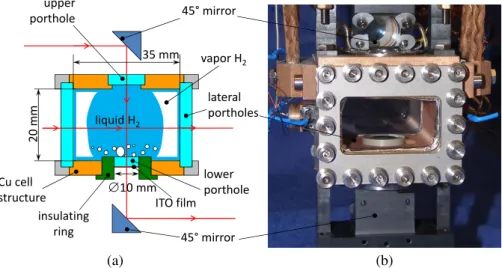
Figure 4. (a) Sketch of the cell with two way optical observation system. The gas and liquid distribution inside the cell in the critical point vicinity is also shown. (b) Cell photo. The sketch (a) corresponds to the cell section by a vertical plane perpendicular to the photo.
first the separate dry spot regime which becomes later on (when the heater becomes hotter) the chain dry spot coa-lescence regime. When one is far from the critical point, the duration of the latter regime is too small to be ob-served. When one approaches the critical point, a tiny heat flux is sufficient to immediately create the chain co-alescence.
Further data treatment from DECLIC is needed to search such a cross-over.
4. MAGNETIC GRAVITY COMPENSATION RE-SULTS
The DECLIC experiments provide valuable and accu-rate information on BC. However, because of the small volume limitation, their geometry and general boiling dynamics is quite different from the conventional pool boiling experiments at low pressure [7, 9] and from mi-crogravity boiling [22]. An experiment in a more con-ventional geometry (deep liquid pool) and a possibili-ties of observation from the bottom and sidewise within the same experiment is needed to link the DECLIC and conventional boiling experiments. Ground based experi-ments with hydrogen have been carried out for this pur-pose. The gravity can be compensated in hydrogen by magnetic forces proportional to the square of the field gradient [23]. The magnetic force per volume is also proportional to the fluid density so that the gravity can be compensated in the vapor and the liquid at the same time. It is however impossible to compensate the gravity uniformly in the whole volume. Typically, exact compen-sation occurs at only one point inside the cell. A special magnetic field configuration is chosen to minimize the residual gravity in the whole volume. It is typically of the order10−2g(gis earth gravity acceleration) , just like in the parabolic flight experiments. Unlike the parabolic flights, it varies in space but not in time. Its direction and
space variation are defined by the magnetic field config-uration. In all our experiments, the exact compensation point is chosen to situate in the heater center. The resid-ual gravity is mainly centripetal; its vertical component is much smaller. The residual gravity strength with respect to the surface tension is characterized by the capillary length. On one hand, it is much larger than the small bub-bles growing at the heater so that its influence on the boil-ing crisis development is negligible. On the other hand, near the critical point it is smaller than the cell size so that the residual gravity is dominant at this scale; liquid forms a column along the cell axis surrounded by gas. We de-scribe below a recent (2014) experiment and compare it to the previous (2011) experiment [15] carried out with the HYdrogen Levitation DEvice (HYLDE). The phase distribution in the new cell is sketched in Fig. 4a. The experimental cell of parallelepiped shape can be filled
in situwith pure hydrogen and sealed. It has four sap-phire portholes for the two-way optical observation (Fig. 4a). The lower cylindrical porthole serves as a transpar-ent heater because of the ITO film deposed on it, similarly to the DOC of DECLIC. It is thermally insulated from the copper cell structure with a PEEK (polyether ether ketone) ring to control the amount of heat injected into the fluid. Unlike the previous HYLDE experiment [15], the cell is shaped in such a way that the heater is com-pletely covered by the liquid, as in conventional boiling experiments. The liquid column bridges the top and the bottom portholes. Such a shape eliminates two problems of the HYLDE cell. The first is the partial heater dryout well before the BC occurrence (the contact line formed by the liquid column edge is visible in Fig. 5), which led to difficult control of the heat flux to the fluid. Sec-ond is the light refraction by the moving meniscus that led to heterogeneous and time varying image brightness (Fig. 5) preventing automatic image treatment. The cell is situated inside a cryostat under vacuum to thermally isolate the cell from the environment. Apart from the cell, the cryostat contains the hydrogen and helium circuits
(the latter being used for cell cooling), the cell temper-ature regulation system and the displaceable periscopes for cell optical observation and lighting. The cryostat is centered inside the powerful coil M8 of the national laboratory of high magnetic fields (LNCMI) at Greno-ble, France. The magnetic field used for gravity compen-sation is about 15 T. This coil provides residual gravity less than10−2gwithin the 25 cm3cell volume. The lat-ter number is about one order of value larger than in the HYLDE capacity. The HYLDE results clearly show the existence of two regimes of dry spot growth at the heater: the chain dry spot coalescence regime (Fig. 5b) similar to Figs. 3a,b that occurred close to the critical temperature, atTc−T = 10mK, and the separate circular spots regime (Fig. 5a similar to Figs. 2c,d) observed farther away from the critical point. Similarity with the DECLIC experi-ments is striking. It was not however possible to observe the transition between two above regimes (or show that it is absent). This is the final objective of the LNCMI experiments. The first campaign of measurements has
(a) (b)
Figure 5. Typical dry spot images recorded during the previous HYLDE experiment [15]. (a) Separate circular spots regime far from the critical point (at 75 mK to the critical point). (b) Chain dry spot coalescence regime close (10 mK) to the critical point.
been carried out at LNCMI in October 2014. Results for
Tc−T ≥20mK have been obtained. They show the
cir-cular spots regime (Fig. 6). When the lower porthole is heated, bubbles nucleate and grow on it. Rather than ver-tical bubble departure, residual gravity causes horizontal displacement of bubbles toward the lateral surface of liq-uid column. The bubbles merge there with the bulk vapor. The vapor recondenses at the surface of the wetting film that covers the internal surface of the copper cell struc-ture. Its temperature T is regulated to be constant thus imposing the pressure inside the cell to be the saturation pressure for this temperature, just as in DECLIC. For the first time we could observe the film boiling at the mi-crogravity conditions (Fig. 6b,c). The 2014 campaign showed the feasibility of such experiments. In the next stage, the thermal regulation system needs to be improved to approach closer the critical point where the chain dry spot coalescence regime is expected.
The behavior observed in the LNCMI experiments is sim-ilar to conventional (low pressure) boiling observations in microgravity [22], except that no hovering above the heater vapor mass is formed. Its absence is explained by
(a) (b)
(c) (d)
Figure 6. Boiling of hydrogen under magnetic gravity compensation: the results of the 2014 LNCMI campaign for Tc −T = 80mK andPh = 44mW. Correspond-ing images obtained from sidewise observations (a,c) and through the transparent heater (b,d) just before BC in the nucleate boiling regime (a,b) and after BC in the film boiling regime (c,d). The heater situates at the bottom of the photos a,c.
the residual gravity forces that cause centrifuge bubble motion toward the cell periphery.
The behavior observed in the LNCMI experiments is completely compatible with both the HYLDE and DECLIC experiments.
5. CONCLUSIONS
Experiments near the critical point present a powerful and versatile tool. They reveal new details of boiling at high heat flux (i.e. near CHF), otherwise difficult to observe. Our observations are incompatible with hypotheses of macroscopic origin of the boiling crisis (in particular with the Zuber and Katto theories [2]).
Our experiments show that the triggering phenomenon of the boiling crisis is the dry spot spreading; the relevant mechanism is microscopic; it occurs in the vicinity of the triple contact line vapor-liquid-heater. The observa-tions show that just before the boiling crisis the appar-ent contact angle is larger or equal90◦. This observation is coherent with the proposed earlier CHF criterion (90◦
apparent contact angle threshold of drastic bubble coales-cence acceleration).
Two regimes of dry spot growth are identified: circu-lar dry spot growth observed far from the boiling cri-sis) and chain dry spot coalescence regime that (as we assume) always precedes the boiling crisis. The objective of the future studies is to find the crossover between these regimes.
compensa-tion experiments are important to bridge the gap between DECLIC and conventional boiling experiments.
ACKNOWLEDGMENTS
The financial support of CNES within the fundamen-tal microgravity research program and two EuroMagnet grants that covered usage of the LNCMI magnet facility are acknowledged. The authors are grateful to J. Chartier and P. Bonnay of SBT for the help with the develop-ment and technical support of the magnetic gravity com-pensation experiments. We acknowledge the support of the LNCMI/CNRS, member of the European Magnetic Field Laboratory (EMFL). We thank the whole CNES-DECLIC team and in particular G. Pont for their enthusi-astic and helpful involvement into this work.
REFERENCES
1. Nukiyama, S. (1934). The maximum and minimum values of the heat Q transmitted from metal to boiling water under atmospheric pressure.J. Soc. Mech. Eng. Jpn.,37, 367 – 374. (translated in Int. J. Heat Mass Transfer,9, 1419 – 1433 (1966)).
2. Dhir, V. K. (1998). Boiling heat transfer.Ann. Rev. Fluid Mech.,30, 365 – 401.
3. Nikolayev, V. S. & Beysens, D. A. (1999). Boiling crisis and non-equilibrium drying transition. Euro-phys. Lett.,47, 345 – 351.
4. Kandlikar, S. G. (2001). A theoretical model to pre-dict pool boiling CHF incorporating effects of contact angle and orientation.J. Heat Transfer,123, 1071 – 1079.
5. Theofanous, T. G., Dinh, T. N., Tu, J. P., & Dinh, A. T. (2002). The boiling crisis phenomenon. Part II: Dryout dynamics and burnout. Exp. Thermal Fluid Sci.,26, 793 – 810.
6. Nikolayev, V. S., Chatain, D., Garrabos, Y., & Bey-sens, D. (2006). Experimental evidence of the va-por recoil mechanism in the boiling crisis.Phys. Rev. Lett.,97, 184503.
7. Chung, H. J. & No, H. C. (2007). A nucleate boil-ing limitation model for the prediction of pool boilboil-ing CHF.Int. J. Heat Mass Transfer,50, 2944 – 2951. 8. Gong, S., Ma, W., & Gu, H. (2014). An experimental
investigation on bubble dynamics and boiling crisis in liquid films.Int. J. Heat Mass Transfer,79, 694 – 703.
9. Jung, J., Kim, S. J., & Kim, J. (2014). Observations of the critical heat flux process during pool boiling of FC-72.J. Heat Transfer,136, 041501.
10. Yagov, V. V. (2014). Is a crisis in pool boiling actu-ally a hydrodynamic phenomenon?Int. J. Heat Mass Transfer,73, 265 – 273.
11. Kannengieser, O., Bergez, W., & Colin, C. (2014). Boiling on an isolated nucleation site close to CHF conditions. In Proc. 15th Int. Heat Transfer Conf., Kyoto, Japan. Paper IHTC15-8856.
12. Nikolayev, V. S., Beysens, D. A., Lagier, G.-L., & Hegseth, J. (2001). Growth of a dry spot under a vapor bubble at high heat flux and high pressure.Int. J. Heat Mass Transfer,44, 3499 – 3511.
13. Janeˇcek, V. & Nikolayev, V. S. (2014). Triggering the boiling crisis: a study of the dry spot spreading mechanism.Interfacial Phenomena and Heat Trans-fer. Accepted.
14. Lloveras, P., Salvat-Pujol, F., Truskinovsky, L., & Vives, E. (2012). Boiling crisis as a critical phe-nomenon.Phys. Rev. Lett.,108, 215701.
15. Charignon, T., Lloveras, P., Chatain, D., Truski-novsky, L., Vives, E., Beysens, D., & Nikolayev, V. S. (2015). Criticality in the slowed down boiling crisis at zero gravity.Phys. Rev. E. To be published.
16. Kandlikar, S. G. & Steinke, M. E. (2002). Contact angles and interface behavior during rapid evapora-tion of liquid on a heated surface.Int. J. Heat Mass Transfer,45, 3771 – 3780.
17. Nikolayev, V. S. (2010). Dynamics of the triple con-tact line on a nonisothermal heater at partial wetting.
Phys. Fluids,22, 082105.
18. Janeˇcek, V. & Nikolayev, V. S. (2013). Apparent-contact-angle model at partial wetting and evapora-tion: Impact of surface forces. Phys. Rev. E, 87, 012404.
19. Garrabos, Y., Lecoutre-Chabot, C., Hegseth, J., Nikolayev, V. S., Beysens, D., & Delville, J.-P. (2001). Gas spreading on a heated wall wetted by liq-uid.Phys. Rev. E,64, 051602.
20. Garrabos, Y., Lecoutre, C., Beysens, D., Nikolayev, V., Barde, S., Pont, G., & Zappoli, B. (2010). Trans-parent heater for study of the boiling crisis near the vapor-liquid critical point.Acta Astronaut.,66, 760 – 768.
21. Lecoutre, C., Garrabos, Y., Beysens, D., Nikolayev, V., & Hahn, I. (2014). Boiling phenomena in near-critical SF6 observed in weightlessness.Acta Astro-naut.,100, 22 – 29.
22. Straub, J. (2001). Boiling heat transfer and bubble dynamics in microgravity.Adv. Heat Transfer,35, 57 – 172.
23. Nikolayev, V., Chatain, D., Beysens, D., & Picha-vant, G. (2011). Magnetic gravity compensation. Mi-crogravity Sci. Technol.,23, 113 – 122.

![Figure 5. Typical dry spot images recorded during the previous HYLDE experiment [15]. (a) Separate circular spots regime far from the critical point (at 75 mK to the critical point)](https://thumb-us.123doks.com/thumbv2/123dok_us/9981841.2895081/5.892.468.808.95.348/typical-recorded-previous-experiment-separate-circular-critical-critical.webp)
