Perceptual coding-based informed source separation
Serap Kırbız, Alexey Ozerov, Antoine Liutkus, Laurent Girin
To cite this version:
Serap Kırbız, Alexey Ozerov, Antoine Liutkus, Laurent Girin. Perceptual coding-based
in-formed source separation. 22nd European Signal Processing Conference (EUSIPCO-2014), Sep
2014, Lisbonne, Portugal. 2014.
<
hal-01016314
>
HAL Id: hal-01016314
https://hal.inria.fr/hal-01016314
Submitted on 30 Jun 2014
HAL
is a multi-disciplinary open access
archive for the deposit and dissemination of
sci-entific research documents, whether they are
pub-lished or not.
The documents may come from
teaching and research institutions in France or
abroad, or from public or private research centers.
L’archive ouverte pluridisciplinaire
HAL, est
destin´
ee au d´
epˆ
ot et `
a la diffusion de documents
scientifiques de niveau recherche, publi´
es ou non,
´
emanant des ´
etablissements d’enseignement et de
recherche fran¸cais ou ´
etrangers, des laboratoires
publics ou priv´
es.
PERCEPTUAL CODING-BASED INFORMED SOURCE SEPARATION
Serap Kırbız
1,2Alexey Ozerov
3Antoine Liutkus
4Laurent Girin
11
GIPSA-Lab and University of Grenoble, Grenoble, France
2MEF University, Istanbul, Turkey
3
Technicolor, Rennes, France
4
Inria, CNRS, Loria, Speech Team, UMR 7503 Villers-lès-Nancy, France
ABSTRACT
Informed Source Separation (ISS) techniques enable manip-ulation of the source signals that compose an audio mix-ture, based on a coder-decoder configuration. Provided the source signals are known at the encoder, a low-bitrate side-information is sent to the decoder and permits to achieve efficient source separation. Recent research has focused on a Coding-based ISS framework, which has an advantage to encode the desired audio objects, while exploiting their mix-ture in an information-theoretic framework. Here, we show how the perceptual quality of the separated sources can be improved by inserting perceptual source coding techniques in this framework, achieving a continuum of optimal bitrate-perceptual distortion trade-offs.
Index Terms— Informed source separation, source cod-ing, perceptual models
1. INTRODUCTION
Active listening of music and audio consists in interacting with the different audio objects that compose a mixture sig-nal. This goes from generalized karaoke to respatialization and audio scene content modification. Since only the mixture signal is usually available at the user’s side, signal process-ing techniques must be used to recover the individual audio objects from the mix. However, blind or semi-blind meth-ods [1] are still not efficient enough on complex mixtures to be embedded in large audience products, and solutions based on a coder-decoder configuration have been recently proposed. Provided the source signals are known at the en-coder, a low-bitrate side-information is sent to the decoder – in addition to the mix signal itself – and used to achieve efficient source manipulation. In this line, the MPEG Spatial Audio Object Coding (SAOC) technology has been derived from multichannel spatial coding and makes use of spatial cues [2]. In parallel, the coder-decoder configuration has
This work is partly funded by the French National Research Agency (ANR) as a part of the DReaM project (ANR-09-CORD-006-03) and partly supported by the European Research Council (Grant 278025), the Emer-gence(s) program from the City of Paris, and LABEX WIFI (Laboratory of Excellence within the French Program "Investments for the Future") under references ANR-10-LABX-24 and ANR-10-IDEX-0001-02 PSL*.
been introduced in the source separation framework, leading to informed source separation (ISS) systems [3]. In a general manner, the side-information consists of models of mixing parameters and source power spectral densities (PSD) which are used to build demixing filters at the decoder [3].
Although efficient, these methods have their performance bounded by the best estimates that can be provided by the sep-aration method and source model. Hence, a large bitrate spent on the separation parameters does not improve consequently the quality of the estimates. Recently, the ISS problem was reformulated in [4] so as to consistently benefit from addi-tional bitrate as in source coding [5, 6]. Coding-based ISS (CISS) was proposed, based on a probabilistic model as in source coding. However, instead of using apriordistribution which does not make use of the mixture, CISS encodes the sources relying on theirposteriordistribution given the mix-ture, whose smaller entropy leads to reduced bitrates. CISS thus provides a flexible scheme that “unifies” source separa-tion and multichannel source coding, and allows for fine and extended tuning of the trade-off between side-information bi-trate and separation quality.
Now, CISS can be further improved. In particular, no perceptual considerations have been introduced so far in this framework, though it is well-known that audio coding tech-niques benefit a lot from the perceptual approach [7]. In the present paper, we propose and experiment a first series of strategies to introduce perceptual models and criteria in the CISS scheme. We report the improvements resulting from those new developments.
This paper is structured as follows. First, we rapidly present the CISS framework in Section 2. Section 3 presents the integration of perceptual models into the CISS frame-work. Finally, the proposed method is evaluated in Section 4.
2. CODING-BASED ISS
All signals are processed in a Time-Frequency (TF) represen-tation, for instance the Modified Discrete Cosine Transform (MDCT), since it is critically sampled and thus a good can-didate for source coding. Letsωt = [s1ωt· · ·sJ ωt]⊤ be the J×1column vector gathering allJsources for TF bin(ω, t),
whereω ∈ [1, Nω] andt ∈ [1, Nt]respectively denote the
frequency and frame index, and·⊤ denotes transposition. In the present study, the mixture is assumed to be a linear com-bination of the sources, with1×Jmixing vectorA:
xωt =Asωt, ∀(ω, t). (1)
This single-channel case is considered here for simplicity of presentation, but the model can be extended to handle many complex multichannel mixing scenarios [8].
The sources are assumed to be independent and to follow a Local Gaussian Model (LGM) [9]. Under this assumption, all TF bins ofsj are independent and normally distributed,
thus yielding the followingprior distribution:
sωt ∼ N(0,Css,ωt), (2)
where N denotes the Gaussian distribution and Css,ωt =
diag{v1ωt,· · ·, vJ ωt} is the prior source covariance matrix.
The variancevjωt of source j at TF bin (ω, t) can be
un-derstood as its PSD. The LGM is hence parametrized by the
J×Nω×Ntsources PSD tensorV={Vjωt}j,ω,t.
Assum-ing that a modelVˆ ofVis transmitted to the decoder along with the mixturexand the mixing coefficients, the (modelled) variance of the mixture at TF bin(ω, t)is
Cxx,ωt=ACss,ωtA⊤= ∑J
j=1A 2
jVˆjωt. (3)
It is straightforward to show that theposterior distributionof
sωtgivenxωt,Vˆ andAwrites:
sωt |xωt,Vˆ,A∼ N(µωt,Kωt), (4)
where:
µωt = Css,ωtA⊤C−xx,ωt1 xωt,
Kωt = Css,ωt−Css,ωtA⊤C−xx,ωt1 ACss,ωt.
(5)
A first trend of research on ISS [3] has focused on us-ingVˆ andAat the decoder to build Wiener demixing filters, which exactly corresponds to estimate the sourcessωtby their
posterior meanµωtin (5). This leads to a computationally ef-ficient ISS method with good but bounded separation quality. To reach arbitrary distortion on separated sources at the cost of higher bitrate, CISS has been proposed in [4] and has the important advantage of being optimal from an information-theoretical point of view. The main idea of CISS is to apply traditional (lossy) source-coding [5] onsωt, with the
impor-tant difference that the considered distribution is the poste-rior distribution (4) instead of the classical pposte-rior distribution, for instance (2). This difference leads to an important de-crease of the source coding bitrate, due to the mutual informa-tion between the sourcessand the mixturexwhich is avail-able at the decoder. Given this fundamental difference, the practical implementation follows the usual fundamentals of source coding (see [4] for a detailed description). In short, the
Algorithm 1Coding-based ISS for squared error.
For all TF bins(ω, t)(which are omitted here for concise-ness):
1. ComputeµandKas in (5).
2. Compute the eigenvalue decomposition
K=Udiag{[λ1,· · · , λD]}UT,
whereUT is the KLT.
3. Computez=UT(s−µ).
4. Quantize each dimension ofzusing a uniform quantizer of constant step-size∆s to yield quantized¯z. Using an
arithmetic coder as an entropy coder [6], the effective codeword length (in bits) is given by:
−∑J j=1log2 ∫ ¯zj+∆s/2 ¯ zj−∆s/2 N(zj|0, λj)dzj,
whereN(· |0, λj)is the probability density function of
the zero-mean normal distribution with varianceλj.
5. Quantized source vector is given by¯s=U¯z+µ.
sourcessωtare encoded using model-based (for instance (4))
constrained entropy quantization based on scalar quantization in the mean-removed Karhunen-Loeve Transform (KLT) do-main [6]. The user chooses a step-size∆sto control the
rate-distortion trade-off and Algorithm 1 is applied, while using an arithmetic coder for entropy coding. Finally, the problem of estimatingVˆ and transmitting it to the decoder has to be ad-dressed (the cost of transmittingAis assumed to be negligi-ble). Due to its important number of entries, factorization and compression techniques are required to model and encodeV. Previous studies [3, 4, 8] have concentrated on Nonnegative Tensor Factorization (NTF) [10], which drastically reduces the number of parameters by assuming thatVˆ is the superpo-sition of a relatively small numberKof rank-1tensors:
ˆ
Vjωt=
∑K
k=1WωkHtkQjk, (6)
whereW,HandQareNω×K,Nt×KandJ×K
nonnega-tive matrices, respecnonnega-tively. Learning these model parameters is achieved through the maximum likelihood (ML) strategy that can be shown equivalent to the following optimization criterion [11]: {W⋆,H⋆,Q⋆}= argmin {W,H,Q} ∑ j,ω,t dIS ( Vjωt|Vˆjωt ) , (7)
wheredIS is the Itakura-Saito divergence (see, e.g., [11] for
a definition). This optimization problem can be tackled with classical NTF multiplicative updating [9], i.e., Algorithm 2 (withPjωt = 1). Once {W,H,Q}are estimated, they are
quantized to be transmitted to the decoder. It has been demon-strated in [4] that nearly optimal performance can be achieved by uniform quantization oflogW,logHandlogQ. The re-spective quantization steps are provided in [4]. The result-ing indices are entropy encoded, e.g. by a Gaussian Mixture Model-based arithmetic coding as in [4].
3. PERCEPTUAL CISS
It is well known from audio coding that optimizing the Mean Squared Error (MSE) is far to be the best strategy to achieve the best perceptual quality possible at a given bitrate. Instead, audio coding is more efficient when the distortion measure to be minimized between compressed and original data includes some perceptual weighting [12]. Here, we show how this principle can be exploited in the CISS framework to yield an optimal CISS strategy that minimizes both the bitrateandthe perceptual distortion. Actually, we propose to integrate per-ceptual models into the CISS scheme either at the NTF model estimation step (Algorithm 2), or at the posterior source cod-ing step (Algorithm 1), or at both steps. The correspondcod-ing perceptually motivated CISS-NTF schemes are referred to as CISS-PNTF, PCISS-NTF, and PCISS-PNTF, respectively.
3.1. Perceptual Models and associated Weighting Tensor
Implementing a psychoacoustic model into the CISS frame-work amounts in defining a perceptualweighting tensorP= {Pjωt}j,ω,t (Pjωt ≥0) that gives the perceptual importance
of each TF bin(ω, t)of each sourcej. Depending on the per-ceptual model considered, the resulting coefficientsPjωtare
computed differently, but all further processing may then be understood as optimizing a perceptually weighted quadratic distortion, which is classical in the audio coding literature. More precisely, while parameter learning presented in sec-tion 3.2 below is amenable to a weighted log-likelihood op-timization, perceptual source coding is achieved by identify-ingPwith a sensitivity matrix, as presented in [7, 13].
We first rapidly present the two auditory perceptual mod-els that we tested in this study. The first model, called here thePar modelwas proposed by van de Paret al. in [7] and the second model is defined in ITU-R BS.1387 [14].
The Par model[7] is a psychoacoustic masking model based on the peripheral bandpass filtering properties of the human auditory system (HAS). It is based on frequency mask-ing only and does not take into account temporal maskmask-ing. It evaluates the distortion-to-masker ratio within each auditory filter which can be used for the derivation of a masking thresh-old and provides a measure for distortion detectability.
In the presence of a source power spectrogram|sjωt|2, the
weighting tensor is obtained as [13]:
Pjωt2 = CsLˆ Nω ∑ i |hω|2|giω|2 1 Nω ∑ ω′|hω′|2|gωi′|2|sjω′t|2+Ca , (8)
wherehω is the transfer function of the outer-middle ear
fil-ter,gωi is that of thei-th gamma-tone filter,Lˆ is the effective
duration of the corresponding block, andCsandCaare some
model calibration constants (see [7, 13] for details).
The ITU-R modelrecommended in ITU-R BS.1387 is a spectro-temporal model and relies on both spectral and tem-poral masking [14]. The quantitative significance of an audi-tory object within a mixture can be measured by its perceived loudness through the HAS. The loudness of one frame is mod-elled by calculating the excitation using perceptually moti-vated frequency scale (Bark scale) and critical bandwidth, compressing the excitation, and integrating over frequency [14].
The loudness coefficientsP˜jbtare calculated in each
crit-ical bandbof ITU-R BS. 1387 model as [14]
˜ Pjbt=c ( Ebτ τbE0 )0.23 ( 1−τb+ τbE˜jbts Eτ b )0.23 −1 , (9)
whereτbis the threshold index,Ebtis the excitation threshold, E0is a constant andE˜jbts areexcitation patterns[14].
The weighting coefficients calculated in the critical bands are extended in the linear frequency scale of the STFT such thatPjωt= ˜Pjbt, for the frequency componentsωlying in the b-th critical band [15]. It can be seen that, loudness is affected by parameters other than sound pressure, including frequency and duration.
3.2. Perceptually weighted model estimation (PNTF)
In this study, instead of the ML approach (7), we propose to estimate the model parameters through a perceptually weighted NTF, which has recently been considered both for multichannel audio coding, and upmixing [10]. Perceptually-weighted NTF amounts to estimate{W,H,Q}by minimiz-ing the followminimiz-ing cost function instead of (7):
{W⋆,H⋆,Q⋆}= argmin {W,H,Q} ∑ jωt PjωtdIS ( Vjωt|Vˆjωt ) . (10)
The rationale behind the use of (10) is that all TF bins are not of equal perceptual importance. Hence, focusing on parame-ters that provide good approximation for perceptually impor-tant TF bins may be a good way to optimize performance. The optimization procedure for estimating the parameters through multiplicative updates is given in Algorithm 2.
3.3. Perceptual posterior source coding (PCISS)
Let P¯ = {P¯jωt }
j,ω,t be the weighting tensor coefficients
computed as in Section 3.1, its quantized version or its estima-tion1, usingVˆjωtas the sources PSD. To apply this weighting
1Note that in contrast to weighed model estimation presented in
sec-tion 3.2, where the weighting tensor needs only to be computed at the encoder side, for the perceptual posterior source coding the weighting tensor needs to be known on both the encoder and the decoder sides. Thus, the weighting tensor should be either transmitted or estimated somehow. In this work we estimate it by replacing source power spectrograms|sjωt|2(e.g., in (8)) by
Algorithm 2Weighted-NTF algorithm
• Inputs:Vjωt=|sjωt| 2
,PjωtandK∈N
• InitializeW,HandQrandomly. Iterate several times:
Qjk ← Qjk (∑ ωtPjωtWωkHtkVjωtVˆjωt−2 ∑ ωtPjωtWωkHtkVˆjωt−1 ) , (11) Wωk ← Wωk (∑ jtPjωtHtkQjkVjωtVˆ− 2 jωt ∑ jtPjωtHtkQjkVˆjωt−1 ) , (12) Htk ← Htk (∑ jωPjωtWωkQjkVjωtVˆjωt−2 ∑ jωPjωtWωkQjkVˆjωt−1 ) . (13)
matrices for quantization, i.e., to optimize a weighted distor-tion instead of the MSE, the entries of distribudistor-tion (4) should be modified as follows s′ωt = diag{P¯ωt}sωt, (14) µ′ωt = diag{P¯ωt}µωt, (15) K′ωt = diag{P¯ωt}Kωtdiag{P¯ωt}⊤, (16) whereP¯ωt = [¯ P1ωt, . . . ,P¯J ωt ]⊤
. After this modification the source vectors should be quantized exactly as described in Algorithm 1. The quantized source vectors will be weighted. Thus, the unweighted coefficients should be obtained by
¯sωt =diag{P¯ωt}−1¯s′ωt.
4. EXPERIMENTS
In this section, we evaluate the performance of the proposed perceptually motivated CISS-NTF method for two different auditory models. For this purpose, a set of 14 excerpts sam-pled at 44.1kHz from the QUASI database2 is used. Each
excerpt is a linear instantaneous mixture of 5 to 10 sources with a duration of approximately 30s long.
The performance is evaluated using the Normalized Sig-nal to Distortion Ratio (NSDR, in dB) and the Normalized Perceptual Similarity Measure (NPSM, between 0 and 1) which measure the improvement of the SDR [16] of BSSEval and PSM of PEMO-Q [17], respectively, over a “do nothing separation”, where the mixture itself is considered as a source estimate. NSDR and NPSM are calculated as
NSDRj(ˆ˜sj,˜sj,x˜) =SDRj(ˆs˜j,˜sj)−SDRj(˜x,˜sj), (17)
NPSMj(ˆ˜sj,˜sj,x˜) =PSMj(ˆs˜j,˜sj)−PSMj(˜x,˜sj), (18)
where˜sj,ˆ˜sj and x˜ denote the original source signal,
esti-mated source signal and the mixture signal in time domain, respectively.
2http://www.tsi.telecom-paristech.fr/aao/en/ 2012/03/12/quasi/
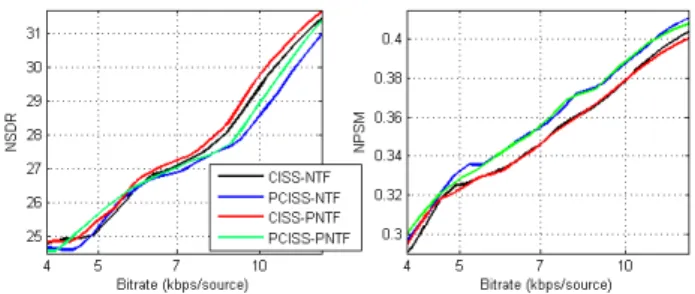
Fig. 1. Performance of the proposed perceptual CISS-NTF scheme.
The NSDR and NPSM values are averaged over different recordings. CISS-NTF, NTF, CISS-PNTF and PCISS-PNTF were run at various levels of quality, corresponding respectively to different choices for the source quantization step-size∆s in Algorithm 1 for CISS. The number of
com-ponents is fixed to three for each source, i.e.,K = 3J. Per-formance of the proposed perceptual CISS-NTF schemes are reported together with the baseline CISS-NTF [4].
The simulations produced many (rate, NSDR) and (rate, NPSM) pairs. Then, for each small range of rates, the pairs corresponding to the highest NSDR and NPSM are selected. The resulting (rate, NSDR) and (rate, NPSM) planes were then smoothed using the locally weighted scatterplot smooth-ing (LOESS) method to produce the rate/performance curves. The results can be found in Fig. 1 and audio excerpts may be downloaded on the webpage dedicated to this paper3
.
Although we evaluated the performance using both Par and ITU-R models for extracting the weighting tensor, we reported the results corresponding to the higher NPSM. As such we report the results with the ITU-R model for PNTF and with the Par model for PCISS. If we use the loudness ma-trix of ITU-R model for weighting the distortion, it forces the louder components to have less distortion, while the distor-tion in the regions with low energy is increased. Thus, we observe an improvement in terms of NSDR around 0.5 dB for CISS-PNTF and PCISS-PNTF compared to CISS-NTF and PCISS-NTF, respectively. Therefore, applying a perceptual weight on the NTF scheme leads to an improvement in terms of NSDR. At the same time, it keeps the NPSM scores un-changed, which is a bit deceiving. On the other hand, we can see that PCISS-NTF and PCISS-PNTF are outperformed by CISS-NTF and CISS-PNTF in terms of NSDR, especially for bitrates above 6.5 kbps, up to approximately 0.5 dB. This is trivial and predictable since NSDR is optimized with the MSE minimization obtained by the CISS scheme. The im-portant point here is that the NPSM scores are improved con-sistently by approximately 0.01–0.02 by using PCISS with the Par model.
3http://www.gipsa-lab.grenoble-inp.fr/~laurent. girin/demo/PCISS-EUSIPCO2014.zip
5. CONCLUSION
In this study, we have shown how perceptual models can be included in coding-based informed source separation (CISS), so as to yield an information-theoretical optimal way to trans-mit audio objects when their mixtures are known at the de-coder. This work extends the state of the art about CISS that previously only considered squared-error as a distortion mea-sure.
Including perceptual weighting in informed source sepa-ration was achieved from two different perspectives. First, we showed how the estimation of the Nonnegative Tensor Fac-torization source model can benefit from perceptual weight-ing at no cost in terms of bitrate. Second, we have demon-strated that recent results on source coding using perceptual distortions could be extended to the case of posterior source-coding, i.e., when both the coder and the decoder share some side-information.
This approach is the first Audio Object Coding approach that permits to include perceptual constraints on the audio sources to be transmitted through their downmix. Indeed, even if other approaches from the state of the art do rely on residual perceptual coding [2], the perceptual models they consider are not relative to the audio objects themselves, but rather to the errors performed during estimation, which is dif-ferent and suboptimal. We have demonstrated through our evaluation that the system we propose permits to recover iso-lated sources that are of better perceptual quality with a bitrate of only a few kilobits per seconds and per source.
REFERENCES
[1] P. Comon and C. Jutten, Eds., Handbook of Blind Source Separation: Independent Component Analysis and Blind Deconvolution, Academic Press, 2010. [2] J. Engdegård, C. Falch, O. Hellmuth, J. Herre,
J. Hilpert, A. Hölzer, J. Koppens, H. Mundt, H.O. Oh, H. Purnhagen, B. Resch, L. Terentiev, M.L. Valero, and L. Villemoes, “MPEG spatial audio object coding - the ISO/MPEG standard for efficient coding of interactive audio scenes,” inAudio Engineering Society Conven-tion 129, 11 2010.
[3] A. Liutkus, J. Pinel, R. Badeau, L. Girin, and G. Richard, “Informed source separation through spec-trogram coding and data embedding,” Signal Process-ing, vol. 92, no. 8, pp. 1937 – 1949, 2012.
[4] A. Ozerov, A. Liutkus, R. Badeau, and G. Richard, “Coding-based informed source separation: Nonnega-tive tensor factorization approach,”IEEE Trans. on Au-dio, Speech and Language Processing, vol. 21, no. 8, pp. 1699 – 1712, Aug. 2013.
[5] R. M. Gray, Source coding theory, Kluwer Academic Press, 1990.
[6] D.Y. Zhao, J. Samuelsson, and M. Nilsson, “On entropy-constrained vector quantization using Gaussian mixture models,” IEEE Transactions on Communica-tions, vol. 56, no. 12, pp. 2094–2104, 2008.
[7] S. van de Par, A. Kohlrausch, R. Heusdens, J. Jensen, and S.H. Jensen, “A perceptual model for sinusoidal audio coding based on spectral integration,” EURASIP Journal on Applied Signal Processing, vol. 9, pp. 1292– 1304, 2005.
[8] A. Liutkus, R. Badeau, and G. Richard, “Low bitrate informed source separation of realistic mixtures,” in
IEEE International Conference on Acoustics, Speech and Signal Processing (ICASSP), Vancouver, Canada, 26-31 May 2013.
[9] A. Liutkus, R. Badeau, and G. Richard, “Gaussian pro-cesses for underdetermined source separation,” IEEE Transactions on Signal Processing, vol. 59, no. 7, pp. 3155 –3167, July 2011.
[10] J. Nikunen, T. Virtanen, and M. Vilermo, “Multichan-nel audio upmixing based on non-negative tensor fac-torization representation,” in IEEE Workshop Appli-cations of Signal Processing to Audio and Acoustics (WASPAA’11), New Paltz, New York, USA, Oct. 2011. [11] C. Févotte, N. Bertin, and J.-L. Durrieu, “Nonnegative
matrix factorization with the Itakura-Saito divergence. With application to music analysis,” Neural Computa-tion, vol. 21, no. 3, pp. 793–830, Mar. 2009.
[12] A. Ozerov and W. B. Kleijn, “Flexible quantization of audio and speech based on the autoregressive model,” inIEEE Asilomar Conference on Signals, Systems, and Computers (Asilomar CSSC’07), Pacific Grove, CA, Nov. 2007.
[13] P. Petkov, “The sensitivity matrix for a spectral auditory model,” M.S. thesis, KTH (Royal Institute of Technol-ogy), May 2005.
[14] ITU-R Recommendation BS.1387, Method for Objec-tive Measurements of Perceived Audio Quality, Decem-ber 1998.
[15] S. Kırbız and B. Günsel, “Perceptually enhanced blind single-channel music source separation by non-negative matrix factorization,” Digital Signal Processing, vol. 23, no. 2, pp. 646–658, Mar. 2013.
[16] E. Vincent, R. Gribonval, and C. Févotte, “Performance measurement in blind audio source separation,” IEEE Transactions on Audio, Speech, and Language Process-ing, vol. 14, no. 4, pp. 1462 –1469, July 2006.
[17] R. Huber and B. Kollmeier, “PEMO-Q - a new method for objective audio quality assessment using a model of auditory perception,” IEEE Transactions on Audio, Speech, and Language Processing, vol. 14, no. 6, pp. 1902 –1911, Nov. 2006.