Turku Centre
for
Computer Science
TUCS Dissertations
No 218, November 2016
Stefan Grönroos
Efficient and Low-Cost
Software Defined Radio on
Commodity Hardware
Efficient and Low-Cost Software
Defined Radio on Commodity
Hardware
Stefan Grönroos
To be presented, with the permission of the Faculty of Science and Engineering of Åbo Akademi University, for public criticism in Auditorium
XX in Agora, Vesilinnantie 5 on November 11, 2016, at 12 noon.
Åbo Akademi University Faculty of Science and Engineering Agora, Vesilinnantie 3, 20500, Turku, Finland
Supervisor
Docent Jerker Björkqvist
Department of Information Technologies Åbo Akademi University
Vattenborgsvägen 3, 20500 Åbo, Finland
Reviewers
Professor Manuel Vélez
Department of Communications Engineering Faculty of Engineering
University of the Basque Country (UPV/EHU) Alda. Urkijo S/N., 48013 Bilbao
Spain
Professor Riku Jäntti
Department of Communications and Networking Aalto University
Otakaari 5, Espoo Finland
Opponent
Professor Manuel Vélez
Department of Communications Engineering Faculty of Engineering
University of the Basque Country (UPV/EHU) Alda. Urkijo S/N., 48013 Bilbao
Spain
ISBN 978-952-12-3456-9 ISSN 1239-1883
Abstract
As general purpose processors become faster, many signal processing func-tions that used to require special purpose hardware, are now feasible to perform in software. In wireless communications, this means we move to-wards the “ideal” software-defined radio (SDR), where we have an antenna and analog/digital converters, after which the signal is processed in software. Defining most of the functionality in software makes software defined radios very flexible, in that they can be reconfigured quickly to perform any task for which they have sufficient computational capacity.
This thesis is composed of a number of studies into high-performance SDR, and very low-cost SDR. The first series of studies explore how well modern programmable general purpose processors are able to run typical signal processing tasks in the physical layer of a modern communications standard: DVB-T2. In the second series of studies, a radio spectrum moni-toring system is built using very low-cost components, and some software.
The first series of studies was initiated by an analysis of the DVB-T2 standard for digital television broadcasting. The most computationally com-plex signal processing functions of a DVB-T2 receiver were implemented on a graphics processing unit (GPU), and various central processing units (CPUs). The objective of these studies was to show that a real-time capable receiver for a modern standard such as DVB-T2 is feasible to implement completely in software on modern off-the-shelf computers.
The second series of studies focuses on distributed radio frequency spec-trum monitoring using very low-cost sensors. The sensors are based on cheap off-the-shelf hardware, which was never intended for spectrum monitoring. The nodes were instead adapted to the tasks of spectrum sensing and geolo-cation of transmitters by running specialized software.
Sammanfattning
De processorer som används för att köra applikationer på datorer och t.ex. mobiltelefoner blir allt snabbare och effektivare. Dessa processorers stora fördel är deras flexibilitet; de kan programmeras för att utföra en mängd olika uppgifter. Processorns uppgift definieras alltså av mjukvaran som körs på den för tillfället. En processortillverkare behöver alltså inte på förhand veta exakt vilka uppgifter processorn kommer att utföra under sin livstid.
Mjukvarudefinierad radio — eller SDR från engelskans Software Defined Radio-– handlar om att låta en programmerbar plattform, t.ex. en gene-rell processor, sköta största delen av uppgifterna i en radiomottagare eller -sändare i mjukvara. Normalt sköts en stor del av den beräkningsintensiva signalbehandlingen i en radio av komponenter specifikt designade för upp-giften. Man använder t.ex. oftast ett speciellt mikrochip för att behandla signalerna från GPS-satelliter och beräkna en position, ett annat chip för att ta emot digital-tv sändningar, och ett eller flera olika chip för att kom-municera med olika typer av trådlösa nätverk. Dessa chip utför sin uppgift effektivt, men är inte flexibla på samma sätt som en processor som kan växla mellan att köra ett datorspel och en ordbehandlare endast genom att ladda in ny mjukvara. Det är också dyrt att designa ny hårdvara för en specifik uppgift.
Målet med SDR är att minska mängden specialiserad hårdvara i en radio för att bygga mer flexibla system. En ideell mjukvaruradio kan t.ex. vara en GPS-navigator, en digital-tv mottagare, eller en mobiltelefon, beroende på vilken mjukvara som körs på den. Detta betyder också att förbättringar på kommunikationsstandarder kan göras genom att leverera ny mjukvara i likhet med hur mjukvaruuppdateringar görs för applikationer på en dator.
I denna avhandling beskrivs ett antal studier, indelade i två grupper, relaterade till SDR. I den första gruppen studier undersöks hur de tunga beräkningsoperationerna som behövs i en DVB-T2 digital-tv mottagare kan utföras på en vanlig konsument-PC utrustad med ett grafikkort. En studie om hur en typisk strömsnål processor för mobiltelefoner kan utföra dessa beräkningar ingår också. Målet med dessa studier är att visa hur moderna datorers beräkningskapacitet kan utnyttjas för att bygga en mjukvaruradio som klarar av en modern trådlös kommunikationsstandard som DVB-T2.
I den andra gruppen studier undersöks hur väldigt billig hårdvara som kostar ca 50AC kan användas för att övervaka radiospektrets användning. Denna hårdvara var inte ursprungligen designad för att övervaka spektru-manvändningen, men genom specialiserad mjukvara blir detta möjligt. En uppdatering till mjukvaran möjliggjorde också användningen av denna bil-liga hårdvara för att estimera positionen på okända radiosändare i området.
Acknowledgments
I started working on this thesis at the Embedded Systems Laboratory (ES-Lab) at Åbo Akademi University in 2010, after completing my master’s the-sis at the same laboratory. There are many people I would like to thank for making these 6+ years a very enjoyable experience.
Jerker Björkqvist has been a great supervisor, for which I am deeply thankful. Jerker has been instrumental in providing guidance, both in the form of technical discussions and in pushing me in the right direction when necessary.
Together with Jerker, Kristian Nybom has been involved as a co-author in most publications and has been great to work with during these years. Kristian’s expertise in error-correction coding and signal processing has been key to the success of my own research. I will certainly miss our highly "creative" meetings in the digital television group of the ESLab. I would also like to thank Juhani Hallio, Jani Auranen, and Reijo Ekman at the radio laboratory at Turku University of Applied Sciences for their valuable collaboration.
I am thankful to Professor Johan Lilius for letting me work at the ESLab during all these years. Both Johan and Jerker have given me the opportunity to work in a wide variety of projects, which has given me valuable exposure to different areas of research.
Professor Riku Jäntti provided valuable feedback on my thesis as my reviewer, for which I am grateful. I would also like to express my gratitude towards Professor Manuel Vélez for both acting as a reviewer and agreeing to act as my opponent.
In general, the ESLab is an amazing place to work, and there is not enough space in this section to thank all the great colleagues I have had the opportunity to work with. I would like to especially thank Johan Ersfolk, Wictor Lund, Simon Holmbacka, and Sébastien Lafond for the interesting discussions and collaboration.
I would also like to thank Marat Vagapov and Dag Ågren for sharing their expertise in electronics and embedded systems. The administrative personnel and IT personnel at the department have been important in making sure that practical matters have been taken care of smoothly. These include Christel
Engblom, Karl Rönnholm, Minna Carla, Joakim Storrank, Tomi Suovuo, Susanne Ramstedt, and several others. For funding my research, I would like to thank TUCS and the Nokia Foundation.
I would like to thank my friends for making these years a much more en-joyable experience. Finally, my parents Ingvor and Björn deserve my deepest gratitude for their neverending support.
List of original publications
Reprinted publications
The following publications are reprinted in Part II of this thesis.
Paper I S. Grönroos, K. Nybom, and J. Björkqvist. “Complexity analysis of software defined DVB-T2 physical layer”. In: Analog Integrated Cir-cuits and Signal Processing 69.2 (2011), pp. 131–142. issn: 1573-1979.
doi: 10.1007/s10470-011-9724-4. url: http://dx.doi.org/10. 1007/s10470-011-9724-4
Paper II S. Grönroos, K. Nybom, and J. Björkqvist. “Efficient GPU and CPU-based LDPC decoders for long codewords”. In: Analog Integrated Cir-cuits and Signal Processing 73.2 (2012), pp. 583–595. issn: 1573-1979.
doi: 10.1007/s10470-012-9895-7. url: http://dx.doi.org/10. 1007/s10470-012-9895-7
Paper III S. Grönroos and J. Björkqvist. “Performance evaluation of LDPC decoding on a general purpose mobile CPU”. in: Global Conference on Signal and Information Processing (GlobalSIP), 2013 IEEE. Dec. 2013, pp. 1278–1281. doi: 10.1109/GlobalSIP.2013.6737142. url:
https://dx.doi.org/10.1109/GlobalSIP.2013.6737142
Paper IV S. Grönroos, K. Nybom, and J. Björkqvist. “Implementation and performance analysis of DVB-T2 rotated constellation demappers on a GPU”. in: Analog Integrated Circuits and Signal Processing 78.3 (2014), pp. 589–598. issn: 1573-1979. doi: 10.1007/s10470- 013-0101-3. url: http://dx.doi.org/10.1007/s10470-013-0101-3 Paper V S. Grönroos et al. “Distributed Spectrum Sensing Using Low Cost
Hardware”. In: Journal of Signal Processing Systems (2015), pp. 1– 13. issn: 1939-8018. doi: 10 . 1007 / s11265 - 015 - 1033 - 1. url:
http://dx.doi.org/10.1007/s11265-015-1033-1
Paper VI S. Grönroos, K. Nybom, and J. Björkqvist. “Synchronization of Low-Cost Distributed Spectrum Sensing Nodes for Multilateration-Based
Geolocation”. In: Proceedings of SDR-WinnComm 2015: Wireless In-novation Conference on Wireless Communications Technologies and Software Defined Radio. Wireless Innovation Forum Conference on Wireless Communications Technologies and Software Defined Radio. The Wireless Innovation Forum, 2015, pp. 223 –229
Related original publications
The following original publications are not reprinted in Part II, as they have been extended by one of the reprinted publications.
VII S. Grönroos, K. Nybom, and J. Björkqvist. “Complexity Analysis of Software Defined DVB-T2 Physical Layer”. In: Proceedings of the SDR ’10 Technical Conference and Product Exposition. Wireless Innovation Forum, Inc., 2010, pp. 634 –639
VIII S. Grönroos, K. Nybom, and J. Björkqvist. “An Efficient GPU-Based LDPC Decoder for Long Codewords”. In: Proceedings of the SDR 11 Technical Conference and Product Exposition. Wireless Innovation Forum, Inc., 2011, pp. 272 –279
IX S. Grönroos, K. Nybom, and J. Björkqvist. “DVB-T2 Rotated Con-stellation Demapping on a GPU”. in: Proceedings of SDR-WinnComm 2013: Wireless Innovation Conference and Product Exposition. The Wireless Innovation Forum, 2013, pp. 233 –238
X S. Grönroos et al. “Distributed Spectrum Sensing Using Low Cost Hardware”. In: Proceedings of WInnComm-Europe 2014 Wireless In-novation European Conference on Wireless Communications Technolo-gies and Software Defined Radio. Wireless Innovation Forum, 2014, pp. 1 –8
Contents
I Research Summary xv
1 Introduction 1
1.1 Research scope and objectives . . . 3
1.1.1 Efficient SDR algorithms . . . 3
1.1.2 Low-cost, versatile SDR . . . 3
1.2 Summary of contributions . . . 4
1.2.1 Efficient SDR algorithms . . . 4
1.2.2 Low-cost, versatile SDR . . . 5
1.3 Organization of the thesis . . . 6
2 Software Defined Radio 7 2.1 Definition . . . 7
2.2 The early days . . . 8
2.2.1 SPEAKeasy . . . 8
2.2.2 Joe Mitola . . . 9
2.3 SDR on consumer hardware . . . 9
2.3.1 MIT SpectrumWare . . . 10
2.3.2 GNU Radio and the USRP . . . 10
2.3.3 Other frameworks for SDR development . . . 11
2.3.4 The rise of inexpensive SDR equipment . . . 12
3 General purpose processors and signal processing 13 3.1 Central processing units (CPUs) . . . 13
3.1.1 Vector instructions . . . 13
3.2 Graphics processing units (GPUs) . . . 15
3.3 Digital signal processors (DSPs) . . . 17
4 Case I: DVB-T2 on general purpose hardware 19 4.1 DVB-T2 . . . 19
4.2 Paper I: Performance analysis of physical layer . . . 22
4.2.1 Author’s contributions to Paper I . . . 22
4.3 Papers II-III: LDPC decoder . . . 23
4.3.2 Designing a parallel decoder architecture . . . 24
4.3.3 GPU implementation . . . 25
4.3.4 Intel CPU implementation . . . 25
4.3.5 ARM CPU implementation . . . 25
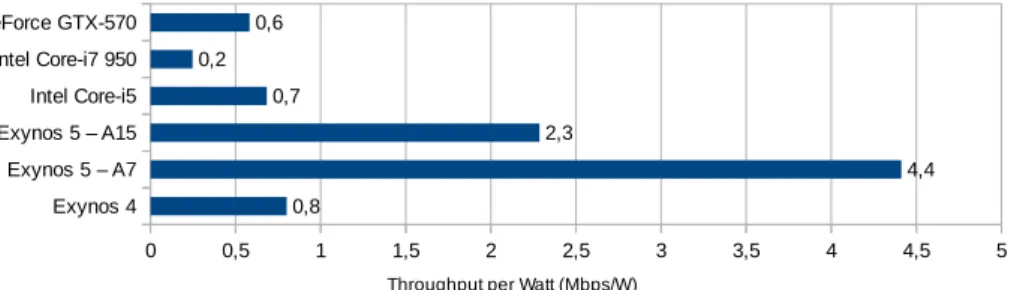
4.3.6 Performance summary and energy efficiency . . . 26
4.3.7 Related works . . . 28
4.3.8 Author’s contributions to Papers II-III . . . 30
4.4 Paper IV: Constellation demapper . . . 30
4.4.1 GPU implementations . . . 32
4.4.2 Related works . . . 33
4.4.3 Author’s contributions to Paper IV . . . 34
4.5 Case I conclusion and discussion . . . 34
4.5.1 Related works . . . 35
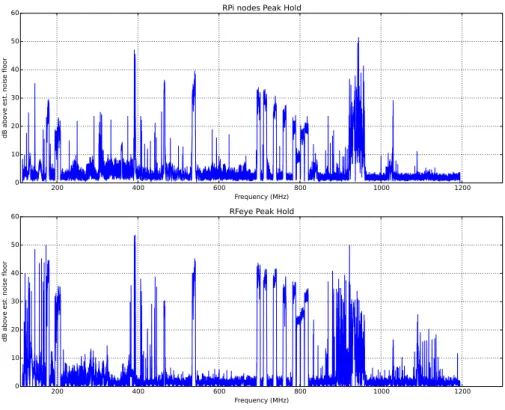
5 Case II: Spectrum Monitoring on Low-Cost Hardware 37 5.1 Paper V: Distributed Spectrum Sensing . . . 38
5.1.1 Spectrum sensing and experimental setup . . . 38
5.1.2 Experiments and results . . . 39
5.1.3 Related works . . . 41
5.1.4 Author’s contributions to Paper V . . . 42
5.2 Paper VI: Distributed Low-Cost Geolocation . . . 43
5.2.1 Multilateration . . . 43
5.2.2 Receiver synchronization . . . 43
5.2.3 The implementation . . . 44
5.2.4 Results and Discussion . . . 45
5.2.5 Related works . . . 46
5.2.6 Author’s contributions to Paper VI . . . 47
5.3 Case II conclusion and discussion . . . 47
6 Conclusions and Future Work 49 6.1 Future work . . . 50
List of Acronyms
ADC analog-to-digital converter
API application programming interface
ASIC application-specific integrated circuit
AVX Advanced Vector Extensions
B21C Broadcasting for the 21st Century
BCH Bose-Chaudhuri-Hocquenghem
BER bit error rate
BICM bit interleaved coding & modulation
C-RAN cloud radio access network
CDMA code division multiple access
CGRA coarse-grained reconfigurable array
COTS commercial off-the-shelf
CPU central processing unit
CUDA Compute Unified Device Architecture
D/A digital/analog
DAB Digital Audio Broadcasting
DAC digital-to-analog converter
DARPA Defense Advanced Research Projects Agency
DMA direct memory access
DSP digital signal processor
DVB-T Digital Video Broadcast - Terrestrial
DVB-T2 Digital Video Broadcast - Terrestrial 2
ESLAB Embedded Systems Laboratory
ETSI European Telecommunications Standards Institute
FEC forward error correction
FFT fast Fourier transform
FIFO first in, first out
FPGA field-programmable gate array
GLONASS Global’naya Navigatsionnaya Sputnikovaya Sistema
GPL General Public License
GPP general purpose processor
GPS Global Positioning System
GPU graphics processing unit
GSE Generic Stream Encapsulation
GSM Global System for Mobile Communications
GuPPI General Purpose PCI Interface
HDTV High Definition Television
I/O input/output
IEEE Institute of Electrical and Electronic Engineers
IF intermediate frequency
JTRS Joint Tactical Radio Systems
LDPC low-density parity-check
LLR log-likelihood ratio
MISO Multiple Input Single Output
MIT Massachusetts Institute of Technology
MMSE minimum mean square error
MS/s megasamples per second
NFC near-field communication
NLOS non-line-of-sight
OFDM orthogonal frequency-division multiplexing
OpenCL Open Computing Language
OS operating system
OSSIE Open Source SCA Implementation::Embedded
PC personal computer
PCI Peripheral Component Interconnect
PLP physical layer pipe
PPS pulse per second
QAM quadrature amplitude modulation
QPSK quadrature phase shift keying
RBW resolution bandwidth
RF radio frequency
ROM read only memory
SCA Software Communications Architecture
SDR software defined radio
SIMD single instruction, multiple data
SM streaming multiprocessor
SoC system on chip
TDMP Turbo-Decoding Message-Passing
TDOA time difference of arrival
TI Texas Instruments
TOA time of arrival
USB Universal Serial Bus
USRP Universal Software Radio Peripheral
VLIW very long instruction word
Part I
Chapter 1
Introduction
A typical modern mobile phone might need to support 10 or more different wireless communications standards. The phone needs to support four gen-erations of mobile telecommunications networks with their extensions, mid-range data links through various WiFi standards, and short-mid-range communi-cations through several generations of Bluetooth as well as near-field commu-nication (NFC). Satellite navigation using Global Positioning System (GPS), Global’naya Navigatsionnaya Sputnikovaya Sistema (GLONASS), and Bei-Dou are also often supported in the same device. There might even be an FM-radio receiver inside the handset. The number of wireless communica-tions standards to be supported will only increase, as the fifth generation (5G) of telecommunications networks is being planned.
In the past, most of the signal processing required to support different wireless standards has been handled by application-specific integrated cir-cuits (ASICs) with fixed functionality. As the computational performance of programmable computing platforms continue to increase, however, an in-creasing number of tasks that have been traditionally handled by dedicated hardware may be replaced by software executing on reconfigurable comput-ing platforms. These reconfigurable platforms include central processing units (CPUs), graphics processing units (GPUs), and digital signal proces-sors (DSPs), as well as reconfigurable hardware such as field-programmable gate arrays (FPGAs). This allows us to move software “closer to the antenna” in radios.
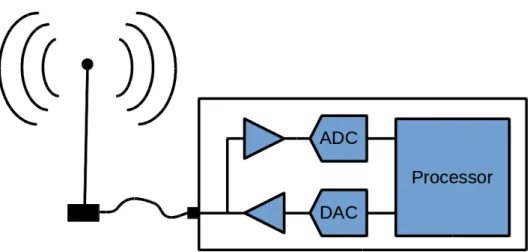
The concept of replacing application-specific circuits with programmable hardware in radio communications is commonly called software defined radio (SDR). In an “ideal” software defined radio, the antenna would be connected almost directly to a programmable processor, with only analog-to-digital converters (ADCs) and digital-to-analog converters (DACs) in between to convert the signal between the analog and digital domains. This concept is illustrated in figure 1.1.
Figure 1.1: An ideal software defined radio, where the antenna is con-nected almost directly, via an amplification stage, to the analog-to-digital and digital-to-analog converters for reception and transmission, respectively.
There are several significant advantages of defining functionality in soft-ware rather than in hardsoft-ware circuits. Hardsoft-ware design is generally very expensive, and any significant upgrades generally require a redesign of the hardware. General purpose processors are widely used due to their appli-cability to a large set of problems, and can therefore enjoy the benefits of mass production, such as lower cost per unit and more advanced produc-tion facilities. The general purpose platform can also be reconfigured in a straightforward manner by updating the software being executed, provided that the processing capacity is sufficient for the new functionality. If the new functionality requires more processing capacity, it is often quite easy to adapt the software to a new processor.
Dedicated, single-purpose hardware is typically significantly more energy-efficient when compared to performing the same task in software on a general purpose processor. As the number of features required from the device grows, however, the complexity and size of the ASIC grows.
DSPs are most commonly utilized for high-performance signal processing in software, since their architecture is commonly optimized for processing digitized signals efficiently. General purpose application processors, however, also increasingly contain functionality to enable efficient digital signal and image processing. An example of this is vector processing extensions enabling the application of a single operation on multiple data elements.
GPUs, originally only designed for 2D and 3D graphics acceleration, are increasingly suitable for other tasks that can take advantage of the massively parallel processing capabilities of the GPU. The capabilities of these
proces-sors – not originally intended for signal processing – in an SDR context are explored as part of this thesis.
1.1
Research scope and objectives
The objective of this thesis is to explore the applicability of general pur-pose processors and low-cost commercial off-the-shelf (COTS) computing platforms to radio applications. The exploration is performed primarily in the form of case studies. Contributions focus on two aspects of SDR using commodity hardware:
1. Feasibility study of implementing components of a modern communi-cations standard in software on commodity hardware.
2. Exploiting COTS hardware to build a low-cost radio spectrum moni-toring system.
1.1.1 Efficient SDR algorithms
The first aspect is explored as a series of studies on the Digital Video Broad-cast - Terrestrial 2 (DVB-T2) standard for video broadBroad-casting. The DVB-T2 standard is a fairly recent standard with several computationally complex building blocks, making this standard a good test case. First, the complex-ities of the various building blocks of a DVB-T2 receiver (the transmitter is less interesting due to its lower complexity) are analyzed, and the most computationally complex parts of a receiver are identified.
Based on the initial study, the most computationally intensive building blocks were implemented on both a regular off-the-shelf GPU, and a common CPU, to gain insight into the feasibility of implementing a receiver completely in software. An implementation for CPUs designed for mobile devices was also developed and evaluated.
The goal of this first series of studies is to show that, given efficient al-gorithms, a completely software-defined implementation of a receiver for a modern telecommunications standard, DVB-T2, is feasible on general pur-pose hardware.
1.1.2 Low-cost, versatile SDR
One clear advantage of software radios over dedicated hardware is that economies of scale can drive down costs to produce generic radio interfaces and general purpose processors, where the functionality of the system can be customized through software. The second set of studies conducted for this thesis is focused on exploiting low-cost COTS hardware to implement specialized functionality.
This is explored through the construction of a distributed network of radio receivers scanning the radio spectrum for activity, where each node is composed of a very low-cost Raspberry Pi computer and an SDR-capable Universal Serial Bus (USB) dongle intended for the reception of Digital Video Broadcast - Terrestrial (DVB-T) broadcasts. In an extension to this study, it is also demonstrated how – by only replacing the software – this setup can also be used to locate the source of detected radio transmissions geographi-cally.
These studies show how SDR can provide low-cost, versatile alternatives to dedicated systems that are often very expensive due to lower demand and high costs related to developing new hardware.
1.2
Summary of contributions
The contributions of this thesis are discussed in more detail in chapters 4 and 5. A brief summary of the main contributions follow here.
1.2.1 Efficient SDR algorithms
The first series of studies regarding the feasibility of implementing a DVB-T2 receiver in software on commodity hardware encompasses Papers I-IV (see list of original publications). Paper I gives an overview of the complexity of the signal processing blocks in a DVB-T2 transmitter and receiver through analysis of a DVB-T2 simulator. Paper I shows that while the transmitter part has fairly low computational complexity, the receiver contains compu-tationally complex parts. The results show that a DVB-T2 receiver’s most computationally complex parts are the low-density parity-check (LDPC) for-ward error correction (FEC) decoder and quadrature amplitude modulation (QAM) demapper.
Paper II presents a DVB-T2 LDPC decoder implemented on both a GPU and multi-core CPU. The GPU implementation in Paper II shows that real-time LDPC decoding of the codes used in DVB-T2 is feasible on a modern GPU.
Paper III presents an implementation of a similar LDPC decoder on a low-power multi-core ARM CPU. This implementation does not reach real-time performance according the requirements of the DVB-T2 standard. It does, however, provide useful insight into the performance of modern low-power CPUs aimed at the mobile market compared to the more performance oriented desktop computer components.
Furthermore, in Paper IV, the study is completed by presenting a real-time capable DVB-T2 QAM demapper on a GPU. Paper IV also shows that the LDPC decoder and demapper can be executed on the same GPU at a throughput exceeding the DVB-T2 requirements for real-time operation.
Thus, with some reservations further detailed in chapter 4, the studies en-compassing Papers I-IV show the feasibility of implementing a receiver for the modern DVB-T2 multimedia broadcasting standard in software on a consumer-grade personal computer (PC).
Author’s contributions
The author of this thesis contributed to the first series of studies as follows. The studies in Papers I-IV are based on the analysis of and implementation of optimized signal processing components in a DVB-T2 simulator developed at Åbo Akademi University. The simulator was mainly developed by the co-authors of Papers I-IV. The co-authors assisted with understanding the simulator, as well as writing parts of Papers I-IV. Most parts of Papers I-IV were written by the author of this thesis.
The author performed the performance analysis of signal processing blocks in Paper I independently. The author also implemented and analyzed the optimized LDPC decoders in Papers II-III independently based on less opti-mized implementations written by co-authors and other contributors to the DVB-T2 simulator. Likewise, the implementation and performance analysis of GPU algorithms in Paper IV was performed by the author.
1.2.2 Low-cost, versatile SDR
The second series of studies exploits mass-produced COTS hardware to build a low-cost radio spectrum monitoring system. This series of studies consists of Papers V-VI. The studies contribute to existing knowledge by demonstrat-ing through field measurements how a very low-cost distributed network of nodes equipped with SDR capabilities can be used for spectrum sensing (Pa-per V) and also for locating the source of transmissions (Pa(Pa-per VI).
In Paper V the performance of the very low-cost equipment is compared to dedicated spectrum sensing equipment. It is shown that useful measure-ments can be performed at very low cost, enabling the construction of dense networks of spectrum sensing nodes. Paper VI goes on to show how, through a change in software, the same network of low-cost nodes can also be used to provide coarse location of the source of unknown arbitrary signals.
Author’s contributions
For Paper V, the author was responsible for all software implementation and the architecture of the distributed network of spectrum monitoring nodes. The results analysis was also performed by the author. Co-authors wrote much of the background part of the paper, as well as some of the introduction and conclusion. Co-authors also set up and provided measurements from the reference spectrum sensing equipment. Paper VI was mostly written
by the author of this thesis, and all implementation and analysis work was performed by the author.
1.3
Organization of the thesis
The thesis is organized as follows. In chapter 2, we familiarize ourselves with the history of SDR, and the emergence of SDR on commodity consumer hardware. In chapter 3, a brief overview of the features of modern CPUs and GPUs that make these platforms suitable for signal processing tasks is given.
Chapter 4, constains a description of the studies on high-performance SDR algorithms for parts of the DVB-T2 standard. Chapter 5 follows with an overview of low-cost spectrum monitoring and geolocation powered by SDR algorithms. Finally, the thesis is concluded in chapter 6.
Chapter 2
Software Defined Radio
This chapter contains a brief overview of how SDR has evolved over the years. In subsection 2.3, we will especially focus on how SDR platforms have become increasingly available as relatively inexpensive off-the-shelf products that anyone with enough interest can acquire.
2.1
Definition
SDR is defined by the Wireless Innovation Forum and the Institute of Elec-trical and Electronic Engineers (IEEE) P1900.1 group as “Radio in which some or all of the physical layer functions are software defined” [95, 55]. An “ideal” software defined radio is designed in such a way that the ADC in a receiver or DAC in a transmitter is placed as close to the antenna as possible, after which all further processing is performed digitally in software [78].
In practice, an analog radio frequency (RF) front-end is typically required – or at least desirable – before the DAC/ADC to perform functions such as amplification, filtering, and possibly downconversion of the signal in the analog domain. Since most of the processing is performed in software, the functionality of the radio can be reconfigured simply by running different software.
Often reconfigurable logic devices, such as FPGAs, are also used to re-alize the reconfigurability, instead of or in addition to software running on a specific processor. In the following section, an overview of the move to-wards an increased amount of signal processing being performed in software is given. In section 2.3 follows a discussion of the increasing popularity of SDR on commodity hardware such as PCs.
2.2
The early days
SDR is not a new concept, and can be traced back, at least, to the 1980s and mostly to U.S. military projects.
As an example of early designs that would seem to fit the definition of SDR, an implementation of a software modem for transmission and recep-tion of burst messages over VHF voice channels was described in an article published in 1979 by Davies and Davies [19]. The authors implemented most of the signal processing on a Texas Instruments TMS9900 16-bit processor. The advantages of the software approach according to the authors [19] in-clude the use of COTS hardware, and the ability to reconfigure the system simply by switching read only memory (ROM) boards.
In a company newsletter published in May 1985, the E-Systems Garland, Texas division — which was later bought by Raytheon — used the term “Soft-ware Radio” to describe their system for analyzing signals captured on tape in software. Their computer system used sixteen Floating Point Systems1 FPS 5430 Array Processors to perform “full speed” signal processing [80].
2.2.1 SPEAKeasy
The two-phase SPEAKeasy project [66, 17], managed by the Air Force Rome Laboratory in the U.S., and funded by various military branches as well as the Defense Advanced Research Projects Agency (DARPA), was conceived in the late 1980s and officially started in 1992. The project was initiated with the goal of developing an open architecture reprogrammable modem, which would be able to cope with new waveforms as they are developed. The system would also need to be able to handle the myriad of existing waveforms that were in use by both the U.S. military and their allies, and bridge different systems as necessary.
The SPEAKeasy phase 1 radio used four Texas Instruments (TI) TMS320-C40 DSPs as the DSP engine, where various waveforms could be demod-ulated. The system included a CYPRIS module to handle encryption of information.
In phase 2, which was initiated in 1995, development was continued with especially architectural openness and modularity in mind [17]. The Phase-2 hardware, again, used the same TI DSP chips, however with programmable logic provided by FPGAs. In phase 2, there were also separate cryptographic processors handling security. The phase 2 hardware could handle a frequency range of 2 to 400 MHz, although the original goal was to handle up to 2 GHz frequencies [17].
1
2.2.2 Joe Mitola
Joe Mitola is regarded as a very influential person in SDR. His initial article on the subject was published in 1993 [78], while Mitola was working at the E-Systems Melpar division in Virginia, USA. In the article, Mitola relates advances in enabling technologies — such as ADCs and DACs, various high performance processor architectures, and interconnects — to the demands of software radios. He also discusses computational models and architectures for software radios.
Mitola mentions [78] that the ideal software radio would be able to com-municate using any signal format by simply changing software algorithms, as long as the processing capabilities and ADC/DAC bandwidth require-ments are met, and the communication is taking place within a supported frequency range. Mitola also mentions that future software radios could automatically select the optimal transmission parameters for a radio link, given requirements on cost, availability, and signal quality. This concept of a context-aware, reconfigurable radio would later be called cognitive ra-dio, and was further explored by J. Mitola and G.Q. Maguire in an article published in 1999 [76].
In 1995, Mitola published an article [77] where he discussed architectural issues in software radio systems. He splits channel processing in a software ra-dio into antenna, RF, intermediate frequency (IF), baseband, and bitstream segments. Based on this segmentation, Mitola discusses the estimation of demand on hardware resources in a software radio in order to meet the often strict timing budgets in such a system.
Recognizing that, especially at the time, a single processor does not have the computational capacity to handle all stages of signal processing on its own, Mitola also discusses the mapping of the various segments onto het-erogeneous multiprocessor hardware architectures. He also mentions other tradeoffs that might need to be made in order to overcome hardware lim-itations or to lower cost, such as offloading some processing to dedicated single-purpose hardware chips.
2.3
SDR on consumer hardware
During the 21th century, powerful platforms for SDR have become more cost effective, which has lead to increased interest in SDR even among hob-byists. Especially SDR systems based around ordinary consumer PCs have become more prevalent, as general purpose CPUs have followed Moore’s law and roughly doubled in performance every two years [94], thus making the heavy number crunching involved in processing many waveforms feasible us-ing these processors.
2.3.1 MIT SpectrumWare
In a paper presented at the USENIX ’98 conference, Ismert[57] identified two weak points when using a PC for SDR. One was the lack of proper input/output (I/O) devices capable of transferring a high-speed stream of digital samples between the ADC/DAC and the main memory of the PC. The other weakness identified was the lack of operating system support for transporting these continuous streams of data with adequately low jitter through the operating system (OS) kernel to the user-space SDR application for processing.
According to Ismert, jitter in the rate at which an application can process incoming data is caused by features such as virtual memory, cache memories, varying I/O bus utilization levels, and multi-tasking in the OS. The jitter issues are mostly not present in traditional radios based on special purpose circuits, or dedicated DSPs, since in these systems, signal processing often happens at the same rate as the I/O, and no other tasks are allowed to interfere with the processing.
Ismert presented the General Purpose PCI Interface (GuPPI) hardware, which was a device connected to the Peripheral Component Interconnect (PCI) bus of a PC, and which consisted of two boards: one containing the ADC/DAC hardware for digitizing an analog signal, and the other for streaming the samples to the main memory using direct memory access (DMA) transfers. First in, first out (FIFO) buffers on the device were used to absorb jitter due to the bursty nature of PCI bus access. Extensions to the Linux kernel were also implemented to avoid copying of data buffers when moving data between kernel and user space.
The GuPPI hardware was used within the SpectrumWare project at Mas-sachusetts Institute of Technology (MIT). Within this project, a software framework called SPECtRA was developed, providing a number of signal processing modules, a way to connect those modules, as well as a scripting language to define the topology of the radio system [11].
A company, Vanu Inc., that was founded based on research within the MIT SpectrumWare project, commercialized a Global System for Mobile Communications (GSM) base station using ordinary HP Proliant servers based on Intel Pentium processors to perform all of their baseband process-ing. The base stations could also be updated to the code division multiple access (CDMA) standard after deployment through updated software [65].
2.3.2 GNU Radio and the USRP
Initially based on code from the SpectrumWare project — but completely rewritten in 2004 — GNU Radio [37, 9] was initiated by Eric Blossom and John Gilmore in 1998 [79, 10, 36]. This software has been actively
devel-oped since, and has become a popular framework for various SDR projects, especially among hobbyists and researchers. The GNU Radio framework contains a large amount of pre-written signal processing blocks and handles the interconnection of these blocks, as well as performing the passing of data between blocks and scheduling of the signal processing operations.
The high level structure of a GNU Radio-based application is commonly written in the Python language, while performance-critical signal processing code is written in C++. The project is developed under an open source GNU General Public License (GPL) license. Typically, at first, GNU Radio would be used together with the computer’s sound card acting as the digital/analog (D/A) interface to an external front-end, or with rather costly combinations of front-ends, such as cable TV tuner development boards and dedicated D/A boards [27].
Matt Ettus also became an active developer in the GNU Radio project in the early years. Due to the lack of affordable data acquisition hardware suitable for acting as an interface between the antenna and the computer, Ettus designed and sold the Universal Software Radio Peripheral (USRP) [101] hardware. The USRP was based around an Altera Cyclone FPGA and four 12-bit 64 megasamples per second (MS/s) ADCs for reception as well as four 14-bit 128 MS/s DACs for transmission [28]. The FPGA was mostly used for downconversion on the receiver side, as well as interpolation on the transmitter side.
The USRP was designed to hold up to two transmitter and two receiver daughterboards, where the daughterboards contain the analog front-ends required for the frequency range of interest. The USRP connected to a host PC through a USB 2.0 bus. The first USRPs were being shipped by early 2005 for less than USD 500, without daughterboards [26]. Since then, the USRP product range has evolved and expanded, and there are now both USRPs with very high-bandwidth interfaces such as 10 Gigabit Ethernet and PCI Express, as well as battery powered stand-alone devices containing on-board processors [29].
2.3.3 Other frameworks for SDR development
In addition to GNU Radio and other frameworks discussed in earlier sections, several other platforms for the development of SDRs and cognitive radios have been developed.
Iris [99] is a framework for the design of cognitive radio testbeds. To meet this goal, Iris emphasizes runtime reconfigurability in order to enable reacting to changes in the environment [99]. Iris also supports processing platforms such as FPGAs in addition to general purpose CPUs. Created within the EU FP7 SAMURAI project, ASGARD[7] is another platform aimed at providing a testbed for the development of cognitive radios.
AS-GARD is mainly targeting general purpose processors and runs on the Linux operating system.
The Open Source SCA Implementation::Embedded (OSSIE) project[38] is an open source framework for the development of SDRs compliant with the Software Communications Architecture (SCA). The SCA is an architec-ture for building interoperable communications systems, and was developed within the U.S. military’s Joint Tactical Radio Systems (JTRS) project.
2.3.4 The rise of inexpensive SDR equipment
With the gain in popularity of frameworks such as the open-source GNU Radio software framework, a wave of more or less open hardware suitable for use with GNU Radio and similar software has also followed. Many of these initiatives aim to provide low-cost, high-bandwidth platforms featuring RF front-ends and D/A hardware to connect to host computers.
Many of the products in the USRP family have board schematics avail-able, and software drivers are open source. Later projects include the HackRF [39], which in addition to schematics, also releases PCB layout files under open licenses. Several of the more recent SDR hardware interfaces have been funded through “crowdfunding”, i.e. through monetary contributions by a large number of people.
Around the year 2010, it was discovered that the demodulation chip of certain DVB-T (Digital Video Broadcast - Terrestrial) USB-based receivers is capable of producing raw 8-bit I/Q samples over the USB in addition to decoding DVB-T on-chip. This capability was originally intended for decod-ing Digital Audio Broadcastdecod-ing (DAB) and FM radio. At a price point of roughly USD 20, however, this capability made these dongles highly popular as very low-cost, relatively high-bandwidth SDR receivers [87]. The don-gles are capable of reliably streaming samples at a rate of approximately 2.5 MS/s to a host computer in the 20 MHz to 2 GHz range depending on the exact tuner chip used.
Chapter 3
General purpose processors
and signal processing
This chapter contains an overview of various general purpose processing ar-chitectures, and how they are suitable for digital signal processing. We will mostly focus on the types of processors commonly found in general purpose computing platforms, such as PCs and lower power devices such as mobile phones. These architectures are mostly various CPUs and GPUs.
While DSPs were designed with signal processing in mind, regular CPUs have also become increasingly capable signal processors due to the data parallelism provided by various multimedia extensions to the architecture. GPUs were originally designed for graphics acceleration alone, but have since evolved into massively parallel general purpose processors.
The contributions of this thesis are mostly focused on general purpose CPU and GPU architectures, and thus we will mostly ignore the traditional choices of architecture for SDR: DSPs and FPGAs.
3.1
Central processing units (CPUs)
Popular CPU architectures such as the IA-32 (32-bit) and x86-64 (64-bit) instruction set architectures used in Intel and AMD processors were not de-signed with signal processing in mind. As these architectures evolved, how-ever, various extensions to the instruction sets have introduced instructions that can accelerate common signal processing tasks.
3.1.1 Vector instructions MMX and SSE
Acceleration of digital signal processing on general purpose CPUs is often achieved using vector instructions, providing single instruction, multiple data
(SIMD) processing which allows the execution of a single operation on mul-tiple pieces of data in parallel. SIMD was introduced in later revisions of the Intel Pentium processor with the MMX extension [56]. MMX introduced eight 64-bit registers, MM0 to MM7 to the IA-32 architecture. These reg-isters were actually aliased to the lower 64 bits of the 80-bit floating point registers. The 64-bit registers support operations on packed integer data, i.e. eight single byte integers, four 16-bit integers, or two 32-bit integers.
An illustration of the PADDB instruction for the addition of two registers containing 8 packed single-byte integers is shown in figure 3.1.
X7 X6 X5 X4 X3 X2 X1 X0
Y7 Y6 Y5 Y4 Y3 Y2 Y1 Y0
X7+Y7 X6+Y6 X5+Y5 X4+Y4 X3+Y3 X2+Y2 X1+Y1 X0+Y0
MM0 MM1 MM0 31-24 23-16 15-8 7-0 39-32 47-40 55-48 63-56 Bits PADDB MM0, MM1
Figure 3.1: An illustration of register contents and the effects of the MMX instruction PADDB for addition of 8 packed byte values. The MM0 and MM1 registers contain the operands. The result is stored in the first operand register.
MMX instructions support addition, subtraction and multiplication arith-metic instructions, where addition and subtraction can also be saturating in case of overflow. There are also comparison, logical, and shift operations, in addition to instructions for packing and unpacking data, as well as loading and storing data from/to memory and other registers.
With the Pentium 3 processor family, Intel introduced Streaming SIMD Extensions (SSE), which provide instructions for computation on packed floating point data, in addition to further integer instructions. SSE provides 128-bit XMM registers for single-precision floating point operations, i.e. op-erations on four packed floating point values in parallel. Some additional integer operations were also added in SSE, still using the MMX registers. SSE2 also allowed integer operations to use 128-bit registers. SSE3, SSSE3 (Supplemental SSE 3), and SSE4 also added further SIMD operations.
The second generation Intel Core processor family, first released in 2011, introduced the Advanced Vector Extensions (AVX) instruction set, which
expanded SIMD registers to 256 bits for floating point operations. With AVX2, 256-bit registers could also be used for integer operations. With AVX2 we can thus, in ideal conditions, achieve speedups approaching 32 times with 8-bit integer arithmetic, or up to 8 times with single-precision floating point arithmetic compared to using non-SIMD instructions.
ARM NEON
The ARM Cortex-A family of processors may include one or more NEON SIMD (also known as Advanced SIMD) units, which give these ARM proces-sors similar SIMD capabilities as procesproces-sors equipped with the SSE family of SIMD units. The NEON register set consists of 32 64-bit doubleword reg-isters, which can also be viewed as a set of 16 128-bit quadword registers. Registers may contain packed integer data of size 8, 16, 32, or 64 bits, or single precision floating-point values. Polynomial types are also supported[6]. The NEON instructions may use quadword registers as operands for 128-bit wide SIMD. Whether the full 128 128-bits can be processed in parallel or not depends on the instruction, architecture and implementation of the proces-sor.
3.2
Graphics processing units (GPUs)
Graphics accelerators became commonplace in home computers in the late 1990s due to the ever increasing complexity of 3D graphics in computer games. In the early accelerators, the graphics pipeline consisted of fixed-function blocks for processing geometry and pixel data, such as perspective transformations, texture mapping, and the application of various visual ef-fects such as fog.
In the early 2000s, however, some parts of the graphics pipeline became programmable to enable more customized visuals. These graphics accel-erators would typically have programmable vertex (coordinate data) and fragment (pixel data) processors that would run programs, called shaders, to be executed on each incoming vertex and fragment separately. For ex-ample, a C-like language called the GL Shading Language (GLSL) was used to program these processors in applications using the OpenGL application programming interface (API).
These shader programs, together with techniques for reading back results from the graphics card, for example in the form of a texture, enabled an early opportunity for general purpose programming on a graphics accelerator. In-put data could be supplied as “vertices” and texture data, and outIn-put data would be read from the graphics card memory as texture data, for exam-ple. Algorithms had to be suitable for running as operations on vertices and fragments, and had to be expressed in a limited shader language.
In the mid-2000s, the programmable processors on the graphics card moved towards a unified shading architecture, where vertex and fragment processing was handled by the same processor, leading to even more general GPU cores [93, 20]. As the processing units on the GPU became more appli-cable to general purpose computing, programming environments that facili-tate general purpose programming followed. NVIDIA’s proprietary Compute Unified Device Architecture (CUDA) API simplifies the writing of GPU ker-nels, i.e. functions that are executed on the GPU to process a piece of input data. The same kernel is typically executed in parallel on a large set of input data in parallel. This is very similar to how a fragment shader is applied to many pixels of the output image in parallel, or how a vertex shader is applied to many 3D points in parallel.
Figure 3.2: A streaming multiprocessor (SM) in the Fermi architecture, as depicted in [84]. There are two warp schedulers per SM, which may schedule a group of 16 threads onto one of two groups of 16 cores. There are also 16 load-store units (LSU), and four special function units (SFU).
Figure 3.2 depicts one streaming multiprocessor (SM) of a fairly modern CUDA-enabled GPU with the Fermi architecture. A typical Fermi GPU might have 1-32 of these multiprocessors. The SM consists of two groups of 16 simple cores each. One such group of cores will execute the same instruction of a kernel at the same time in a SIMD-like fashion. Contrary to a modern CPU, which dedicates large amounts of chip area to cache memories and control logic, the GPU is optimized to process large streams of data in similar ways very quickly. The programming model of GPUs is often called stream processing, as they operate on streams of data.
Besides CUDA, there are other frameworks for general purpose GPU pro-gramming. The Open Computing Language (OpenCL)1 is a cross-platform standard for parallel programming on many different architectures: GPUs, CPUs, and beyond. The more recent Vulkan API2 is aimed at providing a low-level cross-platform API for both general computation and graphics.
3.3
Digital signal processors (DSPs)
While the work described in this thesis is focused on signal processing us-ing CPUs and GPUs, the DSP deserves to be mentioned in this context, since these processors are designed specifically with signal processing tasks in mind. High-performance DSPs are not typically available in general pur-pose desktop computers or workstations. DSPs are however quite common in mobile devices as part of the main system on chip (SoC), where low power consumption is critical.
Modern DSPs come in a variety of forms [16, 100]. DSPs, such as TI’s C6000 series and Qualcomm’s Hexagon, are often based on a very long in-struction word (VLIW) architecture for executing multiple different oper-ations per clock cycle [100, 16]. While GPUs achieve high performance through massive parallelism, DSPs tend to focus more on single-core per-formance [3]. Some DSP are also tailored to some specific domain of signal processing, and may come equipped with accelerators for typical signal pro-cessing operations such as fast Fourier transforms (FFTs), FEC, etc. Recent DSPs also exploit data parallelism in the form of vector instructions, i.e. SIMD, and may also be multi-core similarly to CPUs.
DSPs can be highly competitive with CPUs and GPUs — especially in terms of energy efficiency — in signal processing tasks. The decision to ignore DSPs in this work was mostly due to the following factors:
• A lack of user-programmable DSPs in most general purpose computers, such as PCs (both consumer and server hardware) and also on several low-power SoCs, such as the popular Samsung Exynos 4 and 5 families
1
https://www.khronos.org/opencl/
2
and the Broadcom SoC used in the low-cost Raspberry Pi miniature computer. These are widely available platforms that were used for the research in this thesis.
• DSPs are established in the SDR field. We were interested in evaluating alternative, widely available, hardware platforms, i.e. modern multi-core SIMD-capable CPUs and GPUs.
FPGAs are also often used in SDR systems. These platforms, being reconfigurable hardware rather than general purpose processors, do however fall outside the scope of this thesis. In addition, there are various other programmable architectures suitable for SDR applications [4]. These tend to not be widely available in compute platforms, and are thus not covered here.
Chapter 4
Case I: DVB-T2 on general
purpose hardware
The first series of studies, encompassing original papers I-IV [43, 45, 40, 46] of this thesis, was aimed at gaining insight into how well the signal processing components of a modern telecommunications standard may be executed on a general purpose computing platform such as a desktop PC.
The Embedded Systems Laboratory (ESLAB) at Åbo Akademi Univer-sity has been involved in standardization efforts for the DVB-T2 digital tele-vision broadcasting standard within the Celtic project Broadcasting for the 21st Century (B21C), and later also for the lightweight profile, DVB-T2 Lite. During these projects, a software DVB-T2 physical layer simulator had been developed [85]. The familiarity with the standard, combined with the exist-ing simulation framework made the DVB-T2 standard a natural choice for further examination.
The physical layer simulator framework was used in papers I-IV, first in order to estimate the complexity of the various parts of the DVB-T2 physical layer, and later as a framework in which optimized algorithms were validated and benchmarked for performance.
4.1
DVB-T2
DVB-T2 is the successor to the DVB-T standard, a standard that is widely used for digital television broadcasting. DVB-T2 was developed to increase efficiency in terms of bit-rate per herz of bandwidth, which would limit the impact of an increasing number of High Definition Television (HDTV) broad-casts on RF spectrum usage.
Some features of DVB-T2 that provide significant improvements in per-formance over its predecessor include [25, 103]:
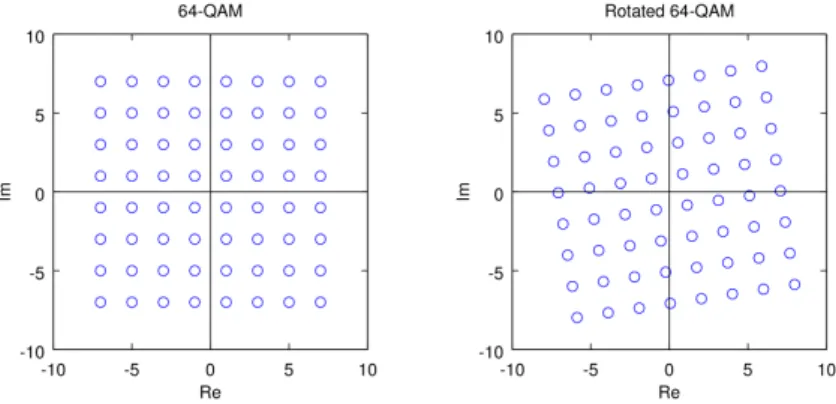
• QAM with up to 256-QAM constellations for increased capacity, in addition to quadrature phase shift keying (QPSK), 16-QAM and 64-QAM. Optional rotation of the QAM constellation for increased ro-bustness in some scenarios.
• Increased FFT sizes used by the orthogonal frequency-division multi-plexing (OFDM) modulation
• Multiple Input Single Output (MISO)
The work performed with respect to analyzing and optimizing algorithms for the physical layer of DVB-T2 mostly involve the so-called bit interleaved coding & modulation (BICM) module. A brief overview of the architecture of a DVB-T2 modulator is provided here, in order to aid the understanding of which stages are involved in the system.
Data fed into a DVB-T2 modulator are encapsulated as MPEG-2 Trans-port Streams or Generic Stream Encapsulation (GSE) streams. These streams are first split into one or more physical layer pipes (PLPs), where each PLP may use different coding and modulation. The data is then passed through an input processing module, which converts the input data streams into DVB-T2 baseband frames. After passing through the input processing module, each baseband frame is processed by the Bit Interleaved Coding & Modula-tion (BICM) module, which contains the following stages (in order):
• FEC coding. DVB-T2 uses an outer Bose-Chaudhuri-Hocquenghem (BCH) code, as well as an inner LDPC code. The resulting FEC blocks can be either 16200 (short code) or 64800 bits (long code) long. 6 different LDPC code rates are available.
• Bit Interleaver (not used for QPSK modulation). Consists of parity bit interleaving, followed by column twist interleaving.
• Mapper, which maps bits onto constellations. Produces cell words.
• Constellation Rotation, if rotated constellations are used. The cell values produced by the mapper are rotated in the complex plane (the angle depends on the modulation used), and the imaginary part is cyclically delayed by one cell.
• Cell Interleaver. Used to uniformly spread the cell words of a FEC block.
• Time Interleaver. In this block, cells of groups of FEC blocks, mak-ing up TI-blocks – which in turn make up Interleavmak-ing Frames – are interleaved.
Figure 4.1: Block diagram of the BICM module of a DVB-T2 modulator [25].
The BICM module is also depicted in figure 4.1. The BICM module is followed by the Frame Builder, the task of which is to assemble T2 frames
from the Interleaving Frames of each PLP, as well as various signaling data. Cells that are going to be included in one OFDM (Orthogonal Frequency-Division Multiplexing) symbol are grouped together in this module. The Frame Builder module also includes frequency interleaving, where the cells belonging to an OFDM symbol are interleaved, providing interleaving in the frequency domain.
The frames produced by the Frame Builder are sent to the OFDM Gener-ation module for further processing. The OFDM GenerGener-ation module includes the following parts:
• MISO processing. This is optional, and allows for the generation of two slightly different output signals for transmission from two groups of transmitters.
• Pilot Insertion. Cells containing reference information are inserted at to the receiver known points in the transmitted signal. Pilots can be, among other uses, used to aid in synchronization and channel estima-tion at the receiver.
• IFFT (Inverse Fast Fourier Transform). The OFDM symbols are mod-ulated here. FFT sizes of 1K, 2K, 4K, 8K, 16K, and 32K are supported by the standard.
• PAPR reduction. This optional part allows us to reduce the Peak-to-Average Power Ratio (PAPR) of the transmitted signal.
• Guard interval insertion. This is where we insert guard intervals, which are a cyclic continuation of the useful part of an OFDM symbol.
• P1 symbol insertion. The P1 symbols are special 1K OFDM symbols that are used mainly to aid the receiver in recognizing and tuning in to the DVB-T2 signal.
The output of the OFDM Generation module is a signal ready for trans-mission. In Paper I, the execution speed of blocks in the BICM, frame builder, as well as OFDM generation stages are analyzed. Results from the analysis drive optimization efforts detailed in Papers II-IV.
4.2
Paper I: Performance analysis of physical layer
In the first paper [43] — an extended conference publication [42] — we profile the software DVB-T2 simulator in order to gain insight into which building blocks of the DVB-T2 standard appear to be the most computationally com-plex, and whether they meet the throughput requirements for DVB-T2 trans-mitters and receivers. The DVB-T2 simulator was mostly developed with correctness in mind, and did not exploit features such as multi-threading and vector instructions to increase performance, however the study does still show the relative complexity of the involved signal processing tasks, and provides guidance for further optimization efforts.
Some signal processing blocks that would be necessary in an actual re-ceiver were not available in the simulator. A simulator often assumes perfect receiver-transmitter synchronization, for example, while an actual receiver needs to perform signal processing to detect and synchronize to the transmit-ted signal. These non-implementransmit-ted blocks were thus left out of this study.
The study in Paper I indicated that most parts of the modulator (trans-mitter) executed well above the required throughputs in a DVB-T2 system. The BCH FEC encoder was the only block that did not reach real-time throughput. Other blocks performed at roughly 1.3 to 160 times the real-time requirements. With modest optimization efforts, the transmitter could likely be executed at real-time performance on a regular multi-core CPU.
The demodulator (receiver) side contained several bottlenecks on perfor-mance. The LDPC decoder performed at only 2% of real-time requirements in some configurations, and the QAM constellation demapper performed at 8% of real-time requirements in the demanding 256-QAM configuration. These blocks were thus very computationally expensive, and would require further optimization, acceleration, and/or faster algorithms to meet real-time requirements. Other blocks were quite fast at roughly double the required throughput or more. As the demodulator contained the most computation-ally complex parts, optimization efforts in Papers II-IV were concentrated there.
4.2.1 Author’s contributions to Paper I
The idea for the article was conceived by me and the co-authors of the paper. The article is based on analyzing the DVB-T2 physical layer simulator, which was to a large part developed by my co-authors Kristian Nybom and Jerker
Björkqvist. Some simulator blocks were also written by graduate students as part of their theses. I was responsible for performing the analysis and writing the majority of the paper.
4.3
Papers II-III: LDPC decoder
In Paper I, it was found that the LDPC FEC decoder was able to perform at below 10% of the real-time requirements on a desktop PC within the existing software simulator. This finding indicated that the LDPC decoder requires heavy optimization and perhaps acceleration on alternative computing plat-forms to reach real-time throughput figures while maintaining sufficiently good error correction capabilities.
A GPU-accelerated LDPC-decoder was first implemented for a confer-ence publication [41]. Paper II [45] extends that conferconfer-ence publication with an implementation targeting SSE SIMD-enabled CPUs. For Paper III [40], we created a version of the decoder supporting the NEON SIMD engine often present in high-end ARM processors.
4.3.1 LDPC codes and decoder algorithms
A brief introduction to LDPC codes and the decoding process follows. A binary LDPC code with a codeword length ofn, withkinformation bits and n−k parity bits is defined by a sparse binary (n−k)×nmatrix H. The
H matrix also describes a bipartite graph with n variable nodes and n−k check nodes.
Each “1” in theHmatrix then denotes an edge between a variable node and check node. Thus, columniofHdescribes to which check nodes variable nodeiis connected, and row idescribes to which variable nodes check node i is connected. The variable nodes then correspond to the codeword bits, and the check nodes define dependencies between variable nodes (parity). A codeword xis valid if HxˆT =0 holds.
LDPC decoding using the optimal maximum likelihood decoder is not feasible for useful code sizes [97]. Typically, these codes are decoded using iterative belief propagation algorithms. In these algorithms, and using the so-called flooding message update schedule [64], we have a two-stage procedure. In the first stage, each variable node sends a message to all connected check nodes on its belief of the bit value corresponding to the variable node in question. In the second stage, the check nodes send messages to the variable nodes.
In each stage, we calculate a new message for each edge in the bipartite graph, i.e. for each 1 in H. A hard decision may be performed in the variable node update, where we obtain the current best guess, xˆ, of the transmitted codeword. The guess is valid if the equationHxˆT =0is fulfilled.
If the equation is not fulfilled, we continue iterating the two stages until it is fulfilled, or until we reach a predefined maximum number of iterations.
The LDPC codes specified in the DVB-T2 standard use very long code-word lengths of 16200 or 64800 bits. The best iterative belief propagation decoder algorithm is the sum-product decoder [73], which is also, however, quite complex in that it uses computationally costly transcendental func-tions. Thus, the sum-product decoder is seldom used in decoder imple-mentations. The min-sum [108, 15] decoder trades some error correction performance for speed by approximating the complex computations of out-going messages from the check nodes. The min-sum algorithm was used in all of our optimized LDPC decoder implementations.
The flooding schedule — where all check nodes are updated at once, followed by the variable node update — was chosen due to its inherent par-allelism. There are, however, also alternative ways to schedule the message passing. These approaches (such as ones proposed by Mansour and Shanbhag [74]; and Sharon, Litsyn, and Goldberger [96]) tend to serialize the decoding algorithm, and are therefore more difficult to parallelize. They do however tend to require significantly fewer iterations than the flooding schedule to recover a codeword.
4.3.2 Designing a parallel decoder architecture
There is a large amount of inherent parallelism in each stage of the decoder algorithm described in the last section. In the first stage, allnvariable nodes can generate messages for their connected check nodes in parallel, while in the second stage, each of the n−k check nodes can generate messages in parallel. Thus, since n and n −k are both in the thousands or tens of thousands, parallelism would not seem to be an issue, even with the hundreds or even thousands of cores found in modern GPUs.
The issue, instead, in LDPC decoding is memory access patterns. Mes-sages between the two stages of the algorithm need to be stored for each edge in the graph. Depending on the order in which messages are stored in mem-ory, at least one stage will require very irregular memory accesses to update messages connected to a single variable or check node, due to the pseudoran-dom layout ofH. This is problematic both on the CPU and GPU platforms, since cache memories can not be used efficiently, and SIMD-like operations become difficult when input and output data is scattered in memory.
Our solution to this issue was to decode up to 128 codewords in one batch, slightly increasing decoding latency while greatly improving memory usage patterns. When decoding several codewords in parallel, for each one in
H, we can store the corresponding message for all codewords consecutively in memory. When decoding, we can then perform the exact same operations for each codeword corresponding to a single variable or check node update
in parallel. Thus, we can read and write messages from/to memory for all or part of the codewords in parallel, greatly increasing performance.
Given that we use 8 bits per message for our LDPC decoder, we need to decode at least 16 codewords in parallel on a CPU using SSE to utilize the 128-bit SIMD registers fully. On the GeForce GTX 570 GPU, we have groups of 16 cores executing the same code in lockstep, i.e also here we should decode a minimum of 16 codewords in parallel. The reason for us decoding up to 128 codewords is due to cache line sizes of the various architectures. The GeForce GPU fetches 128 bytes from RAM memory at a time, when the L1 cache is enabled, while the Intel Core i7 CPU used has a cache line size of 64 bytes. In addition, different variable and check node updates may be executed on different cores on the CPU, or on different processors on the GPU (the GeForce GTX 570 has 15 processors containing 32 cores each).
4.3.3 GPU implementation
We targeted the GPU platform for our first optimized LDPC decoder, due to promising results in earlier works [30]. The target hardware was a fairly capable NVIDIA GeForce GTX 570, with 480 simple CUDA cores, and the implementation was written using the CUDA API in the C language. With this implementation we were able to slightly exceed real-time decoding throughput even when running 50 iterations of the min-sum algorithm with a codeword length of 64800 bits.
4.3.4 Intel CPU implementation
The CPU implementation was benchmarked on an Intel Core i7-950 CPU with 4 physical cores, which consist of two logical cores each due to Intel Hyperthreading technology. This implementation used SSE SIMD for paral-lelism on a single core, i.e. 16 codewords could be decoded in parallel using SIMD instructions. The decoder was also multi-threaded in order to scale to several processor cores. When using all cores, the implementation reached throughputs that were roughly 25% of the obtained GPU throughputs.
4.3.5 ARM CPU implementation
For Paper III [40], we implemented the same LDPC decoder on a Hardkernel ODROID-X development board, which features a Samsung Exynos 4 SoC containing four ARM Cortex-A9 cores. This SoC is found in several mobile phones as well, and served as an indicator of how well software decoding of LDPC would work on a mobile platform compared to a desktop computer system.
Porting the code for the Intel SSE implementation of the decoder was straightforward, as many instructions found in SSE have counterparts in

![Figure 3.2: A streaming multiprocessor (SM) in the Fermi architecture, as depicted in [84]](https://thumb-us.123doks.com/thumbv2/123dok_us/10056207.2905319/36.892.306.581.487.946/figure-streaming-multiprocessor-sm-fermi-architecture-depicted.webp)
![Figure 4.1: Block diagram of the BICM module of a DVB-T2 modulator [25].](https://thumb-us.123doks.com/thumbv2/123dok_us/10056207.2905319/41.892.175.713.183.337/figure-block-diagram-bicm-module-dvb-t-modulator.webp)
![Figure 5.1: Placement of the Raspberry Pi-based sensor nodes (RPi 1 to 4 in figure), as well as the reference RFeye Node in Turku, Finland [49].](https://thumb-us.123doks.com/thumbv2/123dok_us/10056207.2905319/59.892.174.715.365.787/figure-placement-raspberry-sensor-figure-reference-rfeye-finland.webp)