Cite this article as: Kaveh, A., Vazirinia, Y. "An Upgraded Sine Cosine Algorithm for Tower Crane Selection and Layout Problem", Periodica Polytechnica Civil Engineering, 2020. https://doi.org/10.3311/PPci.15363
An Upgraded Sine Cosine Algorithm for Tower Crane Selection
and Layout Problem
Ali Kaveh1*, Yasin Vazirinia1
1 School of Civil Engineering, Iran University of Science and Technology, Narmak, Tehran, P.O. Box 16846-13114, Iran * Corresponding author, e-mail: [email protected]
Received: 30 November 2019, Accepted: 30 January 2020, Published online: 27 February 2020 Abstract
Tower crane is the core construction facility in the high-rise building construction sites. Proper selection and location of construction tower cranes not only can affect the expenses but also it can have impact on the material handling process of building construction. Tower crane selection and layout problem (TCSLP) is a type of construction site layout problem, which is considered as an NP-hard problem. In consequence, researchers have extensively used metaheuristics for their solution. The Sine Cosine Algorithm (SCA) is a newly developed metaheuristic which performs well for TCSLP, however, efficient use of this algorithm requires additional considerations. For this purpose, the present paper studies an upgraded sine cosine algorithm (USCA) that employs a harmony search based operator to improve the exploration and deal with variable constraints simultaneously and uses an archive to save the best solutions. Subsequently, the upgraded sine cosine algorithm is employed to optimize the locations to find the best tower crane layout. Several benchmark functions are studied to evaluate the performance of the USCA. A comparative study indicates that the USCA performs quite well in comparison to other recently developed metaheuristic algorithms.
Keywords
Tower Crane Layout, Upgraded Sine Cosine Algorithm, construction site layout, global optimization, local search, tower crane selection
1 Introduction
Tower cranes are fundamental components in lifting heavy and colossal items at construction sites because of being versatile tools. They can handle objects, including steel beams, prefabricated components, mixed concrete, and heavy tools such as equipment and various machinery, to name but a few. On the other hand, recent improvements in technologies provided new opportunities to increase the use of prefabrication and modularization in large buildings [1]. According to the assembly speed of these structures in the construction process, the transportation of prefabri-cated elements is remarkably essential. In terms of safety and accessibility, the location of tower cranes is extremely important for being capable of handling both colossal and heavy materials on the site. In fact, the selection of tower cranes location can be of great importance in the total effi-ciency of a construction site because it has overlap with the Construction Site Layout Problems (CSLPs). In order to meet their final goals such as dropping various construc-tion materials between demand and supply points, reach-ing and coverreach-ing their job in a way that it can cover all
necessary parts of the buildings in the site is a necessary prerequisite. Subsequently, for any successful tower crane locating, some considerations such as transportation dis-tances and operating costs are supposed to be taken into account. In this vein, the tower crane layout should be carefully optimized to meet the above-mentioned goals. Therefore, the better layout of both tower cranes and the locations of material supply we have, the more productive efficiency we will have in construction sites.
Moreover, tower crane layout planning (TCLP) is con-sidered as a combinatorial optimization problem [2]. Clearly, in the last few decades, much great research has been conducted so that researchers can figure out the best way of approaching combinatorial Construction Engineering Optimization Problems (CEOPs). As a result of which, researchers have extensively used metaheuris-tics in order to uncover the tower crane selection and lay-out problems. Metaheuristics are well-known and practi-cal methods for solving complex optimization problems. These algorithms optimize iteratively by mimicking the
biological evolution, artificial intelligence, nervous sys-tems, statistical mechanics, mathematical and physical sciences, and classic heuristics so that the results approach the optimal solutions [3]. The Sine Cosine Algorithm (SCA) [4] is one of the recently developed optimization techniques inspired by the sine and cosine mathematical functions. Although there are several techniques to solve TCSLP before, they suffer problems like low convergence speed and easily fell into the local optima. On the other hand, SCA is a new type of algorithm to encounter this problem. Since the SCA has poor stability, and the exper-imental results also have plenty of room for optimiza-tion, therefore, this paper proposes an algorithm, called Upgraded Sine Cosine Algorithm (USCA), that has bet-ter stability and fasbet-ter convergence than the original SCA. This algorithm employs the SCA pattern and updates it considering the above points. For this purpose, a memory is added to save the best agents and a harmony based side constraint handling approach is utilized. Incorporating these approaches a new variant of SCA, namely USCA, is proposed to solve the TCSLP. The experimental results intimate that USCA provides better performance than its standard version.
Section 2 presents a brief review of the related works; Section 3 explains the optimization algorithms. Some opti-mization problems are described in Section 4. Experimental studies are presented in Section 5, and the results are dis-cussed, and conclusions are derived in Section 6.
2 Literature review
In this research, the topics of Metaheuristic Algorithms and Sine Cosine Algorithm (SCA), besides Tower Crane selection and layout problem is meticulously elaborated upon in the following paragraphs.
2.1 Metaheuristic algorithms
In the last few decades, there has been a considerable grow-ing interest in metaheuristic algorithms in order to discover better solutions for problems involved in our daily lives. As a result of this, a verity of metaheuristics – with various attitudes and aspects – are developed, and at the same time, they are utilized in virtually all fields. Efficiency is one of the main goals of these optimization methods, which can eventually lead to a global solution. These algorithms are neither problem-specific nor depend on the derivatives of the objective functions. The industry and academic com-munity are tremendously paying attention to this field of knowledge [5]. Being a global method, metaheuristic
methods trying to stimulate natural phenomena (particle swarm optimization [6], genetic algorithm [7], ant lion optimizer (ALO) [8], Cyclical Parthenogenesis Algorithm (CPA) [9]), socio-cultural behaviors (socio evolution and learning optimization (SELO) [10] and Ideology Algorithm (IA) [11]), or physical phenomena (colliding bodies opti-mization [5], gravitational search algorithm (GSA) [12], charged system search (CSS) [13]). Metaheuristic optimi-zation methods have two unique, distinctive aspects: explo-ration and exploitation. Exploitation focuses on finding the best available solutions and the best likely points; it also grants optimizers to scrutinize the search space, usually by randomization, in a highly efficient way. Exploitation involves generating diverse solutions for exploring the search space globally [5]. Mirjalali [4] introduced the sine cosine algorithm (SCA) based on mathematical formula-tions of sine and cosine funcformula-tions, and this algorithm is applied to various fields of optimization widely. Previous studies have shown that SCA is able to yield encouraging results, in comparison with some other metaheuristic rithms. Moreover, SCA, among other metaheuristic algo-rithms, has proven to be a promising method for resolving across different engineering and scientific problems.
2.2 Tower crane selection and layout problem
During the last few decades, researchers have been obsessed with finding the best method to address problems related to the Construction Engineering Optimization Problems (CEOPs) [14]. Since the main function of tower cranes are for transporting bulky construction mate-rials [15], and also material transportation is a complex activity during the building construction process; thus, hoisting and lifting bulky materials needs meticulous planning [16]. As a result, during the last twenty years, TCLP is applied as a method to find out the best possi-ble location for supply points and tower cranes within a building construction site to enable to meet minimum time objectives efficiently and effectively. Zhang et al. [17] expanded an analytic model taking into account the hook traversal time and then selecting a Monte Carlo simulation for optimizing the tower crane’s location. Nevertheless, their assumption was based on a single crane, and also, the impact of supply points location on lifting requirements without taking into consideration the travel time.
Tam and Tong [18] have utilized an artificial neural net-work model in order to anticipate tower crane operations. In this vein, they also applied a model based on a genetic algorithm for optimizing the layout of tower crane and
supply points [19]. The approach adopted by Tam et al. [19] afterward was utilized in quite a few papers to show the effectiveness of their models. For example, Huang et al. [16] applied a mixed-integer linear programming (MILP) for optimizing the tower crane and supply points location, Kaveh and Vazirinia [20] have made a compar-ison between the performance of physical inspired algo-rithms on this model and have discussed the results.
Lien and Cheng [2] utilized a model similar to Huang et al. [16] but with a different solution approach employ-ing particle bee algorithm. Also, they expanded Huang’s single tower crane model to a model with a predetermined number of tower cranes. Wang et al. [21] integrated the firefly algorithm with building information model (BIM) for solving the tower crane selection and layout problem by the objective of minimum cost-weighted hook traversal time. In addition, Marzouk and Abubakr [22] incorporated the AHP to select the best tower cranes and the Genetic Algorithm for minimizing the total operation cost of the tower crane. Karan and Irizarry [23] combined the appli-cation of the GIS and BIM for arranging tower cranes with the objective of minimal conflict.
3 Formulation of optimization algorithms 3.1 Metaheuristic algorithm
The Sine Cosine Algorithm (SCA) is proven to have a lot of capabilities which are as follow: to explore various areas in the search spaces, to exploit likely areas of the search space while optimizing efficiently, for converging to the global optimum, and also escape from the local optima, to name but a few [4]. The SCA initiates with a set of ran-dom solutions and moves toward or outwards the best solution using sine and cosine functions. Whenever the functions of sine and cosine have a value smaller than -1 or more than 1, various areas in the search space will be considered. Additionally, if the process returns the value between -1 and 1 from sine and cosine, promising areas of the search space will be exploited. As for SCA, the number of parameters – which are required to be optimized – bring about defining the dimension of the search space. The user determines the number of search agents. The current solu-tions have randomly initialized posisolu-tions (Xi) that will be adapted to the former positions by Eq. (1) to guarantee that the solutions constantly will have positions updated according to the optimum solution have been achieved.
X X r r r P X r X r r r P X ii i t it it it it it + = +
( )
− < +( )
− 1 1 2 3 4 1 2 3 0 5 sin , . cos ,rr4≤0 5 . (1)In order to make the process of convergence and diver-gence in the search agents smooth, four variables – random and adaptive variables – are combined. As a result of this, the balance of exploration and exploitation holds in getting the best result of regions of the research space. Finally, a globally-acceptable result can be obtained. By doing so, the range of sine and cosine will be adjustable according to the definition of the parameter r1 in the Eq. (2). Hence, the parameter r1 indicates the region of next position (or movement orientation), so the result likely would be either outside of the space, which is between destination and solution or inside it.
Since sine and cosine occur in a cyclic form, it enables solution to be positioned again along another solution; it explains the space exploitation between two solutions. By altering the domain of sine and cosine functions, the solutions should be able to explore the outside search space between their corresponding destinations. If we have a ran-domly-selected number for r2 in range [0 2π] in Eq. (1), the random location is obtainable for both inside and outside. Thus, the random parameter r2 explains the distance of movement outwards or towards the destination. By doing so, this process makes certain that the search space of exploitation and exploration can be separate. The random parameter r3 assigns a random weight to the destination for emphasizing (r3 > 1) or deemphasizing (r3 > 1) the influ-ence of destination on defining the distance. Ultimately, the parameter r4 changes equally among the components of sine and cosine in Eq. (1).
r a t a1 = − T (2)
Furthermore, Algorithm 1 shows the pseudo-code of the SCA algorithm. The process of optimization in the SCA begins through a set of randomly generated solutions. Subsequently, the best-achieved solutions up to now are saved by the algorithm; the algorithm determines it just as the best destination point and provides up-to-date solutions accordingly. At the same time, the domain functions of sine and cosine are brought up to date, so that the exploitation
Algorithm 1 Sine Cosine Algorithm While (< maximum number of iterations)
Randomly initialize the set of search agents (Xi) Do
Evaluate the search agents by the objective function Update the best solution obtained so far (P = X) Update r1, r2, r3, and r4
Update the position of search agents using Eq. (1) End While
related to search space can be emphasized whenever the iteration counter goes up. The SCA algorithm automati-cally brings the optimization process to an end as the high-est iteration number is lower than the iteration counter, vice versa. The details have been elaborated in [4].
3.2 Upgraded Sine Cosine Algorithm
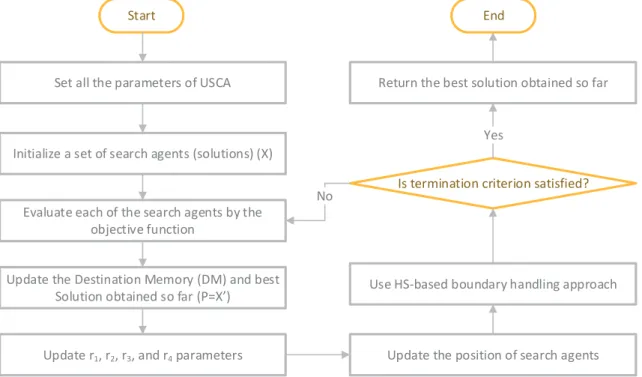
The prominent aim of this section is introducing an upgraded version for the SCA, Upgraded Sine Cosine Algorithm (USCA), which improves the SCA getting faster with more reliable solutions. By adding the best agents memory (AM), the convergence speed of USCA can be increased with respect to the standard SCA. Moreover, changing violated components of search agents in the case of boundary violation using a side constraint handling approach based on harmony search helps the USCA in escaping from local optima [24]. The flowchart of the USCA is presented in Fig. 1, and the processes asso-ciated with the enhancement of SCA are elaborated in the following:
Step 1: Initialization
First, in the USCA, parameters will set, and then the initial locations of the agents (solutions) are randomly determined in the search space.
Step 2: Solution evaluation
According to each agent, the process starts calculating the objective function value.
Step 3: Saving
Enhancing the performance of algorithm without esca-lating the computational cost can be achieved through considering a memory for saving some of the histori-cal-best search agents and regarding their objective func-tion values [13]. In this vein, the best agents memory (AM) should be introduced, for saving some of the best solutions up to now. Then, AM members will be used as destination agents randomly.
Step 4: Updating the positions of the agents
According to the sine cosine concept, the positions are updated by Eq. (1).
Step 5: Side constraints handling
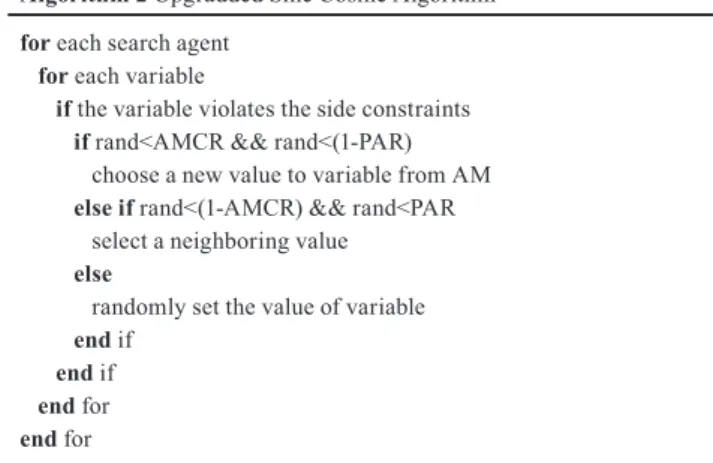
Though by moving the agent in the search space, a bet-ter solution can be obtained, still there is a possibility to violate the side constraints. Common side constraint han-dling approaches may lessen the exploration capability of the algorithm. Moreover, during the optimization process, it is important to balance exploration and exploitation. Regarding these issues, a harmony search-based side con-straint-handling approach is utilized to regenerate the vio-lated components [13, 24]. As for this method, in order to identify whether the violated component should be altered with the equivalent component of a random AM member with AMCR (Agent Memory Considering Rate) probabil-ity (in range [0 1]), or it has to be determined randomly within the search space by the probability of (1−AMCR). Start
Set all the parameters of USCA
Is termination criterion satisfied? No
Yes End
Evaluate each of the search agents by the objective function
Initialize a set of search agents (solutions) (X)
Update the Destination Memory (DM) and best Solution obtained so far (P=X’)
Update r1, r2, r3, and r4 parameters Update the position of search agents Return the best solution obtained so far
Use HS-based boundary handling approach
In addition, still, when the component of an AM member is chosen, we have a possibility such as Pitch Adjusting Rate (PAR) specifying whether this value needs to be altered with a neighboring value or not. If a value is cho-sen from the AM, the pitch adjusting process will be per-formed. The value of (1−PAR) sets inaction rate, and PAR adjusts the rate of selecting a value from the neighboring of the best AM. Algorithm 2 shows the process of han-dling side constraints. The readers may refer to [13, 24] for additional details.
Step 6: Terminating condition check
The process of optimization ends following a fixed num-ber of iterations. If this criterion does not meet its goal, steps 2 to 6 will be repeated for another round of iteration.
As far as this study is concerned, any condition can be considered for termination and here the optimization pro-cess terminates after fixed number of iterations.
4 Optimization problems
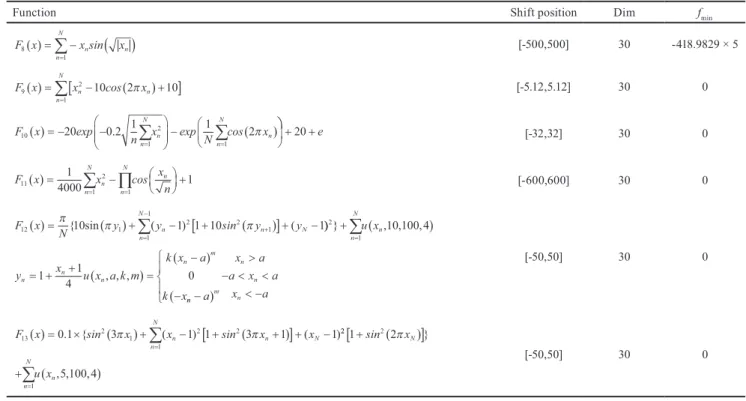
In metaheuristic optimization, many test cases are usually applied to illustrate the performance of algorithms because of the stochastic nature of these algorithms. There is an adequate collection of test functions; therefore, a group of models should be applied to ascertain that the best find-ings do not happen by chance. Nevertheless, still, there is a lack of a vivid definition of suitability for a set of bench-mark case studies. Thus, this research tried to evaluate the USCA algorithm on mathematical test functions with var-ious characteristics. The set of test problems utilized here encompasses three groups: uni-modal and multi-modal test functions, and TCSLP. Then, three real-sized TCSLP case studies are solved by the ASCA algorithm as well.
4.1 Mathematical test functions
Tables 1 and 2 present the formulation of the mathematical test functions. There is just one global optimum without any local optima in the first family of test functions. This makes them very suitable to test the exploitation and convergence speed of algorithms. The other group of test functions, has although multiple local optima along with a globally opti-mum solution. These characteristics are advantageous for getting the explorative ability of an algorithm and testing local optima avoidance. The ASCA algorithm is superior to its standard version and some well-known algorithms like Whale Optimization Algorithm (WOA), Vibrating Particles System (VPS), Slap Swarm Optimization (SSA), Colliding Bodies Optimization (CBO), and PSO for verifi-cation of the results.
Algorithm 2 Upgradded Sine Cosine Algorithm
for each search agent for each variable
if the variable violates the side constraints if rand<AMCR && rand<(1-PAR) choose a new value to variable from AM elseif rand<(1-AMCR) && rand<PAR select a neighboring value
else
randomly set the value of variable end if
end if end for
end for
Table 1 Uni-modal test functions
Function Shift position Dim fmin
[-100,100] 30 0 [-10,10] 30 0 [-100,100] 30 0 [-100,100] 30 0 [-30,30] 30 0 [-100,100] 30 0 [-1.28,1.28] 30 0 F x x n N n 1 1 2 ( )= =
∑
F x x x n N n n N n 2 1 1 ( )= + = =∑
∏
F x x n N n N n 3 1 1 2 ( )= = −∑ ∑
F x4( )=max xn{ n,1≤ ≤n N} F x x x x n N n n n 5 1 1 1 2 2 2 100 1 ( )= ( − ) +( − ) = − +∑
[ F x x n N n 6 1 2 0 5 ( )= ([ + ]) =∑
. F x nx random n N n 7 1 4 0 1 ( )= + [ ] =∑
Table 2 Multi-modal test functions
Function Shift position Dim fmin
[-500,500] 30 -418.9829 × 5 [-5.12,5.12] 30 0 [-32,32] 30 0 [-600,600] 30 0 [-50,50] 30 0 [-50,50] 30 0 F x x sin x n N n n 8 1 ( )= −
(
)
=∑
F x x cos x n N n n 9 1 2 10 2 10 ( )= [ − ( )+ ] =∑
πF x exp n x exp N cos x
n N n n N n 10 1 2 1 20 0 2 1 1 2 ( )= − − − ( ) = =
∑
∑
. π +20+e F x x cos x n n N n n N n 11 1 2 1 1 4000 1 ( )= − + = =∑ ∏
F x N y y sin y y n N n n N 12 1 1 1 2 2 1 10 1 1 10 1 ( )= ( )+ − [ + ( )]+ − = − +∑
π π π { sin ( ) ( )) } , , , , , , 2 1 10 100 4 1 1 4 0 + ( ) = + + ( )= − ( ) − =∑
n N n n n n n m u x y x u x a k m k x a k xnn m n n n a x a a x a x a − ( ) > − < < < − F x sin x x sin x x n N n n N 13 2 1 1 2 2 0 1 3 1 1 3 1 1 ( )= × ( )+ − [ + ( + )]+ − =∑
. { π ( ) π ( )22 2 1 1 2 5 100 4 + ( ) [ ] + ( ) =∑
sin x u x N n N n π } , , ,4.2 Tower crane selection and layout problem (TCSLP)
The workspace of construction sites located in the urban context is usually very limited, and the spaces for material storage are comparably small. In this section, the mathe-matical formulation of a constrained tower crane selection and layout problem (TCSLP) with discrete and continuous variables are investigated to demonstrate the efficiency of the USCA algorithm, incorporating the sine cosine algo-rithm. In order to figure out the best approach in select-ing the proper tower crane and findselect-ing the best layout, a number of instances have been studied. In this model, a single tower crane transfers materials from the opti-mized location of supply yard to the demand points. The mathematical formulation and constraints are presented in Eqs. (3)–(19):
4.2.1 Hook movement time
Having a calculated total material transportation time by a tower crane, the movement time of the hook is an import-ant parameter. Therefore, in order to have an accurate time parameter, the hook traversal time is divided up into vertical and horizontal paths to show all operation cost. Figs. 2 and 3 illustrate the comparable movement path with various directions. Travel span, which is a distance between demand points and supply, is measured through Eqs. (3)–(5) referring to Figs. 2 and 3.
Fig. 2 Radial and tangential movements of the crane hook
ρ
(
De Crj,)
= (Xj −XCr' )2+(Y Yj− Cr' )2 (3)ρ
(
Su Cr,)
= (XSu' −XCr' )2+(YSu' −YCr' )2 (4) L= (XSu' −Xj)2+(YSu' −Yj)2 (5)The continuous type parameter "α" – which has to do with the tower crane operator's capability in controlling it – specifies the degree of hook movement coordination in tangential and radial orientations. As a result of this, the time of both vertical and horizontal movements of hook is computed in Eqs. (8) and (9), respectively.
T De Cr Su Cr V j kr j kr , , , = ρ
(
)
−ρ(
)
(6) T V L De Cr Su Cr De Cr Su Cr j k k j j , cos , , * , * , =(
)
(
)
−(
)
(
)
− − − 1 2 1 2 2 2 ρ ρ ρ ρ < −( )
< , cos 0 1 θ π (7) Tj kh, =max{
Tj kr, +Tj k,}
+α* min{
Tj kr, +Tj k,}
(8) T Z Z V j kv j De Su kv , = − (9)For the tower crane, all the travel time between supply area and demand point j through the tower crane type k
can be estimated by applying Eq. (10), Tj,k, this result is
achievable by defining the continuous parameter called β
which is necessary for defining the coordination degree of both horizontal and vertical planes according to the hook's movement.
Tj k, =λ. max
[
{
Tj kh, +Tj kv,}
+β.min{
Tj kh, +Tj kv,}
]
(10)It is worth bearing in mind that the hook functioning properly and changing the location of tower crane are greatly affected by the state of circumstances such as the level of operator's proficiency and the level of visibility of surrounding due to the climate; so, these factors can probably decrease the overall efficiency as well. In other words, the more operation takes time, the more likely the tower crane should be moved to another place [16].
If something does not allow the operator to see prop-erly, the total travel time needs to be increased accord-ingly. In this regard, another numerical parameter λ should be taken into account when it comes to the total time of hook travel time and tower crane, see Eq. (10). Various
λ needs to be utilized for different locations of crane k
for determining location-specific effects in a construc- tion site. Having high-tech vision tools in tower cranes help operators to see better and at the same time help the operation to carry out faster which means a smaller λ is applicable [25].
4.2.2 Objective function
The TCSLP is formulated as a mixed-integer nonlinear programming (MINLP) facility layout design problem (FLDP). The objective function (Eq. (11)) is represented as the total cost of material transportation, which includes the fixed cost of tower crane and operational cost; these costs are highly contingent upon the actual amount of materials transporting between the location of supply area and demand points. This model not only optimizes the lay-out of the tower crane and supply area but also considers the selection of a proper type of tower crane.
minTC T OC FC j J k K jk jk k k K k k = + = = =
∑∑
∑
1 1 1 δ ℵ (11)4.2.3 Demand satisfaction constraints
To make sure that every demand j is served by supply point using tower crane type k, the constraints Eqs. (12) and (13) are employed.
k K jk j J =
∑
≥ ∀ ∈{ }
1 1 1 δ , , (12) j J jk M k k K =∑
≤ ∀ ∈{ }
1 1 δ ℵ , , (13) 4.2.4 Assignment constraintMoreover, Eq. (14) guaranties the assignment of maximum one tower crane for each tower crane location.
k K k =
∑
= 1 1 ℵ (14) 4.2.5 Capacity constraintsIn the process of proper tower crane selection and optimal layout of the tower crane and supply yard, the crane has to meet the capacity related constraints Eqs. (15) and (16). Whereby during the travel of materials from supply yard to the demand points the load moment across the jib must be less than the maximum load moment capacity (Eq. (15)), which can be approximated as the product of load (weight of demand) and distance from mast ρ. Also, the maximum value of demands' weight has to meet tower crane's overall capacity, which is guaranteed by Eq. (15).
max δ Weight ρ δ Weight ρ ℵ jk j jk j j k k Su Cr De Cr MLM j , , , ,
(
)
(
)
(
(
)
)
{
}
≤ ∀ ∈ 11 1 , , J k K{ }
∈{ }
(15) max , , , j∈{ }1J(
Weightj)
≥Capk ∀ ∈{
k{ }
1K (16) 4.2.6 Covering constraintsAll of the supply and demand points should be covered by the radius and height-under-hook of the tower crane to ensure the physical reachability of these points by the crane (Eqs. (17) and (18)).
max ρ Su Cr ρ De Cr Ra j J k K j k , , , , , ,
(
)
(
)
{
}
≤ ∀ ∈{ }
∈{ }
1 1 (17) max , , , j∈{ }1J( )
Zj ≥HUHk ∀ ∈{
k{ }
1K (18)4.2.7 Area size constraint
The dimensions of all facilities (here supply yard) have to meet the given area and size requirements. This circum-stance is controlled by defining the Eqs. (19) and (20).
1 µSu µ Su Su x Su x Su A L L ≤ ≤ (19) L A L Su y Su Su x = (20) 4.2.8 Side constraints
Various side constraints that occur in facility layout design can be included simply into TCSLP. In case that two departments (e.g., tower crane, supply yard or building blocks) should be placed distanced from each other. It may be specified that two departments should be distanced with
some minimum predefined distance Æ > 0; this condition
is modeled by combining Æ to the left hand side of Eqs. (21)–(23). This also can be generalized along directions X and Y. max XCr XSu LCr k L Y Y L L x Su x Cr Su Cr k y Su y ' ' , ' ' , , max − − + − − + ≥ 2 2 ∅ ∅ ∅
{
Cr kmin, , Sumin}
,∀ ∈k{ }
1,K (21) max XCr Xo LCr k L Y Y L L x o x Cr o Cr k y o y Cr km ' , ' , , , max − − + − − + ≥ ∅ 2 2 iin o min o O k K , , , , ∅{
}
∀ ∈{ }
∈{ }
1 1 (22) ∅Cr kmax, ≥o∈{ },O{
XCr−X Yo Cr−Yo}
∀ ∈k{ }
K ' ' min , , , 1 1 (23) max m XSu Xo LSu L Y Y L L x o x Su o Su y oy ' ' , − − − − − − ≥ 2 2 a ax{
∅Sumin,∅omin}
,∀ ∈o{ }
1,O (24) Non-rectangular departments or obstacles (build-ing blocks) can be modeled employ(build-ing well-sized fixed flawless artificial rectangular facilities (dividing build-ings into rectangular departments). For modeling of the fixed departments (building blocks), only their actual width, length, and centroid should be determined, i.e., ifo is fixed, (Lox; L
oy) and (Xo; Yo) are known parameters. Of
course, departments with fixed orientation or shape can be modelled as well. 0 2 1 ≤XCr+LCr k + ∅ ≤L ∀ ∈k
{ }
K x o min x ' , , , (25) 0 2 1 ≤YCr+LCr k + ∅ ≤L ∀ ∈k{ }
K y o min y ' , , , (26) 0 2 ≤XSu+LSu+ ∅ ≤L x Su min x ' (27) 0 2 ≤YSu+ ALSu + ∅ ≤L Su x Sumin y ' (28)5 Exploratory study (results and discussion)
For the sake of completeness of the investigations, the results of USCA is compared with several algorithms: the standard SCA algorithm, some well-known algorithms such as the PSO [6] Vibrating Particles System (VPS) algorithm [24], Colliding Bodies Optimization (CBO) [5], Whale Optimization Algorithm [26], Salp Swarm Algorithm (SSA) [27]. After several initial pilot experi-ments in MATLAB R2017a for determining the suitable parameter settings, the algorithms are employed to find the optimal solution.
Regarding the central limit theorem, it is a prerequisite for the sample size to be at least 30 to achieve statistically significant data. By increasing the size of a sample, its dis-tribution converges to normal disdis-tribution [28].
Three instances of tower crane selection and layout problem have been studied in this research.
For solving the mathematical test functions, the num-ber of search agents is set to 30 for determining the global optimum after 500 iterations. Also, to solve the TCSLP case studies 1 to 3, the number of search agents is set to 50, after 500 iterations.
5.1 Results of the algorithms on mathematical test functions
5.1.1 Results of the algorithms on uni-modal test functions
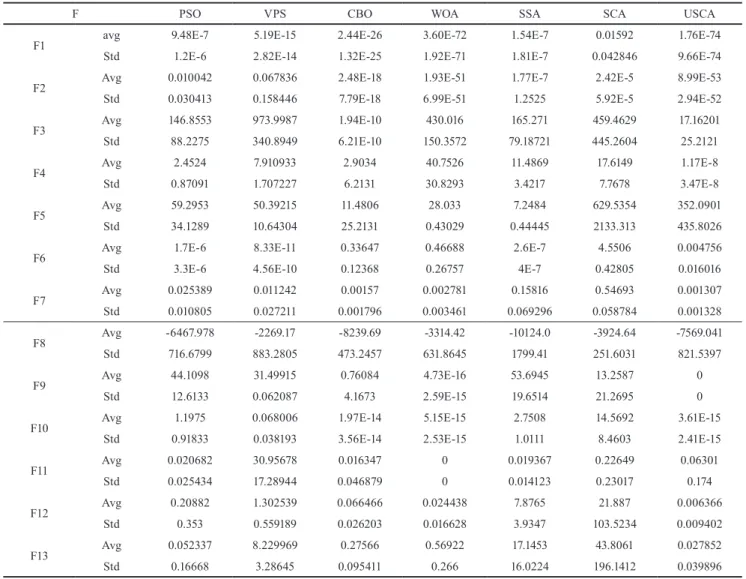
Since functions F1 to F7 have just one global optimum, they are uni-modal. These functions make it possible to assess the exploitation ability of the analyzed metaheuristic algo-rithms. According to Table 3, USCA outperforms the rest of metaheuristic algorithms in most of the analyzed cases. Especially, it is either the most effective optimizer for F1, F2, F4, and F7 functions or at least the best second opti-mizer among the majority of test problems. Therefore, the current algorithm can come up with excellent exploitation.
5.1.2 Results of the algorithms on multi-modal test functions
In contrast to unimodal functions, multimodal functions contain many local optima, in which their number esca-lates rapidly with the number of variables, in other words,
problem size. Subsequently, as far as the purpose is assess-ing the exploration capability of an optimization algorithm, this type of test problem can be handy. The findings pre-sented in Table 3 for functions F8–F13 indicate that USCA not only outperforms SCA but also it has better exploration performance in comparison to majority of the algorithms (F9, F10, F12, and F13). This is because of integrated local search mechanisms into the SCA algorithm, which guides this algorithm with this aim for getting the global optimum.
5.2 Results of the algorithms on Tower crane selection and layout problems
In this section, the performance of the USCA and SCA are compared with newly developed metaheuristic algo-rithms (WOA and SSA) and some known metaheuris-tic algorithm from the literature with regard to their efficiency in resolving TCSLP. In order to explore the effectiveness of the suggested USCA algorithm on the
Table 3 Results of algorithms for the uni-modal and multi-modal benchmark functions
F PSO VPS CBO WOA SSA SCA USCA
F1 avg 9.48E-7 5.19E-15 2.44E-26 3.60E-72 1.54E-7 0.01592 1.76E-74
Std 1.2E-6 2.82E-14 1.32E-25 1.92E-71 1.81E-7 0.042846 9.66E-74
F2 Avg 0.010042 0.067836 2.48E-18 1.93E-51 1.77E-7 2.42E-5 8.99E-53
Std 0.030413 0.158446 7.79E-18 6.99E-51 1.2525 5.92E-5 2.94E-52
F3 Avg 146.8553 973.9987 1.94E-10 430.016 165.271 459.4629 17.16201 Std 88.2275 340.8949 6.21E-10 150.3572 79.18721 445.2604 25.2121 F4 Avg 2.4524 7.910933 2.9034 40.7526 11.4869 17.6149 1.17E-8 Std 0.87091 1.707227 6.2131 30.8293 3.4217 7.7678 3.47E-8 F5 Avg 59.2953 50.39215 11.4806 28.033 7.2484 629.5354 352.0901 Std 34.1289 10.64304 25.2131 0.43029 0.44445 2133.313 435.8026
F6 Avg 1.7E-6 8.33E-11 0.33647 0.46688 2.6E-7 4.5506 0.004756
Std 3.3E-6 4.56E-10 0.12368 0.26757 4E-7 0.42805 0.016016
F7 Avg 0.025389 0.011242 0.00157 0.002781 0.15816 0.54693 0.001307 Std 0.010805 0.027211 0.001796 0.003461 0.069296 0.058784 0.001328 F8 Avg -6467.978 -2269.17 -8239.69 -3314.42 -10124.0 -3924.64 -7569.041 Std 716.6799 883.2805 473.2457 631.8645 1799.41 251.6031 821.5397 F9 Avg 44.1098 31.49915 0.76084 4.73E-16 53.6945 13.2587 0 Std 12.6133 0.062087 4.1673 2.59E-15 19.6514 21.2695 0
F10 Avg 1.1975 0.068006 1.97E-14 5.15E-15 2.7508 14.5692 3.61E-15
Std 0.91833 0.038193 3.56E-14 2.53E-15 1.0111 8.4603 2.41E-15
F11 Avg 0.020682 30.95678 0.016347 0 0.019367 0.22649 0.06301 Std 0.025434 17.28944 0.046879 0 0.014123 0.23017 0.174 F12 Avg 0.20882 1.302539 0.066466 0.024438 7.8765 21.887 0.006366 Std 0.353 0.559189 0.026203 0.016628 3.9347 103.5234 0.009402 F13 Avg 0.052337 8.229969 0.27566 0.56922 17.1453 43.8061 0.027852 Std 0.16668 3.28645 0.095411 0.266 16.0224 196.1412 0.039896
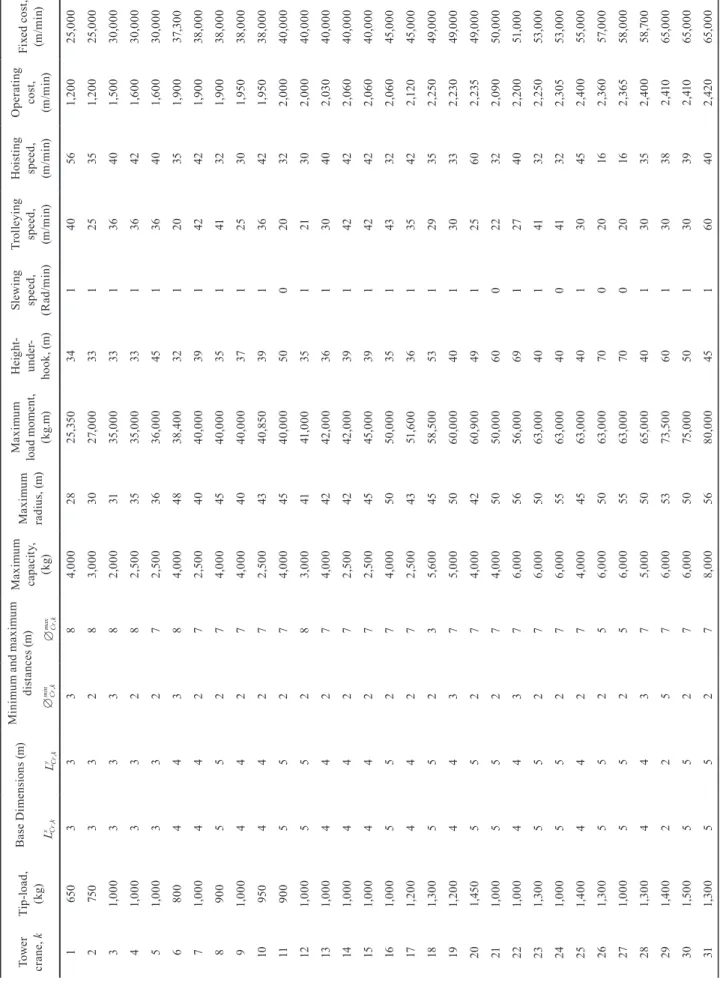
TCSLP three real-sized structures presented by Kaveh and Ilchi Ghazaan [29] are used. In all of these exam-ples, all frame members are line elements, and the height of all stories are equal to 3.5 m. Also, the information of 72 tower crane alternatives are presented in Appendix A1. The design variables are consists of an integer able for tower crane selection and continuous type vari-ables to determine the location of tower crane and supply point and dimensions of supply yard. In all these cases the required area of supply yard ASu is equal to 40 m2, and
the safety distance of building blocks Æomin and supply
yard ÆSumin are considered equal to 0 and 2 meters
respec-tively. Also, the rate μSu is equal to 2 in all cases.
5.2.1 Results and discussion for Case 1
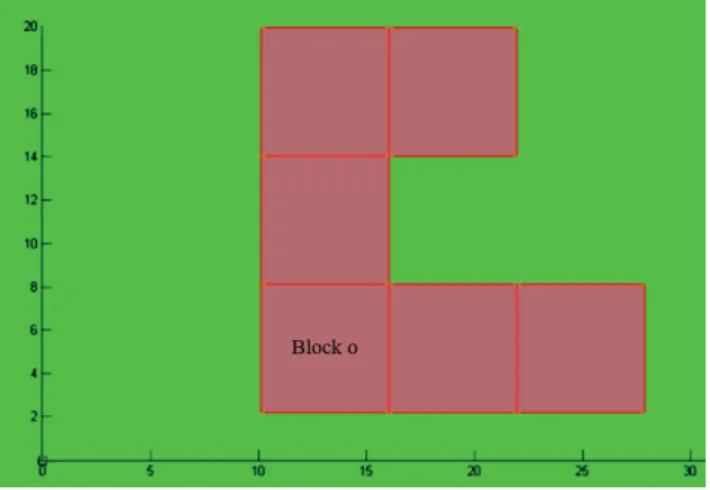
A four-story steel frame with AISC W-sections is given consisting of 273 members. The plan view of this crane layout case is illustrated in Fig. 4. Groping of the members and their weights are shown in Tables 4 and 5, respectively.
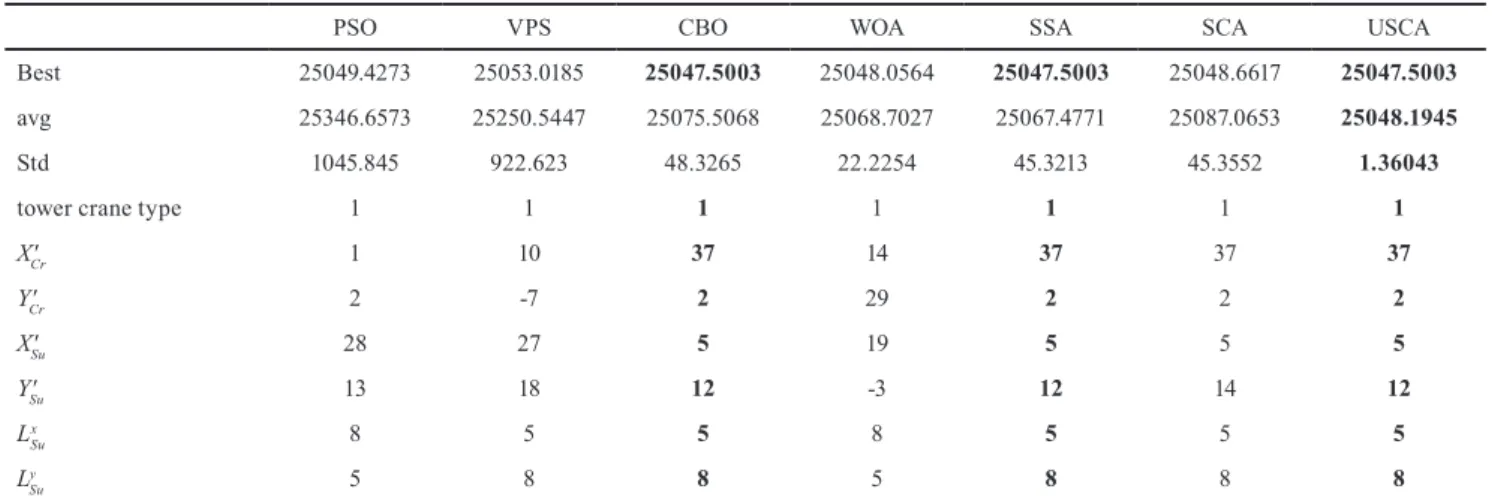
Table 6 is an abridged form of the numerical findings for the algorithms. For each algorithm, the findings encom-pass the best cost, average, standard deviation, and best. The results of all the algorithms are shown in this table for comparison. In addition, Table 6 is also an abridged form of the best possible solutions from 30 independent runs which point out – as for solution quality – the superior per-formance of the USCA approach compare with SCA and other approaches.
The summary of the best-found solutions in Table 6 indi-cates that the performance of the USCA method is superior to SCA and other methods in terms of solution quality.
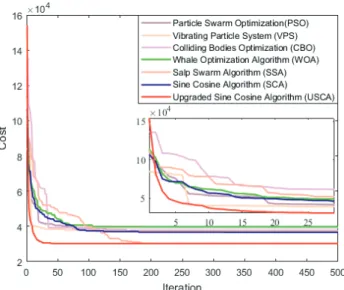
Having and presenting Fig. 5 – which illustrates the mean convergence curve of every algorithm in the course of its iteration – assists to have a meticulous analysis
and discussion about the numerical results. According to Table 6 and Fig. 6 and, it is apparent that tower crane Type 1 is selected and located in point (47.20) to supply materials from supply yard with dimensions of (5.8) where locates at centroid (15.30).
Fig. 4 Plan view of the site for Case 1
Table 4 Grouping of members in Case 1
Story 1 2 3 4
Corner column 1 2 3 4
Side column 5 6 7 8
Side beam 9 10 11 12
Inner beam 13 14 15 16
Table 5 Weight of members in each group in the Case 1
Element Group Weight of members (kg)
1 192.5 2 161 3 234.5 4 168 5 192.5 6 199.5 7 175 8 168 9 156 10 156 11 126 12 132 13 156 14 186 15 132 16 132 0 50 100 150 200 250 300 350 400 450 500 Iteration 2.5 3 3.5 4 4.5 5 5.5 6 Cost 104
Particle Swarm Optimization(PSO) Vibrating Particle System (VPS) Colliding Bodies Optimization (CBO) Whale Optimization Algorithm (WOA) Salp Swarm Algorithm (SSA) Sine Cosine Algorithm (SCA) Upgraded Sine Cosine Algorithm (USCA)
20 40 60 80 3 3.5 4 4.5 5 5.5 104
5.2.2 Results and discussion for Case 2
The second case study is also a four-story steel frame with AISC W-sections, which has 428 members. The plan of the crane layout case from the top view is shown in Fig. 7. Groping of the members and their weights are shown in Table 7 and Table 8, respectively.
Table 7 Grouping of members in Case 1
Story 1 2 3 4 Corner column 1 2 3 4 Side column 5 6 7 8 Inner column 9 10 11 12 Side beam 13 14 15 16 Inner beam 17 18 19 20
Table 8 Weight of the members in each group for the Case 1
Element Group Weight of members (kg)
1 175 2 238 3 185.5 4 168 5 238 6 238 7 175 8 157.5 9 294 10 227.5 11 301 12 738.5 13 156 14 156 15 156 16 156 17 156 18 156 19 132 20 126
Table 6 Comparison of the results using different algorithms for Case 1
PSO VPS CBO WOA SSA SCA USCA
Best 25049.4273 25053.0185 25047.5003 25048.0564 25047.5003 25048.6617 25047.5003
avg 25346.6573 25250.5447 25075.5068 25068.7027 25067.4771 25087.0653 25048.1945
Std 1045.845 922.623 48.3265 22.2254 45.3213 45.3552 1.36043
tower crane type 1 1 1 1 1 1 1
X'Cr 1 10 37 14 37 37 37 Y'Cr 2 -7 2 29 2 2 2 X'Su 28 27 5 19 5 5 5 Y'Su 13 18 12 -3 12 14 12 Lx Su 8 5 5 8 5 5 5 Ly Su 5 8 8 5 8 8 8
The best experimental results are shown in bold.
Fig. 6 Best layout of USCA for Case 1
In this part, the performance of the USCA and SCA are compared with two newly developed metaheuristic algo-rithms (WOA and SSA) and some distinguished meta-heuristic algorithms from the literature with regard to their efficacy in analyzing a TCSLP. In order to explore the performance of the suggested USCA algorithm, we made a comparison with some known algorithms. Thus, in Table 9, there is an abridged data about the statisti-cal information of 30 separate runs for the metaheuristic algorithms.
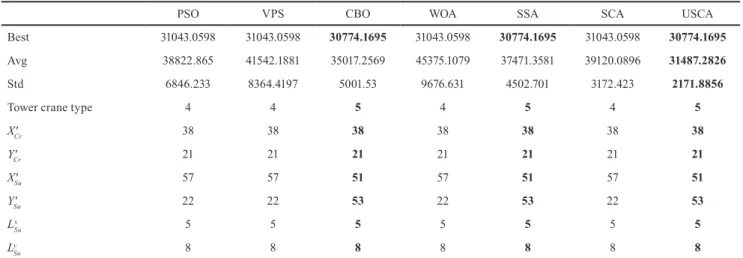
In Table 9, the optimum solutions of the USCA algo-rithm and other algoalgo-rithms are shown for comparison. For all the considered algorithms, the results include the sta-tistical results (best cost, average, and standard deviation) and best layout (tower crane location and allocation order of supply points to demand points 1, 2, …, and 9).
In the same manner, Table 9 also shows an abridged text of the best potential solutions which designate, as far as solution quality concerned, the surpassing performance of the USCA method in comparison to other methods.
By comparison, it can be found that USCA not only out-performs SCA but also it has better performance regard-ing solution quality with majority of the algorithms.
Having and presenting Fig. 8 – which illustrates the mean convergence curve of every algorithm in the course of its iteration – assists to have a well-elaborated analysis and discussion about the numerical results. The optimal solution is shown in Table 9 and Fig. 9. As it can be seen from Fig. 9 and Table 9, it is apparent that tower crane Type 5 is selected and located in point (63.46) to supply materials from supply yard with dimensions of (5.8) where locates at centroid (76.74).
5.2.3 Results and discussion for Case 3
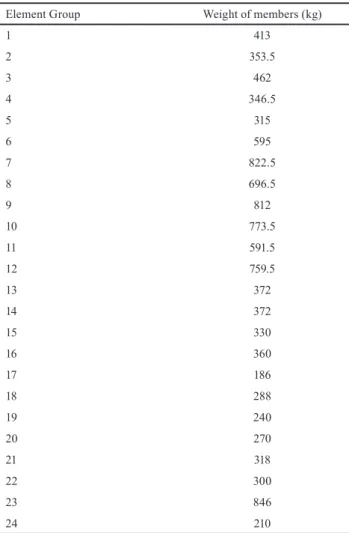
This case study is a twelve-story steel frame with AISC W-sections, having 376 members. The plan view of this case is presented in Fig. 10. Groping of the members and their weights are shown in Table 10 and Table 11, respectively.
Table 9 The Comparison result of algorithms for Case 2
PSO VPS CBO WOA SSA SCA USCA
Best 31043.0598 31043.0598 30774.1695 31043.0598 30774.1695 31043.0598 30774.1695
Avg 38822.865 41542.1881 35017.2569 45375.1079 37471.3581 39120.0896 31487.2826
Std 6846.233 8364.4197 5001.53 9676.631 4502.701 3172.423 2171.8856
Tower crane type 4 4 5 4 5 4 5
X'Cr 38 38 38 38 38 38 38 Y'Cr 21 21 21 21 21 21 21 X'Su 57 57 51 57 51 57 51 Y'Su 22 22 53 22 53 22 53 Lx Su 5 5 5 5 5 5 5 Ly Su 8 8 8 8 8 8 8
The best experimental results are shown in bold.
0 50 100 150 200 250 300 350 400 450 500 Iteration 0.2 0.4 0.6 0.8 1 1.2 1.4 1.6 1.8 2 Cost 10
Particle Swarm Optimization(PSO) Vibrating Particle System (VPS) Colliding Bodies Optimization (CBO) Whale Optimization Algorithm (WOA) Salp Swarm Algorithm (SSA) Sine Cosine Algorithm (SCA) Upgraded Sine Cosine Algorithm (USCA)
5 10 15 20 25 0.5
1 1.5
105
Fig. 8 Mean cost convergence curves for Case 2
In this section, both benchmark algorithms and optimal solutions achieved from USCA are presented in Table 12. With regard to the best cost, the standard, and the aver-age deviation throughout 30 simulation iterations, the optimization results are obtained to assess the precision and the stability of the benchmark algorithms, which are presented in Table 12. The results of the real case study indicate that the USCA algorithm presents more reliable solutions compared to the SCA, and it is very competitive versus other benchmark algorithms in terms of stability.
The mean convergence curves of optimization tech-niques are presented in Fig. 11. Investigating this fig-ure confirms that the USCA behaves faster than other
algorithms in terms of convergence speed. Fig. 12 shows the best-found solution of this paper by USCA. As can be seen from Fig. 12 and Table 12 tower crane Type 5 is assigned to a location with X'Cr and Y'Cr coordinates of 7 and 19, respectively to supply steel frames from supply yard with dimensions (5.8) located in point (38.20).
Fig. 10 Plan view of the site for Case 3
Table 10 Grouping of members in Case 1
Story 1–4 3–4 5–6 7–8 9–10 11–12
Corner column 1 2 3 4 5 6
Side column 7 8 9 10 11 12
Side beam 13 14 15 16 17 18
Inner beam 19 20 21 22 23 24
Table 11 Weight of members in each group in the Case 1
Element Group Weight of members (kg)
1 413 2 353.5 3 462 4 346.5 5 315 6 595 7 822.5 8 696.5 9 812 10 773.5 11 591.5 12 759.5 13 372 14 372 15 330 16 360 17 186 18 288 19 240 20 270 21 318 22 300 23 846 24 210
Table 12 Comparison of the results of the algorithms for Case 3.
PSO VPS CBO WOA SSA SCA USCA
Best 30237.2729 30233.6411 30234.4237 30232.4910 30232.4910 30233.4333 30232.4910
avg 37599.6565 37227.2476 39224.7855 39802.2626 30264.6556 36667.5658 30238.9881
Std 10971.9316 9736.7181 9649.0305 14626.8785 47.4766 16352.0203 6.2586
Tower crane type 5 5 5 5 5 5 5
X'Cr 36 28 0 2 2 4 2 Y'Cr 2 22 -1 6 6 4 6 X'Su 12 18 28 33 33 33 33 Y'Su 13 -3 4 7 7 9 7 Lx Su 8 8 5 5 5 5 5 Ly Su 5 5 8 8 8 8 8
6 Conclusions
From the results of the experimental studies on mathe-matical functions and various tower crane locating sce-narios, it can be found that by adding agent memory and the HS-based side constraint approach, the performance of the SCA is improved. Also, these features have made the USCA competitive with other known or recently devel-oped algorithms, placing USCA in the first or second rank for majority of test examples.
This paper presents a new version of sine cosine algo-rithm which combines a memory for best ever found results and a harmony search based local search opera-tor. This strategy makes the algorithm avoid falling into the local optima through local search with a small prob-ability. The experimental results showed that it is bene-ficial to add the local search operator to the sine cosine algorithm. Compared to other locating algorithms, USCA has more advantages like faster convergence speed and superior stability. In this paper, USCA is tested on several
mathematical test functions and five TCSLP scenarios. Since only five benchmark functions have been tested, the lack of research on broader dimensions is the limitation of this research. Although, from the results of the experiment it is found that the proposed USCA algorithm produces better stability and optimization results. In this research, the USCA employed only on TCSLP, however, the appli-cation of this algorithm can future be extended for solution of other engineering problems.
Compliance with ethical standards
Conflict of interest: No potential conflict of interest was reported by the authors.
Nomenclature
Abbreviations, superscripts and subscripts
AHP Analytic Hierarchy Process
AISC American Institute of Steel Construction
ALO Ant Lion Optimizer
AM Agents Memory
AMCR Agent Memory Considering Rate
BIM Building Information Model
CBO Colliding Bodies Optimization
SELO Socio Evolution and Learning Optimization CEOPs Construction Engineering Optimization
Problems
CPA Cyclical Parthenogenesis Algorithm
Cr Tower Crane
CSLPs Construction Site Layout Problems
CSS Charged System Search
De Demand point
ECBO Enhanced Colliding Bodies Optimization
FLDP Facility Layout Design Problem
GIS Geographic Information System
GSA Gravitational Search Algorithm
IA Ideology Algorithm
MILP Mixed Integer Linear Programming
MINLP Mixed-Integer Nonlinear Programming
PSO Particle Swarm Optimization
QAP Quadratic Assignment Problem
SCA Sine Cosine Algorithm
SSA Salp Swarm Optimization
Su Supply point
TCSLP Tower Crane Selection and Layout Problem
TCLP Tower Crane Layout Planning
USCA Upgraded Sine Cosine Algorithm
Fig. 11 Mean cost convergence curves for Case 3
VPS Vibrating Particles System
WOA Whale Optimization Algorithm
Set
k Set of Potential Tower Crane Types k = {1,
K}
o Set of building blocks o = {1, O}
j Set of demands j = {1, J}
Parameters
a A constant number (here it is considered equal to 2).
t The current iteration in the SCA
T The maximum iteration number in SCA
Xj, Yj, Zj Coordinates of the th demand point
Vkv Hoisting velocity of the th tower crane's
hook (m/min)
Vkw Slewing velocity of the th tower crane's jib
(rad/min)
Vkr Radial velocity of the th tower crane's jib
(m/min)
TC Total cost
OCk Operating cost of tower crane k FCk Fixed cost of tower crane k
μSu Maximum permissible ratio between two aspects (sides) of the supply point (Su) (μSu ≥ 1)
ASu Area of supply yard
Minimum and maximum allowable distance of tower crane type k from a building block (Obstacle) to attache the tower crane into the building in high rises
Xo, Yo Centroids of building blocks (obstacle)
Lox, L
oy Dimensions of building blocks (obstacles)
Æomin Minimum safety distance of obstacles or
building blocks from other departments in the site
ÆSumin Minimum safety distance between supply
yard and other facilities in the site
M An arbitrary large integer number
Lx, Ly Dimensions of construction site Variables
Pi The destination point's position in ith di-mension in the SCA process
Knt the nth dimension of current solution at tth
iteration in the SCA
δjk A set of binary type variables to define
ma-terial flow, which is equal to "1",
if tower Crane type k transports the material supply yard, towards jth demand point, and "0" if not.
Dimensions of tower crane base
Rak Maximum jib length of tower crane type HUHk Height of tower crane unuder hook Weightj Weight of material demand at point
MLMk Maximum load moment of tower crane
Capk Maximum capacity of tower crane Shows the selection of tower crane type Centroids of the th tower crane location
ASu The area of supply yard
Centroids of the th supply yard Dimensions of supply yard
Tjk The actual transportation time of demand at point from supply yard by the th tower Crane type ∅Cr kmin ∅ Cr kmax , , , LCr kx , ,�LCr ky , ℵk X YCr' , Cr' X Y ZSu' , Su', Su L LxSu,� Suy References
[1] Sharafi, P., Mortazavi, M., Samali, B., Ronagh, H. "Interlocking sys -tem for enhancing the integrity of multi-storey modular buildings", Automation in Construction, 85, pp. 263–272, 2018.
https://doi.org/10.1016/j.autcon.2017.10.023
[2] Lien, L.-C., Cheng, M.-Y. "Particle bee algorithm for tower crane layout with material quantity supply and demand optimization", Automation in Construction, 45, pp. 25–32, 2014.
https://doi.org/10.1016/j.autcon.2014.05.002
[3] Crawford, B., Soto, R., Astorga, G., García, J., Castro, C., Paredes, F. "Putting Continuous Metaheuristics to Work in Binary Search Spaces", Complexity, Article ID 8404231, 2017.
https://doi.org/10.1155/2017/8404231
[4] Mirjalili, S. "SCA: A Sine Cosine Algorithm for solving optimiza-tion problems", Knowledge-Based Systems, 96, pp. 120–133, 2016.
https://doi.org/10.1016/j.knosys.2015.12.022
[5] Kaveh, A. "Advances in Metaheuristic Algorithms for Optimal Design of Structures", 2nd ed., Springer, Cham, Switzerland, 2017.
https://doi.org/10.1007/978-3-319-05549-7
[6] Eberhart, R., Kennedy, J. "A new optimizer using particle swarm the-ory", In Proceedings of the Sixth International Symposium on Micro Machine and Human Science, Nagoya, Japan, 1995, pp. 39–43.
https://doi.org/10.1109/MHS.1995.494215
[7] Golberg, D. E. "Genetic Algorithms in Search, Optimization, and Machine Learning. Reading", Addison-Wesley Publishing Longman Co., Boston, MA, USA, 1989.
[8] Mirjalili, S. "The Ant Lion Optimizer", Advances in Engineering Software, 83, pp. 80–98, 2015.
https://doi.org/10.1016/j.advengsoft.2015.01.010
[9] Kaveh, A., Zolghadr, A. "Cyclical Parthenogenesis Algorithm: A
new meta-heuristic algorithm", Asian Journal of Civil Engineering, 18(5), pp. 673–701, 2017.
[10] Kumar, M., Kulkarni, A. J., Satapathy, S. C. "Socio evolution & learning optimization algorithm: A socio-inspired optimization methodology", Future Generation Computer Systems, 81, pp. 252– 272, 2018.
https://doi.org/10.1016/j.future.2017.10.052
[11] Huan, T. T., Kulkarni, A. J., Kanesan, J., Huang, C. J., Abraham, A. "Ideology algorithm: a socio-inspired optimization methodology", Neural Computing and Applications, (28),pp. 845–876, 2017.
https://doi.org/10.1007/s00521-016-2379-4
[12] Rashedi, E., Nezamabadi-pour, H., Saryazdi, S. "GSA: A Gravitational Search Algorithm", Information Sciences, 179(13), pp. 2232–2248, 2009.
https://doi.org/10.1016/j.ins.2009.03.004
[13] Kaveh, A., Talatahari, S. "A novel heuristic optimization method: charged system search", Acta Mechanica, 213, pp. 267–289, 2010.
https://doi.org/10.1007/s00707-009-0270-4
[14] Kaveh, A., Ilchi Ghazaan, M. "Optimum Design of Skeletal Structures using PSO-Based Algorithms", Periodica Polytechnica Civil Engineering, 61(2), pp. 184–195, 2017.
https://doi.org/10.3311/PPci.9614
[15] Kaveh, A., Vazirinia, Y. "Optimization of Tower Crane Location and Material Quantity Between Supply and Demand Points: A Comparative Study", Periodica Polytechnica Civil Engineering, 62(3), pp. 732–745, 2018.
https://doi.org/10.3311/PPci.11816
[16] Huang, C., Wong, C. K., Tam, C. M. "Optimization of tower crane and material supply locations in a high-rise building site by mixed-integer linear programming", Automation in Construction, 20(5), pp. 571–580, 2011.
https://doi.org/10.1016/j.autcon.2010.11.023
[17] Zhang, P., Harris, F. C., Olomolaiye, P. O., Holt, G. D. "Location
Optimization for a Group of Tower Cranes", Journal of Construction Engineering and Management, 125(2), pp. 115–122, 1999.
https://doi.org/10.1061/(ASCE)0733-9364(1999)125:2(115)
[18] Tam, C. M., Tong, T. K. L. "GA-ANN model for optimizing the locations of tower crane and supply points for high-rise public hous-ing construction", Construction Management and Economics, 21(3), pp. 257–266, 2003.
https://doi.org/10.1080/0144619032000049665
[19] Tam, C. M., Tong, T. K. L., Chan, W. K. W. "Genetic Algorithm for Optimizing Supply Locations around Tower Crane", Journal of Construction Engineering and Management, 127(4), pp. 315–321, 2001.
https://doi.org/10.1061/(ASCE)0733-9364(2001)127:4(315)
[20] Kaveh, A., Vazirinia, Y. "Tower cranes and supply points locating problem using CBO, ECBO, and VPS", International Journal of Optimization in Civil Engineering, 7(3), pp. 393–411, 2017. [online] Available at: http://ijoce.iust.ac.ir/article-1-305-en.html [Accessed: 10 January 2020]
[21] Wang, J., Zhang, X., Shou, W., Wang, X., Xu, B., Kim, M. J., Wu,
P. "A BIM-based approach for automated tower crane layout plan-ning", Automation in Construction, 59, pp. 168–178, 2015.
https://doi.org/10.1016/j.autcon.2015.05.006
[22] Marzouk, M., Abubakr, A. "Decision support for tower crane selec-tion with building informaselec-tion models and genetic algorithms", Automation in Construction, 61, pp. 1–15, 2016.
https://doi.org/10.1016/j.autcon.2015.09.008
[23] Irizarry, J., Karan, E. P. "Optimizing location of tower cranes on construction sites through GIS and BIM integration", Journal of Information Technology in Construction, 17, pp. 351–366, 2012. [online] Available at: http://www.itcon.org/2012/23 [Accessed: 10 January 2020]
[24] Kaveh, A., Ilchi Ghazaan, M. "A new meta-heuristic algorithm: vibrating particles system", Scientia Iranica Transactions A: Civil Engineering, 24(2), pp. 1–32, 2017.
https://doi.org/10.24200/sci.2017.2417
[25] Huang, C., Wong, C. K., Tam, C. M. "Optimization of material hoisting operations and storage locations in multi-storey build-ing construction by mixed-integer programmbuild-ing", Automation in Construction, 19(5), pp. 656–663, 2010.
https://doi.org/10.1016/j.autcon.2010.02.005
[26] Mirjalili, S., Lewis, A. "The Whale Optimization Algorithm", Advances in Engineering Software, 95, pp. 51–67, 2016.
https://doi.org/10.1016/j.advengsoft.2016.01.008
[27] Mirjalili, S., Gandomi, A. H., Mirjalili, S. Z., Saremi, S., Faris, H.,
Mirjalili, S. M., "Salp Swarm Algorithm: A bio-inspired opti-mizer for engineering design problems", Advances in Engineering Software, 114, pp. 163–191, 2017.
https://doi.org/10.1016/j.advengsoft.2017.07.002
[28] Kaveh, A., Vazirinia, Y. "Construction Site Layout Planning Problem Using Metaheuristic Algorithms: a Comparative Study", Iranian Journal of Science and Technology - Transactions of Civil Engineering, 43, pp. 105–115, 2019.
https://doi.org/10.1007/s40996-018-0148-6
[29] Kaveh, A., Ilchi Ghazaan, M. "Meta-heuristic Algorithms for Optimal Design of Real-Size Structures", Springer, Cham, Switzerland, 2018.
Ta bl e 1 3 Sp ec if ic at io ns o f a va ila bl e t ow er c ra ne t yp es Towe r cr an e, k Ti p-lo ad , (k g) Ba se D im en sio ns ( m ) M in im um an d m ax im um di st an ce s (m ) M ax im um ca pa cit y, (k g) M ax im um rad ius , ( m ) M ax im um lo ad m om en t, (k g. m) He ig ht-un de r-ho ok , (m ) Sl ew in g sp ee d, (R ad /m in) Tr ol le yi ng sp ee d, (m /m in ) Hoi st in g sp ee d, (m /m in ) Op er at in g co st , (m /m in ) Fi xe d c os t, (m /m in ) 1 65 0 3 3 3 8 4, 000 28 25 ,35 0 34 1 40 56 1, 20 0 25 ,000 2 75 0 3 3 2 8 3, 000 30 27 ,000 33 1 25 35 1, 20 0 25 ,000 3 1, 000 3 3 3 8 2, 000 31 35 ,000 33 1 36 40 1, 50 0 30 ,0 00 4 1, 000 3 3 2 8 2, 50 0 35 35 ,000 33 1 36 42 1, 60 0 30 ,0 00 5 1, 000 3 3 2 7 2, 50 0 36 36 ,000 45 1 36 40 1, 60 0 30 ,0 00 6 80 0 4 4 3 8 4, 000 48 38 ,4 00 32 1 20 35 1, 90 0 37, 30 0 7 1, 000 4 4 2 7 2, 50 0 40 40 ,000 39 1 42 42 1, 90 0 38 ,000 8 90 0 5 5 2 7 4, 000 45 40 ,000 35 1 41 32 1, 90 0 38 ,000 9 1, 000 4 4 2 7 4, 000 40 40 ,000 37 1 25 30 1, 95 0 38 ,000 10 950 4 4 2 7 2, 50 0 43 40 ,85 0 39 1 36 42 1, 95 0 38 ,000 11 90 0 5 5 2 7 4, 000 45 40 ,000 50 0 20 32 2, 000 40 ,000 12 1, 000 5 5 2 8 3, 000 41 41 ,000 35 1 21 30 2, 000 40 ,000 13 1, 000 4 4 2 7 4, 000 42 42 ,000 36 1 30 40 2,0 30 40 ,000 14 1, 000 4 4 2 7 2, 50 0 42 42 ,000 39 1 42 42 2,0 60 40 ,000 15 1, 000 4 4 2 7 2, 50 0 45 45 ,000 39 1 42 42 2,0 60 40 ,000 16 1, 000 5 5 2 7 4, 000 50 50 ,000 35 1 43 32 2,0 60 45 ,000 17 1, 20 0 4 4 2 7 2, 50 0 43 51 ,6 00 36 1 35 42 2,1 20 45 ,000 18 1, 30 0 5 5 2 3 5, 60 0 45 58 ,5 00 53 1 29 35 2, 250 49 ,000 19 1, 20 0 4 4 3 7 5, 000 50 60 ,000 40 1 30 33 2, 230 49 ,000 20 1, 45 0 5 5 2 7 4, 000 42 60, 90 0 49 1 25 60 2, 235 49 ,000 21 1, 000 5 5 2 7 4, 000 50 50 ,000 60 0 22 32 2,0 90 50 ,000 22 1, 000 4 4 3 7 6, 000 56 56 ,000 69 1 27 40 2, 20 0 51 ,000 23 1, 30 0 5 5 2 7 6, 000 50 63 ,000 40 1 41 32 2, 250 53 ,000 24 1, 000 5 5 2 7 6, 000 55 63 ,000 40 0 41 32 2, 30 5 53 ,000 25 1, 40 0 4 4 2 7 4, 000 45 63 ,000 40 1 30 45 2,4 00 55 ,000 26 1, 30 0 5 5 2 5 6, 000 50 63 ,000 70 0 20 16 2, 36 0 57 ,000 27 1, 000 5 5 2 5 6, 000 55 63 ,000 70 0 20 16 2, 365 58 ,000 28 1, 30 0 4 4 3 7 5, 000 50 65 ,000 40 1 30 35 2,4 00 58 ,7 00 29 1, 40 0 2 2 5 7 6, 000 53 73, 50 0 60 1 30 38 2, 41 0 65 ,000 30 1, 50 0 5 5 2 7 6, 000 50 75 ,000 50 1 30 39 2, 41 0 65 ,000 31 1, 30 0 5 5 2 7 8, 000 56 80 ,000 45 1 60 40 2, 42 0 65 ,000 LCr k x , LCr k y , ∅Cr k mi n , ∅Cr k ma x ,
Towe r cr an e, k Ti p-lo ad , (k g) Ba se D im en sio ns ( m ) M in im um an d m ax im um di st an ce s (m ) M ax im um ca pa cit y, (k g) M ax im um rad ius , ( m ) M ax im um lo ad m om en t, (k g. m) He ig ht-un de r-ho ok , (m ) Sl ew in g sp ee d, (R ad /m in) Tr ol le yi ng sp ee d, (m /m in ) Hoi st in g sp ee d, (m /m in ) Op er at in g co st , (m /m in ) Fi xe d c os t, (m /m in ) 33 1, 80 0 5 5 3 7 8, 000 45 81 ,000 45 1 25 60 2, 485 68 ,6 00 34 1, 30 0 5 5 2 5 8, 000 56 80 ,000 90 1 60 20 2, 50 0 72 ,000 35 1, 80 0 5 5 3 7 8, 000 45 81 ,000 42 1 30 30 2, 485 76 ,000 36 1, 50 0 6 6 3 7 8, 000 55 82 ,50 0 65 1 30 30 2, 53 0 77 ,000 37 1, 40 0 6 6 3 7 8, 000 60 84 ,000 68 1 30 26 2,5 40 78 ,000 38 1, 40 0 5 5 2 7 8, 000 60 84 ,000 45 1 30 40 2, 56 0 78 ,000 39 1, 40 0 5 5 3 7 8, 000 60 84 ,000 65 1 30 40 2, 57 0 78 ,000 40 1, 40 0 6 6 3 7 10 ,000 60 84 ,000 65 1 30 52 2, 58 5 78 ,000 41 1, 60 0 2 2 5 7 8, 000 55 88 ,000 56 1 1 31 2,7 60 78 ,000 42 1, 60 0 4 4 3 5 8, 000 55 88 ,000 74 1 27 40 2,7 00 80 ,000 43 1, 60 0 5 5 3 5 6, 000 55 88 ,000 92 1 30 38 2,7 40 80 ,000 44 2, 30 0 6 6 3 7 8, 000 45 10 3, 50 0 40 1 30 40 2,7 60 92 ,000 45 1, 95 0 6 6 2 7 8, 000 55 10 7, 25 0 68 1 30 29 2,8 06 98 ,000 46 1, 80 0 6 6 2 5 8, 000 60 10 8, 000 71 1 33 55 2, 82 0 99 ,000 47 1, 60 0 5 5 2 7 10 ,000 60 12 5, 000 50 1 60 50 2, 83 0 10 1, 000 48 1, 85 0 6 6 3 7 12 ,000 65 12 0, 25 0 70 1 50 50 2,8 40 10 2, 000 49 1, 60 0 5 5 2 5 10 ,000 60 12 5, 000 10 0 1 60 27 3, 000 10 4, 000 50 1, 95 0 6 6 3 7 8, 000 65 12 6,7 50 62 1 79 57 2,9 60 10 8, 000 51 2, 050 6 6 3 7 10 ,000 65 133 ,2 50 70 1 50 40 3, 000 11 5, 000 52 2, 50 0 6 6 3 7 12 ,000 60 15 0, 000 64 1 30 34 3, 000 12 4, 30 0 53 2,4 00 6 6 3 7 12 ,000 65 15 6, 000 65 1 50 58 3, 000 12 5, 60 0 54 2, 000 6 6 2 7 12 ,000 65 16 0, 000 50 1 60 57 2,9 00 130 ,0 00 55 2, 000 6 6 2 5 12 ,000 65 16 0, 000 10 0 1 60 29 3, 000 13 6, 000 56 3, 000 6 6 2 7 18 ,000 60 18 0, 000 68 1 50 10 5 2,9 90 14 6, 000 57 2, 30 0 11 11 6 7 20 ,000 80 18 4, 000 69 1 77 56 3, 02 0 15 0, 000 58 2, 20 0 10 10 5 8 20 ,000 84 18 4, 80 0 72 1 10 0 50 3, 05 0 15 0, 000 59 2, 10 0 6 6 2 7 12 ,000 70 200 ,000 50 1 60 57 3,0 30 16 3, 50 0 60 2,8 00 8 8 5 6 20 ,000 75 21 0, 000 60 1 12 0 11 6 3, 08 0 16 4, 000 61 3, 000 8 8 3 5 12 ,000 70 21 0, 000 84 1 40 13 0 3, 08 0 16 8, 50 0 62 2, 10 0 6 6 2 5 12 ,000 70 200 ,000 10 0 1 60 29 3, 10 0 16 9, 50 0 63 3, 000 8 8 5 7 16 ,000 75 22 5, 000 61 1 96 10 0 3, 08 0 17 0, 000 64 3, 000 6 6 3 7 25 ,000 80 24 0, 000 55 1 10 0 96 3, 075 17 8, 000 LCr k x , LCr k y , ∅Cr k mi n , ∅Cr k ma x ,
Towe r cr an e, k Ti p-lo ad , (k g) Ba se D im en sio ns ( m ) M in im um an d m ax im um di st an ce s (m ) M ax im um ca pa cit y, (k g) M ax im um rad ius , ( m ) M ax im um lo ad m om en t, (k g. m) He ig ht-un de r-ho ok , (m ) Sl ew in g sp ee d, (R ad /m in) Tr ol le yi ng sp ee d, (m /m in ) Hoi st in g sp ee d, (m /m in ) Op er at in g co st , (m /m in ) Fi xe d c os t, (m /m in ) 66 3, 000 8 8 4 7 16 ,000 70 25 0, 00 0 43 1 60 52 3, 10 5 17 9, 000 67 3, 50 0 8 8 5 7 8, 000 71 25 0, 00 0 43 1 60 52 3, 10 5 17 9, 000 68 4, 000 8 8 3 7 16 ,000 60 24 0, 000 52 1 43 25 3, 070 18 3, 000 69 3, 40 0 12 12 6 8 40 ,000 84 28 5, 60 0 79 1 88 73 3, 20 0 19 4, 000 70 3, 000 8 8 4 5 16 ,000 70 25 0, 00 0 135 1 60 26 3, 50 0 200 ,000 71 4, 000 10 10 5 5 20 ,000 82 32 6, 000 81 1 88 10 7 3, 40 0 21 0, 000 72 3, 50 0 8 8 5 5 8, 000 71 25 0, 00 0 270 1 60 26 3, 80 0 21 0, 000 LCr k x , LCr k y , ∅Cr k mi n , ∅Cr k ma x ,