Analysis of the Behaviour of Construction Concrete Joints
André Marques Borges
Extended Abstract of the Dissertation for Integrated Master Degree in Civil Engineering
JURI:
Presidente: Professor Jorge Manuel Caliço Lopes de Brito
Orientador: Professor João Paulo Janeiro Gomes Ferreira
Vogais: Professor Augusto Martins Gomes
Novembro de 2008
UNIVERSIDADE TÉCNICA DE LISBOA
Behaviour of Construction Concrete Joints
André Marques Borges
Student of the Integrated Master Degree in Civil Engineering from UTL –
Instituto Superior Técnico, Lisbon, Portugal, [email protected]
ABSTRACT
According to (BUSSEL & CATHER, 1995), obtaining an adequate mechanical strength along the construction joint will be always an important aspect to be taken into account in its preparation. The joint may be virtually under any type of strength, however, it is only required to the joint and the reinforcement material to resist tensile and shear stresses
The main purpose of this dissertation is to assess the tensile strength of various construction joints, through an experimental program. The various joints were obtained according to preparation methods of the substrate surface. In the end, it is intended to have a guiding line for an adequate substrate surface for the joint.
The use of a needle gun to make the chipping of the joint surface, followed by the use of an epoxy-based bonding agent was the surface treatment that provided the best bonding results in the area of horizontal construction joints. The use of an expanded metal mesh was an effective solution, however when used together with an epoxy-based agent did not provided a good bonding solution. The factors that most influenced the establishment of an adequate construction joint, characterized by a good tensile strength behavior, was the roughness of the substrate surface, the use of an expanded metal mesh, or the use of an epoxy-based bonding agent. Although it is a common practice, wetting the interface of the concrete joint before the restart of the concrete operations, does not improve the tensile behavior of the construction joint.
Key-words: Concrete joint; bonding; chipping the concrete surface; wire-brushing of the concrete surface; epoxy-based bonding agent; expanded metal mesh
Introduction
According to (DIÁRIO DA REPÚBLICA - I - SÉRIE B - PORTARIA 246/98 DE 21 DE ABRIL, 1998 ), “Construction joints are surfaces of discontinuity between concrete of different ages, usually horizontal or with a little inclination, which should be implemented and treated …, to ensure the integrity of the structure and its capacity of retaining liquids.” In general terms, concrete construction joints are surfaces of separation between concrete layers of different ages, and they exist mainly because of restrictions of constructive nature in a concrete structure (MARTINS, 2004), see Image 1.
Image 1- Aspect of a concrete construction joint
The need for creating and establishing a concrete joint is something usual and indispensable in the construction process of practically every concrete structure. With them it is possible to divide the concrete structure into several pieces of smaller geometry, allowing the Contractor to manage the concrete operations in an easier way. By dividing the concrete structure into several pieces, the structure can no longer behave as monolithic. So, one of the big objectives for a concrete construction joint is in trying to achieve a behaviour similar to a monolithic structure while at the same time allow the division of the structure into smaller geometric pieces. A badly designed concrete joint is a site of mechanical weakness and its bad development will create a section of discontinuity along the surface, in such a way that the correct transmission of strength will be at risk (CAVACO, 2006). These sections will be much more likely to present cracking (ACI STANDARD 224.3R-95, AGOSTO,1995). Besides the requirement for achieving an adequate strength, issues like appearance, durability and resistance to moisture, location and spacing of construction joints are also important in their design (BUSSEL & CATHER, 1995).
Construction joints can be divided into vertical and horizontal joints, depending on its geometrical orientation. Horizontal concrete joints are normally associated to the bonding
between vertical concrete elements, like for e.g. columns, walls or stairs, while vertical joints are used in the bonding of horizontal elements, like for e.g. beams or slabs. The two stages in the production of a vertical construction joint are firstly to provide a former against which the concrete is stopped until it has hardened; and secondly to prepare the hardened concrete surface to achieve the necessary required continuity (MARTINS, 2004). Horizontal construction joints are not formed, but occur at the free surface of poured concrete (BROOK K. , 1969). It is normal for some surplus water to inevitably rise to the top of the fresh concrete. When this water evaporates, a layer of so-called laintance remains. This layer is weaker than the concrete in tension, compression, and shear. Is not watertight and does not satisfactorily bond to concrete. In this situation, the laitance should be removed so a good bonding between the different aged concretes might be possible (BUSSEL & CATHER, 1995).
According to (ACI STANDARD 224.3R-95, AGOSTO,1995) the number of construction joints should be kept to the minimum necessary for the execution of the work and its location should be carefully considered and agreed upon before concrete is placed. In order to prevent a considerable reduction in the mechanical strength of the structure, it is absolutely necessary to evaluate the correct location of the joint. According to (BUSSEL & CATHER, 1995), the main criterias for the joint location and spacing are:
• The practical limits on what volume and area of concrete can be finished in one
session;
• The strength required and achievable at the joints;
• The presence of restraints to contraction of the hardening concrete, affecting the
possibility of early-age thermal cracking;
• Compatibility with the appearance and jointing of applied finishes;
For slabs and beams, (BUSSEL & CATHER, 1995) suggest that it is satisfactory to locate the joints between ଵ
ଷ and ଵ
ହ of the spam. According to (ACI STANDARD 350/350R-06, JULHO,2006), its location should be in a section of the structure where flexural and shear are reasonable for the existing loads. In elements mainly subjected to compressive strengthes, like columns for e.g., there will be no specific restrictions to the location of the joint. However, and also for the vertical joints, the concrete joints should be spaced in such a way that can be possible to make a correct control of the cracking due to the contraction of the hardening concrete.
As was stated, a concrete joint will always be a point of structural weakness. A concrete joint can be exposed to any type of strength. However, it is only required to the joint and the reinforcement material that might form the joint, to resist to tensile and shear strength (BROOK K. , 1969). To face and avoid the weakening of the structure due to the presence of a concrete construction joint, it is necessary to apply specific treatments and measures to the joint interface, in order to achieve a good mechanical behaviour, or more specifically, a good
resistance to tensile. Surface treatments of the hardened concrete joint surface are carried out for the following purposes (BUSSEL & CATHER, 1995):
• To remove laintance – particularly when the joint is horizontal, where the concrete has
to carry direct or flexural compression or shear across the joint;
• To ensure good bond across the joint where the concrete has to transfer tension and/or
significant shear;
• To clean and prepare the existing concrete surface, so that it has no adverse effect on
the fresh concrete;
To achieve a good resistance to tensile a roughened surface must be created, devoid of loose debris and any kind of particles that could influence the correct bonding between the different age concrete (BUSSEL & CATHER, 1995). The surface should also be clean and dry or ‘saturated surface dry’, i.e. wet but with no free water present (MONKS, FEVEREIRO,1974). According to (RAMÍREZ & DIAZ, JULHO, 1975), (TRINKER, ABRIL, 2006), (JÚLIO, BRANCO, SILVA, & LOURENÇO, CONCRETE-TO-CONCRETE BOND STRENGHT. INFLUENCE OF THE ROUGHNESS OF THE SUBSTRATE SURFACE, ABRIL,2004), a roughened surface is vital and indispensable to achieve a good resistance in a construction joint. Several methods are used to increase the roughness of the concrete substrate surface with the purpose of improving the bonding. Surface treatments like wire-brushing, sand-blasting, water jetting, and chipping the surface with a scalling hammer are the most commonly used (JÚLIO, BRANCO, SILVA, & LOURENÇO, CONCRETE-TO-CONCRETE BOND STRENGHT. INFLUENCE OF THE ROUGHNESS OF THE SUBSTRATE SURFACE, ABRIL,2004). According to (STOPPENHAGEN, JIRSA, JR., & A., 1995), when the roughened surface is obtained with a scalling hammer, the structure where the joint is located will tend to behave as monolithic. Wetting the interface of the concrete joint before the restart of the concrete placing is a common practice, although the increasing of the joint resistance and the possible advantages of these methods are not well documented. For instance, (EMMONS, 1994), (RAMÍREZ & DIAZ, JULHO, 1975) state that the moisture level of the substrate surface is very important in order to achieve a good bonding. However, (JÚLIO, BRANCO, SILVA, & LOURENÇO, CONCRETE-TO-CONCRETE BOND STRENGHT. INFLUENCE OF THE ROUGHNESS OF THE SUBSTRATE SURFACE, ABRIL,2004) (RAMÍREZ & DIAZ, JULHO, 1975), concluded in experimental work that wetting the interface of the substrate before the restart of concrete operations has no effect on the mechanical resistance of the joint.
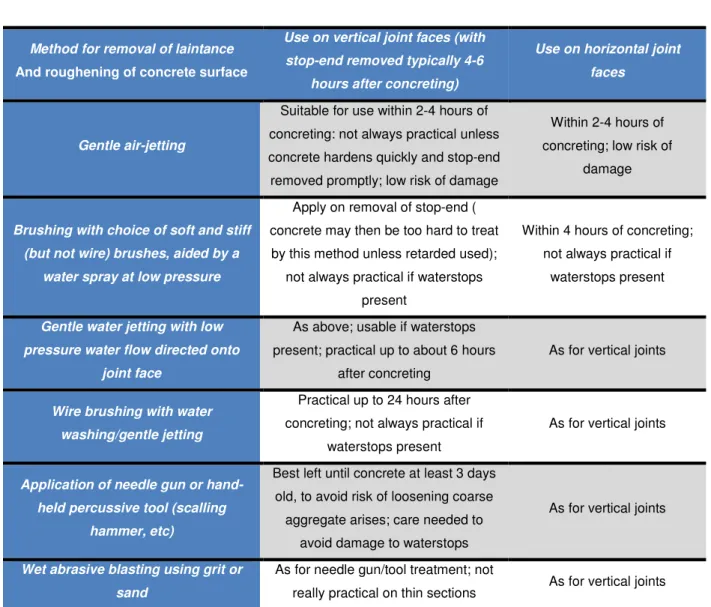
The following table illustrates a short description of the common treatment methods available for the obtaining of a roughened surface for the concrete joints.
Table 1 – Treatment methods for surface at construction joints
Frequently, the use of a bonding agent is adopted, with the epoxy based agent’s or latex emulsions the most commonly used agents in the construction industry. For (ACI STANDARD 503.2, 1992), the main characteristics of epoxies and which make them a desirable adhesive for use with concrete are:
• Adhesion • Versatility • Chemical resistance • Low shrinkage • Rapid hardening • Moisture resistance
Method for removal of laintance And roughening of concrete surface
Use on vertical joint faces (with stop-end removed typically 4-6
hours after concreting)
Use on horizontal joint faces
Gentle air-jetting
Suitable for use within 2-4 hours of concreting: not always practical unless concrete hardens quickly and stop-end removed promptly; low risk of damage
Within 2-4 hours of concreting; low risk of
damage
Brushing with choice of soft and stiff (but not wire) brushes, aided by a
water spray at low pressure
Apply on removal of stop-end ( concrete may then be too hard to treat by this method unless retarded used);
not always practical if waterstops present
Within 4 hours of concreting; not always practical if
waterstops present
Gentle water jetting with low pressure water flow directed onto
joint face
As above; usable if waterstops present; practical up to about 6 hours
after concreting
As for vertical joints
Wire brushing with water washing/gentle jetting
Practical up to 24 hours after concreting; not always practical if
waterstops present
As for vertical joints
Application of needle gun or hand-held percussive tool (scalling
hammer, etc)
Best left until concrete at least 3 days old, to avoid risk of loosening coarse aggregate arises; care needed to
avoid damage to waterstops
As for vertical joints
Wet abrasive blasting using grit or sand
As for needle gun/tool treatment; not
A correct preparation of the substrate for the application of the epoxy is important to achieve a good bonding. It is mainly focused on achieving a roughened concrete surface, so that the bonding agent should be easily absorbed by the pore structure of the substrate (ACI STANDARD 503.6R-97, 2007). The methods used to obtain a roughened surface are the same as the ones earlier mentioned. The application of the epoxy should be made in accordance with its pot-life and at the temperatures mentioned by the epoxy’s producer, under penalty of the bonding being at risk.
More recently, there have been some improvements in the area of the reinforcement materials to apply in the joint interface. Expanded metal meshes have been gaining a relative importance and a more frequent use in concrete joint, particularly in slabs. They incorporate raised ribs that allow stiffening of the mesh, preventing the distortion of the mesh under the impulsion of the fresh concrete. The big advantage of this method in comparison to others, is the fact that this can be used as a stop-end former while allowing the joint to obtain a roughened substrate surface (KIND-BARKAUSKAS, 2002). (BUSSEL & CATHER, 1995) state that the raised ribs will allow a good adherence between concretes, and the introduction of the metal mesh inside the concrete will increase the mechanical resistance of the joint. Extra attention should be made during the placing and compaction of the concrete, in order to prevent the passage of any excess of cement past and fines through the mesh, which will create a plan of weakness at the backside of the mesh (BUSSEL & CATHER, 1995).
Experimental Investigation
The main purpose of this dissertation is to assess and study the tensile strength of different construction joints, created by different techniques, throughout an experimental program. At the end of this dissertation, it is intended to have a comparative study of the tensile behaviour of different concrete construction joints, in order to have a guiding line for the development and correct treatment of the concrete construction joints. With the conclusions of this study, designers can choose the best preparation technique for their substrate surface in order to obtain higher bond strengths at lower costs. The methods for the roughening of the joint substrate were according to its use and importance in the construction world, by its simplicity, quality and tensile resistance achieved.
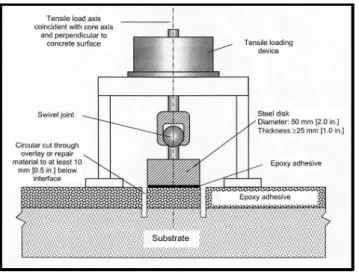
To evaluate the tensile strength of the concrete joints, several experimental tests it were performed using the pull-off method according to (ASTM C 1583-04, 2004). The pull-off method was chosen because it can evaluate the bonding strength of the interface and is a simple method of doing so. The pull-off tests were executed 40 days after the first concrete pouring, because the study of the mechanical behaviour was defined to be in a situation of ruin for the structure and for the concrete joint, and it was considered that at this date the construction joints
would have already obtained the designed resistance. At the figure below is shown a schematic example of the pull-off test.
Image 2 – The pull-off test (ASTM C 1583-04, 2004)
The experimental program and the techniques for the concrete construction joint can be seen at the table below. In group I the mechanical behaviour to tension of specific horizontal concrete joints was evaluated while treatments belonging to group II were specific for vertical concrete joints.
Table 2 – Experimental program
Type of treatment for the joint Group N.º of tests — (monolithic specimen) 0 5
No treatment
I
5
Wire brushing the surface followed by a gentle wetting
of the surface before the restart of the concrete operations 5
Chipped with a needle gun followed by the application
of an epoxy based bonding agent 5
Chipped with a scalling hammer followed by the application of a gentle wetting of the surface before the restart of the
concrete operations 5 Chipped with a needle gun
5
Application of a expanded metal mesh followed by the application of a gentle wetting of the surface before
the restart of the concrete operations
Application of a expanded metal mesh by the application
of a epoxy based bonding agent 5
For the experimental tests 45 pull-off cylindrical specimens were obtained, with 20cm of height and 5 cm of diameter, dividing 5 specimens for each treatment (See Image 3).
Image 3 – Metal discs for the pull-off test for each treatment
The first pour of the concrete was placed in the first 10cm of height of the specimen while the final 10cm were filled with concrete from the second pour, with the interface line of the construction joint being in the middle of each specimen. At this section the concrete joint was created with the correspondent treatment. This procedure was valid for all of the five different treatments belonging to group I, see Image 4.
Image 4 – Configuration adopted for the concrete pieces in the group I
For the two treatments of group II, the procedure was similar to the experimental work of group I, with a slight change. In this group there was introduced a metal mesh that works as a stop-end former. See Image 5.
Image 5 - Configuration adopted for the concrete pieces in the group II
The concrete pieces of group 0 did not have a concrete joint, they were a monolithic, and their objective was to have a term of comparison to the results obtained in each treatment (See Image 6).
Image 6 – Concrete pieces of group I at the end of the first concrete pour. At the bottom of the image a monolithic piece from group 0.
As was said, concrete joints should allow the structure to work and behave as monolithic and one of their objectives is to achieve a monolithic mechanical behaviour. The concrete used for each pour was a concrete belonging to the class of resistance C20/25. It was supplied by UNIBETÃO – INDÚSTRIAS DE BETÃO PREPARADO S.A., a company of fresh concrete, to try to insure that the concrete from each pouring had the same resistance, the same type of cement dosage or aggregates, in order for these parameters to have little influence in the final results.
In the experimental tests where the joint had no treatment, there was no kind of treatment applied to the substrate surface, with the retake of the concrete operations being made directly against the concrete layer from the first pour (See Image 7).
Image 7 – Aspect of the no treatment joint substrate surface
In the brushing treatment, the fresh concrete of the first pour was brushed with a wire-brush, and all the surface laintance was removed and the aggregates were exposed in a slight depth. Moments before the retake of the placing of the second pour of concrete, the substrate surface of the joint was cleaned with a gentle air-jetting to remove any loose debris that might reduce and influence the bonding (see Image 8). This procedure was valid to all the treatments of group I.
Image 8 - Aspect of the joint substrate surface obtained by the wire-brushing treatment
For the treatment that involved the chipping of the substrate, the substrate surface was chipped uniformly along its development until the coarse aggregate was exposed to a depth of 5mm. When it was became necessary to proceed to a gentle wetting of the surface, some care to avoid the presence of free water in the substrate surface was taken into account. According to (BUSSEL & CATHER, 1995), a gentle wetting of the surface moments before the retake of the second pour allows an acceptable retraction for the new concrete layer (See Image 9).
When it was necessary to apply an epoxy-based bonding agent, the bonding agent was applied 10 minutes before the retake of the concrete placing and inside the pot-life range. The bonding agent used was the ICOSIT K 101 N from SIKA.
Results and discussion
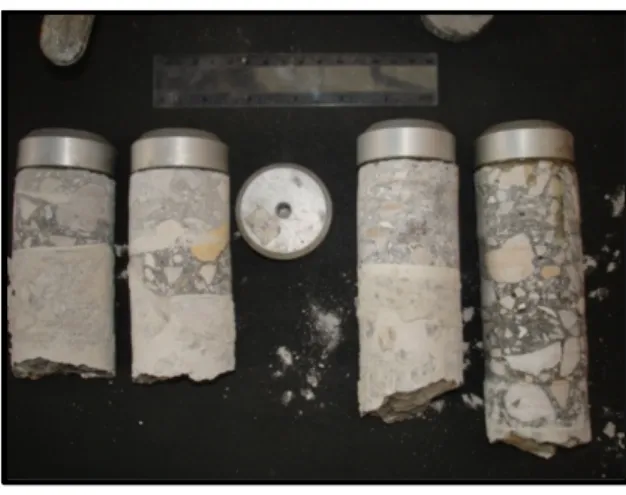
As was said, one of the parameters that allow us to study the mechanical behaviour of a concrete joint is its resistance to tensile. To evaluate this resistance, several pull-off test according to (ASTM C 1583-04, 2004) in order to obtain the rupture tensile strength of the concrete joint. In case the rupture of the cores occurs by the substrate interface, the strength obtained will correspond to the rupture tensile strength of the joint. However, if the rupture is localized in a section, different from the substrate, the value of the tensile obtained will be an estimated rupture tensile strength by default (See Image 10).
Image 10 – Illustration of the different types of rupture of the cores from the pull off tests
On the board below the values of the strength rupture of the concrete joint obtained by the pull-off tests, as well as the location of the rupture are presented.
Table 3 – Results of the pull off tests
Type of treatment for the joint Pull-off Tensile Strength(a) (MPa)
Standard Deviation (MPa)
Coefficient Range (%)
Most frequent location of the rupture — monolithic specimen I (1) 1,78 0,42 23,33 -
— monolithic specimen II (2) 1,83 0,27 14,70 -
No treatment(3)
1,52 0,37 24,13 Out of the interface
W.B.+ G.W. (4) 1,41 0,28 19,91 Interface
Ch. + Epoxy agent (5) 1,63 0,12 7,65 Out of the interface
Ch.+ G.W. (7) E.M.M.+ G.W. (8) E.M.M + Epoxy agent (9)
(1) Monolithic specimen without any concrete join
(2) Monolithic specimen without any concrete joint and formed by the concrete of the second pour. (3) Substrate surface of the concrete joint without any kind of treatment
(4) Substrate surface wire brushed followed by a gentle wetting moments before the restart of the concrete placing (5) Substrate surface of the joint totally chipped with a scalling hammer followed by the application of a
agent
(6) Substrate surface of the joint totally chipped with a scalling hammer
(7) Substrate surface of the joint totally chipped with a scalling hammer followed by a gentle wetting moments before the restart of the concrete placing
(8) Utilization of an expanded metal mesh on the concrete joint interface followed by a gentle wetting of the joint moments before the concrete placing
(9) Utilization of an expanded metal mesh together with an epoxy based bonding agent (a) Rupture tensile strength of the concrete joint and obtained by the pull off test
On the charts below the dispersal of the results of the tensile strength obtained
test as well as a chart with the mean of the rupture tensile strength obtained in each type of treatment applied to the concrete joints
Image 11 0,00 0,50 1,00 1,50 2,00 2,50 3,00 Monolithi c specimen I Monolithi specimen Maximum value 2,39 2,14 Minimum value 1,48 1,63 Mean value 1,78 1,83 R u p tu re t e n si le s tr e n g h t (M P a )
Dispersal of the results obtained in the pull off tests
Maximum value
1,21 0,43 35,95
1,68 0,53 31,59
1,15 0,19 16,44
Monolithic specimen without any concrete joint and formed by the concrete of the first pour. any concrete joint and formed by the concrete of the second pour. Substrate surface of the concrete joint without any kind of treatment
Substrate surface wire brushed followed by a gentle wetting moments before the restart of the concrete placing Substrate surface of the joint totally chipped with a scalling hammer followed by the application of a Substrate surface of the joint totally chipped with a scalling hammer
chipped with a scalling hammer followed by a gentle wetting moments before the restart of mesh on the concrete joint interface followed by a gentle wetting of the joint moments before metal mesh together with an epoxy based bonding agent
Rupture tensile strength of the concrete joint and obtained by the pull off test
the charts below the dispersal of the results of the tensile strength obtained
test as well as a chart with the mean of the rupture tensile strength obtained in each type of treatment applied to the concrete joints is shown.
– Dispersal of the results obtained from the pull off tests Monolithi c specimen II No treatmen t joint W.B.+ G.W. Ch. + Epoxy agent Chipped Ch.+ G.W E.M.M.+ G.W. 2,14 1,78 1,68 1,83 1,94 1,78 1,63 0,92 1,12 1,53 0,97 1,02 1,83 1,52 1,41 1,63 1,26 1,29
Dispersal of the results obtained in the pull off tests
Maximum value Minimum value Mean value
Interface Interface Interface
Substrate surface wire brushed followed by a gentle wetting moments before the restart of the concrete placing
Substrate surface of the joint totally chipped with a scalling hammer followed by the application of an epoxy based bonding
chipped with a scalling hammer followed by a gentle wetting moments before the restart of mesh on the concrete joint interface followed by a gentle wetting of the joint moments before
the charts below the dispersal of the results of the tensile strength obtained by the pull off test as well as a chart with the mean of the rupture tensile strength obtained in each type of
E.M.M.+ G.W. E.M.M + Epoxy agent 2,44 1,43 1,27 1,02 1,68 1,15
Image 12 – Mean values of t
• - (Monolithic Specimen I
formed by the concrete of the first pour
• - (Monolithic Specimen II
formed by the concrete of the second pour.
• No treatment joint
treatment
• E.B + G.W.→ Substrate surface wire brushed followed by a gentle wetting moments before the restart of the concrete placing
• Ch. + Epoxy Agent
hammer followed by the application of an epoxy based bonding agent
• Chipped→ Substrate surface of the joint totally chipped with a scalling hammer
• Ch. + G.W. → Substrate surface of the joint totally chipped with a scalling hammer followed by a gentle wetting moment
• E.M.M + G.W.→ Utilization of an expanded metal mesh on the concrete joint interface followed by a gentle wetting of the joint moments before the concrete placing
• E.M.M. + Epoxy agent
epoxy based bonding agent
As expected, the monolithic specimen was the one that present
rupture strength, 1,78 MPa for the specimen with concrete of the first pour and 1,83MPa for the specimen with concrete of the second pour.
not exist any type of interface or ph 1,78 1,83 0,00 0,50 1,00 1,50 2,00
R
u
p
tu
re
t
e
n
si
le
s
tr
e
n
g
h
t
(M
P
a
)
Mean values of the rupture tensile strength of the different
Monolithic specimen I W.B. + G.W.
Ch.+ G.W.
Mean values of the rupture tensile strength of the different concrete joints treatments
Monolithic Specimen I) → Monolithic specimen without any concrete joint and formed by the concrete of the first pour
Monolithic Specimen II) → Monolithic specimen without any concrete joint and formed by the concrete of the second pour.
→ Substrate surface of the concrete joint without any kind of Substrate surface wire brushed followed by a gentle wetting moments before the restart of the concrete placing
→ Substrate surface of the joint totally chipped with a scalling llowed by the application of an epoxy based bonding agent
Substrate surface of the joint totally chipped with a scalling hammer
Substrate surface of the joint totally chipped with a scalling hammer followed by a gentle wetting moments before the restart of the concrete placing
Utilization of an expanded metal mesh on the concrete joint interface followed by a gentle wetting of the joint moments before the concrete placing
E.M.M. + Epoxy agent → Utilization of an expanded metal mesh together with an epoxy based bonding agent
As expected, the monolithic specimen was the one that presented the highest value of the rupture strength, 1,78 MPa for the specimen with concrete of the first pour and 1,83MPa for the specimen with concrete of the second pour. The reason for this result is the fact that there did exist any type of interface or physical separation between the concrete of the specimen. The
1,83
1,52
1,41
1,63
1,26 1,29
Type of treatment for the joint
Mean values of the rupture tensile strength of the different
concrete joints treatments
Monolithic specimen I Monolithic specimen II No treatment joint
Ch.+ Epoxy agent Chipped
E.M.M+G.W. E.M.M.+Epoxy agent
he rupture tensile strength of the different concrete joints treatments
specimen without any concrete joint and Monolithic specimen without any concrete joint and te joint without any kind of Substrate surface wire brushed followed by a gentle wetting moments Substrate surface of the joint totally chipped with a scalling Substrate surface of the joint totally chipped with a scalling hammer
Substrate surface of the joint totally chipped with a scalling hammer s before the restart of the concrete placing
Utilization of an expanded metal mesh on the concrete joint interface followed by a gentle wetting of the joint moments before the concrete placing
d metal mesh together with an
the highest value of the rupture strength, 1,78 MPa for the specimen with concrete of the first pour and 1,83MPa for the ult is the fact that there did rete of the specimen. The
1,15
1,68
Mean values of the rupture tensile strength of the different
existance of an interface of separation between the different concrete layers will introduce a point of weakness in the structure so first of all, the introduction of a concrete construction joint in a structure should be avoided avoided in order to avoid a reduction in the resistance of the joint.
The joint treatment formed by a chipping of the substrate surface of the joint followed by the application of an epoxy based bonding agent was the treatment of all the treatments of group I that present the highest value for the rupture tensile strength, 1,63MPa. This value is an estimation by default of the rupture tensile due to the fact of the most frequent location for the rupture was out of the joint interface. Through these results it is possible to conclude that this is an excellent treatment for a concrete joint, and being able to ensure a good mechanical behavior to tensile for the joint. One of the possible justifications is the roughened surface that was obtained with the scalling hammer as well as the complete removal of the laitance, allowing the substrate surface to have excellent bonding conditions. The roughened surface allowed the epoxy agent to have a correct substrate for its application. The epoxy based agent works as structural glue and allows a perfect bonding between different concrete layers, with its tensile resistance of 3 MPa, quite above the tensile resistance of the concrete used. This product is suitable to be applied in concrete joints, and its extreme bonding capacity allows it to achieve excellent mechanical results for the concrete joint (O'BRIEN, 1985).
On the no treatment joint situation the obtained values for the tensile treatment were higher than the expected. With this treatment, a mean value for the tensile rupture of 1,52MPa was achieved, a value above the means obtained with treatments for the concrete joint, like the chipped surface treatment or the wire brushed substrate treatment. This value goes against what the whole bibliography refers to and what would be expected. For instance, (ACI STANDARD 224.3R-95, AGOSTO,1995), (BS 8007:1987, OUTUBRO,1987), (BROOK K. M., 1969) refer that a smooth and non roughened surface will achieve a lower value of bonding between different age concrete layers. In these experiments considerable values for the standard deviation were obtained and according to the chart of the dispersal of the results there were situations where the pull off tests presented quite lower values for the tensile rupture, for e.g. 0,92MPa. For instance, this value is more likely inside the range of values that where expected. Although the mean of the values obtained for this treatment were higher, it is sensible to say that the values do not reflect reality, and the number of tests (5) are not enough and are not statistically representative to make any conclusion for this treatment. However, the value of 0,92 MPa obtained in this treatment (lowest value in all pull off tests), leaves in the air the possibility of confirming what all bibliographies refer to, and in analysis permits to say that a no treatment joint will create a concrete joint with a poor mechanical behaviour.
In the wire brushed substrate surface situation, the mean of the rupture tensile strength was 1,41 MPa, result of the good roughness substrate surface obtained. The simple fact of obtaining a roughened surface and make an efficiently exposing the aggregates of the substrate of the concrete joint is mainly responsible for achieving a good bonding between different age
concretes. Comparing this value to other treatments, and assuming that the values obtained in the no treatment situation were incorrect or unrealistic, this treatment was able to achieve a good mechanical behaviour to the concrete joint. Although the exposure of the aggregates and the roughness of the substrate surface was higher in the treatment with the chipping, the wire brushing treatment achieved a higher bonding, as it is possible to see by the values of the tensile strength obtained. A possible justification for this is that the scalling hammer introduced a slight micro-cracking in the substrate concrete, with consequences for the mechanical resistance of the joint and with a reduction in the bonding of the concretes. These conclusions are in agreement to what (JÚLIO E. N., 2001), (TALBOT, PIGEON, BEAUPRÉ, & MORGAN, 1994) concluded. However, although the treatment of the concrete joint with a wire brush presented a higher value of rupture to tensile when compared to the chipped surface with a scalling hammer, wire brushing does not represent an efficient joint treatment. Taking into consideration factors like time lost, the man power necessary, the extension of the concrete joint and the performance of both treatments, it is easy to conclude that chipping the substrate interface is better than the use of the wire-brushing of the substrate surface. The use of the wire-brushing of the substrate is only viable in situations where the joints have little extension and the concrete from the first pour hasn’t already hard, making the treatment only applicable in the first hours after the pouring. The use of a scalling hammer, besides the frequent introduction of micro-cracking allows the cover of wider concrete joint areas.
Observing the values obtained in the chipped treatments, with and without the gentle water jetting moments before the retake of the concrete placing, 1,27 and 1,21 MPa respectively, it is easily concluded that there is no difference and no influence of using a gentle water jetting at the joint in these situations. This conclusion is in agreement with (JÚLIO E. N., 2001), while other authors like (MARTINS, 2004) state that pre-wetting is good for avoiding the contraction of the newest concrete layer. There are substantial suspicious that if the conclusion of (MARTINS, 2004) is correct, with the pre-wetting of the concrete joint surface there will be less cracking in the structure. So, although the pre-wetting of the surface has no relative effect on the ultimate tensile strength of the joint, it is wise to suppose that this procedure will introduce gaining in the service behaviour of the concrete joint. The chipped substrate surface treatments were the ones that present the lowest bonding results in the group I experiments, which supports what was said in relation to the micro-cracking introduced by these treatments and the effects on the ultimate tensile strength.
In the group II tests, where the mechanical behaviour to tensile of vertical joints was studied, the construction joint obtained by the expanded metal mesh together with an epoxy-based bonding agent was the one that presented the highest rupture tensile strength, 1,68 MPa. This value is quite closer to the value obtained in the monolithic specimens, which indicates that this is an excellent treatment and is able to achieve a very good mechanical behaviour for the concrete joint. The use of only an expanded metal mesh did not achieve a good behaviour to tensile, by presenting a mean value of 1,15 MPa for the pull off tests. Although the fact that the expanded
metal mesh has raised ribs incorporated that in accordance to (BUSSEL & CATHER, 1995), allows us to obtain a roughened substrate surface for the concrete joint and achieve a good resistance (see Image 13).
Image 13 – Raised ribs from the expanded metal mesh
With this test it was shown that this is not quite true and the use of expanded metal mesh does not guarantee a good behaviour for the joint. Taking into consideration what was concluded in the earlier paragraphs, the bonding agent itself is greatly responsible for the good tensile result of the treatment composed by the expanded metal mesh and the epoxy-bonding agent, with very small influence by the expanded metal mesh. The big advantage of this material is that it can be used as a stop-end former and allows the continuity of the reinforcement. The mesh of this material is slightly tightened, in such a way that there is little contact between the different age concrete, not allowing the correct contact between them and obstructing the correct bonding. In the Image 14, it is possible to see the roughened surface created by the metal mesh, however it was unable to achieve a good tensile strength.
Image 14 – Roughened surface obtained by the expanded metal mesh
Another justification for the results obtained is the fact that there was some passage of excess of cement past and fines through the mesh during the first pour (see Image 15). This introduced a plan of weakness in the backside of the joint, which in such a way justifies the value of the tensile strength achieved. This bonding agent was able to bypass the situation of the passage of excess of cement past and fines and the poor bonding connection between the concretes, in such a way that at the end this was the treatment that which achieved better mechanical behaviour for the joint. So, when applying expanded metal mesh, there must be specific
attention paid to these details, with the vibration of the concrete and its compaction being made at not less than 0,3 meters from the mesh (THE CONCRETE SOCIETY, 1988).
References
A
ACI Standard 224.3R-95. (Agosto,1995). Joints in Concrete Construction (Reapproved 2008). ACI Manual of Concrete Practice.
ACI Standard 503.6R-97. (2007). Guide for the Application of Epoxy and Latex Adhesives for
Bonding Freshly Mixed and Hardened Concretes (Reapproved 2003). ACI Manual of o
Concrete Practice.
B
Brook, K. (1969). CIRIA REPORT 16: Treatment of concrete construction joints. London: C.I.R.I.A.
Bussel, M. N., & Cather, R. (1995). CIRIA REPORT 146: Design and construction of joints in
concrete structures. London: CIRIA ( Construction Industry Research and Information
Association.
K
Kind-Barkauskas, F. (2002). Concrete construction manual. Basel: Birkhauser.
M
Martins, J. G. (2004). Estruturas de Betão - Condições técnicas de execução. Porto: Universidade Fernando Pessoa.
Monks, W. L. (Fevereiro,1974). Treatment of construction joints (Vol. 8).
O
O'Brien, T. (1985). Resins in construction: feedback from structural applications. International
Journal of Cement Composites and Lightweight Concrete, VII.