This is a repository copy of
Data augmentation for low resource languages
.
White Rose Research Online URL for this paper:
http://eprints.whiterose.ac.uk/152844/
Version: Published Version
Proceedings Paper:
Ragni, A. orcid.org/0000-0003-0634-4456, Knill, K.M., Rath, S.P. et al. (1 more author)
(2014) Data augmentation for low resource languages. In: INTERSPEECH 2014 : 15th
Annual Conference of the International Speech Communication Association.
INTERSPEECH 2014 : 15th Annual Conference of the International Speech
Communication Association, 14-18 Sep 2014, Singapore. International Speech
Communication Association (ISCA) , pp. 810-814.
© 2014 International Speech Communication Association (ISCA). Reproduced in
accordance with the publisher's self-archiving policy.
[email protected]
https://eprints.whiterose.ac.uk/
Reuse
Items deposited in White Rose Research Online are protected by copyright, with all rights reserved unless
indicated otherwise. They may be downloaded and/or printed for private study, or other acts as permitted by
national copyright laws. The publisher or other rights holders may allow further reproduction and re-use of
the full text version. This is indicated by the licence information on the White Rose Research Online record
for the item.
Takedown
If you consider content in White Rose Research Online to be in breach of UK law, please notify us by
Data augmentation for low resource languages
Anton Ragni, Kate M. Knill, Shakti P. Rath and Mark J. F. Gales
Department of Engineering, University of Cambridge
Trumpington Street, Cambridge CB2 1PZ, UK
{ar527,kmk1001,spr38,mjfg}@eng.cam.ac.uk
Abstract
Recently there has been interest in the approaches for train-ing speech recognition systems for languages with limited re-sources. Under the IARPA Babel program such resources have been provided for a range of languages to support this research area. This paper examines a particular form of approach, data augmentation, that can be applied to these situations. Data aug-mentation schemes aim to increase the quantity of data available to train the system, for example semi-supervised training, multi-lingual processing, acoustic data perturbation and speech syn-thesis. To date the majority of work has considered individual data augmentation schemes, with few consistent performance contrasts or examination of whether the schemes are comple-mentary. In this work two data augmentation schemes, semi-supervised training and vocal tract length perturbation, are ex-amined and combined on the Babel limited language pack con-figuration. Here only about 10 hours of transcribed acoustic data are available. Two languages are examined, Assamese and Zulu, which were found to be the most challenging of the Ba-bel languages released for the 2014 Evaluation. For both lan-guages consistent speech recognition performance gains can be obtained using these augmentation schemes. Furthermore the impact of these performance gains on a down-stream keyword spotting task are also described.
Index Terms: data augmentation, speech recognition, babel
1. Introduction
A large amount of transcribed training data is usually needed to enable accurate speech recognition [1, 2]. Although for some languages, such as English and Mandarin, these resources may be sourced, for others, termedlow resource languages, it may not always be feasible. This has recently created lots of in-terest in the approaches that can be applied to these situations [3, 4, 5]. To facilitate research in this direction, consistent packs of limited resources for a range of languages have been provided under the IARPA Babel program. The goal of the program is to provide effective search capabilities to efficiently process real-world recorded speech. This is effectively a spoken term detection task, where speech recognition systems are assessed based on keyword search (KWS) performance rather than more conventional transcription accuracy. Though improvements in This work was supported by the Intelligence Advanced Research Projects Activity (IARPA) via Department of Defense U. S. Army Re-search Laboratory (DoD/ARL) contract number W911NF-12-C-0012. The U. S. Government is authorized to reproduce and distribute reprints for Governmental purposes notwithstanding any copyright annotation thereon. Disclaimer: The views and conclusions contained herein are those of the authors and should not be interpreted as necessarily rep-resenting the official policies or endorsements, either expressed or im-plied, of IARPA, DoD/ARL, or the U. S. Government.
speech recognition performance may not necessarily translate into improved KWS capacity [3], a certain positive correlation does exist [3, 4, 5], which motivates the work on building accu-rate speech recognition systems.
A common issue that arises from the use of limited re-sources in speech recognition systems is robust parameter es-timation. A range of approaches can be applied to address ro-bustness issues. These include standard statistical approaches, such as maximum a posteriori (MAP) estimation [6], anddata augmentation[7, 8, 9, 10, 11, 12]. The MAP estimation intro-duces a prior on model parameters into training objective func-tion [6, 13]. However, this approach is ill-suited in situafunc-tions when there is no training data or informative prior distribution available. The data augmentation aims to increase the quantity of training data. This approach has an important theoretical ad-vantage of being able to produce data when real examples are not available [8]. Common schemes include semi-supervised training [7, 2, 11], multi-lingual processing [3, 11, 14], acoustic data perturbation [9, 10, 12] and speech synthesis [8].
The previous work with data augmentation has mostly fo-cused on individual schemes. Not much work has been done on contrasting and examining whether the schemes are compli-mentary. This paper examines and combines semi-supervised training and acoustic data perturbation on two languages, As-samese and Zulu, found to be the most challenging of the Babel languages released for the 2014 Evaluation.
The rest of this paper is organised as follows. Section 2 provides an overview of commonly used data augmentation schemes including semi-supervised training and acoustic data perturbation. Section 3 discusses options available for train-ing speech recognition systems on augmented data. Sec-tion 4 provides individual and combined results on using semi-supervised training and acoustic data perturbation for the two Babel program languages, Assamese and Zulu. Finally, Sec-tion 5 presents conclusions drawn from this work.
2. Data augmentation
The data augmentation refers to the schemes that aim to increase the quantity of data available to train speech recognition sys-tems. The schemes can be split based on the type of produced data, such as unsupervised, synthesised and other language data.
2.1. Unsupervised data
The unsupervised data refers to data which lacks correct tran-scriptions. This also includes data having only rough transcrip-tions, such as closed captions [7, 2]. The unsupervised data may be adopted by recognising it with an existing or boot-strapped system, filtering out those utterances that fail to decode/pass confidence threshold [15, 16] and re-training the system on
pervised and filtered unsupervised training data. This is com-monly referred to as a semi-supervised training. The main ad-vantage of unsupervised data is that it is generally possible to collect vast amounts of such data, e.g., radio and television news broadcasts [7], covering all sorts of speaker and noise conditions. The main disadvantage of this type of data is the lack of correct transcriptions. This limits possible gains from the approaches particularly sensitive to the accuracy of supplied transcriptions, such as discriminative training [17] and speaker adaptation based on discriminative criteria [18].
2.2. Synthesised data
The synthesised data may refer to existing but perturbed in a certain way data as well as new artificially generated data. One major advantage of synthesised data is that, similar to unsuper-vised case, it is possible to collect vast amounts of such data. Furthermore, different to unsupervised case, the correctness of associated transcriptions is usually guaranteed. A major disad-vantage of this type of data could be its quality.
There are numerous options how data can be perturbed. These include vocal tract length perturbation (VTLP) [9, 10] and stochastic feature mapping (SFM) [12]. The VTLP scheme attempts to alter vocal tract length during extraction of stan-dard speech parametrisations such as Mel-frequency cepstral (MFCC) and perceptual linear prediction (PLP) coefficients. Essentially, a single warping parameter is modified either stochastically [9] or deterministically [12]. This results in a sim-ple synthesis process yet the data is perturbed in a non-linear way. Though the original motivation for VTLP was to learn multi-layer perceptrons (MLP) robust to changes in vocal tract length [9, 10, 12], the scheme could be of a wider interest, for instance, to boot-strap systems used for recognising unsuper-vised data. In contrast to VTLP, the SFM is a general method-ology for stochastically mapping features from one domain to another [19, 12]. When applied to speakers, the SFM essentially yields a simplified voice morphing [20] scheme. One simple ap-proach to map utterances of one speaker to another is to apply global constrained maximum likelihood regression (CMLLR) transform [21] estimated from statistics of the other speaker [12]. The issue with this approach is that a simple global trans-form is applied to every observation in the sequence which may not be powerful enough to yield accurate mapping.
Rather than perturbing existing data it is possible [8] to artificially generate new examples using speech synthesis ap-proaches, such as concatenative or statistical [22]. The concate-native approach attempts to synthesise speech by concatenating existing waveform segments into a sequence. The statistical ap-proach usually adopts acoustic models, such as hidden Markov models (HMM), to produce speech parameter sequences max-imising likelihood [22]. These model-based schemes may be particularly useful since speech parameter sequences, such as MFCC or PLP, rather than waveforms are required. Thus many of the waveform production issues [23] are not rele-vant. Furthermore, these schemes permit model-based adap-tation/compensation approaches [24] to be used for synthesis-ing data with target [25] and new [26] speaker and environ-ment characteristics. In contrast to acoustic data perturbation schemes, the use of speech synthesis offers flexibility in gen-erating data for arbitrary given transcription. For instance, it is possible to generate data for targeting only particular confusions using schemes such as acoustic code-breaking [27].
Hidden Layers Layer Bottleneck Input Layer Targets
GMM
L
P
M
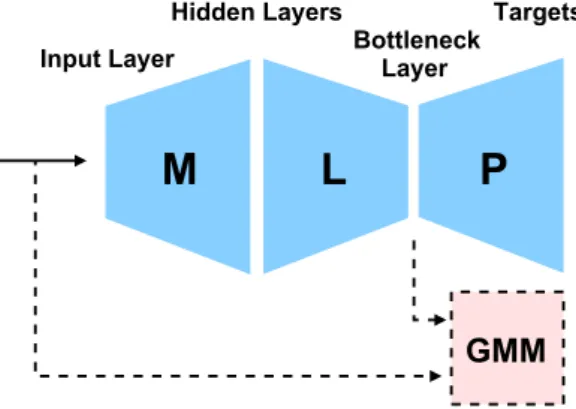
Figure 1:Schematic diagram of a tandem approach 2.3. Other language data
Though for many languages there are only limited or no re-sources, for some languages sufficient resources are available. This has prompted lots of interest in using this type of augment-ing data [3, 11, 14]. Furthermore, the use of unsupervised other language data has also been considered [11]. Compared to syn-thesised data, this type of augmenting data, similar to unsuper-vised data, is real. However, its use may also be more compli-cated as it is not obvious what is the best way to exploit it [3]. There have been proposed several approaches. One group relies on the use of a universal phone set to accomplish mapping of one language to another [28, 3]. Another group relies on an al-ternative form of mapping, such as phone-to-phone [29] or hid-den layer unit-to-target as in the MLP-based work of [30, 14]. Both directions have their own advantages and disadvantages [3]. In particular, it is not obvious how to ensure sufficient coverage in the training data for approaches based on universal phone sets, map phones between languages such as English and Cantonese in approaches based on phone-to-phone mappings or ensure that targets are optimally ordered in approaches that map hidden layer units to targets.
3. Augmentation modes
Given augmenting data, an important question is how to best exploit it. The answer to this question will ultimately depend on the particular architecture the speech recogniser adopts and the nature and amount of augmenting data used. There are nu-merous configurations possible, such as standard Gaussian mix-ture model (GMM) based HMM [31], tandem [32], hybrid [33], stacked versions of the tandem [34] and hybrid [33] architec-tures. This section considers several of these, putting a particu-lar emphasis on the tandem architecture adopted in Section 4.
The tandem architecture may be illustrated by Figure 1 which shows a MLP and GMM-based HMM speech recog-niser. Three types of MLP layers are shown: input, hid-den and bottleneck. The standard parametrisation, such as MFCC or PLP, optionally de-correlated and transformed, is fed into the input layer which is followed by hidden layers where it undergoes a series of non-linear transformations un-til it reaches bottleneck layer where MLP-derived features are extracted. These features, also called bottleneck (BN) features, are then concatenated with the standard parametrisation, option-ally de-correlated and transformed, and used within the standard GMM-based HMM speech recogniser. The hybrid architecture may also be illustrated by Figure 1, although in this case the dashed part is not present and the bottleneck layer is replaced with an extra hidden layer. The posterior probabilities of
gets at the final layer after proper scaling are adopted in place of GMM likelihoods within the standard HMM speech recog-niser [33]. The stacked architectures are based on replacing the dashed block in Figure 1 by another MLP of tandem or hybrid configuration. Though all these architectures are based on MLPs, the final speech recognisers often show different er-ror behaviours. This is where system combination approaches [35, 16] may yield further gains in transcription accuracy.
Such MLP-based architectures offer flexibility into the use of augmenting data. For instance, there are options how it can be exploited in the tandem architecture. One option is to only re-train the GMM whilst keeping MLP parameters fixed to the estimates obtained from the supervised data. Another option is to only re-train the MLP. The third option is to re-train both, the GMM and MLP. For hybrid architectures it is common to re-train the whole system on the augmented data [12], although it is possible to consider fine-tuning on the supervised data only. The stacked architectures offer more flexibility though for sim-plicity they were not investigated in this paper.
In addition to architecture, the optimal approach will also depend on the nature and amount of the particular data used. For instance, it is not obvious which parts are best kept unilingual and which are better to train multi-lingual in case of augmenting data from other languages. Also, there is a clear limit to the usefulness of schemes such as VTLP. Furthermore, some of the augmenting data types may not combine well in practice.
4. Experiments
Experiments were conducted on two limited language packs re-leased by IARPA Babel program: Assamese and Zulu.1 The data is recorded in real conditions, such as conversational tele-phone speech in a range of acoustic conditions. There are also provided phone set and phonetic lexicon, which contains only words that appear in the supervised training data transcrip-tions. The amount of supervised data is 12 and 14 hours for Assamese and Zulu respectively. The underlying transcriptions were used to create a bigram language model (LM) for discrimi-native training [31] and trigram LM for decoding. The develop-ment sets for both tasks contain approximately 10 hours of data. The experiments were conducted using an extended version of CUED’s HTK-3.4.1 toolkit [31] providing GMM-based HMM speech recognition techniques, an extended version of ICSI’s QuickNet toolkit [36] providing MLP techniques and IBM’s proprietary KWS system [37] for keyword searching.
4.1. Speech recognition system
The tandem architecture was selected for investigation. A con-sistent procedure was used to create tandem systems. This largely followed [38] and consists of three stages. In thefirst stagea speaker-independent GMM-based HMM is built based on PLP. This applies maximum likelihood (ML) training, het-eroscedastic linear discriminant analysis (HLDA) and discrimi-native, minimum phone error (MPE) [39], training. The HMM states were phonetic decision tree clustered into 1000 unique states following the procedure in [3]. The first stage system was used to produce hypotheses for adaptation by running a Viterbi decoding with the trigram LM over the development sets. Thesecond stageis the MLP training. A simple MLP topology with 3 hidden, 1 input and 1 bottleneck layer was
1The precise code identifiers are IARPA-babel102b-v0.5a and IARPA-babel206b-v0.1e. These releases additionally contain full lan-guage packs, where the amount of transcribed data is roughly 70 hours.
adopted. The targets were set to 1000 unique states derived for the first stage system. The input to MLP was a 504-dimensional stack of 4 past, 1 current and 4 future vectors, where each vec-tor was a 13-dimensional PLP feature vecvec-tor augmented with pitch [40], its delta (∆), delta-delta (∆2
) and triples (∆3 ). The MLP was pre-trained layer-wise and fine-tuned using a cross-entropy criterion [33]. The first stage system was used to pro-vide targets. This MLP was used to propro-vide 26-dimensional BN features for training and development data. These BN fea-tures were concatenated with 52-dimensional PLP+∆+∆2
+∆3 and 3-dimensional pitch+∆+∆features. Thethird stageis the tandem build. This stage (re-)estimates HLDA transform for PLP and global semitied transform [41] for BN. This reduces dimensionality of tandem features from 81 to 68. The SI tan-dem system is then built similar to the first stage SI system. In addition to SI, the third stage also performs CMLLR-based speaker adaptive training (SAT) first using ML [21] and then feature-space MPE (fMPE-SAT) criterion [42]. The CMLLR transforms during fMPE-SAT were fixed to ML estimates and not re-estimated. This final system was used for decoding. Prior to this, CMLLR and MLLR transforms were estimated using initial hypotheses produced by the first stage system. These transforms were then used in Viterbi decoding with the bigram LM to produce lattices. Though these lattices could be rescored with more advanced LMs, this was not done in this initial inves-tigation. The accuracy of speech recogniser was assessed based on token error rate (TER) in percentage points (%).2 The TER performance of this system on Assamese and Zulu was 69.4 and 78.4%, as shown in the first row of Tables 3 and 2.
4.2. Keyword search system
For the 2014 Evaluation the IARPA Babel program required each submitted system to be assessed in keyword search ca-pacity. The task was to find all the exact matches of a query in the development set. The KWS performance is measured according to the maximum term weighted value (MTWV), a metric that takes into account the probabilities of misses and false alarms with larger MTWV values corresponding to bet-ter KWS performance. The supplied queries were split into in-vocabulary (IV) and out-of-in-vocabulary (OOV) parts. For the IV queries the set of word lattices is searched [43] to retrieve the list of hits. For the OOV queries a different approach is used. This operates at the phone level by converting OOV queries into phonetic representation using a grapheme-to-phoneme con-verter [44]. A soft search, which may improve recall whilst de-grade precision, is then performed by expanding the obtained phonetic OOV query representation using phone-to-phone con-fusion matrix [44]. Only 100 representations with the highest score were retained. Furthermore, the language model scores during search were zeroed as this was found to improve KWS performance. The same approach was also adopted with those IV queries that produced no hits (IV-OOV). The combined list of hits including IV, OOV and IV-OOV parts after sum-to-one normalisation [37] is used to compute MTWV.
4.3. Data augmentation
Two data augmentation schemes, semi-supervised (semi) training and VTLP (vtlp), were considered. The unsupervised
2The TER is used for consistency of reporting performance for all Babel program languages, such as Assamese and Zulu, where token is a word, or Vietnamese, where token is a syllable or foreign word, or Cantonese, where token is a character.
data is provided by the limited language pack release and con-versational portion of the full language pack. The unsupervised data was selected as described in Section 2.1. Here, the tan-dem system was used to produce lattices. These lattices were then converted into confusion networks to yield word confusion scores [16]. The confusion scores were weighted by the aver-age number of frames to yield the final score for data selection. The data selection process followed [17] and retained half of the unsupervised data. This corresponds to the threshold of 0.4 and 0.3 for Assamese and Zulu respectively as can be seen from Figure 2. The perturbed data,sup+vtlpandsemi+vtlp,
0 25 50 75 100 0 0.1 0.2 0.3 0.4 0.5 0.6 0.7 0.8 0.9 1 Data (%) Confidence threshold Assamese Zulu
Figure 2: Percentage of unsupervised data retained for semi-supervised training at different confidence threshold values
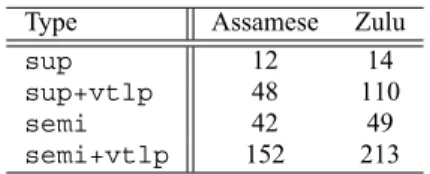
was obtained as discussed in Section 2.2. Here, the original data,supandsemi, was perturbed 4 and 8 times for Assamese and Zulu respectively as the former was found sensitive to the larger amount of perturbed data. One perturbation factor was fixed to 1, which yields the original data, and the rest, 3 and 7, were randomly sampled from[0.8,1.2]range for each side. The perturbed semi-supervised (semi+vtlp) data was created in the same way. This provides with an approach to increase the amount of unsupervised data where confidence in the accuracy of the underlying transcriptions is above 0.4 and 0.3 thresholds. The amounts of supervised (sup) and other types of augment-ing data are summarised in Table 1.
Table 1:Augmenting data quantity in hours
Type Assamese Zulu
sup 12 14
sup+vtlp 48 110
semi 42 49
semi+vtlp 152 213
4.4. Results
A range of experiments was conducted to assess the useful-ness of augmenting data starting with the more challenging language, Zulu. The first experiment examined the impact of re-training MLP only. The first block of TER results in
Ta-Table 2:Zulu GMM MLP TER MTWV sup sup 78.4 0.1362 sup sup+vtlp 77.1 0.1496 sup semi 77.7 0.1468 sup semi+vtlp 76.7 0.1446 semi semi 76.9 0.1490 semi semi+vtlp 76.1 0.1441 semi+vtlp semi+vtlp 76.1 0.1454 ble 2 third column shows that the use of augmenting data yields
gains over the supervised data. In particular, the combined ap-proach, (semi+vtlp, the fourth line) yields the largest 1.7% absolute improvement. The next experiment assessed whether increasing the complexity of GMM system may further improve the results. The tandem system was retrained on the semi-supervised data starting from the first stage. The number of unique states was increased to 3000. This yields 76.9% TER performance as shown on the first line of the second block in Table 2. The use of additional data for training MLP in this case gives small improvement. Re-training the tandem on perturbed semi-supervised data with 5000 unique states yields no addi-tional improvement in TER performance (last line in Table 2). The second series of experiments was conducted on Assamese. The results in Table 3 show a pattern similar to that of Zulu apart from a rather limited usefulness of perturbed compared to unsupervised data. Table 3:Assamese GMM MLP TER MTWV sup sup 69.4 0.2286 sup sup+vtlp 69.3 0.2355 sup semi 67.6 0.2309 sup semi+vtlp 68.3 0.2341 semi semi 66.9 0.2221 semi semi+vtlp 66.9 0.2291
Although the above results indicate that data augmentation schemes may be useful for improving TER performance, the ultimate measure of interest in the IARPA Babel program is MTWV. The KWS results in the fourth column of Tables 2 and 3 show that consistent gains in MTWV are also possible. These results also illustrate that improvements in TER do not nec-essarily translate into improvements in MTWV [3]. For both languages the best MTWV is obtained with the GMM trained on supervised data and MLP trained on perturbed supervised data. The use of standard and perturbed semi-supervised data for training MLP yields a slightly lower MTWV. However, in this case re-training GMM on the semi-supervised data may hurt performance. This indicates that the approach is also sen-sitive to the accuracy of training transcriptions.
5. Conclusions
Providing accurate speech recognition and keyword searching capabilities for low resource languages is a challenging task. This paper examined an approach, data augmentation, that aims to increase the quantity of available data. Particular schemes discussed were semi-supervised training, acoustic data pertur-bation, speech synthesis and multi-lingual processing. This paper also discussed various ways to exploit this data in tan-dem and hybrid architectures. Two of these schemes, semi-supervised training and acoustic data perturbation, individu-ally and in combination were applied within the tandem archi-tecture for two low resource languages, Assamese and Zulu. Speech recognition performance gains were observed from the use of both scheme, with the combined scheme yielding largest gain only for Zulu. Keyword search results showed that gains are also possible, however, the use of semi-supervised training yielded mixed results in this case suggesting sensitivity of the approach to the accuracy of training data transcriptions.
6. Acknowledgements
The authors are grateful to IBM for the KWS system.
7. References
[1] G. Evermann, H. Y. Chan, M. J. F. Gales, T. Hain, A. Liu, D. Mrva, L. Wang, and P. C. Woodland, “Development of the 2003 CU-HTK conversational telephone speech transcription system,” inICASSP, vol. 1, 2004, pp. 249–252.
[2] M. J. F. Gales, D. Y. Kim, P. C. Woodland, H. Y. Chan, D. Mrva, R. Sinha, and S. E. Tranter, “Progress in the CU-HTK broadcast news transcription system,”IEEE Tran ASLP, vol. 14, no. 5, pp. 1513–1525, 2006.
[3] K. M. Knill, M. J. F. Gales, S. P. Rath, P. C. Woodland, C. Zhang, and S.-X. Zhang, “Investigation of multilingual deep neural net-works for spoken term detection,” inASRU, 2013.
[4] R. Hsiao, T. Ng, F. Grezl, D. Karakos, S. Tsakalidis, L. Nguyen, and R. Schwartz, “Discriminative semi-supervised training for keyword search in low resource languages,” inASRU, 2013, pp. 440–445.
[5] M. Saraclar, A. Sethy, B. Ramabhadran, L. Mangu, X. Cui, B. Kingsbury, and J. Mamou, “An empirical study of confu-sion modeling in keyword search for low resource languages,” in
ASRU, 2013, pp. 464–469.
[6] J.-L. Gauvain and C.-H. Lee, “Maximum a posteriori estimation of multivariate gaussian mixture observations of markov chains,”
IEEE Tran SAP, vol. 2, no. 2, pp. 291–298, 1994.
[7] L. Lamel and J.-L. Gauvain, “Lightly supervised and unsuper-vised acoustic model training,”Computer speech and language, vol. 16, pp. 115–129, 2002.
[8] M. J. F. Gales, A. Ragni, H. AlDamarki, and C. Gautier, “Support vector machines for noise robust ASR,” inASRU, 2009, pp. 205– 210.
[9] N. Jaitly and G. E. Hinton, “Vocal tract length perturbation (VTLP) improves speech recognition,” inICML, 2013.
[10] N. Kanda, R. Takeda, and Y. Obuchi, “Elastic spectral distortion for low resource speech recognition with deep neural networks,” inASRU, 2013, pp. 309–314.
[11] Y. Qian, K. Yu, and J. Liu, “Combination of data borrowing strate-gies for low-resource LVCSR,” inASRU, 2013, pp. 404–409. [12] X. Cui, V. Goel, and B. Kingsbury, “Data augmentation for deep
neural network acoustic modeling,” inICASSP, 2014.
[13] D. Povey, M. J. F. Gales, D. Y. Kim, and P. C. Woodland, “MMI-MAP and MPE-“MMI-MAP for acoustic model adaptation,” in Eu-rospeech, 2003, pp. 1981–1984.
[14] Z. T¨uske, J. Pinto, D. Wilett, and R. Schl¨uter, “Investigation on cross- and multilingual MLP features under matched and mis-matched acoustical conditions,” inICASSP, 2006, pp. 7349–7353. [15] G. Zavaliagkos and T. Colthurst, “Utilizing untranscribed training
data to improve performance,” inBNTU, 1998, pp. 301–305. [16] G. Evermann and P. C. Woodland, “Large vocabulary decoding
and confidence estimation using word posterior probabilities,” in
ICASSP, vol. 3, 2000, pp. 1655–1658.
[17] L. Wang, M. J. F. Gales, and P. C. Woodland, “Unsupervised train-ing for Mandarin broadcast news and conversation transcription,” inICASSP, vol. 4, 2007, pp. 353–356.
[18] L. Wang and P. C. Woodland, “Discriminative adaptive training using the MPE criterion,” inASRU, 2003, pp. 279–284. [19] H. Zen, Y. Nankaku, and K. Tokuda, “Continuous stochastic
fea-ture mapping based on trajectory HMMs,”IEEE Tran ASLP, pp. 417–430, 2010.
[20] H. Ye and S. J. Young, “High quality voice morphing,” inICASSP, vol. 1, 2013, pp. 9–12.
[21] M. J. F. Gales, “Maximum likelihood linear transformations for HMM-based speech recognition,” Computer Speech and Lan-guage, vol. 12, no. 2, pp. 75–98, 1998.
[22] K. Tokuda, H. Zen, and A. W. Black, “An HMM-based approach to multilingual speech synthesis,” inText to speech synthesis: new paradigms and advances, S. Narayanan and A. Alwan, Eds. Prentice Hall, 2004, ch. 7, pp. 135–153.
[23] H. Zen, K. Tokuda, and A. W. Black, “Statistical parametric speech synthesis,”Speech Communication, vol. 51, pp. 1039– 1064, 2009.
[24] M. J. F. Gales, “Model-based approaches to handling uncertainty,” inRobust speech recognition of uncertain or missing data. The-ory and applications, D. Kolossa and R. Haeb-Umbach, Eds. Springer, 2011, ch. 5, pp. 101–126.
[25] K. Ogata, M. Tachibana, J. Yamagishi, and T. Kobayashi, “Acous-tic model training based on linear transformation and MAP modi-fication for HSMM-based speech synthesis,” inInterspeech, 2006, pp. 1328–1331.
[26] T. Yoshimura, K. Tokuda, T. Masuko, and T. Kobayashi, T. Ki-tamura, “Speaker interpolation in HMM-based speech synthesis system,” inEurospeech, 1997, pp. 2523–2526.
[27] V. Venkataramani and W. Byrne, “Lattice segmentation and sup-port vector machines for large vocabulary continuous speech recognition,” inICASSP, 2005, pp. 817–820.
[28] T. Schultz and A. Waibel, “Fast bootstrapping of LVCSR systems with multilingual phoneme sets,” inEurospeech, 1997, pp. 371– 373.
[29] P. Beyerlein, W. Byrne, J. M. Huerta, S. Khudanpur, B. Marthi, J. Morgan, N. Peterek, J. Picone, and W. Wang, “Towards lan-guage independent acoustic modellings,” inASRU, 1999. [30] K. Vesely, M. Karafiat, F. Grezl, M. Janda, and E. Egorova,
“The language-independent bottleneck features,” inSLT, 2012, pp. 336–341.
[31] S. J. Young, G. Evermann, M. J. F. Gales, T. Hain, D. Kershaw, X. Liu, G. Moore, J. Odell, D. Ollason, D. Povey, V. Valtchev, and P. C. Woodland, The HTK Book (for HTK Version 3.4.1). http://htk.eng.cam.ac.uk: University of Cambridge, 2009. [32] H. Hermansky, D. P. W. Ellis, and S. Sharma, “Tandem
con-nectionist feature extraction for conventional HMM systems,” in
ICASSP, vol. 3, 2000, pp. 1635–1638.
[33] G. Hinton, L. Deng, D. Yu, G. Dahl, A. Mohamed, N. Jaitly, A. Senior, V. Vanhoucke, P. Nguyen, T. N. Sainath, and B. Kings-bury, “Deep neural networks for acoustic modeling in speech recognition,”Sig Proc Mag, vol. 29, pp. 82–97, 2012.
[34] C. Plahl, R. Schl¨uter, and H. Ney, “Hierarchical bottle neck fea-tures for LVCSR,” inInterspeech, 2010, pp. 1197–1200. [35] J. Fiscus, “A post-processing system to yield reduced word error
rates: Recog- niser output voting error reduction (ROVER),” in
ASRU, 1997, pp. 347–352.
[36] D. Johnson, “Quicknet,” inICSI, Berkeley, USA, 2004. [37] J. Mamou, J. Cui, X. Cui, M. J. F. Gales, B. Kingsbury, K. M.
Knill, L. Mangu, D. Nolden, M. Picheny, B. Ramabhadran, R. Schl¨uter, A. Sethy, and P. C. Woodland, “System combination and score normalization for spoken term detection,” inICASSP, 2013, pp. 8272–8276.
[38] J. Park, F. Diehl, M. J. F. Gales, M. Tomalin, and P. C. Wood-land, “The efficient incorporation of MLP features into automatic speech recognition systems,” Computer speech and language, vol. 25, pp. 519–534, 2011.
[39] D. Povey, “Discriminative training for large vocabulary speech recognition,” Ph.D. dissertation, Cambridge University, 2003. [40] D. Talkin, “A robust algorithm for pitch tracking (RAPT),” in
Speech Coding and Synthesis, W. B. Kleijn and K. K. Paliwal, Eds. Elsevier Science B. V., 1995, ch. 14, pp. 495–518. [41] M. J. F. Gales, “Semi-tied covariance matrices for hidden Markov
models,”IEEE Tran SAP, vol. 29, pp. 82–97, 2012.
[42] D. Povey, B. Kingsbury, L. Mangu, G. Saon, H. Soltau, and G. Zweig, “fMPE: Discriminatively trained features for speech recognition,” inICASSP, vol. 1, 2005, pp. 961–964.
[43] C. Allauzen, M. Mohri, and M. Saraclar, “General indexation of weighted automata - application to spoken utterance retrieval,” in
IASIR, 2004, pp. 33–40.
[44] L. Mangu, H. Soltau, H.-K. Kuo, B. Kingsbury, and G. Saon, “Ex-ploiting diversity for spoken term detection,” inICASSP, 2013, pp. 8282–8286.