PURDUE UNIVERSITY
GRADUATE SCHOOL
Thesis/Dissertation Acceptance
7KLVLVWRFHUWLI\WKDWWKHWKHVLVGLVVHUWDWLRQSUHSDUHG %\ (QWLWOHG )RUWKHGHJUHHRI ,VDSSURYHGE\WKHILQDOH[DPLQLQJFRPPLWWHH $SSURYHGE\0DMRU3URIHVVRUVBBBBBBBBBBBBBBBBBBBBBBBBBBBBBBBBBBBB BBBBBBBBBBBBBBBBBBBBBBBBBBBBBBBBBBBB $SSURYHGE\+HDGRIWKHDepartment *UDGXDWH3URJUDP 'DWH
To the best of my knowledge and as understood by the student in the Thesis/Dissertation Agreement, Publication Delay, and Certification/Disclaimer (Graduate School Form 32), this thesis/dissertation adheres to the provisions of Purdue University’s “Policy on Integrity in Research” and the use of copyrighted material.
Abeer Kalash
TRUST MODELLING THROUGH SOCIAL SCIENCES
Master of Science Arjan Durresi Mohammad Al Hasan Mihran Tuceryan Arjan Durresi Shiaofen Fang 11/14/2014
TRUST MODELLING THROUGH SOCIAL SCIENCES
A Thesis
Submitted to the Faculty of
Purdue University by
Abeer Kalash
In Partial Fulfillment of the Requirements for the Degree
of
Master of Science
December 2014 Purdue University Indianapolis, Indiana
ACKNOWLEDGEMENTS
First of all, I would like to thank my God whose presence in my life gives me the strength to keep going, and gives me the wisdom to deal with difficulties. My prayers to him have helped me through the whole preparation process for this thesis. My faith in him gave me the power to believe in myself.
I would like also to take this opportunity to thank my professor and thesis advisor Dr. Arjan Durresi for trusting me to work under his invaluable guidance. His encouragement, patience, and dedication have inspired me to work harder in spite of many difficulties. He was and continues to be a great role model who has a tremendous impact on my life. I have learnt a lot from him on many levels academically, professionally, and personally. He makes the work enjoyable even with the hardest parts of it. He is a very sincere person who has high level of kindness and sensitivity to his students’ feelings. He cares about other people and always ready to provide the support to lift them up when they need that the most. His sense of humor has always motivated us as a team when things were getting a bit complicated. His unconditional support has made my work possible.
I would like also to thank Dr. Muhammad al Hasan and Dr. Mihran Tuceryan for graciously accepting to be a part in my committee. It is truly a great honor to present my thesis work with the presence of such real precious experiences and knowledge like theirs.
They continue to provide a lot of knowledge, experience and great teaching for IUPUI students. Thanks for being part of my work and for inspiring me to do my best in it.
Thanks to Yefeng Ruan for his contribution and advice in our teamwork in order to help in getting a good outcome. A special thanks to my dear friend Lina Alfantoukh whose invaluable support, on many levels, has made my work possible. With all her kindness, she was always ready to lift me up when things got a bit overwhelming.
The biggest thank from my heart is to my dear husband Nader, who has always been the most supportive understanding person in my life. How can I thank you enough? For the first time in my life I find myself speechless in front of your generosity, innocence, and love. Without you, I wouldn’t have been here in the first place. You handle me every time I become frustrated; your words and advice were what kept me going. You had a faith in me and pushed me to reach my highest possibilities, especially when I was ready to give up. I hope that our future together be as white as your heart is.
Thanks for my baby girl Krista whose smile has made my life easier and happier. Your birth is the most beautiful event that happened in our life. You are the reason we keep going, and your smile is what fills our life with grace and gratitude. We thank God every day when we wake up on your beautiful voice and shining eyes.
My parents and in laws have a big thanks in my heart as well. They are my source of love and support even when they are away. I hope I live to be a great parent for my children as you were for us.
Very special thanks to the entire department of computer science, and to Nicole Wittlief. The support, knowledge and experience you all provide for your students is priceless, and it is what makes them stand out from other graduates.
TABLE OF CONTENTS
Page
LIST OF TABLES ... vi
LIST OF FIGURES ... vii
ABSTRACT ... viii
CHAPTER 1. INTRODUCTION ... 1
1.1 Introduction ... 1
1.2 The Need for Trust Models ... 2
1.3 Thesis Objective and Contributions ... 3
1.4 Thesis Organization ... 5
CHAPTER 2. RELATED WORKS... 8
CHAPTER 3. TRUST DEFINITIONS ... 14
CHAPTER 4. THE DISCUSSED MODEL ... 20
CHAPTER 5. TRUST MAPPING ... 24
5.1 Trust and Content/ Context ... 25
5.1.1 Discussion ...27
5.2 Trust and Timing ... 29
5.2.1 Trust is Learnt over Time (Trust Dynamicity) ...30
5.2.2 Forgetting Factor ...31
5.2.2.1 Discussion and Experiment ... 34
5.2.3 Timely Response Effects on Trust ...38
5.2.3.1 Discussion and Suggestions ... 39
5.3 Trust and Experience ... 40
5.3.1 Discussion and Suggestions ...42
Page
5.4.1 Discussion and Experiment ...50
CHAPTER 6. TRUST MANAGEMENT ... 56
6.1 A Brief Look on Transitivity in Computer Science ... 57
6.2 Transitivity in Social Sciences ... 59
6.2.1 Transitivity and Content/Context ...59
6.2.2 Transitivity through the Effects of Third Parties ...60
6.2.3 Transitivity by Balance Theory ...64
6.2.4 Time Effects on Triads Transformation toward Balance ...66
6.2.5 Inequality in Popularity ...71
6.2.6 Transitivity in Different Sociograms Settings...73
6.2.7 Transitivity by Status Theory ...76
6.3 Aggregation ... 79
6.3.1 Discussion of the First Principle ...81
6.3.2 Discussion of the Second Principle ...83
6.3.3 Assigning Weight to the Parallel Paths ...84
CHAPTER 7. DECISION MAKING ... 86
CHAPTER 8. CONCLUSION AND FUTURE WORK ... 92
8.1 Conclusion ... 92
8.2 Future Works ... 93
LIST OF TABLES
Table Page
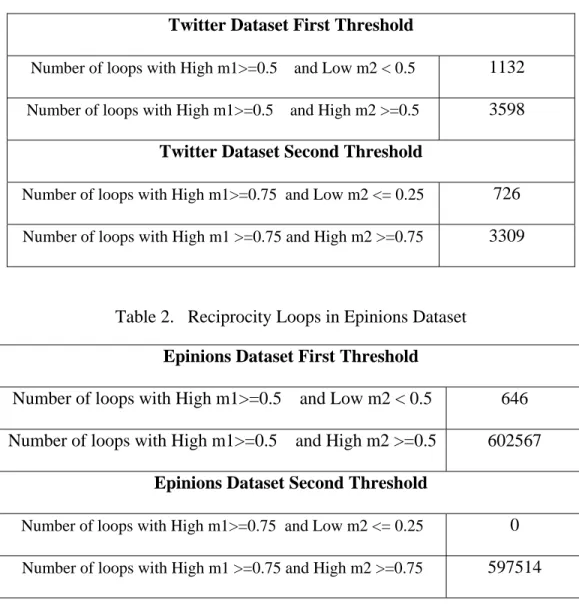
Table 1 Reciprocity Loops in Twitter Dataset ... 52
Table 2 Reciprocity Loops in Epinions Dataset ... 52
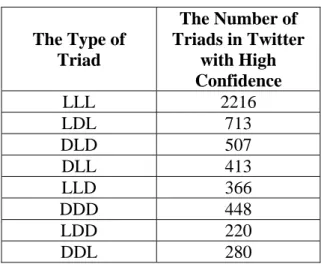
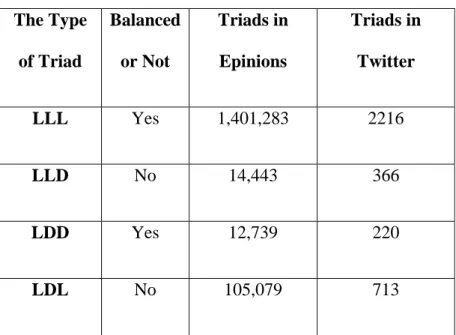
Table 3 The Number of Triangles in Twitter Dataset ... 67
Table 4 The Number of Triangles in Epinions Dataset ... 68
Table 5 Frequency of Occurrence of Triangles Starting with L ... 68
LIST OF FIGURES
Figure Page
Figure 1 Twitter without forgetting factor ... 35
Figure 2 Exchanging tweets. ... 50
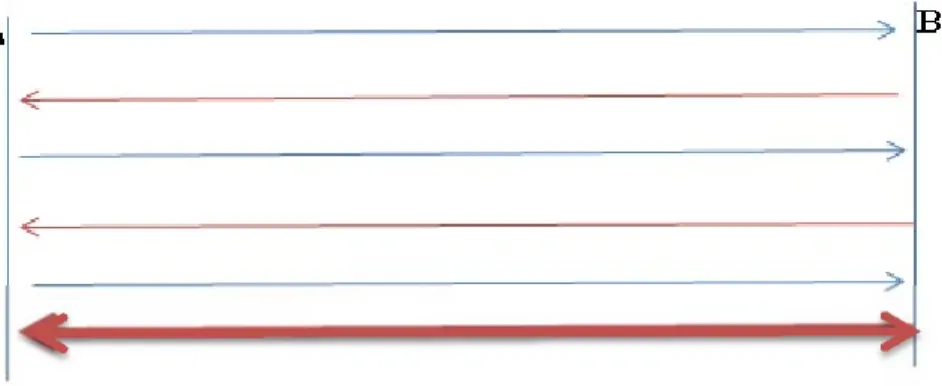
Figure 3 Mutual exchange of tweets ... 54
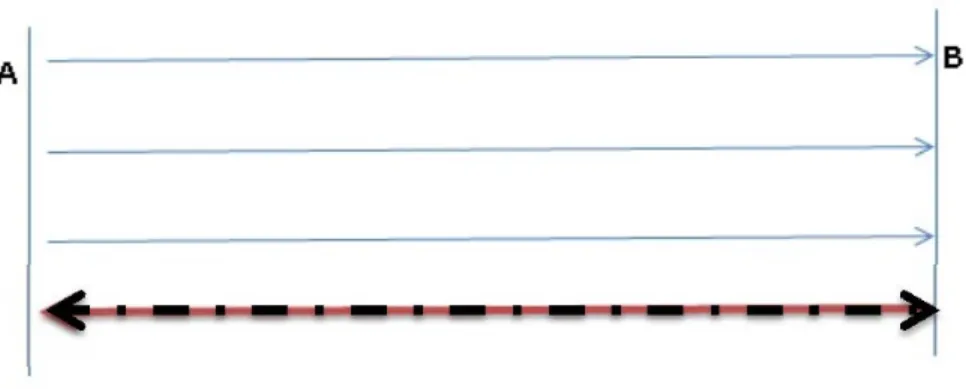
Figure 4 One-sided tweets exchange ... 55
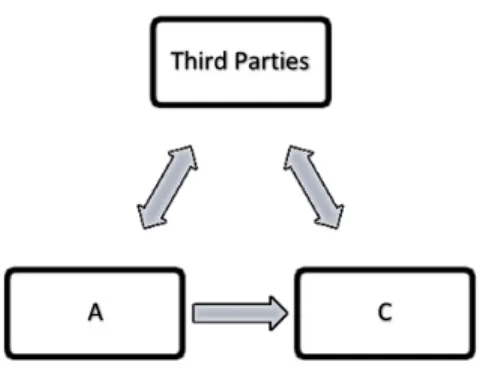
Figure 5 Third parties between A and C ... 60
ABSTRACT
Kalash, Abeer M.S., Purdue University, December 2014. Trust Modelling through Social Sciences. Major Professor: Arjan Durresi.
In today’s fast paced world, people have become increasingly interested in online communication to facilitate their lives and make it faster. This goes on from simple social interactions to more advanced actions like shopping on the internet. The presence of such activities makes it crucial for people to use their common sense and judgment to process all this information and evaluate what/who they trust and what/whom they do not. This process would have been much easier if the number of people in such networks is really small and manageable. However, there are millions of users who are hooked online every day. This makes the person very overwhelmed with his trusting decision, especially when it comes to interacting with strangers over the internet, and/or buying personal items, especially expensive ones. Therefore, many trust models have been proposed by computer scientists trying to evaluate and manage the trust between users using different techniques and combining many factors.
What these computer scientists basically do is coming up with mathematical formulas and models to express trust in online networks and capture its parameters. However, social scientists are the people better trained to deal with concepts related to human behaviors and their cognitive thinking such as trust.
Thus, in order for computer scientists to support their ideas and get a better insight about how to direct their research, people like social scientists should contribute.
With this in mind, we realized in our group work the importance of such contribution, so we came up with the idea of my research work. In my search, I tried to find how these social scientists think and tackle a dynamic notion like trust, so we can use their findings in order to enhance our work and trust model.
Through the chapters, I will discuss an already developed trust model that uses measurement theory in modeling trust. I will refer back to this model and see how other social scientists dealt with some of the issues encountered by the model and its functionality. Some small experiments have been done to show and compare our results with social scientists results for the same matter.
One of the most important and controversial point to be discussed from social scientists point of view is whether trust is transitive or not. Other points to be discussed and supported by social scientists’ research include aggregation, reputation, timing effects on trust, reciprocity, and experience effects on trust. Some of these points are classified into trust mapping categories and others are related to trust management or decision making stages.
In sum, this work is a multidisciplinary study of trust whose overall goal is to enhance our work and results, as computer scientists.
CHAPTER 1. INTRODUCTION
1.1 Introduction
Suppose you are about to buy a new car, and you have no experience about car markets whatsoever. You contact a friend whom you trust asking for his advice. If your friend is expert in car markets, he directs you in the right way to go; otherwise he will refer you to someone else whom he trusts. Now are you going to trust his friend in this matter? How about the scenario where that suggested friend consults his friend as well? Now the chain of trust is even longer. How will you proceed in your trust decision?
This is just a simple example of unlimited ones about trust scenarios and its complex choices options between people’s social interactions. In the essence of these social interactions between people, trust is a very essential factor that they depend on [1], especially when this trust decision has some serious consequences, i.e. related to health issues [2].
Now, all the scenarios above will become even much more complicated when you have to do all the evaluation online, where there are huge amount of information that is hard to process by human [1]. Users in this case may end up interacting with others they never saw before or with institutions they did not hear about [3]. This makes it very difficult to decide whether the information in hand is really credible, and whether the other person you are dealing with is really trustworthy [3]. The rampant widespread of
online interaction makes it very important to take some precautious into consideration when dealing with people and services there, and trust concept comes into the picture in such scenarios.
Trust and trustworthiness are recognized as very vital keys in many different social and financial fields [4]. In [4] for example, they mentioned a very concrete example about the role of trust in social networks in the revolution that happened in Egypt where people arranging to that day depended on Facebook and Twitter to organize their movements. However, they had to have some kind of trust between them and the people to whom they send the invitations to arrange that uprising [4]. Otherwise, they would have been in a very risky situation for participating in such actions against the regime, especially if they had communicated their real opinions and plans with untrusted people who leaked out the news to the higher authority [4].
1.2 The Need for Trust Models
All the scenarios above show the role that the online world plays in people’s daily lives and how it has become the new trend over the last recent years. This goes from social networks such as Facebook, Twitter to shopping and e-commerce ones such as eBay, Amazon, Yelp, and Epinions, etc. The number of social networks went from 125 to 223 between December 2004 to 2006, and the number of their users have also increased dramatically and still growing [5, p.31], [6]. This increase is not just in the numbers of participants but also in the number of links between them making the network management a very hard task to do [7].
Such situations present some kind of hazards since users participating in the online process are not there in person, so there is a bigger chance for deception and/or misbehaving [8]. In short, it is very hard to handle and process all this information and manage trusting decision for millions of users scattered everywhere online. Thus, the need and importance of trust management systems and frameworks has spiked more, and the research in this area has been a hot topic for computer scientists. Each paper tries to introduce different factors and metrics to capture trust in its different state and occurrence.
1.3 Thesis Objective and Contributions
So depending on this pressing need, computer scientists have worked hard and proposed many trust models to help in the management of online trust, so where does the problem lie?
As we all know, computer scientists are people of numbers, formulas and calculations. In other words, they use mathematical tools in analyzing a situation in order to formalize it and express it in a scientific way. However, since trust is a subjective concept in nature, it has many definitions and meanings in different fields that until today there is still no one unique definition used by all scholars in different fields to express and evaluate trust [9, Ch.1]. Also, trust is a human nature feature, and it is even a complicated process that requires different levels of brain processing, especially reciprocal trust as explained in [10, pp.147-167], and the dynamic nature of trust can add up to all previous complications. All these findings show that trust is more than merely just numbers and applied math, so it has to be studied from other points of views as well, and not just by computer scientists.
Thus, we thought in our group work that a complex concept like that is better to be approached and studied from people in fields that deal more closely with issues related to human behaviors and interaction. These are the fields of social sciences, which include fields such as psychology, sociology, economic, business and social management, etc.
The importance of such multi-discipline study step is even mentioned in [11] during their evaluation of trust from different angles. Therefore, if we want our work as computer scientists to be more reliable and credible, we have to depend on such expert and knowledgeable people. Social scientists are the first to study concepts related to human behavior such as trust, so they are more suitable and better equipped to deal with this notion, and they have the real knowledge and tools to tackle similar issues in a way better than the ways of computer scientists. This is especially important when it comes to some controversial concepts such as the transitivity of trust where some scholars even in the same field (computer science) assume trust is transitive while others say not (this will be discussed more in details in the section of trust transitivity).
So far and to the best of my knowledge there has not been very much contribution to connect computer scientists’ studies with social sciences studies when it comes to trust research. In other words, most of the studies and research about trust in the field of computer science are not backed up with evidence from other fields to support or dispute their findings.
Therefore, the objective of my thesis is to explore how trust is looked at from different points of view in social sciences fields, and this will help to make a bridge between computer science and other social sciences fields. In some points, this work will help to support some existing findings by computer scientists, and this will give these
findings more credibility. In other places, however, there will be some contradictions, and this will give us, computer scientists, some insights for future work and improvements. This is crucial because it is not the job of computer scientists to study trust, so they have to get the conclusions from people who know best about this matter (social scientists), and only then they can use the computers in order to automate the study of trust.
In sum, this paper will be such a collaborative view and multi-discipline study of trust in today’s networks from different points of view. It aims to improve computer scientists’ work when it comes to analyzing trust, especially the trust model in [1].
1.4 Thesis Organization
This thesis will be organized in the following manner: first, it starts with listing some of the related work that is similar to ours in chapter 2. Then it moves to chapter 3 that gives a brief overview about some trust definitions from different fields. After that, I proceed in chapter 4 to talk about the trust model proposed in [1] that I am depending on in my discussion. This model had been previously developed by the group I am working with now. I explain how modeling trust and managing it requires several points to be taken into consideration. This is coupled with explaining the metrics and principles used proposed there.
From this point on, the paper will be divided into three parts/chapters depending on the stages of processing trust, which, according to [12], can be categorized into:
1) Trust mapping/modeling. 2) Trust management.
According to [2], all these three stages should depend on the context of trust, so they may change depending on that specific context (or setting) in which trust is analyzed and studied.
The first step in processing trust which is modeling/mapping will be discussed in chapter 5. In this chapter, I list more in depth the factors that I found can be related to this stage, especially from social sciences points of view. These points are: trust being dependent on context/content, trust and timing including forgetting factor and other timing effects, trust and experience, trust and reciprocity. When some of these points are used in the discussed model, a connection will be made to compare the outcomes between the two different fields. At some times, small experiments will be done to support some findings. Other times, I will be giving some insight to what could have been done better or differently to get better results. I sometimes pin point to some drawbacks I found in the discussed model as well.
Chapter 6 will be devoted to talk about the next stage which is trust management. Here I will discuss trust transitivity and aggregation. I will list some papers and experiments that people in social sciences have done that are closely related to these two concepts. Most importantly, I try to provide some insights about the concept of transitivity from social scientists points of view.
In both previous chapters, I try to mention which points from what we dealt with in our work are supported by social scientists, and which ones are contradicted, or what can be done in the future in order to get better outcome.
The last part will be related to decision making stage which is discussed in chapter 7, and this part will talk about the role of reputation in building trust. Finally, I conclude the paper, and make some future work suggestions in chapter 8.
Before I proceed, however, I would like to clarify some points that may be a bit controversial along the way when reading this paper. During my study to these kinds of social sciences papers, I was trying to make a connection between their way of tackling some issues and our way. Sometimes, they may have used different words to express the same ideas that we, as computer scientists, express in formulas or in a more scientific way. My job was trying to read between the lines in a way that make the connection more clear. This will be clarified when needed. However, I just wanted to mention this point ahead of time, so when interested readers refer back to the original papers that contributed to this work, they do not get confused looking for the same words. Instead, it is an encouraging way to read between the lines and try to infer what is not explicitly stated. In my opinion, this is the best way to make the connection between different fields which are using different terminology sometimes to express the same matter.
CHAPTER 2. RELATED WORKS
As I stated earlier, there is not much work done to connect computer scientists’ work with social scientists’ work in the matter of trust management and mapping. Thus, I will mention some of the small contributions out there, even if they have a brief insight in their work about a connection between different fields. In addition, I will list some of the work in the field of computer science in general when it comes to trust models, managements and transitivity since all of our work basically depends on this. In fact, there are many interesting papers in the field of computer science in the form of surveys comparing and describing different trust models or the same concept of trust but in different settings and networks. For example, in [13] different definitions of trust were analyzed from different angles trying to explain how it can be managed in different settings and internet applications. Also, in [14], there is a thorough study about trust in social networks from different points of view, where different definitions and aspects of trust were discussed, in addition to focusing on some aspects of what they defined as social trust.
In [15], they try to analyze the concept of trust transitivity and come up with some principles and factors that go along with social psychology findings and some features of trust. They suppose that many different factors play a role in trust transitivity and all
these factors should be taken into consideration in order to build a successful transitivity outlines. Some of the factors they consider are the role of recommendation and how much similar users are in their preferences. This is in addition to the role of social intimacy between participants. Using all these factors as inputs and attributes in their proposed model in [15], they show how they get good results in their experiment in computing trust values along the transitive path.
In [11], they also try to study trust considering multiple fields. They mention how trust is defined differently by researchers in different disciplines such as economy, psychology and sociology. These differences may create some kind of conflict, yet make the concept richer in value [11]. This is in conjunction with a lot of overlapping in the concept of trust between all these fields [11]. The work in [11] also tried to investigate whether there is a common ground for trust between all these disciplines regarding the dynamic nature of trust, and what are the different ways to model it among them. At the end, they were hoping to create a clearer view of trust among different levels, firms, and organizations and study the way it is modeled. Several studies were cited in [11] in order to answer some questions related to trust and some of its concepts, how it is analyzed, its levels, its different forms, and the way it is viewed and tackled by different scholars.
Marsh’s work in [16] is one of the best well-known in formalizing trust, and it is cited frequently. He approached the matter considering aspects and fields such as sociology, biology, and psychology as explained in [16]. This is in order to come up with a computational trust model explaining the relations between these different contexts in a formalized way. He used arithmetic formulas to represent trust, where he categorized it as being general, basic, or situational trust as showed in [16].
The model in [17] is based on experience, direct trust, and reputation; all of these factors are considered main factors in the mapping stage as I will show in the following sections. They also use recommendations on the way to come up with the final trust value, so the final decision to trust or not depend on a combination of all these factors as explained in [17].
Another work trying to gather information from different disciplines to analyze trust from many angles is in [18]. In [18], they argue that this is an important step since the concept of trust is manipulated differently among different researchers depending on their purposes. Their goal is to shed the light on this issue and come up with a base line that gives the concept more accurate use in different dimensions and levels, especially in the business field. They present trust in fields like economic, psychology, and philosophy.
In [19], they apply their experiment on Facebook data, specifically its wall posts trying to monitor/study the triads and the transitivity, which give an idea about the nature of interaction between users and the motives behind it. They identified many factors that influence the interaction between users including the effects of relationship’s strength and bonding among these members as explained more in [19].
Many research in social and computer sciences fields have considered the importance of reputation in building trust. In [20] for example, the authors try to build a model considering the role of reputation, by introducing new ideas in their work to overcome some problems in previous models when it comes to depending on direct experience as a source of trust. They stated that the approach of experience reliance alone may not be the best one, and it may even introduce some kinds of errors in trust measurement, especially if the experience is not built for a long enough time to be
accurate. Therefore, in [20] they incorporate some kind of reputation information in their model trying to solve this problem which results in introducing what they called a certified reputation. This will help the other agents to evaluate their trusting decision more accurately according to [20].
Also, in [21] they take the role of reputation into consideration when designing their framework. This is done by giving the agents in the network the ability to dynamically participate in the process of trust. The agents themselves build a reputation table of trust values about their neighbors (through direct or indirect experience they had with them), where the negative behavior of a neighbor will affect the trust value in this table negatively, and this will be spread through the network in order to warn other agents from suspicious people [21]. According to [21] this way they can reduce suspicious behaviors in providing feedbacks, yet cannot eliminate all of it. This is because they merely depend on having a reasonable number of honest users that can overcome the untrustworthy ones, but again cannot eradicate them completely as stated in [21].
Other extensive work has been done by Josang, who mostly depend on subjective logic in his evaluation of trust like his work in [22]. The use of this subjective logic is what makes his work special because this takes into consideration the uncertainty that subjective concepts like trust hold in its meaning, in addition to considering the belief of individual users toward it [22]. In the same paper, they describe the difficulties they had in finding the right operator for a concept as subjective as transitivity, but they approached the matter with its uncertainty providing new insights over the pre-existing proposed models as they elaborated in [22].
In [7], it is another joint work between two fields: computer science and sociology, which was done in order to monitor the structure in a big network like Facebook providing some evidence on the progression that networks in general can do over time. This evolution of course includes many features related to network structure and properties, and one of them is transitivity. Facebook wall posts and randomly chosen triangles were main elements in the study in [7] enabling them to extract information about the studied network. Time is considered an important factor in [7] as well, so they use the information provided by their collected triangles at a specific time interval trying to predict the network status and properties at the next time intervals.
In [23], they also study the factors that affect people’s trust in each other, and they show that some factors may even decrease the level of trust that a person feel toward another. Such factors include: some characteristics related to individuals’ personalities, belonging to specific minorities group, some economic factors, and whether these people come from heterogeneous or homogeneous community [23]. All of these factors have effects on how people deal with trust information and handle it in different situations.
In [24], an experiment was conducted to observe how trust develops through different kind of mediums. Some of them promote more cooperation and collaborations than others. They studied face to face and video communication which proved to be both good compared to merely messaging or audio connections as shown in [24]. This study was done using game theory and social dilemma rules.
Another paper for the same researcher of [24] is in [25] where the experiment is to show how doing some actions to get to know your partner a bit before interacting with him online will raise the trust between both sides to be better than the case where there is
no such knowledge beforehand. Such activities can be done online and may include meeting online or messaging. The bottom line in [25] is that any (even simple) information obtained about the other side before starting the interaction, will help in paving the road for later trust with him online in a way similar to live meeting.
In [26], we encounter another joint work between artificial intelligence, philosophy, and cognitive psychology. Their work depends on using some experiments trying to prove some points related to trust dynamicity nature, and how it varies from time to time. Their study specifically targets the role of experience in trust (negative and positive ones).
Finally, there have been some studies including Twitter website as well. For example, in [27] they examine the content of some users’ tweets using some special tools to see how the mood and attitude of the users and the network in general over time may affect and even help in making some predictions related to the field of stock market.
CHAPTER 3. TRUST DEFINITIONS
Trust study has been a very motivating topic to discuss by many scholars, so it has been studied in many areas including social and natural sciences fields [8]. In this section, I will briefly go over some of the different definitions and concepts of trust trying to show how diverse this concept is.
When it comes to defining trust, there is still no one unique formulation to contain all different meanings in a way that scholars from different fields agree on [9, Ch.1], [11]. Each investigator gives a different definition of trust depending on his area of focus and study, so it cannot be applied generally for other fields as well [9, p.7], [11]. This could result in insufficient definition of trust that does not take into account all different faces of it [9, p.7]. The definition of trust, however, should not be related just to one specific domain, but should be more accurate and thorough, one that should take into consideration all important features and characteristics of trust [9, Ch.1]. In [18], they mention the difficulty in coming up with such general common definition of trust given its complicated nature.
Due to all this confusion surrounding trust, they tried in [9] to come up with a model that generalizes the notion of trust without being dependent on a specific domain.
In order to do that, they depended a bit on the work of Castaldo in [28] where he used thorough and comprehensive techniques to study trust. Seventy two different
definitions of trust were taken from different fields and collected through the years in [28], and this study shows how mixed-up and vague the definition of trust has been in different fields [9, Ch.1]. According to [9, p.9], Castaldo’s study reveals that the definitions of trust can be dependent on five classifications which are: the trustee, the construct of trust, actions or the behavior, the result or the expected outcome from the process, and finally there is the risk to be taken in the trust process.
In [9, p.10], they noted that trust is a conception with multiple layers in the sense that it has several meanings and definitions such as (trust is credibility, evaluation, confidence, expectation, decision, intention, sincerity, belief, dependence or reliance, attitude, and competence, etc.).
In spite of the different meanings of trust, there is some kind of settlement about the elements or factors that should be involved in the trust process among different fields such as psychology, sociology, and economy, and these two important factors are: taking risks and interdependence [11]. Taking risks should be combined with some knowledge and data about the person someone is going to deal with in the trusting process, so this information helps to reveal or gives some insight about the trustworthiness of this potential person to interact with [18], [29].
In addition to these factors being agreed on by most researchers, some other papers state that trust is also agreed on to be a belief, meaning that you have some faith in the person you are about to trust, and you expect this person to do the job you anticipate and expect from her/him [8].
In the field of marketing, trust has started to be recognized by its important role in sustaining good relationships and improving sale activities to be in a better shape [18].
To be uncertain about your trust decision, and to put yourself to be vulnerable in this process seem to be very important elements in studying trust on many different dimensions [18].
The difficulty in putting all pieces of trust puzzle together stems from the fact that trust is not the same in different context or situations, so it is different in different contexts [18].
In [30], they mainly focus on trust meaning as to anticipate some kind of behavior or action from the other person, and to believe that this action or behavior will happen. This true belief is what motivates the trustor to make himself vulnerable for that trusted partner. Two types of trust were proposed in [30] which are either trust in belief or trust in performance. This is done in the process of proposing a formal model to deal with some important questions about trust transitivity and semantics in general.
Another important definition in [31] can be summarized that a trust action manifests itself when a person encounters a situation that is not completely clear, and the consequences of following its path could be good or not good depending on the act of the trustee. However, he (the trustor) may choose to take the risk and follow the trusting route, or he may decline the whole trust process. It is also noted in [31] that the negative effects of following the wrong path may be very bad, so the trustor will be eager to take the right choice, and this definition mentioned in [16] as well.
There is also a well-known definition of trust in [32] that holds in its meaning that trust decision is kind on gambling in the sense that it is related to how the other partner will relate back to you in the future when you risk trusting them at the present without knowing or being able to expect the outcome ahead of time.
In [5], the researcher bases his work on two types of trust: the decision trust and the evaluation trust. The decision trust means how much one agent is ready to rely on and trust another hoping to fulfill its needs, and this decision is to trust in spite of the possible bad outcome [5, p.43]. The other type of trust is the evaluation trust which is probability that is subjective in nature, and it happens when a person Y evaluates how its partner Z is acting to achieve what is expected from her/him [5, p.43].
There have also been some surveys done to come up with some features related to trust and distrust like: trust is a subjective concept because each agent may evaluate differently the same person or the same object [5, p.12], [33]. Trust is directed, so for example Y may trust Z to be a good teacher, but Z may not trust Y to be a very well-informed student [5, p.12], [33].
Marsh in [16] has done some of the most thorough work in studying and defining trust and come up with a formal model describing it as stated in [34]. He was trying to collect and study the concept of trust from different points of view as stated in [34]. Thus, some of his work depends and cite researchers from different fields and area of interest. For example, Marsh discussed some of the work presented by Luhman (such as the one in [29]), whose approach is sociological in nature according to Marsh in [16]. Other parts of his work also discussed the work of the researcher (Deutsch) who focuses on studying trust from a psychological point of view, according to Marsh in [16], among other cited researchers.Marsh did also discuss the subjective nature of trust referring to an important paper in [35], that discusses how trust is a subjective concept because different people may have different opinions and trusting choices about the same matter, which results in
multiple definitions and opinions even about the same issue. This is what makes this concept a very complex notion to study, analyze, and even to simply define [16], [35].
Marsh also in [16] discussed the work of Deutsch which was presented in [36], where Deutsch proposed about 19 trust related hypotheses that express different situation, and he tests them using some psychological experiments. Marsh also in his work in [16] categorized trust into three parts which are: basic trust, situational trust, and general trust.
Other two definitions are offered in [3]: one is the reliability trust that is inspired by the work of Gambetta in [37], and the second definition is for trust as a decision.
Another well-known and cited definition is the one mentioned by Dasgupta in [38], which also focuses on trust as expectancy of good deeds or bad deeds from people, and acting up depending on this expectation before knowing the reaction of the second interacting party.
Even when some researchers were doing some experiments to study the process of trust and how it is built or destructed, they distinguished between the different meanings of trust trying to explain which one they depend on in their study. This shows the variety in trust definition and the different ways it is tackled. For example, in [39] they revealed that the results of their experiments depend of trust as attitude and not trust as behavior. This is because they just interviewed the actors and asked them questions in order to evaluate their trusting options and plot the results, and this implies their attitude about trust. However, researchers did not monitor the real behavior of these actors in the real life about similar situations, and how this attitude can be interpreted and transferred into real behavior in real life, and this is why it is not considered trust as behavior [39].
These above mentioned definitions are just like a drop of water in the ocean. The list could go on and on, but I just wanted to mention some of most used definitions in the literature in a way that gives an idea about how this concept is approached differently from different disciplines; sometimes even from people in the same disciplines but with different interest.
CHAPTER 4. THE DISCUSSED MODEL
The model I will depend on in my study is the one proposed in [1], which had been developed by a team work at my school with my advisor. Joining this team, my overall goal was to improve the way this (already proposed by them) model works, and the way they map trust data, use formulas, and manage trust from the perception of social scientists (depending on their findings).
There are many proposed trust models in the field of computer science, but what is special about this model is its use of the measurement theory in calculation, and it is because this theory is similar to the way trust process works in human being [1]. According to [1], in both cases someone can have an initial measured value (which is represented by the initial trust impression in our case) that can be improved later on by follow up measurements using different tools to decrease the error (trust can be improved through repeated interaction with the same person in our case as well).
Depending on this kind of similarities, two trust metrics were proposed in this model, which are the impression (m) and the confidence (c). The impression represents the initial trust measurements that a person Y, for example, makes toward another person Z to evaluate how much he is trustworthy [1]. The next metric: confidence (c) is similar to the error in measurement theory because it represents how much Y, for example is sure about the trust impression he has just made toward Z [1]. Of course, human can do more
than one evaluation in order to be more sure and certain (confident) about their trusting decision about a specific person, and this is similar to repeating the measurement in order to decrease the error in the measurement theory as stated in [1].
The model was tested using a dataset taken from another study for Epinions website, which consists of 405,154 different individual users who have some kind of shared reviews or ratings between each other to some degree.
The same model is discussed again in [2], but they also tried to use different dataset in the evaluation which is a dataset collected from Twitter website. The data there was gathered from a public group related to stock market, where the IDs of users following this group were first acquired, and then these ID’s were used to collect their corresponding information, and most importantly their tweets using Twitter API tools and twitter4J library as explained in [2].
In addition to the metrics of impression and confidence, the proposed framework depends on error propagation theory in the computation, along with the use of transitivity and aggregation concepts as means of trust propagation, and all these combined will help in the process of coming up with the corresponding arithmetic formulas [1].
They express the concept of transitivity using the multiplication operator, and I will justify the use of such operator from social scientists point of view later on in section 5.3.1. Thus, if A trusts B, and B trust C, then the indirect assessment of C’s trust level, made by A, and through B recommendations will most likely end up with the results of A trusting C, which means trust is transitive [1].
Two principals were proposed in [1] to express how transitivity works in a way that could be psychological based. These proposed principals can be summarized that
transitivity does not increase confidence or impression along the transitive path, because the original, direct impression or confidence is most likely stronger than the indirect one.
Since in real life, trust information may come from more than one source, trust aggregation concept was also discussed in [1], so both the impression and error have to be aggregated depending on the rules of error propagation and measurement theory.
Along the way, different paths in the aggregation process will be assigned different weights depending on the confidence level of that specific path as shown in [1], and this will also be discussed more in depth when talking about aggregation.
Similarly to transitivity, two principals have been proposed in [1] related to the aggregation process, and in chapter 6, I will go through both of them and try to support their validity from social scientists perspective.
The way trust is mapped in [1] for Epinions is a little bit different than mapping in Twitter in [2]. This is because the way of interaction between users differs between Epinions and Twitter, and in fact it is more complicated in Twitter.
In Epinions, the process of mapping trust is kind of evident since users express their trust using some kind of ratings, reviews, and stars [1]; in Twitter, however, it is not that straight forward case. That is why in [2], they have to depend on other measures and signs to help them in the mapping process, so they used some kind of sentiment analysis tool as the one in [40] in order to evaluate the content of each tweet. This way they can judge whether this tweet is considered positive or negative in its meaning.
After this step, they convert the value resulted from analyzing the sentiment to a value between zero and one in order to represent the trust impression as it is shown in [2].
As I said earlier, my job is to enhance the way this model works, so I will be referring to this model frequently. In order to make it easy and clear on the readers, I will refer to this model by saying (the discussed model), and I will try to pin point to the dataset used in the study (whether taken from Epinions or Twitter). I just wanted to note this in here so it becomes easier on interested readers to navigate through this thesis easily and be able to point accurately to what I am referring to.
Now that I have covered the basics of my thesis and the discussed model, the paper, as mentioned in the introduction, will be split into three chapters according to the phases of processing trust mentioned earlier in [12]. The first phase that will be discussed in the following chapter is the stage of trust modeling or mapping.
CHAPTER 5. TRUST MAPPING
The first and most important stage in studying trust and coming up with a model to represent it is the stage of mapping, so what does mapping mean?
According to [2] trust mapping or modeling means using the data and information available in hands (through the website or network we are studying) as a base trying to come up with metrics that can be formulated to represent trust. Of course, the more data available to use, the better mapping we get. This is because more factors used in the mapping process provide a better picture about how trust is expressed in that specific situation. All these information is to be used later in the stage of trust management [2]. Some examples include: reviews in Epinions, stars from Amazon, Facebook wall posts, Facebook like/dislike, and tweets in Twitter [2].
Given the importance of this step, I tried to summarize which information may be useful to be taken into account in the trust mapping stage in order to get a better outcome and more accurate mapping, especially from social scientists’ points of view. These points will be discussed separately throughout the paper, and include:
Trust and content/ context.
Trust and timing.
Trust and experience.
5.1 Trust and Content/ Context
In multi-disciplines study of trust found in [9, p.29], it is argued that trust depends on the content or on the context. Thus, in analyzing the main elements of trust they include the context of trust as main element in the entire process in addition to the trustor and trustee [9, p.36]. In other words, person A trusts another person B to do a specific task or to achieve a specific goal, and this is just in a specific context [9, p.36]. Sometimes the same task may exist with the same trustee, but in a different context or settings which change the trust outlook that this trustor will hold toward this trustee as shown in [9, pp.83-85].
Moreover, they showed in [9, p.150] that trust is related to what is called causal attributions, so A’s inability to achieve the task expected from her does not always results in less trust toward her from B and the reverse is also true, so A ‘success in her task does not mean more trust from B toward her because it all depends on whether this kind of effects is internal, external, stable, or occasional. In their example, A may trust B more even if B did not get the job done at the end, but A witnessed that B at least did a lot of hard work and that is sufficient from A’s perspective to trust B again in the future; In this case, maybe there were some external occasional factors that prevented B from having the job done, so factors not related to B specifically; this is why it did not affect A’s trust in B as explained in [9].
However, this kind of effects related to causal attributions is not easy to be captured when modeling trust, so for the time being it was not taken into consideration in our work. We may get some kind of surprising results when an agent seems to trust
another in one way and not another, or when an agent seems not to trust another agent even when the latter has done the work expected from her. Still, we cannot capture this kind of effects, especially in the online world when you do not have a clear picture of the people behind the screens, and the way they perceive and approach each other. Also, their decision could have been affected by some kind of knowledge that is hard to be captured when trying to map trust, since we usually look at the most obvious information or in other words, the information available to us in hands.
Now, we talk about the content issue that comes to mind, especially when talking about transitivity, so if A trust B, and B trust C, does that mean A will trust C?
According to [9, Ch.6], in the psychology field this is not always the case because trust transitivity does not simply depend just on the trustor and trustee, but it also depends on the content of trust in addition to the task/ competence on which the trust is built (what exactly is being transferred from one side to another). This mean that X trust Y to be competent enough and in a specific domain, so A can make her suggestion depending on this specific domain as stated in [41] as well. Similarly to the example stated in [9, p.171] and [41], I would like to illustrate: so if A trusts B on a ask t like as a computer engineer, and B trust C as a computer technician, so A is more likely to trust C as well because A trust B’s judgment about choosing his colleagues in the same field since he is also competent in that matter, so A is sure enough about B ‘competence in this domain that he can recommend someone else to be trusted as well. On the other hand, if A knows that B is not good enough in real-estate market and that B trust C in that field, so then A is less likely to trust C for that matter because A does not trust B’s judgment or competence in this area even though A trust B in another area in which B is expert (as it seems to A).
This may also mean that A should consider B as influential person in his domain in order to adopt his point of view and trust C like him [41]. In other words, the discussion between all these parties should revolve about the same matter or issue (which means the same kind of content).
5.1.1 Discussion
Considering these points mentioned above, I wanted to reflect that on the discussed model. In other words, I wanted to see whether the relation between trust and content/context was taken into consideration in the mapping stage for Epinions or Twitter.
I think that this point was taken into account partially when collecting data from Twitter. This is because the data collection was done from the same group in Twitter which is one related to stock market as explained in [2]. I think that this can, to some degree, guarantees that most of the discussions taking place are about the same issue, and that trust process revolves about the same matter, so hopefully the tweets are kind of related to the same or at least to similar topics.
This can help to some degree in capturing the relation between trust and content because evaluating the tweets as a measure for trust degree between users will be easier assuming that they are all related to the same topic. Thus, we have the same environment which is the online world of people in the same group (same context), and we also have people (who are hopefully) competent in this domain, so they can be trusted in making suggestion. The competence also can be captured to some degree because influential people should be well-known in this group, so their suggestion can be trusted as well.
Having said that, it is assumed that when people in this group are exchanging tweets, it is somehow related to the same matter, so analyzing the content of tweets in order to deduce the trust level is considered to be content based (content related trust). However, I said earlier that this is captured partially or “to some degree” because in the online world we cannot guarantee that this is the case all the time, and we do not have control over the exchanged tweets or their content, but at least this point was taken into consideration when collecting the data.
However, in Epinions dataset in [1], this point was not taken into consideration because first of all the data used in their experiment was derived from a data collected for another study, so it was a random snapshot. In other words, the snapshot has different users evaluating different kinds of reviews which are written for different kinds of products, so there is no concentration on a specific matter in this snapshot.
Also, the formation of trust triangles there was kind of arbitrary. To illustrate, in Epinions, the way it works is that some people go and write their opinion or review about some products, and others go there and read their reviews and evaluate it by giving starts from one to five [1]. On the process of coming up with trust triangles and users who have direct or indirect links between each other (to have a link of trust is to have at least one shared rating [1]), the content of the review is not taken into consideration because choosing the triangles was random. So for example, in a triangle ABC, A may have evaluated B for some kind of review about a product (p), and B evaluated C for something else, and A evaluated C for completely different third thing. We may get some similarity, but it would be merely by chance. This is because the data was not collected targeting specific group of people with specific interests, but it was just general data
about people who gave their evaluations of others’ reviews. Even when trying to form triads to study transitivity, the process was random, so there is no guarantee that the nodes in a specific triangle are all about evaluation to the same product or reviews. Thus, the content was not taken into consideration in Epinions.
This gives some motivation to do more work on Epinions data set in the future by using some kind of filtering considering the same kind of content, and comparing the results with the recent ones we have now hoping to find better outcomes. Doing this step may help to come up with a conclusion that is more in line with what social scientists state about the relation between trust and content. In my opinion this step will have a big effect on trust mapping and on the accuracy of the results in general.
5.2 Trust and Timing
Time plays an important role in a concept as dynamic as trust [41]. According to [41], the dynamic nature of trust comes from its changing nature over time, in addition to being related to the history and experience between the two interacting parties (direct or indirect experience).
Generally speaking, more time spent interacting with a person means more experience and information about him, so the level of trust about him will change over time. However, when it comes to social scientists, there are more complicated cases related to timing than this simple concept.
In the following sub-sections, I have categorized three cases where I figured time can be related to trust and can alter its outcome according to social scientists experiments.
5.2.1 Trust is Learnt over Time (Trust Dynamicity)
In [39], their whole study focuses on the effects of timing on trust, and how people learn to trust or not to trust over time. Their argument lies in the learning process that people go through over time toward their decision to trust/distrust others around them. They argue that this process depends on many factors such as the direct information a person obtain about a partner with whom he is directly interacting, or from others’ opinions when they give their judgments when they are asked about a person.
The experiment in [39] was held in a dialysis unit in a Dutch hospital and lasted for one year during which measurements were taken every three months to compare how trust relations are evolving and changing over time between the participants in real life.
Some variables were used in [39] to express the whole trust process such as: a variable to represent the trust tie between 2 participants at different times, another one to represent the frequency of interaction, and some other factors to weigh differently the information received from different third parties. They assumed that by using the information available at previous time measurement they will be able to predict the tie and trust at a present time (t), and this information can be obtained either through direct experience of third party effects.
Since trust can be learnt through time (this is what this paper in [39] focuses on), users’ recent trust in each other at time (t) is strongly affected by their trust in each other at time (t-1), so a positive/negative experience at time (t-1) is more likely to encourage/discourage trust at time (t) according to [39].
Studying the relation through different points of time (different measurements), there was some changes in the relations and ties between people over time where more than 50% of bonds changed over time even if it is just a small change as shown in [39].
This experiment is a simple way to shed the light about the effects of timing on the trusting process, in addition to the dynamicity of trust and its changing nature over the course of time between people interacting directly or indirectly.
In fact, this kind of result motivates us to focus more about studying the dynamicity of trust instead of just focusing on a static snapshot in the network. Most computer scientists focus mostly on studying static snapshots of the network, which deprives the trust from one of its most important features which is dynamicity. Thus, focusing on studying dynamic snapshots in our data is one of my most crucial suggestions for improvement and enhancement in our mapping stage.
5.2.2 Forgetting Factor
During the process of modeling trust for Twitter dataset in [2], the concept of forgetting factor was incorporated in the mapping stage. It means that by the time, users tend to forget their past experiences (or the effects of these experiences fade away with time) with their partner, and they tend to focus more on the most recent one which becomes the experience that matters most for them, so it has the highest impact in their subsequent trusting decisions as argued in [2].
In the field of social sciences, I found that they use a different way or different naming for the same concept of forgetting factor, but this is done in a way that convey the same idea.
Through these social scientists simple experiments with people, I have found that they somehow support the presence of the forgetting factor, and they include this kind of effects in their study.
Before moving to fields other than computer science, it is feasible to mention that some other computer scientists have given the idea of forgetting factor a bit of attention through their studies even if it is just kind of brief mention.
One example is found in [42] where they discuss the necessary elements for trust topology analysis and one of the elements mentioned as an important tool in this process is the time factor. They think that this is important because it provides the user with information about the most recent trust experience he had with another person, so he can depend on this info in order to evaluate his coming trust options [42]. I think that this indirectly point to the concept of forgetting factor.
Also, in [43, p.54] which is a joint study between different fields, they mention that the latest encountered experiences seem to be more significant than previous ones, so they give the old experiences kind of discount to express their decreased effects on making subsequent trust decision. They think that the most recent ones weigh more because they have better influence on making subsequent decisions than the old experiences, and this kind of effects was applied in their experiments in studying trust.
In [44], from the field of sociology, they ran a simple experiment questioning people and collecting their points of view about trust issues while they monitored their informal interactions with others. Their goal is to show how informal social bonds and continuous interaction with others increases the general level of trust in people toward each other, and they proved that through their work. They concluded that this heightening
in the general trust level help people to keep trusting each other even if they had some bad negative, and undesirable experiences in the past, so there is a chance that trust can be restored again as argued in [44]. I think this also means that what matters most is the recent value of trust and this implicitly represents the effects of forgetting factor.
Another paper in [26] has researchers from three different fields: artificial intelligent, cognitive psychology, and philosophy. They showed through a small experiment that the most recent experiences are more likely to be the focus and have more weight in the trusting decision than the ones happened a while ago. They used some experimental tools to show how trust changes from time to time depending on the kind of experience encountered (whether it is bad or good experience). The experiment in [26] simply depends on four groups of participants reading 2 sets of 10 stories (five stories about bad experiences that are assumed to decrease trust and five about good experiences that are assumed to increase trust). The trick is with the order these stories were given to the participants, where each group was given a different set of stories with a different order than the other groups in a way alternating between the good ones and the bad ones. They tried to control for the effects of such alternating action and balance the way the stories handed out to the participants because the goal is to monitor the impact that the changes in these stories order will make on the participants’ trust attitude for next encountered experiences as resulted in [26]. The order of the stories makes a lot of difference because sometimes recent good experience may make up for the previous bad ones and vice versa. After that, the participants were given some questionnaires to answer in order to evaluate what they think, and the results were compared with another research done to study the dynamic of trust that can be found in [45].
I think that the results in [26] are somehow supportive for the forgetting factors and its presence. To illustrate, it has been showed in [26] that the group who was handed positive stories last had mostly positive trust attitude at the end of the experiment toward the object/subject in the story in spite of reading negative stories about the same object/subject at the beginning, so the positive stories (when read last) were able, to some degree, to override the effects of the negative ones read first. At the same time, they showed how the group who was handed positive stories first and the negative last mostly ended up with a negative attitude and less trust level at the end of the experiment. I think this means that after facing some recent bad experience, the effects of that will overweigh the effects of the old positive ones, and this result in negative trust. In my opinion this means that participants tend to focus more on their most recent experience in order to finalize their trust decision, which is similar to how the concept of forgetting factor actually works.
5.2.2.1 Discussion and Experiment
So considering the importance of this concept from social scientists points of view, the idea of forgetting factor was mostly taken into consideration in the mapping stage in Twitter in [2] as I mentioned earlier, where firstly after collecting the data they focused just on studying the tweets posted in 2013 and not before considering these ones in 2013 to have more importance in the evaluation process (since they are more recent). Secondly, even the collected tweets of 2013 were grouped into monthly windows, so each window has the tweets took place in that specific month [2]. They consider the most recent experience to be represented by the last month of collecting the data (which was the
month of October 2013 in [2] for example), so all tweets that were posted in that month were given the highest weight and their confidence value was not discounted when aggregating the final results. However, the confidence of tweets posted in the months before were discounted by the value of Forgetting factor (set to 0.9 first and then decreased for each previous month, and you can refer to [2] for the detailed technique). This is to represent the idea that as they are going back in time, the effects of the old experiences are fading and what matter most is the most recent one.
The model was tested to see how well it can predict transitive trust between users in Twitter dataset comparing two cases (with or without forgetting factor in the mapping stage).
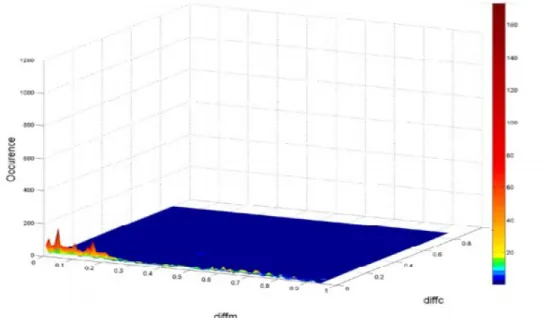
We notice from Fig. 1 above that without using forgetting factor, there is a low concentration of triangles or points in the area close to zero which is the area with small errors (Diffm and Diffc are small). This means that the frequency of times where the model predicted indirect trust accurately was not very high when forgetting factor was not considered in the mapping stage.
Diffm and Diffc are used in [1] to measure the error in prediction made by the model, where Diffm represents the difference between the impression that the model calculates and the impression that the user express himself, and the same applies for Diffc but for the confidence [1]. Of course, the smaller Diffm and Diffc, the better the model was able to predict indirect trust between users. We compare Diffm, Diffc for both cases:
With forgetting factor the error: Avg (Diffm) =0.2508, Avg (Diffc) =0.0963; without forgetting factor the error is: Avg (Diffm) =0.2905, Avg (Diffc) =0.0980.
Comparing Diffm and Diffc in both cases we notice that we have slightly better results (smaller values=less error in prediction) when applying forgetting factor compared to the time when forgetting factor was not applied. This may be related to the fact that forgetting factor effects are real in the network, and people in real life depend on this kind of effects in order to make their trust decision, so maybe that is why the discussed model performed better when this factor was considered in the mapping stage.
In our group work, we wanted to do more manipulation with the experiment related to forgetting factor, but we wanted to first get the insight from what social scientists have to offer in this area.
Through my search about this matter, I think that most of the time social scientists studies failed to provide us with some information needed for further support.
For example, as far as I read, there is no data or information to reveal the exact time window or threshold that people in general depend on when they want to evaluate their recent experiences that matter most. As far as I found, there is no quantification for the concept of time. In other words, what would be the threshold of forgetting factor; do people care most about experiences from last month or last week or just last day? In [2], they just consider the most recent experience to be represented by the last month, but it could be any number.
Also, it would be useful to know how we should weigh experiences from different periods of time. In other words, do experiences from last day get higher weight or importance than the ones from 2 days ago, or they should be the same? Do experiences from last month have the same importance as experiences from last 2 weeks? Do recent experiences have higher confidence and how much higher should that be? And if this is the case, how should we weigh or discount these different experiences at different times. All these questions are to be answered by sociologists and psychologists in order to give us insight in our work. Studies like these could have given us a base line about how to manage and tackle our data. This is very important when mapping trust because when this information is accurate in this stage, it helps in capturing trust in a better way.
This information, however, may be kind of tricky and subjective that differs from one person to another, and form one situation to another. Even in [26], they have found different results when comparing how many bad experiences were enough to turn down the level of trust, and how many good experiences were adequate to turn the level up in different settings. In other words, there was no definite answer to how much time and frequency of experience is needed to fade away the effects of the old past experiences.
Thus when findings some answers from social scientists, it will be a great motive to play with the above experiment again and compare different results, so we can get more thorough study, and hopefully better results compared to what we have now.
5.2.3 Timely Response Effects on Trust
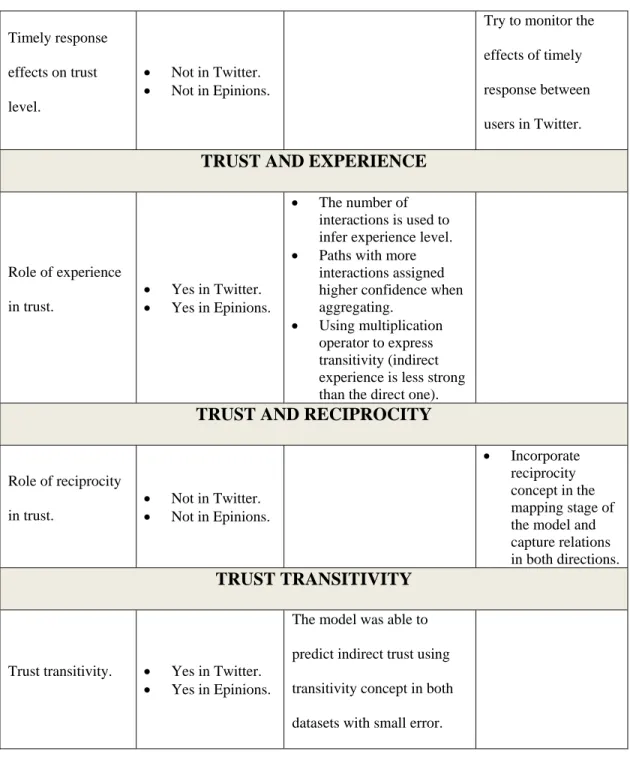
Another good point to be taken into consideration in mapping trust is timely response or how fast someone responds to you. For example, many people in real life evaluate the trustworthiness of their friends or even online strangers by the time they take to respond to messages, some online posts, or emails, etc. as stated in [46].
In the field of psychology, there is a theory named fundamental attribution errors, which simply state that people judge others’ personality when something wrong happens instead of blaming external environmental factors as explained in [46]. However, people tend to blame the external situation to explain their own behavior when something goes wrong [46]. This is because people know the whole conditions surrounding their own situations and what is happening in their environment, so they can easily place the excuse on that, but they are not clear and they do not have enough information about other’s situations, so they tend to blame their personalities to help them find excuses for others behavior [46]. For example, if you are late for a gathering, person A tends to jump to a conclusion and start accusing you of being not punctual, irresponsible, etc. instead of giving excuses for your situation that something external not related to your personality may have happened that made you late. However, if the same person A is late himself, he tries to find other external factors that contributed to his situation such as the traffic, the weather, etc.