Full Terms & Conditions of access and use can be found at
http://www.tandfonline.com/action/journalInformation?journalCode=upri20
Download by: [Pangyen Weng] Date: 23 November 2015, At: 21:50
PRIMUS
Problems, Resources, and Issues in Mathematics Undergraduate
Studies
ISSN: 1051-1970 (Print) 1935-4053 (Online) Journal homepage: http://www.tandfonline.com/loi/upri20
Developmental Math, Flipped and Self-Paced
Pangyen Weng
To cite this article: Pangyen Weng (2015) Developmental Math, Flipped and Self-Paced, PRIMUS, 25:9-10, 768-781, DOI: 10.1080/10511970.2015.1031297
To link to this article: http://dx.doi.org/10.1080/10511970.2015.1031297
Published online: 27 Oct 2015.
Submit your article to this journal
Article views: 13
View related articles
Copyright © Taylor & Francis Group, LLC ISSN: 1051-1970 print / 1935-4053 online DOI: 10.1080/10511970.2015.1031297
Developmental Math, Flipped and Self-Paced
Pangyen WengAbstract: This article describes a developmental math course design that uses flipped instruction and self-paced learning. The design was created and taught at Metropolitan State University, where most students are returning adult students with little prepa-ration in mathematics. The author argues that this design suits the students well: the learning outcome is better than traditional classes and student satisfaction is high. This article contains three parts: a description of the procedures of the course, learning outcomes with comparison to traditional classes, and analysis and outlooks for future development.
Keywords: Developmental mathematics, flipped instruction, self-paced learning, differentiated teaching.
1. INTRODUCTION
Many students begin their college career with insufficient preparation in math-ematics. In the United States, more than 60% of students entering 2-year institutions are required to take at least one developmental math course before they are allowed to take college-level math courses. The lack of math readi-ness is a major road block to academic success in college: 70% of students taking developmental math do not complete their developmental mathematics courses, and are unable to continue their pursuit of higher learning [1,2].
Developmental math, once calledremedial math,is not a new invention in higher education. For decades, colleges and universities have been providing remediation for students before entering college-level math. In recent years, many innovative methods of instruction have been adopted by institutions nationwide, such as blending traditional and online instruction, enhancing stu-dent support services, and aligning expectations across education sectors [4].
Address correspondence to Pangyen Weng, Department of Mathematics, Metropolitan State University, 700 7th St, St Paul, MN 55106, USA. E-mail:
At Metropolitan State University, students take a one-semester develop-mental math course instead of a multiple-semester sequence. For most students, this required course is MATH 98: Introduction to Mathematical Thinking. This course is based on a concise curriculum that focuses only on topics and skills essential to college algebra. Since the content material has varied levels of dif-ficulty and the students have varied levels of competency, it is challenging for instructors to engage all the students and make the most out of class time. This is where flipped instruction and self-paced learning come into the big picture.
Flipped instruction is a concept introduced in the early 2000s and is quickly becoming popular in modern math classrooms [8]. Although there is no universal definition of flipped instruction, flipping the classroom usually means interchanging the function of classroom and home by having students watch video lessons and obtain content information at home, and by conducting in-depth discussion and practices in class. Technology has made it easy to conduct flipped instruction: there are many video lessons on YouTube, and instructors can easily create their own lessons using interactive whiteboard software such asEducreationsandScreenChomp.
Self-paced learning is natural for mathematics teaching and has been con-sidered by many educators and researchers. Also known as individualized learning or differentiated teaching, self-paced learning is more common at the K–12 levels than in higher education. In self-paced learning, students learn and make progress at their own pace. This approach is believed to be effective in engaging all students in the same class [6,7]. Different students have different challenges at different times, and a class cannot be truly effective if everyone is forced to sit through the same lecture and learn at a pace dictated by the instruc-tor. With the aid of modern learning technology, advanced students should have the opportunity to learn the material quicker. Students who have difficulties at a certain point should also have the opportunity to work their way through the difficulties and catch up with the class without being rushed.
In the next sections, the author will describe the procedures of his flipped and self-paced course, discuss the learning outcomes in comparison with tradi-tional classes, analyze the strengths and weaknesses, and discuss possible ways of future implementations.
2. A FLIPPED AND SELF-PACED DESIGN 2.1. Background
Like many other universities and colleges in the United States, Metropolitan State University requires that students pass a placement test to enter college-level mathematics courses. Students who are not placed at college-college-level must pass a developmental math course. Most students take MATH 98: Introduction to Mathematical Thinking.
MATH 98 was created in 2009 to replace a long-time developmental math course MATH 101: Exploring Functions. In 2012 MATH 98 was revised, and it immediately produced impressive outcomes: 68% of students passed MATH 98 in the Fall of 2012, and among the passing students enrolled in subse-quent college-level math courses in the spring of 2013, 79% passed at their first attempt.
In addition to great efforts from the instructors and excellent tutoring ser-vice provided by the university’s math center, two factors were crucial to the success of the revised MATH 98: (i) a concise curriculum with a mastery-driven teaching approach, and (ii) the utilization of web-based learning technology.
The curriculum: The revised MATH 98 focused solely on important math skills necessary for college-level math. A relatively small set of topics was adopted, and instructors were asked to focus on these topics with high expectations. Instead of trying to make up all the math they should have known before college, students would work towards mastery of important math skills by working with teachers, tutors, and classmates, and by practicing relentlessly and repeatedly. The topics of MATH 98 can be found in the Appendix.
Web-based learning technology: During the 2012 revision, a web-based learn-ing technology calledMyMathLab1was adopted by all sections of MATH 98. A generic onlineMyMathLabcourse was used by all instructors, and assign-ments of at least 40 to 60 problems were given to students on a weekly basis. Students responded positively towards MyMathLab: they liked its immedi-ate feedback and real-time learning aids, and they could keep trying difficult problems until they got the right answers.
As the coordinator of MATH 98, the author envisioned an even more effective MATH 98, which could be accomplished by improving some aspects of the course. First, not all students learn math at the same pace. Students come to developmental math classes with widely divergent skills and motivations. Advanced students who find the pace slow would show lit-tle interest, lose focus, start skipping classes, or waste time while waiting for other students to make progress. In the meantime those who struggle with mathematics do not have sufficient time to learn thoroughly or find help. Students routinely comment on these issues in the university’s course evaluations.
Second, students rely too much on lectures in class. They need to learn to preview content materials before class and practice hard on arithmetic skills and problem-solving after class.
To address these learning issues of MATH 98, the author created a course design that has the following features:
1MyMathLabis a product of Pearson Education Services.
1. Flipped instruction. Students view custom-made video lessons before class meetings. Classroom time is designated for discussions and problem-solving exercises.
2. Self-paced learning. The course is divided into multiple modules. Students can move to the next module as soon as they complete a module.
3. High expectations. The passing grade is 80% for all homework assignments, quizzes, and tests.
Some ideas of this design came from Preparation for College Mathematics Program (PCMP) at Ramapo College of New Jersey, a project the author co-created with Drs. G. Viglino and K. Potocka [5]. However these two courses are fundamentally different: PCMP is completely online, whereas the flipped MATH 98 is taught and monitored by an instructor.
2.2. The Course Design
The main concept of this course design is that students study the content knowl-edge before class, meet for discussions and exercises in class, and then continue learning by using web-based resources. Students obtain content knowledge from video lessons and build skills by doingMyMathLabassignments at their own pace, under the supervision of the instructor. The instructor plays an important role in this class: instead of lecturing, the instructor helps students by coaching their math skills, monitoring their progress, and offering help when needed.
This class meets twice a week, each time for 100 minutes. One of the meet-ings is in the classroom, where the instructor briefly presents material, answers questions, and conducts discussions and exercises. The other meeting is in a computer lab, where students take online tests or do homework onMyMathLab
with one-on-one assistance from the instructor.
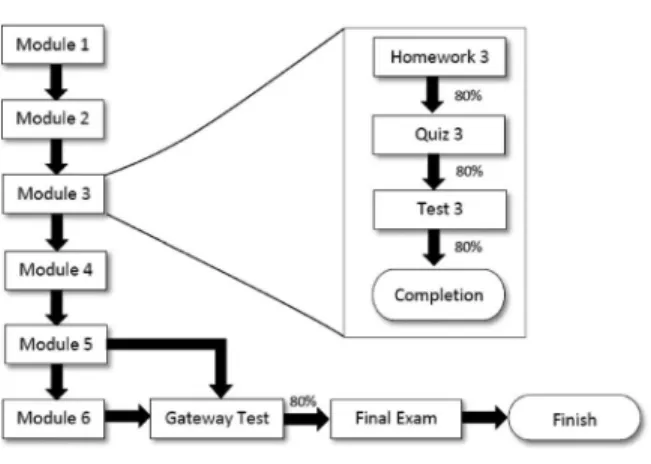
The content of the course is divided into six modules. Each module con-tains a homework assignment, a quiz, and a module test. Students must pass the homework to enter the quiz and must pass the quiz to enter the test. A module is completed when a student passes the module test. Students must complete a module before moving on to the next module. Students also need to pass a gateway test to be eligible for the final exam. The procedure is illustrated in
Figure 1.
Here are descriptions of the components of this course.
Self-paced Learning: Although this course is self-paced, it is offered in the 15-week time frame of a semester. A tentative schedule is recommended to students to prevent them from falling too far behind. In the tentative schedule, Module 1 takes three weeks, Modules 2 to 5 each take two weeks, and Module
Figure 1. MATH 98 flowchart.
6 takes up to four weeks. The instructor monitors the progress based on the schedule and intervenes when students do not make adequate progress.
Students who are ahead of the tentative schedule are excused from class-room discussions but are required to attend the lab sessions. Other students must attend the discussions and the lab sessions. There is no penalty for falling behind the schedule for less than a week. Students who are behind within three weeks are contacted and invited to meet with the instructor for help. Students who are behind the schedule by more than three weeks are dropped from the class. If they meet with the instructor for consultation, they may receive special permission to remain in the class.
Textbook and calculators: The textbook used in this course is a custom edition ofElementary and Intermediate Algebra: Graphs and Models,fourth edition, by Bittinger et al. Only chapters 1 to 4, 10 and 11 are included in the Metro State custom edition. A MyMathLab student access kit is bundled with the textbook. Calculators are not required for this course and are not allowed in proctored exams.
Video Lessons: Educreations is an app for iPads that allows instructors to record videos lessons on a whiteboard-like environment. Students view the videos on Educreations.com. Educreations organizes the videos in an online class and records the viewing activities of students. The author created more than 30 videos lessons that are between 10 and 20 minutes long. These lessons cover concepts and problems in specific modules, and are accompanied by stu-dent worksheets. Stustu-dents are reminded that if they do not watch video lessons before class then no credit is given for viewing the videos.
Homework assignments: Each homework assignment contains at 60 to 80 prob-lems. Students must score 80% or higher to pass a homework assignment.
Quizzes: When a student passes a homework assignment, he/she is eligible to take a quiz. Students take quizzes online and on their own. Each quiz has 10 problems, and must be completed within 15 minutes. Quizzes can be con-sidered practices for module tests, as the format and the problems in the quizzes are similar to those in the module tests. Students are allowed to retake quizzes as many times as necessary. The passing score for a quiz is 80%.
Module tests: When a student passes a quiz, he/she is eligible to take a module test. Module tests are proctored by the instructor at the computer lab. For mod-ule tests, students must complete 10 problems in 15 minutes and the passing score is 80%. Students are allowed to retake a test until they pass it.
Discussions and written group work: The instructor runs discussion sessions based on a tentative class schedule. He answers questions about the video lessons, demonstrates examples, and makes the class solve similar prob-lems. Students practice problem-solving in groups, but each submits his/her own work. Students who are excused from discussions can instead submit written work on problems in the online quiz. Written work is graded for credit.
Attendance: Students are excused from discussions if they are ahead of the tentative class schedule. All students are required to attend the lab.
Final exam: Students must: (i) complete at least the first five modules; and (ii) pass a gateway test to be eligible for the final exam. Module 6 is not required to be eligible for the final exam. It would be inequitable to require it because many students in traditional classes would struggle with the same material but still manage to take the final exam and sometimes pass it. However, the final exam does contain material from Module 6 and students are expected to learn as much as possible.
The gateway test consists of 10 problems and includes topics such as fraction operations, the distributive property, functions, and linear equations. Students are given 15 minutes for the gateway test, and are allowed to retake it until they pass it. The passing score is 80%.
The final exam is a 90-minute 24-problem exam. Students cannot retake the final exam. Students may take the final exam whenever they are eligible for it. In the experiment, six students were eligible to take the finals early, and two students did, in fact, do so.
Grading policy: Out of 100 points, students earn 10 points for completing each module on-time, or eight points for completing a module past the due date. They also earn up to 10 points for graded written group work. The final exam is worth 30 points. Table 1 shows the grading scale without shaded grades.
Table 1. Grading scale
Points
[0, 50) [50, 70) [70, 80) [80, 90) [90, 100]
Grade F D S V A
3. LEARNING OUTCOMES AND STUDENT FEEDBACK
In the Fall of 2013, the author taught two classes of MATH 98 with the flipped design. Students were not aware before the first day of class that they would be taking a flipped class; they were subsequently offered to opportunity to switch to a traditional class.
In this section the author compares the outcomes of the two flipped classes with two traditional classes the author taught during 2012 and 2013 with the same curriculum and expectations. In both flipped and traditional classes, stu-dents must meet certain requirements to become eligible for the final exam. SeeTable 2for the comparison.
3.1. Comparison of Course Grade
The students in flipped classes earned higher grades and had a higher passing rate. The grade distributions of the two groups are shown inTable 3. Note that the grading schemes are different between flipped and traditional classes.
Table 2. Enrollment and retention
Class type Enrolled Minus withdrawals Eligible for final
Flipped 62 56 45
Traditional 63 59 42
Table 3. The Grade distributions of the course grades
Class type Number A (%) B (%) C (%) D (%) F (%) W/I
Flipped 56 41 21 14 − 5 18
Traditional 59 17 22 10 8 22 20
3.2. Comparison of Final Exam Results
Students in the flipped classes were given final exams equivalent to those given in traditional classes. Compared with traditional classes, the flipped classes have a similar percentage of A grades in the final exam, but a higher percentage of B and C grades (seeTable 4).
3.3. On-Time Completion Rates
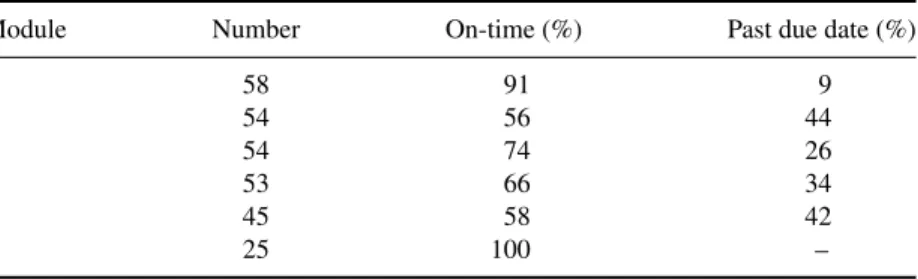
For the self-pacing aspect of this design, the percentages of students complet-ing each module, on-time or past the due date, are listed in Table 5. Note that Module 6 is not required in order to enter entering the final exam, and its deadline is the day of the final exam.
3.4. Student Survey
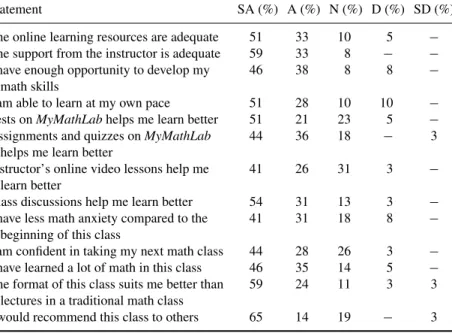
A survey of 13 questions and open-ended student comments was given to stu-dents at the end of the semester. A total of 39 stustu-dents took the survey, and the results are summarized inTable 6. Notable outcomes include:
● 79% of students were learning at their own pace (instead of the scheduled
pace);
● 72% of students have a lower anxiety about maths after taking this class;
Table 4. Distribution of final exam results
Class type Number A (%) B (%) C (%) D (%) F (%)
Flipped 45 20 24 24 24 7
Traditional 42 21 12 17 33 17
Table 5. On-time completion rates
Module Number On-time (%) Past due date (%)
1 58 91 9 2 54 56 44 3 54 74 26 4 53 66 34 5 45 58 42 6 25 100 –
Table 6. Survey results
Statement SA (%) A (%) N (%) D (%) SD (%) The online learning resources are adequate 51 33 10 5 − The support from the instructor is adequate 59 33 8 − − I have enough opportunity to develop my
math skills
46 38 8 8 −
I am able to learn at my own pace 51 28 10 10 − Tests onMyMathLabhelps me learn better 51 21 23 5 − Assignments and quizzes onMyMathLab
helps me learn better
44 36 18 − 3
Instructor’s online video lessons help me learn better
41 26 31 3 −
Class discussions help me learn better 54 31 13 3 − I have less math anxiety compared to the
beginning of this class
41 31 18 8 −
I am confident in taking my next math class 44 28 26 3 − I have learned a lot of math in this class 46 35 14 5 − The format of this class suits me better than
lectures in a traditional math class
59 24 11 3 3
I would recommend this class to others 65 14 19 − 3
Note: SA=Strongly agree; A=Agree; N=Neutral; D=Disagree; SD=Strongly disagree.
● 83% of students think that the flipped format suits them better than lectures
in a traditional classroom;
● 79% of students would recommend this class to others.
Student comments on this course were mostly positive. Here are some excerpts:
● (I like) the videos the teacher made. (I like)MyMathLabview-an-example tab.
● (I like) the online component. I couldn’t do what I was able to do if this were a traditional lecture.
● I like the amount of opportunity to learn at your own pace - I like how the computer breaks down everything for me. If I don’t understand, my instructor is always there to help.
● The questions I had were answered by our prof during lab testing.
● I liked being able to take my time with each lesson. It helped me learn better. Also the reviewing in class helped me a lot.
● Like learning at my own pace and I also liked having all the online resources available to me whenever I needed them.
● I really appreciated being able to learn at my own pace. It worked with my busy school schedule very well.
● (I like that) it’s both in-class and online.
● I really liked how this class was run. It really helped me with my math knowledge.
4. ANALYSIS AND FUTURE DEVELOPMENT 4.1. Strengths of the Design
Learning outcomes and student feedback of the flipped classes suggest that the flipped design has met or exceeded all initial expectations. To be specific, the flipped classes have the following advantages.
1. Improved learning outcomes. The combination of flipped teaching and self-paced learning significantly improves student learning outcomes. One indi-cator is the final exam that measures student competency at the end of the course. When compared with traditional classes, flipped classes have simi-lar percentages of A grades (20% versus 21%), but higher percentages of B grades (24% versus 12%) and C grades (24% versus 17%). (SeeTable 4.)
Students in flipped classes receive much higher grades than those in tra-ditional classes (seeTable 3). In addition to improved learning, students benefit from a favorable grading scheme that rewards them with a full credit for completing a module. The author thinks this encourages students to make a consistent effort in learning. Under this scheme, students who are on pace with the class schedule usually earn either an A or B grade provided they perform reasonably in the final exam.
2. Excellent teaching and learning experiences. Students respond well to flipped instruction because it allows them to access information and learn mathematics anytime they want. They are more engaged in their own learn-ing: instead of coming to a lecture not knowing what to expect, they come to class for a higher level of learning, where questions are answered, important concepts are reinforced, and more problem-solving is practiced.
Self-paced learning reduces stress and increases productivity. Although it is not unusual for students to fall behind the schedule in traditional or flipped classes, students in flipped classes usually manage to catch up with-out seriously hurting their progress or grades. They also feel less stress because they are in control of their own pace and progress.
The author enjoyed teaching this course. He was able to be a guide at their side, not a sage on the stage. Although students were doing hands-on learning, the instructor could target difficult course material and provide individualized assistance anytime to anyone who needed it. Students liked the fact that their instructor guided them through the course instead of lec-turing them on the course content and later judging them via testing and grading them.
3. Improved academic skills. Students in MATH 98 need to be taught not only the content but also how to learn it. In the flipped class, students preview before class meeting, discuss with classmates in groups, keep trying until getting correct answers, solve problems in timed online tests, meet with
instructor or tutors for help, and monitor their progress regularly. These learning activities improve their academic skills and make them better learners.
4. Easy management of withdrawals and incompletes. At Metropolitan State University, students who fail or withdraw from a class have to retake it and start all over again. Students who receive an incomplete can get their grades converted if they fulfill anindividualized completion planunder the super-vision of the instructor in the following semester. In reality, incompletes seldom get converted because an individualized completion plan is hard to manage when the student and instructors are occupied with other courses in a new semester.
For flipped classes, if a student fails or withdraws from the class, they would continue their work when they enroll again. An incomplete is only granted to a student who has completed at least four modules, and the com-pletion plan is simple: The student will complete the rest of the work. A students with an incomplete has full access to the computer lab, the university’s testing and tutoring services, and the instructor’s office hours.
4.2. Things to Improve
1. Unlimited retakes were counterproductive. Students who fail a particular test multiple times often resort to memorizing formulas and patterns of solutions instead of trying to better comprehend the problems. Since the problems in tests are similar and there are unlimited retakes, some students might eventually pass them without fully achieving the desired learning objectives. A possible solution is to limit the number of retakes and require students to put in extra work or consult with the instructor before trying the tests again.
2. The number of custom-made video lessons viewed was sometimes lower than expected.This happened at the beginning of the semester when stu-dents were still expecting traditional lectures, and during the semester when the materials were easier. Some students also seemed to have a habit of start-ing homework right away, and viewstart-ing video lessons or usstart-ingMyMathLab
learning resources only when needed. Viewing video lessons is impor-tant for the flipped classroom, and in the future the author would consider making video lessons prerequisites of homework assignments.
4.3. Future Development
This design can be used in developing new pedagogy and instruction prac-tices to provide better learning experience to more students. The author is particularly interested in exploring in the following directions.
1. Flipping college algebra. College algebra is considered one of the most difficult courses for average students: nationally, the passing rate of stu-dents enrolled in college algebra is 40% [9]. Not only do students struggle with content knowledge, many of them also lack interest and do not enjoy the learning experience. If flipped classes are successful for developmental math, it might also be suitable for college algebra. The nature of college algebra is similar to that of developmental math: it is skill and problem-solving oriented, it requires a lot of practice and coaching, and the benefit of self-paced learning outweighs the benefit of lectures in the classroom. 2. Collaboration among instructors. The flipped design makes it easy for
instructors to co-teach classes by dividing the duties into discussion sessions and lab sessions. It also allows the math department to best use its instruc-tors by staffing the discussion sessions with more experienced instrucinstruc-tors and staffing the lab sessions with less experienced instructors or teaching assistants. Another idea is to team up a group of instructors and create a math learning lab that is accessible to more students.
3. Rolling enrollment. Many universities admit students year-round on a rolling basis. It would be fantastic to also enroll students in developmental math on a rolling basis. Students should not wait until the beginning of the upcoming semester to start learning developmental math. With the flipped design, it is possible to create a system that enrolls students as soon as they are admitted, generates individualized study plans for them, and initiates learning right away. Eventually, college algebra and other math courses with self-paced learning designs can also be integrated into the system. These courses would form self-paced math sequences.
Rolling enrollment might sound like an administrative mess involving faculty resources, student billing, grade registration, etc., but more and more institutions are finding ways to implement it. More than 350 institutions have been offering or are seeking to create self-paced and competency-based programs since 2013, when the U.S. Department of Education began to allow student aid to go into such programs in higher education [3,10].
5. SUMMARY
In an era when online classes play an increasingly important role in higher edu-cation, mathematics remains as one of the rare subjects where many instructors and students still value face-to-face delivery of knowledge. The flipped and self-paced design combines the best of the two worlds of online and class-room instructions: students can learn the course anywhere and anytime by using web-based technology, and they also receive personalized help and in-depth instruction from meeting with the instructor. This design produces better learning outcomes and excellent learning experiences for students. The author recommends this design to instructors of developmental-level and college-level
algebra, and to institutions that are interested in creating significant learning experiences via innovative ideas.
ACKNOWLEDGMENTS
The author thanks the Mathematics Department of Metropolitan State University for supporting his exploration and experimentation on instruc-tional designs of developmental mathematics over the years. The author also thanks Dr. G. Viglino of Ramapo College of New Jersey for being a mentor and for his many visionary ideas of teaching developmental mathematics.
APPENDIX: TOPICS OF MATH 98
The following topics are covered in MATH 98. They are organized in modules for use in the flipped classes. They are based onElementary and Intermediate Algebra: Graphs and Models,fourth edition by Bittinger et al.
● Module 1: 1.1 Introduction to Algebra. 1.2 The Commutative, Associative,
and Distributive Laws. 1.3 Fraction Notations. 1.4 Positive and Negative Real Numbers. 1.5 Addition of Real Numbers.
● Module 2: 1.6 Subtraction of Real Numbers. 1.7 Multiplication and Division
of Real Numbers. 1.8 Exponential Notation and Order of Operations. 2.1 Solving Equations. 2.2 Using the Principles Together. 2.3 Formulas.
● Module 3: 2.4 Application with Percent. 2.5 Problem-Solving. 2.6 Solving
Inequalities. 2.7 Solving Applications with Inequalities.
● Module 4: 3.1 Reading Graphs, Plotting Points, and Scaling Graphs.
3.2 Graphing Equations. 3.3 Linear Equations and Intercepts. 3.4 Rates. 3.5 Slope.
● Module 5: 3.6 Slope-Intercept Form. 3.7 Point-Slope Form; Introduction to
Curve Fitting. 3.8 Functions. 10.8 The Complex Numbers.
● Module 6: 11.1 Quadratic Equations. 11.2 The Quadratic Formula.
11.6 Quadratic Functions and Their Graphs.
ORCID
Pangyen Weng http://orcid.org/0000-0001-7628-6234
REFERENCES
1. Attewell, P. A., D. Lavin, T. Domina, and T. Levey. 2006. New evidence on college remediation.The Journal of Higher Education. 77(5): 886–924. 2. Bailey, T., W. J. Dong, and S. W. Cho. 2010. Referral, enrollment and completion in developmental education sequences in community colleges.
Economics of Education Review. 29(2): 255–270.
3. Fain, P. 2013. Experimenting with aid. https://www.insidehighered.com. Accessed 20 May 2015.
4. Le, C., K. Rogers, and J. Santos. 2011. Innovations in Developmental Math: Community Colleges Enhanced Support for Nontraditional Students. Boston, MA: Jobs for the Future.
5. Potocka, K. 2010. An entirely-online developmental mathematics course: Creation and outcomes.PRIMUS. 20(6): 498–516.
6. Rock, M. L., M. Gregg, E. Ellis, and R. A. Gable. 2008. REACH: A frame-work for differentiating classroom instruction.Preventing School Failure. 52(2): 31–47.
7. Slavin, R. E., M. Leavey, and N. A. Madden. 1982. Combining cooperative learning and individualized instruction: Effects on student mathematics achievement, attitudes and behaviors. U.S. Office of Special Education, Grant No. G-00-80-01494.
8. Strauss, V. 2012. The flip: Turning a classroom upside down. Washington Post, June 3, 2012.
9. Thompson, C. J. and P. McCann. 2010. Redesigning college algebra for student retention: Results of a quasi-experimental research study.
MathAMATYC Educator. 2(1): 34–38.
10. U.S. Department of Education. 2013. Applying for Title IV eligibility for Direct Assessment (Competency-based) programs. DCL ID: GEN-13-10.
BIOGRAPHICAL SKETCH
A native Taiwanese, Pangyen “Ben” Weng came to the United States at the turn of the 21st century, earned his Ph.D. from University of Minnesota, and fell in love with the land of 10,000 lakes. Since joining Metropolitan State University in Saint Paul, Minnesota, Ben has focused mainly on improving its developmental mathematics program. His motto isanyone can learn math.