DISCUSSION PAPER SERIES
Forschungsinstitut
zur Zukunft der Arbeit
Institute for the Study
Forecasting with Spatial Panel Data
IZA DP No. 4242
June 2009
Badi H. Baltagi
Georges Bresson
Alain Pirotte
Forecasting with Spatial Panel Data
Badi H. Baltagi
Syracuse University
and IZA
Georges Bresson
ERMES (CNRS), Université Panthéon-Assas Paris II
Alain Pirotte
ERMES (CNRS), Université Panthéon-Assas Paris II
and INRETS-DEST
Discussion Paper No. 4242
June 2009
IZA
P.O. Box 7240
53072 Bonn
Germany
Phone: +49-228-3894-0
Fax: +49-228-3894-180
E-mail: [email protected]
Any
opinions expressed here are those of the author(s) and not those of IZA. Research published in
this series may include views on policy, but the institute itself takes no institutional policy positions.
The Institute for the Study of Labor (IZA) in Bonn is a local and virtual international research center
and a place of communication between science, politics and business. IZA is an independent nonprofit
organization supported by Deutsche Post Foundation. The center is associated with the University of
Bonn and offers a stimulating research environment through its international network, workshops and
conferences, data service, project support, research visits and doctoral program. IZA engages in (i)
original and internationally competitive research in all fields of labor economics, (ii) development of
policy concepts, and (iii) dissemination of research results and concepts to the interested public.
IZA Discussion Papers often represent preliminary work and are circulated to encourage discussion.
IZA Discussion Paper No. 4242
June 2009
ABSTRACT
Forecasting with Spatial Panel Data
*
This paper compares various forecasts using panel data with spatial error correlation. The
true data generating process is assumed to be a simple error component regression model
with spatial remainder disturbances of the autoregressive or moving average type. The best
linear unbiased predictor is compared with other forecasts ignoring spatial correlation, or
ignoring heterogeneity due to the individual effects, using Monte Carlo experiments. In
addition, we check the performance of these forecasts under misspecification of the spatial
error process, various spatial weight matrices, and heterogeneous rather than homogeneous
panel data models.
JEL Classification:
C33
Keywords:
forecasting, BLUP, panel data, spatial dependence, heterogeneity
Corresponding author:
Badi H. Baltagi
Department of Economics and Center for Policy Research
426 Eggers Hall
Syracuse University
Syracuse, NY 13244-1020
USA
E-mail:
[email protected]
*
This paper was presented at a conference in honor of Phoebus Dhrymes in Paphos, Cyprus, June
1-3, 2007. Also, at the 14th International Conference on Panel Data at the Wang Yanan Institute for
Studies in Economics (WISE), Xiamen University, China, July 16-18, 2007, and the 63rd European
1
Introduction
The literature on forecasting is rich with time series applications, but this
is not the case for spatial panel data applications. Exceptions are Baltagi
and Li (2004, 2006) with applications to forecasting sales of cigarettes and
liquor per capita for U.S. states over time.
1Best linear unbiased prediction
(BLUP) in panel data using an error component model have been
consid-ered by Taub (
1
979), Baltagi and Li (
1
992), and Baillie and Baltagi (
1
999)
to mention a few. Applications include Baltagi and Gri
ffi
n (
1
997), Hsiao
and Tahmiscioglu (
1
997), Schmalensee, Stoker and Judson (
1
998), Baltagi,
Gri
ffi
n and Xiong (2000), Hoogstrate, Palm and Pfann (2000), Baltagi,
Bres-son and Pirotte (2002, 2004), Frees and Miller (2004), Rapach and Wohar
(2004), and Brucker and Siliverstovs (2006), see Baltagi (2008) for a recent
survey. However, these panel forecasting applications do not deal with spatial
dependence across the panel units. Spatial dependence models – popular
in regional science and urban economics – deal with spatial interaction and
spatial heterogeneity (see Anselin (
1
988) and Anselin and Bera (
1
998)). The
structure of the dependence can be related to location and distance, both in a
geographic space as well as a more general economic or social network space.
Some commonly used spatial error processes include the spatial
autoregres-sive (SAR) and the spatial moving average (SMA) error processes. Two
di
ff
erent variants of these models for spatial panels are considered, one
dis-cussed in Anselin (
1
988) and another in Kapoor, Kelejian and Prucha (2007)
and Fingleton (2007). The best linear unbiased predictors for the Anselin
type model was derived by Baltagi and Li (2004). This paper derives the best
linear unbiased predictors for the Kapoor, Kelejian and Prucha (2007) and
Fingleton (2007) variants. More importantly, it compares the performance of
sixteen various forecasts of the spatial panel data using Monte Carlo
exper-iments. These include homogeneous as well as heterogeneous estimators of
the spatial panel model and their corresponding forecasts. The true data
gen-erating process is assumed to be a simple error component regression model
with spatial remainder disturbances of the autoregressive or moving average
1
In order to explain how spatial autocorrelation may arise in the demand for cigarettes,
we note that cigarette prices vary among states primarily due to variation in state taxes
on cigarettes. Border e
ff
ect purchases not included in the cigarette demand equation can
cause spatial autocorrelation among the disturbances. In forecasting sales of cigarettes, the
spatial autocorrelation due to neighboring states and the individual heterogeneity across
states is taken explicitly into account.
type. The best linear unbiased predictor is compared with other forecasts
ignoring spatial correlation, or ignoring heterogeneity due to the individual
e
ff
ects. In addition, we check the performance of these forecasts under
mis-speci
fi
cation of the spatial error process, di
ff
erent spatial weight matrices,
and various sample sizes. Section 2 introduces the error component model
with spatially autocorrelated residuals of the SAR and SMA type. Section
3 describes the forecasts using the estimators considered in Section 2, while
Section 4 gives the Monte Carlo design. Section 5 reports the results of the
Monte Carlo simulations and Section 6 gives our summary and conclusion.
2
The Error Component Model with Spatially
Autocorrelated Residuals
Consider a linear panel data regression model:
y
it=
X
itβ
+
ε
it,
i
= 1
, ..., N
;
t
= 1
, ..., T
(
1
)
where the disturbance term follows an error component model with spatially
autocorrelated residuals. The disturbance vector for time
t
is given by:
ε
t=
µ
+
φ
t(2)
where
ε
t= (
ε
1t, ...,
ε
N t)0,
µ
= (
µ
1, ..., µ
N)
0denotes the vector of speci
fi
c
ef-fects assumed to be
iid
¡
0
,
σ
2µ
¢
and
φ
t= (
φ
1t, ...,
φ
N t)
0are the remainder
disturbances which are independent of
µ
. We let the
φ
t’s follow a spatial
autoregressive (SAR) or a spatial moving average (SMA) error model. The
SAR process is known to transmit the shocks globally while the SMA process
transmits these shocks locally, see Anselin, Le Gallo and Jayet (2008).
The SAR speci
fi
cation for the
(
N
×
1)
error vector
φ
tat time
t
can be
ex-pressed as:
φ
t=
ρ
W
Nφ
t+
v
t= (
I
N−
ρ
W
N)
−1
v
t=
B
N−1v
t(3)
where
W
Nis an
(
N
×
N
)
known spatial weights matrix
2,
ρ
is the spatial
au-toregressive parameter and
v
tis an
(
N
×
1)
error vector assumed to be
dis-2
In the simplest case, the weights matrix is binary, with
w
ij
= 1
when
i
and
j
are
neighbors and
w
ij= 0
when they are not. By convention, diagonal elements are null:
wii
= 0
and the weights are almost always standardized such that the elements of each
row sum to
1
.
tributed independently across cross-sectional dimension with constant
vari-ance
σ
2vI
N.
B
N= (
I
N−
ρ
W
N)
and is assumed to be non-singular. The error
covariance matrix for the cross-section at time
t
becomes:
Ω
t=
E
[
ε
tε
0t] =
σ
2
µ
I
N+
σ
2v(
B
N0B
N)
−1
(4)
For the full
(
N T
×
1)
vector of disturbances:
ε
= (
ι
T⊗
I
N)
µ
+
¡
I
T⊗
B
N−1¢
v
(5)
the corresponding
(
N T
×
N T
)
covariance matrix is given by:
Ω
=
σ
2µ(
J
T⊗
I
N) +
σ
2vh
I
T⊗
(
B
N0B
N)
−1
i
(6)
where
ι
Tis a
(
T
×
1)
vector of ones and
J
T=
ι
Tι
0Tis a
(
T
×
T
)
matrix of
ones.
The spatial moving average (SMA) speci
fi
cation for the
(
N
×
1)
error vector
φ
tat time
t
can be expressed as:
φ
t=
λ
W
Nv
t+
v
t= (
I
N+
λ
W
N)
v
t=
D
Nv
t(7)
where
D
N= (
I
N+
λ
W
N)
.
The error covariance matrix for the cross-section
at time
t
becomes:
Ω
t=
E
[
ε
tε
0t] =
σ
2
µ
I
N+
σ
2v(
D
ND
0N)
(8)
For the full
(
N T
×
1)
vector of disturbances:
ε
= (
ι
T⊗
I
N)
µ
+ (
I
T⊗
D
N)
v
(9)
the corresponding
(
N T
×
N T
)
covariance matrix is given by:
Ω
=
σ
2µ(
J
T⊗
I
N) +
σ
v2[
I
T⊗
(
D
ND
0N)]
(
1
0)
MLE under normality of the disturbances using these error component
mod-els with spatial autocorrelation have been derived by Anselin (
1
988). The
log-likelihood is given by:
L
∝
−
N T
2
ln
¡
2
πσ
2v¢
−
1
2
ln
|
Σ
|
−
1
2
σ
2 vε
0Σ
−1ε
(
11
)
where
ε
=
y
−
X
β
,
Ω
=
σ
2vΣ
Σ
=
½
(
J
T⊗
θ
I
N) +
£
I
T⊗
(
B
N0B
N)
− 1¤
for SAR
(
J
T⊗
θ
I
N) + [
I
T⊗
(
D
ND
N0)]
for SMA
(
1
2)
with
θ
=
σ
2µ/
σ
2v.
Regression models containing spatially correlated disturbance terms based
on the SAR or SMA models are typically estimated using MLE, where the
likelihood function corresponds to the normal distribution. However, this can
be computationally demanding for large
N
. Kelejian and Prucha (
1
999)
sug-gested a generalized moments (GM) estimation method for the SAR model
in a cross-section setting, and Fingleton (2007) extended this generalized
moments estimator to the SMA model. Kapoor, Kelejian and Prucha (2007)
generalized this GM procedure from cross-section to panel data and derived
its large sample properties when
T
is
fi
xed and
N
→ ∞
. However, their SAR
random e
ff
ects model (SAR-RE) di
ff
ers from that described in (2) which we
will call (RE-SAR). In fact, in their speci
fi
cation, the disturbance term
ε
titself follows a SAR process and the remainder term follows an error
compo-nent structure. This allows the individual e
ff
ects, i.e., the
µ
’s themselves to
be spatially correlated but with the same
ρ
. In particular, the disturbance
vector for time
t
is given by:
ε
t=
ρ
W
Nε
t+
u
t(
1
3)
where
u
tfollows an error component structure :
u
t=
µ
+
v
t(
1
4)
The SAR-RE speci
fi
cation for the
(
N
×
1)
error vector
ε
tat time
t
can be
expressed as:
ε
t= (
I
N−
ρ
W
N)
−1
u
t=
B
N−1u
t(
1
5)
where
B
N= (
I
N−
ρ
W
N)
.
For the full
(
N T
×
1)
vector of disturbances:
ε
=
¡
ι
T⊗
B
N−1¢
µ
+
¡
I
T⊗
B
N−1¢
v
(
1
6)
and the corresponding
(
N T
×
N T
)
covariance matrix is given by:
Ω
=
σ
2µ³
J
T⊗
(
B
N0B
N)
−1
´
+
σ
2vh
I
T⊗
(
B
0NB
N)
−1
i
Kapoor, et al. (2007) proposed three generalized moments (GM) estimators
of
ρ
,
σ
2vand
σ
21¡
=
σ
2v+
T
σ
2µ¢
based on the following six moment conditions:
E
1 N(T−1)u
0 NQ
0,Nu
N 1 N(T−1)u
0 NQ
0,Nu
N 1 N(T−1)u
0 NQ
0,Nu
N 1 Nu
0 NQ
1,Nu
N 1 Nu
0 NQ
1,Nu
N 1 Nu
0 NQ
1,Nu
N
=
σ
2 vσ
2 v 1 Ntr
¡
W
N0W
N¢
0
σ
21σ
2 1N1tr
¡
W
N0W
N¢
0
(
1
8)
where
u
N=
ε
N−
ρε
N(
1
9)
u
N=
ε
N−
ρε
N(20)
ε
N= (
I
T⊗
W
N)
ε
N(2
1
)
ε
N= (
I
T⊗
W
N)
ε
N(22)
Q
0,N=
µ
I
T−
J
TT

⊗
I
N(23)
Q
1,N=
J
TT
⊗
I
N(24)
Under the random e
ff
ects speci
fi
cation considered, the OLS estimator of
β
is
consistent. Using
b
β
OLSone gets a consistent estimator of the disturbances
b
ε
=
y
−
X
β
b
OLS.
The GM estimators of
σ
21
,
σ
2νand
ρ
are the solution of
the sample counterpart of the six equations given above. Kapoor, et al.
(2007) suggest three GM estimators. The
fi
rst involves only the
fi
rst three
moments which do not involve
σ
21
and yield estimates of
ρ
and
σ
2ν. The fourth
moment condition is then used to solve for
σ
21
given estimates of
ρ
and
σ
2ν. The
second GM estimator is based upon weighing the moment equations by the
inverse of a properly normalized variance-covariance matrix of the sample
moments evaluated at the true parameter values. A simple version of this
weighting matrix is derived under normality of the disturbances. The third
GM estimator is motivated by computational considerations and replaces
a component of the weighting matrix for the second GM estimator by an
identity matrix. Kapoor, et al. (2007) perform Monte Carlo experiments
comparing MLE and these three GM estimation methods. They
fi
nd that
similar. The feasible GLS estimator of
β
is then obtained by replacing
ρ
,
σ
2v
and
σ
21by their GM estimators.
3Recently, Fingleton (2007) extended this GM estimator for the SMA panel
data model with random e
ff
ects. We call this SMA-RE to distinguish it
from the RE-SMA procedure described in Anselin, et al. (2008). In fact,
for the Fingleton (2007) SMA-RE, the disturbance term
ε
tin (2) follows a
SMA process and the remainder term follows an error component structure.
Unlike the Anselin, et al. (2008) RE-SMA, the individual e
ff
ects, i.e., the
µ
’s themselves are allowed to be spatially correlated but with the same
λ
. In
particular, the disturbance vector for time
t
is given by:
ε
t= (
I
N+
λ
W
N)
u
t=
D
Nu
t(25)
where
D
N= (
I
N+
λ
W
N)
, and
u
tfollows an error component structure (
1
4).
So, the full SMA-RE
(
N T
×
1)
vector of disturbances is given by:
ε
= (
ι
T⊗
D
N)
µ
+ (
I
T⊗
D
N)
v
(26)
and the corresponding
(
N T
×
N T
)
covariance matrix is given by:
Ω
=
σ
2µ(
J
T⊗
(
D
ND
0N)) +
σ
2
v
[
I
T⊗
(
D
ND
0N)]
(27)
The moment conditions for SMA-RE are similar to those derived by Kapoor,
et al. (2007), see Fingleton (2007).
3
Prediction
Goldberger (
1
962) has shown that, for a given
Ω
, the best linear unbiased
predictor (BLUP) for the
i
th individual at a future period
T
+
τ
is given by:
b
y
i,T+τ=
X
i,T+τb
β
GLS+
ω
0Ω
−1
b
ε
GLS(28)
where
ω
=
E
[
ε
i,T+τε
]
is the covariance between the future disturbance
ε
i,T+τand the sample disturbances
ε
.
β
b
GLSis the GLS estimator of
β
from equation
(
1
) based on
Ω
and
b
ε
GLSdenotes the corresponding GLS residual vector.
3
Later, in our Monte Carlo experiments, we computed the predictors for all three GM
estimators suggested by Kapoor, et al. (2007). However, the di
ff
erences in root mean
squared error performance were minor. To save space, we only report the second GM
estimator, called weighted GM estimator by Kapoor, et al. (2007).
For the error component without spatial autocorrelation (
λ
= 0
), this BLUP
reduces to:
b
y
i,T+τ=
X
i,T+τβ
b
GLS+
σ
2 µσ
2 1(
ι
0T⊗
l
i0)
b
ε
GLS(29)
where
σ
21
=
T
σ
2µ+
σ
v2and
l
iis the
i
th column of
I
N. This predictor was
considered by Wansbeek and Kapteyn (
1
978), Lee and Gri
ffi
ths (
1
979) and
Taub (
1
979).
The typical element of the last term of equation (29) is
¡
T
σ
2µ
/
σ
21¢
ε
i.,GLSwhere
ε
i.,GLS=
P
Tt=1b
ε
ti,GLS/T
. Therefore, the BLUP of
y
i,T+τfor the RE model modi
fi
es the usual GLS forecasts by adding a
frac-tion of the mean of the GLS residuals corresponding to the
i
th individual.
In order to make this forecast operational,
b
β
GLSis replaced by its feasible
GLS estimate and the variance components are replaced by their feasible
estimates.
Baltagi and Li (2004, 2006) derived the BLUP correction term when
both error components and spatial autocorrelation are present and
φ
tfollows
a SAR process. So, the predictors for the SAR and the SMA are given by:
b
y
i,T+τ=
X
i,T+τβ
b
M LE+
θ
¡
ι
0 T⊗
l
0iC
− 1 1¢
b
ε
M LE=
X
i,T+τβ
b
M LE+
T
θ
NP
j=1c
1,jε
j.,M LEfor SAR
X
i,T+τβ
b
M LE+
θ
¡
ι
0T⊗
l
0iC
2−1¢
b
ε
M LE=
X
i,T+τβ
b
M LE+
T
θ
NP
j=1c
2,jε
j.,M LEfor SMA
(30)
where
c
1j(resp.
c
2,j) is the
j
th element of the
i
th row of
C
1−1(resp.
C
2−1) with
C
1=
£
T
θ
I
N+ (
B
N0B
N)
−1¤
(resp.
C
2= [
T
θ
I
N+ (
D
ND
0N)]
) and
ε
j.,M LE=
P
Tt=1
b
ε
tj,M LE/T
. In other words, the BLUP of
y
i,T+τadds to
X
i,T+τβ
b
M LEa weighted average of the MLE residuals for the
N
individuals averaged
over time. The weights depend upon the spatial matrix
W
Nand the
spa-tial autoregressive (or moving average) coe
ffi
cients
ρ
and
λ
. To make these
predictors operational, we replace
θ
,
ρ
and
λ
by their estimates from the
RE-spatial MLE with SAR or SMA. When there are no random individual
e
ff
ects, so that
σ
2µ
= 0
,
then
θ
= 0
and the BLUP prediction terms drop out
completely from equation (30). In these cases,
Ω
in equation (
1
2) reduces to
σ
2v
£
I
T⊗
(
B
N0B
N)
−1¤
for SAR and
σ
2v
[
I
T⊗
(
D
ND
N0)]
for SMA, and the
cor-responding MLE for these models yield the pooled spatial MLE with SAR
or SMA remainder disturbances.
For the Kapoor, et al. (2007) model, the BLUP of
y
i,T+τfor the SAR-RE
also modi
fi
es the usual GLS forecasts by adding a fraction of the mean of
the GLS residuals corresponding to the
i
th individual. More speci
fi
cally, the
predictor is given by:
b
y
i,T+τ=
X
i,T+τb
β
GLS+
µ
σ
2 µσ
2 1
b
i(
ι
0T⊗
B
N)
b
ε
GLS(3
1
)
where
b
iis the
i
th row of the matrix
B
N−1. This is derived in the Appendix
of this paper which also shows the resulting predictor has the same form as
that of the RE model (29). This proof applies to both the Kapoor, et al.
(2007) SAR-RE speci
fi
cation and the Fingleton (2007) SMA-RE speci
fi
ca-tion. Therefore, the BLUP of
y
i,T+τfor the SAR-RE and the SMA-RE, like
the usual RE model with no spatial e
ff
ects, modi
fi
es the usual GLS forecasts
by adding a fraction of the mean of the GLS residuals corresponding to the
i
th individual. While the predictor formula is the same, the MLEs for these
speci
fi
cations yield di
ff
erent estimates which in turn yield di
ff
erent residuals
and hence di
ff
erent forecasts.
4
Monte Carlo Design
In this section, we consider the small sample performance of several predictors
for an error component model with spatially autocorrelated residuals. The
data generating process (DGP) consider two speci
fi
cations on the remainder
errors, namely SAR and SMA:
y
it=
β
0+
β
1x
it+
ε
it,
ε
it=
µ
i+
φ
it,
i
= 1
, ..., N
;
t
= 1
, ..., T
(32)
where
4x
it=
δ
i+
ξ
itwith
µ
i∼
iid.N
¡
0
,
σ
2µ¢
,
δ
i∼
iid.U
(
−
7
.
5
,
7
.
5)
,
ξ
it∼
iid.U
(
−
5
,
5)
,
β
0= 5
,
β
1= 0
.
5
4
In the spirit of Nerlove (
1
97
1
), we have tried another DGP for
xit
. We obtain the
same ranking as those which appear in the reported tables. The only di
ff
erence is that
the gap between the average heterogeneous estimators and the homogeneous estimators
widens with a Nerlove (
1
97
1
) type design. In other words, the forecast performance of the
heterogeneous estimators becomes worse.
φ
t=
½
ρ
W
Nφ
t+
v
tfor SAR
λ
W
Nv
t+
v
tfor SMA
with
ρ
,
λ
=
½
0
.
8
0
.
4
(33)
and
v
it∼
iid.N
¡
0
,
σ
2v¢
(34)
We consider the simple regressions (32) and (33) with
N
= (50
,
100)
,
T
=
(10
,
20)
and two cases for the residuals variances:
½
σ
2µ= 4
,
σ
2v= 16
σ
2µ= 16
,
σ
2v= 4
(35)
Following Kelejian and Prucha (
1
999), we use two weight matrices which
es-sentially di
ff
er in their degree of sparseness. The weight matrices are labelled
as “
j
ahead and
j
behind” with the non-zero elements being
1
/
2
j
,
j
= 1
and
5
. Even with this modest design we have 64 experiments.
For each experiment, we obtain the following
1
6 estimators:
1
. Pooled OLS which ignores the individual heterogeneity and the spatial
autocorrelation.
2. The average heterogeneous OLS which estimates the cross-sectional
equation using OLS for each time period and averages these
heteroge-neous estimates to obtain a pooled estimator, see Pesaran and Smith
(
1
995).
3. The
fi
xed-e
ff
ects (FE) estimator which accounts for
fi
xed individual
e
ff
ects but does not take into account the spatial autocorrelation.
4. The random e
ff
ects (RE) estimator which asssumes that the
µ
i’s are
iid
(0
,
σ
2µ
)
,
and independent of the remainder disturbances
φ
it’s. This
estimator accounts for random individual e
ff
ects but does not take into
account the spatial autocorrelation.
5. The RE-spatial MLE assuming a SAR speci
fi
cation (RE-SAR) on the
remainder disturbances. In this case, the
µ
i’s are
iid
(0
,
σ
2µ
)
and are
independent of the
φ
it’s which follow a SAR process, see Anselin, et al.
6. The RE-spatial MLE assuming a SMA speci
fi
cation (RE-SMA) on the
remainder disturbances. In this case, the
µ
i’s are
iid
(0
,
σ
2µ)
and are
independent of the
φ
it’s which follow a SMA process, see Anselin, et
al. (2008).
7. The pooled spatial MLE assuming a SAR speci
fi
cation (Pooled SAR)
on the remainder disturbances. This estimator ignores the individual
heterogeneity but takes into account the spatial autocorrelation of the
SAR type.
8. The pooled spatial MLE assuming a SMA speci
fi
cation (Pooled SMA)
on the remainder disturbances. This estimator ignores the individual
heterogeneity but takes into account the spatial autocorrelation of the
SMA type.
9. The average heterogeneous spatial MLE assuming a SAR speci
fi
cation
on the remainder disturbances. This estimates cross-sectional MLE
with SAR disturbances for each time period and averages the estimates
over time.
1
0. The average heterogeneous spatial GM estimator assuming a SAR
speci
fi
cation on the remainder disturbances proposed by Kelejian and
Prucha (
1
999). This estimates cross-sectional GM estimator with SAR
disturbances for each time period and averages the estimates over time.
11
. The average heterogeneous spatial MLE assuming a SMA speci
fi
cation
on the remainder disturbances. This estimates cross-sectional MLE
with SMA disturbances for each time period and averages the estimates
over time.
1
2. The average heterogeneous spatial GM estimator assuming a SMA
speci
fi
cation on the remainder disturbances proposed by Fingleton (2007).
This estimates cross-sectional GM estimator with SMA disturbances for
each time period and averages the estimates over time.
1
3. The FE-spatial MLE assuming a SAR speci
fi
cation (FE-SAR) on the
remainder disturbances.
1
4. The FE-spatial MLE assuming a SMA speci
fi
cation (FE-SMA) on the
1
5. The (SAR-RE) model following Kapoor, et al. (2007). This utilizes
a panel data GM estimator where the disturbance term itself follows
a SAR process and the remainder term follows an error component
structure.
1
6. The (SMA-RE) model following Fingleton (2007). This utilizes a panel
data GM estimator where the disturbance term itself follows a SMA
process and the remainder term follows an error component structure.
Next, we compute the following predictors for the
i
th individual at a
fu-ture period
T
+
τ
for
τ
= 1
,
2
, ...,
5
:
OLS
y
b
i,T+τ=
X
i,T+τβ
b
OLSAverage hetero. OLS
y
b
i,T+τ=
X
i,T+τβ
b
av.OLSFE
5(
b
y
i,T+τ=
X
i,T+τb
β
F E+
b
µ
iwith
µ
b
i=
y
i−
X
ib
β
F E,
y
i=
P
T t=1y
it/T
RE
y
b
i,T+τ=
X
i,T+τβ
b
RE+
σ2 µ σ2 1(
ι
0 T⊗
l
0i)
b
ε
RERE-SAR
½
b
y
i,T+τ=
X
i,T+τb
β
M LE,RE−SAR+
θ
¡
ι
0 T⊗
l
0iC
− 1 1¢
b
ε
M LE,RE−SARwith
C
1=
£
T
θ
I
N+ (
B
N0B
N)
−1¤
and
θ
=
σ
2µ/
σ
2vRE-SMA
½
b
y
i,T+τ=
X
i,T+τb
β
M LE,RE−SM A+
θ
¡
ι
0 T⊗
l
i0C
− 1 2¢
b
ε
M LE,RE−SM Awith
C
2= [
T
θ
I
N+ (
D
ND
0N)]
and
θ
=
σ
2µ/
σ
2vPooled SAR
y
b
i,T+τ=
X
i,T+τβ
b
M LE,SARPooled SMA
y
b
i,T+τ=
X
i,T+τβ
b
M LE,SM AAverage hetero. SAR
b
y
i,T+τ=
(
X
i,T+τb
β
av.M LE,SARX
i,T+τb
β
av.GM,SARAverage hetero. SMA
b
y
i,T+τ=
(
X
i,T+τb
β
av.M LE,SM AX
i,T+τb
β
av.GM,SM AFE-SAR
(
b
y
i,T+τ=
X
i,T+τb
β
M LE,F E−SAR+
b
µ
iwith
µ
b
i=
y
i−
X
ib
β
M LE,F E−SAR,
y
i=
P
Tt=1
y
it/T
FE-SMA
(
b
y
i,T+τ=
X
i,T+τb
β
M LE,F E−SM A+
µ
b
iwith
µ
b
i=
y
i−
X
ib
β
M LE,F E−SM A,
y
i=
P
Tt=1
y
it/T
SAR-RE
b
y
i,T+τ=
X
i,T+τb
β
M LE,SAR−RE+
³
σ2 µ σ2 1´
(
ι
0 T⊗
l
0i)
b
ε
M LE,SAR−RESMA-RE
b
y
i,T+τ=
X
i,T+τb
β
M LE,SM A−RE+
³
σ2 µ σ2 1´
(
ι
0 T⊗
l
0i)
b
ε
M LE,SM A−REFor all experiments,
1
000 replications are performed and the RMSE for
one step to
fi
ve step ahead forecasts are reported.
5
Monte Carlo Results
5.1
The Spatial Dependence Speci
fi
cation E
ff
ect
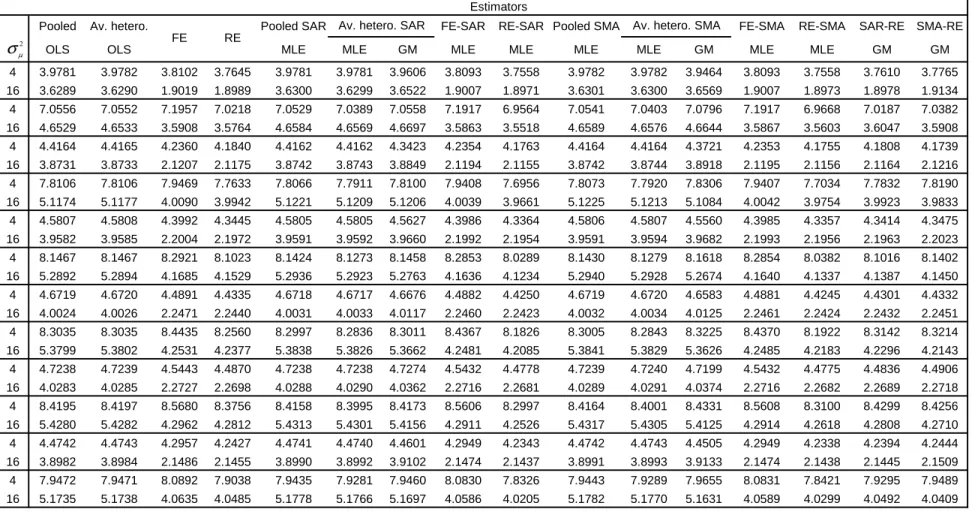
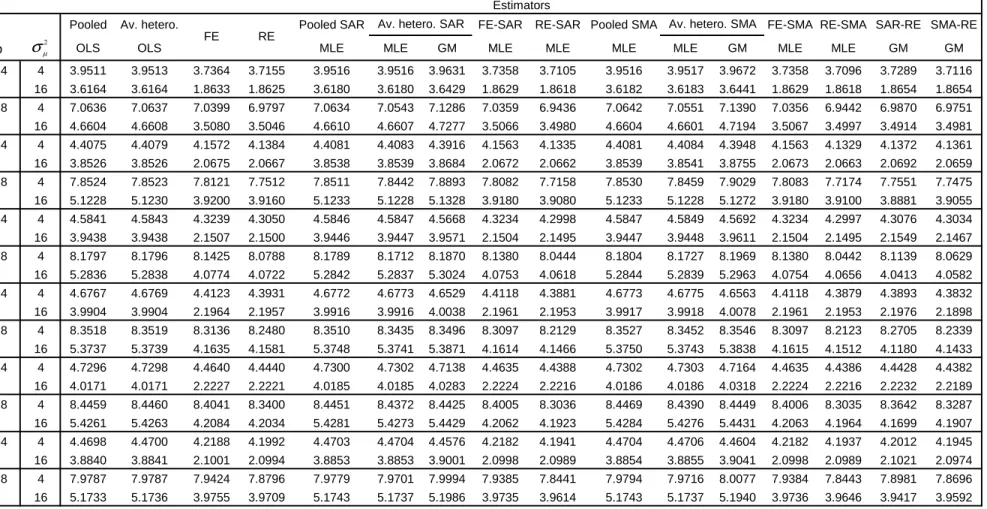
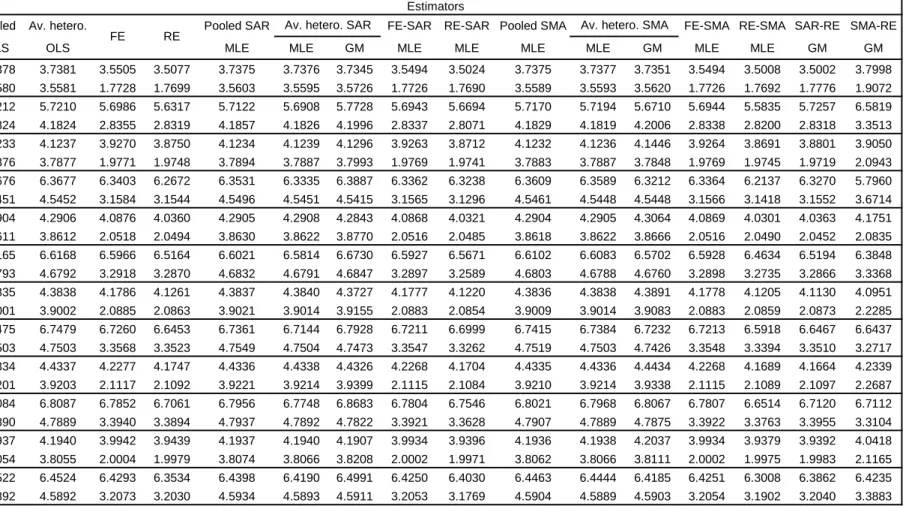
Table
1
gives the RMSE for the one year, two year,..., and
fi
ve year ahead
forecasts along with the average RMSE for all 5 years. These are out of
sam-ple forecasts when the true DGP is a RE panel model with SAR remainder
disturbances. The sample size is
N
= 50
and
T
= 10
,
the weight matrix is
W(
1
,
1
), i.e., one neighbor behind and one neighbor ahead. In general, for
ρ
= 0
.
4
,
0
.
8
and
σ
2µ= 4
,
16
,
the lowest RMSE is that of RE-SAR. This is
fol-lowed closely by SAR-RE and SMA-RE. It con
fi
rms the
fi
ndings of Kapoor,
et al. (2007) that, on average, RMSE of MLE and their GM estimators are
quite similar. It also seems like misspecifying the SAR by an SMA in an error
component model does not a
ff
ect the forecast performance as long as it is
taken into account. As the spatial autoregressive parameter
ρ
doubles from
0
.
4
to
0
.
8
, the RMSE also doubles. The RMSE improves as
σ
2µ
gets large,
i.e.,
16
rather than
4
,
for estimators that take heterogeneity into account.
Pooled OLS, average heterogeneous OLS, pooled SAR, pooled SMA, average
heterogeneous SAR (MLE and GM) and average heterogeneous SMA (MLE
and GM) perform worse in terms of RMSE than spatial/panel homogeneous
estimators. This forecast comparison is robust whether we are predicting
one period, two periods or 5 periods ahead and is also re
fl
ected in the
av-erage over the
fi
ve years. The gain in forecast performance is substantial
once we account for RE or FE and is only slightly improved by additionally
accounting for spatial autocorrelation, i.e., FE-SAR or RE-SAR, FE-SMA,
or RE-SMA.
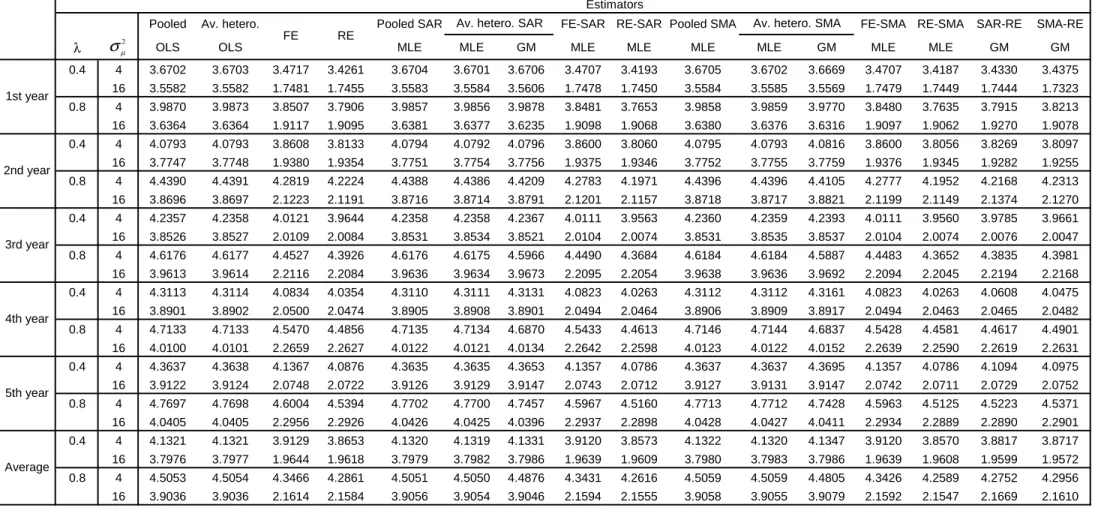
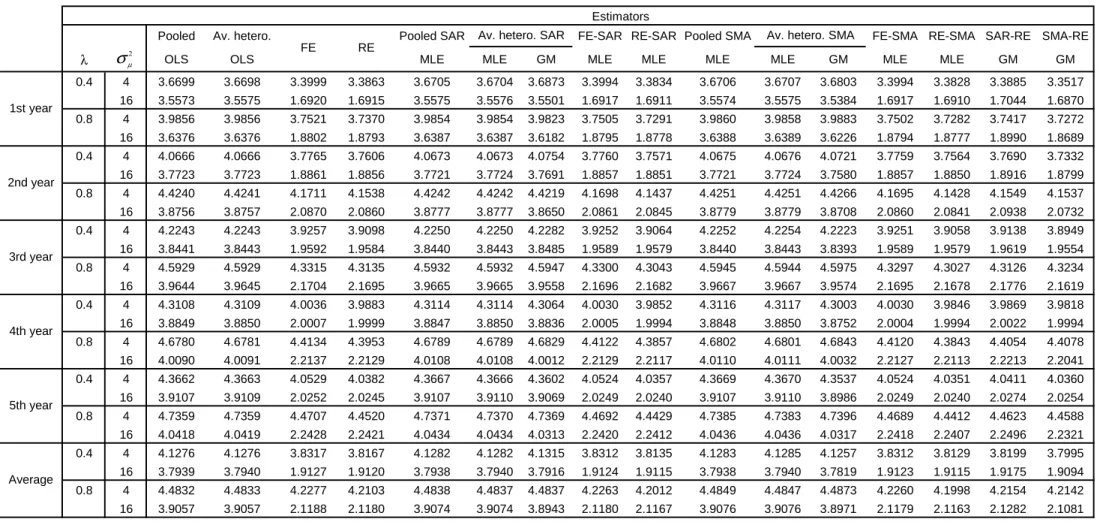
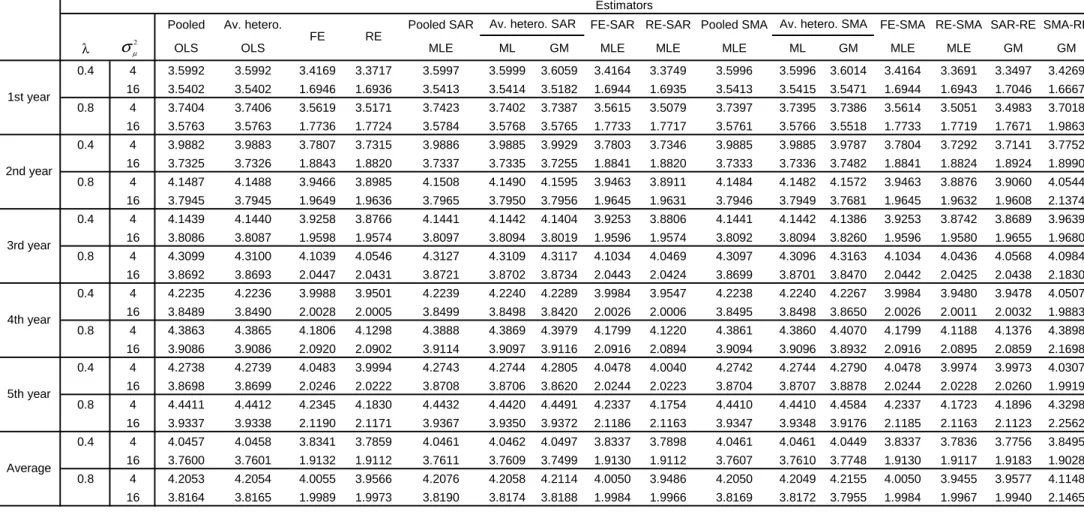
Table 2 gives the RMSE results when the true DGP is a RE panel model
with SMA remainder disturbances. The sample size is still
N
= 50
, T
= 10
,
and the weight matrix is W(
1
,
1
). In general, for
ρ
= 0
.
4
,
0
.
8
and
σ
2µ
= 4
,
16
,
the lowest RMSE is that of RE-SMA. This is followed closely by RE-SAR.
5See Baillie and Baltagi (
1
998).
Misspecifying the SMA by an SAR in an error component model does not
seem to a
ff
ect the forecast performance as long as it is taken into account.
However, the magnitudes of the RMSE in Table 2 (where the true DGP is
a RE-SMA process) are much lower than those in Table
1
(where the true
DGP is a RE-SAR process). Once again, the forecast RMSE of based on
MLE and their GM counterparts are quite similar, compare SAR-RE and
SMA-RE with RE-SAR and RE-SMA. The RMSE improves as
σ
2µ
gets large,
i.e.,
16
rather than
4
,
for estimators that take heterogeneity into account. As
the spatial autoregressive parameter
λ
increases from
0
.
4
to
0
.
8
, the RMSE
also increases but not as much as it did for the SAR process in Table
1
.
Pooled OLS, average heterogeneous OLS, pooled SAR, pooled SMA, average
heterogeneous SAR (MLE and GM) and average heterogeneous SMA (MLE
and GM) perform worse in terms of RMSE than spatial/panel homogeneous
estimators. This forecast performance is robust whether we are predicting
one period, two periods or 5 periods ahead and is also re
fl
ected in the average
over the
fi
ve years. Once again, the gain in forecast performance is substantial
once we account for RE or FE and is only slightly improved by additionally
accounting for spatial autocorrelation, i.e., FE-SMA, or RE-SMA, FE-SAR
or RE-SAR.
5.2
Sensitivity Analysis
5.2.1
The Spatial Weight Matrix e
ff
ect
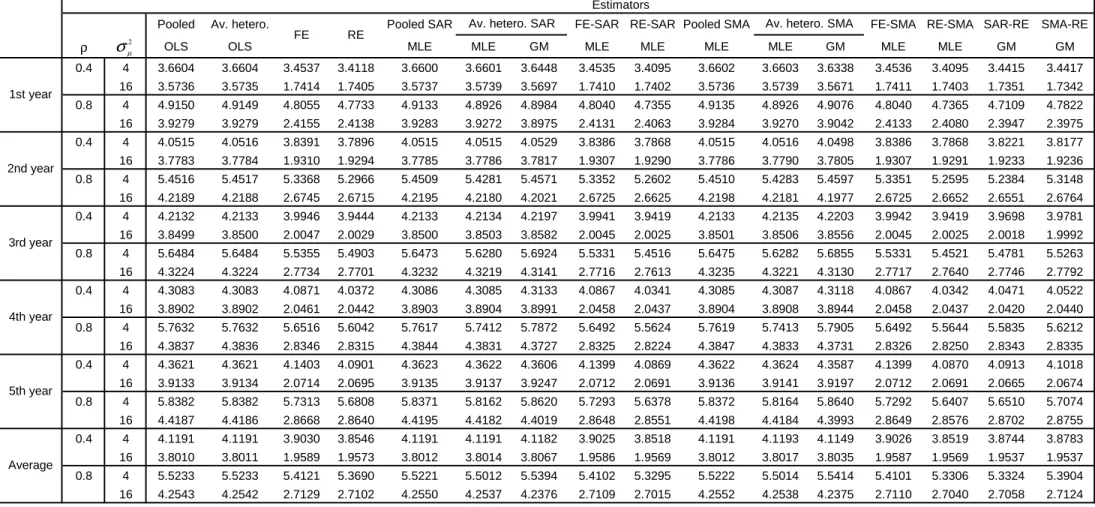
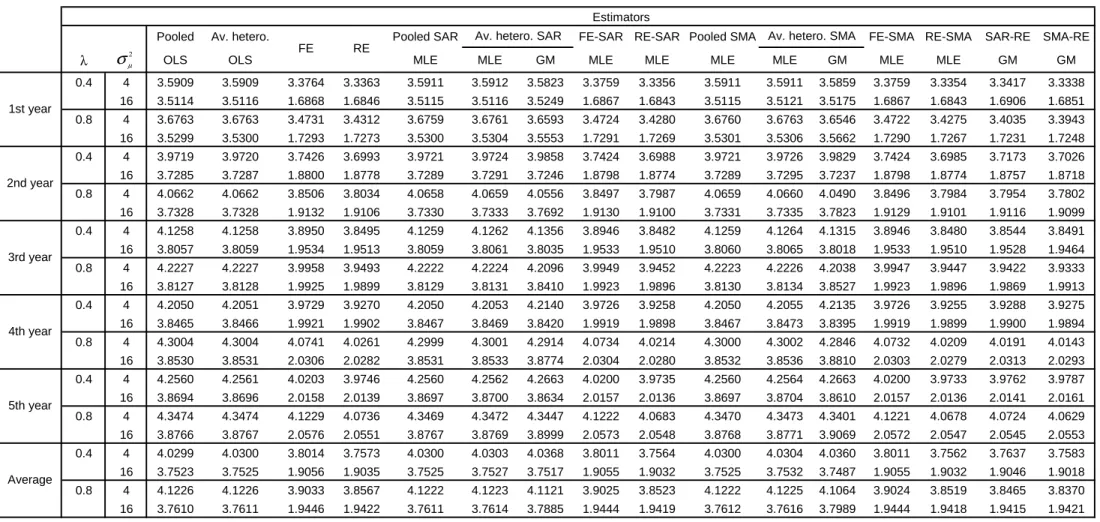
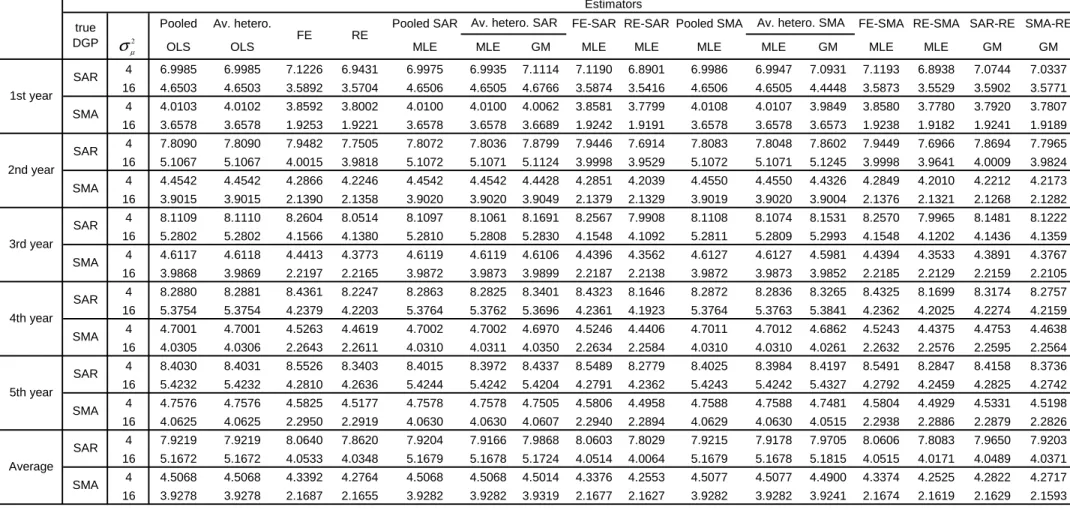
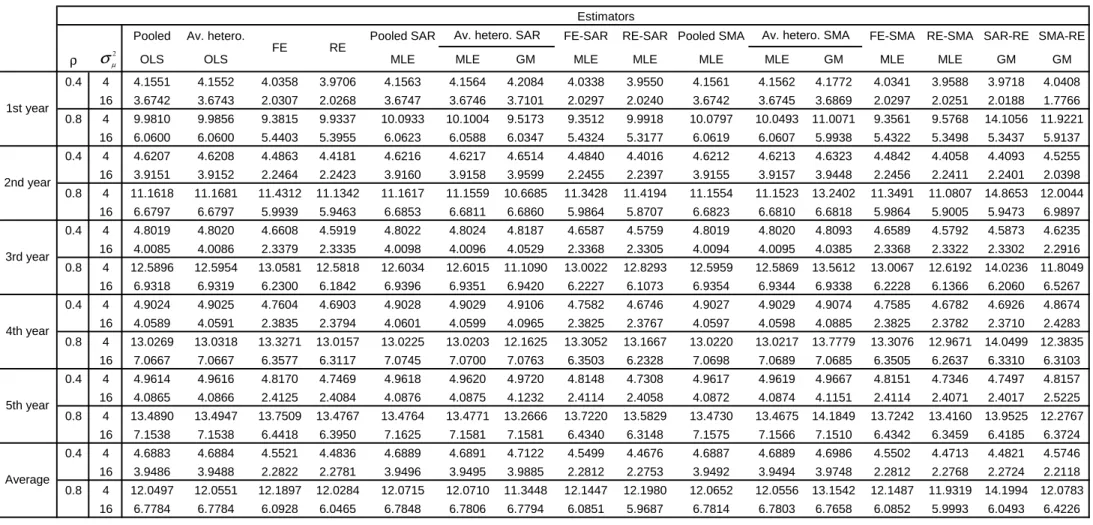
Tables 3 and 4 report the RMSE results as Tables
1
and 2 except that the
weight matrix is changed from a
W
(1
,
1)
to
W
(5
,
5)
,
i.e.,
fi
ve neighbors
behind and
fi
ve neighbors ahead. Except for the magnitudes of the RMSE,
the same rankings in terms of RMSE performance are exhibited as before.
Tables 5 and 6 report the RMSE results as Tables
1
and 2 except that
T
is
now doubled from
10
to
20
holding
N
fi
xed at
50
. Except for the magnitudes
of the RMSE, the same rankings in terms of RMSE performance are exhibited
as before.
Table 7 reports the RMSE results when
ρ
=
λ
= 0
.
8
,
the weight matrix
is
W
(1
,
1)
,
and
N
is doubled from
50
to
100
holding
T
fi
xed at
10
. While
Table 8 reports the RMSE results as Table 7 except that the weight matrix
is
W
(5
,
5)
.
Except for the magnitudes of the RMSE, the same rankings in
terms of RMSE performance are exhibited as before.
65.2.2
Sensitivity to Irregular Lattice Structures
The spatial weights matrices considered in the paper are regular lattice
struc-tures. Using real irregular lattices structures, as in Anselin and Moreno
(2003) and in Kelejian and Prucha (
1
999), does not change the conclusions
of the Monte Carlo study. We used real-world matrices by taking spatial
groupings of French administrative communes for dimension
N
= 50
.
7Those
spatial matrices have been used by Baltagi, Bresson and Pirotte (2007).
Spa-tial weight matrices may represent high-order contiguity relationships. We
use a
k
-order contiguity matrix containing
N
−
1
potential neighborhoods
in French municipalities. We have patterns of
0
and
1
values in an
(
N
−
1)
by
(
N
−
1)
grid for the
k
-nearest neighborhoods and we use the
1
-nearest
neighborhood
(
k
= 1)
and the
5
-nearest neighborhoods
(
k
= 1)
8. Results of
Tables 9 to
1
2 are very similar to those of Tables
1
to 4. Using irregular
lattice structures do not change the main conclusions in terms of the RMSE
forecast performance of the various estimators considered. These are similar
to the rankings obtained when regular lattice structures are used, only the
magnitudes of the RMSE di
ff
er.
5.2.3
Robustness to Non-Normality
So far, we have been assuming that the error components have been generated
by the normal distribution. In this section, we check the sensitivity of our
results to non-normal disturbances. In particular, we generate the
µ
i’s from
a
χ
2distribution and we let the remainder disturbances follow the normal
distribution. Tables
1
3 and
1
4 give similar results as those of Tables
1
and
2 (when the individual e
ff
ects follow a normal distribution). So, the results
seem to be robust to non-normality of the disturbances of the
χ
2type.
RMSE forecast performance and are not shown here to save space. These are available
upon request from the authors.
7
Other Tables for
N
= 100
are available upon request from the authors.
8
Note that a non-zero entry in row
i
, column
j
denotes that neighborhoods
i
and
j
have
borders that touch and are therefore considered “neighbors”. For
N
= 50
and for
k
= 5
,
and for the
2401
possible elements in the
49
by
49
matrix, there are only
250
non-zero
elements. So, the sparseness value is
10%
(
= 250
/
2500
). These non-zero entries re
fl
ect the
contiguity relations between the
5
-nearest neighborhoods.
6
Summary and Conclusion
Our Monte Carlo study
fi
nds that when the true DGP is RE with a SAR or
SMA remainder disturbances, estimators that ignore heterogeneity/spatial
correlation perform badly in RMSE forecasts. For our experiments,
account-ing for heterogeneity improves the forecast performance by a big margin and
accounting for spatial correlation improves the forecast but by a smaller
mar-gin. Ignoring both leads to the worst forecasting performance. Heterogeneous
estimators based on averaging perform worse than homogeneous estimators
in forecasting performance. This performance improves with a larger
sam-ple size and seems robust to the type of spatial error structure imposed on
the remainder disturbances. These Monte Carlo experiments con
fi
rm earlier
empirical studies that report similar
fi
ndings.
7
Appendix
This appendix
fi
rst derives the BLUP for the KKP model which we are calling
the (SAR-RE) model described in (
1
3) and (
1
4). The variance-covariance
matrix
Ω
is given in (
1
7). The inverse of
Ω
is given by:
Ω
−1=
1
σ
2 v·µ
I
T−
T
σ
2µσ
2 1J
T
⊗
(
B
N0B
N)
¸
where
J
T=
J
T/T
and
σ
21=
T
σ
2µ+
σ
2vand
B
N= (
I
N−
ρ
W
N)
. From (
1
3)
and (
1
4), we have :
ε
T+τ=
B
N−1u
T+τ=
B
−N1(
µ
+
v
T+τ)
so that,
E
h
ε
T+τε
0i
=
E
h
B
N−1(
µ
+
v
T+τ)
¡¡
ι
T⊗
B
N−1¢
µ
+
¡
I
T⊗
B
N−1¢
v
¢
0i
=
σ
2µB
N−1³
ι
0T⊗
B
N−10´
ω
0=
E
h
ε
i,T+τε
0i
=
σ
2µb
i³
ι
0T⊗
B
− 10 N´
where
b
iis the
i
th row of the matrix
B
N−1. In this case,
ω
0Ω
−1=
σ
2 µσ
2 vb
i³
ι
0T⊗
B
N−10´ ·µ
I
T−
T
σ
2µσ
2 1J
T
⊗
(
B
N0B
N)
¸
=
σ
2 µσ
2 vb
i·³
ι
0T⊗
B
N´
−
T
σ
2 µσ
2 1³
ι
0T⊗
B
N´¸
=
σ
2 µσ
2 1b
i³
ι
0T⊗
B
N´
But
b
i¡
ι
0T⊗
B
N¢
= (1
⊗
b
i)¡
ι
0T⊗
B
N¢
=
¡
ι
0T⊗
l
0 i¢
, where
l
0 iis the
i
th row of
I
N. This holds because
B
N−1B
N=
I
Nand therefore
b
iB
N=
l
0i. This means
that the predictor of the KKP model from (28) is given by:
b
y
i,T+τ=
X
i,T+τβ
b
GLS+
σ
2µσ
2 1(
ι
0T⊗
l
i0)
b
ε
GLS(36)
which is the same as that of the RE model with no spatial correlation. While
the predictor formula is the same, the MLEs for these speci
fi
cations yield
di
ff
erent estimates which in turn yield di
ff
erent residuals and hence di
ff
erent
forecasts.
The proof is the similar for the Fingleton (2007) speci
fi
cation which we
are calling the (SMA-RE) model described in (25) and (
1
4). The
variance-covariance matrix
Ω
is given in (27). The inverse of
Ω
is given by:
Ω
−1=
1
σ
2 v·µ
I
T−
T
σ
2µσ
2 1J
T
⊗
(
D
ND
0N)
−1¸
where
D
N= (
I
N+
λ
W
N)
. From (25) and (
1
4), we have :
ε
T+τ=
D
Nu
T+τ=
D
N(
µ
+
v
T+τ)
so that,
E
[
ε
T+τε
0] =
E
£
D
N(
µ
+
v
T+τ) ((
ι
T⊗
D
N)
µ
+ (
I
T⊗
D
N)
v
)
0¤
=
σ
2µD
N³
ι
0T⊗
D
N0´
ω
0=
E
[
ε
i,T+τε
0] =
σ
2µd
i³
ι
0T⊗
D
0N´
where
d
iis the
i
th row of the matrix
D
N. In this case,
ω
0Ω
−1=
σ
2 µσ
2 vd
i³
ι
0T⊗
D
0N´ ·µ
I
T−
T
σ
2 µσ
2 1J
T
⊗
(
D
ND
N0)
−1¸
=
σ
2 µσ
2 vd
i·³
ι
0T⊗
D
N−1´
−
T
σ
2 µσ
2 1³
ι
0T⊗
D
−N1´¸
=
σ
2 µσ
2 1d
i³
ι
0T⊗
D
−N1´
But
d
i¡
ι
0T⊗
D
−N1¢
= (1
⊗
d
i)¡
ι
0T⊗
D
N−1¢
=
¡
ι
0T⊗
l
0 i¢
, where
l
0 iis the
i
th row of
I
N. This holds because
D
ND
−N1=
I
Nand therefore
d
iD
N−1=
l
0i. This means
that the predictor of the Fingleton (2007) model is again the same as that
of the RE model with no spatial correlation. While the predictor formula is
the same, the MLEs for these speci
fi
cations yield di
ff
erent estimates which
in turn yield di
ff
erent residuals and hence di
ff
erent forecasts.
References
Anselin, L.,
1
988, Spatial Econometrics: Methods and Models, Kluwer Academic
Pub-lishers, Dordrecht.
Anselin, L. and A.K. Bera,
1
998, Spatial dependence in linear regression models with an
introduction to spatial econometrics. In A. Ullah and D.E.A. Giles, eds., Handbook
of Applied Economic Statistics, Marcel Dekker, New York.
Anselin, L. and R. Moreno, 2003, Properties of tests for spatial error components,
Re-gional Science and Urban Economics 33, 595-6
1
8.
Anselin, L., J. Le Gallo and H. Jayet, 2008, Spatial panel econometrics. Ch.
1
9 in L.
Mátyás and P. Sevestre, eds., The Econometrics of Panel Data: Fundamentals and
Recent Developments in Theory and Practice, Springer-Verlag, Berlin, 625-660.
Baillie, R.T. and B.H. Baltagi,
1
999, Prediction from the regression model with one-way
error components, Chapter
1
0 in C. Hsiao, K. Lahiri, L.F. Lee and H. Pesaran, eds.,
Analysis of Panels and Limited Dependent Variable Models, Cambridge University
Press, Cambridge, 255—267.
Baltagi, B.H., 2008, Forecasting with panel data, Journal of Forecasting 27,
1
53-
1
73..
Baltagi, B.H. and J.M. Gri
ffi
n,
1
997, Pooled estimators vs. their heterogeneous
counter-parts in the context of dynamic demand for gasoline, Journal of Econometrics 77,
303—327.
Baltagi, B.H. and D. Li, 2004, Prediction in the panel data model with spatial correlation,
Chapter
1
3 in L. Anselin, R.J.G.M. Florax and S.J. Rey, eds., Advances in Spatial
Econometrics: Methodology, Tools and Applications, Springer, Berlin, 283—295.
Baltagi, B.H. and D. Li, 2006, Prediction in the panel data model with spatial correlation:
The case of liquor, Spatial Economic Analysis
1
,
1
75-
1
85.
Baltagi, B.H. and Q. Li,
1
992, Prediction in the one-way error component model with
serial correlation, Journal of Forecasting
11
, 56
1
—567.
Baltagi, B.H., G. Bresson and A. Pirotte, 2002, Comparison of forecast performance for
homogeneous, heterogeneous and shrinkage estimators: Some empirical evidence
from US electricity and natural-gas consumption, Economics Letters 76, 375-382.
Baltagi, B.H., G. Bresson and A. Pirotte, 2004, Tobin q: forecast performance for
hier-archical Bayes, shrinkage, heterogeneous and homogeneous panel data estimators,
Empirical Economics 29,
1
07-
11
3.
Baltagi, B.H., G. Bresson and A. Pirotte, 2007, Panel unit root tests and spatial
depen-dence, Journal of Applied Econometrics 22, 339-360.
Baltagi, B.H., J.M. Gri
ffi
n and W. Xiong, 2000, To pool or not to pool: Homogeneous
versus heterogeneous estimators applied to cigarette demand, Review of Economics
and Statistics 82,
11
7—
1
26.
Brucker, H. and B. Siliverstovs, 2006, On the estimation and forecasting of international
migration: how relevant is heterogeneity across countries, Empirical Economics 3
1
,
735-754.
Fingleton, B., 2007a, A generalized method of moments estimator for a spatial model with
endogenous spatial lag and spatial moving average errors, paper presented at the
1
3th international conference on panel data, University of Cambridge, forthcoming
Spatial Economic Analysis.
Fingleton, B., 2007b, A generalized method of moments estimator for a spatial model
with moving average errors with application to real estate prices, forthcoming in
Empirical Economics.
Frees, E.W. and T.W. Miller, 2004, Sales forecasting using longitudinal data models.
International Journal of Forecasting 20, 99—
11
4.
Goldberger, A.S.,
1
962, Best linear unbiased prediction in the generalized linear
regres-sion model, Journal of the American Statistical Association 57, 369—375.
Kapoor, M., H.H. Kelejian and I.R. Prucha, 2007, Panel data models with spatially
correlated error components, Journal of Econometrics
1
40, 97-
1
30.
Kelejian, H.H. and I.R. Prucha,
1
999, A generalized moments estimator for the
autore-gressive parameter in a spatial model, International Economic Review 40, 509-533.
Lee, L.F. and W.E. Gri
ffi
ths,
1
979, The prior likelihood and best linear unbiased
pre-diction in stochastic coe
ffi
cient linear models, working paper, Department of
Eco-nomics, University of Minnesota.
Hoogstrate, A.J., F.C. Palm and G.A. Pfann, 2000, Pooling in dynamic panel-data
mod-els: An application to forecasting GDP growth rates, Journal of Business and
Eco-nomic Statistics
1
8, 274-283.
Hsiao, C. and A.K. Tahmiscioglu,
1
997, A panel analysis of liquidity constraints and
fi
rm
investment, Journal of the American Statistical Association 92, 455—465.
Nerlove, M.,
1
97
1
, Futher evidence on the estimation of dynamic economic relations from
a time-series of cross-sections, Econometrica 39, 359-382.
Pesaran, M.H. and R. Smith,
1
995, Estimating long-run relationships from dynamic
heterogenous panels, Journal of Econometrics 68, 79—
11
3.
Rapach, D.E. and M.E. Wohar, 2004, Testing the monetary model of exchange rate
determination: a closer look at panels, Journal of International Money and Finance
23, 867—895.
Schmalensee, R., T.M. Stoker and R.A. Judson,
1
998, World carbon dioxide emissions:
1
950-2050, Review of Economics and Statistics 80,
1
5—27.
Spanos, A., 2002, The ET interview: Professor Phoebus J. Dhrymes, Econometric Theory
1
8,
1
22
1
-
1
272.
Taub, A.J.,
1
979, Prediction in the context of the variance-components model, Journal
of Econometrics
1
0,
1
03—
1
08.
Theil, H.,
1
96
1
, Economic Forecasts and Policy, North-Holland, Amsterdam.
Wansbeek, T.J. and A. Kapteyn,
1
978, The seperation of individual variation and
sys-tematic change in the analysis of panel data, Annales de l’INSEE 30-3
1
, 659-680.
Pooled Av. hetero. Pooled SAR FE-SAR RE-SAR Pooled SMA FE-SMA RE-SMA SAR-RE SMA-RE
ρ OLS OLS MLE MLE GM MLE MLE MLE MLE GM MLE MLE GM GM
0.4 4 3.9781 3.9782 3.8102 3.7645 3.9781 3.9781 3.9606 3.8093 3.7558 3.9782 3.9782 3.9464 3.8093 3.7558 3.7610 3.7765 16 3.6289 3.6290 1.9019 1.8989 3.6300 3.6299 3.6522 1.9007 1.8971 3.6301 3.6300 3.6569 1.9007 1.8973 1.8978 1.9134 0.8 4 7.0556 7.0552 7.1957 7.0218 7.0529 7.0389 7.0558 7.1917 6.9564 7.0541 7.0403 7.0796 7.1917 6.9668 7.0187 7.0382 16 4.6529 4.6533 3.5908 3.5764 4.6584 4.6569 4.6697 3.5863 3.5518 4.6589 4.6576 4.6644 3.5867 3.5603 3.6047 3.5908 0.4 4 4.4164 4.4165 4.2360 4.1840 4.4162 4.4162 4.3423 4.2354 4.1763 4.4164 4.4164 4.3721 4.2353 4.1755 4.1808 4.1739 16 3.8731 3.8733 2.1207 2.1175 3.8742 3.8743 3.8849 2.1194 2.1155 3.8742 3.8744 3.8918 2.1195 2.1156 2.1164 2.1216 0.8 4 7.8106 7.8106 7.9469 7.7633 7.8066 7.7911 7.8100 7.9408 7.6956 7.8073 7.7920 7.8306 7.9407 7.7034 7.7832 7.8190 16 5.1174 5.1177 4.0090 3.9942 5.1221 5.1209 5.1206 4.0039 3.9661 5.1225 5.1213 5.1084 4.0042 3.9754 3.9923 3.9833 0.4 4 4.5807 4.5808 4.3992 4.3445 4.5805 4.5805 4.5627 4.3986 4.3364 4.5806 4.5807 4.5560 4.3985 4.3357 4.3414 4.3475 16 3.9582 3.9585 2.2004 2.1972 3.9591 3.9592 3.9660 2.1992 2.1954 3.9591 3.9594 3.9682 2.1993 2.1956 2.1963 2.2023 0.8 4 8.1467 8.1467 8.2921 8.1023 8.1424 8.1273 8.1458 8.2853 8.0289 8.1430 8.1279 8.1618 8.2854 8.0382 8.1016 8.1402 16 5.2892 5.2894 4.1685 4.1529 5.2936 5.2923 5.2763 4.1636 4.1234 5.2940 5.2928 5.2674 4.1640 4.1337 4.1387 4.1450 0.4 4 4.6719 4.6720 4.4891 4.4335 4.6718 4.6717 4.6676 4.4882 4.4250 4.6719 4.6720 4.6583 4.4881 4.4245 4.4301 4.4332 16 4.0024 4.0026 2.2471 2.2440 4.0031 4.0033 4.0117 2.2460 2.2423 4.0032 4.0034 4.0125 2.2461 2.2424 2.2432 2.2451 0.8 4 8.3035 8.3035 8.4435 8.2560 8.2997 8.2836 8.3011 8.4367 8.1826 8.3005 8.2843 8.3225 8.4370 8.1922 8.3142 8.3214 16 5.3799 5.3802 4.2531 4.2377 5.3838 5.3826 5.3662 4.2481 4.2085 5.3841 5.3829 5.3626 4.2485 4.2183 4.2296 4.2143 0.4 4 4.7238 4.7239 4.5443 4.4870 4.7238 4.7238 4.7274 4.5432 4.4778 4.7239 4.7240 4.7199 4.5432 4.4775 4.4836 4.4906 16 4.0283 4.0285 2.2727 2.2698 4.0288 4.0290 4.0362 2.2716 2.2681 4.0289 4.0291 4.0374 2.2716 2.2682 2.2689 2.2718 0.8 4 8.4195 8.4197 8.5680 8.3756 8.4158 8.3995 8.4173 8.5606 8.2997 8.4164 8.4001 8.4331 8.5608 8.3100 8.4299 8.4256 16 5.4280 5.4282 4.2962 4.2812 5.4313 5.4301 5.4156 4.2911 4.2526 5.4317 5.4305 5.4125 4.2914 4.2618 4.2808 4.2710 0.4 4 4.4742 4.4743 4.2957 4.2427 4.4741 4.4740 4.4601 4.2949 4.2343 4.4742 4.4743 4.4505 4.2949 4.2338 4.2394 4.2444 16 3.8982 3.8984 2.1486 2.1455 3.8990 3.8992 3.9102 2.1474 2.1437 3.8991 3.8993 3.9133 2.1474 2.1438 2.1445 2.1509 Estimators
Table 1 - Forecasts RMSE - (N,T)=(50,10), SAR data generating process for φφφφ, W(1,1), 1000 replications
FE RE
Av. hetero. SAR Av. hetero. SMA
Average 1st year 2nd year 3rd year 4th year 5th year 2 µ
σ
Pooled Av. hetero. Pooled SAR FE-SAR RE-SAR Pooled SMA FE-SMA RE-SMA SAR-RE SMA-RE
λ OLS OLS MLE MLE GM MLE MLE MLE MLE GM MLE MLE GM GM
0.4 4 3.6702 3.6703 3.4717 3.4261 3.6704 3.6701 3.6706 3.4707 3.4193 3.6705 3.6702 3.6669 3.4707 3.4187 3.4330 3.4375 16 3.5582 3.5582 1.7481 1.7455 3.5583 3.5584 3.5606 1.7478 1.7450 3.5584 3.5585 3.5569 1.7479 1.7449 1.7444 1.7323 0.8 4 3.9870 3.9873 3.8507 3.7906 3.9857 3.9856 3.9878 3.8481 3.7653 3.9858 3.9859 3.9770 3.8480 3.7635 3.7915 3.8213 16 3.6364 3.6364 1.9117 1.9095 3.6381 3.6377 3.6235 1.9098 1.9068 3.6380 3.6376 3.6316 1.9097 1.9062 1.9270 1.9078 0.4 4 4.0793 4.0793 3.8608 3.8133 4.0794 4.0792 4.0796 3.8600 3.8060 4.0795 4.0793 4.0816 3.8600 3.8056 3.8269 3.8097 16 3.7747 3.7748 1.9380 1.9354 3.7751 3.7754 3.7756 1.9375 1.9346 3.7752 3.7755 3.7759 1.9376 1.9345 1.9282 1.9255 0.8 4 4.4390 4.4391 4.2819 4.2224 4.4388 4.4386 4.4209 4.2783 4.1971 4.4396 4.4396 4.4105 4.2777 4.1952 4.2168 4.2313 16 3.8696 3.8697 2.1223 2.1191 3.8716 3.8714 3.8791 2.1201 2.1157 3.8718 3.8717 3.8821 2.1199 2.1149 2.1374 2.1270 0.4 4 4.2357 4.2358 4.0121 3.9644 4.2358 4.2358 4.2367 4.0111 3.9563 4.2360 4.2359 4.2393 4.0111 3.9560 3.9785 3.9661 16 3.8526 3.8527 2.0109 2.0084 3.8531 3.8534 3.8521 2.0104 2.0074 3.8531 3.8535 3.8537 2.0104 2.0074 2.0076 2.0047 0.8 4 4.6176 4.6177 4.4527 4.3926 4.6176 4.6175 4.5966 4.4490 4.3684 4.6184 4.6184 4.5887 4.4483 4.3652 4.3835 4.3981 16 3.9613 3.9614 2.2116 2.2084 3.9636 3.9634 3.9673 2.2095 2.2054 3.9638 3.9636 3.9692 2.2094 2.2045 2.2194 2.2168 0.4 4 4.3113 4.3114 4.0834 4.0354 4.3110 4.3111 4.3131 4.0823 4.0263 4.3112 4.3112 4.3161 4.0823 4.0263 4.0608 4.0475 16 3.8901 3.8902 2.0500 2.0474 3.8905 3.8908 3.8901 2.0494 2.0464 3.8906 3.8909 3.8917 2.0494 2.0463 2.0465 2.0482 0.8 4 4.7133 4.7133 4.5470 4.4856 4.7135 4.7134 4.6870 4.5433 4.4613 4.7146 4.7144 4.6837 4.5428 4.4581 4.4617 4.4901 16 4.0100 4.0101 2.2659 2.2627 4.0122 4.0121 4.0134 2.2642 2.2598 4.0123 4.0122 4.0152 2.2639 2.2590 2.2619 2.2631 0.4 4 4.3637 4.3638 4.1367 4.0876 4.3635 4.3635 4.3653 4.1357 4.0786 4.3637 4.3637 4.3695 4.1357 4.0786 4.1094 4.0975 16 3.9122 3.9124 2.0748 2.0722 3.9126 3.9129 3.9147 2.0743 2.0712 3.9127 3.9131 3.9147 2.0742 2.0711 2.0729 2.0752 0.8 4 4.7697 4.7698 4.6004 4.5394 4.7702 4.7700 4.7457 4.5967 4.5160 4.7713 4.7712 4.7428 4.5963 4.5125 4.5223 4.5371 16 4.0405 4.0405 2.2956 2.2926 4.0426 4.0425 4.0396 2.2937 2.2898 4.0428 4.0427 4.0411 2.2934 2.2889 2.2890 2.2901 0.4 4 4.1321 4.1321 3.9129 3.8653 4.1320 4.1319 4.1331 3.9120 3.8573 4.1322 4.1320 4.1347 3.9120 3.8570 3.8817 3.8717 16 3.7976 3.7977 1.9644 1.9618 3.7979 3.7982 3.7986 1.9639 1.9609 3.7980 3.7983 3.7986 1.9639 1.9608 1.9599 1.9572 Estimators
Table 2 - Forecasts RMSE - (N,T)=(50,10), SMA data generating process for φφφφ, W(1,1), 1000 replications
FE RE
Av. hetero. SMA Av. hetero. SAR
5th year Average 1st year 2nd year 3rd year 4th year 2 µ