Competency-based E-assessment in Project Management and Firm
Performance: a Case Study
CONSTANŢA NICOLETA BODEA, MARIA DASCĂLU Economic Informatics Department
The Academy of Economic Studies
Calea Dorobanţi, no.15-17, Sector 1, 010552 Bucharest ROMANIA
[email protected], [email protected]
Abstract: Firm performance is strongly related to growth and dependent on competitive advantage. Relying on the fact
that competitive advantage is not given by market power, but comes from inside, from employees’ competences, current paper underlines the correlation between investments in education and training and increased earning for business. A case study was designed to explore whether the project management knowledge checked by an e-assessment application, as a learning tool, influences the profitability, the customer satisfaction and the skill development maturity, as firms’ performance indicators. The e-assessment application involved in the study is based on a well-known project management standard, offered by International Project Management Association. The subjects of the study were the users of the e-assessment application: 77 employees working in 19 Romanian firms, mainly from IT and consulting business sector. The positive correlation between the three considered performance indicators and companies’ growth is strengthened by the fact that the analyzed domain was project management, a key factor in economic development. Except proving the influence of competences development through e-assessment on enterprise performance, the current paper reveals the various valences of competences assessment within a firm, as well as the role of e-assessment in knowledge creation chain.
Key-Words: firms’ performance, assessment systems, project management, competences, e-assessment, knowledge
creation
1 Introduction
Firm performance has many definitions in the literature. Considering the firm as an association of assets who voluntary come together to obtain economic advantage, its performance can be defined as the difference between the value that managers expect to obtain from the productive activities and the value that a firm truly creates. [1] Performance is strongly related to growth and dependent on competitive environment. There are various explanations for firm performance, as suggested by Harris and Ogbonna: the Bain-Main tradition of industrial organization, the Chicago revisionist school of industrial organization, the Austrian school of economics, the resource-based view of the firm and the emerging revolutionary strategy perspective [2]. The last two directions are especially interesting in our opinion. The resource-based view explains the firm performance as coming from inside, not given by market power. The strategy perspective highlights the role of learning and rapidly changing as an advantage over competitors and, thus, a factor for obtaining performance. Both theories stress the importance of human competences in achieving business performance. This “soft” perspective on performance is also an explanation for firms’ uniqueness on the market. A recent study reveals that many “firms
have embraced the notion of human capital as a good competitive advantage that will enhance higher performance” [3].
The Swanson model for human capital explains its impact on firm performance, by establishing a correlation between investment in education and training, which results in increased learning, then in increased productivity, this phenomenon leading to increased wages for individuals and increased earning for business [3]. The relationship between information systems and the development of competences and, implicitly, the development of human capital, was explored by many researchers so far [4]. Among the tools used for reaching competitive advantage by implementing knowledge strategies, a special place was taken by learning and e-assessment tools.
Current paper analyzes o sample of small and medium Romanian firms which extensivelly used an e-assessment tool for project management competences. How the e-assessment tool affected the performance of the considered firms is the research question of our case study. Correlations between the features of the e-assessment application and their effects on business performance are also underlined.
2 The Importance of Learning at Work
Firm performance can be quantified by financial indicators, such as productivity, market share or profitability and also by non-financial indicators, such as customer satisfaction, innovation degree or skills development maturity [3]. Learning activities influences more than one indicator. For example, profitability, which is a financial metric, is determined by the strategic capabilities of a firm. The accumulation of capabilities is correlated with the rate of learning [5]. On the other hand, one of the measures for quality of learning is its degree of transformation: the increase of competences as a result of the learning process. This aspect impacts on the maturity of skills development in firms.
Managers understood the key role played by learning in firms and organizations, which explains the importance given to training [3] or periodic check of employees’ competences. Learning is meant to multiply the activities of economic value. For learning to conduct to competences, it’s better to be integrated in an organizational environment or in a community of practice [6] Advices from co-workers may round up the feed-back received from an information system. Selection for suitable activities for competences development has a tremendous impact on firm well being [7].
3 Competency-based Assessment as a
Learning Tool in Firms
In enterprise environments, assessment is seen by managers as a decision tool. The trust put by them in e-assessment is synthesized by the following quote from a report related to different purposes of e-assessment: “If a person passes on e-assessment he/she should have the essential knowledge for performing the relevant tasks for he/she holds a competency” [8]. But e-assessment is also used as a method of increasing the already acquired knowledge [9] or for transforming the tacit knowledge into explicit knowledge. According to current studies, the society moved from the testing culture to the assessment culture [10]. Testing means addressing basic lower level competences, as a result of repetition of what have been taught or read in books, but assessment is more related to educational outcomes, to the effect of evaluation on individuals’ behaviour or on organizations’ performance.
The importance of innovative management of technology, as a way of manage knowledge, to the firms’ growth is another feature of present society [11]. Competitive advantage of firms is correlated to knowledge discovery, constant communication and “eventual automatization and utilization of this knowledge” [11]. Taking into consideration the importance of assessment, on one hand and the spreading of technology for knowledge management, on the other
hand, an e-assessment application appears a strategic tool for business.
Usually, many IT firms use assessment applications for recruiting purposes, but e-assessment is also used in periodic evaluation. The results are the entry points for establishing performance criteria in wages. Surprisingly, e-assessment is also used in more subjective areas, such as character assessment [12]. The results aim to establish leadership skills, which has impact on the strategic level of an organization. Because e-learning platforms are expensive or training activities consume a lot of time, many enterprises prefer to use e-assessment services for both purposes: checking employees’ knowledge and making them realize what they don’t know and what they should learn by themselves. E-assessment can be also a decision making tool inside a firm: the employers or the managers see what their employees’ knowledge gaps are and act accordingly. E-assessment, as a form of competence development, can be used to increase firm performance [5]. Taking into account the cubic valence of e-assessment for a firm, which is highlighted in Fig. 1, we studied whether these general assumptions are valid also for project management, a domain with a higher degree of applicative parts.
Fig. 1: E-assessment Valences in Firms
Project management has a greater strategic value for business health, that’s why determining the dimension of project management e-assessment on firm performance could be really helpful for economic activities.
4 Project Management E-assessment and
Its Impact to Firm Performance: a Case
Study
Project management is an attractive topic for today’s business, as it is the main form of economic organization in knowledge society. There is a high connection between firms’ performance and projects’ success. Extensive research has been done on this topic, but project management is a highly dynamic field. Still, several categories of factors have been discovered,
related to: project management actions, project related factors, project procedures, human factors and environmental factors [13]. All these factors are described by standardized guides and codes of practices, such as PMBOK [14], developed by Project Management Institute (PMI) or IPMA Competence Baseline (ICB) [15], developed by the International Project Management Association (IPMA).
The current study relies on the ICB approach, which states that one can perform high project management related activities if one holds technical, behavioral and contextual competences. It is difficult to choose the proper tools for assessing these kinds of competences. The certification process organized by IPMA relies on:
• written exams;
• reports;
• workshops;
• interviews;
Thanks to the spreading of information systems, written exams can be replaced by computer based tests. Such an application is the e-assessment application, offered by the Romanian Association of Project Management as a preparation tool for the real
certification exams: “CertExam” (http://pm.org.ro/certexam). Romanian Association of
Project Management is successfully affiliated to IPMA, that’s why the e-assessment tool respects the ICB content.
The correlation between the projects’ success and business performance can’t be disputed [13]. Relying on IPMA reputation, the knowledge checked by “CertExam” will lead to projects’ success, in a great extent. The aim of our study was to explore whether this relation is a transitive one, meaning whether the knowledge checked by the e-assessment tool influences the firms’ performance.
4.1 Case Study Design
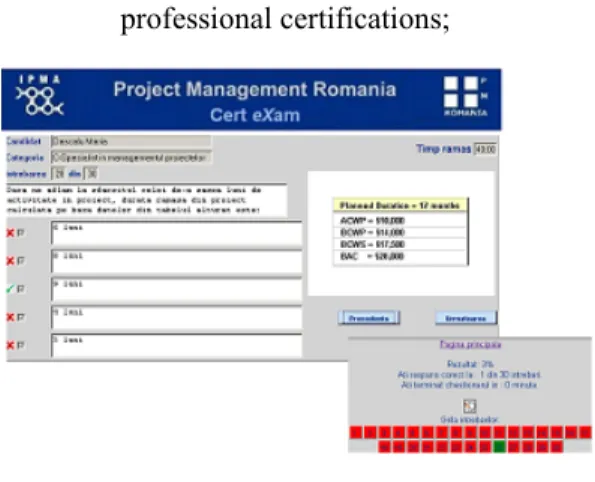
The case study design was based on Yin’s book [16]. The research question, as previously mentioned in the paper, was: “How e-assessment in project management influences the performance of Romanian firms?”. The objects of the study were a few Romanian firms’ performance indicators and “CertExam” e-assessment application (see Fig. 2). The subjects of the study were the users of “CertExam”, the ones who took the tests. As instruments of research, we mainly used the questionnaire and, sometimes, interviews and informal e-mails.
The propositions of our study were strongly related to the following performance indicators:
• wage increases;
• customer retention rate;
• number of employees who obtained professional certifications;
Fig. 2. An E-assessment Application for Project Management Competences
The propositions of our study are stated below:
• There is a connection between the period of using “CertExam” and the wage increases for the users of the e-assessment application.
• There is a relationship between the number of clients who returned to the firms and the use of “CertExam” by firms’ employees.
• There is a connection between the number of certified people and the use of “CertExam” by those people.
• The impact of the e-assessment application on firm’s performance depends on the business sector of the firm.
The performance indicators chosen by us are also reflected in other theoretical models [3]: wage increases is a reflection of profitability, number of returning clients is a form of calculating customers’ satisfaction and number of certified employees is an expression of skill development maturity.
As a part of the authors participated also at the conception and development of the e-assessment tool, the case study aimed to find out the connection between the qualitative aspects of the application and their role to business performance.
4.2 Case Study Results and Analysis
In order to establish the relationship between the use of “CertExam” (the dependent variable) and Romanian firms’ performance (the independent variable), we questioned the users of the application. The management component (see Fig. 3) was of tremendous help in establishing the users’ profiles. There are two types of users stocked in the database: individuals who created their account online and individuals registered for the IPMA certification, which have more rights in using the application. Also, users can be classified according to the
level of their abilities in project management activities: from level A-D [15].
Fig. 3. Management Component of the Project Management E-assessment
Application
Questionnaires were sent to 153 users of the application. The response rate was 50.32%., meaning that 77 users responded back. Details about the respondents’ profiles can be consulted in Table 1.
Table 1. Profiles of "CertExam" Users
IPMA Level No. Users No. Respondents A 0 0 B 11 2 C 35 11 D 106 64 Another aspect taken into account to our analysis was the affiliation of our subjects to the same firm or to the same business sector (see Table 2).
Table 2. Profiles of Case Study Subjects
Business sector No. Firms No. Subjects IT 7 32 Consulting 9 29 Other sectors 3 16
The main method of analysis was the pattern matching between the current statements in the literature [3] and our findings from the empirical study. We obtained some data triangulation from the subjects who stated that they worked in the same firm.
Our study revealed that 35% of our subjects got an IPMA certification as a result of their use of “CertExam”, most of them from the IT sector. The reason for starting using “CertExam” was their desire of getting certifications. This desire drifted from the need of getting professional recognition, a higher level of well being and improving the firms’ portfolios. The fact that most individuals who finalized their work with the e-assessment tool were from the IT sector proves
the striving force which pushes the Romanian IT firms to achieve greater performance.
Most of our subjects said that the customer retention rate in a six-month period was of 55%, which is a very high percent. Most subjects who stated this fact were from the consulting sector. This fact can be explained by the duration of IT projects, which is usually longer. When we asked our subjects if they thought that their improved skills, as a result of the “CertExam”, had any impact on clients’ returning rate, 60% of them said a definite “yes” and the other 40% agreed on a certain level of impact.
Just 9% of our subjects got a wage raise after using the e-assessment tool. This low result can be caused by the recession. 50% from those who got the raise named the competence development through the e-assessment tool as one important factor for it. The ones who made this affirmation were from different business sectors.
The results of our case study proved that might be a link between the use of “CertExam” and the growth of performance indicators at firms. We claim that this relationship is not pure speculation, by specifying that other researchers underlined the importance of continuous competences development to firm growth [4], [7], [11].
4.3 Case Study Recommendations for
Developing Competency-based E-assessment Systems
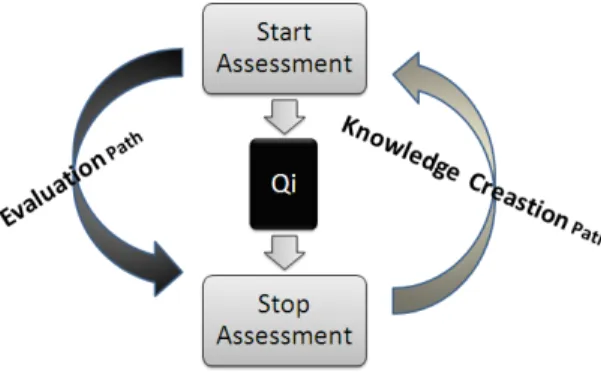
Except the answer at our research question, we also drew some other remarks which could be useful in developing efficient competences assessment systems. The subjects of the study stated that they found quite useful the feed-back mechanism of the e-assessment application. This was designed to create knowledge. As one could see in Fig. 2, a wrong answer is displayed in red and points out to what should have been the right answers. The e-assessment tool is not just an evaluation tool, but a learning instrument, a knowledge creator. As seen in Fig. 4, the knowledge creation path is fader and fuzzier: it depends very much of individuals’ capacities of learning from own mistakes.
Fig. 4. Knowledge Creation Function in E-assessment
To increase the knowledge creator dimension, adaptive features are recommended. An adaptive behaviour would provide not only a better profile of the examinee, but also a better assessment-taking experience and a much more chance to fill the knowledge gaps which were revealed by the e-assessment [17]. For matching the competences of the employees to the ones considered as units in electronic assessment, hierarchical structures should be used. Semantic nets are a solution worthy of being explored [9]. The improvement of “CertExam” should be an easy fix, as it has a service oriented architecture (see Fig. 5). Thanks to this type of architecture, the optimization can be made step by step. Each of the following three services can be subject of improvement:
• item selectors, designated to select proper questions from distributed item pools;
• statistic providers, which calculate scores, offer correct answers, make reports;
• profile loaders, which load information about certain classes of users;
Fig. 5. System Architecture for a Web Application for Project Management
Knowledge Assessment
5 Conclusions
The paper provides an empirical study on the relationship between the use of an e-assessment
application and the firms’ performance. Also the study addresses only three indicators of business performance, the positive correlation between the assessment system and companies’ growth is obvious. The fact that project management domain, a key factor in economic development, is the umbrella for the current research strengthens its relevance. Further investigations on correlating e-assessment use with other performance indicators are the normal follow-up for the study. The current work highlights the importance of using information systems in enterprise environments [18], [19] and also stresses the importance of developing professional competences to achieve business excellence: “To develop a competitive advantage, it is important that firms truly leverage on the work force as a competitive weapon” [3].
This article is a result of the project „Doctoral Program and PhD Students in the education research and innovation triangle”. This project is co funded by European Social Fund through The Sectorial Operational Programme for Human Resources Development 2007-2013, coordinated by The Bucharest Academy of Economic Studies.
References:
[1] Chen, L.-J., Chen, C.-C., & Lee, W.-R, Strategic Capabilities and Innovation Intensity, Journal of Service Science and Management , Vol.1, 2008, pp.
111-122.
[2] Harris, L. C., & Ogbonna, E., Competitive advantage in the UK food retailing sector:past, present and future, Journal of Retailing and Consumer Services ,
Vol. 8, 2001, pp. 157-173.
[3] Marimuthu, M., Arokiasamy, L., & Ismail, M., Human Capital Development and Its Impact on Firm Performance: Evidence from Developmental Economics, The Journal of International Social Research , Vol. 2, No. 8, 2009, pp. 265-272.
[4] Zhang, M. J., & Lado, A. A., Information systems and competitive advantage: a competency-base view.
Technovation , Vol. 21, 2001, pp. 147–156.
[5] Leiponen, A. (2006). Dynamic Competences and Firm Performance. Laxenburg: International Institute
for Applied Systems Analysis.
[6] Lundin, J. (2005). Talking about Work: Desiging Information Technology for Learning in Interaction.
Gothenburg: Gothenburg Studies in Informatics. [7] Kröll, M., Limits and possibilities for competence
development in firms, European Conference of Educational Research (ECER), Ghent, 2007.
[8] Gilbert, L., Gale, V., Warburton, B., & Wills, G.,
Report on Summative E-Assessment Quality (REAQ),
Southampton: Joint Information Systems Committee, 2008.
[9] Bodea, C. N., & Dascalu, M., Designing Project Management Tests based on Semantic Nets and Concept Space Graph. Creating Global Economies through Innovation and Knowledge Management:
Theory & Practice, Proceedings of the 12th International Business Information Management Association Conference, Kuala Lumpur: IBIMA,
2009, pp. 1232 – 1236.
[10] Baartman, L. K., Bastiaens, T. J., Kirschner, P. A., & van der Vleuten, C. P., Evaluating assessment quality in competence-based education: A qualitative comparison of two frameworks,
Educational Research Review , 2007, pp. 114–129.
[11] Hitt, M. A., Ireland, R. D., & Lee, H.-u, Technological learning, knowledge management,firm growth and performance: an introductory essay, Journal of Engineering and Technology Management , 200, pp. 231-246.
[12] Barlow, C. B., Jordan, M., & Hendrix, W. H., Character Assessment: an Examination of Leadership Levels. Journal of Business and Psychology , Vol. 17, No. 4, 2003, pp. 563-584.
[13] Ling, F. Y., Low, S. P., Wang, S. Q., & Lim, H. H., Key project management practices affecting Singaporean firms’ project performance in China,
International Journal of Project Management ,
2009, pp. 59–71.
[14] Project Management Institute, A guide to the project management body of knowledge (PMBOK guide). Newtown Square, Pennsylvania: PMI Inc,
2004.
[15] International Project Management Association,
IPMA Competence Baseline. Nijkerk, Netherlands:
IPMA, 2006.
[16] Yin, R. K., Case Study Research: Design and Methods (3rd ed.), Thousand Oak, California: SAGE
Publications, 2003.
[17] Bodea, C. N., & Dascalu, M., Testing as a Learning Tool in the Project Management Competence Development Environments. Studia Informatica ,
Vol. 3, 2009, pp. 11-14.
[18] Delcea, C., & Dascalu, M., Knowledge Strategies Tools for Managing Enterprise Crisis. The 4th International Conference on Knowledge Management: Projects, Systems and Technologies,
Bucharest: “Carol I” National Defense University,Romania, 2009, pp. 115-117.
[19] Raymond, L., Croteau, A.-M., & Bergeron, F., The Integrative Role of IT in Product and Process Innovation: Growth and Productivity Outcomes for Manufacturing. Enterprise Information Systems, 11th International Conference, Berlin Heidelberg: